



Abstract
This data visualization presents trends and patterns in gender, race, and their intersection in campaign donations to U.S. congressional candidates by American corporate leaders during the 1990–2014 election cycles. On the basis of a new longitudinal database, this visualization shows consistent gender and racial disparities in corporate leaders’ propensity to donate and in their partisan preferences. Throughout the series, the authors find that women are less likely to contribute to congressional campaigns than men in U.S. corporate leadership. Conditional on contributing, women are overall more likely to donate to Democrats than men. In addition to a consistent gender gap in partisan preferences, we find that women of color are the most Democratic leaning, compared with their white counterparts. This latter finding implies a role for intersectionality in explaining the political behavior of these leaders.
Corporate money is very influential in American politics. Beyond the money that comes directly from corporate political action committees, individual corporate leaders make political contributions to advance their own preferred political candidates or to invest in candidates for corporate economic interests (Aggarwal, Meschke, and Wang 2012, Heerwig 2018). Meanwhile, U.S. corporate leadership has become more diverse in the past three decades.
Relying on the unique longitudinal Corporate Leader Political Donation Database, which matches corporate leaders in BoardEx with individual donation records from the Database on Ideology, Money in Politics, and Elections Bonica (2014), this visualization shows the long-term trajectory of corporate leaders’ propensity to donate and their partisan preferences once active, by gender and race. In doing so, we provide the first quantitative estimates of gender-racial intersectionality in the donations of corporate America. In addition, we provide important insights into the potential implications of corporate diversity on the political alignments of American corporate leadership.
Figure 1 documents the overall trends and patterns in donation rates and partisan preferences among U.S. corporate leadership from 1990 to 2014. To compute donation rates by gender and race, we construct a dummy variable that captures whether a leader contributed to congressional campaigns in a given election cycle from 1990 to 2014. To estimate overall partisan preferences, we calculate an election cycle–level index for each corporate leader that captures the average share and amount of donations given to Democrats relative to both parties. The index is based on the number of donations given to Democrats relative to the number of donations given to both parties, the dollar amount of political donations given to Democrats relative to the amount given to both parties, and the number of unique Democratic recipients relative to the number of unique Republican or Democratic recipients. We then average all three items to obtain a composite index of the Democratic rate by gender and race for each election cycle.
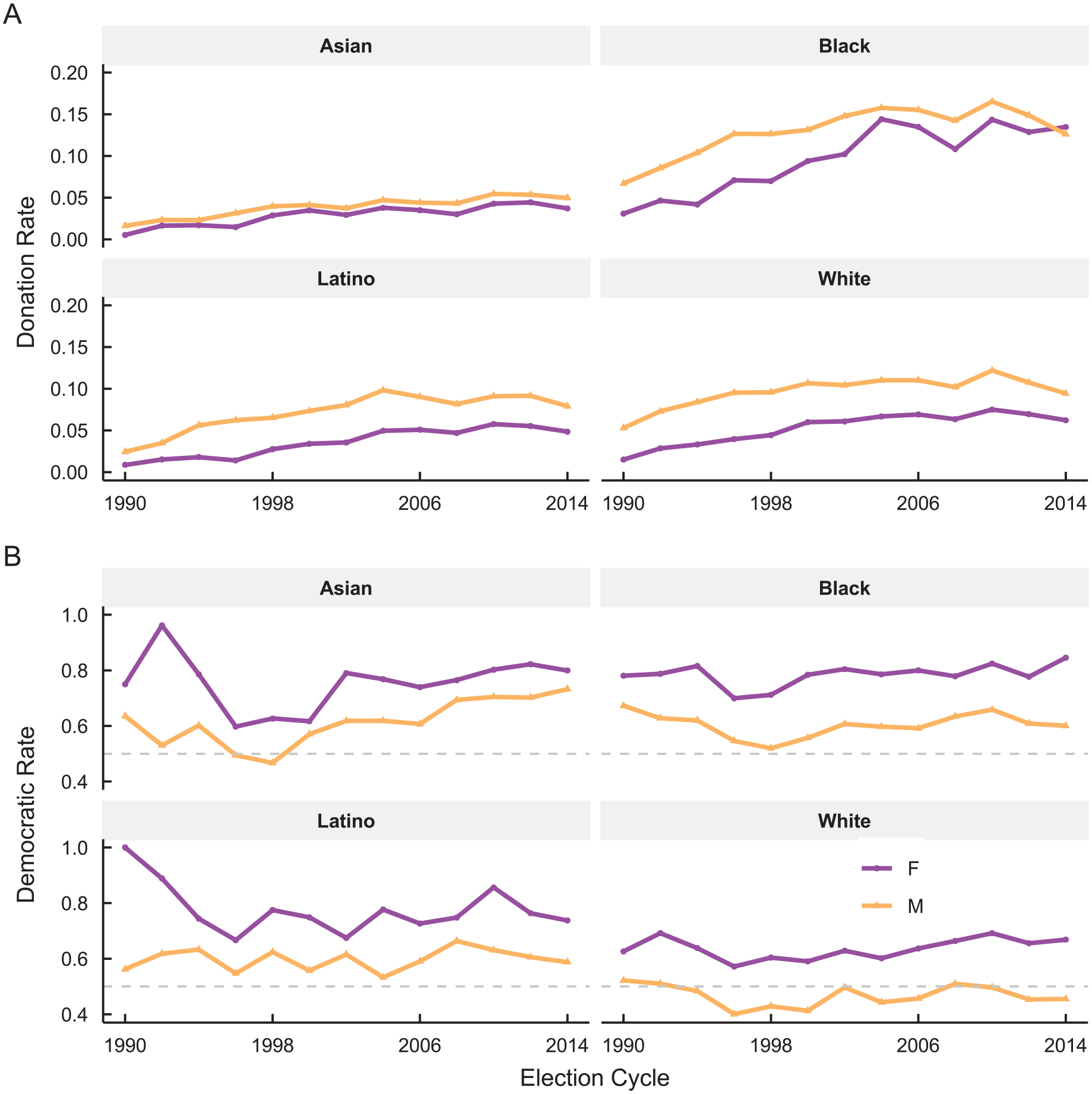
Visualizing gender-race intersectionality in campaign cash to the U.S. Congress among American corporate leadership, 1990 to 2014. Panel A shows that (1) there were persistent gender disparities in donation rates given to the U.S. Congress among corporate leaders over time, (2) the gender gap was least salient among Asian corporate leaders, and (3) Black leaders were more active regardless of gender. Panel B shows that (4) the gender gap in campaign cash given to U.S. Democratic candidates remained persistent over time, but (5) women of color were considerably more Democratic leaning compared with their white counterparts. Replication data and code can be accessed via https://osf.io/hbzep/.
Figure 1A shows the donation rate to congressional elections from corporate leadership over time. During the 1990–2014 election cycles, corporate leaders, including the top management team, directors, and senior managers, became more politically active in congressional campaigns. We also observe clear gender and racial disparities in campaign donations given to congressional candidates. Women leaders consistently show a lower donation rate than their men counterparts from 1990 to 2014. Black leaders consistently show the highest donation rate over time, while Asian leaders consistently show the lowest donation rate; Latino leaders show a similar pattern to their white counterparts. The gender gap is also heterogeneous across different racial groups. It is relatively smaller among Asians than among Blacks, whites, and Latinos.
Figure 1B shows the pro-Democratic trend among corporate leaders. It captures the average proportion corporate leaders contributed to Democrats as a share of their donation portfolio. Overall, corporate leaders of color and women were more likely to be Democratic leaning compared with their white and men counterparts. White men leaders (with an average score of 0.478) consistently show a Republican-leaning donation strategy from 1990 to 2014, while white women leaders (0.632) were more Democratic leaning, with Grumbach and Sahn (2020) and Grumbach, Sahn and Staszak (2022) scores ranging from 0.6 to 0.7. Women leaders of color, including Asians (0.755), Blacks (0.802), and Latinos (0.775), were consistently more Democratic leaning compared with their white counterparts (0.632). This latter finding points to intersectionality in the political donations of women leaders of color.
To conclude, our visualization suggests the existence of gender, racial, and intersectional disparities in campaign finance in corporate America from 1990 to 2014. Regardless of race, women leaders in corporate America were less likely to donate to congressional candidates and more likely to be Democratic leaning compared with their men counterparts. Women of color in corporate America showed heterogeneous patterns in terms of the propensity to donate, but they were more Democratic leaning compared with their white counterparts.
Supplemental Material
sj-docx-1-srd-10.1177_23780231221121063 – Supplemental material for Gender, Race, and Intersectionality in Campaign Cash to the U.S. Congress, 1990 to 2014
Supplemental material, sj-docx-1-srd-10.1177_23780231221121063 for Gender, Race, and Intersectionality in Campaign Cash to the U.S. Congress, 1990 to 2014 by Yongjun Zhang and Jennifer Heerwig in Socius
Footnotes
Acknowledgements
We wish to thank the Institute of Advanced Computational Science at Stony Brook University for access to high-performance computing.

Supplemental Material
Supplemental material for this article is available online.
Author Biographies
References
Supplementary Material
Please find the following supplemental material available below.
For Open Access articles published under a Creative Commons License, all supplemental material carries the same license as the article it is associated with.
For non-Open Access articles published, all supplemental material carries a non-exclusive license, and permission requests for re-use of supplemental material or any part of supplemental material shall be sent directly to the copyright owner as specified in the copyright notice associated with the article.
