



Abstract
The moral economy is a set of institutionalized rules, norms, and values that guide action in market economies. Historically, the norm of wage negotiations has been a central pillar of the U.S. moral economy, but research suggests that this may be changing. In the present study, the authors seek to evaluate whether the norm of wage negotiations is decoupled from the U.S. moral economy. Results of a factorial survey experiment administered to a quota sample of U.S. adults (N = 707) indicate that the norm of wage negotiations is weak: it is largely bipolar, conditional, and of a low to moderate intensity, with disagreement over the norm as well as the circumstances demarcating the norm. These social cleavages, however, do not fall along demographic lines: the character of the norm is comparable across groups. These findings reveal that there has been an erosion of the distributional norms underlying the U.S. moral economy.
In standard economic models of wage bargaining, wage agreements are a function of three key inputs: preferences, self-interest, and bargaining power (Nash 1950; Rubinstein 1982; Schelling 1960). Although these models are powerful tools for explaining the complexities and nuances of wage bargaining, they have been criticized for giving too little attention to nonpecuniary factors in a worker’s decision on whether to negotiate for a higher salary (Elster 1989a, 1989b). Building from Elster’s (1989a, 1989b) seminal work, there has been growing interest in understanding whether societal factors, such as social norms, shape wage negotiations (Exley, Niederle, and Vesterlund 2020; Katzenstein 1985; Swenson 1989; Western and Rosenfeld 2011).
This turn toward social norms is particularly relevant given how labor markets are deeply entrenched in, and difficult to separate from, a wider moral economy (Arnold 2001; Booth 1994; Bowles 2016; Fourcade and Healy 2007; Mau 2003). The moral economy is a set of institutionalized rules, norms, and values that guide individual actions and attitudes in market economies (Polanyi 1944; Scott 1976; Thompson 1971). For any given population, the moral economy can be understood as “a popular consensus about legitimate and illegitimate practices of social exchange” (Sachweh 2012:422). In modern market economies, these legitimate practices rest on shared notions of justice and fairness (Mau 2003), and for wage bargaining in particular, the fair distribution of wages and equality in pay serve as pillars of the modern moral economy (Western and Rosenfeld 2011). But as Western and Rosenfeld (2011) suggested, these pillars may be slowly crumbling away.
This research implies that a set of institutionalized rules and norms—or moral economy—may guide wage negotiations in the U.S. labor market. But whether a norm of wage bargaining exists in the United States remains underexamined and begs the question: Is there a social norm of wage negotiations in the United States? If so, what is the “character” (Jasso and Opp 1997) of this social norm? Does the norm encourage wage negotiations? Does it hold under all circumstances? Do individuals intensely subscribe to the norm? And does the American public widely share the norm?
To answer these questions, we design a factorial survey experiment (FSE) of wage negotiations (Auspurg and Hinz 2015). As leading scholars of social norms argue, FSEs are particularly well suited to measuring the four aspects of a social norm that denote its “character” (Horne, Dodoo, and Dodoo 2018; Jasso 2006; Jasso and Opp 1997; Robbins, Dechter, and Kornrich 2022; Rossi and Berk 1985): (1) polarity, whether a norm for a given individual is prescriptive (permit and endorse behavior), proscriptive (prohibit and oppose behavior), bipolar (both prescriptive and proscriptive), or nonexistent (an individual does not subscribe to the norm); (2) conditionality, whether a norm for a given individual holds under all or some circumstances; (3) intensity, the degree to which an individual subscribes to a norm; and (4) consensus, the extent to which members of a population share a norm.
With this design, we evaluate the U.S. public’s approval of wage negotiations, how conditional that approval is on the characteristics of those who may or may not negotiate, and how much consensus there is within and between demographic groups. Most importantly, the proposed FSE placates issues of internal validity. Negotiation conditions and preferences that are correlated in real life, such as occupation and earnings, are orthogonal by design in our experiment via random assignment. We can, in other words, test and directly compare the independent effects of conditions that demarcate the norm of wage negotiations. And because we use a sample of the general population, we can make claims about the norm of wage negotiations more broadly.
Our findings show that the majority of Americans embrace a norm of wage negotiations. The norm, however, is weak, with disagreement over the norm as well as the circumstances demarcating the norm. But these deep social cleavages do not fall along demographic lines. The norm—and the conditions serving as boundaries thereof—are comparable across demographic groups. Our results support the idea that the norm of wage negotiations is decoupled from the U.S. moral economy.
Social Norms and the Norm of Wage Negotiations: Theoretical and Empirical Background
Four Aspects of a Social Norm
A social norm is a rule about a particular behavior, with some degree of consensus, that is socially enforced (Coleman 1990; Horne and Mollborn 2020). Norms, and rules in particular, are statements claiming that “persons ought or ought not to act in a certain way” (Gibbs 1965:589; see also Opp 2013). When there is a social norm, individuals who do or do not follow the rules invite rewards and punishments, respectively, from those who subscribe to the norm (Coleman 1990; Hechter and Opp 2001; Horne 2009). As Williams (1968) classically wrote: “Norms are rules for behaving: they say more or less specifically what should or should not be done by particular types of actors in given circumstances” (p. 284). These definitions highlight four key aspects of a social norm (Grigoryeva and Robbins 2021; Horne et al. 2018; Jackson 1966; Jasso and Opp 1997; Rauhut and Winter 2010; Robbins et al. 2022; Rossi and Berk 1985). First, norms might vary in their polarity: they can be prescriptive, proscriptive, bipolar, and/or nonexistent. Second, norms might vary in their conditionality: they can hold under all (unconditional) or some (conditional) circumstances. Third, norms might vary in their intensity: individuals can differ in the degree to which they subscribe to a norm (e.g., low, moderate, or high). Fourth, norms might vary in their level of consensus: they can be shared by all or only a few members of society.
Polarity
Mapping the character of a norm begins by identifying its polarity for each individual. Polarity means that for any given individual, a person can uniformly oppose a focal action or behavior regardless of the circumstances (proscriptive), uniformly endorse a behavior regardless of the circumstances (prescriptive), oppose and endorse a behavior depending on the circumstances (bipolar), or neither oppose nor endorse a behavior, as there may not be a norm or rule guiding the focal action (nonexistent). Establishing a norm’s polarity is fundamentally important for institutional analysis. If each individual in a population, for instance, prescribes a behavior (e.g., recycling), then we would expect behavior to follow said prescriptions.
Conditionality
One should also evaluate whether the norm under study is unconditional: “under all circumstance should an individual perform X” or “under no circumstances should an individual do X.” If a social norm is conditional, scholars must probe the circumstances in which the norm applies. Most norms are conditional. Even some universal norms, such as the norm of reciprocity, has limits placed on the circumstances in which it does or does not hold. Returning a favor in some cultures may not be appropriate if the target of reciprocation is an out-group member. Conditionality, then, is the degree to which a social norm, for any given individual, holds under all circumstances, where circumstances are characteristics of the situation and/or the situations’ interactants. Unlike polarity, conditionality identifies the degree to which an individual varies in their evaluation of a norm in light of shifting circumstances. For instance, individual A might uniformly proscribe wage negotiation, but nonetheless vary the magnitude of their proscriptions depending on the circumstances. Individual B, by contrast, might uniformly proscribe wage negotiations to the same degree regardless of the circumstances. Individual A in this example subscribes to a conditional norm, while individual B subscribes to an unconditional norm. For any given person, an unconditional norm may be prescriptive or proscriptive, but never bipolar; a conditional norm, by contrast, may be prescriptive, proscriptive, or bipolar. A bipolar norm, by definition, is always a conditional norm.
Intensity
Intensity is the degree to which an individual subscribes to a norm. For instance, individuals A and B might both uniformly proscribe wage negotiations, but the degree of this proscription could be “not at all strong” for individual A and “extremely strong” for individual B. Although individual A and individual B both feel obligated to conform to the norm to negotiate, the magnitude of each individual’s personal obligations and expectations varies.
Consensus
Consensus is the degree to which individuals in the population share a norm. It can “be described as the homogeneity of acceptance [italics added] concerning the validity of one particular norm within a population” (Rauhut and Winter 2010:1183). Consensus is demonstrated by identifying the extent to which a norm is shared within and between subpopulations, and ultimately rests on the amount of between-individual variation in a norm (Jasso 2006). Consensus is important for understanding the shared character of a norm in a population. Some norms vary within subpopulations but not between, while other norms vary to a great extent within and between subpopulations. Gaining knowledge of how a norm is shared in a population specifies how strong or weak a norm might be. For instance, if half of the individuals in a population uniformly proscribe wage negotiations while the other half uniformly prescribe wage negotiations, this would suggest disagreement (or a lack of consensus) in the norm to negotiate. Given disagreement in the population, the next step is to identify which traits or characteristics are common among subpopulations (e.g., men might be more likely to prescribe wage negotiations than women).
Our goal, then, is to ascertain (1) the norm of wage negotiations to which people in the U.S. population subscribe, if any; (2) the character of each individual respondent’s norm (polarity, conditionality, and intensity); and (3) the homogeneity of acceptance (or interrespondent consensus).
The Norm of Wage Negotiations
Modern market economies are embedded in a moral economy, or a set of collectively shared institutionalized rules, norms, and values (Arnold 2001; Booth 1994; Fourcade and Healy 2007; Mau 2003). These norms and values guide the structure of social and economic exchange, including the exchange of land, food, and labor (Polanyi 1944). With respect to the latter, the moral economy, and social norms in particular, appear to play an important part in wage negotiations.
Consider one of the early statements on the topic: Jon Elster’s (1989a, 1989b) model of wage bargaining and social norms. Elster contended that “norms of equality, equity, and fair division shape the outcome of bargaining generally and of collective wage bargaining in particular” (Elster 1989b:113). For Elster, two norms stand out, namely, the norm of equality and the norm of equity. In the course of bargaining, the norm of equality may be invoked, which claims equal pay for everyone, regardless of occupation or type of work. A person’s output—salary, hourly wage, and so on—is independent of one’s inputs. Other norms may also be invoked during the bargaining process, such as the norm of equity: to each proportionality to his or her δ, where δ includes effort, hardship, skill, education, seniority, or contribution to output. Elster argued that these norms can come in various forms, such as strong or weak versions. They can also conflict, serve as obstacles to wage agreements, and lead to bargaining impasse. On the other hand, norms of equality and equity can help workers and firms overcome problems created by a “plurality of cooperative arrangements” (Elster 1989b:113).
Empirical research strongly suggests that norms are important determinants of wage negotiations in the moral economy. Western and Rosenfeld (2011) argued that labor unions foster norms of equity, and contribute to “a moral economy that [institutionalizes] norms for fair pay, even for nonunion workers” (p. 514). For Western and Rosenfeld (2011), unions solidify distributional norms that protect low-wage workers and combat the “injustice of unchecked earnings for managers and owners” (p. 518). 1 Yet, from 1973 onward, private sector union membership in the United States has declined dramatically, marking an “erosion of the moral economy and its underlying distributional norms” (Western and Rosenfeld 2011:514). Western and Rosenfeld’s (2011) analysis of union membership shows that declines in organized labor contributed to the dramatic growth of inequality in the United States.
Other norms besides equality and equity, however, may undergird the moral economy of wage negotiations. Some scholars suggest that wage negotiations are a specific instance of claims-making (Tilly 1999; Tomaskovic-Devey and Avent-Holt 2019), such that one’s “claims-making power emanates from relationships among positions and status groups, rather than individual skills or proclivities” (Sauer et al. 2021:935). As Sauer et al. (2021) wrote, “subordinate-status actors will often avoid making claims they believe others will see as outside the norm [italics added] for a person of their status in that interactional context” (p. 939). Norms surrounding positions and status are important for who can and cannot negotiate for higher wages. In this regard, multiple status distinctions are important, such as gender, race, and occupational status. Sauer et al. (2021) found that subordinate-status actors, when in jobs that permit negotiation, are less likely to exercise that option: women, people in lower class jobs, and people with temporary contracts are less likely to negotiate even when given the opportunity.
Although norms went unobserved in Sauer et al. (2021), Exley et al. (2020) showed that they do exist for female workers but yield unintended consequences for women. In two lab experiments, Exley et al. (2020) showed that the counterfactual condition of always negotiating does not benefit women and that forcing women to negotiate serves “as a caution against the recommendation that women should negotiate more” (p. 845). This finding implies that if traditional “lean-in” advice is normative in the United States, it disproportionately imposes costs on women. To explore how widespread the sentiment is that “women should negotiate more,” the authors conducted two additional experiments. In these experiments, Exley et al. (2020) implemented a “third party” design, whereby a third person exogenous to the worker-firm dyad can influence a worker’s ability to opt out of negotiations. By eliciting an incentivized measure of norms (Krupka and Weber 2013), Exley et al. (2020) found that there is a societal norm favoring increased negotiations for women over those for men.
Thus, there appear to be norms governing entry into wage negotiations in the moral economy. But these norms are not unconditional, claiming that any person, regardless of their position or status, should negotiate under all circumstances. As for polarity, although the emphasis in previous research has been on proscriptive norms and prescriptive norms, the norm of wage negotiations likely includes all three types: prescriptive, proscriptive, and bipolar. Thus, studying polarity in the norm of wage negotiations is an important research endeavor. Finally, the level of intensity and consensus are obviously central concerns in the study of wage negotiations.
Data and Methods
To measure the norm of wage negotiations in the United States, we used an FSE design (Auspurg and Hinz 2015; Jasso 2006). FSEs present respondents with hypothetical scenarios (vignettes) that reflect real-life situations and stimuli. Within each scenario or vignette, researchers manipulate attributes of the situation (dimensions) by randomly assigning attribute values (levels) to elicit judgments, decisions, or intentions with one or more dependent variables (evaluation task). In this study, we presented a quota sample of U.S. adults with 10 vignettes describing fictive workers, person A and person B. We used a number of norm-relevant dimensions, such as person A’s and person B’s gender and race, to characterize their circumstances. Each dimension consisted of two or more manipulated levels (e.g., Black and White) that we randomly assigned to respondents. We then asked respondents to evaluate and judge whether person A in each vignette should or should not negotiate for a higher salary.
The Respondent Sample
An online survey and FSE were administered to a sample of respondents drawn from the Qualtrics online survey platform. Qualtrics fielded the study in January and February 2020 to a quota sample that was proportionally representative of the college-educated, employed U.S. population by age cohort, gender, and education. Qualtrics contacted 1,371 Web panel participants. Seven hundred seven participants completed the study, yielding a 51.6 percent completion rate. In terms of relative majorities, 50.92 percent of the respondents were male, 34.79 percent had a bachelor’s degree or greater, 77.51 percent were non-Hispanic White, and 32.39 percent were between the ages of 18 and 34 years (M = 46.35, SD = 16.54, minimum = 18, maximum = 85). As can be seen, Qualtrics produces samples that are reflective of the U.S. population; previous assessments find that Qualtrics samples average within 7 percent of corresponding values in the U.S. population along key demographic variables (Heen, Lieberman, and Miethe 2014).
The Qualtrics study consisted of four blocks, the order of which was fixed from respondent-to-respondent: block 1 (consent form), block 2 (screener question), block 3 (demographic characteristics), and block 4 (vignettes). Participants who completed the survey received an incentive based on the length of the survey, their specific panelist profile, and respondent acquisition difficulty. The specific type of compensation varied (e.g., cash, airline miles). Eligibility was restricted to U.S. adults 18 years and older who (1) voluntarily consented to participate; (2) met quota requirements on the basis of age, gender, and education; and (3) passed a screener question at the beginning of the survey. 2 Those who failed any of these conditions were prohibited from participating in the study. The median survey length was approximately 10.60 minutes.
Demographic Characteristics
One goal of our study is to investigate whether the norm of wage negotiations is universal or specific to subpopulations on the basis of age, race, gender, and socioeconomic status (SES). We measured age as a continuous variable. We measured and restricted gender to men and women. We restricted our race-ethnicity variable to non-Hispanic Whites and non-Whites. To measure SES, we used two variables: education and income. Highest educational attainment was categorized as high school diploma or lower, some college, and bachelor’s degree or higher. The “high school diploma or lower” category consisted of respondents who had (1) no high school diploma and (2) received a high school diploma, GED, or high school equivalence certification. The “some college” category consisted of respondents who received an associate’s degree or completed some college courses but did not receive a degree. The “bachelor’s degree or higher” category consisted of individuals who had graduated with a bachelor’s, master’s, professional, or doctoral degree. To measure household income, we took the midpoints of closed income categories. We then adjusted for household size (divided midpoint values by total household size) and natural log the adjusted values. This produced a logged per capita household income adjusted for household size.
Control Variables
To account for possible confounding at the individual level, we controlled for various demographic characteristics, including marital status, employment status, cohabitation status, and region. We omitted estimates of the control variables from all tables to conserve space, as our focus is on testing whether the norm of wage negotiations varies by age, race, gender, and SES.
Summary statistics and descriptions of all individual-level variables used in the present study are in the Appendix (Table A1).
The Vignette Samples
Vignette Dimensions and Levels
The first step in constructing our FSE was to select circumstances relevant to setting the norm’s boundaries. The vignette characteristics we used to capture “potentially normatively relevant information” (Jasso and Opp 1997:951) were based on three separate sources of information.
First, the willingness of a person to negotiate for a higher wage is frequently based on the reference point against which offers and concessions are judged (Lewicki, Saunders, and Barry 2006). The typical wage negotiation anchors on several different reference points, including the worker’s current wage and the least amount the worker is willing to accept. But in most jobs, workers generally do not know their market value and consequently anchor on, and compare their incomes with, the wages of coworkers (Clark and Oswald 1996). For instance, Card et al. (2012) randomly selected a subset of University of California employees to receive an e-mail informing them of their pay. Employees who discovered that their pay was below the median income were less satisfied with their salary and more interested in leaving than above-median-income earners. Given this key reference point, our design consists of a dyadic social comparison whereby respondents judge whether person A, in comparison with person B, should negotiate for a higher salary. Although realistic, this design feature limits the generalizability of our results. The norm of wage negotiations may exhibit a different character for reference points centered on market value. We discuss this issue in greater detail in the discussion and conclusion.
Second, we were also informed by recent fairness of earnings research (Auspurg, Hinz, and Sauer 2017; see also Jasso and Rossi 1977; Jasso and Webster 1997). Auspurg et al. (2017) manipulated up to 12 characteristics of a fictive person, such as age, gender, degree, occupation, and earnings, among others, and asked respondents to assess the fairness of this hypothetical person’s monthly gross earnings. We borrow certain design features from Auspurg et al. (2017) and apply them to our social comparison experiment. Third, and most importantly, we were guided by the previously reviewed literature on the norm of wage negotiations in the United States.
Given the literature, 13 vignette dimensions were manipulated (see Table 1), consisting of status group and earnings characteristics of person A and person B. 3 To avoid number-of-level effects (see Auspurg and Hinz 2015:20), we restricted the number of levels manipulated per dimension to no more than three. And following convention (Wallander 2009), our manipulated levels included high and low values or the presence and absence of vignette characteristics. 4
Vignette Dimensions and Levels.

Informed by relational inequality theory (Sauer et al. 2021; Tilly 1999; Tomaskovic-Devey and Avent-Holt 201), we manipulated a number of status groups that encompass multiple categorical distinctions (see also Auspurg et al. 2017). The most common distinctions are gender, race, age, education, level of experience, and occupation. For gender, we distinguished between male and female for person A and person B. We restricted race to Black and White for person A and person B. Although other ethnoracial groups can be manipulated, we focused on Blacks and Whites because they exhibit the largest racial pay gap in the United States (McCall 2001). With respect to age, we manipulated 30 and 50 years old for person A and person B. Our motivation behind selecting these two age categories is that the relative majority of the American workforce is between the ages of 30 and 50, with a median age of roughly 42 (Bureau of Labor Statistics 2020).
For education, we restricted our manipulations to workers with a high school diploma and those with a college degree, roughly constituting the two most common educational attainment categories in the United States. Following Auspurg et al. (2017), we manipulated level of experience with “little experience” and “a lot of experience.” Although qualitative labels such as little or a lot are vague, lending to greater measurement error in responses (Schaeffer 1991), quantitative values would have produced implausible combinations (e.g., a 30-year-old White man with a high school diploma having 20 years of labor market experience). Simply dropping implausible combinations would have undermined the orthogonality of our experimental design. Regarding occupation, we included a single dimension that characterized the occupation of person A and person B, creating a situation in which both persons are colleagues in the same workplace. The levels of occupation consisted of unskilled (cashier) and semiskilled (social worker) workers. Skilled occupations such as medical doctors, lawyers, clinical psychologists, and the like were not used in the design, because of implausible combinations (e.g., a medical doctor with a high school degree). 5
Beyond differences in status groups, we also manipulate the earnings of person A and person B to explore whether (1) the magnitude of monthly gross earnings and (2) the inequality of earnings between person A and person B serve as conditions for the norm of wage negotiations. Our position is that earnings act as a normative boundary: individuals will believe that others should (should not) negotiate for a higher salary when their monthly gross earnings are unfairly low (high). Observers concerned with fairness norms will react more strongly to person A’s low (high) earnings and prescribe (proscribe) wage negotiations (Elster 1989a, 1989b). Person A’s earnings consisted of two levels: $1,800 and $3,600 (monthly gross earnings before taxes and extra charges). The exact values were established by converting the median weekly earnings for each of the two occupations (cashier and social worker) as reported by the Bureau of Labor Statistics. 6
We also contend that a key normative boundary demarcating whether person A should or should not negotiate for a higher salary is person B’s earnings, which workers do anchor on and reference (Sauer et al. 2021:943–46). Following Elster (1989a, 1989b), wage (in)equality between persons A and B should motivate how respondents evaluate and judge person A’s economic standing, regardless of person A’s earnings and occupation (Jasso and Webster 1999). When person A earns the same as person B, we expect proscriptions of wage negotiation (especially in the absence of information about person B’s salary). But when person B earns more than person A, we anticipate stronger prescriptions of wage negotiation (Jasso and Rossi 1977). We thus manipulate three levels of person B’s earnings: (1) no information provided to respondents (i.e., person A does not know person B’s earnings), (2) person B earns the same amount as person A, and (3) person B earns 30 percent more than person A (i.e., $2,340 or $4,680). 7
Population of Vignettes
With the vignette dimensions and levels outlined in Table 1, we constructed the factorial object universe or vignette population (i.e., all possible combinations of dimensions and levels). The number of possible vignettes (V) is 212 × 31 = 12,288. As all possible vignettes were plausible and logical, the resulting factorial object universe did not result in impossible combinations of dimensions and levels. As a result, we retained the full population of 12,288 vignettes.
Drawing Vignette Samples
With respect to the number of vignettes to present to respondents, the methodological literature suggests that respondents should evaluate no more than 10 vignettes to avoid cognitive overload, fatigue, and learning effects (Auspurg and Hinz 2015). Although evaluating more than one vignette increases statistical efficiency and power (Jasso 2006), the assumption of temporal stability and causal transience must be maintained. We observe statistical support this assumption (see the Supplemental Materials online). We thus restrict the number of vignettes evaluated per respondent to 10.
We used a simple random design to assign vignette dimensions and levels to respondents, where vignettes were randomly drawn with replacement from the vignette object universe. 8 Given the respondent sample size (N = 707), the size of the vignette object universe (V = 12,288), the total number of vignettes evaluated per respondent (n = 10), and the random sampling procedure, 43.58 percent of all possible vignettes were assessed by respondents. 9
The Evaluation Tasks
Ten vignettes were presented successively to each respondent at the end of a Web-based survey. Prior to assessing the vignettes, respondents were shown a coversheet providing details about person A, person B, and the task at hand: We will show you 10 scenarios. For each scenario, imagine that there are two people who work for the same employer, Person A and Person B. Each scenario will have the same structure. But each scenario will have different details. When you read each scenario, use all of the details to make judgements about Person A. Please answer the questions after each scenario as best as you can.
A vignette is presented below as an illustration:
After respondents read each scenario, they were shown two evaluation tasks: one assessing fairness of earnings and another evaluating personal normative beliefs. We included a measure of fairness of earnings to control for justice evaluations, which may confound the relation among status groups, earnings, and social norms (Auspurg et al. 2017). As fairness evaluations and social norms range in polarity, respondents were asked to judge each attitude on a 7-point bipolar scale. Instead of showing respondents a horizontal rating scale with all seven response values, we used a branching technique to simplify the complex decision tasks (Schaeffer and Dykema 2020).
For fairness of earnings, we asked respondents, “Are the monthly earnings of Person A fair, or unfairly high or low?” Respondents were then shown an initial five-option question (“unfairly low,” “fair,” “unfairly high,” “don’t know,” and “prefer not to say”). After selecting one of the end points, respondents were shown three levels of intensity: “To what extent are Person A’s monthly gross earnings [unfairly low | unfairly high]?”, with “extremely low (high),” “moderately low (high),” “not at all low (high),” and “prefer not to say” as response options (M = 2.34, SD = 1.59, N = 6,421, minimum = 0, maximum = 6). The 7-point scale ranges from unfairly low (0 = “extremely low,” 1 = “moderately low,” 2 = “not at all low”) to fair (3) to unfairly high (4 = “not at all high,” 5 = “moderately high,” 6 = “extremely high”).
For personal normative beliefs, we asked respondents, “Should Person A negotiate for a higher salary?” Respondents were then shown an initial five-option question (“should not,” “neutral,” “should,” “don’t know,” and “prefer not to say”). After selecting one of the end points, respondents were shown three levels of intensity: “How strong is your belief that Person A [should not | should] negotiate for a higher salary?”, with “not strong at all,” “moderately strong,” “extremely strong,” and “prefer not to say” as response options (M = 3.64, SD = 1.96, N = 6,499, minimum = 0, maximum = 6). The 7-point scale ranges from should not negotiate (0 = “extremely strong”, 1 = “moderately strong”, 2 = “not at all strong”) to neutral (3) to should negotiate (4 = “not at all strong,” 5 = “moderately strong,” 6 = “extremely strong”).
We thus measured social norms as “personal normative beliefs” (Bicchieri 2016), or the extent to which individuals believe that others should (or ought to) follow a rule under various circumstances. We selected personal normative beliefs as our operationalization of social norms for one key reason: personal normative beliefs, along with empirical and normative expectations, undergird most social norms (Bicchieri 2006). Although some types of social norms exist in the absence of personal normative beliefs, most scholars of social norms contend that evaluations and judgments about what others ought to or ought not to do are core features of a social norm (Gibbs 1965; Hechter and Opp 2001; Opp 2013; Williams 1968). As Hechter and Opp (2001) wrote, “the most common element in [definitions of a social norm] is ‘oughtness’” (p. 403). Alternatively, we could have measured empirical and normative expectations in addition to fairness of earnings and personal normative beliefs. Doing so, however, would have increased respondent burden and fatigue, likely biasing our estimates and findings (see Auspurg and Jäckle 2017; Robbins and Kiser 2018). As a result, we chose to focus on personal normative beliefs.
Measuring the Character of a Norm: Averages, Dispersion, and Multilevel Models
Polarity
Following the norms literature (Jasso and Opp 1997; Rauhut and Winter 2010; Robbins et al. 2022), we differentiated among nonexistent, proscriptive, prescriptive, and bipolar norms. If a respondent assigned a rating of 3 (neutral rating) to all evaluated vignettes, we interpreted this as a “nonexistent” norm for that individual. That is, the respondent did not subscribe to a proscriptive, prescriptive, or bipolar wage negotiation norm. If a respondent’s ratings included neutral values and values less than 3, we interpreted this as a proscriptive norm. Conversely, we identified a prescriptive norm when a respondent’s ratings included neutral values of 3 and values greater than 3. If a given respondent’s ratings included values greater than 3 for some vignettes and less than 3 for other vignettes, we interpreted this as a bipolar norm.
Conditionality
We also differentiated among unconditional and conditional norms. If a respondent assigned the same non-neutral rating to all evaluated vignettes, the respondent’s norm was interpreted as unconditional (e.g., ratings of 1 for all 10 vignettes). In all other cases, the norm was treated as a conditional norm.
Intensity
We assess the intensity of an individual’s norm by calculating the numerical “distance” of each rating from the neutral value of 3 (e.g., a rating of 3 would generate a distance of 0, a rating of 2 would generate a distance of 1, a rating of 5 would generate a distance of 2). We then estimate an individual-specific mean of the distances. For instance, a respondent who subscribes to a prescriptive norm with an individual-specific mean of 2.50 would have a greater intensity (or a stronger devotion to the norm) than a respondent with an individual-specific mean of 0.25. Finally, we take an average of the individual-specific means to estimate the intensity of the norm of wage negotiations in the population for each type of norm (e.g., unconditional proscriptive norm, conditional prescriptive norm). In this sense, measures of intensity will always be greater than 0 but less than or equal to 3, where higher values equal greater intensity. 10
Consensus
To assess consensus, we first summarize the proportion of respondents who vary in the polarity and conditionality of the norm. If some respondents subscribe to conditional prescriptive norm while others subscribe to an unconditional proscriptive norm, then there is disagreement over the norm. But if all respondents subscribe to an unconditional proscriptive norm of similar intensity, then there is consensus regarding the norm. Heterogeneity of acceptance characterizes the first example, while homogeneity of acceptance describes the second example (Rauhut and Winter 2010). Statistical estimates of consensus quantify the degree of respondent heterogeneity in normative judgments (Jasso 2006).
Following Jasso (2006), we quantified the degree of consensus by estimating random intercept and random slope hierarchical linear models (HLMs) and compared these models with models in which random intercepts and/or random slopes were fixed, or constrained to zero (see Robbins et al. 2022). Improvements to model fit would suggest that respondents differed in their “mean” views of the norm of wage negotiations (i.e., random intercept) and that respondents differed in their views of the circumstances demarcating the norm of wage negotiations (i.e., random slopes). Lack of statistical improvements to model fit would suggest sample homogeneity in intercepts and slopes, indicating consensus among respondents in their views of the norm of wage negotiations. Thus, standard deviations of the random effects provide metrics for the degree of consensus about the norm of wage negotiations.
If random intercepts and/or random slopes were observed, then the next step is to investigate which subpopulations accounted for the random variation in intercepts and/or slopes (Jasso 2006). To do this statistically, we estimated models in which age, race, gender, and SES predicted random intercepts and random slopes (i.e., cross-level interaction effects). The final step is to identify whether within group differences (or variances) are the same for each subpopulation (e.g., male respondents have greater or lesser consensus than female respondents). To do this, we visualize density plots of individual-specific mean ratings of wage negotiations across demographic groups.
We thus estimated a series of nested two-level HLMs with robust standard errors and a first-order autoregressive residual structure, in which i vignettes (i = 1, . . . , 10) were nested within j individuals (j = 1, . . . , 700). We chose to model our 7-point dependent variable within a linear framework. This was done for a number of reasons. First, linear models are easier to interpret than ordered logit models, especially for higher-order interaction terms. Second, HLM fitted values produced estimates near the lower and upper bounds of the dependent variable (0 and 6, respectively). Third, we found little to no difference in estimates of main effects from linear and ordered logit regression models. The statistical models we estimated along with various tests of modeling assumptions are in the Supplemental Materials online.
Results
The Character of the Norm of Wage Negotiations: Polarity, Intensity, Conditionality, and Consensus
Of the 707 respondents in our sample, slightly fewer than 1 percent (7 respondents) did not rate any of the vignettes, and slightly more than 31 percent (221 respondents) rated between 1 and 9 vignettes. Our analyses use all available data, and include respondents who rated 10 or fewer vignettes by answering “don’t know” or “prefer not to say” (N = 6,499).
Polarity of the Norm of Wage Negotiations
Among respondents, 1.57 percent did not subscribe to a wage negotiations norm by providing neutral ratings of 3 for all evaluated vignettes (see Table 2). In contrast, 30.14 percent of the respondents subscribed to a prescriptive norm, and 1 percent subscribed to a proscriptive norm. A majority of the sample endorsed a bipolar norm of wage negotiations: 67.29 percent of the respondents vacillated between proscribing and prescribing wage negotiations as a result of person A’s and person B’s changing characteristics. 11
Polarity and Conditionality of the Norm of Wage Negotiations.
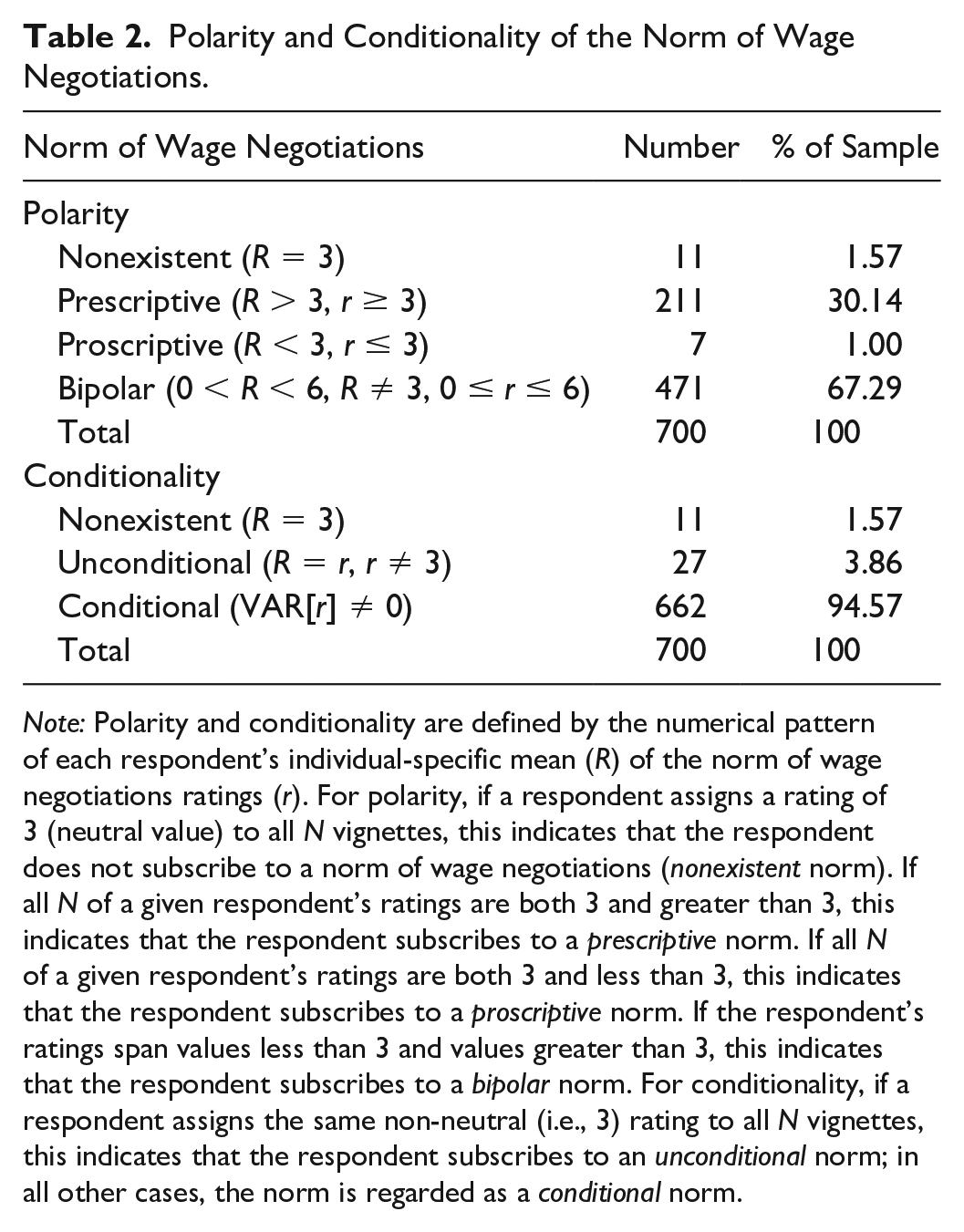
Note: Polarity and conditionality are defined by the numerical pattern of each respondent’s individual-specific mean (R) of the norm of wage negotiations ratings (r). For polarity, if a respondent assigns a rating of 3 (neutral value) to all N vignettes, this indicates that the respondent does not subscribe to a norm of wage negotiations (nonexistent norm). If all N of a given respondent’s ratings are both 3 and greater than 3, this indicates that the respondent subscribes to a prescriptive norm. If all N of a given respondent’s ratings are both 3 and less than 3, this indicates that the respondent subscribes to a proscriptive norm. If the respondent’s ratings span values less than 3 and values greater than 3, this indicates that the respondent subscribes to a bipolar norm. For conditionality, if a respondent assigns the same non-neutral (i.e., 3) rating to all N vignettes, this indicates that the respondent subscribes to an unconditional norm; in all other cases, the norm is regarded as a conditional norm.
Conditionality of the Norm of Wage Negotiations
Beyond the 67.29 percent of respondents who subscribed to a bipolar norm, which is a conditional norm by definition, 27.28 percent of the respondents subscribed to a conditional proscriptive norm or a conditional prescriptive norm, for a total of 94.57 percent. Altogether, the norm of wage negotiations in the United States is overwhelmingly conditional.
Intensity of the Norm of Wage Negotiations
The norm of wage negotiations is intense among respondents who subscribed to an unconditional norm, as they were relatively far from the neutral rating. For unconditional proscriptive norms (N = 1), the average distance (of the individual-specific mean rating) from the neutral value was 2.00, while the average distance was 2.50 for unconditional prescriptive norms (N = 26). The small number of respondents (3.85 percent) who subscribed to an unconditional norm favored extreme values, and the level of intensity was statistically stronger for prescriptive norms than proscriptive norms (b = 0.500, SE = 0.114, p < .001). 12
Among conditional norms, the average distance was 0.86 for conditional proscriptive norms (N = 6) and 1.40 for conditional prescriptive norms (N = 185). The intensity of the norm of wage negotiations was statistically equivalent for respondents who subscribed to either a conditional proscriptive or prescriptive norm (b = 0.537, SE = 0.396, p = .176). 13 For individuals who subscribed to a bipolar wage negotiations norm (N = 471), the average distance was 1.83, or moderately intense ratings.
Taken together, the majority of the sample subscribed to a bipolar wage negotiations norm where the average level of intensity was between “not at all strong” and “moderately strong.” The patterns in the data thus indicate that the overall intensity of the wage negotiations norm was low to moderate.
Consensus about the Norm of Wage Negotiations
The analysis of polarity, conditionality, and intensity indicates disagreement among respondents (see Figure A1 in the Appendix for histograms of individual-specific mean ratings of the norm of wage negotiations by norm type). To investigate consensus formally, we estimated the two-level HLMs outlined above. A likelihood ratio test rejected a model of fixed intercepts and slopes for each vignette dimension in favor of random intercepts and fixed slopes, χ2(1) = 583.06, p < .001. In addition, significant variation was observed around the intercept as indicated by the level 2 error term, SD(intercept) = 0.793. This indicates differences across individuals in their tendencies to proscribe or prescribe wage negotiations, thereby demonstrating respondent heterogeneity and a lack of normative consensus (Jasso 2006). 14
Next, we relaxed the assumption of fixed slopes, so that each respondent had a unique intercept and a unique slope for each vignette dimension. A model in which all random slopes were freely estimated failed to converge. To assess consensus of the conditions demarcating the norm of wage negotiations, we conducted a series of likelihood ratio tests in which each vignette dimension for person A and person B was freely estimated separately. For instance, we estimated a model in which the genders of person A and person B were freely estimated, followed by a separate model in which the races of person A and person B were freely estimated. The results of a likelihood ratio test rejected a model of random intercepts and fixed slopes in favor of both random intercepts and random slopes for most vignette dimensions, namely, the education, experience, occupation, and earnings of person A and person B. 15 Likelihood ratio tests in which the gender, race, age, and occupation of person A and person B were freely estimated showed that freed slopes were not a statistical improvement over fixed slopes. 16 These results indicate that respondents differed with one another in their tendencies to proscribe or prescribe wage negotiations and respondents placed different weights on some circumstances demarcating the norm of wage negotiations. Thus, there is disagreement among the respondents over the norm of wage negotiations.
The Circumstances Demarcating the Norm of Wage Negotiations
We now investigate respondents’ views about which circumstances demarcate, or serve as boundaries of, the norm of wage negotiations. Figure 1 presents results of two-level HLMs in which random slopes were fixed. For both models, we show unstandardized coefficients and their respective 95 percent confidence intervals (with robust standard errors and a first-order autoregressive residual structure). In model 1, we observed strong and weak statistical support for the vignette dimensions. Some status groups affected views of wage negotiation as expected: the greater the age, education, and experience of person A, the more prescriptive the norm of wage negotiations. Interestingly, these effects reversed for person B: the greater the age, education, and experience of person B, the more proscriptive the norm of wage negotiations. As expected, occupational status also affected the norm of wage negotiations: prescriptions to negotiate for a higher salary were stronger for higher occupational statuses (social worker vs. cashier). Other status groups, namely, nominal social categories such as the gender and race of person A and person B, yielded statistically nonsignificant results.
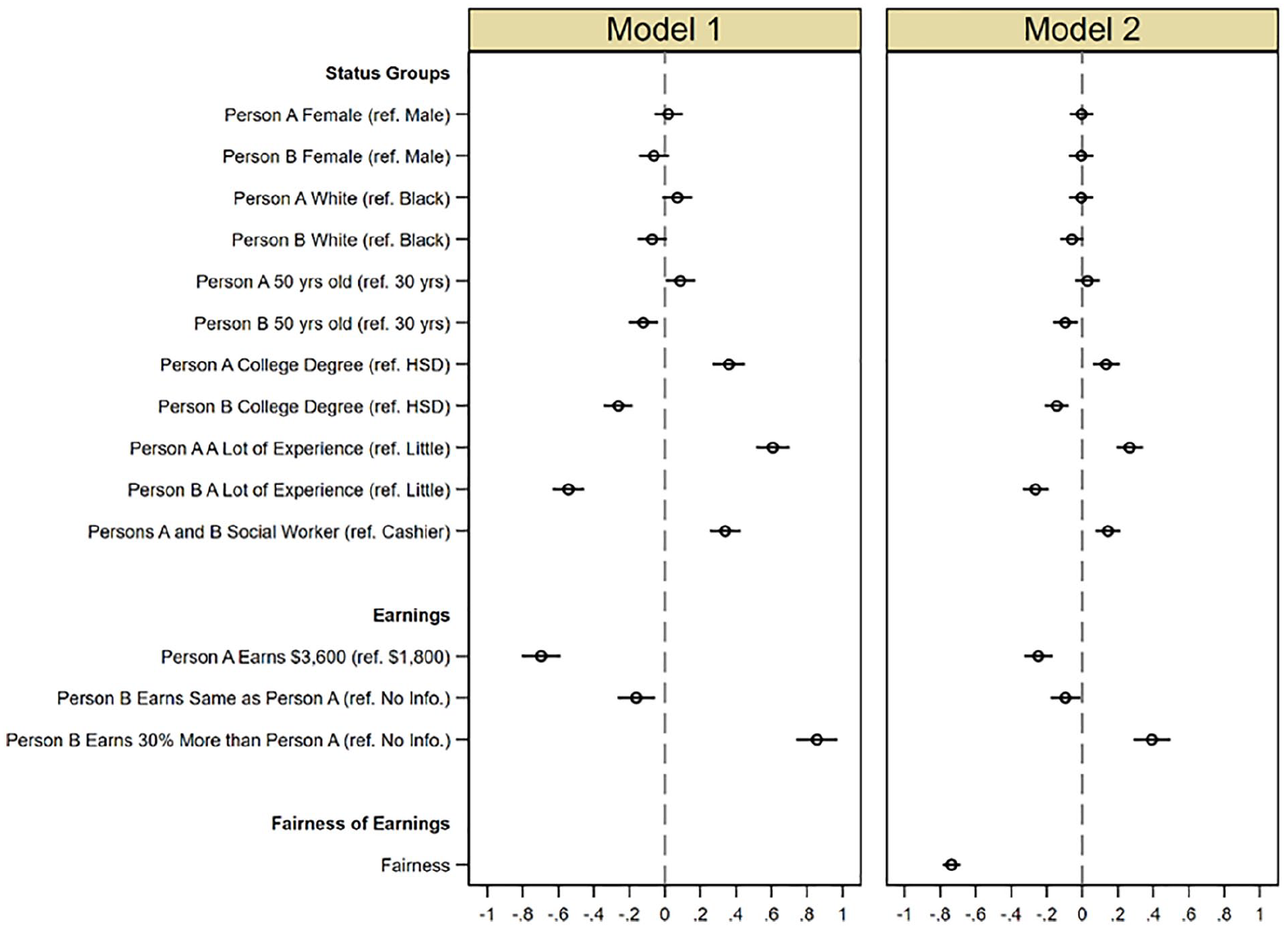
Coefficients of vignette dimensions and fairness of earnings on the norm of wage negotiations.
For earnings, our results followed previous research (Elster 1989a, 1989b): the greater the monthly salary of person A ($3,600 vs. $1,800), the more proscriptive the norm of wage negotiations (a statistically significant effect). This implies that prohibitions against wage negotiations are stronger for higher earning individuals. We also found that respondents anchored on person B’s earnings (a statistically significant family-wise effect, χ2[2] = 325.94, p < .001). When person B earns the same monthly salary as person A, respondents proscribed wage negotiations (in relation to the referent category, or no information about person B’s monthly salary). Conversely, when person B earns 30 percent more than person A, respondents prescribed wage negotiations. This earnings inequality finding is the strongest effect observed in the model. Finally, we found that most vignette dimensions attenuate in magnitude when controlling for fairness of earnings (Figure 1, model 2). But fairness does not entirely confound the effects of the vignette dimensions on the norm of wage negotiations.
Overall, our experimental design and sample simultaneously supports and refutes prior work. We do not find that there is a societal norm favoring increased negotiations for women over those for men (Exley et al. 2020), or a norm favoring one racial group over another. What we do find is that categorical status distinctions involving age, education, experience, and occupational status demarcate who should or should not negotiate for a higher salary (Sauer et al. 2021). And even more interesting, the categorical status distinctions of age, education, and experience yield countervailing effects depending on who possesses these characteristics: the negotiator (person A) or the reference point (person B). Finally, the magnitude of person A’s earnings, as well as the (in)equality of earnings between person A and person B, strongly dictates whether an individual should or should not enter wage negotiations (Elster 1989a, 1989b).
Table 3 reports select linear predictions (and 95 percent confidence intervals) by profiles of person A’s and person B’s categorical status distinctions (rows 1, 2, and 3) and earnings (columns 1–4) calculated from Figure 1, model 1, estimates. Starting with a high-status profile for person A (i.e., male, White, 50 years old, college degree, and social worker) and a low-status profile for person B (i.e., female, Black, 30 years old, and high school diploma), respondents prescribed wage negotiations to the greatest extent (a linear prediction of 6.064, or “extremely strong”) when person A earned $1,800 month and person B earned 30 percent more than person A. With these status profiles, respondents always prescribed wage negotiations regardless of variation in person A’s and person B’s earnings.
Select Linear Predictions of the Norm of Wage Negotiations.

Note: Linear predictions based on model 1 in Figure 1 using the delta method (values in parentheses are 95 percent confidence interval). BA = college degree; HSD = high school diploma.
Only when person A was low status and person B was high status did respondents proscribe wage negotiations. With these two status profiles, respondents proscribed wage negotiations to the greatest extent—“not at all strong” (a linear prediction of 1.967)—when person A earned $3,600 a month and person B earned the same as person A. When person A and person B were both high status, respondents prescribed wage negotiations regardless of variation in person A’s and person B’s earnings. Taken together, the linear predictions illustrate how strong the average treatment effects of the circumstances were in motivating respondents to proscribe and prescribe wage negotiations.
Next, we relaxed the assumption of fixed slopes to investigate which vignette dimensions varied in their magnitude. Figure 2 presents box plots of best linear unbiased predictions of random slopes. These linear predictions were derived from models in which random slopes for each vignette dimension of person A and person B were estimated separately. Of the status group differences, only the effect of person B’s experience varied to a great extent between respondents, with some estimates slightly positive (most being negative). For the remaining status group differences, there were varying amounts of disagreement, which tended to increase for statistically significant vignette dimensions (e.g., person A’s and person B’s education).

Box plots of the best linear unbiased predictions of random slopes.
In contrast, the earnings dimensions varied to a great degree between respondents in their effects on the norm of wage negotiations. As Figure 2 shows, most respondents proscribed wage negotiations (to varying degrees) when person A earned $3,600 a month (vs. $1,800 a month), while a small minority of respondents (roughly an eighth) prescribed wage negotiations under the same conditions. Similar dynamics were observed for person B earning the same monthly salary as person A, while all respondents prescribed wage negotiations (with some heterogeneity of acceptance) when there was an inequality in earnings between person A and person B.
In short, categorical status differences and the earnings of person A and person B served as boundaries between who should and should not negotiate for a higher salary. Moreover, circumstances demarcating the norm of wage negotiations exhibited more consensus in some cases (e.g., age, education, occupation) and less consensus in others (e.g., experience, earnings). Overall, however, we observed relatively little consensus.
Consensus within and between Subpopulations: Age, Race, Gender, and SES
In the next subsection, we identify whether individual-level tendencies to proscribe or prescribe wage negotiations are a function of the age, race, gender, and SES of respondents. After that, we investigate whether variation in the weights placed on the circumstances driving the norm of wage negotiations is a function of the age, race, gender, and SES of respondents.
The Character of the Norm of Wage Negotiations within and Between Subpopulations
We now present estimates from a two-level HLM that includes the age, race, gender, and SES of respondents as predictors of normative differences. The model, in Table 4, controlled for vignette dummies, vignette dimensions, and the individual-level control variables outlined in the “Data and Methods” section. These results show that classic demographic characteristics yield statistically nonsignificant effects. Next, we investigate whether within-group variation was the same between subpopulations (e.g., consensus is greater or lesser among White respondents than non-White respondents). In Figure 3, kernel density plots of individual-specific mean ratings of the norm of wage negotiations revealed that the amount of disagreement (or lack of consensus) within subpopulations was comparable between subpopulations (e.g., disagreement among White and non-White respondents was comparable). In short, classic demographic groups did not vary in their tendencies to proscribe or prescribe wage negotiations, and the amount of disagreement (or lack of consensus) within groups was comparable between groups.
Consensus of the Norm of Wage Negotiations across Subpopulations, Two-Level Hierarchical Linear Model.
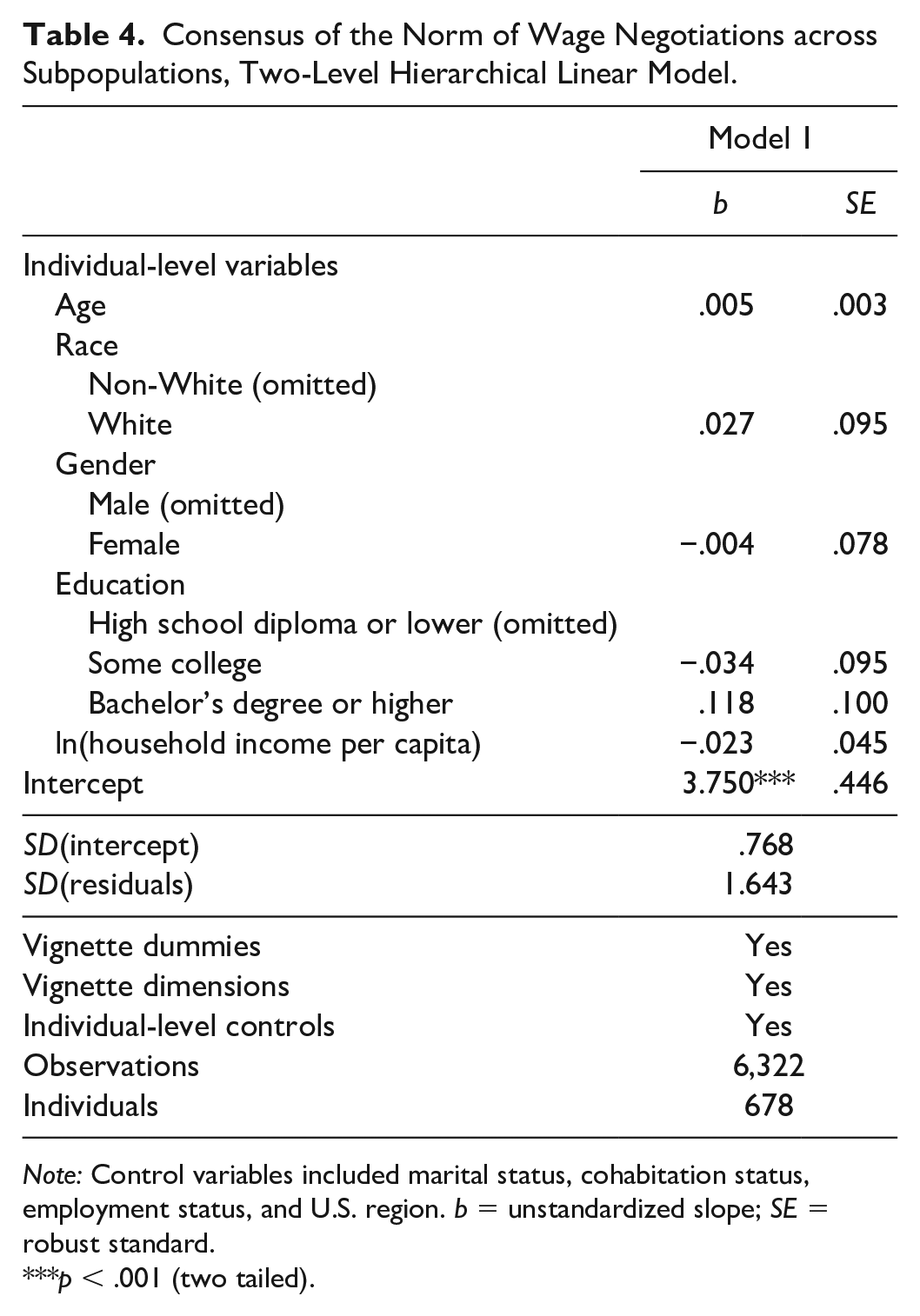
Note: Control variables included marital status, cohabitation status, employment status, and U.S. region. b = unstandardized slope; SE = robust standard.
p < .001 (two tailed).

Kernel density plots of individual-specific mean ratings of the norm of wage negotiations by age (A), gender (B), race (C), and education (D).
The Circumstances Demarcating the Norm to Marry between Subpopulations
Earlier, we found that some circumstances demarcating the norm of wage negotiations exhibited greater disagreement than other circumstances. We next investigate how much classic demographic groups account for this disagreement by estimating a series of two-level HLMs with cross-level moderation in which the age, race, gender, and SES of respondents interacted with each vignette dimension separately. These models controlled for vignette dummies and the individual-level control variables outlined in the “Data and Methods” section.
Note that our interest here is not with the direction of effects but with whether classic demographic characteristics account for variation in the random slopes. Following from this logic, Table 5 details which demographic characteristics yield statistically (non)significant cross-level interact effects. Table 5 shows that the majority of cross-level interactions are statistically nonsignificant, suggesting that demographic groups interpret the boundaries of the norm of wage negotiations similarly; that is, we find limited social cleavages along demographic lines in evaluations of the circumstances demarcating the norm of wage negotiations. However, there are some exceptions. The age and gender of respondents appear to generate the greatest number of cross-level interactions (i.e., four), while all other demographic groups yield statistically significant interactions, albeit inconsistent across demographic groups, with zero to two vignette dimensions. Overall, we found that classic demographic groups place different levels of importance on how some circumstances affect the norm of wage negotiations. Most circumstances, however, yielded relatively consistent effects regardless of the age, race, gender, and SES of respondents.
Cross-Level Interaction Effects.

Note: For each model, N = 678, V = 6,322. Plus and minus signs indicate statistically significant interaction effects at p < .05. Where appropriate, this includes family-wise tests of interaction effects. NS = statistically nonsignificant (p > .05).
Discussion and Conclusion
Many scholars claim that the moral economy and wage bargaining are tightly coupled. In this article, we have sought to understand whether a norm of wage negotiations exists in the United States, and, if so, what the character of this norm might look like. Our FSE is uniquely positioned to map the character of this norm because we were able to exogenously manipulate various counterfactual conditions that demarcate, or serve as boundaries of, the norm of wage negotiations.
In terms of key findings, we first demonstrate that a norm of wage negotiations exists in the U.S. moral economy, but the norm is decoupled, as there is little consensus. The vast majority of individuals follow a norm, while a small minority believe that wage bargaining is not governed by norms. However, we do find that the norm of wage negotiations is weak: it is largely bipolar, conditional, and of a low to moderate intensity, with disagreement over the norm as well as the circumstances demarcating the norm. Despite normative disagreement, two types of norm followers predominate in the United States: those who prescribe wage negotiations regardless of the conditions (prescriptive norm), and those who vacillate between prescribing and proscribing wage negotiations depending on the conditions (bipolar norm).
Second, we fail to observe deep social cleavages along demographic lines. The character of the norm of wage negotiations, and the conditions serving as boundaries thereof, are comparable across demographic groups. The young and the old, men and women, Whites and non-Whites, and low- and high-SES individuals tend to agree on the norm of wage negotiations. What appears to drive variation in the norm of wage negotiations are the characteristics of individuals and circumstances under evaluation, not the status group distinctions of those individuals doing the evaluating.
Third, we discover that key conditions prompt the approval and disapproval of wage negotiations: when (1) the focal actor is a high-status employee who (2) has a low salary and (3) works with a low-status colleague (or reference point) who (4) earns more than the focal actor, respondents approve of (or prescribe) wage negotiations. Again, we find that the magnitude of these conditions is comparable across demographic groups.
Implications
Our findings have important implications for scholarship in the areas of moral economy, wage negotiations, and social norms. At first glance, our findings might suggest that a moral economy of wage negotiations is alive and well in the United States. Only a small minority of individuals are unwilling to state whether others should or should not negotiate for higher wages, suggesting a nonexistent norm. The remaining 98.43 percent of individuals subscribe to a norm. Upon deeper inspection, however, we find that the nature of the norm is conditional and does not exhibit consensus. Even for a classic condition known to spark wage negotiations, such as the inequality of earnings, there is heterogeneity of acceptance, with treatment effects ranging from 0.052 to 1.331 (see Figure 2). This all implies that views of wage negotiations are not standardized or uniform in the United States. The moral economy of wage negotiations cannot be understood as “a popular consensus about legitimate and illegitimate practices” of wage bargaining (Sachweh 2012:422). What are the implications of these differences of opinion? Under conditions of mass disagreement, individuals are prone to bargaining, conflict, and debate (Coleman 1990). Such conflict will play out over who and why people should or should not negotiate for higher wages. Although we cannot track change over time, our results support Western and Rosenfeld’s (2011) main finding: there has been an erosion, or decoupling, of the distributional norms underlying the U.S. moral economy.
A second major contribution of our analysis is to gain insight into how status groups and earnings inequalities are linked to the norm of wage negotiations. Sauer et al. (2021) found that categorical status distinctions determine who enters negotiations, as well as the magnitude of economic returns. The authors in particular show that women are less likely to enter wage negotiations than men. And when they do negotiate, the wages of women do not appear to improve. In our study, categorical status distinctions are features of the situation that serve as boundaries of the norm of wage negotiations. We find that the norm is independent of some status groups, namely, the gender and race of hypothetical employees under evaluation. We also find that respondents’ age, race, gender, and SES do not account for between-individual variation in the norm of wage negotiations. This set of findings underscores how weakly tied gender is to the norm of wage negotiations, contrary to Exley et al. (2020). By showing that the link between gender and the norm of wage negotiations is weak, we are able to rule out a key channel through which the gender gap in pay persists. Instead, the inequality of earnings between men and women is likely a function of discrimination (Tomaskovic-Devey and Avent-Holt 2019), shared cultural beliefs about gender (Ridgeway 2011), and status differences in claims-making (Sauer et al. 2021). That being said, other status distinctions are important determinants of who should or should not negotiate for a higher salary. These include the age, experience, education, and occupation of employees.
Third, our analysis contributes to the literature on social norms by further demonstrating the utility of the multidimensional approach to mapping social norms. For decades, scholars of social norms have pushed for the widespread use of measurement tools that properly measure polarity, conditionality, intensity, and consensus (Grigoryeva and Robbins 2021; Jasso and Opp 1997; Rauhut and Winter 2010; Robbins et al. 2022). These tools, however, are time consuming and costly for general population surveys and laboratory experiments since they require respondents to assess a systematic set of counterfactual conditions. But when done properly, they can shed light on various social dynamics, including social protest (Jasso and Opp 1997), bride wealth (Horne et al. 2018), inequality (Rauhut and Winter 2010), and marriage (Robbins et al. 2022). Our study builds on this literature by providing novel empirical support for the idea that the norm of wage negotiations is decoupled from the U.S. moral economy. A finding that would have been difficult to discover without our novel FSE.
Limitations and Directions for Future Research
Our study provides important insights into the inner workings of the U.S. moral economy, but it is not without limitations. Although our dependent variable captures personal normative beliefs, it does not provide evidence about whether individuals would actually sanction norm violators (e.g., Opp 2002) or evidence about subjective expectations of other people’s willingness to follow the norm (e.g., Grigoryeva and Robbins 2021). Many studies on social norms measure personal normative beliefs (Diefenbach and Opp 2007; Grigoryeva and Robbins 2021; Jasso and Opp 1997; Robbins et al. 2022), and our findings align with actual selection into wage bargaining (Sauer et al. 2021). Although we believe that this provides some support for the idea that we are tapping into the concept of social norms, future research would do well to measure other dimensions of the social norm concept, including behavioral and attitudinal measures of empirical and normative expectations.
We also recognize limitations to our design. Our FSE excluded a number of circumstances demarcating the norm of wage negotiations, which may have affected estimates of conditionality and consensus. We settled on this design to see whether people approve or disapprove of wage negotiations under commonplace bargaining conditions and to offer a conservative assessment of the moral economy, but other circumstances likely drive views of wage bargaining. It would be useful for future research to investigate the impact of these other circumstances, including market value, job tenure, health status, and job performance (Auspurg et al. 2017). Likewise, because our research targeted a specific norm, we can say little about other norms that might undergird the moral economy of wage negotiations. For instance, prior research shows that masculinity norms drive behavior in the workplace (Berdahl et al. 2018). Men, as a result, may be more likely to negotiate for higher wages because of these norms, and not the norm of wage negotiations. Investigating the impact of these alternative norms would supply further revelations about the U.S. moral economy.
In conclusion, the present article extends our understanding of the U.S. moral economy in general and the norm of wage negotiations in particular. By using an FSE, we unearthed important observations about wage bargaining in the United States. We found that the norm of wage negotiations is weak, that it does not vary across certain demographic groups, and that the relation between categorical status distinctions and views of wage bargaining are causal. With this work, our hope is to help sociologists better understand the norm of wage negotiations and to lay the groundwork for novel measurement tools that ascertain the norms, rules, and values of the moral economy.
Supplemental Material
sj-docx-1-srd-10.1177_23780231221115408 – Supplemental material for The Norm of Wage Negotiations in the United States
Supplemental material, sj-docx-1-srd-10.1177_23780231221115408 for The Norm of Wage Negotiations in the United States by Melisa Demirović and Blaine G. Robbins in Socius
Footnotes
Appendix
Summary Statistics and Descriptions of Variables.

| Name | Definition | Mean | SD | Minimum | Maximum | N |
|---|---|---|---|---|---|---|
| Vignette evaluation tasks | ||||||
| Norm of wage negotiations | Should person A negotiate for a higher salary? | 3.64 | 1.96 | 0 | 6 | 6499 |
| Fairness of earnings | Person A’s earnings fair? | 2.34 | 1.59 | 0 | 6 | 6421 |
| Individual-level variables | ||||||
| Age | Age in years | 46.34 | 16.54 | 18 | 85 | 707 |
| Race | ||||||
| White | Non-Hispanic White | 77.51% | — | — | — | 548 |
| Non-White | Non-White | 22.39% | — | — | — | 159 |
| Gender | ||||||
| Male | Male | 50.92% | — | — | — | 360 |
| Female | Female | 49.08% | — | — | — | 347 |
| Education | ||||||
| High school diploma or lower | High school diploma or lower | 37.62% | — | — | — | 266 |
| Some college | Some college (no degree) or an associate’s degree | 27.58% | — | — | — | 195 |
| Bachelor’s degree or higher | Bachelor’s, master’s, professional, or doctoral degree | 34.79% | — | — | — | 246 |
| ln(household income per capita) | 9.91 | .91 | 6.08 | 11.83 | 688 | |
| Individual-level control variables | ||||||
| Marital status | ||||||
| Never married | Never married | 32.81% | — | — | — | 232 |
| Married | Married | 48.66% | — | — | — | 344 |
| Formerly married | Widowed, divorced, separated | 18.53% | — | — | — | 131 |
| Cohabitation status | ||||||
| Not cohabiting | Not living with a partner | 41.84% | — | — | — | 295 |
| Presently cohabiting | Presently living with a partner | 58.16% | — | — | — | 410 |
| Employment status | ||||||
| Not working | Temporarily not working, unemployed, retired, going to school, keeping house, etc. | 43.32% | — | — | — | 305 |
| Working full-time | Working full-time | 47.02% | — | — | — | 331 |
| Working part-time | Working part-time | 9.66% | — | — | — | 68 |
| Region | ||||||
| Northeast | 25.18% | — | — | — | 178 | |
| Midwest | 20.23% | — | — | — | 143 | |
| South | 40.17% | — | — | — | 284 | |
| West | 14.43% | — | — | — | 102 | |
Acknowledgements
We thank Eric Hamilton and Malte Reichelt for helpful advice and comments.

Funding
The author(s) disclosed receipt of the following financial support for the research, authorship, and/or publication of this article: The research reported here was financially supported by the Division of Social Science at New York University Abu Dhabi and the Center for Behavioral Institutional Design and Tamkeen under New York University Abu Dhabi Research Institute Award CG005.
Supplemental Material
Supplemental material for this article is available online.
Notes
Author Biographies
References
Supplementary Material
Please find the following supplemental material available below.
For Open Access articles published under a Creative Commons License, all supplemental material carries the same license as the article it is associated with.
For non-Open Access articles published, all supplemental material carries a non-exclusive license, and permission requests for re-use of supplemental material or any part of supplemental material shall be sent directly to the copyright owner as specified in the copyright notice associated with the article.
