




Abstract
The authors analyze the 2020–2021 Chapman University Survey of American Fears (n = 1,035), the most recent nationally representative survey to examine fears of and beliefs about supernatural and paranormal phenomena, including ghosts, hauntings, zombies, psychics, telekinesis, Bigfoot or Sasquatch, Atlantis, and extraterrestrial visitation. This research examines how supernatural beliefs vary by race/ethnicity, gender, and education after adjustment for other demographic characteristics and religiosity. There were five gender differences, such that women were more likely than men to believe in or fear all nonmaterial or spiritual supernatural phenomena, as well as Atlantis. People with a bachelor’s degree or higher were less likely to believe in extraterrestrial visitation, hauntings, Bigfoot or Sasquatch, and Atlantis. There were also six beliefs and fears for which racial/ethnic differences emerged. The results highlight how gender, education, and race/ethnicity are strongly related to complex belief systems, including supernatural phenomena.
Keywords
Despite scientific advances in understandings of the natural world, supernatural beliefs are fairly common among Americans (Bader, Baker, and Mencken 2017). We borrow Force’s (2018) definition of “supernatural”: “any phenomenon encountered by human beings that is currently unexplained or unexplainable” (p. 19). 1 This definition is broad enough to encompass everything from telekinesis to ghosts to cryptids such as Bigfoot or Sasquatch. Nonreligious unexplained phenomena, specifically, are what scholars typically refer to as “supernatural” or “paranormal” (Baker, Bader, and Mencken 2016). Supernatural beliefs may have become more widespread over the past several years (Wilkinson College 2018), although patterns of dis/belief over time are difficult to determine because of data limitations. Not coincidentally, there are countless podcasts, television shows, books, and online articles about purportedly real-life encounters with the supernatural. 2 These productions both reflect and reinforce beliefs about unexplained phenomena. Despite the commonality of supernatural beliefs, 3 they are understudied in the sociological literature.
Supernatural beliefs are of sociological significance in part because they reveal the ontological underpinnings of a society or group of people. Durkheim ([1915] 2001), for instance, discussed how the concept of the “supernatural” is historically recent, given that it relies upon a scientific understanding of what is possible or not possible (see also Force 2018; Waskul and Eaton 2018). The same phenomena may be interpreted differently across societies, time periods, and groups of people, given that there are different frameworks which explain how the world operates.
Supernatural beliefs are also of sociological significance because they serve social functions: they may “be a powerful source of meaning, community, and identity” (Waskul and Eaton 2018:10). Entire subcultures exist around interest in supernatural phenomena (Bader et al. 2017; Bader, Mencken, and Baker 2010; Baldwin 2018; Krulos 2018). Supernatural beliefs may also, to some extent, “serve as a functional alternative to mainstream religious beliefs” (Waskul and Eaton 2018:5). Belief in the supernatural suggests that many people are experiencing shifts to how they perceive the world and make meaning from it (Castro 2019; see also Baker and Bader 2014 for an analysis of age and supernatural belief or engagement).
To what extent race, gender, and education relate to supernatural beliefs today is an open empirical question. Social identities and statuses structure lived experiences (Collins 2015; Crenshaw 1989), which in turn shape beliefs and attitudes. For instance, education is one of the social axes most strongly related to social attitudes (Schnabel 2018). Relatedly, there are gender and racial differences regarding a wide variety of topics, including belief in climate change (McCright and Dunlap 2011), perceptions of risk (Kahan et al. 2007), and religiosity (Pew Research Center 2016; Schnabel 2020).
Perceptions of reality do not occur within a vacuum. Ontological understandings of how the world operates are shaped by racialized and gendered meaning-making processes (Ladson-Billings 2000; Thomson, Mehta, and Ecklund 2020). For instance, Eurocentric masculinist science favors seemingly objective interpretations of material reality in contrast to nonmaterial, spiritual, and intuitive knowledge systems which tend to be associated with women and people who are racialized or Indigenous (Bain 2009; Knopf 2015). Examining how social locations are related to supernatural beliefs is important because lived experiences are deeply tied to perceptions of reality. Although most supernatural beliefs are not supported by modern science, they reflect collective social fears, desires, and perceptions of what it means to be human. Focusing on the ways in which supernatural beliefs vary by race, gender, and education illuminates how views that are seemingly personal may in fact be shaped by social forces. Accordingly, our research question is: How do beliefs about and fears of supernatural phenomena vary by race/ethnicity, gender, and education?
We answer this question by analyzing the 2020–2021 Chapman University Survey of American Fears (CSAF), which is the most recent nationally representative survey to ask about supernatural beliefs. The purpose is to analyze how three key axes of social life—race/ethnicity, gender, and education—relate to a range of supernatural beliefs. We analyze fear of ghosts and zombies, as well as beliefs in hauntings, psychics, telekinesis, Bigfoot or Sasquatch, advanced ancient civilizations, and extraterrestrial visitation. All relate to different types of nonreligious supernatural phenomena; for instance, ghosts relate to the afterlife, Bigfoot or Sasquatch to undiscovered creatures, and telekinesis to rare human abilities. Analyzing these beliefs allows us to discover patterns of significant differences and nondifferences that highlight the salience of race/ethnicity, gender, and education for complex belief systems.
Background
There has been little nationally representative survey research about supernatural beliefs in the past several years. Most research that does exist analyzes data that were collected prior to 20104 and focuses primarily on how religion relates to supernatural beliefs. These studies typically include gender, education, and (to a lesser extent) race as independent variables, but these axes are not usually the main focus of inquiry.
Scholars who study phenomena that cannot be explained by science typically distinguish between phenomena that are central to religious doctrine of a particular religion (e.g., angels, demons, divine intervention) and phenomena that are not (Baker et al. 2016; Glendinning 2006; Mencken, Bader, and Kim 2009; Rice 2003). These two categories of beliefs “share a similar ontological status” (Baker et al. 2016:340) but are perceived differently on the basis of an individual’s religiosity. Many deeply religious people reject the existence of unexplained phenomena that are not encoded in religious scriptures because these phenomena are not rendered comprehensible through adherents’ religious framework (Bader, Baker, and Molle 2012). For instance, highly religious people may believe in angels but not telekinesis. Highly religious people may also, alternatively, interpret phenomena as religious when others interpret them as nonreligious and supernatural. For instance, highly religious people may interpret spiritual visitation as angelic or demonic rather than ghostly.
There is a curvilinear relationship between religiosity (in particular, frequency of church attendance) and nonreligious supernatural beliefs, such that individuals with the highest and lowest levels of religiosity are the least likely to report supernatural beliefs (Bader et al. 2012; Baker and Draper 2010; see also Baker et al. 2016; Mencken et al. 2009). 5 Individuals with the lowest levels of religiosity may reject supernatural beliefs because they endorse a highly scientific view of the world. In contrast, individuals with the highest levels of religiosity rely on their religious framework to understand the world and, accordingly, are more likely to reject supernatural beliefs that do not align with their religious doctrine (Mencken et al. 2009). 6 People in between these two extremes are most likely to report beliefs in supernatural phenomena. They may believe that science alone cannot explain everything and have moderate levels of religious belief, but they also do not endorse strict religious frameworks that reject ideas about the supernatural.
Less studied is how beliefs about the supernatural vary by race, gender, and education. Some prior survey research has examined these axes in relation to supernatural beliefs, although most projects did so with data collected decades ago. 7 Many researchers have used a combined measure of supernatural beliefs and have found that women and individuals with lower levels of education are more likely to endorse supernatural beliefs than men and individuals with higher levels of education (Bader et al. 2012; Baker et al. 2016; Mencken et al. 2009; Orenstein 2002). Others have found similar results with regard to gender but insignificant differences in belief likelihood by education (Glendinning 2006). Prior analyses have also shown that people of color are more likely to report some supernatural beliefs than white people (Baker et al. 2016; Mencken et al. 2009). In contrast, some surveys have revealed no significant differences in beliefs by race/ethnicity, gender, or education (Moore 2005).
Individuals may believe in some supernatural phenomena but not others (Bader et al. 2017). For instance, some individuals may believe that places can be haunted but consider the existence of Bigfoot or Sasquatch to be implausible. Rice (2003) found that which social axes were significant, and in what direction, differed depending on the specific supernatural belief. Variables Rice (2003) examined included astrology, extrasensory perception, extraterrestrial visitation, the existence of unidentified flying objects (UFOs), ghosts, psychic healing, and déjà vu. Highly educated people were more likely to believe in extrasensory perception, psychic healing, and déjà vu than people with lower levels of education, whereas people with lower levels of education were more likely to believe in astrology. Women were more likely than men to believe in all phenomena except déjà vu and the existence of UFOs (which had no significant gender differences) and extraterrestrial visitation, in which men were more likely to believe than women. Black people were less likely than white people to believe in psychic healing and UFOs; these beliefs were the only two on which significant racial differences emerged. In short, patterns of significant differences varied extensively depending on the attitude.
Bader et al. (2017) examined the 2014 CSAF and found more consistent patterns (see Table A.3 in their Appendix). Higher levels of education were associated with lower levels of belief in psychics, astrology, hauntings, prophetic dreams, and Bigfoot or Sasquatch. Race/ethnicity was mostly unassociated with supernatural beliefs. Gender differences were split: women had higher levels of belief in psychics, astrology, and hauntings, but men had higher levels of belief in UFOs and Bigfoot or Sasquatch.
It is worth reexamining the relationship between the aforementioned social axes and supernatural beliefs for five main reasons. First, supernatural beliefs may have increased over the past several years (Wilkinson College 2018). If so, the relationship between social identities and statuses and supernatural beliefs may have also changed. Additionally, regardless of whether supernatural beliefs have become more common, a variety of social changes have occurred in American society over the past several years that may have affected the relationship between social identities and statuses and supernatural beliefs. For instance, church, synagogue, and mosque membership has declined significantly in the United States: 47 percent of Americans reported membership in 2020, compared with 62 percent between 2008 and 2010 (Jones 2021). Large declines occurred within most demographic groups (Jones 2021). Given the relationship between religiosity and supernatural beliefs, it is reasonable to consider whether relationships between social identities and statuses and supernatural beliefs has shifted alongside declines in religious membership.
Second, not all surveys have produced the same results about race, gender, and education, so additional analyses can help clarify the relationships between these axes and supernatural beliefs. Third, there is not a large base of survey research about supernatural beliefs like there are about other complex belief systems, such as religion, so further research can help provide more insight about this topic. Fourth, much prior survey research has used a combined measure of supernatural beliefs rather than analyzing beliefs individually, which we do to capture variations in beliefs on the basis of specific supernatural phenomena (following Bader et al. 2017; Rice 2003). And fifth, no prior research has examined the supernatural beliefs of Asian Americans. In short, this brief research article contributes to the literature by using the most recent (2020–2021) data and by providing visualizations of specific supernatural beliefs, which demonstrate variation in how race, gender, and education relate to these beliefs.
Despite some inconsistent results from prior research, enough evidence exists for us to test the following hypotheses about education and gender:
Hypothesis 1: Where significant differences exist, people with less than a bachelor’s degree will have higher levels of belief in or fear of supernatural phenomena than people with a bachelor’s degree or higher.
Hypothesis 2: Compared with men, women will have higher levels of belief in or fear of nonmaterial or spiritual supernatural phenomena, including psychics, telekinesis, hauntings, ghosts, and zombies.
Hypothesis 3: Compared with women, men will have higher levels of belief in material supernatural phenomena, including extraterrestrial visitation, Bigfoot or Sasquatch, and Atlantis.
We do not pose hypotheses about race/ethnicity for two main reasons. First, existing research has generated highly inconsistent conclusions, even more so than results regarding education and gender. And second, because no prior research has examined Asian American respondents, we have no empirical foundation to test any particular claim about Asian American people’s belief in or fear of supernatural phenomena.
Methods
Data
All data come from wave VII 8 of the 2020–2021 CSAF (Bader, Day, and Gordon 2021). 9 All data were gathered in January 2021. Respondents were recruited from the online SSRS Opinion Panel. Panel members were originally recruited randomly via address-based and telephone-based sampling. Overall, 2,019 individuals in the SSRS Opinion Panel were invited to complete the CSAF, and of them, 1,067 completed it. Quality control checks removed approximately 32 surveys, for a total sample size of 1,035. Although the sample is small, CSAF is the only nationally representative survey to query about supernatural topics, and therefore it is the best source of data for this study’s goals. All surveys were completed online, in English, and the median completion time was 22 minutes. SSRS designed weights to make results representative of American adults aged 18 and older. For more detail on methods, see Rapoport, Berta, and Kline (2021). Ethics approval was not necessary for this study, because the data were anonymized and publicly available (all CSAF data are publicly available).
Dependent Variables
Nine variables measured beliefs about or fears of supernatural phenomena. The CSAF measured fears about ghosts and zombies using the following question: “How afraid are you of the following? Ghosts” and “How afraid are you of the following? Zombies.” Each question included options of “very afraid,” “afraid,” “slightly afraid,” and “not afraid.” For seven other questions, the CSAF asked, “Please indicate your level of agreement with the following statements.” These questions included (1) “Fortune tellers and psychics can foresee the future”; (2) “Places can be haunted by spirits”; (3) “Bigfoot is a real creature”; (4) “Ancient advanced civilizations, such as Atlantis, once existed”; (5) “Some people can move objects with their minds”; (6) “Aliens have visited the Earth in our ancient past”; and (7) “Aliens have come to Earth in modern times.” For each question, response options included “strongly agree,” “agree,” “disagree,” and “strongly disagree.”
We determined whether it was appropriate to combine any of these nine items by first performing a rotated factor analysis and then by evaluating Cronbach’s α and Spearman’s correlation between different variables. Ultimately, we combined the two extraterrestrial visitation variables into a single measure. We also combined the variables about psychics and telekinesis into a single item that can be reasonably described as measuring belief in supernatural human abilities (foretelling the future and moving objects with one’s mind). Analyses did not support combining most of the other items. 10
Given highly asymmetrical response patterns, responses for other variables were dichotomized into “not afraid” versus “very afraid”/“afraid”/“slightly afraid” and “strongly agree”/“agree” versus “disagree”/“strongly disagree” for analysis in logistic regressions. Supplemental analyses examine these variables linearly. 11
In sum, in main analyses, seven dependent variables are examined in seven separate models. Two examine fears about (1) ghosts and (2) zombies. Five examine beliefs about (3) hauntings, (4) Bigfoot or Sasquatch, (5) advanced ancient civilizations such as Atlantis, (6) supernatural human abilities, and (7) extraterrestrial visitation. All variables are dichotomized for logistic regressions except for variables reflecting belief in extraterrestrial visitation and supernatural human abilities, both of which had values that ranged from 2 to 8 and were examined linearly.
Key Independent Variables
Gender, race/ethnicity, and education are the three key independent variables we examine in analyses. Gender included man (n = 500), woman (n = 523), and nonbinary (n = 7). We could analyze men and women only because of small sample sizes for nonbinary respondents. Race/ethnicity included non-Latinx white (n = 686), non-Latinx Black (n = 94), non-Latinx Asian American (n = 79), and Latinx (n = 160). Respondents of other racial/ethnic identities (n = 10) were placed in a separate category, which could not be analyzed further. Highest educational degree included less than a bachelor’s degree (n = 544) and a bachelor’s degree or higher (n = 491).
Covariates
Regressions adjusted for a variety of demographic measures. We followed the suggestions of Bader et al. (2017) when deciding what variables to include in models. Age ranged from 18 to 90 years. 12 Political ideology was a 7-point measure that ranged from “extremely conservative” to “extremely liberal.” Partnership status included (1) single; (2) cohabiting; (3) married; and (4) separated, widowed, or divorced. Household income in U.S. dollars included five categories: up to $24,999, $25,000 to $49,999, $50,000 to $74,999, $75,000 to $99,999, and $100,000 or more. U.S. region included (1) Northeast, (2) Midwest, (3) South, and (4) West. Three religion variables were also included. Religious identity included (1) Catholic, (2) non-Catholic Christian, (3) other religion, and (4) no religion (including atheist and agnostic). Religious attendance was a 9-point variable that included options of never to several times a week. Biblical literalism included five options: (1) “The Bible means exactly what it says. It should be taken literally, word-for-word, on all subjects”; (2) “The Bible is perfectly true, but it should not be taken literally, word-for-word. We must interpret its meaning”; (3) “The Bible contains some human error”; (4) “The Bible is an ancient book of history and legends”; (5) “Don’t know.” We do not focus on religious findings because they have been documented extensively in the literature.
Analysis
All data were analyzed in Stata/SE 17.0, and figures were produced using the R visualization package ggplot2 (Stata code is available as a supplemental file and R code is available upon request). Weights designed by SSRS were applied to all analyses. The combined measures that reflect beliefs about extraterrestrial visitation and supernatural human abilities were analyzed using linear regression. All other dependent variables were analyzed using logistic regression. Seven separate regression models thus examine the seven dependent variables: two linear and five logistic. The “Results” section details marginal estimates 13 of beliefs and fears by race/ethnicity, gender, and education, 14 as well as tests of difference between these estimates. 15 Marginal estimates of supernatural beliefs by each key independent variable are adjusted for all other independent variables. Marginal estimates for gender, race/ethnicity, and education, as well as their confidence intervals, were also used to produce figures in R. 16
Results
The response distribution of dependent variables is depicted in Table 1. The weighted prevalence estimate of belief in one or more supernatural phenomena (extraterrestrial visitation, supernatural human abilities, Bigfoot or Sasquatch, hauntings, Atlantis) was high, at 71.91 percent. Figures 1 to 7 display Americans’ beliefs about or fears of specific supernatural phenomena by gender, education, and race/ethnicity. Estimates should be evaluated with caution given small sample sizes, particularly for Asian American respondents (confidence intervals for figures are in brackets). The marginal estimates upon which the figures and tests of difference are based are included in Tables 2 and 3. There were five significant gender differences, six racial/ethnic differences, and four educational differences.
Response Distribution of Dependent Variables.

Note: Values for belief in extraterrestrial visitation and supernatural human abilities ranged from 2 to 8. Higher values indicate higher levels of belief. Missing cases are excluded from counts and percentages of dichotomous variables.
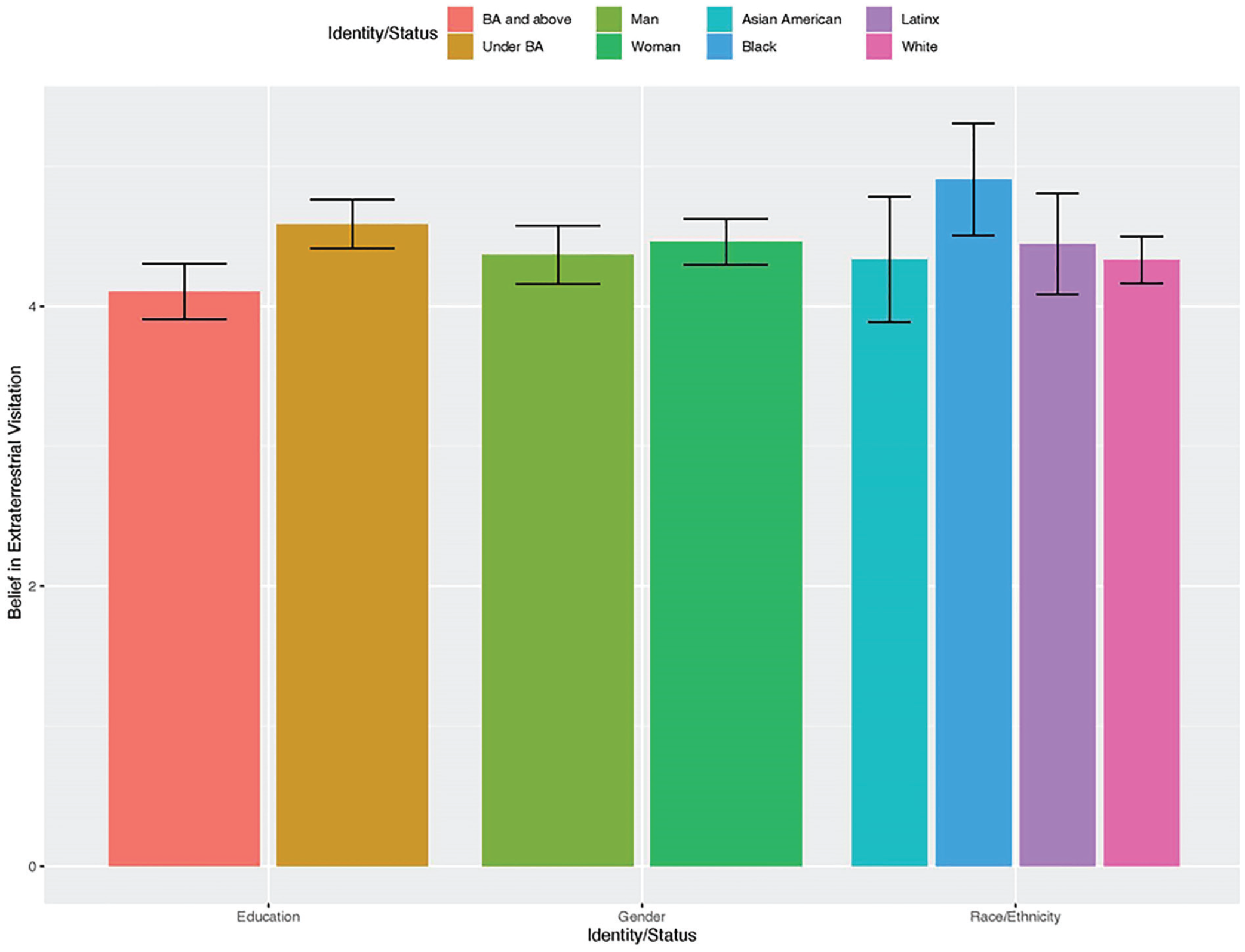
Belief in extraterrestrial visitation by gender, education, and race/ethnicity.

Belief in supernatural human abilities by gender, education, and race/ethnicity.

Fear of ghosts by gender, education, and race/ethnicity.

Fear of zombies by gender, education, and race/ethnicity.

Belief in hauntings by gender, education, and race/ethnicity.
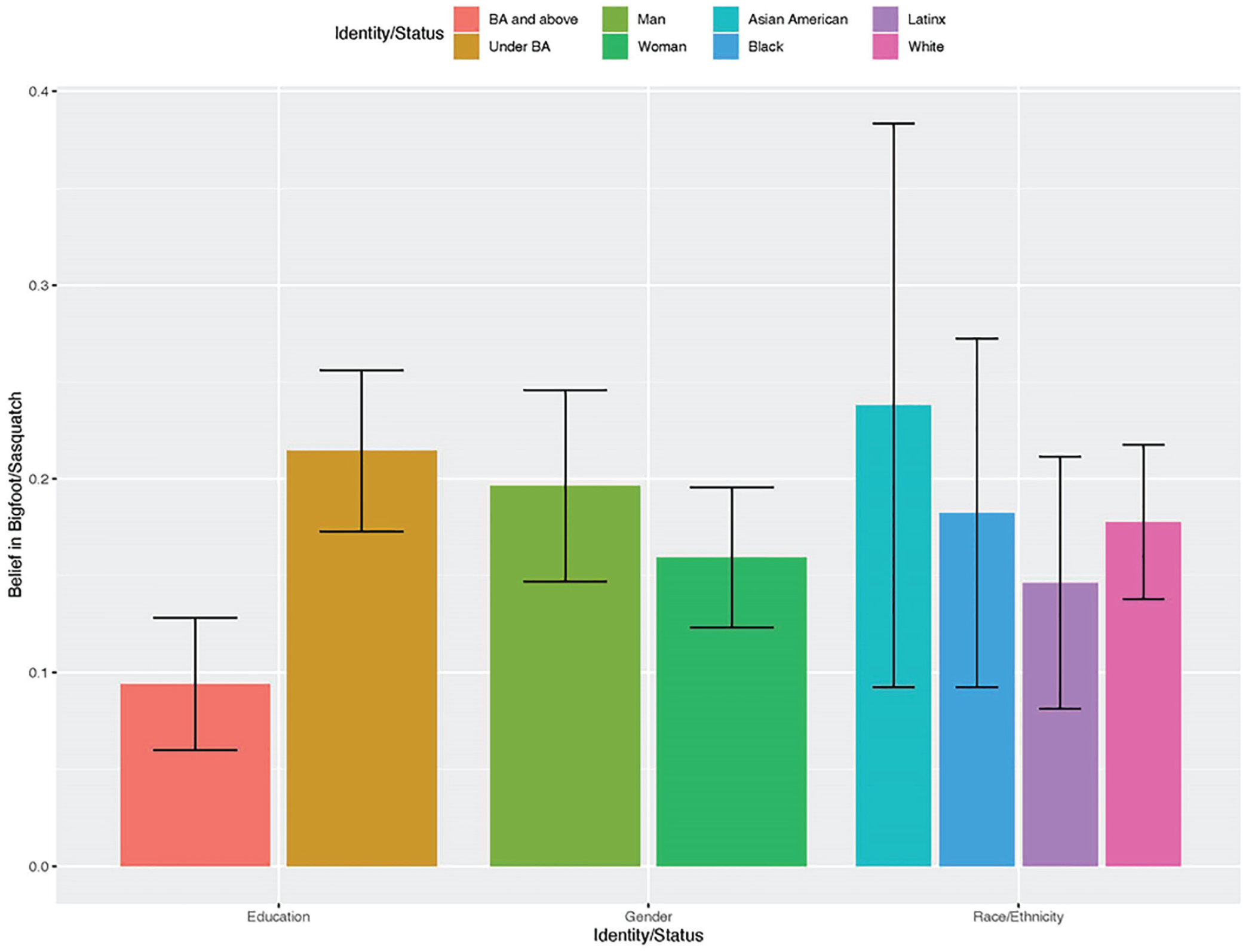
Belief in Bigfoot or Sasquatch by gender, education, and race/ethnicity.

Belief in Atlantis by gender, education, and race/ethnicity.
Marginal Estimates of Belief in or Fears about Supernatural Phenomena.
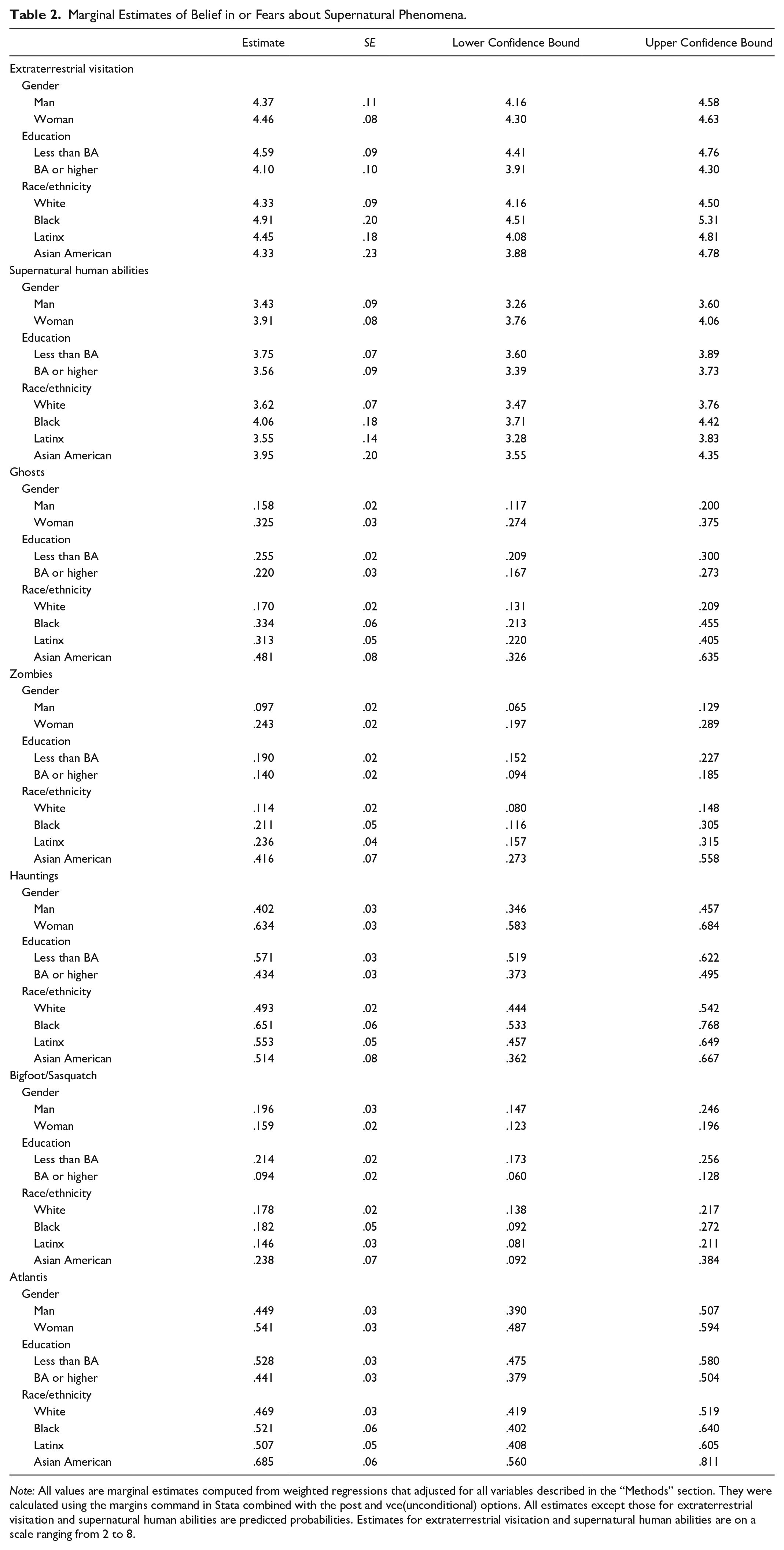
Note: All values are marginal estimates computed from weighted regressions that adjusted for all variables described in the “Methods” section. They were calculated using the margins command in Stata combined with the post and vce(unconditional) options. All estimates except those for extraterrestrial visitation and supernatural human abilities are predicted probabilities. Estimates for extraterrestrial visitation and supernatural human abilities are on a scale ranging from 2 to 8.
Analyses of Difference.

Note: All analyses of difference were calculated from the estimates in Table 2 using the Stata command lincom.
p < .05, **p < .01, and ***p < .001 (two tailed).
Women had a higher marginal score than men regarding beliefs about supernatural human abilities (estimate of marginal difference = 0.48, p < .001) and had a higher predicted probability (PP) than men to fear ghosts (.167, p < .001) and zombies (.146, p < .001) and to believe in hauntings (.232, p < .001) and Atlantis (.092, p < .05). These findings partially support hypothesis 2 and do not support hypothesis 3. Women did indeed have higher marginal estimates than men on all of the nonmaterial or spiritual beliefs or fears, but the finding that women had a higher PP than men to believe in Atlantis was unexpected. Hypothesis 3 is entirely unsupported, as there were no items in which men had higher marginal estimates or PPs than women.
Six supernatural items displayed racial/ethnic differences. Black people had higher marginal scores than white people in belief about extraterrestrial visitation (0.58, p < .01) and a higher PP to believe in hauntings (.157, p < .05). Black people also had higher marginal scores than white and Latinx people regarding belief in supernatural human ability (0.45 and 0.51, both at p < .05). White people had lower PPs of fearing ghosts compared with Black (–.164, p < .05), Latinx (–.143, p < .01), and Asian American (–.311, p < .001) people. Similarly, white people had lower PPs of fearing zombies than Latinx people (–.122, p < .01) and Asian Americans. Asian Americans had higher PPs of fearing zombies than white (.302, p < .001), Black (.205, p < .05), and Latinx (.180, p < .05) people. Lastly, Asian Americans had a higher PP of belief in Atlantis compared with white (.216, p < .01) and Latinx (.179, p < .05) people.
There were four differences by education. People with a bachelor’s degree or higher had a lower marginal score on belief about extraterrestrial visitation (–0.48, p < .001). They also had a lower PP of belief in hauntings (–.136, p < .001), Bigfoot or Sasquatch (–.120, p < .001), and Atlantis (–.086, p < .05). These results support hypothesis 1. Importantly, there were several items on which there were no significant education differences, indicating that education is strongly, but not determinatively, linked to supernatural beliefs and fears.
Discussion
We used nationally representative data collected in 2021 to examine how fears of and beliefs about supernatural phenomena vary by key social axes: race/ethnicity, education, and gender. Our research makes several key contributions to the literature. First, we used the most recent data available to examine the relationship between supernatural phenomena and social axes. Second, this study contributes to the large body of research showing that social axes are strongly related to attitudes and religiosity (e.g., Schnabel 2018, 2020). Third, we analyzed several supernatural beliefs individually, rather than combining them into an index, to detect patterns of significance or lack of significance on the basis of particular beliefs or types of beliefs. Empirically, this study shows that gender, race/ethnicity, and education are strongly related to supernatural beliefs and fears. Theoretically, the results suggest that beliefs about supernatural phenomena are shaped by gendered, racialized, and classed social processes.
It is notable that there are large gender differences in some beliefs but not others. One explanation could be the perceived role of spirituality in supernatural phenomena. Ghosts, hauntings, zombies, and psychics all involve the influence of spiritual forces, and telekinesis similarly involves a nonmaterial energy. In contrast, Bigfoot or Sasquatch and extraterrestrial visitation (for the most part) indicate concrete but unexplained issues such as undiscovered animals and contact with advanced nonhuman species. As Bader et al. (2017) argued, gendered differences in belief reflect how women are more likely to be interested in supernatural phenomena that provide a greater understanding of the world, even if the processes cannot be scientifically documented. In contrast, men may be more interested in phenomena that can be scientifically established with the correct evidence, although we did not find that men were more likely than women to believe in any phenomena.
It is unclear why women had a higher PP to believe in Atlantis and other advanced ancient civilizations than men, although it is possible that people differently interpreted the question. For instance, some people may have interpreted the question to mean lost but discoverable ancient civilizations. Others may have interpreted “advanced” to mean technological capabilities more sophisticated than today’s. Still others may have considered the purported link between ancient civilizations and metaphysical energy (e.g., some people believe that residents of advanced ancient civilizations used crystal energies). Thus, the implications of the finding about advanced ancient civilizations are unclear.
The fact that most configurations of American masculinity are characterized by notions of rationality (Connell 2005) could explain men’s lower probability of belief in supernatural phenomena linked to spiritual and nonmaterial forces (see also Thomson et al. 2020; Ward and King 2020). Indeed, American men are socially rewarded for displaying traits such as detached rationality (Bain 2009) and may be socially sanctioned for relying on intuition and spiritual beliefs. Men are also socialized to demonstrate stoicism. Femininity, in contrast, is often associated with the emotional and spiritual realms. 17 Women are less likely to be sanctioned for using intuition and expressing fear. This pattern could explain women’s higher levels of belief in hauntings and supernatural human abilities (foretelling the future and telekinesis), and to fear ghosts and zombies. Similarly, a 2017 study by the Pew Research Center showed that 20 percent of adult men in the United States believed in astrology, 27 percent believed in reincarnation, 34 percent believed in psychics, and 37 percent believed that “spiritual energy can be located in physical things” (Gecewicz 2018). In contrast, equivalent figures for women were 37 percent, 39 percent, 47 percent, and 46 percent, respectively (Gecewicz 2018). Thus, gendered social expectations likely shape supernatural beliefs.
Education is related to supernatural beliefs in a straightforward way. People with a bachelor’s or more had lower marginal estimates or PPs of belief in extraterrestrial visitation, hauntings, Bigfoot or Sasquatch, and Atlantis. Notably, there were no educational differences for other supernatural beliefs/fears. Although higher levels of education are associated with lower levels of belief in several supernatural phenomena, there are others in which there are no significant educational beliefs. These findings are similar to those of Bader et al. (2017) and unlike those of Rice (2003). It is possible that today, unlike in prior decades, higher levels of education have become associated with disbelief in most supernatural phenomena.
It is notable that several racial/ethnic differences emerged. Asian Americans had higher PPs of belief in Atlantis and fear of zombies than most other groups, and white people had the lowest PP of fearing ghosts than all other groups. Black people had higher levels of belief than white people regarding extraterrestrial visitation and hauntings and higher marginal estimates of belief in supernatural human abilities than both white and Latinx people. Similarly, the Pew research cited above showed that Black and Latinx people had higher levels of belief than white people regarding astrology, reincarnation, psychics, and spiritual energy in physical things (Asian Americans were not analyzed) (Gecewicz 2018).
There are several different possible explanations for these racial/ethnic differences in supernatural beliefs. First, it is possible that trust in science may be related to belief in supernatural phenomena. According to a 2020 Pew survey, 88 percent of white people and 87 percent of Latinx people have “a great deal” or “a fair amount” of confidence in scientists, compared with 79 percent of Black people (Asian Americans were not analyzed) (Funk, Kennedy, and Johnson 2020). Thus, trust in science may be one of many factors that shape racialized belief systems.
Second, cultural traditions may also explain racial differences in paranormal beliefs. For instance, Black Americans historically had a tradition of intergenerational oral culture that can be traced back to enslavement (Gorn 1984). Historically, superstitions and stories of ghostly visitations were prominent within African American folklore (Gorn 1984), which may shape the belief systems of some Black Americans today (see also Bellot 2021). Similarly, the idea of ancestral spirits visiting the living is deeply embedded in some racial/ethnic cultural traditions such as Lunar New Year, which is widely observed throughout the East Asian and Southeast Asian American diasporas (Wen 2021). On the eve of the new year, special meals are prepared to honor the spirits of deceased ancestors (Wen 2021). Even outside of prominent holidays, ancestor worship is a daily spiritual practice for groups such as Vietnamese Buddhists (Jellema 2007). Día de los Muertos (Day of the Dead), which has its origins in both European Catholicism and Indigenous traditions, is widely celebrated throughout Mexico and in the Mexican American diaspora to honor the spirits of deceased relatives and friends (Lopez 2021). These cultural traditions may explain why Black, Latinx, and Asian Americans are more likely than white people to believe in certain paranormal phenomena.
It is intriguing that this study revealed numerous racial/ethnic differences in supernatural beliefs, whereas most other studies have not. In contrast, findings for gender and education largely mirrored those of other recent research. Differences in findings regarding racial/ethnic differences in supernatural beliefs may exist for variety of reasons. First is random sampling variation. To confirm these results, more research needs to be done, ideally with larger samples. Research findings are robust when they are confirmed by studies using multiple samples. Replication is particularly important when the sample size of certain subgroups is small, as with Black and Asian Americans in this sample. Thus, results regarding race/ethnicity should be evaluated with caution until further studies are conducted. Second, and relatedly, no prior research about the supernatural included Asian Americans except, possibly, in a combined “other” category. Several of the differences in this study were between Asian Americans and other groups; no prior research could have documented these differences when it did not examine Asian Americans specifically. And third, rapid social changes over the past several years may have shaped belief systems such that group differences emerged or became larger. In addition to the decline in church, synagogue, and mosque membership previously discussed (Jones 2021), the past several years have brought multiple social changes: the coronavirus pandemic, sharp political polarization, and increased attention paid to structural racial inequities, among others. These changes, combined, may have affected belief systems in varied ways depending on racial/ethnic identity. Future research will need to examine this possibility.
It is possible that other factors shape belief in supernatural phenomena. For instance, a recent study showed that lower levels of self-control were associated with a higher level of belief in supernatural phenomena (Mowen, Heitkamp, and Boman forthcoming). Low self-control is defined by one’s tendency to favor short-term gratification while ignoring long-term consequences (Mowen et al. forthcoming). The authors theorized that low self-control may be related to the adoption of paranormal beliefs, which “reflect a decision-making process whereby scientific evidence is cast aside in lieu of an easy explanation for some of life’s greatest mysteries” (p. 12). This study also showed that women were more likely than men to believe in supernatural phenomena, as were people of “other” races compared with white people (comparisons between white and Black people were not statistically significant) (Mowen et al. forthcoming). Although that study was based on a convenience sample of undergraduate students, the results indicate that researchers should include additional measures in surveys to better understand why individuals report supernatural beliefs.
Future research can build on this study. It would be beneficial to collect a larger sample size of Black, Latinx, Asian, Pacific Islander, and Indigenous individuals, which would make it possible to produce more reliable estimates of beliefs by race/ethnicity. Although the results related to race/ethnicity are intriguing, future research with larger samples will need to further investigate this topic, particularly with regard to Black and Asian American respondents, as their sample sizes were small (which resulted in large confidence intervals). Future studies might also deploy explanatory frameworks to identify reasons why there is observed variation in paranormal beliefs by race/ethnicity.
Additionally, the CSAF did not query about sexual identification, even though it is one of the strongest predictors of social attitudes (Grollman 2017; Schnabel 2018) and is strongly related to religiosity (Schnabel 2020), which in turn is related to supernatural beliefs (Bader et al. 2012; Baker and Draper 2010; Baker et al. 2016; Mencken et al. 2009). Some scholars have argued that cryptids have become queer symbols in part because “the identification of cryptids as queer both reclaims and challenges a past in which queerness was considered monstrous” and because cryptids challenge conventional ideas about normativity and natural orders (Hord 2018:2). Others have argued that queerness is less stigmatized in online supernatural communities because supernatural communities are built on embracing the unfamiliar, thus making them more appealing to queer people (Wall 2018). Additionally, queer people may find cryptids intriguing because they are often framed as threats, just as queer people were historically and still are today in many contexts, and because the existence of cryptids, like queer people, is often denied or rendered invisible (Wall 2018). In short, there are a variety of reasons why queer people may be more inclined to believe in supernatural phenomena, and future research should include a measure of sexual identification to capture possible group differences on the basis of sexual identity.
In conclusion, we examined how beliefs about, and fears of, supernatural phenomena—including ghosts, hauntings, zombies, psychics, telekinesis, Bigfoot or Sasquatch, Atlantis, and extraterrestrial visitation—vary by race/ethnicity, gender, and education. Specifically, women are more likely to believe in or fear phenomena that relate to nonmaterial or spiritual matters (ghosts, hauntings, zombies, and supernatural human abilities including psychic powers and telekinesis) rather than material phenomena that could potentially be proved through conventional scientific investigation (Bigfoot or Sasquatch and extraterrestrial visitation), although women were also more likely than men to believe in Atlantis. Education is also strongly related to several supernatural phenomena, such that people with a bachelor’s degree or higher are less likely to believe in certain phenomena than people with less than a bachelor’s degree. Race/ethnicity was also strongly related to supernatural beliefs and fears, although in ways that differed on the basis of the belief or fear. The results underscore how gender, education, and race/ethnicity are strongly related to beliefs, including about supernatural phenomena.
Supplemental Material
sj-docx-1-srd-10.1177_23780231221084775 – Supplemental material for Supernatural Sociology: Americans’ Beliefs by Race/Ethnicity, Gender, and Education
Supplemental material, sj-docx-1-srd-10.1177_23780231221084775 for Supernatural Sociology: Americans’ Beliefs by Race/Ethnicity, Gender, and Education by Tony Silva and Ashley Woody in Socius
Supplemental Material
sj-docx-2-srd-10.1177_23780231221084775 – Supplemental material for Supernatural Sociology: Americans’ Beliefs by Race/Ethnicity, Gender, and Education
Supplemental material, sj-docx-2-srd-10.1177_23780231221084775 for Supernatural Sociology: Americans’ Beliefs by Race/Ethnicity, Gender, and Education by Tony Silva and Ashley Woody in Socius
Supplemental Material
sj-docx-3-srd-10.1177_23780231221084775 – Supplemental material for Supernatural Sociology: Americans’ Beliefs by Race/Ethnicity, Gender, and Education
Supplemental material, sj-docx-3-srd-10.1177_23780231221084775 for Supernatural Sociology: Americans’ Beliefs by Race/Ethnicity, Gender, and Education by Tony Silva and Ashley Woody in Socius
Footnotes

Supplemental Material
Supplemental material for this article is available online.
Notes
Author Biographies
References
Supplementary Material
Please find the following supplemental material available below.
For Open Access articles published under a Creative Commons License, all supplemental material carries the same license as the article it is associated with.
For non-Open Access articles published, all supplemental material carries a non-exclusive license, and permission requests for re-use of supplemental material or any part of supplemental material shall be sent directly to the copyright owner as specified in the copyright notice associated with the article.
