




Abstract
Although belief in ghosts or analogous concepts is prevalent cross-culturally, including in contemporary Western cultures, social scientific treatments of spirit belief and experience often dismiss such views as superstitious, or overlook this dimension of culture completely. Using mixed methods, we examine ghost belief, experience, and media consumption, as well as the practice of ‘ghost hunting’ in the United States. Results from a national survey demonstrate that these beliefs and practices are common and concentrated strongly among younger generations of Americans, especially moderately religious ‘dabblers.’ Fieldwork with multiple groups centered on ‘hunting’ ghosts reveals several notable themes, including rhetorical appeals to both science and religion, magical rites, the extensive use of technology to mediate evidence and experiences of ghosts, and the narrative construction of hauntings. We argue that the inherent liminality of spirits as cultural constructs accounts for their persistence, power, and continual recurrence.
If it – learning to live – remains to be done, it can only happen between life and death. Neither in life nor in death alone. What happens between two, and between all the ‘two’s’ one likes, such as between life and death, can only maintain itself with some ghost, can only talk with or about some ghost [s’entretenir de quelque fantôme]. (Derrida, 1994: xvii, emphasis in original)
Introduction
Ghosts or analogous supernatural entities are ubiquitous cultural objects across time and space, a fact noted by social anthropologists, both classical (Durkheim, 1995 [1912]: 242–275; Lévy-Bruhl, 1966 [1927]) and contemporary (Boyer, 2001; Cohen, 2007; Delaplace, 2012: S131). This results from the natural tendency of the human brain to perceive the ‘soul’ (or some synonymous construct) and body as distinct and to posit anthropomorphic supernatural agents. The generalized cognitive bifurcation of anima as distinct from material reality intuitively allows spirits to exist or persist without bodily presence (Bloom, 2004, 2007; Cohen et al., 2011). While spirit concepts are cross-cultural, the narrative content given to experiences of and beliefs about spirits is highly flexible, molded into culturally specific expressions.
In the United States, media with paranormal themes and content have never been as varied or widely available as they are at present. For example, before the mid-1990s, Americans who desired ‘non-fiction’ paranormal content were limited to a small selection of television shows such as In Search Of (1976–1982) and Arthur C. Clarke’s Mysterious World (1980) and rare theatrical releases such as Legend of Boggy Creek (1972) and Legend of Bigfoot (1976). By 2012 there were, at a minimum, 31 paranormal ‘reality’ series that aired new episodes, ranging from shows about Bigfoot and other mystery beasts (Finding Bigfoot, Monsters and Mysteries in America, Mountain Monsters), UFOs, and aliens (Ancient Aliens, Chasing UFOs) to the paranormal in general (Fact or Faked: Paranormal Files, Destination Truth). The most frequent and successful subject of paranormal television programming, however, has proven to be ghosts, with dozens of examples spread across the networks, including Ghost Hunters, Ghost Adventures, Ghost Stories, Celebrity Ghost Stories, Haunted Collector, The Dead Files, Ghost Mine, and Haunted Encounters. 1 Accompanying this media expansion, public opinion polls indicate increasing belief in ghosts (Kwilecki, 2009).
Coinciding with the cultural diffusion of the paranormal, a rapidly expanding proportion of Americans have begun claiming no religious affiliation (Hout and Fischer, 2002; Pew Research Center, 2012). Far from indicating a disenchanted secularity, increasing numbers now claim the de-institutionalized (but not atheistic) identity of ‘spiritual but not religious’ (Chaves, 2011). There are, however, differing subsets of people with ‘no religion’: those who are disbelievers in the supernatural in general and those who retain supernatural beliefs outside a specific religion (Baker, 2012; Davie, 1994; Storm, 2009). A substantial majority of those claiming no religion maintain privatized supernatural beliefs and more than a passing interest in religion (Baker and Smith, 2009; Lim et al., 2010). This is particularly the case among the youngest generation of American adults (Clark, 2003; Putnam and Campbell, 2010).
So how do people who are neither institutionally religious nor fully irreligious express their interest in spiritual and supernatural pursuits? One potential outlet is paranormalism, which is most likely to be of interest to religious ‘dabblers’ who privatize religious belief but are not fully committed to exclusivist religious groups (Bader et al., 2010; Bainbridge, 2004; Baker and Draper, 2010; Goode, 2000; Mencken et al., 2009; Mencken et al., 2008). Perhaps no set of cultural phenomena better fits the definition of non-institutionalized religion/spirituality than the paranormal. Irwin (2009: 16–17) defines the paranormal as ‘phenomena that have not been empirically attested [to] to the satisfaction of the scientific establishment’. Sociologists have also noted that belief in the paranormal represents supernaturalism that has not been institutionalized into mainstream religious traditions (Bader et al., 2010; Northcote, 2007). 2 Put another way, UFOs, Bigfoot, ghosts, psychic phenomena, and other paranormal subjects share the feature of being entities and/or powers not currently ‘claimed’ by major religious organizations. 3 Belief in such entities is a form of spiritual exploration not officially tied to conventional religious forms and is typically less organized than conventional religions (Stark and Bainbridge, 1986).
With the American religious landscape recently moving towards de-institutionalization, it becomes increasingly important to understand the nature of paranormal beliefs in this context: who holds them, their relationship to conventional religiosity, and the manner in which enthusiasts frame them. We contribute to this literature by closely examining ghosts. Specifically, we examine ghost belief, experience, and media consumption, as well as ‘ghost hunting.’ Using mixed methodology, we outline some of the basic population parameters and patterns of ghost experience and belief for Americans in general, while highlighting the cultural and interactional dimensions of ghosts. To do so we collected and analyzed quantitative data from a national survey of Americans and qualitative data from fieldwork with multiple ghost-hunting groups.
Quantitative data
Data on ghost belief, experience, and media consumption are taken from the 2005 Baylor Religion Survey (BRS). The survey was funded by the Templeton Foundation and designed by Bader, Mencken and Froese (2007). It contains the most extensive set of questions on the ‘paranormal’ ever put to a national sample of American adults (Bader et al., 2010). For comparison, the demographic results of the 2005 BRS are similar to the results for the 2004 General Social Survey (Bader et al., 2007).
The Gallup organization collected the data in the fall of 2005 using a mixed-mode sampling design. Potential respondents were first contacted by phone and asked if they would be willing to complete a mailed questionnaire. Gallup attempted to contact 7,041 potential respondents; 2,603 people agreed to participate and provided valid mailing addresses. A total of 1,721 questionnaires were returned for a response rate of 66.1% for the mailed survey phase and total combined response rate of 24.4%, including all refusals, breakoffs, and incomplete phone interviews. Gallup created a weight based on data from the Census Bureau that incorporates population parameters for region, gender, race, age, and education. We employ this weight in all our analyses.
Measures
Dependent variables
To assess levels and patterns of belief in, experience of, and consumption of media about ghosts we used six items from the BRS. To assess belief we created an additive index of three items. The first asked respondents: ‘Does each of the following exist?’. ‘Ghosts’ were specifically included in the battery, alongside a number of more conventional, religiously supernatural items (e.g. angels). Answer choices were: absolutely not (1), probably not (2), probably (3), and absolutely (4). Forty-nine percent of respondents answered probably or absolutely with reference to ghosts. The remaining two items were taken from a battery of questions on the ‘New Age’ that asked respondents: ‘To what extent do you agree or disagree with the following statements?’. Included in the battery were: ‘It is possible to communicate with the dead,’ and ‘Places can be haunted’. Answer choices ranged from strongly disagree (1) to strongly agree (5), with undecided (3) as the middle category. Twenty-one percent of respondents agreed or strongly agreed that it is possible to communicate with the dead and 39% agreed that places can be haunted. A principal components analysis of these items produced a single factor with an Eigenvalue of 2.25, and each item loading at ≥ .844. The items were combined into an index with a Cronbach’s α = .831.
To assess ghost experiences and consumption, we used three items with no (0) and yes (1) as outcomes. The two items addressing experiences were part of a battery with a prompt reading: ‘As an adult, have you ever done any of the following?’. Included in the battery were: ‘Visited or lived in a house or place believed to be haunted’ (yes = 22%) and ‘Consulted a Ouija board to contact a deceased person or spirit’ (yes = 8%). 4 The question about media consumption was included in a battery with a prompt reading: ‘Have you ever read a book [on], consulted a web site [about], or researched the following topics?’. Included in the battery was: ‘Ghosts, apparitions, haunted houses, or electronic voice phenomena’ (yes = 25%). To analyze patterns in these data, we conducted OLS regression models for the belief index and logistic regression models for the binary outcomes. 5 We used the results of the binary logit models to portray graphically the effects of age, our primary independent variable of interest.
Independent variables
Age was measured in years ranging from 18 to 93. In addition to age, we examined patterns for gender, race, education, income, marital status, and religion. Gender was a dummy variable, such that women = 1. Race was coded as a series of dummy variables for white, African-American, and ‘other’ races. 6 White was used as the excluded category in multivariable models. Education was measured in attainment categories ranging from 8th grade or less (1) to post-graduate or professional degree (7). Annual family income was measured in categories ranging from less than $10,000 (1) to more than $150,000 (7). Marital status consisted of a series of dummy variables for never married, currently married, cohabitating, divorced or separated, and widowed. Currently married respondents served as the reference group in multivariable models.
To account for the influence of religion, we controlled for religious tradition and level of religious practice. For religious tradition, we used a dummy variable series based on a modified version of Steensland et al.’s (2000) RELTRAD schema, which classifies religious traditions in the United States into: evangelical (conservative) Protestant, mainline (liberal) Protestant, black Protestant, Catholic, Jewish, ‘other’ religions 7 , and no religion. To differentiate respondents with no religion who still believe in God in some way from those who are theistic disbelievers, we used an additional question to split the no religion category. Respondents were asked: ‘Which of the following comes closest to your belief about God?’. An answer choice of ‘I don’t believe in anything beyond the physical world’ was included. Respondents who claimed no religion and answered that they were materialists were grouped together, while religious ‘nones’ who maintained some form of theism were classified into a separate category. These categories were coded into dummy variables that could be used with the rest of the RELTRAD scheme.
To account for religious practice, we created an additive index that combined frequency of attendance at religious services, measured from never (1) to more than once a week (9); frequency of prayer outside of religious services, measured from never (1) to several times a day (6); and frequency of reading sacred texts, measured from never (1) to several times a week or more (9). A principal components analysis of the items produced a single factor with an Eigenvalue of 2.24 and each of the items loading at ≥ .852. Because of the sizable difference in scale between the attendance and scripture reading items and the prayer item, the measures were mean standardized before being summed into an index with a Cronbach’s α = .83. Recent research also indicates that there is a curvilinear relationship between conventional religious practice and paranormal belief and interest (Bader et al., 2012; Bader et al., 2010; Bainbridge, 2004; Baker and Draper, 2010; Orenstein, 2002). To control for this pattern we created a quadratic term for the religious practice index. Finally, to account for whether a respondent was open to novel or heterodox religious ideas, we included a question that asked whether respondents thought of themselves as ‘religious seekers.’ Responses were no (0) and yes (1).
Quantitative findings
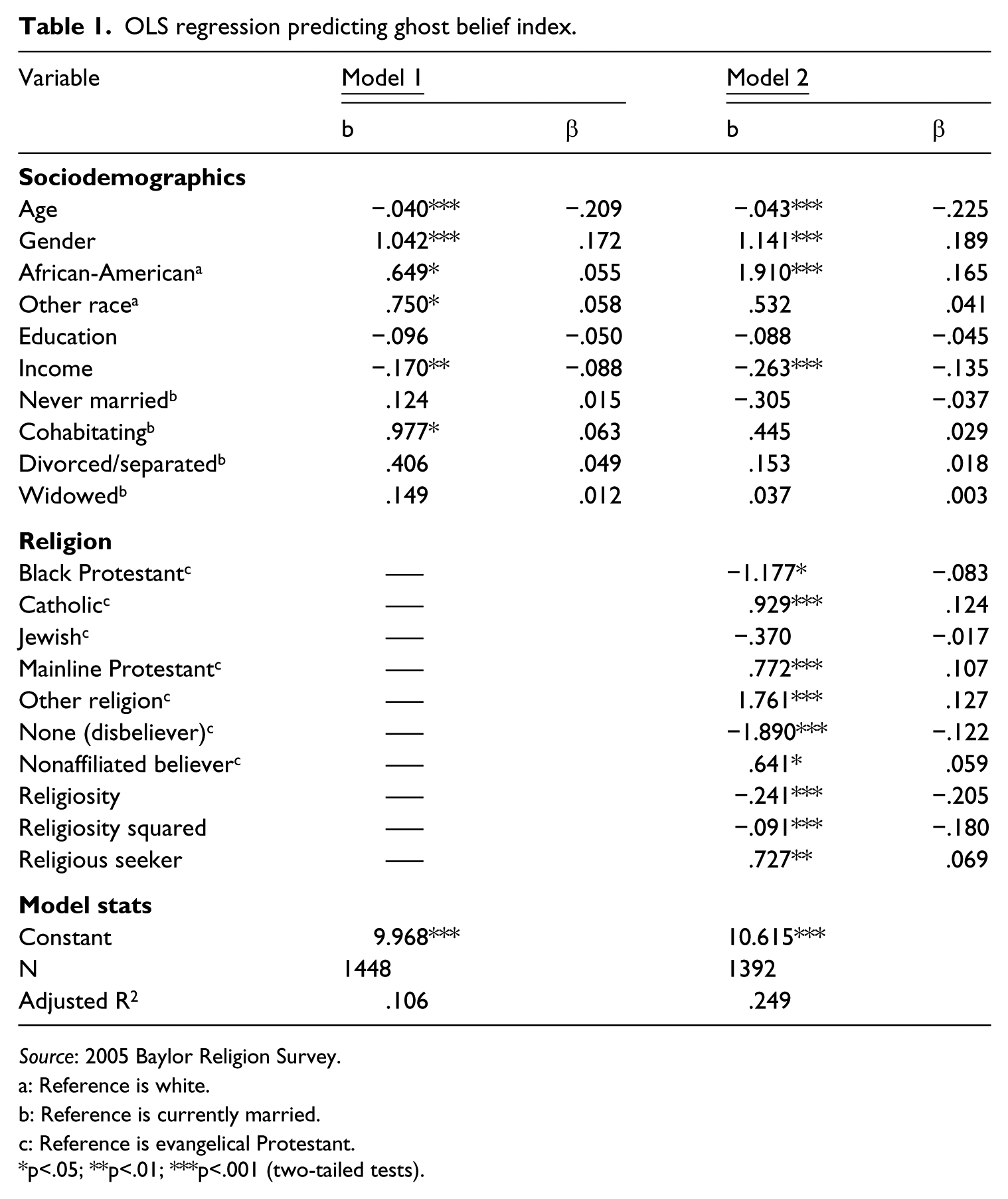
Table 1 displays two OLS regression models predicting the ghost belief index. The first includes sociodemographic predictors and the second adds the variables for religious tradition, religiosity, and religiosity squared. Younger Americans (β = -.209; p≤.001), women (β = .172; p≤.001), African-Americans (β = .055; p≤.05), those of ‘other’ races (β = .058; p≤.05), and those who were cohabitating (β = .063; p≤.05) all had significantly higher levels of ghost belief in Model 1. Furthermore, lower income leads to higher belief in ghosts (β = -.088; p≤.01).
OLS regression predicting ghost belief index.
Source: 2005 Baylor Religion Survey.
Reference is white.
Reference is currently married.
Reference is evangelical Protestant.
p<.05; **p<.01; ***p<.001 (two-tailed tests).
These variables remain significant after controlling for religion, with the exception of cohabitation, which is mediated to statistical non-significance by religious controls. There are also substantial suppressor effects for African-Americans and income after accounting for religion. The difference between blacks and whites is 3.2 times larger in Model 2 compared with Model 1, indicating that levels of ghost belief are much higher among African-Americans after accounting for levels of religious practice and religious tradition. Because African-Americans have higher levels of religiosity than whites in the US (see Ellison and Sherkat, 1995), accounting for this factor substantially increases the size of the difference in ghost belief between black and white Americans. Further, black Protestants had significantly lower levels of ghost belief than evangelicals (β = -.083; p≤.01), leaving the difference between blacks and whites as the difference among those not in black Protestant faiths. As with the effect for race, the size of the effect for income increases after accounting for religion, which is reflective of people of lower socioeconomic status engaging in higher levels of religious practice, especially privatized versions such as prayer (Baker, 2008; Schwadel, 2008).
As with paranormalism more generally, there is a significant curvilinear relationship between religiosity and ghost belief (β = -.180; p≤.001), such that those at mid-levels of religious practice tend to have stronger belief in ghosts than those at the extremes. Concerning religious tradition, Catholics (β = .124; p≤.001), mainline Protestants (β = .107; p≤.001), ‘other’ religions (β = .127; p≤.001), and nonaffiliated believers (β = .059; p≤.05) have higher average levels of ghost belief than evangelicals, while the nonaffiliated who do not believe in God have significantly lower levels of belief (β = -.122; p≤.001). Religious seekers have significantly higher levels of belief than non-seekers (β = .069; p≤.01). 8 Overall, the strongest predictors of level of belief in ghosts are, in order of strength: age, religiosity, and gender.
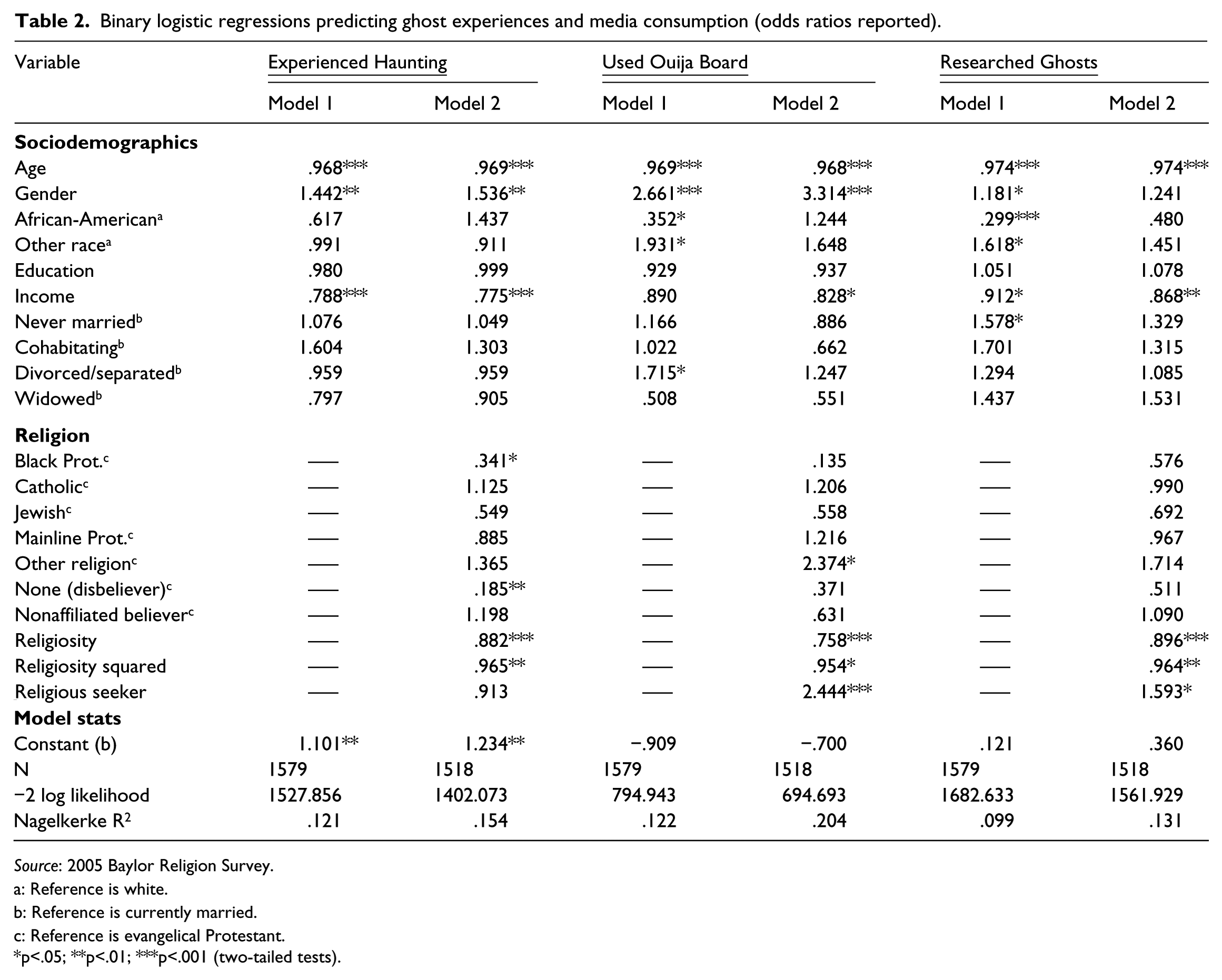
Table 2 displays the results of binary logistic regression models predicting haunting experience, use of a Ouija board, and researching ghosts. The models are again structured such that sociodemographics are entered first, then religious variables. For the sake of brevity, we focus on the final models for each outcome. Women and those with lower levels of income are significantly more likely to have experienced haunting and used a Ouija board. Those with lower incomes are more likely to have researched ghosts, while the variable for gender fell only just above statistical significance (p = .052). Black Protestants are less likely than evangelicals to have experienced a haunting, while those in the ‘other’ religion category are more likely than evangelicals to have used a Ouija board and researched ghosts. For all three outcomes, religiosity exerts a significant, negatively curvilinear effect such that individuals at mid-levels of religious practice are the most likely to report ghost experiences and ghost media consumption. Religious nones who do not believe in God are less likely to have experienced haunting, while religious seekers are more likely to have used a Ouija board and researched ghosts.
Binary logistic regressions predicting ghost experiences and media consumption (odds ratios reported).
Source: 2005 Baylor Religion Survey.
Reference is white.
Reference is currently married.
Reference is evangelical Protestant.
p<.05; **p<.01; ***p<.001 (two-tailed tests).
Notably, age is strongly and negatively significant in each of the binary logistic models. To better illustrate the effects of age, Figure 1 displays the predicted probabilities for claiming a haunting experience, using a Ouija board to contact the dead, and the consumption of media about ghosts for individuals ages 18 to 90, while controlling for all of the other variables in the second-stage models. Net of other factors, an 18-year-old American has a probability of .39 of reading about ghosts, .38 of claiming a haunting experience, and .11 of having used a Ouija board. By comparison, a 90-year-old has a .09 probability of consuming media about ghosts, .06 of claiming a haunting experience, and just a .01 probability of having used a Ouija board to contact the dead. These results are even more striking considering that older individuals have lived longer, and therefore had more opportunity to experience or consume the matters in question. Although we cannot distinguish between aging and generational effects without longitudinal data, it is evident that the youngest generation of American adults has substantially greater belief in, experience of, and interest in (religiously deinstitutionalized) spirits. Whether heightened interest in ghosts reflects the liminal nature of apparitions aligning with a particularly liminal period of life in late adolescence and young adulthood (see Evrard, 2010) or generational shifts in relation to institutional and non-institutional supernaturalism remains an open question.
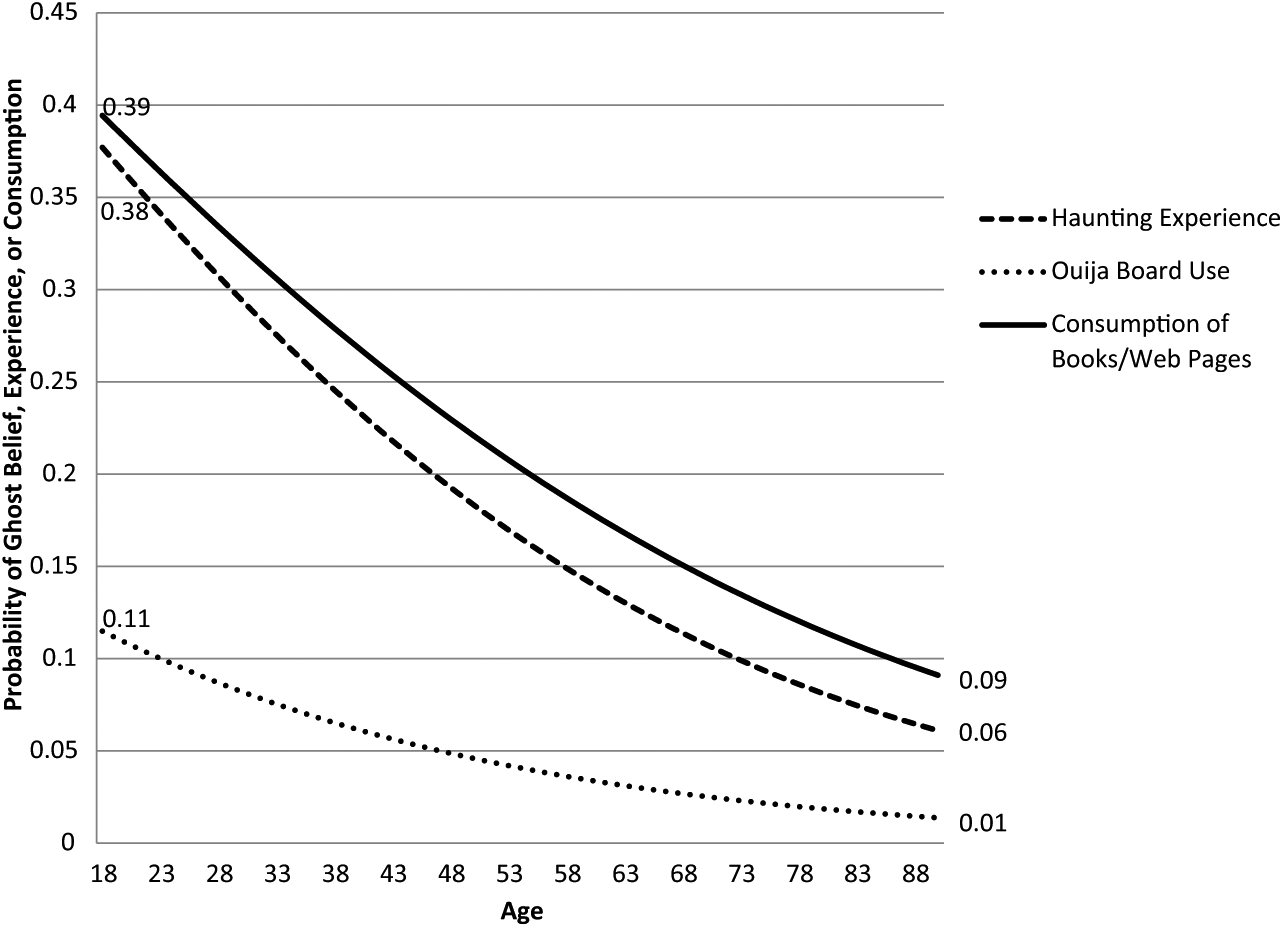
Probability of ghost belief, experience, or media consumption by age.
While quantitative analyses can tell us much about broad patterns of ghost beliefs and experiences, the inherent limitations of survey data restrict a deeper understanding of the multivalent cultural meanings of apparitions, as well as the processes by which people come to experience, believe in, and retell narratives about ghosts. To examine the cultural and interactional dimensions of ghosts in contemporary America, we must turn to qualitative fieldwork.
Qualitative data
We conducted participant observations and informal interviews with three groups dedicated to ghost hunting and other practices related to the detection of and communication with spirits. By spending time with multiple groups, we were better able to identify some of the commonalities and variations at play in ghost belief, practice, and experience. We use pseudonyms for all groups to protect the confidentiality of our informants.
The first group, which we shall call the ‘Southwestern Ghost Hunters,’ is a collection of individuals in a small Texas town united by their interest in the occult and hauntings. Our primary informants from this group included a self-identified ‘warlock,’ a medium, and a psychic. We engaged the members in a variety of informal conversations about their beliefs and practices, and accompanied them on ghost hunts.
The second group, ‘Southeastern Ghost Tours,’ is an organization offering night walking tours of allegedly haunted historical sites in the Southern Appalachian Mountains, a region rife with folklore about spirits (see Gainer, 2008; Montell, 1975; Roberts, 1988). As one of the researchers, I enrolled in its publicly available course entitled ‘Ghostology.’ After contacting the leader of the group and paying the fee to take the course, I attended the class and participated in all of the activities designed to teach students the group’s preferred method of locating and communicating with ghosts. The primary method employed by the group is divination through dowsing, a method not used by either of the other two groups studied.
The third group, ‘Appalachian Specter Investigations,’ is a group that also offers ghost tours in the same region as the Southeastern group. Because of their competition in a niche market, the two groups have a highly antagonistic relationship, and were quick to distinguish themselves from their competition. In studying this group, we attended multiple public lectures intended as presentations of their ‘best evidence’ for the hauntings they investigated. We also engaged group members in informal settings, which allowed us to ask follow-up questions about their experiences, beliefs, and methods pertaining to hauntings.
While all three groups made extensive use of technology to conduct investigations of hauntings, the Appalachian Specter group emphasized the technological elements of ghost hunting to a greater degree than either of the two other groups. Henceforward in the text we refer to these groups as Southwestern, Southeastern, and Appalachian respectively.
We employed a strategy emphasizing participation over overt observation roles during our time spent with all three groups. That is, we engaged in the group’s activities as naturally and inconspicuously as possible. When they engaged in a practice or activity, so did we, excluding things such as the bodily channeling of spirits. After leaving spaces of mutual presence, we took extensive field notes on everything that could be recalled, focusing on generating the greatest amount of detail possible, with no initial consideration for overarching narratives or themes. In instances where multiple authors were present at the same interaction, each took their own set of field notes to maximize the amount of information retained and provide multiple perspectives. After taking the initial set of notes, we subsequently coded the field notes for emergent themes, took ‘notes on notes’ (Kleinman and Copp, 1993), then narrativized our experiences in short pieces detailing the most noteworthy and interesting elements of episodic interaction with the group. All of these writings became the data analyzed to assess the common and divergent themes in the three groups.
Qualitative findings
Through our various fieldwork with ghost hunters and mediums, we identified four notable themes: appeals to science; appeals to religion and magical rites; the role of technology in constructing experience and ambiguity; and the role of narratives and ‘deathlore’ (folklore about death; see Montell, 1975) in constructing ghost belief and experience.
Scientific rhetoric
Appeals to science were generally made in an effort to legitimize both the activities and the views of ghost believers, while also problematizing the idea that we live in a disenchanted, fully rationalized world. For example, at various points throughout the ghost-hunting class, the instructor referenced quantum mechanics, parapsychology, and Stephen Hawking’s views of relativity. In each instance, science was referenced to validate claims made, while at the same time questioning conventional, rationalized understandings of reality. The instructor stated that efforts to locate and communicate with ghosts were built on theories of quantum mechanics and relativity. Experimental research shows that such appeals increase the perceived legitimacy of paranormal claims (Brewer, 2013).
Students also took photos in an effort to capture ‘ghost orbs,’ especially those with ‘Kirlian emanations,’ and were told to take multiple pictures of the same spot in order to have ‘control pictures.’ In spite of institutional science’s rejection of paranormal subjects, the appeal to and use of scientific rhetoric is a common feature of subcultures built around paranormalism (see Ben-Yehuda, 1985; Cross, 2004; Hess, 1993). By citing controversial areas of science (such as parapsychology) and fields that cast doubt on commonsense understandings of the world (such as quantum mechanics), the instructor simultaneously sought the legitimacy granted by ‘science’ and used such rhetorical appeals to cast doubt on the taken-for-grantedness of mundane reality.
Rhetoric of (deinstitutionalized) religion and magical rites
Each of our fieldwork experiences produced an understanding of the inherently syncretic nature of ghost belief. Although such views are often considered beyond the bounds of exclusive, organized religious institutions (e.g. Korem and Meier, 1980), ghost believers themselves rarely consider their beliefs to be isolated from either privatized versions of more conventional religious beliefs (especially angels and demons) or ‘New Age’ belief systems (especially astrology). While there are many people with conventional religious beliefs who hold these to be their exclusive interest in the supernatural, ghost believers tended to hold a plethora of other supernatural beliefs.
For the Southwest group, this ‘pluralism’ was expressed with reference to the bricolage of ritual practices and beliefs commonly referred to as New Age (see Heelas, 1996; Pike, 2004; York, 1995). Three members of this group maintained at least semi-regular professional activity in New Age circles through their roles as a medium, a psychic, and the entrepreneur of a small café that functioned as a meeting house for locals interested in New Age themes and services. In this group, there was virtually no discussion of traditional religious versions of supernaturalism, but there was an extensive integration of ideas from astrology, Tarot, neo-paganism, and the occult. New Age elements were used to frame hauntings, and often as a means of communicating with apparitions.
For the Southeastern group, both traditional religion and generalized paranormal beliefs and practices were integrated with belief in hauntings. The instructor of the ghost-hunting course had also experienced Sasquatch sightings and held a deep interest in UFOs and a wide variety of other ‘stigmatized knowledge’ (see Barkun, 2003). The group also offered ‘Bigfoot tours’ of densely wooded areas with reported Sasquatch sightings. Still, the course on ghost hunting opened with a traditional Christian prayer and throughout the day included claims such as ‘Jesus was the greatest metaphysician who ever lived,’ and that Jesus was able to walk on water because he understood the dynamics of quantum physics. The primary technique used to communicate with spirits was dowsing, a practice derived from magical forms of divination. The Southeastern group included the greatest diversity of cultural traditions within its domain of beliefs and practices.
In the Appalachian group, there was an emphasis on traditional Christian religious beliefs and practices accompanied by a rejection of other streams of culture, which were subsumed under the broad umbrella of the New Age or the paranormal. Indeed, the competition between the Southeastern and Appalachian groups for advantage in the niche market of ghost tours and services led to the Appalachian group drawing firm distinctions between itself and the more generalist group. This was accomplished through the use of rhetoric dismissing the ‘crackpot’ views of the Southeastern group, which incorporated elements from other paranormal subcultures such as UFOlogy. The practitioners from the Appalachian group did, however, make frequent reference to entities from traditional Christian religion, particularly Satan and demons. They claimed that there were differences between hauntings by ghosts that were the spirits of specific individuals and those that were the result of demonic activity, but they considered supernaturalism outside of ghost activity and traditional religious sources to be blatantly false.
In spite of their disagreements over the content of the symbiotic tradition(s) they were drawing on, both groups employed ritual prayers, blessings, and curses in efforts to communicate with, control, or ward off spirits. The Southwestern group used ritual protection prayers to keep their bodies from being contaminated by spirits, such that they could be in communication with apparitions without becoming completely possessed by them (see Cohen, 2009; Cohen and Barrett, 2008). The Southeastern group used ritual prayers and blessings in a similar manner, but employed them primarily as positive rites for seeking the guidance and protection of spirits. Meanwhile, the Appalachian group used ritual cleansings and exorcisms to rid places of malevolent or unwanted spirits.
While the contents of the belief systems of each of the groups were distinct from one another, they all used similar ritual means for cleansing or protection. These rites had the character of magic, where practitioners attempt to control or appease spirits through prescribed bodily movements, sacred recitations, and direct commands to the spirits. The goal is one of performing the rite in order to produce a this-worldly result (Eleta, 1997; Luhrman, 1988). In all three cases, consistent with Durkheim’s ([1912] 1995: 42) observation that ‘The magician has a clientele, not a Church,’ clients actively sought the ritual assistance of the group to produce the desired outcomes. Each group drew some of its rationale and beliefs from larger currents of religious thought – New Age/neo-pagan (Southwestern), Christian (Appalachian), or both (Southeastern) – and also employed ritual elements drawn from the realm culturally defined as magic, casting doubt on the often rigidly delineated academic distinction between religion and magic (e.g. Stark, 2001; Geertz, 1975; Hammond, 1970; Luhrman, 2012: 190–192; Tambiah, 1990). Durkheim’s distinction between clientele and community proves more useful, although this delineation can also be ‘fuzzy’ in application.
Ghosts in the machines
In all three groups, ghost experiences were vicariously channeled through a wide variety of technological media, a process fusing science and spiritualism that has been dubbed ‘techno-mysticism’ (Potts, 2004; also see Harvey, 2013). Indeed, the recent explosion of amateur ghost-hunting groups is at least partly due to the increased accessibility and affordability of the ‘necessary’ equipment, as ‘the “scientific laboratory” has also been able to be integrated into the residential-private sphere’ (Mayer, 2013: 366).
Serious ghost hunting in the contemporary West requires digital thermostats, electromagnetic field readers, AM radio scanners (‘ghost boxes’), night vision technology, and photography – moving and still – of all manner of imputations (e.g. radiographic, digital, film). Electronic voice phenomena (EVPs), where recorded aural anomalies are magnified and collectively experienced as indirect evidence of ghosts, are one of the most common evidentiary objects and techniques in spectral subcultures. This aspect of experience is collective in the sense that it is shared by believers. Rather than serving to clarify empirical reality – as might be expected from highly sensitive, technical, and empirical assessments of physical surroundings – the wash of ambiguous sensory input blurs perception, substituting the uncanny for the everyday and giving carte blanche to the imagination. 9 Instead of the body (or objects acting as an extension thereof) serving as the medium between the material and the ethereal, it is sensory data channeled and projected by various forms of technology that breaches the division. Even the individual we interviewed who most explicitly identified herself as clairvoyant and an ‘active channel’ to the spiritual realm used forms of technology such as EMF meters to search for hotspots where the voices would best be heard. At the same time, the production of data poured forth by the various forms of technology often requires individuals to play the role of the medium for the playback audience, so that a voice makes inquiries of spirits, which then allow a seeming dialogue to be deciphered at selected points on audio recordings.
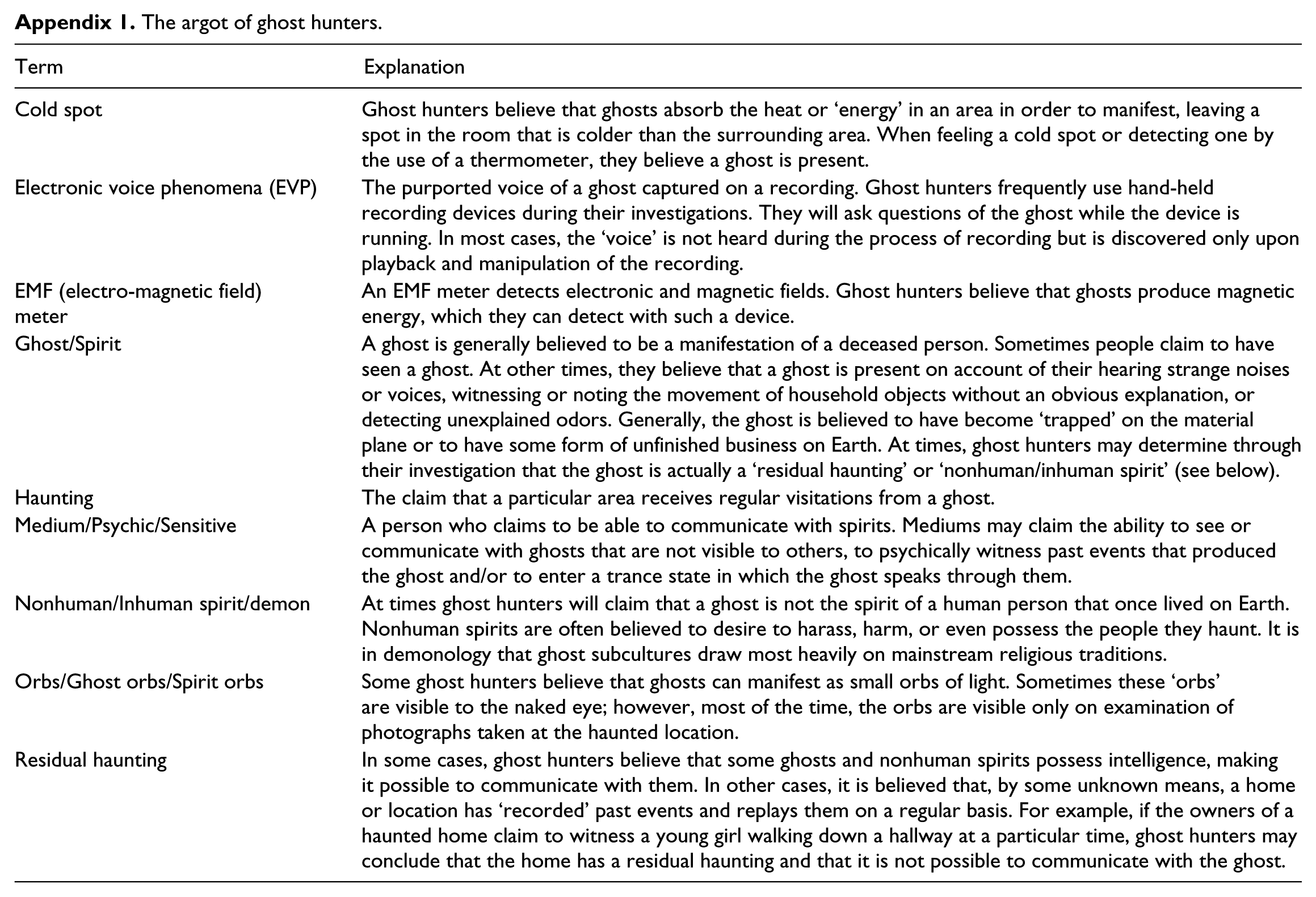
The extensive use of technology is also tied to the scientific rhetoric of paranormal investigation. The various forms of technology allow participants to take measurements, set up quasi-experimental scenarios (often combined with mediumship), and make interpretations of the data generated. The ability to derive meanings from ambiguous sensory information serves to enhance mediums’ powers while simultaneously requiring a participatory stance that affirms shared cultural frames as individuals come to an agreement about meaning (Wirtz, 2005). The ability to participate actively in this non-exclusive, democratized expression of folk science constitutes one of the primary appeals of paranormalism (Molle and Bader, 2013). Appendix 1 provides an explanation of some of the most common argot used by ghost enthusiasts, including expressions relating to the use of technology.
Narrative constructions of reality and experience
A final theme that emerged from our fieldwork was the role of narrative in ghost belief and experience. In settings where ghost belief is espoused, debated, and maintained, narrative is the central interactional feature. The particular narrative and rhetorical features of the retelling and construction of paranormal experiences have been outlined in fine detail, particularly by Bennett (1986, 1987, 1999) and Wooffitt (1992, 2006). A central feature of narratives recounting paranormal experiences is their use of rhetoric and style to neutralize preemptive or potential skeptical objections from a ‘rationalist’ point of view (Childs and Murray, 2010), although recent research suggests that this narrative feature may be uniquely Western (Ohashi et al., 2013; Delaplace 2014).
Narratives in the settings we observed took three primary forms: historical framing via deathlore, shared interpretation of empirical or narrative information (vicarious haunting experiences), and experiential recollection. Like extra-sensory ‘religious’ experiences, hauntings and apparitions are inseparable from the stories that frame them, and researchers generally have access only to narratives rather than to experiences per se (see Yamane, 2000). In each of the groups studied, historical deathlore was used to ‘set the mood’ of a haunted location, explain perceived anomalies detected via technology and experienced in such locations, and retrospectively (linguistically) reconstruct experiences; in short, before, during, and after ghost encounters.
The ghost-hunting class taught by the Southeastern group provides an instructive example. Before the class session began, the instructor told pupils deathlore about the location of the class, a historic hotel. Throughout the course, he made reference to these and other deathlore stories, introduced where called upon by the situation. The instructor also told the class that ‘historical accounts can be used to verify information obtained by dowsing.’ Deathlore was the primary rhetorical frame of haunted experience in the two other groups studied as well. For example, the Appalachian group used deathlore to frame the photographic and EVP evidence they presented. In the Southwestern group, deathlore was also central to an understanding of haunting experiences, i.e. in explaining ‘who’ was doing the haunting.
Concerning vicarious hauntings, these experiences occur in a number of ways. Some primary expressions are consumption of ghost-themed media, individual or collective assessment of information generated via technologically mediated reality, and affirmation of others’ personal narratives of ghost experiences. Consumption of ghost-themed media includes viewing movies, television shows, and web sites centered on ghosts, as well as reading about ghosts. This form of vicarious experience tends to be the most privatized, although it can clearly be shared as well. The assessment of data generated by technology occurs almost incessantly in the process of a ghost hunt, and also typically well after the event through analysis of the gathered information, such as listening for EVPs and inspecting photographic and video footage. While this process may begin individually (e.g. a person gets a spike on a Gauss meter while walking around a haunted space or hears a voice in a playback), it moves quickly to collective assessment as others are called in to confirm the evidence. Accordingly, evidence gathered through technology is often consumed in a collective setting where believers affirm each other’s views that the information is evidence of spiritual activity. This usually involves a discursive process where those who may initially be skeptical or oblivious to the evidence presented are persuaded of the data’s validity through verbal cues.
Consumption of others’ personal narratives of spectral experience is the most powerful form of vicarious experience. As with religion, people are more likely to be persuaded by the beliefs and experiences of others they know and trust than by ‘disembodied appeals’ via the media (Bainbridge, 1997), at least initially. This form of vicarious experience is so powerful that it becomes a primary fount of belief. Many people believe in hauntings primarily on the strength of the experiential testimony of trusted others. For example, when we were following the Southwestern group, a woman assisted the medium the entire night, vicariously experiencing apparitions through the commands and utterances of the medium. She told us she ‘had no special gifts’ like the medium and considered herself ‘an amateur ghost hunter at best,’ but nonetheless she believed in the medium’s power, which she fed on (and supplied credence to) by shadowing her in order to experience hauntings second-hand. As this example shows, in many cases the line between vicarious and direct spectral encounters is not absolute.
Experiential recollection of first-hand haunting experience is the bedrock of ghost belief. For believers, direct experience of apparitions is the most powerful and dramatic event that can occur to the still living. Often it is a direct encounter with a spirit that spurs individuals’ deeper interest in paranormal topics, including ghosts (Mayer and Gründer, 2011). Among individuals in all three groups, recollections of spectral encounters formed the core of what makes ghosts compellingly real and cognitively intriguing. Whether it was the self-proclaimed warlock of the Southwestern group’s experience of awaking in the night to a howling, malevolent apparition at the foot of his bed or the Appalachian group’s primary investigator’s recounting of a ritual cleansing in which light bulbs splintered into shards, personal stories of ghost encounters are the primary form of evidence believers present for the reality of apparitions. Indeed, although the Appalachian group regularly presented a wide range of technologically mediated information as evidence, personal narratives consistently held the most sway over audiences. Skeptical audience members regularly questioned the authenticity, veracity, or interpretation of mediated evidence, but never (at least in the presence of the interlocutors) questioned the legitimacy of personal encounter narratives. To do so would be tantamount to calling the narrator a liar. This ‘just so’ characteristic lends the personal narrative its central place in ghost lore (as well as in mainstream religion).
Discussion
In this mourning work in process, in this interminable task, the ghost remains that which gives one the most to think about – and to do. (Derrida, 1994: 98)
While anthropological perspectives emphasizing cognition provide clues to the prevalence of spiritual concepts and percepts, they have been rightly criticized as overlooking the emotive and experiential aspect of spirits and possession (see Espírito Santo et al., 2010). So, beyond their intuitive cognitive appeal (Boyer, 2003), what makes such beliefs so persistent and compelling? Turner’s (1969) concept of liminality, initially analyzed as a distinct phase of ritual but later metaphorically extended beyond the bounds of ritual per se (1980, 1982), provides a key theoretical insight. By definition, ghosts violate a number of binaries held as central tenets of human, and especially Western, thought. Primary examples include body/soul, life/death, past/present, presence/absence, human/inhuman, and material/ethereal. This violation of fundamental categories of thought, this ‘in-between-ness’ (liminality) lends spirits a potentially powerful cultural position (Gordon, 2008; Van Wagenen, 2004) onto which varying cultural manifestations can be projected (see Davies, 2007; McCorristine, 2010). For instance, a particular physiological experience, such as sleep paralysis, can be understood in widely divergent ways according to the experientialist cultural frame of reference (Hufford, 1982). Thus, the substantive content of spirits reflects (and acts back on) specific cultural contexts (Finucane, 1996), ranging from narrative schema about (in)human strangers (Delaplace, 2012) to renewing in-group community (Wirtz, 2007), and even to complex, ambiguous encounters between ‘us’ and ‘them’ (Giumbelli, 2014). Like substantive content, the degree and timing of the interpenetration of the material and spiritual is highly variable across cultures (Harris, 2014). Thus, spirits are a highly flexible cultural concept that produces innumerable permutations through creative narration.
The trend in the Western world toward the privatization and de-institutionalization of religion has opened up space for paranormal spiritualism to play meaningful cultural roles. As formal religion ebbs, paranormalism and informal religion flow. Across recent studies in Western countries, younger people have higher levels of belief in the paranormal than older people (Anderson, 2010; Bader et al., 2012: 716; also see Belyaev, 2011). It seems that younger generations have both considerably more interest in the paranormal and less interest in organized religion than previous generations. Studies of institutional religious involvement in the US (Schwadel, 2010) and UK (Crockett and Voas, 2006) suggest that the effects are more generational than life-course dependent.
Beyond its prevalence among general populations, paranormalism also haunts the borderlands of what is considered legitimate knowledge in numerous academic fields, including sociology (Northcote, 2004), (para)psychology, anthropology (Turner, 1993) 10 , history (Pamié, 2014), and philosophy of science (Collins and Pinch, 1982; Pinch and Collins, 1984; cf. Nickles, 1984), by materializing discontinuities in space (Bell, 1997) and time (Derrida, 1994). This points to the usefulness of analyzing the processes by which some objects and phenomena come to be classified as ‘paranormal’ for accounts of institutionalized knowledge boundaries. At the same time, innovative cultural studies scholars can use specters as a key interpretive concept in post-colonial and inter-cultural analyses (e.g. Blouin, 2013; Brogan, 1998). Meanwhile, Derrida’s (1994) talk of specters, apparitions, and ‘hauntology’ continues to ripple out from philosophy into the humanities more broadly (Davis, 2005). The liminality and transposability of the paranormal in general and ghosts in particular extend their importance beyond folk experience and belief into formalized epistemologies. Ghosts haunt multiple audiences – outside, but also inside academe.
Ghost (or analogous) beliefs and experiences are prevalent and highly flexible concepts, allowing them to exist, persist, and thrive even in ostensibly secular, rationalized cultural contexts (Bubandt, 2012; McCorristine, 2010). Their ability to transcend the constraining dualisms of modernity confers upon spirits a potential for deep literary, metaphorical, and experiential power. By existing simultaneously within and beyond time, space, and life itself, the constraints of post-Enlightenment rationality can be shattered by phantasm, at least temporarily. Rather than banishing such ‘superstition’ to the past, the crumbling façade of modernity as a totalizing project provides spirits with ample space to haunt perpetually in the present.
Footnotes
Appendix
The argot of ghost hunters.
| Term | Explanation |
|---|---|
| Cold spot | Ghost hunters believe that ghosts absorb the heat or ‘energy’ in an area in order to manifest, leaving a spot in the room that is colder than the surrounding area. When feeling a cold spot or detecting one by the use of a thermometer, they believe a ghost is present. |
| Electronic voice phenomena (EVP) | The purported voice of a ghost captured on a recording. Ghost hunters frequently use hand-held recording devices during their investigations. They will ask questions of the ghost while the device is running. In most cases, the ‘voice’ is not heard during the process of recording but is discovered only upon playback and manipulation of the recording. |
| EMF (electro-magnetic field) meter | An EMF meter detects electronic and magnetic fields. Ghost hunters believe that ghosts produce magnetic energy, which they can detect with such a device. |
| Ghost/Spirit | A ghost is generally believed to be a manifestation of a deceased person. Sometimes people claim to have seen a ghost. At other times, they believe that a ghost is present on account of their hearing strange noises or voices, witnessing or noting the movement of household objects without an obvious explanation, or detecting unexplained odors. Generally, the ghost is believed to have become ‘trapped’ on the material plane or to have some form of unfinished business on Earth. At times, ghost hunters may determine through their investigation that the ghost is actually a ‘residual haunting’ or ‘nonhuman/inhuman spirit’ (see below). |
| Haunting | The claim that a particular area receives regular visitations from a ghost. |
| Medium/Psychic/Sensitive | A person who claims to be able to communicate with spirits. Mediums may claim the ability to see or communicate with ghosts that are not visible to others, to psychically witness past events that produced the ghost and/or to enter a trance state in which the ghost speaks through them. |
| Nonhuman/Inhuman spirit/demon | At times ghost hunters will claim that a ghost is not the spirit of a human person that once lived on Earth. Nonhuman spirits are often believed to desire to harass, harm, or even possess the people they haunt. It is in demonology that ghost subcultures draw most heavily on mainstream religious traditions. |
| Orbs/Ghost orbs/Spirit orbs | Some ghost hunters believe that ghosts can manifest as small orbs of light. Sometimes these ‘orbs’ are visible to the naked eye; however, most of the time, the orbs are visible only on examination of photographs taken at the haunted location. |
| Residual haunting | In some cases, ghost hunters believe that some ghosts and nonhuman spirits possess intelligence, making it possible to communicate with them. In other cases, it is believed that, by some unknown means, a home or location has ‘recorded’ past events and replays them on a regular basis. For example, if the owners of a haunted home claim to witness a young girl walking down a hallway at a particular time, ghost hunters may conclude that the home has a residual haunting and that it is not possible to communicate with the ghost. |
Acknowledgements
We would like to thank our informants for their time and for sharing their experiences. Melissa Schrift and Michael Blouin provided insightful comments on this research and ghosts as cultural constructs. Scott Gossett generously provided assistance with translation. We are also grateful to the anonymous reviewers for directing us to helpful and relevant literature in the anthropology of spirits.
Funding
This research received no specific grant from any funding agency in the public, commercial or not-for-profit sectors.
Notes
Author biographies
Address: Department of Sociology and Anthropology, East Tennessee State University
Box 70644, Johnson City, TN, USA
Email:
 ), an online archive of religion survey data funded by the Templeton Foundation and Lilly Foundation and supported by Penn State University and Chapman. He is the author of two books, America’s Four Gods (OUP, 2010, with Paul Froese) and Paranormal America (New York University Press, 2010), and has published numerous articles and chapters on the sociologies of deviance, criminology, education, and religion.
Address: Department of Sociology, Chapman University, 1 University Drive, Orange, CA, USA
Email: