




Abstract
“The Irrelevance of Innocence” is a case study of Chicago that focuses on parking tickets that are written under false pretenses. We leverage multiple data sets against one another to demonstrate that more than one in eight tickets over a six-year span were written under conditions when restrictions did not apply. Then, we situate these findings within a multilevel framework to answer three questions: (1) Are errored tickets more likely to be issued in neighborhoods with higher proportions of Black or Latinx residents? (2) Are errored tickets more likely to be issued by patrol officers as opposed to parking enforcement officers? and (3) Does ethnoracial composition moderate the relationship between ticketing authorities and errored tickets? The implications of our findings (1) quantitatively trouble the ontological assumptions of data that are defined from a policing standpoint and (2) underscore an adjudicative process that routinely sanctions drivers without cause.
As the hiss of the street sweeper slowly slithered through residential streets on Chicago’s west side, Kimberly Brown thought little of it at the time (Thometz 2020). It was May 2020. Coronavirus disease 2019 lurked patiently around many corners. Governor J. B. Pritzker had issued a stay-at-home order to reduce the spread of the deadly virus, and Mayor Lori Lightfoot suspended parking tickets unrelated to public safety. Upon returning to her car, Brown saw an orange piece of paper that could ruin anyone’s day. Chicago’s unofficial greeting card contrasted the gray streetscape, still soaked from the wettest month on record in some 150 years. Sunbathing on her window was a notice of violation. Her car was out of compliance, allegedly parked in a restricted area during scheduled street cleaning. The Department of Streets and Sanitation would later issue a statement saying that parking tickets such as these were written in error. All these sanctions would be rendered null and void, and any payments would be refunded. The misunderstanding would be resolved for everyone involved, but it shines light on a long-standing issue in Chicago. Thousands of motorists are routinely issued parking tickets under false pretenses each year.
How might the study of monetary sanctions differ if researchers returned to the category of crime to trouble what it marks? Data represent the currency through which researchers build economies of knowledge, and they accumulate even more value with their circulation. Taking crime data at face value, however, can foreclose upon inquiries that question whether these numbers are legitimate reflections of noncompliance. Perhaps inadvertently, the common data practice of accepting these data without scrutiny adopts the ontological standpoint of policing and calcifies its authority in consequential ways. The arrangement creates an intellectual dependency between researchers and police, whereby the latter’s definition of the situation is laundered through interpretations offered by the former. Even though crime data are inscribed with a particularized “definition of the situation,” the very institution responsible for their production goes unnamed (Thomas and Thomas 1928).
There is good reason to cross-examine crime data as suspect. Those deputized with police power routinely withhold evidence, provide false accounts, and perjure themselves under oath (Reiss 1971; Skolnick 2011), particularly in Chicago (Van Cleve 2016). Those who write parking tickets exercise tremendous lawmaking authority as street-level bureaucrats (Lipsky 1980). They decide if compliance laws are broken, under which conditions, and when. Broad power is often justified on the basis that on-the-job decisions are rarely made under conditions of straightforward legal standards. Yet discretion can vary according to a host of contingencies, from perceptions of neighborhood disorder to occupational differences in policing to cross-level interactions between these factors. With our case study, the study of fines and fees is advanced by naming assumptions that factor into crime data, highlighting their limits by corroborating them against outside data, and grounding these data within a multilevel framework that discerns key predictors of tickets issued in error. Three questions are answered by our study:
Are parking tickets written under false pretenses more likely to be issued in neighborhoods with proportionally more people of color?
Do occupational differences in policing (patrol officers vs. parking enforcement officers) influence the odds that a ticket is improperly written?
Does a neighborhood’s ethnoracial composition moderate the relationship between occupational differences in policing and the odds of being issued an erroneous ticket?
The Parked Car: Finding a Spot in the Literature
Why study parking tickets? Street parking is something that, at once, blurs the lines of what is public and private. Although cars are often seen as extensions of independence and freedom, their occupancy of public space represents a regulatory matter. The sheer volume of space devoted to parking makes it no trivial matter in defining key questions of how state power intervenes people’s lives (Seo 2019). As much as 36 percent of all surface land in Chicago’s central business district (CBD), for example, is parceled for parking (Manville and Shoup 2005). Any violations of parking restrictions and prohibitions are subject to pecuniary penalties. Parking tickets are more akin to fines and fees of the criminal-legal system than other common debts such as student loans or home mortgages (cf. Seamster and Charron-Chénier 2017; Taylor 2017). They represent a coerced point of entry into financial obligations that are neither voluntarily accepted nor necessarily planned (see also Pattillo and Kirk 2021).
A focus on parking tickets represents a move within research on monetary sanctions to uncover how authorities outside the criminal-legal system impose fines and fees beyond felony and misdemeanor conviction (cf. Harris, Pattillo, and Sykes 2022; Martin et al. 2018). We argue that expanding what is known about these tickets is vital to building a more complete theoretical picture of monetary sanctions because administrative law implicates more people than does criminal law, though the two domains are increasingly intertwined (Beckett and Murakawa 2012). Whereas the Cook County State’s Attorney Office annually refers just under 500,000 cases for criminal prosecution, for example, the City of Chicago issues between 2.5 million and 3 million parking tickets within a jurisdiction of less than half the county population. In fact, these tickets are frequently more than 20 times the order of yearly traffic stops that are documented by the Chicago Police Department, an encounter some researchers describe as the epicenter of police encounters (Baumgartner, Epp, and Shoub 2018; Epp, Maynard-Moody, and Haider-Markel 2014). With these numbers in mind, we suggest that the centering of parking violations can recalibrate what researchers know about a key modal experience of pecuniary justice.
We ask whether ticketing patterns are shaped by the relationship between a neighborhood’s ethnoracial composition and occupational differences in policing. Much of the emphasis within established literature on monetary sanctions highlights the role that clerks, judges, and probation or parole officers play in imposing fines and fees (e.g., Gordon and Glaser 1991; Harris, Evans, and Beckett 2011), but notably absent from these important inquiries are police: the initial point of contact with the legal system. To the extent that policing is a language spoken in a specific geometric dialect, then officers may speak a street-level fluency whereby the vehicles most legible to them are those parked in communities defined by disorder. Already studies have verified that communities with greater Black or Latinx representation tend to generate larger levels of fines and fees relative to communities with mostly white residents (Brazil 2020; Henricks and Harvey 2017; Sances and You 2017). However, what researchers know about the determinants behind these sanctions is limited to high units of aggregation such as cities, wards, and block groups. Such inquires obscure how variation in sanctions can be stitched together by multilevel threads that can be disaggregated to issuing officers and their situated context.
Does a Neighborhood’s Ethnoracial Composition Shape the Odds of Error?
Parking tickets are situated within a broader context of policing strategy that obsesses over the street aesthetic: broken windows (Wilson and Kelling 1982; see also Shoup, Yuan, and Jiang 2017). The underlying logic of broken windows is straightforward. Small symbols of disorder lead to larger crimes when they are left unchecked. If disorder can be contained, then strategists are able to insist upon targeted surveillance of low-level offenses in the name of maximized efficiency. That is, they can justify differential approaches to policing that varies within a jurisdiction (Paulsen and Robinson 2004). As long as “hot spots” of crime can be identified, police chiefs can concentrate their resources and plan where to patrol accordingly. Uneven geographies of surveillance result from, as the narrative goes, evidence-based claims that some neighborhoods have greater propensity toward crime than do others. In other words, these data-driven decisions that mark areas as high or low risk follow a self-fulfilling prophesy that directly determines the possibility of police encounters and subsequent criminal justice involvement.
Because crime statistics are frequently taken to reflect criminal behavior, as opposed to the policing project that produces them, officers tend to be disproportionately assigned to communities with more Black residents (Parker, Stults, and Rice 2005; Stults and Baumer 2007). Officers assigned to majority-Black neighborhoods, especially white ones, often define what they see in these spaces within a racist vocabulary of disorder (LeCount 2017). Not only are Black neighborhoods believed to be more dangerous than white ones (Chiricos, McEntire, and Gertz 2001; Quillian and Pager 2001), but these communities are frequently stigmatized even when visual cues of disorder (e.g., abandoned cars, graffiti, panhandling) are absent altogether (Sampson and Raudenbush 2004). Perceptions of disorder help explain why police deploy more aggressive enforcement techniques in majority-Black spaces than their white counterparts (Bohon and Ortiz 2021; Roh and Robinson 2009). Perhaps this same stigma applies to parked cars in mostly Black neighborhoods, even for those vehicles that are in compliance.
Hypothesis 1: The odds of receiving an errored ticket will increase as a neighborhood is composed of proportionally more Black residents.
Are Patrol Officers More Likely Than Parking Enforcement Officers to Write Tickets in Error?
Among the two primary ticket-writing agents in Chicago, 1 we suspect that patrol officers are more likely than parking enforcement officers to be error prone. Patrol officers generally detest ticket work as a low-level detail, if not a duty reserved for punishment, because it stands in contrast to how they see themselves (Rubinstein 1973). Officers tend to describe their vocation with an emphasis on threat neutralization (Carlson 2020), but parking violations rarely pose any clear and pressing danger. Writing a parking ticket is a clerical task (i.e., the feminized labor of “paperwork”) that is devalued as irrelevant to the central mandate of police (Herbert 2001; Hunt 1990), and parking violations represent police work that is distanced from spectacular crimes such as assault, murder, rape, and robbery (Chambliss 1967). Because crime control over these paradigmatic offenses is frequently upheld to define policing, patrol officers demean parking enforcement as menial if not unimportant work (Bittner 1970). Such low valuation of ticket duty can have deleterious effects on the relative odds of issuing invalid citations between patrol officers and parking enforcement officers, whose job is defined to writing tickets alone.
The second reason we suspect patrol officers are more likely to issue tickets under false pretenses regards a hierarchy of autonomy. Whereas patrol officers answer to the Chicago Police Department, parking enforcement officers answer to the Department of Finance or the Department of Streets and Sanitation. Patrol officers can be distinguished from other street-level bureaucrats in their legal capacity to exercise legitimate violence (Bittner 1970; Brown 1981). Their exclusive claim to violence, combined with a job description that is defined by its proximity to danger, allows police to assert a license to commit otherwise forbidden acts with little consequence (Neocleous 2021). Chicago’s Fraternal Order of Police (Lodge #7) routinely cites these factors when insisting, through collective bargaining, to be free of external oversight as a condition of employment (Correia and Wall 2018). Judged by standards of exceptionality, these circumstances preemptively flatten any possibility for an exchange among equals since police and nonpolice engage one another on incommensurable terms. Therefore, patrol officers inhabit a prerogative power that allows them to operate beyond a higher point of legal restraint relative to parking enforcement officers.
Although we expect patrol officers are more likely than parking enforcement officers to write improper tickets, let us acknowledge that some ticket patterns may be traceable to a small fraction of rogue agents or “bad apples.” One Chicago ticketing agent, for example, recently made headline news after gloating on social media about how many citations he issued: “I’ve written more tickets in 5 days than some people in my department write in a month. 744 tickets equals [sic] $62,905 in generated revenue for the city budget” (quoted in Spielman 2017). Those scholars who evoke the bad-apples metaphor distinguish between situational from institutionalized patterns of police misconduct, and they do not view malpractice as an endemic feature of policing (e.g., McElvain and Kposowa 2008; Paoline and Terrill 2007). Officers who flout the rules represent the proverbial rotten apples who can be isolated and separated from the otherwise flourishing bunch (Rozema and Schanzenbach 2019). Whether disparities between patrol officers and parking enforcement officers are robust to these extreme cases is a question we take up in the models to come. We suspect disparities between patrol officers and parking enforcement officers will persist after accounting for officer-level variation.
Hypothesis 2: The odds of an errored ticket will increase when issued by a patrol officer relative to a parking enforcement officer, even when high-disparity officers are held constant.
To What Extent Does Ethnoracial Composition Moderate Occupational Differences of Error?
Although our first two hypotheses anticipate that errored tickets are more likely to be issued (1) in neighborhoods with greater Black representation and (2) by patrol officers relative to parking enforcement officers, let us suggest that there may be a crossover interaction at play when one considers the relationship between Latinx neighborhoods and parking enforcement officers. Much of Chicago’s undocumented population, which comprises some 183,000 mostly Latin American migrants (85 percent), resides in majority-Latinx communities (Tsao 2014). To the extent that parking enforcement officers work in a revenue-maximizing capacity, they can leverage a political climate that fosters a lurking threat of deportation to their occupational advantage (De Genova 2002). Tickets for those without legal status can invite unwanted attention from police who are viewed, with good reason (Armenta 2017), as gatekeepers of an immigration dragnet. Even those with established legal residency are fearful of becoming targets of immigration practices that might lead to their expulsion (Asad 2020). These conditions can incentivize many in Latinx spaces to pay their tickets outright even when issued under false pretenses. Payment preempts additional punishments (e.g., late penalties, collections fees, impoundment), collateral consequences (e.g., barred city employment, state tax return interception), and other criminal-legal involvements (e.g., license suspensions).
Even though parking tickets underwrite public services like other taxes, they represent a form of “taxation by citation” that allows policy makers to eschew sheer mention of the “T word” in a political environment defined by antitax sentiment (Martin 2018). As opposed to unpopular tax hikes that can be blamed on policy makers, parking tickets can be issued in ways that redistribute, if not outsource, the financial liability of who pays for state capacity. The ticketed become not only suitable but deserving marks of sanction. Seen through a veneer of personal accountability, parking tickets become the justifiable consequence of bad judgment or defiance of the rules. From a patrol standpoint, tickets can be targeted to neighborhoods of concentrated vulnerability, through what Pacewicz and Robinson (2021) label “pocketbook policing,” whereby those without political voice are collateralized for extraction (see also Page and Soss 2021; Sanchez et al. 2022). Many drivers in Chicago’s Latinx spaces, specifically, can be seen as nonconstituents with little recourse against errored tickets, making their money ripe for the taking by parking enforcement officers whose main purpose is to maximize revenue.
Hypothesis 3: The odds that a parking enforcement officer, relative to a patrol officer, will issue an errored ticket will increase as a neighborhood is composed of proportionally more Latinx residents.
Alternative Explanations for Errored Tickets
Although understanding how ethnoracial representation and occupational differences in policing affect errored tickets is our central goal, alternative explanations are considered in the analysis to come. Most tickets get issued when drivers are absent from the scene, meaning that they represent nonmoving violations where cars sit as stationary props within the streetscape backdrop. Therefore, citation practices may be as much a reflection of the neighborhood as anything else, and neighborhood characteristics vary considerably from one place to the next. Parking restrictions can differ between residential and commercial districts. Some communities experience higher parking demand (e.g., proximity to the lake). People have differential access to public transit on the basis of where they live, creating spatially uneven demands for car ownership. All these factors point to a common theme: the built environment. It proscribes what ticketing practices are possible. These spatial conditions, however, do not exist in a vacuum (Sampson 2012). Frequently associated with them are features of the resident population. Thus, any statistical association between flawed tickets and neighborhood composition, on one hand, or patterns of policing, on the other hand, should disappear after accounting for these measures.
The City of Chicago: A Case-Study Approach
Why center Chicago as a case study? The city has led policy change later throughout the country in terms of monetizing its street networks and expanding regulatory enforcement (Ashton, Doussard, and Weber 2016). Census data show that Chicago’s fines and forfeits have grown by more than 300 percent since the late 1970s, even as the population declined (see Figure 1). The growth trend began during the early 1990s, after Richard M. Daley was inaugurated mayor. Daley turned to these sanctions as a means, he claimed, to offset traditional revenue streams such as property taxes. During a special meeting of the City Council, he explained,“There’s a limit to what we can ask of local taxpayers. And that’s why we’re putting even more muscle into collection of fines and fees next year” (City of Chicago 1992:10).

Fines and forfeits during the post–Richard J. Daley era.
The muscle included working with the State of Illinois to identify drivers without annual city stickers, aggressively pursuing those with delinquent debt through “boot and tow,” and doubling the daily storage fees for impoundments. Money from fines and fees now contributes well over $300 million, or 3 percent to 4 percent of revenue, to the City’s treasury each year. Rather than imply that Chicago profits from fines and fees, however, we suspect that most of these proceeds are funneled back into the system for its own bureaucratic preservation (see also Harris 2016).
Consistent with neoliberal trends of transforming public provisions to deliver “returns on investment” (Friedman, Fernandes, and Kirk 2021; Soss, Fording, and Schram 2011), much of the city’s ticketing regime has been privatized through costly contracts with corporate interests such as United Road Towing, IBM, and Chicago Parking Meters. The partnership between Chicago and IBM, specifically, is of substantive importance to our inquiry. Since 1998, IBM has provided the city with a centralized, real-time record-keeping technology (known as CANVAS, the Chicago Adjudication, Noticing, and Violation Administration System). At a current price tag of $18.8 million per year, the system’s main purpose is to fulfill all ticket processing needs. IBM sealed its relationship with Chicago by making numerous promises to these ends, one of which included a pledge to reduce the issuance of bogus tickets such as the one Kimberly Brown received (Spielman 2012). Keeping this arrangement in mind, the timeline of our analysis aligns with citation practices that span the ongoing contract. We begin with tickets that were issued on August 1, 2012 (i.e., the contract start date), and end with tickets issued through May 18, 2018 (our most current data).
What Data Did We Consult?
Our study synthesizes (1) ticketing data from ProPublica with (2) parking regulation information from Chicago’s Department of Streets and Sanitation, Department of Transportation, and Office of the City Clerk. The ticketing data consist of public records obtained from Chicago’s Department of Finance. Because these data only include information on tickets issued and who issues them, they are joined with Department of Streets and Sanitation, Department of Transportation, and Office of the City Clerk sources that contain data on parking restrictions. For neighborhood-level information, we turn to (3) sociodemographic data from the Census Bureau’s American Community Survey. These are five-year estimates from 2013 to 2017, and neighborhoods are defined as tracts to remain consistent with much of the Chicago-focused literature on crime. We control for (4) features of the built environment using data from the Census Bureau’s TIGER/Line Shapefiles, the Chicago Teachers Union, the Chicago Transit Authority, and the Illinois Department of Public Health. Although the ticket-level data are nested within the officer and tract units of measure, officers and tracts share a partially crossed data structure. Ticketing officers, for example, are not confined to neighborhoods. Altogether, we capitalize on this hierarchal data structure to explore the extent that parking tickets are written under false pretenses, which police authorities issue these sanctions, and what sociospatial contexts situate these encounters. Specifics for how we operationalize all variables, plus their descriptive statistics and sourcing information, are available in Table 1.
Overview of the Considered Measures in the Final Models.
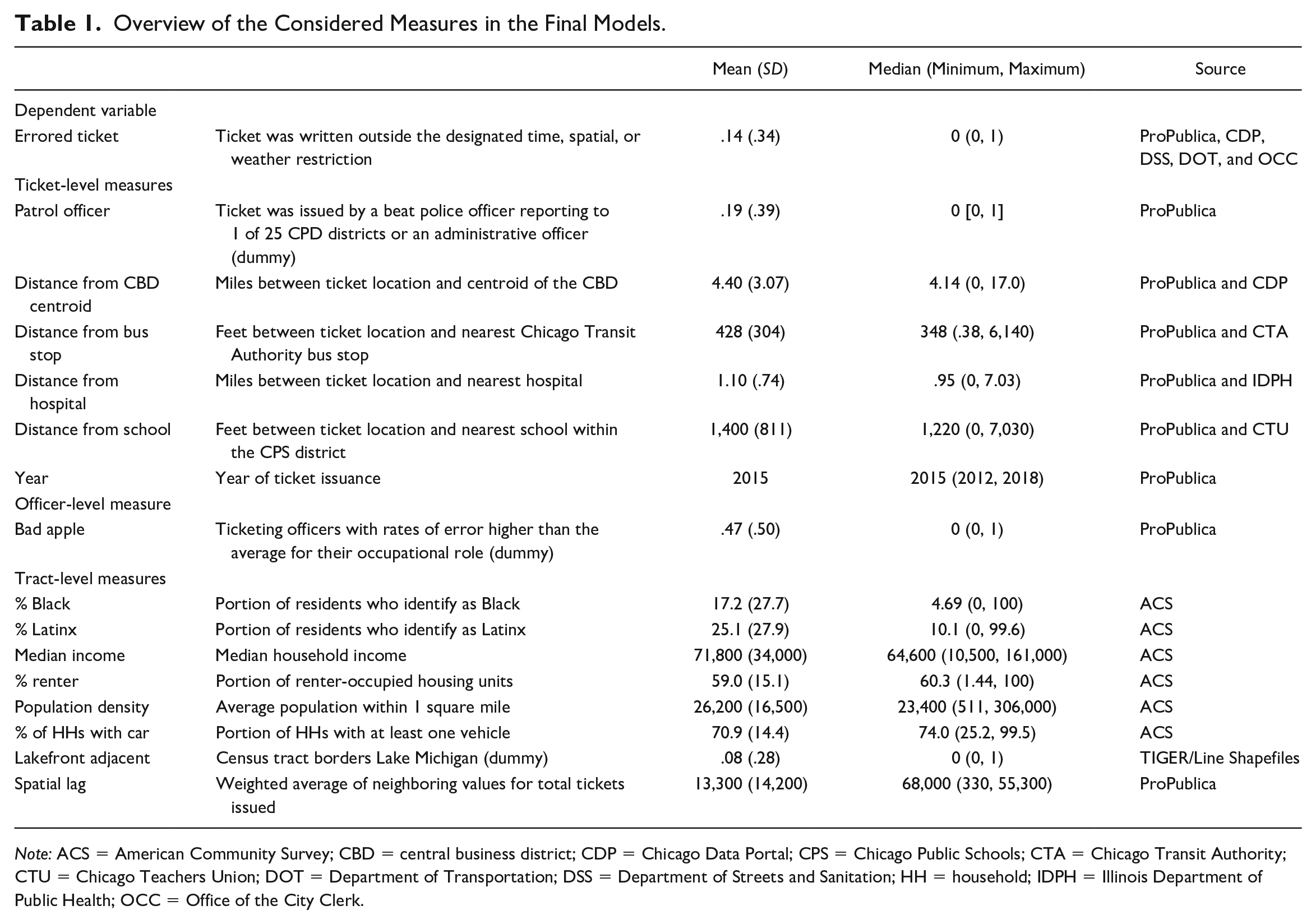
Note: ACS = American Community Survey; CBD = central business district; CDP = Chicago Data Portal; CPS = Chicago Public Schools; CTA = Chicago Transit Authority; CTU = Chicago Teachers Union; DOT = Department of Transportation; DSS = Department of Streets and Sanitation; HH = household; IDPH = Illinois Department of Public Health; OCC = Office of the City Clerk.
The Calculus behind Our Quantification of Error
Many of Chicago’s parking restrictions are not hard-and-fast rules. The dizzying maze of signs instructing drivers to park here, but not there, communicate as much. They say who belongs in what spaces and under which conditions, telling drivers where to park and when. Our study identifies seven types of violations that specify circumstantial conditions of compliance. 2 When one considers that the City of Chicago maintains much administrative data that can (dis)confirm the pretext for noncompliance, through some detective work it becomes possible to recreate the proverbial scene of the crime. To verify if a snow-route ticket was issued when there was accumulation, for instance, we cross-referenced records from the Department of Streets and Sanitation that detail snowfall levels for plow deployment. For violations of parking in restricted residential space, we triangulated these tickets against zoning information maintained by the Office of the City Clerk. For tickets issued for parking in areas reserved for special events, we turned to permits maintained by the Department of Transportation. Altogether, the methods novelty offered by our research design is that it does not defer to officers and accept without question their definitions of censure-worthy situations. The strategy is one that rises to recent calls for alternative modes of knowledge production that are dislodged from a policing perspective (Brown and Schept 2017).
We suspect that there could be, and often is, a mismatch between what officers record as infractions and the corroborating evidence available to contradict their claims. Table 2 outlines our coding strategy for each ordinance of interest. The ticket-level data were georeferenced using Geocodio, a service that translates street addresses into latitude and longitude coordinates. Not only do these coordinates allow areal units (e.g., wards, ward sections, census tracts) to be appended for each case, but they permit a measure between where a ticket was issued and its proximity to features of the built environment. Geocodio triangulates multiple data sources (e.g., Census Bureau, OpenAddress, OpenStreetMap, GeoNames) to pinpoint precise locations, and it recommends using results with accuracy scores of 80 percent or above in academic research. These accuracy scores reflect differences between input and output, and scores of at least 80 percent indicate that minor changes were made because of problems such as formatting issues. Only those cases that surpass this threshold remain in the final analysis. Among the ordinances of interest, our final sample retains 98 percent of the original tickets issued between August 1, 2012, and May 18, 2018.
The Coding Procedure for Ticket Validation by Violation Type.

Note: CBD = central business district; CDP = Chicago Data Portal; DSS = Department of Streets and Sanitation; DOT = Department of Transportation; OCC = Office of the City Clerk.
How Many Errors Are We Talking About?
There is not one Kimberly Brown in Chicago. There are many. Over a six-year period, a total of 475,106 of the 3,590,005 tickets (13.2 percent) we reviewed were issued under false pretenses. One ordinance, in particular, is driving this error. March may leave like a lamb, but April hits Chicago like a street sweeper (Figure 2). Not only are $60 street-cleaning tickets among the most frequently issued out of all tickets in Chicago, but they had the largest volume of error. As many as 313,983 street-cleaning tickets were issued outside the (1) months of scheduled cleaning (April to November), (2) designated cleaning days (which vary by ward section), or (3) reserved cleaning times for commercial (7 a.m. to 9 a.m.) or residential (9 a.m. to 2 p.m.) streets. 3
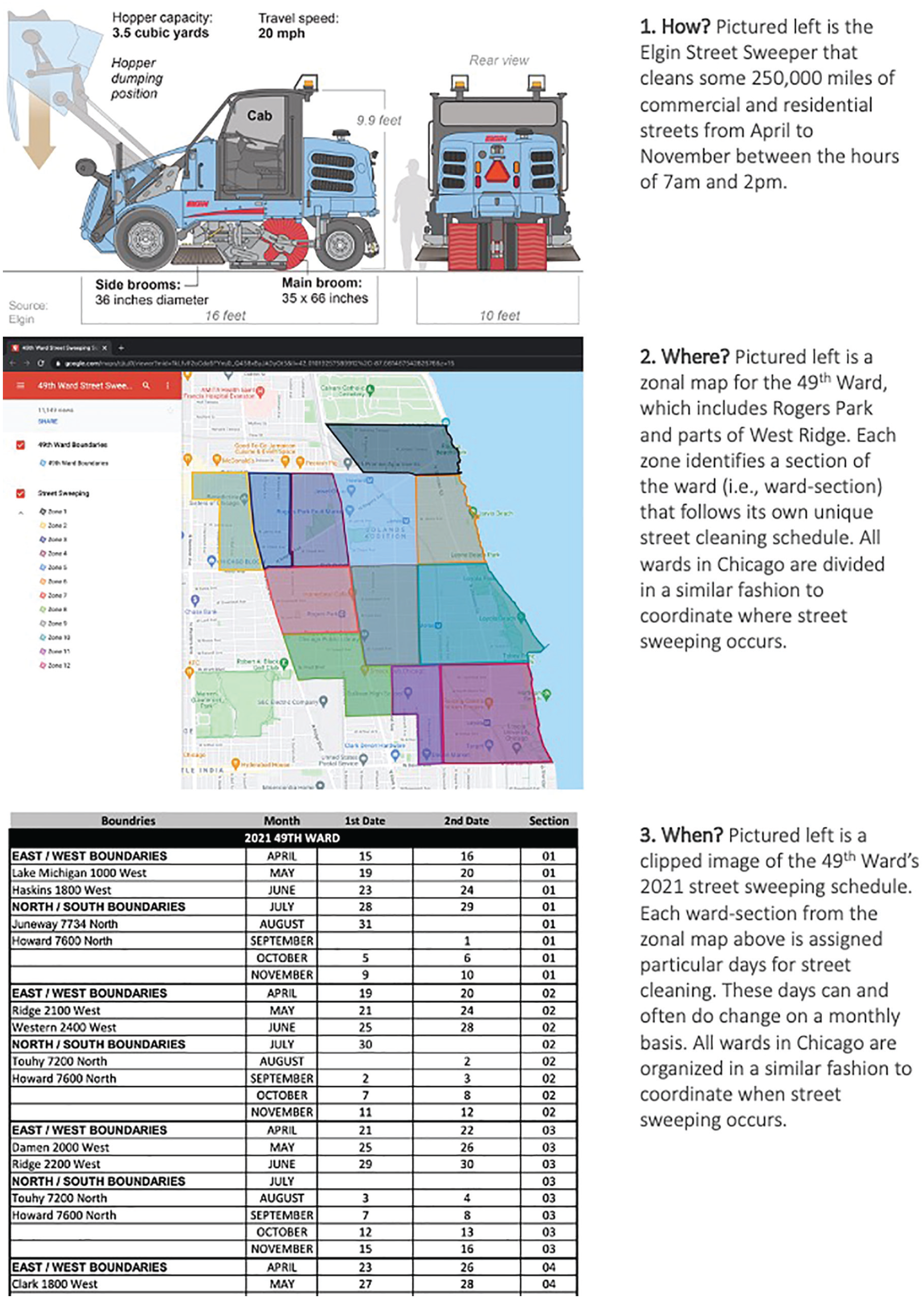
How is street cleaning coordinated in Chicago? An example from the 49th Ward.
Parking in a restricted residential zone makes up the next largest number of errors. These restrictions apply to specific residential zones where curbside parking requires an additional $25 permit on top of the annual city sticker. Out of the ordinances considered, these came with the steepest financial penalty ($75). We found that 101,286 tickets were written outside of 1,763 unique residential zones, which altogether cover about one quarter of the city’s geography.
The third most common errored ticket involved parking at an expired meter in the CBD (see also Chapman 2019). These CBD-specific tickets are more expensive than the more general expired-meter tickets that apply throughout the remainder of the city. As opposed to the typical $50 fine, they come with a penalty of $65. When we plotted these citations on a map, we found that 38,292 could be georeferenced outside the CBD. Even if all these tickets were rightfully issued to cars parked at expired meters, the $15 difference between the general and CBD-specific fines nets Chicago another $574,380 in revenue.
Special-events tickets make up the fourth most frequent error. These $60 citations involve restrictions for temporary street impacts, ranging broadly from annual block parties to the filming of popular Chicago-based shows such as Shameless to health and wellness events such as the Chicago Marathon. We find that 13,086 tickets were issued at least one city block, or 660 feet, from a special event approved by the Department of Transportation or outside the permit’s designated times of parking restriction.
Coming in with the fifth most errors are winter-ban tickets. The official line from City Hall is that this ban ensures that streets will be plowed and accessible to emergency vehicles during snow events (Ramos, Hagan, and Howard 2016). These $60 tickets frequently come with an additional $150 towing fee plus a $20 to $35 daily storage fee. They represent violations of an overnight winter parking ban on some 100 miles of streets, spanning December 1 to April 1 between 3 a.m. and 7 a.m. We found that 6,045 of these tickets were issued either (1) outside the times of restriction or (2) at least one city block removed from a winter-ban route.
Two-inch snow-route violations make up the next most common type of error. Even though these $60 tickets also come with additional towing and storage fees, citations that fall under this ordinance are different from the overnight winter ban. They apply year-round to more than 500 miles of arterial streets, but only when snow meets or exceeds two inches. As many as 2,345 tickets were written either outside of a recorded snow event (plus a three-day grace period to account for major blizzards) or beyond a one-city-block radius of a two-inch route.
Among all the ordinances reviewed, the $60 citation for no parking in the Loop was the most infrequent. However, these violations also had the highest rate of error. We found that 69 of the 88 “no Loop parking” tickets issued could be georeferenced outside the Loop in neighborhoods as distant as the city’s far south and northwest sides. In sum, Figure 3 overviews the complete scope of the problem in Chicago, totaling how many tickets were issued by ordinance, the rate of error, and how many errors were committed.

The frequency and scope of tickets written in error by violation type.
The Inescapability and Clustering of Errored Tickets
Where are errored tickets issued? The short answer is everywhere. Like grains of sand that cling to your body after a beach day at Lake Michigan, these tickets find their way into every nook and cranny of Chicago. Between 2012 and 2018, errors were committed in 793 of Chicago’s 801 tracts. Six of the remaining tracts either extend beyond city limits or overlap with major airports. Despite their presence across neighborhoods, however, errored tickets cluster in space. When Moran’s i is calculated to estimate the distribution of errors across neighborhoods, we obtain a value of 0.31 (p < .001), indicating a moderate degree of spatial dependence.
The cluster map presented in Figure 4 decomposes Moran’s i to the local level, indicating pockets of “hot” and “cold” spots. A cluster is defined as a focal tract alongside those neighbors that share a border (i.e., a queen-based contiguity). When a tract is flagged as significant (p < .05), it is categorized into one of four possible cluster types. High-high indicates positive autocorrelation, with high numbers of errored tickets among a tract and its neighbors. High-low indicates negative autocorrelation, with high numbers of errored tickets among a tract surrounded by neighbors with low numbers. Low-high indicates negative autocorrelation, with low numbers of errored tickets among a tract surrounded by neighbors with high numbers. Low-low indicates positive autocorrelation, with low numbers of errored tickets for a tract and its neighbors.

Local Moran’s i for the geography of errored tickets.
As many as 73 neighborhoods fall into the high-high category, 2 into the high-low category, 14 into the low-high category, and 237 into the low-low category. Hot spots of error (µ = 2,238, σ = 1,831), indicated in red, cluster on the far north side as well as the near northwest and southwest sides. They overlap with spaces overrepresented by Latinx or white residents. Indicated in blue are cold spots (µ = 109, σ = 84) on the far south side as well as the west and far northwest sides. Whereas the far southside communities consist mainly of Black residents, those on the far northwest side consist mostly of city employees (e.g., firefighters, police officers).
Multilevel Modeling: A Turnkey Approach
Moving from a univariate to multivariate framework, we follow a turnkey modeling procedure (see Table 3). It begins with a null model to verify if a multilevel approach is needed. This model estimates what proportion of errored tickets are explained by tract- and officer-level variation. Then, we specify two intermediate models in which (1) direct effects are disentangled at the ticket and neighborhood levels (i.e., a random-intercept and fixed-slope [RIFS] model) and (2) the need for a cross-level interaction term is confirmed (i.e., a random-intercept and random-slope [RIRS] model). Finally, we model a cross-level interaction to determine if ethnoracial composition moderates the relationship between occupational differences in policing and erroneous ticketing.
The Turnkey Modeling Approach to Multilevel Logistic Regression.

Table 4 summarizes our findings. For ease of interpretation, we group-mean-center our ticket-level measures by tract. Doing so moves the unit of reference to the neighborhood level, and the ticket-level regression coefficients refer to the change in odds for a typical tract. Although this transformation changes the data structure, it also causes the ticket- and tract-level measures to be uncorrelated, yields more accurate estimates of within-tract slopes, and reduces the possibility of spurious cross-level interactions. Throughout our analyses, we performed diagnostics to confirm that the models are free from misspecification. These multilevel models were completed using the glmer package in R, where the BOBYQA algorithm (i.e., a quadratic approximation) was applied to balance concerns of processing and convergence. Cases with missing data (2.3 percent of the 3,590,005 cases) were excluded from the models.
Multilevel Logistic Models for the Odds of Being Issued an Errored Ticket.

Note: A total of 3,508,020 (n) parking tickets are nested in 793 tracts (k). All main entries are presented as odds ratios with standard errors in parentheses. Any measures not dichotomously coded are standardized as z scores. These models include only those cases with complete information. AIC = Akaike information criterion; CBD = central business district; FIML = full information maximum likelihood; HH = household; ICC = intraclass correlation coefficient.
p < .05. **p < .01. ***p < .001.
The Null Models
We begin with a null model to determine if a multilevel approach is appropriate. It estimates the proportion of variance in the odds of being written an errored ticket, rather than not, that lies between different units of analysis. As a supplement to the empty model, we calculate the intraclass correlation coefficient (ICC) to quantify what proportion of flawed tickets is accounted for by differences at the neighborhood and officer levels. The ICC ranges from 0 to 1, where the former represents perfect independence of residuals and the latter represents perfect interdependence. Even with small values, however, standard errors and significance tests can be compromised with hierarchal data. The tract-level ICC indicates that neighborhood differences account for 20 percent of the variation in errored tickets, while the combined tract-officer ICC indicates that as much as 79 percent of variation is explained by differences at these levels. These results confirm that a multilevel model is preferred over a single-level regression.
The Intermediate Models
Having confirmed that multilevel models are appropriate, we specify a pair of intermediate models: the RIFS model and the RIRS model. These models disentangle effects at two different levels of analysis: (1) cross-level effects at the neighborhood level and (2) lower level effects at the ticket level. By measuring cross-level effects, we return to our first research question: are erroneous tickets more likely to be issued in neighborhoods with greater Black representation? By measuring lower level effects, we take up our second question: are patrol officers more likely than parking enforcement officers to issue tickets in error, even after controlling for high-disparity officers? Answers to both questions are visualized as a forest plot in Figure 5.
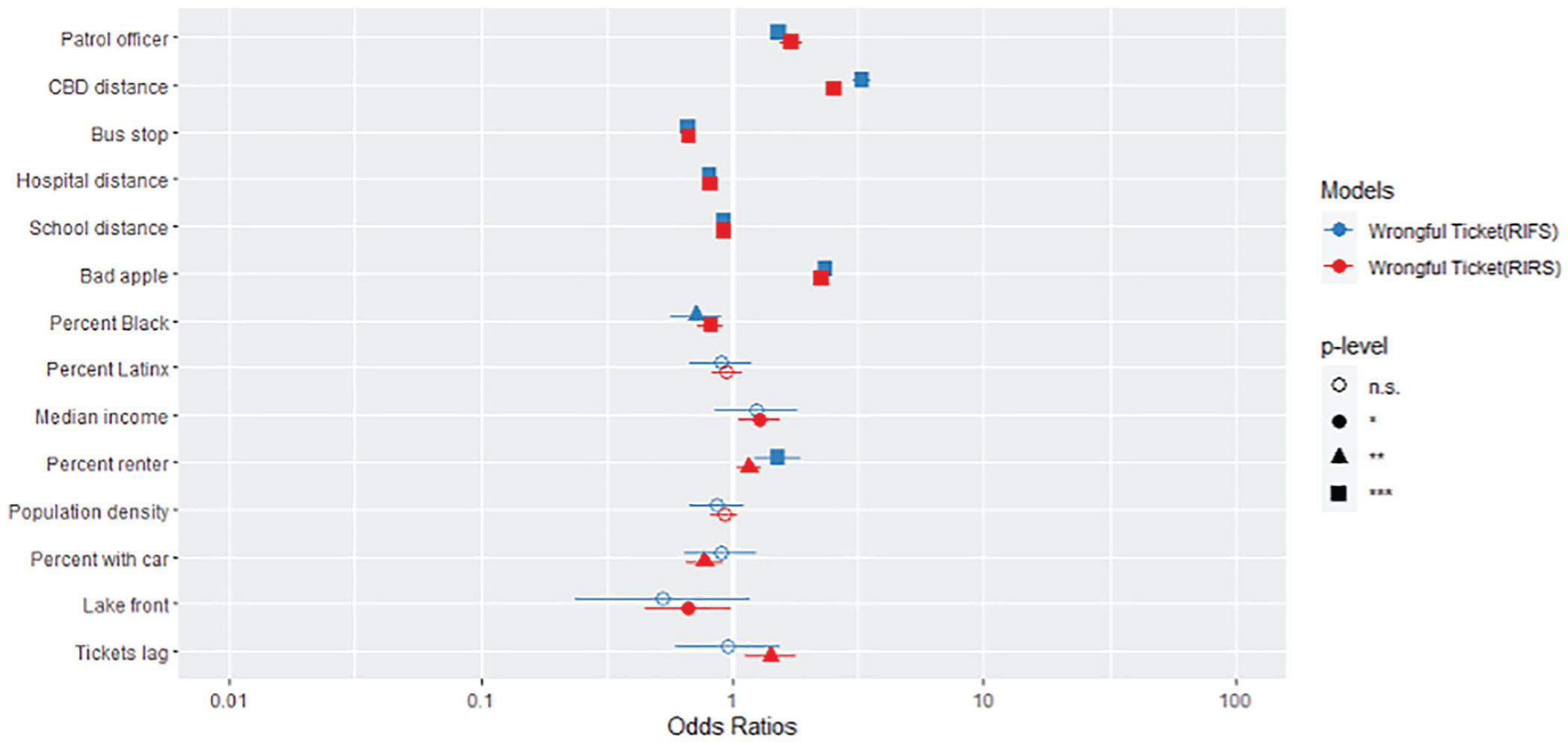
Direct effects at the ticket and tract levels for the odds of being issued an errored ticket.
Are Black Neighborhoods More Likely to Be Ticketed in Error?
The RIFS model estimates the degree that cross-level effects are present among neighborhood-level measures. If neighborhood-to-case effects are present, these findings explain some of the higher order variance of the intercept measured in the null model. The model makes legible, in other words, the context in which tickets are issued. Given how Blackness proxies for disorder (Chiricos et al. 2001; Quillian and Pager 2001; Sampson and Raudenbush 2004) as well as the aggressive overpolicing of majority-Black neighborhoods (Parker et al. 2005; Roh and Robinson 2009; Stults and Baumer 2007), we expect the odds of error to increase as the percentage of Black residents also increase. Our model predicts the opposite. Other factors held constant, cars parked in neighborhoods with greater Black representation are less likely than their non-Black counterparts to be ticketed in error (odds ratio [OR] = 0.72, p < .01). The odds decline by 18 percent for each standard deviation increase in a neighborhood’s Black population.
Even though police are the face of government most familiar to communities of color (Soss and Weaver 2017), we find that errored tickets democratize the dispersal of discipline in ways that drain resources beyond the usual suspects of crime control (Cohen 1979). Of the flawed tickets we identified, for example, 38 percent were issued in neighborhoods where at least half the residents identified as white. Only 21 percent of these tickets were issued in majority-Latinx spaces, and an even fewer 13 percent were issued in majority-Black spaces. Our findings show that erroneous tickets are issued to a more generalized population than those presumed to partake in crimes routinely policed under broken windows, bringing into focus communities that typically evade surveillance. Let us suggest that this mesh-widening effect results, in part, from parking violations’ being less reprehensible than those street crimes (e.g., assault, robbery, drugs) taken up by the literature that informed our original hypothesis. Because parking tickets are more of a regulatory than a moral affair, where violations are distanced from racialized threats to safety, we suggest that their attendant policing strategies implicate different sets of subjects, including non-Black communities generally and white communities specifically.
Do Occupational Differences in Policing Influence the Odds of Error?
Now that we have established the racial context in which erroneous tickets are issued, let us transition the analysis to who is writing these tickets. The RIFS model allows us to test whether disparities between patrol officers and parking enforcement officers persist after accounting for high-disparity ticketers. Our second hypothesis leads us to expect that patrol officers are more prone to error than parking enforcement officers on two counts. Not only is ticketing generally belittled as a “hassle” among the rank-and-file police (Bittner 1970; Rubinstein 1973), but patrol officers enjoy more prerogative power and less accountability than their administrative peers (Brown 1981; Correia and Wall 2018). Both of these features can have adverse effects on how closely patrol officers follow the letter of law relative to parking enforcement officers (Bittner 1970). That said, we recognize that a handful of ticketing officers could drive most the misconduct (McElvain and Kposowa 2008; Paoline and Terrill 2007; Rozema and Schanzenbach 2019).
Are errored tickets driven by a few bad apples, or does the problem result from systemic differences in policing? The RIFS model suggests both factors are at play. When we define high-disparity officers as those who issue tickets at error rates higher than the mean for their occupational role, we find that the distribution (µ = 0.47, σ = 0.50) is not as skewed the “bad apples” label implies. Nearly half the officers in our sample fit the bad-apple profile, which calls into question whether this measure captures outliers or reflects broader ticketing norms. Even with a liberal definition of high-disparity officers, however, our model predicts that occupational differences are systematic across ticketing officers. Bad apples may be driving some of the citations issued under false pretenses, given that they are 134 percent more likely than their peers to commit these errors (OR = 2.34, p < .001), but occupational differences in policing remain robust after accounting for officer-level variation. Patrol officers may only issue fewer than one out of every five parking tickets, but they are 52 percent more likely than parking enforcement officers to issue a citation in error (OR = 1.52, p < .001). There is a central tendency for patrol officers to write tickets in error above and beyond their administrative counterparts.
For the next step in our analysis, we take up whether the relationship between policing and erroneous tickets varies across neighborhoods. We answer this question using the RIRS model. When we relax the assumption of a fixed effect and allow our measure of occupational differences in policing to vary by tract, we find that RIRS model achieves a better fit of the data over the RIFS model. Whereas a likelihood ratio test indicates that the deviance of the RIFS model is significantly higher than the deviance for the RIRS model (χ2[2] = 6,171, p < .001), change in the Akaike information criterion shows a clear preference for the latter instead of the former (Δ Akaike information criterion = 6,167). The RIRS model verifies the relationship between policing and erroneous tickets differs from one neighborhood to the next, and these results confirm that a subsequent model with an interaction term is warranted.
The Final Model
Because the relationship between policing and the policed can depend upon the context in which these encounters take place, the next step in our analysis considers a cross-level interaction effect to integrate the micro and macro domains of our modeling procedure. No longer are we strictly measuring whether erroneous tickets can be predicted by neighborhood-level measures such as ethnoracial composition or case-level measures such as occupational differences in policing. The cross-level interaction model discerns if differences in the latter are moderated by the former. It allows us to capture a conditioning effect between Latinx representation and occupational differences in policing that may be stronger in some neighborhoods but weaker in others. As a robustness check, we complete an alternative final model that inverts our coding scheme for ticketing officers so that the analysis is consistent with hypothesis 3. Rather than use parking enforcement officers as the baseline, patrol officers become our point of comparison. Results for the cross-level interaction are visualized as predicted probabilities in Figure 6.

Is the relationship between errored tickets and occupational differences moderated by a tract’s representation of Latinxs?
Relative to their peers, parking enforcement officers are policing by different standards in neighborhoods with more Latinx residents. One reason that ticketing patterns may differ across neighborhoods by occupational differences in policing is the relative focus between them. To the extent that parking enforcement officers work in a revenue-maximizing capacity, they can capitalize on the vulnerabilities of Latinx spaces for moneymaking opportunities (Pacewicz and Robinson 2021; Page and Soss 2021; Sanchez et al. 2022). What exposes many in predominantly Latinx spaces to this risk is a combination of their proximity to those who lack legal residency alongside political conditions that foster threats of deportation (De Genova 2002). That many residents in these spaces are poorly positioned to challenge the state makes them more desirable as targets for expropriation because there are fewer possible repercussions. Our model predicts that the odds of errored tickets being issued by parking enforcement officers, relative to patrol officers, rises by 21 percent (OR = 1.21, p < .001) for each standard deviation increase in the Latinx population. That is, our third hypothesis is supported.
Once drivers are ticketed in error, they are within their motorists’ bill of rights to request an independent review at Chicago’s Department of Administrative Hearings. Few ever exercise their right to appeal, though. Even fewer pursue appeals among those ticketed in majority-Latinx neighborhoods. Only 4 percent of errored tickets are contested for cars parked in tracts where at least half the residents identify as Latinx. To the extent that deportability structures how noncitizens and their social ties engage the state even absent any direct encounter, Chicago’s ticketing regime can weaponize a group’s liminal status for financial exploitation. The appeals process itself can trigger additional contact with government, including protracted surveillance and escalating punishment should the case be lost, that dissuades the ticketed from pursuing appeal. Whether parking enforcement officers are aware of these low rates of contestation remains an open question, but these numbers are nevertheless consistent with the “pocketbook policing” hypothesis, as they work toward revenue maximization (Pacewicz and Robinson 2021).
Price of the Ticket and the Irrelevance of Innocence
What our findings reveal is that the City of Chicago engages in actions unbecoming of any rule of law. It censures those who have committed no offense. Over the six-year timeline we reviewed, more than one in eight parking tickets were issued when restrictions did not apply. We find that multilevel factors explain when law in action departs from law on the books. To summarize our main takeaways, the models predict that (1) patrol officers are more likely than their administrative peers to commit errors and (2) cars parked in Black communities are less likely than their non-Black counterparts to be erroneously ticketed. When we account for how policing patterns are conditioned by a neighborhood’s representation, however, the cross-level interaction model shows (3) a more complex relationship. The odds of error increase among parking enforcement officers, relative to patrol officers, in neighborhoods with proportionally more Latinx residents. Altogether, tickets written under false pretenses represent a multimillion dollar industry for Chicago (see Figure 7). They generated $27,543,807 in revenues during the six-year timeline we reviewed. Another $8,034,666 remains as unsettled (but leverageable) debt, with no statute of limitations in the State of Illinois.

After the errored ticket is issued: August 1, 2012, to May 18, 2018, the City of Chicago.
That so many errored tickets are issued, and so few are ever challenged, only reinforces the vast prerogative imbued upon Chicago’s ticketing regime. As much of 72 percent of the 475,106 erroneous tickets we identified were nevertheless paid in full for the original amount. By making these payments, the ticketed avoided any “administrative burden” that comes with appeal (Herd and Moynihan 2018). They did not have to write a cogent statement. They did not need to mobilize evidence to the contrary. They did not need duplicate acceptable documents that the city will not return (e.g., police reports, affidavits, registration documents, pictures of nearby surroundings). For those who preferred to appeal in person, they did not need to forfeit a day’s wages. Settling the debt “gets it over with.” In other words, the procedural hassles of asserting due-process rights become implicit sanctions in their own right (Feeley 1979; Kohler-Hausmann 2018). And should the ticketed vindicate their innocence through a successful appeal, they may find that the costs of contestation exceeded the original $50 or $60 fine.
For those subjected to errored tickets, these debts may seem like any other payment. Because cash represents the currency that satisfies ticket debt, the line is blurred between what constitutes a reprimand and a price or premium (Bottoms 1983; O’Malley 2009). The ticketed can evade courtroom ceremony with an online payment or check by mail. So long as fines are paid (or appealed), noncompliance is not an indictable offense. Violations can be repeated indefinitely without further recourse. Automobility goes uninterrupted upon debt fulfillment. What is purchased with the payment of an errored ticket, however, is not some illicit misdeed. Tickets become the cost of no further punishment (e.g., additional penalties, collateral consequences, criminal-legal involvement) by the state (Pattillo and Kirk 2021). Although the uniformity of parking tickets can appear like debt imposed upon contractual equals, where two drivers censured for a common violation face the same penalty, those without money are singled out by the pecuniary character of these sanctions (Rusche and Kirchheimer 1939). The sticker price on parking tickets sets in motion debt that is bifurcated between dutiful and debilitating types of discipline. Some can satisfy what they owe with disposable income. Others experience debt as a form of coercion whereby nonpayment amplifies precarity among the precarious.
Same Ticket, Different Consequence
Once a vehicle is ticketed in Chicago, the registered owner has 14 days to contest by mail or 21 days to request a hearing. A determination of liability is entered should the person remain nonresponsive. Thereafter, a penalty equal to the original fine is assessed, and another 22 percent in collections fees can be added. Our data show that more than one in five errored tickets (22 percent) are subject to these late penalties, with a lopsided share falling on those ticketed in majority-Black neighborhoods. As many as 37 percent of the errored tickets issued in majority-Black spaces incur additional penalties, compared with 25 percent in Latinx neighborhoods and 17 percent in white ones. The spatial distribution of late penalties is consistent with Chicago’s geography of inequality, whereby most every socioeconomic indicator maps onto the city’s segregation patterns (Dukmasova 2018). Whether it is a map of child poverty, vacant housing, or rent-burdened households, the racial geography of these patterns remains consistent. Depravation is concentrated in majority-Black spaces on the south and west sides more so than elsewhere in the city. Because residential proximity tends to compound disadvantage and set the stage for uneven economic fallout (Rugh and Massey 2010), the spatial distribution of late penalties lands a blow at both the individual and neighborhood levels (O’Neill, Kennedy, and Harris 2022). Their repercussions intensify financial burdens in ways that can widen place-anchored inequalities, introducing consequences that begin before any ticket was issued and persist long after (see also Seamster 2019).
Although mounting debt from wrongfully issued tickets rarely results in bankruptcy, we located 2,313 tickets that could be tied to subsequent bankruptcy filings. That averages to more than one invalid ticket ending in insolvency each day. About half these filings (n = 1,065) were tickets issued in neighborhoods where at least half the residents identify as Black. The rate of errored tickets turned bankruptcies is 9.11 times higher for cars parked in majority-Black neighborhoods compared with their white counterparts. These trends dovetail with Chicago’s new status as the nation’s bankruptcy capital. The Northern District of Illinois, which includes Chicago, processes more bankruptcies than any other court, and Chapter 13 filings related to ticket debt are driving this trend (Sanchez and Kambhampati 2018). Although those who pursue Chapter 7 bankruptcy as opposed to Chapter 13 pay less, on average, in attorney fees ($1,000 compared with $2,600), resolve their case in less time (four months compared with three to five years), and are more likely to discharge their debt (a 96 percent success rate compared with 33 percent of all bankruptcy cases), drivers find Chapter 13 appealing because it shelters personal vehicles from liquidation, lifts license suspensions tied to parking tickets, and keeps vehicles off Chicago’s “tow and impound” list as long as the bankruptcy case stays active (Morrison, Pang, and Uettwiller 2020). Chapter 13 accounts for nearly half of bankruptcies in the Northern District of Illinois among Black filers compared with fewer than one fourth among all other groups.
What makes errored tickets, and the disparate financial strain they impose, all the more insidious is the legal process that legitimizes them. Occupying the lowest legal echelon, parking tickets are adjudicated in “courts of convenience,” where procedural safeguards have less traction (see also Natapoff 2018). There is no custom to scrutinize, let alone challenge, ticketing allegations with systemic attention, as the mere issuance of a ticket substitutes for evidence inside Chicago’s Department of Administrative Hearings. 4 The adjudicative process invites mistakes of devastating consequences, as charges of parking violations need not be proved to hold up in court. Because drivers can be sanctioned without verifiable cause, the meaning of noncompliance is redefined altogether, since parking tickets are decoupled from evidence. By relying so much on tickets themselves as self-evident violations, and exercising little commitment to questions of factual accuracy, the adjudication process implies a certain level of apathy toward laws motivated by concerns of public safety, culpability, and principles of justice. Even innocence becomes irrelevant for the many ticketed under false pretenses.
Footnotes
Acknowledgements
We are indebted (the good kind) to the journalism of Melissa Sanchez, Elliott Ramos, David Eads, and Matt Chapman. The project grew out of conversations with them and engagement with their work. Early versions of our article benefited from close readings offered by Michelle Brown, Tyler Wall, and Stephanie Bohon as well as generative discussions with Amanda Lewis, Iván Arenas, Mary Pattillo, Chris Poulos, Julika Griem, Yin Paradies, Heather Came, and Reuben Miller. Let us acknowledge editors Ryan Light, Aaron Gullickson, and C. J. Pascoe, in addition to the confidential reviewers, who provided pointed guidance throughout the review process. Our article is better for it.
Funding
The author(s) disclosed receipt of the following financial support for the research, authorship, and/or publication of this article: This work was supported (in part) by grant 2105-32138 from the Russell Sage Foundation. Any opinions expressed are those of the principal investigator alone and should not be construed as representing the opinions of the Russell Sage Foundation. All errors that remain are our own.
