



Abstract
The authors investigate the relationship between platform work engagement and worker mental health on the basis of two nationally representative samples of Canadian workers. Integrating insights from the job demands–resources model and Schor’s idea of “platform dependence,” the authors examine whether a dependent attachment to the platform economy is associated with poorer mental health. Multivariate analyses reveal that dependent platform workers report higher levels of psychological distress than secondary platform workers, wage workers, and the traditional self-employed. In contrast to work conditions, which contribute little to these distress patterns, financial strain explains approximately 50 percent of dependent platform workers’ higher distress. Contingency analyses reveal that financial strain also exacerbates the mental health penalties associated with dependent platform work. These findings support a “dependent-precarity” perspective of platform work stress, raising questions about the future health challenges posed by platform work in a postpandemic economy.
The growth of gig work obtained through mobile apps and online labor platforms has attracted considerable scholarly interest. Despite this attention, limited research has examined the potential mental health consequences of platform-mediated gig work. The absence of robust empirical inquiry into this issue is more glaring in the context of the often polarized debate between proponents and critics of platform work (Vallas and Schor 2020). Favorable accounts of platform work emphasize its flexibility and entrepreneurial opportunities, implying beneficial health outcomes for workers (Sundararajan 2016), while critics highlight the precarious and surveillance potential of platform work: work conditions that are generally associated with poorer health (Griesbach et al. 2019; Lewchuk 2017; Ravenelle 2019). Despite active debate over the gig economy’s implications for the future of work and workers, there has been few, if any, attempts to corroborate either argument with respect to platform worker well-being (Freni-Sterrantino and Salerno 2021). In this article, we contribute to this underexamined area by analyzing two representative samples of Canadian workers to investigate a possible relationship between engagement in platform work and mental health.
In a recent study of gig workers, Schor (2020) cautions against efforts to generalize the conditions and consequences of platform work. With this heterogeneity in mind, we use the idea of “platform dependence” to examine the potential contingent mental health consequences of platform work. Drawing from the job demands–resources (JD-R) model, we argue that the demands of platform work are exacerbated for those reliant on this employment, while the resources available to them are undermined, which should translate into greater work strain for this group (Bakker and Demerouti 2007). We evaluate this possibility by examining workers’ mental health across a typology of employment arrangements that include platform work as a dependent versus secondary income source. Relatedly, we also examine whether workers’ experiences of financial strain shape any mental health penalties associated with platform work.
To test these ideas, we use data from two nationally representative studies of Canadian workers conducted as part of the Canadian Quality of Work and Economic Life Study (C-QWELS II and III) in September 2020 and September 2021. In the following sections we review platform work scholarship and discuss the limitations of existing occupational health models for predicting the mental health impacts of platform work. We then outline an alternative approach that incorporates dependency on platform work as a potential contingency.
Background
The recent growth of temporary and short-term employment that is compensated on a piece-rate basis—signature features of the “gig economy”—has largely been driven by the emergence of online labor platforms that match and mediate relationships between workers and consumers (Jeon, Liu, and Ostrovsky 2019). Since the 2008 Great Recession, the digital platform labor model has proliferated within many industries (Farrell and Greig 2016). This means that there is considerable variation in the work activities performed by platform workers (Vallas and Schor 2020). However, a distinction is often made between digital platforms that offer person-to-person services, such as ride-hail and delivery services, and platforms specializing in online freelancing and crowd work (Berg 2016).
Despite the range of services offered by platform firms, uniting most platform work is a labor model in which an intermediary firm facilitates worker-consumer connections and transactions using various cloud-based and geolocation tracking technologies (Calo and Rosenblat 2017). Intermediary firms often tout the benefits of these technologies to allow those seeking flexible employment opportunities to connect with consumers requiring timely, on-demand services. Labor advocates, however, challenge this positive assessment, arguing that online labor platforms unequally benefit intermediary firms and customers, while increasing the risk that platform workers are misclassified as independent contractors, which may deprive them of important employment entitlements and benefits (De Stefano 2016).
Accurate estimates of the prevalence and social distribution of platform work are generally lacking in North America (Collins et al. 2019), with a rare exception being a recent study by the Pew Research Center (Anderson et al. 2021), which revealed that 16 percent of Americans reported earning income from online labor platforms at least once. Inconsistent approaches to identifying platform workers, however, means that quantitative measurement of their work conditions and personal characteristics, including their health, remains in its infancy (O’Farrell and Montagnier 2020).
Although comparatively little is known about platform workers’ mental health, insights can be gleamed from a growing body of qualitative research that describes their job quality. Several studies find that platform workers are especially vulnerable to job insecurity, unpredictable work schedules, and low wages, conditions that are generally characterized as stressors that reduce mental health (Ravenelle 2019; Rosenblat and Stark 2016; Shapiro 2018; Tausig and Fenwick 2011). At the same time, other research shows that some platform workers enjoy autonomy and flexibility, conditions that tend to be associated with improved well-being (Huws et al. 2017; Wood et al. 2019). These diverging accounts highlight the challenges in broadly characterizing platform work as a desirable or undesirable form of employment.
Theorizing of the mental health implications of platform work is similarly underdeveloped (Freni-Sterrantino and Salerno 2021). The most notable exception to date is Keith, Harms, and Long’s (2021) use of the JD-R model to classify the various resources and demands associated with platform work (Bakker and Demerouti 2007). According to the JD-R model, job strain is contingent on the degree and interactions of these demands and resources, where job demands represent physical or psychosocial aspects of a job that require effort from workers and that have physiological and/or psychological costs, while resources are work conditions that facilitate the completion of job demands and therefore reduce any of their associated costs (Bakker and Geurts 2004).
From the perspective of the JD-R model, the flexibility and independence of platform work can be viewed as resources that should help workers cope with the psychological demands stemming from its insecure nature. Although this implies somewhat favorable health implications for platform workers, we raise two limitations with this approach. First, it is unclear whether the JD-R model can account for the work strain experiences of a group as diverse as that of platform workers, especially when the resources and demands associated with this work may not be evenly distributed across workers (Keith et al. 2021). For example, some platform workers may be unable to capitalize on the flexibility that it offers (Ravenelle 2019). Yet the JD-R model offers little insight into how access to job resources may be shaped by existing socioeconomic disparities (Tausig and Fenwick 2011). Second, like most occupational health models, the JD-R model focuses on the work conditions associated with one’s primary employment; however, it is unclear whether the model applies to an employment arrangement that typically represents a worker’s second job (Bracha and Burke 2019).
Given these issues, we first discuss three dominant perspectives of platform work to situate our inquiry into its potential health consequences. These perspectives do not constitute formal theoretical frameworks, nor do they make explicit predictions about platform workers’ health (see Vallas and Schor 2020). Nevertheless, their focus on the job quality of platform workers offers a lens for considering the health implications of this work, given an established literature that connects job quality to worker well-being (Landsbergis, Grzywacz, and LaMontagne 2014). Then, guided by recent research on workers’ varying attachments to platform work, we discuss how the idea of “platform dependence” may help contextualize the predictions of the JD-R model for platform workers in different employment and financial circumstances.
Perspectives of Platform Work
A precarity perspective of platform work highlights the similarities between platform work and other contingent work arrangements, including temporary and contract work, that offer limited job security, unpredictable work schedules and few employment protections (De Stefano 2016; Ravenelle 2019). As platform intermediaries normally classify their workers as independent contractors and offer no assurance of future employment beyond a worker’s current assignment, the precarity approach acknowledges how risk and uncertainty are downloaded entirely onto platform workers (Petriglieri, Ashford, and Wrzesniewski 2019). Although the self-employed may also be exposed to similar levels of risk, platform workers’ autonomy and earning opportunities are often constrained such that their experiences more closely resemble those in precarious wage work (Ravenelle 2019). The parallels drawn between platform work and other insecure contingent work arrangements suggest that participation in platform work should be associated with poorer mental health, given evidence of a robust association between precarious employment and worker well-being (Kalleberg 2018; Lewchuk 2017).
An algorithmic control perspective also predicts negative health outcomes for platform workers. This approach suggests deleterious health effects emerge out of the technological capacity of platform intermediaries to engage in extensive worker surveillance and control. Platform intermediaries coordinate and control workers using a combination of tracking technologies and software algorithms (Griesbach et al. 2019; Rosenblat and Stark 2016). These algorithmic management systems run continuously with limited human input, leading some to label them as “panoptic control” systems, similar to those used in call centers that are associated with work intensification, reduced worker autonomy, and burnout (Johnson et al. 2005; Woodcock 2020). Like the precarity perspective, the algorithmic control perspective therefore implies poorer mental health among platform workers.
Finally, a flexibility perspective views the technological affordances of platform work as a tool of worker empowerment. Algorithmic management systems facilitate efficient worker-consumer matching, benefiting both platform workers and their clients (Edelman and Geradin 2016). For workers, this means an easily accessible supply of work opportunities (Anwar and Graham 2021). As workers can choose the timing and duration that they work, platform work should therefore help them achieve better work-life balance or assist them in meeting personal financial goals. As a strategy for alleviating work-life conflict or financial strain, the flexibility perspective therefore suggests that platform work should be associated with improved mental health (Schieman, Glavin, and Milkie 2009).
Although each of these perspectives is helpful in broadly situating inquiry into a possible platform work-health relationship, they, like the JD-R model, ignore considerable heterogeneity in platform workers’ circumstances and their relationship to this work, differences that may shape how they experience working for an online platform (Dunn 2020). In the next section, we discuss how platform workers’ employment and financial circumstances are important for understanding the relationship between platform work and mental health.
Employment and Financial Contingencies
On the basis of interviews with workers on seven online labor platforms, Schor et al. (2020) find notable variation in platform workers’ experiences of flexibility and precarity that was in part shaped by their employment circumstances. Workers who relied on platform work for their main income reported greater job security worries and felt more pressure to accept job assignments. These experiences differed from those of “supplemental earners,” who reported more satisfaction with platform work, describing it as either as a “safety net” to fall back on or as a means to support discretionary spending. On the basis of these diverging accounts, Schor et al. propose “platform dependence” as a key contingency that explains why certain workers experience the risk and unpredictability of platform work as precariousness, while others experience it as an opportunity.
Goods, Veen, and Barratt (2019) make a similar argument that individuals respond to online labor platforms on the basis of their relationship to platform work, finding that on-demand couriers with the most favorable perceptions of their work tended to be young students looking for flexible work schedules to fit around their studies. Relatedly, Dunn (2020) argues that most gig work research has adopted a platform-centric focus to understanding job quality at the expense of examining whether platform workers view their work as temporary and involuntary. Other recent studies of gig workers have also used the approach of identifying gig worker “types” on the basis of motivation and economic circumstances (Ravenelle 2019).
We draw on the above ideas to articulate a contingent view of platform worker job quality and health. Integrating the idea of “platform dependence” with the JD-R model offers a framework for understanding how the demands and resources of platform work vary according to one’s attachment to this employment, producing different work strain outcomes for those who are more versus less reliant on it. Key to this viewpoint is the recognition that dependency on platform work reflects an existing labor market vulnerability that alters workers’ experiences of potential job resources and demands. For example, we expect that scheduling flexibility should be less of a resource for dependent platform workers. Given that many dependent workers have limited employment options, the pressure to earn a living wage from this work means that their schedules are likely to be driven by customer demand (Gray and Suri 2019; Ravenelle 2019). Dependence on platform work may also limit a worker’s feeling of autonomy and independence. Breaking from work practices encouraged by platform firms carries the threat of deactivation or fewer profitable work assignments, penalties that may limit the decision-making latitude of those who depend on this work (Bucher, Schou, and Waldkirch 2021). In contrast, these penalties may be perceived as less consequential for less vulnerable supplemental or sporadic earners, allowing them to retain a sense of independence.
The potency of a key demand associated with platform work—job insecurity—may also vary by platform dependency. Decades of occupational health studies have demonstrated the “allostatic load” potential for insecure work to negatively erode worker mental and physical health (Kim and von dem Knesebeck 2015). Despite this, some research suggests that the meaning and stress of job insecurity may vary for different groups of workers depending on their life-course position (Glavin 2015). In a similar vein, the insecure nature of platform work may be perceived as more threatening for those who are dependent on this work, compared with secondary platform workers with other more secure employment.
Merging insights from the JD-R model and recent scholarship on platform dependence, we therefore expect to find support for the precarity and algorithmic control perspectives among dependent platform workers, as this group should experience more job demands associated with this work because of their greater precarity, while having fewer resources (e.g., autonomy) to deal with these demands. In contrast, the flexibility perspective should better describe the health experiences of supplemental earners. This leads to the following hypothesis:
Dependency hypothesis: Platform work should be associated with poorer mental health for dependent platform workers; for secondary platform workers, the association between platform work and mental health should be null or reversed so that platform work is associated with better mental health.
Although we propose platform dependency as a contingency in the association between platform work and mental health, it is possible that distinguishing between dependent and secondary platform work fails to capture the experiences of partially dependent platform workers who may also experience deleterious health consequences from working for an online labor platform, even for a secondary, supplemental income. To examine this possibility, we use workers’ reports of financial strain as an indicator for examining some dependence on platform work. We suggest that engagement in platform work in the context of financial strain constitutes a partially dependent arrangement, regardless of whether it constitutes one’s main or secondary employment. Thus, beyond observing greater mental health penalties among dependent platform workers, we expect that secondary platform workers who are financially struggling should also experience poorer mental health in comparison with their counterparts in nonplatform work.
Partial dependency hypothesis: Secondary platform work should be associated with poorer mental health among those reporting high levels of financial strain; the association between secondary platform work and mental health should be null or reversed among those reporting low financial strain.
In testing the dependency and partial dependency hypotheses, we examine how dependent and secondary platform workers’ mental health compares with that of those in permanent wage work, those in temporary-based employment, and the self-employed. Dependent platform workers should exhibit the largest mental health gap in comparison with those in permanent wage work and the smallest difference with those in temporary wage work, a contingent work arrangement that is itself associated with high levels of precariousness and poor worker well-being (Hünefeld, Gerstenberg, and Hüffmeier 2020). We also expect the self-employed to report better mental health compared with dependent platform workers. Although the self-employed are not a homogenous group, with some pursuing self-employment out of necessity and others doing so voluntarily, evidence suggests that the majority of those in self-employment are attracted by economic opportunity or the desire for work-life flexibility, motives that are associated with greater job and life satisfaction (Poschke 2013; Robichaud, LeBrasseur, and Nagaragan 2010).
Methods
Sample
We analyze survey data collected as part of the September 2020 and September 2021 C-QWELS Trends II and III. Both studies were conducted as online surveys in cooperation with the Angus Reid Forum, a Canadian national survey research firm that maintains a national panel of Canadian respondents that contains enough people in each major demographic group to draw randomized samples that represent the Canadian population as a whole.
Selection started with creating balanced sample matrices of the Canadian working population. A randomized sample of Angus Reid Forum members were then selected to match each matrix to ensure a representative sample. Subsequent to this step, final sample data were analyzed and weighted to a series of variables (age, gender, and region) to ensure balanced representativity of all working Canadians. The C-QWELS sample frame is based on the employed Canadian population 18 years of age or older from the 2016 Canadian census.
The precision of Angus Reid Forum online polls is measured using a credibility interval, with the C-QWELS samples accurate to within ±1.55 percentage points, 19 times out of 20. The 2020 C-QWELS successfully interviewed 4,001 working Canadians, with a response rate of 47.0 percent. The 2021 C-QWELS successfully interviewed 3,508 working Canadians, with a response rate of 45.1 percent. We pool observations from both study samples because of small cell counts for dependent platform workers. Multivariate analyses of the pooled samples include a “study year" indicator, reflecting the year that respondents participated in. After excluding cases with missing values, the pooled analytical sample size was 7,381.
Focal Measures
Psychological distress
Psychological distress was measured using five common symptoms of nonspecific psychological distress (Kessler et al. 2002): feel anxious or tense, feel nervous, feel restless or fidgety, feel sad or depressed, and feel hopeless. Respondents indicated the frequency they experienced each symptom in the previous month, with response scales of “all of the time,” “most of the time,” “some of the time,” “a little of the time,” and “none of the time.” All responses were coded so that higher values indicated more frequent symptoms. Psychological distress was measured as the mean of responses to these five questions (Cronbach’s α = .88).
Platform work engagement
Respondents were asked, “In the past month, have you used an app-based or web-based service to earn income from any of the following activities?” Respondents were then presented with the four following activities: (1) “Driving for a ride-sharing service (e.g., Uber, Lyft)”; (2) “Delivering groceries, takeout, packages etc. (e.g., Instacart, Skip the Dishes, Amazon Flex)”; (3) “Performing services for people, such as cleaning, yard work, furniture assembly/repair (e.g., TaskRabbit, Handy)”; and (4) “Completing tasks online through websites such as Fiverr, Upwork, Mechanical Turk (e.g., editing documents, graphic design, rating pictures, computer programming, etc.)” Respondents who indicated that they had performed at least one of the four activities were also asked if they considered platform work to be their main job. On the basis of responses to this question, we created a “dependent platform worker” measure, coded 1 to reflect respondents who said platform work was their main job, versus all other workers (coded 0). We also created a “secondary platform worker” measure, coded 1 for those who indicated that they performed platform work in the last month but not as their main job, versus all other workers (coded 0).
Non–platform work employment
We created three dummy indicators to capture the employment arrangements of those reporting no platform work in the last month, including permanent wage work, temporary wage work, and the self-employed. Together with the indicators for platform work engagement, we created a five-category employment measure (dependent platform work, secondary platform work, permanent wage work, temporary wage work, self-employed) with dependent platform work as the reference group.
Financial strain is assessed using three items. Respondents were asked, “How often did you have trouble paying the bills?” and “How often did you not have enough money to buy food, clothes, or other things your household needed?” Response choices are coded “never” (1), “rarely” (2), “sometimes” (3), “often” (4), and “very often” (5). A third item asked, “How do your finances usually work out by the end of the month?” Response choices are coded “a lot of money left over” (1), “a little money left over” (2), “just enough to make ends meet” (3), “barely enough to get by” (4), and “not enough to make ends meet” (5). Responses from the three items summed and averaged; higher scores indicate more financial strain (Cronbach’s α = .85).
Job Qualities
Job autonomy
Job autonomy is measured as a three-item index. Respondents were asked, “I have the freedom to decide what I do on my job,” “It is basically my own responsibility to decide how my job gets done,” and “I have a lot of say about what happens on my job.” Response choices range from “strongly disagree” (1) to “strongly agree” (4). We averaged responses to create the index (Cronbach’s α = .85).
Job monitoring
To assess the extent of workplace monitoring, respondents were asked, “My work activities are closely tracked” and “My performance at work is frequently evaluated.” Response choices include “disagree” (1), “somewhat disagree” (2), “somewhat agree” (3), and “agree” (4). Responses from the two items summed and averaged (Cronbach’s α = .63).
Schedule control
Respondents were asked, “How much control do you have in scheduling your work hours?” Response choices include “complete” (1), “a lot” (2), “some” (3), “very little” (4), and “none” (5). We collapsed “complete” and “a lot” responses to reflect “high” schedule control, coded 1, versus all other responses (coded 0). “Some” responses were coded 1 to reflect “moderate” schedule control versus all other responses (coded 0). “Very little” and “none” responses were coded 1 to reflect “low” schedule control versus all other responses (coded 0). High-control respondents were omitted as the reference group.
Control Measures
Respondents’ personal income for the year prior to the interview is modeled with a series of dummy categories: from $25,000 or less (the reference category) to $150,000 and higher. Education is coded as respondents with a university degree or higher (1) versus all other respondents (0). Occupational class was measured using a five-category classification—service, professional, clerical, laborer, and other occupation—with professional as the reference. Work hours for all jobs and age are modeled as continuous variables. Gender is coded 1 for women and 0 for men. Minority race and ethnicity are commonly measured in Canada using a “visible minority” categorization (Little 2016). Adopting a similar approach as Statistics Canada, we ask respondents, “Would you say you are a member of a visible minority here in Canada (in terms of your ethnicity/race)?” Visible minority status is coded 1 for those answering “yes” to this question and coded 0 for those answering “no.” Marital status was indicated by a dummy variable for cohabitating and married individuals (1) versus “single” respondents (0). Presence of children was measured with one or more children in the household (1) contrasted to those with no children (0).
Plan of Analysis
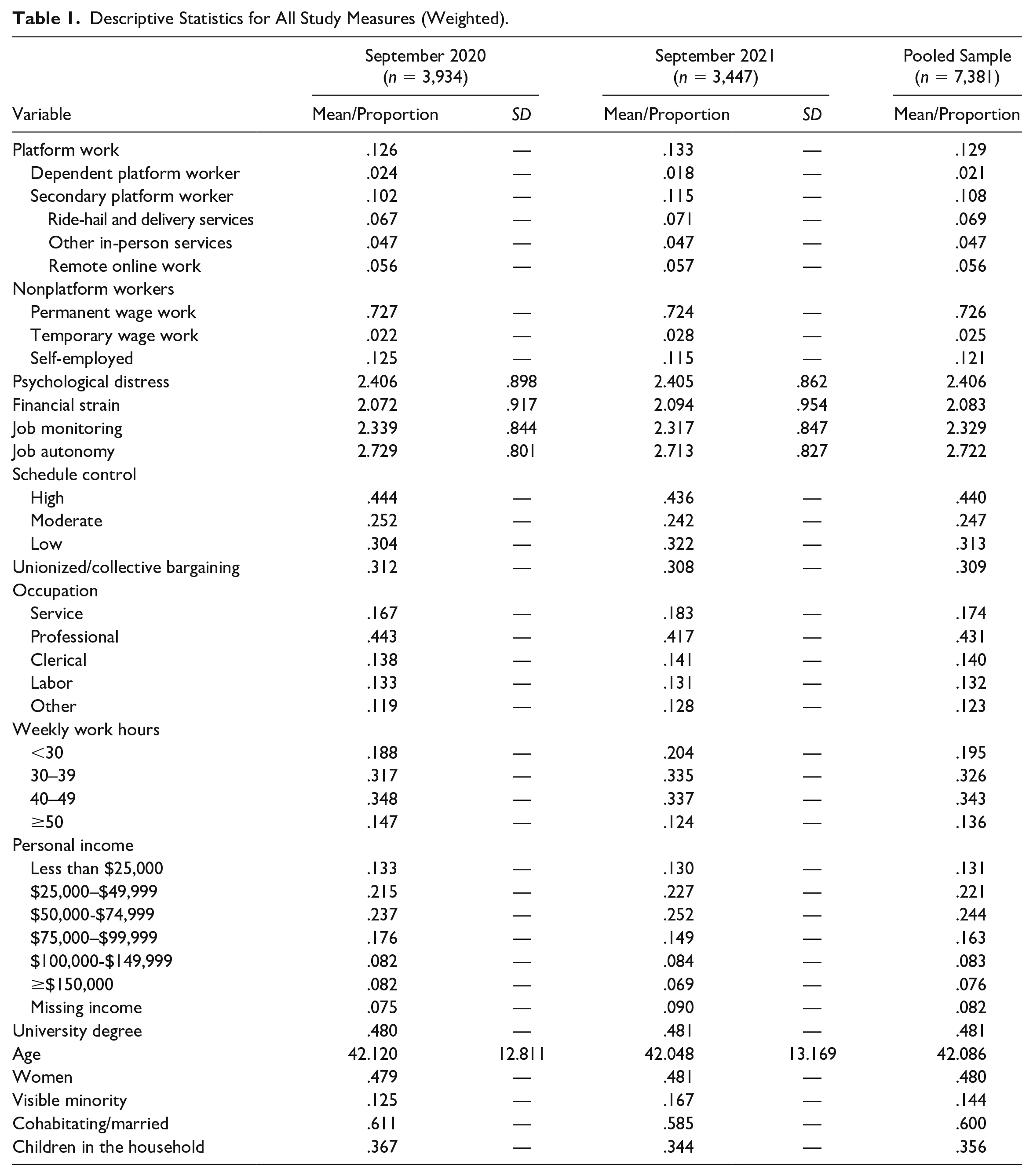
Table 1 presents descriptive statistics for the year-specific samples and the pooled analytical sample, while Table 2 presents the sociodemographic characteristics of dependent and secondary platform workers. Assessing the three perspectives of platform work, Figures 1 and 2 present results from bivariate analyses examining platform-nonplatform worker differences in financial strain (precarity perspective); employer monitoring (algorithmic control perspective); and job autonomy and schedule control (flexibility perspective).
Descriptive Statistics for All Study Measures (Weighted).
Bivariate Breakdown of Platform Work Engagement (Pooled 2020 and 2021 Sample).

Proportion difference across groups statistically significant (p < .05) on the basis of bivariate logistic regression model predicting dependent (and secondary) platform work engagement (coded 1) (weighted).

Mean comparisons of job monitoring, job autonomy, and financial strain by employment arrangement (pooled 2020 and 2021 sample).
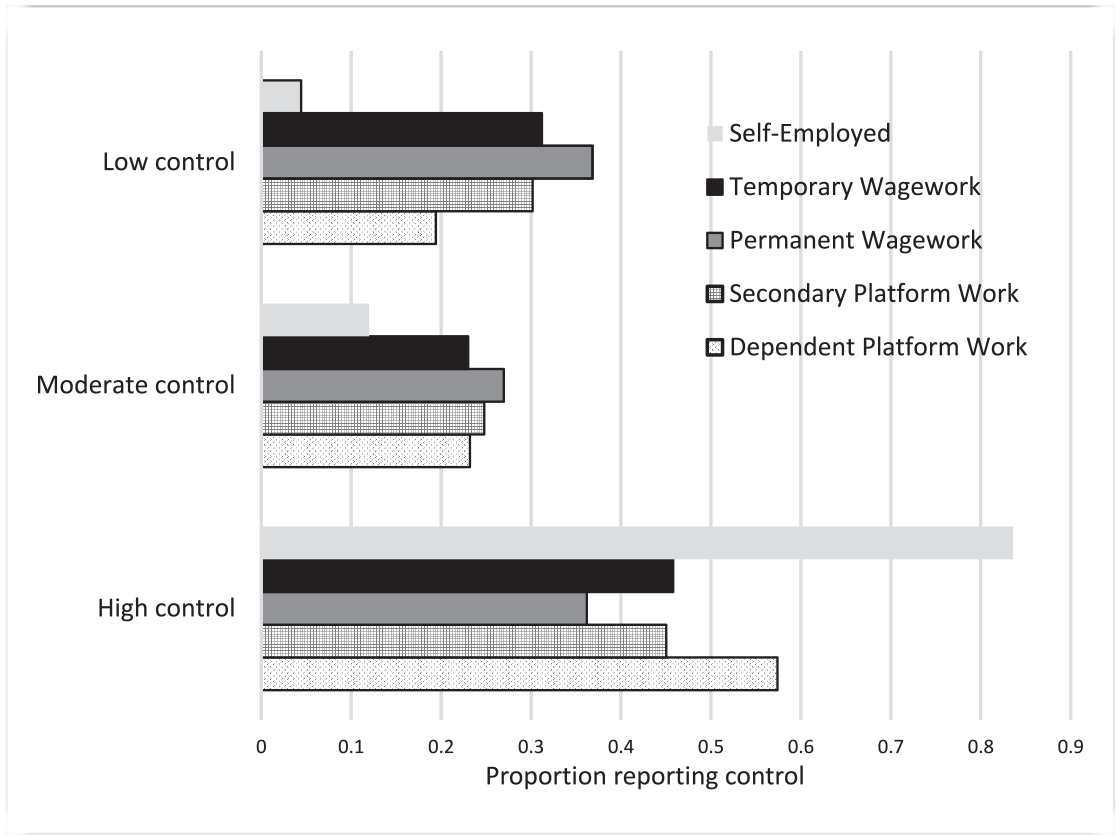
Schedule control comparisons by employment arrangement.
Table 3 presents ordinary least squares regression analyses of psychological distress. In model 1, we regress distress on platform work participation and controls. Model 2 includes a measure distinguishing dependent from secondary platform work to test the dependency hypothesis. We then adjust for workers’ financial strain in model 3 and their job quality in model 4 to examine their respective contribution to any association between platform work and distress revealed in model 2. We test the partial dependency hypothesis in model 5 by including a platform work × financial strain interaction to investigate whether the relationship between platform work participation and mental health is contingent on workers’ experiences of financial strain.
Ordinary Least Squares Regression Analyses of Psychological Distress (Pooled 2020 and 2021 Sample, n = 7,381).

Note: Values in parentheses are standard errors.
p < 0.05, **p < 0.01, and ***p < 0.001 (two tailed).
Results
Descriptive Statistics
Table 1 displays weighted descriptive statistics for focal measures and controls. In the pooled sample, approximately one in eight C-QWELS respondents report some level of engagement in platform work in the previous month (13 percent), with the majority performing this work as a secondary job (84 percent). We observe a relatively even distribution in the types of services performed by platform workers, with ride-hail and delivery work the most reported services. Year-specific descriptive statistics revealed little change in platform work engagement across the study samples. Although general engagement in platform work marginally increased from 2020 to 2021, the difference was not statistically significant.
Table 2 presents social status comparisons of engagement in platform work among C-QWELS respondents in the pooled sample. Visible minorities and younger workers are more likely to report platform work as a dependent or secondary job. The visible minority difference is especially pronounced for dependent platform work, with visible minorities 5 times more likely to report this employment situation. Those without a university degree are more likely to report both dependent and secondary platform work, while we observe no evidence of gender differences in platform work engagement.
Bivariate Analyses
We compare platform workers’ financial circumstances and work conditions to those in other employment arrangements (Figures 1 and 2). Dependent platform workers report statistically significant (p < .05) higher levels of financial strain than permanent and temporary wage workers, the self-employed, and secondary platform workers (Figure 1). Additional subgroup comparisons revealed that secondary platform workers also report higher financial strain than permanent wage workers and the self-employed; however, no statistically significant difference was observed between secondary platform workers and temporary wage workers.
We find no evidence of job monitoring or autonomy differences between platform workers and workers in other employment arrangements, suggesting no support for the algorithmic control perspective. Figure 2, however, indicates some support for the flexibility perspective: dependent platform workers are more than 20 percentage points more likely than permanent wage workers to report high schedule control. At the same time, platform workers appear to be distinct from the self-employed, the latter of which report statistically significant lower levels of monitoring, higher autonomy, and more schedule control, patterns that contradict entrepreneurial portrayals of platform work. Collectively, then, the bivariate analyses support the precarity and flexibility perspectives but not the algorithmic control perspective. With regard to secondary platform workers, readers should note that the reported job conditions for this group pertain to their primary job and not their platform work.
Multivariate Analyses
Table 3 presents results from ordinary least squares regression analyses of psychological distress for the pooled C-QWELS sample. Before examining whether platform work dependency is associated with higher distress, we first investigate general engagement in platform work. The “platform work” coefficient in model 1 is statistically significant, indicating that recent participation in platform work is associated with higher distress. In additional analyses (not presented), we tested an interaction between study year and platform work engagement; the interaction coefficient was not statistically significant, revealing no evidence that the association between platform work and distress varied across the 2020 and 2021 samples.
In model 2, we include an employment measure that distinguishes dependent from secondary platform workers. The measure also distinguishes nonplatform workers who are either engaged in wage work (permanent or temporary) or self-employment. Dependent platform workers, the reference group, report statistically significant higher levels of distress compared with workers in all other employment arrangements, including secondary platform workers. Ancillary analyses (not shown) revealed no evidence that secondary platform workers report higher distress than nonplatform workers. These patterns, which show substantially higher distress levels among dependent platform workers compared with wage workers, therefore provide support for the dependency hypothesis.
Adjusting for respondents’ financial strain in model 3 reduces the magnitude of the distress differences observed in model 2 for each of the employment arrangement comparisons by approximately 30 percent to 50 percent, although the coefficients remain statistically significant, with the exception of the coefficient for temporary wage work. The standardized difference in distress between dependent platform workers and permanent wage workers, for example, remains sizable at .27. The finding that financial strain explains part of the association between platform work and distress reflects the greater financial struggles of platform workers, revealed in Figure 1, and the positive association between hardship and distress as indicated in model 3 of the multivariate analyses.
In model 4, the subsequent inclusion of job quality measures has little impact in explaining any of the employment arrangement–distress differences presented in model 3. In fact, the size of the distress gap between dependent platform workers and wage workers and secondary platform workers increases slightly after adjusting for job quality. With regard to these job quality measures, workers with lower levels of autonomy and less schedule control report more distress.
Model 5 tests an interaction between financial strain and employment arrangement. Each of the “financial strain × employment arrangement” interaction coefficients is statistically significant, indicating that although financial strain is positively associated with distress across all employment arrangements, dependent platform workers experience disproportionately larger mental health penalties associated with higher financial strain. Figure 3 illustrates this contingency for workers at −1 and +1 standard deviations from the mean (signifying low vs. high financial strain, respectively). At low levels of financial strain, the difference between dependent platform workers and those in other employment arrangements is not statistically significant. However, dependent platform workers report greater distress at high levels of financial strain compared with secondary platform workers, wage workers, and the self-employed. These patterns are particularly noteworthy given that approximately half of dependent platform workers report financial strain levels at approximately one standard deviation higher than the mean. Ancillary analyses revealed no evidence of a significant interaction between financial strain and secondary platform work, however. We therefore find no support for the partial dependency hypothesis. Secondary platform workers struggling with financial strain do not report higher distress than nonplatform workers with similar financial difficulties.

Financial strain contingency in the association between employment arrangement and psychological distress.
In summary, our findings indicate support for the dependency hypothesis: dependent platform workers reported higher distress compared with secondary platform workers and those working outside the platform economy. These patterns were not explained by platform worker differences in job quality. Financial strain, however, accounted for almost 50 percent of the distress difference between dependent platform workers and permanent wage workers. Finally, we find no support for the partial dependency hypothesis: although dependent platform workers reported disproportionately higher mental health penalties from financial strain, secondary platform workers experiencing financial strain did not report higher distress than nonplatform workers in similar financial circumstances.
Discussion
This study makes several contributions to the platform work literature. First, responding to the limited large-scale studies that assess platform work engagement, we document the sociodemographic characteristics of Canadian platform workers. We find that a nonnegligible number of Canadian workers, one in eight, report recent engagement in platform work. Despite this, few workers in our study considered platform work as their primary job—a finding that is consistent with European studies (Pesole et al. 2018). Additionally, we reveal a distinct profile for platform workers, who tend to be younger, racialized and less likely to possess a university degree, patterns that are particularly pronounced for dependent platform work.
The timing of the two studies also allowed us to examine whether engagement in platform work changed throughout Canada’s “COVID-19 pandemic”. Interestingly, engagement remained remarkably stable across the September 2020 and September 2021 samples, stability that was observed across primary and secondary platform workers. There has been much speculation about the impact of the pandemic on the gig economy and the potential implications of a post-COVID-19 economic recovery on platform work growth (Jeon and Ostrovsky 2020). Although it is beyond the scope of this study to address these questions, our findings point to the resilience, but not growth, of online labor platforms in the face of what were fairly stringent economic lockdowns and public health restrictions in Canada over this period.
A second contribution of this research is our investigation of platform workers’ job conditions. Integrating insights from the JD-R model and Schor’s (2020) research on “platform dependence,” we argued that workers’ experiences of job resources and demands should vary according to their dependence on this work. We find mixed support for this prediction. Dependent platform workers in our study reported higher financial strain than nonplatform workers and secondary platform workers, confirming previous qualitative evidence regarding the precarious nature of the gig economy that challenges the ability of many platform workers to maintain a stable and livable working wage (Ravenelle 2019). Although we are unable to directly examine their job security appraisals, we suggest that dependent platform workers’ greater economic vulnerability likely exacerbates any concerns about insecure employment, which we highlighted as a potential demand for this group. At the same time, we did not find any evidence of another potential demand—increased employer monitoring—among platform workers.
Support for our predictions is also mixed when examining platform workers’ job resources. Counter to our predictions, dependent platform workers reported higher levels of schedule control, a valuable job resource that is helpful for reducing work strain. It is possible, however, that the efficacy of this flexibility for reducing work strain is weaker for dependent platform workers, as they may make a distinction between the availability of this resource and its practical value, a possibility that we are unable to examine because of the small subgroup size for dependent platform workers. Despite reporting more schedule control, dependent platform workers did not enjoy similarly high levels of autonomy, a finding that calls into question the claims of platform firms that they offer autonomous work alternatives for disillusioned wage workers (Ravenelle 2019). Collectively, then, our findings paint a picture of dependent platform work that appears flexible yet precarious. Questions remain, however, about how much meaningful control these workers have.
A third and core contribution of this study is the examination of the association between platform work and mental health, an issue that few studies have addressed using nationally representative worker data. Our findings, which revealed increased distress among dependent workers—but not those using it as a secondary job—support a growing body of research that points to the divergent experiences of vulnerable workers who rely on platform work and those who use it for other purposes (Gray and Suri 2019; Ravenelle 2019; Schor 2020). Given the recent growth of multiple jobholding, we suggest that occupational health researchers should pay more attention to this distinction, and how it potentially shapes experiences of work strain (Glavin 2020).
Our analyses were also able to shed some light on the factors contributing to dependent platform workers’ poorer mental health. Although the higher distress of this group remained after adjusting for psychosocial work conditions, financial strain explained up to 50 percent of the distress association. We speculate that the pervasive uncertainty and insecurity attached to working in the gig economy may account for a large part of the remaining unexplained association. We also examined whether financial dependency affected the mental health of platform workers, including those using gig work as a second job. Evidence of financial hardship contingencies were limited to dependent platform workers, however. At high levels of hardship, dependent platform workers reported disproportionately more distress than nonplatform workers with similar levels of financial troubles. Given the high level of financial hardship reported by dependent platform workers in the study, these findings further underscore how their precariousness disproportionately puts them at risk for poorer mental health.
We discuss limitations with this research and suggest some avenues for future study. First and foremost, we are unable to disentangle the potential influence of the COVID-19 pandemic on our focal associations. It is possible that part of the revealed association between platform work and psychological distress is explained by the greater vulnerability of platform workers to increased economic uncertainty arising from the pandemic. This issue can only be fully addressed with further waves of postpandemic data. Nevertheless, we believe that the mental health penalties experienced by platform workers in our study cannot be fully attributed to the pandemic context, given that we continued to observe higher distress for this group even after adjusting for their greater vulnerability to financial strain. This is an issue that certainly requires further inquiry; however, we argue that our findings, which we believe are the first of their kind, represent an important step toward understanding the health implications of platform work.
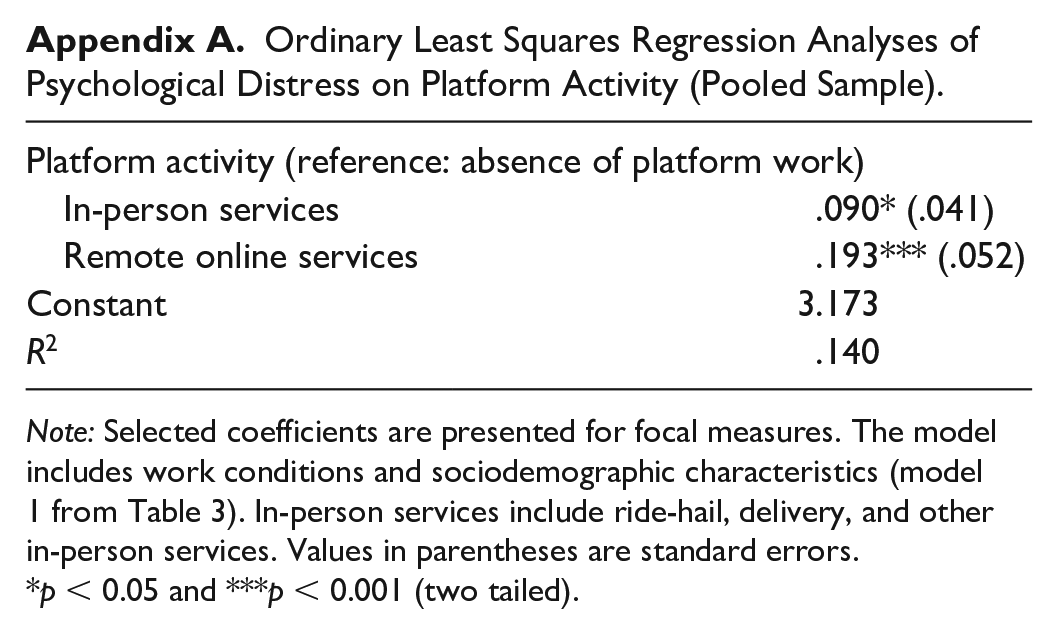
A second limitation is that our measure asking about platform work as one’s main job may simplify what is a likely more fluid phenomenon of platform dependence. We tried to address this issue by looking at financial strain contingencies in a platform work-distress association; however, it may be preferable for future research to examine the proportion of one’s income that comes from platform work. A further limitation is that our analyses overlook possible variation in the experiences of remote versus in-person platform workers, as our survey instrument did not measure workers’ dependency on specific platforms but instead dependency on platform work more broadly. In additional analyses (available in Appendix A) we examined how general engagement in each of these forms of platform work was associated with mental health. Results revealed that both in-person and online platform work were associated with higher distress, although the mental health association was stronger among online platform workers. These patterns should be interpreted cautiously, however, as some individuals engage in both forms of platform work.
Finally, since our ability to infer conclusions about a causal relationship between platform work and mental health is constrained by the cross-sectional nature of the C-QWELS samples, further longitudinal research is necessary to confirm the appropriate temporal sequencing of our measures. Longitudinal data would also serve an additional purpose in revealing the different pathways that workers take into dependent versus secondary platform work arrangements, information that would be useful in determining the extent that these reflect voluntary versus forced employment decisions. There are currently few, if any, quantitative studies of platform workers’ employment histories. In the absence of these data, we point to the overrepresentation of marginalized groups among dependent platform workers in our study, including racialized individuals and those with less education, to argue that platform dependency is more likely a sign of labor market vulnerability rather than personal choice. Further research is necessary to confirm these interpretations, however. Connecting platform workers’ health and labor market histories would also go some way to addressing calls within the health inequalities literature for researchers to move beyond description of socioeconomic health disparities in favor of revealing the processes through which social class generates these inequalities (McCartney et al. 2019).
Conclusion
Our findings support the value of Schor’s (2020) idea of “platform dependence” for identifying vulnerable workers in the gig economy. Our results also dispel more optimistic viewpoints regarding the potential benefits that online labor platforms offer workers. Despite their greater levels of schedule control, we find no evidence that this flexibility translates into improved mental health for any of the groups of platform workers that we studied. Given that we examined platform work stress during a uniquely turbulent economic period, we do not know whether these patterns will persist in a postpandemic economy. However, a precarity perspective of platform work suggests that hardship and dependency will continue to define the experiences of a considerable segment of gig workers, exposing them to elevated occupational health risks and exacerbating existing health disparities.
Footnotes
Appendix
Ordinary Least Squares Regression Analyses of Psychological Distress on Platform Activity (Pooled Sample).
| Platform activity (reference: absence of platform work) | |
| In-person services | .090* (.041) |
| Remote online services | .193*** (.052) |
| Constant | 3.173 |
| R 2 | .140 |
Note: Selected coefficients are presented for focal measures. The model includes work conditions and sociodemographic characteristics (model 1 from Table 3). In-person services include ride-hail, delivery, and other in-person services. Values in parentheses are standard errors.
p < 0.05 and ***p < 0.001 (two tailed).
Funding
The author(s) disclosed receipt of the following financial support for the research, authorship, and/or publication of this article: This research is funded by the University of Toronto COVID-19 Action Initiative 2020 and Tri-Council Bridge (Scott Schieman, principal investigator) This research was also supported by a Social Sciences and Humanities Research Council of Canada Insight Development Grant 430-2015-00904 (Paul Glavin, PI)”.
