




Abstract
The authors examine how linguistic niches may develop in certain industries. Using acoustic measurement techniques, the authors examine the extent to which workers in different industries display dialect features associated with the American South. The data are drawn from 190 semistructured sociolinguistic interviews from 2008 to 2017. Six linguistic variables were constructed to measure dialect features associated with southern American English. The results show that workers who are employed in the technology industry display significantly fewer southern dialect features than workers in interactive service work, law, and government. The general movement away from southern American English over time was also more prominent among technology workers. These results suggest that newer and more professional industries display less traditional patterns of southern speech. While the results do not support causal claims, they imply that individuals tend to work in industries that match their linguistic and cultural backgrounds.
Culture has long been recognized as an important means through which social inequality related to paid work is reproduced across generations. People tend to pursue work in occupations and industries that are aligned with their cultural habitus (Desmond 2008). Diversity in cultural pursuits, such as broad taste in arts, improves access to social network connections that can be helpful for finding jobs (Erickson 1996; Lizardo 2013). The job search process also involves distinctive interactional approaches across cultures, which can be consequential for obtaining job-finding assistance (Sharone 2013; Smith 2007). Employers at top professional firms, for example, look to hire individuals whom they see as good cultural matches (Rivera 2016). Culture also reflects and influences how people engage in work (Blair-Loy 2001) and can vary across occupations and industries (Turco 2010). Culture serves as a proving ground for contests over authority and occupational jurisdictions (Vallas and Cummins 2014). Cultural boundary maintenance is therefore an essential activity in work settings (Bandelj 2012; Block 2012; Zelizer 2005).
Language represents an inherently transactional form of cultural capital (Lamont 1992; Mische and White 1998), and cultural boundaries are actively created and sustained through language (Bourdieu 1991; Lamont 1992, 2002). However, relatively little is known about how language is associated with the types of employment in which individuals engage. Previous research in sociology shows that immigrants and non-native speakers face linguistic barriers that limit access to job finding networks (Liversage 2009; Moroşanu 2016) and linguistic discrimination during job interviews (Duchêne, Moyer, and Roberts 2013). Other researchers have argued that bilingualism is a resource for occupational attainment (Bankston and Zhou 1995). In the aggregate, workers with higher English language proficiency receive higher wages in the U.S. labor market (Chiswick and Miller 2005, 2010). However, occupations with lower English proficiency requirements may act as “occupational linguistic niches” acting to increase wage group over time (Mouw and Chavez 2012). These are important insights, but they are insufficient for understanding how factors such as dialect variation within a language contribute to cultural boundary maintenance in employment.
We draw on Bourdieu’s (1977) concept of the “linguistic marketplace” to theorize how language, specifically regional dialect variation, may situationally serve as both a resource and an impediment in the labor market. Within the linguistic marketplace, the symbolic valuation of ways of speaking (e.g., languages, regional dialects) reflects extant power relations in society. Actors are rewarded for deploying standard, prestigious forms of linguistic features, such as variations in word choice or pronunciation. Engagement in different forms of economic activity depends in large part on demonstrated competence in legitimized language use (Bourdieu and Boltanski 1975). Work activity varies in the value placed on legitimized speech mastery (Sankoff and Laberge 1978), leading to distinct discursive domains (Mische and White 1998) across industries, occupations, and work settings. Subtle dialect features are therefore consequential for understanding the connection between individuals and specific work pursuits. Consequently, we may find “occupational linguistic niches” for these dialect variations, as well.
Culture—and, by extension, language—has long been afforded an important role in workplace interactions, but sociological studies have failed to address features of dialect in a concrete, measurable way. This study fills that gap, providing a quantification of linguistic features through the measurement of vowels, allowing a nuanced analysis of differences in accent. In this study, we examine how dialect variation maps onto employment in different industries. We use sociolinguistic methods to precisely estimate dialect features from a sample of southern U.S. speakers. The southern United States was chosen for its unique vowel pronunciations associated with the regional dialect (Labov, Ash, and Boberg 2008), which are often stigmatized by listeners as unpleasant or uneducated (Fridland and Bartlett 2006; Fridland, Bartlett, and Kreuz 2005). In part because of this stigmatization, these traditional dialect features are disappearing over time in more urbanized areas (Dodsworth and Kohn 2012; Prichard 2010). Precise acoustic measurements allow us to examine how stigmatized southern dialect features are associated with different types of employment in a community that has experienced rapid transformation in the linguistic marketplace because of increased in-migration from other areas of the United States. The results provide compelling evidence of cultural matching to employment on the basis of subtle dialect variation, demonstrating a pathway for the linguistic reproduction of sociocultural difference.
The Linguistic Marketplace and the Valuation of Features
Bourdieu (1977, 1991) conceptualized language and its constituent features as existing within a “linguistic marketplace,” which reflects extant material and symbolic relationships of social actors. He drew equally from his theories of habitus and cultural capital (Bourdieu 1984) and Marxist-influenced analyses of material relationships to fashion an integrated cultural and structural approach to the role of linguistic differences in maintaining inequality. In other words, his formulation of the linguistic marketplace connects the symbolic aspects of language more commonly analyzed in the interactionist tradition (Goffman 1959; Silverstein 2003) with structural concerns such as class, occupation, and labor markets.
Within the linguistic marketplace, linguistic features are imbued with symbolic meaning. Bourdieu (1991) characterized these features as “goods destined to be given a price by powers capable of providing credit (varying according to the laws of the market on which they are placed)” (p. 77), firmly lodging them within market relations. Thus, the “standard” form of a given language reaps the greatest symbolic rewards, because of its association with the classes in control of the symbolic (and material) means of production. In a sense, market prices are fixed; valuation is pegged to power differentials inherent in social relationships. The elite maintain ideological control over the variety of a language seen as “correct” or “valuable,” and they have a vested interest in perpetuating the linguistic status quo through institutional structures such as the educational or political system. These institutions inscribe linguistic ideologies upon the habitus slowly and consistently over a person’s lifetime, so the value of the specific linguistic features rarely receives critical questioning. Consequently, the strength of the relationship between elites and symbolic capital is so strong that they can flout linguistic conventions and use vernacular (i.e., common dialect) features with no risk to their social status.
At the interactional level, actors attempt to “maximize symbolic profit” (Bourdieu 1991:77), which can result in a range of linguistic productions from those who attempt to adhere closely to the standard of the highly vernacular. Linguistic interactions are transactional and relational in their character, with constraints sensitive to the social positions of all actors involved. In other words, a conversation between an upper-class speaker and a working-class speaker entails different valuations of linguistic features than one between two working-class speakers. Bourdieu (1991) illustrated this phenomenon through the example of speech expected between two men in a café versus that of a politician addressing an audience, with the former allowing much more leeway in the use of vernacular language. In sociolinguistics, this same relationship is described as a distinction between “overt prestige” and “covert prestige” (Trudgill 1972). The former concept describes the prestige afforded to linguistic features and language varieties that resemble the standard, which have the symbolic support of national-level ideologies. However, speakers of a vernacular can also draw upon covert prestige when in the company of others who share that linguistic system, resulting in perceptions of solidarity, friendliness, or in-group membership (Fridland et al. 2005; Niedzielski and Preston 2003).
Whereas Bourdieu’s theory speaks to a unified national linguistic market, we argue instead that the valuation of dialect-specific pronunciation features are negotiated and reproduced at local levels within regions, industries, and organizations. These local linguistic marketplaces generate distinct discursive domains (Mische and White 1998) in which mastery of local vernacular is essential for signaling in-group status (Lamont 2002). Workplace misunderstandings, conflict, and hostility frequently arise when workers enter unfamiliar discursive domains and face language barriers (Nath 2011; Thuesen 2017). Work can also involve interaction with multiple discursive domains (through engagement with customers or coworkers in different jobs), which requires workers to “style shift” 1 (i.e., alter their speech patterns) to navigate different domains (Eustace 2012). Consequently, linguistic niches (Mouw and Chavez 2012) may develop for certain sectors of the labor market in which the vernacular dialect of a region may be more valuable, even if those linguistic varieties are not valued within a wider national linguistic marketplace.
Dialect and Employment
To elucidate the connection between dialect features and industries in more concrete terms, we draw on research from the discipline of sociolinguistics and integrate it with sociological perspectives on work. Sociolinguistics provides two important tools to assist in analyzing dialect: first, a way to quantify dialect differences in the form of acoustic analysis of vowel pronunciations (Thomas 2010) and, second, a body of literature that engages with connections between dialects and social factors (Eckert 1989, 2000; Labov 1972b, 2001).
Several decades of sociolinguistic research has revealed that well-established local and regional dialect features tend to stratify across different types of employment. For example, Labov’s (1966) linguistic survey of New York City found that native New York speakers with professional occupations were less likely than lower middle class and working-class speakers to use dialect features associated with the city. Less is known about the how and why dialect might vary across types of employment. Three interdependent pathways seem plausible. First, occupations and industries tend to develop distinct cultural schemas that reflect ideal worker norms (Turco 2010). Hiring decisions are fundamentally influenced by these cultural schemas (Ridgeway 2011; Rivera 2016), furthering occupational and industrial segregation on the basis of gender, race, and class. Auditory cues in the form of dialect variation are likely reflected in these cultural schemas and should similarly affect hiring decisions. Second, individuals tend to self-select into employment in which ideal worker norms tend to match their cultural habitus (Desmond 2008). Similarly, one would expect individuals to self-select into industries that are associated with familiar linguistic domains. Third, socialization as part of communities of practice involves the development of worker identities alongside development of skills (Lave and Wenger 1991), which helps align identities with workplace culture. Likewise, workers should be expected to adopt the dialect features of their coworkers over time to better fit into their linguistic domains (Eustace 2012). All of this suggests that we should observe substantial clustering of dialect features across industrial groups.
We test these ideas with an examination of dialect variability among lifelong residents of the American southern city of Raleigh, North Carolina. For more than a century, southern speakers have maintained a core set of linguistic features that, taken together, distinguish them from speakers in all other U.S. regions (Labov et al. 2006). In particular, the vowel system in the South involves several distinctive vowel pronunciations, hereafter called the southern vowel shift (SVS) (Labov 1991). For example, the vowel in words such as ride and high is pronounced so that the words sound like rahd and hah. Most of the features of the SVS have been declining in southern cities because of increased migration from other regions in the United States. In Raleigh, a period of rapid decline of the SVS coincided with the creation of jobs in the technology industry starting in the mid–twentieth century, which led to the large-scale migration of people from northern cities to the “Research Triangle,” which includes Raleigh (Rohe 2011).
The decline in these features has resulted in a linguistically heterogeneous mix of native Raleigh speakers. The strongest predictor of linguistic southernness is age, as Raleigh speakers born after 1950 have become less southern. However, as in Labov’s (1966) New York City data and in many other sociolinguistic studies, occupation is also a strong predictor: speakers with professional jobs are less linguistically southern than speakers with blue-collar jobs or white-collar jobs not requiring a college degree (Dodsworth and Benton 2017; Forrest and Dodsworth 2016). Whereas at one time, all or most native Raleigh speakers had southern-shifted vowel systems, now the traditional SVS features operate as symbolic capital reflective of a southern cultural habitus, conveying a rural, working-class, easygoing, and friendly persona (Preston 2015). Simultaneously, southern dialect features can also be stigmatized as uneducated or improper (Fridland and Bartlett 2006; Fridland et al. 2005; Niedzielski and Preston 2003), reflecting their devaluation in some segments of the linguistic marketplace. Because the SVS has connections to multiple—and sometimes even conflicting—personality traits, the specific characteristics of an individual’s work can affect the usefulness of southern features.
In relation to different kinds of work, SVS features can operate to show working-class cultural membership, and they can also indicate a local or regional identity that builds solidarity with a listener (Rakić, Steffens, and Mummendey 2011). Shared regional dialect features between speaker and listener can help create more positive perceptions of interactions (Mai and Hoffmann 2011), and the possible positive connotations of southern accents (e.g., friendly, relaxed) may further this effect. The complexities in the perception of southern dialects extend to the ecology of workplace interactions. For example, with a local customer or client base native to the area, it may be advantageous to sound like a member of the local community. Rather than simply reflecting a working-class/middle-class divide, we argue that southern features provide cultural capital to navigate the dynamics of the linguistic marketplace (Bourdieu 1991) of the local area. We expect that speakers who are lifelong residents of Raleigh who use SVS features should be employed in industries that have long-standing histories in the area or in those industries that involve substantial personal interaction. By contrast, individuals employed in the technology sector are less likely to have these dialect features, thus possessing vowel systems that are less regionally distinctive and avoiding the possible stigmatized connotations of southern dialects.
Data and Community Background
Data Collection and Extraction
The data for this project come from the Raleigh Corpus, a larger corpus of sociolinguistic interviews conducted with lifelong residents 2 of the Raleigh, North Carolina, area gathered from 2008 to 2017. Sociolinguistic interviews are a type of semistructured ethnographic interview in which the interviewer focuses primarily on life history information, with additional attention to issues of cultural relevance to the Raleigh area (e.g., changes in the city center, opening and closing of local cultural landmarks). Participants were recruited via public events and news outlets, including a language-oriented booth at the North Carolina state fair and a news article describing the study and its requirements in the local Raleigh newspaper. Snowball sampling methods were used to extend the sample beyond the initial participants gathered from these public recruitment materials. Despite the nonrandom sampling methods, research on dialect features has shown them to be consistent whether random or nonrandom sampling is used, reducing the concern about generalizability (Labov 2001).
The subset used for this analysis comprises 190 speakers among approximately 300 total, and it consists of all interviews that have been transcribed and measured for linguistic information. All speakers in the corpus are white, to control for cross-race differences in linguistic features. Substantial differences in dialect exist across racial and ethnic boundaries in most areas of the United States (Fought 2002; Kohn 2014; Labov 1972a; Wolfram 1969; Wolfram and Thomas 2008), resulting in divergent linguistic systems among racial groups within general dialect regions. These differences are in part the result of unequal access to—and subsequent identity-driven use of—differentially valued linguistic resources (Eckert 1989, 2000, 2008). Most of an individual’s dialect features are shaped during adolescence (Labov 1989), and race-based friendship segregation results in exposure to different linguistic norms (Moody 2001; Quillian and Campbell 2003). Likewise, language serves as a salient marker of group membership and culture in the context of interactional performance (Schwalbe and Shay 2014). Nonwhite speakers can strategically deploy features of both white and nonwhite dialects depending on audience or social context (Alim and Smitherman 2012; Wolfram et al. 2016), and language use seen as incongruent with group membership can result in peer censure (Fordham and Ogbu 1986). In short, examining dialect features across social groups requires a sensitivity to intersectional complexities in both structure and identity, especially with regard to race and ethnicity. At present, the available data in the Raleigh Corpus do not provide an adequate foundation to address this complexity with regard to race, so we focus exclusively on white speakers for this analysis.
Dialect features were captured through the measurement of vowel pronunciation and collected through an automated alignment and extraction system. Each interview was transcribed by hand, then aligned to match the acoustic signal with individual words. Subsequently, acoustic measurements indicating the pronunciation of vowels were extracted, measured, and hand-corrected. Vowel measurements were collected for each vowel implicated in the SVS, a socially salient system of altered vowel pronunciations that exists within the southern United States (Labov 1994; Thomas 1997). Within the SVS, the pronunciations of the five front vowels 3 shift location, creating a holistic system that creates the perception of a “southern accent” when described by listeners (Fridland and Bartlett 2006; Fridland et al. 2005). In addition to the front vowels, we also examine the production of the vowel in the word time, another vowel modified within the SVS. The data were normalized using the Lobanov (1971) method within individual speakers’ vowel systems, a method that controls for vocal tract differences between speakers and allows aggregate comparisons of vowel data.
Although Raleigh exists within the southern dialect region of the United States, the dialect of white speakers in the region is becoming less traditionally southern over time (Dodsworth 2013; Dodsworth and Kohn 2012; Forrest 2015). Younger Raleigh natives show fewer features of the SVS, with a near complete reversal of the southern system by the youngest generation of speakers in the corpus. 4
Figure 1 shows the changes in the pronunciation of the vowels in bit, bet, and bat over time, where lower values on the y-axis indicate a less southern vowel. A clear downward trend emerges within the white community, illustrating the change away from traditional southern dialect features. The community-wide change results in large part from the wave of in-migration to Raleigh from other regions of the United States, with new migrants bringing features of other dialects to the greater Raleigh area. As a result, children growing up in Raleigh postmigration have numerous linguistic inputs from both native southern and nonsouthern sources. The general stigmatization of southern speech in the United States (Fridland and Bartlett 2006; Fridland et al. 2005; Niedzielski and Preston 2003) also motivates younger white speakers to abandon traditional southern linguistic norms, culminating in the gradual movement away from the SVS. The sources of this linguistic change are both structural and individual. As the “average” dialect shifts away from traditional southern features in the community, most speakers show less evidence of the SVS than those speakers born a generation prior. There remains a wide spectrum of variation at the individual level, however, and speakers have a degree of control over aspects of their dialect, as evidenced by phenomena such as style shifting (Labov 2001) or code switching (Alim and Smitherman 2012). Speakers can therefore acquire a suite of linguistic resources, or repertoire (Benor 2010; Eckert 2008), with which they can navigate institutional contexts or individual interactions.

Changes in southern vowel pronunciation over time.
Industry Growth and Change in the Raleigh Area
Because Raleigh is the state capital of North Carolina, prior to the area’s growth, a large portion of its residents were employed in jobs within or related to state government (Bureau of Economic Analysis 1999), including, as a corollary, many law offices. Because government and legal jobs have a long history in the area, they are deeply embedded within the local cultural landscape. Consequently, these jobs should also have strong cultural ties to the traditional linguistic features of the area, with little motivation for change toward national linguistic norms. We would expect workers in these positions to more closely mirror the traditional speech patterns of Raleigh.
Over the years, these jobs have constituted less and less of the overall labor market in light of the rise of other industries and private service-sector jobs. The initial prominence and subsequent decline of government jobs is displayed in Figure 2 using data drawn from the Regional Economic Information System, with employment statistics in retail, FIRE (finance, insurance, and real estate), and services-related jobs provided for comparison. Government’s share of the overall labor force declined throughout the period from 1969 to 2000, and as of 2014 (not pictured), government jobs constituted 13 percent of all jobs in the Raleigh area, a marked shift from the nearly 25 percent recorded in 1969 (Bureau of Economic Analysis 2015). Although the Regional Economic Information System database’s codebook does not contain many fine-grained codes for service jobs before 2001, the sharp increase in service jobs beginning in 1979–1980 corresponds to a period of rapid population growth for Raleigh.

Changes in the industrial mix over time in Raleigh, North Carolina.
This rapid population growth in Raleigh came in large part from the expansion in the technology industry, beginning in the mid-1960s with the establishment of Research Triangle Park, an industrial park located between Raleigh and nearby Durham that features a number of research and development institutes. In many cases, well-known firms, such as IBM and GlaxoSmithKline, established new branches in Research Triangle Park and brought employees from other locations in the United States to serve as initial staff, thus substantially contributing to the influx of nonsouthern residents to the area. This shift in population transformed the linguistic landscape, adding nonsouthern dialect features to the area and simultaneously transforming the culture. The stigma surrounding southern linguistic features would almost certainly be problematic in the tech industry, because of these extralocal connections with nationally oriented firms. Consequently, we expect to find relatively fewer SVS features among Raleigh natives working in the tech industry.
The shifting mix of industries in Raleigh is also related to the national trend toward increased employment in the service industry (Henderson 2012; Personick 1987). Service jobs have grown dramatically in the past few decades in Raleigh, replacing middle-wage manufacturing and factory jobs and defining the current employment landscape to a large degree (Lorence 1991). Service workers are likely to show more southern features by virtue of the perception of southern dialects and the nature of interactive service work. Listeners generally perceive southern dialects as friendly (Niedzielski and Preston 2003), and such perceptions may enhance the scripted interactions that make up the majority of interactive service work. A positive linguistic perception may help the worker to navigate more difficult social situations and diffuse any conflicts. Furthermore, when recounting a sales interaction, individuals tend to have a more positive view of both the sales representative and the interaction when the representative’s dialect resembles their own (Mai and Hoffmann 2011; Rakić et al. 2011). These positive perceptions may cause southern dialect features to be a greater asset to service workers, motivating these workers (and their employers) to shift away from them more slowly than others.
We examine the linguistic patterns among workers in the above industries alongside several other industrial/occupational categories. FIRE represents another growth area in postindustrial economies. Employment in these types of jobs tends to be relatively well paid (Tomaskovic-Devey and Lin 2011) and requires substantial educational credentialing. We also examine a separate category of workers employed as professionals in industries not described above, such as doctors, managers, and university professors. Finally, we also examine workers who engage in blue-collar employment (e.g., mechanics, farmers). Within the sociolinguistic literature, the most vernacular speakers tend to be found in traditional blue-collar occupations (Baranowski 2008; Labov 1966; Trudgill 1974; Wolfram 1969). Consequently, we include blue collar 5 as a category to capture the speakers who likely represent the greatest degree of SVS in the community at any given time point. For all of these categories, industry codes cut across organizational position or specific job role.
We also expect to observe changing effects of industrial classification over time. As the linguistic landscape of Raleigh changes, the pool from which firms recruit workers changes as well. During the course of linguistic change, we anticipate a tendency to maintain traditional southern features in law, government, and service, accompanied by a decline in these features in the technology sector. This tendency will widen the difference between these industries over time, resulting in a faster shift away from the SVS for workers in the tech industry and a slower shift for those in law, government, and service.
Methods
Coding Industries
Classifications of industry were drawn from interviewees’ descriptions of their job histories and coded according to a seven-way typology: blue collar, care, FIRE, law and government, professional, service, and tech. An additional “none” code for speakers with limited or nonexistent employment histories was also included, allowing the inclusion of these speakers when estimating language-internal effects. In many cases, a participant held jobs in multiple industries over the course of his or her lifetime, resulting in the possibility of multiple codes. In these cases, we use the industry in which the participant worked the longest as the overall code. If the participant worked in two industries for approximately the same length of time, preference was given to the most recent industry of employment, as that industry would more accurately reflect the participant’s current cultural situation at work. Individuals whose employment histories did not closely fit a single code were also coded “none.” For all speakers coded in our data set, no speaker could be argued to fit two different categories. Table 1 shows the distribution across industries for our data.
Distribution of Speakers across Industrial Categories.

Statistical Modeling
Analyses were conducted at the level of vowel utterance nested within individuals and words. Linear mixed-effects regressions were run separately for each vowel in the corpus, with normalized measures of vowel pronunciation as the outcome. These vowel measurements capture the position of the tongue in the mouth when articulating vowels, and these positional differences are one of the major factors that make dialects of a language sound distinct. Linguistic controls were included within all models to allow comparison of vowels across different words and different pronunciation environments. Controls were included for preceding and following phonetic environment (i.e., the type of sound before and after the vowel) 6 and the duration of the vowel itself (Dodsworth and Kohn 2012; Labov 1994, 2001), such that a high number of tokens in a given phonetic environment will not have an outsized effect on the model predictions. Our observations come from the token level, meaning that each observation represents a single utterance of a given vowel. To control for the resulting nestedness of these data, we also include a random intercept for both word and speaker in our models. Individuals store words as discrete cognitive units (Hay et al. 2015; Pierrehumbert 2002), meaning that the speakers pronounce the vowel in two rhyming words slightly differently, depending on their experience with the word. Likewise, individuals’ dialects are unique systems that differ from speaker to speaker, requiring a further control for the nestedness of tokens within individuals. Last, we include a random slope for vowel duration by speaker, as an individual’s overall linguistic “southernness” affects the relationship between duration and pronunciation.
We include a variable for speaker’s year of birth (YOB) to control for the changes in Raleigh’s dialect features over time. Individuals’ dialect features remain relatively stable after adolescence (Labov 1989), meaning that each speaker remains comparable with others of his or her age cohort. To aid in model interpretation, the variable for YOB is centered at the mean (YOB = 1961) and scaled so that 1 unit of YOB is equal to 1 standard deviation (SD = 17.25 years). Five models were run in total for each variable, following the list in Table 2. Because the models are not completely nested, Akaike information criterion comparison (Burnham and Anderson 2004) was used to ascertain best model fit. In total, model sets were run for six separate vowels with vowel measurements as the outcome, resulting in a total of 30 regression models. The dependent variable in these regression models represents an approximate measure of “how southern” a given vowel would sound. For all tables and figures in the results, higher values indicate a “less southern” vowel pronunciation for a token or group, and lower values indicate a “more southern” pronunciation. In some of the following results, models were rerun with a different reference level for industry to produce reportable t values for specific interaction effects, but this process does not change the underlying model used for inference.
Summary of Modeling Strategy.

Results
The results of the Akaike information criterion–derived model selection are displayed in Table 3, showing the top model for each vowel. 7 Of the six vowels, four show some effect related to an individual’s industry. The vowels that do not show any industry-related effects (BET and BAT) have demonstrable network-based effects 8 (Dodsworth and Benton 2017) and linguistic-internal changes 9 (Dodsworth 2015) that likely override these effects. For the four vowels that do show industry-level effects, we examine the coefficients of each industry to address our empirical expectations regarding law, government, service, and technology workers.
Best Model Fit for Each Vowel.

The model results presented in Table 4 suggest that language does indeed serve as a cultural signal within industries. For three of the four vowels (BIT, BEET, and BIDE), the regression results confirm our expectations that workers in law, government, and service sectors show no difference in southern dialect features from the vernacular baseline. Although law and government workers do not produce BAIT with a significantly more southern pronunciation than the vernacular baseline (t = .721), service workers show a significantly less southern pronunciation (t = 3.541). The results drawn from the regression models confirm that technology workers show significantly less southern pronunciations for all four vowels.
Regression Coefficients of Southern Vowel Sounds on Occupational Characteristics.

Note: FIRE = finance, insurance, and real estate; YOB = year of birth.
p < .05. **p < .01. ***p < .001.
Figure 3 provides a visual representation of the relationship among the three key industries in our investigation, using BIT as an example. The y-axis represents regression coefficient estimates drawn from the best-fitting model, where greater values correspond to a lesser degree of the SVS (i.e., less southern). Both law and government workers (β = .128, t = 1.598) and service workers (β = .096, t = 1.595), net of linguistic and YOB controls, show no significant difference from blue-collar workers, represented in this chart as distance from zero. Technology workers, however, do show a difference (β = .203, t = 2.912) from the baseline, suggesting that workers in this industry use a significantly less southern pronunciation of this vowel. Connecting back to the transmission of cultural capital at work, these results suggest that individuals linguistically cluster within industries. Law, government, and service workers have motivation to retain more southern features because of their connection with the local economy (in the former case) and the cultural perception of southern dialects (in the latter case). Workers in the technology sector—whether through employer selection, worker self-selection, or conformity in dialect after point of hire—show orientation toward national mainstream linguistic norms, rather than those of the local community. Although the coefficients for these industries do operate as expected in all four cases, three of four vowels include an interaction term in the best model, so we will discuss main effects of industry in tandem with their interactions for these models.

Industrial variation in pronunciation of BIT.
For the three vowels that show significant model improvement with the addition of an interaction between industry and YOB, we examine each vowel individually, as all three behave differently with regard to expectations regarding persistence of SVS features over time. Figure 4 shows the fitted model results for the BAIT vowel. The y-axis represents predicted vowel measurement, with lower values representing more southern-shifted pronunciations. Blue collar, law and government, service, and technology, our industries of interest, are delineated by both shading and line differences.

Industrial variation in pronunciation of BAIT.
Of the interaction coefficients in this model, only that of law and government workers (represented by the dashed line) differs significantly (t = 2.270) from the blue-collar baseline (represented by the solid dark line). Therefore, we see that law and government workers lose southern-associated dialect features more slowly than does the baseline. A significant interaction also exists between both law and government and service compared with the technology industry (t = 2.781, t = 2.069). This result suggests that workers in both law and government and service do move away from southern features at a slower rate than tech workers but not their blue-collar counterparts, highlighting a likely difference in the cultural cachet of the SVS between industries. Last, examining the main coefficients of the industries shows that significant differences exist for the expected industries, at least at the intercept of YOB (YOB = 1961). The apparent inconsistencies in cross-industry linguistic relationships for older speakers likely stem from the progress of dialect changes in Raleigh. In the aggregate, the move away from the SVS only begins for speakers born around 1960, as these speakers reached adolescence during Raleigh’s initial population growth. Without the influx of nonsouthern linguistic models and the cultural pressure to move away from the SVS because of stigma, the oldest speakers had neither motivation nor means to avoid the SVS.
Figure 5 displays the predicted model fit for the BEET vowel, using the same display parameters as Figure 4. Technology workers show a difference in rate of change from all other industries, not just the vernacular baseline (t = 2.967). Conversely, neither law and government workers nor service workers show a significant difference in rate of change from blue-collar workers. Although the downward slope for technology workers may suggest that they are actually becoming more southern, the difference in vowel pronunciation again results from the context of this vowel in the larger process of change in Raleigh. All of the vowel changes described in the community represent a shift away from “southern” cultural markings to more “standard,” mainstream vowel pronunciations. In the case of the BEET vowel, all speakers, regardless of industry, have reached the mainstream pronunciation by approximately 1980, meaning that individuals in the technology sector already have a nonsouthern vowel for BEET at the beginning of our sample. The vowel differences for tech workers shown by this interaction effect for BEET do not actually result in a pronunciation that would actually sound “southern” to a listener, and BEET therefore does not act as a southern cultural symbol in this case.

Industrial variation in pronunciation of BEET.
Last, Figure 6 shows the predicted model fit for the BIDE vowel. Model statistics provide evidence that the interaction between YOB and industry yields improvement, but no significant coefficients exist when using blue collar as a reference. Instead, the model improvement derives from the interaction between law and government workers, who show a clear downward slope over time, and the other industries in the model. This interaction provides significant evidence of a difference in behavior for law and government workers. Unlike in the case of BEET, for which technology workers reached a nonsouthern vowel target and maintained it over the course of our data, law and government workers retain a southern feature that workers in other industries remove. It is especially interesting that southernness is maintained for the BIDE vowel specifically, as a southern pronunciation of this vowel garners a great deal of conscious notice and stereotyping (Silverstein 2003).
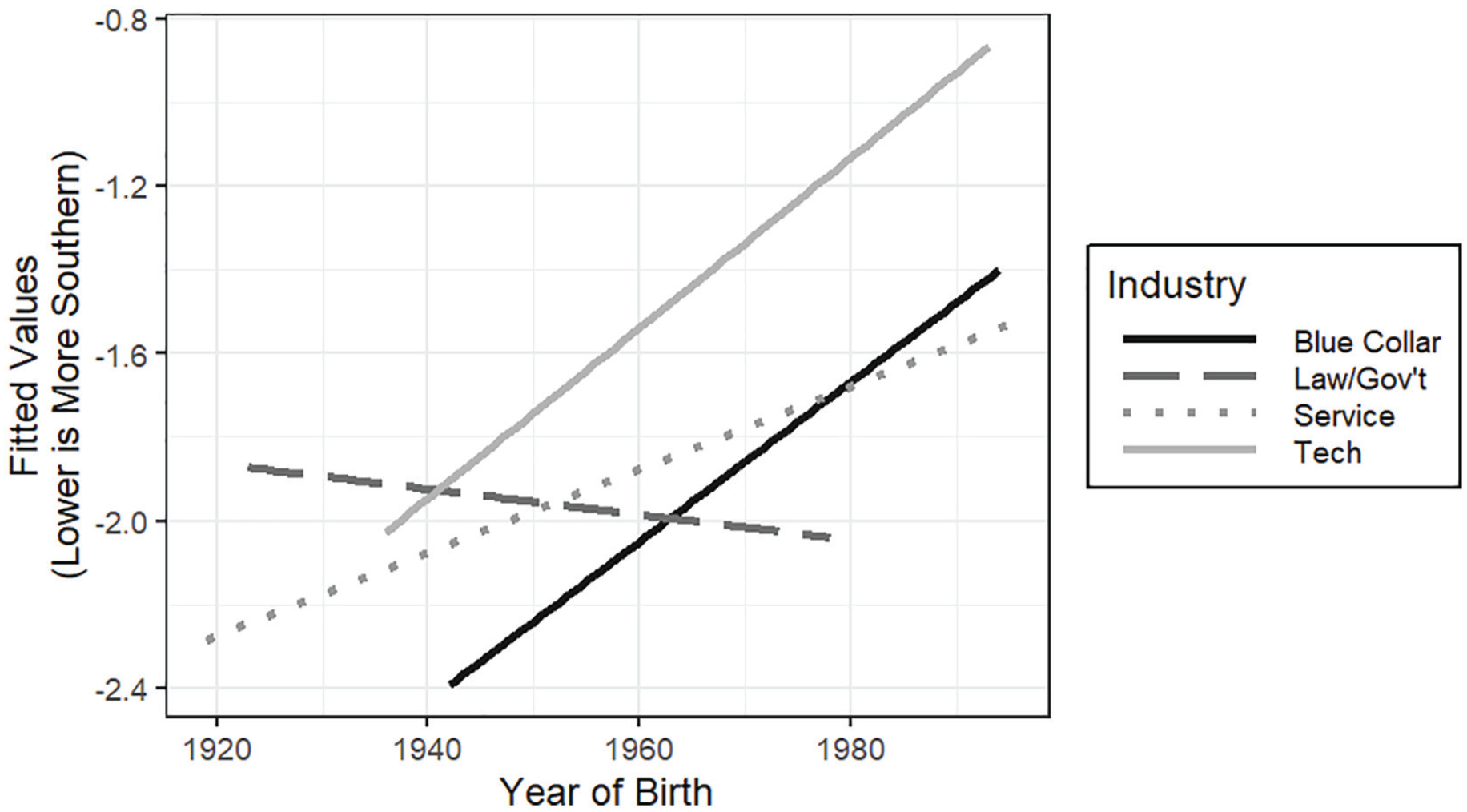
Industrial variation in pronunciation of BITE.
Discussion
Culture plays an important role in the connection between workers and jobs, and language is emblematic of this relationship. The precise acoustic measurements we implement here allow an investigation of how workers’ dialects, as set of transactional cultural symbols, correlate with industry-level employment patterns. Our results provide evidence that workers’ use of southern features clusters within industries, a marker of industry-specific cultural differences analogous to “linguistic niches” for English dialects. Beyond these static differences, workers also show differential sensitivity to community trends depending on their industry, preserving or removing southern features.
These findings extend understanding of the connection between language and work from both a sociological and sociolinguistic perspective. In general, the difference in worker patterning supports a conception of the linguistic marketplace as a locally embedded system (Bourdieu 1991). Language represents an inherently transactional form of cultural capital (Lamont 1992; Mische and White 1998), and the ubiquity of interaction allows workers to reaffirm existing cultural boundaries or create new divides, with consequences for broader social inequalities (Lamont, Beljean, and Clair 2014). The differences in linguistic patterns over time provide evidence of the renegotiation of the cultural significance of traditional southern features. As the entire community moves away from traditional southern speech norms, the symbolic divide between workers in technology and those in law widens, reflecting their differing orientations to the community and its history. These results also move beyond traditional findings in sociolinguistics. Sociolinguistic research acknowledges the importance of work in a general sense (Labov 2001; Sankoff and Laberge 1978), but analyses tend to focus on coarse-grained typologies (Labov 1972b) or discursive interactions (Holmes and Stubbe 2015). Merging sociological theories of culture and work with the sociolinguistic analytical toolkit allows a deepening of both social and linguistic understanding of language and work.
Most vowels in our analysis show either a main effect or an interactive effect for individuals’ industries, but some show no model improvement through the addition of industry. We provide specific explanations as to why some vowels show no work-related effects, but the lack of uniformity across vowels also underscores the importance of keeping local cultural context in mind when examining sociolinguistic variation (Eckert 2000, 2008). Save for the vowel in BIDE, which has nationwide awareness as a stereotypical component of southern speech (Johnstone, Andrus, and Danielson 2006; Silverstein 2003), the perceptual meanings for the SVS are constructed within the community. Much like the emphasis on organization-specific processes in the study of work (Acker 2006; Tomaskovic-Devey and Avent-Holt 2019), a sociological analysis of dialect must keep in mind the sociocultural history of the community when interpreting linguistic differences. As with other cultural objects that create and maintain inequality, individuals reinterpret broader systems of valuation locally, in this case through linguistic interaction (Bourdieu 1991; Tilly 1999).
Although we had no clear expectations for the linguistic behavior of professional workers, their linguistic productions are consistent with those in the technology sector. For all vowels that show any industry effect, professional and technology workers display similarity in both strength and direction of coefficients. These findings have two possible explanations. First, the avoidance of southern dialect features may be, at its root, a marker of class division. Sociolinguistic research tends to find strong class-based correlations with linguistic variation (Labov 1972b, 2001), and cultural reproduction also reflects existing class divides (Bourdieu 1984). Second, a more general pressure to adopt a culture of professionalism may encourage workers in both of these industries to avoid features that are seen to be stigmatized, making more of an active effort to adapt to the culture of the workplace (Swidler 1986). Language can be more difficult to modify than other components of the habitus, but more overtly stigmatized and stereotyped features are easier for speakers to modify (Labov 2001; Silverstein 2003). Consequently, southern features, which often face overt negative evaluations, may be more available for modification. In either explanatory case, however, the local situation seems to supersede concerns of class or stigma, as workers in law and government retain SVS features throughout our data. 10 As lawyers share many of the other features of professional work (higher credentialing, relative autonomy, etc.), these pressures appear to be less important than the historical connections with dialect features in a community. Although the results are consistent with our theorizing about the linguistic marketplace, language also maps onto other factors, such as politics and religion, that we are unable to measure but may play a role in linking people with employment. Future research should work toward disentangling these relationships.
Our results acknowledge dialect as an important cultural boundary between industries. The dialect features of workers reflect both the needs of their jobs and the linguistic ecology of their community. In light of these results, we see this study as opening a door into further research, rather than a final word on the issues surrounding language and work. A critical question that our data cannot address is that of process: how do these linguistic divisions arise and what impacts do they have within workplaces? The extant literature examining workplace culture, linguistic discrimination, and style shifting suggests several major points of investigation.
The first possible site is cultural gatekeeping at the point of hire. Culture plays a key role in the hiring process in general, especially within professional firms (Rivera 2011, 2012), and language can serve as a proxy to ascertain fit (Cocchiara, Bell, and Casper 2016). Research shows that listeners rate speakers of nonstandard dialects as less desirable hires, even when the dialect garners other positive social evaluations (Atkins 1993; Rakić et al. 2011; Segrest Purkiss et al. 2006). Also, when interacting with people whose dialects are judged as “out-group,” individuals tend to be less cooperative (Heblich, Lameli, and Riener 2015) and rate the interaction less positively (Mai and Hoffmann 2011). These findings fit within a wealth of research on other forms of discrimination that emphasizes the importance of the hiring process in maintaining boundaries of categorical inequality (e.g., Bertrand and Mullainathan 2003; Pager 2008). Language acts as an indexical expression of categorical memberships, and it can therefore serve to reproduce categorical boundary lines.
Second, workplace convergence on linguistic norms may occur after individuals are hired, resulting in industry-level clustering. Workplaces develop their own specific structures and systems of cultural knowledge that reproduce existing categorical inequalities (Acker 2006; Hallett 2003; Tilly 1999). To more clearly align themselves with firm-internal cultural norms and reap the possible benefits, speakers may converge on a dialect norm that reflects membership in the organization. These organizational cultures can cluster within industries (Chatman and Jehn 1994), creating industry-level patterns and maintaining symbolic boundaries between industries that produce the clustering evident in our data. This idea has some support in the sociolinguistic literature when drawing on theories of accommodation to the speech of conversation partners (Coupland 1984; Giles, Coupland, and Coupland 1991), but studies of accommodation only address short-term dialect differences (i.e., a single interaction). A true test of this hypothesis would require longitudinal data, and the few sociolinguistic studies that possess these data draw from interviews with children and adolescents (Kohn 2014; Van Hofwegen and Wolfram 2010), and sometimes reinterviews are conducted in adulthood (Rickford and Price 2013). Although the individuals in these studies do show long-term restructuring of dialect systems that reflect changing group membership or personal identity, adolescence represents a unique period when dialects can (and do) show dynamic variation. The same dramatic restructuring of systems has not been shown to occur outside of the adolescent context and examining dialect change in adulthood presents many challenges (Wagner 2012).
In sum, whatever the mechanisms creating the observed pattern, our data show more clustering of southern linguistic features in some industries over others. These findings extend our understanding of the role of language in cultural transaction related to work and the patterned changeability of cultural and linguistic norms over time. Linguistic variation among industries demonstrates movement within the linguistic marketplace that reflects the restructuring of economic relationships. Our findings also reveal the complexity of the linguistic marketplace. The persistence of stigmatized dialects among workers in law and government suggests that linguistic matching cannot be defined by a linear class hierarchy alone. Rather, dialect features may operate as status characteristics imbued with stereotype content (Ridgeway et al. 1998). Even stigmatized dialects offer value in the linguistic marketplace, such as warmth and pleasantness in the case of southern speech (Fridland et al. 2005; Kinzler and DeJesus 2013), which are perceive to be beneficial for performing job tasks in specific industries (such as law and government). As such, future research should consider the meanings conveyed by specific dialect features, how these meanings align with boundaries between good and bad jobs (Kalleberg 2009) and how this process can result in occupational linguistic niches (Mouw and Chavez 2012).
We hope that these results lead to a greater acknowledgment of the roles dialect features outside the discursive realm may play in the maintenance of cultural boundaries and possibly further into the reproduction of inequality. Linguistic discrimination remains a relatively unacknowledged phenomenon in public discourse, and bias against culturally associated linguistic features can be used as a coded means of discussing race, class, gender, and other social categories (Alim and Smitherman 2012; Lippi-Green 1997). Further examination of the role of dialect at work can shed light on how concrete connections between language and the maintenance and reproduction of inequality.
Footnotes
Appendix
Maximally Specified Regression Models for All Vowels under Analysis.

| BAIT | BIT | BEET | BET | BAT | BITE | |
|---|---|---|---|---|---|---|
| YOB | .425*** (.092) | –.213*** (.057) | .130** (.046) | –.176** (.059) | –.174** (.057) | .315** (.112) |
| Care | .373** (.119) | –.156* (.076) | .076 (.062) | –.073 (.076) | –.045 (.073) | .309* (.153) |
| FIRE | .406** (.142) | –.360*** (.099) | .186* (.076) | –.146 (.094) | –.064 (.088) | .458* (.205) |
| Law/government | .098 (.136) | –.120 (.082) | .073 (.070) | –.052 (.085) | –.086 (.083) | .015 (.166) |
| None | .294** (.112) | –.195** (.075) | .097 (.057) | –.129 (.071) | –.016 (.068) | .224 (.141) |
| Professional | .448*** (.112) | –.284*** (.075) | .158** (.058) | –.125 (.072) | –.079 (.068) | .555*** (.141) |
| Service | .254** (.098) | –.120 (.063) | .045 (.050) | –.019 (.062) | –.032 (.060) | .037 (.124) |
| Tech | .394*** (.111) | –.242** (.075) | .189*** (.057) | –.106 (.071) | –.084 (.067) | .532*** (.143) |
| Male | –.037 (.058) | –.008 (.037) | .082** (.030) | –.035 (.037) | .079* (.035) | –.170* (.073) |
| YOB × care | .014 (.122) | .082 (.076) | .0002 (.064) | –.019 (.080) | –.016 (.076) | .241 (.158) |
| YOB × FIRE | –.062 (.152) | .178 (.099) | –.080 (.083) | –.005 (.106) | –.149 (.097) | –.105 (.221) |
| YOB × law/government | –.328* (.144) | .209* (.089) | .012 (.073) | .124 (.093) | –.049 (.089) | –.317 (.177) |
| YOB × none | .064 (.109) | .067 (.068) | –.065 (.056) | –.054 (.071) | –.088 (.068) | .204 (.134) |
| YOB × professional | .073 (.125) | .048 (.078) | –.145* (.064) | –.056 (.081) | –.077 (.077) | .071 (.153) |
| YOB × service | –.135 (.104) | .150* (.065) | –.042 (.054) | .039 (.068) | –.005 (.065) | –.012 (.130) |
| YOB × tech | .044 (.120) | .126 (.075) | –.181** (.061) | .034 (.078) | –.073 (.074) | .155 (.149) |
| Intercept | –.001 (.106) | 1.560*** (.103) | 3.297*** (.077) | .103 (.102) | –1.037*** (.082) | –1.501*** (.145) |
| Observations | 15,836 | 12,467 | 12,013 | 13,321 | 17,649 | 13,009 |
| Akaike information criterion | 30,770.910 | 22,518.500 | 22,997.320 | 24,437.580 | 35,828.690 | 32,213.310 |
| Conditional R2 | .557 | .482 | .274 | .511 | .426 | .507 |
Note: FIRE = finance, insurance, and real estate; YOB = year of birth.
p < .05. **p < .01. ***p < .001.
