




Abstract
Despite theoretical claims that assimilation is a multidirectional process, most studies assess the behaviors of immigrants and their children. The author departs from this tradition to ask whether immigrant-origin populations influence the availability of Advanced Placement Spanish and Chinese/Japanese language courses. Building on past work, the author treats foreign language programs as a marker of institutional change and a greater acceptance of immigrant culture. County-level data are pooled from the American Community Survey, the Common Core of Data, the Voting and Elections Collection (CQ Press), and the College Board between 2000 and 2017. The results indicate that Hispanic and Chinese/Japanese populations exert an influence on school curricula, but this relation varies depending on historical patterns of immigrant settlement. The author also finds that Spanish and Asian foreign language programs are most likely to be demanded in locations with highly educated populations. This article provides evidence that mainstream institutions can move toward immigrant and minority culture.
Studies of assimilation and incorporation almost exclusively assess the behaviors of immigrants and their children. This approach may be motivated by a desire to uncover persistent disparities in human capital between foreign- and native-born populations (Chiswick and DebBurman 2004; Hall and Farkas 2008; Zeng and Xie 2004) or may simply reflect normative interpretations of assimilation and the immigrant experience (Jung 2009). In either case, solely focusing on cultural and social characteristics of the foreign-born ignores theoretical predictions that supposed the host society would also transform as a result of immigration (Gordon 1964; Park and Burgess 1921). It is thus necessary to consider whether cultural exchanges between ethnic groups can alter local communities. After all, one must first have a complete understanding of existing landscapes and institutions before asking whether immigrants and their children assimilate to the host society. There are many lenses through which to examine U.S. institutions, but public school curricula represent a promising avenue of study.
Schools have long been responsible for socializing all youth to the norms and expectations of American society (Bowles and Gintis 1976). To ensure that immigrant-origin youth acquire native language skills and adapt to new cultural contexts, schools emphasize bilingual and English language learner (ELL) programs (Dondero and Muller 2012; Gottfried 2014; Turner 2015). However, the proliferation of foreign language instruction suggests that norms surrounding appropriate and necessary curricula have shifted over time (Linton 2004; Olneck 2000). Following a growing body of work that frames assimilation as a multidirectional process (Alba, Beck, and Sahin 2018; Alba and Duyvendak 2019; Jiménez 2017), I argue that immigrant-origin groups introduce new norms, preferences, and curricular options that make foreign language programs more desirable to non-coethnics. By diversifying socioeconomic opportunities and drawing mainstream institutions closer to an ethnic core (Telles and Sue 2019), immigrant-origin populations may have the ability to influence widespread cultural change.
This study has several goals that assess the geographic and temporal patterning of educational curricula and population dynamics in the United States. I rely on advanced foreign language instruction—measured as Spanish, Chinese, and Japanese Advanced Placement (AP) courses—as a marker of cultural change that reflects the emergence of bilingual schooling norms. These languages overlap with large and/or influential immigrant-origin populations that are prominently featured in the global economy (Barboza 2010). Other indicators of cultural change, such as ethnic restaurants (Boch, Jiménez, and Roesler 2021; Diaz and Ore forthcoming) or participation in ethnic festivals (Jiménez 2017; Millard, Chapa, and Burillo 2004) certainly reflect the willingness of non-coethnics to engage in new sets of symbols and practices. But because foodways and celebrations involve few long-standing commitments, they represent portions of immigrant culture that are most digestible and/or tolerable for established residents. Shifts in foreign language programming, however, require additional commitments that may be harder to integrate into American life.
I begin by asking whether the Asian/Hispanic population is linearly associated with foreign language instruction at the county level; such a pattern would suggest that the host society similarly responds to the coethnic population. I also test for nonlinearities in the relation of interest to evaluate the possibility of racial threat, a pattern that could emerge when the Asian/Hispanic population amasses a sizable degree of influence. And because the benefits of engaging with foreign language curricula may depend on the influence of long-standing Asian and Hispanic communities, I examine variation across new and established destination areas.
Next, I ask whether foreign language programs are more likely to be offered in areas with higher concentrations of educated residents. This analysis is motivated by a large and growing body of work arguing that educated populations strategically amass socioeconomic advantages for their children (Calarco 2018; Edgerton and Roberts 2014; Lareau and Conley 2008; Lareau and Horvat 1999). Yet mounting evidence suggests that educated whites differentially leverage foreign language programs to boost their children’s success (Muro 2016; Woody 2020). For this reason, I separately assess the role of college-educated white and minority populations. Finally, I examine these associations within counties to test whether school curriculum is sensitive to changes in the immigrant-origin population.
Conceptual Framework
Assimilation as a Multidirectional Process
Throughout the twentieth century, political leaders and scholars debated whether immigrants, many of whom arrived from eastern and southern Europe, could effectively adapt to American life. Although empirical work solely emphasized the social and cultural characteristics of minority populations, theoretical considerations offered a more nuanced perspective. Park and Burgess (1921), for instance, equated assimilation to a fusion-like process in which “persons and groups acquire the memories, sentiments, and attitudes of other persons or groups, and, by sharing their experiences and history, are incorporated with them in a common cultural life” (p. 735). Others argued that the host society would exhibit comparably less movement toward minority culture (Fichter 1957; Green 1952) and that the contributions of new populations would be limited to cuisine, artistic expression, and religious activity (Gordon 1964).
Yet there is compelling evidence that immigrant-origin persons transformed multiple institutions. As early as 1788, the Catholic Church established national parishes to serve non-English speakers across the nation, including French Canadians, Poles, Irish, and Italians. Gordon (1964) argued that priests, many of whom were recruited to work in the United States, preserved traditions from sending counties and conducted mass in the congregations’ native tongues. By adapting services to accommodate the needs of new populations, the Church successfully increased membership and solidified their influence in the community. More contemporary work confirms that immigrants and their offspring continue to reshape religious organizations (Hondagneu-Sotelo 2006; Menjívar 2006; Warner and Wittner 1998; Yang and Ebaugh 2001). For example, Hispanic populations, much like early European immigrants, demand bilingual priests and the preservation of specific religious rituals (Millard et al. 2004). Levitt’s (2001, 2004) work on transnationalism further asserts that migrants use churches to leverage sociopolitical representation in the United States as well as in their home countries. In total, the evidence suggests that relatively new populations can transform the practices and traditions of religious organizations to effectively suit their goals.
Of course, religion is not the only facet of society altered by immigrant-origin groups. A vast literature also examines the effect of immigration on natives’ wages and skills (Borjas 1999, 2003; Card 1990; Dustmann, Frattini, and Preston 2013; McHenry 2015; Ottaviano and Peri 2012), local housing markets (Card 2007), and crime (Chalfin 2015; Hagan and Palloni 1999; Martinez, Stowell, and Lee 2010; Ousey and Kubrin 2009). Although this work does not explicitly draw on theoretical debates surrounding assimilation, it is guided by the presumption that new populations could harm U.S. communities. The evidence suggests, however, that immigrants and their children rejuvenate communities by increasing housing prices, decreasing violent crime, and boosting local economies via tax contributions and multiplier effects (Peri and Sparber 2009). This work reifies the notion that immigrant-origin populations influence contemporary American society and that this can occur in the absence of close, purposeful engagement with U.S.-origin persons.
In recent work, Jiménez (2017) asked whether community change can be directly attributed to minority and immigrant populations, a process he referred to as relational assimilation. Established residents report that language, religious organizations, and schooling norms have each diversified because of local demographic change. For instance, parents stress that U.S.-origin children must exert substantially more energy in school and extracurricular activities to remain competitive with children born to highly skilled immigrants, the majority of whom hold exceptionally high educational expectations. Jiménez (2017) thus concluded that the presence of new immigrant groups can alter the practices, value systems, and institutions within established communities. Although consistent with theoretical predictions, the aforementioned study is most effective in sharing residents’ perceptions of long-standing institutional change.
In total, a nascent body of work acknowledges that immigrant-origin populations influence U.S. society by altering economic, institutional, and linguistic practices. However, it remains an empirical question whether this shift varies depending on historical patterns of settlement. If the presence of immigrant-origin populations in established areas yields unique business or educational opportunities that have yet to manifest in new destinations, the real or perceived benefits of adopting another language should differ. It will thus be useful to consider whether established and new destinations exhibit unique patterns of cultural transformation.
New and Established Destinations: Background and Implications
Over the past 30 years, immigrant-origin populations have bypassed established gateways in favor of smaller communities in nontraditional states (Johnson and Lichter 2008; Light and von Scheven 2008; Singer 2013). Although counties in California, Texas, and Illinois, known as established destinations, continue to attract immigrant-origin populations, areas in the Midwest and the South experienced pronounced Asian and Hispanic growth (Kandel and Cromartie 2004). These formerly homogenous communities would have experienced population and economic decline in the absence of new migration patterns (Lichter and Johnson 2009).
Numerous factors are responsible for the movement away from traditional locations. The 1986 Immigration Reform and Control Act allowed formerly undocumented persons to find employment outside of the ethnic enclave (Massey, Durand, and Malone 2002). As a result of increased border enforcement, some undocumented migrants began crossing into the United States using less traditional points of entry (Durand, Massey, and Parrado 1999). Employers also aggressively recruit low-skilled individuals, mainly Hispanics, to work in meat processing and manufacturing plants (Kandel and Parrado 2005; Parrado and Kandel 2010). In the case of Asian migration, some attribute the emergence of new destinations to demands for skilled workers in information, technology, and higher education (Frey 2014; Singer Hardwick, and Brettell 2008).
Established destinations, known as “assimilation machines,” ensure that immigrants and their children are incorporated into American life (Massey 2008). Although this is certainly true, institutions and non-coethnics should also adopt new preferences and opportunities as a result of ongoing contact with Asians and Hispanics. Predictions for new destinations are less certain. On one hand, majority and minority groups likely share public spaces, including parks, schools, and community centers (Crowley and Lichter 2009; Millard et al. 2004). To the extent that social and geographic proximity influence tastes, the Asian and Hispanic population should exert a strong and linear influence in new destinations (Grey and Woodrick 2005). On the other hand, these populations may be viewed as economic and cultural threats (Fennelly and Federico 2008; Marrow 2009), especially in areas that experience rapid minority growth (Singer et al. 2008); such a scenario implies that the influence of Asians and Hispanics in new destinations will assume a nonlinear form.
A few in-depth studies suggest that institutions within established and new destinations have adapted to the needs of the immigrant population, particularly with respect to language-based services. A growing number of police officers, firefighters, and social service workers are required to take Spanish language courses before entering the field; there are even reports of a wage premium for bilingual employees in midwestern towns (Millard et al. 2004). Radio stations are moving from English-only to bilingual or Spanish-only broadcasting, and this programming shift is boosting locally owned businesses as well as the effectiveness of community outreach (NBC News 2014). And some Georgia schoolteachers are encouraged to enroll in Spanish language courses to better serve their students (Hernández-Leon and Zúñiga 2005). To be sure, some of these changes can be attributed to Executive Order 13166, which mandates that federal services must be available to residents with limited English proficiency. That local agencies are not obligated to provide language assistance to residents but often do so implies that new populations can transform institutions within both established and emerging destinations.
Schools and Foreign Language Programs: Promises and Pitfalls
As key societal institutions, schools are responsible for cultivating students’ cognitive and noncognitive skills to prepare them for the emerging responsibilities of adulthood (Brint 1998; Collins 1977; Parsons 1959). For immigrant youth, schools also function as a bridge to new social and cultural contexts, which include exposure to U.S. norms and practices (Bowles and Gintis 1976; Singer et al. 2008). It is thus not surprising that many schools offer ELL courses. Such programs, which serve as a stepping-stone to English-only instruction, are designed to expedite communication with native speakers and mainstream institutions (Fry 2008; Gottfried 2014). Although the merits of ELL instruction are debatable, it is clear that schools prioritize the skills and language of the dominant class (Bernstein 1994; Bourdieu and Passeron 1977; Bowles and Gintis 1976; Labaree 1986; Sharp 1980). The dramatic rise of foreign language instruction over the past 50 years (Welles 2004), however, suggests that a new set of preferences are emerging.
As the nonwhite population increases, parents and students develop new expectations for class curriculum and learning, including foreign language courses (American Councils for International Education 2017; Brint, Contreras, and Matthews 2001). For example, enrollment in college foreign language programs increased from more than 600,000 in 1960 to 1.4 million in 2016, with Spanish overtaking French and German languages by a wide margin (Looney and Lusin 2019). Extensive case studies also argue that foreign language immersion programs, which provide U.S.-origin children the opportunity to expand their language skills and cultural repertoire, are disproportionally located in districts with large numbers of Hispanics (Thomas and Collier 2002; Turner 2015). Indeed, Linton and Jiménez (2009) argued that dual-language programs are especially popular among U.S.-born Latinos and non-Latinos who wish to develop skills, relationships, and business opportunities with Spanish-speaking populations.
Highly educated parents provide numerous opportunities for their children’s success in part by cultivating skills to effectively navigate the classroom and labor market (Calarco 2018; Hamilton, Roksa, and Nielsen 2018; Horvat, Weininger, and Lareau 2003; Lareau 2015). Because bilingual youth appear to earn higher test scores than their monolingual peers (Benet-Martínez, Lee, and Leu 2006; Freeman, Freeman, and Mercuri 2005; Stewart 2005), foreign language curricula are likely demanded by those who emphasize higher education and lucrative employment. Educated persons may also be especially cognizant of institutional shifts that accommodate the language needs of immigrant-origin groups. If advantaged populations can readily identify academic, professional, or cultural opportunities for themselves or their children, a positive correlation should emerge between the share of college-educated residents and the availability of foreign language programs.
Using in-depth interviews and ethnographic observations, Muro (2016) and Woody (2020) separately examined the attitudes and experiences of white and nonwhite parents whose children attend Spanish immersion schools. Although both studies took place in different periods and locations, their results are strikingly similar. Educated whites assert that bilingualism will help their children gain admission to college, find lucrative employment, and allow them to navigate an increasingly cosmopolitan world (Woody 2020). Minority parents, however, emphasize other benefits: to avoid discrimination in majority schools and/or to communicate with non-English-speaking relatives. Ultimately, Muro stressed that white parents disproportionally reap benefits from diversity while monopolizing resources that reinforce racial disparities. It will thus be important to separately consider how concentrations of educated white and minority persons affect the availability of Chinese/Japanese and Spanish programs.
Resistance to Multiculturalism and Threat
Despite being particularly appealing to educated non-coethnics, foreign language programming also depends on general support from local governments and citizens. Schools may adopt new curricula, but this does not necessarily mean that the larger U.S. population embraces multiculturalism (Banks 1995; Bernstein 1994; Turner 2015). In fact, resistance to diversity and new curricula appears strongest when and where the English language is perceived to be threatened (Olneck 2000). 1 Perhaps not surprisingly, federal and local efforts to designate English as the official language of the United States gained traction as the Asian and Hispanic population increased during the 1990s (Magaña and Lee 2013). Recent estimates suggest that 31 states and numerous counties and cities implemented English as their official language, with sponsorship from conservative leaders and policy makers (Dyste 1989; Liu et al. 2014).
Although some argue that English-official legislation is purely symbolic, attacks on foreign languages are designed to police the actions and behaviors of immigrant-origin persons (Liu et al. 2014; MacKaye 1990). I thus integrate predictions from the racial threat literature (Blalock 1967; Fennelly 2008; Olzak 1990) to test whether foreign language curricula could exhibit a nonlinear relation with the Asian and Hispanic population. Such a scenario may emerge if residents actively protest or boycott foreign language programs in locations with a dense number of coethnics.
Study Goals and Hypotheses
I begin by asking whether Asian and Hispanic populations are associated with foreign language courses offered in secondary schools. If a positive relationship emerges, it would suggest that the host society may be influenced by relatively new populations. However, if there is little evidence to support relational assimilation, findings may instead support racial threat. On the basis of existing work, I generate the following hypotheses:
Hypothesis 1A: Counties with a larger presence of Asians and Hispanics should offer a greater number of Chinese/Japanese and Spanish language programs.
Hypothesis 1B: There may instead be a nonlinear (concave) relationship between Asian/Hispanic growth and the number of foreign language programs in a county.
Hypothesis 2: The correlation between the Asian/Hispanic population and foreign language programs will differ between established and other destination types.
Hypothesis 3: Foreign language programs are more likely to be available in counties with larger numbers of educated populations, but this should be most pronounced among whites.
Hypothesis 4: Hypotheses 1 to 3 will also hold when examining intracounty variation between the Asian/Hispanic population and foreign language curricula.
Data and Measures
I combine data from five unique sources: the decennial U.S. census, the American Community Survey (ACS), the Voting and Elections Collection from CQ Press, the Common Core of Data (CCD), and the College Board. When used in combination, these data sources shed light on whether, and the extent to which, the presence of Asian and Hispanic populations is associated with foreign language instruction.
Outcome: AP Courses
Before describing my outcome variables, it will be useful to elaborate on AP more generally. AP programs were first adopted in 1952 by a handful of schools on the east coast (Rothschild 1999). Along with biology, chemistry, and mathematics, French and German were among the original language courses approved by the test committee. And it was not until 1975, a period marked by economic stagnation and heightened unemployment, that AP gained traction as a renowned, national program (Grady 1979). While Spanish language courses were added in the 1970s, just as multiculturalism and ethnic studies proliferated in the United States, Chinese and Japanese were introduced in 2006 (Ewing 2006). There are many reasons for shifts in AP programming, but one explanation is that courses are designed to mirror key curricula offered by colleges and universities (Rothschild 1999). Others posit that state legislatures, professional organizations, foundations, and local resources determine the number and type of courses offered (Highsmith 1989; Lively 1993).
Substantively, AP courses allow academically prepared students who are still enrolled in high school to engage in college-level studies while remaining in their usual academic environment. To receive credit for their endeavors, students must complete a standardized exam at the end of the year, typically in the spring. Upon successfully passing, most colleges and universities offer students college credit and/or allow them to forgo introductory courses (College Board 2019). The adoption and recognition of foreign language programs by high schools and postsecondary institutions suggests that new cultures and languages are viewed as legitimate curricula. Although it would be ideal to draw on all foreign language instruction offered in secondary schools (and not just AP courses), these data are not collected by the College Board.
I rely on the availability of AP foreign language programs in public high schools to create my outcomes of interest. Not only do 84 percent of students in the United States attend public school, but these institutions continue to grapple with pronounced demographic change (Gandara and Mordechay 2017). The College Board, a nonprofit organization that seeks to increase access to higher education, is charged with approving all syllabi for AP courses. Once a course is approved by the College Board, it appears in the AP Course Ledger, a directory containing the universe of AP courses offered by schools across the nation. Although AP courses were offered before 2007, data are available only between 2007 and 2017 because of the revised audit system (see https://apcourseaudit.inflexion.org/ledger/ for details).
I begin by pulling all AP course data for U.S. schools in 2007, 2012, and 2017. Each record contains the AP subjects offered within individual schools as well as the physical locations of these institutions. 2 Given my interest in assessing the relation between foreign language programs and the larger coethnic population, I aggregate the number of Spanish, Chinese, and Japanese AP courses to the county level; the logic guiding this decision is further described in my analytic approach. The focal outcomes are based on a series of dummy and continuous indicators that denote the presence and number of courses.
Predictors
The presence and growth of minority populations represents a key component of relational assimilation: the process by which institutions are believed to more closely reflect new ethnic groups (Alba and Duyvendak 2019; Jiménez 2017). As such, the two main predictors are specified as the percent of county residents who are Hispanic or non-Hispanic Chinese and Japanese; a quadratic term is also created to explicitly look for nonlinearities consistent with racial threat. Because it would be naive to assume that Asians and Hispanics immediately alter school curricula, I rely on predictors from the 2000 decennial census as well as five-year estimates from the 2005–2009 and the 2010–2014 ACS. Although not all Hispanic- and Asian-origin individuals can speak in their ancestral languages, 73 percent of Hispanics aged five years and older speak Spanish (Krogstad, Lopez, and Rohal 2015) and 66 percent of Asians speak languages other than English at home (Budiman and Ruiz 2021).
Covariates
It is essential to control for measures that are likely to confound the relation of interest. First, the local political context may influence the number of Asian/Hispanic persons who reside in a community and may also reflect willingness to adopt new language programs. I thus include the percentage of Republican votes cast during the 2000, 2008, and 2012 presidential elections. Given that local economic conditions are associated with both school resources and demographic change, I control for region, the unemployment rate, median household income, as well as industrial composition in 2000, 2005 to 2009, and 2010 to 2014. Of particular interest are professional, construction, and farming, fishing, and forestry occupations, as these represent categories that traditionally have large numbers of immigrant-origin workers (Flippen 2012; Kandel and Parrado 2005).
To control for the availability of school-based resources, I draw on the CCD from the U.S. Department of Education within counties in 2000, 2008 to 2009, and 2013 to 2014. I begin by gathering data for elementary/secondary and secondary school districts, which allows me to identify the respective counties in which districts operate. I then obtain the percentage of students who have limited English proficiency (LEP), the share of students who receive free or reduced-price lunch, and the pupil/teacher ratio by averaging values within counties. Controlling for the share of students with LEP reduces concerns that AP courses are solely demanded by coethnics who are already fluent in their native tongues. I also adjust for the average number of students enrolled in school (logged) to capture demand for school services as well as potential competition for school-based resources.
To assess whether demands for advanced foreign language programs are higher in areas with educated populations, I include the percentage of non-Hispanic white residents with a bachelor’s degree or a higher level of attainment. I also include the share of college-educated minority populations, but Hispanics (Asians) are excluded when estimating the relation between Spanish (Asian) AP courses and the Hispanic (Asian) population; this is done to ensure that the coethnic population is not solely influencing results. Information is obtained from the 2000 census as well as the 2005–2009 and 2010–2014 ACS.
There are several ways to define established and new destinations. Following existing work, counties with Hispanic populations of 10 percent or more in 1990 and 2000 are considered established areas of settlement. New destinations are counties that experienced Hispanic growth of 150 percent or more and grew by 1,000 residents (Kandel and Cromartie 2004). Counties that are neither established nor new Hispanic destinations are included in a residual “other” category and serve as the reference category in analyses. Because Chinese and Japanese residents make up a smaller share of the U.S. population, I adjust the aforementioned criteria on the basis of 1990 national estimates. Counties with populations of 2 percent or greater in 1990 and 2000 are designated as established destinations, whereas new destinations are counties that increased by 1,000 Asian individuals and experienced population gains of 100 percent or more.
Analytic Strategy
I begin by estimating the probability that AP Spanish programs are offered in a county (2017) by using the Hispanic population (2010–2014) as a predictor. Because it would be naive to assume that changes in school curricula simultaneously occur alongside changes in the Hispanic population and local socioeconomic conditions, I lag all predictors by 7 years and include a quadratic term for the Hispanic population; this allows me to account for potential nonlinearities in the association of interest. In separate specifications, I include an indicator of whether a county is a new, established, or other destination, as well as interactions with the percentage Hispanic. Finally, I look for evidence that foreign language curricula are more likely to be offered in locations with greater shares of educated persons. I do so by separately including the percentage of white and minority populations with a college degree or higher. All estimates from cross-sectional analyses are derived from logistic regression.
Measuring Intracounty Change
To assess variation within counties, I specify the number of AP Spanish programs in county i at time t as a linear and quadratic function of the share of the Hispanic population, h and h2, and a set of time-varying characteristics (

To determine whether the correlation of interest systematically differs across destination type, I interact the time-varying measure of percentage Hispanic with a time-invariant indicator of destination type; “other” destinations serve as the reference category.

Here, β1 and β2 allow the effects of the Hispanic population to be nonlinear in counties that are neither established nor new destinations, β3 and β4 denote the difference in nonlinear effects between Hispanic growth in established and other destination types, and β5 and β6 denote the difference in nonlinear effects between new and other destinations. Finally, I include the percentage Hispanic with the share of white and minority persons who earned a bachelor’s degree or higher; this allows me to test whether counties with larger gains in the educated population have additional foreign language programs. I repeat this exercise using Chinese/Japanese AP courses as an outcome and the coethnic population as a key predictor.
The final sample consists of 3,103 U.S. counties, as Alaska, Hawaii, and Puerto Rico are excluded from the analysis. I treat independent cities and county equivalents in New England states as counties (Johnson and Lichter 2008). Bronx, Kings, New York, Queens, and Richmond counties in New York are combined into a single unit of geography given the structure of some data sources. Rather than choosing school districts as my unit of analysis, I select counties for three reasons. First, the emergence of new cultural and curriculum-based norms likely extends to local governments, employers, and residents. Moreover, relying on counties helps eliminate concerns that results are driven solely by changing district boundaries or the emergence of new or revised districts. 3 And although counties do not neatly correspond to social, political, and labor markets, they are intuitive approximations of local communities in both urban and rural areas.
Results
Figure S1 illustrates the geographic distribution of Spanish and Chinese/Japanese AP courses across the United States. Courses can be generally found in areas characterized by high population densities and established patterns of Asian and Hispanic settlement. Specifically, Spanish AP programs are clustered throughout California, Florida, Illinois, the Northeast, and along the U.S.-Mexico border. There are also programs offered in the South and Midwest, which correspond to new destinations. Asian programs are less plentiful and are concentrated in coastal locations in Los Angeles and Orange County in California, Cook County in Illinois (the Chicago area), and throughout New York. This provides some evidence that historical and contemporary immigration patterns influence local availability and demand for school curricula.
Selected descriptive statistics are provided in Table 1. On average, fewer than one Asian course was offered per county in 2007, 2012, or 2017. However, overall availability increased so that 234 Asian courses appeared in nearly 8 percent of counties by 2017. Spanish is the most common foreign language course, outpacing German, French, and Italian throughout the entire period of observation. About two AP Spanish courses were offered per county, with a total of 950 programs in 31 percent of counties by 2017. And as documented by past work, the Hispanic and Asian population exhibited remarkable growth between 2000 and 2010 to 2014. Although the number of Republican voters remained stable, the average share of students who qualified for free or reduced-price lunch increased (from 37 percent to 52 percent), as did the share of limited English proficiency students (2.6 percent to 4.1 percent).
Selected Descriptive Statistics by Year.

Note: n = 3,103. Median household income is inflation-adjusted to 2014 dollars. ACS = American Community Survey; AP = Advanced Placement.
Is There a Relation between Local Hispanic Composition and School Curricula?
Next, I estimate a series of logistic regression models to assess the relation between the 2010–2014 Hispanic population and the availability of Spanish AP courses in 2017 (Table 2). Prior to the inclusion of controls, a statistically significant and concave association emerges. An additional percentage-point increase in the Hispanic population is predicted to increase the odds that a Spanish language program is offered by nearly 9 percent; this relation slightly flattens, however, in locations with larger numbers of Hispanics (model 1). Putting results into further perspective, a county with no Hispanics has a much lower probability (0.20) of offering such programs than locations where Hispanics constitute 25 percent of the population (0.54). The association remains after controlling for socioeconomic factors (model 2) but diminishes in magnitude and significance with the inclusion of school-related controls (model 3); see Table S1 for all estimated odds ratios. This suggests that across-county variability in AP Spanish language curricula can largely be explained by school-related economic and contextual measures.
Logistic Regression Predicting Spanish Language Courses.

Note: n = 3,103. Values in parentheses are standard errors. Results were obtained from logistic regression. Odds ratios are shown.
p < .10. ***p < .001.
To test whether the availability of Spanish language programs differs across destinations, I estimate a logistic regression model containing relevant linear, quadratic, and interaction terms (Table 2, model 4); counties that are neither new nor established Hispanic destinations serve as the reference category. 4 To facilitate interpretation, predicted probabilities are graphed for each destination type (Figure 1). It is striking that Spanish language curricula do not significantly vary across destination type after controlling for key confounders. Moreover, there is little indication that such curricula linearly or nonlinearly vary alongside the local Hispanic population in these locations.

Predicted probability of AP Spanish and Asian language programs by destination type (2017).
Is There a Relation between Local Asian Composition and School Curricula?
I repeat this strategy to assess the association between the Chinese/Japanese population and the availability of Chinese/Japanese AP courses (Table 3). Recall that fewer AP Asian courses are offered than Spanish programs and that the Asian population represents a smaller share of the overall population. Nevertheless, I observe a substantive and significant association, one that resembles the concave pattern for Hispanic curricula. Each percentage-point increase in the Asian population is predicted to increase the odds that a Chinese or Japanese language program is offered by nearly 15, with the slope increasing less steeply in areas with larger numbers of Asians (model 1). A county with no Asians has a near zero probability of offering such programs, but locations where Asians constitute 8 percent of the population exhibit a probability of nearly 1. Unlike the Hispanic case, the association of interest persists linearly with the inclusion of both socioeconomic and school-related controls (models 2 and 3); see Table S2 for all estimated covariates. Although Chinese and Japanese residents make up a much smaller share of the population than Hispanics, results suggest that Asians play an especially influential role in shaping school curricula.
Logistic Regression Predicting Asian Language Courses.
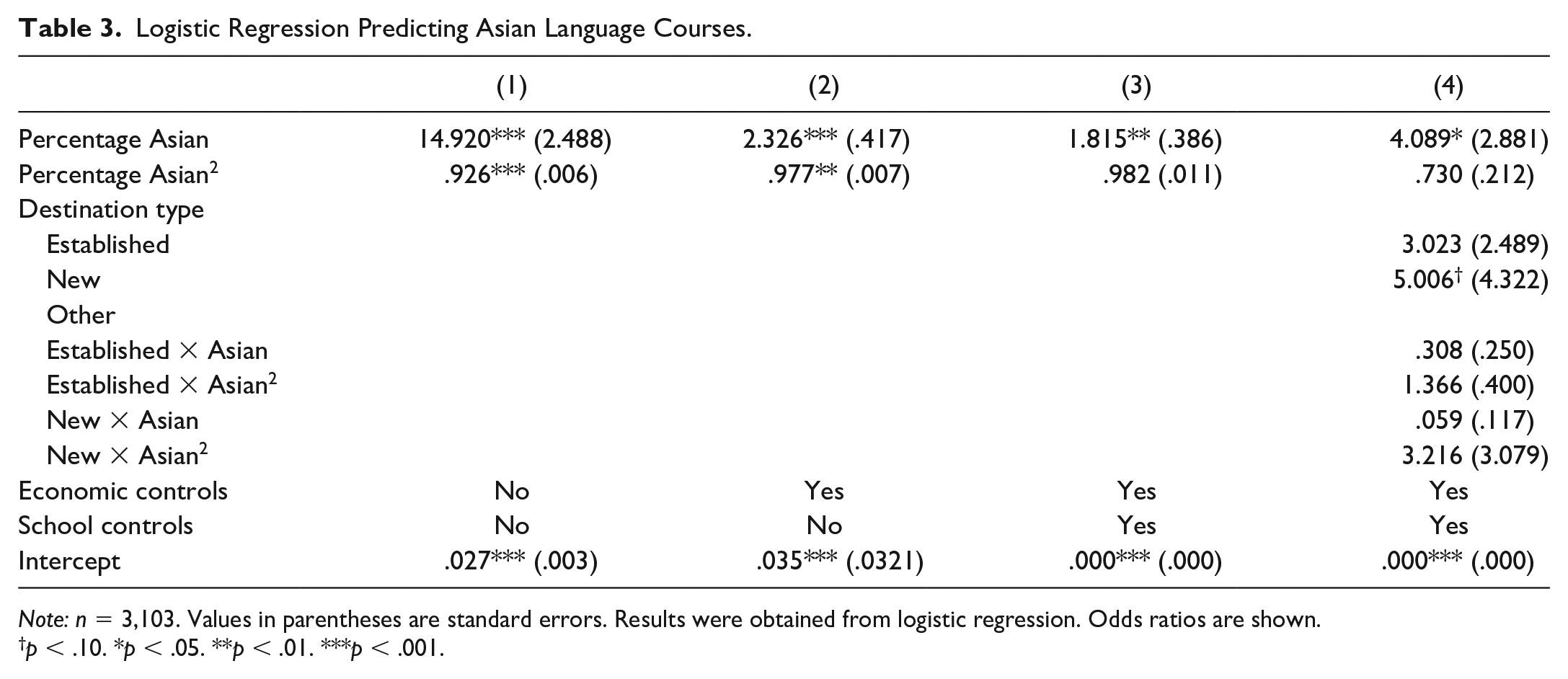
Note: n = 3,103. Values in parentheses are standard errors. Results were obtained from logistic regression. Odds ratios are shown.
p < .10. *p < .05. **p < .01. ***p < .001.
Next, I include a series of linear, quadratic, and interaction terms to test whether the association between Chinese/Japanese AP courses and the coethnic population varies across destination type (Table 3, model 4). A positive and linear association emerges between the Asian population and AP course offerings in destinations that are neither established nor new. Results also indicate that new destinations are predicted to have 4 times the odds of offering AP Chinese/Japanese language courses than other destination types when no coethnics are present (z = 1.87). Figure 1 illustrates that once the coethnic population exceeds 2 percent, the predicted probability that an AP program is offered in a new Asian destination approaches nearly 1.
Do Educated Populations Influence the Availability of Foreign Language Curricula?
The final portion of this cross-sectional analysis tests whether educated white and minority populations differentially demand foreign language curricula. Figure 2 contains results from four separate regressions (see Table S3 for odds ratios) after holding covariates at mean values. Turning to results shown in model 1, the Hispanic population is predicted to exhibit a significantly linear and positive relation with AP Spanish programs, but only in counties with no educated whites. And each percentage-point increase in the share of educated whites is predicted to increase the odds that a Spanish language program is offered by 9 percent. Although the correlation appears strongest in counties with small numbers of Hispanics, there is a convergence as the Hispanic population increases. This could indicate that demand for Spanish language curricula is heightened when the white majority believes that there are strong returns to bilingualism. I find virtually no relation between the Hispanic population, educated minority populations, and AP Spanish courses.

Predicted probability of AP Spanish and Asian language programs by local educated population (2017).
Results for Chinese and Japanese AP programs are also shown in Figure 2. It is worth stressing that the relation between the Asian population and language courses is imprecisely estimated because of a large standard error. Nevertheless, Chinese and Japanese courses are significantly more likely to be offered in locations with educated whites. For instance, counties with modest Asian populations (2 percent) that also host large educated white populations (30 percent) have twice the probability of offering Chinese and Japanese AP courses than counties with fewer educated whites (10 percent). However, the magnitude of this association is very small and close to 0. Results also indicate that AP courses are more likely to be offered in areas with larger shares of educated non-Asian, nonwhite populations (z = 1.75) and that demand is driven by those living alongside larger groups of coethnics.
Are Changes in Local Population Composition Linked to Shifts in School Curricula?
I conclude by examining within-county variation in the number of AP Spanish and Asian programs using a series of linear fixed-effects regressions; a continuous outcome allows me to assess changes in foreign language programs in greater detail. Table 4 examines whether changes in the Hispanic population are linked to AP Spanish programming after controlling for time-varying covariates. Although the number of Spanish courses grew during this period, I find little evidence that shifts in the Hispanic population are associated with additional Spanish language programs (model 1). And although changes in the Hispanic population are not associated with increased AP programming within other destination types, I do find that established and new destinations characterized by additional Hispanic growth offered comparably more Spanish language programs (model 2); Wald tests indicate differences persist among established and new destinations as well. 5
Predicted Change in the Number of Spanish Language Courses.

Note: Year 2 corresponds to 2005–2009 predictors, and year 3 corresponds to 2010–2014 predictors. Values in parentheses are standard errors. Results were obtained from fixed-effects linear regression models. Time-varying controls are included.
p < .10. *p < .05. ***p < .001.
I then test whether changes in the share of the educated white and non-Hispanic minority population are linked to changes in AP Spanish programming (models 3 and 4). Similar patterns emerge for both sets of results. First, I observe a convex relation between Hispanic population growth and AP courses in locations whereby the share of educated persons remained unchanged; this apparent negative relation becomes positive when the share of educated whites increases by about 2 percent. Among counties with gains in both educated persons and Hispanics, there were small, nonlinear increases in AP Spanish courses. And demand for Spanish language curricula appears stronger among college-educated whites than it does among college-educated minorities, particularly when the Hispanic population is small.
Results for AP Chinese and Japanese programs are shown in Table 5. Overall, the number of Chinese/Japanese courses offered throughout this period increased significantly. Model 1 illustrates a substantively large, nonlinear (concave) association between changes in the Asian population and the number of Asian courses; these results are similar in direction and significance as the cross-sectional analysis presented earlier. Model 2, which includes interactions between the local Asian population and destination type, suggests that AP Asian courses have not increased with the Asian population in areas that are neither established nor new. However, I do observe a significant and concave relation within established and new destinations: counties with relatively small and large gains in the Asian population are predicted to offer less advanced foreign language instruction, and this concave function is more pronounced within new destinations.
Predicted Change in the Number of Asian Language Courses.

Note: Year 2 corresponds to 2005–2009 predictors, and year 3 corresponds to 2010–2014 predictors. Values in parentheses are standard errors. Results were obtained from fixed-effects linear regression models. Time-varying controls are included.
p < .05. **p < .01. ***p < .001.
Finally, models 3 and 4 assess whether changes in the educated white and non-Asian minority population are associated with shifts in Asian language curricula. The relation between the local Asian population and foreign language programs assumes a convex form when the educated white population is included. Within areas that experienced no Asian growth, language programs did not decline as steeply in areas with educated whites, and counties with gains in both educated persons and Asian residents exhibited weaker declines in AP Asian courses. However, changes in the educated minority population expanded the number of Chinese/Japanese programs, but only in counties that experienced coethnic population growth. It is possible that diverse communities with members who can readily leverage their resources may be particularly receptive to foreign language curricula deemed useful and/or prestigious.
Discussion
Empirical investigations of assimilation theory are beginning to ask whether and how immigrant-origin populations influence American life (Alba et al. 2018, Jiménez 2017). Given that a growing body of work acknowledges that institutions respond to the needs, preferences, and demands of immigrant-origin populations, new norms and policies are likely to emerge as a result of demographic change. It is precisely this type of institutional shift that helps facilitate the creation of a hybrid culture and the expansion of the American mainstream (Alba and Nee 2003).
There are many ways to examine the contributions of relatively new populations, but I focus on AP foreign language courses. Other modes of linguistic change, such as non-English television and media, deliberately target coethnics (Olzak and West 1991; Park 1922) and reflect access to financial resources and purchasing power (Schreiber and Lenson 2004). As such, it is unclear whether and under what conditions non-coethnics would consume these cultural objects. I argue that foreign language programs capture the potential for community openness and the emergence of institutionalized bilingualism in the host society. Moreover, everyday Americans must first become familiarized with another language before seriously consuming other forms of ethnic culture and media.
Foreign language programs may emerge to better reflect college curricula that bolster later career outcomes and language skills. Programming could also shift because of demands from educated parents who wish to secure human and cultural capital for their children in a multilingual world. Moreover, changes in the availability of foreign language courses may be the result of a growing supply of coethnic, bilingual teachers who have aged into adulthood. Any of these scenarios suggest that school curricula are fundamentally transformed by new populations. In this way, advanced foreign language instruction represents a compelling avenue to test whether the U.S. incorporates aspects of immigrant culture. I begin by assessing the association between the Chinese/Japanese and Hispanic population and AP foreign language courses. I then draw on a growing body of work that highlights the significance of place and socioeconomic resources to ask whether this relation depends on historical patterns of immigrant settlement or the presence of educated adults.
For Hispanics, I find little evidence of relational assimilation or racial/ethnic threat (hypothesis 1A and 1B) after accounting for economic and school-based resources, and this is true when examining patterns within and between counties. However, foreign language programs are most likely to expand within established and new destinations that experience ongoing Hispanic growth. Thus, my expectation that foreign language programs would be most prevalent in established destinations (hypothesis 2) was supported. I also find that the educated white population is consistently associated with the presence and growth of AP Spanish programming, particularly in counties with large and increasing shares of the coethnic population. It is striking that the educated minority population is not associated with the presence of AP Spanish across counties but that increases in the share of educated minorities and Hispanics yield additional foreign language programming. Thus, hypothesis 3 is partially supported, as the overall influence of college-educated residents is quite strong. Given their relatively advantaged position, highly educated populations could be less threatened by cultural change and may instead embrace multiculturalism in schools, even if to preserve their own socioeconomic interests; this is unlikely to be the case among those occupying lower positions on the status hierarchy (e.g., Kaufmann 2019).
For Asians, the coethnic population plays a substantively important role in the demand for Chinese/Japanese curricula between and within counties. This could be because Asians are a relatively new population, at least compared with Hispanics, making demand for language programs more closely tied to local population composition. It is also striking that this association depends on destination type, as results examining within-county variation align with theories of racial/ethnic threat in both established and new Asian destinations. To the extent that boundary blurring requires acceptance and participation by long-time residents who monopolize access to institutions, Asian growth may suppress demand for foreign language instruction. This is especially likely if children of majority populations find themselves competing with children of recently arrived and skilled immigrant-origin parents (Jiménez 2017).
I also find the educated white population is positively correlated with the availability of Chinese/Japanese programs across and within counties. Unlike Spanish courses, demand appears strongest when there are increases in the share of educated minorities as well as the number of coethnics. Results partially support my hypothesis that anticipated courses would be concentrated in areas with educated whites. I suspect that this correlation emerges because Asians represent a smaller share of the population than other hypervisible minority groups (i.e., Black and Hispanic) and are relatively skilled. In this way, educated minority populations may exhibit more openness toward new languages and cultures that are associated with economic success.
There are, of course, other issues to consider. First, it would be ideal to record the racial and ethnic identification of students who enroll in these courses. In the absence of such data, it is difficult to make claims about the ethnic origins of students who take advanced foreign language instruction. There is information on racial and ethnic composition of overall AP test takers, however. Asians make up 4 percent of students enrolled in grades 10 to 12, but nearly 11 percent of AP test takers are Asian; Hispanics constitute 21 percent of enrollments but only 19 percent of test takers (College Board 2014). Although there are disparities in AP test taking, these figures suggest that demand for Japanese/Chinese and Spanish foreign language courses is unlikely to be driven solely by coethnics.
One might also be concerned that findings for Asian language programs solely reflect schooling preferences among coethnics. Because Chinese- and Japanese-origin persons are positively selected with respect to human capital, and also exhibit high rates of college attendance (e.g., Lee and Zhou 2015), results could simply reflect preferences among highly educated coethnics, not changes in social, economic, and cultural influence. To rule out this possibility, I test whether changes in the local Chinese/Japanese population continue to predict shifts in the availability of AP curricula with the inclusion of college-educated Asians. If a positive and significant relation emerges, it would undermine my argument that new populations transform American institutions. The results demonstrate that this is not the case: I see no evidence that the inclusion of college-educated Asians predicts changes in AP Asian courses or alters the relation between the coethnic population, college-educated whites, and changes in Mandarin/Japanese programming (Table S4).
Despite some limitations, this study offers a more complete understanding of the many ways schools are influenced by local demographics. It is worth stressing, however, that cultural shifts in American institutions do not necessarily result in a reallocation of resources toward Asians or other minority groups. The long history of immigrant exclusion and anti-Asian sentiment demonstrates that cultural influence alone is not enough to reduce inequality or discrimination. Future work exploring assimilation and integration would benefit from assessing the well-being of individuals within institutions and contexts whose boundaries are expanding.
Supplemental Material
sj-docx-1-srd-10.1177_23780231211065270 – Supplemental material for Foreign Language Curricula and the Influence of Immigrant-Origin Groups
Supplemental material, sj-docx-1-srd-10.1177_23780231211065270 for Foreign Language Curricula and the Influence of Immigrant-Origin Groups by Christina J. Diaz in Socius
Footnotes
Acknowledgements
I would like to thank the anonymous reviewers and the editors of Socius for their helpful feedback. I am also grateful for Jesse Merriman’s research assistance and Charles Seguin’s support with data scraping.
Supplemental Material
Supplemental material for this article is available online.
1
One example is California’s Proposition 227, which sought to fast-track students with limited English proficiency in English-only classrooms.
2
AP Spanish courses are described as developing “your Spanish language skills and learn about the cultures in Spanish-speaking parts of the world . . . practice communicating in Spanish and study real-life materials such as newspaper articles, films, music, and books” ( ). Japanese and Chinese courses (Mandarin) are described similarly.
3
Reliably matching AP curricula to school districts is not feasible, as the College Board does not provide unique identifiers that are compatible with district identifiers provided by the National Center for Education Statistics.
4
Analyses that use more recent data to construct destination categories yield identical results.
5
I also tested whether the effects of the coethnic population differ over time by including a series of interactions. I find no evidence this is the case.
Author Biography
References
Supplementary Material
Please find the following supplemental material available below.
For Open Access articles published under a Creative Commons License, all supplemental material carries the same license as the article it is associated with.
For non-Open Access articles published, all supplemental material carries a non-exclusive license, and permission requests for re-use of supplemental material or any part of supplemental material shall be sent directly to the copyright owner as specified in the copyright notice associated with the article.
