




Abstract
Although science, technology, engineering, and mathematics (STEM) majors remain male dominated, women’s greater enrollment in STEM is one of the greatest transformations to occur in U.S. higher education in the past half century. But to what extent have women’s gains in STEM enrollment translated to greater parity in labor market outcomes? Although the challenges women face in STEM have been well documented, questions about the influence of gender for STEM employment and earnings differences remain. In the present research, the authors use data from recent birth cohorts in the American Community Survey between 2009 and 2018 (starting with the first year college majors were available in the survey) and a reweighting technique from labor economics to track the evolution of gender inequalities in STEM employment and earnings inequality among STEM work at the onset of labor market entry. Even among a sample expected to produce highly conservative gender differences, sizable gender inequalities in STEM employment are observed. The authors show that despite women’s gains in STEM education among recent cohorts, women with STEM degrees face employment prospects in STEM work that more closely resemble those of men without STEM degrees than men with STEM degrees. Moreover, although modest gender earnings gaps eventually emerge for those without STEM degrees, large gaps occur at the outset of employment for STEM workers. Thus, although STEM education provides important opportunities for women’s earning potential, it may be less effective in itself to address significant gender inequalities among STEM employment.
Over the past half century, women have made great strides in U.S. higher education (Buchmann, DiPrete, and McDaniel 2008; DiPrete and Buchmann 2013). In particular, women’s representation among science, technology, engineering, and mathematics (STEM) bachelor’s degree recipients has increased dramatically over this time period. From 1967 to 2017, women’s representation among engineering graduates increased from 1 percent to 22 percent, from 6 percent to 21 percent in physics, from 11 percent to 39 percent in earth sciences, from 18 percent to 49 percent in chemistry, from 34 percent to 41 percent in mathematics and statistic,; and, perhaps most dramatically, from 31 percent to 61 percent in biology (U.S. Department of Education, National Center for Education Statistics 2017). Although many of these majors remain male dominated, women’s gains in STEM reflect considerable public and institutional efforts to equalize gender differences in enrollment (Fox, Sonnert, and Nikiforova 2011). Although equalizing educational opportunities may be a worthwhile goal in its own right, scholars note how doing so may also help equalize labor market outcomes and opportunities between men and women, as STEM majors may enable access to lucrative and prestigious career opportunities in STEM employment (e.g., Roberts and Wolf 2017; Rothwell 2013; Xie and Shauman 2003).
Yet gender inequality in STEM does not end once students graduate from college. A growing body of scholarship demonstrates that even among women who beat the odds by earning bachelor’s degrees in STEM fields, many face continued obstacles in STEM workplaces, including (but not limited to) challenges in achieving work-family balance, cultural stereotypes about STEM work (and women’s suitability for such work), and assumptions that women are less capable and less committed to their jobs than their men coworkers (Blair-Loy and Cech 2017; Cech 2013a; Cech and Blair-Loy 2010, 2014; Quadlin 2018; Thébaud and Charles 2018; Williams, Muller, and Kilanski 2012; Xie and Shauman 2003). These obstacles may push women out of the high-paying occupations and industries in which STEM majors frequently work or may prevent women from seeking or gaining access to jobs related to their STEM training altogether (Cech and Blair-Loy 2019).
Recent research has documented challenges faced by women in STEM fields and has traced the parenthood mechanisms that lead to premature workplace exit and earnings inequality (Cech and Blair-Loy 2019), as well as problems with the “leaky pipeline” connecting STEM education and employment (Xie and Shauman 2003). Less is known about just how quickly gendered inequalities emerge surrounding STEM employment and earnings differences, nor how such early career gender inequality among STEM workers compares with other segments of the labor market. Moreover, the complex nature of historical changes in employment, earnings, life-course transitions, and cohort shifts in gender norms and discriminatory barriers to STEM education and employment make it challenging for scholars to isolate the effect of gender in these contexts.
In this research we use data from the American Community Survey (ACS) between 2009 and 2018 to assess how gender disparities in STEM education translate into subsequent employment and earnings inequality in STEM work, which tends to be high paying as well as high status (Noonan 2017; Rothwell 2013). Our argument about STEM employment is rooted in theories of gender inequality that position men as “ideal workers” within organizations (Acker 1990). This norm of the ideal male worker, as we argue and others have argued (Blair-Loy and Cech 2017; Thébaud and Charles 2018), is particularly durable in STEM-based workplaces, thus leading to both intangible (e.g., gender bias) and tangible (e.g., pay) gendered penalties that push women out of STEM-based work. These penalties may be so durable that women opt not to work in STEM industries and occupations even when they have already made the investment to complete a college degree in a STEM field.
We combine the benefits of the large and representative ACS sample with a reweighting technique to track the emergence of gender employment and earnings inequalities prior to any unequal parenthood effects among a younger cohort of college graduates just entering the labor market in the first year of our sample. These respondents, who entered the labor market at a unique period when normative and discriminatory barriers regarding women in STEM education have eased substantially compared with those faced by previous cohorts, should provide a highly conservative estimate of the extent to which gender continues to act as a mechanism of stratification among STEM work. These data and methods help us effectively focus on the influence of gender and its role in shaping the extent to which STEM education translates to STEM employment.
Our analyses show that despite shrinking gender gaps in STEM educational attainment in recent cohorts, men and women who have recently graduated with STEM degrees face very different chances of working in both STEM occupations and the high-tech industries in which STEM degree holders tend to be concentrated. The probabilities that STEM-trained women are employed either in STEM occupations or high-tech industries are closer to those of men without STEM degrees than to those of men with STEM degrees, with very little change over time. These patterns of STEM training and employment, in turn, are linked with distinctly gendered patterns of earnings among young adults, even at labor market entry. Whereas a modest earnings gap eventually emerges over time for those not trained in STEM and those outside STEM employment, we observe a large earnings gap between men and women with STEM training at the onset of their careers that is especially pronounced in STEM occupations and high-tech industries. The accumulation of these gendered penalties over our 10-year sample are roughly equivalent to one year’s salary of STEM work.
Our study has several implications. First, most basically, our results show that gender inequality is robust among those with STEM degrees and among STEM work. Although gender inequality among those without STEM education and outside STEM work have shrunk considerably among recent college graduates, gender earnings differences in STEM work remain remarkably similar to levels found among older cohorts. Second, we focus on a critical space in the life course that has clear implications for gender inequality: the beginning of worker careers. This is a period when gender inequalities should be smallest, especially among recent birth cohorts and among those without children. Although gender inequalities are often modest for those in our sample who have education and/or jobs outside of STEM, we find sizable and enduring employment and earnings inequalities between otherwise similar men and women that are most pronounced among STEM degree holders employed in STEM work. Finally, our results highlight a potential challenge for advocates of STEM education as a mechanism for achieving greater gender parity. Our results show that although STEM training may provide opportunities for women to attain higher earnings than they otherwise would, STEM training may be less successful, in and of itself, in closing gender gaps in pay.
Background
Gender, STEM Education, and STEM Employment
Previous research has documented many mechanisms that contribute to gender inequalities in STEM education and STEM work. In what follows, we outline both supply- and demand-side mechanisms that help shape these inequalities. Following prior research on gender inequality in education and at work, we argue that both sets of mechanisms rely on deeply gendered processes. Rather than agentic choices or essentialist preferences that emerge at the level of individual actors, these processes instead are the result of long-standing and deeply entrenched beliefs about men’s and women’s suitability (or lack thereof) for STEM fields.
Supply-Side Mechanisms
Prior studies on supply-side mechanisms have considered the multiple barriers that prevent women from enrolling in and completing STEM degree programs. Riegle-Crumb et al. (2012), for example, draw on Risman’s (2004) theoretical work on gender as a social structure to examine how STEM fields have remained sex segregated over time. Men’s and women’s decisions to enroll (or not enroll) in STEM fields are influenced at three interconnected levels: “the larger macro level of politics, economics, and culture; the more micro contexts of personal interactions and exchanges; and lastly, the individual with internalized beliefs and values” (Riegle-Crumb et al. 2012:1067). Scholars have posited that at all three levels of social interaction, women receive the message that they are less suited for STEM fields than their men counterparts (Eisenhart and Finkel 1998; England 2010; Quadlin 2020). These messages influence women’s decisions to enroll in STEM degree programs and also, later on, their decisions to work in STEM fields (even conditional on receiving STEM degrees). Research shows that women may opt out of STEM workplaces not because they are unable to do the work but because managers, coworkers, and the broader society send the message that women are not welcome or are not suited for the work (in addition to workplace norms that may be incompatible with competing gendered demands on women’s time, as we discuss later; Cech and Blair-Loy 2019).
In addition to the messaging that women receive about their (un)suitability for STEM fields, another important mechanism involves gender-informed preferences for fields of study and work. A long line of research shows that women gravitate toward degree programs that allow them to express their “gendered selves” (Charles and Bradley 2009) or that reflect their “self-expressive” desire to work with and/or help other people (Cech 2013b; see also Herzog 1982; Lueptow 1980; Ma 2009; Marini et al. 1996). Recent research confirms this tendency for women to gravitate toward fields of study that they perceive as offering altruistic rewards (and, more broadly, that men and women choose divergent fields of study even when they cite the same reasons for choosing their degrees programs; Quadlin 2020). Rather than reflecting personal agency, scholars have shown that these patterns reflect deeply gendered beliefs about what people should do or should care about, thus deepening gendered divisions.
Demand-Side Mechanisms
On the demand side, scholars have repeatedly demonstrated that STEM workplaces may be particularly inhospitable to women. May studies rely on the theoretical framework of gendered notions of the “ideal worker” to explain why workplaces, especially STEM workplaces, remain male dominated. The ideal worker is a person who is dedicated to their job above all else and is regularly available to work long hours because they have few commitments aside from paid work (Acker 1990; Blair-Loy 2003). These expectations for workplace behavior ultimately have gendered consequences. Men can emulate the ideal worker much more readily than women, in part because women are expected to spend considerable time on housework, childcare, and other commitments outside the realm of paid work (Damaske 2011; Doan and Quadlin 2019; Williams et al. 2012). Although this framework has been applied to a range of white-collar workplaces (see Kelly et al. 2010), the gendered consequences of the ideal worker norm may be particularly strong in STEM occupations (Thébaud and Charles 2018). Expectations in many STEM fields entail a willingness to work long hours at a rapid pace, with the goal of “disrupting” the status quo and “innovating” to create the next big thing in science and technology, suggesting that STEM employers may be particularly likely to show a preference for men applicants and employees (Blair-Loy and Cech 2017). Gendered notions of STEM training and ideal STEM workers may influence perceptions of legitimacy, performance, and competence, resulting in varied perceptions of, and responses to, otherwise similar work performed by men and women (Castilla 2008; Ridgeway 2011).
Scholars have posited that the ideal worker norm affects employer expectations for women workers at both the intangible and tangible levels. At the intangible level, women readily face assumptions that they are less competent and capable than their men counterparts. This happens not only because men are better able to emulate the ideal worker (which, as we have argued, is an especially pervasive archetype in STEM occupations) but also because men benefit from widespread cultural beliefs that they are inherently more skilled at science and math than women (Correll 2004; Moss-Racusin et al. 2012; Quadlin 2018). Because employers are embedded in social structures that privilege these gendered beliefs, these beliefs ultimately creep into the tangible level of STEM workplaces, affecting processes such as hiring, pay, and promotion in ways that advantage men and disadvantage women. Studies of STEM workplaces demonstrate that women workers are routinely assessed as less accomplished than their men coworkers and less suitable for management positions, which influences decisions surrounding pay setting (Cech and Blair-Loy 2010, 2014; Quadlin 2018).
Taken together, these findings raise the question, to what extent do STEM education and STEM work combine to create gender inequality in labor market outcomes? Although much research has shown that women face considerable hurdles in obtaining STEM employment, and in balancing those jobs with gendered expectations and responsibilities, less is known about when and how gender inequalities among these segments emerge or how STEM-based gender inequalities compare with those in other segments of the labor market. Accordingly, in this article, one of our primary aims is to examine college-educated men’s and women’s chances of employment in STEM work, both for those who did and for those who did not receive degrees in STEM fields. These patterns represent differential opportunities and perceived compatibility for men and women in STEM employment, even among those with similar education and training. Moreover, we consider gendered patterns of earnings, inside and outside STEM employment, for those with and without STEM degrees. This approach provides an important comparison, allowing us to assess the extent to which STEM education and STEM work are unique or in line with broader trends of gender inequality. In total, we aim to provide critical extensions to studies that have documented the numerous challenges women face in STEM jobs.
Types of STEM Work
Of course, scholars are not simply interested in the expansion of STEM education because of the intellectual opportunities afforded to those who hold STEM degrees but also because of how these degrees translate to employment outcomes. To this end, we focus on two key dimensions of STEM employment: (1) STEM occupations and (2) high-tech industries. These job characteristics are clearly interrelated, but they may be unique in the extent to which they shape gender inequality.
First, following most studies on STEM and gender inequality, we focus on STEM occupations. Such employment is typically sought after, as occupations associated with science tend to be high status and lucrative for those employed (Xie and Shauman 2003). Many STEM fields of study have direct connections to STEM occupations, with STEM educational training often being a prerequisite for employment: engineering degrees for engineering occupations, for example. Nevertheless, there is no deterministic connection between field of study and STEM employment: studies by the Bureau of Labor Statistics (BLS) show that mismatches between fields of study held (STEM or otherwise) and the nature of STEM occupations are common. For example, BLS data show that about 15 percent of engineering jobs have STEM-educated workers with degrees other than engineering and that about 40 percent of computer and math STEM jobs are held by workers with degrees outside STEM (Noonan 2017). Furthermore, although about 6 percent of the workforce is employed in STEM occupations, a larger share of potential employees hold STEM degrees, suggesting that educational attainment in and of itself is not sufficient to guarantee STEM occupational attainment. These patterns, combined with the gendered barriers discussed above, highlight the potential issues related to the “leaky pipeline” connecting STEM education and STEM employment for women (Xie and Shauman 2003).
Second, we consider employment in high-tech industries, such as pharmaceutical manufacturing, software publishing, data hosting services, and computer systems design. Given the mismatches discussed above between STEM education and STEM occupations, it is sensible to extend analyses to broader conceptions of STEM employment. Such industries have a disproportionately high rate of expenditure on research and development, produce advanced technological products, and are where STEM occupations tend to cluster (Roberts and Wolf 2017). Like STEM occupations, high-tech industry employment is associated with high pay and status across specific occupation categories (Roberts and Wolf 2017). STEM occupations are not the only destinations of STEM-trained workers, and an increasing proportion of occupations outside of traditionally defined STEM occupations require STEM knowledge, especially among high-tech industries (Rothwell 2013). Thus, STEM knowledge or STEM degrees may similarly sort workers into high-tech industrial employment.
We underscore the usefulness of conceptualizing STEM work broadly, across both occupations and industries. Workplace practices and cultures in high-tech industries may broadly align with the gendered stereotypes and behaviors toward STEM work discussed above, suggesting that STEM-based barriers to female employment and earnings may operate in industries that are STEM based, even if their job is not on the STEM side of a company (e.g., someone who works in marketing or legal at Google). Additionally, STEM workers may transition across specific occupations within high-tech industries, such as moving from an engineering position (which is classified as a STEM occupation) to a supervisory or managerial position (which is not classified as a STEM occupation). STEM knowledge may still provide a foundational prerequisite for these seemingly non-STEM occupations, and gender inequality may still be important for labor market outcomes in these occupations. Thus, to provide a comprehensive account of how gender relates to STEM employment, we situate STEM work as overlapping with both occupational and industry characteristics. Most studies have been unable to classify workers at both of these levels, but we are able to do so here using ACS data.
Potential Sources of Skepticism: Selection and Devaluation
Although we expect to find large employment and earnings inequalities between men and women related to STEM work, any hope of developing an unbiased estimate must account for several critical issues that interfere with the proper identification of gender as a mechanism of inequality.
First, time-varying selection of women and men into higher education, STEM training, and employment may result in substantially biased results. The steep and aggressive barriers faced by women to gain access to higher education generally, and STEM education specifically, has been well documented by gender and stratification scholars. Only in recent decades have women and men graduated from college at similar rates, and substantial investment in broader cultural and education reform to equalize access to STEM education lagged behind. Together, these patterns suggest that uneven selection on unobserved factors, such as personality qualities or social background, among older cohorts of STEM-educated men and women may drive labor market outcomes (not necessarily gender in and of itself). Additionally, earlier cohorts had very different rates of female labor force participation compared with more recent cohorts. For example, whereas 81 percent of college-educated, prime-aged women and 91 percent of college-educated, prime-aged men were employed in 2019, these rates were about 60 percent and 94 percent, respectively, in the early 1970s. 1 The uneven rates of labor force participation among men and women in earlier cohorts may make comparable groups based only on observed characteristics difficult to use to discern gender inequalities in employment and earnings differences.
Second, the literature on motherhood penalties and earnings premiums highlight the care needed to detect gender inequalities that are not fully explainable by transition to parenthood. As noted above, recent research has documented the importance of parenthood status changes for pushing women out of STEM work and lowering levels of economic attainment. These findings align with broader research on the unequal returns to parenthood faced by men and women in the labor market (Benard and Correll 2010; Blau and Kahn 2017; Budig and England 2001; Correll, Benard, and Paik 2007). Thus, any gender employment or earnings gap found in a sample of mixed ages and cohorts may in fact partially reflect time-varying residual inequalities surrounding parenthood, meaning that our narrow focus on gender inequalities in STEM have not been achieved. Furthermore, placing these issues in relation to uneven selection into employment and education, as discussed above, suggests that any gender inequality might be difficult to detect from unobserved gaps in employment history that also influence wage attainment.
Finally, previous research on the devaluation hypothesis has demonstrated that returns to fields of study and typical earnings of occupations are at least partially driven by their respective gender compositions (England 1992; Levanon, England, and Allison 2009). Although equalization of STEM fields of study and STEM work has progressed in recent decades, much of STEM still remains male dominated. This point implies that without attention to the gender composition of fields of study and occupations, our study may unintentionally replicate the devaluation hypothesis: what appears to be large gender inequality among STEM may actually simply reflect unequal sorting into female dominated work among STEM fields of study and STEM work.
Data and Methods
We use ACS data from 2009 to 2018. Annual waves of the ACS correspond to approximately 1 percent samples of the U.S. population. The ACS is ideal for our purposes, providing highly detailed and nationally representative data on earnings, field of study, industry, occupation, and sociodemographics for a much larger number of respondents than are typically included in social science data sets. We begin analysis in 2009, the first year the ACS collected information on respondents’ fields of study. We are thus able to track one decade’s worth of gender inequality trends using ACS data. We restrict our sample to those with bachelor’s degrees who were born between 1986 and 1988, or roughly those who would enter the labor market with bachelor’s degrees in the first wave of our sample, 2009. 2 We track those in this cohort who are employed and have yet to have transitioned to a parenthood role by 2018. See the supplemental materials for a detailed discussion of this “decision, sample construction, and reweighting technique (DiNardo, Fortin, and Lemieux 1996).”
Measures
Main Dependent and Independent Variables
We focus on five primary variables in the present study. We include the respondent’s (1) logged weekly earnings, which we measure as the respondent’s annual pretax income from salary and wages, divided by number of weeks worked in the year.3,4 We also include indicators for whether a respondent (2) is female, (3) received a STEM degree, (4) works in a STEM occupation, and (5) works in a high-tech industry. STEM majors include agriculture, environmental and natural resources, computer sciences, engineering, engineering technologies, biology and life sciences, math and statistics, physical sciences, and nuclear/industrial radiology.5,6,7 We code an occupation as STEM on the basis of a coding scheme developed for census occupation categories by the BLS (Stella, Lacey, and Watson 2017).8,9 Similarly, we code an industry as high tech on the basis of a BLS coding scheme identifying industries that have disproportionate concentration of STEM workers, for example, scientific research and development services, oil and gas extraction, and others that fall under the broad umbrella of science and technology (for a full list, see Roberts and Wolf 2017). We note a critical distinction between high-tech industries and STEM occupations, which we alluded to in the “Background” section. High-tech industries, such as software publishers and data processing services, include a variety of occupational classifications, such as software engineers but also managers and administrative assistants. Although STEM occupations are concentrated among high-tech industries, such occupations are not entirely nested within these industries: a software engineer could be employed in the insurance industry, for example. In our analyses, we first predict whether a respondent is employed in a STEM occupation and/or a high-tech industry. Then, we predict respondent earnings using occupation, industry, education, and gender indicators.
An assessment of both occupations and industries associated with STEM work provides a clear benefit to the present study, as we discussed earlier in the “Background” section. For example, a mechanical engineer may be promoted to a managerial position in their aeronautics company. A focus on STEM work exclusively at the occupation level may identify this transition as a loss of STEM work, when in fact it is an instance of upward mobility in a high-tech industry (Deming and Noray 2018). Furthermore, a consideration of both STEM occupations and high-tech industries allows us to assess whether returns to STEM education are especially lucrative, and the extent to which these dynamics are gendered, when one is employed simultaneously in both a STEM occupation and a high-tech industry. Information on our key variables, along with their variation across men and women, are included in Table 1. In our sample (which we discuss extensively later), we observe a 17 percentage point difference in STEM degrees held between men and women, a 15 percentage point difference in STEM occupations, and a 10 percentage point difference in high-tech industry employment. These initial statistics illustrate that gender gaps in STEM industries and occupations are not one and the same, nor do men and women transition from STEM education to STEM work at a uniform rate. Control variables and supplemental analyses are discussed in the supplemental materials.
Descriptive Statistics.

Note: n = 216,317. Women constitute 49.6 percent of the sample. The sample is American Community Survey (ACS) 2009–2018 respondents who are employed, not in group quarters, with a college degree or more, born between 1986 and 1988, without children. The sample is reweighted to the 2018 distribution of all time-invariant characteristics available in the ACS (see the “Methods” section and supplemental materials for reweighting details). STEM = science, technology, engineering, and mathematics.
All mean differences between men and women are significant at the p < .001 level (two-tailed test).
Methods
Our study proceeds in two broad steps. First, we predict whether a respondent is employed in a STEM occupation and whether they are employed in a high-tech industry. We estimate a multinomial logistic regression model on a four-category employment outcome: (1) STEM occupation/high-tech industry, (2) other occupation/high-tech industry, (3) STEM occupation/other industry, and (4) other occupation/other industry. We use our reweighted sample as well as the logic of group comparisons developed by Long and Mustillo (2021) by fully interacting gender with year contrasts, controls discussed above, and STEM degree type. We present predicted probabilities of type of employment by year.
Second, we use ordinary least squares regression models with robust standard errors to predict logged wages. We expect that our restriction to young cohorts prior to parenthood should present a highly conservative estimate of gender wage gaps. To verify this, we present results compared with a full sample of workers aged 25 to 64 years of any parenthood type.
Results
STEM Employment in the 1980s Cohort
Figure 1 presents probabilities of employment in STEM occupations and high-tech industries, estimated by a group comparison multinomial logistic regression model. Rows present annual probabilities of employment separately by gender and whether a respondent has a STEM degree (for combinations of either or both STEM occupation and high-tech industry employment). The left column shows probability levels, while the right column presents marginal effects for gender separately by those with and without a STEM degree.

Probability of STEM employment over time, by gender and degree type.
We observe that the group with far and away the highest probability of employment in STEM occupations is men with STEM bachelor’s degrees. This group has a temporally consistent 0.25 probability of employment in a STEM occupation outside a high-tech industry and a 0.3 probability of employment in a STEM occupation in a high-tech industry. Women with STEM degrees have substantially lower probabilities of employment in a STEM occupation both outside and, especially, inside high-tech industries. The gender gap among this STEM-educated group remains consistently about 0.07 (outside high-tech industries) and 0.135 (inside high-tech industries). Thus, for these women at the beginning of their careers, STEM educational training is less likely to translate into STEM employment than it is for their men counterparts, especially among those high-tech industries in which STEM occupations cluster.
We also observe a striking comparison between women with STEM degrees and men without STEM degrees for employment in STEM occupations. Outside high-tech industries, the difference in probability of STEM employment between women with STEM degrees and men without STEM degrees is about 0.08, the same magnitude as the gap between STEM-trained men and women. Among high-tech industries, the gap is more pronounced, with respective probability differences of 0.10 and 0.135. Simply put, the probability of STEM occupational employment is more similar between a woman with a STEM degree and a man without a STEM degree than between men and women with STEM degrees.
Few trends over time are noticeable in Figure 1. We observe a modest growing male advantage in high-tech industry employment, inside and outside STEM occupations, for men without STEM degrees. Furthermore, we assessed samples without advanced degrees and found similar trends. We similarly assessed trends over time among those with advanced degrees without consideration of STEM training in those degrees. We found no substantive change in probability levels of STEM employment for these women, suggesting that women did not turn to advanced degrees to overcome initial barriers of employment. In total, we observe a sizable gap in STEM employment between men and women immediately at the point of labor market entry that remains largely locked in over the first decade of these workers’ careers.
Wages across STEM Work
Figure 1 establishes a central empirical point of the present study: gender gaps in STEM employment, both inside and outside high-tech industries, are as substantively based on gender as they are on STEM educational attainment. Before assessing gender earnings gaps across STEM employment, we first demonstrate the earnings gains associated with STEM employment to illustrate its central importance for upward wage attainment. Table 2 shows predicted earnings levels across STEM occupations by high-tech industry.
Predicted Earnings by STEM Occupation and High-Tech Industry.
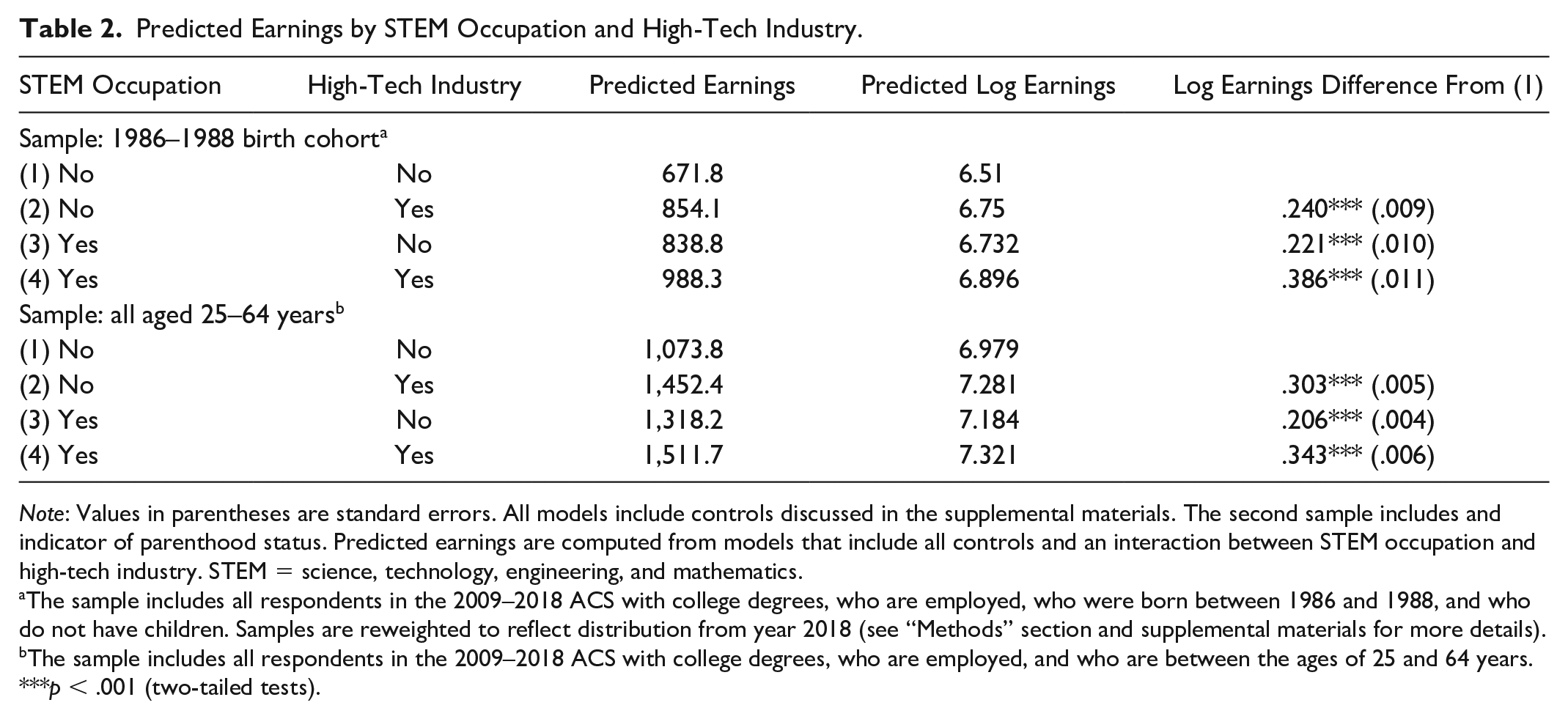
Note: Values in parentheses are standard errors. All models include controls discussed in the supplemental materials. The second sample includes and indicator of parenthood status. Predicted earnings are computed from models that include all controls and an interaction between STEM occupation and high-tech industry. STEM = science, technology, engineering, and mathematics.
The sample includes all respondents in the 2009–2018 ACS with college degrees, who are employed, who were born between 1986 and 1988, and who do not have children. Samples are reweighted to reflect distribution from year 2018 (see “Methods” section and supplemental materials for more details).
The sample includes all respondents in the 2009–2018 ACS with college degrees, who are employed, and who are between the ages of 25 and 64 years.
p < .001 (two-tailed tests).
The first panel shows predicted earnings from the 1986–1988 birth cohort. Working either in a STEM occupation or a high-tech industry is associated with an approximately $170 weekly earnings increase, or about 25 percent higher earnings. What is more, working in a STEM occupation and in a high-tech industry is associated with especially high earnings, about $310 more weekly compared with non-STEM, non-high-tech occupations, or roughly 45 percent higher weekly earnings. Simply put, work opportunities are especially lucrative within STEM employment.
The bottom panel presents a comparison of the entire working population with a college degree or more. Again, we observe higher weekly earnings among either or both high-tech industries and STEM occupations. Although the older sample predictably has higher predicted earnings, the relative gap across occupation and industry roughly mirrors that found among the more recent birth cohort. Altogether, Table 2 shows the importance of the gendered employment gaps in Figure 1: STEM work tends to provide more lucrative employment opportunities compared with other occupations and industries, a critical point to understand in relation to the gendered patterns of employment presented in Figure 1. This is a point that has been demonstrated in prior research and is central to the claim that STEM education and employment is key to improving the status of women; but this table is important for our purposes because it shows that the earnings advantages associated with STEM occupations and high-tech industries are substantively large within our recent cohort of interest.
Gender Wage Gaps across STEM Work
We next turn attention to gender earnings gaps among our recent cohort of college-educated workers prior to parenthood, for which we expect to find particularly high gender earnings gaps among those with STEM degrees employed in STEM work. Figure 2 presents results from regression models predicting logged weekly earnings.

Gender earnings gaps, total and separately by STEM degree, occupation, and high-tech industry.
The black marker in the bottom panel of Figure 2 shows the overall gender earnings gap for this recent cohort, adjusted for all covariates discussed in the “Data and Methods” section, including occupation and devaluation characteristics, while the light gray markers with confidence intervals present gender earnings gap with no controls, with controls, and with STEM education and employment information added. The small circular markers without error bars provide equivalent comparisons of gender earnings gaps among the entire sample of employed individuals with college degrees between 25 and 64 years of age.
Unsurprisingly, we find an overall modest gender earnings gap among this recent birth cohort. After accounting for control and devaluation mechanisms, women have about 2.5 percent lower weekly earnings compared with similar men. This gender earnings gap is substantially smaller than the adjusted gap found among the entire sample of employed individuals, which is at about 17 percent. As expected, our restricted sample of early career workers prior to parenthood with high education levels in a cohort with more egalitarian norms about female employment has a small, near-zero earnings gap.
The top four panels show predicted gender earnings gaps from a second model that includes all control, occupation, and devaluation mechanisms. We include an interaction between gender, STEM degree, STEM occupation, and high-tech industry variables and compute the marginal effect of gender across STEM degree and STEM employment contrasts.
In support of our expectations of particularly strong gendered norms of the ideal worker among STEM employment, we find the largest gender earnings differences among those with STEM degrees working in STEM occupations. Both inside and outside high-tech employment, we find that women are expected to earn about 14.5 percent lower wages compared with similar men. In contrast, we observe no gender earnings gap among workers without STEM degrees and outside of STEM occupations and high-tech industries. This group makes up the majority of employed respondents in our sample. Furthermore, a comparison of the gender earnings contrasts show that any combination of STEM work tends to bring about a significant gender earnings difference, whereas the two contrasts with insignificant effects are for those completely outside STEM employment, both with and without a STEM degree. Simply put, the remaining modest gender earnings gap among college-educated workers occurs primarily within STEM employment and becomes particularly pronounced among those with STEM educational training.
We note a critical comparison across our recent cohort and the total sample of the ACS. Among the latter, the largest gender earnings gaps tended to occur outside STEM employment. Yet the gender earnings gaps among STEM-trained, STEM-employed respondents are remarkably similar in their magnitudes across our two samples. These findings underscore that the gender earnings inequality associated with STEM work remains remarkably sticky across samples with vastly different experiences of educational, employment, and parenthood selection.
We further underscore two critical points. First, the main results presented in Figure 2 include controls for the proportion of women in occupations and fine-grained college majors. Our results thus do not simply reduce to the mechanism of devaluation of pay to fields of study and work based on their gender compositions. 10 Second, these results are found prior to parenthood status change, as results from our recent cohort are computed from a sample of respondents without children. Our findings thus highlight an important point: large and sticky gender inequalities await those recent college graduates who have successfully completed STEM training.
Trends in Gender Earnings Gaps
We next assess the extent to which gender earnings gaps emerge across the early career of our young cohort. To do so, we replicate regression results from Figure 2 separately by year. We plot the predicted earnings gap in real dollars to develop a substantive sense of the magnitude of gender differences in earnings. Results plotting percentage differences are included in the supplemental materials. Figure 3 presents results. Each panel in Figure 3 presents results for workers in any combination of STEM occupations and high-tech industries. Solid lines present the gender contrast for those with a STEM degree, and dashed lines present gender contrasts for those with other fields of study.

Gender earnings gaps over time, by STEM degree and STEM work.
Although no simple trend explains the complex results in Figure 3, we highlight two fundamental patterns that help make sense of these results. First, we observe no gender difference among respondents without STEM degrees in the first three to five years of observation. However, after these early years of relative gender earnings equality, we observe a gender gap outside of STEM occupations that grows to about $80 to $100 per week by 2018.
Second, we observe large gender earnings gaps among respondents with STEM education and in STEM work. Most notably, we observe gender earnings gaps by the second year of observation among those in STEM occupations. Across STEM work, the gender earnings gap remained largely stable over time, ranging between $150 and $250 per week, from 2010 to 2018. 11 If we assume constant 50-week employment for STEM-educated workers in high-tech employment, a consistent $200 per week penalty over 9 years translates to approximately $90,000 less in earnings for otherwise similar women during the first 10 years of labor market experience. To make sense of this number, we examined the mean annual income of our sample working in high-tech fields with STEM degrees and found it to be about $70,000. Thus, the culmination of nine years of the gender wage gap for this highly paid group is slightly more than one year’s salary among these early career workers.
In total, the gender earnings gap either (1) emerges over time among those without STEM education and outside STEM work at modest levels or (2) exists at the outset of employment among those with a STEM education and inside STEM work. Critically, these results are drawn from a highly restricted sample, chosen to develop as conservative an estimate of gender inequality as possible. This is precisely the space of employment where many economic studies of gender inequality argue that the gender earnings gap should be smallest, considering that employees have not yet faced confounding factors that combine to make gender wage gaps much more pronounced. These estimates, in other words, present perhaps the best-case scenario when it comes to gender and earnings today in relation to STEM education and work, and yet the gender gaps we observe are already substantively large.
Conclusion
Recent research has made clear the challenges women face in science and technology, including in the classroom and at work. Women in STEM encounter broad assumptions that they are less competent and less committed than their men counterparts, and these assumptions may prevent them from being hired into lucrative jobs that align with their educational training and may diminish their workplace experiences. Over the past 50 years, sizable gendered transformations have occurred in STEM enrollments at colleges and universities nationwide. Although much potential for progress remains, these changes in higher education warrant an investigation of parallel changes in the labor market. To what extent are men and women working in STEM employment enabled by STEM training? How big is the gender earnings gap in STEM work, and how does it compare with other segments of the labor market? Furthermore, what trends in the gender earnings gap emerge when examining a comparable sample over time?
To assess these questions, we analyzed 10 years of data from the ACS, restricting our attention to a group that should provide highly conservative results: those at the beginning of their careers, prior to parenthood. We find that despite women’s gains in STEM majors over the past half century, substantial inequalities remain when it comes to employment and earnings. Even among recent cohorts, in which we would expect to find only modest gender differences, we find substantial inequalities in employment and earnings among those with STEM degrees and employed in STEM work. We find a stable pattern of employment, whereby women who earned STEM degrees more closely resembled men who did not earn STEM degrees in the probability of working in either a STEM occupation or a high-tech industry. And even for those women who do gain entry into STEM work, we find substantial earnings gaps that have remained remarkably sticky in their relative magnitude for this younger cohort compared with older ones. Nor do these earnings gaps improve over workers’ careers. In contrast to other segments of the labor market in which modest gender gaps emerge across the first decade of young people’s careers, we observe that STEM-trained workers face a near-immediate and large gender earnings gap. A simple assessment of the magnitude suggests that for women with STEM degrees and in STEM occupations, gender earnings gaps in the first decade of their careers, prior to any parenthood penalty, are roughly equivalent to one year’s salary.
Taken together, our results present a fundamental complication to those who advocate equalizing STEM education as a direct pathway for improving women’s status in society. This is an important implication for scholars and policy makers that we wish to emphasize. We find that substantial barriers to equal employment opportunity remain in the lucrative sectors of the labor market that largely motivate contemporary STEM education, that is, high-tech industries such as software, research and development, and other jobs that fall under the broad umbrella of science and technology. In addition, once employed, women face substantial earnings penalties compared with otherwise similar men. Our supplementary analyses show that within each individual STEM major (e.g., computer and information science, engineering), a greater proportion of men graduates work in either high-tech industries or STEM occupations than women. Echoing prior scholars who have pointed to the many challenges women face in STEM fields, such as gendered beliefs that position men as “ideal workers” (Acker 1990), we show that these challenges have manifested at the population level to create substantively large gaps in STEM employment, even for those who have completed bachelor’s degrees in STEM fields.
Simply put, equalization in STEM education alone does not guarantee access to, and equality within, STEM work. Rather, equalization of access to STEM education must be accompanied by efforts to equalize access to lucrative STEM employment, as our results suggest that this latter process is structured as much by gender as it is structured by STEM training. Our results provide important counterarguments to popular claims that unequal representation in STEM work are unrelated to issues of gender discrimination. Why would such a significant portion of women in our sample of recent cohorts devote substantial energy to STEM educational training but suddenly lose interest in further pursuing STEM and its lucrative employment opportunities nearly immediately after graduating from higher education institutions? We believe that a more compelling answer focuses on mechanisms that create barriers for women with requisite training to join STEM work, from recruitment to culture and routines in STEM workplaces to broader conceptions of women’s status.
A natural question to ask is, where do STEM-trained women go when not employed in STEM jobs, and do their occupational characteristics differ from similar men with STEM degrees outside of STEM jobs? In the supplemental materials, we examine this question further. For women, the most common occupations are in health and teaching. Although health occupations tend to have higher than average pay and are STEM adjacent, we underscore the point that they are not STEM jobs—suggesting that many women use STEM degrees to demonstrate competence for admission to medical, pharmacy, and nursing school—and all the most common occupations have lower pay compared with the typical pay for women in STEM employment. Moreover, women and men with STEM degrees outside STEM work resemble women and men without STEM degrees outside STEM work in terms of the gender composition of their occupational attainment. In total, although health and teaching jobs may have alternative benefits for women not provided in STEM work, we underscore that the occupations for STEM-trained women tend to be lower paid and gender segregated. We highlight this finding as an important avenue for future research.
More broadly, our findings speak to both theoretical and empirical research on occupational feminization (England 1992; Levanon et al. 2009). The findings show that women face considerable barriers in accessing STEM work, even when they have completed college degrees that have trained them for these jobs. The fact that men without STEM training have comparable access to high-tech work as women with STEM training suggests deeply gendered processes in these fields, including how credentials and experience are valued and devalued. Scholars have placed great emphasis on the devaluation of women’s work, and the systematic weakening of female-typed jobs and people who work in these jobs (see, e.g., England 1992). Our findings show that these explanations work well for many segments of the labor market, but that STEM work may present an important need for theoretical extension. Our findings here instead demonstrate the other side of this equation, what we might call the outsized valuation of men’s work. In male-typed jobs such as those in STEM work, not only are pay and prestige high, but the rules of the game are structured such that women are unable or unwilling to participate.
Our study makes a useful contribution by assessing returns to STEM across both STEM occupations and high-tech industries. As we have shown, returns to a STEM degree vary substantially across these segments of the labor market that partially, but do not fully, overlap. Thus, our research points to broad segments of the labor market that social scientists can examine to assess unequal returns to STEM training. Furthermore, we highlight that the greatest and most persistent gender inequalities occur among work that overlaps in both STEM work and high-tech industries. We suspect that the gendered expectations of the ideal worker connected to STEM work better explain these escalating gender inequalities than the nature of the work across different segments of the labor market. We also suspect that future research that interrogates more fine-grained STEM occupations across high-tech industries, or vice versa, can help reveal the precise mechanisms by which gender inequality and STEM remain tightly coupled.
This study has several important limitations that should motivate future research in this line of inquiry. We likely miss important microlevel processes that link STEM education to STEM work. Additional comparative analyses of employers or higher education institutions examining the matching process between STEM training and STEM employment is needed. Furthermore, although we can follow cohorts across time, we do not track individuals as they transition across jobs. Some of the earnings gaps we observe may be due to variation in employment transitions across and within firms between men and women. Finally, we do not have attitudinal or achievement information for the respondents in our sample. Perhaps unequal employment in high-tech fields is partially because some women have a preferences for STEM training but not high-tech employment, and for men, vice versa. We are skeptical of this argument, as Sassler et al. (2017) showed that preferences do little to explain employment trajectories in the National Longitudinal Survey of Youth 1979 data. However, future research incorporating richer premarket and social psychological information would help explain the broad trends examined in the present study.
In total, we highlight the challenges faced in the labor market after the moderate successes of increasing STEM education for women. Even for women who successfully attain STEM degrees, substantial gendered barriers to employment and earnings remain in the labor market. These differences cannot be accounted for by earlier generations’ facing more explicit and codified gender discrimination, nor can they be explained by the motherhood penalty or the devaluation of women’s work. Rather, gender itself remains central to patterns of employment and returns to STEM education.
Supplemental Material
sj-docx-1-srd-10.1177_23780231211064392 – Supplemental material for Gender Inequality in STEM Employment and Earnings at Career Entry: Evidence from Millennial Birth Cohorts
Supplemental material, sj-docx-1-srd-10.1177_23780231211064392 for Gender Inequality in STEM Employment and Earnings at Career Entry: Evidence from Millennial Birth Cohorts by Tom VanHeuvelen and Natasha Quadlin in Socius
Footnotes

Supplemental Material
Supplemental material for this article is available online.
Notes
Author Biographies
References
Supplementary Material
Please find the following supplemental material available below.
For Open Access articles published under a Creative Commons License, all supplemental material carries the same license as the article it is associated with.
For non-Open Access articles published, all supplemental material carries a non-exclusive license, and permission requests for re-use of supplemental material or any part of supplemental material shall be sent directly to the copyright owner as specified in the copyright notice associated with the article.
