




Abstract
It remains unclear how far back the intergenerational transmission of educational advantage operates because most inquiries are limited to two or three generations. In this study, the authors use four generations of family data from the Panel Study of Income Dynamics to examine the association of great-grandparents’ educational attainment with their great-grandchildren’s early academic achievement, net of intervening generations’ educational attainments. The authors find that the relationship between great-grandparent educational attainment and great-grandchild early academic achievement is nonlinear, modest, and accounted for entirely by the educational attainment of intervening generations and great-grandchild demographic characteristics. Thus, for early academic achievement, the direct transmission of intergenerational educational advantage is limited to three generations in these data.
Keywords
When one generation attains educational advantage, the next generation reaps significant benefits in its own educational, financial, cultural, marital, health, and occupational prospects (e.g., Anderson, Sheppard, and Monden 2018; Axinn and Thornton 1992; Dubow, Boxer, and Huesmann 2009; Erola, Jalonen, and Lehti 2016; Kraaykamp and Van Eijck 2010; Ross and Mirowsky 2011). The strength of the parent-child correlation in life chances is now widely recognized. However, for many decades scholars suggested that the intergenerational transmission of life chances did not extend beyond the parent-child pair (Song et al. 2020). In this account, known as the Markovian model, the grandparent’s outcomes were correlated with the focal child’s but in ways that were attributable to their common association with the parent’s outcomes (e.g., Warren and Hauser 1997). Mare’s (2011) influential Population Association of America (PAA) presidential address led researchers to reexamine whether intergenerational effects reach beyond this generational span. The resulting research has consistently revealed that grandparents may exert direct and indirect effects on the educational outcomes of their grandchildren through a variety of non-Markovian mechanisms. Findings from the past decade of research raise the question of whether the intergenerational reach of socioeconomic status may include great-grandparents as well.
It is presently unclear if great-grandparents directly affect their great-grandchildren’s academic achievement, given that many more of them die before they can provide the same direct monetary or cultural benefits as grandparents. Thus, if research uncovers a direct linkage, the mechanisms linking great-grandparents’ outcomes to those of their great-grandchildren may differ considerably from those linking grandparent-grandchild and parent-child pairs. Three prior studies have investigated great-grandparent effects on the intergenerational transmission of socioeconomic advantage (Clark 2014; Ferrie, Massey, and Rothbaum 2016; Knigge 2016). However, these studies have a number of limitations, including single-gender samples prone to survivorship bias, generational linkage errors, educational measurement error, and analyses based on uncommon surnames purposively drawn from extremes of the socioeconomic spectrum. We build on prior work while using data better suited to examine the existence of multigenerational mobility.
We examine this key question by analyzing the intergenerational determinants of early childhood academic achievement, rather than educational attainment, in the fourth generation. Research shows that academic achievement scores predict eventual educational attainment (Alexander, Entwisle, and Olson 2007; Marjoribanks 2005; Sewell, Haller, and Ohlendorf 1970), and early academic achievement is an important indicator of child well-being in its own right. Furthermore, four-generation data sets with directly linked educational indicators are scarce. No publicly available, nationally representative, U.S.-based data sets can yet measure four consecutive generations’ educational attainment as adults, but at least one has an adequate sample size to examine early childhood educational attainment.
Accordingly, we ask the following research question: Does the intergenerational transmission of educational advantage extend to a four-generation model? We analyze the Panel Study of Income Dynamics (PSID) using the Family Identification Mapping System and Child Development Supplement (CDS) files to investigate great-grandparents’ educational attainment’s association with great-grandchildren’s early childhood academic achievement. Using this unique resource, we examine the association between great-grandparents’ educational attainment and great-grandchildren’s early academic achievement and how well the association is explained by grandparents’ and parents’ educational attainment. We find that the relationship between great-grandparent educational attainment and great-grandchild early academic achievement is nonlinear and mediated entirely by the educational attainment of great-grandchildren’s parents and grandparents and other great-grandchild characteristics.
Background
Intergenerational Transfer of Educational Advantage
For decades, educational inequality scholars believed that a two-generation, Markovian model could summarize the intergenerational transmission of education. The Markovian model posits that parents’ education exerts a clear, direct impact on children’s educational attainment and achievement. Earlier generations’ educational attainment, such as that of grandparents and great-grandparents, may predict grandchild’s and great-grandchild’s educational attainment, but strictly through the indirect pathway of the educational attainment of intervening generations (Mare 2011; Warren and Hauser 1997). Because of data limitations, scholars could examine only parent-child, usually father-son, pairs (e.g., Blau and Duncan 1967; Erikson and Goldthorpe 1992; Featherman and Hauser 1978; Sewell and Hauser 1975; Solon 1992). Warren and Hauser’s (1997) finding that grandparent education in the Wisconsin Longitudinal Study had no association with grandchild educational attainment net of parent educational attainment effectively cemented the conventional wisdom that had been building for 30 years.
This conventional wisdom largely held until Mare’s (2011) presidential address to the PAA, in which he argued for renewed examinations of multigenerational processes of inequality. Mare argued that two-generation models of family influence ignored a host of mechanisms of intergenerational continuity, such as the moderating influence of social institutions; the intervening role of demographic processes such as marriage, fertility, migration, and survival; and the direct transfer of the benefits of socioeconomic status beyond the parent-child binary. This address launched new research on both sides of the Atlantic; scholars used census and population register data to supplement other research using mature longitudinal studies such as the PSID. This new generation of studies better measure and model multigenerational mobility processes on larger, more representative, and more diverse samples (e.g., Anderson et al. 2018; Pfeffer 2014).
Research since Mare’s address has provided mixed insights on the issue of multigenerational mobility. In many cases, higher order generations do exert considerable influence on younger generations’ socioeconomic outcomes net of the intervening generations’ outcomes. Scholars have suggested that variations in time, contexts, outcomes, data quality, and analyses testing for different mechanisms of multigenerational mobility may explain these mixed results and a large number of null findings (Anderson et al. 2018; Daw, Gaddis, and Morse 2020). Although there is no guarantee that multigenerational mobility effects exist in all populations, subpopulations, and eras, the past decade of research suggests that there is considerable utility in examining family inequality in the widest possible generational lens.
Theoretical Mechanisms of Three-Generation Education Effects
The literature on intergenerational mobility over three generations has attempted to clarify the specific mechanisms of how, when, and why grandparents matter. Prior studies suggest at least three broad potential pathways and explanations of grandparent effects, through (1) direct resource transfers that may depend on several factors, including existing parental resources, grandparent-grandchild life span overlap, and resource dilution; (2) indirect effects that affect grandchildren through their effects on the middle generation; and (3) genetic transmission. Scholars have discussed these mechanisms at length in the literature, so we present a concise version of these ideas here (for more details, see Anderson et al. 2018; Daw et al. 2020; Gaddis and Daw 2020; Solon 2018).
First, grandparents may provide direct resources such as economic, human, social, or cultural capital (Hällsten and Pfeffer 2017; Jæger 2012; Møllegaard and Jæger 2015; Sheppard and Monden 2019). Some commonly suggested ways that grandparents may transfer capital include paying for private education or college, reading to grandchildren, connecting grandchildren through existing networks with employment or other opportunities, or teaching grandchildren how to navigate the education system. Although having the means to provide these resources is a necessary condition, it may not be sufficient. Grandparents may choose or be able to provide them only in select situations. If grandparents believe that their children fail to provide adequate resources for their grandchildren, they may compensate for this inadequacy (Jæger 2012). Similarly, grandparents may believe that their children provide adequate resources for their grandchildren, but they may choose to augment those resources to provide even greater opportunities for their grandchildren (Chiang and Park 2015). More research has found support for the compensation hypothesis (Braun and Stuhler 2018; Deindl and Tieben 2017; Havari and Savegnago 2014; Wightman and Danziger 2014; Wolbers and Ultee 2013) compared with the augmentation hypothesis (Daw et al. 2020; Lindahl et al. 2015; also see Ziefle 2016, who found evidence supporting both hypotheses). Moreover, grandparents may provide direct transference of capital or resources only while they are alive and able to do so for their grandchildren (Ferguson and Ready 2011; Sheppard and Monden 2019; Zeng and Xie 2014). Finally, dilution of grandparent resources may occur depending on a grandchild’s number of siblings and cousins (Sheppard and Monden 2019).
Second, grandparents may indirectly affect grandchildren through the intermediate generation. One recent example demonstrates that grandparent educational attainment is associated with their child’s spouse’s educational attainment, which is associated with grandchild’s educational attainment (Gaddis and Daw 2020). This spousal mediation effect coexists along with an independent effect of grandparent educational attainment on the third generation. These types of indirect effects may occur in tandem with direct effects or absent separate direct effects. The latter case represents a proper Markovian process, in which the study of intergenerational mobility beyond two generations provides no additional information on the process. Research in this vein includes early work on three-generational mobility processes that revealed no grandparent effects (Behrman and Taubman 1985; Cherlin and Furstenberg 1986; Peters 1992; Warren and Hauser 1997), research finding that intervening generation parental structure modifies the relationship of grandparent educational attainment with grandchild educational attainment (Song 2016), and Gregory Clark’s (2014) comprehensive historical analysis of long-term mobility across multiple societies.
Third, grandparents may pass down genetic material that predicts educational attainment and achievement (Clark 2014; Zeng and Xie 2014). Common genetic factors may plausibly explain a portion of intergenerational associations in educational indicators for genetically related pairs. The genetic transmission mechanism is possible because biological grandparents and grandchildren share 25 percent of their DNA by descent and because educational attainment is substantially heritable (Branigan, McCallum, and Freese 2013) and partially predictable from specific genetic loci (Lee et al. 2018).
Possible Four-Generation Mobility Effects
Should we expect the same theoretical mechanisms from three-generation mobility studies to apply in an analysis of four-generation mobility? Perhaps, although not all of these factors apply in varied contexts for three-generation studies. A meta-analysis suggests that direct contact mechanisms between grandparents and grandchildren fail to pan out across a body of work that operationalizes contact in a few different ways and examines different outcomes and contexts (Anderson et al. 2018). These findings are pertinent for the present research, as great-grandparents are less likely than closer relatives to have meaningful, sustained contact with their great-grandchildren.
To explain any potential effect of great-grandparents on great-grandchildren, we suggest that some of the mechanisms of grandparent effects may still apply, but with caveats. First, highly educated great-grandparents may set aside financial resources to be passed along to great-grandchildren, just like highly educated grandparents can. At this stage of the life course, great-grandparents might direct financial resources toward preschool or other early education programs, activities, and learning toys. Second, highly educated great-grandparents may spend time with great-grandchildren when parents are otherwise busy and provide learning opportunities by practicing letters and numbers, reading to or with great-grandchildren, or otherwise engaging in the direct transference of knowledge and skills.
These potential direct mechanisms of great-grandparent effects are similar to the direct mechanisms of grandparent effects, albeit with some important constraints to consider. Great-grandparents are older during the early years of their great-grandchildren’s lives compared with grandparent-grandchild pairs. Thus, great-grandparents are more likely to have time- and activity-limited constraints in addition to reduced cognitive function. It is less likely that great-grandparents can actively direct or oversee the use of these resources because of limited life span overlap and generational distance. Moreover, it is unclear whether great-grandparents can predict the need for such resources this early in the life course of great-grandchildren, as suggested by the compensation and augmentation hypotheses. Finally, resource dilution may play a more significant role in determining great-grandparent effects because there is one additional generation over which to spread the wealth. Conversely, there could be a selection effect in that the largest families by the fourth generation are those that have the most resources to spread around (Song, Campbell, and Lee 2015).
Great-grandparents may bestow the advantages of their educational attainment through indirect means as well, although it is unclear what forms these mechanisms may take. The three-generation mobility literature is woefully underexamined in this area, and Clark’s (2014) research combines ideas from the Markovian process, genetics, and indirect effects. Although researchers have challenged the Markovian process theory (Mare 2011; Pfeffer 2014), Clark suggested that even error-prone measurements of multigenerational mobility should yield no direct effects over three to five generations if the process is truly indirect and Markovian. Thus, studies moving beyond three generations might reveal only indirect effects, providing some suggestive evidence in support of Clark’s claim
Relatedly, highly educated great-grandparents may transmit genetic advantage to their great-grandchildren. It is important to note, however, that only two prior studies have provided empirical support for this pathway among grandparents: Clark (2014), whose interpretation has been subjected to substantial criticism discussed in detail below, and Daw et al. (2020), who found evidence for this pathway only among white respondents and primarily for college-degree outcomes. Although researchers have not examined the mechanisms discussed above, a few studies have tested whether great-grandparents have effects on great-grandchildren’s outcomes. We discuss this research in the following section.
Existing Research on the Effects of Great-Grandparents
As this literature has matured, a few scholars have turned their attention to the next logical topic: great-grandparental effects on younger generations’ socioeconomic attainment. To date, two studies have done so using population-level data and creative intergenerational linkage strategies. First, Ferrie et al. (2016) linked multiple censuses and government surveys together through stable census identifiers and observed parent-child coresidential connections to stitch together a four-generation study of educational attainment in the United States. In a sample of 1,444 four-generation lineages, the authors found that great-grandparent educational attainment is significantly associated with great-grandchild educational attainment in bivariate models. However, as the authors introduced intervening generations’ educational attainment into their models, the four-generation association was statistically and substantively eliminated.
Second, Knigge (2016) used Dutch marriage certificate data from 1812 to 1922 to trace patrilineal patterns of occupational advantage, linking 9,116 great-grandfathers with 25,433 great-grandchildren. He found that great-grandparent occupational status has a positive, statistically significant association with great-grandchild occupational status, even when he incorporated the occupational status of grandfathers, fathers, and uncles into the model. Knigge explained that the relatively short nineteenth-century Dutch life expectancy implies that relatively few great-grandfathers are likely to have interacted with their great-grandchildren and therefore attributed his findings to an enduring form of family privilege.
In his controversial book The Son Also Rises, Clark (2014) also reported an enduring advantage of socioeconomic status. Clark took advantage of rare surnames as a signal of family membership and examined the association between the average socioeconomic outcomes of surnames in each generation with the next, arguing that this averaging procedure purges the association of measurement error, leaving a true signal of social status. Applying this procedure to a wide range of geographic and historical contexts, Clark found that the intergenerational elasticity of social status is consistently about 0.75 or higher, which under the Markovian assumption implies a great-grandparent/great-grandchild correlation of 0.753 = 0.42. Clark argued that this extremely large elasticity value and its apparent universality implies a genelike transmission mechanism and excludes nearly all other plausible interpretations.
Clark’s (2014) argument has been subject to forceful countercriticism. Methodologically, Torche and Corvalan (2018) argued that Clark’s analysis was flawed in three key ways. First, they argued that averaging outcomes within surnames eliminates the relevance of these findings for individual fortunes. Second, they argued that Clark’s justification for this procedure—that surname average reduces measurement error bias—is completely misapplied (see also Vosters 2018). Third, they argued that the universally high persistence of social status across time and place is an artifact of Clark’s purposive selection of elite and underclass groups. The authors marshaled simulated and empirical data to persuasively make these counterarguments.
Although less methodologically flawed, the studies of Ferrie et al. (2016) and Knigge (2016) on this subject were limited in key respects as well. Knigge’s sample relied on patrilineal marriage chains in the Netherlands in a historical period in which women rarely attained high-status occupations. Because of the significant differences in national and historical contexts as well as the specific aspect of socioeconomic status examined, it is unclear how much of this result generalizes to educational processes in the United States. Ferrie et al. examined educational attainment in the United States on a mixed-gender sample, but their study was limited in a few other respects. First, the intergenerational linkages they used to construct their sample rely on particular intergenerational spacing for each member of the four-generation lineage to be identifiable. In effect, the authors included in their analytical sample only four-generation sets that met certain restrictive conditions, 1 leaving uncertain how broadly these results may be externally generalized. Second, as the authors acknowledged, the absence of educational measures prior to the 1940 census means that the measurement of great-grandparents’ education was contingent on their longevity, which may have resulted in selection biases. Third, Ferrie et al.’s intergenerational linkage procedure—which relied on matched first, middle, and last names, age, and birthplace data matched across decennial censuses—is a potentially error-prone operation. Indeed, the authors concluded that their results were consistent with a model driven entirely by educational measurement error. Together, these limitations suggest that research on more directly linked four-generation sets with high-quality educational attainment measures would shed additional light on this important research question. Accordingly, in this study we investigate the following: Is a great-grandparent’s educational attainment directly associated with their great-grandchildren’s academic achievement? And if so, does this relationship stand after accounting for the educational attainment of intervening generations?
Data and Methods
Data
To assess whether intergenerational educational advantage persists over four generations, we use the PSID. The PSID is one of the longest running longitudinal studies in the United States. A nationally representative sample of U.S. households, the PSID began in 1968 and provides researchers with a unique genealogical design. The PSID followed households every year from 1968 to 1997, when it began to survey households every other year. In 1997, the PSID also developed the CDS, which obtained more detailed information on children within the PSID sample aged 0 to 12 years. The combination of the PSID with the CDS allows researchers to investigate the family dynamics that influence child development more extensively than any other nationally representative, longitudinal, multigenerational sample of U.S. children. For brevity and clarity, we refer to each generation using the following nomenclature: G1 stands for the great-grandparent (i.e., the first generation in the family in the data), G2 for the grandparent, G3 for the parent, and G4 for the child in the sample.
The PSID Family Identification Mapping System file permits researchers to directly link chains of parent-child households across time, which allows us to investigate four generations of households. Thus, heads of households in 1968 may be readily linked to their children, grandchildren, and great-grandchildren 50 years later when they exist and all participated in the study. This linkage file includes parent-child pairs for which the parents were not surveyed directly but rather their children describe some of their key characteristics. Specifically, we use the wide version of the biological or adoptive linked file. 2 A key limitation of these data is that, from the perspective of younger generations, they do not cover the “missing half” of older relatives on the side of the family without the PSID gene. An additional limitation is that G2s who did not reside with their G1 parents in 1968 or later will not be included in the data, nor will their descendants.
With this dataset, we analyze all available G1-G2-G3-G4 lineages for which we observe at least one valid educational attainment value for G1, G2, and G3, and G4 participated in at least one wave of the CDS. These lineages are included regardless of whether the educational reports are reported by the household in question or by their adult children.
Variables
Dependent Variables
The CDS administers the Woodcock-Johnson Tests of Achievement to all children in the sample aged 3 years and older. Researchers widely accept this test as an established measure of children’s academic achievement (Roksa and Potter 2011). We use the standardized applied problems score to represent mathematics achievement. We create a composite score representing reading achievement by combining the standardized broad reading score, letter word score, and passage comprehension score. These measures give us our two dependent variables representing the academic achievement level of great-grandchildren (G4) in the sample. Although the CDS provides us with a standardized score for each test with a mean centered around 100, we restandardize our two achievement variables so that the mean of the sample is 0 and unit differences in these outcomes correspond to a standard deviation. We retain these measures as dependent variables for CDS children (G4) with measured great-grandparent ties in the PSID.
Independent Variables
Our main independent variables are the educational attainment of great-grandparents (G1) and the mediating educational attainment of grandparents (G2) and parents (G3). Figure 1 visually illustrates some of the complexity of the PSID data structure. In this figure, each circle represents an individual, and downward lines indicate parent-child relationships. Some G1s (C and D, marked in solid lines) were PSID-Gene Sample members, while other G1s (A, B, E, and F, marked in dashed lines) were the parents of persons who married into the PSID lineage, rather than being descended from the original household. Similar measurement complexity applies to G2, though not G3, because we are working with the CDS sample for G4, where no children report on their parents’ educational attainment.

Illustration of four generations of kin with mixed educational reporting modalities.
As this figure helps illustrate, the complexity of assigning educational attainment values to each generation is unusually high for several reasons. First, educational attainment reports are available from two different sources in the PSID. In the first source, we access household reports of an individuals’ educational attainment in years from the PSID individual file. Only PSID-Gene Sample members provide this item, which is measured on a scale ranging from 0 to 17 years. 3 Hereinafter, we will refer to these measures as self-reported educational attainment. As depicted in Figure 1, self-reported educational attainment is available only for individuals with solid outlines. The second source of education reports is adult children’s reports on their mothers’ and fathers’ educational attainment. This item is measured in less detail but is available for non-PSID-Gene Sample members as well. 4 Hereafter, we refer to these measures as child-reported educational attainment. In Figure 1, child-reported educational attainment is available for PSID-Gene Sample members (solid outlines) and nonmembers (dashed outlines). It is not obvious which of these measures will generate the most reliable data.
Second, the PSID collected these educational attainment variables for every year in which an individual or their adult child participated in the PSID from 1968 to 2019, and sometimes these reports vary year to year for the same individual. As a result, a single individual may have dozens of measures of their educational attainment throughout the study (up to one self-reported measure in each of the PSID’s 40 waves and potentially one child-reported measure per child beginning in the second wave), which may not all agree with one another. It is not obvious which of these measures to select in all cases.
Third, even once a single indicator of educational attainment is assigned to each G1, G2, and G3 out of the potentially dozens of measures available, it is statistically impractical and substantively misguided to employ every single ancestor’s educational attainment as an independent variable predicting each G4’s academic achievement. Practically, because of assortative mating and family effects on education, these values will often be highly collinear. Furthermore, G4s will vary widely in the number of identified ancestors in each generation, which is not straightforward to resolve in typical regression analysis. Substantively, we are most interested in measuring each generation’s socioeconomic status, a latent variable related to but not automatically aggregated from each individual’s educational attainment. For these reasons, we wish to assign one educational attainment value to each ancestor generation.
We applied the following rules to reduce this considerable complexity to a single educational attainment value assigned to each generation in a G1-G4 lineage:
When an individual’s household-reported education values conflicted across years, we used the most recent household-reported value as the individual’s household-reported value. Similarly, when adult children’s reports on a parent’s educational attainment conflicted across multiple such reports, we used the most recently reported value as the individual’s child-reported value. In this way, we assigned each ancestor a maximum of one household-reported and one adult child–reported educational attainment value, regardless of how many values of that person’s educational attainment are measured across the waves of the PSID.
Within each ancestor generation (G1, G2, and G3), we assigned the highest educational attainment value observed from either the household or adult child items described in the previous item as the maximum educational attainment value observed in that generation. In this way, we assigned each generation a single maximum educational attainment value, regardless of how many members of that generation are observed.
When multiple individuals were observed with the maximum educational attainment value in a generation, we used a random number draw to determine which individual was selected as the single individual with the maximum generational educational attainment.
We assigned other ancestor characteristics for each generation (i.e., sex) by using the values observed for each generation’s maximally educated individual. When this person is not a PSID-Gene Sample member, we assigned their sex on the basis of whether the adult child’s education report refers to their father or mother.
To adjust for potential source differences in the focal relationships of the analysis, we include dichotomous controls for whether G1’s or G2’s educational attainment is self-reported. Furthermore, as a robustness check, we provide the results of the primary analyses of this study using an alternative method of combining these values (see Table C1 in Appendix C for details). 5
From our combined highest education variable, we create a categorical variable to represent the older generations’ educational attainments divided into four categories: less than high school (0–11 years), high school graduate or equivalent (12 years), some college (13–15 years), and college degree or higher (16–17 years). In our appendix, we also include models that operationalize prior generations’ educational attainment as a continuous variable (Appendix A, Tables A1 and A2).
Control Variables
We include multiple control variables that are associated with academic achievement. We control for the gender of G1, G2, and G3 who contribute to the model with the highest educational attainment. We also include controls for G4’s race, gender, age in months, and whether they live in a two-parent household. Finally, we categorically control for which CDS wave G4’s achievement score comes from: 2002, 2007, or 2014.
Analytic Strategy
To answer our research questions, we estimate multilevel models. We use multilevel models because there are multiple G4s who participated in both the 2002 and 2007 waves of the CDS, and in these cases both observations are analyzed. G4’s unique identifier serves as our level 2 indicator, with their year in the study serving as our level 1 indicator. We use the mixed command in Stata 16 to run our analyses. The multilevel model is represented below by the following equation:

where


where i represents the year, j represents G4, e represents the level one residual, u represents the random effect residual,
Results
Descriptive Statistics
We present descriptive statistics in Table 1. This table shows that G1s’ modal educational attainment is less than high school. Having a college degree or higher is much rarer among G1s compared with G2s and G3s. Furthermore, although fewer than 10 percent of G1s obtained a college education or higher, about 30 percent of G2s and G3s obtained at least a college education. There is a roughly equal percentage of white and Black children. This is due largely to the nature of original PSID sampling strategy. 6 We account for this in our models by including sampling weights. Additionally, about half of G4s are female and live with parents who are married.
Descriptive Statistics.

Note: Our models use the highest educated individual in each generation. When more than one individual had the highest education level, we randomly selected the individual contributing to our models. G1 = great-grandparent, G2 = grandparent, G3 = parent, G4 = child.
Four-Generation Models of G4 Early Academic Achievement
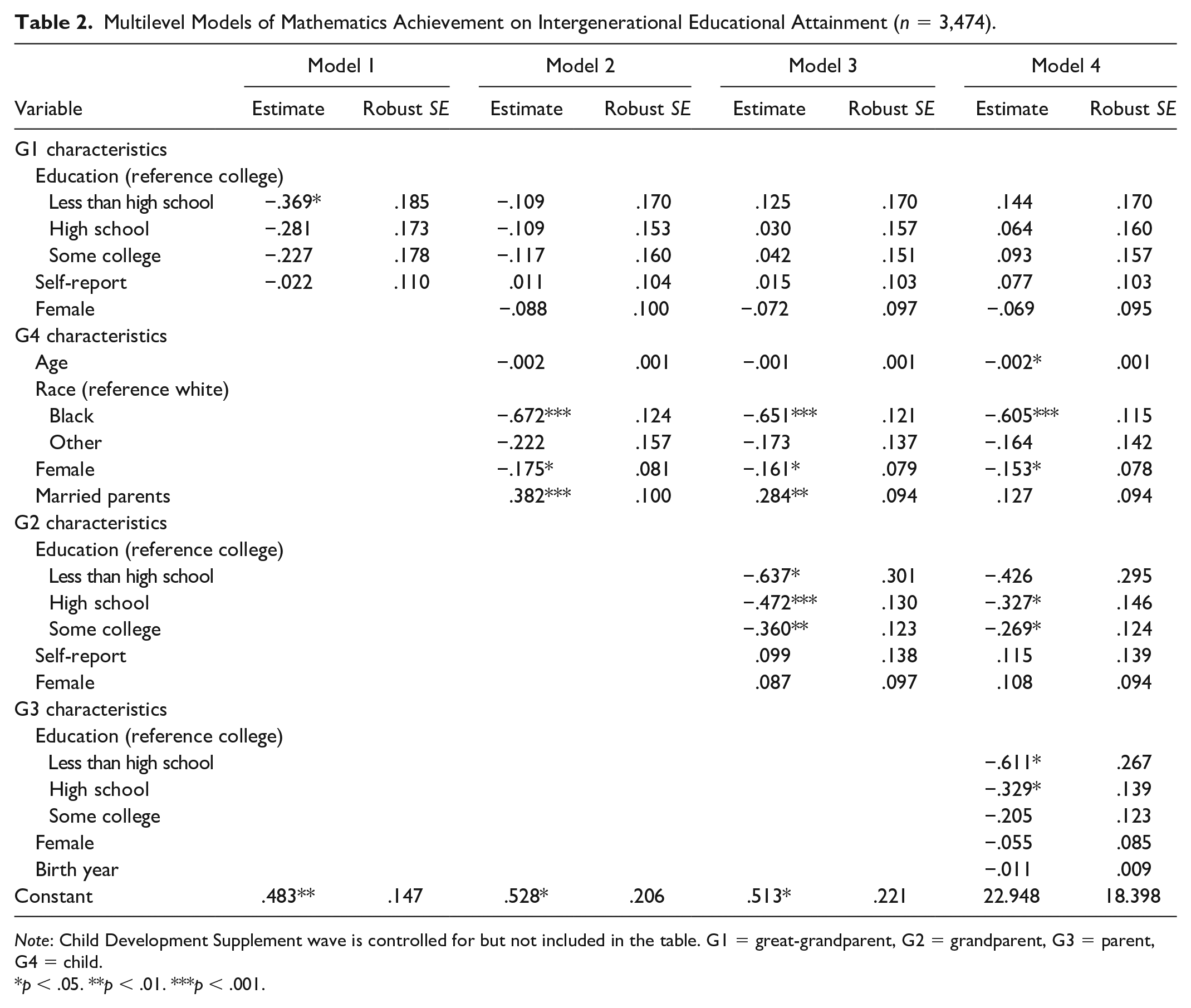
In Tables 2 and 3, we present the multilevel models regressing mathematics and reading achievement, respectively, on intergenerational educational attainment.
Multilevel Models of Mathematics Achievement on Intergenerational Educational Attainment (n = 3,474).
Note: Child Development Supplement wave is controlled for but not included in the table. G1 = great-grandparent, G2 = grandparent, G3 = parent, G4 = child.
p < .05. **p < .01. ***p < .001.
Multilevel Models of Reading Achievement on Intergenerational Educational Attainment (n = 3,474).

Note: Child Development Supplement wave is controlled for but not included in the table. G1 = great-grandparent, G2 = grandparent, G3 = parent, G4 = child.
p < .05. **p < .01. ***p < .001.
In model 1 in Tables 2 and 3, we find a statistically significant association of G1 educational attainment with G4 early academic achievement. Table 2 shows that compared with G4s whose G1s attained college or higher, children whose G1s had less than a high school education score 0.37 standard deviations lower on their mathematics achievement tests, a substantively moderate and statistically significant difference. High school (−0.28) and some college (−0.23) G1 educational attainment is also associated with lower G4 mathematics achievement than college or higher G1 educational attainment, but these associations do not reach statistical significance. These associations are substantively reduced and no longer statistically significant once controls for G1 gender and G4 demographic characteristics are introduced into the model (model 2): all G1 educational attainment associations with G4 mathematics achievement are reduced by half or more once basic controls are introduced, to coefficients smaller than their standard errors. This remains the case for models 3 and 4, where controls for G2 and G3 characteristics are introduced to the model.
Table 3 shows the results for a parallel analysis of G4 reading achievement and reveals highly similar results as those for mathematics achievement. In model 1, we find that compared with G4s whose G1s attained college or higher education, those whose G1s attained lower education levels have about one quarter of a standard deviation lower reading achievement scores. These substantively moderate associations are also statistically significant for the comparison of G1 high school and some college educational attainments compared with college graduation, but this is not the case for less than high school attainment. Similar to the analyses of G4 mathematical achievement outcomes in Table 2, we find that these associations are no longer statistically significant (though moderately substantively significant) in model 2, which introduces controls for G4 characteristics and G1 gender. Model 3 introduces controls for G2 characteristics and reduces the association of high school or some college G1 educational attainments with G4 reading achievement to substantively trivial and statistically insignificant levels, but the association of G1 less than high school educational attainment with G4 reading achievement becomes positive, moderately substantively significant, and statistically insignificant. Similar results are found in model 4.
The associations of G2 and G3 educational attainment with G4 early academic achievement are also of interest in these results. In model 4 in Table 2, we find that children with G2s whose education stops at high school or some college have moderately lower mathematics achievement scores than those whose G2s completed college. Additionally, we find that children whose G3s have a college education score substantively higher on their mathematics achievement test than those whose G3s have less than a high school education and moderately higher than those whose G3s have a high school diploma. Model 4 in Table 3 shows that children whose G2s went to college have significantly higher reading achievement scores than those whose G2s received less education at all levels. Additionally, we find that children whose G3s have a college or higher education score significantly higher on their reading achievement tests than those whose G3s have less than a high school education.
Sensitivity Tests
As a sensitivity test, we examine separate models operationalizing educational attainment as a continuous variable. We present these results in Tables A1 and A2. We find no significant relationship between the educational attainment of G1 and G4’s academic achievement, even without controls for G2’s and G3’s educational attainment. In Appendix C, we delve in considerable depth into the complicated interactions between these factors and race/ethnicity and gender. We find no significant gender interaction and limited significance among other race children.
Discussion
Mare’s (2011) PAA presidential address led many scholars to examine whether the intergenerational transmission of social class extends beyond the parent-child dyad. This research demonstrates that there are many circumstances in which grandparents provide both direct and indirect benefits to their grandchildren (Anderson et al. 2018). However, data restrictions have limited prior studies of G1-G4 educational linkages in the United States. Data collection for the PSID has now matured to the point at which an examination of four generations is possible.
Our study examines whether there is a lasting association between great-grandparents’ educational attainment and their great-grandchildren’s academic achievement.
Our findings are dependent on whether we operationalized educational attainment as a continuous or categorical variable. We find no direct or indirect association of G1 educational attainment as a continuous variable on G4 academic achievement. However, when we operationalized educational attainment as a categorical variable, we find a significant bivariate association between G1 educational attainment and G4 mathematics and reading achievement. We find a significant difference in G4 mathematics achievement scores between G1s with less than a high school education and G1s with a college education. This relationship, however, is mediated entirely by G4 attributes and G2 and G3 educational attainment. Similarly, we find a significant bivariate relationship between G1s with a college education and G4 reading achievement. Again, these associations are no longer statistically significant when we control for G2 and G1 educational attainment and G4 attributes.
Together, these findings suggest that the relationship between G1 educational attainment and G4 early educational attainment is nonlinear, modest, and explained largely by the educational attainment of intervening generations and G4 demographic characteristics. In particular, we observe a critical G4 academic achievement divide between G1s with college degrees and those without degrees. In our regression models, the coefficients for G1 educational attainments less than a college degree generally cluster together (with variable statistical significance) with G4 academic achievement scores between 0.25 and 0.40 standard deviations lower than those descended from college-educated G1s. The typical member of the G1 cohort in this dataset was born in the 1920s (mean G1 birth year = 1926), and therefore it is unsurprising that only 9.5 percent of them earned college degrees (compared with 30 percent of the G2 cohort). Thus, this educational credential was a significantly stronger human capital signal than was the case for subsequent cohorts.
Our findings suggest that although the intergenerational transfer of educational advantage is not Markovian, direct non-Markovian effects are likely to be limited in generational scope to elders whose lives meaningfully overlap with those of their descendants. However, few great-grandparents’ lives overlap with the lives of their great-grandchildren for more than a few years. If robust G1 associations require substantial life span overlap and attendant interactions, researchers may be hard-pressed to find direct effects without a detailed large-n longitudinal data set. This issue is likely further exacerbated by the poor health of many great-grandparents during their life span overlap period; with 25-year generational spacing, a great-grandparent would be 75 when they assumed this role, an age that is likely to limit their potential for meaningful social interaction with their young descendant. Under these conditions, it seems unlikely that great-grandparents are able to directly, substantially influence the educational prospects of their great-grandchildren beyond the resources they provided to their children and grandchildren. Grandparents may be the limiting generation for direct intergenerational mobility effects at scale due to these conditions.
Our findings largely accord with Ferrie et al.’s (2016) findings using census linkage data with restrictive inclusion conditions. Like Ferrie et al., we find evidence of a positive, statistically significant bivariate association between educational indicators for great-grandparents and great-grandchildren, which is no longer statistically significant once we account for the characteristics of intervening generations. This concordant finding suggests that the main findings of Ferrie et al. are generalizable to a different U.S. sample with less restrictive inclusion criteria and more reliable intergenerational linkages. However, our findings contrast with those of Knigge (2016), who found an association between the occupational attainments of great-grandfathers and great-grandsons in the Netherlands between 1812 and 1922. Knigge’s findings held up even after he included the occupational attainments of grandfathers, fathers, and uncles in his models. This contrast in findings suggests one of three possible interpretations: that the intergenerational dynamics of occupational attainment differ from those of educational indicators, that the intergenerational dynamics of the Netherlands differ from those of the United States, and/or that the four-generation transmission of socioeconomic advantage was stronger in earlier eras than more recent ones. Future research should further investigate which of these interpretations best fit these divergent findings.
This research is subject to some important limitations. First, our data are limited in its ability to capture great-grandparent characteristics. In particular, because a relatively small number of great-grandparent/grandparent/parent/child sets were available in which all had participated in the PSID, we relied on a mixture of self-report and report-on-parents to obtain information on the educational attainment of older generations, and we included minimal controls on their other characteristics. Because the educational items were measured on somewhat different scales and by different individuals, our results are subject to a mixture of sources of measurement error that may reduce the strength of the associations measured. However, mode of reporting is not a significant predictor of great-grandchild academic achievement scores, suggesting that this concern is relatively minor. Second, though it is traditional in the intergenerational literature to control for intervening generations to assess for direct, residual associations between three-generation and four-generation lineages, such an approach raises a concern for collider bias (Breen 2018; Engzell, Mood, and Jonsson 2020). As a result, our findings should be interpreted cautiously.
Third, the demographic composition of the United States has evolved considerably since the PSID began in 1968, especially the expansion of Latino/a and Asian/Pacific Islander populations, which are comparatively underrepresented in the segments of the PSID we use in this analysis. Thus, it is best to consider our results as generalizable to the population of children descended from members of the U.S. population in 1968 rather than the current population. Furthermore, although we find no statistically significant Black-white differences in our main conclusions, the G1 education categories’ patterns of association with G4 academic achievement do differ descriptively (see Appendix B). These differences may warrant future research with larger and more representative samples.
Fourth, because of the paucity of four-generation sets in which the youngest generation had attained its full educational attainment, we restricted our inquiry to early childhood academic achievement rather than educational attainment. Although early childhood academic achievement is an important outcome in its own right and predictive of educational attainment, these two measures are not equivalent. Therefore, future research should work to confirm our findings using data sets with adequate coverage of adult great-grandchildren.
Research examining intergenerational mobility among three generations has flourished since Mare’s (2011) PAA presidential address. Scholars have published dozens of studies generating thousands of citations in the past 10 years. However, knowledge about four-generation mobility processes remains limited. Although our work advances this literature, more work is needed to understand when, how, and why great-grandparents’ socioeconomic status influences their great-grandchildren. We recommend that future researchers focus on the life span overlap and resource dilution mechanisms and contextual and demographic differences in effects, especially as current and new data sets make possible broader examinations of four generations.
Footnotes
Appendix A: Educational Advantage Operationalized as a Continuous Measure in Years
Prior research on the intergenerational transmission of educational advantage often operationalizes educational attainment as a continuous variable (Anderson et al. 2018). However, the context of specific research questions, time period, and geography, among other characteristics, can influence the measurement choice of educational attainment (Connelly, Gayle, and Lambert 2016), especially in research on intergenerational mobility (Daw, Gaddis, and Morse 2020). Although each additional year of education may be important in some contexts, research in the United States often focuses on nonlinear effects of educational attainment represented by categories of degrees and certificates that proffer certain advantages. Time period is also critically important, as children born in the United States in the early twentieth century, such as the great-grandparents in the PSID, were not always born into a compulsory education system, depending on their birth states (Rauscher 2015, 2016). Furthermore, given the rapid expansion of higher education during the latter half of the twentieth century, a great-grandparent is much less likely than a grandparent or a parent to have attended or graduated from college (Bowen, Chingos, and McPherson 2009; Gaddis 2013).
Prior work discusses the important differences in educational attainment measurement selection (Shavit and Muller 2001; UNESCO 1976). Findings may differ on the basis of whether scholars operationalize education as a categorical or continuous variable. Thus, given the aforementioned role of higher education in the United States in the context of a great-grandparent generation born during the 1920s, we chose to primarily investigate education represented by degree categories. However, as a robustness check. we also examine education as a continuous measure in years.
Tables A1 and A2 replicate Tables 2 and 3 to assess whether the educational attainment of G1 affects G4’s academic achievement when G1 education is operationalized as a continuous variable ranging from 0 to 17. Table A1 predicts mathematics achievement, and Table A2 predicts reading achievement. Both Tables A1 and A2 show that there is no significant bivariate relationship between the educational attainment of G1 and G4’s academic achievement. These findings contrast with those found in Tables 2 and 3. The results indicate that the relationship between G1 educational attainment and G4 academic achievement is nonlinear.
Appendix B: Variation in the Intergenerational Transmission of Educational Advantage by Race and Gender
Research shows that both race and gender gaps exist in academic achievement. White children have higher achievement scores in both math and reading than Black children (Kremer et al. 2016; Ladson-Billings 2006; Vanneman et al. 2009). Research also shows that boys typically score higher in mathematics achievement than girls (Kremer et al. 2016; Weaver-Hightower 2003), and girls score higher in reading achievement than boys (Gambell and Hunter 1999; Kremer et al. 2016; Ready et al. 2005). Although there are myriad studies investigating each of these two topics respectively, we focus on how the four-generation model of educational advantage may also vary in its influence on academic achievement by race and gender.
Given the persistent Black-white disparity in levels of education due to poor schools and discrimination, we may observe Black-white disparities in the intergenerational transmission of advantage, as Blacks who reach higher levels of academic achievement are less able to confer the same advantages to their descendants. Compared with whites, Blacks who obtain upward mobility in one generation are more likely to experience downward mobility in the next (Chetty et al. 2018). Middle-class Black households are in more precarious positions than middle-class white households, with less wealth to help them remain in their social position and to transfer to the next generation (Shapiro 2004). In this vein, Anderson et al. (2018) noted that, given mixed findings in the multigenerational mobility literature, investigating heterogeneous effects could help resolve these inconsistencies. Furthermore, Daw et al. (2020) found that the mechanisms linking grandparent and grandchild educational attainment in the PSID are highly racially stratified; for instance, the extent of grandparent-grandchild life span overlap and whether G1 and G3 are biologically related both significantly modify the G1-G3 educational attainment association for whites but not Blacks. However, it is also possible that differential four-generation transmission of educational advantage is not a mechanism of children’s Black-white disparities in academic achievement. For instance, it may be that linkages between the educational attainment of prior generations and the younger generation’s academic achievement are statistically equivalent across racial groups, but Black children are on average disadvantaged by their forebears’ limited educational opportunities.
We examine great-grandchild gender interactions for similar reasons. Given the academic achievement gap between girls and boys in mathematics and reading achievement (Kremer et al. 2016), we may suspect that differential intergenerational processes contribute to this gap for a variety of reasons. It may be the case that children’s forebears have gendered interactions with their descendants that differentially translate into academic achievement. Although great-grandparents would not often have extensive direct interactions with their great-grandchildren, they may have indirect effects through their previous gendered interactions with the great-grandchild’s parents and grandparents. Additionally, given higher life expectancies among women, children may be more likely to have met and had interactions with their female great-grandparents. This could lead to more exposure to gendered norms of previous generations. However, given the limited life span overall overlap and young age of the children, it may also be the case that there would be no gendered effect of the transmission of educational advantage or that these gendered effects arise later in children’s lives.
Tables B1 and B2 assess whether there is an interaction effect between the child’s gender and the educational attainment of G1, G2, and G3. Similarly, Tables B3 and B4 assess whether there is an interaction effect with race. All four tables present the interaction results when educational attainment is operationalized as a categorical variable.
Table B1 presents the results of the models interacting G4 gender and G1 educational attainment to predict mathematics achievement. In all four models, we find no statistically significant interaction between G1 educational attainment and G4 gender. However, there are some gender differences in whether the total effects of G1 educational attainment are statistically significant from zero. For instance, in model 1 in Table B1, girls descended from G1s with a high school education have a statistically significantly lower predicted mathematics achievement test score than girls descended from G1s with college or greater educational attainment (b = −0.382, SE = 0.181, p = .035). However, this result is not reproduced in model 2, 3, or 4 in Table B1, nor are any such effects found in the reading achievement results presented in Table B2.
Table B3 presents the results of models interacting G1 educational attainment and G4’s race/ethnicity predicting mathematics achievement. In models 1 and 2, there are no statistically significant interactions between these variables predicting mathematics achievement. However, the total effect of G1 educational attainment is statistically significant in some models. In model 1, the predicted mathematics achievement score of other race/ethnicity G4s whose G1s attained some college is statistically significantly lower than the mathematics achievement score of other race/ethnicity G4s whose G1s were college graduates or higher (b = −0.587, SE = 0.197, p = .003). This effect is not reproduced in model 2, which introduces demographic controls. However, in model 3, the predicted mathematics achievement of other race/ethnicity G4s descended from G1s with less than high school attainment is statistically significantly higher that of other race/ethnicity G4s whose G1s graduated college or higher (b = 0.665, SE = 0.287, p = .021). This significant total effect is also reproduced in model 4 (b = 0.795, SE = 0.267, p = .003).
Table B4 presents results of identically specified models to Table B3 applied to G4 reading achievement outcomes. Model 1 in Table B4 shows that there is a statistically significant interaction of G1 educational attainment and G4 other race/ethnicity predicting reading achievement scores, and the total effect of G1 education for this group is statistically significantly different from that of other race/ethnicity G4s whose G1s graduated college or higher (b = −0.882, SE = 0.281, p = .002). A similar effect is found for model 2 (b = −0.670, SE = 0.278, p = .016).
Overall, we find no statistically significant Black-white differences in our main conclusions. However, the G1 education categories’ patterns of association with G4 academic achievement do differ descriptively. For mathematics achievement outcomes, we find the total effect for G1 education categories for whites is monotonically positive, while the total effect for G1 education categories for Blacks is nonmonotonic concave-down shaped. For reading achievement outcomes, we find the total effect of G1 education for whites is nonmonotonic concave-up shaped, while the total effect of G1 education for Blacks is nonmonotonic with no clear pattern. Future research with larger and more representative samples should investigate these patterns.
Appendix C: Robustness Check: Combining Self- and Child-Reported Educational Attainment Measures within an Ancestral Generation
As discussed at length in the main text, a single individual may have dozens of educational attainment measures over 40 waves of PSID data and two different sources: household-reported measures from one’s own household survey and child-reports from one’s adult children’s household survey. This means that assigning a single educational attainment value to an individual is not straightforward. Moreover, there are potentially numerous members of each ancestral generation, with the result that assigning a single educational attainment value to an ancestral generation is also not straightforward. In the main results for this article, we resolved these challenges by assigning each individual the most recently observed value of household-reported education, then assigning to each generation the highest household-reported or child-reported educational attainment value for all members of the generation in question.
This solution is clear and simple but potentially arbitrary in ways that could change the results. In particular, it may be that children cannot report their parents’ educational attainment as accurately as the surveyed member of the parent’s household can. Accordingly, we constructed an alternative measure of each generation’s maximum educational attainment. In this measure, priority is given to educational attainment values from one’s own household reports; child-reported educational attainment is used only when no members of the generation have a valid household report. We then compared the association of G1 educational attainment (modeled in three categories compared with the college graduate reference category) with G4 academic achievement across eight models (two dependent variables, four model specifications each, matching the analysis structure presented in Tables 2 and 3). These models were estimated only for G1-G4 lineages in which both measures could be constructed.
Table C1 and Figure C1 depict the results of this comparison. Table C1 depicts the coefficients for each nonreference category of G1 educational attainment as measured by the main and alternative measures. The statistical significance of differences between them is tested using a cross-model Wald test. To perform these tests, all regression models were fit using ordinary least squares regression with the Huber-White estimator for robust standard errors. Preliminary analyses showed that the results of these models were nearly identical to the random intercept multilevel models we used in the primary analysis (which are less readily compared in a Wald test). Table C1 shows that the coefficients for each G1 educational attainment measurement strategy were highly similar, and no differences were statistically significant out of 24 comparisons performed. Figure C1 visually presents these results in scatterplot form, showing that estimates for these coefficients are correlated at 0.971, for an r2 value of 0.943, with a clear, linear, positive relationship between the coefficients associated with these alternative measurement strategies.
Appendix D: References
Anderson, Lewis R., Paula Sheppard, and Christiaan W. S. Monden. 2018. “Grandparent Effects on Educational Outcomes: A Systematic Review.” Sociological Science 5(6):114–42.
Bowen, William G., Matthew M. Chingos, and Michael S. McPherson. 2009. Crossing the Finish Line: Completing College at America’s Public Universities. Princeton, NJ: Princeton University Press.
Connelly, Roxanne, Vernon Gayle, and Paul S. Lambert. 2016. “A Review of Educational Attainment Measures for Social Survey Research.” Methodological Innovations 9:205979911663800.
Daw, Jonathan, S. Michael Gaddis, and Anne Roback Morse. 2020. “3Ms of 3G: Testing Three Mechanisms of Three-Generational Educational Mobility in the U.S.” Research in Social Stratification and Mobility 66(February):100481.
Gaddis, S. Michael. 2013. “A Matter of Degrees: Educational Credentials and Race and Gender Discrimination in the Labor Market.” Doctoral dissertation, University of North Carolina at Chapel Hill.
Gambell, Trevor J., and Darryl M. Hunter. 1999. “Rethinking Gender Differences in Literacy.” Canadian Journal of Education 24(1):1–16.
Kremer, Kristen P., Andrea Flower, Jin Huang, and Michael G. Vaughn. 2016. “Behavior Problems and Children’s Academic Achievement: A Test of Growth-Curve Models with Gender and Racial Differences.” Children and Youth Services Review 67(1):95–104.
Ladson-Billings, Gloria. 2006. “From the Achievement Gap to the Education Debt: Understanding Achievement in U.S. Schools.” Educational Researcher 35(7):3–12.
Rauscher, Emily. 2015. “Educational Expansion and Occupational Change: US Compulsory Schooling Laws and the Occupational Structure 1850-1930.” Social Forces 93(4):1397–1422.
Rauscher, Emily. 2016. “Does Educational Equality Increase Mobility? Exploiting Nineteenth-Century U.S. Compulsory Schooling Laws.” American Journal of Sociology 121(6):1697–1761.
Ready, Douglas D., Laura F. LoGerfo, David T. Burkam, and Valerie E. Lee. 2005. “Explaining Girls’ Advantage in Kindergarten Literacy Learning: Do Classroom Behaviors Make a Difference?” Elementary School Journal 106(1):21–38.
Shavit, Yossi, and Walter Muller, eds. 2001. From School to Work: A Comparative Study of Educational Qualifications and Occupational Destinations. Oxford, UK: Oxford University Press.
Vanneman, Alan, Linda Hamilton, Janet Baldwin Anderson, and Taslima Rahman. 2009. “Achievement Gaps: How Black and White Students in Public Schools Perform in Mathematics and Reading on the National Assessment of Educational Progress: Statistical Analysis Report.” Retrieved November 22, 2021. https://nces.ed.gov/nationsreportcard/pdf/studies/2009455.pdf.
Weaver-Hightower, Marcus. 2003. “The ‘Boy Turn’ in Research on Gender and Education.” Review of Educational Research 73(4):471–98.
Acknowledgements
We were inspired to undertake this research by the groundbreaking work of Rob Mare, who sadly passed away in early 2021.
Funding
The authors disclosed receipt of the following financial support for the research, authorship, and/or publication of this article: The collection of data used in this study was partly supported by the National Institutes of Health (grant R01 HD069609) and the National Science Foundation (award 1157698). We acknowledge assistance provided by the Population Research Institute at Penn State University, which is supported by an infrastructure grant from the Eunice Kennedy Shriver National Institute of Child Health and Human Development (P2CHD041025). This project was supported in part by the California Center for Population Research at UCLA, which receives core support (P2C-HD041022) from the Eunice Kennedy Shriver National Institute of Child Health and Human Development.
1
Great-grandparents with children in their homes from 1910 to 1920 who survived to and participated in the 1940 census, whose children also survived to and participated in the 1940 census.
2
Specifically, the fim8261_gid_BA_4_UBL_wide file (downloaded April 2, 2018).
3
Where 17 represents any education obtained beyond a college degree.
4
The scale of children’s reports on their parents’ educational attainment is different from the household survey response categories. Accordingly, we recoded children’s reports to the midpoints of the ranges of each category: 0 to 5th grade was recoded to 3, 6th to 8th grade was recoded to 7, 9th to 11th grade was recoded to 10, high school was recoded to 12, high school plus nonacademic training was recoded to 14, some college but no degree was recoded to 14, college was recoded to 16, and college and an advanced or professional degree was recoded to 17.
5
This alternative measure of ancestral generations’ educational attainments prioritizes household reports over adult child reports of an individual’s educational attainment whenever both are available. Thus, if any household-reported educational attainment measures are available in an ancestral generation, the highest observed value is used. Adult child reports on their parents’ educational attainment are used in this measure only when no household reports of educational attainment are available for any members of the ancestral generation in question.
6
The original sampling frame of the PSID included an oversample of low-income populations in the United States in 1968, who were disproportionately Black, in what is known as the Survey of Economic Opportunity (SEO) sample. The SEO was a stand-alone survey administered by the Census Bureau in 1966 and 1967, but a subset of the SEO was subsequently combined with a nationally representative sample administered by the University of Michigan Survey Research Center to form the original 1968 wave of the PSID.
Author Biographies
 .
.