




Abstract
The Deferred Action for Childhood Arrivals (DACA) program was created to mitigate some of the harmful consequences of undocumented immigration status. Although research shows that the DACA program promoted employment outcomes for the average DACA recipient, life-course theory and immigrant integration theory suggest that the program may differentially affect younger and older recipients. Using data from the American Community Survey, the authors test whether DACA was associated with different education and employment outcomes for younger and older Mexican immigrants. The results indicate that DACA was associated with increases in the likelihood of working among younger but not older DACA-eligible individuals and with greater decreases in the likelihood of school enrollment among younger DACA-eligible individuals. These results suggest that policy makers should ensure that opportunities to permanently legalize status are available to immigrants as early as possible in the life course.
Research has shown that restrictive and punitive U.S. immigration policy and policy enforcement have harmful impacts on the lives of immigrants (Bean et al. 2015; Menjívar and Lakhani 2016; Waters, Pineau, and National Academies 2015). Immigration policy has especially harmful consequences for children who are undocumented as they grow up and transition to adulthood (Abrego 2006; Gonzales 2011; Gonzales et al. 2018; Patler 2018; Torres and Young 2016). As undocumented adolescents leave childhood roles and enter adult ones, immigration policy and enforcement limit their access to and ability to benefit from institutions, creating a disjuncture between individuals’ ambitions and identities and the opportunities and supports available to them (Abrego 2006; Gonzales 2011). This disjuncture has socioeconomic consequences; for example, the inability to apply for financial aid could discourage high school students from going to college, and the inability to search openly on the job market could prevent job seekers from finding the jobs that best fit their skills and interests. Because the transition to adulthood sets the stage for later life socioeconomic outcomes, legal restrictions on work and school during the transition to adulthood can have lasting impacts on mobility and well-being (Gonzales et al. 2018; Patler, Hale, and Hamilton 2021; Torres and Young 2016).
The Deferred Action for Childhood Arrivals (DACA) program was a stopgap measure introduced by the Obama administration in 2012 to mitigate some of the harmful consequences of undocumented immigrant status on adolescents and young adults. DACA allowed some undocumented immigrants who arrived to the United States as children protection from deportation and work authorization, among other benefits under existing laws, for two-year periods, subject to renewal. The program has faced substantial political and legal challenges. The Trump administration sought to terminate the program, but the Supreme Court ruled its efforts insufficiently justified. Nevertheless, they created substantial stress in the lives of participants (Patler et al. 2019; Patler, Hamilton, and Savinar 2021). New legal challenges presented by several state attorneys general and led by Texas have introduced further stress and uncertainty.
Studies show that DACA was associated with increased high school graduation, labor force participation, employment, wage growth, and hours worked but was also associated with lower enrollment in, and exiting from, postsecondary schools (Amuedo-Dorantes and Antman 2017; Hamilton, Patler, and Savinar 2020; Hsin and Ortega 2018; Patler, Hale, et al. 2021; Pope 2016). Research shows that some DACA participants may have prioritized the opportunity to work over pursuing postsecondary education because they could not depend on the long-term stability of the program and therefore could not count on being able to find jobs commensurate with their schooling. This is one of several ways that the DACA program’s temporariness and political contingency limited the benefits of legal status for participants (Aranda, Vaquera, and Castañeda 2021; Castañeda 2019; Cebulko and Silver 2016; Martinez 2014; Martinez and Salazar 2018; Muñoz and Vigil 2018; Roth 2019).
DACA was created for young adults who were at least 15 years old and no older than 30 in 2012. Within this age group are adolescents who have yet to finish high school and young adults with more than a decade of work experience; in other words, some who have not yet started the transition to adulthood and others who have completed it. Because the consequences of undocumented status emerge and become especially harmful during the transition to adulthood, DACA may have had different impacts on the lives of recipients, depending on their stages in the life course. Gonzales (2011) argued that the transition to adulthood is coupled with the “transition to illegality” for the undocumented 1.5 generation, which involves “awakening to a nightmare” of formal and informal exclusion from U.S. institutions (Gonzales and Chavez 2012). Although undocumented youth develop expectations and aspirations rooted in American culture through their formative years, during their transition to adolescence and adulthood they begin to face legal constraints similar to their undocumented parents. Legal barriers limit their access to postsecondary schools and the labor market and create a shift in their self-perceptions, dreams, and hopes. Gonzales et al. (2018) argued that DACA delayed aspects of the transition to illegality, especially for younger recipients who had less adult exposure to the harms of legal exclusion, that is, who had not yet completed the transition to adulthood as undocumented immigrants when they received DACA status. Those with less exposure to the harmful experiences of adult life and adult institutions in undocumented status (i.e. younger individuals, who have yet to finish schooling or begin postschooling work) may have gained more from the benefits provided by DACA status compared with older recipients who have been exposed to the harms of legal exclusion later in the life course.
In this research, we examine whether DACA was associated with different education and employment outcomes for younger and older immigrants from Mexico. Specifically, we test whether DACA had greater beneficial impacts on men and women who were younger at the time of DACA’s announcement in 2012. There is some evidence of this hypothesis in the literature, but it has not been directly tested. Kuka, Shenhav, and Shih (2020) found that DACA had stronger impacts on schooling for younger cohorts, but their analysis did not directly test age differences in impacts. Moreover, their analysis did not consider employment outcomes and was restricted to a subset of DACA-eligible individuals who arrived before the age of 10. Patler, Hale, et al. (2021) found that younger DACA recipients experienced faster wage growth compared with their older counterparts. In this article, we analyze data from the American Community Survey (ACS) data using a difference-in-differences-in-differences (DDD) design that exploits the arbitrariness of the eligibility criteria and the timing of the program to identify the differential age effects of DACA on the employment and education outcomes of younger and older DACA-eligible men and women of Mexican origin.
Data and Methods
We use data from the ACS from 2009 to 2017. The ACS is a nationally representative survey that produces information about the U.S. population and housing characteristics. The ACS provides information on labor market and educational outcomes, as well as variables that allow us to estimate DACA eligibility. Other studies have used the ACS to study DACA’s impacts (Jones forthcoming; Kuka et al. 2020; Pope 2016).
We limit the analysis to 2009 and later because our sample of younger individuals at the time of the creation of DACA in 2012 was too young prior to 2009 to analyze their labor market outcomes. 1 We limit the analysis to Mexican-born immigrants who were between the ages of 15 and 30 years in 2012. This age restriction means that the youngest individuals were 12 in 2009 and the oldest were 35 in 2017. The analytic sample varies across outcomes, as we further restrict on age and other criteria depending on the outcome. Table A1 in the Appendix shows sample restrictions and sizes across dependent variables. The sample ranges between 51,061 (for analyses of income, which is limited to employed individuals 16 and older) and 150,584.
We stratify all analyses by gender, following a long history of research arguing that gender is a structuring principle of immigration and immigrant integration (Donato, Enriquez, and Llewellyn 2017; Donato and Gabaccia 2015). Indeed, although DACA is a gender-neutral policy, it does not exist outside of gendered social hierarchies. Men and women face distinct systems of opportunities and constraints that shape the processes of migration and incorporation, including in the experience of immigration policy and enforcement and the labor market (Enriquez 2017, 2020; Garcia Cruz 2020; Hall, Greenman, and Farkas 2010; Itzigsohn and Giorguli-Saucedo 2005; Menjívar 1999).
Our key test is whether the impact of DACA varies by age at the time of DACA’s implementation. We compare DACA-eligible immigrants who were 24 and younger at the time of implementation to those who were 25 or older in order to test whether earlier age at DACA’s implementation is associated with different work and school outcomes. This age division is based on existing research on life-course transitions and undocumented immigrants: those who are 24 and younger are still “learning to be illegal” and have not yet completed the transition to work. Life-course research indicates that the timing of the transition from school to work is completed for most young adults by age 24 (Eliason, Mortimer, and Vuolo 2015). Gonzales (2011) defined individuals who were older than 24 as having completed the process of “learning to be illegal” (i.e., recognizing the full extent of their exclusion from the institutions that govern adult life in the United States).
To identify the effect of DACA, we use and extend a difference-in-differences (DD) design. The DD design compares the difference in an outcome (here, employment and educational outcomes) among the treatment group (likely DACA-eligible individuals) before and after the treatment (DACA) is introduced with the difference in outcomes for similar but untreated individuals before and after the treatment (employment and educational outcomes among DACA-ineligible people before and after DACA). The model controls for time trends common to all individuals and for group differences common across time. The DD model estimates the treatment effect with an interaction term between the treatment and the posttreatment period (i.e., between DACA eligibility and the post-DACA period). A causal interpretation of the interaction term as an effect of DACA assumes that nothing else occurred at the time of DACA (2012) that would differentiate the outcomes of DACA-eligible and DACA-ineligible people. Because we identify potential eligibility rather than program participation, we estimate the intent-to-treat effect.
An assumption of the model is that the two groups are similar to each other except for the receipt of DACA. A way of testing this assumption is to examine whether the groups have parallel (similar) time trends prior to the treatment. Tables A4 and A5 in the Appendix show estimates from models testing and affirming the parallel pretrend assumption among our groups. We test whether the two groups are similar to each other in the pretreatment period, between 2009 and 2011, by interacting DACA eligibility with a dummy for year and omitting 2012 as the reference year. We do this separately for younger and older participants to test the assumption of similar pretrends for each age group. A significant interaction term in 2009, 2010, or 2011 indicates differential pretrends. The results show no consistent evidence of differential pretrends for DACA-eligible and DACA-ineligible immigrants among younger and older groups.
We extend the DD model to allow the average effect of DACA to vary across individuals by age in 2012 when DACA was implemented. Specifically, we compare the effect of DACA on younger and older individuals in a DDD model. The DDD model estimates the differential treatment effect (of DACA on younger and older individuals) with an interaction term between DACA eligibility, the post-DACA period, and age, defined as younger (≤24 years) versus older (≥25 years) in 2012. The DDD estimator is equivalent to the difference between the two differences and can be expressed in regression form as follows:

The first difference in differences is for older individuals and is given by the first set of square brackets, while the second difference in differences is for younger individuals, given by the second set of square brackets. T identifies the treated, or DACA-eligible, group, and C identifies the control, or DACA-ineligible, group.
DACA eligibility has seven criteria. A person is DACA eligible if they: (1) were at least 15 years old on June 15, 2012, or after and younger than 31 on June 15th, 2012; (2) arrived in the United States before June 15, 2007; (3) immigrated to the United States at 15 or younger; (4) were currently in school, graduated from high school or obtained a GED, or were a veteran; (5) had no significant criminal record; (6) had continuously resided in the United States since 2007; and (7) resided in the United States in unlawful immigration status. The ACS includes questions that allow us to identify criteria 1 to 4 but not 5 to 7. Of these, the most important criteria we cannot directly observe in the ACS is immigration status. The ACS asks whether a person is a citizen but solicits no further information on immigration status. Because noncitizens include authorized immigrants (on green cards or temporary visas) who are ineligible for the program on the basis of legal status (but eligible on the basis of age and year of arrival), their potential inclusion means that we likely underestimate the intent-to-treat effect of DACA. This error is common to studies that use the ACS and other secondary data to estimate the impacts of DACA (Amuedo-Dorantes and Antman 2017; Hamilton et al. 2020; Hsin and Ortega 2018; Kuka et al. 2020; Pope 2016). We apply a factor of adjustment equivalent to 1 over the estimated proportion of the Mexican noncitizen population that is undocumented to estimate the intent-to-treat effect, accounting for this error.
We limit the analytical sample to Mexican-born noncitizens, the group with the highest rate of undocumented immigrants among noncitizens (Migration Policy Institute 2021), who are eligible for DACA on the basis of age in 2012 and who qualify for DACA on the qualitative criteria listed in item 4 previously listed: they are high school graduates, are currently enrolled in school, or are veterans (see Table A1). Limiting the sample of Mexican-born noncitizens who meet the DACA age and educational or veteran criteria reduces heterogeneity in the population and increases our confidence in the validity of the DDD model assumption for causal inference. Among this sample of Mexican-born noncitizens who were 15 to 30 years old in 2012, have completed high school, are enrolled in school, or have veteran status, we identify DACA eligibility by timing and age at arrival. DACA-eligible individuals arrived in the United States before 2008 and were 15 or younger when they immigrated. DACA-ineligible individuals arrived in the United States between 2008 and 2012 at any age or arrived before 2008 but were 16 years old or older when they immigrated. Because our primary test is of differences within the DACA-eligible group, that is, between older and younger DACA-eligible immigrants at the time of the DACA announcement, our test does not confound the differential effect of DACA on age groups with age at arrival. 2
We present results for nine employment and educational outcomes. Table A1 shows mean values for men and women in our analytical sample. Labor force participation is equal to 1 if individuals older than 16 report that they were working or seeking work at the time of the survey. Employed is equal to 1 if individuals in the labor force report being currently employed. Worked last year is equal to 1 if individuals 16 and older report that they worked for profit, pay, or as an unpaid family worker during the previous year. Logged income is the log of each individual’s total pretax personal income or losses from all sources for the previous year among individuals who were in the labor force and earned an income greater than zero. 3 Usual hours worked per week reports the number of hours per week that the respondent usually worked, if the person worked during the previous year. We also include a measure equal to 1 if individuals are currently “not in school nor in the labor force.” School attendance is equal to 1 if the individual attended school in the past three months. Earned high school or GED is equal to 1 if the individual completed at least high school or a GED. Some college or more is equal to 1 if the individual attended at least some college. We separately tested college degree attainment but did not find differences from the results presented below for some college or more.
We present results from linear probability models estimated with ordinary least squares. For binary outcome variables, we replicated the analysis with logistic regression models and compared our estimates to average marginal effects and found similar results. In all models, we control for age (in single year dummies), whether a person was married (as a dichotomous variable; those younger than 16 are assigned a value of 0), and the state rate of unemployment. We include state fixed effects in all models. Because the ACS samples are household samples, and we conduct analysis on an individual level, we address the issue of bias produced because of clustering by using ACS replicate weights that generate empirically derived standard errors.
Results
Figure 1 shows the predicted values of each outcome before and after DACA for four groups of men: DACA-eligible and DACA-ineligible immigrants who are younger (≤24 years) and older (≥25 years). We estimated these values from regression models presented in Table A2. The impact of DACA can be observed in Figure 1 by comparing the difference in the outcome pre- and post-DACA for the eligible to the difference in the outcome pre- and post-DACA for the ineligible within each age group. For instance, we observe that DACA was associated with a significant increase in labor force participation among younger, but not older, DACA-eligible immigrants, compared with ineligible immigrants. The top left panel of Figure 1 shows that labor force participation rose among the younger eligible group (from 68.6 percent to 73.3 percent) but declined among the younger ineligible group (from 75.1 percent to 72.3 percent) from the pre- to the post-DACA period. The difference in differences here is equal to a 7 percentage point increase in labor force participation associated with DACA for the younger age group. Because labor force participation changed similarly for both groups of older immigrants (DACA eligible and ineligible), we conclude that DACA did not affect labor force participation among older eligible individuals.

Predicted values of socioeconomic outcomes by Deferred Action for Childhood Arrivals (DACA) eligibility, age, and period among Mexican immigrant men in the United States, 2009-2017.
The DDD is the difference in these differences across age groups; it is summarized in Figure 2. It shows that DACA was associated with greater positive increases in labor force participation (7 percentage points), employment (5 percentage points), work in the past year (9 percentage points), hours worked (1.7 hours per week; not shown in the graph), and high school graduation (4 percentage points) among younger as compared to older DACA-eligible Mexican immigrant men. DACA was associated with declines in the proportion of men who were enrolled in school among both age groups, but this effect was larger among younger men (5 percentage points vs. 1 percentage point). Overall, the results in Figures 1 and 2 show that DACA had stronger effects on the work and schooling of Mexican immigrant men who were 24 and younger at the time the program was created.

Difference in the effect of Deferred Action for Childhood Arrivals for young (≤24 years) Mexican immigrant men compared with older (≥25 years) Mexican immigrant men in employment and educational outcomes in the United States, 2009 to 2017.
We also observe age variation in DACA’s impacts among Mexican immigrant women, as shown in Figures 3 and 4. DACA was associated with positive increases in the labor force participation (9 percentage points), work in the past year (6 percentage points), and hours worked (2.4 hours per week) among younger but not older DACA-eligible Mexican immigrant women. As with men, the results show that DACA was associated with a decrease in the proportion of women who were enrolled in school, but the effect was larger among younger women than it was among older women (4 percentage points vs. 2 percentage points).

Predicted values of socioeconomic outcomes by Deferred Action for Childhood Arrivals (DACA) eligibility, age, and period among Mexican Immigrant women in the United States, 2009 to 2017.
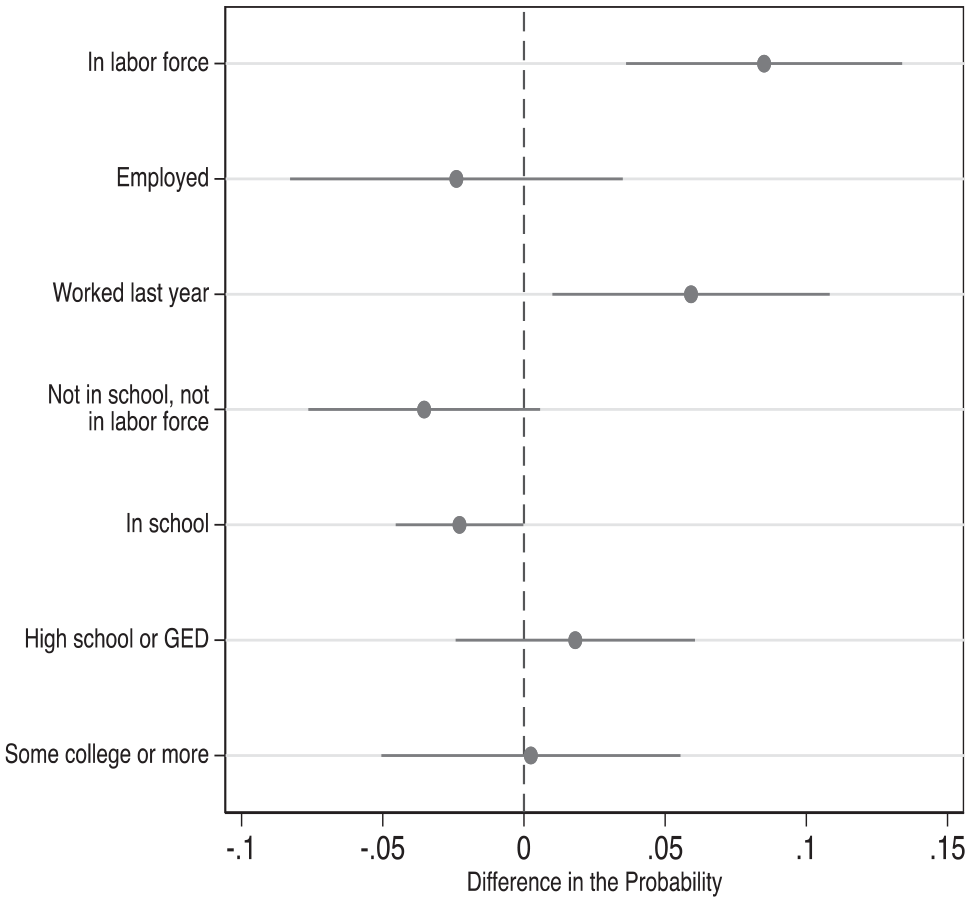
Difference in the effect of Deferred Action for Childhood Arrivals for young (≤24 years) Mexican immigrant women compared with older (≥25 years) Mexican immigrant women, in employment and educational outcomes in the United States, 2009 to 2017.
Our estimates of DACA’s (intent-to-treat) effects are likely downwardly biased by the inclusion of documented immigrants in the DACA-eligible category. Estimates of the size of the Mexican noncitizen and undocumented immigrant populations indicate that 72 percent of Mexican noncitizens were undocumented in 2011, and 60 percent were undocumented in 2018 (Baker 2019, 2021a, 2021b; Pew Research Center 2021). Assuming that these estimates do not vary by age, these figures suggest that our estimates may be downwardly biased by a factor between 1.38 (1/.72) and 1.67 (1/.6).
Our findings are fairly similar across gender. For both men and women, DACA was associated with increases in work and declines in school enrollment, and these effects are concentrated among those 24 and younger. Furthermore, we see no impact of DACA on wages or college attainment for men or women in either age group. One exception is that DACA had a positive effect on high school or GED completion among young men but had no association with high school or GED completion among women.
Conclusion
U.S. immigration policy and enforcement limit the chances of upward mobility among immigrants by creating deportation fear and restricting access to the institutions that govern adult life in the United States, such as the labor market and institutions of postsecondary education (Abrego 2006; Gonzales 2011). DACA was designed to mitigate some of these harms by protecting undocumented young people from deportation and providing work authorization. Because the transition to adulthood is a sensitive and critical life-course period, we hypothesized that younger undocumented individuals might experience greater benefits from legal status, compared with individuals who were farther along in the transition to adulthood (Abrego 2006; Gonzales et al. 2018; Patler, Hale, et al. 2021; Torres and Young 2016). Younger recipients of DACA status have had less exposure to the harms of undocumented adult life: they are less likely to have started their work lives or made decisions about postsecondary education while facing the harsh constraints imposed by undocumented status beyond high school.
In this study, we tested this idea using ACS data and comparing the educational and employment outcomes of younger and older Mexican immigrant men and women who were and were not eligible for DACA before and after DACA was created in 2012. We found substantial support for the hypothesis that DACA had differential impacts on younger and older DACA-eligible individuals. Among both men and women, DACA was associated with increases in labor force participation, employment, work in the last year, and hours worked among younger but not older individuals. These results suggest that the earlier a legal status transition occurs, the greater the impact on employment.
Qualitative research shows us how the impacts of DACA on young adults’ employment extend through and beyond work. Enriquez’s (2020) research on young DACA recipients demonstrated that work authorization may have been particularly important for men by enabling them to better fulfill gendered expectations of being a financial provider, which then facilitated decisions to pursue marriage and parenthood. Abrego’s (2018) research showed that work authorization led DACA recipients to experience greater spatial mobility and independence from family. These indirect responses to the program, and their longer term meanings for socioeconomic mobility, merit continued research and explication.
We also found that DACA was associated with a decline in school enrollment among all DACA-eligible Mexican immigrants but that the decline was greater among those younger than 25. These results are consistent with existing work arguing that the limits of the DACA program may have led younger participants to prioritize work over school (Hsin and Ortega 2018). Given the uncertain horizon over which DACA granted work authorization and its political contingency, many DACA participants may have opted to take advantage of the opportunity to work and earn money, instead of pursuing schooling, which recipients may see as a riskier investment if they are later unable to pursue employment commensurate with their education (Gonzales et al. 2018; Hamilton et al. 2020). The pressure to work may be especially great in mixed-status households in which DACA recipients support family members who do not have work authorization (Abrego 2011, 2018; Castañeda 2019; Enriquez 2020). Another related interpretation of our findings draws from the insight that schools and the labor market are institutions that differently condition the experiences of undocumented immigrants (Gleeson and Gonzales 2012). Whereas immigration status may be less consequential for current and/or future enrollment in schooling, legal status is a requirement for participation in the formal labor market. DACA enables mobility into the formal labor market and may therefore seem like a better choice, especially in the context of a potentially temporary program.
Our results for postsecondary schooling differ from those of Kuka et al. (2020), who found a positive effect of the program on college attendance among Hispanic DACA-eligible immigrants who arrived before age 10. 4 The difference suggests that DACA’s impacts may vary both by age and age at arrival, perhaps because younger arrivals have greater access to local resources to navigate the transition to college (Cortes 2006; Gonzalez 2003). Other research further suggests that DACA recipients’ experiences vary by ethnicity, race, class, sexuality, and geography (Cebulko 2018; Cebulko and Silver 2016; Sudhinaraset et al. 2017; Valdez and Golash-Boza 2020). Taken together, the existing research and our present findings suggest that there is heterogeneity in the experiences, identities, and impacts of the program that is overlooked in research that estimates only average impacts of the program.
We emphasized the importance of stage of life course in moderating DACA’s impacts on schooling and work, and we also considered gender as a structuring principle of the processes linking legal status, school, and work (Donato and Gabaccia 2015; Enriquez 2017, 2020; Golash-Boza and Hondagneu-Sotelo 2013; Menjívar 1999). Our findings suggest few differences in DACA’s life course impacts across men and women, whose gendered labor market and educational experiences appear to remain stable under DACA, compared with before the program was implemented. In other words, although gender structures immigrants’ experiences—for instance, Mexican immigrant men in DACA ages are far more likely to be in the labor force than women—the DACA program did not differentially affect men and women by age at the time of program implementation.
Research has shown that policies that expand the socioeconomic opportunities of participants have different effects on the later well-being of participants, depending on age of intervention. For example, Chetty, Hendren, and Katz (2016) analyzed the Moving to Opportunities for Fair Housing program and found that younger children benefited from moves to lower poverty neighborhoods, while older children did not. Our findings suggest that work authorization provided earlier in life leads to greater increases in work among younger DACA-eligible individuals, whose transition to adulthood is still in progress. At the same time, the program suppresses school enrollment, possibly reflecting a difficult decision young DACA participants make about their future: to work now, instead of pursuing postsecondary education, given the short and uncertain horizon of work authorization. These findings suggest that policy makers should urgently implement permanent legalization programs that allow legal status transitions as early as possible in the life course.
Footnotes
Appendix
Coefficients Testing for Differential Pretrends in Employment and Education Outcomes by Daca Eligibility and Age Group among Mexican Immigrant Women.

|
|
|
|
||||
|---|---|---|---|---|---|---|
| coef. | se | coef. | se | coef. | se | |
| DACA Elig x 2009 | 0.05 | (0.04) | –0.02 | (0.03) | 0.06 | (0.03) |
| DACA Elig x 2010 | –0.03 | (0.04) | 0.01 | (0.03) | 0.01 | (0.04) |
| DACA Elig x 2011 | –0.02 | (0.03) | –0.00 | (0.03) | –0.02 | (0.04) |
| DACA Elig x 2009 x Younger | –0.05 | (0.06) | –0.04 | (0.07) | –0.08 | (0.06) |
| DACA Elig x 2010 x Younger | 0.00 | (0.06) | –0.05 | (0.06) | –0.03 | (0.05) |
| DACA Elig x 2011 x Younger | 0.01 | (0.05) | 0.03 | (0.06) | 0.01 | (0.05) |
|
|
|
|
||||
| coef. | se | coef. | se | coef. | se | |
| DACA Elig x 2009 | –0.01 | (0.08) | –0.74 | (0.83) | –0.05 | (0.03) |
| DACA Elig x 2010 | –0.08 | (0.07) | 0.52 | (1.01) | –0.02 | (0.03) |
| DACA Elig x 2011 | –0.04 | (0.08) | –0.09 | (0.93) | 0.02 | (0.02) |
| DACA Elig x 2009 x Younger | 0.02 | (0.16) | –0.83 | (1.80) | 0.01 | (0.04) |
| DACA Elig x 2010 x Younger | 0.20 | (0.16) | –1.69 | (1.97) | 0.01 | (0.04) |
| DACA Elig x 2011 x Younger | 0.09 | (0.16) | 0.12 | (1.84) | –0.05 | (0.04) |
|
|
|
|
||||
| coef. | se | coef. | se | coef. | se | |
| DACA Elig x 2009 | 0.01 | (0.01) | 0.01 | (0.03) | –0.06 | (0.03) |
| DACA Elig x 2010 | 0.01 | (0.01) | 0.03 | (0.03) | –0.01 | (0.03) |
| DACA Elig x 2011 | –0.00 | (0.02) | 0.04 | (0.03) | –0.01 | (0.03) |
| DACA Elig x 2009 x Younger | 0.08* | (0.03) | –0.01 | (0.04) | 0.06 | (0.06) |
| DACA Elig x 2010 x Younger | 0.01 | (0.03) | –0.07 | (0.05) | 0.07 | (0.06) |
| DACA Elig x 2011 x Younger | 0.03 | (0.03) | –0.04 | (0.03) | 0.07 | (0.06) |
Note: Models adjust for age, sex, married, state-level rate unemployment and state fixed effects. Robust standard errors in parentheses.
p < .05.
Funding
The author(s) disclosed receipt of the following financial support for the research, authorship, and/or publication of this article: This work was supported by the National Science Foundation (award 1822787) and the University of California, Davis, Global Migration Center.
1
Results on school enrollment, not in the labor force nor in school, and high school or GED completion, using data from 2006 onward are substantively similar to those we present.
2
Younger DACA-eligible immigrants were, on average, two years younger at arrival than older DACA-eligible immigrants in our sample. The inclusion of age at arrival as a control in our models yields substantively similar results.
3
The inclusion of zero-income earners (by assigning a value of 1 to income prior to logging) does not change the results. We also separately analyzed total income and hourly wage, which we calculated by dividing weekly income by usual hours worked per week; results were similar for these outcomes.
4
Kuka et al. compared their design and results with those of others, especially  , who found negative impacts of DACA on postsecondary schooling. Kuka et al.’s positive coefficient of 2 percentage points declined to 0.2 percentage points and statistical nonsignificance when they relaxed the age of entry restriction, suggesting that their results were driven primarily by restriction to early arrivers.