




Abstract
This visualization captures shifts in partisan identification in the 2016–2020 General Social Survey Panel. Although most partisans remained stable in their identifications, a significant proportion of respondents either shifted to the opposing party or became independents. These patterns have important implications for our understanding of recent party realignment, trends in partisanship, and the care needed when using party identification as an independent variable.
Research on political partisanship typically relies on self-reported partisan identification (party ID) as a key independent variable (e.g., Baldassarri and Gelman 2008; DellaPosta 2020). When studying trends in partisanship as a predictor, an important question to ask is whether observed trends are due to changes among partisans or to shifts in the makeup of those groups (i.e., individual identifications shifting). Because of the cross-sectional design of most major surveys used in the social sciences, it is usually not possible to disentangle these separate effects. Given the turbulent political arena of recent years—including the coronavirus disease 2019 pandemic, racial justice movements, and the Donald Trump presidency—there will likely continue to be heightened interest in partisanship and its effects in American society. How stable have these identities been, and, subsequently, how much impact could switching have when party ID is used as an independent variable?
We take advantage of the recent release of the 2016–2020 General Social Survey Panel (Davern et al. 2021) to track shifts in party ID between 2016 and 2020. We match respondents across the two waves, measuring self-identified party identification at each time. (See the Appendix for more information on the data, as well as results for the 2018–2020 panel.) Figure 1 is a flow plot (alluvial plot) that displays changes in respondents’ ID from the first to second waves of interviews. The left side indicates party ID in 2016, and the right side shows ID in 2020. The “alluviums” (the bars flowing between waves) depict shifts in ID over time, with the size corresponding to the percentage of respondents in each category.
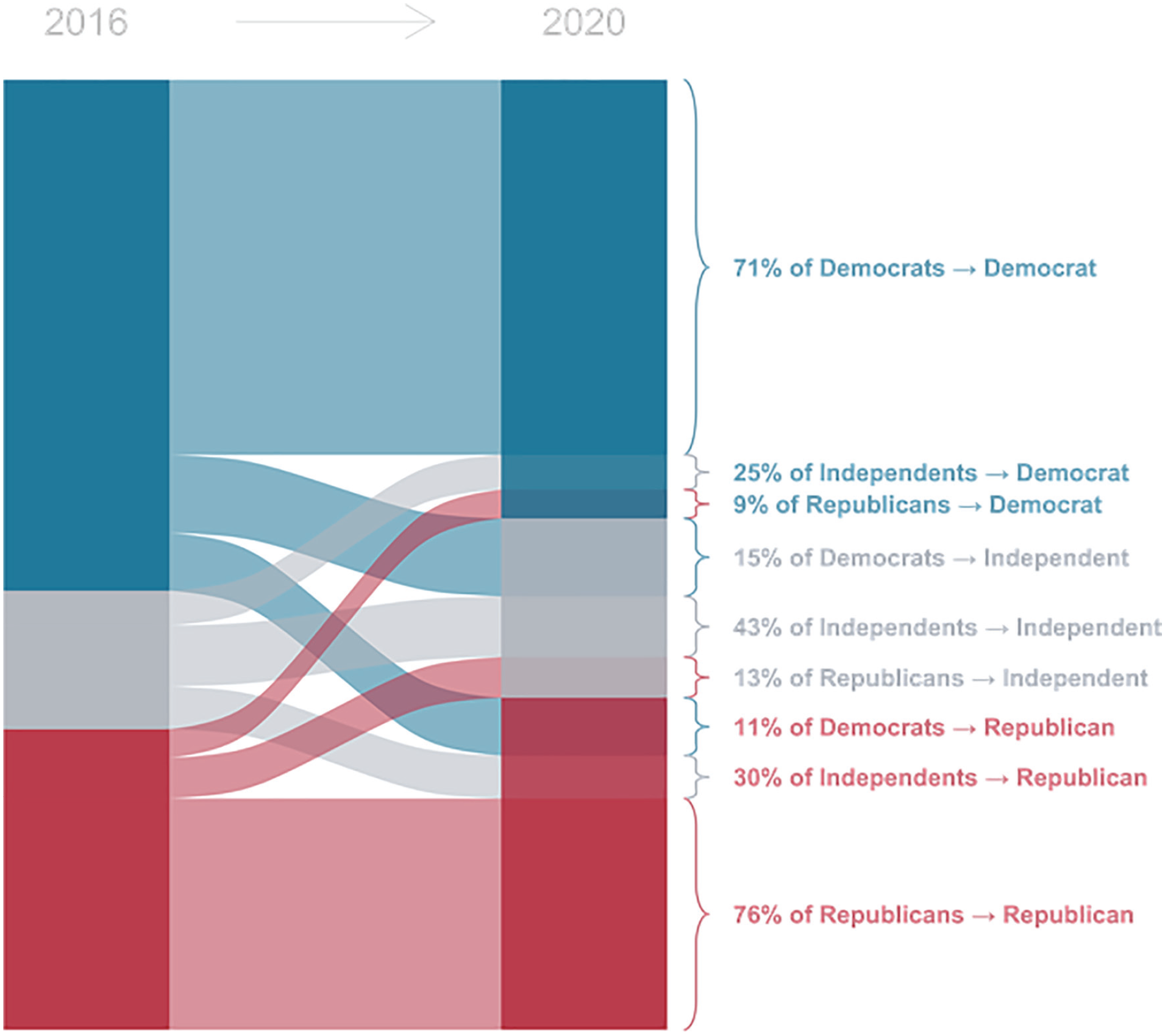
Partisan identification switching, 2016–2020.
Overall, the results demonstrate that most Democrats and Republicans retained their party ID between the first and second wave (both more than 70 percent in each sample). 1 At the same time, there is evidence of instability: about a quarter of Republicans and Democrats shifted their party ID from 2016 to 2020. How did partisans shift their identities? For both Democrats and Republicans, the second most likely outcome after retaining the same party ID was becoming a political independent (~15 percent for both Democrats and Republicans). Importantly, about 10 percent of partisans flipped party ID from 2016 to 2020, indicating a nonnegligible realignment between parties. The highest volatility was among independents, with the majority of this group self-aligning with parties in 2020. This suggests that for many people, independent is a liminal rather than stable and persistent identity (Hout 2017).
This visualization demonstrates that despite marked partisan entrenchment over the past several decades, there remains a considerable level of realignment and volatility in party ID. These patterns highlight the potential importance of partisan switching when considering partisanship as a predictor, especially when considering partisan trends over time. Moreover, the observed volatility among independents highlights the difficulty in drawing conclusions about this fluctuating group. Finally, these results, which demonstrate substantial switching across just a few years, suggest that even short periods of time, especially if they are politically volatile, can have clear consequences for political identities, which for a substantial proportion of the American public are changeable and/or unstable rather than entrenched.
Supplemental Material
sj-docx-1-srd-10.1177_23780231211057322 – Supplemental material for Visualizing Partisan Identification Switching in the General Social Survey Panel, 2016–2020
Supplemental material, sj-docx-1-srd-10.1177_23780231211057322 for Visualizing Partisan Identification Switching in the General Social Survey Panel, 2016–2020 by Sean Bock and Landon Schnabel in Socius
Footnotes
Acknowledgements
We thank Bart Bonikowski and the Editors at Socius for helpful feedback on this project.

Supplemental Material
Notes
Author Biographies
References
Supplementary Material
Please find the following supplemental material available below.
For Open Access articles published under a Creative Commons License, all supplemental material carries the same license as the article it is associated with.
For non-Open Access articles published, all supplemental material carries a non-exclusive license, and permission requests for re-use of supplemental material or any part of supplemental material shall be sent directly to the copyright owner as specified in the copyright notice associated with the article.
