




Abstract
Efforts to address the coronavirus disease 2019 (COVID-19) pandemic have encountered skepticism among the public, but COVID-19 is not the only medical or scientific issue that receives such skepticism. How does COVID-19 skepticism relate to other forms of science skepticism? Using new data from a nationally representative survey of U.S. adults, this study reveals that skepticism toward COVID-19 is similar to patterns of skepticism toward vaccines in general and, more interestingly, skepticism toward climate change. Patterns of skepticism toward evolution and genetically modified foods are more distinct from COVID-19 skepticism. Notably, even after accounting for other forms of science skepticism, political conservatism is significantly associated with greater skepticism toward COVID-19. Finally, contrary to some media narratives, the analysis reveals few racial or ethnic differences in skepticism toward COVID-19, and the differences that do exist indicate less skepticism among Black and Asian individuals relative to White individuals.
Research aimed at mitigating and ending the coronavirus disease 2019 (COVID-19) pandemic naturally focused on the biological and medical dynamics of the virus, such as understanding the methods of transmission and moving toward vaccine development. That research has produced incredible successes, especially with the rapid development of multiple safe and effective vaccines. Yet it has become apparent that there are as many social and psychological obstacles to ending the pandemic as there are medical or biological ones.
Efforts to vaccinate the public have been hampered by a sizable minority of the population that is skeptical about the safety, effectiveness, or the need of getting the vaccine. Skepticism surrounding the pandemic, though, did not begin with the vaccines. From the beginning of the pandemic, segments of the public were skeptical about the safety or effectiveness of specific mitigation efforts, such as mask wearing (Goodman and Carmichael 2020; Khazan 2020), the dangers of the virus (Pekosz 2020), or that the virus even exists (Reuters 2020).
None of this should have been surprising. Studies examining a wide variety of science issues have shown that there are sizable portions of the public that reject or are skeptical of the scientific or medical consensus, whether it is around climate change (Pew Research Center 2016), evolution (Pew Research Center 2015), or other scientific issues. Yet it is not always the same groups that express skepticism regarding these issues (Rutjens, Sutton, and van der Lee 2018). In their analysis of survey data, for instance, Ecklund et al. (2017) found that religion is a much stronger predictor of skepticism toward evolution than it is of skepticism toward climate change. The latter, they found, is driven more by political conservatism. Indeed, net of political conservatism, their analysis demonstrated no independent association between evolution skepticism and climate change skepticism.
How do patterns of COVID-19 skepticism relate to the patterns observed for those other issues? Understanding the answer to this question might help better target interventions meant to reduce skepticism. Using new data from a nationally representative survey of adults in the United States that asked about multiple items measuring skepticism of COVID-19 alongside a number of other science issues, we examine how predictors of skepticism toward COVID-19 are similar to or different from the predictors of skepticism toward other science issues.
Sources of Science Skepticism
Both popular discussions and social scientific research on the causes of science skepticism tend to highlight some usual suspects. In particular, much research has focused on the role of education and scientific knowledge, religion, political ideology, and race or ethnicity. As we note below, each of these factors has also been part of the scholarly and popular discussion of COVID-19 skepticism.
Education and Scientific Knowledge
The idea that skepticism toward scientific issues is a function of ignorance has long been the core of much scientific communication and outreach (Ahteensuu 2012; Simis et al. 2016). This deficit model argues that if the public knew more about a scientific issue, they would be more supportive of it. This has led much research to focus on the role of education or more direct measures of scientific knowledge in shaping science skepticism. This hypothesis does have support in the literature. Direct measures of scientific knowledge and measures of education both independently predict positive attitudes toward science in general and toward specific scientific issues, although they tend to be less powerful predictors of positive attitudes toward scientific issues seen as controversial (Bak 2001).
This deficit model, however, does have limitations. Measures of education or scientific knowledge often do not explain all of the variation in skepticism toward science, nor do they typically eliminate the associations seen across other measures (Gauchat 2011). Moreover, attempts to reduce deficits or increase knowledge among the public have occasionally been found to have no impact or even the opposite intended impact on the public’s skepticism of science (Nyhan et al. 2014). This has led social scientists to look beyond education or knowledge to understand science skepticism, including when it comes to COVID-19 skepticism (Rutjens, van der Linden, and van der Lee 2021; Tavernise 2021).
Religion
The cultural narrative, at least in the West, often points to religion as a source of skepticism of and conflict with science (Hardin, Numbers, and Binzley 2018). Some media discussions and scholarly research, in fact, have connected religion to (non)adherence to COVID-19-related mitigation efforts (Crary 2021; Hill, Gonzalez, and Burdette 2020) or skepticism of scientists studying COVID-19 (Evans and Hargittai 2020). There is at least some support for such a hypothesis. Religion, particularly adherence to more conservative strains of Protestantism and more literal views of the Bible, is negatively associated with trust in science broadly (Sherkat 2017). There is some nuance to such findings, though, as the connection between religion and science skepticism varies greatly depending on the scientific issue at hand. Issues that raise moral questions or strike at the heart of particular theological claims generate more skepticism from religious individuals than those that do not (Evans 2011, 2013).
Political Ideology
Any potential influence of religiosity on science skepticism must also be distinguished from any overlap it may have with the influence of political conservatism. Indeed, political conservatism has become increasingly associated with skepticism toward science in general, a finding that has been connected in part to science’s increasing role or at least perceived role in social and economic policies (Gauchat 2012, 2015; Evans and Feng 2013). Perhaps not surprisingly, then, some of the focus on COVID-19 skepticism has been on political ideology (Diamond 2021; Evans and Hargittai 2020). As with religion, though, the strength of the association between political ideology and science skepticism differs depending on the issue being examined. Studies have shown strong associations between political conservatism and skepticism toward climate science issues (Azevedo and Jost 2021; McCright and Dunlap 2011). Cross-national studies suggest that this connection is particularly strong in the United States (Hornsey, Harris, and Fielding 2018). On the other hand, some studies of skepticism toward the safety of genetically modified foods have not revealed a significant association with political party or ideology (Elder, Green, and Lizotte 2018).
Race and Ethnicity
The role of race and ethnicity in skepticism toward science has been a point of contention, both in general and with COVID-19 specifically. On one hand, some studies have shown that some racially and ethnically minoritized people have greater skepticism toward science, particularly when it comes to medical science. This has been attributed to both historical abuses (e.g., the Tuskegee syphilis study) and contemporary discrimination experienced by these groups in the context of medical research (Shavers, Lynch, and Burmeister 2000). On the other hand, some studies have argued that the impact of these factors is overstated, and that racially and ethnically minoritized people are not necessarily skeptical of science even if they are at times more hesitant to be research subjects (Katz et al. 2006). Rather, advocates argue that the main issue is that scientists and physicians do not engage as much with these groups when it comes to issues like COVID-19 vaccination (Dembosky 2021).
Current Research Questions
Although past studies of science skepticism highlight some common predictors, they also highlight that the significance of those predictors can often vary across issues. And although some research has begun to examine predictors of COVID-19 skepticism (e.g., Latkin et al. forthcoming), they often do not place these findings in the context of other forms of science skepticism. The study presented here has two basic questions:
What social factors appear to be associated with skepticism toward COVID-19?
How do the predictors of COVID-19 skepticism compare with the predictors of skepticism toward other scientific issues?
We answer these questions by using a new nationally representative survey that includes multiple items measuring COVID-19 skepticism alongside items assessing other forms of science skepticism. We now turn to introducing and describing these data in more detail.
Data
The data for this study were generated from a survey fielded using the AmeriSpeak panel. The AmeriSpeak panel is a probability-based panel of nearly 50,000 individuals age 13 and older in the United States. The AmeriSpeak panel is funded and operated by NORC at the University of Chicago. NORC randomly selects households through a multistage sampling process and recruits them through mail, phone, and face-to-face methods. Although most panelists complete surveys online, NORC also conducts phone surveys with panelists who prefer that mode or who do not have access to online surveys. A more detailed technical overview of the AmeriSpeak panel can be found at NORC (2021).
For the survey that produced the data used in this study, NORC invited 8,238 panelists to complete the survey for a target completed sample of 2,000 responses. In the end, a total of 2,003 completions were received. Most of these responses were completed online (1,915), while a handful (88) were completed using phone interviews. The survey was in the field from May 17 through June 1, 2021, which is relevant to keep in mind in terms of the larger context of the COVID-19 pandemic. During this time period, about half of the U.S. population had received at least one dose of a COVID-19 vaccine, and about 40 percent of the population was fully vaccinated (Mayo Clinic 2021). Using benchmarks from the February 2021 Census Bureau current population reports, NORC computed weights on the basis of age, gender, census division, race and ethnicity, and education. When weighted, sample-based point estimates for these demographics closely mirror that of the U.S. adult population.
This research was supported by a grant from the Science and Religion: Identity and Belief Formation grant initiative, spearheaded by the Religion and Public Life Program at Rice University and the University of California, San Diego, and provided by the Templeton Religion Trust via the Issachar Fund. Note that these data will be publicly archived at the Association of Religion Data Archives (https://www.thearda.com) no later than two years after the conclusion of the larger project’s funding period, which equates to no later than June 2025.
Measures
The survey instrument that produced the data used in this survey was focused heavily on measuring respondents’ attitudes and behaviors related to science, religion, and spirituality. As a result, this study benefits from a wider variety of measures on some of the key outcomes and predictors relative to many other studies.
Outcomes
The survey included questions about respondents’ attitudes or skepticism toward several scientific claims or issues. Regarding COVID-19, we asked respondents their level of agreement with six statements: (1) “COVID-19 is a hoax,” (2) “COVID-19 is God’s punishment for immoral behavior,” (3) “Mask wearing reduces the transmission of COVID-19,” (4) “The seasonal flu is just as dangerous as COVID-19,” (5) “COVID-19 vaccines are safe,” and (6) “COVID-19 vaccines are effective.” For each statement respondents could (1) strongly disagree, (2) somewhat disagree, (3) neither agree nor disagree, (4) somewhat agree, or (5) strongly agree. To serve as a measure of skepticism, we reverse-coded these responses for items 3, 5, and 6.
These statements admittedly represent a range of issues, but this was intentional, as we wanted to assess the full spectrum and potential subtypes of COVID-19 skepticism. These items were largely adapted from questions asked in existing surveys either about COVID-19 specifically or about related issues. For instance, surveys have often asked respondents their level of agreement with an item such as “In general, vaccines are safe” (e.g., El-Elimat et al 2021). We simply adapted this to be specific to COVID-19. Some COVID-19 surveys have asked about individuals’ beliefs concerning the effectiveness of wearing a mask (Knotek et al 2020), which motivated our similar item. Other items represent particular narratives related to COVID-19 skepticism, such as it being a hoax or “plandemic” (Frenkel, Decker, and Alba 2020; Schaeffer 2020).
Exploratory factor analyses showed that the item concerning COVID-19 as God’s punishment and the item concerning COVID-19 as equivalent to the seasonal flu did not load with each other or with the other four items. The two vaccine-related COVID-19 items did load together, along with the items concerning COVID-19 being a hoax and the effectiveness of masks. For the analysis below, we created a scale that represented the mean response across these four items (Cronbach’s α = .87). Because the two vaccine items were more closely related both empirically and conceptually, we also created two subscales that separate the two vaccine items from the other two items. The vaccine subscale has a Cronbach’s α of .92, while the hoax-mask subscale has a Cronbach’s α of .70. In the following analysis, we examine the general COVID-19 skepticism scale and the two specific subscales.
In a separate section of the survey instrument, presented before the COVID-19 items, we also asked respondents about their level of agreement with a series of statements about other scientific claims or issues. Again, these items were modeled on issues and questions from past surveys. For each statement respondents could (1) strongly disagree, (2) somewhat disagree, (3) neither agree nor disagree, (4) somewhat agree, or (5) strongly agree, which we recoded when necessary to represent skepticism toward the scientific claim.
Two of these statements related to general vaccine skepticism: (1) “Overall, vaccines are effective,” and (2) “Vaccines are generally safe.” We take the mean response across these two responses to generate a general vaccine skepticism outcome. The Cronbach’s α for this outcome is .89. Two other items in this series asked about evolution. The two statements were (1) “Human beings developed from earlier species of animals” and (2) “Evolution is the best explanation for the origins of human life on earth.” Again, we take the mean response across these items to generate an outcome representing evolution skepticism. The Cronbach’s α for this outcome is .89. Another two items asked about the safety of genetically modified organisms (GMOs). The offered statements were (1) “Genetically modified crops are as safe as conventionally grown crops” and (2) “It is safe to eat foods that have been genetically modified.” The Cronbach’s α for the combined scale for these two items is .87.
The survey also asked two items about climate change. The first was contained in the same series as these other items and asked for the respondents’ level of agreement with the statement “Climate change is happening.” The second came immediately after this series of items and asked, “Which of these three statements about the earth’s temperature comes closest to your view?” Possible responses were (1) “The Earth is getting warmer mostly because of human activity, such as burning fossil fuels”; (2) “The Earth is getting warmer mostly because of natural patterns in the Earth’s environment”; (3) “There is no solid evidence that the Earth is getting warmer”; and (4) “Not sure.” A sizable proportion of respondents (13 percent) chose the “not sure” response, which presented a challenge for how it should be treated in the analysis. Treating those cases as missing data would obviously be unwise. But should they be seen as equivalent to saying that there is no solid evidence (i.e., response 3), equivalent to some other response, or somewhere between the other responses? Our preliminary analyses showed that the internal reliability with the first climate change–related item was strongest when the “not sure” response was treated as being between the “natural patterns” response and the “no evidence” response. That is, our recoded items are (1) “The Earth is getting warmer mostly because of human activity, such as burning fossil fuels”; (2) “The Earth is getting warmer mostly because of natural patterns in the Earth’s environment”; (3) “Not sure”; and (4) “There is no solid evidence that the Earth is getting warmer.” The Cronbach’s α for the outcome combining these two items is .72.
Predictors
Education and Scientific Knowledge
Education is measured on a five-point scale representing (1) less than a high school degree; (2) high school degree or equivalent; (3) vocational, technical college, or associate’s degree; (4) bachelor’s degree; and (5) postgraduate study or graduate or professional degree.
Scientific knowledge is measured with six items that began with the statement Now, we would like to ask you a few short questions like those you might see on a television game show. For each statement that you see below, please tell us if it is true or false, or if you don’t know.
The offered statements were (1) “The center of the Earth is very hot,” (2) “Lasers work by focusing sound waves,” (3) “Electrons are smaller than atoms,” (4) “Antibiotics kills viruses as well as bacteria,” (5) “All radioactivity is man-made,” and (6) “It is the father’s gene that decides whether the baby is a boy or a girl.” These statements mirror those offered in previous editions of the National Science Foundation’s (2014) Survey of Public Attitudes Toward and Understanding of Science and Technology and the General Social Survey (Smith et al. 2018). Note that we purposely did not include items about evolution and the big bang, as research has identified these as “religiously contested scientific facts,” and we did not want to confound scientific knowledge with religious identity (Evans 2011). We summed the number of correct answers provided by respondents to generate an overall science knowledge score. We treated responses of “don’t know” as incorrect answers.
Religion
We measure religion with two items. The first is a broad indicator of the respondent’s religious tradition. This is measured as (1) Evangelical Protestant, (2) other Protestant (3) Catholic, (4) non-Christian (e.g., Jewish, Muslim, Hindu), (5) agnostic, (6) atheist, (7) nothing in particular, or (8) something else. The Evangelical Protestant category was coded by taking respondents who indicated that they were Protestant or just Christian and, on a separate item, said that the term evangelical describes them somewhat or very well. Although obviously not ideal, the non-Christian traditions were combined given their individually low proportions.
The second item is a measure of the respondent’s view of the Bible. This is measured as (1) “The Bible is the actual word of God and is to be taken literally, word for word”; (2) “The Bible is the inspired word of God but not everything in it should be taken literally, word for word”; (3) “The Bible is an ancient book of fables, legends, history, and moral codes.” We use this last response as the reference category in the analysis.
Political Conservatism
We include a measure of political ideology that is coded as (1) very liberal, (2) somewhat liberal, (3) moderate, (4) somewhat conservative, or (5) very conservative. This comes from multiple questions that began by asking, “Generally speaking, do you consider yourself to be a liberal, moderate, or conservative?” Those individuals indicating that they were liberal or conservative were then asked whether they were very or somewhat liberal or conservative.
Race and Ethnicity
Race and ethnicity is measured with a single item with six categories: (1) White, non-Hispanic; (2) Black, non-Hispanic; (3) other, non-Hispanic; (4) Hispanic; (5) multiple races, non-Hispanic; and (6) Asian, non-Hispanic. Note that this measure is produced from a series of items in which respondents are asked to indicate any race(s) they identify as and whether they are of Spanish, Hispanic, or Latino descent.
Other Predictors and Controls
We include several other measures that research suggests could be associated with one or more forms of science skepticism or could be associated with the other focal predictors identified above. For instance, older individuals are particularly susceptible to COVID-19’s most dangerous health impacts, which means that they may be less skeptical of it either because they are more aware of people who have been acutely affected by the virus or because they are more fearful of the virus’s impact on them. Given this, we include a measure for the respondent’s age, which is measured on a seven-point scale: (1) 18 to 24, (2) 25 to 34, (3) 35 to 44, (4) 45 to 54, (5) 55 to 64, (6) 65 to 74, and (7) 75 or older.
Media and scholarly reports have also shown that social media has been key in disseminating misinformation and conspiracy theories concerning the COVID-19 pandemic (Pazzanese 2020). Given this, we include two indicators for whether respondents say that they are Facebook users or Twitter users (0 = no, 1 = yes). Finally, we include measures representing respondents’ incomes and their regions of residence, primarily to control for the overlap these predictors may have with other focal predictors, particularly education and religion. Income represents respondents’ household income and is measured on a nine-point scale ranging from (1) less than $10,000 to (9) $150,000 or more. Region is measured as the nine census divisions.
Results
All analyses are conducted in Stata/SE 15.1 and use the software’s complex survey commands (svy) to account for the sample weights. Table 1 presents descriptive statistics for all of the measures used in this study. The outcome measures of science skepticism are shown at the top of the table. Remember that higher values represent more skepticism, so we can see that skepticism is highest for the GMO outcome (mean = 3.0) and the evolution outcome (mean = 2.8). Skepticism is lowest when it comes to climate change (mean = 1.8) and toward the existence and transmission of COVID-19 (mean = 1.8). Skepticism toward COVID-19 vaccines (mean = 2.1) and vaccines in general (mean = 2.0) is slightly higher. It is noteworthy that skepticism toward vaccines in general is significantly lower (95 percent confidence interval = 1.974–2.109) than COVID-19 vaccine skepticism (95 percent confidence interval = 2.113–2.267). This could reflect the specific concerns about the speed of development or the general newness of the COVID-19 vaccines.
Descriptive Statistics.
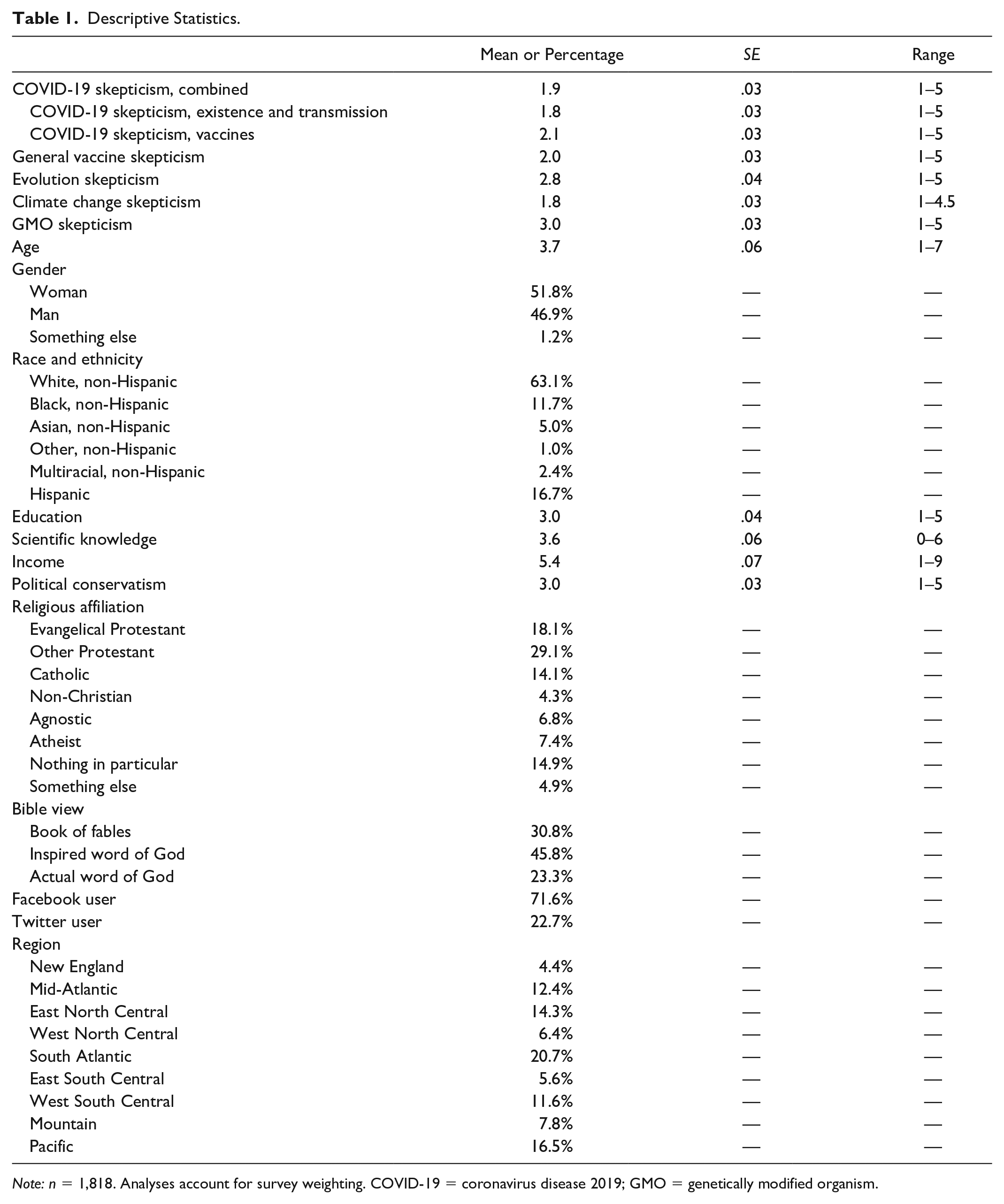
Note: n = 1,818. Analyses account for survey weighting. COVID-19 = coronavirus disease 2019; GMO = genetically modified organism.
Table 2 shows the percentage providing the most extreme response on an example item from each of the skepticism outcomes. For example, we find that 7.3 percent of U.S. adults say that they strongly disagree that “mask wearing reduces transmission of COVID-19.” The evolution item receives the highest rate of strong skepticism, as 24.4 percent of individuals strongly disagree that “human beings developed from earlier species of animals.” Note that, as seen in Table 1, the mean skepticism toward GMOs is actually a bit higher than that for evolution, but this is because attitudes are more polarized when it comes to the evolution issue. Hence, we find a higher percentage of individuals expressing strong disagreement and a higher percentage expressing strong agreement on the evolution items.
Percentage of U.S. Adults Expressing Strong Skepticism Toward Select Science Issues.

Note: n = 1,818. Analyses account for survey weighting. COVID-19 = coronavirus disease 2019; GMO = genetically modified organism.
How does COVID-19 skepticism relate to the other forms of science skepticism? We begin to examine this in Table 3, which presents bivariate correlations between each of the skepticism outcomes. We see that the broad COVID-19 skepticism outcome is the most highly correlated with general vaccine skepticism (r = .69), followed by climate change skepticism (r = .50). Relatively speaking, broad COVID-19 skepticism is less strongly correlated with evolution skepticism (r = .29) and GMO skepticism (r = .29). Looking at the non-COVID-19-related skepticism outcomes shows moderate correlations between each (r ~ .30–.40).
Correlations between Science Skepticism Outcomes.

Note: All correlations are significant at the p < .01 level. n = 1,818. Analyses account for survey weighting. COVID-19 = coronavirus disease 2019; GMO = genetically modified organism.
Table 4 takes this a step further by examining how the predictors of COVID-19 skepticism compare with the predictors of other forms of science skepticism. Each model presented in Table 4 is identical other than the outcome, which is indicated at the top of each column. The first column, for instance, represents the broad COVID-19 skepticism outcome (i.e., the one with all four COVID-19 items). We see that age is negatively associated with broad COVID-19 skepticism, which could correspond to the greater risks that COVID-19 presents to older individuals. We also find that, relative to White individuals, Asian individuals have significantly less skepticism with this broad COVID-19 outcome. Education, scientific knowledge, and income are all independently associated with less skepticism toward COVID-19, while political conservatism is associated with more skepticism toward COVID-19. These findings are all generally in line with what might be expected on the basis of media reports and scientific research on COVID-19 skepticism.
Ordinary Least Squares Regression Models Predicting Skepticism toward Different Forms of Science Skepticism.

Note: Analyses account for survey weighting. COVID-19 = coronavirus disease 2019; GMO = genetically modified organism.
p < .05. **p < .01.
We do find some religion-related effects. Protestants, both evangelical and not, are somewhat more skeptical toward COVID-19 relative to atheists, as are those saying that their religion is “something else” or “nothing in particular.” We also find that Twitter users are significantly less skeptical of COVID-19 than nonusers. This might be surprising given that social media is often pointed to as a culprit in spreading COVID-19 misinformation. It is possible, though, that individuals who use Twitter are more sophisticated on average when evaluating such information relative to those who might not be users themselves but might hear misinformation generated on social media offline.
Comparing the two COVID-19 skepticism subscales reveals a few interesting differences. Black individuals, for instance, are significantly less skeptical of COVID-19’s existence and transmission relative to White individuals. Black individuals do not significantly differ from Whites, though, in their skepticism toward the COVID-19 vaccines. This suggests that the dynamics of skepticism across racial groups is nuanced by what COVID-19-related issue is being considered.
When we compare these findings with those for the non-COVID-19 outcomes, we find both similarities and differences. Across all or almost all of the outcomes, political conservatism is associated with more skepticism, while education and scientific knowledge are associated with less skepticism. Overall, the patterns of predictors for COVID-19 skepticism appear to be most similar to that for the general vaccine skepticism and the climate change skepticism outcomes, although political conservatism has a stronger association with COVID-19 skepticism than general vaccine skepticism, and we do not see an age association with climate change skepticism.
The patterns of COVID-19 skepticism are more distinct from those observed with the evolution skepticism and GMO skepticism outcomes. For both of these outcomes, for instance, we find a gender gap that does not exist with COVID-19 skepticism, with men expressing less skepticism toward evolution and GMOs than women. We also find stronger religious and regional differences in skepticism toward evolution when compared with any of the other outcomes.
Table 5 presents similar models as those seen in Table 4 but includes the other forms of science skepticism as predictors of the COVID-19 skepticism outcomes. We see that general vaccine skepticism and climate change skepticism both independently predict greater COVID-19 skepticism in both the broad skepticism outcome and in the two subscales. Even accounting for other forms of science skepticism, we still find that age is associated with less COVID-19 skepticism, while political conservatism is associated with more COVID-19 skepticism. That is, political conservatism appears to add something to COVID-19 skepticism above and beyond its consistent connection to other forms of science skepticism.
Ordinary Least Squares Regression Models Predicting COVID-19 Skepticism by Other Forms of Science Skepticism.

Note: Analyses account for survey weighting. COVID-19 = coronavirus disease 2019; GMO = genetically modified organism.
p < .05. **p < .01.
On the other hand, unlike in Table 4, we find no significant independent associations between education, scientific knowledge, or Twitter use and reduced COVID-19 skepticism. This suggests that the reason those predictors mattered is because those individuals (i.e., more highly educated, more scientific knowledge, Twitter users) are less likely to hold these other forms of science skepticism and therefore less likely to be skeptical of COVID-19. We discuss these findings further below.
Discussion
Our analysis shows that some of the predictors of COVID-19 skepticism mirror those of skepticism toward other scientific issues. In particular, political conservatism is substantially associated with skepticism toward COVID-19, as it is for skepticism toward vaccines in general, evolution, climate change, and GMOs. Moreover, political ideology remains a significant predictor of COVID-19 skepticism even after accounting for an individual’s skepticism toward other scientific issues. To put this another way, if we took two people who share the same level of skepticism toward climate change, GMOs, evolution, and so on, but one is a political liberal and the other is a political conservative, we would expect the conservative to be more skeptical of COVID-19. This finding underscores the particularly politicized nature of COVID-19 skepticism.
Although probably not as strong or clear of a predictor as those engaged in scientific outreach and communication would like, education and scientific knowledge are somewhat associated with less skepticism toward COVID-19, as they generally are for the other scientific issues. Education and scientific knowledge do not have independent associations with COVID-19 skepticism once we account for other forms of science skepticism, but we might not have necessarily expected such an independent association. Keep in mind that our scientific knowledge items were not specific to COVID-19. If they had been, then we might have expected such an independent “COVID-19 scientific knowledge” association.
Skepticism toward COVID-19, though, does present some unique patterns relative to skepticism toward some other scientific issues. The social patterns for evolution skepticism and GMO skepticism, for instance, are fairly distinct from those for COVID-19 skepticism. For those issues there are clearer gender-based and religion-based patterns to skepticism, while income and age also present different patterns for COVID-19 skepticism relative to evolution and GMO skepticism.
Indeed, the social patterns for COVID-19 skepticism are more parallel to those for general vaccine skepticism and climate change skepticism. The former might not be too surprising given that COVID-19 has a natural connection to vaccines. But COVID-19 skepticism’s connection to climate change skepticism would seem to require a bit more explanation.
We might first suspect that they are connected through political ideology: political conservatives are skeptical toward climate change and COVID-19, which spuriously links the two issues together. But we saw in Table 5 that climate change skepticism remains a significant predictor of COVID-19 skepticism even after accounting for political ideology. That is, if we take two individuals who are both politically conservative, but one individual is more skeptical of climate change than the other, we would expect that person to be more skeptical of COVID-19 as well. It is possible that what connects these issues is trust, or lack of trust, in scientists to engage in creating policies and regulations that affect or are at least are perceived to affect everyday life, whether mask regulations or energy regulations. Indeed, it is noteworthy that climate change skepticism is more strongly connected to skepticism toward COVID-19’s existence and the effectiveness of masks in Table 5 than to skepticism toward COVID-19 vaccines. This could be because the former raises more questions about regulations than the latter. Relatedly, some research has found that those who hold individualistic ideologies are more likely to be skeptical of climate change (McCright et al. 2016; Wang and Kim 2018) and COVID-19 (Dryhurst et al. 2020). Both types of science skepticism tend to endorse that the issue is a hoax and thus resist regulations perceived to impede their freedoms.
Of course, the data used in this study are cross-sectional, so we cannot speak to changes in individuals’ skepticism of COVID-19. Still, these findings do have some potential implications for efforts to change individuals’ views of COVID-19, especially when it comes to the COVID-19 vaccines given that that is probably the primary public outreach challenge at the moment. First, our analysis shows that general vaccine skepticism is a major source of skepticism toward the specific COVID-19 vaccines. Although this is intuitive, it highlights the fact that efforts to convince individuals to get the COVID-19 vaccine likely need to focus more broadly on addressing skepticism toward vaccines in general rather than just convincing people that the specific COVID-19 vaccines are safe and effective.
Second, our analysis shows that some of the factors often pointed to as sources of science skepticism are not relevant for COVID-19 skepticism. We find, for instance, no significant differences across race or ethnicity in skepticism toward the COVID-19 vaccines (and Black and Asian individuals are significantly less skeptical toward the existence or transmission of COVID-19 compared with White individuals). Discussions about COVID-19 skepticism explicitly tied to race or ethnicity, therefore, would seem to be largely misdirected. Moreover, any observed gaps in, say, COVID-19 vaccination rates in such groups would not seem to be connected to those groups’ skepticism but rather due to other issues (e.g., access).
More broadly, this study contributes to the scholarly literature on science skepticism by reinforcing the point that although there are some common threads across types of science skepticism, there are also unique components to any particular instance of skepticism. When trying to understand COVID-19 skepticism or any skepticism toward some other particular science issue, we must consider the unique patterns and mechanisms underlying that issue.
Footnotes
Acknowledgements
We thank Elaine Howard Ecklund, John Evans, and Erin Hudnall for their support and assistance with this project.
Funding
This research was supported by a grant from the Science and Religion: Identity and Belief Formation grant initiative, spearheaded by the Religion and Public Life Program at Rice University and the University of California, San Diego, and provided by the Templeton Religion Trust via the Issachar Fund.
