




Abstract
An expansive body of literature has documented how academia acts as a gendered organization, characterized by disadvantage at multiple levels. Because of data limitations, we know surprisingly little about whether and how access to the resources needed to carry out high-quality research may be gendered. This study begins to fill this gap using a newly available survey of researchers in three disciplines across five European countries. Across a wide range of resources, findings point to marked gender disparities. Women are more likely than men to say that they do not have the resources they need to do their research well and that having them would make a big difference in their work. These findings are robust to controls including academic seniority, suggesting that structural sexism contributes to resource disparities in science. Even after overcoming obstacles en route to research positions in competitive fields, women in science remain systematically disadvantaged.
Although progress has been made in recent decades, widespread gender inequalities persist in the academy. Women face many barriers to a successful research career. They tend to be paid less (European Commission 2018), to take on the most burdensome service roles (Guarino and Borden 2017; Miller and Roksa 2020), and to be viewed by colleagues as less committed to their work (Ellemers et al. 2004). Perhaps a cumulative effect of these wide-ranging disparities, women remain underrepresented. Overall, across Europe only about one third of researchers are women (European Commission 2018). At the highest ranks, these patterns are worse. Fewer than one in four senior professorships are held by women. In science, technology, engineering, and mathematics (STEM) fields, this figure is just 15 percent. And fewer than one in four institutions of higher education in Europe are led by women (European Commission 2018). The picture is similar in the United States, where only about a quarter of full professors are women (Fox et al. 2017)
Scholars have examined various possible explanations for the persistent underrepresentation of women at the highest levels of academia. Research that points to factors other than contemporary gender bias, such as demographic inertia (Hargens and Long 2002) and productivity (Ceci et al. 2014), has been undercut by recent studies demonstrating the insufficiency of cohort explanations (Auriol, Friebel, and Wilhelm 2019) and the outsized role of evaluation bias (Weisshaar 2017). In contrast, studies in the gendered organizations tradition (Acker 1990, 2006) emphasize how a gendered logic is built into academic organizations at multiple levels, disadvantaging women in pervasive if sometimes subtle ways. Such studies suggest that a type of structural sexism (Homan 2019) may be at play in the academy, which like structural racism can produce unequal outcomes even when processes do not seem gendered and even if no actors have explicitly sexist intentions. This study contributes to this literature by analyzing potential gender differences in the extent to which researchers report access to the resources they need to do their jobs well and advance their careers.
Because of data limitations, gendered patterns of resource access have been underexplored. This is a major gap. Science cannot proceed and academic careers cannot develop without access to relevant resources, including obvious resources such as funding and infrastructure but also things such as collaborative networks and good working environments. Indeed, resources are crucial for the development of independent lines of research (e.g., Whitley and Gläser 2014) and therefore for academic career advancement (Laudel 2017). Given persistent gender disparities in the scientific leadership often responsible for allocating both local and external resources, an important question is whether women are disadvantaged in this regard. Indeed, recent findings demonstrate that resource-intensive fields have greater gender disparities (Duch et al. 2012), suggesting that inequalities in resource allocation may serve as an “inequality-producing mechanism” (Acker 2006:455). Analyzing survey data from a sample of researchers in three fields across five European countries, I ask whether researchers report individual-level differences in unmet resource needs. Findings demonstrate that across a wide range of resources, women in science report less access and greater unmet need than men. Reflecting recent advances in gender theory (Homan 2019; Homan and Burdette 2021), I argue that although structural sexism may not always be “directly perceived” (Homan 2019:490), including by men and women in science (Britton 2017; Rhoton 2011), its systemic nature in the academy nevertheless creates conditions that disadvantage women in concrete ways.
Gendered Organizations and Structural Sexism in Science
A long-standing principle of science as a social institution is that it should be universalist in its assessment of research and researchers (Merton 1942), operating independently of individual and social characteristics (Long and Fox 1995). The myth of universalist assessment is deeply ingrained in the way scientists think about their work. Despite much evidence that social biases often creep into scientific practice, many scientists believe it to be true, even among disadvantaged groups. Studies have demonstrated that even in highly gender segregated fields, many women are loath to see gender as mattering within their fields (e.g., Britton 2017; Rhoton 2011). Similarly, the view among academic leadership that aggressive gender equity measures (e.g., quotas) violate the value of universalist assessment can hinder progress (Roos et al. 2020).
Despite this universalist cultural ethos within science, a vast body of scholarship documents far-reaching gender inequalities. The basic observation that women are underrepresented in science as a whole and in some disciplines especially has been explained in ways that point to very different causes. Approaches that focus on potential causes other than present-day bias, such as “demographic inertia” (e.g., Hargens and Long 2002) and publication rates (Ceci et al. 2014), appear at best partial explanations, having been undercut by studies showing a glacial pace of change in many fields (Holman, Stuart-Fox, and Hauser 2018) and productivity differences playing only a small role in tenure disparities (Weisshaar 2017).
That gender inequality remains rampant in the academy and cannot be explained away by such things as demographics or performance comes as no surprise from a sociology-of-gender perspective, which tends to see gender as a social structure (Risman 2004), constructed at multiple levels and deeply embedded in the operation of social organizations. Multilevel gendered processes yield structural sexism (Homan 2019), defined as “the degree of systematic gender equality in the power and resources characterizing a given gender structure” (Homan and Burdette 2021:235). Structural sexism operates similarly to structural racism in that it exists independently of intent and has been constructed through historical and contemporary processes that disadvantage women. As with race, gender can be thought of as a “central organizing principle of organizations” (Bonilla-Silva 1999:899) that exists independently of individual intentions, operating even when a process does not appear explicitly gendered or when no actors involved are explicitly sexist.
Consistent with the gender-as-structure framework, the gendered organizations perspective developed by Joan Acker (1990, 2006) has been particularly influential in studies of gender in science. The overall crux of this perspective is that organizations, including those in higher education, have been historically dominated by men; that they therefore reflect the perspectives, attitudes, and interests of men; and that they thereby disadvantage women in pervasive, yet often subtle ways. Organizations vary in the extent and types of inequalities within them, yet all are shaped by particular “inequality regimes, defined as loosely interrelated practices, processes, actions, and meanings that result in and maintain class, gender, and racial inequalities” (Acker 2006:443). As such, the gendered organizations perspective serves as a robust general framework for understanding the many gender biases that operate in academic science. The present study adopts the assumption that “gender inequalities are built into organizations” (Britton and Logan 2008:110) on at least four levels: policies and practices, cultures, worker identities, and interactions (Acker 1990; Britton and Logan 2008).
And indeed, much research documents gendered processes across these levels within academia, including at the level of policies and practices, where Roos et al. (2020) showed that meritocratic discourses serve as barriers against the implementation of effective gender equity policies; at the cultural level, where stereotypes associating men with science persist (Carli et al. 2016) and men remain overrepresented in public representations of researchers (Adams, Brückner, and Naslund 2019); at the level of worker identity, where studies show successful women sometimes distancing themselves from a collective gender identity and thus limiting the potential for advocacy (e.g., Derks et al. 2011; Ellemers et al. 2004); and at the interactional level, where processes such as homosociality (Kanter 1977) and othering (Acker 1990) create barriers for women in the workplace. In addition to creating a “chilly” climate (Britton 2017), such processes can have direct career consequences through evaluation and mentorship (Lamont 2009; O’Connor et al. 2015), as well as the establishment of academic networks that facilitate reputation and collaboration (Fox 2001).
Among the most important findings from this literature for the present study are those that show how women scientists must struggle to gain credibility as researchers (Rosser 2004). The dominant model in the sociology of science for how resources are distributed centers credibility (Latour and Woolgar 1986), “an attribute which persuades others to believe in and invest in researchers and their ideas” (Smith 2010:182). According to this framework, credibility is earned through publications and then serves as a powerful form of capital that can be converted into many types of resources (e.g., funding, jobs, networks). What it does not consider is that researchers might bring with them to the academy different levels of perceived credibility, based merely on their social positioning within intersectional power structures. Gender scholarship suggests that men may be at an advantage in this regard, with studies showing that women are rated as less competent in grant competitions (Benschop and Brouns 2003) and evaluations for laboratory manager positions (Moss-Racusin et al. 2012). Thus to the extent that credibility is tied to research resources, we can expect women scientists to report greater unmet need.
The present study contributes to the gendered organizations literature by asking whether these multilevel gendered processes create conditions that lead to resource disparities in academic research. Studies in the gendered organizations tradition have made great headway in identifying processes that maintain inequality regimes in academia, but few have examined how these processes do or do not translate into disparities in the conditions that facilitate research success. In taking that step, this study examines a key site of organizational inequality identified by Acker (2006:443): disparities in control over resources. It also contributes toward an empirical understanding of how gendered organizations have created a structurally sexist (Homan 2019) academy characterized by material disparities in resources.
Research Resources
Given the overall lack of research on academic resource access, this study casts a wide net, analyzing a diverse range of resources that shape research careers. By “resources” in this study, I refer to material and nonmaterial forms of capital that facilitate research productivity. This definition allows analysis of subtle ways research conditions may contribute to gender inequalities in science (e.g., through the relative availability of collaborative networks). Its breadth reflects that resources are allocated at various levels of organization within science (e.g., discipline, department, institution) through both formal (e.g., funding applications) and informal channels (e.g., gendered working climates). It is also consistent with a Bourdieusian perspective that emphasizes the interrelatedness and exchangeability of forms of capital (Bourdieu 1989).
Despite their importance for establishing independent lines of research and therefore research careers (Whitley and Gläser 2014), research resources have received little attention in the gender and science literature. This is likely due to a lack of large-scale data on specific types of resources. Nevertheless, in broader studies of gender inequality in academia, there is some evidence that resources essential for research productivity are allocated unequally by gender. Several surveys have shown that women faculty members rate their access to equipment, support, and facilities lower than men (Fox 2010; Poole, Bornholt, and Summers 1997). A study of early career biomedical scholars found that men received startup packages much larger than women (Sege, Nykiel-Bub, and Selk 2015). Especially relevant is a study by Duch et al. (2012), who found that women are most disadvantaged in fields that require intensive resources. Gender differences in publication rates correlate with research expenditures, leading the authors to conclude that gender disparities in institutional support may influence publications and thus careers.
Also relevant for the present study is a literature that conceptualizes forms of social capital as research resources. Much research has shown the importance of resources that flow through networks for academic careers. Academic networks are crucial for securing desirable positions (Burris 2004; Hadani et al. 2012; Heffernan 2020), being invited to participate in conferences and special issues (Faria and Goel 2010; Heffernan 2020), publishing (Prpić 2002), having one’s work favorably received by editors at top journals (Heckman and Moktan 2020), and increasing one’s citations (Hudson 2007). In other words, one’s academic social capital is crucial for securing opportunities needed to build a career (Angervall, Gustafsson, and Silfver 2018). Qualitative case studies have shown that through homosociality, men often gain access to influential networks and associated social capital without having to try, while women’s attempts to build these networks can be read as neediness (Bagilhole and Goode 2001). Furthermore, women who take active steps to improve their social capital often experience challenges, for example, by having to navigate male-dominated social spaces or needing to cut conference travel short because of competing obligations. These are processes that can hamper both one’s position in the discipline and connections with powerful local allies (O’Hagan et al. 2019).
Although access to a wide range of resources is of course important for all researchers, it may be especially important for women, given their unequal service and teaching burden (Guarino and Borden 2017; Misra, Hickes Lundquist, and Templer 2012) and the disproportionate share of domestic work and childcare they continue to shoulder (e.g., Fox, Fonseca, and Bao 2011; Schiebinger and Gilmartin 2010). Studies comparing the research productivity of women and men in science during the coronavirus pandemic support this notion. During this time, many resources became less available, there was less separation between home and work, and much service work was needed to adjust to the pandemic and online teaching. Studies indicate that women’s research productivity during this time was more negatively affected than men’s (e.g., King and Frederickson 2021), suggesting that research resources and working conditions may be especially important for the careers of academic women.
This study contributes to the literatures on gender and research resources through an analysis of survey items asking about very specific types of science resources. It hence provides a more comprehensive and finer grained analysis than has previously been possible.
Context of the Study
In the present study I analyze survey data collected as part of an eight-year project examining notions of and conditions facilitating research quality. The study includes researchers in the fields of physics, economics, and cardiology in Norway, Sweden, Denmark, the Netherlands, and the United Kingdom. As the data come from a broad study of research quality rather than gender in science, the disciplines of physics, economics, and cardiology were chosen because of differences in research practice across the fields. Generally speaking, economics research is carried out by individuals or small informal groups of researchers, cardiology is predominately clinical and laboratory based, and physics is composed of multiple subfields that organize their research around either local or international infrastructure (Whitley 1984). For the purposes of the present article, the key difference in this regard is that laboratory sciences require considerably more resources (in both equipment and human resources) than fields such as economics, which does not often require major facilities.
Beyond this important difference, each of the selected disciplines fares poorly in terms of gender parity. Although European reports rarely break gender representation down by specific field, the available evidence suggests that women are underrepresented across these fields. The best data are available for economics, because of a Web-scraping tool developed by Auriol et al. (2019) that collected information on all academic positions in all European institutions. Across all positions (from research associate to professor), fewer than one third of European economists are women, including only 21.4 percent of full professors. Beyond economics, the European Commission (2018) reported that about 18 percent of natural scientists in senior positions in Europe are women, as are 27 percent of medical scientists. Under these broad umbrellas, physics and cardiology stand out as particularly gender segregated. Using authorship data, Holman et al. (2018) showed that about a quarter of authors in cardiology were women in 2016, including fewer than 20 percent of sole or senior (last) authors. For physics, these figures were about 16 percent for authorship in general and about 12 percent for single and senior (last) authorship. Within the natural sciences (physics), medical sciences (cardiology), and social sciences (economics), then, the fields included in the sample stand out as particularly gender segregated.
Summary of Expectations
Given the preponderance of evidence documenting gendered processes at multiple levels of academic science, I expect overall that women will report higher levels of unmet resource need than men. I further expect that these relationships will hold net of controls, as gender remains a “master status” in science that cuts across other powerful statuses, including being a scientist or, for example, a physicist (Ecklund, Lincoln, and Tansey 2012). To the extent that multilevel gendered processes have rendered academic science a structurally sexist institution, I expect factors such as academic seniority to only partially account for observed resource disparities.
Concerning disciplines, although Duch et al. (2012) showed that women’s publication careers are most impeded in resource-intensive fields, there is little reason to expect that inequalities in resource allocation would exist only in those fields. 1 Indeed, as they are underrepresented in the fields included in the present sample, I expect women to report resource disparities across the fields. It is indeed possible that particular resources may be more or less evenly distributed across the fields, given epistemological and organizational differences between them (Whitley 1984). But given the dearth of field comparative analyses in the existing literature to guide expectations, these analyses are exploratory.
Method and Data
Data come from a cross-national, Web-based survey carried out by an international research team in 2017 and 2018. The overall response rate was 28.6 percent, with the highest level in Norway (51.3 percent), followed by Sweden (38.6 percent), Denmark (32.3 percent), the Netherlands (19.6 percent), and the United Kingdom (13.4 percent). Across the three disciplines, response rates were roughly even, with 30.3 percent of physicists responding, 27.0 percent of economists, and 26.0 percent of cardiologists. A two-step process was used to identify respondents for the survey. This involved (1) identifying authors in discipline-relevant journals as classified by the Web of Science and (2) reviewing staff lists of relevant organizational units identified through institutions’ Web pages. Overall, 59 percent of respondents invited to participate in the study were identified through staff lists and 41 percent through the Web of Science. Unfortunately, the Danish and British samples did not include cardiologists. To account for this, I represent these limited samples with a binary quasi-weight in lieu of the country fixed effects in supplemental analyses. Results are robust to alternative specifications (see Online Supplement Table S1).
Dependent Variables
The survey included a battery of questions that asked respondents about their access to and need for 16 resources that can facilitate research progress: long-term security of basic funding, more time dedicated to research, data access, resources to recruit staff to group, resources to retain staff in group, technical staff/research support service, administrative help for grant proposals, cutting-edge facilities, library facilities/journal repositories, international collaboration opportunities, industry collaboration opportunities, Horizon 2020 2 opportunities, good collaboration in unit, leadership in unit positive toward research topic, more (local) senior colleagues working in my research area, and a generous working climate.
For each resource type, respondents were asked, “What would you need to make significant progress in your research?” Response categories included “already in place,” “no need,” “may make a difference,” “would really make a difference,” and “cannot say.” For the present analysis, response categories are coded as follows to construct measures of unmet resource needs: 1 = already in place or no need, 2 = may make a difference, and 3 = would really make a difference. “Cannot say” is treated as missing. Higher values thus indicate greater levels of unmet need for a given resource. An alternative specification of the outcomes that drops respondents who answered “no need/not relevant” is presented in the Online Supplement and discussed in the “Supplemental Analyses” section. 3
Importantly, this question was asked neutrally, without reference to gender. Indeed, gender was raised in the survey only as a simple demographic question. Nowhere else were respondents primed to think about gender. Thus, these are not measures of whether respondents think that there is a gender gap. They instead reflect simply how respondents perceive their own research support.
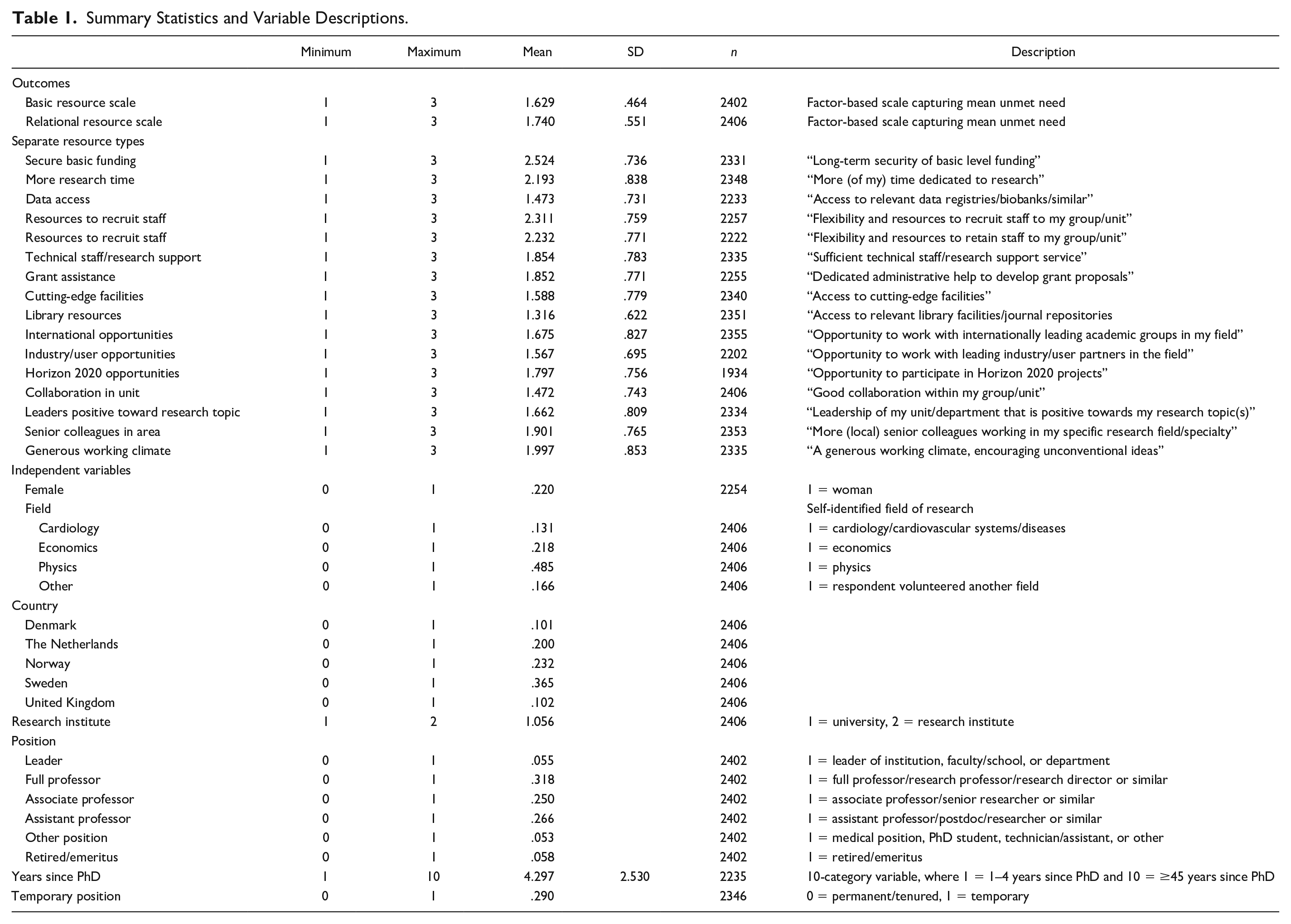
To reduce the complexity of the analysis, I performed exploratory factor analysis, followed by promax oblique rotation. 4 Eigenvalues and scree plots were used to select factors. Two factors had eigenvalues greater than 1 and met the straight-line criterion for scree plots (Pett, Lackey, and Sullivan 2003; Preacher and McCallum 2003). Mean-based scales were then constructed from items that loaded strongly (>0.30) on these factors. The following items loaded together on one factor (eigenvalue = 3.96, α = .74): cutting-edge facilities, data access, library facilities/journal repositories, technical staff/research support service, administrative assistance for grant proposals, industry collaborative opportunities, and Horizon 2020 opportunities. Throughout the findings, I refer to this factor-based scale as the basic resource scale, as it captures resources that are either essential for carrying out research (such as facilities and data) or increase one’s productivity (such as administrative assistance or industry-related opportunities). Five other variables loaded together onto a second factor (eigenvalue = 1.17, α = .72): senior colleagues working in one’s research area, working climate, good collaboration in unit, leadership in unit positive toward one’s research topic, and opportunities to work with internationally leading groups in the field. I refer to this as the relational resource scale, as it captures types of social capital valuable within academia. Both scales range from 1 to 3, with higher values representing greater mean levels of unmet need. Descriptive statistics for all measures included in the analysis are found in Table 1.
Summary Statistics and Variable Descriptions.
Independent Variables
The key predictor in the analysis is gender. This variable is coded as 1 for those who indicated “female” on the survey and 0 for those who indicated “male.” In tables, it is thus referenced as “woman,” indicating a gender effect of women compared with men. Women make up 22 percent of the sample.
Field is derived from a survey item that asked respondents to identify their fields as cardiac/cardiovascular systems/diseases, economics, physics, or other. These are included as binary variables in the models, where physics acts as the base category. Cardiologists compose 13.1 percent of the sample, economists 21.8 percent, physicists 48.5 percent, and other fields 16.6 percent. Respondents in the “other fields” category likely authored articles in journals categorized by the Web of Science as one of the disciplines selected for the survey but in fact worked primarily in other fields. Of these respondents, 32.5 percent are in medical science fields other than cardiology, 13.0 percent are in social science or humanities fields other than economics, and 54.5 percent are in natural science fields other than physics. Women make up 34.5 percent (n = 101) of the cardiologists in the sample, 24.0 percent of economists (n = 119), 18.3 percent of physicists (n = 204), and 20.2 percent of respondents in other disciplines (n = 77).
Controls
Controls include country (with Denmark as the reference category), research institute (vs. university/university hospital), position (leader, full professor, associate professor, assistant professor/postdoc, other, retired/emeritus; leader serves as the reference category); years since PhD 5 ; and temporary (vs. permanent) position. These controls test for whether any observed gender disparities are robust to national policy context, employment context, and seniority differences between men and women.
Analytical Strategy
I first estimate a series of ordinary least squares models to analyze the effects of gender on the basic and relational resource scales. I begin with bivariate models to establish the relationship between gender and resources and then predict models that include a full set of controls. Next, I introduce interactions between gender and field to analyze whether gender operates differently across the research fields, using average marginal effects to facilitate interpretation. Finally, I estimate a series of ordered logit models predicting unmet need for each of the 16 resources separately to better understand which of the specific resource types have the largest gender disparities.
Results
Is there evidence that resource allocation is patterned by gender among academic scientists? Overwhelmingly, the answer is yes. Findings reveal significant gender disparities on both the basic and relational resources scales and for 10 of the 16 separate resource types.
In terms of basic resource needs (Table 2), those things that are necessary to carry out meaningful research and/or facilitate research productivity, the results indicate a significant gender disparity disadvantaging women. In the bivariate model, the gender coefficient is .15, which on a 2-point scale indicates that women’s mean unmet need for basic resources is 7.5 percent higher than men’s. Controlling for field, research organization type, position, temporary status, and country (model 2) reduces the magnitude of the disparity by one third, but the gender coefficient remains strongly significant. This model also demonstrates that cardiologists as a whole report greater unmet need for basic resources than physicists, that researchers in Norway and Sweden report greater unmet need than their Danish counterparts, and that more junior researchers report greater unmet need than departmental leaders. Model 3 introduces interactions between gender and field. The findings reveal no significant interaction. Field-specific gender disparities are presented in Figure 1. This figure presents average marginal gender effects, which represent differences in linear predictions when woman = 0 (men) and woman = 1 (women) for each observation, leaving other independent variables at their observed values and averaged across all observations (Williams 2012). More simply, average marginal effects calculate how the predictions for an outcome would change for each respondent if only their gender was changed and then averages those effects for all respondents. The field-specific predicted gender disparities are .15 in economics, .14 in cardiology, and .08 in physics.
Ordinary Least Squares Models Predicting Mean Level of Unmet Basic Resource Need.

Note: Values in parentheses are t statistics.
p < .05. **p < .01. ***p < .001.

Average marginal gender effects (women) on mean unmet basic resource need.
Results for the unmet relational resource need scale are presented in Table 3. Models 1 and 2 reveal significant gender disparities, similar to those for unmet basic resource needs. The gender coefficient in the bivariate model (model 1) is .14, indicating mean levels of unmet relational resource need 7 percent higher for women than men. Model 2 introduces a full set of controls. This reduces the magnitude of the effect but does not fully account for it, again pointing to a gender disparity net of factors including seniority. These models point to greater unmet need among more junior scientists and in Norway compared with Denmark. Model 3 introduces interactions between gender and field. The cardiology-specific gender coefficient is significant and positive, indicating a greater disparity for women in cardiology compared with the reference category, physics. To facilitate interpretation of the interaction terms, field-specific average marginal gender effects are presented in Figure 2. Findings point to a large and significant gender disparity of .25 in cardiology but not in the other fields.
Ordinary Least Squares Models Predicting Mean Level of Unmet Relational Resource Need.

Note: Values in parentheses are t statistics.
p < .05. **p < .01. ***p < .001.

Average marginal gender effects (women) on mean unmet relational resource need.
Table 4 presents ordered logit models for each of the 16 resource types separately in order to better understand which specific resources have the greatest disparities in unmet need. Findings reveal significant gender effects for 10 of the 16 resources: secure basic funding, more research time, data access, resources to recruit research staff, resources to retain research staff, technical staff/research support, administrative grant development assistance, Horizon 2020 opportunities, leadership positive toward one’s research topic, and working climate. To interpret the magnitude of these effects, Figure 3 presents average marginal gender effects for the outcome categories: “already have/no need” and “would really make a difference.” 6 Each point estimate in Figure 3 can be interpreted as the average effect of being a woman on the probability of being in an outcome category. Some of the biggest effects are for technical staff/research support, administrative grant assistance, resources to retain staff, and working climate. Compared with men, women are 10.3 percentage points more likely to say that having sufficient technical staff/research support service would really make a difference in their research and 11.9 percentage points less likely to say that they already have or do not need that. Similarly, women are 9.1 percentage points more likely to say having dedicated administrative help to develop grant proposals would really help their research and 10.8 percentage points less likely to say that they have that. Women report a greater probability of saying that resources to retain staff would really make a difference in their research, by 15.1 percentage points compared with men. Similarly, women are 9.1 percentage points less likely than men to say that they already have or do not need that resource. For generous working climate, women are 9.0 percentage points more likely to say that it would really make a difference in their research and 8.6 percentage points less likely to say that they already have or do not need that.
Ordered Logit Models Predicting Unmet Basic Resource Needs.

Note: Values in parentheses are z scores.
p < .05. **p < .01. ***p < .001.

Average marginal gender effect (women) on resource needs.
Supplemental Analyses
The analyses discussed in this section are presented in the Online Supplement. Table S1 presents results from models that replace country fixed effects with a binary quasi-weight to account for the Danish and British samples’ not including cardiologists. Results are robust.
Next, I show results from an alternative specification of the resource outcomes in Table S2. As comprehensive measures of unmet resource needs, the outcomes used in the primary analyses treat “already in place” and “no need” as equivalent in that they indicate that a respondent has no unmet need for a particular resource. These measures treat potential differences in perceived need as meaningful aspects of gender disparities, as women are disproportionately burdened with nonresearch work in the academy (Guarino and Borden 2017) and may therefore have legitimately different resource needs. However, collapsing these categories leaves open the possibility that the findings are driven by such differences rather than other gendered processes in science. Thus I constructed an alternative set of resource outcomes in which “no need” is treated as a missing value and the outcome categories are 1 = already have, 2 = may make a difference, and 3 = would really make a difference. Findings using these alternative outcomes (Table S2) are robust. The gender coefficients for both the basic and relational resource scales remain significant and positive. The magnitude of the coefficients is slightly reduced, which is expected, as descriptively men in the sample were more likely to select “no need” responses than women. In models with a full set of controls, the coefficient is .08 for unmet basic resource needs compared with .10 in the primary analysis and .08 for unmet relational resource need compared with .09 in the primary analysis. That the results are robust to this specification suggests a gender gap in unmet resources needs that is not reducible to differences in needs.
The gendered organizations perspective adopted in this article posits that unequal outcomes for women in science result from complex, multilevel processes embedded in organizations. In supplemental analyses, I included additional measures to rule out simpler explanations: namely, that patterns of access to external funding or a few particularly unequal institutions drive the results. External funding is a binary measure, where a value of 1 indicates that a respondent has relied on “competitive grants from external public sources” as a “major source” of funding over the past five years. Institution is a set of binary variables representing the institutions included in the study, including 32 individual institutions and a measure combining institutions whose samples included fewer than 20 respondents. As presented in Tables S3 and S4 in the Online Supplement, neither of these measures accounts for the observed gender disparities. All models reveal significant and positive gender coefficients.
Conclusion
Using the most detailed battery of survey items available to date on scientific resources, in this study I set out to assess whether women and men report different levels of unmet need. The findings point to a clear yes. For both basic resources needed to carry out research and remain productive and relational resources needed to gain visibility and access opportunities within research fields, the results showed clear gender disparities. As expected, these findings were robust to the inclusion of controls, including seniority in the field. The disparity in basic resources differed little across the three fields. For relational resources, however, the findings revealed a large and significant gender disparity in cardiology but not the other fields. Models predicting the 16 resource types separately revealed significant gender disparities for 10 of the 16 resources, with the largest disparities in access to technical staff/research support service, administrative help for grant proposals, resources to retain staff in group, and working climate. Taken as a whole, these findings suggest that resource allocation, as self-reported by researchers, reflects gendered processes within science.
These findings, showing disparities across a range of scientific resources, add to the gendered organizations literature by empirically documenting control over resources as a key site of inequality (Acker 2006). As such, the study suggests that gendered processes operating across various levels of academia come together to affect the work of scientists in potentially career-altering ways. As researchers are limited to questions that seem doable (Fujimura 1987), the disparities documented in the present study may make women less likely than men to pursue potentially innovative yet resource-intensive work, whether in the form of a large research staff, extensive time requirements, or the support of leadership to undertake high-risk projects.
The findings point to several next steps for research. First, a limitation of the present sample is that women are underrepresented in all the included disciplines. Thus, the data do not allow us to parse whether these patterns hold in fields with greater gender parity. This is an important question that could further understanding of the specific processes behind these disparities. It is also an open question. Social psychologists have demonstrated that some women in senior positions accept gender stereotypes to set themselves apart from other women in their field (Derks et al. 2011), for example, by seeing women as less committed to their work than men (Ellemers et al. 2004). Unfortunately, data comparable with those analyzed here are not available for fields with greater gender parity. Future surveys of researchers would do well to include a battery of resource questions to enable this analysis. Relatedly, the finding of an especially strong gender disparity in relational resources among cardiologists suggests that future studies should attend to field differences in the organization of research. This could be due to the clinical and laboratory nature of cardiological research or the degree of employer influence in medical research (Whitley 1984); however, our survey does not allow us to explore these hypotheses. Second, researchers could examine relative gender disparities in resource allocation across national contexts. Assessing whether research policy at this level shapes local resource allocation could help illuminate the processes at play. Third, it may be useful to more closely examine potential mediating effects of local context, such as the gender composition of units. Studies analyzing differences at the levels of research field, nation, or academic department would do well to construct measures of structural sexism at those levels, as Homan (2019) has done for U.S. states and Homan and Burdette (2021) have done for religious congregations. Finally, interviews with researchers and leadership could be useful to dissect how these disparities arise and persist, as well as how they translate (or not) into disparities over the course of a career.
Overall, this study has documented that women and men report different levels of access to a range of research resources. Even after making it through the “leaky pipeline” and into research positions, women in science continue to face systematic disadvantage. Addressing this is a moral imperative, but it should also be a policy priority. Systematic inequalities in the resources scientists have access to no doubt limit the ability of societies to adapt to problems and create better futures. There is little reason to suspect that gender disparities in science will work themselves out any time soon. The hope that demographic inertia will eventually lead to gender parity is undercut by evidence that organizational processes as fundamental as resource allocation remain gendered. Furthermore, as evaluation culture becomes more deeply embedded in higher education with the influence of academic capitalism (e.g., Thornton 2013), continued gender progress in science cannot be taken for granted. The assessment paradigm rests on the myths of meritocracy and universalist assessment in science. Yet evaluation is biased and informed by underlying gender stereotypes (e.g., Weisshaar 2017).
Fixing the problem requires acknowledging its root. On a fundamental level, the beliefs (1) that scientific reward structures are meritocratic and (2) that gender disparities in science reflect power structures are contradictory. One cannot simultaneously believe that rewards are doled out to the scientists who most deserve them and that women are systematically disadvantaged. These ideas work against one another. At best, their side-by-side existence in academia suggests that commitments to equality and justice carry little weight alongside the lure of meritocratic ideology. This is evident when academic leadership dismisses evidence-based, time-bound interventions as radical and antithetical to meritocracy (Roos et al. 2020). Interpreted less generously, their coexistence could imply that gender equality discourses serve as a window dressing covering up continued acceptance of gender stereotypes. In the end, meaningful change cannot happen without a thorough acknowledgment that science is not and has never been purely meritocratic. The present-day scientific profession is permeated by structural sexism (Homan 2019), reflecting centuries of intersectional (dis)advantage. Transformation will not happen by leveraging equality as a management tool to drive growth or efficiency but by seeing the fight for equality in science as a political struggle against long-entrenched power structures that are well served by the meritocratic paradigm and assessment culture (Powell 2018).
Supplemental Material
sj-pdf-1-srd-10.1177_23780231211039585 – Supplemental material for Gendered Patterns of Unmet Resource Need among Academic Researchers
Supplemental material, sj-pdf-1-srd-10.1177_23780231211039585 for Gendered Patterns of Unmet Resource Need among Academic Researchers by Kody Steffy in Socius
Footnotes
Acknowledgements
I would like to thank the following for thoughtful feedback and/or discussions of gender in science: Aaron Ponce, Liv Langfeldt, Siri Brorstad Borlaug, Agnete Vabø, Ingvild Reymert, Thomas Franssen, Dag Aksnes, Sharlene Newman, Melissa Blunck, Angela Gast, Rosemarie Lerma, and participants of the R-QUEST workshop.
Funding
The author(s) disclosed receipt of the following financial support for the research, authorship, and/or publication of this article: This research was funded by the Research Council of Norway (256223).

Supplemental Material
Supplemental material for this article is available online.
Notes
Author Biography
References
Supplementary Material
Please find the following supplemental material available below.
For Open Access articles published under a Creative Commons License, all supplemental material carries the same license as the article it is associated with.
For non-Open Access articles published, all supplemental material carries a non-exclusive license, and permission requests for re-use of supplemental material or any part of supplemental material shall be sent directly to the copyright owner as specified in the copyright notice associated with the article.
