




Abstract
Household adoption of rooftop solar panels and battery storage can potentially reduce the negative environmental impacts of the electric grid. We argue that the number of socially close (friends and family) and geographically close (neighbors) others who have rooftop solar panels will affect norm expectations regarding how much others approve of solar panels and battery storage and expectations about how personally beneficial those technologies are likely to be. We test our hypotheses using survey data collected from California homeowners and find partial support. We find evidence for the significance of socially close others (rather than neighbors), highlighting the importance of identifying the appropriate reference groups when studying norms. Our results also provide insight into how one category of behavior (adoption of solar panels) can influence norm expectations about another less visible behavior (battery storage), suggesting a mechanism that may contribute to norms regulating private behaviors.
The electricity delivery system is a significant contributor to greenhouse gas emissions, accounting for 28 percent of emissions in the United States (de Chalendar, Taggart, and Benson 2019). Because households are responsible for a substantial proportion of electricity use (EIA n.d.), addressing climate change will require reducing the emissions associated with household electricity consumption (Craig, Jaramillo, and Hodge 2018). Whereas fossil fuel generation frequently takes place in large facilities, some renewable generation—in particular, from solar—can be distributed, with generation occurring at the household level. Thus, household adoption of solar panels, in conjunction with battery storage, has the potential to reduce greenhouse gas emissions (Babacan et al. 2018; Drury, Denholm, and Margolis 2009; Shemkus 2019; Zhai et al. 2012). Such distributed generation of electricity from renewable sources can reduce the environmental impacts of the electricity delivery system (EPA n.d.). Accordingly, researchers have been studying factors that contribute to household adoption of solar energy (through installing solar panels on their property) and are beginning to assess interest in household-level battery storage.
Here we draw from the norms literature to examine norm dynamics that may contribute to household interest in installing solar panels (rooftop PV) or battery storage. Norms research finds close associations between people’s perceptions of existing patterns of behavior and their normative expectations regarding the behaviors others approve as well as their success expectations regarding the likely personal consequences of engaging in a behavior (e.g., Eriksson, Strimling, and Coultas 2015; Horne and Przepiorka 2021; Horne, Tinkler, and Przepiorka 2018). In turn, these norm and success expectations increase interest in engaging in the behavior. Much of this research has been conducted with laboratory and hypothetical vignette experiments. In contrast, we assess these mechanisms with survey data in the solar energy context. We also extend these theoretical insights in two ways. First, we examine the effects of the rates of behavior engaged in by people who are socially close (those who are important to an individual) and those who are physically close (those who are in an individual’s neighborhood), assessing whether the effects of behavioral regularities vary depending on type of relationship. Second, we contribute to understanding of norm sets—norms regulating closely related behaviors—by examining the effects of the rates of one behavior (solar adoption) on expectations regarding another closely related (and less visible) behavior (household battery storage adoption).
Building on norms theory and work on household adoption of solar energy, we predict that existing numbers of residential solar panel installations (among socially important others and among neighbors) will increase people’s expectations that those others support solar energy and household battery storage and their confidence that adopting these technologies will be personally beneficial. These expectations, in turn, will affect people’s interest in obtaining solar panels for their home and their interest in installing household-level battery storage. We test our predictions with survey data from a sample of California homeowners and find partial support. Our work extends norms research from the lab to the field. Theoretically, our findings underscore the importance of identifying relevant reference groups for understanding norms and provide evidence regarding the development of norm sets and the emergence of norms regulating private behaviors. Substantively, our findings contribute to understanding of social dynamics around household energy decisions—an important issue given the risks created by climate change and the emissions associated with households and the electricity delivery system.
Literature and Hypotheses
Norm scholars refer to existing patterns of behavior as descriptive norms. More precisely, descriptive norms are people’s perceptions of what most others do (Cialdini 2007). Descriptive norms affect behavior through at least two mechanisms—success expectations and normative expectations (Horne et al. 2018).
Success expectations refers to perceptions of “what is likely to be adaptive and effective” (Cialdini 2007:264). In other words, the frequency of a behavior provides evidence of the value of the behavior (Hedström 2005). If many people are eating at a restaurant, that provides evidence to the individual that the food is likely to be enjoyable. Thus, descriptive norms provide information about how the actor might personally benefit from engaging in the behavior. In the household energy context, this argument from the norms literature suggests that increases in the number of solar adopters will be positively associated with an individual’s expectation that solar would be personally beneficial. The more people who have rooftop PV, the stronger the signal that installing solar panels will be beneficial rather than problematic. For example, people may view rooftop PV as good for their finances. Consistent with the norms literature, research on solar energy provides some evidence that others’ adoption increases people’s confidence in getting solar (Jager 2006; Palm 2016, 2017; Rai and Beck 2015; Rai and Robinson 2013).
Descriptive norms may also influence behavior through their effect on norm expectations. Norm expectations refer to people’s expectations about how much others approve or disapprove of a behavior (Horne and Przepiorka 2021). When most others engage in a behavior, the individual will expect that those others also approve of it (and would disapprove of violations; for related arguments, see Jost, Sterling, and Langer 2015; Opp 2004). So, for example, when people observe frequent hate speech in an online forum, they are likely to infer that others approve of (or at least tolerate) such speech (Álvarez-Benjumea and Winter 2018). Applied to the solar context, the norms argument suggests that the rate of existing adopters will be associated with people’s normative expectations about how much others approve of solar energy (Curtius et al. 2018).
In turn, success and norm expectations affect individual actions (e.g., Cialdini 2007; Horne and Przepiorka 2021; Horne et al. 2018). The more people who engage in a behavior, the stronger individuals’ success and norm expectations will be, and the more interested individuals will be in engaging in the behavior. Thus, existing work provides reason to expect that the frequency of existing solar installations will affect people’s expectations that solar will personally benefit them and that others approve of solar and, in turn, affect their interest in adoption (e.g., Curtius et al. 2018; Palm 2016; Wolske, Stern, and Dietz 2017). Consistent with this argument, energy research shows that people who believe that solar will be beneficial to them are more likely to install solar panels (Faiers and Neame 2006; Korcaj, Hahnel, and Spada 2015). And people’s perceptions of the norms to which others adhere affect intentions to install solar (e.g., Jager 2006; Korcaj et al. 2015; but see Lundheim et al. 2021).
But any given norm does not exist in isolation. Rather, it exists in a complex of other norms, behaviors, and relationships (Mollborn 2018). In the lab, researchers typically focus on a single norm (e.g., the norm of cooperation) in a single group (individuals are exposed to the norm in their group but not other groups; e.g., Fehr and Gintis 2007). In contrast, in the field, individuals are exposed to multiple norms across the different groups to which they belong (e.g., Mollborn 2017). Such potential variation raises questions about which group’s norms matter and how norms regulating closely related behaviors emerge.
Socially Important and Physically Proximate Others
Early norms researchers highlighted the potential importance of reference groups—those to whom the individual looks for information and approval—for understanding norm-related behavior (e.g., Merton 1968; Saxena 1971). Since then, however, substantial norms research has tended to assume the existence of relevant groups. In part, this is because much of the recent work has been conducted in the lab, where researchers create the group to which the experiment participant is assigned (e.g., Fehr and Gintis 2007). But in the field, people are members of multiple groups. Thus, understanding which groups people pay attention to is important for explaining norms and their influence on behavior (e.g., Dodoo, Horne, and Dodoo 2020; Shepherd 2017). Here we focus on two kinds of groups—people who are socially close, such as family and friends, and those who are physically close, living in the same neighborhood.
Norms research suggests that individuals pay attention to the cues provided by others who are important to them. For example, when deciding whether to commit to the International Criminal Court, nation-states are more influenced by countries on which they depend than those with whom they have only weak ties (Goodliffe et al. 2012). Similarly, laboratory experiments find evidence that the strength of ties among group members affects norm enforcement (Horne 2009). This research suggests that others do not have equal influence. People appear to pay more attention to those on whom they depend and to whom they are strongly tied (for a related argument, see Hechter 1987). The implication is that if people who are important to the individual have adopted solar, then the individual will be more interested in adopting it themselves and will be more likely to do so.
Research on the adoption of solar energy specifically draws attention to another potentially relevant social grouping—the neighborhood. Energy research shows that as the number of solar adopters that are geographically close to an individual increases, the likelihood that an individual household will install solar also increases (e.g., Bollinger and Gillingham 2012; Graziano, Fiaschetti, and Atkinson-Palombo 2019; Graziano and Gillingham 2015; Huisman 2020; Richter 2013; Rode and Weber 2016). This research suggests that the number of household solar installations in an individual’s neighborhood affects individual interest in and adoption of rooftop PV.
Together, this research suggests that the behaviors of important others and the behaviors of neighbors will affect an individual’s normative expectations about what those others and neighbors approve. In addition, the individual will feel more confident about the likely consequences of installing solar at their home if important others and neighbors have previously done so. In turn, these normative expectations about approval and expectations about the positive consequences of adoption will affect an individual’s interest in adopting solar themselves. Thus, the number of socially important people who have solar will be positively associated with an individual’s norm expectations (that important people approve of solar) and success expectations (regarding the positive consequences of solar). Similarly, the number of people in the neighborhood who have solar will be positively associated with an individual’s norm expectations (that neighbors approve of solar) and success expectations (regarding the positive consequences of solar). In turn, important people norm expectations, neighbor norm expectations, and success expectations will be positively associated with interest in solar. That is:
Hypothesis 1a: The number of important people who have solar will have a positive effect on participant interest in solar through its effect on important people solar norm expectations and solar success expectations.
Hypothesis 1b: The number of neighbors who have solar will have a positive effect on interest in solar through its effect on neighbor solar norm expectations and solar success expectations.
Related Behaviors and Norm Sets
Norms that regulate closely related behaviors are called norm sets (Horne and Mollborn 2020; Mollborn 2018). Just how norm sets emerge and the mechanisms that produce norms regulating similar behaviors are unclear. We suggest that existing patterns of behavior provide information not only about the benefits and social acceptability of that behavior but also about the benefits and social acceptability of other related behaviors. In the context of household energy use, adoption of one energy technology (e.g., rooftop PV) is closely related to adoption of other energy technologies (e.g., household storage batteries). This is because batteries can enable a household to store electricity that solar panels generate during the day to use at times when the sun is not shining.
Solar panels are a highly visible technology—people can simply look at another’s roof. But other technologies are not so visible. In particular, household battery storage often cannot be seen by outsiders. Batteries tend to be located in garages or other similar locations that are not visible to people walking by. People can only draw inferences based on what they can see. Here we suggest that they rely on their observations of the frequency with which others have installed solar panels to draw inferences about how much others approve of a related technology that cannot be easily observed—household battery storage.
This argument suggests that the number of socially important people who have solar will be positively associated with an individual’s norm expectations (that important people approve of batteries) and success expectations (regarding the positive consequences of battery storage). The number of people in the neighborhood who have solar will be positively associated with an individual’s norm expectations (that neighbors approve of batteries) and success expectations (regarding the positive consequences of battery storage). In turn, important people battery norm expectations, neighbor battery norm expectations, and success expectations regarding battery storage will be positively associated with interest in battery storage. That is:
Hypothesis 2a: The number of important people who have solar will have a positive effect on interest in battery storage through its effect on important people battery norm expectations and battery success expectations.
Hypothesis 2b: The number of neighbors who have solar will have a positive effect on interest in battery storage through its effect on neighbor battery norm expectations and battery success expectations.
Methods
We test our hypotheses using survey data collected from California residents in fall 2019. We focus on California because it has relatively high rates of residential solar installation and there is visible rooftop PV in many neighborhoods (Kennedy 2016). (In states with lower penetration, there may be almost no household solar installations and therefore insufficient variation in our independent variable of interest.)
Sampling and Procedures
The data for this study come from a survey of California homeowners. We targeted two kinds of participants—solar adopters and nonadopters. To obtain a sampling frame of solar adopters, we identified counties for which solar permit data were available online and scraped sites for address information (in California, permits are required for solar installations; “California Solar Permitting Guidebook” 2019; for a list of included counties, see Appendix Table A1). To obtain a sampling frame of nonadopters, we obtained general public address-based samples for the same counties and randomly drew a sample from these lists. We dropped from the general sample any addresses identified in the county solar permit data. We focus on homeowners because they are in a position to make decisions about structural changes to a home such as installing rooftop solar panels. The survey included a screening question about home ownership; respondents who did not own their residence were excluded.
The survey was administered using the tailored design method (Dillman, Smyth, and Christian 2014). Participants received an initial letter in the mail along with a $1 incentive. The letter invited them to go online to complete the survey. Later, they received a reminder postcard. 1 Those who did not respond within a few weeks were then sent a paper questionnaire. Finally, a last reminder was delivered.
The total starting sample was 26,246. We excluded 223 cases because the addresses were either rental or nonresidential. This left 26,023 eligible addresses. We obtained a total of 3,402 surveys for a 13.07 percent response rate. The response rate for our adopter sample was 18.08 percent and was 8.54 percent for our nonadopter sample. Perhaps not surprisingly, solar owners appeared to be more interested in talking about solar energy than those who did not have solar panels. Although our recruiting materials specified that we were interested in the opinions of those who had solar and those who did not, people who did not have solar (or who felt that solar was financially out of reach) may still have felt that they had little to say. In addition, the disruptions associated with fires, outages, and evacuations in fall 2019 may also have reduced the response rate. Our respondents are more wealthy, more educated, and older than the California population in general and have characteristics similar to reported profiles of solar adopters (e.g., Barbose et al. 2020; see Table 1 for a summary of respondent characteristics). Because our primary aim here is to test theoretical predictions about norm dynamics, rather than generalize to the population, this sample is appropriate for our purposes.
Sociodemographic Characteristics for the Samples Used in the Solar and Battery Analyses.

Note: Solar interest analyses N = 634. This sample includes respondents who had not already installed solar panels. Battery interest analyses N = 1,080. This sample includes both solar adopters and nonadopters who did not have battery storage. For both samples, we include only respondents with complete data (no “don’t know” or missing responses).
To analyze factors contributing to people’s interest in solar energy, we relied on data from respondents who did not already have solar panels. To understand interest in battery storage, we relied on respondents who did not already have battery storage. For both sets of analyses, we include only respondents with complete data (excluding those who did not respond to particular questions or who responded with “don’t know”). Table 1 reports the sociodemographic characteristics of these two sets of respondents.
Measures
Our independent variables were participants’ perceptions of the number of important people and neighbors who had rooftop PV. We asked participants to think about people who were important to them, such as their friends and relatives, and then asked, as far as they knew, how many of them had solar panels. Similarly, we asked them, as far as they knew, how many people living in their neighborhood had solar panels. (See Appendix Table A2 for exact wording of all items.)
Our mediating variables were participants’ norm and success expectations. To measure participants’ norm expectations regarding how much important others approved of solar, we included two questions. We asked participants how much they agreed or disagreed that most people who are important to them approve of solar panels and that most support installing solar panels (1 = strongly disagree, 5 = strongly agree). Similarly, to measure norm expectations about neighbors, we asked how much participants agreed or disagreed with the statements that most people in their neighborhood approve of solar panels and support installing solar panels (1 = strongly disagree, 5 = strongly agree). To measure participants’ success expectations about the benefits they might expect to receive from installing solar panels, we asked them how much they agreed with the statement that solar panels could save money for their household (1 = strongly disagree, 5 = strongly agree). We asked a parallel set of questions soliciting respondents’ norm and success expectations for battery storage.
Finally, our dependent variables were participant interest in solar and in battery storage. We asked participants how interested they were in getting solar panels and how interested they were in getting battery storage (1 = not at all, 5 = very). In addition to these theoretically relevant indicators, we asked participants for information on the sociodemographic characteristics described previously. Tables 2 and 3 report mean responses to the theoretical indicators and correlations between them. The means and correlations for the solar analyses include responses from people who did not already have solar. The results for the battery analyses include respondents who did not have battery storage.
Mean Responses.
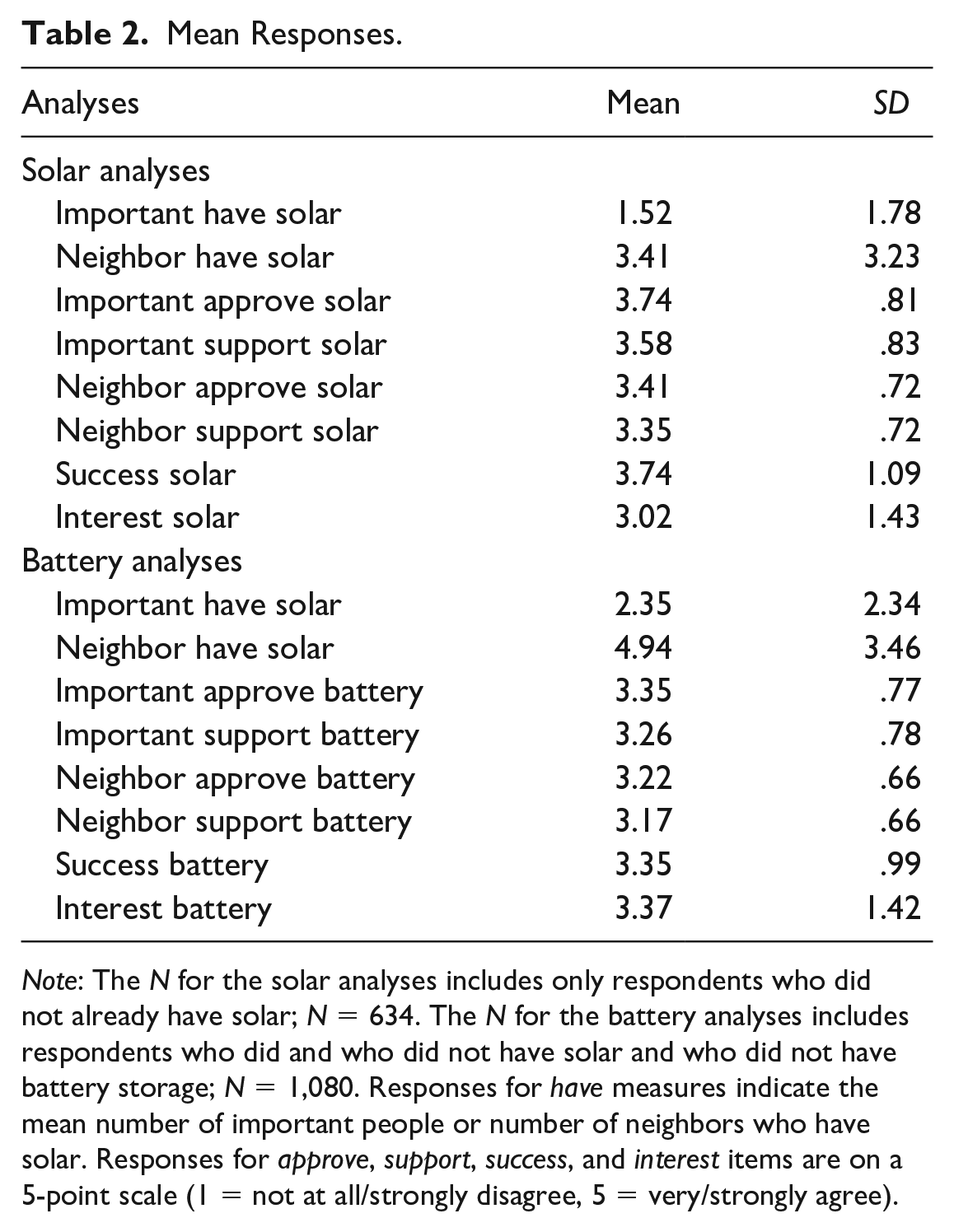
Note: The N for the solar analyses includes only respondents who did not already have solar; N = 634. The N for the battery analyses includes respondents who did and who did not have solar and who did not have battery storage; N = 1,080. Responses for have measures indicate the mean number of important people or number of neighbors who have solar. Responses for approve, support, success, and interest items are on a 5-point scale (1 = not at all/strongly disagree, 5 = very/strongly agree).
Correlations.

Note: N = 634 for the solar data. To examine interest in solar, we include only respondents who do not already have solar. N = 1,080 for the battery data and includes all participants who do not have battery storage —both those who have and do not have solar.
p < .05. **p < .01. ***p < .001.
Results
In the following, we report the results of structural equation modeling analyses that explain participant interest in solar and in battery storage. In these analyses, norm expectations regarding how much important others approve or disapprove of solar and battery storage are latent variables composed of two indicators (approval and support). Similarly, norm expectations regarding how much neighbors approve or disapprove are latent variables based on approval and support. Here we present the results without sociodemographic controls. Analyses with controls can be found in Appendix Tables A3 and A4.
Explaining Interest in Solar
Hypothesis 1a predicts that the number of important others who have solar panels will have an indirect effect on participant interest in solar through its effect on participants’ norm expectations (that people who are important to them approve of solar) and its effect on participants’ success expectations (that installing solar would save them money). Consistent with this hypothesis, there is a statistically significant indirect effect of the number of important people who have solar (Imp Have Solar) on interest in solar that operates through important people norms (see Column 5, Table 4). Similarly, the number of important others who have solar has an indirect effect on interest in solar through its effect on expectations about the success of solar (Column 7). Although not predicted, we checked to see whether the number of important people who had solar was associated with neighbor norms. We found that the number of important people with solar has a direct effect on neighbor norms (Column 2), but neighbor norms are not associated with interest in solar (Column 4), and there is not a statistically significant indirect effect from the number of important people with solar operating through neighbor norms to interest in solar (Column 6).
Structural Equation Modeling Analyses Explaining Interest in Solar.

Note: N = 634. The table lists standardized coefficient estimates from a structural equation model direct maximum likelihood estimation. To account for moderate multivariate nonnormality (skewness < 2, kurtosis < 7), variance-covariance estimators are used (Satorra-Bentler 1994). The effects are decomposed into direct, indirect, and total effects. Variables are measured on a 5-point scale. Both the important others norm and neighbor norm latent variables are composed of two indicators—approval and support—and assume correlated errors. RMSEA = root mean square error of approximation; CFI = comparative fit index; SRMR = standardized root mean squared residual.
p < .01. ***p < .001.
Hypothesis 1b parallels Hypothesis 1a except that it focuses on neighbors instead of important others. We find that the number of neighbors who have solar is positively associated with neighbor norms (Column 2, Table 4). However, neighbor norms are not associated with interest in solar (Column 4), and there is not an indirect effect of the number of neighbors with solar through neighbor norms to interest in solar (Column 6). We predicted a positive association between the number of neighbors with solar and respondents’ success expectations. Instead, we find no effect (Column 3). In addition, although not predicted, we checked to see whether the number of neighbors with solar was associated with expectations about norms held by important others. We found no such effect (Column 1).
In sum, the results for important people are consistent with our hypotheses. As predicted, we find that the number of important others who have solar is positively associated with expectations about norms among important others and with success expectations, which, in turn, are associated with interest in solar. But the number of neighbors who have solar does not have the hypothesized effects. The results suggest that family and friends are more important influences on solar adoption than neighbors.
Explaining Interest in Battery Storage
Hypothesis 2a predicts that the number of important people who have solar will affect people’s normative expectations regarding how much those others approve of battery storage and how successful (money saving) battery storage would be. Our results are partially consistent with this hypothesis. The number of important people who have solar has the predicted association with expectations about norms held by important others and, in turn, with interest in battery storage (Columns 1 and 5, Table 5). Contrary to our hypothesis, the number of important others with solar does not affect expectations about battery success (Column 3). However, success expectations about battery storage are associated with interest in battery storage (Column 4).
Structural Equation Modeling Analyses Explaining Interest in Batteries.

Note: N = 1,080. The table lists standardized coefficient estimates from a structural equation model direct maximum likelihood estimation. To account for moderate multivariate nonnormality (skewness < 2, kurtosis < 7), variance-covariance estimators are used (Satorra-Bentler 1994). The effects are decomposed into direct, indirect, and total effects. Variables are measured on a 5-point scale. Both the important others norm and neighbor norm latent variables are composed of two indicators—approval and support—and assume correlated errors. RMSEA = root mean square error of approximation; CFI = comparative fit index; SRMR = standardized root mean squared residual.
p < .05. **p < .01. ***p < .001.
Hypothesis 2b predicts that the number of neighbors who have solar will have an indirect effect on interest in battery storage through its effect on expectations that neighbors approve of battery storage. Our results are not consistent with this prediction. Although the number of neighbors with solar is positively associated with respondents’ expectations about battery norms held by their neighbors (Column 2, Table 5), those norms are not associated with interest in battery storage (Column 4), and there is no indirect effect of number of neighbors through neighbor norms to interest (Column 6). There is, however, a direct effect of number of neighbors with solar on interest in battery storage (Column 4). The prediction regarding battery success is also not supported. The number of neighbors with solar is not associated with expectations about battery success (Column 3) and does not have an indirect effect on interest in battery storage operating through battery success (Column 7).
In sum, the results regarding interest in battery storage are partially consistent with our predictions. As predicted, the number of important others who have solar drives expectations about the battery norms held by important others and, in turn, interest in battery storage. But the number of important others with solar is not associated with expectations about battery success. The number of neighbors with solar is associated with battery norms, but there is no indirect effect of number of neighbors operating through battery norms. The number of neighbors with solar is not associated with success expectations. These results again highlight the potential relative importance of family and friends (rather than neighbors) in predicting interest in energy technologies.
Discussion and Conclusion
We summarize the findings in Table 6. Our results highlight the importance of close ties for interest in both solar energy and household battery storage. We find that the number of important others who have solar has indirect effects on interest in rooftop PV through norm and success expectations. Our results also show that behavior of important others in one domain (solar panel adoption) affects interest in a behavior in another domain (adoption of battery storage). This association is mediated by norm expectations about important others but not by norm expectations about neighbors or by success expectations.
Summary of Hypotheses and Results.

Theoretically, our research contributes to understanding of norms, providing evidence for the potential importance of identifying the appropriate reference group. Our findings are consistent with existing norms research that highlights the importance of relationship characteristics and, in particular, the role of socially important others (e.g., Horne 2009; Paluck, Shepherd, and Aronow 2016). In contrast, predictions about neighbor effects drawn from the energy research are not supported—neighbor norms have no effects (for additional evidence that the influence of socially close others matters more than that of neighbors, see Palm 2017). One reason for this may be that people pay more attention to those whose opinions they care about (e.g., Ajzen 1991, 2020). For example, people pay more attention to the behaviors of highly connected others (Paluck and Shepherd 2012) and are more likely to meet the demands of others on whom they depend (e.g., Emerson 1962). In addition, research shows that close-knit groups tend to have stronger norm enforcement, motivating members of such groups to be more compliant than people in groups with weaker enforcement (Horne 2009). This existing research is consistent with our finding that socially close others matter whereas neighbors do not. According to this logic, it is also possible that people who live in stable, close-knit neighborhoods (i.e., neighborhoods in which people are socially close in addition to physically proximate) may pay attention to what their neighbors approve (even as people in more transient, socially distanced neighborhoods do not). Future work could investigate how the characteristics of neighborhoods affect the influence of neighborhood descriptive norms on behavior.
Our results also contribute to understanding of norm sets—a relatively undeveloped idea in the norms literature (Mollborn 2018). We find that a behavior (solar adoption) is associated with normative expectations regarding how much important others approve of a closely related behavior (battery storage). Whereas norms scholars typically assume that norms can regulate only behaviors that can be observed, our findings suggest a mechanism that may produce norm expectations regulating private behaviors.
The number of others who have solar, however, has no effect on success expectations regarding battery storage. It may be that in general, people do not use behavior in one domain to draw inferences regarding the likely success of a related behavior. It may also be that this result is specific to the empirical context. Battery storage has a different cost-benefit profile than solar energy. For many households, solar energy is financially viable—the investment pays off (e.g., Vaishnav, Horner, and Azevedo 2017). In contrast, battery storage is still widely seen as too costly to justify (e.g., O’Schaughnessy et al. 2018; Pena-Bello et al. 2020). To the extent that our respondents were aware of the high cost of battery storage, secondhand information (based on others’ solar behavior) may have been an inferior source of information regarding the likely success of installing battery storage. Future research should examine the extent to which alternative sources of information about the likely success of a behavior intersect with information people can derive from others’ behavior.
Substantively, our study adds to the existing body of work on household installation of solar panels—highlighting the significance of important others, rather than neighbors (which is the focus of much of the current energy research). In addition, our findings regarding important others raise the possibility that the effects that current research attributes to neighbors may instead be due to socially important others (depending on how measures are constructed). The study also provides evidence regarding household interest in battery storage. Because household battery storage is new and currently has very low penetration, scholars have much less understanding of factors driving interest in battery storage than they do regarding interest in solar energy.
Although we find evidence that social norms play a role in the adoption of solar panels and battery storage, norms are clearly not the only relevant factor, and the effect of norms may be moderated by other influences (e.g., Wolske, Gillingham, and Schultz 2020). For example, the effect of norms may be weaker when the behavior is difficult or costly or when people have strong preexisting opinions (Wolske, Gillingham, and Schultz 2020; see also Bollinger et al. 2021). In the case of solar panels and battery storage, in particular, research suggests that costs are an important consideration (e.g., Agnew and Dargusch 2017; Balcombe, Rigby, and Azapagic 2014). In a situation where the costs are large enough to be unaffordable, norms may have little effect—even if people want to follow a norm, they may not have the economic resources to do so (for a related argument regarding costs and environmental attitudes, see Derksen and Gartrell 1993; Diekmann and Preisendörfer 2003; Farjam, Nikolaychuk, and Bravo 2019; Kaiser and Schultz 2009). Our study speaks to the mechanisms that may, at least partially, account for the effects of existing rates of solar penetration on individual decisions. But it says nothing about the importance of normative factors in solar and battery storage adoption relative to other influences.
Our study has two obvious limitations—its cross-sectional design and low response rate. Because our study is cross-sectional, we cannot establish causality. However, our findings are consistent with other norms research that assesses causal relations using experimental designs in lab settings or using vignette experiments (e.g., Horne and Przepiorka 2021). Our study complements existing work by providing data about participants’ lives rather than their responses to a lab setting or hypothetical vignette situation. Taken together, correlational and experimental designs that produce consistent findings provide strong evidence of the factors and mechanisms at work. Future research could involve randomized interventions conducted in cooperation with utilities and/or solar companies. Such work would provide an additional source of evidence of causal factors. In addition, our study had low response rates. Respondents therefore may not be representative of our sampling frame. In addition, because we focus on homeowners, our sample is wealthier than Californians in general. Existing research suggests that low- and high-income households are similar but also that observing others with solar may have stronger effects for low-income households (Wolske 2020). It is also possible, however, that normative influences may have weaker effects for low-income households for whom costs may pose a barrier to adoption. Furthermore, because we focus on California homeowners, our results cannot be generalized to the California population or to the United States more broadly. Here we are interested in developing an argument about mechanisms relevant for understanding norms. We expect the argument to apply to a broad range of settings and population characteristics. Future research should test the theory across other populations.
In sum, our research provides insight into norm dynamics in the context of household energy decisions. Our study highlights the importance of identifying the relevant reference group, showing that norms among important others are associated with individual interest in behaviors, whereas norms among more distant others (in this case, neighbors) are not. In addition, it provides evidence that visible behaviors in one domain may influence norms regulating closely related behavior, thus contributing to understanding of norm sets and norms that regulate behaviors that cannot be observed. Substantively, our study contributes to understanding of household interest in rooftop PV and battery storage, providing evidence for the role of social influence and highlighting links between existing solar installations and interest in battery storage.
Footnotes
Appendix
Structural Equation Modeling Analyses Explaining Interest in Battery Storage Including Respondent Characteristics.

| Direct on Imp Norm | Direct on Neigh Norm | Direct on Success Expect | Direct on Interest Battery | Indirect on Interest Battery (through Imp Norm) | Indirect on Interest Battery (through Neigh Norm) | Indirect on Interest Battery (through Success) | Indirect on Interest Battery (through All) | Total on Interest Battery | |
|---|---|---|---|---|---|---|---|---|---|
| Imp Have Solar | .100** | .030 | −.000 | .022 | .030** | .001 | −.000 | .031 | .052 |
| Neigh Have Solar | .016 | .097** | .049 | .019 | .005 | .003 | .013 | .021 | .040 |
| Imp Norm Battery | — | — | — | .299*** | — | — | — | — | .299*** |
| Neigh Norm Battery | — | — | — | .030 | — | — | — | — | .030 |
| Success Battery | — | — | — | .267*** | — | — | — | — | .267*** |
| White | .090** | .078* | −.027 | −.063* | .027* | .002 | −.007 | .022 | −.041 |
| Liberal | .183*** | .093** | .052 | .002 | .055*** | .003 | .014 | .072*** | .073* |
| Year born | .119*** | .094** | .026 | .016 | .035** | .003 | .007 | .045** | .061 |
| Income | .007 | .048 | .026 | .026 | .002 | .001 | .007 | .011 | .037 |
| Education | .003 | .018 | −.040 | .034 | .001 | .001 | −.011 | −.009 | .025 |
| Female | .021 | .042 | .068* | −.010 | .006 | .001 | .018* | .025 | .016 |
| Solar Potential | .169*** | .099** | .100** | .091** | .051*** | .003 | .027** | .080*** | .171*** |
| Have Solar | −.036 | −.046 | −.050 | .193*** | −.011 | −.001 | −.013 | −.026 | .167*** |
| RMSEA | .051 | ||||||||
| CFI | .982 | ||||||||
| SRMR | .007 | ||||||||
| R 2 | .220 |
Note. N = 1,080. The table lists standardized coefficient estimates from a structural equation model direct maximum likelihood estimation. To account for moderate multivariate nonnormality (skewness < 2, kurtosis< 7 ), variance-covariance estimators are used (Satorra-Bentler 1994). The effects are decomposed into direct, indirect, and total effects. Variables are measured on a 5-point scale. Both the important others norm and neighbor norm latent variables are composed of two indicators representing approval and support and assume correlated errors. RMSEA = root mean square error of approximation; CFI = comparative fit index; SRMR = standardized root mean squared residual.
p < .05. **p < .01. ***p < .001.
Funding
The author(s) disclosed receipt of the following financial support for the research, authorship, and/or publication of this article: This material is based upon work supported by the U.S. Department of Energy under Award Number DE-IA0000025. The views and opinions of authors expressed herein do not necessarily state or reflect those of the United States Government or any agency thereof.

1.
Sans Sonoma and Ventura counties did not receive a postcard reminder because of California fires and evacuations.