




Abstract
Students from underrepresented groups face numerous challenges during their scientific education and training, including discrimination. Research tends to investigate student experiences with discrimination on the basis of a single characteristic, but an intersectional framework is necessary for understanding the complexity of discrimination. Using data from a survey of more than 1,300 U.S. graduate students in five natural and social science disciplines, the authors examine the predictors of reported discrimination across three different characteristics: gender, race, and religion. They find that nearly two thirds of students report discrimination on at least one characteristic, while almost 30 percent report discrimination along multiple characteristics. Multivariate analyses show that a student’s report of discrimination on any one characteristic is significantly associated with increased odds of reporting discrimination on each of the other two characteristics. This suggests that an individual’s experiences within one social location are often intertwined with and influence their experiences with in other social locations.
There is substantial interest and investment in increasing the diversity of the scientific workforce (Lee and Buxton 2010; Maton et al. 2012; Medin and Lee 2012; Winkleby et al. 2009). Although recruiting individuals from underrepresented populations to enter advanced science education is an important component of this effort, another concern is the retention of underrepresented individuals once they enter science programs (Chemers et al. 2011; Meador 2018; National Academy of Sciences 2011; Wang 2013; Whalen and Shelley 2010).
Perceived discrimination by peers and faculty members is one reason why underrepresented students leave science graduate programs (Beasley and Fischer 2012; Chang et al. 2011). Science graduate programs are not immune from the biases that exist in the larger culture, and in some cases these biases are specific to science programs (Ceci et al. 2014; Leslie et al. 2015). Women and some racial minorities, for example, often encounter stereotypes about their scientific or mathematical capabilities (Carli et al. 2016; Eaton et al. 2019; Ellemers et al. 2010; Reuben, Sapienza, and Zingales 2014). These stereotypes, whether encountered implicitly or explicitly, can lead students to abandon their program of study (Beasley and Fischer 2012; Chang et al. 2011).
A variety of factors, though, can contribute to whether an individual views a situation as discrimination. In some cases, a student might simply see negative interactions as a function of personality differences or an unfortunate outcome of a high-pressure environment. In other cases, a student may experience negative events as being the result of biases against the student’s gender, race, or other characteristic. Past research on perceived discrimination in such settings has often focused on a single characteristic, making it difficult to assess how self-reported experiences of different forms of discrimination relate to one another.
Intersectional theory and research, though, indicate that individuals’ social experiences are not shaped by any single identity factor. Rather, “as an analytic tool, intersectionality views categories of race, class, gender, sexuality, nation, ability, ethnicity, and age—among others—as interrelated and mutually shaping each other” (Collins and Bilge 2020:2). Intersectionality, can be broadly defined as the “critical insight that race, class, gender, sexuality, ethnicity, nation, ability, and age operate not as unitary, mutually exclusive entities, but as reciprocally constructing phenomenon that in turn shape complex social inequalities” (Collins 1990, 2015:5; Crenshaw 1991, 1993). Intersectionality frameworks focus on how systems of privilege and oppression interact with collective identities. Intersectionality is not just about identifying specific marginalized groups (e.g., Asian and women) within specific categories (e.g., race and gender) but rather identifying the processes by which people come to experience their collective identities within the broader social, historical, and political landscape (Cole 2009).
Although intersectionality frameworks call upon scholars to critically examine perceptions and experiences of discrimination from a collective social identity standpoint, little research has included religion as a social identity to be examined. This is particularly noticeable in scholarship on the recruitment and retention of underrepresented students in science fields. This may be a product of assuming that scientists are at least nonreligious if not strongly atheistic. Although surveys of science faculty do show that this group is less religious than the general public (Ecklund and Scheitle 2007), there is a significant minority of religious scientists, and this may be even more so among graduate students. Some recent research has begun to consider issues of religion-based stigma and discrimination within the scientific community (Barnes et al. 2021). By examining religious discrimination alongside gender and race discrimination, the present study adds to the intersectional knowledge about how religion is an important identity to consider when understanding the graduate student experience in science fields.
Using data generated from a probability survey of more than 1,300 graduate students in the United States across five disciplines, this study assesses the shared and unique predictors of perceived discrimination across three distinct characteristics: gender, race, and religious affiliation. Using an intersectionality theoretical framework that recognizes the interconnected nature of identities and experiences, we also examine how one type of perceived discrimination relates to the other types of perceived discrimination. We ground our expectations for these analyses in prior research on perceptions of bias-related discrimination in educational and other organizational settings.
Perceptions of Discrimination
As is common in the literature, we refer to “perceived discrimination” in this study (e.g., Allen 2019; Frieze, Olson, and Good 1990; Levin et al. 2002). This phrase is meant to recognize the nature of using measures generated from self-report surveys. That is, we are ultimately relying on the perceptions of the survey respondent. This might be seen as in contrast to studies that could be seen as generating measures of “actual discrimination,” such as experimental audit studies or analyses of administrative records. Although our measures are social psychological in nature, this does not discount the reality and importance of these measures. To an individual who reports perceived discrimination, that discrimination is “actual discrimination.”
Research on perceived mistreatment in educational and organizational settings has revealed clear demographic predictors of such perceptions, particularly when surveys ask specifically about bias-motivated mistreatment (i.e., discrimination). McCord et al. (2018), for instance, concluded that there are “significantly larger sex differences in perceived workplace mistreatment when the mistreatment was sex-based, whereas non-sex-based mistreatment exhibited near-zero sex differences” (p. 147). They found similar larger race differences in perceived workplace mistreatment when that mistreatment was race based relative to non-race-based mistreatment.
Perhaps the most obvious explanation for these patterns is that women and racial minorities encounter more explicitly gender- and race-based discrimination. However, women and racial minorities could also be more cognizant, on the basis of prior discriminatory experiences, of the possibility of gender- and race-based discrimination. This could lead them to interpret otherwise ambiguous negative interactions through the lens of bias. For instance, Ellis et al. (2019) presented individuals with case scenarios of potential discrimination and had them assess whether they personally perceived the scenarios as instances of discrimination. They found significant variability in almost each case scenario, indicating a lack of consensus among participants. Women and racial minorities, though, were more likely to perceive discrimination in the scenarios, which could be explained by their past experiences with discrimination.
Indeed, it is likely that an individual’s perception or awareness of discrimination is grounded in actual discriminatory experiences. Quinn, Williams, and Weisz (2015), for instance, found that experiences of discrimination among patients with mental illness were associated with those patients’ anticipated discrimination in the future. In short, individuals’ past experiences with discrimination, their anticipation of future discrimination, and their perception of ambiguous negative interactions as are all highly related.
The role of anticipated discrimination raises the question of how one perceived type of discrimination might influence perceptions of other forms of discrimination. That is, if individuals perceive that they have been discriminated against because of their gender, does this make them more likely to perceive discrimination because of their race, as it might increase their anticipation of discrimination across other social locations? An intersectional approach suggests that this may be the case, as social identities often shape each other (Collins and Bilge 2020). For example, from an intersectional lens, a Black woman who perceives gender-related discrimination will likely find it difficult to compartmentalize those encounters to simply being a woman, as the saliency of oppressions while living as a Black woman are ever present (Williams and Lewis 2021). Unfortunately, no research that we are aware of has examined this issue of how perceived discrimination for one social identity influences expectations or perceptions of discrimination for other, related identities. However, the data used in this study will allow us to explore this question.
There is some research examining perceptions of discrimination specifically among students pursuing advanced degrees. For instance, Wolf et al. (1991) had graduating students fill out a mistreatment questionnaire. They found that 98.9 percent of their sample perceived mistreatment during their time as students. They noted that more than half of their sample reported having experienced sexual harassment, but women were more likely to report sexual harassment than men. The most common form of mistreatment was psychological (i.e., verbal abuse). Haviland et al. (2011) presented similar findings, reporting that graduating students who reported experiences of mistreatment were less likely to plan on pursuing academic careers. These results would suggest that perceiving or experiencing discrimination adversely affects students’ view of the profession and their ability to succeed in it. Similarly, Cook et al. (2014:749) found that the majority of the students in their survey reported at least one incident of discrimination.
Some research has also examined connections between past discrimination and perceptions of discrimination, sometimes referred to as anticipated discrimination or “mistreatment sensitivity.” For instance, Ogden et al. (2005) found that a hypothetical scenario was more likely to be perceived as abusive if a student reports that they had personally experienced abuse. To the contrary, Bursch et al. (2013) found that students’ reports of their own experiences with discrimination were not associated with their perceptions of discrimination in hypothetical scenarios.
Current Study Expectations
On the basis of the theory and research reviewed above, we specify three groups of hypotheses for the present study. First, existing literature suggests that, at least when it comes to sex-based discrimination, women perceive more such discrimination than men. Similarly, regarding race-based discrimination, racial minorities perceive more discrimination than white individuals (Berdahl and Moon 2013; Berdahl and Moore 2006; McCord et al. 2018). Little research has examined perceived discrimination due to religion, particularly in the context of academic science. However, research does show that individuals identifying with a religion are in the minority among academic scientists (Ecklund 2010). Graduate students identifying with a religion, then, would be considered the underrepresented group in the context of their graduate programs. In sum, we suggest that individuals holding a characteristic underrepresented in academic science will be more likely to report perceived discrimination due to that characteristic.
Hypothesis 1: Students in groups that are underrepresented or stigmatized in academic science (female, non-White, and/or religiously affiliated) will be more likely to perceive discrimination than their numerically or culturally dominant peers (male, White, religiously unaffiliated).
Existing literature also suggests that anticipation of discrimination, which itself is often shaped by past experiences with such discrimination, makes individuals more likely to see otherwise ambiguous interactions as being bias motivated. Given this, we posit that individuals who came to graduate school anticipating issues with fit because of a social identity they hold will be more likely to report discrimination due to that characteristic:
Hypothesis 2: Graduate students who say that they were concerned about fitting into graduate school because of their gender, race, or religion will be more likely to perceive discrimination due to that characteristic than those that did not have this concern.
Finally, consistent with intersectional theory, we posit that individuals perceiving discrimination due to one characteristic will be more likely to perceive discrimination due to other characteristics they hold. Although this proposition has not been examined previously as far as we are aware, theories of intersectionality would suggest that failing to account for intragroup differences is problematic, as discrimination or mistreatment on the basis of one identity is often shaped by other identities (Crenshaw 1991). In taking an intersectional approach, we suspect that experiencing one form of discrimination (e.g., due to gender) might make an individual more cognizant of other potential forms of discrimination (e.g., due to race).
Hypothesis 3: Graduate students perceiving discrimination due to one characteristic (e.g., gender) will be more likely to perceive discrimination due to the other two characteristics (e.g., race and gender).
Data
The data for this study were produced from a Web-based survey of graduate students in five disciplines spanning the natural and social sciences: biology, chemistry, physics, psychology, and sociology. The survey was supported by a grant from the National Science Foundation. Sampling for the survey took place in two stages. In the first stage of sampling, departments in the top 60 for each discipline according to U.S. News & World Report’s ranking of graduate programs were identified and stratified into four tiers (i.e., top 15, 16–30, 31–45, and 46–60). Three departments from each tier were then randomly selected. This produced 12 departments per discipline and 60 departments in total.
The second stage of sampling focused on identifying students within those departments. Online directories of current graduate students were identified, and information on student names, e-mail addresses, and other variables were extracted into a database. This database served as the student-level sampling frame for the survey. A total of 800 students for each discipline, or 4,000 in total, were randomly selected from this sampling frame. Note that this represented an oversampling of some disciplines. Weights are used in the analyses described later to account for this oversampling and patterns of nonresponse to return the known proportions back to those seen in the sample frame.
Students were offered a $5 Amazon gift code upon completing the survey. Following an advanced-notice e-mail, an e-mail with the link, and two reminder e-mails, the survey received 1,307 complete responses and 72 partial responses for an overall response rate of 35.9 percent (American Association for Public Opinion Research Definition #4). After excluding cases with missing data, the final analytical sample for the present study was n = 1,260.
Measures
Outcomes: Perceived Discrimination
The outcomes for this study come from three questions asking (emphasis in the survey), “
Possible responses were “never” (0), “less than once a year” (1), “a few times a year” (2), “a few times a month” (3), “at least once a week” (4), and “almost every day” (5). Initial analyses showed that responses were highly skewed, with the bulk of students saying that they had never experienced a particular type of discrimination, some students reporting experiencing discrimination less than once a year or a few times a year, and relatively few reporting more frequent discrimination. For the purposes of this study, we collapse responses so that our analytical outcomes represent never (0) and at least some experience with discrimination (1). The latter represents responses from “less than once a year” to “almost every day.” Note that these measures are also used as predictors to assess hypothesis 3.
Predictor: Student Gender, Race, and Religion
Hypothesis 1 states that graduate students who are of a gender, race, or religion that is underrepresented in academic science will be more likely to perceive discrimination due to that respective characteristic. Our measure of students’ race comes from a question asking, “Which of the following best represents your race or ethnicity? Select all that apply.” Possible responses were American Indian or Alaska Native (1); Black, African, or Caribbean (2); Caucasian, White, or European (3); Central Asian or Arab (4); East Asian (e.g., Chinese, Japanese, Korean, Taiwanese, etc.) (5); Hispanic or Latino(6); South Asian (e.g., Indian, Pakistani, Bangladeshi, etc.) (7); and other, please specify (8). Because of the relatively few students selecting them, students selecting American Indian or Alaska Native, Central Asian or Arab, and multiple responses were recoded into the other category. The Caucasian, White, or European response serves as the reference category in the analyses.
Our measure of students’ gender comes from a question that asked, “With what gender do you currently identify?” Possible responses were female (1), male (2), and other (3). The male category serves as the reference group in the analyses below.
Student’s religious identity is measured using a question on the survey asking, “Religiously, do you consider yourself to be Protestant, Catholic, Jewish, Mormon, Muslim, not religious, or something else? If more than one, click the one that best describes you.” Sixteen possible responses were offered to students, which were collapsed into the following categories used in the analyses: Christian (1); Jewish (2); Muslim, Hindu, Sikh, or Buddhist (3); something else (4); and no religion (5).
Predictors: Concerns about Fit before Starting Graduate School
Hypothesis 2 argues that if a student was concerned about fitting into graduate school because of a particular characteristic, then the student will be more likely to perceive discrimination due to that characteristic while they have been in graduate school. We measure this with a question on the survey that asked, “Were any of the following significant concerns when you were deciding to go to graduate school? Select all that apply.” Eight statements were offered. Three of these statements were “Perception that I would not fit in because of my gender,” “Perception that I would not fit in because of my religion,” and “Perception that I would not fit in because of my race.” We created three dichotomous indicators, where 0 means that the student did not select the particular concern and 1 means that the student did select the concern.
Controls: Other Demographic and Program Characteristics
To assess the hypotheses stated earlier, we must account for other variables that could be related to students’ perceptions of discrimination and the predictors described above. Some of these variables represent other demographic characteristics of graduate students. For instance, we include a measure representing a student’s age. This is measured continuously and ranges from 22 to 61 years. We also control for a student’s sexual identity, which is measured with four categories: heterosexual, gay or lesbian, bisexual, or other sexual identity. The heterosexual category is used as the reference group in the analysis. We also control for the student’s relationship status and number of children. Relationship status is measured with three categories: not in a relationship, in a committed relationship but not married, and married. The not in a relationship category serves as the reference group in the analysis. The number of children a graduate student has had is measured from 0, representing none, to 4, representing four or more children.
Finally, we include three controls representing the student’s program rank, discipline, and the number of years the student has been in the program. Program rank is measured with four tiers: top 15 program, 16th- to 30th-ranked program, 31st- to 45th-ranked program, and 46th- to 60th-ranked program. These rankings come from the U.S. News & World Report rankings of graduate programs, as mentioned earlier in the discussion of sample frame construction. We also include controls representing the discipline of the student’s graduate program. Biology is used as the reference category in the analysis. The student’s years in the program are measured from 1, representing “This is my first year,” to 8, representing “This is my eighth or more year.”
Results
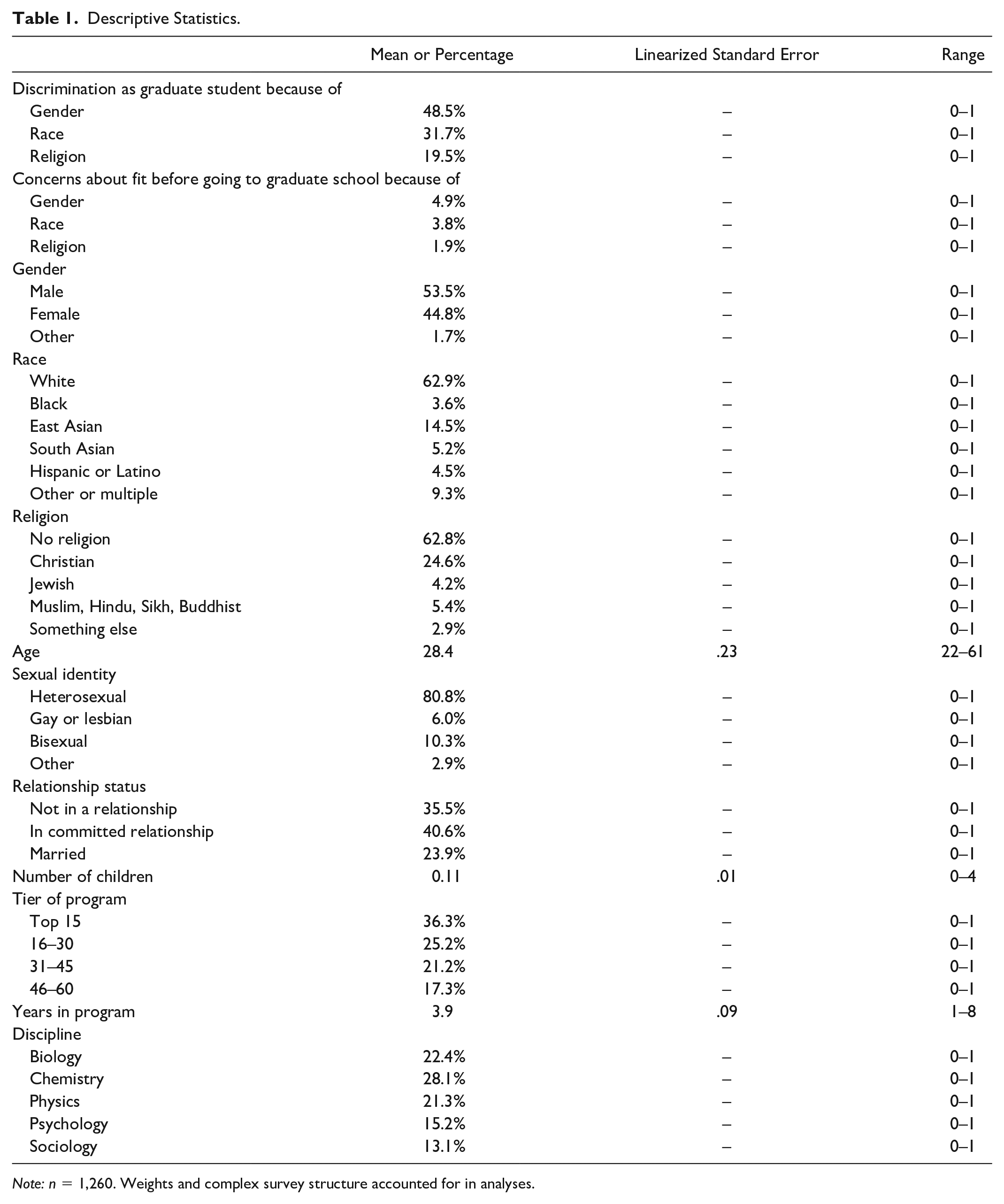
Table 1 presents descriptive statistics for all of the measures examined in this study. Of most interest are the measures representing graduate students’ reports of perceived discrimination. We see that 48.5 percent of graduate students report at least some experience with discrimination due to their gender. This percentage is the highest among the three discrimination items, as 31.7 percent of student report perceiving discrimination due to race and 19.5 percent report perceiving discrimination due to religion.
Descriptive Statistics.
Note: n = 1,260. Weights and complex survey structure accounted for in analyses.
Interestingly, Table 1 shows that comparatively few students say that they were concerned about fitting in because of their gender, race, or religion before they started graduate school. About 5 percent of students say that they were concerned about fitting in because of their gender, 3.8 percent report concerns about race, and 1.9 percent report concerns about religion. Admittedly, concerns about “fit” might not directly lead to concerns about discrimination. Still, comparing these two groups of percentages suggests that graduate students’ experiences with discrimination due to these characteristics might be much more common than they anticipated before entering graduate school. The remaining statistics in Table 1 describe the demographic and disciplinary characteristics of the sample.
Figure 1 presents the percentage of students reporting discrimination by the demographic characteristics of students for that type of discrimination. We see, for instance, that 83.1 percent of female graduate students and 86.8 percent of graduate students identifying with another gender report discrimination due to gender. This compares with 18.3 percent of male graduate students. Similarly, we see that 90.3 percent of Black students and 76.8 percent of Hispanic or Latino students report discrimination due to race. This compares with 13.9 percent of White students. Finally, Figure 1 shows that reports of religion-related discrimination are most common among Christian students (43 percent) and least common among students who are religiously unaffiliated (9 percent). Remember that the survey question asked students who do not identify with a religion how often they were mistreated because they do not identify with a religion. In sum, Figure 1 shows that, perhaps unsurprisingly, graduate students who are part of groups that are numerical and cultural minorities (i.e., nonmale, non-White, religiously affiliated) in academic science are more likely to report perceived discrimination due to the characteristic(s) for which they are a minority. This provides support for hypothesis 1.
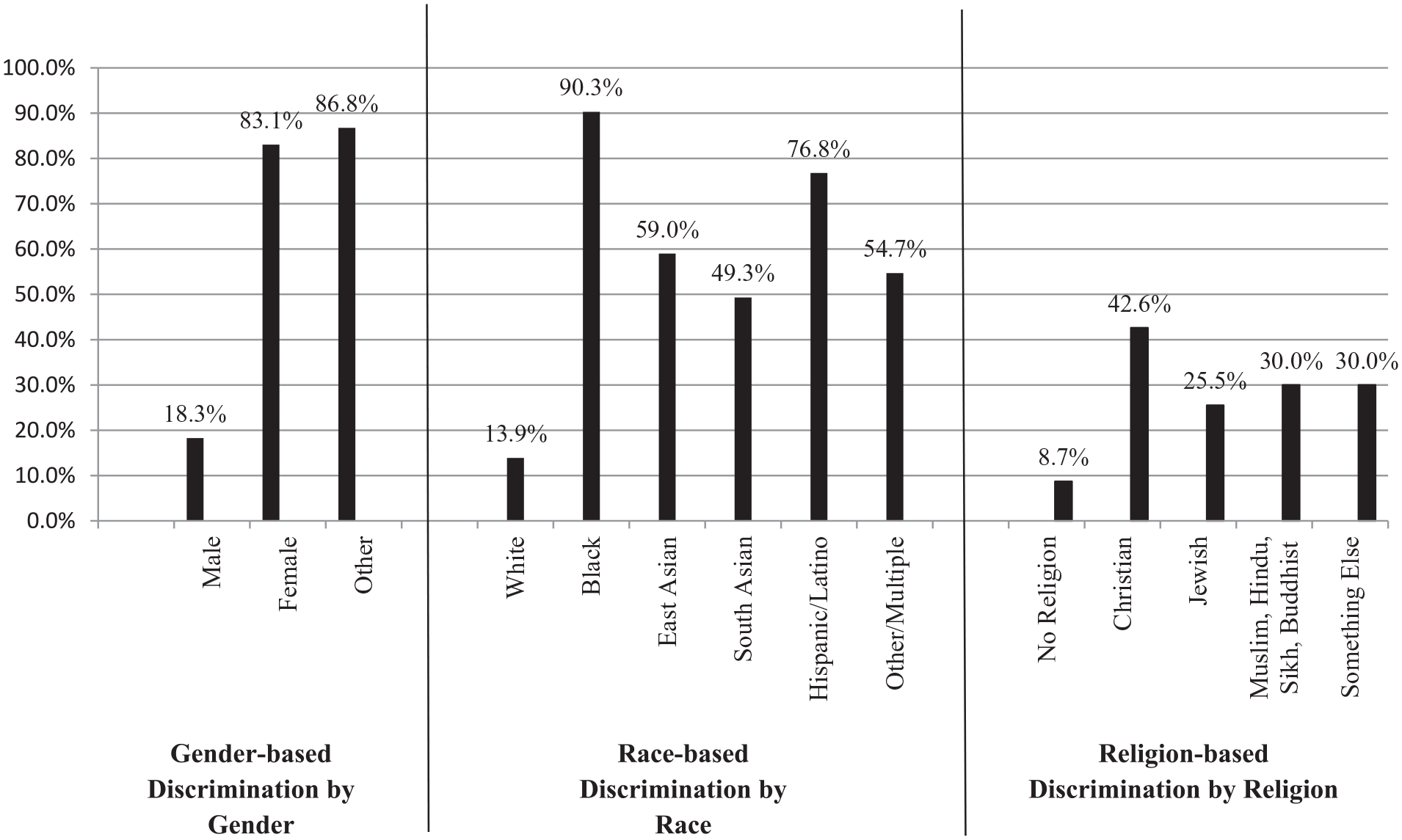
Percentage reporting discrimination by targeted characteristic and student characteristics.
Reporting perceived discrimination due to one characteristic did not preclude students from reporting discrimination due to another characteristic. Because of this, we can examine the prevalence of different combinations of discrimination experiences. These combinations are shown in Table 2. As seen in this table, 36.4 percent of students do not report discrimination due to any of the three characteristics measured in this study. This means that 63.6 percent of students report at least one or more of the perceived discrimination types. Just under 22 percent of students report perceived discrimination due solely to their gender. Nine percent report only race-related discrimination, and 4.1 percent report only religion-related discrimination. Of students who report two or more types of perceived discrimination, the most common combination is gender and race (13.9 percent). The second most common combination, at 6.7 percent, is students who report perceived discrimination with all three characteristics. Note that these data do not allow us to determine whether students are attributing a single experience to two or three characteristics or whether they are reporting distinct experiences with each characteristic. In short, Table 2 suggests that for many students, perception of one type of perceived discrimination is often indicative of perceptions of other types of discrimination. This provides some initial support for hypothesis 3.
Percentage of Graduate Students Reporting Discrimination by Gender, Race, and Religion.

Note: n =1,260. Weights and complex survey structure accounted for in analyses.
Having examined some key univariate and bivariate patterns, we now turn to Table 3, which presents results from logistic regression models predicting perceived discrimination due to gender, race, or religion. Results are presented in the form of odds ratios (ORs), so that coefficients greater than 1 represent an increase in the odds of a student perceiving discrimination, and coefficients less than 1 represent a decrease in the odds of a student perceiving discrimination.
Logistic Regression Models Predicting Graduate Students’ Reports of Ever Being Mistreated Because of Their Gender, Race, or Religion.

Note: n = 1,260. Weights and complex survey structure accounted for in analyses.
Odds ratios > 1 indicate greater odds of reporting discrimination, and odds ratios < 1 indicate reduced odds of reporting discrimination.
p < .05. **p < .01.
The first column in Table 3 presents the results for the perceived gender discrimination outcome, the middle column shows the results for the race discrimination outcome, and the third column displays the results for the religion discrimination outcome. We see that across all three columns perceptions of discrimination on both of the other characteristics are significantly associated with perceiving discrimination on the outcome. For example, as seen in the first column, students who say that they have experienced discrimination due to race (OR = 7.98, p < .01) or religion (OR = 3.39, p < .01) have significantly greater odds of saying that they have experienced discrimination on the basis of gender. Similarly, as seen in the second column, students who say that they have experienced discrimination due to gender (OR = 9.11, p < .01) or religion (OR = 4.52, p < .01) have significantly greater odds of saying that they have experienced discrimination due to race. We see the same pattern in the third column, examining the religious discrimination outcome. In short, these findings suggest that perceptions of discrimination due to one characteristic often spillover or influence perceptions of discrimination due to other characteristics. These findings support hypothesis 3.
Continuing to look down Table 3, we find that if a student says that they were concerned about fitting in because of a particular characteristic before starting graduate school, then they have significantly greater odds of saying that they have experienced discrimination due to that characteristic, net of the other variables considered in the model. For instance, if a student says that they were concerned about fitting in because of gender, then their odds of saying that they have experienced discrimination are 13 times greater (OR = 13.50, p < .01) than if they did not have this concern about fit. We see the same finding for the race (OR = 43.81, p < .01) and religion (OR = 18.54, p < .01) outcomes. This provides support for hypothesis 2.
Interestingly, concerns about fit because of one characteristic (e.g., race) do not significantly influence the odds of perceiving discrimination due to a different characteristic (e.g., religion). This is in contrast to the cross-characteristic associations we saw earlier with reports of discrimination. If a student was concerned about a specific characteristic before starting their program, then that characteristic was likely particularly central and salient to their identity. That is, these pregraduate program measures may represent more focused concerns, which could explain their more focused associations with reports of discrimination. On the other hand, if a student experiences discrimination on one characteristic, that might have an impact on their perceptions of discrimination more broadly.
We now turn to the indicators representing students’ gender, race, and religious identities. All else being equal, we find that female students (OR = 30.79, p < .01) and students identifying with another gender (OR = 21.26, p < .01) have significantly greater odds of reporting discrimination due to gender relative to male students. Looking at the race outcome, we find that all of the racial groups have significantly greater odds of reporting discrimination due to race relative to White students. Similarly, all of the religious groups have significantly greater odds of reporting discrimination due to religion or nonreligion relative to students without a religious identity. These patterns support hypothesis 1.
Looking at the cross-characteristic associations, we find that individuals representing a numerical or cultural minority in one characteristic tend to have lower odds of reporting discrimination on a different characteristic, all else being equal. Female students, for instance, have significantly reduced odds of reporting race discrimination relative to men (OR = .24, p < .01). Similarly, Black students have significantly reduced odds of reporting gender discrimination relative to White students (OR = .10, p < .01), and Christian students have significantly reduced odds of reporting gender discrimination relative to students who do not identify with a religion (OR = .60, p < .05). These patterns could again be a function of identity salience and centrality. Black students, for example, may attribute their discriminatory experiences primarily to race rather than religion or gender because that characteristic is most central to their own identity.
Examining the control measures reveals relatively few statistically significant findings. We do find that gay or lesbian students have significantly lower odds of saying that they have experienced gender discrimination relative to heterosexual students (OR = .52, p < .05), while students identifying as bisexual have significantly greater odds of saying that they have experienced gender discrimination (OR = 2.27, p < .05). The analysis also shows that, net of everything else in the model, students in sociology have significantly greater odds of saying that they have experienced gender discrimination relative to students in biology.
Discussion
Several primary questions motivated this study of perceived discrimination among graduate students in the sciences. First, broadly, how do the predictors of perceived discrimination differ depending on the characteristic being targeted? Second, from an intersectional framework, how are perceptions of one type of discrimination associated with perceptions of another type? Third, how does students’ anticipation of potential issues with “fit” because of a particular characteristic they hold predict their reports of discrimination due to that characteristic? And finally, connecting these latter two questions, how does anticipation of issues with “fit” because of one characteristic predict reports of discrimination along different characteristics?
The analysis presented here revealed that students’ reports of discrimination due to one targeted characteristic are positively associated with perceptions of discrimination along both of the other two targeted characteristics considered. This suggests that students’ perceptions of discrimination in one area often affect their perceptions of how they are being treated more broadly. For example, net of all other factors, if a student feels that they have been mistreated because of their gender, then they are also more likely to feel like they have been mistreated because of their race or religion (and vice versa).
On the other hand, the relationship between anticipated discrimination and perception of actual discrimination was found to be closely connected to the type of discrimination that was anticipated. A student who anticipated issues with their race before starting graduate school, for instance, is more likely to say that they have been mistreated because of their race. All else being equal, though, that student is not more likely to say they have been mistreated because of their religion. This suggests that anticipation of one type of bias-motivated discrimination does not necessarily spillover into perceiving other types of discrimination. Note that this is different from the previous finding concerning actual reports of discrimination, which does suggest such a spillover effect.
The analysis also found that underrepresented groups for a particular characteristic are more likely to perceive discrimination due to that characteristic but generally less likely to view discrimination due to the other characteristics. A female science student, for example, is much more likely to report discrimination due to gender relative to a male science student. However, that female science student is less likely to report discrimination due to race relative to that male student.
Although the findings of the present study add to the scholarship on intersectionality, there are several notable limitations to address. First, related to intersectionality, we did not examine moderating effects between identities because of a lack of statistical power. That is, even with a sample of nearly 1,300 students, breaking out combinations of gender-race-religion categories would lead to many small or empty cells, especially as many of the categories are small to begin with. However, considering such moderating effects would be an obvious direction for future research with the necessary statistical power. Second, the data examined above are cross-sectional in nature, so we cannot be sure of the causal ordering of many variables in our analysis. In particular, it is possible that students’ retrospective reports of concern about fitting in before starting graduate school are shaped by their perception of discrimination during graduate school. It is possible that students who have perceived discrimination report that they had such concerns before starting graduate school, but in fact they might not have had those concerns at that time. The finding that anticipated discrimination shapes future perceptions of discrimination, though, is in line with past research. Moreover, keep in mind that we saw in Table 1 that many more students report discrimination than who report having concerns about fit before starting graduate school. Finally, the analysis presented here also does not directly assess how these perceptions of discrimination influence students’ psychological, educational, or professional outcomes. Past research provides substantial reasons to think, however, that such perceptions do have adverse influences on such outcomes.
Although we acknowledge these limitations, this study does make several notable contributions to research on perceived discrimination specific to science graduate students and perceived discrimination in educational and organizational settings more broadly. First, although much of the past research on these issues has examined only a single targeted characteristic at a time, in this study we used an intersectional approach to investigate the shared and unique predictors of three different targeted characteristics. Second, very little research has looked at perceptions of religion-based discrimination, either specifically among science graduate students or more broadly in the perceived discrimination literature.
The present findings offer preliminary information for graduate programs in science who seek to improve retention of underrepresented students. For example, there is an association between a student’s concern about discrimination prior to arrival and later reports of discrimination. Science programs should consider supportive, inclusive outreach to incoming students with the goal of reducing initial concerns and fostering a positive sense of community. Furthermore, students reporting discrimination related to one social identity are more likely to report discrimination related to other identities. This information points to the need for graduate programs and advisers to see reports of discrimination as having broader implications than they might at first appear. That is, perceptions of gender discrimination likely have implications for perceptions of discrimination along other social locations.
Attending to issues of power and privilege, especially regarding adviser behavior, and communication could help reduce negative and discriminatory experiences. Science graduate programs should consider proper outlets within their systems for students to find support, encouragement, and equal opportunities across numerous social identities. It is also important to note that discrimination can take many forms, is not always intentional, and is easy for individuals in power to dismiss. Reducing discriminatory events involves a concerted, multidimensional effort with invested parties.
Footnotes
Funding
This research was supported by a grant by the National Science Foundation (award 1749130, Christopher P. Scheitle, principal investigator).
