




Abstract
Scholars have pointed to “political backlash” as a key reason for why people leave religion in the United States. This study adds to the growing body of work that emphasizes backlash to localized conditions, rather than national-level phenomena, by demonstrating the importance of conflict on salient issues within churches. Using data from the Baylor Religion Survey, the author exploits a unique set of items to analyze what he calls “conflicted religionists”—those who experience attitudinal conflict with their churches—and measures conflict on two salient issues: same-sex marriage and abortion. The author finds that there is a considerable proportion of conflicted religionists and that the probability of experiencing conflict varies drastically across different groups in the sample. In line with past work, he demonstrates that experiencing conflict is significantly associated with lower church attendance. He concludes with a discussion of the possible pathways available to conflicted religionists.
Over the past half century, the landscape of American religion has shifted dramatically. From the restructuring following World War II (Wuthnow 1988) to the more recent polarization of religionists (Schnabel and Bock 2018), sociologists have studied changes in American religion that have had important consequences for both politics and social change more broadly. Perhaps the most notable and consequential change to American religion over the past several decades, though, has been the rapid rise of the unaffiliated or religious “nones” (Hout and Fischer 2002, 2014; Voas and Chaves 2016).
There has been a growing body of work on the disaffiliation of American religionists since the late 1980s (e.g., Djupe, Neiheisel, and Sokhey 2018; Hout and Fischer 2002, 2014; Margolis 2018; Voas and Chaves 2016). One prominent explanation has been the “political backlash” hypothesis, which points to the increased politicization of religion at the end of the 1980s and the rise of the Christian right, resulting in conflict between liberal and moderate parishioners and churches that espoused more conservative teachings, especially with family-related issues, such as abortion and homosexuality (Hout and Fischer 2002, 2014). This conflict, it goes, led to the subsequent disaffiliation of these religionists from churches, explaining in part the marked and continuous rise of religious “nones.”
Most studies related to the political backlash hypothesis have studied this phenomenon by making post-disaffiliation observations at the aggregate level; that is, past studies have relied on descriptive trends among disaffiliated religionists over the past several decades. And thus, the conflict between religionists and churches—and the subsequent disaffiliation—has been surmised on the basis of characteristics about those who have already dropped their religious affiliations: political liberals disaffiliated at a higher rate compared with other groups, and therefore political conflict was inferred as the culprit for the increased share of religious “nones.”
However, this approach fails to measure an important link in the proposed mechanism, which is conflict between religionists and churches. Assuming that at any given moment there is a number of religionists who are conflicting with their churches and have not yet disaffiliated (i.e., it is unlikely that the process of experiencing attitudinal conflict and disaffiliation is instantaneous), one could measure these “conflicted religionists” and make descriptive observations about this group. The reason for the former approach in the literature is largely due to data limitations: it is difficult to obtain a measure of conflict between a religionist and his or her church. Recent work has made progress toward understanding political conflict at the congregational level (Djupe 2011; Djupe and Gilbert 2008; Djupe and Lewis 2015; Djupe, Neiheisel, and Sokhey 2018), operationalizing conflict as perceived political and social differences from fellow congregates. Although perceived differences from congregates measure an interesting and important feature of conflict, this measure underemphasizes another dimension of conflict, which is perceived discord between one’s personal views and the views or teachings of his or her specific church. As has been argued, this type of conflict is particularly consequential when the perceived discord involves salient issues, such as those related to family and morality (Hout and Fischer 2014). Rather than focusing on responses to national-level political movements (Hout and Fischer 2014) or broad political disagreement with fellow congregates (Djupe, Neiheisel, and Sokhey 2018), a study of perceived conflict on salient issues between religionists and their churches would provide further insight into the increasingly complex relationship between sociopolitical beliefs and religious participation and identity. 1
In the present study I seek to fill this gap by taking advantage of several unique items related to personal attitudes and church teachings to create a novel measure called “conflicted religionists.” I use data from the Baylor Religion Survey (Wave II) to compare responses to questions about respondents’ personal attitudes toward abortion and same-sex marriage and questions about respondents’ current churches’ attitudes toward these same issues. I identify respondents who perceive their personal views as different from the views of their current churches, and I examine how this differs across important sociodemographic groups, such as religious affiliation, political orientation, age, and educational attainment. A breakdown of conflicted religionists by sociodemographic variables helps answer several questions about the dynamics of political conflict among religionists. For instance, Are conflicted religionists actually on the political left? Are conflicted religionists concentrated in mainline and Catholic churches where the hierarchy has been at notable odds with the laity? Is political conflict largely a function of young people and a changing culture?
Under the political backlash model, we would expect conflict to lead to disaffiliation from churches. Given that the data consist of a single cross-section, I take the best available step here to understand the relationship between conflict and religious participation by measuring the association between conflicted religionists and church attendance. I do this in two ways. First, I measure the association between perceived conflict and church attendance to assess whether conflicted religionists attend church less frequently than nonconflicted religionists. Second, I take advantage of an item that asks respondents about their estimated church attendance frequency at age 12 to measure the association between perceived conflict and decreased church attendance from age 12. 2
The results both complement and complicate current understandings of political conflict and religion. I find that a sizable share of religionists experience conflict on both issues and that the probability of conflict varies drastically across different groups in the sample. In line with the backlash model, I find that conflicted religionists attend church much less frequently than nonconflicted religionists, suggesting an incompatibility between perceived conflict and full religious participation with one’s church. Although the political backlash model suggests that lower participation eventually leads to disaffiliation, this is not the only path available to conflicted religionists. Using Hirschman’s (1970) theory of “exit, voice, and loyalty,” I conclude with a discussion of conflicted religionists and the potential paths available to them. The analysis suggests a more nuanced understanding of how people navigate political and religious discord that goes beyond presumed disaffiliation.
Background
There has been a renewed interest in the study of religion by sociologists. With vast changes occurring in family structure, politics, demography, and social movements, sociologists have been interested in the effects of religion on behavior and attitudes of individuals (Bolzendahl and Brooks 2005). This interest has been especially strong in the United States, which has shown high levels of religious participation compared with other postindustrialized nations (Norris and Inglehart 2004). Despite this highly religious “exceptionalism,” the greatest change to religion in the United States over the past few decades has been the drastic increase of religious “nones” (Hout and Fischer 2002, 2014). This trend has occurred much to the surprise of religion scholars.
Religious Restructuring Model
In his book The Restructuring of American Religion, Wuthnow (1988) described vast changes in the American religious landscape following World War II. Although the 1950s and preceding decades were defined by a strong Catholic, Protestant, and Jewish divide, the civil rights era effected a broader division between religious liberals and religious conservatives, thus making the traditional denominational demarcation increasingly irrelevant. The new division resulted in larger conflict within traditional denominations, leading to the rise of new sects and “special purpose groups” (Wuthnow 1988). With increased variety within denominations, outlets were created for those with dissenting views who may have otherwise left the religion altogether. Such denominational diversity—and the lack of a single, national church, as seen in several European countries—has been pointed to as one of the central reasons for the United States’ unique level of religious participation among Western industrialized nations (Chaves and Gorski 2001). The restructuring model suggests that we should see sustained religious vitality and little conflict within churches in the United States. Why, then, has the religious “nones” population increased so dramatically?
Political Backlash Model
Surprisingly, the 1990s saw a drastic increase in the number of people identifying as religious “nones,” and this number has steadily increased since 2000 (Hout and Fischer 2014): 20 percent of Americans claimed no religious preference in 2012, compared with 7 percent in 1987. Hout and Fischer (2002, 2014) offered the most detailed analysis of this important trend, identifying “unchurched believers,” those who maintain their beliefs about God but claim no organized religious identity, as the most significant portion of the increasing “nones” population. They also noticed that this increase of the “nones” corresponded with the rise of the “Christian right,” a time when organized religions were receiving an unprecedented prominence in public discourse; ideas of religion, more specifically God and Christ, were cited as inspiration for politicians (Domke and Coe 2008; Hout and Fischer 2002, 2014). This entanglement of politics and religion—more specifically, the right with Evangelicalism—they argued, ultimately drove people with conflicting political views (i.e., moderates and liberals) to disaffiliate. 3 In short, more Americans saw religion as at odds with their politics. Going against the conventional wisdom of religion scholars, Hout and Fischer, and others (Djupe, Neiheisel, and Sokhey 2018; Patrikios 2008; Schnabel and Bock 2017), have argued that this political backlash model is important for understanding the rapid disaffiliation seen over the past few decades.
Although there is strong evidence that liberal political views lead to disaffiliation (Hout and Fischer 2014), these findings focus on aggregate-level trends and infer a backlash to macro-level political phenomena (the rise of the Christian right). That is, the evidence in favor of the political backlash model has been based on strong associations between liberal political ideology and disaffiliation, and thus the mechanism of political backlash—attitudinal conflict—has been surmised on these descriptive aggregate trends.
Recent scholarship has advanced the political backlash model by further contextualizing the mechanism of attitudinal conflict at lower levels, such as the state (Djupe, Neiheisel, and Conger 2018) and church levels (Djupe 2011; Djupe and Gilbert 2008; Djupe and Lewis 2015; Djupe, Neiheisel, and Sokhey 2018; Patrikios 2008). For instance, Djupe, Neiheisel, and Conger (2018) found evidence of higher rates of disaffiliation in states where there is an increased presence of the Christian right, suggesting that political backlash may depend on context and the presence of salient controversy. Other studies have contextualized this dynamic further by focusing on backlash within specific congregations (Djupe, Neiheisel, and Sokhey 2018; Patrikios 2008). Patrikios (2008) found that Democrats have reduced their church attendance frequency in recent years because of their perceived association between churches and Republican Party politics. Djupe, Neiheisel, and Sokhey (2018) continued the emphasis on specific congregational dynamics, providing the most thorough analysis of political backlash occurring at the congregational level. Their results provide robust evidence that perceived disagreement within congregations is the key driver of disaffiliation and that backlash over the Christian right occurs among those who are more likely to experience disagreement in their congregations. Taken together, these results suggest that dynamics at the congregational level are key to our understanding of the mechanisms of political backlash. As Djupe, Neiheisel, and Sokhey (2018:162) noted, the societal-level pattern of religious “nones” increasingly being concentrated on the political left is likely the aggregation of sets of localized differences.
Studies demonstrating the role of congregational-level conflict for political backlash have operationalized this conflict broadly as perceived political differences with one’s congregation or opposition to the Christian right movement (Djupe, Neiheisel, and Sokhey 2018). Although perceived difference from one’s fellow congregates has been shown to be an important feature and predictor of political backlash, this measure underemphasizes another key dimension of political conflict in churches, which is perceived conflict between religionists and the teachings and views of their churches. This form of conflict is particularly important when the issues are salient: the issues matter more to religionists, making conflict more difficult to reconcile (Hout and Fischer 2014). Although salient and controversial issues have been considered important features of political backlash (e.g., the Christian right made controversial issues, such as abortion and homosexuality, salient in the public sphere, thus driving religionists with dissenting views on those issues away from organized religion), disagreement on these issues—and their role in the process of political backlash—has gone unmeasured (Djupe, Neiheisel, and Conger 2018; Hout and Fischer 2002, 2014). The emphasis of perceived conflict between religionists and churches provides another lens with which to understand political conflict and backlash. For instance, because of social change or life course processes, a religionist may develop new attitudes on certain issues that are now at odds with the teachings of her church. In this scenario, it is possible that the religionist experiences conflict on a specific issue, or set of issues, but does not oppose all views of the Christian right or Republican Party, for example. Here, rather than broad perceived differences with one’s church, it is disagreement on specific issues that matters for one’s political-religious conflict and potential backlash. Furthermore, an emphasis on specific issues allows more flexibility in predicting political backlash across populations and over time: Different groups of people will conflict on different issues, and social change may effect new salient issues that become points of conflict. Just as controversy over salient issues at the state level is an important predictor of political backlash (Djupe, Neiheisel, and Conger 2018), I argue here that the dynamic of specific salient issues within churches is vital to our understanding of this process, and it is this dynamic on which this article is focused.
To measure this group of conflicted religionists, the following logic must be assumed: the process of conflict and disaffiliation is not instantaneous (i.e., at any given point in time, there will be a group of religionists who conflict with their churches but have not yet disaffiliated.) Following this logic, it would be possible to analyze those who conflict with their churches and then study subsequent disaffiliation, allowing a clear understanding of the political backlash process. Although cross-sectional data do not lend themselves to measuring attitude conflict and disaffiliation directly, I can measure the association between conflicted religionists and other important behavior that is potentially related to disaffiliation, such as religious participation (Patrikios 2008). Again, as the process of experiencing conflict and disaffiliation is not likely instantaneous, we could imagine a more realistic sequence of events: (1) a religionist experiences attitude conflict with his or her church; (2) this conflict causes a change in his or her behavior related to said church—declined participation; and then (3) eventually the conflict leads to disaffiliation altogether. This sequence of events describes a more gradual process, whereby conflicted religionists slowly decline in their religious participation and then eventually leave their churches or affiliations altogether. Thus, a researcher could use a single cross-section of data to measure the association between conflicted religionists and religious participation, such as church attendance, to see if attitude conflict is associated with lower religious participation. Although causal claims cannot be made about this association, we can assess whether the association is consistent with the model.
Conflicted Religionists and Their Potential Pathways
The implied model of political backlash is that perceived conflict eventually leads to disaffiliation. Here, I have suggested that conflict will lead to declined participation (attendance) and, ultimately, disaffiliation. Of course, though, it is unreasonable to assume that all religionists who experience conflict ultimately disaffiliate. In reality, there are likely multiple pathways that a conflicted religionist might take.
One way to think of a conflicted religionist is as an individual who experiences an incompatibility with an organization to which he or she belongs. To understand the potential pathways a conflicted religionist might follow, I use Hirschman’s (1970) classic theory of “exit, voice, and loyalty.” When faced with conflict, a member of an organization may leave the organization (“exit”), stay and attempt to change the organization from within (“voice”), or stay and reconcile the conflict somehow, because the benefits of membership outweigh the negative experience of conflict (“loyalty”). Applying this framework to conflicted religionists, upon experiencing attitudinal conflict, a religionist may leave his or her church (“exit”)—either by disaffiliating from religion or selecting into another church—decide to remain in the church and attempt to alter the teachings or views of said church (“voice”), or remain affiliated and somehow reconcile the conflict (“loyalty”).
The implicit model in political backlash is that conflicted religionists will take the first path, “exit,” by ultimately disaffiliating, and it is this outcome that receives the most emphasis in the religion and politics literature. However, it is important to recognize that the first path may not describe all or most of what happens to conflicted religionists. Indeed, many religionists who experience conflict may choose to remain in their churches. Furthermore, conflicted religionists may also “exit” by selecting into other churches, resembling Wuthnow’s (1988) restructuring model. Although this article is focused primarily on analyzing a particular mechanism of political backlash—and thus the pathway of “exit”—the “Discussion” section considers findings in light of each potential pathway.
Measuring Conflicted Religionists
Although an individual’s beliefs may differ from that of his or her church on a wide range of social issues, this study is focused on abortion and same-sex marriage. These issues were chosen for at least five reasons. First, abortion and same-sex marriage are the only two social issues for which there are data about the views of both respondents and their churches. Although there are several other interesting and important issues to consider (e.g., environmentalism, marijuana legalization, premarital sex, cohabitation), these two issues provide a good starting point for our understanding of conflicted religionists. Second, same-sex marriage and abortion are key family issues that have been championed by the Christian right and are issues that Hout and Fischer explicitly identified as being contentious issues and possible culprits for the conflict seen in the 1990s (Djupe, Neiheisel, and Conger 2018; Hout and Fischer 2002, 2014). Third, both issues have been shown to be significantly important to people, politically (Hoffmann and Johnson 2005; Jelen and Wilcox 2003; Manza and Brooks 1997; Olson, Cadge, and Harrison 2006; Schnabel 2016). Fourth, examining these two issues provides a comparison between an issue that has seen rapid attitudinal change (same-sex marriage) (Baunach 2012; Gay, Lynxwiler, and Smith 2015; Powell et al. 2010; Schnabel 2016; Sherkat, Mattias de Vries, and Creek 2010) and one that has seen little attitudinal change in the aggregate over the past few decades but has become increasingly sorted along partisan lines (abortion) (Bolzendahl and Brooks 2005; Hoffmann and Johnson 2005; Jelen and Wilcox 2003). Fifth and finally, religion plays a major role in shaping attitudes about both issues (Adamczyk and Pitt 2009; Bolzendahl and Brooks 2005; Ellison, Echevarria, and Smith 2005; Jelen and Wilcox 2003; Olson et al. 2006; Wuthnow 1988).
Where Is Conflicted Religion Concentrated?
Building on established knowledge of same-sex marriage and abortion attitudes, this study focuses on four key variables to identify likely conflicted religionists: political orientation, religious tradition, education level, and age.
Political orientation remains one of the most important factors for predicting attitudes toward social issues. By and large, liberals are much more likely to support same-sex marriage (Baunach 2012; Powell et al. 2010; Sherkat et al. 2010) and abortion (Jelen and Wilcox 2003). Furthermore, liberals, by a considerable margin, have been the most common group to disaffiliate over the past several decades (Djupe, Neiheisel, and Sokhey 2018; Hout and Fischer 2002, 2014). These patterns make liberals likely and expected candidates for experiencing conflict. 4
Although I examine the patterns among each of the predominant religious traditions in the United States, this study is focused primarily on the comparison between Evangelicals and everybody else. Denominational lines, especially between Catholics and mainliners, have become increasingly irrelevant since the postwar era, and the most prominent demarcation, in terms of religious beliefs and practices, now lies between Evangelicals and non-Evangelicals (Schnabel 2016; Schnabel and Bock 2017, 2018; Wuthnow 1988). Moreover, Evangelicals have distinguished themselves by holding relatively stagnant, conservative social views, and thus there is likely little conflict among Evangelicals, because their Evangelical identities are contingent upon holding such conservative attitudes (Schnabel 2016).
Educational attainment has long been considered an important influence on social attitudes (Ohlander, Batalova, and Treas 2005; Phelan et al. 1995). There is a classic notion that education is correlated with increased acceptance of nonconformity and civil liberties, which results in more liberal stances on social issues (Ohlander et al. 2005; Schoon et al. 2009). Despite drastic changes in attitudes toward same-sex marriage at the aggregate level, more highly educated Americans remain more tolerant of same-sex marriage (Ohlander et al. 2005; Sherkat et al. 2010). As such, it has been shown that educational attainment is still an important factor for predicting liberal social attitudes and therefore is likely related to one having conflicting views with his or her church. This prediction is further bolstered by data on the “unchurched believers,” which show that having more education is linked to a higher rate of disaffiliation (Hout and Fischer 2002, 2014).
With far-reaching changes over the past few decades, social scientists have given special attention to differences in attitudes among age groups (Baunach 2012; Hout and Fischer 2002, 2014; Powell et al. 2010; Schwadel 2010; Voas and Chaves 2016). The general trend reflects a younger population that is unprecedentedly tolerant, especially with regard to same-sex issues, and an older population that is still widely in opposition to abortion (Jelen and Wilcox 2003) and same-sex marriage (Baunach 2012; Gay et al. 2015; Sherkat et al. 2010). Younger Americans show lower levels of religious activity in several regards: they are more likely to report no religious preference (Hout and Fischer 2002, 2014; Schwadel 2010), their church attendance is lower, they pray less often, and they are the least likely to hold a literal interpretation of the Bible (Gay et al. 2015). Some scholars have pointed to an increased value of autonomy among younger Americans, which leads to the fading of authoritative influence (e.g., religion), as the reason for such activity (Hout and Fischer 2014). As such, along with high support for same-sex marriage, young Americans are likely to conflict with their churches’ views. 5
Data, Measures, and Methods
Data
The data used in this study are from the 2007 Baylor Religion Survey (Wave II), a national random sample of 1,648 adults in the United States. Wave II was administered and collected by Gallup, using a mixed-mode method of telephone and self-administered mailed surveys in October and November 2007. A random-digit procedure was used to avoid various sources of bias (Baylor Religion Survey). According to the Baylor Religion Survey Web site, one can say with 95 percent confidence that the error attributable to sampling and other random effects could be plus or minus 4 percentage points (Baylor Religion Survey). 6 See Table B1 for full-sample weighted descriptive statistic. 7
For the purposes of this article, I discuss analyses and results only for a subsample, which is those who are currently in churches that have conservative attitudes toward same-sex marriage (n = 920) and abortion (n = 1,003). The attitudes of the church are based on the respondent’s answers to questions about his or her current church’s beliefs. I also analyzed conflicted religionists who attend churches with more liberal attitudes toward same-sex marriage and abortion, but as this group is very small (same-sex marriage, n = 132; abortion, n = 63), I do not discuss it in the main body of the article. See Appendix D for analyses and further discussion of this group. Although this group of conflicted religionists is interesting and should be evaluated further in future studies, studying conflicted religionists in conservative churches is more theoretically important given recent patterns of social change and is more relevant to the political backlash hypothesis.
Dependent Variables
Same-Sex Marriage Conflict
I measure conflict on same-sex marriage views by comparing two items. I compare one item that concerns personal views toward same-sex marriage and one that concerns the respondent’s church’s views toward homosexual behavior. Respondents are asked to indicate their level of agreement (1 = “strongly disagree,” 2 = “disagree,” 3 = “agree,” 4 = “strongly agree”) with the following question: “Please indicate your level of agreement with the following statements about homosexuals: Homosexuals should be allowed to marry.” Responses were recoded (1/2=1, 3/4=0) 8 to create a dichotomous measure of personal same-sex marriage attitudes (1 = opposed, 0 = in favor). Respondents were asked to answer the following question about their churches’ views (1 = “forbids,” 2 = “strongly discourages,” 3 = “somewhat discourages,” 4 = “encourages,” 5 = “isn’t concerned”) toward homosexual behavior: “By your best guess, how would your current place of worship feel about each of the following? Homosexual behavior.” Responses were recoded (1/3=1, 4/5=0) to create a dichotomous measure (1 = opposed, 0 = in favor) of respondents’ churches’ views on homosexual behavior.
Although these items refer to two different topics (same-sex marriage and homosexual behavior), comparing these two items provides a good—the best available—measure of one’s conflict with his or her church on same-sex marriage views for at least two reasons: (1) past research shows a strong correlation between broader views about homosexuality and views toward same-sex marriage (Powell et al. 2010), and (2) as this study is interested in perceived conflict from the point of view of the individual, it is not unreasonable to assume that in most cases, people would view their attitudes toward same-sex marriage to be incompatible with their churches’ views, on the basis of the churches’ perceived feelings about homosexual behavior (i.e., if an individual believes that his or her church forbids homosexual behavior, he or she is not likely to perceive the church as supportive of same-sex marriage).
Abortion Conflict
To measure conflict on abortion attitudes, I compare respondents’ answers to questions about both personal attitudes toward abortion and the teachings of their current churches. The survey asks respondents how they feel (1 = “always wrong,” 2 = “almost always wrong,” 3 = “only wrong sometimes,” 4 = “not wrong at all”) about the morality of the following: “Abortion, if the family cannot afford the child?” Responses were recoded (1/2 = 1, 3/4 = 0) to create a dichotomous measure (1 = opposed, 0 = in favor) of personal abortion views. Responses to this question were compared with responses to the following item, which asks about the views (1 = “forbids,” 2 = “strongly discourages,” 3 = “somewhat discourages,” 4 = “encourages,” 5 = “isn’t concerned”) of the respondent’s current church: “By your best guess, how would your current place of worship feel about each of the following behaviors? Abortion.” Responses were recoded (1/3 = 1, 4/5 = 0, 8 = missing), creating a dichotomous measure (1 = opposed, 0 = in favor) of church’s views toward abortion.
The recoded responses to the items involving personal views of abortion and the views of the respondent’s church were tabulated to create two categories of abortion attitude conflict: abortion conflict in “conservative” churches (0 = personal views, 1 = church’s views) and abortion conflict in “liberal” churches (1 = personal views, 0 = church’s views). Again, this study examines the people in the first category—those in conservative churches.
Comparing the responses to these items provides a good measure of conflict between one’s personal views and the views of his or her church on abortion. Although the two items do not align perfectly (i.e., the personal views question asks about the morality of abortion, while the church’s views question asks about feelings toward abortion), moral approval or disapproval is largely responsible for one’s attitudes toward abortion (Evans 2002; Hoffmann and Johnson 2005). Furthermore, these items provide the best available measure of conflict, as the Baylor Religion Survey is the only known national survey that asks about both personal views and the views of individuals’ churches on abortion. (See Appendix A for the distribution of responses given to the items used in the creation of each dependent variable.) 9
Church Attendance Frequency
I use two different outcomes to estimate the relationship between experiencing conflict and church attendance frequency. The first is church attendance frequency, and the second is a measure of change in church attendance frequency from the age 12.
Church attendance frequency was originally measured in the survey as an ordinal scale, ranging from 0 (“never”) to 7 (“several times a week”). For interpretability, I transform this measure into an interval scale, approximating days of attendance per year. 10
With respect to change in church attendance frequency, given that the data are a single cross-section, I cannot measure processes over time. However, I am able to take advantage of a measure of change in church attendance from age 12 as a second way of estimating the association between experiencing conflict and church participation. This variable was created by subtracting estimated church attendance frequency at age 12 from current level of church attendance. The resultant measure was then dichotomized: 1 = lower attendance frequency than at age 12, and 0 = greater or equal attendance frequency compared with age 12. Although not perfect (i.e., estimates of a respondent’s church attendance frequency at age 12 may be biased upward or downward), this measure allows the most robust estimate of an over-time component available with a single cross-section of data.
Key Independent Variables
Political orientation is measured by the respondent’s answer to the question “How would you describe yourself politically?” Responses range from 1 (“extremely conservative”) to 7 (“extremely liberal”). In line with Hout and Fischer’s (2002) classification, I use a three-way political orientation variable: (1) conservative, (2) moderate, and (3) liberal.
Religious tradition is measured by the commonly used RELTRAD variable. This variable was created from a larger pool of self-reported religious affiliation to further categorize respondents into seven categories on the basis of Steensland et al.’s (2000) religious categorization scheme: Evangelical protestant, black Protestant, mainline Protestant, Catholic, Jewish, other, and none. Because of small cell counts, I drop Jews and the small number of religious “nones” who attended churches. Although unfortunate, I do not think this limiting of religious traditions substantially harms the substantive findings of this research, especially as I am most concerned with the Evangelical/non-Evangelical comparison. 11
Education is measured by self-reported highest level of education, ranging from 1 (“less than high school) to 5 (“graduate degree”). I collapse responses into three categories: low (high school or less), medium (some college), and high (college degree or higher).
Age is measured in years.
Control Variables
I control for key demographic characteristics that may affect one’s likelihood of conflicting with his or her church on same-sex marriage and abortion attitudes. These variables were chosen on the basis of what is standard in the literature related to public opinion on same-sex marriage and abortion (Jelen and Wilcox 2003; Ohlander et al. 2005). The controls include sex (1 = female), rural/urban (city, suburb, town, or rural), region (East, Midwest, South, or West), and race (white or nonwhite). 12 I also include a control for partisan identification, measured as Republican, independent, or Democrat, as well as a control for religiosity (1 = “very religious,” 0 = “not very religious”). 13
Analytic Strategy
The primary goals of the analyses are to understand the prevalence of conflicted religionists overall, to identify the groups most likely to experience attitude conflict, and to identify the association between conflicted religion and church attendance. To this end, I use bivariate logistic regression to establish baseline probabilities of experiencing conflict by each key covariate. I then turn to multivariable analyses to control for demographic factors and identify the most significant variables predicting same-sex marriage and abortion attitudinal conflict. All results from logistic regressions are presented as predicted probabilities, as predictions provide optimal interoperability and allow better cross-model comparisons; furthermore, as I am interested in the probability of perceived conflict, predictions present the results on their “natural scale” (Mize, Doan, and Long 2019).
I measure the relationship between experiencing conflict and church attendance frequency with two approaches. First, I compare church attendance frequency between conflicted religionists and those not experiencing conflict by regressing church attendance frequency on a dummy variable for experiencing conflict. Because the outcome (church attendance frequency) is a count of church days attended, and therefore includes zero values, Poisson regression with robust standard errors is used to estimate the associations. 14 Simply, this analysis answers the question, Do religionists who experience conflict with their churches attend church less frequently than those who do not experience conflict?
Second, I compare the difference between a respondent’s current church attendance frequency and his or her church attendance frequency at age 12. Although not perfect, this approach gives insight into the over-time dynamics of conflict and its association with church participation. 15 As this variable is binary (1 = current attendance is lower than at age 12, 0 = current attendance is equal to or greater than attendance at age 12), I estimate the probability of attending church less frequently using logistic regression.
Taken together, these two models test the key idea that perceived conflict with one’s church is associated with lower church attendance. A separate question, however, is whether conflict is associated with lower church attendance net of other factors. That is, holding all else equal, is experiencing conflict associated with lower attendance? As the question implies, there may be confounding factors that predict both experiencing conflict and lower church attendance, and thus the relationship between conflict and attendance could be spurious. For instance, younger Americans have been noted for their increased valuing of autonomy compared with older generations, which could explain both the proclivity to disagree with one’s church and the decision to not attend said church as frequently (Hout and Fischer 2014). Thus, a negative association between conflict and church attendance in this scenario would be explained by a third factor, autonomy. To account for potential confounders, I also run models that control for sociodemographic variables. These models, then, demonstrate the partial association between conflict and church attendance difference, holding other variables constant. 16
As a robustness check, I also examine associations after matching; because I am concerned with the association between a single independent variable and an outcome with both of these approaches, rather than the partial contribution of several covariates, matching allows the most robust measure of that association (Morgan and Winship 2014). Matching is a nonparametric technique used to achieve better balance between “treated” and “control” groups, thus reducing the confounding influence of control variables in the data. Although there are several matching models, I use coarsened exact matching (CEM). CEM is a monotonic imbalance bounding matching technique that allows users to explicitly bound the data ex ante (see Iacus, King, and Porro 2009 for more on CEM and its implementation in Stata). 17 Although matching techniques are typically used in the context of causal inference, I want to stress here that the data at hand do not allow me to make causal claims about the relationship between attitude conflict and religious participation 18 ; however, exploiting all available attendance measures, along with matching, does allow the most robust identification of this relationship, an important first step for understanding how perceived conflict with one’s church relates to attendance. 19
Results
Figure 1 displays predicted probabilities of conflicting by each covariate. Gray points are unadjusted estimates from baseline models (without controls), and black points display adjusted predictions, estimated from models including controls. Error bars display 95 percent confidence intervals to demonstrate uncertainty in the estimates. 20 The left panels show predictions for conflict on abortion, and the right panels show predictions for same-sex marriage conflict. I discuss each outcome in turn.

Predicted probabilities of experiencing conflict by key covariates.
Same-Sex Marriage Attitude Conflict
First, about a quarter of people conflict with their churches on same-sex marriage (26 percent). This is an initial and important result. It indicates that within the Baylor sample, a sizable proportion of individuals attend churches that are at odds with their personal views on same-sex marriage.
There is a clear association between people’s political ideologies and attitude conflict: the probability of conflicting on same-sex marriage steadily increases as we move from the political right to left, with liberals having the highest baseline probability of conflicting at .63, compared with conservatives at .11. Although attenuated, this pattern also holds in the full model, suggesting the clear importance of political ideology for predicting conflict on same-sex marriage.
We see interesting differences among religious traditions for conflict on same-sex marriage attitudes in the baseline model. Catholics and mainline Protestants show substantially larger probabilities of conflict compared with other religious traditions (.40 for Catholics, .31 for mainline Protestants), with Catholics showing the largest probability of experiencing conflict. 21 As expected, Evangelicals experience conflict the least among religious traditions (.15), while .17 of religious others are conflicted. About .20 of black Protestants are conflicted.
When controls are added, the gap between Catholics and mainliners disappears, and the difference between these groups, although still significant, shrinks. Interestingly, the probability of conflicting increases for Evangelicals in the full model compared with the baseline model, suggesting that the demographic and political makeup of Evangelicals is driving the baseline probability of conflicting down.
Surprisingly, the patterns among education levels are not definitive. Although those religionists with medium and high levels of education do have higher probabilities of conflicting compared with those with low levels of education in the baseline model, the difference is slight, and this difference only gets smaller with the adjusted predictions. If anything, there is a slight curvilinear pattern in the adjusted model, with those with medium levels of education predicted to conflict the most.
In both the baseline and full models, there is a relatively flat trend in the probability of conflicting across the age distribution, with a decline between 18- and 30-year-olds. 22 Given the relatively strong support among younger Americans for same-sex marriage in 2007, this trend makes sense. Although younger Americans do appear to conflict more, the gap is smaller than what was expected; overall, there does not appear to be a strong association between conflict on same-sex marriage and age. (See Appendix C for patterns among control variables.)
In sum, one’s political views appear to be the strongest predictor of conflict on same-sex marriage, as we would expect. Evangelicals demonstrate a lower probability of conflicting compared with mainliners and Catholics, and this difference holds in the adjusted models. Younger religionists are more likely to experience conflict on same-sex marriage compared with older religionists, but the relationship is weaker than expected. Finally, there is no clear trend among levels of educational attainment. As I discuss at length later, one interpretation of the findings regarding Evangelicals is that these religionists have better selected into churches with which they agree, and past dissenters have successfully selected out. Similarly, the surprising results regarding age and education could be interpreted as successful selection (as opposed to lower proclivity for conflict), either by selecting into different churches or by already having had selected out of organized religion altogether (disaffiliated).
Abortion Attitude Conflict
Conflict on abortion shows similar patterns, with a few notable differences. The overall proportion of people who conflict is slightly lower at .21 (compared with .26 for same-sex marriage). This difference is small but illustrative of the different natures of these two social issues: more rapidly changing attitudes, such as with same-sex marriage, create more opportunity for conflict, as attitudinal change at the individual level is more likely to occur. Consistent with the findings on same-sex marriage, political ideology is the strongest predictor of conflict: liberals are conflicting the most of any group (.50), followed by markedly lower probabilities for moderates and conservatives. Compared with same-sex marriage, the gap between moderates and conservatives is much smaller. This pattern holds in the full model, with the largest difference being an attenuated prediction for liberals, similar to the attenuation in the model for same-sex marriage conflict.
Among religious traditions, we see notably different patterns compared with same-sex marriage. First, black Protestants stand apart as the most likely to experience conflict. This result makes sense in light of the African American community’s long-standing support for abortion rights. The gap between Evangelicals and every other denomination is more notable with abortion compared with same-sex marriage, and this result holds for baseline and full models. As we would expect, given the church’s clear antiabortion doctrine, Catholics demonstrate a lower probability of experiencing conflict on abortion compared with same-sex marriage; still, nearly a quarter of Catholics in this sample disagree with their church’s teachings on abortion.
Education shows a similar, null pattern for abortion as with same-sex marriage. There is a slight increase in probability from low to high education, but these differences are small for both the adjusted and unadjusted models.
There is a curvilinear trend in the probability of experiencing conflict across the age distribution, with a peak at about 40 years of age. This trend among younger Americans runs opposite to what is seen here with same-sex marriage: 18- to 30-year-olds are the least likely to experience conflict on abortion. One possible explanation may, again, rest in the different life courses of these two social issues, in that abortion is long-running issue on which religionists have already firmly sorted. Although the relationship between same-sex marriage and religious identity was still in flux in 2007, the central position of abortion in the identities of religionists was firmly established at this time. Thus, it may be that younger Americans, who are increasingly choosing their religious identities, have simply sorted out of churches that have more conservative views on abortion. (Again, see Appendix C for patterns among control variables.)
To recap, religionists’ political beliefs and identities are the strongest predictors of experiencing conflict on abortion and same-sex marriage. There are distinct differences among religious traditions for both issues, with Evangelicals standing apart as especially unlikely to experience conflict, especially for abortion. Finally, the patterns among young Americans differ between these two issues: although young Americans are the most likely to conflict on same-sex marriage, they are the least likely to experience conflict on abortion, pointing to the different natures of these two issues.
How Does Conflict Relate to Church Attendance?
I have thus far shown the probabilities of experiencing conflict by each key variable. But how does conflict associate with church attendance frequency? In the political backlash model, the expectation is that conflict leads to reduced attendance frequency and, eventually, disaffiliation altogether. Thus, we would expect conflicted religion to be associated with lower church attendance frequency. I estimate this association with two different approaches. First, I estimate the predicted decrease in church attendance frequency for a conflicted religionist compared with a nonconflicted religionist. Next, I display the average marginal effect (AME) of conflicted religion on decreased church attendance from age 12 (i.e., these estimates show the difference in probability of attending church less frequently than the respondent did at age 12 for conflicted religionists vs. nonconflicted religionists).
Figure 2 presents results from three different models, each predicting church attendance frequency. For easier interpretation, I display results as AMEs, predicted from Poisson regressions with robust standard errors. Points indicate the predicted difference in church attendance frequency (yearly number of church days attended) between conflicted and nonconflicted religionists. The first model, “baseline,” is a bivariate model. The second model, “adjusted,” introduces controls. And the third model, “CEM,” demonstrates the prediction achieved after matching. Estimates are statistically significant at the 95 percent level if the error bar does not cross the dashed vertical line at 0 percent. 23
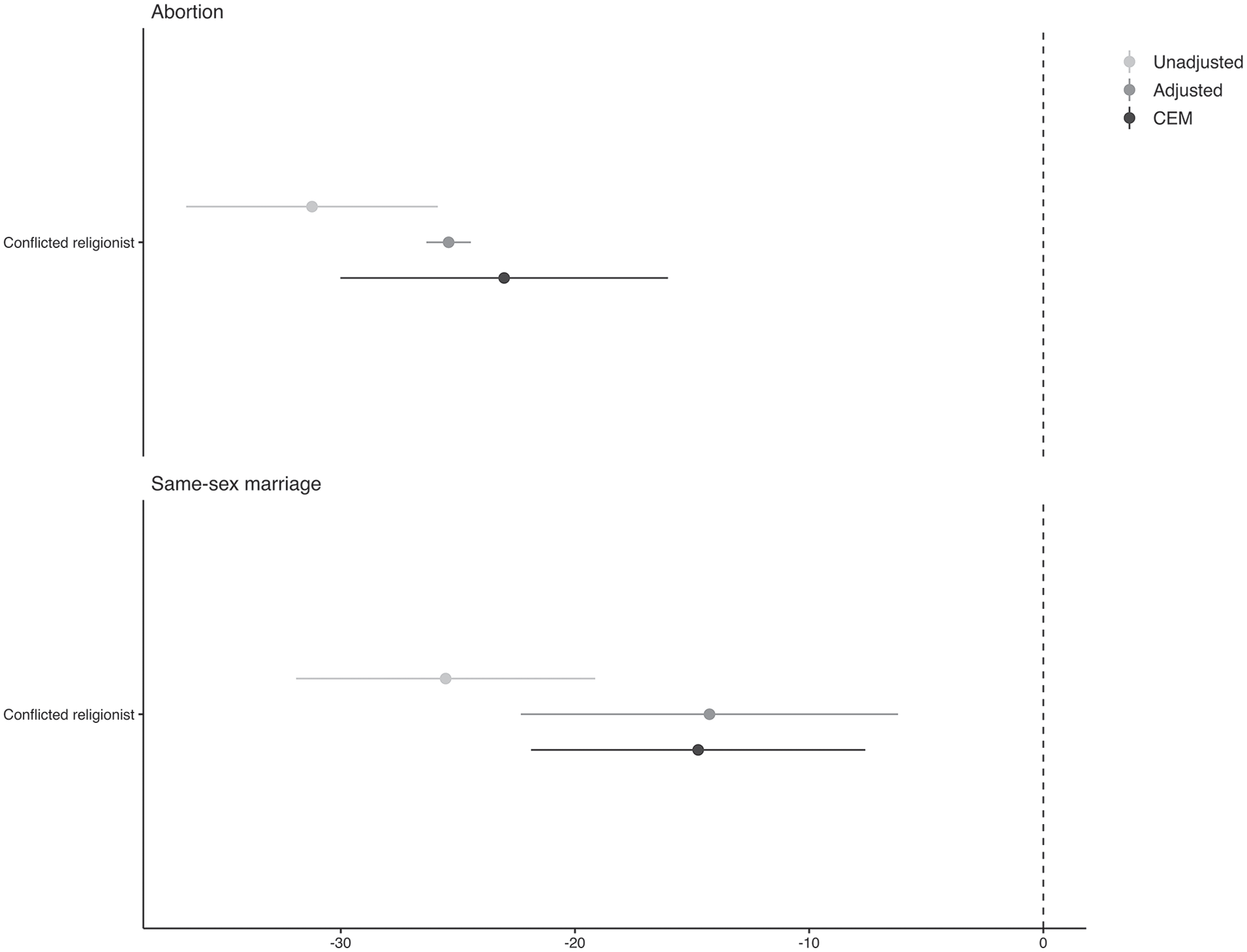
Predicting church attendance frequency. Estimates indicate the predicted difference in number of yearly church days attended for a conflicted religionist compared with a nonconflicted religionist.
As expected, the baseline estimates for both same-sex marriage and abortion are negative and significant at the .05 level, indicating lower church attendance for conflicted religionists on both issues; this result holds in both adjusted models as well, indicating that the observed associations are not likely the result of confounding demographic variables. 24 Those conflicted on abortion are estimated to attend church about 30 fewer days per year than nonconflicted religionists, and those conflicted on same-sex marriage are predicted to attend church about 25 fewer days per year. This is a clear and robust finding that adds support to the proposed mechanism of attitudinal conflict leading to decreased church involvement (measured here as attendance). Simply put, a religionist who disagrees with his or her church on abortion or same-sex marriage is predicted to attend church significantly fewer days each year, suggesting an incompatibility between perceived conflict and full participation with churches.
I now turn to my second estimation approach. Figure 3 displays the AME of experiencing conflict on attending church less frequently than at age 12. As with Figure 2, I include three different models: baseline, including controls, and with matching. Again, we see evidence of a negative association between experiencing conflict and church attendance frequency for both same-sex marriage and abortion. The probability of attending church less frequently than at age 12 increases by about .20 for both same-sex marriage conflict and abortion conflict, and the general pattern holds in both adjusted models. Although these results do not allow me to make a causal claim about the relationship between attitude conflict and church attendance, the associations identified here are consistent with the proposed mechanism of conflict leading to reduced church involvement (Patrikios 2008).

Predicting difference in church attendance frequency from age 12. Estimates indicate the increased probability of attending church less frequently for conflicted religionists compared with nonconflicted religionists.
These results demonstrate that experiencing conflict is negatively associated with church attendance on average. But does this result vary by key covariates? In other words, is the negative association between experiencing conflict and lower church attendance frequency conditional on other variables? To test this, Figure 4 plots the results from several models that regress church attendance frequency on a conflicted religionist × covariate interaction. As with Figure 2, the y axis displays the predicted difference in yearly church attendance frequency for a conflicted religionist compared with a nonconflicted religionist. Gray bars correspond to predictions from baseline models without controls, and black bars correspond to predictions from models with controls. Because cell sizes are relatively small here (and note that the cells sizes drastically vary across categories because of the dispersion of conflicted religionists in the sample), most of these predictions fail to meet statistical significance, and I have omitted errors to avoid distraction. 25 I thus interpret these results with caution, but the descriptive patterns are revealing nonetheless.

Predicting church attendance frequency by conflict × covariate interactions. Estimates indicate the predicted difference in yearly church attendance frequency (in days) for a conflicted religionist compared with a nonconflicted religionist.
Overall, the negative association between experiencing conflict and church attendance holds across these subgroups, with the one exception of black Protestants, who actually have higher church attendance if they conflict with their church on same-sex marriage (in the adjusted model). Interestingly, the pattern among political orientation categories differs between abortion and same-sex marriage. For abortion, there appears to be a steady decline in the negative association between conflict and church attendance going from the political right to left. In other words, if a religionist is conservative and disagrees with her church on abortion, she is predicted to attend church less frequently compared with political liberals. Finally, there appears to be an interaction between age and experiencing conflict, with younger conflicted religionists attending church less frequently than older conflicted religionists. I discuss these results more below.
Discussion
This study has examined perceived attitudinal conflict with one’s specific church (i.e., the congregational level). Another way of describing this phenomenon is as an individual experiencing an incompatibility with an organization with which she belongs; that individual, then, has the choice of multiple paths she can take to resolve this conflict. Hirschman’s (1970) concept of “exit, voice, and loyalty” provides an apt framework with which to understand the potential paths of a conflicted religionist: (1) she may “exit” by leaving the church, (2) she may remain affiliated but attempt to change the church to better align with her beliefs (“voice”), or (3) she may somehow reconcile the conflict and remain an active member of the church (“loyalty”). I discuss results with respect to each of these potential pathways.
Exit as Disaffiliation
The basic assumption of the political backlash model is that religionists who experience conflict ultimately disaffiliate, or “exit.” Given that the available data are a single cross-section, I am unable make claims about conflict leading to eventual disaffiliation. However, I have proposed here that although we cannot observe disaffiliation, we could reasonably expect the effects of attitudinal conflict to take place gradually, whereby conflicted religionists demonstrate decreased religious participation before possibly disaffiliating altogether. In this instance, conflicted religion is a stepping-stone to disaffiliation. Consistent with this model, the results show a clear and strong association between attitudinal conflict and lower church attendance, for both abortion and same-sex marriage conflict. Moreover, this negative association is fairly stable across key covariates, with a few notable exceptions: The negative association between conflict on abortion and church attendance appears to be stronger among conservatives compared with liberals. This is an unexpected finding but is broadly consistent with Djupe, Neiheisel, and Sokhey’s (2018) finding that backlash to the Christian right occurred primarily among Republican Evangelicals because they were the most likely to be confronted with politics of the Christian right. Perhaps conservative conflicted religionists tend to attend churches in which abortion politics are made more salient in their congregations compared with liberal religionists. 26 The negative association between church attendance and conflict is also notably higher among younger Americans for both abortion and same-sex marriage. So although younger Americans are not more likely to experience conflict on abortion compared with older Americans, if they do, it may affect their religious participation more strongly.
Exit as Selection
Again, the assumed pathway of the political backlash model is that religionists who experience conflict ultimately disaffiliate. However, another form of exiting involves leaving one’s church and selecting into another church (Wuthnow 1988). Although the data at hand do not allow me to know if a religionist will eventually select into another church—or whether they have already switched—the patterns among conflicted religionists found here can give some insight into this pathway. For instance, low levels of experienced conflict among certain groups could be interpreted as successful selection.
Evangelicals stand apart from other groups as the least conflicted religionists. A reasonable interpretation of this pattern could be as successful selection in and out of evangelical churches. Indeed, evangelicals have distinguished themselves in recent years by their consistent conservative positions on moral and family issues (Schnabel 2016). The clear boundary constructed between evangelicals and other denominations may facilitate religious selection in and out of this group, as religionists are likely distinctly aware of evangelical churches’ positions on these issues and select in and out accordingly. This interpretation is consistent with the well-documented finding in longitudinal studies that few evangelicals have disaffiliated over the past several decades (Schnabel and Bock 2017, 2018). As Schnabel and Bock (2017, 2018) argued, the result has been an American religious landscape that has become increasingly polarized along religious “intensity” lines, with moderate religion steadily declining and “intense” religion persisting. The findings presented here provide a possible explanation for the sustained affiliation levels among evangelicals.
A similar dynamic may occur with other groups who demonstrate low levels of perceived conflict. Although the probability of experiencing conflict on same-sex marriage is highest among younger Americans, there is a curvilinear relationship between age and conflict on abortion. In fact, younger Americans are the least likely to experience conflict on abortion. Likewise, highly educated religionists are not particularly likely to experience conflict on either issue. Why might this be? One possible explanation is that young Americans and the highly educated are more likely to have switched into churches with which they share more progressive same-sex marriage views. This seems especially likely for highly educated Americans, as they have been shown to be more likely to select their churches rather than remaining in the church of their parents, for example (Schwadel 2011). This scenario is also supported by the data from this study: higher educated respondents, by far, make up the largest percentage of those in churches with more liberal views. Another explanation for the patterns among age groups and education involves previous (before the survey was conducted) selection out of organized religion. It could be that most of the young Americans and the highly educated with more liberal views have already disaffiliated, thus leaving a small proportion of these people in conservative churches. Consequently, there would be fewer young and highly educated respondents left to conflict. This scenario is supported by what we know about disaffiliation trends: younger Americans and the highly educated are among the most likely groups to have disaffiliated in the past few decades (Hout and Fischer 2002, 2014).
The findings regarding Catholics should also be noted. Catholics were the only group to have a significantly higher predicted level of conflict on same-sex marriage compared with Evangelicals. This finding is in line with the unparalleled disaffiliation (Hout and Fischer 2014) and overall changing sentiments among Catholics (Smith et al. 2014). One way of interpreting the findings regarding Catholics is that that the path of “exit” by selecting into another church is more difficult for Catholics compared with, say, mainliners, because of a lack of congregational variety. Compared with mainline Protestants, dissenting Catholics do not have an outlet within the Catholic Church and are thus forced to either (1) remain as a conflicted religionists, (2) switch out of the Catholic Church, or (3) disaffiliate from religion altogether. 27
Voice and Loyalty
Although the political backlash model suggests that conflict ultimately leads to disaffiliation (“exit”), this is likely not the only path taken by conflicted religionists. Alternative paths involve remaining in one’s church and either accepting attitudinal discord (“loyalty”) or attempting to alter one’s church’s views and teachings from within (“voice”). Given these alternative paths, findings regarding the prevalence of conflicted religionists could be interpreted in several ways. For example, consider the results regarding political liberals: on one hand, the strong association between identifying as a political liberal and experiencing conflict could be interpreted as evidence against the expectations of the restructuring model, as these dissenters have not filtered into churches with more liberal views but have rather remained (for now) conflicted religionists. Furthermore, given the large share of liberal conflicted religionists, we might predict continued disaffiliation as a result of ongoing political conflict. On the other hand, one could point to the large concentration of political liberals among conflicted religionists as evidence against the supposed incompatibility of attitudinal conflict and continued affiliation; a substantial share of religionists perceive conflict and yet remained affiliated. Assessing the impact of attitudinal conflict for these conflicted religionists depends on the relative path: attempts to change the church (“voice”) would suggest that conflict does indeed affect one’s experience with her church, whereas the “loyalty” path would indicate that religionists are able to reconcile their perceived conflict. Unfortunately, the data at hand do not allow me to disentangle these different pathways for conflicted religionists. However, given the strong association between conflict and lower church attendance, the results suggest a general incompatibility between experiencing attitudinal discord and religious participation.
Conclusion
Taken together, the results both complement and complicate current understandings of political backlash and the relationship between religion and politics more broadly. Consistent with other studies of conflict in churches, disagreeing with one’s church on important issues, such as same-sex marriage and abortion, is associated with significantly lower church attendance. Different patterns among conflicted religionists on abortion and same-sex marriage point to the importance of evaluating specific salient issues: rather than broad perceived differences (Djupe and Gilbert 2008), opposition to the “Christian right” (Hout and Fischer 2002, 2014), or contention with Republican Party politics (Patrikios 2008), political backlash may occur as a process of religionists’ experiencing irreconcilable conflict with their churches on specific issues that are important to them.
A focus on perceived conflict over salient issues provides a broader lens for understanding the relationship between religion and politics, one that takes into account social change and churches’ responses to such change. The issue of same-sex marriage highlights this point. There was unprecedented rapid change in support for same-sex marriage (Powell et al. 2010), which created the perfect conditions for increased numbers of conflicted religionists: an increased share of the population had pro–same-sex marriage views, while the doctrines of most religionists’ churches had not adapted accordingly—the cultural change occurred too quickly. Although the political backlash literature has focused on the influence of the Christian right to explain recent disaffiliation trends, the framework presented here suggests that any sociopolitical issue has the potential to drive backlash if the conditions are right.
However, as discussed above, conflict does not necessarily lead to disaffiliation, as there are other paths that involve remaining in one’s church or selecting into a new church. Indeed, large shares of conflicted religionists in the sample may indicate that religionists see affiliation despite perceived conflict as a viable option. Does this finding, perhaps, undermine the political backlash model? I do not believe that the present study supports that interpretation. Again, the results regarding church attendance frequency suggest a general incompatibility between perceived conflict and church participation (on average), which is consistent with the backlash model. Moreover, one could consider reduced attendance itself as a form of backlash. Nevertheless, this study suggests the need for a more nuanced understanding of political conflict and religious identity and participation, one that considers the multiple pathways available to conflicted religionists.
Limitations and Future Research
There are several limitations to this study that should be noted. First, although I believe that measuring the relationship between conflicted religionists and church attendance allows the best available assessment of the consequences of attitude conflict, I cannot make causal claims about this relationship. It could be that conflicted religionists do not become conflicted and then attend church less often but that certain religionists already attend church less often and then develop conflicting attitudes more easily because they are not as attached to the church. Separately, there could be confounding variables, rendering the association spurious. I have taken the best available steps by controlling for relevant variables with multiple regression and matching techniques, but these methods cannot account for unobserved confounders that could be biasing associations. Although causality is an important concern, it does not obfuscate the association found here: conflicting with one’s church is associated with lower participation. Regardless of the causal direction, this association points to the apparent incompatibility of holding social views that are at odds with the teachings of one’s church and maintaining strong participation with said church.
Second, in this study I have focused on political conflict at the local church level, thus emphasizing only one possible pathway by which a religionist may become a religious “none.” In other words, political backlash can take several different forms other than one experiencing conflict with the views and teachings of her current church. For instance, backlash can occur in response to national-level phenomena, such as the rise of the Christian right (Hout and Fischer 2002, 2014). Another pathway involves conflict with the broader church (e.g., the Catholic Church) rather than one’s specific place of worship or conflict with religion more generally. Yet another pathway involves selecting out of organized religion before ever belonging to a church (Margolis 2018). Each of these pathways describes mechanisms of political backlash that may not involve conflict with one’s specific church (though it is difficult to ever disentangle all of these mechanisms with survey data), and as such, the present study should not be interpreted as explaining all or most of how political conflict affects religious identity and participation. Rather, it seeks to emphasize one important piece of religious and political conflict, which is perceived belief conflict with one’s specific church, shedding light on one possible pathway to disaffiliation and dissipated religious participation.
Third, the data used in this study are from 2007, but there have been some important legal and social changes since that time: same-sex marriage approval has increased substantially, and, most important, it has become legal at the national level. If anything, then, the estimates of the prevalence of attitude conflict provided in the present study may be conservative. Nevertheless, the aim of this study is to emphasize the importance of salient issues for the process of political backlash. As such, any point in time since the beginning of the recent wave of political backlash (the early 1990s) serves as a good sample frame with which to study this phenomenon. What matters are the particular issues analyzed and their relevant saliency at the time point studied. In this case, 2007 serves as an ideal time to study same-sex marriage beliefs and their role in backlash, given the topic’s growing prominence in social and political discourse at that time (Powell et al. 2010).
Fourth, as I discuss earlier, there are several paths a conflicted religionist might take. Unfortunately, the data at hand do not let me disentangle these different pathways. I have largely focused on the first, “exit,” here, but future studies might ask questions that emphasize other outcomes. For example, Do some religionists remain in a liminal phase between belonging and disaffiliating? If so, why? What are the reasons for a conflicted religionist’s remaining in a church with which he or she conflicts? Why do some religionists experience conflict and have no measurable decline in religious participation? Another vein of future study could incorporate in-depth interviews to better capture the cognitive dissonance that comes from being a conflicted religionist: how does one resolve political-religious conflict? Do conflicted religionists attempt to influence their churches to better align with their own views?
As social change occurs, and sociopolitical beliefs evolve as a result, there will continue to be opportunity for conflict between religionists and churches. The mitigation of such conflict will likely depend on whether churches can adapt to this change. The Catholic Church’s recent firm disavowal of same-sex marriage is a clear example of churches’ not adapting to social change, and the result is likely continued conflict and volatility among Catholics, especially young Catholics (Smith et al. 2014). To understand the changing American religious landscape, scholars should continue to give close attention to the dynamics of social change, belief conflict, and the different paths religionists may take when navigating political and religious discord.
Footnotes
Appendix A: Creation of Dependent Variables
Weighted Distribution of Original Survey Items Used to Create Dependent Variables.

| “By your best guess, how would your current place of worship feel about each of the following? Homosexual behavior” | |
| Forbids | 44.14% |
| Strongly discourages | 23.38% |
| Somewhat discourages | 9.63% |
| Encourages | .24% |
| Isn’t concerned | 9.89% |
| Don’t know | 12.72% |
| “Please indicate your level of agreement with the following statements about homosexuals: Homosexuals should be allowed to marry.” | |
| Strongly disagree | 36% |
| Disagree | 19.91% |
| Agree | 13.62% |
| Strongly agree | 18.55% |
| Undecided | 11.93% |
| “By your best guess, how would your current place of worship feel about each of the following behaviors? Abortion” | |
| Forbids | 51.98% |
| Strongly discourages | 25.01% |
| Somewhat discourages | 6.93% |
| Encourages | .7% |
| Isn’t concerned | 4.6% |
| Don’t know | 10.78% |
| “How do you feel about the morality of the following: Abortion, if the family cannot afford the child?” | |
| Always wrong | 46.48% |
| Almost always wrong | 14.53% |
| Only wrong sometimes | 14.86% |
| Not wrong at all | 24.13% |
Appendix B: Tables
Logistic Regression Predicting Decreased Church Attendance since Age 12.

| Same-Sex Marriage | Abortion | |||||
|---|---|---|---|---|---|---|
| Baseline | Full | CEM | Baseline | Full | CEM | |
| Nonconflicted religionist | Reference | Reference | Reference | Reference | Reference | Reference |
| Conflicted religionist | .677*** | .537** | .427* | .960*** | .839*** | .916*** |
| (.155) | (.171) | (.197) | (.162) | (.183) | (.209) | |
| Low | Reference | Reference | ||||
| Medium | –.048 | .032 | ||||
| (.180) | (.174) | |||||
| High | –.287 | –.194 | ||||
| (.190) | (.181) | |||||
| Age | .094 | .085 | ||||
| (.101) | (.095) | |||||
| Age2 | –.001 | –.001 | ||||
| (.002) | (.002) | |||||
| Age3 | .000 | .000 | ||||
| (.000) | (.000) | |||||
| Evangelical Protestant | Reference | Reference | ||||
| Black Protestant | .036 | –.257 | ||||
| (.401) | (.416) | |||||
| Mainline Protestant | .797*** | .573** | ||||
| (.210) | (.201) | |||||
| Catholic | .540** | .542** | ||||
| (.185) | (.176) | |||||
| Other | –.368 | –.488 | ||||
| (.335) | (.314) | |||||
| Male | Reference | Reference | ||||
| Female | –.187 | –.186 | ||||
| (.145) | (.141) | |||||
| A large city | Reference | Reference | ||||
| A suburb near a large city | .068 | .107 | ||||
| (.243) | (.240) | |||||
| A small city or town | –.098 | –.029 | ||||
| (.234) | (.232) | |||||
| A rural area | –.130 | –.026 | ||||
| (.259) | (.255) | |||||
| East | Reference | Reference | ||||
| Midwest | –.473* | .559** | ||||
| (.217) | (.208) | |||||
| South | –.113 | –.256 | ||||
| (.214) | (.206) | |||||
| West | .189 | .161 | ||||
| (.238) | (.227) | |||||
| Nonwhite | Reference | Reference | ||||
| White | .429 | .305 | ||||
| (.226) | (.219) | |||||
| Constant | –.094 | –1.938 | .162 | –.098 | –1.651 | –.024 |
| (.077) | (1.654) | (.130) | (.072) | (1.566) | (.125) | |
| Pseudo-R2 | .015 | .050 | .007 | .027 | .061 | .026 |
| BIC | 1,268.000 | 1,252.602 | 956.753 | 1,363.526 | 1,337.315 | 941.233 |
| Observations | 920 | 854 | 695 | 1,003 | 928 | 692 |
Note: The number of cases in the CEM models indicates the number of successfully matched cases. Values in parentheses are standard errors. BIC = Bayesian information criterion; CEM = coarsened exact matching.
p < .05. **p < .01. ***p < .001.
Appendix C: Additional Figures
Appendix D: Patterns for Conflicted Religionists in “Liberal” Churches
Figure D1 displays frequencies of conflicted religionists who have more conservative views on abortion and same-sex marriage and their current churches. Although there are too few cases among religionists conflicted on abortion, there are some interesting, yet not surprising, patterns for same-sex marriage. First, mainliners far and away have the largest number of conflicted religionists, which makes sense given the larger number of more liberal mainline churches. Religionists with high levels of education also appear to be much more likely to experience conflict. This is an interesting result, and I am not sure what to make of it. It could be that religionists with higher levels of education are more likely to attend liberal churches, regardless of whether they agree with said churches politically.
Figure D2 plots the mean logged church attendance frequency for conflicted religionists compared with nonconflicted religionists. There is a clear pattern for same-sex marriage, with conflicted religionists having a far lower average church attendance frequency than nonconflicted religionists. The pattern is reversed, however, for abortion conflict, though the difference is small. I will not make too much of these patterns because of the small sample size, but this again could be illustrative of the different nature of these two issues: abortion views and politics have been solidified for many years, whereas same-sex marriage was a rapidly changing issue in 2007. Social conservatives may have found themselves belonging to churches that adopted progressive views on same-sex marriage, and this created a conflict for those religionists.
Acknowledgements
I owe special thanks to Bart Bonikowski, Jason Beckfield, Clem Brooks, Youngjoo Cha, Paul Djupe, Brian Powell, and Landon Schnabel for exceptional feedback throughout this project. I would also like to thank the editors of Socius and the two anonymous reviewers for their helpful comments and criticisms of previous versions of the article. I would also like to thank the other members of the S660 Political Sociology seminar at Indiana University Bloomington for their insightful and supportive comments on early drafts.
Authors’ Note
Earlier versions of this article were presented at the 2019 Society for the Scientific Study of Religion Conference and the 2016 North Central Sociological Association-Midwest Sociological Society Conference. All data and code will be made publicly available to reproduce all analyses in the article.
