




Abstract
Sociological theory and research suggest that experiencing family members’ deaths during childhood and adolescence is an important event subject to significant disparities. Previous research links immediate family members’ deaths to poor life outcomes, but it considers a limited set of family members and has not tested the association of family member death with educational attainment. In this study the authors estimate the rates and educational impacts of experiencing the deaths of immediate (siblings, parents) and extended (aunts and uncles, cousins, and grandparents) family members during childhood and adolescence for black and white Americans. The authors find that family death is associated with educational attainment, but the associations differ by family member type and gender and child’s race. Experiences of family death are unequally distributed by race and demonstrate complex associations with educational attainment. This research broadens life-course and family-systems theory by incorporating childhood family experiences of death on adult educational attainment and stratification.
Experiencing the death of a family member is a nearly certain, important, and understudied event in the life course. Adults often vividly recall their first experience with a family member passing (Dickinson 1992; Knight, Elfenbein, and Capozzi 2000). Depending on the circumstances, these experiences can be anticipated and normal, if emotional, or they can constitute a bewildering family tragedy. Timing, context, and relationship to the decedent can shape how such events influence subsequent life-course trajectories. As it is well documented that adverse events during childhood and adolescence can influence later life outcomes (Haas 2008; Hayward and Gorman 2004), it is especially critical to examine experiences of family death during these ages. Earlier research by sociologists and demographers used analytical and computational methods to document the ages at which people first experienced the deaths of family members in historical periods (Hagestad 1988; Uhlenberg 1980; Watkins, Menken, and Bongaarts 1987). However, researchers have only recently begun to use empirical data to examine how experiencing the deaths of immediate family members during childhood and adolescence influences physical and mental health developmental trajectories (Fletcher et al. 2013; Fletcher, Vidal-Fernandez, and Wolfe 2018; McLeod 1991; Umberson et al. 2017).
In this article, we adopt a life-course approach to studying how the deaths of immediate and extended family members during childhood and adolescence influence educational attainment. A life-course perspective highlights the many possible ways that early experiences with family member death might change children’s and adolescents’ trajectories. For instance, for some, the death of a grandparent may be painful and temporarily impair psychological well-being but not otherwise disrupt the life course. For others, a grandparent’s death may be beneficial if it infuses resources into the family, such as inheritances (Knaplund 2006). For still others, such as for those raised by grandparents, it may lead to substantial upheaval with long-term consequences.
We extend previous research on experiences of family death in four ways: (1) developing further theoretical considerations regarding family death during childhood and adolescence to situate these experiences in the life course; (2) focusing on an important nonhealth outcome, educational attainment by age 25, that ties directly into life-course processes that generate inequality; (3) systematically comparing a broader range of immediate and extended family deaths than those explored in prior work, with special attention to differences by timing, context, or relationship to the decedent; and (4) theorizing why and testing whether such associations might differ across population subgroups. To make these contributions, we combine insights from life-course and family-systems theories and use the extended kinship data and the wealth of longitudinal individual and household information measured in the Panel Study of Income Dynamics (PSID). We focus on black and white American families because of the stark social inequalities in health (Hummer and Hamilton 2019; Phelan and Link 2015) and socioeconomic status attainment (Boen, Keister, and Aronson 2020) between these two groups in the U.S. context and because of the representativeness of the PSID.
Experiencing Death When Lives Are Linked
Adopting a life-course framework extends the mechanisms by which experiences of family mortality might influence a child’s or an adolescent’s outcomes later in life. The literature on the importance of family death during childhood and adolescence has, so far, drawn primarily on insights related to grieving and bereavement processes and other psychological mechanisms (Oltjenbruns 1991; Sood et al. 2006) and looks mostly at the loss of coresident, immediate family members (e.g., Fletcher et al. 2013, 2018). It also almost exclusively hypothesizes that family death will negatively affect child and adolescent development (Fletcher et al. 2013; Umberson et al. 2017), with limited attention to the potential for positive outcomes. A life-course perspective on early experiences with family member loss widens this lens.
Life-course theory considers the social context of lives lived together, or “linked lives,” which parallels concepts in family-systems theory, in which individuals are viewed as being embedded in the larger social structure of a family (Cox and Paley 2003; Elder 1998; Elder, Nguyen, and Caspi 1985). According to these perspectives, the loss of a family member is rarely experienced as a dyadic event, devoid of a broader context. Take the untimely death of an uncle, for example. We might expect that most children receive limited transfers from their uncles and perhaps do not spend much time with them. The child may experience grief at the loss, but the direct associations in terms of financial support or caregiving are likely to be limited.
However, recognizing that lives are linked and families are systems, we must consider additional pathways by which the loss of an uncle could affect the child. For instance, if the deceased uncle had dependents, perhaps the loss would trigger transfers from the child’s parents and grandparents to those other family members, diminishing a child’s resources. Furthermore, parental and grandparental bereavement may limit the attention of more direct caregivers (Abeles, Victor, and Delano-Wood 2004). Losing a family member also may sever or strengthen connections to other family members (Ahrons 2006), such as when connections to an aunt-by-marriage are lost upon an uncle-by-blood’s death. There also is evidence of more disturbing outcomes, such as when the death of a sibling increases risks for intimate partner violence among parents (Weitzman and Smith-Greenaway 2020). Conversely, there may be counteracting positive influences on children’s well-being, such as when an uncle without dependents leaves an inheritance for the child. Some grievers may find meaning in their relative’s death or benefit, or relief from reduced caregiving burdens, lowering levels of depression immediately after the event (Michael and Snyder 2005). Put simply, a child’s uncle is a parent’s brother and a cousin’s father, and those linkages can shape family members’ outcomes following a relative’s death in complex ways. These insights can be applied to most family relationships (White 1963).
Despite theoretical recognition that families are linked systems, little of the scholarship on experiences of family death looks beyond the immediate family. Instead, the focus in the literature is, almost singularly, on parent death (Case and Ardington 2006; Leopold and Lechner 2015; Rostila and Saarela 2011), sibling death (Fletcher et al. 2013, 2018), or grandparent death (Abeles et al. 2004). Few studies have explored the ways extended family members’ deaths, such as those of aunts or cousins, might influence individuals’ life-course trajectories, which is surprising given that theoretical considerations of linked lives so clearly highlight the potential for such deaths to matter for child and adolescent outcomes.
Thinking beyond the immediate family is increasingly important in the contemporary era because of growing heterogeneity in children’s and young adults’ family experiences. There is also reason to believe that kin death experiences may vary by the role of the family member in the context of understanding “who has been lost” (Riley 1968:24). These considerations are especially vital in the context of racial stratification. Grandparents increasingly take part in children’s lives (Leopold and Skopek 2015), which may raise the resources invested in children (Sear and Coall 2011). Critiquing the literature’s focus on immediate family members, Gerstel (2011) emphasizes the important supportive roles that aunts and uncles, or even cousins, play in the lives of black and Latino families, especially in providing care for children. Extended and multigenerational household structures are more and more common for everyone, but they are more prevalent among black than white children (Mollborn, Fomby, and Dennis 2011; Pilkauskas, Amorim, and Dunifon forthcoming; Pilkauskas and Cross 2018). Recent work shows that 35 percent of youth live with extended family members at some point before turning age 18 and that race and class differences in lifetime prevalence of experiencing this family form are much greater than cross-sectional differences (Cross 2018). Moreover, the share of children raised in nonwhite families in the United States is rising rapidly, further underscoring the need to examine how the deaths of a diverse range of kin might influence adolescent outcomes and to consider racial differences in these associations. To fully account for the ways experiences of family death might affect children and adolescents in the contemporary family environment, and its diversity, the deaths of a broad range of family members must be considered and compared, not just those of parents, siblings, and grandparents.
Life-course theory also suggests that the influence of childhood and adolescent experiences of family member deaths may be particularly consequential for educational attainment, a core component of stratification. Life-course theory privileges education as a critical developmental factor, alongside family and work (Elder 1998), because it can influence many other social outcomes, including health, marriage, and fertility. Specifically, education is tied to social mobility, is a relatively fixed status achieved at a young enough age that we can analyze it with high-quality data, and has recently been the focus of many studies on the creation of inequality within multigenerational family structures (Hällsten 2014; Bol and Kalmijn 2016; Jæger 2012; Song 2016; Warren and Hauser 1997). The death of a family member during childhood or adolescence may derail educational trajectories through the loss of resources, or through the documented mental health declines associated with grieving and bereavement, or it may provide a benefit by infusing new resources or removing stressors. These patterns also may differ among population subgroups; unfortunately, scholars have not addressed these topics. Likewise, there may be substantial differences in the association between experiences of family death during childhood and adolescence and specific educational markers, a topic we return to shortly.
Attention to linked lives and family systems brings up other considerations. Although having more older family members typically correlates with greater provision of positive resources for children and adolescents (Mollborn et al. 2011; Sear and Coall 2011), relationships with family members are sometimes detrimental, and their dissolution may in fact be beneficial in some circumstances. For instance, low-quality parent relationships are a strain on children’s outcomes (Amato and Keith 1991). Inheritance or reduced caregiving burdens also may play a role, especially when considering the deaths of extended family such as older grandparents (Conley 2001; Lee et al. 2014).
Although the literature on experiencing family death has neglected the possibility that deaths in the family might in some cases be beneficial, there are suggestions to this effect in related literatures. Studies of family disruption highlight complex relationships between the permanent or temporary absence of a family member—through divorce, migration, or incarceration—and children’s well-being and development. Family disruption may exert both negative and positive influences. For instance, children of divorce score lower on academic assessments (Frisco, Muller, and Frank 2007) and have lower overall educational attainment (Amato and Keith 1991) than children in intact families. But parental divorce may infuse financial resources into a child’s life (Seltzer, Schaeffer, and Charng 1989). Children with a parent absent because of migration are more likely to experience negative educational outcomes (Kandel and Kao 2001), but parental migration also is associated with increased economic resources available due to parental remittances (Kandel and Kao 2001) and increased involvement from other family members who did not migrate (Battistella and Conaco 1998). Children with incarcerated family members show cognitive delays (Poehlmann 2005), but they experience an uptick in social and economic investments from extended family (Adams 2018). These complex and often contradictory relationships between family disruption and children’s well-being and development are challenging to make sense of without the tools of the life-course framework. Furthermore, they highlight the potential for positive associations and the necessity of viewing family death as reverberating throughout a system of linked lives.
In addition to the concept of linked lives, life-course theory also emphasizes the idea of transitions, or entrances into and exits from different roles such as childhood. Although transitions were initially viewed as singular events, subsequent scholarship reconceived them as “multiphasic processes” governed by a series of turning points, or specific events that trigger discontinuities in a person’s trajectory during these transitions (Elder 1998; George 1993). Traditionally, life-course theory envisioned turning points as “choice points” along a transition pathway, such as the transition to unwed motherhood wherein “young girls may choose to engage in premarital sex or not, or to use contraception or not, to seek an abortion or not, and to marry the father or not” (Elder 1998:6). Different choices during these critical periods would alter the outcome, preventing the transition in question. The completion of education is often singled out as a key transition, affected by numerous potential turning points, that connects experiences in early childhood to those in young adulthood and long beyond (Johnson, Crosnoe, and Elder 2011). Later refinements came to appreciate the many structural factors that constrain individual choices during such turning points but retained the idea of discontinuities in trajectories. However, experiencing the death of a family member as a child or adolescent is not a choice, not even a constrained one. In life-course theory, the death of a family member during childhood and adolescence is viewed not as a transition between roles but as a counter-transition, when one’s life is changed by the life transition of another (Hagestad 1988). Understanding how transitions and counter-transitions affect people during critical periods, such as childhood and adolescence, is a long-standing goal of life-course theory, though often the focus has been on health outcomes (i.e., the “long arm of childhood”) (Haas 2008; Hayward and Gorman 2004). It is worth broadening this goal to include education, itself a critical life-course turning point.
Experiencing family death may matter more for some educational turning points, such as the decision to attend college, than for other points, such as completion of high school. Thinking about counterfactuals provides a clear case of how such differences might manifest. Imagine a simple example in which experiencing the death of grandfather comes with a modest inheritance but also a moderate mental health decline. Imagine two identical high schoolers with excellent grades and a desire for educational pursuits but who cannot for whatever reason afford college. Barring financial concerns, both would attend college. If one of these two experiences the death of a grandfather in senior year, the inheritance may outweigh the mental health decline and may spur that person to attend college, whereas the other would not. If we reconsider the case among two individuals with worse grades, however, who would probably not attend college under most circumstances, the inheritance might be less important than the mental health decline. In that case, the one who experiences the grandparental death may be less likely to graduate high school. More generally, it is quite possible that associations between family death and education will differ for different educational thresholds.
The most direct considerations for experiencing family member deaths with respect to life-course theories have to do with timing, context, and relationship to the decedent, specifically, how these might affect children’s educational trajectories. Such considerations also provide a direct link to issues of stratification and how “the meanings of death are in a process of continuing transformation” (Riley 1983:191). Life-course stages have become more standardized in recent decades, as two relevant examples illustrate. First, even as people increasingly reach the markers of “adulthood” at older ages, the ages of completing the transition to adulthood became increasingly compact over the twentieth and twenty-first centuries with lower variance overall and smaller differences among gender, race, and nativity groups, driven largely by increased educational attainment (Furstenberg 2010; Fussell and Furstenberg 2005; Hagestad and Neugarten 1985). Second, the rectangularization of mortality risks has standardized ages of death, with most now occurring in older adulthood (Wilmoth and Horiuchi 1999). Life-course research theorizes and demonstrates that deviations from these increasingly standardized life-course stages increasingly predict failure to complete key life-course transitions, which in turn negatively influence health and other outcomes (Marini 1985, 1987; Mouw 2005). For this reason, contemporary children can expect to share a much greater period of their lives with all manner of family members than in the past (Hagestad 1988; Watkins et al. 1987), though this may be waning (Verdery 2015). However, for those who do experience it, the increasing rarity of death experiences in childhood (George 1993; Hagestad 1988) may make the experience a difficult, “lonely transition” with which few peers are familiar (Hagestad 1988). Just as some argue that infant mortality is more salient in low-mortality environments today than historically (Montgomery 2000), so too may the experience of a family member’s death during childhood be more salient, and potentially disruptive, than it was in the past (Rosel 1978), even if experiences of family members’ deaths remain age graded (Umberson et al. 2017). Furthermore, the experience of these deaths is expected to occur in a certain order: grandparents first, then parents, and then siblings. The order has not changed, of course, but it has become more rigid (Uhlenberg 1980, 1996). Perhaps those who experience family deaths that deviate from this order—a parent prior to a grandparent, for example—are particularly at risk, which offers another reason to consider a broad range of relationships to the decedent.
To this point, we have emphasized stratification in a general sense, but stratification may moderate these processes in multiple ways, including through the attributes of the person who dies or the attributes of the person who experiences the death, or both. First, family death experiences may vary according to the gender of the decedent family member in the context of understanding “who has been lost” (Riley 1968:24). Because of female survival advantages, children may experience male family death at higher rates (Case and Paxson 2005; Hayward and Gorman 2004). Historically, men have worked for pay outside the home in larger numbers, and therefore their deaths may either reduce economic resources or potentially infuse them into a child’s life (Case and Ardington 2006; Raley, Bianchi, and Wang 2012). Women have increased their time spent working, but they typically earn less and have less capital than men. Although all family members may be important for family bonding, women have traditionally done more kin-keeping (Bracke, Christiaens, and Wauterickx 2008; Hagestad 1986) and grandfathers are, on average, less directly involved in grandchildren’s lives than grandmothers (Sear and Coall 2011); therefore, a grandmother’s death may be especially detrimental to a child’s long-term outcomes. Loss of a mother has strong associations with children’s educational outcomes, reducing their overall attainment and attachment to school (Case and Ardington 2006). Loss of female extended family members may have an especially negative association for minority youth, as these members often play a larger caregiving role in these children’s lives (Gerstel 2011).
Likewise, there is the potential for the influence of a family death to be moderated by race. Because of data limitations discussed later, we restrict our discussion and analysis to black and white Americans. Black Americans are more likely than white Americans to experience a family member’s death during childhood (Daw, Verdery, and Margolis 2016; Kain 2009; Umberson et al. 2017). For instance, black children are still twice as likely as white children to have lost a parent or sibling by age 15 (Kain 2009), and similar patterns hold for more extended family members (Umberson et al. 2017). When considering racial stratification in the loss of family members, one must also consider inequality. The potential for family death to infuse resources into a child’s life depends on resource availability, and black families tend to have fewer such resources. For instance, wide disparities in the net worth of white and black families may make inheritances and educational trusts more common for the former than the latter group (McKernan et al. 2014), which might suggest racial differences in the association of experiencing the deaths of certain types of family members (i.e., benefits for white children and adolescents that may not exist for black children and adolescents). Black families are also more likely to coreside and share resources within a household compared with white families (Gerstel 2011; Reyes 2018). Black children have closer relationships with extended family members than white children (Taylor et al. 1990), and living with a grandparent is associated with the highest cognitive scores for black children (Mollborn et al. 2011). As such, losing these family members may matter more (in terms of sociological mechanisms not emotional tolls) for black children and adolescents than for white children and adolescents, while at the same time being more common and resulting in fewer resource transfers.
Data and Methods
We test for associations between childhood and adolescent family death experiences and young adult educational attainment using longitudinal data on young people and their immediate and extended family members in the PSID. These data allow us to examine individuals’ educational trajectories nested within family context, measure the incidence and prevalence of family member death during childhood and adolescence, and determine whether family death experiences are associated with later educational attainment. We use PSID data from 1968 to 2013 to construct our key outcome and explanatory variables, including links to decedents from the National Death Index in 2009 and close and extended family networks constructed from the PSID’s Family Identification Mapping System (FIMS) data, which identify sibling, parent-child, and grandparent-grandchild ties, which we extend to a broad range of family ties. We use individual characteristic data only through 2009 in order to align with the last year of mortality data we obtained.
Our analysis focuses on a broad range of different family ties available to young people: parent, sibling, grandparent, aunt and uncle, and cousin ties. We obtain the first three ties directly from FIMS. To identify aunts or uncles and cousins, we rely on chains of ties from FIMS and marital identifiers in the PSID main survey, as follows: one’s aunt or uncle is either one’s parent’s sibling or one’s parent’s sibling’s spouse; one’s cousin is one’s aunt’s or uncle’s child. Daw et al. (2016) used the same approach to calculate immediate and extended family relationships within the PSID and provide additional details on the construction and validity of these networks, as well as code that we drew on. It is important to note that these procedures limit our ability to measure some family ties and make some of our estimates conservative. That is, because these procedures will miss some of the family members of those who marry or partner into the PSID lineage and those who have never coresided with members of the PSID lineage, some of those who we define as experiencing no family deaths may have in fact experienced them. This would bias estimates of family death associations toward zero. Such issues will be greater for ties like aunts and uncles and cousins than for the ties directly measured in FIMS, but they may also present problems for non-coresident parents and siblings.
The PSID has high response rates and provides “good representation of the corresponding national population with coverage of approximately 97% of the U.S. population of children in 2007 and reasonable balance for most groups” (Duffy and Sastry 2012:1). Over the study period examined (1968–2013), the PSID collected data on 75,252 individuals. We focus on the subset of respondents who meet the following inclusion criteria: (1) black and white 1 respondents in the Survey of Economic Opportunity and Survey Research Center subsets; (2) respondents whose lives overlapped in the 0 to 25 age range with a family member of one of the types we examine; (3) respondents who reached age 25 by the 2013 wave without loss to follow-up; (4) respondents who were in the appropriate generation of their PSID lineage to observe the tie in question—second generation for parents and third generation for all other ties we examine 2 ; and (5) respondents whose focal family members were eligible for mortality follow-up. These inclusion criteria are necessary because of the limited representativeness of other racial/ethnic groups in these PSID subsets and the limited observation period for the Latino and immigrant subsamples (criterion 1), to define deaths that occur during the focal individual’s childhood or adolescence not before (criteria 2 and 5), to observe educational attainment (criterion 3), and to ensure that we have the opportunity to see the tie type in question given the data structure (criterion 4). Because the inclusion criteria vary across relationships, we model each relationship type separately, which means that sample sizes differ by relationship.
We define family member death by death status and date in PSID’s linked mortality files, which we use to calculate respondent ages at the time of the family member’s death. When more than one death in a given relationship category is observed for the focal respondent, we retain the earlier date (conditional on the tie existing, meaning the date must be during the focal respondent’s lifetime). Although income, wealth, and other indicators of socioeconomic status would also be of theoretical interest, we restrict our analysis to education as an indicator of socioeconomic status. 3 We measure respondent education using the most recent valid years of education observed between 1968 and 2009 and use these to define three dichotomous variables in stairstep fashion, 4 indicating high school or more, some college or more, and college graduation or more, which are not mutually exclusive. We also incorporate the following controls. Race is a household-level variable, defined using the head of household’s first reported race and ethnicity and modeled as an indicator variable for black race. Gender is modeled as an indicator variable for being female. We measure decadal birth cohort with respondent year of birth and model it using a different category for each 10-year interval between 1950 and 1990 (with births earlier than 1950 grouped together). Because educational attainment has trended upward across twentieth-century birth cohorts and our focal respondents differ in the birth cohort of their parents, we measure parental educational attainment relative to that of their birth cohort using a z-score transformation, calculated separately for each parental birth cohort. When parental education values vary over time, the most recently reported value is used. Because of the complex nature of the data analyses, we do not use sampling weights. However, because the PSID oversampled black respondents, this means that our estimates are not population representative.
Analytic Plan
Our analysis proceeds in three stages. First, to highlight the scope of family deaths during childhood and adolescence and potential stratification therein, we describe the distribution of family member death counts by race and the frequency with which black and white respondents are exposed to the deaths of different types of family members in childhood and adolescence. We examine several operationalizations of this measure, calculated separately by relationship type: the mean number deceased by age 25, the proportion with one or more family member deaths of this type, and the proportion of such family members that are deceased. Next, we descriptively assess the hypothesized associations between family member death and educational attainment. We compare mean years of education and the proportions graduating high school, attending college, and graduating college by family member death status. Additionally, we describe cumulative exposure to family death, stratified by race, in graphical form.
Second, to test for associations between family death and educational attainment, we present the results of a multivariate model that we selected after testing several alternatives (described in the next paragraph). In this approach, we operationalize respondents’ family death experiences as a dummy variable indicating that at least one family member of the type in question had died by the time the focal respondent was age 25. For years of education, we use ordinary least squares regression with family cluster-adjusted standard errors, controlling for the focal respondent’s race, gender, birth cohort, and cohort-specific parental education z scores. In keeping with our argument that it is important to look at several educational thresholds, we model the educational threshold measures using logistic regression and express coefficients in logits, using the same control variables and standard error adjustments described earlier. We then provide race-stratified and (decedent) family-member-gender-stratified versions of these same models, comparing all key coefficients across racial or gender groups using Wald tests for significant coefficient differences across groups (as well as traditional significance against zero). These tests allow us to determine whether the associations differ by race or decedent gender.
Additionally, we conducted extensive tests to determine how best to specify our primary models; we present some of these results in the main text and others in the Supplemental Appendix. First, to determine whether kinship structure or family member mortality rates drive these results, we compared results obtained using the number of family member deaths a youth experiences and the proportion of deaths they experience. Second, to determine whether it is reasonable to treat deaths equally regardless of timing, we tested the association between the timing of the death experiences by age and educational attainment. Third, we use fixed-effect models, controlling for the specific person who died, that took advantage of the differential relationships that specific decedents have with different young people (i.e., that one person’s uncle is another’s father) to test the robustness of our main findings to controls for unobserved heterogeneity bias. Fourth, to assess whether family death associations vary by focal respondent gender, we analyzed models stratified by focal respondent gender and compare the coefficients using Wald tests (Supplemental Appendix Table A). Finally, to assess whether family deaths taking place after the focal respondent had completed education or before they were born were biasing our results, we perform two additional comparisons. Reasoning that kin deaths during the age 21 to 25 window are most likely to occur after the ego would have completed his or her education, we compare coefficients of family deaths at different ages between 0 and 25 (Supplemental Appendix Table B) to determine whether kin deaths in this window have the strongest association with educational attainment. Extending this logic further, we also conduct falsification tests and model the association of family member deaths before the focal respondent was born and when he or she was age 26 to 35, and thus far less likely to be in school, in order to determine whether these deaths have significant associations with ego educational attainment, which would strongly indicate unobserved heterogeneity bias (Supplemental Appendix Table C).
Results
The data we use to model the association between family death and young people’s educational attainment are described in Table 1. Family member types differ enormously in their typical mean counts, but there are small racial differences in family structure: these differences are smallest for parents (white = 2.28, black = 2.29, black/white ratio = 1.00; ns) and largest for cousins (white = 7.95, black = 9.30, ratio = 1.17; p < .01), with nontrivial racial differences in other relationship types.
Family Member Counts, Deceased Family Member Counts, Proportion with One or More Family Members Deceased, and Proportion Family Members Deceased, by Race and Family Member Type.

Note: Total N = 8,804 (white, n = 5,525; black, n = 3,279; parents, n = 8,267; siblings, n = 7,833; grandparents, n = 2,979; aunts and uncles, n = 3,016; cousins, n = 3,010). Significance tests are from unadjusted t tests for black-white differences.
p < .05.
Continuing with Table 1, the next three columns characterize exposure to family death in three different ways: as the mean number of deaths by relationship category and race, as the proportion of respondents who experienced one or more family member death of this type by age 25, and as the average proportion of such family members deceased by age 25. As expected, grandparents are the greatest source of exposure to family death by all three measures, followed by aunts and uncles, parents, siblings, and cousins. Black respondents’ mean number of deceased family members and the proportion with one or more deceased family member are statistically significantly (p < .05) higher than equivalent values for white respondents for all relationship types except parents. For the proportion of family members of each type deceased, black-white differences are statistically significant for parents (p < .05) and aunts and uncles (p < .01). The contrast between these patterns and those in the previous two columns indicates that the black-white difference in exposure to sibling and grandparent death is due largely to black-white differences in family structure, whereas this is not the case for parents and aunts and uncles. Together, these results suggest that black-white differences in family death are not due to multiple testing; among the 20 hypothesis tests (four indicators multiplied by five relationship categories) in Table 1, 14 of these contrasts are statistically significantly different, whereas we would expect only 1 significant difference due to chance.
The experience of family deaths in young people’s lives is common and varies substantially by relationship type and race. Figure 1 depicts cumulative exposure to one or more deaths of each type by age and race (Figure 2 presents grandparent deaths separately for scaling reasons). As expected, parent and aunt and uncle deaths are the most common among the depicted ties shown in Figure 1. Black and white respondents’ exposure to these deaths followed similar patterns, as deaths of these types are infrequent before respondents reach age 5 and climb steadily thereafter. For both white and black respondents, exposure to aunt or uncle death is more common than exposure to parental death, likely because of the larger number of aunts and uncles in typical family networks and the age dispersion among parental siblings. Our data show that white and black respondents have similar exposure to sibling and cousin deaths.
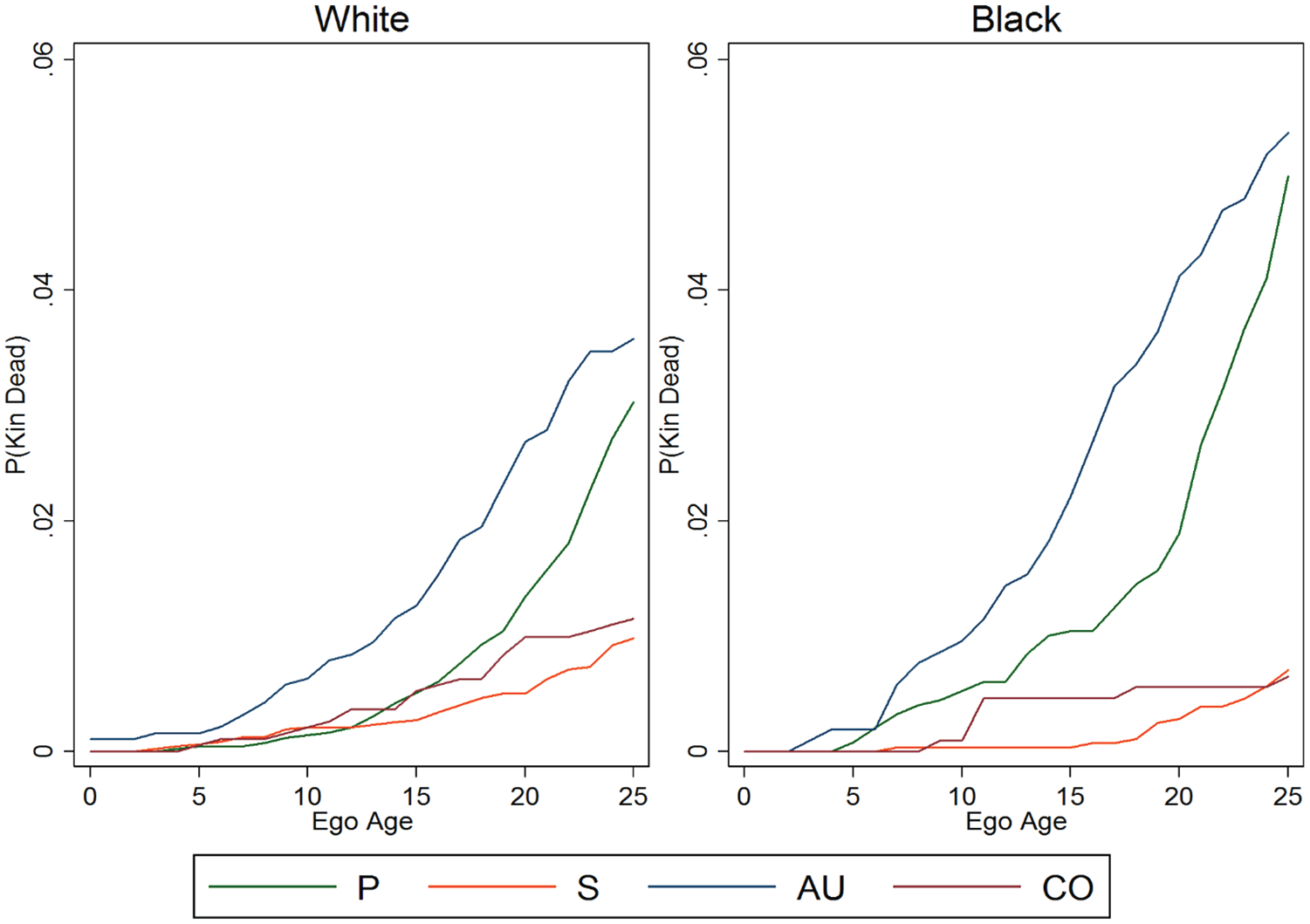
Cumulative exposure to family death, by family member type and race.
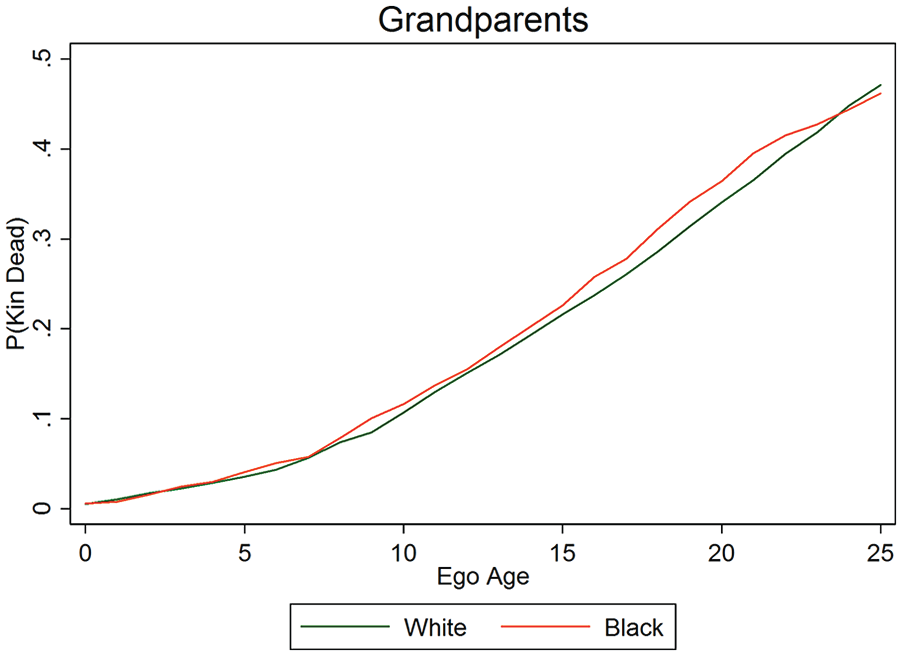
Cumulative exposure to grandparent death, by race.
Next, we characterize the bivariate association between various family members’ deaths and young people’s educational attainment. Table 2 displays the means and proportions for each indicator of educational attainment investigated, as well as the calculated differences in means and proportions and the ratios associated with one or more deaths compared with none. The difference in mean years of education is small: –.4 for parental death (.97 ratio), –.6 for sibling death (.95 ratio), .1 for grandparent death (1.01 ratio), –.2 for aunt and uncle death (.98 ratio), and –.5 for cousin deaths (.96 ratio). However, these differences in mean years of education belie far more substantively important associations with attaining specific educational thresholds. In other words, the association appears to be concentrated around socioeconomically meaningful thresholds: high school graduation, college attendance, and obtaining a four-year degree.
Descriptive Association between Family Death and Educational Attainment.

Note: Total N = 8,804 (parents, n = 8,267; siblings, n = 7,833; grandparents, n = 2,979; aunts and uncles, n = 3,016; cousins, n = 3,010). Mean years indicates mean years of education for the group in question. Differences are calculated as black mean or proportion minus white mean or proportion. Ratio is the ratio of black mean or proportion to white mean or proportion.
Furthermore, these associations appear to increase by level of education attained. This is evident when the association is expressed in ratios (which account for the lower prevalence of higher educational attainments) rather than differences in proportions (which do not). For example, a young person who experiences the death of a parent before 25 is .91 times as likely to graduate high school as someone who does not, but this same ratio is .80 for college attendance and .63 for college graduation. These monotonic changes in ratios are observed for deaths with all types of family members, though the extent varies: aunt and uncle patterns are similar to parental ones but weaker, whereas sibling and cousin deaths have an especially pronounced negative association with this sequence of educational thresholds. Respondents who experience a sibling death are .51 times as likely to graduate from college as those who have not experienced a sibling death, and those who experience a cousin death are .45 times as likely to do so as those who have not experienced a cousin death. However, this trend is positive in the case of grandparents: grandparent death is associated with being 1.06 times more likely to attend college and 1.11 times more likely to graduate. Generally, the size of the association of family member death with educational attainment is inversely proportionate to how common family member deaths of that type are in the analytical sample.
As shown in Table 3, we test whether these associations are robust to the inclusion of controls for respondent race, gender, birth cohort, and parental education, using one or more deaths before age 25 as the exposure of interest. Net of these controls, parent and sibling deaths have the most robust association with educational attainment. In terms of years of education, parental death is significantly associated with .182 fewer years in school, while sibling death is associated with .310 fewer. As in the bivariate associations, these associations are more substantively important when we consider key educational thresholds. Parental death is statistically and moderately substantively significantly associated with reduced odds of high school graduation, with a logit coefficient of –.319 (difference in predicted probability = −.045) and a similar association with college graduation (logit coefficient = −.278, difference in predicted probability = −.023; ns). Statistically and substantively significant associations with sibling deaths are especially notable with college attendance (logit coefficient = −.423, difference in predicted probability = −.088) and college graduation (logit coefficient = −.489, difference in predicted probability = −.038). Other family member deaths are not significantly associated with any educational attainment outcomes in these models. These results are unlikely to be due to multiple testing; of the 20 hypothesis tests in Table 3, 5 are statistically significant, whereas we would expect only 1 statistically significant effect due to chance alone. Together, we interpret these findings to mean that parental and sibling deaths are associated with a moderate decrease in ego’s educational attainment and that the stage of educational attainment at which these associations are expressed are later for sibling deaths than for parental deaths.
Association of One or More Family Member Deaths with Educational Attainment.

Note: Total N = 8,804 (parents, n = 8,267; siblings, n = 7,833; grandparents, n = 2,979; aunts and uncles, n = 3,016; cousins, n = 3,010). Regressions for each examined relationship type are estimated separately, with controls for the focal respondent’s race, gender, birth cohort, and parental educational z score.
p < .05.
Next, we test whether these associations vary by race. Table 4 presents the results of race-stratified models that are otherwise identical to those shown in Table 3, along with the results of Wald tests comparing the association of family deaths by relationship type and race. For white respondents, grandparent deaths are positively and statistically significantly associated with years of education (b = .177), have no statistically significant association with high school graduation, and are strongly, significantly, and positively associated with college attendance (difference in predicted probability = .099) and graduation (difference in predicted probability = .237). In contrast, grandparent deaths are not statistically significantly associated with any educational attainment outcome among black respondents. Wald tests indicate that only the association between grandparent death and college graduation statistically and significantly varies by race at the p < .05 level.
Racial Differences in Family Death and Educational Attainment Associations.
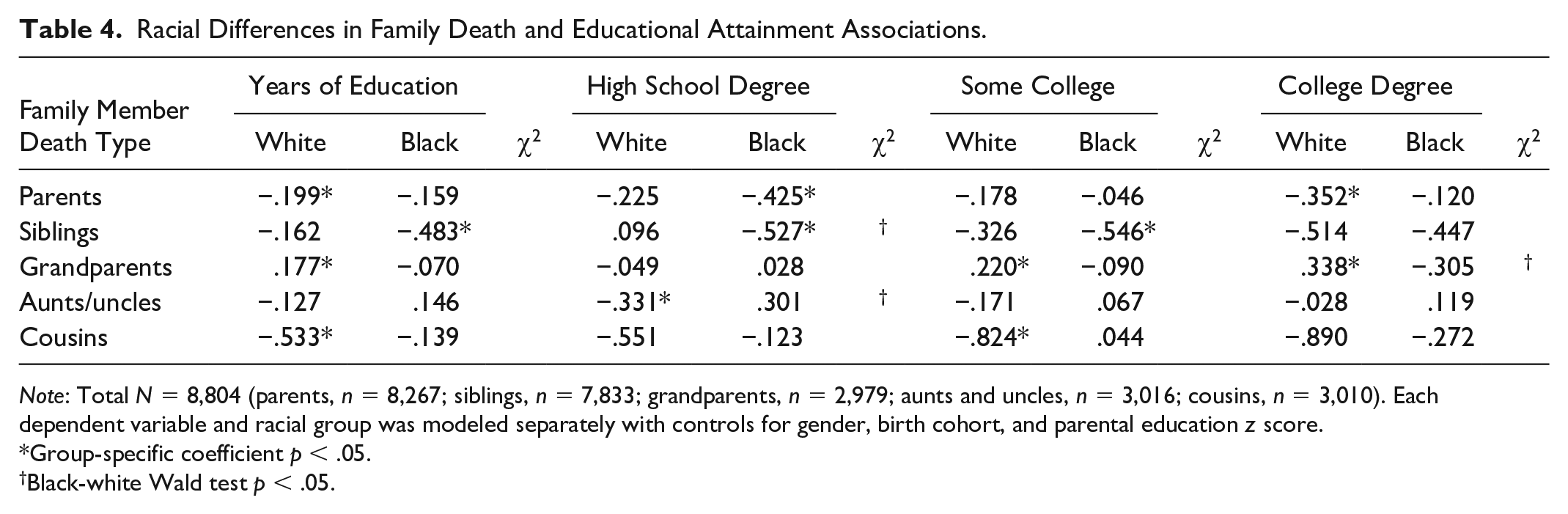
Note: Total N = 8,804 (parents, n = 8,267; siblings, n = 7,833; grandparents, n = 2,979; aunts and uncles, n = 3,016; cousins, n = 3,010). Each dependent variable and racial group was modeled separately with controls for gender, birth cohort, and parental education z score.
Group-specific coefficient p < .05.
Black-white Wald test p < .05.
Two additional death types have significantly different associations with high school graduation by race: sibling and aunt and uncle deaths. For white respondents, sibling deaths have no significant association with high school graduation, whereas such deaths are moderately substantively and statistically significantly, negatively associated with high school graduation for black respondents (difference in predicted probability = −.023). A different pattern is observed for aunt and uncle deaths, however, as these deaths are negatively and statistically significantly (but not substantively significantly) associated with high school graduation for white respondents (difference in predicted probability = −0.005) yet positively but insignificantly associated with high school graduation for black respondents.
The results in Table 4 are unlikely to be due to chance alone. Neither the race-specific hypothesis tests nor the cross-race Wald test hypothesis test results are likely to be due to chance alone: of the 20 hypothesis tests for Whites, 8 are statistically significant (compared with an expected count of 1 due to chance); of 20 hypothesis tests for blacks, 4 are statistically significant (rather than 1 due to chance); and of 20 cross-race hypothesis tests, 3 are statistically significant (rather than 1 due to chance). We interpret these results to mean that for whites, grandparent death is associated with a substantive increase in the probability of attending and especially graduating from college, whereas black respondents do not reap these positive associations but are subject to negative associations with sibling deaths.
Finally, we test whether results vary by decedent family member gender, assessed using Wald tests presented in Table 5. For all four dependent variables, we find a positive association for grandfather death and a negative association for grandmother death (p < .05). All four of these family member gender differences are statistically significant in the Wald tests. Only one other family member gender contrast is statistically significant: a male cousin’s death is negatively associated with college graduation, but a female cousin’s death is positively associated with college graduation (p < .05). Our male-specific results cannot reject the null hypothesis that the 1 statistically significant coefficient obtained (for sibling deaths on some college) out of 20 hypothesis tests is due to chance alone. However, the number of statistically significant associations for the female-specific models (5) and the number of statistically significant male-female contrasts (5) both exceed the number of statistically significant associations expected due to chance alone (1).
Wald Tests for Differences in Family Death Associations with Educational Attainment by Family Member Gender.

Note: Total N = 8,804 (parents, n = 8,267; siblings, n = 7,833; grandparents, n = 2,979; aunts/uncles, n = 3,016; cousins, n = 3,010). All models control for the focal respondent’s race, gender, birth cohort, and parental educational z score. Coefficients for dichotomous dependent variables are expressed in logits. Focal respondent gender differences in the associations between cousin deaths and years of education could not be tested.
Group-specific coefficients p < .05.
Black-white Wald test p < .05.
Sensitivity Analyses
Testing the “Any Death” Assumption
Our primary analyses model the association between one or more family members’ deaths and educational attainment. This amounts to an assumption that a single death has an equivalent association with education as multiple deaths. To test whether this assumption is reasonable, we used an alternative modeling strategy to estimate two family death coefficients: number of family members deceased and proportion deceased in each relationship category. The first is a dummy variable that equals 1 if the respondent did not experience any kin deaths of that type and 0 otherwise; thus, the coefficients in this model will be in the opposite direction of what we obtained in our primary analysis. The second coefficient equals the mean-imputed number or proportion of family members of that type who died during the 0 to 25 age window. 5 We use this procedure so that we can model number and proportion dead associations without dropping respondents who experienced no such deaths from the model, allowing us to simultaneously estimate the association of any deaths and number of deaths.
Table 6 shows that the “any death” modeling strategy is largely supported by the data. Most of the significant family member death associations are attributable to whether the respondent experienced any such deaths, not the number of deaths. Across the five modeled relationships, four dependent variables, and two indicators of family death extent, we conduct 40 tests of this hypothesis and obtain p values below the .05 threshold three times—one more than we would expect under the null hypothesis. In contrast, 11 coefficients are below the .05 threshold for the association with any death. Together, we interpret these findings as strong evidence in favor of our preferred “any death” modeling strategy and weak but nonignorable evidence supporting associations with the extent of family death.
Tests for Number and Proportion Deceased Associations, by Relationship Type and Education Measure.

Note: Total N = 8,804 (parents, n = 8,267; siblings, n = 7,833; grandparents, n = 2,979; aunts and uncles, n = 3,016; cousins, n = 3,010). Years of education coefficients are expressed as ordinary least squares regression coefficients; all other coefficients are expressed as logits. All models control for the focal respondent’s race, gender, birth cohort, and parental education z score.
p < .05.
Testing the “Any Age” Assumption
Next, our primary models implicitly assume that the associations with family death are age invariant: any death before age 25 is treated equally in the variable definition. To test this assumption, we constructed a focal respondent age at first family death variable categorized in 5-year age windows (0–5, 6–10, 11–15, 16–20, and 21–25). These associations were estimated compared with a reference category for no such deaths in the 0 to 25 age window. To test the assumption that these associations are statistically equivalent, we conducted Wald tests of the joint significance of these coefficients to one another. Results are presented in Table 7 as F statistics for the years of education models and χ2 statistics for educational threshold models. We were not able to estimate these models for cousin deaths, because of their relative rarity. For the other relationship types, of the 16 tests that we performed, 4 showed statistically significant evidence of timing associations: parent and sibling death on years of education, parent death on high school graduation, and sibling death on some college outcomes.
Test Statistics for Family Member Death Timing Associations, by Dependent Variable and Relationship.

Note: Total N = 8,804 (parents, n = 8,267; siblings, n = 7,833; grandparents, n = 2,979; aunts and uncles, n = 3,016). The test statistics provided test the statistical equivalence of family death associations with education by 5-year age windows.
p < .05.
Substantively, the models for which we observe significant timing associations indicate the potential for critical periods. For parental deaths, deaths before the age of 10 (p ≤ .10) and between 16 and 20 (p ≤ .01) show stronger evidence of negative associations with years of education. The same patterns are observed for high school outcomes, though they are not statistically significant individually. For sibling death associations, there was a significant positive association with years of education in the 0 to 5 age window, followed by negative associations for each window between 11 and 25. For the some college outcomes, the 0 to 5 age window association was not estimable, but we do see evidence of stronger negative associations in later age windows. Together, these findings cast doubt on the validity of the “any age” assumption for parents and siblings but suggest that it is more reasonable for extended kin deaths.
Accounting for Unobserved Heterogeneity Bias
Next, we provide a fixed-effects analysis that complements our previously documented main results. These tests take advantage of the fact that each person who dies has different relationships to various other individuals in the PSID data, which allows us to rule out unobserved heterogeneity regarding the decedent and to partially identify how relationship to the decedent may matter for educational outcomes. In other words, because the same individual decedent may be a parent to one focal respondent and an aunt or uncle to another, unobserved characteristics of the decedent cannot explain differential consequences for the educational attainments of his or her child and niece or nephew.
These results are presented in Table 8, using grandparent deaths as the reference category because they are the most common. Here, compared with grandparent deaths, cousin deaths are associated with fewer years of educational attainment (ns), parent and aunt and uncle deaths are associated with significantly (p < .05) lower probabilities of high school graduation, and sibling and cousin deaths are associated with significantly (p < .05) lower probabilities of college attendance. No differential associations of college graduation are observed by decedent relationship. Joint significance tests (not shown) confirm that the total association of relationships to the same decedent are statistically significant for years of education (p = .059) and college attendance (p = .032).
Fixed-Effects Regression Models of Educational Attainment by Family Member Death Status.
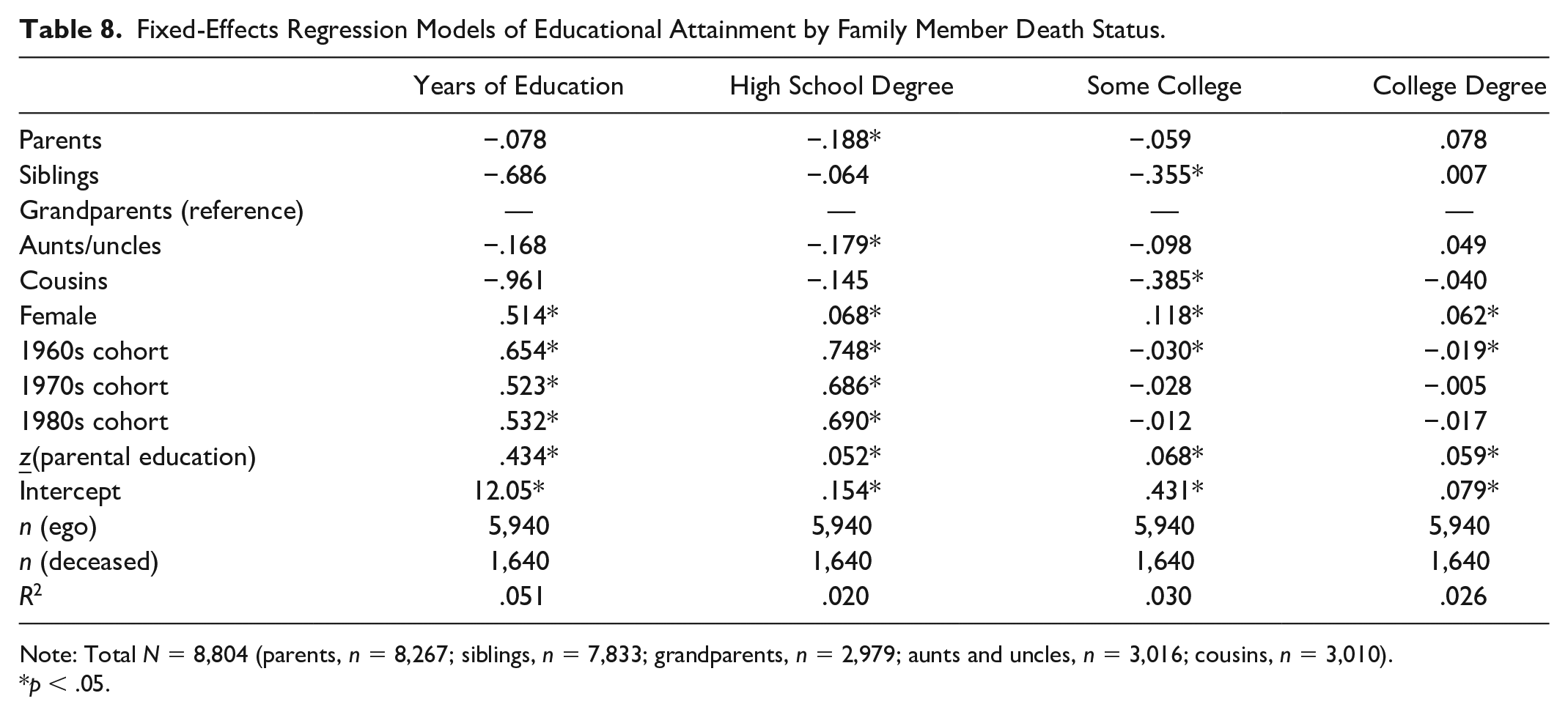
Note: Total N = 8,804 (parents, n = 8,267; siblings, n = 7,833; grandparents, n = 2,979; aunts and uncles, n = 3,016; cousins, n = 3,010).
p < .05.
Other Sensitivity Tests
In the Supplemental Appendix, we report on additional sensitivity tests that we performed. For example, we find only marginal evidence that the association between family death and educational attainment varies by focal respondent gender (Supplemental Appendix Table A). We also exploit the timing of relative deaths to show that sibling death associations are robust to unobserved heterogeneity concerns, but grandparent death associations may not be (Supplemental Appendix Tables B and C).
Discussion
Children’s experiences with family death may influence their outcomes because, in a family, “the misfortune of one member is shared through relationships” (Elder 1998:3). In this article, we respond to calls for more work on disparities in extended family members’ death (Umberson 2017; Umberson et al. 2017) and the multigenerational production of inequality (Gilligan, Karraker, and Jasper 2018; Mare 2011). We use longitudinal, population-based data from the PSID to test the association between experiencing a family member’s death during childhood and adolescence—extending beyond the standard focus on immediate family members to consider extended ones—and young adults’ subsequent educational outcomes. We find that this experience represents an important transition within children’s and adolescent’s family systems and has diverse associations with life course educational attainment.
We make two main contributions to the literature. First, we provide a theoretical and empirical contribution by connecting the deaths of a diverse range of family members to core life-course concepts. Second, we demonstrate that the experience of family death during childhood and adolescence has both negative and positive associations with educational attainment, an idea clearly anticipated in life-course and family-systems theory but not heretofore explored. These ideas build upon prior scholarship to expand considerations of family death experiences as a source of social stratification.
Our findings suggest that family death matters for educational attainment outcomes—but, perhaps surprisingly given prior literature’s focus on negative outcomes (though anticipated through life-course theory), the association can be both positive and negative. Our findings also indicate that contexts of race and relationship to the decedent in terms of both role and gender (e.g., grandmothers vs. grandfathers) strongly shape how these consequences play out. As life-course theory anticipates, key educational thresholds frequently show variable associations with kin death, though the pattern across thresholds varies considerably by relationship to the decedent. Future research should examine the mechanisms underlying these variable patterns.
Similar to Kain (2009) and Umberson et al. (2017), we find differential exposure to family death by race, with black children being more likely to experience family death than white children. Deep social inequality exacerbates racial disparities for both health and mortality risk for black Americans (Phelan and Link 2015), resulting in generally poorer health and higher likelihoods of mortality thus exposing black children to higher rates of family death (Daw et al. 2016; Umberson et al. 2017). Death is therefore one social mechanism through which social inequality accumulates and reproduces itself through a multigenerational process (Gilligan et al. 2018). Moreover, the social inequality and stratification by race in terms of health and mortality outcomes is intimately linked with the socioeconomic status attainment of black Americans (Boen et al. 2020). In response to this elevated burden, black families may provide a different context and understanding of these events and may offer greater support and increased investment to the children who experience them (Hill 2003). Experiences of death by race, the cumulative disadvantage that minority children may face, and the explanatory mechanisms in this association are important areas of further research. These considerations are all the more important in light of the massive mortality shock the United States is currently experiencing from the coronavirus disease 2019 crisis, in which bereavement burdens are not equally distributed across racial groups (Verdery et al. 2020).
We also find that relationship to the decedent, or “who” is lost (Riley 1968:24), in terms of both role and gender, matters for the repercussions of linked lives. For instance, grandparent deaths have no significant association with educational attainment, but this may be due to the gender difference we discover: a grandfather death is associated with positive educational outcomes, while a grandmother death has a negative association. As grandparents continue to share longer periods of the life course with their grandchildren (Uhlenberg 1980), this issue warrants further study. One potential mechanism for these differences is the investment of time and money, which interact in important ways with traditional gender and family roles. On one hand, women are more traditionally the kin keepers within families (Bracke et al. 2008; Hagestad 1986) and therefore may be providing emotional support, leading to greater psychological effects on the child. On the other hand, grandfathers may have a positive association with education for children because of the downward transfer of financial resources across generations (Albertini, Kohli, and Vogel 2007). As more women continue to provide greater financial support to families, and male family members provide more caregiving, these patterns may change.
These differences in “who” is lost matter for each connection to family members. For instance, similar to grandparents we can also think across generational lines whereby the loss of a parent may be associated with both psychological and economic status implications, whereas the loss of a sibling may affect the child through emotional strain but infuse resources due to the loss. Such mechanisms may also underpin our findings about how losses manifest at different educational thresholds. For example, after a sibling dies, grades may suffer in a way that precludes college attendance, whereas the death of a parent may necessitate finding employment and dropping out of high school. We leave investigation of these mechanisms to future work. Additionally, the particular tie and effect of death on a child may depend upon the familial organization including coresidential status within multigenerational households. Future research should explore the potential resources that particular family members provide to children to better understand the impact on children of loss—both of certain family members and of resources.
Our study had limitations. First, the design of the PSID data allows us to follow only certain family members. Prior work refers to this as the “missing half” problem, whereby only part of a person’s extended family may be measured (Daw et al. 2016). Thus, some portion of what we define as the reference category, those who did not experience family death, in fact did so, which could bias our estimates toward zero. Relatedly, we are limited by the small sample numbers of deaths for some family members, such as cousins, and an inability to examine interracial families. Only 9 percent of households within the PSID are different-race households. Ignoring such groups is unlikely to overturn our central conclusions here, but as families become more diverse it will be increasingly important to study how mixed-race families respond to these and other processes. In addition, when trying to understand the interactive associations among race, gender, age, and experience of family death, some cross-classified groups have limited statistical power. Although we controlled for parental education (and used fixed-effects models to understand some of our conjectures), other important social and economic characteristics of family members also may affect children’s educational outcomes and warrant further investigation in future research. To be in our study, family members need not be coresidential. A wide body of work tests residential status differences by race (e.g., Reyes 2018); future work could further disentangle how coresidential status interacts with experiences of family death. As families continue to become more complex over time, data sets that follow family members as they break up and spread out will become increasingly important.
Our results highlight the importance of supporting data sets such as the PSID, which have excellent capacities for collecting extensive family data over time. Other sources with some longitudinal family data include the Wisconsin Longitudinal Survey, the National Longitudinal Study of Adolescent to Adult Health, the Health and Retirement Survey, and the Fragile Families and Child Wellbeing Study; each of these may benefit from further attention to enrolling cohorts of extended family members. Future research that uses other data sets that provide children’s rich family histories could investigate the changing nature of family death experiences across cohorts. For instance, Umberson et al. (2017) compared the incidence and prevalence of family death between very different cohorts of respondents in the Health and Retirement Survey and the National Longitudinal Survey of Youth; future work could compare associations between the deaths of immediate and extended family and educational attainment across these sources. Finally, our analysis is limited to the context of the United States and the PSID; we encourage comparative analysis using data from a variety of demographic and familial contexts.
We focus on family death during childhood and adolescence to understand how these events might affect individuals over the life course and contribute to cumulative inequality. As with other family disruptions, the childhood and adolescent experience of family member deaths has complex associations with educational attainment. Yet these transitions also contribute to stratification. Our findings lend further support to the idea that racial differences in experiences of death may be a “largely overlooked area of racial disadvantage” (Umberson et al. 2017:915) in the family literature. In addition, our work highlights the importance of understanding the resources and roles that particular family members, such as grandfathers and grandmothers, provide to children. As family members continue to have longer periods of linked lives and experience increasing family diversity, this area of research will continue to be important for understanding how families influence and are influenced by patterns of inequality.
Supplemental Material
sj-docx-1-srd-10.1177_2378023120975594 – Supplemental material for Linked Lives and Childhood Experience of Family Death on Educational Attainment
Supplemental material, sj-docx-1-srd-10.1177_2378023120975594 for Linked Lives and Childhood Experience of Family Death on Educational Attainment by Sarah E. Patterson, Ashton M. Verdery and Jonathan Daw in Socius
Footnotes
Acknowledgements
We thank Emily Smith-Greenaway for comments.
Funding
The authors disclosed receipt of the following financial support for the research, authorship, and/or publication of this article: Data collection for the PSID was partly supported by the National Institutes of Health (R01 HD069609) and the National Science Foundation (1157698). We also acknowledge assistance provided by the National Institute on Aging of the National Institutes of Health (T32AG000221), the Population Research Institute, which is supported by an infrastructure grant from the Eunice Kennedy Shriver National Institute of Child Health and Human Development (R24HD041025), a Family Demography Traineeship (T32HD007514), and the Institute for CyberScience at Penn State. Additionally, we acknowledge assistance from the Joint Programming Initiative, More Years Better Lives funding from the Canadian Institute of Health Research (MYB-150262), and Social Sciences and Humanities Research Council (435-2017-0618, 890-2016-9000). The content is solely the responsibility of the authors and does not necessarily represent the official views of the National Institutes of Health.

Notes
Author Biographies
References
Supplementary Material
Please find the following supplemental material available below.
For Open Access articles published under a Creative Commons License, all supplemental material carries the same license as the article it is associated with.
For non-Open Access articles published, all supplemental material carries a non-exclusive license, and permission requests for re-use of supplemental material or any part of supplemental material shall be sent directly to the copyright owner as specified in the copyright notice associated with the article.
