




Abstract
Research shows that lesbian, gay, bisexual, transgender, and queer (LGBTQ) student groups facilitate LGBTQ students’ personal development. Nevertheless, we know little about the prevalence of LGBTQ student groups and why some colleges and universities are home to LGBTQ student groups while others are not. Drawing on our original database of officially recognized LGBTQ student groups across all four-year, not-for-profit U.S. colleges and universities, we first show that LGBTQ student groups can be found at 62 percent of U.S. colleges and universities. Guided by social movement theory, and employing logistic regression analyses, we then show that LGBTQ groups are more likely to be present in favorable political contexts (Democratic-leaning states), favorable educational sectors (public and secular schools), and schools that have the human and organizational resources necessary to support them. The study advances scholarship on LGBTQ issues in higher education and holds important practical implications for students working to promote LGBTQ inclusion in U.S. schools.
Introduction
Lesbian, gay, bisexual, transgender, and queer (LGBTQ) people have made substantial legal progress in the United States. Just two decades ago, no states recognized same-sex marriage, most states allowed people to be fired on the basis of their sexual orientation and/or gender identity, and more than a dozen states criminalized sexual intercourse between two consenting same-sex adults (Movement Advancement Project 2020). Today, as a result of Supreme Court rulings, same-sex marriages are recognized by every state, employment discrimination on the basis of sexual orientation and gender identity is prohibited, and so-called anti-sodomy laws have been struck down (Movement Advancement Project 2020).Despite these rapid gains, LGBTQ people in the United States still face significant challenges. On U.S. college and university campuses, for example, LGBTQ students face problems ranging from formal discrimination (Coley 2018b) to microaggressions, bullying, and harassment (Chica 2019; Craig et al. 2017; Hughes 2019). These problems, in turn, contribute to higher rates of depression and suicidal ideation among LGBTQ college students (Craig et al. 2017; Wolff et al. 2016; Woodford, Kulick, and Atteberry 2015; Woodford, Weber, et al. 2018).
A growing body of research has demonstrated the role that LGBTQ groups play in addressing problems faced by LGBTQ students. For example, research shows that students who join LGBTQ groups are less likely to experience depression (Kulick et al. 2017; Woodford, Kulick, et al. 2018) and more likely to develop positive personal relationships (Fetner and Elafros 2015). 1 LGBTQ student groups also play an important role in improving the campus climate for all LGBTQ students, whether they participate in such groups or not (Hughes 2020; Marx and Kettrey 2016), and they inspire many students to engage in activism both within and outside the confines of their schools (Coley 2018a; Renn 2007; Renn and Bilodeau 2005; Schmitz and Tyler 2018).Yet despite the demonstrated value of LGBTQ student groups, we currently know little about the prevalence of LGBTQ student groups and the types of school where LGBTQ student groups are most likely to be found. To date, only a few quantitative studies have systematically examined the presence of LGBTQ student groups or student centers at U.S. colleges and universities, and these studies are limited in their focus either by geographic scope—for example, Kane (2013) examines the establishment of LGBTQ student groups in a single state, North Carolina—or by educational sector—Coley (2017, 2020) examines LGBTQ student group formation at Christian colleges and universities. We simply lack an understanding of why some U.S. colleges and universities, beyond single states or particular educational sectors, might be home to LGBTQ student groups while other schools still lack them.
To both quantify and explain the presence of LGBTQ student groups on college and university campuses, we constructed an original, comprehensive data set of officially recognized LGBTQ student groups across all 1,953 four-year, not-for-profit colleges and universities in the United States. Building on political opportunity and educational opportunity theories of social movement mobilization, we assess the possibility that LGBTQ groups are more likely to be present in favorable political contexts (e.g., in blue states) and in favorable educational contexts (e.g., in public and secular schools). Additionally, building on resource mobilization theory, we consider whether LGBTQ groups are more likely to be present at schools that have the human and organizational resources necessary to form and/or sustain them (e.g., at schools with larger numbers of students, a higher percentage of women students, and Democratic student organizations). We find strong support for the association between political opportunities, educational opportunities, school resources, and the presence of LGBTQ student groups.
The study makes several contributions. First, we contribute the only study to date of LGBTQ groups across all four-year, not-for-profit U.S. colleges and universities, showing that LGBTQ groups can currently be found at the majority (62 percent) of such colleges and universities nationwide. 2 Second, we build on other studies that have linked political opportunities and school resources to the presence of LGBTQ student groups (Fetner and Kush 2008; Fine 2012; Kane 2013; McEntarfer 2011) but advance the literature by also assessing the association between educational opportunities and the presence of LGBTQ student groups. Finally, through our analysis of the opportunities and resources associated with the presence of LGBTQ student groups at U.S. colleges and universities, we contribute practical insights into the environments most conducive to LGBTQ student groups. We elaborate on these findings and their implications later in the article, but first we describe our theoretical approach and outline our methods of data collection and our analytic strategy.
Theorizing the Presence of LGBTQ Student Groups at U.S. Colleges and Universities
To explain the presence of LGBTQ student groups at U.S. colleges and universities, we follow other scholars of LGBTQ student groups by drawing on theories from the subfield of social movement studies (Fetner and Kush 2008; Fine 2012; Kane 2013; McEntarfer 2011). Why social movement theory? Although early social movement theorists focused on activist groups that deployed direct action tactics in pursuit of governmental policy changes (e.g., McAdam 1982), recent scholarship has sought to broaden scholars’ understanding of the types of activities and goals that might be associated with activist groups. For example, in his study of LGBTQ student groups at Christian colleges and universities, Coley (2018a) identifies three ideal-typical forms of LGBTQ student groups. First, direct action groups deploy extra-institutional protest tactics (such as rallies, sit-ins, and marches) in pursuit of policy changes at their schools (e.g., changes in nondiscrimination policies). Second, educational groups employ more institutionalized, conciliatory educational tactics (such as lectures, movie showings, and Safe Zone trainings) in attempts to transform campus cultures (e.g., to reduce bullying and increase acceptance of LGBTQ people on campus). Finally, solidarity (or affinity) groups simply work to construct a safe space on campus for LGBTQ students to meet each other and support each other’s personal growth. Although the methods and goals of these LGBTQ groups differ, they all seek to facilitate some type of change on their campuses and thus can be conceptualized as activist groups. In this section, we draw insights from several theories in social movement studies to suggest ways that political opportunities, educational opportunities, human resources, and organizational resources might facilitate the presence of LGBTQ groups at U.S. colleges and universities.
Political Opportunities
In social movement studies, political opportunity theories were borne out of an awareness that the political context can either enable or constrain social movement mobilization (McAdam 1982). When politicians signal that they are favorable to a given cause, activist groups that seek to advance that cause are more likely to emerge, grow, survive, and succeed (McAdam 1982). This is because favorable political opportunities can shape people’s sense of “what is possible” (Johnston 2011:28), inspiring even highly marginalized groups to form organizations and/or continue mobilizing for change.
A key indicator of a favorable political environment for LGBTQ people is a state’s support for Democratic presidential candidates. In the most recent presidential election, for example, Democratic presidential candidate Hillary Clinton issued statements of support for same-sex marriage, federal nondiscrimination laws inclusive of sexual orientation and gender identity, and policies ensuring that transgender students have equal access to schools. In contrast, Republican presidential candidate Donald Trump issued fairly ambivalent statements about the rights of LGBTQ people, and once in office, Trump quickly moved to roll back LGBTQ-inclusive policies (Zezima and Callahan 2016). Indeed, in one of his first acts in office, the Trump administration announced that it no longer considered Title IX of the Educational Amendments of 1972 to protect students on the basis of gender identity or gender expression and thus made it clear that it would not investigate colleges and universities that denied transgender students equal access to bathrooms, locker rooms, and residence halls (Kreighbaum 2017). Trump’s supporters, moreover, were less supportive of LGBTQ rights such as same-sex marriage and antidiscrimination policies than were Clinton’s supporters (Kaufman and Compton 2020).A state’s support for Democratic presidential candidates, then, may send a signal to LGBTQ students in that state that they live in a relatively liberal, accepting environment and thus that an LGBTQ student group could emerge or continue to thrive at their school. Past studies have indeed uncovered an association between a state’s support for Democratic presidential candidates and the presence of LGBTQ student groups (Coley 2017, 2020) or LGBTQ student centers (Fine 2012). 3 We assess a similar possibility here, employing a state’s support for Hillary Clinton in 2016 as a proxy for a state’s Democratic leanings:
Hypothesis 1. Colleges and universities located in states that cast more (in percentages) votes for the Democratic presidential candidate in 2016 are more likely to have LGBTQ student groups.
Educational Opportunities
Extending the insights of political opportunity theorists, social movement scholars have recently identified characteristics of educational opportunity structures that might enable or constrain campus activism (Coley 2021; Reger 2018). Coley (2021), for example, argues that public colleges and universities offer more opportunities for the formation of campus groups than private colleges and universities because public schools are “by definition less exclusive spaces than private schools” and are required by federal courts to allow students to form organizations that represent diverse backgrounds and viewpoints (p. 180). Private colleges and universities, by contrast, have more latitude to restrict different groups’ abilities to operate on campus. Although little past research explicitly assesses whether schools’ public or private statuses affect the ability of students to form or maintain LGBTQ student groups, Fine (2012) has shown that public schools are more likely to be home to LGBTQ student centers. Thus, we expect public schools will be more conducive to LGBTQ student groups:
Hypothesis 2. Public colleges and universities are more likely to have LGBTQ student groups than are private colleges and universities.
In his work on educational opportunity structures, Coley (2021) argues that religious schools (all of which are private) offer even fewer opportunities for the formation of campus groups than do secular schools (which can be public or private) because religious schools possess the ability to discriminate on the basis of characteristics that might normally be protected by state and/or federal laws, including sexual orientation and gender identity. Indeed, analyzing data collected in 2013, Coley (2017) shows that a minority (45 percent) of Christian colleges and universities are home to LGBTQ student groups. Additionally, 31 percent of Christian colleges and universities go so far as to ban so-called homosexual acts or homosexual behavior in their student handbooks (Coley 2018b). Comparing secular schools to religious schools in North Carolina, Kane (2013) finds that religious schools are less likely than secular schools to be home to LGBTQ student groups. Based on this past theorizing of educational opportunity structures, along with past empirical research on LGBTQ student groups, we thus expect that the secular colleges and universities in our study will be more conducive environments for LGBTQ student groups:
Hypothesis 3. Secular colleges and universities are more likely to have LGBTQ student groups than are religious colleges and universities.
Human Resources
Resource mobilization theories in social movement studies suggest that activist groups are more likely to exist when marginalized groups have access to resources (Edwards and McCarthy 2004; McCarthy and Zald 1977). Even in contexts rich with opportunities, if marginalized groups are unable to either generate new resources or appropriate existing resources to support their mobilization efforts, LGBTQ groups are unlikely to form or survive. We consider the role that human resources and organizational resources might play in the establishment and continuation of LGBTQ student groups at U.S. colleges and universities.
First, LGBTQ groups are unlikely to exist at schools lacking in “human resources”—that is, leaders, members, and allies (Edwards and McCarthy 2004:127–28). Without people who would be willing to lead and participate in a group, LGBTQ student groups would not be able to exist. Past scholarship on LGBTQ groups thus first suggests that schools with larger numbers of students are more likely to have LGBTQ student groups. Although we lack data on the number of LGBTQ students at each college and university, it is likely that as the size of a student body grows, the number of LGBTQ students at a school and straight allies at a school will grow (Coley 2017, 2020; Fetner and Kush 2008; Fine 2012):
Hypothesis 4. Colleges and universities with larger student bodies are more likely to have LGBTQ student groups.
Schools with more women students may be more likely to have LGBTQ student groups. One reason is that women in the United States are marginally more likely to personally identify as LGBTQ than are men (Gates 2017). Second, many straight, cisgender women who do not identify as LGBTQ may nevertheless join LGBTQ student groups as a way to show their support for the LGBTQ community. Indeed, a common stereotype of LGBTQ groups in high schools is that they draw gay men and their straight women friends (Miceli 2005; Pascoe 2012:chap. 5). Although this may be less true of LGBTQ groups at colleges and universities, straight, cisgender women are simply more likely to identify as allies of the LGBTQ community than are straight, cisgender men (Moon 1995; Worthen 2012) and thus might contribute to a welcoming campus climate that fosters LGBTQ student mobilization. 4 We assess this possibility in our fifth hypothesis:
Hypothesis 5. Colleges and universities with higher percentages of women students are more likely to have LGBTQ student groups.
Organizational Resources
Finally, beyond “human resources,” LGBTQ student groups may benefit from access to “organizational resources” (Edwards and McCarthy 2004:127); specifically, LGBTQ student groups may be more likely to form and/or sustain themselves when they can appropriate the resources of other existing organizations on a campus. Democratic student organizations represent an organization possessing resources that would be of great value to LGBTQ student groups. First, they comprise members who would likely be supportive of LGBTQ rights and who might be interested in joining or supporting an LGBTQ student group (Holland, Matthews, and Schott 2013; Kaufman and Compton 2020). Second, they possess leaders who also are likely to be supportive of LGBTQ rights and who might be willing to lend their expertise in structuring organizations or navigating their schools’ bureaucracies. Although past quantitative studies of LGBTQ groups do not consider the association between the presence of Democratic student organizations and the presence of LGBTQ student organizations in schools, quantitative studies do show that college students who identify as Democrats are more likely to be supportive of the LGBTQ community in general (Holland et al. 2013). Also, qualitative research provides evidence that Democratic student organizations have supported LGBTQ organizations’ efforts to exist on college and university campuses (Coley 2018a:16, 119). We thus assess this final hypothesis:
Hypothesis 6. Colleges and universities that are home to Democratic student organizations are more likely to have LGBTQ student groups.
Data and Methods
To quantify and explain the presence of LGBTQ student groups, we constructed an original, comprehensive database of LGBTQ college and university student groups. We began by obtaining a list of all four-year, not-for-profit U.S. colleges and universities from the U.S. Department of Education (http://nces.ed.gov/ipeds). The initial list contained 2,026 schools; however, after visiting the website of each school, we removed 73 from the list that had shut down, were online only (prior to COVID-19), or had been misclassified (e.g., some were actually community colleges). Thus, our final list contains 1,953 colleges and universities across the 50 U.S. states. We constructed the database in December 2019 and January 2020.
Dependent Variable
To construct our dependent variable—a simple measure of whether a school has an LGBTQ student group—we first visited the student organization websites of each college and university contained in our database. Specifically, we located either a static web page that listed all student organizations at a school or a searchable database containing separate web pages for each student organizations at a school, and we searched for LGBTQ student groups using the keywords “LGBT,” “LGBTQ,” “gay,” “lesbian,” “queer,” “GSA [Gay-Straight Alliance],” “Equality,” “Spectrum,” “Prism,” and “Alliance.” If none of these keywords led us to relevant LGBTQ student organizations listed on these official student organization pages, we then conducted Google searches using the name of each specific college or university along with the keyword “LGBTQ.” 5 If either of these methods led us to evidence that a school had an officially recognized LGBTQ student group as of the 2019–2020 school year, we recorded a “1”; otherwise, we recorded a “0.” 6
Independent Variables
For our key measure of political opportunities—state support for the Democratic Party—we constructed a variable for the percentage of votes cast for the Democratic presidential candidate in 2016, Hillary Clinton, for each state (US Election Atlas 2020). To construct our measures of educational opportunities, we drew on data from the U.S. Department of Education (Integrated Postsecondary Educational Data System [IPEDS] 2018) to construct dummy variables indicating whether schools are “public” (rather than private) and “secular” (rather than religious). Similarly, to construct measures of schools’ human resources, we drew on U.S. Department of Education data (IPEDS 2018) to construct variables for the number of students at a school and the percentage of women students at a school. We log the number of students variable because this variable is highly right skewed. Finally, for our measure of a relevant organizational resource, we constructed a variable indicating whether a school was home to a Democratic student organization. Specifically, we again visited the student organization web pages of the schools contained in our database and searched for a Democratic student organization using the keywords “Democrat(s)” and “Democratic.” If these keywords did not lead us to official documentation that these schools had Democratic student organizations, we then conducted subsequent Google searches using the name of each school along with the keyword “Democrats.” When we uncovered evidence that a school had a Democratic student organization as of the 2019–2020 school year using either method, we recorded a “1” for that variable; otherwise, we recorded a “0.”
Control Variables
Our focus is on assessing political opportunity, educational opportunity, and resource mobilization approaches to LGBTQ student group presence. However, Fetner and Kush (2008) have linked two other variables—schools’ presence in rural versus nonrural areas and in Southern versus non-Southern states—to the presence of LGBTQ student groups in a slightly different context (U.S. high schools), with the logic that rural areas have traditionally been less hospitable to LGBTQ people than more urban areas and states in the South have historically been much more resistant to the expansion of LGBTQ rights than have non-Southern states. 7 Fetner and Kush (2008) indeed find that high schools outside rural areas and outside the South are more likely to be home to LGBTQ student groups. Thus, using data from the U.S. Department of Education (IPEDS 2018), we include variables indicating whether a school is located in a nonrural area and outside the South.
Analytic Strategy
Our analysis proceeds in two stages. First, we present descriptive analyses demonstrating the prevalence of LGBTQ student groups at U.S. colleges and universities. Then, we provide results from binary logistic regression analyses, regressing our variable that indicates the presence of an LGBTQ student group at a college or university on the political opportunity, educational opportunity, resource mobilization, and control variables of interest. We provide results from binary logistic regression analyses because of our dichotomous dependent variable, and we employ cluster-robust standard errors to account for clustering by state. We indicate whether variables are statistically significant in our regression tables; however, because we are describing the characteristics of the population of four-year, not-for-profit U.S. colleges and universities, we focus on describing the substantive effects of our independent variables of interest when reporting our results below.
Results
Descriptive Findings
We begin by providing descriptive statistics. Table 1 provides basic definitions of our variables and their associated means, standard deviations, and numerical ranges. As the table indicates, approximately 62 percent of U.S. colleges and universities are home to LGBTQ student groups, providing evidence that LGBTQ students have made inroads at the majority of U.S. colleges and universities.
Descriptive Statistics.
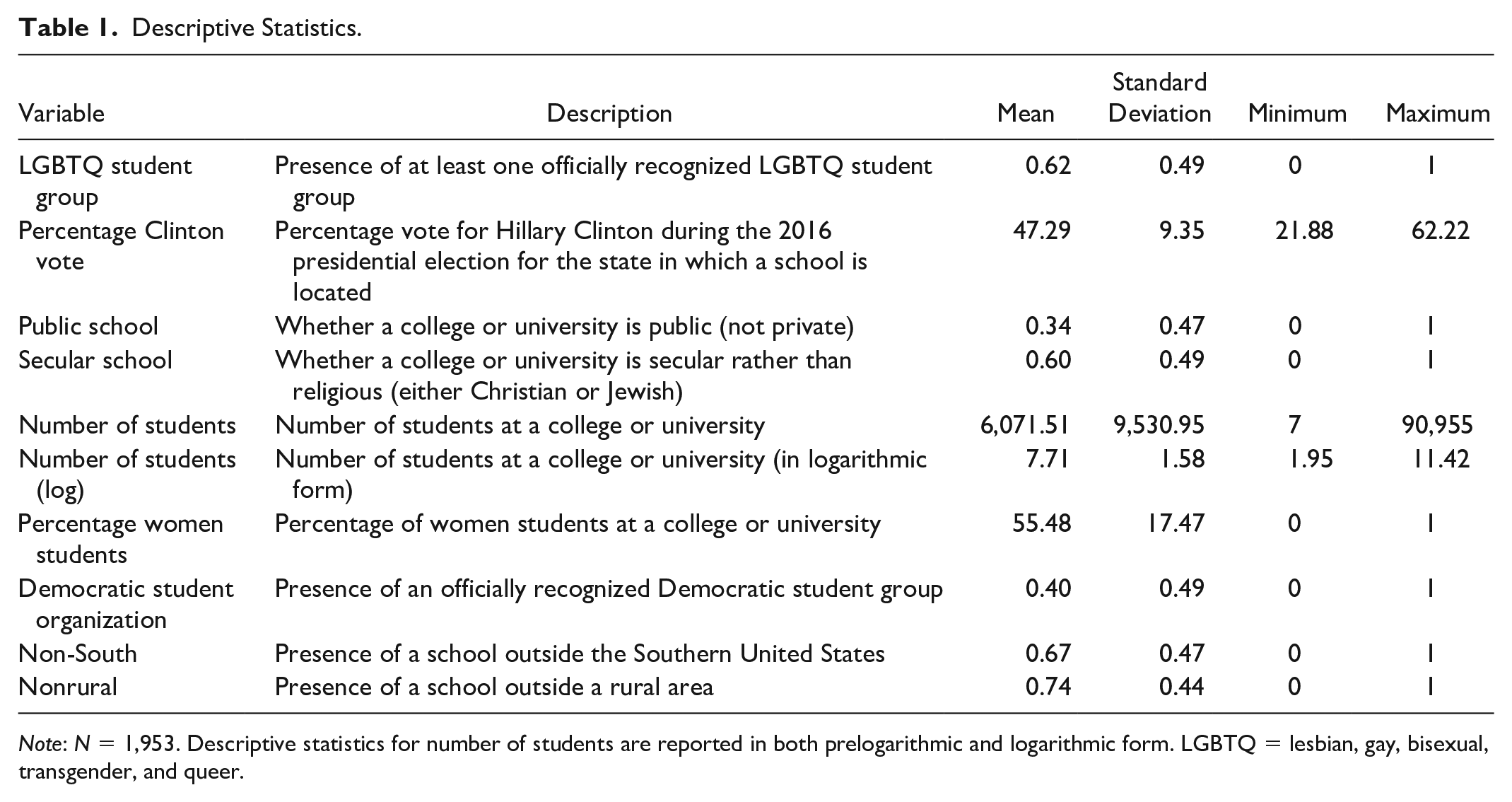
Note: N = 1,953. Descriptive statistics for number of students are reported in both prelogarithmic and logarithmic form. LGBTQ = lesbian, gay, bisexual, transgender, and queer.
Figure 1 provides a map of the United States wherein states in the darkest shade of blue have the highest proportions of colleges and universities that are home to LGBTQ student groups and states in the lightest shade of blue have the lowest proportions of schools that are home to LGBTQ student groups. The 10 states with the highest proportions of colleges and universities with LGBTQ student groups—Colorado, Connecticut, Maine, Massachusetts, Nevada, New Hampshire, Pennsylvania, Rhode Island, Washington, and Wyoming—nearly all voted for the Democratic presidential candidate in 2016, with the only exceptions being Pennsylvania (which had voted for Democratic presidential candidates for several cycles prior to 2016) and Wyoming (which is the only state that has only one four-year college or university, the University of Wyoming). All of these states are outside the South. By comparison, the 10 states with the lowest proportions of colleges and universities with LGBTQ student groups—Alabama, Alaska, Delaware, Hawaii, Idaho, Louisiana, Mississippi, Montana, Oklahoma, and Tennessee—mostly gave their electoral votes to the Republican presidential candidate (Donald Trump) in 2016. The only exceptions are Delaware and Hawaii, which are surprisingly the two states with the lowest proportions of colleges and universities that contain LGBTQ student groups; only 40 percent of colleges and universities in Delaware and only 22 percent of colleges and universities in Hawaii have LGBTQ student groups.

Proportion of schools with lesbian, gay, bisexual, transgender, and queer groups, by state.
Logistic Regression Analyses
Table 2 provides results from binary logistic regression analyses. Model 1 includes the political and educational opportunity variables, model 2 includes the human and organizational resource variables, model 3 includes all independent variables, and model 4 includes all independent variables along with the two control variables. As model 1 in Table 2 indicates, schools in states that cast a higher share of votes for the 2016 Democratic presidential candidate (Hillary Clinton) tend to be more hospitable environments for LGBTQ student groups. Controlling for other variables, the odds of a school’s having an LGBTQ student group are approximately 2 percent higher for every 1 percent increase in a state’s vote for Clinton in 2016 (e0.017 = 1.02 odds ratio). Additionally, public and secular schools tend to be friendlier environments for LGBTQ student groups. Holding the other variables in the model constant, the odds of having an LGBTQ group are 321 percent higher for public schools as compared to private schools (4.21 odds ratio), although this effect weakens once the variable for student body size is included in later models, and the odds of having an LGBTQ group are 118 percent greater for secular schools as compared to religious schools (2.18 odds ratio). Note that the Nagelkerke indicator of model fit is approximately 0.22.
Logistic Regression Models for Lesbian, Gay, Bisexual, Transgender, and Queer Student Groups.

Note: N = 1,953. Values are unstandardized coefficients with standard errors clustered by state.
p < .05. **p < .01. ***p < .001 (two-tailed tests).
Model 2 of Table 2 shows that schools are more likely to have LGBTQ student groups as the student body size increases (2.35 odds ratio) and the percentage of women students increases (1.01 odds ratio). Schools with Democratic student organizations also are more likely to have LGBTQ student groups, and the substantive effect of this variable is particularly notable, as the odds of a school’s having an LGBTQ group are 247 percent greater for schools with Democratic student organizations as compared to schools without Democratic student organizations (3.47 odds ratio). Note also that the Nagelkerke indicator of model fit increases from 0.22 (in model 1) to 0.45 (in model 2), indicating that resource variables explain a larger proportion of the variance in LGBTQ student groups across U.S. colleges and universities.
The patterns identified in models 1 and 2 continue to hold in model 3, which includes all variables from models 1 and 2, and in model 4, which adds control variables. The overall portrait of LGBTQ-inclusive schools provided in model 4 suggests that LGBTQ student groups are more likely to be found in Democratic-leaning states (1.02 odds ratio), public schools (1.52 odds ratio), secular schools (1.92 odds ratio), schools with large student bodies (2.12 odds ratio), schools with larger percentages of women students (1.01 odds ratio), schools that are home to Democratic student organizations (4.30 odds ratio), and schools that are located outside the South (2.09 odds ratio). The Nagelkerke measure of model fit is approximately 0.5 in model 4, indicating that these variables account for nearly half of the variance in LGBTQ student groups across U.S. colleges and universities.
Figure 2 graphs the effects of our primary variables of interest on the predicted probabilities of schools’ having LGBTQ student groups and thus facilitates substantive interpretations of our findings. In terms of the political opportunity variable, with all of the other variables in model 4 held at their mean, we find that the predicted probability of schools’ having LGBTQ groups in the most Republican-leaning states is lower (as low as 0.54) than in the most Democratic-leaning states (up to 0.66). In terms of the educational opportunity variables, the probability of private schools’ having an LGBTQ student group is lower (0.60) than for public schools (0.65), while the probability of religious schools’ having an LGBTQ student group is lower (0.55) than for secular schools (0.66). Finally, in terms of the human and organizational resource variables, we find that the predicted probability of schools’ having LGBTQ groups ranges from less than 0.2 for the smallest schools (with 50 or fewer students) to greater than 0.8 for the largest schools (with more than 20,000 students); the predicted probability of schools with all men having LGBTQ groups is lower (0.51) than for schools with all women (0.70); and the predicted probability of schools without Democratic student organizations having LGBTQ student groups is lower (0.52) than for schools with Democratic student organizations (0.75).

Predicted probabilities of schools’ having lesbian, gay, bisexual, transgender, and queer groups, by percentage Clinton vote, public versus private status, secular versus religious status, number of students, percentage women students, and Democratic organization presence.
Discussion
Why are some schools home to LGBTQ student groups whereas others are not? The results confirm the expectations derived from political opportunity theory, educational opportunity theory, and resource mobilization theory. First, political opportunity theory suggests that when governmental leaders express support for a given cause, they inspire organizations that rally around that cause and agitate for further change (Johnston 2011; McAdam 1982). We do find that blue states—in this case, states that cast a higher share of votes for the 2016 Democratic presidential candidate, Hillary Clinton, who expressed public support for LGBTQ rights—are more often home to schools with LGBTQ student organizations. 8 These results align with prior studies that similarly show that state support for previous Democratic presidential candidates like Barack Obama (in 2012) and John Kerry (in 2004) was associated with the presence of LGBTQ student groups or LGBTQ student centers in those states (Coley 2017; Fine 2012). We thus find support for hypothesis 1 (see Table 3).
Summary of the Evaluation of Hypotheses.
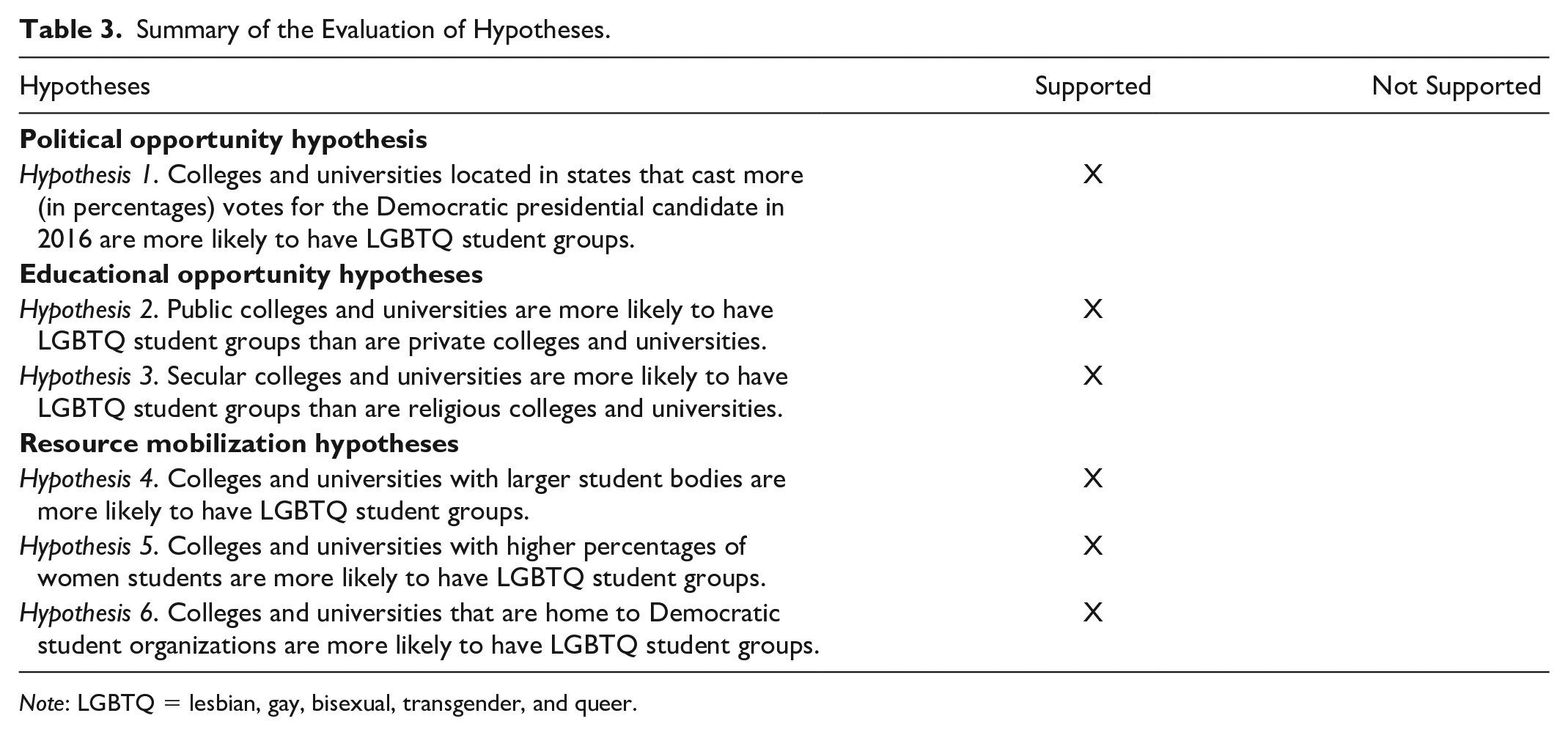
Note: LGBTQ = lesbian, gay, bisexual, transgender, and queer.
Educational opportunity theory suggests that certain characteristics of schools, such as their public versus private status or secular versus religious status, shape students’ ability to form campus activist groups (Coley 2021). We expected that LGBTQ groups would be more likely to exist at public colleges and universities, given that public schools must allow students to form LGBTQ student groups so long as they allow other student groups to form on campus. We did find support for this expectation (hypothesis 2), although the difference in the predicted probability of public schools versus private schools having LGBTQ student groups (0.65 vs. 0.60) was not stark. Given Fine’s (2012) previous finding that the single greatest predictor of a school’s having an LGBTQ student center is whether a school is public rather than private, our results suggest that the factors most associated with LGBTQ student group presence may be slightly different than the factors most associated with LGBTQ student center presence.
We also expected that secular colleges and universities would be more likely to be home to LGBTQ groups since religious colleges and universities have the ability to discriminate against students on the basis of sexual orientation and gender identity. Note that the population of religious colleges and universities in the United States almost exclusively comprises Christian and Jewish schools. We again find strong support for this expectation (hypothesis 3), in line with past literature (Kane 2013). In further examining our data, we find that Jewish colleges and universities are much less likely to be home to LGBTQ groups than are Christian colleges and universities, although this seems to be because most Jewish colleges and universities are quite small, dedicated to rabbinical training, and thus not home to many student organizations of any type. Christian colleges and universities that tend to be home to LGBTQ student groups are associated with the Roman Catholic Church or Mainline Protestant denominations (such as the Disciples of Christ, Episcopal Church, Evangelical Lutheran Church in America, Presbyterian Church USA, United Church of Christ, and United Methodist Church). Christian colleges and universities that tend to lack LGBTQ student groups are associated with historically white Evangelical Protestant denominations (such as the Assemblies of God, Churches of Christ, Nazarene Church, and Southern Baptist Convention) or are nondenominational. Christian colleges and universities associated with historically black Protestant denominations fall in the middle, with about half of schools containing LGBTQ student groups.
A final relevant theory, resource mobilization theory, suggests that activist organizations are more likely to emerge, grow, survive, and/or succeed when they are able to mobilize human resources (e.g., leaders and rank-and-file participants) and appropriate organizational resources (Edwards and McCarthy 2004; McCarthy and Zald 1977). For one of our measures of human resources, we assessed whether schools with larger numbers of students would be more likely to have LGBTQ student groups since these schools would likely have a larger overall number of LGBTQ students and straight allies who might be willing to join LGBTQ student groups, and we found strong support for this expectation (hypothesis 4). We also assessed whether schools with a higher share of women students would be more likely to have LGBTQ student groups since women are slightly more likely to personally identify as LGBTQ, are significantly more likely to support LGBTQ rights, and are more willing to join LGBTQ groups even as straight allies. We similarly found support for this expectation (hypothesis 5), and this finding contrasts with those of past studies that found the percentage of women at a school to be insignificantly or weakly related to LGBTQ student center presence (Coley 2017; Kane 2013). Additionally, for our measure of organizational resources, we considered whether schools that are home to Democratic student organizations might be more likely to be home to LGBTQ student groups, since members of such organizations may contain many supporters of LGBTQ rights who would be willing to join and/or lend their support for LGBTQ groups. No other previous studies had directly assessed this possibility, but we did find strong support for hypothesis 6. 9
Conclusion
A large and growing literature demonstrates the positive impacts of LGBTQ student groups in schools. Studies show that LGBTQ student groups play a positive role in the lives of students, as LGBTQ participants are more likely to develop positive personal relationships and report better mental health than do nonparticipants (Fetner and Elafros 2015; Kulick et al. 2017; Woodford, Kulick, et al. 2018). Some evidence suggests LGBTQ student groups also make schools safer, including by decreasing incidences of bullying and harassment against LGBTQ students in schools (Marx and Kettrey 2016). Nevertheless, previous literature has been mostly silent on the question of why some colleges and universities are home to LGBTQ student groups whereas others are not (though see Kane’s 2013 study on LGBTQ student groups at North Carolina colleges and universities and Coley’s 2017 study on LGBTQ student groups at U.S. Christian colleges and universities).
Through an analysis of our new, comprehensive database of LGBTQ student groups across the 1,953 four-year, not-for-profit colleges and universities in the United States, we have identified characteristics of colleges and universities that are associated with the presence of LGBTQ student groups. Informed by political opportunity theories of social movements, we found first that political context matters: Schools in blue states that cast a larger (percentage) share of votes for Hillary Clinton, the 2016 Democratic presidential candidate, are more likely to be home to LGBTQ student groups. Through an original application of educational opportunity theory (Coley 2021), we show also that educational context matters, as public and secular schools are much more likely to be home to LGBTQ student groups. Finally, guided by resource mobilization theories of social movements, we show that school resources matter: Schools with larger numbers of students, schools with larger percentages of women students, and schools that are home to Democratic student organizations are also more likely to be home to LGBTQ student groups.
Our article represents the most comprehensive study of LGBTQ student groups at U.S. colleges and universities and is the first study to identify correlates of officially recognized LGBTQ student groups across all four-year, not-for-profit U.S. colleges and universities. However, it is important to note what these analyses do not show. First, because our dependent variable indicates only whether a school has an officially recognized LGBTQ student group, our study does not identify all schools where LGBTQ students may currently be mobilizing or all schools that offer programming related to LGBTQ issues. For example, at many conservative Christian colleges and universities, students have formed unofficial or underground LGBTQ student groups that are not included in our data set (Coley 2018a). Also, some schools may sponsor LGBTQ-related programs (such as Safe Zone programs) yet lack LGBTQ student groups. Future studies thus might undertake analyses of unofficially recognized LGBTQ student groups or officially sponsored LGBTQ programs.
Additionally, because we rely on cross-sectional data, we cannot conclusively show that political opportunities and school resources cause the initial formation or establishment of LGBTQ groups. Rather, we show only that political opportunities and school resources are associated with the active presence of LGBTQ student groups (as of the 2019–2020 school year). Although social movements theory would suggest that the political and resource factors we identify should be linked to the initial formation of these groups, it is still possible that just as many LGBTQ groups have been established in less hospitable states and in less resource-rich schools yet quickly folded and are not present in our data. Thus, future studies could further address questions of causality.
Our study should not be understood as having identified all possible ingredients for the successful establishment of LGBTQ groups on college and university campuses. For example, although we link the presence of Democratic student organizations to the presence of LGBTQ student organizations, it is also possible that other types of student organizations (such as feminist student organizations or organizations for students of color) facilitate the formation or active presence of LGBTQ student groups; future studies could explore this possibility. Relatedly, because our study is quantitative in nature, it likely emphasizes structural factors (state characteristics, institutional characteristics) linked to the presence of LGBTQ groups in schools, likely at the expense of agentic processes associated with the establishment of LGBTQ groups on college and university campuses. Qualitative research shows that students must often take up the work of “framing” LGBTQ groups as in line with the institutional missions of their colleges and universities, thus making the groups appealing to students and palatable to administrators (see, e.g., Coley 2018a: chap. 4; Hughes 2020; McEntarfer 2011). Our study should be understood as complementing, but not replacing, this important qualitative work about the establishment of LGBTQ groups at colleges and universities.
Finally, because we focus on only four-year, not-for-profit U.S. colleges and universities, future studies should assess whether state political opportunities, school institutional characteristics, and school resources are similarly associated with the presence of LGBTQ groups in other educational settings, including U.S. community colleges, high schools, and middle schools as well as schools outside the United States. More work is necessary to know whether the characteristics that seem to explain the presence of LGBTQ groups at U.S. colleges and universities are generalizable to other educational sectors and geographical locations.
With that said, our study does hold significant practical implications for LGBTQ students who are working to create LGBTQ-inclusive changes at U.S. colleges and universities. Specifically, our study suggests that LGBTQ students looking to form or join LGBTQ student groups may want to seek out public, secular schools that are located in blue states and that have a large number of students, a relatively high percentage of women students, and Democratic (and perhaps other Left-leaning) student organizations. Conversely, our study identifies types of environments that would present more challenges and barriers for students looking to join or form LGBTQ student groups. Thirty-eight percent of U.S. colleges and universities still lack LGBTQ student groups, and these schools are often private, religious schools that are located in red states and that attract a relatively small number of students, contain a relatively smaller percentage of women students, and lack a Democratic student organization. LGBTQ students at schools with these characteristics may face starker challenges to their health, safety, and well-being (Fetner and Elafros 2015; Kulick et al. 2017; Woodford, Kulick, et al. 2018).
Footnotes
Acknowledgements
The authors thank Jared Fitzgerald, Rachel Schmitz, Corinne Schwarz, the Socius editors, and the anonymous reviewers for providing helpful comments on earlier drafts of this manuscript. The authors also thank Jericho McElroy for providing research assistance and Oklahoma State University’s College of Arts and Sciences for providing financial support for this project.
1
 show that the effects of campus engagement on mental health are contingent on race: “For White LGBTQ students, engagement in student leadership appears to weaken the heterosexism-depression link . . . [but for] LGBTQ students of color, engaging in LGBTQ-specific spaces can strengthen the association between sexual orientation victimization and depression” (p. 1125).
2
3
4
5
Google’s search algorithm is constructed in such a way that the search term “LGBTQ” also generates links to pages that use similar terms like “LGBT,” “gay,” and “sexuality.”
6
We recorded a school as having an LGBTQ student group no matter if that LGBTQ student group was tailored to all people in the student body or if that LGBTQ student group was tailored toward a specific group of students (e.g., LGBTQ people of color, LGBTQ law students, LGBTQ medical students). In practice, though, nearly all colleges and universities that had more specialized LGBTQ student groups also had more general LGBTQ student groups.
7
8
In additional analyses (not shown here), we examined whether the presence of a Democratic governor and the presence of a school nondiscrimination law were associated with the presence of LGBTQ student groups. However, we found that these variables were weakly associated with the presence of LGBTQ student groups at U.S. colleges and universities.
9
In additional analyses (not shown here), to rule out the possibility that the Democratic student organization variable serves as simply a latent indicator of a school’s tendency to have a wide range of student organizations, we considered whether schools with Republican student organizations are more likely to have LGBTQ student groups. Republican student organizations are generally more opposed to LGBTQ rights (), so we would not expect this variable to be strongly associated with LGBTQ student group presence unless this variable simply suggested that a wide range of student interests were represented at a school. We found that the predicted probability of a school’s having an LGBTQ student group was only slightly higher (0.63) if a school had a Republican student group compared to if a school lacked a Republican student group (0.61). By contrast, the presence of a Democratic student organization seems to be strongly and meaningfully associated with the presence of an LGBTQ student group.