




Abstract
Our study aims to identify effective activities to enhance student retention and promote student success in higher education institutions (HEIs) by reviewing the factors that affect student retention through a literature review. Our study used a systematic review with the bibliometric method to analyze 125 articles related to the retention of students in higher education from 2014 to 2022. We used PCA and network analysis to identify and describe three research fronts of activities to student retention in higher education, two of which are from the perspective of the higher education institution (HEI) and focus on actions for retention to reduce student dropout and activities developed for student success. The third research front is centered on the student, seeking to understand what can lead to persistence in finishing their course. Our bibliometric study enabled us to identify the works and themes that have influenced current research on retention in higher education. By analyzing the bibliographic coupling component, our study provides insights into the research streams in higher education and highlights areas that require further investigation.
Plain language summary
In our research, we explored how colleges can better support students so they remain in school and succeed academically. We carefully reviewed many articles written between 2014 and 2022 to understand why some students leave while others stay and complete their courses. By examining these articles, we identified key strategies colleges can use to help students, as well as the reasons some students persevere. Our findings offer a fresh look into the latest ideas researchers have about keeping students in college. Our hope is that this knowledge can guide colleges in providing better support for their students, ensuring more of them graduate and achieve their academic goals.
Introduction
Student retention in higher education has been considered a strategic theme for Higher education Institutions (HEIs) worldwide (Qvortrup & Lykkegaard, 2022). Retention strategies become essential due to the dimension of dropout in HEIs. In the 1980s, dropout in the USA was around 45% (Tinto, 1982) and remained constant for many years (OECD, 2019b; Schnepf, 2014). Authors also identified high and similar rates in studies in several countries in developed economies, for example, in England (Smith & Naylor, 2001; Vignoles & Powdthavee, 2009), in Germany (Heublein et al., 2017), and Australia (Morgan et al., 2001). Dropout is more than 50% in Latin America (Ferreyra et al., 2017). Higher education student dropout is closely related to student retention, as dropout is the opposite of persistence and student success. Student dropout refers to the act of leaving college before completing a degree, while student retention refers to the ability to persist and successfully complete a degree.
This study aimed to provide a comprehensive understanding of student retention as a significant strategic issue for HEIs due to the problem of student dropout (Qvortrup & Lykkegaard, 2022). Through a thorough literature review, we aim to identify the factors that affect student retention and highlight areas for future research and improvement. Our primary objective is to contribute to the development of effective strategies that can enhance student retention in higher education. By implementing activities that support student success and creating a positive institutional climate, we can promote student persistence and ultimately create a more equitable and inclusive higher education system that benefits all students.
Higher education student retention has been a topic of concern for many years, as colleges and universities face the challenge of improving student success and reducing dropout rates. With the increasing cost of higher education and the need for a highly educated workforce, the issue of student retention seems more important than ever. Despite the research volume and the length of time the topic has been researched, student dropout continues to be significant (Heritage et al., 2023). The low degree of student retention still remains, and the research remain with fragmented and ambiguous (Burke, 2019). Previous research in development of retention strategies indicates that is necessary to understand the reasons for dropout (Demeter et al., 2022). This research was mainly focused on student retention theoretic models concerned with the reaction of the students to specific factors, rather than the student’s specific reasons to dropout (Aljohani, 2016). In this sense, Tinto’s (1975) seminal work was fundamental for developing retention studies. The author proposed a longitudinal model to explain the aspects and processes influencing the students’ decision to abandon their studies at colleges and universities: the integrated model of student attrition. Despite the importance of preventing student dropout, student retention is still a challenge regarding the research findings and theoretical developments (Qvortrup & Lykkegaard, 2022; Tinto, 2012b).
Student retention involves understanding the student abandonment movement throughout the course and the student dropout. Retention is considered a complex problem and depends on the context in which it occurs; see Tinto (1975, 1982, 1987, 1988) and other influential authors of the current research (Astin, 1975, 1984; Bean, 1980; Braxton et al., 1997; Pascarella, 1980). In general, research on retention is related to dropout factors, the student’s path throughout the course, and the individual and institutional aspects involved. However, there is a dispersion in literature, concepts, and contexts (Behr et al., 2020b).
Despite research progress, student dropout in higher education is still significant in developed and emerging countries (OECD, 2019a). It indicates the need to understand better what is being studied about student retention and set an objective future agenda with practical impact. Based on this need, we want to answer the following research questions: What is studied about student retention? What are the indicated paths for future research?
To answer these questions, we did a systematic review using the bibliometric method (Vogel & Güttel, 2013). Our final sample consists of 125 articles related to the retention of students in higher education. We used PCA in conjunction with network analysis to support the bibliometric study. We identified and described three research fronts of student retention in higher education. Two of these research fronts are oriented from the perspective of HEI. The first seeks to understand the actions for retention to reduce student dropout—the other activities developed for the student to succeed in his way. The distinct perspective is centered on the student, trying to understand what can lead to persistence to finish his course.
Our bibliometric study allowed us to identify the works and themes that have influenced current research on retention in higher education. The results of the study, represented by the bibliographic coupling component, offer valuable insights into the research streams in higher education and the areas that require further investigation. Although higher education classification varies according to the country, in this study, we considered undergraduate education under a US classification, divided into associate and bachelor. The associate includes colleges. We treated both colleges and universities indistinctively (Understanding U.S. Higher Education, available at https://educationusa.state.gov/foreign-institutions-andgovernments/understanding-us-higher-education).
This article is organized into six parts. Following this introduction, we present a literature review on student retention. We then explain the method and describe all the study procedures. The results section presents the bibliometric results. Then, we discuss the results considering higher education student retention and weave suggestions for future studies, closing with a conclusion.
Literature Review
Studies on retention in higher education began with the use of student demographics to assess their persistence in completing a course (Summerskill, 1962). Although Tinto’s (1975) model was influential, structured research on the subject began to emerge from other models and studies, such as Spady (1970), Astin (1984), and Pascarella (1980).
Tinto’s (1975) study, “Student Integration Model (SIM) of Attrition,” was fundamental for the development of research on retention in higher education. In his work, Tinto proposed that integrating the student into the academic and social communities of the educational institution would increase the students’ involvement and sense of belonging in the HEI community, which could contribute to retention. Later, Tinto (1993) improved his model by adding the student’s entry characteristics, commitment to the institution, and intention to complete the course as relevant factors for evaluating the possibility of retention. These studies encouraged more structured research on the subject, contributing to developing a more comprehensive approach to retention in higher education.
Braxton et al. (1997) expanded on Tinto’s (1975, 1993) original model intending to provide recommendations for student retention. They argued that the theory needed more empirical support and that the student’s social integration on the HEI campus was more critical for retention than academic integration. Subsequently, research on retention began to include other aspects such as student diversity, financial support and guidance, and cultural capital gained during the student journey. Other researchers made additions, such as Berger and Milem (1999) and Braxton et al. (2013), who expanded the theoretical framework of the original model by Tinto (1975, 1993) and incorporated new perspectives and situations for the study of retention in higher education.
Studies focused on student retention or persistence also consider psychological factors (Tinto, 1998). These factors are studied through the proposal of empirical or conceptual models (Bean, 1983; Bean & Eaton, 2000; Bean & Metzner, 1985, 1987; Cabrera et al., 1993; Montmarquette et al., 2001; Murtaugh et al., 1999; Reason, 2009; Robbins et al., 2004; Yorke, 1999), and address retention and persistence in online courses (Nash, 2005; Rovai, 2003). Theoretical approaches, such as self-efficacy (Bandura, 1977), are tested to evaluate aspects of persistence (Zajacova et al., 2005), as well as self-determination theory (Ryan & Deci, 2000) to assess intrinsic motivation to complete the course. Scholars also investigate factors such as high rates of student dropout in the first year (Herzog, 2005; Pascarella & Terenzini, 1980; Tinto, 1999; Yorke & Longden, 2008), first-generation college students (Ishitani, 2006) and institutional actions to prevent student dropout (Tinto, 2012b).
Studies investigating the effect of student dropout emphasize the importance of institutional actions and climate, as they both have causes and consequences (Lovitts, 2001). Scholars have examined the relationship between academic or social interaction throughout the course and student dropout (Bean, 1982; Pascarella & Terenzini, 1977, 1979), as well as student involvement and perception of integration (Berger & Milem, 1999). These factors are related to institutional conditions (Tinto, 2010), which may encompass educational practices (Kuh et al., 2008) and the institutional climate (Oseguera & Rhee, 2009).
Retention scholars have also been concerned with specific institutional aspects (Tinto, 2012a) related to student attrition throughout the course that should influence student retention, as academic and social experiences can be influenced by perceptions of prejudice and discrimination among underrepresented groups (John et al., 1996), teacher influences (Ehrenberg & Zhang, 2005; Umbach & Wawrzynski, 2005), infrastructure (Emmons & Wilkinson, 2011), financial pressure (Cabrera et al., 1992), and learning environment (Meeuwisse et al., 2010). To some extent, it could be said that an approach from rational choice theory seeks to explain student choice (Beekhoven et al., 2002). Some studies have also sought to understand persistence and dropout beyond the first year (Crisp & Nora, 2012; Ishitani & Desjardins, 2002).
Recent studies have been dedicated to identifying factors that contribute to student dropout. Aljohani (2016) compiled a list of variables that could be associated with dropout and suggested that the quality of the institutional experience and level of integration into academic and social systems of HEI are primary factors influencing it. Behr et al. (2020a) identified three determinants: national education system policies, HEI characteristics, and student-related factors, including pre-study and study-related aspects. Qvortrup and Lykkegaard (2022) expanded on Tinto’s model by including institutional factors related to the study environment, such as social, academic, and teaching systems.
Although previous studies are essential for identifying factors that may hinder student retention in HEIs (Aljohani, 2016), it is also crucial to identify activities that can positively influence retention and prevent dropout. While we acknowledge that the reasons for retention may vary in different contexts (Boston & Ice, 2011) and are distinctive to each campus (Berger et al., 2012), activities can generally be adapted to specific situations.
It is important to review works and identify activities to improve student higher education in recent years because HEIs face ongoing challenges in retaining and supporting students. In today’s fast-changing environment, students’ needs and expectations are evolving, and the factors that affect student success and retention are changing. By reviewing recent works, HEIs can stay up-to-date on the latest research and best practices to address these challenges effectively (e.g., Swani et al., 2022).
Identifying effective activities that promote student success is essential for improving retention rates, enhancing the quality of the learning experience, and ultimately helping students achieve their academic and career goals. By identifying successful strategies and practices, HEIs can improve their policies, services, and resources to meet the needs of today’s diverse student body. Furthermore, reviewing works and identifying effective activities can help HEIs to close achievement gaps, promote diversity, equity, and inclusion, and better serve underrepresented students. By understanding the challenges and opportunities for different student groups, HEIs can tailor their support programs and services to meet the needs of all students and promote student success.
Continued research on the topic is important, as mentioned, despite it having been around for nearly six decades (Aljohani, 2016; Qvortrup & Lykkegaard, 2022). This may indicate that student retention, as a response to the phenomenon of dropout in higher education, needs to be better understood. In this sense, this study conducts a semi-systematic review, with bibliometric pairing, to understand what is being studied in student retention in higher education and the possibilities for future research. Semi-systematic reviews are recommended for evaluating a research topic, with a qualitative/quantitative method, allowing the understanding of the themes related to this work on the study of retention, and proposing a research agenda (Snyder, 2019).
Method
Data Collection and Sample
The documents were collected in the Scopus database and WoS, considering all those available in the base journals in Social Sciences. For the selection, we only chose articles between 2014 and 2022, and the search expression was “student retention.” The search took place in the title, abstract, and keywords. Our full sample can be retrieved by typing the following query in Scopus and WoS: “TITLE-ABS-KEY (“student retention”) AND PUBYEAR > 2013 AND PUBYEAR < 2023 AND DOCTYPE(ar) AND SUBJAREA(SOCI).” Five hundred forty-one articles were initially selected.
Analysis
We used the Bibexcel software to capture and organize information about the articles, making it possible to generate the co-occurrence matrix (Bernard & Ryan, 2010; van den Besselaar & Heimeriks, 2006). In co-occurrence matrices, the rows and columns have the same labels in a square matrix. The matrix data represents a similarity measure (Bernard & Ryan 2010). These matrices enable the use of multivariate techniques to support qualitative exploratory studies (Bazeley, 2013, p. 301). The co-occurrence matrix serves as the basis for the bibliographic coupling.
In the bibliographic coupling, pairs of articles share the same reference. In this case, it indicates similar lines of research that are taking place (Vogel & Güttel, 2013). To reach the articles that started to represent the research front in retention, at Bibexcel, we selected only articles that share at least one citation with themselves. This procedure reduced the sample from 541 to 360 articles left to compose the bibliographic coupling matrix, which corresponds to about 67% of the total sample. Our analysis was conducted by reading all articles to label and identify the components that emerged from the bibliographic coupling. We also superimposed the articles in a network analysis visualization.
A principal component analysis (PCA) was performed using the bibliographic coupling matrix, converted into a Pearson correlation matrix (Vogel & Güttel, 2013). The components were extracted using varimax rotation (Lin & Cheng, 2010) and Kaiser normalization. We kept only variable loads above or equal to absolute 0.4. Our final sample decreased to 125 articles. We used parallel analysis to calculate the number of components to extract (Hayton et al., 2004; Horn, 1965). The result of the parallel analysis for this work indicated that we should retain three components.
We also performed a network analysis. To make the analysis more robust and complement the PCA, we used the same bibliographic coupling matrix as an adjacency matrix, that is, support with another method (Vogel & Güttel, 2013). It allows viewing the structure of the field from a network diagram. The nodes in the diagram represent the publications. The edges represent the relationship between the publications in the case of a bibliometric article. We analyzed using the Ucinet software. We superimposed the PCA results onto the network. In the result section, we present the bibliographic coupling analysis results for the principal components analysis and the superimposed network.
The density and cohesion of the relationship network were also calculated (Vogel & Güttel, 2013). Density represents the extent to which the components define a frequent conceptual basis. The maximum value, 1, represents the exhaustion of the connections between the components references (Vogel & Güttel, 2013). The bibliographic coupling indicates that the articles use common references and clearly focus on grouping research. Cohesion, also a measure of density, represents the connection with other components, meaning the degree of interdependence between the components (Wasserman & Faust, 1994). The bibliographic coupling helps interpret the results, making it possible to understand how the research fronts are related.
We evaluated the influence of the primary references on each component’s articles to assist in identifying the orientation of the components based on the organization of a table, comparing the accumulated influence of the references in the articles that made up the component. The influence was verified by reading two authors, not only by title and abstract but by organizing a table with the main topics of the components. Additionally, we verified the presence and influence of the main references identified in the texts. With the interpretation of cross-loads and the article network, this procedure made it possible to elaborate on the reference research streams in higher education retention.
To evaluate the relationship between the components, we assessed the cross loads that are in Table 1, the network metrics (Table 2), and the network (https://drive.google.com/file/d/1SqPElMxnyickqTbmGvI3zHljELv1xCws/view?usp=share_link). This joint analysis enabled the organization of Figure 1, which we used to guide the discussion and future research agenda.
Bibliographic Coupling Analysis.


The shade entries represents the largest factor among the components.
Bibliographic Coupling PCA and Network Metrics.


Higher education student retention works.
Results
Three components were identified by the PCA of bibliographic coupling (Table 1), with about 78% of the explained variance. The results of the principal components indicate that the components BC1 and BC3 are related, but component BC2 seems in opposition. The BC abbreviation means Bibliographic Coupling.
Table 2 shows all the loads of the PCA, including the cross-loads. We considered all component loads, the shape of the network with the identified components, the network metrics (Table 2), and the readings and interpretation of the predominance of references to interpret the results.
The cross-loads indicate that the components communicate, but it also seems to suggest, due to the number of negative charges of component BC2, about components BC1 and BC3, that there must be some aspect that tends to stand out. This is supported by cohesion values in Table 2 and density values indicating a research focus. The use of network visualization and metrics supported the construction of Figure 1 (https://drive.google.com/file/d/1SqPElMxnyickqTbmGvI3zHljELv1xCws/view?usp=share_link).
Higher Education Student Retention
Figure 1’s research streams illustrate the current body of research on retention in higher education. On the one hand, the HEI perspective, and on the other, the student’s perspective. The left part of Figure 1 lists the initiatives or characteristics of the HEI that impact student retention. Research from the perspective of HEI has focused on retention activities, which seem to have derived activities aimed at improving student performance and success. Another perspective, derived from the more traditional approach of activities for the retention of HEI, is the research that seeks to investigate the student’s perspective to understand their persistence to finish the course.
We described each of these perspectives in more detail below. A pertinent observation is that retention research, derived from the dropout phenomenon, is focused on practice; that is, it aims to bring solutions to minimize the effect of retention.
HEI Perspective—Activities for Student Retention (Component 1)
We grouped 48 articles considering this side of the perspective. Most articles deal with the institutional activities of the HEIs that can encourage students to continue their courses (Hinojosa et al., 2022; Tinto, 2017), and attenuate forces beyond students’ immediate surroundings (Mendoza et al., 2015). To prevent dropouts, HEIs should consider the overlapping domains of a social system, an academic system, and teaching (Qvortrup & Lykkegaard, 2022), and increase their satisfaction with the HEI (Strahan & Credé, 2015).
In their 2019 study, Richards and Graber investigated how doctoral programs can prepare physical education teachers to perform retention functions. The faculty plays a significant role in delivering educational services, but other areas of the higher education institution (HEI) can also contribute to student support. To enhance support for students, some authors suggest that HEIs should implement regular programs of encouragement, awareness, and training for the entire team (Cara, 2015; Griffin et al., 2016; Kiser & Hammer, 2016; Lake et al., 2018; Roberts, 2018; Southwell et al., 2018).
Several actions can improve the academic performance of first-year students and increase their retention rates. These include analyzing students’ performance before entering higher education (Behr et al., 2020a, 2020b; Marrero, 2016), offering introductory courses (Bloemer et al., 2017; Windham et al., 2014), consider student entry characteristics (Johnson et al., 2014; K. Walker & Okpala, 2017), administering tests with low levels of difficulty at the beginning to improve confidence (Meer & Chapman, 2014), monitoring complementary course schedules (Hansen et al., 2014), establishing performance goals (Lorch, 2014), providing academic support (García Villa & González y González, 2014; Kiser & Hammer, 2016; Lee & Matusovich, 2016), offering scholarships to financially restricted students (Mendoza et al., 2014), engaging in complementary activities (Crowe, 2015), and developing specific processes for students who experience difficulties (Carter & Yeo, 2016; Damkaci et al., 2017; Sass et al., 2018; Thompson-Ebanks, 2017; Windham et al., 2014). According to several authors (Novak et al., 2016; Picton et al., 2018; Perchinunno et al., 2021; Raju & Schumacker, 2015; Zając & Komendant-Brodowska, 2019), enhancing academic performance in the first few months of a course is a significant motivational factor for students and can increase their retention rates.
HEIs can take various steps to increase student retention rates. One such step is to provide face-to-face services on digital platforms with interaction through social media (Oregon et al., 2018). Other steps include sending motivational emails to students (Inkelaar & Simpson, 2015), offering online tutorials and classes (Maul et al., 2018), and providing remote access to the library collection (Ames et al., 2018; Eng & Stadler, 2015; Soria et al., 2014).
In addition to the benefits mentioned earlier, students’ use of an institution’s physical and digital infrastructure offers several advantages. For instance, digitally, students can access classes (Yu, 2017) and library collections (Krieb, 2018), interact with teachers and peers and use monitoring and control tools to minimize dropout rates. Moreover, Mah (2016) proposes a model that links student learning analysis with digital badges, which can be shared on professional social networks and enhance student retention rates in HEIs (Mah & Ifenthaler, 2020).
HEI Perspective—Activities for Student Success (Component 3)
The 31 articles in this component, from the perspective of HEIs, are predominantly focused on themes related to student success. The student individual level is recognized as important to the retention (Mellado et al., 2018). However, Component 3 differentiates itself by dealing primarily with activities that provide academic services to educational institutions. Academic support programs aimed at helping students during the pre-higher education transition (Kruse et al., 2015; Mezick, 2015; Raelin et al., 2014; Slade et al., 2015; Xu & Webber, 2018) and their first year (Borgen & Borgen, 2016; Mah & Ifenthaler, 2018; Reid et al., 2014; Robertson & Pelaez, 2016; Xu, 2017, 2018) can reduce stress during this critical period. HEIs must take care with the class sizes to avoid dropout (Bettinger & Long, 2018). Weekly sessions for students attending challenging courses (Goomas, 2014; Kimbark et al., 2017) are one such support measure. Additionally, HEIs must facilitate an adaptation process for transferred or exchange students, which includes conveying rules, values, and procedures to minimize the impact on their success (Jacobson et al., 2017; Mosley-Howard et al., 2016).
Measures aimed at supporting students during the pre-higher education transition (Slade et al., 2015) and their first year (Borgen & Borgen, 2016; Gallegos et al., 2018; García-Ros et al., 2018; Mah & Ifenthaler, 2018; Reid et al., 2014; Thomas & Hovdhaugen, 2014), as student affairs offices (Gansemer-Topf et al., 2014) can reduce stress during this critical period. One such measure is academic support programs, including weekly sessions for students attending traditionally tricky courses (Goomas, 2014; Kimbark et al., 2017). In cases where HEIs receive students who have permanently transferred or are going through an exchange period, an adaptation process that includes the transmission of rules, values, and procedures is necessary to minimize the impact on the success of the new student (Jacobson et al., 2017; Mosley-Howard et al., 2016).
Students who pursue higher education and receive a diploma and professional training expect to improve their job prospects, which is associated with their satisfaction levels (James & Yun, 2018; Luke et al., 2015), and identity (Bowman & Felix, 2017). In this context, transforming academic advisors into career coaches (Tudor, 2018) to guide students in developing their academic and professional skills can enhance student success rates. Furthermore, creating pathways between students and potential employers is crucial for facilitating their transition to the job market.
Student Persistence (Component 2)
This component consists of 47 articles whose focus is on the student’s perspective regarding permanence. Unlike Tinto’s (1975, 1987) integrated student model approach, which focuses on the student’s sociological aspects, most articles of this component approach Bean’s (1980) student friction model approach that evolved the previous model including psychological aspects of the student.
Self-efficacy (Bandura, 1977, 1986) is a prominent approach in the academic context, often used to indicate students’ confidence in their academic skills. Holt and Fifer (2018) showed that a teacher’s self-efficacy in mentoring improved the mentee’s performance and increased their retention. Fong et al. (2018) found that motivation and self-perception were associated with students’ achievement and persistence in community colleges. Student motivation seems significant role in determining academic success and college persistence (Slanger et al., 2015). L. Walker (2016) found that implementing a course on successful strategies for nursing students improved their self-efficacy. Wood et al. (2015) showed that self-efficacy in mathematics benefited academic integration, promoting meetings between students, teachers, and academic advisors. Marczuk (2022) argues that a highly structured curriculum and practical activities may improve students’ academic self-efficacy, reducing dropout intention, but achievement norms have the opposite effect.
Another key factor, highlighted in the study by Bean and Eaton (2000), is that as students interact with the campus environment and its members, such as teachers, fellow students, and staff, they undergo psychological processes that evaluate their experiences and feelings, ultimately increasing their retention rates. Studies by Licursi (2018), Fussy (2018), Jilg and Southgate (2017), Flanders (2017), Collings et al. (2014) show that students who are oriented toward peer relationships have higher levels of integration into the university. Similarly, articles by Amegbe et al. (2018), Cotton et al. (2017), Boateng et al. (2016), Thistoll and Yates (2016), Richardson (2015), McDonald and Robinson (2014), Witt et al. (2014) reveal that the frequency and quality of interactions with teachers, both inside and outside the classroom, can clearly increase persistence.
Other components that have been highlighted in the literature include consistent use of library services (Knapp et al., 2014; Murray, 2015; Murray & Ireland, 2017), scholarship programs (Harrison et al., 2018), summer bridge programs (programs that help incoming students integrate into US HEIs) (Wachen et al., 2018), the difference of online students (Fraser et al., 2018; Gaytan, 2015; Shea & Bidjerano, 2014; Slanger et al., 2015), and the analysis of receiver operating characteristics (ROC) (McCluckie, 2014). These components contribute to the development of positive psychological factors that can increase students’ persistence and ultimately lead to course completion.
The impact of psychological issues on students is still being discussed in the evolution of existing theoretical and conceptual models (Demetriou & Powell, 2014). It reinforces the central role of trust in improving student loyalty, favoring their persistence (Heo & Lee, 2016). Students who do not feel that their social or institutional expectations have been met accurately are much less likely to return to the institution (Ahmed et al., 2015; Martín et al., 2018; Mckendry et al., 2014; Pleitz et al., 2015). Students from lower socioeconomic backgrounds have a higher risk of dropping out of higher education because they are concerned with the cost and benefits of higher education (Miranda & Guzmán, 2017; Müller & Klein, 2022). However, employed students may engage more with their courses and have a stronger identification with them (Kocsis & Pusztai, 2021; Kocsis et al., 2022; Pokorny et al., 2017).
However, despite surveys identifying the challenge of retaining students and recommending actions, institutionalized planning articles and structured initiatives for student retention in HEIs as a whole are lacking. Instead, there seem to be motivational initiatives implemented at the course or department level, which are not part of a comprehensive strategy for addressing the challenge of student retention. Student retention should be viewed as a student retention form a holistic perspective that considers its complexity (Forsman et al., 2014, 2015; Pereira et al., 2015).
Summary of Activities
Table 3 summarizes the actions proposed for addressing student retention from different perspectives. HEIs (Higher Education Institutions) develop retention activities that include academic support programs, activities to address student difficulties and motivation, and technology support. Activities that consider the student’s perspective, particularly in addressing their difficulties and motivation, are also important for student success and retention.
Summary of Activities by Perspective.

The focus of the articles in Component 1 is on preventing student dropouts in higher education institutions (HEIs) by considering the overlapping domains of a social system, an academic system, and teaching. The articles discuss various actions that HEIs can take, such as analyzing students’ performance before entering HEIs, offering introductory courses, providing academic support, and using digital platforms and services to increase student retention rates. The articles also emphasize the importance of faculty and institutional support, including regular programs of encouragement, awareness, and training for the entire team.
The 31 articles in Component 3 primarily focus on academic services provided by HEIs, whereas those related to student success primarily appear in other components. Supporting students during the pre-higher education transition and their first year is critical, and academic support programs, such as weekly sessions for students taking challenging courses, can be effective. An adaptation process is necessary to ensure that transferred or exchange students receive the information they need to succeed. Transforming academic advisors into career coaches can help students develop both academic and professional skills and enhance success rates. Creating pathways between students and potential employers is essential for facilitating their transition to the job market.
The articles in Component 2 suggest that student retention in higher education is affected by psychological factors, such as self-efficacy, interactions with campus members, and meeting social and institutional expectations. Other factors, such as the use of library services, scholarship programs, and summer bridge programs, also contribute to positive psychological development that increases student persistence. HEIs need to develop comprehensive strategies to address the challenge of student retention, including academic support programs, technology support, and activities that consider the student’s perspective. However, current institutional planning and initiatives for student retention lack a comprehensive approach.
We classified each article of the components in Table 3 into one of three categories: academic supporting activities and programs, supporting students’ difficulties and motivation, and technological supporting activities. Academic supporting activities and programs are activities and programs designed to help students succeed academically, such as tutoring, academic advising, study skills workshops, and academic support centers. Supporting students’ difficulties and motivation are activities and programs designed to address students’ personal and emotional challenges, such as mental health counseling, financial aid support, and career counseling. They also aim to motivate and engage students in their academic journey by providing them with opportunities for personal growth and leadership development. Technological supporting activities are activities and programs that use technology to support students’ academic and personal success, such as online learning platforms, digital tools for organization and time management, and social media platforms for communication and collaboration with peers and faculty.
Discussion
The present study provides a comprehensive overview of research on retention in higher education from both the institutional and student perspectives. The research from the institutional perspective focuses on identifying retention initiatives and characteristics that impact student persistence, as well as activities that enhance student success. Our study groups articles into two components - Component 1 deals with activities for student retention, Component 3 deals with activities for student success - to provide a comprehensive understanding of the retention landscape, and Component 2 deals with student persistence – understanding the student perspective.
Previous literature reviews have identified a significant evolution of research on student retention, moving from Tinto’s model to a more inclusive and nuanced theoretical framework that considers individual and institutional factors. Institutional actions and climate are crucial in affecting student retention, but recent research has not provided clear guidance on how to improve it. Hence, our study conducted a semi-systematic review to identify research gaps and propose a research agenda for future studies on student retention.
Our primary objective is to contribute to the development of effective strategies that can enhance student retention in higher education. By understanding the factors that affect student retention and implementing activities that support student success, we can create an environment that fosters positive institutional climate and supports student persistence. Ultimately, this can lead to a more equitable and inclusive higher education system that benefits all students.
Our bibliometric study allowed us to identify the works and themes that have influenced current research on retention in higher education. The results of the study, represented by the bibliographic coupling component, offer valuable insights into the research streams in higher education and the areas that require further investigation (Figure 1).
Student Retention and Context - HEI and Cultural
Retaining students in higher education has been a priority for university managers for more than six decades as a response to high dropout rates (Aljohani, 2016; Qvortrup & Lykkegaard, 2022). Despite ongoing efforts, the number of students who drop out remains high and stable, with rates around 50% across regions, countries, and types of institutions. This is an etic phenomenon that needs to be understood in its specific context (Marsh, 2014). Therefore, standardized approaches may not be effective, and retention strategies should be tailored to individual institutions and student populations.
The studies analyzed in this research show a predominant focus on higher education institutions in the United States, with some representation from European institutions, but a lack of research on institutions in less developed countries and economies. However, it is essential to consider the context of the HEI and the region in which it is located. For instance, when examining Latin America, the ethnic and minority factors present in North American studies may not be relevant (Aguinis et al., 2020). Additionally, Latin America faces significant economic and social challenges that may impact student retention (e.g., Slade et al., 2015). The region also offers a large number of distance learning courses, including 2-year and 4-year non-integral programs. Therefore, to advance our knowledge of student retention, it is essential to consider the context of different countries and regions, not only to benefit these countries but also to enable cross-cultural comparisons and improve our understanding of the factors that impact student retention globally (Lazzarini, 2012).
The significant volume of both quantitative and qualitative studies conducted on student retention in higher education suggests that more systematic reviews are necessary to synthesize and compare existing research evidence. Meta-analysis and meta-synthesis studies should be considered, as they can explore various aspects of student performance and assess the effects of different retention initiatives. By examining the dimensioning of the effect, we can evaluate what is common across different contexts (Snyder, 2019). Systematic reviews can provide an objective assessment of the evidence and help identify effective strategies for student retention. Therefore, it is crucial to continue conducting systematic reviews to advance knowledge in this area.
Freshmen, Senior, and Others
A considerable proportion of the literature focuses on first-year students, given that 60% of dropouts occur in the first 2 years of study, with most happening in the first year (Ross et al., 2012). Nonetheless, it is necessary to gain a better understanding of dropout across both 2-year and 4-year courses. Even if we exclude the dropout that happens in the first year, retention rates significantly decrease until the end of the course, with up to 20% of students dropping out (Ross et al., 2012). Longitudinal studies are necessary to improve our understanding of dropout across the course. It is also crucial to examine dropout beyond the first year, as the factors that influence students’ persistence appear to be distinct, and involve psychological and social aspects beyond institutional factors and student characteristics (Ross et al., 2012).
While many studies indicate that the majority of students who drop out are under 25 years of age, it is important to consider that in less developed countries, there may be many older and working students, as well as gender differences, that could be significant factors in dropout rates. Future research should consider these distinctions and the use of subgroups, such as people with similar behaviors in a given context, and the evolution of these subgroups over time to better understand the factors that contribute to dropout (Picton et al., 2018).
Focus from the Student
To increase retention in higher education, future research should consider the actions, activities, and services provided by HEIs from the student’s perspective and with the goal of promoting persistence and success. Most HEIs seem to focus on reducing dropout, but they should also consider the broader context of retention as a strategic issue that requires integration between sectors and levels of the university. Surprisingly, only a few studies have examined the impact of the curriculum and teaching techniques and technologies on retention. It is essential to consider both psychological and social aspects in retention research, with a focus on the student’s perspective (Dewberry & Jackson, 2018; Gray & Swinton, 2017).
Offer Mode - Face-to-Face, Hybrid, or Distant Learning
Traditionally, HEI studies deal with face-to-face and distance learning courses. Some papers also examine graduate courses. Despite the importance of face-to-face and distance learning, the future indicates the growth of hybrid courses and skills development for the job market. Distance learning courses, for example, present problems of social integration and direct relationship with the teacher, which have been identified as necessary for retention (Hoffman, 2014). Face-to-face courses, on the other hand, do not incorporate available technology to increase their value. With the emergence of hybrid courses, the challenge remains to understand better the type of on-site courses for distance learning as a continuum, regardless of HEI’s position. This understanding involves investigating aspects of price, cost, teaching methodologies, standardization, or not of curriculum and adoption of technological innovations.
Adopting teaching technologies has been highlighted, but the effects on retention are not in the studies we have evaluated. Due to the novelty of the theme, it seems to be a need for qualitative studies that evaluate experiments and their impacts on students’ persistence and success. It was clear from the effect of COVID-19 on higher education the many possibilities that technology can bring through remote education (Tang et al., 2021). However, there are challenges to understanding the engagement and quality control of courses in these circumstances, which opens up significant possibilities for postgraduate and other offer levels.
The least developed countries’ challenges are significant in guaranteeing skills development for the labor market. These challenges also exist in developed countries (Govindarajan & Srivastava, 2020). Traditionally, despite the existence of MOOCs (massive open online course), HEIs do not take advantage of this need, nor do professional certifications, which institutes of practitioners usually offer. It appears to be a strategic challenge for long-term sustainability to be considered and investigated, not only because of the long-term reduction in the stock of eligible students and young people but also the continuing education that smaller consulting companies have explored.
Future Research Agenda Summary
Below we present more explicitly the future agenda based on the analysis of research in student retention. Some possible research questions and explicit future research agenda topics are presented in Table 4.
Future Research Agenda.
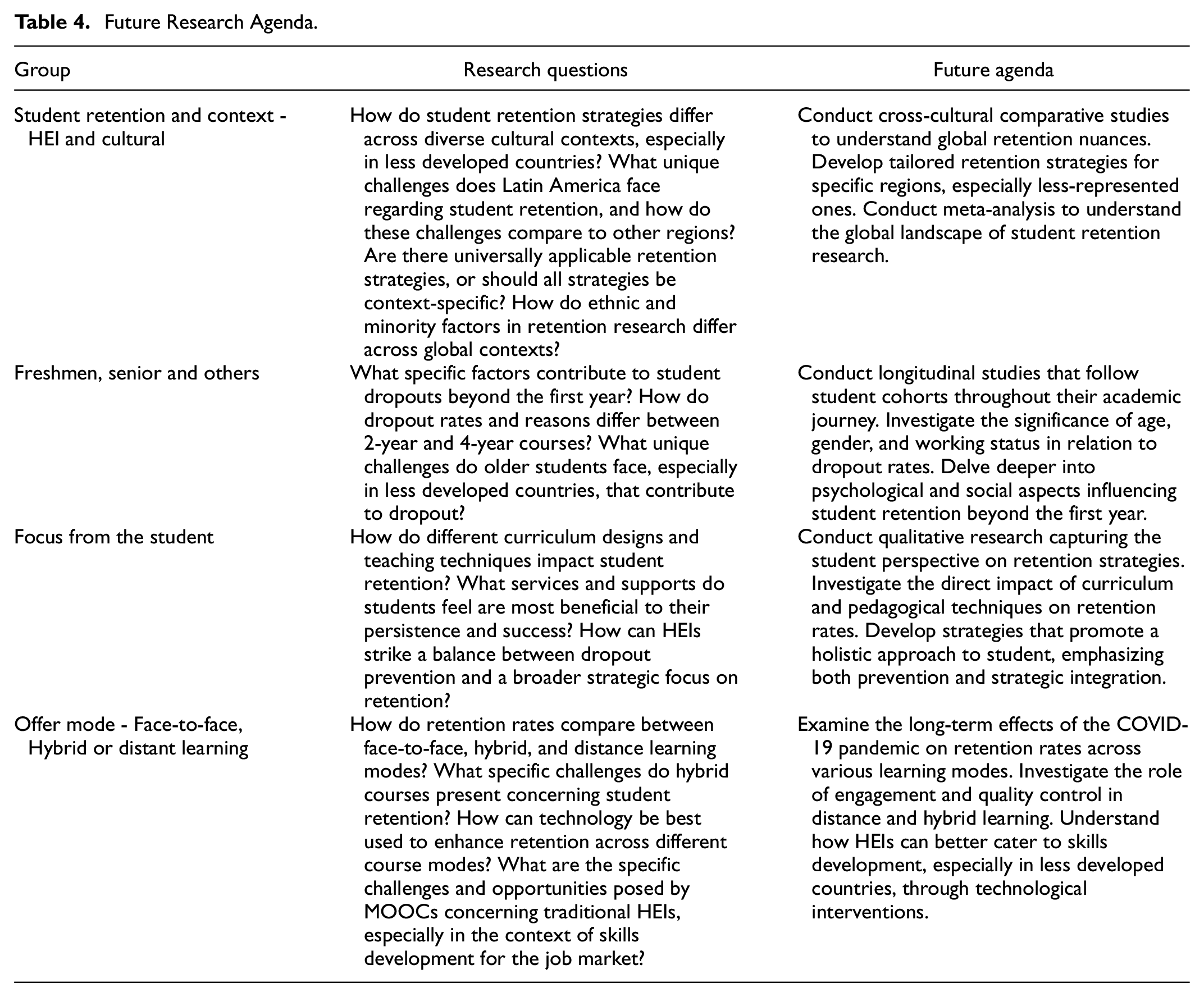
Research on student retention has predominantly focused on higher education institutions in developed regions like the United States (Aljohani, 2016). To achieve a holistic understanding of retention challenges and strategies, it is imperative to consider institutions in less developed economies (Aguinis et al., 2020). The varying cultural, economic, and social contexts, like those in Latin America, underscore the importance of region-specific research (Lazzarini, 2012; Slade et al., 2015).
The spotlight on first-year dropouts, given the majority occur during this period, risks overlooking the significant number that continue throughout the course (Ross et al., 2012). To truly combat dropout rates, research must venture beyond the freshman year and delve into diverse age groups, especially since factors influencing persistence can differ greatly with progression (Picton et al., 2018).
Universities tend to emphasize dropout reduction, but a broader, more strategic focus is essential (Dewberry & Jackson, 2018; Gray & Swinton, 2017). This involves examining retention from the student’s perspective, considering both psychological and social aspects, and evaluating the impact of curriculum modifications and evolving teaching techniques.
With the future hinting at the rise of hybrid courses, it becomes crucial to decipher the unique retention challenges they present (Hoffman, 2014). COVID-19 unveiled the untapped potential of remote education (Tang et al., 2021), but the nuances of engagement and quality assurance in such modes remain underexplored. Furthermore, the response of HEIs to the demands of the job market, especially in less developed regions, needs attention (Govindarajan & Srivastava, 2020).
Conclusion
In our pursuit to understand and enhance student retention within HEIs, we embarked on a comprehensive journey through recent literature spanning from 2014 to 2022. By employing a systematic review coupled with the bibliometric method, we thoroughly analyzed 125 pertinent articles related to student retention in higher education. This deep dive revealed three distinct research fronts that have been central to the discourse.
Two of these fronts are from the institutional perspective, emphasizing the pivotal role of HEIs in developing and implementing strategies not just to mitigate dropout rates but also to promote student success. These findings underscore the importance of proactive institutional actions that holistically cater to student needs. Simultaneously, the third research front illuminated the student’s side of the equation, emphasizing the myriad factors contributing to their persistence in course completion.
By leveraging PCA and network analysis, our study has successfully mapped the current contours of the retention research landscape. It not only identifies influential works and themes but also delineates critical research streams in higher education. Our findings, particularly those drawn from the bibliographic coupling component, serve as a beacon, spotlighting specific domains that demand further exploration.
In essence, our study underscores the multifaceted nature of student retention in HEIs and paves the way for future research, laying the foundation for crafting more effective retention strategies and nurturing an environment conducive to student success.
The study has limitations due to its bibliometric method and the use of a specific keyword, but the researchers included Scopus and WoS (Web of Science) databases to mitigate this issue. However, due to the broad nature of the theme, further research is needed to understand contextual issues. It would be interesting to replicate the study in different contexts and perform meta-analysis and meta-synthesis to better understand the effects. The researchers also verified complementary keywords and used a method to mitigate other possible limitations.
Footnotes
Declaration of Conflicting Interests
The author(s) declared no potential conflicts of interest with respect to the research, authorship, and/or publication of this article.
Funding
The author(s) disclosed receipt of the following financial support for the research and/or authorship of this article: This research was supported by CNPQ and CAPES.

Data Availability Statement
Data sharing not applicable to this article as no datasets were generated or analyzed during the current study.