




Abstract
How much life in the United States is lost to encounters with the police? The author builds on a demographic life table model by Edwards, Lee, and Esposito to estimate, for race- and gender-specific populations, how many years of life are lost in two categories of police encounters: (1) encounters involving officer use of force and (2) all deaths involving police encounters. Average life years lost by individuals who are killed ranges from 39 years (white men) to 52 years (Native women). The loss of years per 100,000 people over their collective lifetimes is largest for Black men, with 5,696 years of life lost to all encounters with police, of which 3,772 years are lost to police use of force. This implies a loss of roughly 16,000 years of life for recent cohorts of Black men. These results provide context for current debates surrounding the cost and necessity of protests.
How much life in the United States is lost to encounters with the police? One way to answer that question is to determine how many deaths occur in police encounters. Edwards, Lee, and Esposito (2019) took that approach, using the crowd-sourced, news coverage–based Fatal Encounters data set, and found that the lifetime risk of death through an encounter involving police officer force, for Black men, is 1 in 1,000. A second way to answer that question asks how much lifetime is lost when police encounters end in death. Bui, Coates, and Matthay (2018) took this approach, using a similar data set maintained by the Guardian, and found that roughly 56,000 years of life are lost annually to encounters with the police.
Combining these approaches, I used the data set and lifetime risk model developed by Edwards et al. (2019) to analyze how many years of life are lost in two categories of encounters with the police: (1) encounters involving officer use of force and (2) all deaths involving police encounters (outside of custody in a jail or detention center), which also include deaths to causes such as suicide and vehicular accident. Using demographic life table methods, I estimated how long people killed in police encounters would have been expected to live without such deaths. Average life years lost by individuals who are killed ranges from 39 years (white men) to 52 years (Native women).
Adding up the life years lost with each death yields an estimate of the total lifetime lost per 100,000 people ever born into the population. These are shown in Figure 1 for men and for women. Note that the graph scale for women is one tenth of that for men, reflecting many fewer deaths in police encounters for women. For women, a much smaller proportion of the total life lost to police encounters is due to officer use of force: at the low end, 29 percent to 30 percent of the total (for Asian, Black, and Latinx women), and at the high end, 41 percent (for Native women). For men, this range is much higher, at 66 percent to 67 percent (for Black and white men) to 79 percent (for Native men).
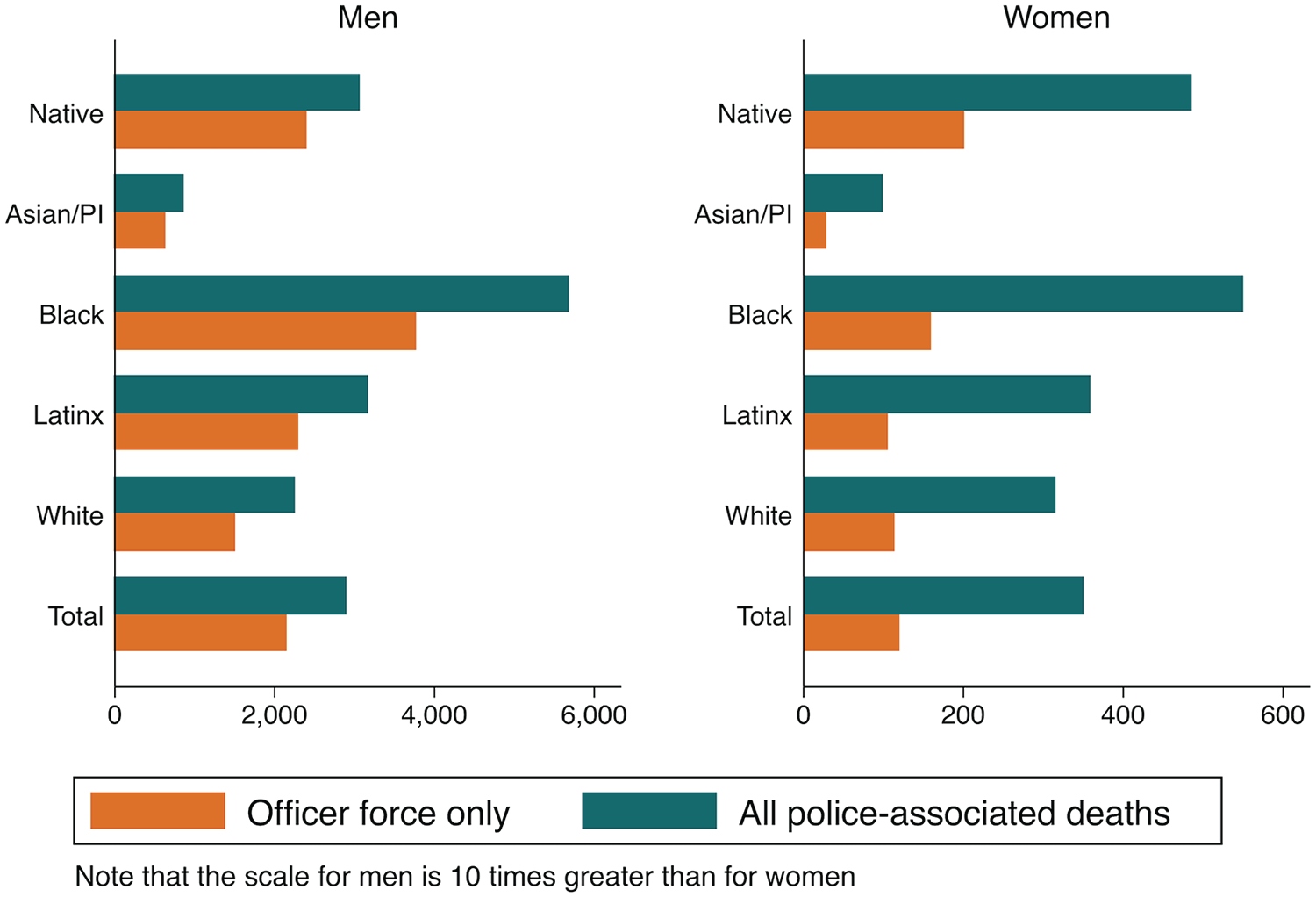
Life years lost to police encounters per 100,000 people.
The loss of years per 100,000 people over their collective lifetimes is largest for Black men, with 5,696 years of life lost to all encounters with police, of which 3,772 years are lost to police use of force. For both outcomes, Black men’s cumulative loss of life is just over 2.5 times white men’s.
In 2017, an estimated 284,365 Black male babies were born. These estimates suggest that if current rates of death in police encounters were to remain constant, that cohort would lose 402 men to police encounters, 273 of them to police use of force, with 16,198 total life years lost, including 10,727 to police use of force.
In the coming weeks, there will be many attempts to quantify the effects of the ongoing rebellion against police violence in the United States. Assessments of mass protests as potential sites of coronavirus disease 2019 spread will pose the question “Is it safe to protest during a pandemic?” (Renwick 2020; but see Goldstein 2020; Greiner et al. 2020). That question has particular force given that at least 1 in 1,500 Black Americans is estimated to have died of coronavirus disease 2019 already (APM Research Lab 2020). This analysis provides context for those discussions. It suggests that although protesting police violence may not be safe, neither is it safe to allow policing to continue as usual. In the United States, ordinary policing brings extraordinary loss of life.
Supplemental Material
PoliceKilling_Supplement – Supplemental material for Life Years Lost to Police Encounters in the United States
Supplemental material, PoliceKilling_Supplement for Life Years Lost to Police Encounters in the United States by Elizabeth Wrigley-Field in Socius
Footnotes
Acknowledgements
I would like to thank Frank Edwards, Hedwig Lee, and Michael Esposito for making their replication package available; Jane Sumner for material assistance and advice; and Michelle Niemann, Michelle Phelps, and Matthew Plummer for helpful comments.
Funding
The author(s) disclosed receipt of the following financial support for the research, authorship, and/or publication of this article: The author is supported by the Minnesota Population Center, funded by a center grant from the Eunice Kennedy Shriver National Institute of Child Health and Human Development (P2C HD041023), and the Fesler-Lampert Chair in Aging Studies at the University of Minnesota.

Supplemental Material
Supplemental material for this article is available online.
Author Biography
References
Supplementary Material
Please find the following supplemental material available below.
For Open Access articles published under a Creative Commons License, all supplemental material carries the same license as the article it is associated with.
For non-Open Access articles published, all supplemental material carries a non-exclusive license, and permission requests for re-use of supplemental material or any part of supplemental material shall be sent directly to the copyright owner as specified in the copyright notice associated with the article.
