




Abstract
The Black Lives Matter protests following George Floyd’s murder during the summer of 2020 demonstrated an unprecedented scale of mobilization against police violence. This mobilization has been theorized as a response to the “triple crisis” of police brutality, coronavirus disease 2019, and its resulting economic downturn. The authors provide an analysis of the triple-crisis theory by analyzing how the rapid health crisis and economic recession related to protest participation. They collect data on protest attendance and sudden employment loss in 491 commuting zones in the United States and find that employment loss is positively and significantly associated with greater rates of Black Lives Matter protest attendance. This relationship is not observed for other protests during the pandemic, indicating a specific relationship between police brutality and economic shock rather than a general moment of heightened contention. These findings expand the social movement literature on contemporary protests, examining interconnections between systems of injustice across issue areas.
On May 25, 2020, a Black man, George Floyd, was killed by white police officer Derek Chauvin in Minneapolis when the police officer knelt on his neck for more than nine minutes during his arrest for an alleged counterfeit $20 bill. George Floyd’s murder was the latest instance of police killings of Black people, sparking a national uprising against police brutality. These protests were part of the Black Lives Matter (BLM) movement, which coalesced in 2013 in reaction to police killings and amplified long-standing calls for the abolition of the carceral state. 1 An estimated 15 million to 26 million people attended protests in more than 2,500 towns and cities in the United States, making this uprising the largest in the country’s history (Buchanan, Bui, and Patel 2020; Chenoweth et al. 2020). These protests were held not only in large cities but in small and conservative towns, where support for BLM might have been unexpected (Cheung 2020).
Some scholars and reporters have theorized the scale of the 2020 protests resulted from the ongoing police brutality against Black men converging with a moment of public health crisis and economic instability, creating a “triple crisis” (Cheung 2020; Widyaningtyas and Munjid 2021; Yates 2020). Yates (2020) suggested that the particular social, political, and economic circumstances in which George Floyd’s death occurred “reveal the fault lines in a society.” This created a moment ripe for politicization, where “an underemployed student or the owner of a business shuttered by quarantine” could direct their frustration into organizing or attending a protest (Rohlinger and Meyer 2024:9) However, the relationship between coronavirus disease 2019 (COVID-19), sudden job loss, and protests against police brutality has not been tested empirically. In this study, we explore the intersections between economic and racial injustice and the movements mobilizing against them.
We contribute to the literature on social movements and COVID-19 by expanding on the claim that the so-called triple crisis laid bare the co-constitutive nature of economic and racial violence. We provide an empirical analysis to explore this argument. We regress the occurrence of and rate of attendance at BLM protests on COVID-19 deaths and the pandemic induced sudden employment loss that occurred across urban centers and their commuting zones in the United States between January and May 2020. The analysis shows a positive, statistically significant relationship between the sudden decrease in employment in an area and its likelihood of having a BLM protest. We find that a larger decrease in employment is significantly related to a larger increase in the rate of protest attendance. Furthermore, we find that this relationship appears specific to BLM protests, rather than indicating a heightened moment of protest mobilization regardless of issue area. We suggest that this exploration of the triple crisis highlights an underexplored lens to understanding the relationships between issue areas in modern protest mobilization. The interplay between mobilization in places experiencing economic instability and police violence opens a discussion on the role of racial capitalism in understanding moments of crisis and mobilization. We conclude with a discussion of implications for the study of social movements, underscoring the necessity of grounding protest mobilization in economic and political context, and suggest avenues for future research into the mechanisms underlying these triple crisis relationships.
The Triple Crisis: COVID-19, Economic Recession, and Police Brutality
To understand the protests in the summer of 2020, it is essential to consider them as a particular moment exemplifying the larger historic, political, and economic contexts in which they occurred. George Floyd’s death came as part of a series of highly publicized police murders of Black men in the United States. Although state-sanctioned violence against Black people has a long history, the BLM movement has brought renewed public attention to the issue since the early 2010s. In the United States, Black people are more likely to die from police violence than any other group (Edwards, Lee, and Esposito 2019); Black people are 3.2 times more likely to be killed by police (Schwartz and Jahn 2020) and 1.6 times more likely to be killed while unarmed than white people (DeGue, Fowler, and Calkins 2016).
George Floyd’s death also occurred during a unique historical context: the early months of the COVID-19 pandemic and its resulting economic devastation. In the first three months of the pandemic, 111,000 people died from causes relating to COVID-19, while more than 1.3 million tested positive for the virus (CDC 2020a, 2020b). The unequal impact of COVID-19 laid bare the racialized structure of the economy and public health: Black people died from COVID-19 at 3.5 times the rate of white people in the United States (Gross et al. 2020). People of color were also more likely to be living in multigenerational or crowded homes, have preexisting health conditions, and lack health insurance, all factors which intensified the likelihood and the severity of contracting COVID-19 (Purkayastha 2021).
Beyond its health impacts, the sudden changes and lockdowns brought by the pandemic upended entire occupational sectors, creating a large economic contraction. Between February and May 2020, the national unemployment rate rose from 3.8 percent to 13.0 percent, a larger increase than during the Great Recession and any quarter of the Great Depression (Brinca, Duarte, and Faria e Castro 2020; Coibion, Gorodnichenko, and Weber 2020; Iacurci 2020; Kochhar 2020; Wheelock 2020). Black and Hispanic workers both lost their jobs at disproportionate rates and those employed were more likely to be essential workers with heightened exposure to COVID-19 (Angelucci et al. 2020; Rho, Brown, and Fremstad 2020).
It is within this context that the George Floyd protests occurred: not as an isolated incident, but within a long history of economic, state, and racial violence. Scholars and journalists have noted how the pandemic highlighted the state’s inability to adequately address the unfolding crises of police violence, economic precarity, and the pandemic, connecting these crises as a systemic failure (Azmanova 2020; Cheung 2020; Widyaningtyas and Munjid 2021; Yates 2020). Although the summer 2020 protests were not about the government’s mishandling of the pandemic or its resulting economic hardship, some scholars have argued that “significant factors motivating the collective actions that followed the death of George Floyd were deeply rooted in the context of the surrounding Covid-19 pandemic and its health-related, social, economic, and political consequences” (Christián, Erdős, and Háló 2022:7). As Frank Leon Roberts, an activist and teacher at New York University, put it, Floyd’s death forced people to “[ask] themselves what parts of normal are no longer acceptable” (Cheung 2020).
Yates (2020) referred to the convergence of police violence, sudden unemployment, and the pandemic as the “triple crisis.” Although the pandemic protests directly responded to systemic racism, that racism is itself a result of the United States’ political and economic history, articulating the issues of COVID-19, police violence, and economic shock not as separate, but mutually co-constitutive forces (Yates 2020). Azmanova (2020) claimed that the triple crisis destabilizes neoliberalism’s pillars: the COVID-19 deaths show the cost of offloading public services to individual responsibility, the economic collapse demonstrates fallacies in the narrative that the market acts with an economic rationality that creates the most prosperity, and the police killings delegitimize the use of law enforcement to uphold order in an increasingly precarious society. The protests during this period, then, may reflect not only the injustice of the criminal legal system, but also the broader context of the state’s inability to adequately address the ongoing economic and public health crises and their underpinnings.
Mobilization in Moments of Crisis
Social movements scholars have long examined the conditions that lead to protest mobilization, one of which includes sudden shocks. Protests often occur when instability provides the political opportunity for collective action (Tarrow 1994; Tilly 2006). Moments of “suddenly imposed grievances” (Walsh 1981) and crisis are especially important to mobilization, particularly when the state or authorities are unresponsive to concerns (Davies 1962; Molotch 1970). The sudden shock of such breakdowns spurs collective action that may not have otherwise occurred and that is often related to the disruption of the “quotidian” or everyday routines (Snow et al. 1998). We examine each of the facets of the triple crisis below, as well as how protests may diffuse and spill over between the different issues.
Protests about police killings may be viewed as both a sudden crisis and a form of discontent and grievance, where protestors mobilize in response to deprivation or moral indignation (Gurr 1970; Merton and Lazarsfeld 1950; Runciman 1966). Previous waves of protests have followed highly publicized instances of police brutality or jury acquittals of the associated police officers (Almeida 2019). In the case of the BLM movement, these grievances, or killings, also had a cumulative effect: Williamson, Trump, and Einstein (2018) found that BLM protests are more likely to occur in places where more Black people have been killed by police. Protests against police killings also occur in tandem with broader frustrations with state governance: Kawalerowicz and Biggs (2015) analyzed protesters arrested at the 2011 London riots following the police shooting of a mixed race man and find that, although the uprising was in direct response to the police shooting, it also reflected frustration with the rise of a new conservative government which had begun cutting social spending and public services.
Economic devastation and unemployment are also powerful incentives for political mobilization, as seen through worldwide protests such as the Arab Spring (Achcar 2013; Gamson 1968; Wilkes 2004). Economic divisions continue to be a “powerful source of grievances and base for mobilizing identities, even as they intertwine with gender, nation, race, and other cleavages” (Eidlin and Kerrissey 2018:518; see also Della Porta 2015; Eggert and Giugni 2012). Caren, Gaby, and Herrold (2017) studied 145 countries from 1960 to 2006 and found that periods of economic decline are associated with increases in antigovernment demonstrations, and that this relationship is exacerbated when the economic decline is severe. Worsening economic conditions and fiscal retrenchment have also been associated with worsening social unrest (Ponticelli and Voth 2020).
Furthermore, several studies have found that sudden economic shocks provoke different forms of mobilization than long-term economic trends (Davies 1962). Kern, Marien, and Hooghe (2015) found that rising unemployment in Europe from 2008 to 2010 increased noninstitutionalized political participation, whereas overall trends in economic growth from 2002 to 2008 showed a reverse pattern. Economic downturns have ignited into major arenas of protest, most notably following the 2008 financial crisis, including Occupy Wall Street in the United States, the Indignados in Spain, and the widespread protests across former countries of the Soviet Union (Angelovici, Dufour and Nez 2016; Beissinger and Sasse 2014). Protests were particularly large in countries where the recession followed a period of economic growth (Yagci 2017) or where residents had positive expectations about improvements in their standard of living (Beissinger and Sasse 2014). Looking at the 2008 financial crisis, Grasso and Giugni (2016) found that individuals’ experience and relative deprivation affect their likelihood of protesting, but that the effect is greater during certain unfavorable conditions such as times of high unemployment.
Health crises have similarly shifted power balances and contributed to social instability and conflict by reducing trust in the state and contributing to economic crises (González-Torres and Esposito 2020; Li and Coppo 2020; Xu and Sedik 2020). The occurrence and scale of protests during the COVID-19 pandemic were contingent on “pre-existing, country-specific conditions, and how a government and other actors frame the issue and respond” (Hilhorst and Mena 2021:188)
A Triple Crisis or a General Moment of Contention?
Were the heightened protest numbers during the triple crisis simply a reflection of protest cycles, which Tarrow (1993) characterized as periods of “heightened conflict across the social system” (p. 284)? Or were the unprecedentedly large and frequent protests following George Floyd’s death a reflection of the intersection of particular political drivers?
Studies have shown that protests may be influenced by processes of diffusion and spillover between movements. Most studies examining relationships across movements focus on processes of tactical diffusion (Olzak and Uhrig 2001), social movement spillover (Meyer and Whittier 1994), or how that diffusion relates to organizational density and sustained political opportunity (Minkoff 1997). Ring-Ramirez and Earl (2021) examined agenda spillover in racial justice and environmental movements to show that the goals of one movement can be taken up by others in serious and enduring manners. Similarly, the BLM movement has grown in influence partially through recognition of how various aspects of racism, including economic and environmental racism, intersect (Pulido 2016; Ransby 2015; Williamson et al. 2018). Yet few existing studies have emphasized how social movement mobilization for a single issue may be constructed across frames, and how “overlapping motivations influence participants who join a protest that is concentrated on one specific issue” (Fisher, Dow, and Ray 2017:1; Fisher and Rouse 2022). Social movements may deploy a set of interconnected frames that go beyond the specific issue the protest is about, underscoring the value of studying issue coalitions that are often overlooked in social movement literature (Fisher et al. 2017).
The convergence in 2020 of the ongoing policing crisis with an unexpected economic and health crisis provided an opportunity for protests to mobilize around the fundamentally linked systems perpetuating inequality. Indeed, the lockdown provided people with ample availability both to consume more online information about instances of police brutality, as well as to protest in the streets (Rohlinger and Meyer 2024). Yet there were another set of protests occurring during the COVID-19 pandemic: ones that were opposed to the government imposed public health lockdowns.
The literature on antilockdown protests largely focuses on the impacts of these protests on the spread of COVID-19 (Lange and Monscheuer 2022). However, a growing body of work examines the protests as a social movement mobilization. Antilockdown protests in the United States mobilized against government intervention, which they characterized as infringing on individual liberties and creating direct economic grievances (Chayinska et al. 2024). Their choice to protest “as usual” in the streets without masks emphasized their opposition to COVID-19 restrictions (Kowalewski 2021) and led to increased spread of the disease (Lange and Monscheuer 2022). These antilockdown responses were most likely to occur when COVID-19 mitigation regulations increased economic grievances or amplified initially existing inequalities and distrust toward the government, while also providing increased opportunities for collective action (Iacoella, Justino, and Martorano 2024; Rohlinger and Meyer 2024; Wood et al. 2022). A study of antilockdown tweets showed they focused on topics such as small business rights, the unconstitutionality of COVID-19 lockdowns, antimasking, perceived lack of difference between COVID-19 and the flu, and the deleterious health impacts of lockdowns (Karami and Anderson 2020).
Bratich (2021) theorized these protests as “necropopulist downsurgency” on the basis of the promotion of whiteness and exclusion, suggesting that these protests may reflect a different motivation and sentiment than the BLM protests and therefore not just a general moment of heightened contention. This assertion is supported by the finding that white people in the United States reported feeling less vulnerable to COVID-19 than racialized minorities, regardless of risk level, social status, and ideology (Vargas, Mora, and Gleeson 2023).
Although a handful of recent articles posit the relationship between the COVID-19 economic recession and the BLM protest, up to this point they largely do not explore this hypothesis or the idea of the triple crisis empirically. In one of the only empirical studies thus far examining the triple crisis, Gifford and Oliver (2021) provided a causal analysis of concern over job loss and concern over BLM. They examined online search trends data and found a positive relationship between searches for jobs and for the BLM movement, concluding that COVID-19 “provided a transfer of social energy into BLM through the devastation of the labor resource market” (p. 1679). Although search volume provides a useful benchmark, they did not observe actual job loss or protest attendance in an area. Here, we directly contribute to these findings to explore how the protests were affected by the triple crisis of COVID-19, police brutality, and economic shock and whether they reflect a general moment of protest that is seen in all protests during this time period or indicate a more specific relationship between state violence, economic, and health precarity.
Data and Methods
We examine the relationship between the sudden employment loss resulting from the COVID-19 pandemic and the rate of BLM protest attendance in the area. We combine data from publicly available sources and aggregate to the core-based statistical area (CBSA), which is a geographic area consisting of one or more counties around an urban center of at least 10,000 people, plus adjacent counties that are socioeconomically tied to the urban center by commuting. The CBSA more accurately captures the commuting and economic centers of an area, and thus is likely to include most of the spillover that may exist from people traveling to a central protest location. We exclude CBSAs for which we do not have valid data for all variables, which limits our analysis to 491 CBSAs. This limitation stems primarily from the change in employment variable, which has missing data for the remaining CBSAs. 2 The CBSAs we have data for cover almost 90 percent of the total population across all CBSAs and 83 percent of the total population in the country.
Protest Attendance
Data on protests comes from the Crowd Counting Consortium (CCC), which uses newspaper and television data to document protest events and estimate crowd size (Chenoweth et al. 2020). Protest data, and particularly protest attendance estimates, are notoriously difficult to obtain and present known limitations such as tending to overreport large protests and underreport smaller ones (Rafail, Walker, and McCarthy 2015). The CCC works to reduce such biases by cross-referencing its list with other datasets, such as CountLove, that also work to collect protest instances and estimates. 3
CCC data are recorded at the protest level, with geographic identifiers for the city or town and county where the protest occurred. Where CCC provides a county Federal Information Processing Standard (FIPS) code, we use the county FIPS code as the location for the protest. Where there is no FIPS code provided, we use the latitude and longitude points that are provided. These points do not correspond to the exact location of a protest, but rather to the geographic center of the city or town where the protest occurred. We use those points to find the county FIPS code for the city or town. We then aggregate from the county level to the CBSA level for analysis.
Our analysis of BLM protests uses two outcome variables. First, we create a binary variable of whether a CBSA had any protests related to BLM following the killing of George Floyd on May 25, 2020, through August 31, 2020. Second, we use the estimated number of attendees at BLM-related protests per 10,000 residents in the CBSA for the same time period to model protest attendance. We categorize events as being about BLM on the basis of the recorded description, including terms such as Black Lives Matter, BLM, racism, George Floyd, police brutality, police violence, and defund the police. We include all events fighting for stated issues around Black people and police brutality, regardless of whether they are formally affiliated with BLM. Although the majority of protest activity occurred within the first two to three weeks after George Floyd’s death, it is often anecdotally referred to as the summer of protest, and so we extended our window through August 31, 2020, to capture any protest activity during the summer.
The CCC records mean, low, and high estimates for the count of attendees at an event. We use the mean where reported, and if only a low or high estimate was reported we used the recorded value. Some size estimates contained free-form text answers that we converted to numbers where possible and using low, conservative interpretations of ranges following the CCC documentation guidelines (i.e., “hundreds” is 200, “thousands” is 2,000, and “a small group” is 10; see data documentation from Chenoweth et al. 2020). Of all BLM events recorded by the CCC, 51 percent have crowd size estimates that can be used for analysis. Events without crowd size estimates are included in modeling whether the CBSA held any protests but are excluded from attendance estimates. As attendance is heavily dependent on population, we scale the attendance counts to be a rate per 10,000 individuals on the basis of the CBSA population in 2019 (e.g., Inclán 2009; Rosenfeld 2006).
We also calculate occurrence and rates of attendance at antilockdown and all non-BLM protests during the same time period. We categorize antilockdown protests as ones where the reported issue description expressed discontent with shutdowns, stay-at-home orders, lockdown mandates, mask mandates, school closures and sports cancellations, curfews, store closures, social distancing, and government restrictions, and include all events that were not in our BLM models as non-BLM protests.
Sudden Employment Loss
Our key employment variable comes from the Opportunity Insights Economic Tracker (Chetty et al. 2020), which estimates employment levels on the basis of paychecks sent out within the county and indexed to the employment level in that county for January 4 to 31, 2020. Data are sourced from Paychex, Intuit, Earnin, and Kronos to directly capture paychecks for employment, rather than relying on household survey estimates. Using a variable that directly measures job loss by the change in paychecks disbursed provides a more accurate representation of the rapid changes experienced during this period of volatility. Most employment metrics rely on self-reported household surveys and model-based estimation, which are useful for long-term trends but imprecise for smaller temporal units. Furthermore, common metrics of employment such as the Bureau of Labor Statistics have acknowledged that they do not accurately capture the rapid unemployment resulting from COVID-19, because of measurement error and difficulty adjusting their models (Kochhar 2020). As a result, the Opportunity Insights tracker provides a more nuanced measurement for capturing a break in the temporal trends expected during this period and is less prone to undercounting than traditional sources. We take the average change in employment from May 1 to 24, 2020, indexed against January 2020 employment, for each CBSA, to estimate the exogenous economic shock caused by the pandemic lockdown. As we are looking at employment loss, we invert the variable to ease interpretation so employment loss is positive.
COVID-19
To account for the direct health impacts of COVID-19 in an area, we aggregate COVID-19 deaths through May 24, 2020, from the New York Times COVID-19 county-level tracker (The New York Times 2020). We use COVID-19 deaths in our ultimate analysis as a clearer indicator of the severity of COVID-19 trauma experienced in a community and as a more reliable metric in reporting than case counts, which often go underreported. 4
Relevant Covariates
We include a number of relevant covariates that we predict may affect protest occurrence and attendance. Direct regional impacts of police violence may relate to protest attendance. We include the number of Black people who have been killed by police in the area from Mapping Police Violence (Sinyangwe, McKesson, and Elzie 2021). 5 We include counts of Black people killed by police in the CBSA from January 1, 2017, to May 25, 2020, with a temporal decay on the basis of the number of years since the person was killed, to account for any direct, local effect of police killings (see Williamson et al. 2018). This variable does not include less severe forms of racialized police brutality, and so may provide a conservative estimate of the impact of police brutality on our outcomes. However, it is recorded much more consistently at a national level than other forms of police brutality, and so provides the best estimate for this scale of analysis.
Some areas of the country have also hosted many BLM protests over the years, while others held their first during the summer of 2020, and so networks and resources to mobilize a protest may vary on the basis of the organizing history (Andrews and Biggs 2006). We include an indicator of whether there has ever previously been a BLM protest in the CBSA from 2017 to 2019, as recorded by the CCC, as a measure of resource mobilization. 6
Support for BLM is highly politicized, and thus the political leaning of an area is likely to influence protest attendance. We would expect more political opportunity in areas aligned with the Democratic party, which is typically more sympathetic to the BLM movement than more heavily Republican areas. We include the percent of all votes cast for Donald Trump in the CBSA during the 2016 presidential election to account for the political openness of an area. We source these counts from the MIT Election Data and Science Lab (2018), which publicizes presidential vote counts by county.
We also include a number of covariates from the 2019 American Community Survey (ACS) five-year estimates. We include the baseline population and population density of the area to get a sense of the CBSA’s size. Larger cities tend to be centers for national protest events, though this may be in part counteracted by the COVID-19 lockdowns and resultant restricted mobility. Population density may also factor into COVID-19 concern for infection. As the movement is motivated by racial discrimination, we include the percentage of the population that identifies as non-Hispanic Black. We might expect that areas with more Black residents may have proportionately higher rates of mobilization, as identity-based ties have been found to increase the likelihood that individuals act on behalf of a group (LeFebvre and Armstrong 2018; Vélez, Lyons, and Santoro 2015).
To estimate availability and capacity to mobilize, we also include the percentage of the population older than 25 years with a bachelor’s degree or higher and the percentage of the population enrolled in college or graduate degree programs, as college students are often a mobilizing force in protest movements (see Andrews and Biggs 2006; Williamson et al. 2018). We also include the percentage of the labor force working in essential jobs, as education and occupation may affect time available to protest and access to resources and networks. In addition to time constraints, those working as essential workers were already risking their health for work and so may have been less averse to health risks of protest participation. We categorize essential workers as all those working in retail, such as grocery workers; food service; health care practice, such as doctors, nurses, dentists; and health care support, such as certified nursing assistants, orderlies, and aides.
Finally, the percentage of the CBSA that is unemployed in the five-year 2019 ACS serves as a counterpart to our sudden employment loss variable, as it allows us to compare a baseline measure of economic deprivation in an area with the sudden emergent crisis, which may have a differing relationship to mobilization (Davies 1962; Kern et al. 2015). We also include the percentage of the Black population that is unemployed and the percentage of the Black population that is in the labor force from the 2019 ACS, as racialized income inequality and disproportionate Black unemployment increase protests (DiPasquale and Glaeser 1998; Myers 1997). 7
Methodology
We hypothesize that sudden employment volatility and COVID-19 exposure are associated with the likelihood of a protest occurring and that a larger decrease in employment and greater COVID-19 impact in an area are associated with an increased rate of protest attendance at BLM protests but not necessarily at other types of protests. To test these hypotheses, we use two different outcome variables: first, a binary variable of whether any BLM protest occurred in the area and, second, the rate of protest attendance per 10,000 residents in the area. We first examine a logistic regression of the likelihood that any BLM protest was held in the ith CBSA on the basis of the change in employment, COVID-19 deaths, and our covariates:
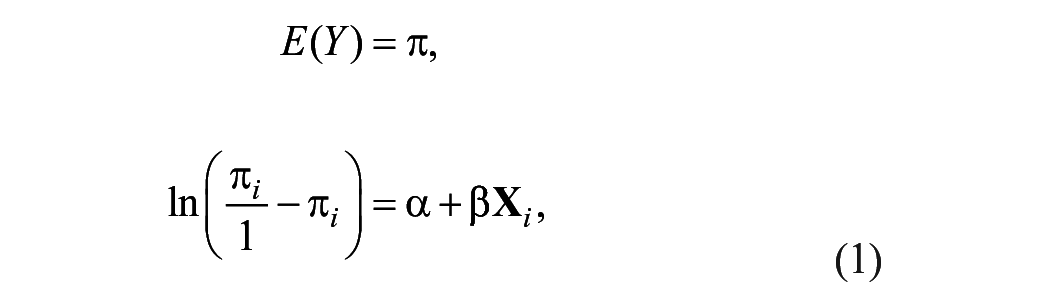
where π
i
is the probability of any BLM protest being held in the CBSA from May 25, 2020, to August 31, 2020;
Next, we regress the rate of BLM protest attendance per 10,000 on employment change from January 2020 to May 2020 and our confounders to investigate whether the rate of protest attendance is related to the severity of employment loss. Given the strong skew in attendance, we take the natural log of the attendance rate, resulting in a log-linear model specification:

where Yi is the rate of BLM protest attendance per 10,000 residents, and the rest are specified as in equation 1. We are interested in the relative effect of the crisis moment rather than the total volume of attendees, and thus a rate reflects our variable of interest (see Biggs 2016; Richardson 1948:523). 8 In addition to the log-linear specification, we explored generalized linear models using Poisson and quasi-Poisson distributions with a logged population offset and observed largely similar results (available in the Appendix). Results were also robust to removing outliers and using robust standard errors.
Finally, to examine whether the relationship we observe between protest attendance and sudden employment loss is specific to BLM protests or reflects an increased mobilization cycle regardless of the subject matter, we ran comparison models for antilockdown protests and all non-BLM protests. Similar to the models for BLM protests, these include logistic models for whether there was any lockdown or non-BLM protest, as well as log-linear models to examine the rate of protest attendance.
Results
Table 1 shows descriptive statistics for relevant variables in this analysis at the CBSA level. 9 On average, there were 65 people per 10,000 residents in the CBSA who attended BLM protests following George Floyd’s death. Ninety-four percent of all CBSAs had at least one BLM protest, aligning with reports that protests were widespread across the country. These protests were overall much larger and more prevalent than other protests during the same period, including antilockdown protests.
Descriptive Statistics: Summary Statistics at the Core Based Statistical Area Level for BLM and Antilockdown Protests, Economic, Political, and Demographic Variables (n = 491).

Note: BLM = Black Lives Matter; COVID-19 = coronavirus disease 2019.
Compared with the start of the year, employment fell 17 percent on average by May 2020, representing a sharp loss of employment during the beginning of the COVID-19 pandemic. The average unemployment rate per CBSA before the pandemic was 5.34 percent, and the average CBSA has 8.71 percent of its population identifying as non-Hispanic Black. The average Black unemployment rate per CBSA is almost double the average unemployment rate for the total population, at 9.63 percent, and on average 57.1 percent of the Black population is in the labor force. Although the number of Black people killed by police is hugely disproportionate, the average recorded per CBSA is relatively small. Seventy-two percent of CBSAs had a previous BLM protest sometime between 2017 and 2019, showing that the movement was already geographically diverse but a number of CBSAs held their first BLM protest during the summer of 2020. On average, 27 percent of the population in a CBSA holds a bachelor’s degree or higher and 27.5 percent are essential workers, with education varying more from one location to another than the share of essential workers. The average percentage of votes in a CBSA that were cast for Trump in the 2016 presidential election is 54 percent. In the first few months of the pandemic, there were an average of 5,800 COVID-19 deaths in a CBSA.
Protest Occurrence
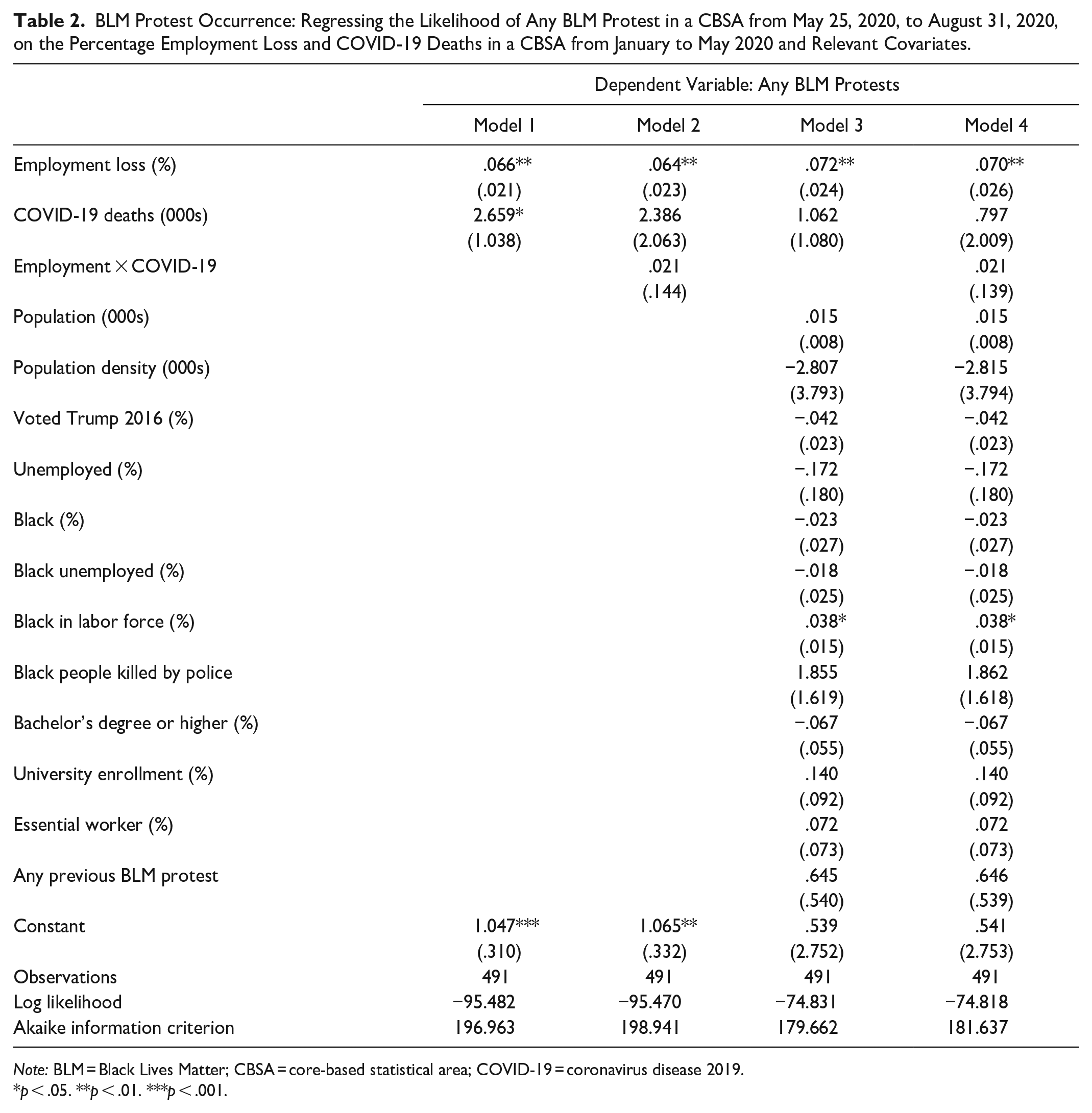
We first discuss models for protest occurrence and then move on to protest attendance rates. Finally, we compare BLM models to non-BLM and antilockdown models. Table 2 provides model outputs for regressing BLM protests on the percentage change in employment, COVID-19 deaths, and covariates. Models use a binary outcome to estimate the likelihood that there was at least one BLM protest in a CBSA, regardless of scale. This allows us to consider differences between places that did and did not respond to George Floyd’s murder with protest activity. Model 1 provides a baseline “triple crisis” measure for the likelihood of any BLM protest on the employment change and COVID-19 deaths from January to May 2020. Model 3 adds in relevant covariates discussed above. Models 2 and 4 replicate models 1 and 3, respectively, with an interaction between employment loss and COVID-19 deaths.
BLM Protest Occurrence: Regressing the Likelihood of Any BLM Protest in a CBSA from May 25, 2020, to August 31, 2020, on the Percentage Employment Loss and COVID-19 Deaths in a CBSA from January to May 2020 and Relevant Covariates.
Note: BLM = Black Lives Matter; CBSA = core-based statistical area; COVID-19 = coronavirus disease 2019.
p < .05. **p < .01. ***p < .001.
All models show that a 1 percentage point decrease in employment from January to May 2020 is positive and significantly associated with the likelihood that a CBSA held a protest. Additionally, the coefficient for employment loss stays relatively consistent, and even slightly increases, with relevant covariates included. Looking at model 3, which includes the full covariate set, a one percentage point decrease in employment from January to May 2020 is associated with an exp(0.072) = 1.075 = 7.5 percent increase in the odds that there was a BLM protest in the CBSA following George Floyd’s murder, net of relevant covariates. These models indicate that there is a positive and statistically significant relationship between sudden employment loss and whether there was a BLM protest in an area that is not explained by relevant covariates, providing an initial indication that local economic instability relates to BLM mobilization.
However, we do not see a significant relationship between COVID-19 deaths and whether a BLM protest occurred, nor do we see anything in the interaction term between employment loss and COVID-19 deaths. Although the effect size for COVID-19 deaths is large, and significant when no covariates are included, it drops dramatically with the inclusion of covariates and is not statistically significant. The interaction between COVID-19 deaths and employment loss is small and insignificant. Using the Akaike information criterion to assess goodness of fit, we can see that the model with the full covariate set but excluding the interaction term, model 3, provides the best fit.
The percentage of the Black population in the labor force is also significantly related to the likelihood of a protest occurring, with a 3.9 percent increase in the odds that there was a BLM protest associated with each additional percentage Black in the labor force. The number of Black people killed by police in the area since 2017 has one of the largest effect sizes of any coefficient in the model, with about a 640 percent increase in the odds of a BLM protest in the CBSA for one additional Black person killed by police, but it is not statistically significant. Next, we turn to the size of the protest to see whether the relationship to sudden employment loss scales with the BLM protest attendance rate.
Protest Attendance
Table 3 provides log-linear model outputs for regressing the rate of BLM protest attendance per 10,000 residents, baseline, with interactions, and with the full covariate set.
BLM Protest Attendance: Regressing the Logged Rate of BLM Protest Attendance per 10,000 Residents in a CBSA from May 25, 2020, to August 31, 2020, on the Percentage Employment Loss and COVID-19 Deaths in a CBSA from January to May 2020 and Relevant Covariates.

Note: BLM = Black Lives Matter; CBSA = core-based statistical area; COVID-19 = coronavirus disease 2019.
p < .05. **p < .01. ***p < .001.
Across all models, we estimate a positive and significant relationship between employment loss and the rate of BLM protest attendance per 10,000 residents. In model 3, a 1 percentage point decrease in employment between January and May 2020 in the CBSA is associated with a exp(0.022) − 1 = 2.2 percent increase in the rate of protest attendance per 10,000 residents, net of covariates. Similarly, we again see a positive relationship between more COVID-19 deaths and increased BLM protest attendance when there are no covariates, but that relationship disappears once covariates are added. Unlike in the protest occurrence models, where COVID-19 deaths were large but insignificant, here COVID-19 deaths are small and not significant. This is most notable in model 3, which includes the full covariate set but not the interaction term. Again, we see that this provides the best model fit on the basis of the adjusted R2. The employment loss and COVID-19 deaths interaction term in the covariate model, model 4, is small and not significant.
We see that the percentage of the population that was unemployed in 2019 has a large, negative relationship to protest attendance, where a one percentage point increase in the percent of people who were unemployed is associated with a exp(−0.115) − 1 = 10.9 percent decrease in the rate of protest attendance. This indicates that there is a difference between long-term unemployment in a region and the sudden employment loss experienced in the first few months of COVID-19, in line with previous literature around economic crisis compared with long-term deprivation. Surprisingly, the estimate for the percentage of the CBSA’s population that identifies as Black is also negative, though it is small and not significant. The count of Black people killed by police is also not significant.
Whether the CBSA had any previous BLM protests, on the other hand, has a large and significant relationship with the attendance at protests in summer 2020. 10 A CBSA having had a previous BLM protest is associated with a 58.9 percent increase in the rate of protest attendance per 10,000 residents. Similarly, a 1 percentage point increase in the share of the population that is enrolled in undergraduate or graduate education is associated with a 4.4 percent increase in the rate of BLM protest attendance in the CBSA. Together, these variables support the theory that resource mobilization plays a role in protest attendance. However, there does not appear to be an especially large or significant relationship between the rate of protest attendance and the population, the proportion of the population who are essential workers, or the proportion that have a bachelor’s degree or higher. 11 As expected, there is a negative and significant relationship between the percentage of a CBSA that voted for Trump in 2016 and the attendance rate at BLM protests. For a 1 percentage point increase in the percentage of votes cast for Trump, there is an expected 2.3 percent decrease in the rate of protest attendance.
Comparison with Other Protests
BLM protests were far from the only protests happening in the United States during the early stages of the pandemic. The “triple crisis” would imagine a distinct relationship between the sudden economic shock and the police killing of George Floyd that would not be reflected in protests on other issues during the same time period, whereas the cycles of contention framework might imagine that the crises simply create heightened mobilization across issue areas. To explore whether the sudden economic shock had a distinct relationship to BLM protest attendance, or whether BLM protests are simply part of a larger protest cycle, we compare the relationship of sudden job loss to the rate of protest attendance for BLM protests, antilockdown protests, and all protests except BLM.
Figure 1 shows the exponentiated coefficients for sudden employment loss, net of covariates and with robust standard errors, in three logistic regression models during the same time period. 12 We see that there is no discernible relationship between employment loss and whether a CBSA had any antilockdown or non-BLM protests. This indicates a distinct relationship to BLM protest occurrence during the period.

Employment loss estimates for actions by protest type.
Similarly, Figure 2 shows the exponentiated coefficients for sudden employment loss, net of covariates, in three log-linear models of protest attendance rates. Although sudden employment loss is positively and statistically significantly related to the protest attendance rate at BLM protests, this relationship is not observed for antilockdown or non-BLM protests. This lends support to a “triple crisis” style understanding of economic crisis mobilization within a context of multiple systems of state violence, rather than the economic crisis indicating increased protest activity irrespective of purpose. However, we do not see a robust relationship of COVID-19 deaths to either protest occurrence or protest attendance for any type of protest: BLM, antilockdown, or all non-BLM protests (Figure 3). Although there is a negative relationship between COVID-19 deaths and antilockdown protest occurrence (−3.1 percent), it does not hold with robust standard errors or for protest attendance.

Employment loss estimates for attendance by protest type.

Coronavirus disease 2019 deaths estimates by protest type.
Discussion and Conclusion
In this study, we explore the “triple crisis” relationship between economic shift, the COVID-19 pandemic, and BLM protests, constituting a period of intense and sudden crisis. Our results indicate that the sudden loss of employment may be consistently and significantly related to both BLM protest likelihood and attendance rates across commuting zones in the United States. We find that CBSAs with a larger decrease in employment in the months between January and May 2020 experienced both a higher likelihood of having a protest occur and higher attendance rates at those protests, net of relevant covariates. Our results indicate that part of what made this particular set of protests so large may extend beyond the issue of police brutality to the relationship between systemic concerns highlighted by massive instability. The jarring effects of unemployment were likely compounded by the loss of health insurance, increasing the lack of social safety net in the case of contracting COVID-19. On the other hand, COVID-19 deaths did not show a significant relationship to BLM attendance, an unexpected finding for the “triple crisis” framework. Although this could mean that COVID-19 deaths did not affect protest mobilization, more likely it indicates that the severity of the pandemic may have been felt nationally, rather than relative to the local health impact.
Similar to Walsh (1981) and Snow et al. (1998), we see suddenly imposed grievances and disruptions of the quotidian relate to movement participation. We observe that the level of unemployment in 2019 in a CBSA was negatively associated with protest attendance, illustrating that the relationship of sudden employment loss differs from the historic unemployment trend and providing support for the idea that sudden crisis and shocks increase mobilization. As expected, areas with higher vote percentages for Trump in 2016 were less likely to have and attend protests. We observe that places that have had a previous BLM protest may be better able to support rapid mobilization on the issue in the future, supporting theories of resource mobilization.
Black people killed by the police since 2017 in a CBSA had a positive and large but nonsignificant relationship to protest likelihood and attendance. It may be that police killings often become high-profile events felt nationally, rather than remaining local. It is possible that police violence in the community need not rise to the level of killing to have a local impact, but may be more closely tied to harassment, surveillance, arrest, and/or assault. Future analyses may look to incorporate additional metrics of police use of force to better understand this relationship. Additionally, the percentage of Black people in a CBSA did not show a consistently significant relationship to protests. These protests were notably multiracial, with some of the largest protests occurring in places such as Portland, where over 70 percent of the population identifies as non-Hispanic white. Many of the small towns that held protests were similarly predominantly white spaces (Ayesh 2020).
Although our analysis indicates a relationship between sudden job loss and attendance at BLM protests, we find no relationship between the sudden decrease in employment and attendance at all other protests or at antilockdown protests specifically, despite the antilockdown protestors’ explicit reference to economic well-being. Antilockdown protests challenged state restrictions, and allowed conservatives to coalesce around a shared identity that was channeled into electoral efforts to reelect Donald Trump in 2020 (Rohlinger and Meyer 2024). BLM protests, on the other hand, were not just actions against the state but against the racial capitalist order in which largely workers of color die from COVID-19 or police brutality, while unemployed people are left to fend for themselves with little state support. Meanwhile antilockdown protests follow a “tradition of death-driven liberty” and “passionate protections of the homogenous—of a whiteness that articulates itself through a disregard for the lives of Others” (Bratich 2021:259). Differing relationships across protest types during the same period provides an opportunity to further investigate the variation that may exist within cycles of contention.
Our explanatory analysis indicates the need for further analysis of the relationships across coexisting forms of crisis in mobilizing large-scale social movements. Future work could examine the way in which people conceptualize the intersections within the state’s violence, inequality, and abandonment across multiple issue areas, and the way that these conceptualizations explicitly or implicitly influence protest behavior. Currently we are unable to address the mechanisms by which this relationship functions: is it conscious framing of the interconnections of the triple crisis? Or is it simply a case of biographical availability? If it were only biographical availability we might expect that we would see a relationship to the percent essential workers or that employment loss would relate to increased turnout at all protest types, neither of which we observe. However, future qualitative analysis would be best positioned to delve into the mechanisms behind protest mobilization. Surveys, interviews, or other data sources may more explicitly test the motivation people report for protest participation and whether they cite the economic crisis or directly link racism and state violence (see Fisher and Rouse 2022). These sources may also be able to test any potential spillover effects of the 2020 presidential primary campaign that occurred during this period. Future work may also look to expand the relationship across multiple cycles of economic crisis and mobilization to further investigate the causal relationship between employment loss and protest attendance. Additionally, future work collecting data on the funding and locations of contemporary social movement organizations would prove fruitful for better understanding resource mobilization, and such data may be incorporated into future analyses of the relationship between economic crisis and protest mobilization.
We perform our analysis at the CBSA level to capture local labor markets. Although the CBSAs we include in this analysis cover more than 80 percent of the U.S. population, they may undercount very rural areas. Future research may look to expand to cover more rural areas, or explore whether this relationship holds at other geographic scales. Differences in lockdown policies may also influence protest turnout (Iacoella, Justino, and Martorano 2021). Although our unit of analysis spanned across municipal borders, future analyses at the county or state level may be able to include policy changes to provide additional insight on how government regulation influenced protest turnout. Additionally, as our study is based on macro-level data, we cannot link individuals who lost their jobs with protest attendance, and therefore may not account for all variables that influence each individual’s decision making process. Our study, however, reflects a larger connection between breakdowns in economic security and moments of contention.
Our study provides a useful exploration of interconnected crises in protest mobilization. Specifically, our findings lend support to the necessity of investigating the political and economic context of protest participation and provide support for a relationship between economic crisis and protests against racialized state violence. However, we does not attempt to estimate the impact of these protests on changes, policy outcomes, or other material conditions. Indeed, since the protests, little has changed. COVID-19 has killed more than 1 million Americans. Inequality has risen as the pandemic shifted more money to corporate shareholders, while inflation has largely neutralized the benefits of increased wages that have come from a temporarily tight labor market. Corporate support for diversity initiatives bloomed following the BLM protests, but these have largely been disbanded or faded (Rohlinger and Meyer 2024). Ebbinghaus, Bailey and Rubel (2024) found that BLM protests did not lead to police defunding and in fact led to increased police budgets in heavily Republican cities. The protests did decrease favorability toward the police among liberals; however, attitudes among conservatives remain unchanged (Reny and Newman 2021; Thomas and Horowitz 2020). Support for police reforms was driven by the perceived seriousness of policing issues (Powell and Worrall 2021) and higher among those who believed that structural discrimination led to racial inequities in policing, as opposed to those who attributed racial differences in policing to higher crime rates (Dunbar and Hanink 2023). Indeed, Koslicki (2022) found that there was no significant change in the use of police force against Black citizens immediately following the protests, but that one year after the protests, there was a significant rise in the use of force by police in general and toward Black people in particular. Calls for police defunding have been met with a media storm covering a “historic crime surge” and calls to increase police presence (Elinson 2022; Krishnakumar et al. 2021). Olzak (2021) found that places that protest police brutality are more likely to establish community review boards and decrease officer-involved fatalities, but that establishing review boards does not reduce fatalities.
The outpouring of mobilization observed in this moment of crisis, though, may present future opportunities for social movements to organize across traditional issue boundaries in times of crisis. By drawing attention to the breaking apart of structural norms created by the converging economic crisis, health crisis, and policing crisis, we hope to encourage future work on understanding social mobilizations as referendums on racial capitalism and state legitimacy, the opportunity to reexamine existing structures, and push for new ones. This interpretation of BLM protests provides a space for reconsidering mobilization tactics and for encouraging collaboration between social movements that focus on the different pillars of racial violence. The call to defund the police, which became amplified after the George Floyd protests, shows the relationship between reducing police violence and combating the root causes of inequality by diverting funding to education, housing, and social services.
Supplemental Material
sj-docx-1-srd-10.1177_23780231251328799 – Supplemental material for A Convergence of Crises: Sudden Employment Loss and Black Lives Matter Protest Attendance during the COVID-19 Pandemic
Supplemental material, sj-docx-1-srd-10.1177_23780231251328799 for A Convergence of Crises: Sudden Employment Loss and Black Lives Matter Protest Attendance during the COVID-19 Pandemic by Katy Habr and Hannah Pullen-Blasnik in Socius
Footnotes
Authors’ Note
Both authors contributed equally to this work.
Funding
The author(s) disclosed receipt of the following financial support for the research, authorship, and/or publication of this article: This work is in part supported by the National Science Foundation Graduate Research Fellowship Program under grant DGE-2036197. Any opinions, findings, and conclusions or recommendations expressed in this material are those of the authors and do not necessarily reflect the views of the National Science Foundation.
1
BLM formalized into an organization and an umbrella coalition, the Movement for Black Lives, which formally includes dozens of organizations at the local and national scale. There are also many organizations, activists, and actions that are not formally affiliated with the movement but have coalesced around similar goals of fighting anti-Black racism, particularly in relation to police brutality, incarceration, and state violence. Following examples from previous scholarship on BLM (see  ), we use “BLM” here to refer to the collection of affiliated and unaffiliated actions that have emerged since 2012, regardless of formal affiliation.
2
Although only 55 percent of CBSAs are included in our final sample, according to the Opportunity Insights Economic Tracker data documentation, employment data are aligned with commuting zone level data from the Quarterly Census of Employment and Wages and provide a representative view of employment changes at the local level.
3
We explored a number of protest databases before settling on the CCC as the most comprehensive. We downloaded and worked with the CountLove dataset, but given that CCC cross-references to them, we did not see a benefit in using this dataset as well. We also explored Elephrame and Armed Conflict Location and Event Data but ultimately found that they were not as comprehensive as the CCC data. Furthermore, Armed Conflict Location and Event Data does not provide crowd count estimates and so is not available for the full purposes of this study.
4
For robustness, we tested models with COVID-19 cases instead of deaths and observed no notable change in the relationship of attendance to COVID-19, employment loss, or their interaction.
5
Although Mapping Police Violence is a comprehensive dataset of police killings, we also test models using data from the Washington Post’s Police Shooting Database and find no difference in the results.
6
Although ideally an indicator of resource mobilization would include the presence of social movement organizations in each CBSA, these data are not available nationally for the period of study. Furthermore, BLM is a diffuse online organization, and many of the 2020 protests were the result of “novice organizers” acting on the basis of online posts (Rohlinger and Meyer 2024:818). As a result, we may expect that physical locations of social movement organizations may not have as direct an impact as with past mobilizations (such as those studied by Andrews and Biggs 2006). Efforts to include historic social movement organization locations have not shown significant effects on BLM protest mobilization, whereas past BLM protests have shown significant relationships to future BLM mobilization (see, e.g., ).
7
We ruled out “floor effects,” that cities with more employed people have a higher risk for sudden unemployment, by checking a correlation matrix between 2019 unemployment and 2020 job loss and finding no notable correlation (−0.01). This was also true for Black unemployment and percentage Black in labor force.
8
We also tested the log of the raw count compared with the rate, as well as alternative transformations such as the square root and alternative constant scaling of the log. These models showed similar relationships as the models presented here.
9
Note that these descriptive statistics are at the CBSA level, not the raw population level. This aggregation is important for interpreting specifically population-level percentages, which would need to be population weighted for national comparability. When population weighted, all are within a few percentage points of census estimates, showing strong representativeness for the country as a whole. For example, the population-weighted average percentage vote share for Trump is 43.1 percent, percentage Black is 12.9 percent, and percentage of the population 25 years and older with a bachelor’s degree or higher is 34.2 percent.
10
This relationship’s size and significance are both more volatile on the basis of model specifications, as seen in the comparison with Poisson and quasi-Poisson models in the . Whereas employment loss and COVID-19 deaths coefficients maintain relative stability, the size of this effect is dramatically reduced.
11
It is worth noting that population is correlated with a number of other covariates. Removing it from the model does not affect the significance or size of our other coefficients, so we leave it in for theoretical reasons. Similarly, the percentage with a bachelor’s degree or higher was correlated with the percentages of Trump votes, unemployed, and Black people in the labor force, at a level of 0.4 or higher. Removing these variables, the estimated coefficient of the percentage with a bachelor’s degree is positive and significant (4.8 percent). Despite the collinearity, we keep all variables for their theoretical importance. Adding or removing bachelor’s degree or its correlated variables does not notably change the coefficient for our employment loss variable in size or significance.
12
Author Biographies
References
Supplementary Material
Please find the following supplemental material available below.
For Open Access articles published under a Creative Commons License, all supplemental material carries the same license as the article it is associated with.
For non-Open Access articles published, all supplemental material carries a non-exclusive license, and permission requests for re-use of supplemental material or any part of supplemental material shall be sent directly to the copyright owner as specified in the copyright notice associated with the article.
