




Abstract
The authors use 2014–2018 data from the American Community Survey to answer two questions: To what extent is military service associated with higher rates of earning a bachelor’s degree in a science, technology, engineering, and mathematics (STEM) field (vs. a non-STEM field)? To what extent is this relationship gendered? The findings suggest that military service is associated with higher odds of completing a STEM degree and that this association is particularly strong for female veterans. Comparison across multiple STEM definitions suggests that military service does not simply channel women into traditionally female-dominated STEM fields. Instead, the findings show the biggest boost for women earning degrees in traditionally male-dominated STEM fields. The authors situate these findings in light of extant empirical and theoretical research on gender gaps in STEM and discuss implications for policy and research.
Public debate about shortages of science, technology, engineering, and mathematics (STEM) professionals has a long history (Anft 2013; Teitelbaum 2014). During the past two decades, researchers, professional organizations, and government branches alike have reiterated the need to increase the number of STEM professionals and diversify the STEM workforce (NAS 2007; NRC 2006). Yet women still earn fewer STEM degrees and are underrepresented in STEM fields overall (Charles and Grusky 2004; Hill, Corbett, and St. Rose 2010; Riegle-Crumb et al. 2012; Weedon, Thébaud, and Gelbgiser 2017; Xie, Fang, and Shauman 2015). This study explores a potential relationship between military service and rates of STEM degree earning among college graduates, with particular emphasis on gendered patterns.
Why do we focus on the role of military service? Approximately 3.7 percent of U.S. undergraduates are veterans (NCES 2012), and approximately 20.6 percent of undergraduate veterans declare STEM majors, compared with only 14.3 percent of nonveteran undergraduates (NCES 2012). This calls for examining the extent to which veterans’ STEM degree completion outpaces that of their civilian counterparts. Moreover, today’s military includes a growing number of women: the Department of Veterans Affairs expects 180,000 additional female veterans by 2025 (NCVAS 2017). Despite these numbers, the U.S. military remains a gendered organization, and a substantial body of research has documented the ways gendered expectations, policies, and procedures shape career trajectories of military personnel (Steidl and Brookshire 2018; Britton and Logan 2008; Carreiras 2006; Kronsell and Svedberg 2012; Sasson-Levy 2011). Even after completing service, female veterans report lower incomes than their civilian peers (Cooney et al. 2003). Nonetheless, compared with female civilians, female veterans have higher labor force participation rates and are more likely to hold a bachelor’s degree (NCVAS 2017). Whether they also are more likely to earn STEM degrees remains unknown. Thus, our analysis focuses on two questions. First, among college graduates, to what extent is military service associated with earning a STEM bachelor’s degree? Second, to what extent is this relationship gendered?
Military Service and STEM Education
Military recruitment efforts have long emphasized educational benefits associated with the GI Bill (Hamrick and Rumann 2013; Mettler 2005; Ortiz 2010; Pash 2012). However, research on veterans’ educational and career outcomes has produced mixed results. Post-9/11 veterans, who have the broadest access to educational benefits in a long time, are more likely to be enrolled in college than their civilian peers (Kleykamp 2013; Routon 2014), and research on life-course outcomes suggests that military service generally has positive long-term effects on veterans’ incomes and intragenerational upward mobility patterns (Kleykamp 2010; Teachman and Tedrow 2007; but see Angrist and Chen 2008). Military service has been shown to increase college enrollment and two-year (but not four-year) degree completion rates for women, minorities and working-class veterans (Routon 2014; Wang, Elder, and Spence 2012).
Even so, we know little about how military service is connected to educational specialization, including the pursuit of STEM fields. Recruitment materials frequently stress the STEM opportunities available in the military (Hamrick and Rumann 2013; Lim et al. 2013; Mettler 2005). Cate (2014) suggested a link between military service and STEM outcomes using descriptive data from veterans (without a comparison group). Yet virtually no research has explicitly compared the STEM trajectories of veterans and civilians.
Research on transitions from military to civilian life suggests that several factors may explain why educational and occupational trajectories for veterans differ from those for civilians (Kleykamp 2010, 2013). The military might serve as a bridging environment, providing participants with opportunities for training and the acquisition of technical skills and experience that transfer into the civilian world (Browning, Lopreato, and Poston 1973; Cooney et al. 2003; Kleykamp 2013). Thus, STEM skills and experience acquired during service may increase veterans’ interest and/or confidence in pursuing a STEM degree. Military service has also been shown to signal “soft skills” to employers, who relate it to accomplishment, professionalism, and other desirable attributes (DeTray 1982; Kleykamp 2009). This signaling function may operate similarly in academic settings, increasing the likelihood that veterans who pursue STEM degrees receive the mentorship and resources to successfully complete them. Finally, selection effects may play a role, leading individuals who would eventually seek to earn STEM degrees to join the military. Our goal is not to arbitrate selection versus exposure effects but instead to examine the extent to which STEM degree patterns for civilians and veterans differ. We propose the following hypothesis:
Hypothesis 1: Veterans are more likely to earn a STEM degree than their civilian peers.
Not surprisingly, the majority of existing research on veterans’ educational and career trajectories has focused exclusively on men. The small number of female veterans included in most data sets precludes similar analysis for women. Thus, research remains inconclusive about the extent to which military service provides particular advantages to female veterans.
However, a substantial body of research has documented the unique barriers to career advancement faced by women in the context of the military as a gendered organization (Steidl and Brookshire 2018; Bonnes 2017; Connell 2005; Silva 2008). Scholarship on gendered organizations emphasizes gender not as separate from organizational processes but as formally and informally embedded in organizational logics (Acker 1990; Britton 2000; Martin 2004; Williams, Muller, and Kilanski 2012). These logics produce different expectations and experiences for male and female employees (e.g., Steidl and Brookshire 2018; Bonnes 2017; Cech 2013). For example, until recently, women were explicitly banned from combat positions, serving disproportionately in medical and administrative capacities (Patten and Parker 2011). Less formal processes may produce the same outcome if women are perceived as more detail oriented, and so on. Thus, differing opportunities provided to male and female service members may create a pattern of unequal STEM exposure, leading to different rates of STEM degree earning.
On one hand, women in the military may thus face a double disadvantage with regard to STEM. If female service members are already less likely to earn a STEM degree (by virtue of their gender), and are then channeled into military careers in which they receive less STEM exposure than their male colleagues, the following hypothesis should hold:
Hypothesis 2a: The association between military service and STEM degrees will be weaker for female than for male veterans (i.e., the advantage female veterans have over female civilians will be smaller than the advantage male veterans have over male civilians).
On the other hand, exposure to STEM skills and knowledge gained during military service may have a disproportionate impact on women, who (by virtue of their gender) may not have previously considered a STEM trajectory. Thus, if STEM exposure during military service has less of an impact on male service members (who are already more likely to earn degrees in STEM, by virtue of their gender), the following hypothesis should hold:
Hypothesis 2b: The positive association between military service and STEM degrees will be stronger for female than for male veterans (i.e., the advantage female veterans have over female civilians will be larger than the advantage male veterans have over male civilians).
Finally, gendered patterns of STEM degree earning associated with military service may reflect patterns of gender segregation among STEM fields (Barone 2011). Specifically, the military may, intentionally or unintentionally, sort women disproportionately into the more feminized fields of health care while sorting men into the traditionally masculine fields of mathematics, computer science, and engineering (MCSE). Moreover, public debates about gender equity in STEM are characterized by disagreement and misunderstanding about which fields count as STEM (Steidl and Werum 2019). To address these concerns, we use three different STEM definitions: a broad definition that includes a relatively wide range of STEM fields, a conventional definition that aligns with popular notions of STEM, and a narrow definition that focuses exclusively on the most male-dominated fields. We discuss these measures further below.
Hypothesis 3: The strength of the association between military service and STEM degree earning will increase as we define STEM more narrowly.
Data and Methods
Ideally, researchers examining the relationship between military service and STEM outcomes should use a large longitudinal data set, allowing controls for a host of factors known to be associated with STEM degree earning (e.g., high school grades, educational aspirations), plus selection and exposure effects related to military service. However, one challenge of working with a small subset of the population (like military personnel) is finding samples large enough to allow consideration of differences within this group. Unfortunately, no existing longitudinal data set has a large enough sample of college-educated veterans to explore differences in rates of STEM degree earning or comparisons with civilian counterparts.
Given the lack of available longitudinal data, we use an Integrated Public-Use Microdata Sample (2014–2018) file of the American Community Survey (ACS) (Ruggles et al. 2020). Its key strength, the sheer scale of the ACS makes it an invaluable asset to analyze the relationships between demographic characteristics and field-specific educational outcomes. Specifically, the ACS contains data on both major field of study for bachelor’s degrees and a large enough sample of veterans to examine gendered patterns among them and between veterans and civilians. ACS data also have limitations: because the data are cross-sectional, we can analyze only associations between military service and STEM degree earning; we cannot establish causal relationships. Second, the ACS’s primary mission is to provide a demographic snapshot of the U.S. population. Thus, unlike other data sets sociologists typically use to examine determinants of educational outcomes, the ACS lacks indicators for factors known to influence STEM degree outcomes (e.g., aspirations, prior achievement, school-level dynamics).
Our analyses focus on a subset of the 2014–2018 five-year ACS sample. To allow comparison across degree fields, our analyses include only respondents who had earned bachelor’s degrees or higher at the time of the survey. From the full 2014–2018 sample of ACS respondents, 23.2 percent of civilians and 27.8 percent of veterans reported having earned a bachelor’s degree or higher. This difference is consistent with previous research suggesting that veterans are generally more likely than civilians to enroll in postsecondary programs, though whether they do so depends in part on their era of service (Kleykamp 2010, 2013; Teachman and Tedrow 2007). We also limit our analyses to those respondents born since 1968, to reduce bias in STEM degrees earned related to historical factors: the transition to the all-volunteer force in 1973, the vacillating benefits of the GI Bill in the 1970s, and shifts in civilian access to posteducational opportunities since the late 1960s (Kato 1995; Mettler 2005). Our final analytic sample contains 1,815,237 observations (1,760,897 civilians, 54,340 veterans). See Table 1 for variables and descriptive statistics.
Weighted Descriptive Statistics.

Note: CI = confidence interval; MCSE = mathematics, computer science, and engineering.
Dependent Variables
The ACS contains detailed information about bachelor’s degree fields. Respondents were coded as having a STEM degree if they indicated that either their first or second major field of study was in a STEM field. To assess the types of STEM fields in which veterans are earning their degrees, and to test the robustness of our models, our analyses incorporate three different binary STEM degree variables: STEM-broad, STEM-conventional, and MCSE.
STEM-Broad
Our first STEM degree variable is coded on the basis of U.S. Department of Defense guidelines, which define STEM as including life and physical sciences, mathematics, computer and information sciences, and engineering and surveying occupations, as well as social sciences, STEM managerial occupations, and health sciences and practitioners (e.g., doctors, nurses; see Lim et al. 2013). By this relatively broad measure, approximately 41.0 percent of respondents in our analytic sample reported having earned a STEM degree.
STEM-Conventional
Our second STEM degree variable is coded on the basis of U.S. Department of Education guidelines, which define STEM more narrowly as including only life and physical sciences plus MCSE fields (NCES 2009). In other words, this definition focuses on those fields considered “conventional” STEM fields. By this measure, only 23.2 percent of respondents report having earned a STEM degree.
MCSE
Our third STEM degree variable includes only the fields of MCSE (i.e., mathematics and applied mathematics fields that have historically been, and continue to be, male dominated). All other degree fields are coded as non-STEM, including life and physical science fields. Unlike our first two STEM measures then, MCSE does not comprise an alternative “definition” of STEM but functions instead as a methodological tool. Analyzing this subset of STEM fields allows us to assess the extent to which the relationship between military service and STEM degree earning is driven by traditional gender dynamics across fields. Only 12.9 percent of respondents report having earned an MCSE degree.
Most of the 174 bachelor’s degree fields included in the ACS were easily coded as STEM or not STEM using the definitions described above. In cases of uncertainty, we systematically used a more stringent interpretation. Our coding decisions may thus slightly undercount STEM graduates in each dependent variable, creating a conservative estimate of rates of STEM degrees earned.
Independent Variables
Veteran
Veteran status is also coded dichotomously (civilian = 0). We code as veterans those respondents who reported having served on active duty in the U.S. Armed Forces in the past but who were not actively serving at the time of the survey. Civilians include those who reported either no military service or training only as part of the National Guard/Reserves. Table 1 shows that, defined this way, veterans constitute 3.1 percent of our analytic sample (54,340 veterans, including 12,475 female veterans).
Female
Gender is coded dichotomously (male = 0). Women constitute 55.2 percent of our analytic sample.
Control Variables
The scope of the ACS limits available controls. Our analyses include four demographic controls linked to STEM degrees. 1
Race
Racial differences persist in STEM degrees earned (Bonous-Hammarth 2000; Flowers and Banda 2015; Hanson 2013; Hurtado et al. 2007; Song and Glick 2004; Strayhorn 2015) and in rates of military service (Bachman, Freedman-Doan et al. 2000; NCVAS 2017; Patten and Parker 2011; Perna et al. 2009). The ACS codes race and ethnicity separately. Following Harcey and Smith (2017), we combine these measures into a single variable with five, mutually exclusive categories: non-Hispanic white (66.7 percent of the analytic sample), non-Hispanic black (8.5 percent), Asian or Pacific Islander (12.2 percent), Hispanic/Spanish/Latino (2.8 percent), and other (9.7 percent). In our analyses, non-Hispanic white is the reference category.
Citizenship
Previous research has documented how citizenship and immigration history influence STEM outcomes (Han 2016; Margolis, Fisher and Miller 2000). We measure citizenship using a variable with three categories: native born (81.5 percent), naturalized (8.8 percent), and noncitizen (9.7 percent). In our analyses, native born is the reference category.
Disability
Military service members, including those enrolled as students, have substantially higher disability rates than their civilian counterparts (Angrist and Chen 2008; NCES 2012). We code respondents dichotomously as having a disability (disability = 1) if they provided positive responses for any of six ACS measures of disability: cognitive difficulty, ambulatory difficulty, independent living difficulty, self-care difficulty, vision difficulty, and hearing difficulty. Approximately 3.1 percent of our analytic sample reported having some disability.
Age
Age is measured as a self-reported continuous variable. Because we limit analyses to adult respondents born after 1968, age ranges from 18 to 50 years. In our sample, the mean age of respondents is 35.1 years.
Analytic Approach
We use weighted logistic regression, using weights calculated by Ruggles et al. (2015). Our first set of models examines the association between veteran status and STEM degrees, across our three STEM degree variables. Our second set of models examines the interaction effect of gender by veteran on the same three STEM degree variables. Because logistic regression results involving interaction effects are notoriously difficult to interpret (Norton, Wang, and Ai 2004), we focus our discussion on group-level marginal probabilities calculated from these regression equations (Long and Freese 2014), using Stata’s “margins” command (Figures 1 and 2). Marginal probabilities suggest the relative probability of an outcome by group (e.g., veterans vs. civilians), holding all other variables constant at the sample mean. When comparing marginal probabilities between groups, we typically discuss both the difference in probability (which indicates the absolute difference between groups) and the percentage increase (indicating the relative size of the difference). For example, if the marginal probability of a STEM degree is .10 for civilians and .15 for veterans, this constitutes a .05 increase in probability for veterans but a 50 percent increase. Our regression tables are available as online appendices. However, to control for variation in absolute rates of STEM degree earning across our three variables, we assess our hypotheses according to the percentage increase.

Predicted marginal rates of STEM degree earning by veteran status.
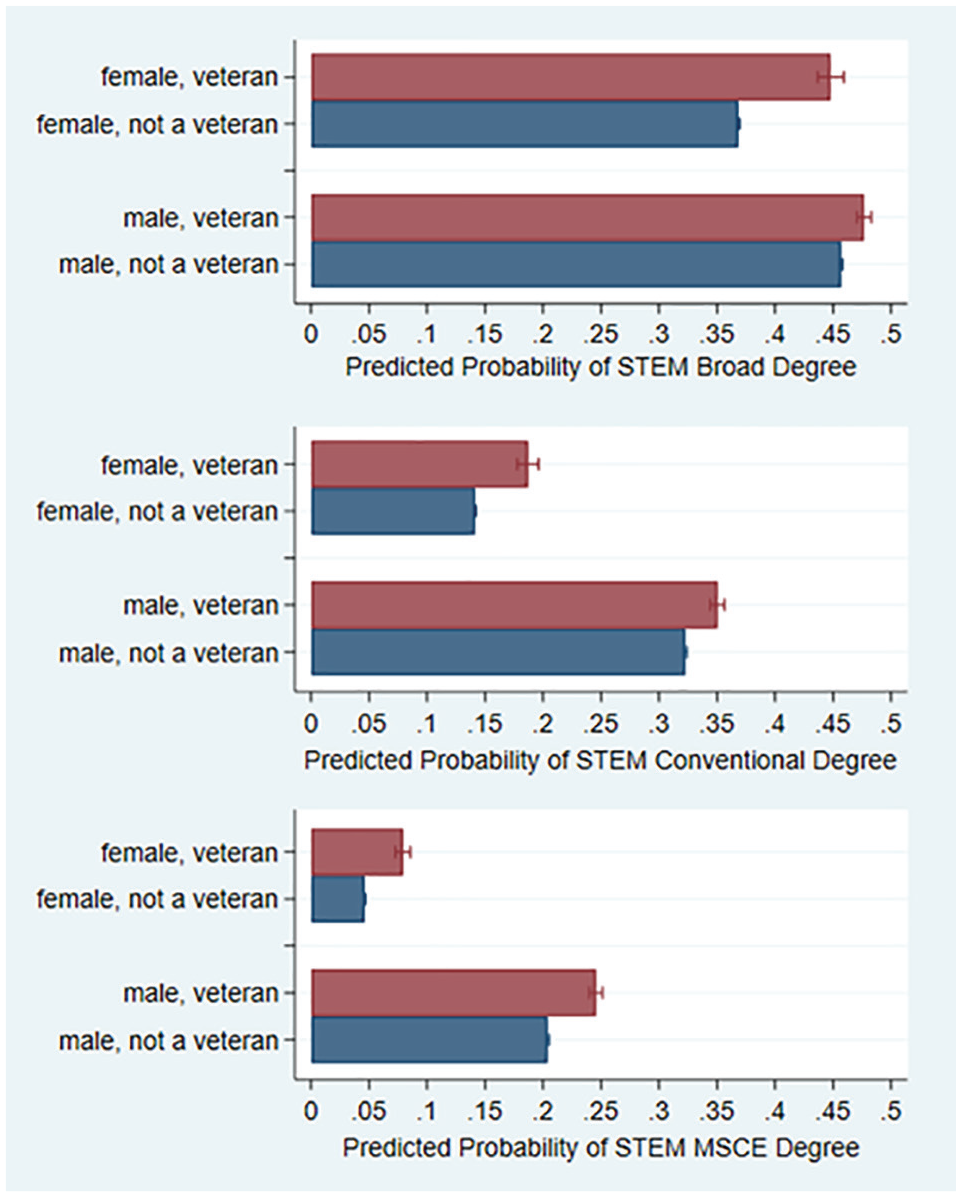
Predicted marginal rates of STEM degree earning by gender × veteran status.
Results
We find strong support for two of our hypotheses: veterans are indeed more likely than civilians to earn STEM degrees, and our results show that this positive association between military service and STEM degree earning becomes stronger the more narrowly we define STEM. Just as important, our results adjudicate between our competing second set of hypotheses: we find clear evidence that the association between military service and STEM degree earning is gendered. Specifically, military service is more strongly associated with STEM degree earning for women than for men, providing support for hypothesis 2b and leading us to reject hypothesis 2a. All of these findings are consistent across the three measures of STEM and strengthen as we measure STEM more narrowly, again supporting hypothesis 3. Below, we describe our results in detail.
Military Service and STEM Degrees
Our first set of models examines the association between military service (i.e., veteran status) and STEM degrees across STEM measures. Figure 1 illustrates the marginal probabilities of having earned a STEM degree for veterans and civilians, holding all other variables at the mean. The results show that for all three dependent variables, veterans are more likely to have earned a STEM degree than are civilians, supporting our first hypothesis.
As Figure 1 demonstrates, the size of this association is substantial, and the strength of the association increases as we define STEM more narrowly, supporting our third hypothesis. When we use the STEM-broad measure, the marginal probability of a veteran’s earning a STEM degree is .441, while the marginal probability for a civilian is .407; this is a .034 increase in probability for veterans, or an 8.4 percent increase. When we use the STEM-conventional measure, the marginal probability of a veteran’s earning a STEM degree is .237, while the marginal probability for a civilian is .210; this is a .027 increase in probability for veterans, or a 12.9 percent increase. Finally, when we use the MCSE measure, the marginal probability of a veteran’s earning a STEM degree is .118, while the marginal probability for a civilian is .093; this is a 0.025 increase in probability for veterans, or a 26.9 percent increase. In other words, our estimates of the percentage increase in the rate of STEM degree earning associated with having served in the military are 8.4 percent (STEM-broad), 12.9 percent (STEM-conventional), and 26.9 percent (MCSE).
Gender, Military Service, and STEM Degrees
Our second set of models tests hypothesis 2a against hypothesis 2b, related to interactions between gender, military service, and STEM degrees (see Figure 2). We find strong support for hypothesis 2b: Military service is more strongly associated with STEM degree earning among female veterans than among male veterans, leading us to reject hypothesis 2a. As evident for veterans in general, the strength of this association increases for both women and men the more narrowly we define STEM. It is worth noting that although the advantage female veterans have over female civilians is substantially larger than the advantage male veterans have over male civilians, men continue to outpace women in earning STEM degrees (regardless of military service) across all three outcome measures.
Using the STEM-broad measure, the marginal probability of earning a STEM degree for female veterans is .448, compared with .368 for female civilians (i.e., .080 increase in probability, or a 21.7 percent increase, among women). The increase associated with military service is much smaller among men: the marginal probability of earning a STEM-broad degree for male veterans is .477, compared with .457 for male civilians (i.e., .020 increase in probability, or a 4.4 percent increase, among men).
Using the STEM-conventional measure, we once more see an increase in the association between military service and STEM degree earning for both men and women, and again the association is much stronger among women. Here, the marginal probability of earning a STEM degree for female veterans is .187, compared with .141 for female civilians (i.e., .046 increase in probability, or a 32.6 percent increase, among women). Again, the increase associated with military service is much smaller among men: the marginal probability of earning a STEM-conventional degree for male veterans is .350, compared with .323 for male civilians (i.e., .027 increase in probability, or an 8.4 percent increase, among men).
Finally, using the MCSE measure, the marginal probability of earning a STEM degree for female veterans is .079, compared with 0.046 for female civilians (i.e., .033 increase in probability, or a 71.7 percent increase, among women). In contrast, the marginal probability of earning a MCSE degree for male veterans is .246, compared with .204 for male civilians (i.e., .042 increase in probability, or a 20.6 percent increase, among men).
To summarize, our results show that military service is associated with consistently and significantly larger increases in the rate of STEM degree earning for women than for men (larger percentage increase). Moreover, the increase associated with military service is highest for women when we use the narrow MCSE measure (71.7 percent increase), versus the STEM-conventional measure (32.6 percent increase), versus the STEM-broad measure (21.7 percent increase). This suggests that this pattern does not simply result from female veterans earning degrees in feminized STEM fields (e.g., nursing) or even in more gender integrated fields (e.g., biology). Instead, female veterans are 1.72 times as likely as civilian women to earn a degree in the most male-dominated STEM fields: mathematics, computer science, and engineering.
Discussion
We posed two empirical questions: Among college graduates, to what extent is military service associated with higher rates of earning a bachelor’s degree in a STEM field? To what extent is this relationship gendered?
We find a strong positive association between military service and STEM degrees (vs. non-STEM degrees) earned overall. This pattern remains markedly robust across three very distinct STEM measures. 2 Similarly, we find that this relationship is even more pronounced for female veterans, and this pattern is most pronounced for male-dominated STEM fields. By comparing women’s and men’s educational outcomes, these findings expand on systematic outcomes other researchers have noted with respect to male veterans’ life-course outcomes (Bound and Turner 2002; Kleykamp 2010; Teachman and Tedrow 2007). Our finding that the association between military service and STEM degree earning is noticeably stronger for women is also consistent with previous studies that have found women more likely to follow multiple and nontraditional pathways into STEM fields (Espinosa 2011; Fealing Lai and Myers 2015; Han 2016; Ma 2011; Wang 2013).
The cross-sectional structure of the ACS data may invite the interpretation that perhaps a classic selection effect is at work, leading women with a penchant for STEM fields to join the military. Research on selection into the U.S. Armed Forces has determined that despite the focus of recruitment efforts on postsecondary educational benefits associated with the GI Bill (Mettler 2005; Ortiz 2012; Spaulding 2000), individuals with definite college plans remain the least likely to enlist (Bachman, Segal et al. 2000). Although our analyses focus exclusively on veterans (and civilians) who do earn bachelor’s degrees, these patterns suggest that our results are all the more remarkable: veterans who, on average, have lower grades and less educated parents (Bachman, Segal et al. 2000), and are less likely to plan to attend college than their civilian peers would seem particularly unlikely candidates for earning degrees in STEM, fields typically perceived as requiring strong academic preparation and a continual progression through the STEM pipeline. However, Bachman, Segal et al. (2009:18) concluded that “whereas military service may be more of a default option for many men not planning on college, this does not appear to be the case for women”; instead, women who enlist are more likely to say that they will “probably” attend college in the future. Nonetheless, prior research has found that military service affects educational and occupational outcomes above and beyond selection effects (Routon 2014). Thus, although selection likely contributes to the association between military service and STEM degrees, to attribute our results solely to selection effects seems implausible.
Alternatively, we may also be witnessing some combination of exposure effects (Bachman, Freedman-Doan 2000; Patten and Parker 2011): specifically, women’s exposure to STEM knowledge and skills during military service may make them more likely to pursue a STEM degree (i.e., military service may serve as a “bridging environment” or “signal” to potential civilian employers; Browning et al. 1973; Cooney et al. 2003; Kleykamp 2009, 2013; Routon 2014). Or, as a result of exposure to military norms and practices, female service members may develop cultural capital that enables them to navigate more successfully the organizational climate and institutional hurdles that contribute to civilian attrition from STEM degree programs (Smith-Doerr 2004). Put differently, female veterans likely face challenges similar to those faced by female civilians in pursuing a STEM degree. Yet having successfully negotiated the culture of the U.S. military may encourage women to select a STEM major and persist in STEM at higher rates as they are better able to access resources, connect with peers, and seek out mentorship, despite the well-documented “chilly climate” (Britton 2017; Flowers and Banda 2015; Fox, Sonnert and Nikiforova 2009; Hill et al. 2010). Additional research, including the collection of longitudinal data from a large sample of female veterans, is needed to adjudicate the relative impacts of selection versus exposure in driving this relationship.
Our results suggest that military service may provide the biggest boost for women earning degrees in traditionally male-dominated STEM fields (MCSE). The robustness of findings across STEM definitions (and measures) notwithstanding, our analyses also indicate that although female veterans earn STEM degrees at rates far surpassing female civilians, even female veterans continue to lag behind both male veterans and male civilians in STEM degree rates. Thus, our findings do not suggest that a traditionally gendered institution (i.e., military) furthers the reproduction of classic gender segregation patterns in another gendered entity (STEM fields). Instead, military service apparently helps diversify the STEM pipeline, especially in those fields in which women have been traditionally been most underrepresented.
Conclusion
This study produces two major empirical insights with significant policy implications and spurs several suggestions for future research. We find that military service appears to significantly boost veterans’ odds of earning STEM degrees, regardless of how broadly or stringently we define and measure STEM. The U.S. military, especially the Army, has long maintained that it provides excellent opportunities to gain valuable technical skills, and recruitment efforts across the armed services have placed heavy emphasis on training and postsecondary educational benefits (Hamrick and Rumann 2013; Mettler 2005; Ortiz 2010; Pash 2012). Our analyses provide empirical support for these claims, while also extending a body of research that suggests military service has positive long-term effects on veterans’ income, education and employment outcomes (Kleykamp 2010, 2012; Teachman and Tedrow 2007).
More important, we find that this association between military service and STEM degree earning is far stronger among women than among men. Once again, this association is strongest for the most male dominated STEM fields (MCSE). At face value, readers may consider this striking finding counterintuitive. After all, aren’t both the military and STEM fields classically gendered, marked by a “chilly climate” toward women? However, perhaps it is also an opportunity for researchers and policy makers to recognize the importance of unintended consequences, a classic concept widely attributed to Robert Merton (1936). Specifically, our analyses clearly advance research on gendered organizations by showing that, at least in this regard, female veterans experience an unexpected advantage rather than a double disadvantage. Although our analyses have focused exclusively on the intersection of military service and gender, future research should examine explicitly whether and, if so, how other status characteristics (e.g., race) might influence the patterns described here.
Our analysis also illustrates the extent to which how we operationalize STEM influences our understanding of the gender gap and gendered STEM pathways (Blickenstaff 2005; Bonous-Hammarth 2000; Ma 2011; Mann and DiPrete 2013). This in turn has important implications for policy and institutionally based efforts to broaden STEM participation in specific fields. Our findings suggest that such efforts may benefit from rethinking the current focus on K–12 efforts to diversify the classic “pipeline” in favor of initiatives aimed at harnessing experiential opportunities for exposure among young adults. Similarly, researchers might consider shifting from social-psychological efforts to boost girls’ science identities toward more structurally based approaches aimed at optimizing and incentivizing STEM career choices for traditionally underrepresented groups.
We also noted above that the ACS’s cross-sectional design and lack of variables related to educational aspirations and academic preparation make it impossible to draw conclusions about the causal relationship between military service and STEM degrees. In the future, analyzing the relative impacts of selection versus exposure effects on STEM outcomes will be key to developing effective policies that optimize STEM recruitment and retention at all levels of education.
Supplemental Material
Appendices – Supplemental material for Soldiers to Scientists: Military Service, Gender, and STEM Degree Earning
Supplemental material, Appendices for Soldiers to Scientists: Military Service, Gender, and STEM Degree Earning by Christina Steidl, Regina Werum, Sela Harcey, Jacob Absalon and Alice MillerMacPhee in Socius
Footnotes
Acknowledgements
We thank colleagues at the NSF, at the American Sociological Association and IUS meetings, as well as peers at the University of Alabama in Huntsville and the University of Nebraska–Lincoln, the Max Planck Institute in Rostock, and the University of Frankfurt for their valuable feedback.
Funding
The author(s) disclosed receipt of the following financial support for the research, authorship, and/or publication of this article: Part of this research was supported by a collaborative grant from the National Science Foundation (SES 1728044 and SES 1727969) and by the Office of Research and Economic Development at the University of Nebraska–Lincoln.

Supplemental Material
Supplemental material for this article is available online.
Notes
Author Biographies
References
Supplementary Material
Please find the following supplemental material available below.
For Open Access articles published under a Creative Commons License, all supplemental material carries the same license as the article it is associated with.
For non-Open Access articles published, all supplemental material carries a non-exclusive license, and permission requests for re-use of supplemental material or any part of supplemental material shall be sent directly to the copyright owner as specified in the copyright notice associated with the article.
