




Abstract
The author explores how the gender gap in aspirations for scientific, technical, engineering, and mathematical (STEM) work changes with societal affluence. Over-time data on cohorts of eighth graders in 32 countries reveal that aspirations for mathematically related work become more gender differentiated as societal affluence grows. This relationship holds controlling for students’ social class backgrounds, mathematical achievement, and affinity for school, and it is not explained by cross-national differences in the economic integration of women, gender stereotyping of science, or Internet access. Observed patterns of gender segregation reflect more than just women’s greater freedom to indulge tastes for non-STEM work in affluent societies; tastes are themselves more gendered in these contexts.
Over the past three decades, policy makers, activists, and business leaders around the world have launched wide-ranging global and local initiatives aimed at increasing the presence of women in scientific, technical, engineering, and mathematical (STEM) occupations and degree programs. Motivating these initiatives are interests in increasing women’s access to secure, well-rewarded occupations and in addressing shortages of scientific and technical labor that are believed to threaten national prosperity, private profits, and the broader public welfare (National Academy of Sciences 2007; United Nations Educational, Scientific and Cultural Organization 2010; Wotipka and Ramirez 2003).
In the United States and other affluent democracies, these STEM diversification efforts have resulted in little change in the gender segregation of scientific and technical fields since the 1990s, with the exception of increased representation of women in biological and health-related fields (England et al. 2007; Pearson, Frehill, and McNeely 2015; Xie, Fang, and Shauman 2015). Despite women’s growing numerical advantage in higher education, their share of engineering, computer, and physical science degrees has barely kept pace with overall enrollment gains in the advanced industrial world (DiPrete and Buchmann 2013; National Science Foundation 2015; Schofer and Meyer 2005).
Perhaps more surprising is evidence that women’s representation in many STEM occupations and degree programs is considerably weaker in the most affluent societies than in developing and transitional economies (Barinaga 1994; Charles 2011; Charles and Bradley 2009). Data from the United Nations Educational, Scientific and Cultural Organization (UNESCO) show, for example, that some of the most male-dominated engineering programs are in the world’s leading industrial democracies (Japan, Switzerland, Germany, and the United States). The gender composition of science overall follows a similarly counterintuitive pattern, with women’s share of science graduates nearly 50 percentage points higher in some Eastern European and Muslim countries than in the Netherlands (United Nations Educational, Scientific and Cultural Organization 2010).
One possible explanation for stronger segregation of STEM fields in advanced industrial societies is that women have greater latitude to indulge their gendered aspirations for less lucrative non-STEM pursuits in more affluent contexts. This seems plausible; opportunities for realizing aspirations and mitigating occupational risks vary across societies, and there is evidence that people are more willing to accept the economic costs associated with pursuit of personally attractive career paths in societies characterized by broad-based affluence (Inglehart and Welzel 2005).
A second possibility (and these are not mutually exclusive) is that attitudes are themselves more gender differentiated in affluent societies, perhaps because gender stereotypes more strongly influence educational and career affinities in contexts where concerns about material security are less salient (Charles 2011). Recent comparative research offers some support for this argument. The gender gap in STEM aspirations does vary cross-nationally and in ways that seem to map onto observed patterns of gender segregation. Sikora and Pokropek (2012) found, for example, larger gender differences in expectations to work in computing, engineering, or mathematics (but not biology or health) in advanced industrial societies. My colleagues and I likewise found stronger affinity for mathematics and science and stronger aspirations to pursue STEM careers in more affluent countries (Charles and Bradley 2009; Charles et al. 2014).
The present study uses over-time data from 32 countries to assess more rigorously the relationship between societal affluence and the gender gap in STEM aspirations, which has been investigated only cross-sectionally so far. By modeling within-country change in eighth grade boys’ and girls’ aspirations as a function of within-country change in societal affluence, I am able to measure the affluence effect net of stable country-level characteristics (i.e., characteristics that do not change substantially over the period of study). These include geographic region, religious and secular cultural traditions, levels of political democracy, welfare-state regime type (Cooke 2011), national work-family policies (Mandel and Semyonov 2006; Pettit and Hook 2009), and such properties of educational systems as ability tracking, testing regimes, and density of single-sex and religious-based schooling (Buchmann and Dalton 2002; Charles and Bradley 2002). As a second analytical step, I explore some intermediary variables that may be more proximate drivers of an attitudinal gender gap in affluent societies.
Why Study Aspirations?
Orientations and affinities figure prominently in popular accounts of social outcomes in the United States, and they are one of the most common explanations for women’s persistent underrepresentation in many STEM fields (see review by Ceci and Williams 2010). Explanations tying gender segregation to men’s and women’s free choices are popularly resonant because they align well with Western individualistic values and with widely held beliefs about men’s and women’s naturally distinct tastes and values.
Despite the obvious essentialist interpretations, an analytical focus on aspirations does not imply a privileging of micro- over macro-level explanations for gender segregation. Occupational aspirations are social products, not intrinsic properties of individuals. 1 The sociological evidence is strong that American women’s interest in STEM fields is influenced by all sorts of structural and cultural factors, including statistical discrimination, male-centered professional cultures, and self-fulfilling stereotypes about gender and about the nature of scientific and mathematical work (Cohoon and Aspray 2006; Des Jardins 2010; Faulkner 2010; Rossiter 1993).
Once established, however, aspirations feel very real to those who hold them (Cech 2015), and they have real effects on educational and occupational outcomes. We know that gendered aspirations play a significant role in producing and that reproducing many sorts of gender segregation (Correll 2004; Okamoto and England 1999) and that young people’s interest in STEM careers is highly predictive of later educational and occupational outcomes (Cech et al. 2011; Morgan, Gelbgiser and Weeden 2013). We cannot possibly understand women’s underrepresentation in science and technology in the United States and other advanced industrial labor markets without understanding the social underpinnings of gender-differentiated aspirations and affinities.
I explore the relationship between societal affluence and eighth-graders’ aspirations for mathematically-related jobs in 32 countries between 2003 and 2011. Results show that aspirations become more gender differentiated as societal affluence grows. This gendering effect holds net of students’ social class backgrounds, mathematical achievement, age, and affinity for school, and it is robust to numerous changes in model specification and measurement. The association between societal affluence and the attitudinal gender gap is also not explained by cross-national differences in the educational and economic integration of women, the gender stereotyping of science, or student Internet access. One possible intermediary mechanism is the greater tendency for people to understand school and work as vehicles for personal fulfillment in affluent societies; expectations for self-realization through work may intensify the influence of cultural gender beliefs on educational and occupational aspirations. In any case, observed patterns of gender segregation reflect more than just women’s greater latitude to indulge tastes for non-STEM work in affluent societies; tastes are themselves more gendered in these contexts.
Data and Methods
Student-level data are taken from the Trends in International Mathematics and Science Study (TIMSS), in which surveys have been conducted every four years since 1995 by an independent cooperative of national research institutions and government agencies. The survey instruments are translated from a common English survey into local languages and verified by linguistic experts for cross-national comparability and local usage (Trends in International Mathematics and Science Study at the Eighth Grade 2013).
On the basis of availability of the requisite data at two time points, the sample for the main analyses includes 32 countries and territories and approximately 200,000 students with at least one high-school educated parent. Countries and student sample sizes are shown in Appendix A and analyses using a sample unrestricted by parental education are shown in the online Appendix. Although it is not globally representative (most notably because of missing data on mainland China and India), this country sample is more regionally and socioeconomically diverse than those used for most previous comparative analyses on this topic.
Measuring Aspirations
Aspirations for STEM careers are assessed using eighth graders’ responses to the statement “I would like a job that involved using math” (strongly agree, agree, disagree, or strongly disagree). TIMSS does not ask directly about STEM (or science) aspirations, but this item’s reference to “a job that involve[s] using math” likely calls to mind strongly male-dominated occupations in engineering, computing, and other physical sciences, rather than biological or health-related fields, which require completion of mathematics courses but not ongoing use of mathematics at work. Previous research showed that different indicators of STEM affinity and aspirations (e.g., “I like math,” “I like science,” “I would like a job involving math,” “I enjoy learning math”) follow similar patterns of cross-national variability (Charles and Bradley 2009; Charles et al. 2014; Sikora and Pokropek 2012).
Research on educational and career paths in advanced industrial societies shows higher levels of attrition from STEM tracks among girls and women than among boys and men. This gender gap in persistence has been attributed to the competitive, masculine cultures and structures in many STEM environments and to cultural stereotypes that make girls and women less confident in their mathematical and scientific abilities and more sensitive to negative performance evaluations (Cech 2015; Cheryan et al. 2016; Correll 2001; Morgan et al. 2013; Seymour and Hewitt 1997). On the basis of the premise that more strongly held STEM aspirations will be more resilient in the face of such pressures, the primary models distinguish students who agree strongly (coded 1) with the survey statement from all others (coded 0). Robustness checks, presented further on, show similar results using a coding scheme that distinguishes students who strongly agree or agree from those who strongly disagree or disagree. Conclusions are also unchanged if agreement is treated as a continuous four-point scale and modeled using ordinary least squares regression, and using a sample that includes all levels of parental education (see online Appendix Table A3). Twenty percent of boys and girls reported strong agreement in 2003, and 23 percent reported strong agreement in 2011 (see Appendix B).
TIMSS included some variant of the math aspirations item in every survey year but 2007. The primary over-time analyses use data from the 2003 and 2011 waves because the question wording changed between 1999 and 2003. To rule out the possibility that findings are specific to the 2003–2011 period, I present supplementary models of change during the 1990s.
Analytic Strategy
The primary analyses predict strong aspirations for a job involving mathematics using fixed-effect logistic regression models with robust standard errors and dummy variables for country and year. 2 The year indicator (2011 vs. 2003) accounts for any time trend that affects all countries similarly; country dummies control for unobserved characteristics of countries that are stable between 2003 and 2011 and might be correlated with both societal affluence and gendered aspirations.
The focal country-level covariate, societal affluence, is measured for each survey year (or as close thereto as possible) using the United Nations Development Programme’s Human Development Index (HDI), which takes into account life expectancy, education, and national income. The HDI offers a broader perspective on living standards and existential security of the population than purely economic measures (United Nations Development Programme 2012), and it fluctuates less in response to short-term ups and downs in the economic cycle. Between the 2003 and 2011 survey years, the HDI increased by approximately 5 percent (from .76 to .80) in the average country. Appendix B shows descriptive statistics, including (in table note) minimum and maximum HDI values by year. 3
The interaction of student gender with societal affluence is of particular interest, because it gives the effect of within-country change in societal affluence on change in gender-specific aspirations holding constant student-level traits, generic time trends, and stable country-level traits.
Because the 2003–2011 period includes the great recession, eighth graders surveyed in 2011 came of age during a period of greater global economic insecurity than those surveyed in 2003. Any general trend in students’ aspirations (net of within-country changes in economic development) is captured with the dichotomous indicator for survey year 2011. Gender-specific trends were assessed by introducing an interaction term of gender by year, but this showed no significant effect and was omitted from the final models.
Basic student-level demographic covariates include gender, age, and socioeconomic status. The latter is measured as education level of the most highly educated parent (primary or tertiary, with secondary as the omitted category).
Indicators for mathematics achievement are included at both the individual and country levels. The student-level achievement variable controls for the possibility that girl students are more positively selected into secondary education (i.e., are higher achieving on average than boy students) in less affluent societies, perhaps because only academically “exceptional” girls are enrolled in secondary school in these contexts. If girls were more positively selected in low-HDI contexts, the smaller attitudinal gender gap in these countries might be an artifact of their stronger mathematical achievement relative to boys. Student achievement is measured using “plausible scores” (BSMMAT01) on TIMSS’s cross-nationally standardized tests, which range from 0 to 1,000 and are standardized to a mean of 500 in 1995. I divide the plausible scores by 100 to simplify tabular presentation of coefficients.
Mathematical achievement at the societal level is measured as the mean of eighth graders’ plausible scores in each country or territory for the respective survey year (again divided by 100). I treat this variable as a proxy for the difficulty of the national mathematics curriculum: countries with the most intensive mathematics curricula are likely to have higher average achievement scores than countries with less intensive mathematics curricula. To the extent that students dislike fields thought to be difficult, highly competitive, or time consuming, change in these aggregate scores should be negatively related to change in aspirations for mathematically related jobs, and effects could differ by gender (Charles et al. 2014; Mann and DiPrete 2016; Osborne, Simon, and Collins 2003).
Strong aspirations for a mathematically related job may coincide with more positive orientations toward academic pursuits in general. These orientations may in turn vary by gender and across countries in ways that confound measurement of cross-national variation in the dependent variable. I control for this by including a student-level measure of school affinity, defined as strong agreement with the statement “I like being in school.” Supplementary analyses revealed no significant interaction with gender, so the final models include the main effect only.
Following the over-time analyses and extensive sensitivity tests, a final series of cross-sectional models explores possible intermediary mechanisms in the relationship between STEM aspirations and societal affluence. Because some of the key mediating variables are available at a single time point, these analyses are based on 2011 data only. To account for clustering of cases within countries, the cross-sectional analyses are carried out using Stata’s XTMELOGIT command for multilevel models. 4
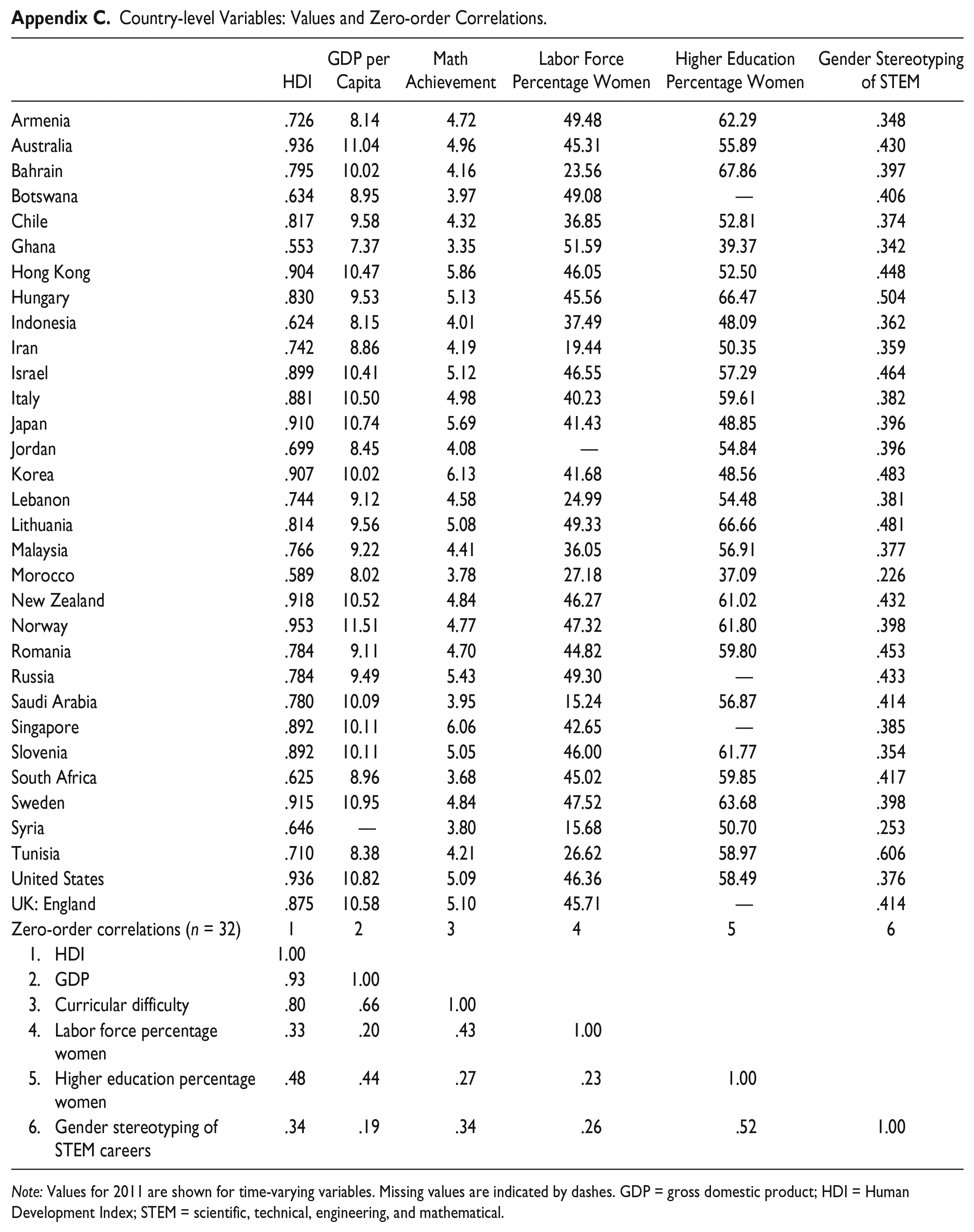
Appendix B shows means and standard deviations for variables used in regression models; Appendix C shows scores for country-level covariates and their intercorrelations.
Results
Cross-national Variability in STEM Aspirations
Table 1 shows predicted odds of strong aspirations for a mathematically related job in 2011. These odds were computed separately for boys and girls through logistic regression models with fixed country effects and controls for student age, math achievement, affinity for school, and parental education. They are “adjusted odds” because they account for differences across countries in student-level traits.
Adjusted Odds of Strong Scientific, Technical, Engineering, and Mathematical Career Aspirations, 2011.

Note: Values are predicted odds of strong aspirations for a mathematically related job for students of average age and math achievement and with secondary-educated parents. Data are from the 2011 Trends in International Mathematics and Science Study sample of eighth-graders (n = 56,277 girls, n = 52,770 boys).
The first two columns of Table 1 give values for girls and boys, respectively, and the third column gives the ratio of girls’ to boys’ odds. These odds ratios provide a good measure of gender differences in aspirations for mathematically related jobs in 2011. Values less than 1, which are found in all but one country, indicate a greater likelihood of strong aspirations for mathematically related work among boys than girls. An odds ratio of 1 indicates equal odds for boys and girls.
Although boys’ attitudes are more positive than girls’ nearly everywhere, cross-national variability in these odds ratios is substantial, ranging from .424 in Hong Kong to 1.000 in Botswana. The aim of the present study is to understand how variability in this gender gap relates to differences in societal affluence. A first impression can gained by plotting the girl-to-boy ratios in Table 1 against the 2011 HDI. Results, shown in Figure 1, reveal a strong negative correlation (–.76), meaning that girls’ odds of reporting strong aspirations for math-related careers are lower, relative to boys of similar ability, age, and class background, in higher HDI contexts. Over-time analysis within countries allows a better assessment of this affluence effect because it holds constant stable country-level traits that might be correlated with both affluence and the attitudinal odds ratios.

Adjusted Girl-to-boy Odds Ratios of Strong Aspirations for a Job Involving Math, by Societal Affluence.
Predicting Eighth Graders’ Aspirations, 2003 to 2011
Table 2 shows the results of models predicting within-country change in eighth graders’ aspirations between 2003 and 2011. Model 1 includes a gender dummy along with student- and country-level controls. The large negative coefficient in the first row confirms previous research findings that girls are significantly less likely than boys to express strong aspirations for mathematically related work, even controlling for differences in mathematical achievement and social background (Charles et al. 2014; Riegle-Crumb et al. 2012). This model shows predicted odds that are more than 50 percent higher for boys than girls (exp[.447] = 1.564).
Two-way Fixed-effects Models of Eighth Graders’ Strong Aspirations for a Mathematically Related Job, 2003 to 2011.

Note: Values are coefficients (standard errors) from models with fixed country and year effects and robust standard errors (n = 190,366 students, 32 countries, 2 years). HDI = Human Development Index. Reference category on parental education is some postsecondary.
p < .05. **p < .01. ***p < .001.
Model 2 adds to this baseline model the focal country-level covariate: societal affluence, measured here as HDI. This coefficient gives the effect of within-country change in affluence on within-country change on aspirations. Interestingly, results show no significant effect on aspirations when the affluence effect is constrained to be the same for boys and girls. But introduction in model 3 of the interaction term with gender suggests a significant difference between boys and girls in the effect of societal affluence. Coefficients from the logit model indicate that an increase of .2 on the HDI scale (roughly half the distance between the lowest and highest scoring countries in our 2011 sample) is associated with a decrease of about 19 percent in girls’ odds of strong aspirations for a mathematically related job (exp[.2 × (.389 − 1.456)] = .808), while HDI is unrelated to boys’ aspirations. Together this implies a larger gender gap in more affluent societies and seems to confirm the negative cross-sectional relationship shown in Figure 1.
Student-level control variables show mostly expected effects. Individual mathematical achievement and affinity for school are both positively related to aspirations, and older students are more likely to have strong aspirations for mathematically related work. None of these relationships differ significantly by gender (results available on request).
The positive effect of parental university education is inconsistent with recent evidence from the United States showing a stronger tendency for students from less privileged social backgrounds to select majors and aspire to occupations that offer greater material security (Ma 2009; Mullen 2014). This discrepancy may be attributable to the greater propensity for those from higher socioeconomic statuses to expect completion of higher education, a prerequisite for most jobs involving mathematics (Xie et al. 2015). Supplementary analyses that include primary-educated parents show strongest STEM aspirations among students with most- and least-educated parents (online Appendix Table A2).
The coefficients for survey year indicate a greater prevalence of strong aspirations in 2011 than in 2003. The overall rise in strong aspirations may be partly attributable to increased pragmatism among students coming of age in the shadow of the great recession and/or to efforts by governments, nongovernmental organizations, and industry around the world to encourage young people to consider STEM careers. Supplementary models show no significant trend in aspirations between 1995 and 1999 and no gender-specific trend in either decade.
Net of individual-level achievement, the effect of average national mathematical achievement is strongly negative: increasing curricular difficulty is associated with decreasing STEM aspirations. This finding is consistent with previous analyses showing that students’ interest wanes as mathematics curricula become more difficult within the United States, 5 and it suggests that the weaker overall STEM aspirations in affluent societies, evident in columns 1 and 2 of Table 1, may be partly attributable to the more difficult mathematics curricula in these contexts (see Appendix C). Supplementary analyses, discussed further on, show no significant gender difference in this effect.
Figure 2 presents graphically the girl-to-boy odds ratios predicted by model 3 of Table 2 for three hypothetical countries: with high, medium, and low affluence. All bars fall clearly short of gender parity (the value of 1, representing equal odds). But comparing bars across country types, we see that the predicted gender gap in aspirations becomes larger (i.e., bars get shorter) as societal affluence increases. In high-affluence contexts, girls’ predicted odds of aspiring to a math-related job are about half as large as boys’ odds. In low-affluence contexts, their odds are about 80 percent of boys’. As described below, I also assess this interaction by graphing average marginal effects and confidence intervals, and through ordinary least squares regression.

Predicted Girl-to-boy Odds Ratios, by Societal Affluence.
Sensitivity Tests
The relationship observed between societal affluence and the attitudinal gender gap is robust to changes in model specification and variable definition. Columns 2 to 7 in Table 3 show results of diverse sensitivity tests. Coefficients from the full fixed-effects specification (model 3 in Table 2) are shown in the first column for comparative purposes.
Sensitivity Tests for Fixed-effects Models.
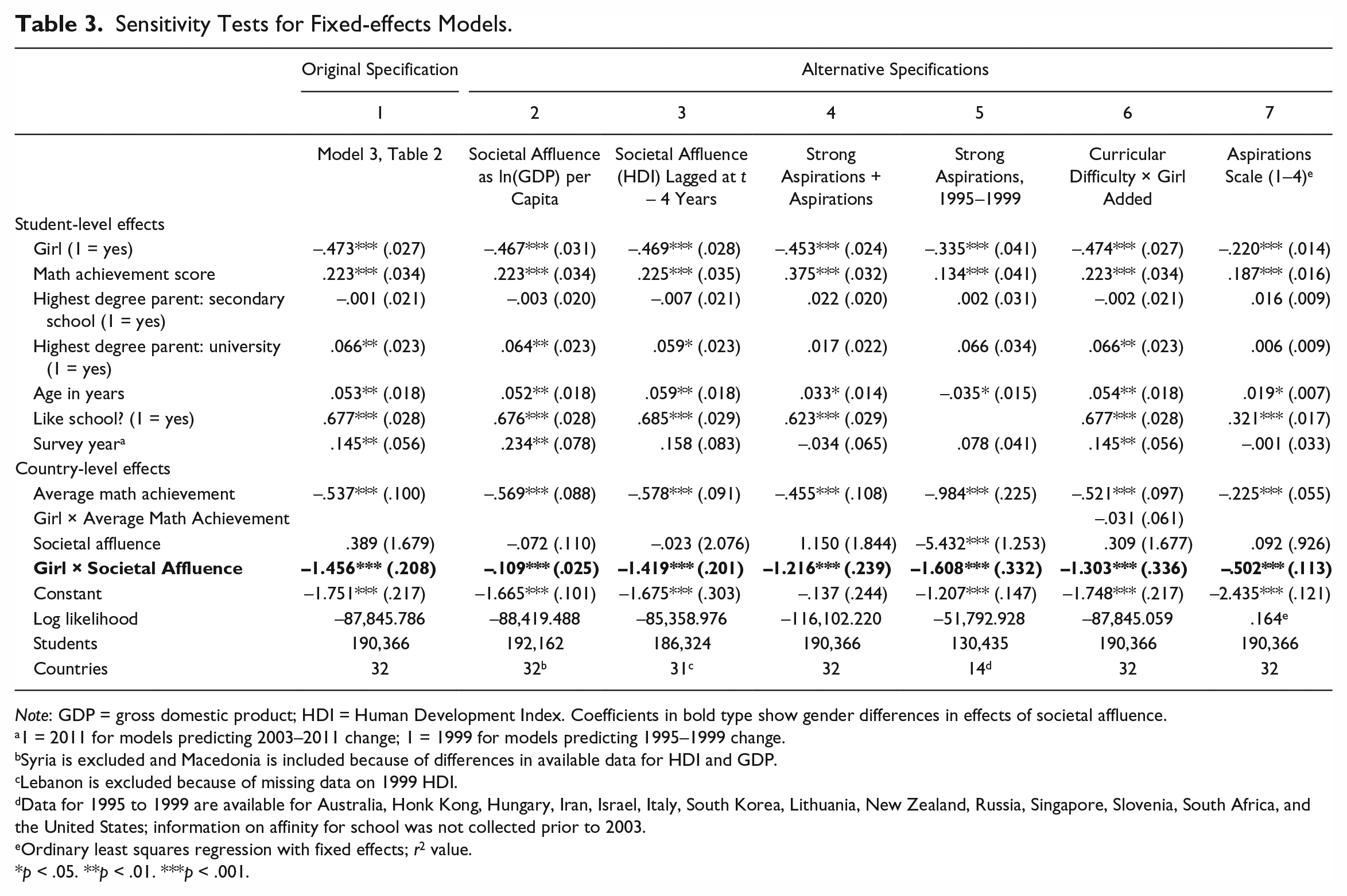
Note: GDP = gross domestic product; HDI = Human Development Index. Coefficients in bold type show gender differences in effects of societal affluence.
1 = 2011 for models predicting 2003–2011 change; 1 = 1999 for models predicting 1995–1999 change.
Syria is excluded and Macedonia is included because of differences in available data for HDI and GDP.
Lebanon is excluded because of missing data on 1999 HDI.
Data for 1995 to 1999 are available for Australia, Honk Kong, Hungary, Iran, Israel, Italy, South Korea, Lithuania, New Zealand, Russia, Singapore, Slovenia, South Africa, and the United States; information on affinity for school was not collected prior to 2003.
Ordinary least squares regression with fixed effects; r 2 value.
p < .05. **p < .01. ***p < .001.
In column 2, HDI was replaced with the natural logarithm of gross domestic product per capita as an alternative time-varying indicator of societal affluence. Conclusions are unchanged, which is not surprising given that the two measures are very highly correlated (r = .93).
In a second sensitivity test, I measured societal affluence with a temporal lag, which might better capture its effect on eighth graders’ career aspirations. Column 3 in Table 3 shows results from models computed with HDI measured four years prior to the attitudinal surveys (i.e., in 1999 and 2007, instead of concurrently in 2003 and 2011). The coefficient for the girl–by–societal affluence interaction is very close in magnitude to that for the contemporaneous specification.
Column 4 in Table 3 shows that the interaction of HDI with gender remains negative and significant if aspirations are defined more broadly to include both those who agree and those who strongly agree with the statement that they would like to have a job involving math. The only difference in the model is a nonsignificant effect of parental university education and the elimination of the positive effect for survey year 2011. 6
As a further check, I examine trends during the 1990s. Because of changes in question wording between 1999 and 2003, 7 the primary analyses compare the 2003 and 2011 waves. The 1995–1999 analysis is based on the survey item “Do you think that you would like a job that involved using math?” which is available for 14 of 32 sample countries. Results of these models are shown in column 5 in Table 3. The negative interaction of HDI with gender indicates a growing gender gap with increasing societal affluence during the 1990s as well. The significant main effect of HDI indicates a (smaller) negative effect of affluence on boys.
In column 6, the baseline model is shown with the addition of an interaction term that allows boys and girls to respond differently to the difficulty of the national mathematics curriculum, as suggested in cross-national analyses by Mann and DiPrete (2016). Curricular difficulty (average mathematical achievement) continues to show a strongly negative main effect in this model, but I find no significant gender interaction, meaning that girls’ STEM aspirations are not more adversely affected by a difficult mathematical curriculum than are boys’ aspirations, net of individual achievement. The coefficient representing the interaction of HDI with gender shows modest attenuation in model 6, but it remains statistically significant at the .001 level. Country-level effects are also substantively unchanged if student-level achievement is omitted from the model (results available on request).
To ensure that findings are not driven by a single high-leverage country, I reestimated model 3 (Table 2) 32 times, dropping a different country each time. The interaction of gender and HDI remained negative and significant in all models. Omitting the indicators for parental education (missing for many students) also does not change the overall conclusion.
Because biases can be introduced by comparing odds ratios across sample subgroups (Mood 2010; Williams 2012), I have also (1) run an ordinary least squares regression model predicting values on an aspirations scale ranging from 1 to 4 and (2) computed and graphed predicted probabilities (average marginal effects) and confidence intervals from the original specification at different HDI levels. The ordinary least squares regression results are shown in column 7 in Table 3, and the predicted probabilities are shown in Appendix Figure A1. These analyses support conclusions from Table 2 and Figure 2: differences between boys’ and girls’ aspirations increase with HDI.
Intermediary Mechanisms
Why are adolescents’ aspirations for mathematically related work more gendered in affluent societies? A final series of analyses explores some possible intermediary mechanisms. Included in these models are the same covariates as in the previous analyses plus a student-level indicator for home Internet access and country-level indicators of women’s educational and economic status and the gender-stereotyping of science. Because over-time data are not available for most of these covariates, these models are restricted to a single time point, 2011. Results are therefore preliminary but may identify fruitful directions for further research.
One possible explanation for the larger attitudinal gender gap in affluent societies is adolescents’ more frequent and more intensive use of the Internet in these contexts. 8 Regular use of the Internet may influence STEM aspirations by increasing students’ exposure to Western cultural values and gender stereotypes that are disseminated online and/or by increasing students’ experience with information technologies. I measure Internet exposure using students’ responses to the TIMSS item (available in 2011 but not 2003) “Do you have Internet access at home?”
Past research suggests that women’s incorporation into labor markets and higher education in affluent democracies often coincides with the consolidation of “pink collar” occupational and educational niches and therefore diversion of women from some historically male fields (Bradley and Charles 2004; Charles and Grusky 2004; Oppenheimer 1973). I assess this effect using two indicators: women’s share of the formal labor market in 2007 (from the International Labour Organization; http://laborsta.ilo.org/STP/guest) and women’s share of higher education in 2007 (from UNESCO’s statistical database; http://data.uis.unesco.org/). Values are taken four years prior to the 2011 TIMSS wave to capture possible socializing effects of women’s educational and labor market status on respondents during early childhood. For countries with missing data in 2007, the closest available year was used. 9
I have also explored the possibility that the negative relationship between societal affluence and girls’ STEM aspirations reflects stronger gender stereotyping of science in affluent contexts. Nosek et al. (2009) found symbolic male gendering of scientific pursuits in countries spanning all major geographic regions and a broad range of economic development (see also Miller, Eagly, and Linn 2014). But countries differ significantly in the strength of these stereotypes, and we know little about how this affects career aspirations. The intensity of gender-science stereotypes in each of the 32 sample countries is measured using data assembled through Project Implicit, an international collaboration among researchers interested in unconscious social cognition (Nosek et al. 2009). 10
Table 4 shows selected coefficients from multilevel models predicting eighth graders’ aspirations in 2011. The first column gives results for a model that includes the same predictors as in the full over-time specification. Model 2 adds to that a student-level indicator of at-home Internet access and its interaction with gender. Models 3 to 5 add to model 2 some possible country-level mediators (and their interactions with gender), one at a time to conserve degrees of freedom. 11
Multilevel Logistic Regression Models of Eighth Graders’ Strong Aspirations for a Mathematically Related Job in 2011.

Note: Values are coefficients (standard errors) from mixed-effects logistic regression models. In addition to covariates shown here, all models include the student- and country-level controls shown in Table 2 (model 3). Coefficients in bold type show gender differences in effects of societal affluence.
Jordan is excluded because of missing data on women’s labor force participation.
Botswana, Russia, Singapore, and England are excluded because of missing data on women’s share of higher education.
p < .05; **p < .01; ***p < .001.
Why the Affluence Effect?
A first finding from Table 4 is that addition of these new variables in no case eliminates the significant negative effect of societal affluence (HDI) on girls’ relative aspirations for a mathematically related job.
Students’ at-home Internet access (model 2) shows a negative effect on aspirations for STEM work that is especially strong among girls. This result is consistent with the idea that young people access Internet content that supports more negative and more gendered attitudes toward STEM. This may occur through diffusion of Western stereotypes about science and mathematics 12 or through diffusion of individualistic values that may make people more averse to what they perceive as boring, difficult, or gender-nonconforming work (Inglehart and Welzel 2005). The gendering effect of Internet access may also be attributable to the lived experience of using computers, for example, girls’ exposure to the masculine culture of online gaming communities. Although the coefficient for societal affluence attenuates only slightly with inclusion of this variable, findings suggest that the relationship between Internet use and (gendered) career aspirations should be studied further, ideally with over-time data.
Model 3 adds to model 2 a country-level indicator for women’s labor participation and its interaction with student gender. In contrast to previous research suggesting stronger occupational gender segregation in contexts in which more women are employed, the coefficients in model 3 suggest a modest positive, not negative, effect of female labor force participation rate on girls’ aspirations for mathematically related work. It does not appear, therefore, that the observed affluence effect can be attributed to higher employment rates of women in more affluent societies. It may be that girls who are more exposed to employed women are less influenced by gender stereotypes and therefore more likely to aspire to male-typed pursuits (Riegle-Crumb and Moore 2013).
The indicator for women’s university attendance, included in model 4, shows no effect on aspirations, nor does it eliminate the significant interaction of gender with societal affluence. Taken together, results from models 3 and 4 offer no support for the idea that cross-national differences in women’s public-sphere roles explain the observed relationship between societal affluence and gendered STEM aspirations. Supplementary models substituting women’s share of professional occupations (http://laborsta.ilo.org/STP/guest) for women’s labor market share yielded similar results (available on request).
Although gender-science stereotypes are somewhat more pronounced in high-HDI societies (r = .34 in Appendix C), these differences do not appear to account for girls’ weaker STEM aspirations in these contexts (model 5). 13 It may be that the observed patterns of cross-national variability are influenced less by the extent of gender stereotyping than by the cultural linkage of these stereotypes to individual career choice.
Although societal affluence likely operates on aspirations through more proximate cultural or structural mechanisms, coefficients in Table 4 provide little evidence for some of the most obvious ones. I suggest below some other possible mediating variables and directions for future research.
Discussion
This study explores the gender gap in eighth graders’ aspirations for STEM work in cross-national comparative perspective. Results of over-time analyses and diverse sensitivity tests indicate that this gender gap varies significantly across countries and that it is larger in more affluent societies. I find no evidence that this relationship reflects cross-national differences in women’s socioeconomic role or in the gender stereotyping of science.
The Cultural Pull of Mars and Venus
The question of how growing societal affluence might promote gendered career aspirations remains open. One plausible mechanism, as yet untested, involves change in the cultural meaning of education and work to more strongly emphasize personal fulfillment in advanced industrial societies (Bellah et al. 2008; McGee 2005). In societies characterized by broad-based affluence, educational and career choices are about more than earning a living; they are also acts of identity construction. In these contexts, self-expression comes to be a normatively sanctioned basis for life choices. Young people, especially those from more privileged classes (Ma 2009; Mullen 2014), are increasingly urged to do what they love and “follow their passions” in selecting career paths.
Political scientist Ronald Inglehart has demonstrated a greater prevalence of “postmaterialist” ideals of self-expressiveness in affluent late modern democracies (Inglehart and Norris 2003; Inglehart and Welzel 2005). But what Inglehart and colleagues do not consider is that the authentic inner selves that we are expected to stay true to are also social products. These selves develop in environments permeated by taken-for-granted beliefs about the fundamentally different natures of men and women, as reflected in John Gray’s (2012) popular Mars-Venus metaphor. Because young people often do not know in advance what they will love doing, they may attempt to follow their passions by drawing on stereotypes about what same-gendered others love and are good at. Girls may, for example, expect to enjoy work they think is more people oriented and emotionally rewarding, and they may steer clear of pursuits they think require masculine traits and aptitudes, such as the solitary science careers depicted in Western popular culture (Colatrella 2011; Goldman and Penner 2016; Nosek et al. 2002; Frehill, Abreu, and Zippel 2015). 14 As a result, career aspirations may be more strongly influenced by essentialist gender stereotypes in societies where occupational choice represents a vehicle for self-expression.
In affluent democracies, equality is generally defined in formal procedural terms: as equal opportunity to realize preferences, which are widely understood to be intrinsic properties of individuals. Extreme gender segregation can coexist quite comfortably alongside these liberal egalitarian principles as long as it can be interpreted as reflecting free choices by equal but fundamentally different men and women (Charles and Grusky 2004; Cotter, Hermsen, and Vanneman 2011; Levanon and Grusky 2016). American girls who opt out of STEM courses or aspire to become kindergarten teachers rarely experience these choices as forced conformity to societal gender norms or feel that they are yielding to the realities of their hard-wired feminine competencies. Rather, they understand their aspirations as reflecting likes and dislikes that are quintessentially individual and must be respected as a matter of personal freedom (Frank and Meyer 2002; Cech 2013). This emotional buy-in is where many forms of gender segregation get their staying power, even in the most modern, liberal-egalitarian contexts.
Looking Forward
A full understanding of the specific mechanisms by which societal affluence shapes attitudes toward STEM will require more fine-grained comparative studies, including new international surveys, in-depth interviews, and comparative ethnographies on the development of adolescent career aspirations in diverse societies. In particular, future analyses should explore how cultural meanings of education and work change with societal affluence and how such changes influence young people’s work aspirations. 15
The relationship between Internet connectivity and students’ aspirations is another fertile field for future comparative research: does Internet use per se reduce adolescents’ interest in STEM and widen the gender gap in STEM aspirations, as suggested by results of this study? If so, what are the intermediary mechanisms? One possibility is that Internet-connected students are more exposed to Western stereotypes that depict science and technology as difficult, boring, nonexpressive, and/or quintessentially masculine (Colatrella 2011; Lagesen 2008; Steinke et al. 2007).
Another open question is whether the gender segregation of STEM fields will increase in less affluent societies as those citizens come to enjoy more broad-based economic security. Although the present results provide some evidence of attitudinal convergence, it is possible that the distinct socioeconomic and historical contexts under which STEM labor markets are expanding in less developed and transitional economies will lead to different occupational outcomes than those seen in the United States and Europe (e.g., Stinchcombe 1965). It is also possible that efforts to diversify STEM fields in the West will show increasing success and contribute to cross-national convergence on patterns of educational and work aspiration that are less gender typed.
Diversifying STEM occupations and degree programs in the United States and other affluent democracies will likely depend on increasing girls’ and women’s interest in scientific and technical work (Morgan et al. 2013; Osborne et al. 2003; Seymour and Hewitt 1997; Xie et al. 2015). This will in turn require the erosion of cultural stereotypes depicting scientific and technical work as uncreative, solitary, and fundamentally masculine and depicting women as ill suited for STEM work. Cultural change of this sort does not occur quickly, but some efforts toward counterprograming can be seen in ongoing public- and private-sector STEM diversification initiatives and in parents’ growing embrace of toys that resist pink-aisle marketing to girls (e.g., GoldieBlox, Lego woman scientists).
A more aggressive strategy for integrating STEM might be to restructure secondary curricula to require all students to complete more math and science. Although such a policy shift would be at odds with the ideals of free choice and individual self-expression that are hallmarks of the American educational system, there is some evidence that reducing or delaying curricular choice can lessen peer influence and weaken effects of gender beliefs on course taking (Buchmann and Dalton 2002; Gerber and Schaefer 2004). 16
The contextual contingency of the attitudinal gender gap documented here and elsewhere should provide a counterweight to popular essentialist representations of intrinsically “opposite sexes” with intrinsically different work orientations. Boys’ and girls’ attitudes toward STEM are as much a social product as the career outcomes that they influence; they vary systematically across socioeconomic contexts.
Supplemental Material
sj-pdf-1-srd-10.1177_2378023117697179 – Supplemental material for Venus, Mars, and Math: Gender, Societal Affluence, and Eighth Graders’ Aspirations for STEM
Supplemental material, sj-pdf-1-srd-10.1177_2378023117697179 for Venus, Mars, and Math: Gender, Societal Affluence, and Eighth Graders’ Aspirations for STEM by Maria Charles in Socius
Footnotes
Appendix
Country-level Variables: Values and Zero-order Correlations.
| HDI | GDP per Capita | Math Achievement | Labor Force Percentage Women | Higher Education Percentage Women | Gender Stereotyping of STEM | |
|---|---|---|---|---|---|---|
| Armenia | .726 | 8.14 | 4.72 | 49.48 | 62.29 | .348 |
| Australia | .936 | 11.04 | 4.96 | 45.31 | 55.89 | .430 |
| Bahrain | .795 | 10.02 | 4.16 | 23.56 | 67.86 | .397 |
| Botswana | .634 | 8.95 | 3.97 | 49.08 | — | .406 |
| Chile | .817 | 9.58 | 4.32 | 36.85 | 52.81 | .374 |
| Ghana | .553 | 7.37 | 3.35 | 51.59 | 39.37 | .342 |
| Hong Kong | .904 | 10.47 | 5.86 | 46.05 | 52.50 | .448 |
| Hungary | .830 | 9.53 | 5.13 | 45.56 | 66.47 | .504 |
| Indonesia | .624 | 8.15 | 4.01 | 37.49 | 48.09 | .362 |
| Iran | .742 | 8.86 | 4.19 | 19.44 | 50.35 | .359 |
| Israel | .899 | 10.41 | 5.12 | 46.55 | 57.29 | .464 |
| Italy | .881 | 10.50 | 4.98 | 40.23 | 59.61 | .382 |
| Japan | .910 | 10.74 | 5.69 | 41.43 | 48.85 | .396 |
| Jordan | .699 | 8.45 | 4.08 | — | 54.84 | .396 |
| Korea | .907 | 10.02 | 6.13 | 41.68 | 48.56 | .483 |
| Lebanon | .744 | 9.12 | 4.58 | 24.99 | 54.48 | .381 |
| Lithuania | .814 | 9.56 | 5.08 | 49.33 | 66.66 | .481 |
| Malaysia | .766 | 9.22 | 4.41 | 36.05 | 56.91 | .377 |
| Morocco | .589 | 8.02 | 3.78 | 27.18 | 37.09 | .226 |
| New Zealand | .918 | 10.52 | 4.84 | 46.27 | 61.02 | .432 |
| Norway | .953 | 11.51 | 4.77 | 47.32 | 61.80 | .398 |
| Romania | .784 | 9.11 | 4.70 | 44.82 | 59.80 | .453 |
| Russia | .784 | 9.49 | 5.43 | 49.30 | — | .433 |
| Saudi Arabia | .780 | 10.09 | 3.95 | 15.24 | 56.87 | .414 |
| Singapore | .892 | 10.11 | 6.06 | 42.65 | — | .385 |
| Slovenia | .892 | 10.11 | 5.05 | 46.00 | 61.77 | .354 |
| South Africa | .625 | 8.96 | 3.68 | 45.02 | 59.85 | .417 |
| Sweden | .915 | 10.95 | 4.84 | 47.52 | 63.68 | .398 |
| Syria | .646 | — | 3.80 | 15.68 | 50.70 | .253 |
| Tunisia | .710 | 8.38 | 4.21 | 26.62 | 58.97 | .606 |
| United States | .936 | 10.82 | 5.09 | 46.36 | 58.49 | .376 |
| UK: England | .875 | 10.58 | 5.10 | 45.71 | — | .414 |
| Zero-order correlations (n = 32) | 1 | 2 | 3 | 4 | 5 | 6 |
| 1. HDI | 1.00 | |||||
| 2. GDP | .93 | 1.00 | ||||
| 3. Curricular difficulty | .80 | .66 | 1.00 | |||
| 4. Labor force percentage women | .33 | .20 | .43 | 1.00 | ||
| 5. Higher education percentage women | .48 | .44 | .27 | .23 | 1.00 | |
| 6. Gender stereotyping of STEM careers | .34 | .19 | .34 | .26 | .52 | 1.00 |
Note: Values for 2011 are shown for time-varying variables. Missing values are indicated by dashes. GDP = gross domestic product; HDI = Human Development Index; STEM = scientific, technical, engineering, and mathematical.
Acknowledgements
I thank Amber Lopez and Yan Ling Anne Wong for excellent research assistance and David Brady, Noah Friedkin, Francisco Ramirez, and anonymous reviewers for helpful comments and suggestions. Earlier drafts were presented at the annual meeting of the American Academy for Advancement of Science and in colloquia at Northwestern University, Stanford University, Stockholm University, University of Southern California, the University of California, Santa Barbara, Broom Center for Demography, and Wissenschaftszentrum Berlin.
Funding
The author disclosed receipt of the following financial support for the research, authorship, and/or publication of this article: This research was supported by the National Science Foundation (grant no. 1036679).
Notes
Author Biography
References
Supplementary Material
Please find the following supplemental material available below.
For Open Access articles published under a Creative Commons License, all supplemental material carries the same license as the article it is associated with.
For non-Open Access articles published, all supplemental material carries a non-exclusive license, and permission requests for re-use of supplemental material or any part of supplemental material shall be sent directly to the copyright owner as specified in the copyright notice associated with the article.
