




Abstract
Is delayed fertility associated with a reduced motherhood wage gap in all occupations? Using multilevel models and data from the 2011–2015 American Community Survey, O*NET, and the Current Population Survey, I examine whether delayed fertility is associated with a reduced motherhood wage gap in 140 occupations. Delayed childbearing is one strategy women use to mitigate the motherhood wage penalty. Findings indicate that mothers in high-earning professional occupations experienced the largest wage penalties with early motherhood but also the largest premiums with delayed childbearing. Although delaying a first birth mitigated the motherhood wage penalty in high-wage occupations requiring extensive career preparation, the majority of women who worked in lower wage occupations with more limited human capital requirements experienced no economic benefit from older motherhood. These results challenge the broader narrative that most women can improve their long-term earnings and partly overcome the structural motherhood wage gap by delaying fertility.
Ample evidence shows that employed mothers earn less than nonmothers (Waldfogel 1998; Budig and England 2001; Correll, Benard, and Paik 2007), and this wage gap is commonly referred to as the “motherhood penalty” (Gough and Noonan 2013). Yet not all mothers experience a wage penalty. The presence and magnitude of the wage penalty varies on the basis of women’s demographic and economic characteristics, as well as the characteristics of the occupation they work in. A related literature shows that the motherhood wage penalty also varies on the basis of the timing of children, as women who delay their first births accumulate more human capital (Blackburn, Bloom, and Neumark 1993; Miller 2011). Women who delay childbearing have longer work tenure, resulting in greater access to employer flexibility and benefits (Amuedo-Dorantes and Kimmel 2005; Laughlin 2011), which can reduce work-family conflict and increase job attachment, resulting in improved earnings prospects (Kossek and Distelberg 2009; Waldfogel 1998). However, not all women are employed in occupations that reward human capital accumulation or that provide workplace flexibility and benefits. Therefore, delayed childbearing may be effective at increasing wages only among women working in, or transitioning to, select occupations that reward high levels of human capital investment.
I examine how occupational characteristics and the timing of children jointly affect mothers’ wages in 140 occupations. This study contributes to the motherhood wage gap literature in two ways. First, I expand upon recent research showing that mothers in professional occupations experience the largest wage penalty (England et al. 2016) by disaggregating the motherhood wage penalty by first-birth timing. I show that mothers in high-earning professional occupations experienced the largest wage penalty if they had their first children before age 25 but had the largest wage premium if they delayed their first births until after age 29. Second, using multilevel models, I allow the association between birth timing and wages to vary across occupations. Results confirm that the relationship between wages and delayed childbearing varies significantly by occupation, ranging from an 18 percent wage penalty to a 16 percent wage premium.
Data come from the 2011–2015 American Community Survey (ACS) Public Use Microdata Sample. As the largest household survey in the United States, the ACS is ideal for the evaluation of occupation effects that require large samples to do so effectively. By combining five years of the ACS, the sample is robust for measuring first-birth timing within occupations. Supplementary data on occupational characteristics come from the O*NET database of occupational characteristics and Current Population Survey modules. Using these data, I show that although delaying fertility helps mitigate the motherhood wage penalty among women in competitive occupations requiring extensive preparation for career advancement, women in low-wage occupations with limited human capital requirements experienced little economic benefit from older motherhood. Overall, only 13 percent of women between the ages of 35 and 44 are employed in occupations that benefit from fertility delay, while 87 percent are employed in occupations that convey no benefit or a penalty. Thus, fertility delay as an individual mechanism to mitigate the motherhood wage penalty is effective for only a minority of women.
The Motherhood Wage Penalty and the Timing of Children
Who Experiences the Largest Penalty? The “Price of Privilege” Examined
Even as mothers have increased their labor force participation over time, researchers find that mothers earn less than nonmothers. Estimates of the motherhood wage penalty range from 6 percent to 7 percent for mothers of one child to 12 percent to 13 percent for mothers of multiple children (Amuedo-Dorantes and Kimmel 2005; Anderson, Binder, and Krause 2003). However, not all mothers experience a wage penalty, and there is disagreement among researchers on who experiences the largest penalties. On one hand, researchers show that highly educated women in professional occupations experience lower wage penalties than other mothers. For instance, Anderson et al. (2003) found no wage penalty among the least and most educated. Budig and England (2001) found a lower wage penalty among women in managerial and professional jobs. Buchmann and McDaniel (2016) showed that measurement of women’s specific occupation groups is essential to examine the wage gap between mothers and nonmothers, and they found that mothers in science, technology, engineering, and medical professions experience a wage premium compared with nonmothers. Adding the consideration of birth timing, Amuedo-Dorantes and Kimmel (2005) showed that college-educated women experience a wage premium associated with delayed childbearing, and Doren (2019) showed that college-educated women experienced a lower wage penalty overall and a wage premium following a first birth.
Other research shows that the most highly skilled and paid mothers experience the steepest wage penalties because of their larger returns to experience (England et al. 2016; Wilde, Batchelder, and Ellwood 2010). Women at the top of the earnings distribution are privileged in many ways. Women in these professional occupations not only enjoy higher wages, but they are more likely to have access to paid leave and retirement benefits (Bureau of Labor Statistics 2017a, 2017b). Although work-hour expectations are higher in these jobs, women are more likely to have the flexibility to adjust their schedules (Landivar 2014). Nevertheless, larger returns to experience result in a larger wage penalty among highly skilled, highly paid women, which England et al. (2016) referred to as the price of privilege. Although advantaged in wages and benefits, among the few women who do temporarily leave the labor force, the wage penalty is steep. Evaluating the wage gap among lawyers, Noonan, Corcoran, and Courant (2003) showed that even several months to a year spent in a nonwork or part-time work status yields a significant wage penalty of 5 percent to 8 percent. Although women in professional occupations are the least likely to leave the labor force (Landivar 2017), England et al. (2016) found that the steep wage penalty associated with temporary exits makes up for their reduced spells of nonemployment.
Reconciling Mixed Findings on the Motherhood Wage Gap
Collectively, the motherhood wage gap literature presents seemingly conflicting findings. Although some researchers have found greater penalties among higher wage workers (England et al. 2016; Wilde et al. 2010), other researchers have found lower penalties or a wage premium among higher wage workers (Amuedo-Dorantes and Kimmel 2005; Buchmann and McDaniel 2016; Budig and England 2001; Doren 2019; Landivar 2017). This highlights the complexity of the wage gap and the need to delve deeply to explore this variability. To reconcile these prior findings on the motherhood wage penalty, in this study I evaluate the motherhood wage gap in 140 occupations, a level of occupational detail not explored in prior research, and I include first-birth timing.
Following a life-course perspective that theorizes that an event’s significance depends on its sequencing and timing (Elder and Giele 2009), the timing of women’s births relative to their employment trajectories is significant. If women have children at critical career junctures, to the extent that critical career junctures are present in their occupations, they may experience larger penalties than if they have births outside these critical career-building periods. In addition to delaying births, women may limit the number of children they have to avoid career penalties. However, research in European countries has shown that these individual strategies are largely ineffective at reducing long-term career penalties without broad-based state supports, especially publicly funded childcare (Abendroth, Huffman, and Treas 2014). The United States lacks robust family policy programs and public childcare funding (Gornick and Meyers 2003), and in the absence of these programs that would enhance employment continuity for mothers, women adopt individual strategies that are reliant on human capital attainment (Blackburn et al. 1993). Women in professional occupations are especially likely to delay having children, which may allow them to establish careers and obtain access to more employment benefits. These benefits may enable them to remain employed or return to the same employer following the birth of a child (Waldfogel 1998). In the United States, delayed first births is associated with increased earnings. Women who had their first children after age 30 earned 6 percent more than nonmothers and 13 percent more if they were college educated (Amuedo-Dorantes and Kimmel 2005). Delayed childbearing results in higher wages through greater investments in human capital and higher returns to education (Blackburn et al. 1993) and more continuous work experience (Aughinbaugh and Sun 2016). Considering the motherhood wage gap across 140 occupations, I formulate the following prediction on the effect of first-birth timing:
Hypothesis 1: Delayed first births will be associated with smaller motherhood wage penalties in professional occupations.
Having children at older ages may be a viable strategy to boost earnings among women who would pursue higher education and are in jobs that reward investments in human capital through career-ladder opportunities and enhanced employment benefits. Women in occupations with limited educational requirements and returns to tenure are expected to receive no financial returns to fertility delay.
The Motherhood Wage Penalty and Mothers’ Work Environment
Occupational characteristics play a key role in women’s employment continuity following birth, as well as the size of the motherhood wage penalty. Occupational characteristics shape the work environment and create conditions and expectations that are more or less hospitable to parents. Yet few studies have examined how structural characteristics of occupations affect mothers’ earnings (Yu and Kuo 2017). Goldin (2014) found that occupations that value long work hours and job continuity have larger gender wage gaps. Occupations that place a premium on hours worked and client relationships (lawyers, for example), are more disadvantageous for workers with family responsibilities than flexible occupations with work interchangeability (pharmacists, for example). Jobs that are more competitive also have larger motherhood wage gaps (Yu and Kuo 2017). Jobs with competitive demands often entail obtaining and maintaining client relationships. Under these conditions, mothers who take time off from work when they have children may lose clients or career networks, affecting their earnings over the long term. Birth timing may be more consequential in competitive occupations, though early and delayed fertility may both carry negative effects. Young mothers are more apt to exit the labor force following a birth (Landivar 2017), and longer employment absences could make reentry more difficult. Therefore, I propose the following hypothesis:
Hypothesis 2: The motherhood wage penalty in competitive occupations will be larger among women with early childbearing.
However, older mothers may have more extensive networks developed over longer periods of time, leaving them with more to lose from a break in employment. Lack of support for this hypothesis would be consistent with the price-of-privilege perspective finding that high-earning women experience a steeper penalty for any career interruptions because of their larger returns to experience (England et al. 2016).
Yu and Kuo (2017) found that mothers with more autonomy experience lower wage penalties, moderating the wage gap by easing work-family conflict. Autonomy may ease job strain by allowing more worker discretion in the timing and prioritization of activities. This autonomy may also allow mothers to maintain full-time hours, accommodating work and family responsibilities. Yet, similar to the price-of-privilege perspective, Schieman, Milkie, and Glavin (2009) argued that privileged workers—those who are highly paid and have autonomy and schedule flexibility—experience greater work-to-family spillover because of higher job demands, which they identified as the stress of higher status. Schedule control and autonomy may not shield them from work-family role strain, because of the jobs’ more intense pressure. Although these workers may have more flexibility in when and where they can work, their total hours worked are longer (Landivar 2017). Among women, these pressures have been linked with labor force exit and reduced lifetime earnings (Stone 2007). Additionally, workers who avail themselves of workplace flexibility benefits may find themselves stigmatized for their use (Cech and Blair-Loy 2014). Mothers who use workplace flexibility benefits may experience stigma and be provided with fewer opportunities at work (e.g., fewer lucrative clients or job assignments, promotions) which could affect their wages in the short and long terms. Therefore, the reduction of job strain as a result of more autonomous and flexible arrangements may come at a cost if the autonomy carries a flexibility stigma penalty. Yet later first-birth timing may mitigate some of these negative effects. One possibility is that workers with delayed fertility may have more established tenure with employers, enabling them to avoid some of the negative stereotypes associated with the use of flexibility. Older mothers are also more likely to work longer hours, enabled by more flexibility in when the hours are worked (Landivar 2017), and this may contribute to a lower wage penalty. Therefore, I formulate the following hypothesis:
Hypothesis 3: The motherhood wage penalty will be smaller in more autonomous jobs among women with delayed fertility.
Analytic Strategy
Data and Methods
Data for these analyses come from the 2011–2015 ACS Public Use Microdata Sample provided by the Integrated Public Use Microdata Series (Ruggles et al. 2015). The total sample size is 480,233 women. The sample is restricted to women ages 35 to 44 who are currently employed and work year round (descriptive statistics are provided in Table 1). Age is restricted to 35 and older to retain women who have completed higher education and career preparation. Younger ages were evaluated but determined to be unfeasible for some occupations requiring longer career preparation periods (e.g., physicians). Initial specifications included women up to age 50, but estimates of childlessness increased nonlinearly at age 45 and could be an indicator of increasing presence of empty-nesters in the sample, so the sample was restricted to age 44 to limit the commingling of estimates for nonmothers with empty-nesters. However, results are robust to multiple age specifications designed to differentiate between nonmothers and empty-nesters. A complete description of age at first birth robustness checks is available in Appendix A.
Descriptive Statistics of Employed Women Ages 35 to 44 and 140 Occupations.
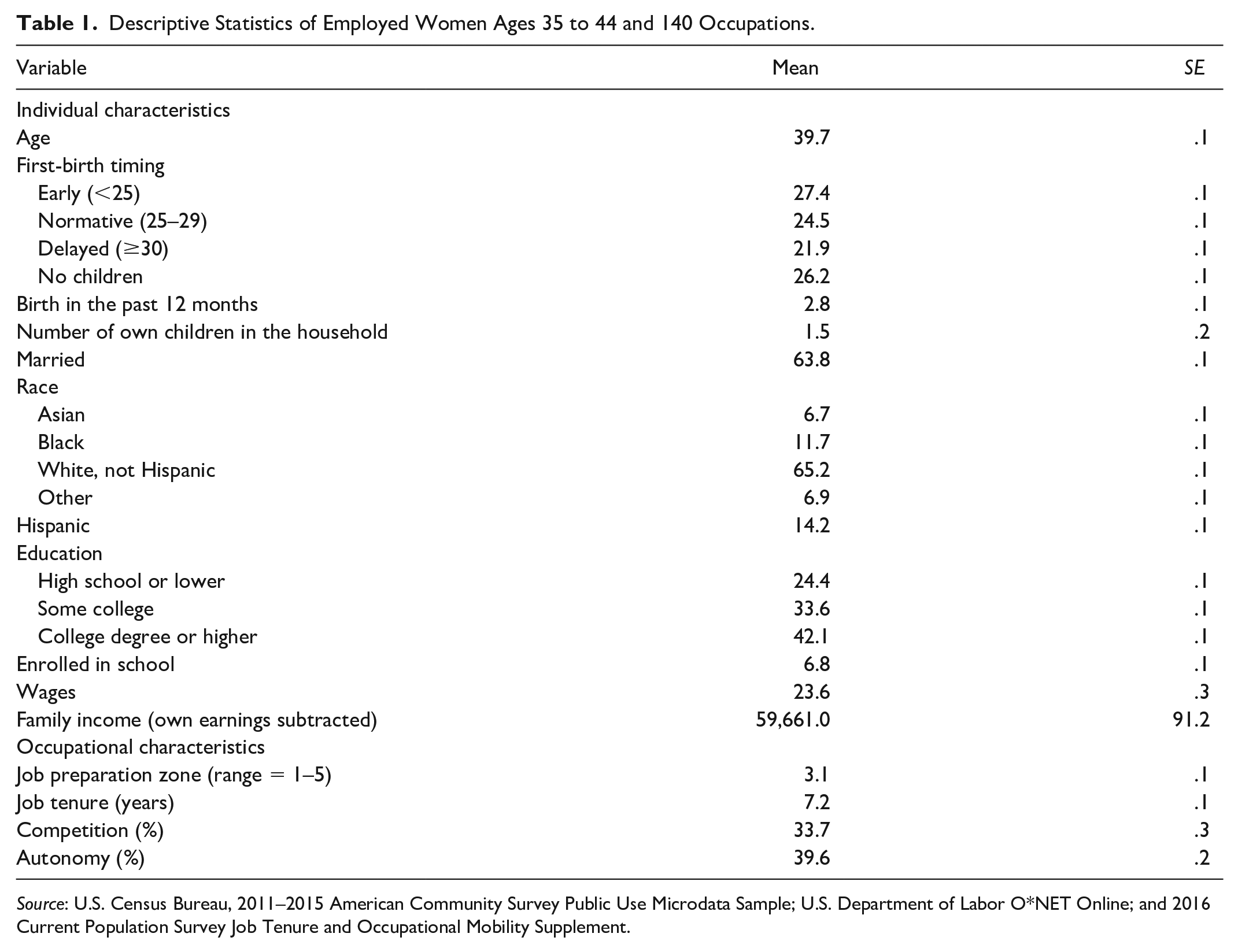
Source: U.S. Census Bureau, 2011–2015 American Community Survey Public Use Microdata Sample; U.S. Department of Labor O*NET Online; and 2016 Current Population Survey Job Tenure and Occupational Mobility Supplement.
Women are classified as having delayed first births if their first births occurred at age 30 or older and early first births if their first births occurred before age 25. Normative first-birth timing ranged from ages 25 to 29. In 2016, the mean age at first birth for mothers was 26.6 (Martin et al. 2018). Although the average age at first birth has been increasing in recent years, a larger share of women experience first births before age 25 than at age 30 or later. About 30 percent of mothers were age 30 or older at their first births, but 42 percent of mothers had their first children before age 25 (Mathews and Hamilton 2016). In this sample, the age at first birth was 26, and all major occupation groupings had an average age at first birth between 24 and 28 (Figure 1). I focus on the timing of the first birth because this marks the transition into parenthood. Research shows that the timing of the first birth leads to the most significant adjustments in labor force participation, with most women making a determination following the first birth whether to work continuously, withdraw, or work part-time (Yao, Wang, and Han 2017), and most of the benefit to fertility delay should accrue to the timing of first births (Abendroth et al. 2014).

Age at first birth by occupational group: 25th, 50th, and 75th percentiles.
The sample is restricted to year-round workers to obtain an accurate wage measure. The ACS stopped collecting data on weeks worked in the past 12 months as a continuous variable in 2008, presenting the data in ranges of weeks worked instead. The lack of specific information on the number of weeks worked results in the creation of a wage estimate that is likely inaccurate among those who did not work continuously throughout the year. As the sample is restricted to those working year round (defined by the ACS as 50 to 52 weeks in the past year, including weeks on paid leave), weeks worked is set at 52, the modal response to weeks worked among full-time workers in the ACS and the point estimate used by the Census Bureau to derive wages in editing procedures.
The main focus of this study is to evaluate how first-birth timing affects mothers’ wages within occupations. Occupational analyses require thoughtful consideration of sample size to yield analytical precision. The Census Bureau collects data for 535 occupations, but workers are not evenly distributed across occupations. About half of working women are concentrated in fewer than 30 occupations, resulting in a small sample across hundreds of occupations. Wage estimates are compromised when using fewer than 100 unweighted sample cases per occupation (Foster et al. forthcoming). To maintain analytic precision, I restrict the sample to occupations that have a minimum of 100 unweighted cases per occupation-birth-timing cell. The occupation restrictions result in a sample of 480,233 women among a potential 549,591 women who would otherwise meet sample age and employment restrictions, or 87 percent of eligible cases. The number of represented occupations is 140, with most complete coverage in managerial and professional, service, and sales and office occupations. Occupations not well represented are those that employ few women, such as engineering, agriculture, and construction. The largest occupation (elementary and middle school teachers) has 26,297 unweighted observations, and the smallest (miscellaneous media workers) has 495 observations.
The ACS is the only survey data source that offers a large enough sample to estimate occupational effects across a broad range of detailed occupations (commonly referred to as four-digit occupations). Nevertheless, ACS data are cross-sectional. As such, work history information is largely unavailable. Work history data are typically restricted to small-scale longitudinal surveys that do not have large enough samples to evaluate occupation with precision. Instead, estimates presented are highly unreliable or rely solely on major occupational groupings. Recognizing the trade-off between using longitudinal surveys with work history measures and using cross-sectional surveys large enough to analyze occupation with precision, Foster et al. (forthcoming) use administrative records providing earnings and work history data combined with ACS data to assess how the lack of detailed work histories or detailed occupation groupings affect estimates of the gender wage gap. They conclude that in a trade-off between detailed work histories and detailed occupation groups, having a sample large enough to support the use of detailed occupation groups is significantly more important. Among recent cohorts, the explanatory power of detailed occupation far outweighs that of work history in explaining the gender wage gap among full-time workers, and omitting work history does not bias other predictors. Buchmann and McDaniel (2016) used a similar rationale for using decennial census and ACS data to evaluate the gender wage gap in professional occupations, arguing that it is not possible to study the wage gap within detailed occupations using panel data and fixed-effects models because of inadequate sample size. When using panel data, the alternative is to rely on large occupation groups, such as the commonly used “managerial and professional” category, but these obscure important differences in earnings, benefits, and work patterns.
To address limitations stemming from the use of cross-sectional data, I compare the natural log of wages among employed women who are of the same age and working in the same occupation. I control for numerous demographic and economic characteristics that might differentiate these two groups of women. As an additional check, I control for having a birth in the past 12 months. Several studies show that women’s earnings trajectories typically diverge after a birth, not preceding it (Wilde et al. 2010). Although some mothers move into new occupations following births, occupational switching is limited and tends to occur between occupations requiring similar levels of training (McRae 1991). About 65 percent of mothers return to the same jobs following first births (Landivar 2017), and there are significant limitations to later entry into most professional occupations due to extensive training and credentialing.
To model the occupation-specific association of birth timing with wages in 140 occupations, I use multilevel models. Multilevel models are useful when data are nested within groups (here, individuals are nested within occupations), as they do not require the assumption of independence between observations. Multilevel models also allow us to derive random slopes (Snijders 2005). Rather than estimating fixed effects for early, normative, and delayed childbearing across occupations, I include random slope coefficients for first-birth timing by occupation. Continuous individual characteristics are grand mean centered to allow easier interpretation of the coefficients. Interaction effects are included in the final model to estimate the wage effect of occupational characteristics by first-birth timing. For illustrative purposes, I show the model estimates of wages and first-birth timing for selected occupations across four industries: education, healthcare, legal, and financial. These allow occupational pairings of high- and low-wage occupations within industries. Full model results for all occupations are available in Appendix B.
Measures
Dependent Variable
The dependent variable is the natural logarithm of wages. Log wages are defined as log[annual earnings/(weeks worked × usual hours worked)]. Wages are bottom-coded at half the federal minimum wage in 2015 ($3.63) and top-coded at $500/hour. About 1.5 percent of the sample is bottom-coded, and 0.02 percent of the sample is top-coded. The wage gap is the adjusted difference between mothers’ and nonmothers’ wages. Robustness checks using alternative sample specifications and earnings are detailed in Appendix A.
Independent Variables
Multilevel models estimate how occupational characteristics affect wages and control for individuals’ demographic characteristics. These include age, timing of first birth (early = 24 or younger, normative = 25–29, and delayed = 30 or later; nonmothers are the reference category), birth in the past 12 months, number of own children in the household, marital status (1 = married), race (Asian, Black, non-Hispanic White, and other), and ethnicity (1 = Hispanic). Other human capital variables are also included, such as educational attainment (high school [reference], some college, and college degree or higher), school enrollment (1 = enrolled), and the natural logarithm of family income (respondent income subtracted). Age squared was not significant, so it was dropped.
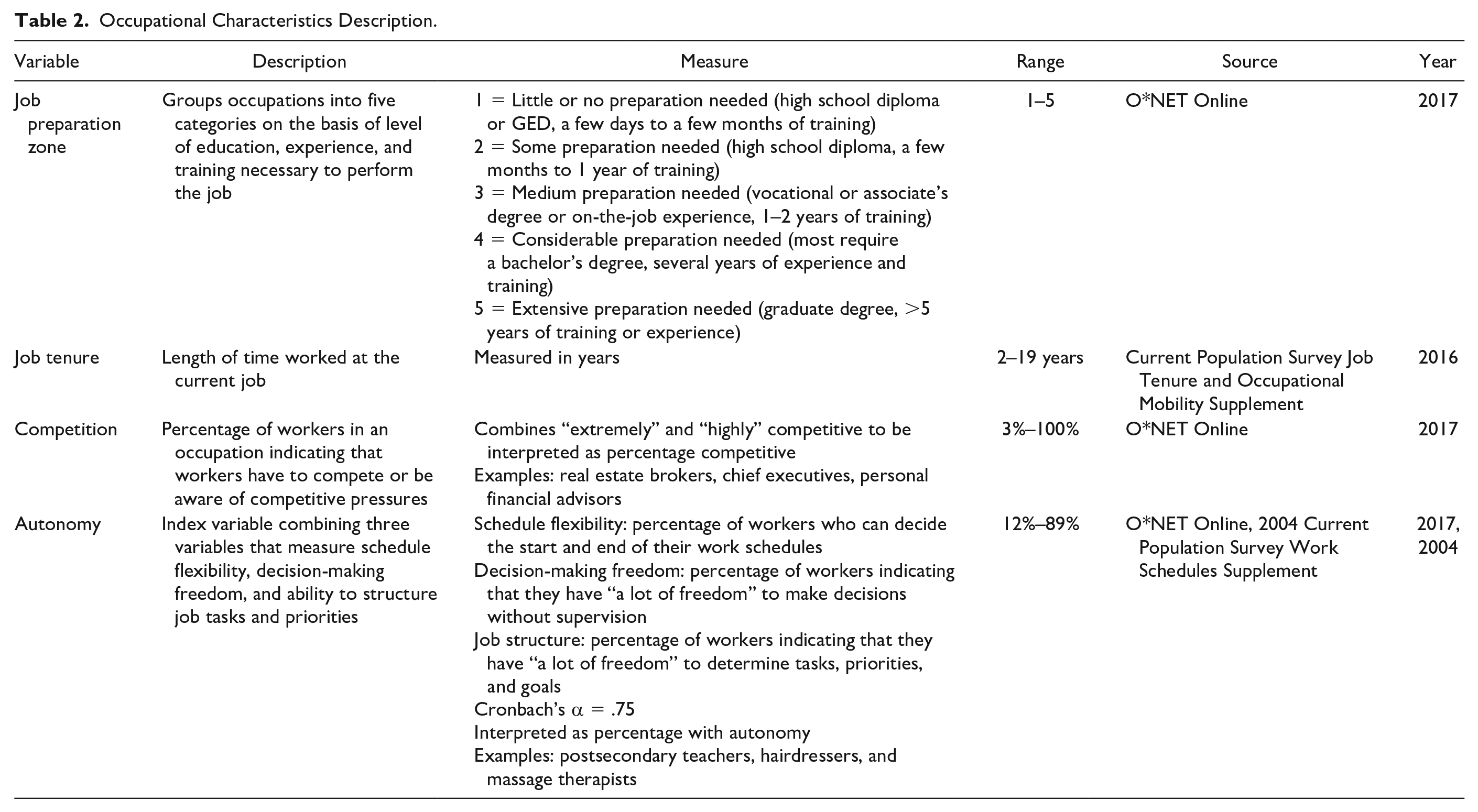
The key predictors are occupational characteristics. The models include measures of job preparation zone, job tenure, competitiveness, and autonomy. An additional measure, median occupational earnings, obtained from the 2017 Occupational Employment Statistics, is used descriptively to show the effect of first-birth timing in high- and low-earning occupations but is omitted from the models because of collinearity. The O*NET database of occupational characteristics developed by the U.S. Department of Labor groups occupations into one of five job preparation zones on the basis of the level of education, experience, and training necessary to perform the job. These categories range from job zone 1, requiring little to no preparation, to job zone 5, requiring extensive preparation (Table 2). Job tenure is obtained from the 2016 Job Tenure and Occupational Mobility Supplement to the Current Population Survey. Job tenure represents the average number of years individuals in an occupation have worked at their current jobs. To measure the level of competition in an occupation, O*NET asks workers whether they have to compete or be aware of competitive pressures in their occupation. Answers range from “not at all competitive” to “extremely competitive.” “Extremely competitive” and “highly competitive” were combined and can be interpreted as the percentage of workers in an occupation who indicate that their occupation is highly competitive. Some illustrative examples of competitive occupations include real estate brokers, chief executives, and personal financial advisors. Autonomy is an index that captures the extent to which workers have freedom to make decisions, to structure and prioritize their tasks and goals, and to set their work schedules. These three measures are strongly correlated (α = .75) and could not be entered into the model separately with acceptable levels of collinearity. The autonomy index can be interpreted as the percentage of workers in an occupation who indicate that they have significant job autonomy. Illustrative examples include postsecondary teachers, hairdressers, and massage therapists.
Occupational Characteristics Description.
Results
The Distribution of First-Birth Timing by Occupation
Women in managerial and professional occupations were more likely to delay a first birth than women in other occupational groups. The average age at first birth was 26 years old, with a higher average age of 28 among managerial and professional women (Figure 1). Among managerial and professional women, 20 percent experienced early first births (before age 25), 26 percent had their first children within the normative age range (25–29), and 28 percent delayed their first births (age 30 and older) (Table 3). In service occupations, 40 percent of women had early first births and 13 percent had delayed first births. Similarly, women in production occupations were more likely to have an early first birth (41 percent) than a delayed first birth (11 percent). Although there were differences in birth timing across occupations, differences in parental status across occupations were relatively small. Across the sample, about 26 percent of women did not have children.
Distribution of First-Birth Timing by Occupation Group.

Source: U.S. Census Bureau, 2011–2015 American Community Survey Public Use Microdata Sample.
Women’s Wage Profiles by Age and Occupation
Women’s wage profiles differed by occupation. Women in managerial and professional occupations had a sharper increase in wages between the ages of 35 and 44 compared with women in other occupation groups, growing by 10.3 percent. Women in service occupations had a flatter wage profile, growing by 2.6 percent. Because this is a cross section of women, we are observing age effects by occupation. Nevertheless, this provides support that birth timing is more significant for women in professional occupations. There is a more significant career buildup period with sharper wage increases at a time when many women have young children at home. In contrast, women in service occupations are less likely to face a steep penalty for exiting the labor force because there is minimal upward trajectory in this occupation’s wage, indicating birth timing is unlikely to significantly change their expected wages upon reentry.
The Effect of First-Birth Timing in Low- and High-Wage Occupations
Evaluating the motherhood wage gap by first-birth timing carries important implications for the total estimated wage gap, as well as the wage gap within occupations. Mothers’ and nonmothers’ wages were not statistically different in models that controlled for demographic characteristics and hours worked. (A supplemental model without first-birth timing was used to obtain estimates for the total motherhood wage gap. Results are presented in Appendix B.) However, disaggregating by first-birth timing reveals a wage gap of about 5 percent for mothers with early childbearing and a wage gap of 1 percent for mothers with normative birth timing compared with nonmothers. Mothers with delayed fertility earned 6 percent more than nonmothers. This indicates that the total motherhood wage gap masks important variation by first-birth timing, changing not only the magnitude of the gap but the direction as well. It also reveals that some mothers experience a wage premium rather than penalty. This is consistent with recent research showing that highly educated women (Doren 2019) and women in higher earning professional occupations (Buchmann and McDaniel 2016) earned more than nonmothers. To the extent that there is a selection effect in that mothers with the highest earnings potential remain in the labor force (Landivar 2017), mothers with delayed births may experience a small wage premium relative to nonmothers. Mothers who remain in the labor force may have higher levels of commitment to work, better benefits, and accommodations to facilitate maintaining their work hours (e.g., schedule flexibility), or need to contribute more to their households (e.g., as a primary earner or more financial need relative to nonmothers) which could be associated with higher wages.
Divergence in the motherhood wage gap by birth timing was even sharper within occupation. Overall, the largest motherhood penalties accrued to women working in service and education occupations, such as childcare workers, teacher assistants, and hairdressers, where mothers earned 7 percent to 12 percent less than nonmothers. The largest motherhood premiums went to mothers working as physicians and lawyers, who earned between 12 percent and 17 percent more. When looking at the effect of birth timing, mothers in the highest earning occupations were more likely to experience a wage penalty with an early first birth but a wage premium with delayed fertility. These differences were not evident when looking solely at the total motherhood wage gap within an occupation, as the total averaged the penalty and the premium observed by birth timing, resulting in wage comparisons between mothers and nonmothers that were not statistically different. For example, financial managers with children earned about 3 percent less than nonmothers, though the difference was not statistically significant. However, mothers with early first births earned about 10 percent less than nonmothers, whereas mothers who delayed earned about 5 percent more; both differences statistically significant.
Pairing occupational results within industry shows that the benefits to fertility delay largely accrue to women in the higher paying professional occupations (Figure 2). Across education, healthcare, legal, and financial occupations, women working in management and other higher level positions (e.g., postsecondary teachers, physicians, lawyers, securities and financial services sales agents) experienced larger gains to fertility delay. Penalties for early childbearing were most pronounced among education administrators, financial managers, and lawyers. One notable exception was the lack of a penalty for early childbearing in health occupations, even in higher paying jobs. Overall, there is a negative relationship between an occupation’s average earnings and early childbearing and a positive relationship with delayed childbearing (Figure 3). These patterns are consistent whether earnings or wages are used in the analyses. Figure 3 shows that across all 140 occupations, the highest earning occupations yielded the largest returns to fertility delay (e.g., physicians, chief executives, lawyers) and the largest penalties for early childbearing (e.g., chief executives, financial managers, lawyers). On the other hand, few low-earning occupations experienced any benefit from fertility delay, and compared with high-earning occupations, they were more likely to experience a wage premium with early childbearing (e.g., janitors, bill collectors) or penalty with fertility delay (e.g., childcare workers, teacher assistants).
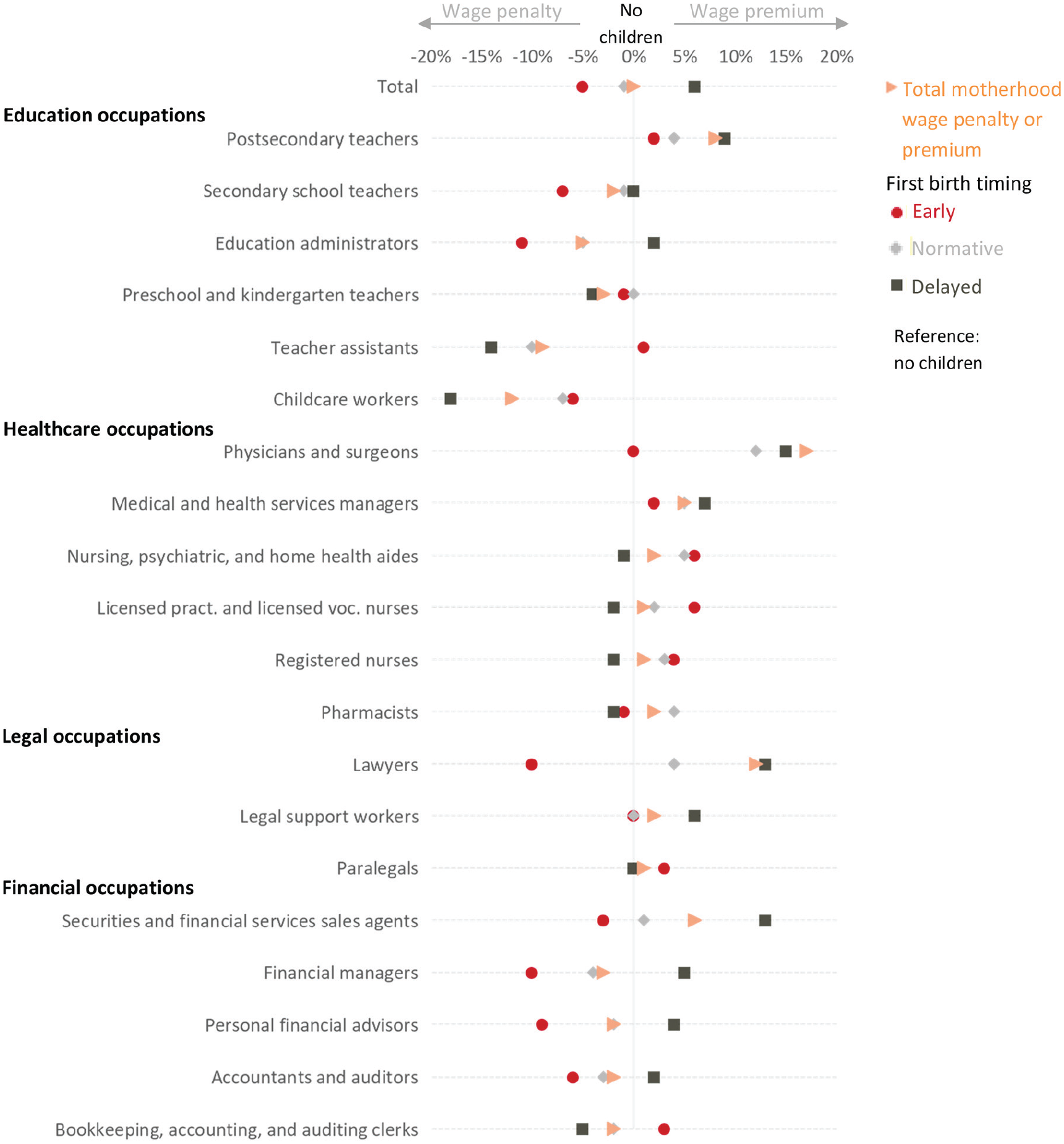
The association between wages and first-birth timing in selected occupations by industry: multilevel model results.

The association between median occupational earnings and the estimated effect of age at first birth.
These results support hypothesis 1, showing that women in professional occupations gained the most in delaying fertility. Motherhood status had no significant association with wages after control variables in most occupations, but motherhood had a larger significant positive or negative effect depending on birth timing in professional and sales occupations.
Motherhood status and birth timing had a weaker relationship with wages among women in service and production occupations, where mothers were unlikely to see gains to fertility delay but in some cases gains to early first births. These results are consistent with Herr’s (2016) findings that women without college degrees earned more if they had children early and prior to labor force entry because it minimized disruption caused by labor force exit. Women in low-earning occupations are especially unlikely to have access to family leave, so they are more likely to quit their jobs following childbirth. The lack of benefits in these occupations, flatter wage profiles, and the shorter or absent career ladders may explain why fertility delay does not improve earnings prospects.
How Occupational Characteristics Affect the Motherhood Wage Gap
Differences in occupational characteristics may explain why mothers in professional and sales occupations experience a wage premium with fertility delay. High-wage occupations are more likely to provide a return on investment in human capital and job tenure and are more likely to provide workplace benefits that may increase the compatibility of work and family responsibilities. Turning to Table 4, we see how human capital characteristics, competitiveness, and autonomy are associated with the motherhood wage gap.
Logged Wages of Employed Women Ages 35 to 44: Multilevel Model Estimates of Individuals Clustered by Occupation.

Source: U.S. Census Bureau, 2011–2015 American Community Survey Public Use Microdata Sample; U.S. Department of Labor O*NET Online; and 2016 Current Population Survey Job Tenure and Occupational Mobility Supplement.
Note: Standard errors are in parentheses and rounded to .01 if they would otherwise appear to be zero.
The dependent variable is the natural log of wages.
p < .05, **p < .01, and ***p < .001 (two-tailed tests).
Jobs that required more significant preparation, had longer average tenure, and were more competitive paid more. A one-level increase in job preparation zone was associated with 16 percent higher wages. Each additional year of average job tenure in an occupation was associated with a 3 percent increase in expected wages. Similarly, for every 10 percent increase in the percentage of workers indicating that their occupations are highly competitive, there was a 6 percent increase in expected wages. In contrast, for every 10 percent increase in the percentage of workers indicating that their jobs have high levels of autonomy, there was a 3 percent decrease in expected wages. However, interaction effects between occupational characteristics and first-birth timing show that these relationships differed by first-birth timing (Table 4). As required job preparation increased, mothers with early births experienced a wage penalty of 3 percent compared with nonmothers. Mothers working in occupations with longer job tenure earned more if they had children at an older age. Delayed motherhood was associated with a 1 percent increase in wages per additional year of tenure. Combined, these variables indicate that mothers mitigated a wage penalty in occupations with higher job preparation requirements or experienced a wage premium in occupations with longer job tenure as long as fertility was delayed. This is consistent with human capital accumulation theories. That is, women who delay childbearing are more likely to invest in career preparation and maintain more consistent job attachment. Longer tenure may also mitigate some of the negative penalties mothers face during the job search, as research shows that mothers are less likely to be hired and are offered lower starting salaries (Correll et al. 2007). Through an established relationship with an employer, mothers may avoid some types of discrimination and resulting wage penalties.
Mothers with delayed first births working in more competitive occupations earned more than nonmothers, but less than nonmothers when they had children at a young age. These results support hypothesis 2, which posits that earlier first births would be more disruptive for women in competitive occupations. Earlier first births may be associated with less continuous work experience, and in competitive occupations, work interruptions may more significantly disrupt career networks and pose barriers to reentry. These results do not lend support to the price-of-privilege perspective, which would indicate that women with delayed fertility face greater penalties in competitive occupations, as their returns to experience would be higher. Mothers with delayed fertility in competitive occupations may be less likely to exit employment following a birth, which may mitigate losses in clientele or work assignments and the necessity to compete for reentry. Level of job competition may partly explain why high-earning sales occupations have a similar motherhood wage gap to high-earning professional occupations. Similar to lawyers and physicians, lucrative sales occupations, such as personal financial advisors and real estate brokers, rely on having networks and clientele for which workers compete, building and maintaining these relationships over time with continuous employment.
Although prior studies showed that mothers with job autonomy earn more even when more autonomous jobs are penalized (Yu and Kuo 2017), I show that autonomous jobs carry a penalty, but there is no significant relationship with motherhood status or first-birth timing. Consistent with the flexibility stigma perspective, all else equal, occupations carry a 3 percent penalty per 10 percent increase in job autonomy. These results do not lend support to hypothesis 3, which predicted that mothers with delayed fertility would have a smaller wage penalty in autonomous jobs. Instead, the negative relationship between autonomy and wages is not conditional on parental status and birth timing. Because job autonomy is associated with longer work hours (Schieman et al. 2009), autonomy may not sufficiently ease job strain. However, job flexibility increases retention among mothers, thus more flexible and autonomous occupations may enhance employment continuity (Landivar 2014), mitigating additional penalties conditional on parental status.
Two of the largest sectors of employment among women are education and healthcare. Women in education largely experienced wage penalties associated with motherhood, especially in the lowest earning education occupations (Figure 2). In contrast, mothers working in healthcare earned about the same as or more than nonmothers. The education sector offers low levels of job autonomy and relatively low wages. In contrast, healthcare offers more autonomy and higher wages, especially among physicians and registered nurses. In a detailed study of work schedules in healthcare, Clawson and Gerstel (2014) showed that physicians and registered nurses had greater leverage to request flexible schedules and employment accommodations because of demand in their occupations. Mothers used this leverage to obtain schedules that better fit their needs. Having this flexibility also allows women to maintain full-time hours after they have children. Autonomy is protective against experiencing a wage penalty associated with motherhood even if it is not associated with a wage premium.
Conclusion
This study contributes to our understanding of the motherhood wage gap by showing how the timing of childbirth affects mothers’ wages within specific occupations. This study provides the most detailed disaggregation of the motherhood wage gap by occupation and first-birth timing to date. I show that the motherhood wage gap diverges significantly by occupation and is associated with first-birth timing, but not always in ways we would expect. Managers and lawyers experienced significant wage penalties if they had children at a young age but earned more than nonmothers if they had children after age 29. England et al. (2016) indicated that these high-earning women pay the largest wage penalties because of their returns to experience. My results show that high-earning women do have higher wage penalties, but this penalty is concentrated among those who have children at a young age. Because women in these occupations are especially likely to delay fertility, women in several high-earning occupations experience a wage premium, not a penalty, on average.
Outside of high-wage professional and sales occupations, most women experienced no financial gains to delayed childbearing. Rather, in some low-income occupations, delayed childbearing was associated with a wage penalty. Women who experienced the largest wage penalties were mothers who provided care for children: childcare workers and teacher assistants. Women in these occupations may be labor force reentrants and may have less recent continuous job experience. Mothers may enter teaching occupations or open a childcare business after having children to be available during summers or to be able to provide care to their own children and reduce caregiving costs. However, this too comes at a cost. Budig (2006) showed that mothers who became childcare providers after having children experienced a steep earnings penalty. An important direction for future research is to evaluate the extent of selectivity in reentry occupations and how this affects mothers’ earnings prospects. Newly available, albeit highly restricted, administrative data sources that provide work histories combined with ACS data could control for selectivity in work history as well as provide new insight on reentry occupations among mothers.
Evaluating employment continuity in combination with fertility timing may be especially important in low-wage occupations. Women in these occupations have more discontinuous employment (Landivar 2017), and later births may increase career interruptions, resulting in larger cumulative earnings losses. This may partly explain why women in some low-wage occupations experienced wage premiums with earlier childbearing. Herr (2016) showed that women without college degrees had higher wages if their first births happened prior to labor force entry because it resulted in less career disruption. Workers in the low-paying retail and service sectors typically do not accrue benefits, and turnover is high, with limited returns to tenure. In low-wage occupations, job preparation is limited, and investments in human capital may not yield returns.
This study samples women who are currently employed year-round. As mothers are less likely to be employed, there is a selection effect in that mothers with higher earnings potential are more likely to remain employed than mothers with lower earnings, which is one possible explanation for why mothers earn more in some occupations. Because mothers are more likely to exit the labor force than nonmothers (Landivar 2017), those who do remain employed may have better earnings prospects, attained a better occupational fit or employer match, or invested more extensively in career preparation than other women or mothers who left the labor force. Mothers who remain employed may also have larger roles as economic providers in their households, which may incentivize taking on more profitable roles, seeking promotions, or working longer hours. In addition to this study that shows that mothers working full-time in select high-wage, professional occupations earn more than nonmothers, other recent research has documented that mothers experience a wage premium under certain conditions (Buchmann and McDaniel 2016; Doren 2019) using cross-sectional and longitudinal data sources. Agreeing with other calls to expand the sources used to study the motherhood wage gap, which is based largely on the same longitudinal sources of older cohorts of women (Weeden, Cha, and Bucca 2016), these new findings point to issues that need more in-depth exploration. It is critical to evaluate the motherhood wage gap using more recent cohorts of women to ascertain whether the motherhood wage premium is emerging or growing among younger cohorts of full-time workers or has been consistently present among full-time workers in select professional occupations. We also need to identify and confirm the mechanisms for this wage premium in diverse work settings and occupations.
This study shows that delaying childbearing may be an effective strategy to mitigate the wage penalty among the minority of women employed in high-wage occupations that require extensive career preparation, but women in low-wage occupations experienced little economic benefit from older motherhood. These results challenge the broader narrative that individual women can improve their long-term earnings and partly overcome the structural motherhood wage gap by delaying fertility. Rather, expanding work-family policies, benefits, and flexibilities across occupations may show better promise in reducing the motherhood wage gap than delaying motherhood.
Footnotes
Appendix A: Age at First Birth and Earnings and Wages Robustness Checks
Appendix B
Occupation-Specific Effect of First-Birth Timing Compared with Nonmothers in the Same Occupation: Multilevel Model Estimates of Individuals Clustered by Occupation.

| Variable | Table 4, Model 2 |
|---|---|
| Dependent variable: natural log of earnings | |
| Intercept | 2.79 (0.03)*** |
| Individual characteristics | |
| Age | 0.01 (0.01)*** |
| First-birth timing (reference = no children) | |
| Early (24 or earlier) | –0.05 (0.01)*** |
| Normative (25–27) | –0.01 (0.01)** |
| Delayed (28 or later) | 0.06 (0.01)*** |
| Birth in the past 12 months | 0.03 (0.01)*** |
| Number of own children in the household | –0.01 (0.01)** |
| Married | –0.03 (0.01)*** |
| Race (reference = White, not Hispanic) | |
| Asian | 0.05 (0.01)*** |
| Black | 0.00 (0.01) |
| Other | 0.01 (0.01)** |
| Hispanic | –0.02 (0.01)*** |
| Education (reference = high school or lower) | |
| Some college | 0.08 (0.01)*** |
| College degree or higher | 0.34 (0.01)*** |
| Enrolled in school | –0.05 (0.01)*** |
| Log of family income | 0.06 (0.01)*** |
| Occupation-specific effect of first-birth timing a | |
| Managerial and professional occupations | |
| Chief executives b (0010) c | .54 (.03)*** |
| Mothers d | .00 (.02) |
| Early | –.11 (.03)*** |
| Normative | –.02 (.02) |
| Delayed | .07 (.02)** |
| General and operations managers (0020) | .28 (.03)*** |
| Mothers | .01 (.02) |
| Early | –.04 (.02) |
| Normative | –.01 (.02) |
| Delayed | .08 (.02)*** |
| Marketing and sales managers (0050) | .39 (.03)*** |
| Mothers | .01 (.02) |
| Early | –.10 (.03)*** |
| Normative | –.04 (.02)* |
| Delayed | .08 (.02)*** |
| Computer and information systems managers (0110) | .51 (.03)*** |
| Mothers | .04 (.02) |
| Early | .00 (.03) |
| Normative | .03 (.03) |
| Delayed | .04 (.03) |
| Financial managers (0120) | .36 (.03)*** |
| Mothers | –.03 (.02) |
| Early | –.10 (.02)*** |
| Normative | –.04 (.02)* |
| Delayed | .05 (.02)** |
| Human resources managers (0136) | .32 (.03)*** |
| Mothers | .02 (.02) |
| Early | –.06 (.03)** |
| Normative | .00 (.02) |
| Delayed | .08 (.03)*** |
| Industrial production managers (0140) | .34 (.04)*** |
| Mothers | –.01 (.03) |
| Early | –.10 (.04)* |
| Normative | .02 (.03) |
| Delayed | .03 (.04) |
| Purchasing managers (0150) | .33 (.04)*** |
| Mothers | .02 (.03) |
| Early | .00 (.04) |
| Normative | .00 (.03) |
| Delayed | .05 (.04) |
| Farmers and other agricultural managers (0205) | –.73 (.04)*** |
| Mothers | .08 (.03)* |
| Early | .09 (.04)* |
| Normative | .03 (.03) |
| Delayed | .06 (.04) |
| Education administrators (0230) | .15 (.03)*** |
| Mothers | –.05 (.02)** |
| Early | –.11 (.02)*** |
| Normative | –.05 (.02)** |
| Delayed | .02 (.02) |
| Food service managers (0310) | –.26 (.03)*** |
| Mothers | .02 (.02) |
| Early | .03 (.02) |
| Normative | .01 (.02) |
| Delayed | .05 (.03) |
| Lodging managers (0340) | –.04 (.04) |
| Mothers | .00 (.03) |
| Early | .02 (.04) |
| Normative | –.01 (.03) |
| Delayed | .00 (.05) |
| Medical and health services managers (0350) | .25 (.03)*** |
| Mothers | .05 (.02)** |
| Early | .02 (.02) |
| Normative | .05 (.02)* |
| Delayed | .07 (.02)** |
| Property and real estate managers (0410) | .11 (.03)*** |
| Mothers | –.04 (.02) |
| Early | .02 (.03) |
| Normative | –.04 (.03) |
| Delayed | –.06 (.03)* |
| Social and community service managers (0420) | .14 (.03)*** |
| Mothers | –.04 (.02) |
| Early | –.05 (.03) |
| Normative | –.06 (.03)** |
| Delayed | .03 (.03) |
| Miscellaneous managers (0430) | .33 (.03)*** |
| Mothers | .01 (.01) |
| Early | –.10 (.01)*** |
| Normative | –.02 (.01) |
| Delayed | .09 (.01)*** |
| Wholesale and retail buyers (0520) | .00 (.04) |
| Mothers | –.04 (.03) |
| Early | –.08 (.04)* |
| Normative | –.02 (.03) |
| Delayed | .04 (.04) |
| Purchasing agents (0530) | .13 (.03)*** |
| Mothers | .03 (.03) |
| Early | .07 (.03)* |
| Normative | .01 (.03) |
| Delayed | .00 (.03) |
| Claims adjusters and appraisers (0540) | .16 (.03)*** |
| Mothers | .00 (.02) |
| Early | .01 (.03) |
| Normative | .00 (.03) |
| Delayed | –.02 (.03) |
| Compliance officers (0565) | .30 (.03)*** |
| Mothers | .01 (.03) |
| Early | .00 (.04) |
| Normative | –.01 (.03) |
| Delayed | .02 (.03) |
| Human resources workers (0630) | .23 (.03)*** |
| Mothers | .01 (.02) |
| Early | –.04 (.02) |
| Normative | –.01 (.02) |
| Delayed | .06 (.02)** |
| Training and development specialists (0650) | .17 (.04)*** |
| Mothers | –.01 (.03) |
| Early | –.04 (.04) |
| Normative | –.01 (.03) |
| Delayed | .04 (.04) |
| Management analysts (0710) | .40 (.03)*** |
| Mothers | .01 (.02) |
| Early | –.07 (.03)** |
| Normative | –.03 (.02) |
| Delayed | .05 (.02)* |
| Market research analysts (0735) | .31 (.03)*** |
| Mothers | .02 (.02) |
| Early | –.07 (.04) |
| Normative | –.07 (.03)* |
| Delayed | .10 (.03)*** |
| Business operations specialists (0740) | .21 (.03)*** |
| Mothers | –.03 (.03) |
| Early | –.07 (.03)* |
| Normative | –.02 (.03) |
| Delayed | .03 (.03) |
| Accountants and auditors (0800) | .23 (.03)*** |
| Mothers | –.02 (.01) |
| Early | –.06 (.02)*** |
| Normative | –.03 (.01)** |
| Delayed | .02 (.02) |
| Personal financial advisors (0850) | .43 (.04)*** |
| Mothers | –.02 (.03) |
| Early | –.09 (.04)* |
| Normative | –.02 (.03) |
| Delayed | .04 (.03) |
| Insurance underwriters (0860) | .26 (.04)*** |
| Mothers | .01 (.03) |
| Early | –.02 (.04) |
| Normative | .00 (.03) |
| Delayed | .00 (.04) |
| Credit counselors and loan officers (0910) | .18 (.03)*** |
| Mothers | .05 (.03) |
| Early | .06 (.03)* |
| Normative | .04 (.03) |
| Delayed | .01 (.03)* |
| Computer systems analysts (1006) | .40 (.03)*** |
| Mothers | .01 (.02) |
| Early | .00 (.03) |
| Normative | .00 (.03) |
| Delayed | .00 (.03) |
| Computer programmers (1010) | .42 (.04)*** |
| Mothers | .02 (.03) |
| Early | .00 (.04) |
| Normative | .03 (.03) |
| Delayed | .01 (.04) |
| Software developers (1020) | .55 (.03)*** |
| Mothers | –.02 (.02) |
| Early | –.02 (.03) |
| Normative | –.02 (.02) |
| Delayed | –.02 (.02) |
| Computer support specialists (1050) | .20 (.03)*** |
| Mothers | .00 (.02) |
| Early | .04 (.03) |
| Normative | –.02 (.03) |
| Delayed | .01 (.03) |
| Computer occupations, all other (1107) | .33 (.03)*** |
| Mothers | .00 (.03) |
| Early | –.02 (.04) |
| Normative | .01 (.03) |
| Delayed | .01 (.03) |
| Operations research analysts (1220) | .44 (.04)*** |
| Mothers | –.01 (.03) |
| Early | .00 (.04) |
| Normative | .00 (.03) |
| Delayed | –.04 (.04) |
| Miscellaneous science technicians (1965) | .09 (.04)* |
| Mothers | –.04 (.03) |
| Early | –.04 (.04) |
| Normative | .00 (.03) |
| Delayed | –.04 (.04) |
| Counselors (2000) | –.05 (.03) |
| Mothers | .02 (.02) |
| Early | .01 (.02) |
| Normative | .02 (.02) |
| Delayed | .03 (.02) |
| Social workers (2010) | –.05 (.03) |
| Mothers | .01 (.01) |
| Early | .03 (.02) |
| Normative | .02 (.02) |
| Delayed | .01 (.02) |
| Probation officers (2015) | .06 (.04) |
| Mothers | .02 (.03) |
| Early | .03 (.04) |
| Normative | .01 (.03) |
| Delayed | .01 (.04) |
| Social and human service assistants (2016) | –.14 (.04)*** |
| Mothers | –.01 (.03) |
| Early | .03 (.03) |
| Normative | –.02 (.03) |
| Delayed | .00 (.04) |
| Miscellaneous social service specialists (2025) | –.03 (.04) |
| Mothers | –.01 (.03) |
| Early | –.03 (.04) |
| Normative | –.02 (.03) |
| Delayed | .06 (.04) |
| Lawyers (2100) | .62 (.03)*** |
| Mothers | .12 (.02)*** |
| Early | –.10 (.03)** |
| Normative | .04 (.02) |
| Delayed | .13 (.02)*** |
| Paralegals and legal assistants (2145) | .14 (.03)*** |
| Mothers | .01 (.02) |
| Early | .03 (.02) |
| Normative | .00 (.02) |
| Delayed | .00 (.02) |
| Miscellaneous legal support workers (2160) | .13 (.03)*** |
| Mothers | .02 (.03) |
| Early | .00 (.03) |
| Normative | .00 (.03) |
| Delayed | .06 (.04) |
| Postsecondary teachers (2200) | .05 (.03) |
| Mothers | .08 (.02)*** |
| Early | .02 (.03) |
| Normative | .04 (.02)* |
| Delayed | .09 (.02)*** |
| Preschool and kindergarten teachers (2300) | –.43 (.03)*** |
| Mothers | –.03 (.02) |
| Early | –.01 (.02) |
| Normative | .00 (.02) |
| Delayed | –.04 (.03) |
| Elementary and middle school teachers (2310) | –.04 (.03) |
| Mothers | –.03 (.01)** |
| Early | –.07 (.01)*** |
| Normative | –.03 (.01)** |
| Delayed | .00 (.01) |
| Secondary school teachers (2320) | –.01 (.03) |
| Mothers | –.02 (.02) |
| Early | –.07 (.03)** |
| Normative | –.01 (.02) |
| Delayed | .00 (.02) |
| Special education teachers (2330) | –.06 (.03) |
| Mothers | .00 (.03) |
| Early | –.04 (.03) |
| Normative | .01 (.03) |
| Delayed | .04 (.03) |
| Other teachers and instructors (2340) | –.15 (.03)*** |
| Mothers | –.04 (.02)* |
| Early | –.03 (.03) |
| Normative | –.04 (.02) |
| Delayed | –.03 (.03) |
| Librarians (2430) | –.03 (.03) |
| Mothers | –.09 (.03)*** |
| Early | –.06 (.04) |
| Normative | –.10 (.03)*** |
| Delayed | –.01 (.03) |
| Teacher assistants (2540) | –.52 (.03)*** |
| Mothers | –.09 (.02)*** |
| Early | .01 (.02) |
| Normative | –.10 (.02)*** |
| Delayed | –.14 (.03)*** |
| Other education, training, and library workers (2550) | .00 (.04) |
| Mothers | –.02 (.03) |
| Early | –.08 (.04)* |
| Normative | –.02 (.03) |
| Delayed | .08 (.04)* |
| Designers (2630) | –.03 (.03) |
| Mothers | –.01 (.02) |
| Early | –.02 (.03) |
| Normative | –.06 (.02)** |
| Delayed | .01 (.02) |
| Miscellaneous media workers (2860) | –.05 (.04) |
| Mothers | –.02 (.03) |
| Early | –.01 (.04) |
| Normative | –.02 (.03) |
| Delayed | .01 (.04) |
| Dietiticians and nutritionists (3030) | .08 (.04)* |
| Mothers | .01 (.03) |
| Early | –.05 (.04) |
| Normative | .03 (.03) |
| Delayed | .02 (.04) |
| Pharmacists (3050) | .74 (.03)*** |
| Mothers | .02 (.03) |
| Early | –.01 (.04) |
| Normative | .04 (.03) |
| Delayed | –.02 (.03) |
| Physicians and surgeons (3060) | .88 (.03)*** |
| Mothers | .17 (.02)*** |
| Early | .00 (.04) |
| Normative | .12 (.02)*** |
| Delayed | .15 (.02)*** |
| Physician assistants (3110) | .47 (.04)*** |
| Mothers | .01 (.03) |
| Early | –.07 (.04) |
| Normative | .02 (.03) |
| Delayed | .02 (.04) |
| Physical therapists (3160) | .36 (.03)*** |
| Mothers | .02 (.03) |
| Early | .01 (.04) |
| Normative | .04 (.03) |
| Delayed | –.02 (.03) |
| Respiratory therapists (3220) | .30 (.04)*** |
| Mothers | .00 (.03) |
| Early | .02 (.04) |
| Normative | .03 (.03) |
| Delayed | –.06 (.04) |
| Other therapists (3245) | .02 (.04) |
| Mothers | –.02 (.03) |
| Early | –.03 (.03) |
| Normative | –.02 (.03) |
| Delayed | .00 (.03) |
| Registered nurses (3255) | .36 (.03)*** |
| Mothers | .01 (.01) |
| Early | .04 (.01)*** |
| Normative | .03 (.01)** |
| Delayed | –.02 (.01) |
| Nurse practitioners (3258) | .56 (.04)*** |
| Mothers | .01 (.03) |
| Early | .04 (.04) |
| Normative | .02 (.03) |
| Delayed | –.05 (.03) |
| Clinical laboratory technologists (3300) | .04 (.03) |
| Mothers | .02 (.02) |
| Early | .03 (.03) |
| Normative | .01 (.03) |
| Delayed | .02 (.03) |
| Dental hygienists (3310) | .41 (.03)*** |
| Mothers | .00 (.03) |
| Early | .04 (.03) |
| Normative | .00 (.03) |
| Delayed | –.04 (.03) |
| Diagnostic related technologists (3320) | .33 (.03)*** |
| Mothers | .00 (.02) |
| Early | –.02 (.02) |
| Normative | .03 (.02) |
| Delayed | –.02 (.02) |
| Health practitioner support technologists (3420) | –.10 (.03)*** |
| Mothers | .01 (.02) |
| Early | .04 (.02)* |
| Normative | .03 (.02) |
| Delayed | –.04 (.03) |
| Licensed practical and licensed vocational nurses (3500) | .02 (.03) |
| Mothers | .01 (.02) |
| Early | .06 (.02)** |
| Normative | .02 (.02) |
| Delayed | –.02 (.02) |
| Medical records technicians (3510) | –.07 (.04)* |
| Mothers | –.01 (.03) |
| Early | .03 (.03) |
| Normative | .00 (.04) |
| Delayed | –.04 (.04) |
| Miscellaneous health technologists (3535) | .06 (.04) |
| Mothers | .00 (.03) |
| Early | –.02 (.04) |
| Normative | .00 (.03) |
| Delayed | .03 (.04) |
| Service occupations | |
| Nursing, psychiatric, and home health aides (3600) | –.34 (.03)*** |
| Mothers | .02 (.01) |
| Early | .06 (.01)*** |
| Normative | .05 (.01)*** |
| Delayed | –.01 (.02) |
| Massage therapists (3630) | –.21 (.03)*** |
| Mothers | .03 (.03) |
| Early | .08 (.03)* |
| Normative | .00 (.03) |
| Delayed | .00 (.04) |
| Dental assistants (3640) | –.07 (.03)* |
| Mothers | .02 (.02) |
| Early | .06 (.02)* |
| Normative | .03 (.02) |
| Delayed | –.03 (.03) |
| Medical assistants (3645) | –.16 (.03)*** |
| Mothers | –.01 (.02) |
| Early | .02 (.02) |
| Normative | .02 (.02) |
| Delayed | –.03 (.03) |
| Healthcare support workers, all other (3655) | –.25 (.04)*** |
| Mothers | .00 (.03) |
| Early | .01 (.04) |
| Normative | –.01 (.03) |
| Delayed | .05 (.05) |
| Bailiffs and correctional officers (3800) | .05 (.03) |
| Mothers | .03 (.03) |
| Early | .05 (.03) |
| Normative | .04 (.03) |
| Delayed | –.03 (.04) |
| Police officers (3850) | .29 (.03)*** |
| Mothers | .02 (.03) |
| Early | .02 (.03) |
| Normative | .02 (.03) |
| Delayed | –.01 (.03) |
| Security guards (3930) | –.15 (.03)*** |
| Mothers | .03 (.03) |
| Early | .04 (.03) |
| Normative | .05 (.03) |
| Delayed | –.01 (.04) |
| Supervisors of food preparation workers (4010) | –.39 (.03)*** |
| Mothers | –.01 (.02) |
| Early | .04 (.03) |
| Normative | –.01 (.03) |
| Delayed | –.07 (.04) |
| Cooks (4020) | –.59 (.03)*** |
| Mothers | –.03 (.02)* |
| Early | .02 (.02) |
| Normative | .00 (.02) |
| Delayed | –.11 (.03)*** |
| Food preparation workers (4030) | –.58 (.03)*** |
| Mothers | .03 (.02) |
| Early | .03 (.03) |
| Normative | –.01 (.03) |
| Delayed | –.09 (.04)* |
| Bartenders (4040) | –.43 (.03)*** |
| Mothers | –.07 (.02)** |
| Early | –.02 (.03) |
| Normative | –.04 (.03) |
| Delayed | –.08 (.04)* |
| Waiters (4110) | –.50 (.03)*** |
| Mothers | –.01 (.02) |
| Early | .02 (.02) |
| Normative | .00 (.02) |
| Delayed | –.02 (.02) |
| Janitors and building cleaners (4220) | –.50 (.03)*** |
| Mothers | .06 (.02)*** |
| Early | .10 (.02)*** |
| Normative | .08 (.02)*** |
| Delayed | –.04 (.03) |
| Maids and housekeeping cleaners (4230) | –.57 (.03)*** |
| Mothers | .04 (.01)*** |
| Early | .10 (.01)*** |
| Normative | .06 (.02)*** |
| Delayed | –.04 (.02) |
| Supervisors of personal service workers (4320) | –.34 (.04)*** |
| Mothers | –.04 (.03) |
| Early | –.06 (.04) |
| Normative | .01 (.03) |
| Delayed | –.04 (.04) |
| Nonfarm animal caretakers (4350) | –.45 (.03)*** |
| Mothers | –.01 (.03) |
| Early | .00 (.04) |
| Normative | –.01 (.03) |
| Delayed | .00 (.04) |
| Hairdressers and cosmetologists (4510) | –.34 (.03)*** |
| Mothers | –.08 (.02)*** |
| Early | –.05 (.02)** |
| Normative | –.06 (.02)*** |
| Delayed | –.05 (.02)* |
| Miscellaneous personal appearance workers (4520) | –.50 (.03)*** |
| Mothers | –.12 (.02)*** |
| Early | –.05 (.03)* |
| Normative | –.10 (.02)*** |
| Delayed | –.11 (.03)*** |
| Childcare workers (4600) | –.66 (.03)*** |
| Mothers | –.12 (.02)*** |
| Early | –.06 (.02)*** |
| Normative | –.07 (.02)*** |
| Delayed | –.18 (.02)*** |
| Personal care aides (4610) | –.54 (.03)*** |
| Mothers | .01 (.02) |
| Early | .06 (.02)*** |
| Normative | .01 (.02) |
| Delayed | –.04 (.02) |
| Recreation and fitness workers (4620) | –.31 (.03)*** |
| Mothers | –.07 (.03)** |
| Early | .02 (.03) |
| Normative | –.06 (.03)* |
| Delayed | –.09 (.03)** |
| Sales and office occupations | |
| Supervisors of retail sales workers (4700) | –.11 (.03)*** |
| Mothers | –.05 (.01)*** |
| Early | –.05 (.01)*** |
| Normative | –.04 (.01)** |
| Delayed | .00 (.02) |
| Supervisors of nonretail sales workers (4710) | .22 (.03)*** |
| Mothers | .02 (.02) |
| Early | –.06 (.02)** |
| Normative | .00 (.02) |
| Delayed | .12 (.02)*** |
| Cashiers (4720) | –.50 (.03)*** |
| Mothers | .00 (.01) |
| Early | .04 (.01)** |
| Normative | .02 (.02) |
| Delayed | –.04 (.02) |
| Retail salespersons (4760) | –.29 (.03)*** |
| Mothers | –.03 (.01)* |
| Early | –.02 (.02) |
| Normative | –.04 (.02)* |
| Delayed | .03 (.02) |
| Advertising sales agents (4800) | .21 (.04)*** |
| Mothers | .00 (.03) |
| Early | –.05 (.04) |
| Normative | –.05 (.03) |
| Delayed | .12 (.04)*** |
| Insurance sales agents (4810) | .12 (.03)*** |
| Mothers | –.04 (.02) |
| Early | –.04 (.03) |
| Normative | –.01 (.03) |
| Delayed | –.03 (.03) |
| Securities and financial services sales agents (4820) | .38 (.04)*** |
| Mothers | .06 (.03) |
| Early | –.03 (.04) |
| Normative | .01 (.03) |
| Delayed | .13 (.04)*** |
| Sales representatives, services (4840) | .22 (.03)*** |
| Mothers | .05 (.02)* |
| Early | –.06 (.03)* |
| Normative | .01 (.03) |
| Delayed | .15 (.03)*** |
| Sales representatives, wholesale (4850) | .22 (.03)*** |
| Mothers | .03 (.02) |
| Early | –.12 (.02)*** |
| Normative | .03 (.02) |
| Delayed | .11 (.02)*** |
| Real estate brokers and sales agents (4920) | .00 (.03) |
| Mothers | .00 (.02) |
| Early | –.01 (.03) |
| Normative | .03 (.02) |
| Delayed | –.04 (.03) |
| Door-to-door sales workers (4950) | –.47 (.04)*** |
| Mothers | –.06 (.04) |
| Early | –.05 (.04) |
| Normative | .00 (.03) |
| Delayed | –.10 (.05)* |
| Sales and related workers, all other (4965) | .07 (.04) |
| Mothers | .05 (.03) |
| Early | .00 (.04) |
| Normative | –.04 (.03) |
| Delayed | .16 (.04)*** |
| Supervisors of office workers (5000) | .07 (.03)** |
| Mothers | .02 (.01) |
| Early | .03 (.02)* |
| Normative | .01 (.02) |
| Delayed | .05 (.02)* |
| Bill and account collectors (5100) | –.09 (.04)* |
| Mothers | .02 (.03) |
| Early | .08 (.03)* |
| Normative | .01 (.03) |
| Delayed | –.03 (.04) |
| Billing and posting clerks (5110) | –.11 (.03)*** |
| Mothers | –.01 (.02) |
| Early | .04 (.02) |
| Normative | .00 (.02) |
| Delayed | –.04 (.02) |
| Bookkeeping, accounting, and auditing clerks (5120) | –.05 (.03) |
| Mothers | –.02 (.01) |
| Early | .03 (.02) |
| Normative | –.02 (.02) |
| Delayed | –.05 (.02)** |
| Payroll and timekeeping clerks (5140) | .02 (.03) |
| Mothers | .00 (.03) |
| Early | .03 (.03) |
| Normative | .02 (.03) |
| Delayed | –.04 (.04) |
| Tellers (5160) | –.32 (.03)*** |
| Mothers | .00 (.03) |
| Early | .05 (.03) |
| Normative | –.01 (.03) |
| Delayed | –.04 (.03) |
| Financial clerks, all other (5165) | .15 (.04)*** |
| Mothers | .02 (.03) |
| Early | –.03 (.04) |
| Normative | .02 (.03) |
| Delayed | .05 (.04) |
| Customer service representatives (5240) | –.14 (.03)*** |
| Mothers | –.01 (.01) |
| Early | .00 (.01) |
| Normative | .00 (.01) |
| Delayed | .01 (.02) |
| Eligibility interviewers, government programs (5250) | .05 (.04) |
| Mothers | .00 (.03) |
| Early | .03 (.04) |
| Normative | .00 (.03) |
| Delayed | –.03 (.05) |
| File clerks (5260) | –.19 (.03)*** |
| Mothers | .04 (.03) |
| Early | .07 (.03)* |
| Normative | .03 (.03) |
| Delayed | .01 (.04) |
| Interviewers (5310) | –.18 (.04)*** |
| Mothers | .01 (.03) |
| Early | .06 (.04) |
| Normative | .00 (.03) |
| Delayed | –.04 (.04) |
| Loan interviewers and clerks (5330) | .02 (.04) |
| Mothers | .00 (.03) |
| Early | .06 (.03) |
| Normative | .00 (.03) |
| Delayed | –.06 (.04) |
| Receptionists (5400) | –.27 (.03)*** |
| Mothers | .01 (.02) |
| Early | .06 (.02)*** |
| Normative | .02 (.02) |
| Delayed | –.06 (.02)** |
| Reservation and transportation ticket agents (5410) | –.07 (.04) |
| Mothers | –.01 (.03) |
| Early | –.01 (.04) |
| Normative | –.02 (.03) |
| Delayed | .05 (.05) |
| Information and record clerks (5420) | –.08 (.04)* |
| Mothers | –.02 (.03) |
| Early | .03 (.04) |
| Normative | .02 (.03) |
| Delayed | .00 (.04) |
| Dispatchers (5520) | –.06 (.03) |
| Mothers | .01 (.03) |
| Early | .01 (.03) |
| Normative | .01 (.03) |
| Delayed | .03 (.04) |
| Postal service mail carriers (5550) | .18 (.04)*** |
| Mothers | .01 (.03) |
| Early | .07 (.03)* |
| Normative | .00 (.03) |
| Delayed | –.06 (.04) |
| Production, planning, and expediting clerks (5600) | .01 (.03) |
| Mothers | –.01 (.02) |
| Early | –.02 (.03) |
| Normative | –.01 (.03) |
| Delayed | .02 (.03) |
| Shipping, receiving, and traffic clerks (5610) | –.25 (.03)*** |
| Mothers | .01 (.03) |
| Early | .04 (.02) |
| Normative | .04 (.03) |
| Delayed | –.06 (.04) |
| Stock clerks and order fillers (5620) | –.32 (.03)*** |
| Mothers | .00 (.02) |
| Early | .03 (.02) |
| Normative | .00 (.02) |
| Delayed | .03 (.03) |
| Secretaries and administrative assistants (5700) | –.09 (.03)*** |
| Mothers | –.04 (.01)*** |
| Early | .00 (.01) |
| Normative | –.04 (.01)*** |
| Delayed | –.05 (.01)*** |
| Data entry keyers (5810) | –.20 (.03)*** |
| Mothers | .03 (.02) |
| Early | .06 (.03)* |
| Normative | –.03 (.03) |
| Delayed | –.03 (.03) |
| Word processors and typists (5820) | –.14 (.03)*** |
| Mothers | .00 (.02) |
| Early | .05 (.03)* |
| Normative | .00 (.02) |
| Delayed | –.05 (.03) |
| Insurance claims and policy processing clerks (5840) | –.04 (.03) |
| Mothers | .02 (.02) |
| Early | .04 (.02) |
| Normative | .03 (.02) |
| Delayed | –.01 (.03) |
| Office clerks, general (5860) | –.14 (.03)*** |
| Mothers | .00 (.01) |
| Early | .05 (.02)** |
| Normative | .01 (.02) |
| Delayed | –.05 (.02)* |
| Miscellaneous office and support workers (5940) | –.03 (.03) |
| Mothers | –.03 (.02) |
| Early | .01 (.02) |
| Normative | –.01 (.02) |
| Delayed | –.04 (.02) |
| Production, transportation, and material moving occupations | |
| Supervisors of production workers (7700) | .03 (.03) |
| Mothers | –.01 (.02) |
| Early | –.01 (.03) |
| Normative | .00 (.03) |
| Delayed | .04 (.03) |
| Miscellaneous assemblers and fabricators (7750) | –.26 (.03)*** |
| Mothers | –.01 (.02) |
| Early | .03 (.02) |
| Normative | .02 (.02) |
| Delayed | –.07 (.03)* |
| Sewing machine operators (8320) | –.56 (.04)*** |
| Mothers | .02 (.03) |
| Early | .09 (.03)** |
| Normative | .01 (.03) |
| Delayed | –.09 (.04)* |
| Inspectors, testers, samplers, and weighers (8740) | –.16 (.03)*** |
| Mothers | .00 (.02) |
| Early | .00 (.02) |
| Normative | .04 (.03) |
| Delayed | .01 (.03) |
| Miscellaneous production workers (8965) | –.26 (.03)*** |
| Mothers | –.01 (.02) |
| Early | .01 (.02) |
| Normative | .02 (.02) |
| Delayed | .00 (.03) |
| Bus drivers (9120) | –.27 (.04)*** |
| Mothers | –.03 (.03) |
| Early | .05 (.03) |
| Normative | –.02 (.03) |
| Delayed | –.09 (.04)* |
| Driver/sales workers and truck drivers (9130) | –.27 (.03)*** |
| Mothers | .00 (.03) |
| Early | .01 (.03) |
| Normative | .07 (.03)* |
| Delayed | –.08 (.03)* |
| Laborers and material movers (9620) | –.35 (.03)*** |
| Mothers | .03 (.02) |
| Early | .07 (.02)** |
| Normative | .03 (.02) |
| Delayed | –.01 (.03) |
| Packers and packagers (9640) | –.45 (.03)*** |
| Mothers | –.01 (.03) |
| Early | .04 (.03) |
| Normative | .00 (.03) |
| Delayed | –.06 (.04) |
| n | 480,233 |
| Likelihood ratio χ2 | 790,781 |
Sources: U.S. Census Bureau, 2011–2015 American Community Survey Public Use Microdata Sample provided by the Integrated Public Use Microdata Series; U.S. Department of Labor O*NET Online; and 2016 Current Population Survey Job Tenure and Occupational Mobility Supplement.
Note: Standard errors are in parentheses and rounded to .01 if they would otherwise appear to be zero.
Women with no children is the reference category.
Occupation-specific intercept.
Census occupation code in parentheses.
Women with no children is the reference category. Estimate for mothers obtained from a separate model that excluded birth timing and number of children because birth timing, number of children, and parental status are collinear. In no occupation did the removal of the number of children control change estimated earnings by more than 1 percent.
p < .05, **p < .01, ***p < .001 (two-tailed tests).
Acknowledgements
I am grateful to Tanya Byker, Mary Noonan, Mark deWolf, Tiffany Boiman, Sanders Korenman, and several anonymous reviewers for their helpful comments and suggestions on this work. Any views expressed are those of the author and not necessarily those of the U.S. Department of Labor.
