



Abstract
Lawrence M. Eppard, Annie Linker, Madison Laughman, and Katie Bonomo on global pay gaps.
Common measures of the gender pay gap calculate the difference in average earnings between all full-time female workers and their male counterparts, taking into account none of the numerous differences between these two groups. The gap in the United States is currently 16% according to the most recent available data. This means full-time female workers as a group, on average, earn 84% of what full-time males earn today. This is a dramatic improvement from previous generations—in the 1970s, for instance, the gap was a whopping 41% for a pay ratio of 59%.
The weight of the empirical evidence—from scholars like Claudia Goldin, Francine Blau, Lawrence Kahn, Henrik Klevin, and others—points to two primary drivers of the current earnings gap.
The weight of the empirical evidence points to two primary drivers of the gender pay gap: the "motherhood penalty" and "occupational segregation."
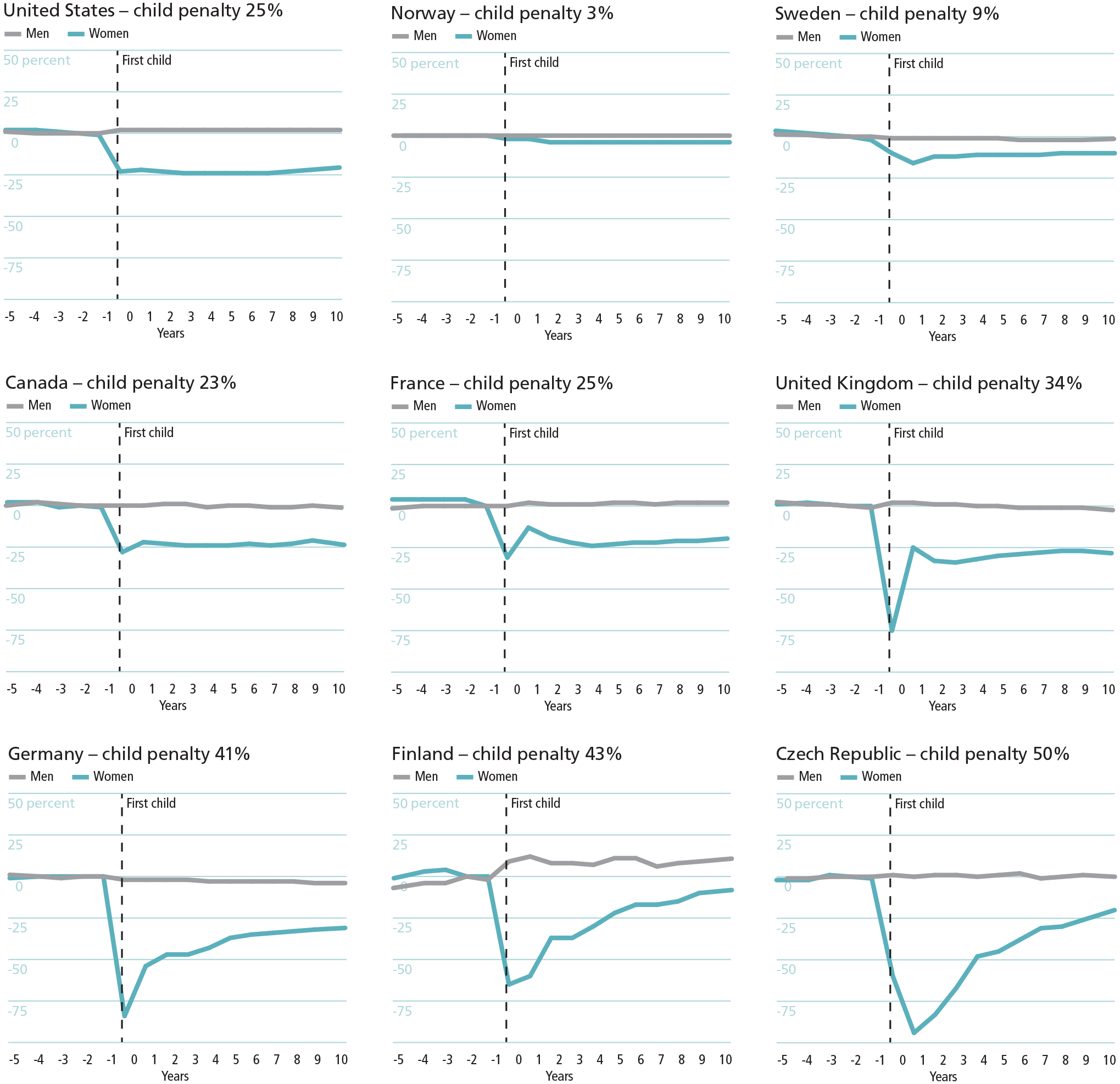
One key factor is sex differences in caring for young children, often referred to as the "motherhood penalty" or "child penalty." Working mothers, compared with working fathers, are much more likely to drop out of the labor force for a period of time when they have a child, scale back their hours, and/or depriori-tize their careers to focus on caring for young children. This can have a substantial impact on women’s earnings and career advancement, and it may impact the types of jobs they are willing or able to take on.
As you can see in the charts on the next page, childbirth impacts female wages virtually everywhere you look around the world. The severity of this impact varies significantly from country to country, however, meaning context really matters. These data come from Princeton University economist Henrik Klevin and his team, who have generously made it available to the public for free at their easy-to-use website—check it out at childpenaltyatlas.org.
Why is this penalty specific to women? It plausibly stems from the preferences and choices of females themselves, from societal pressures and expectations, or from some combination of the two.
Another driver of the gap is sex differences in who works in what jobs, often referred to as "occupational segregation." This is an important part of the equation, as Cornell University economist Francine Blau explains: "[W]e have considerable occupational segregation.. Among professional workers, women are more likely to be in relatively lower-paying jobs, such as elementary school teachers, whereas men would be more likely to be in higher-paying jobs, like lawyers or doctors. Women also tend to be more concentrated in lower-paying service occupations, like childcare workers."
Some of the reasons for this segregation may arise from differences in the characteristics of men and women themselves. On average, men and women tend to prefer different kinds of jobs, as psychologist Gijsbert Stoet and several other scholars have demonstrated. These preferences could be the result of biological differences between men and women, differential societal pressures and expectations, or some combination.
There are also observed group differences in psychological traits between the sexes which may play a role here, such as differences in competitiveness, risk aversion, agreeableness, and importance placed on family/work/money, among others. These differences may influence the types of occupations that women and men end up choosing, the promotions they seek, the number of hours they end up working, the work/family balance they desire, and their perceived job performance.
What about discrimination? A 2023 meta-analysis by Michael Schaerer and several colleagues of 85 field audits and over 360,000 individual job applications found that women do not seem to be discriminated against today when it comes to job callbacks. This is a sign of great progress toward gender equality, of course. But these results are for callbacks alone, so we cannot rule out the possibility of unequal treatment after the callback—such as in the actual decision to hire, as well as later decisions about pay, workplace treatment, promotions, and firing.
In the spring of 2024, we undertook our own exploratory study into the gender pay gap in the Mid-Atlantic Region of the United States. We were particularly interested in sex differences in college major selection and whether these decisions might be moderated by social class. We published a longer and more detailed account of our findings in the Journal of Working-Class Studies.
Motherhood Penalties Around the World
Source: Henrik Klevin’s “Child Penalty Atlas.” childpenaltyatlas.org
Our first hypothesis was that female students would be overrepresented in lower-paying majors and males in higher-paying ones. This follows from previous research which suggests the presence of such differential decision-making by sex.
Our second hypothesis was that working-class females, while still overrep-resented in lower-paying majors, would be more likely to choose higher-paying majors compared with non-working-class females. This is based on the assumption that, while working-class women would be influenced in their college major choice by their sex, they would also be influenced by their social class in ways that non-working-class women were not. We posited that economic security would be a more salient concern for them when compared with non-working-class women, thus moderating the impact of sex and leading to less unequal representation in higher-paying majors.
To explore these hypotheses, we analyzed detailed enrollment data from a regional university in the Mid-Atlantic region of the United States (henceforth referred to by the pseudonym "Mid-Atlantic University" or "MAU"). These data allowed us to calculate the percentage of women and men in each major at this university and examine whether these percentages were different for first-generation (our proxy for working-class) female students compared with non-first-generation ones.
Association Between College Major Sex Distribution and Starting Salary
Note: r = 0.78, p < .001.
Source: Authors’ calculations using data from both Glassdoor and Mid-Atlantic University.
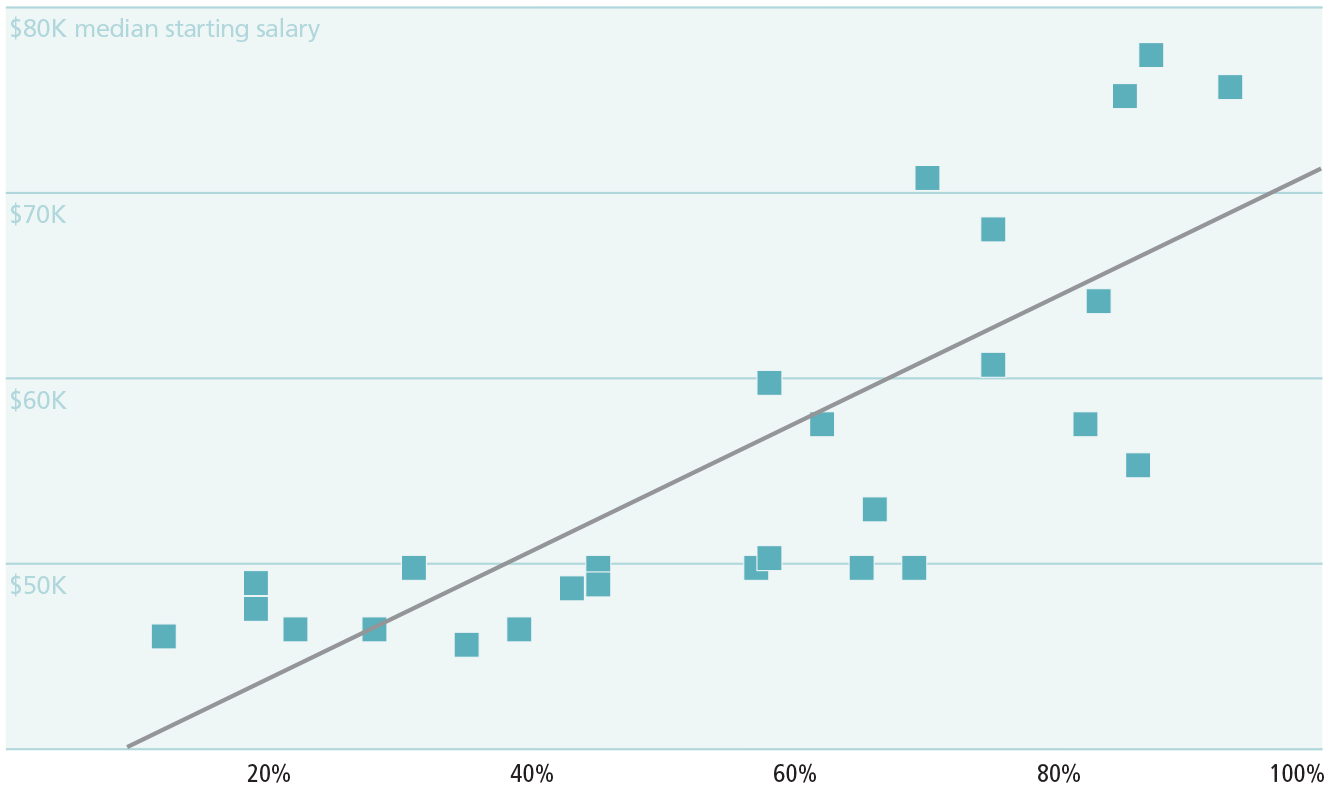
The scatterplot at right displays the association we found between sex and college major selection in the enrollment data. The x-axis (horizontal axis) is the percentage of men in each major, while the y-axis (vertical axis) displays the median starting salaries in the first five years that these majors are in the labor force.
As you can see, there is a strong correlation (r = 0.78, p < .001) between percent sex in a major and starting salary. As you move left-to-right on the horizontal axis, the percentage of men in each major increases, corresponding with a significant increase in starting salaries on the vertical axis by the time you get to the most male-dominated majors. While correlation does not equal causation, our first hypothesis was nonetheless supported.
As an example of the degree of sex segregation in different programs at MAU, high-paying majors, like electrical engineering (93% male) and computer science (87% male), are overwhelmingly male, while majors with much lower salaries, like social work (88% female) and education (81% female), are overwhelmingly female (MAU is 51% female overall).
To explore the possible moderation by social class of the relationship between sex and college major, we calculated a cross-tabulation of the average starting salaries for the highest-paying, middle-paying, and lowest-paying college major tiers. There was more than a $20k difference between the highest-paying ($67,709) and lowest-paying ($47,242) tiers, with middle-paying majors yielding a $51,664 average starting salary. We then analyzed the percentages of first-generation and non-first-generation women who chose majors in these three tiers, finding little difference. Nearly identical percentages of first-generation (10.6%) and non-first-generation (10.2%) women chose the highest-paying majors, while high percentages of both first-generation (65.7%) and non-first-generation (63.4%) women chose the lowest-paying majors. Thus, our second hypothesis was not supported—in our study, sex plays a much more important role than social class in the selection of one’s major.
To further illuminate these quantitative findings, we distributed a Qualtrics survey to 100 students in introductory social science courses at MAU. It was a non-random and non-representative convenience sample, meant to generate ideas for future research, not to generalize to the entire U.S. population. The survey asked open-ended questions about how these students chose their college majors.
There were three overwhelmingly dominant themes in the female undergraduates’ survey responses: having a personal interest in a particular area of study, desiring to pick a major that will lead to a job that she knows she will like, and desiring a major that matches her abilities and that she knows she will succeed in academically. Another slightly less frequent but still popular theme was the desire to improve society and/or help people. These responses are in line with our quantitative data, suggesting that individual preferences, whatever their cause, vary between the sexes and lead to differential career pathways.
Previous research shows that occupational segregation is a major cause of the gender pay gap, and the sex differences we observed in college major selection are surely a crucial part of that story. In the future, we plan to broaden our efforts substantially, including analyzing multiple college campuses, adding statistical complexity, surveying far more students, and adding survey questions.