




Abstract
Research shows that children of immigrants, the “second generation,” have comparatively high educational aspirations. This “immigrant optimism” translates into ambitious educational choices, given the second generation’s level of academic performance. Choice-driven (comprehensive) education systems, which allow the children of immigrants to follow their ambitions, are therefore regarded as facilitating their structural integration. The authors focus on an underappreciated consequence of these findings. If the second generation strives for higher qualifications than children of native-born parents with similar performance, working-age children of immigrants should have lower skills than children of native-born parents with comparable formal education. This could result in (statistical) employer discrimination and ultimately hamper integration. This pattern should be particularly pronounced in choice-driven education systems and in systems that emphasize vocational education. Two-step regression models using data on 16 countries support these expectations. The authors explore implications of these findings for comparative research on ethnic gaps in labor market attainment.
Over the past decades, research on the educational attainment of the “second generation” (i.e., the children of immigrants) in Western countries has come to two firm and generally accepted conclusions. First, the children of immigrants tend to have lower academic performance than the children of native-born parents, largely because they are disadvantaged by (on average) lower language skills, lack of information about the education system, and low parental resources. In this regard, the second generation resembles children of native-born parents from disadvantaged backgrounds. Second, and in contrast to other disadvantaged groups such as working-class children, the children of immigrants hold particularly ambitious educational and vocational aspirations, a pattern that is often summarized under the term “immigrant optimism” (Kao and Tienda 1995). These high aspirations likely stem from the positive selection mechanism deeply rooted in the process of international immigration and lead the second generation to strive for more ambitious educational goals than similar children of native-born parents. In this respect, the children of immigrants differ from working-class children, who tend to avoid the risks of ambitious educational choices. 1 The prevailing interpretation of these two results—lower academic performance and more ambitious educational choices—is that the high aspirations of the second generation mitigate their disadvantages and accelerate the integration of immigrant minorities across generations.
We agree with this interpretation but would like to draw attention to an underappreciated consequence of immigrant optimism. If the children of immigrants strive for higher formal levels of education than children of native-born parents with similar academic performance, then one might expect them to show lower academic performance than children of native-born parents pursuing the same kinds of educational degrees. We refer to this pattern as one of “lower skill selectivity” (with respect to academic performance). The first contribution of this article is to spell out this implication of lower skill selectivity and to highlight some of its potential consequences. Most important, we argue that the process could lead to a situation in which the working-age children of immigrants have lower average skills than children of native-born parents with the same level of formal educational attainment, potentially resulting in labor market disadvantages.
Our second contribution is to provide the first empirical assessment of the long-term consequences of lower skill selectivity by looking at skills differentials between the second generation and the children of native-born parents in adulthood. Our analysis is based on the Programme for International Assessment of Adult Competencies (PIAAC), a unique data set that offers high-quality data on the cognitive skills of working-age adults for a large set of advanced economies.
Our third contribution, made possible by the comparative nature of PIAAC, is to explore cross-national variation in the extent of lower skill selectivity and how it is related to secondary education systems. That is, we compare the ethnic skills gap across 16 Western countries where the group of interest—working-age and domestically educated children of immigrants—is reasonably large. In “choice-driven” (comprehensive) education systems, eligibility for continuing with education, including attendance of more demanding (academic) secondary- and tertiary-level programs, is only weakly related to prior academic performance. In such systems, there are few institutional barriers that would prevent the high aspirations of immigrants’ children from translating into increased attendance (and potentially also completion) of advanced programs. By contrast, stricter academic eligibility criteria—as they exist in educational systems characterized by performance-based tracking—might limit the scope for realizing ambitious educational aspirations. Hence, choice-driven systems should facilitate the integration of immigrant minorities because they allow the unencumbered expression of their higher educational aspirations. Previous studies have found some empirical support for this (Jackson, Jonsson, and Rudolphi 2012; van de Werfhorst and Mijs 2010), but they have not investigated a potential flip side of this argument: that the pattern of lower skill selectivity might be more pronounced in choice-driven education systems.
In addition to the contrast between choice-driven and performance-tracked systems, we also consider the availability of vocational education and training options in (upper) secondary education. Not only have such options been argued to “divert” students from attending tertiary education (Shavit and Müller 2000), but research also suggests that this diversion effect is stronger among children of native-born parents than among children of immigrants, possibly because domestically born parents and their children are better aware of the labor market value of vocational degrees (Tjaden and Hunkler 2017). A stronger vocational orientation should therefore reinforce the lower skill selectivity of the children of immigrants because, given similar levels of performance, the latter are more likely than the children of native-born parents to choose (higher) academic tracks in upper secondary education.
The main focus of our empirical analysis lies with the gap in numeracy skills between the working-age children of native-born parents and the children of immigrants, who were either born in the country where they were surveyed or immigrated before age six. In further analyses, we additionally explore the magnitude of ethnic gaps in formal educational attainment, risk for dropping out from higher education, and labor market attainment.
Our results support the skill selectivity hypothesis: 14 of the 16 countries exhibit negative ethnic skills gaps, and in 8 cases these gaps are statistically significant. In most countries, the adult children of immigrants thus have lower numeracy skills than the adult children of native-born parents, given the same level of formal educational attainment. Country-level regressions further indicate that the pattern of negative selectivity is less pronounced in countries with stronger educational tracking and more pronounced when upper secondary education has a strong vocational component. We also find that the second generation tends to have somewhat lower educational attainment and higher dropout rates than the children of native-born parents. Yet contrary to our expectations, these dropout and attainment gaps are associated only with a stronger vocational orientation, not with performance-based tracking. Nevertheless, and again in line with the lower skill selectivity hypothesis, our analyses of labor market inequalities indicate that ethnic skills gaps are a (typically unobserved) factor that partly explains cross-national variation in the labor market attainment of the second generation relative to the children of native-born parents.
These results are subject to several limitations, including small sample sizes at the country and individual levels and limited possibilities of accounting for compositional differences with respect to parental countries of origin. Nevertheless, our theoretical discussion and results point to several underappreciated implications of well-established findings in the literature on immigrant educational attainment.
Background
Following Boudon (1974), social class differentials in educational attainment can be conceptualized as the product of two types of effects. So-called primary effects of social origin are all those that operate via one’s academic ability and performance. “Secondary effects” are effects of social origin that operate via educational decision making conditional on academic performance. Boudon’s theory was formulated with a view to explaining social class differentials in educational attainment, and his crucial insight is that the lower educational attainment of working-class children is not fully explained by their lower average performance in school: the fact that working-class children make less ambitious educational choices conditional on performance (e.g., choosing less demanding tracks or leaving education earlier) is an important part of the explanation, too. The possible factors driving such secondary effects are manifold and may include differences in financial and nonfinancial resources (e.g., knowledge of the education system), differences in risk aversion, and differences in educational aspirations (e.g., Breen and Goldthorpe 1997; Breen and Yaish 2006; Jackson et al. 2012).
Leaving the vast heterogeneity of persons of immigrant origin aside for a moment, one might expect a similar pattern for the children of immigrants, the “second generation”: their parents, too, tend to lack financial resources, a disadvantage that is compounded by lower average language skills and less knowledge about the education system (for overviews see Alba, Sloan, and Sperling 2011; Heath and Brinbaum 2007). The children of immigrants indeed tend to perform worse in school than the children of native-born parents (e.g., OECD 2016), but interestingly, their aspirations and educational choices do not follow the pattern assumed in Boudon’s (1974) classic account. Conditional on academic performance, members of the second generation tend to hold higher educational aspirations and to make more ambitious educational choices than comparable children of native-born parents.
Following Kao and Tienda (1995), a popular line of argument relates the high aspirations of immigrants—often referred to as “immigrant optimism” or even as an “immigrant paradox”—to the process of international migration (Dollmann 2017; Relikowski, Yilmaz, and Blossfeld 2012; Salikutluk 2016; Tjaden and Hunkler 2017; but see Polavieja, Fernández-Reino, and Ramos 2018). People who emigrate from their home countries strive to improve their life chances and are tolerant of the risks involved in international migration. The argument continues by suggesting that immigrants transmit their high motivation, drive, and risk tolerance to their children.
Irrespective of its origins, the phenomenon of immigrant optimism has been documented for children of immigrants from various origin countries and for various receiving countries, including Denmark (Birkelund 2019), Finland (Kilpi-Jakonen 2011), France (Brinbaum and Cebolla-Boado 2007), Germany (Dollmann 2016, 2017; Dollmann and Weißmann 2020; Kristen and Dollmann 2010; Kristen, Reimer, and Kogan 2008), the Netherlands (Hustinx 2002; van de Werfhorst and van Tubergen 2007), Norway (Fekjær and Birkelund 2007), Sweden (Engzell 2019; Jackson et al. 2012; Jonsson and Rudolphi 2011), Switzerland (Griga 2014; Tjaden and Scharenberg 2017), the United Kingdom (Jackson 2012; Jackson et al. 2012), and the United States (Feliciano and Lanuza 2017; Waters et al. 2013). Interestingly, a recent study by Ciocca Eller and DiPrete (2018) revealed a similar pattern for the college enrollment decisions of blacks in the United States, a phenomenon the authors referred to as “paradoxical persistence.”
Against this background, some scholars argue that choice-driven educational systems, which allow the children of immigrants to follow and realize their aspirations, facilitate the structural integration of immigrant minorities (Jackson et al. 2012). In contrast, integration may be hampered by tracked systems that tie access to higher secondary and tertiary programs more strongly to prior performance. In line with this expectation, two international comparisons showed that tracking in secondary education is associated with greater educational disadvantages for the second generation in terms of both test scores (van de Werfhorst and Heath 2019) and transition rates to (academic) upper secondary and tertiary education (Griga and Hadjar 2013; van de Werfhorst and Heath 2019). 2 Another noteworthy study was conducted by Dollmann (2016), who exploited a policy change in the German federal state of North Rhine-Westphalia that made teacher recommendations for secondary school tracks mandatory. His analysis confirms that the restriction of secondary (choice) effects resulted in lower transition rates to higher academic tracks for children of Turkish origin.
Summarizing current research, we may thus conclude that the high motivation and educational aspirations of the children of immigrants counteract their lower academic performance stemming from several sources of disadvantage. Educational systems that limit secondary (choice) effects may suppress this process.
Lower Skill Selectivity?
We agree with the literature summarized above and with its focus on high levels of educational attainment as the primary route to structural integration. The main goal of our study is to highlight an implication of these results that has received very limited attention so far: a pattern of “lower skill selectivity.”
The fact that children of immigrants tend to make more ambitious educational choices than children of domestically born parents with similar levels of academic performance implies that, other things being equal, members of the second generation will find themselves in the company of (on average) stronger performing children of native-born parents after each educational transition. 3 A related idea, recently articulated by Engzell (2019), is that the children of immigrants may find themselves in an “aspiration squeeze” characterized by “high expectations but only limited means to fulfill them” (p. 98).
We deliberately emphasized the ceteris paribus condition in the previous paragraph: other processes (e.g., discrimination in grading or admissions) may work in the opposite direction so that second-generation students might have to outperform children of native-born parents to attain similar transition rates and, eventually, degrees. We therefore remain agnostic about the overall direction of performance differentials, although previous research indicates that the lower skill selectivity pattern trumps other mechanisms in at least some countries: in their study of Sweden and the United Kingdom, Jackson et al. (2012) noted that most ethnic minority students have lower grades than students in the majority group. In part, the poor performance of ethnic minority students is a consequence of minority groups at this level being slightly more negatively selected on previous performance than majority students. (p. 170)
Birkelund’s (2019) recent analysis of the second generation in Denmark yielded similar results and further suggests that lower skill selectivity leads to increased risk for dropout from academic upper secondary education. This was recently confirmed with German data by Dollmann and Weißmann (2019), who concluded that the resulting higher dropout rates counteract potential benefits of immigrant optimism. Ciocca Eller and DiPrete (2018) similarly concluded that ambitious choices and the resulting lower skill selectivity are one of the factors driving higher BA noncompletion rates among blacks in the United States.
Because it is simply the flip side of immigrant optimism, the extent of lower skill selectivity should depend on the extent to which ambitious preferences can actually be realized. The established literature on immigrant educational attainment therefore suggests some clear expectations concerning the moderating role of the education system. Negative selectivity with respect to prior academic performance should be more pronounced in choice-driven education systems in which the pursuit of educational ambitions faces relatively few constraints. It should be less pronounced in countries whose education systems emphasize performance-based tracking. These considerations have a straightforward implication for ethnic skills gaps after the completion of formal education, that is, for skills differentials between the working-age children of immigrants and children of domestically born parents in the same educational group:
Hypothesis 1: Any potential ethnic skills gap (between children of native-born and immigrant parents with similar formal education) should be less pronounced (i.e., “less negative”) in tracked education systems.
Tjaden and Hunkler (2017) pointed out another potential consequence of immigrant optimism. The high aspirations of the children of immigrants could lead them to disregard vocational degrees and applied tertiary-level education, which are viable options with good labor market prospects in countries with elaborate vocational education and training systems such as Germany (the focus of Tjaden and Hunkler’s study). Shavit and Müller (2000) famously argued that vocational options may divert (working-class) students from higher education, thereby increasing the positive skill selectivity of academic tracks in upper secondary and of (university-level) tertiary education. Tjaden and Hunkler suggested that this “diversion effect” may be weaker among pupils of immigrant origin, for example, because they and their parents are less informed about the education system of their countries of residence and about the labor market value of vocational qualifications (Abrassart et al. 2018). 4 Kogan (2016) has already emphasized that a stronger vocational orientation of an education system penalizes foreign-born and foreign-educated persons, because the strong link between educational credentials and labor market attainment devaluates their foreign degrees. We argue that vocational options might also have subtle effects on the domestically born and educated second generation: a strong vocational orientation might raise the skill selectivity of higher education participation more strongly for children of native-born parents, thereby further raising the lower skill selectivity of the children of immigrants relative to children of native-born parents in the same educational group.
Accordingly, our second hypothesis is as follows:
Hypothesis 2: The ethnic skills gap (between children of domestically born and immigrant parents with similar formal education) should be more pronounced (i.e., more negative) in vocationally oriented education systems. 5
Finally, although our main focus is on differences in (numeracy) skills between the second generation and children of native-born parents, we also acknowledge and investigate the implications of the above arguments for ethnic gaps in educational attainment, in the prevalence of dropping out of tertiary education, and in labor market outcomes. Specifically, our discussion suggests that the educational attainment of the second generation, relative to children of native-born parents, should be higher in countries with choice-driven education systems. As noted above, this possibility has actually received some attention in previous research, albeit with mixed results. The argument further suggests that the second generation’s risk for dropping out of (i.e., of starting but not completing) advanced educational programs and in particular tertiary education should be higher in choice-driven systems in which it is easier for ambitious students to attend higher education at relatively low levels of preparedness. Last, but not least, our considerations suggest that the ethnic skills gap may be an important, but typically unobserved, confounding variable in analyses of ethnic inequalities on the labor market. Moreover, the extent and direction of confounding might be systematically related to national education systems. We provide results on all of these issues below.
Data and Methods
We base our analyses on the first cycle of PIAAC (OECD 2013a, 2013b), which was conducted in 24 countries in 2011 and 2012 and in another 9 countries in 2014 and 2015. Our analysis is restricted to the 16 countries that have sizable populations of domestically educated and working-age children of immigrants (see definition in the next paragraph). All country samples are probability samples of the population aged 16 to 65. We analyze the public-use files that are available on the Organisation for Economic Co-operation and Development’s (OECD) PIAAC Web page. 6
Our main analysis focuses on the numeracy skills gap between children of native-born parents and children of immigrant parents. We include respondents among the second generation if they were born in the country where they were surveyed (the “survey country”) or if they immigrated before the age of six. 7 In the main analysis, individuals are treated as belonging to the second generation if at least one of their parents was born abroad. In supplementary analyses we also used a stricter definition of immigrant origin that requires both parents to have been born abroad (see Appendix G in the Online Supplement). Results were similar to the main analysis, despite a considerable increase in statistical uncertainty (due to lower sample sizes).
In the case of Israel, we exclude respondents whose first language is Arabic and whose parents were both born in Israel. This is because they are a special group that achieved only very low average scores on the PIAAC tests. We only include respondents if they obtained their highest degree in the survey country and if they were not enrolled in full-time education at the time of the interview. The latter criterion ensures that we capture skills inequalities after the end of individuals’ main educational biographies. We drop respondents older than 54 to guarantee a reasonable match with our education-system variables, while maintaining sufficiently large sample sizes. Respondents who were born abroad and immigrated at age six and older are excluded from the main analysis.
Although our primary strategy for dealing with missing data is multiple imputation, we exclude 1,440 of 59,258 cases meeting the sample restrictions because they have incomplete information on immigrant origins (e.g., mother’s and/or father’s country of birth). To simplify the imputation procedure, we further drop 203 cases with missing values on variables with very low proportions of missing data, as this simplifies the imputation procedure considerably. Our final sample for the analysis of numeracy skills comprises 16 countries and 57,615 (59,258 – 1,440 – 203) respondents, 6,985 of whom are children of immigrants (6,152 are domestically born second generation, and 833 immigrated before the age of six). The median number of second-generation respondents per country is 286, with a minimum of 47 in Finland and a maximum of 1,614 in Canada. Lower level sample sizes are smaller for the analysis of dropout from higher education, hourly wages, and occupational status because these outcomes are defined only for certain subgroups (e.g., those who ever started higher education or those who worked at the time of the interview).
We obtain imputations separately by country and generate 10 imputations, 1 for each of the plausible values for the skills measures. The only variable with a non-negligible proportion of missing data is parental education, which is not available for 3,933 of the 57,615 cases in the main analysis sample (6.8 percent). 8 Further details on the treatment of missing data, including complete-case results for the main regressions, are provided in Appendix J in the Online Supplement.
Outcome Variables
The main outcome of interest in this analysis is respondents’ numeracy skills. In Appendix F of the Online Supplement we also analyze literacy skills; but in a comparative analysis in which immigrants’ proficiency in the country’s primary language(s) likely differs across survey countries (e.g., tends to be better in English-speaking ones), numeracy scores make for a better comparison. That being said, results for the ethnic literacy gap are somewhat attenuated but broadly similar to those for the numeracy gap. In further analyses, we also consider other outcome variables such as years of education or log hourly wages. We provide details on these measures when discussing the respective analyses.
The PIAAC numeracy and literacy scores are based on unique assessment components that required respondents to work through a set of test items optimized for cross-national comparability. The assessed skills can be described as basic (as opposed to advanced) cognitive and general (as opposed to specific or vocational) skills. The numeracy domain focused on everyday tasks involving numerical operations (e.g., interpreting bar charts that might appear in newspaper articles or government brochures); the focus in the literacy domain was on comprehension of short pieces of text (e.g., instructions or newspaper articles) that citizens might encounter at work or in private life. For further details, see OECD (2013a).
The PIAAC numeracy and literacy scales range from 0 to 500, with higher values indicating higher skills. We standardized the skill variables to have a mean of 0 and a standard deviation of 1, so coefficient estimates can be interpreted in terms of predicted standard deviation changes on the respective scale. 9
Like most large-scale skills assessments, PIAAC administered only a relatively small number of test items to each individual, rendering competence scores somewhat uncertain. To account for this, PIAAC provides 10 plausible values rather than a unique score for each respondent. All estimates presented in the article were obtained by running the respective analysis 10 times (once for each plausible value) and then applying standard (multiple imputation) rules for obtaining final point estimates and standard errors (Rubin 1987).
Individual-Level Predictors
The cardinal individual-level predictor in this analysis is a dichotomous variable that indicates members of the second generation (again, including respondents who immigrated before age six). Although most of our analyses do not attempt to differentiate the second generation with respect to parental countries of origin, some specifications focus on the second generation of non-Western descent. PIAAC provides no direct information on parental country or region of birth, so we have to proxy non-Western descent using information on the language currently spoken at home and on the (first and second) languages spoken at home during childhood. 10 These additional analysis must be viewed with caution: the lower-level sample sizes are very small in some countries, and we must completely exclude Canada and the United States because their PIAAC public-use files provide no information on the languages spoken during childhood.
To capture the ethnic skills gap conditional on formal education, we control for respondents’ highest educational degree. PIAAC provides internationally comparable information on the basis of the 1997 revision of the International Standard Classification of Education (ISCED-97). ISCED-97 distinguishes among seven main categories (ranging from 0, preprimary, to 6, advanced tertiary), with additional distinctions according to the length or orientation (academic vs. vocational) within some of these main categories. In principle, we would want our measure of formal qualifications to be as fine grained as possible. In practice, the degree of detail we can afford is limited by the fact that some educational categories do not exist in some countries and, more important, that the PIAAC public-use files for many countries provide educational information in coarsened form to protect confidentiality. We therefore use a seven-category version that is the most detailed variant available for all countries (ISCED-97 codes in parentheses): primary or less (0, 1); lower secondary (2, 3c short); upper secondary (3a, 3b, 3c long); postsecondary, nontertiary (4a, 4b, 4c); tertiary, professional (5b); tertiary, bachelor’s level (5a short), and tertiary, master’s or research degree (5a long, 6). 11 Appendix D in the Online Supplement shows additional results based on a detailed 15-category measure of educational attainment (which is not available for Canada, so we conducted this analysis using a reduced sample of only 15 countries). Results based on the 7- and 15-category measures of education are so similar that we can safely conclude that the results in the main article are not biased by the coarseness of the education measures.
To account for compositional differences across countries, our regressions further include age in five-year categories and gender. Because immigrant countries differ with respect to the degree to which immigrants represent a positively selected group and because this again is related to the academic performance of their children (Levels and Dronkers 2008; van de Werfhorst and Heath 2019), we also control for parental education (in three categories: neither parent has attained upper secondary education, at least one parent has attained upper secondary education, and at least one parent has attained tertiary education).
Further analyses provided in Appendix E of the Online Supplement additionally control for the employment status at the time of interview (three categories: employed, unemployed, and out of the labor force), for the cumulated years of work experience (linear and squared), and for the broad occupational category of the respondent’s current or last job. 12 We see this additional specification mainly as a robustness test that addresses the concern that ethnic skill differentials might partly result from the different labor market experiences of the second generation and children of native-born parents, not from their educational trajectories. For example, we might find a negative ethnic skills gap because the children of immigrants are less likely to work or because they work in less stimulating and demanding jobs (e.g., because of ethnic discrimination). On the other hand, one might be concerned that differences in work experiences are a consequence (rather than a source) of the ethnic skills gap. Accordingly we do not include these variables in our main specifications, because they are endogenous to the outcome variable (skills). In any case, the robustness test shows that the country-level relationships between the education system measures and the ethnic numeracy gap remain quite similar to the ones reported in the main article, although the tracking coefficient is not fully robust. Depending on the specification it declines by 20 percent to 25 percent and remains marginally significant only in the models without selectivity controls.
Appendix A in the Online Supplement provides descriptive sample statistics of all individual-level variables.
Country-Level Variables
The main country-level variables of interest in this analysis are the education system’s degree of performance-based tracking and its vocational orientation. The measures for both dimensions come from version 4 of the Educational Systems Database by Bol and van de Werfhorst (2016). 13
Performance-based tracking is captured by the index of external differentiation, which is based on a principal-factor analysis of three variables: age of first selection into different tracks, number of tracks available at age 15, and length of tracked education as a proportion of the total duration of primary and secondary education. The values refer to the years 2002 and 2003. This index is an imperfect operationalization of the theoretically central factor: the extent to which educational choices are constrained by academic performance. That said, it can be expected to be highly correlated with the strength of such constraints because tracked systems are generally characterized by performance-related assignment to secondary tracks and because attendance of the upper or highest school tracks tends to be crucial for access to tertiary education later on.
For vocational orientation, we use Bol and van de Werfhorst’s (2016) vocational orientation index. This measure is based on a principal-factor analysis of the proportion of students enrolled in upper secondary education, as provided in two sources: the OECD’s and UNESCO’s online databases. Values refer to 2004 and 2006 or the closest year available. The use of two alternative data sources should increase the reliability of the measurement, which might be subject to measurement error or slight differences in the definition of vocational programs.
Figure H1 in the Online Supplement visualizes how the 16 countries in our sample vary across the two dimensions of performance-based tracking and vocational orientation.
Our focal country-level variables capture differences in secondary education systems in the early to mid-2000s, when the cohorts we study had mostly left secondary education. Our empirical strategy thus hinges on the assumption that changes in education systems between the late 1970s and the 2000s were rather limited for our country sample. To the best of our knowledge, none of the 16 countries radically changed their extent of external differentiation or vocational orientation during this period.
To avoid spurious findings concerning the relationships between the education system characteristics and the ethnic skills gap, we need to account for cross-country differences in the composition of the second generation. As the available individual-level controls (age, gender, and parental education) might be insufficient, we will explore whether results are robust to the inclusion of two country-level proxies for the composition of a country’s immigrant population. The first one is constructed from the PIAAC data: it is the average numeracy score for first-generation immigrants who immigrated at ages 16 and older and who had been in the country for at least 15 years when they took part in PIAAC (i.e., who immigrated in the late 1990s or earlier). Our goal with this measure is to approximate the skill level of the parental generation of the second generation in our sample. The match clearly is not perfect, but limited sample sizes and a lack of more detailed information about the immigration history of respondents preclude the construction of a more refined measure. Whenever we restrict the analysis of the second generation to those of non-Western descent, we also restrict the calculation of the numeracy mean for the “parental” generation to immigrants from non-Western countries.
Our second macro-level control for selectivity is a summary indicator of the strictness of immigration policy taken from the Immigration Policies in Comparison database (Helbling et al. 2017). The measure is available on a yearly basis from 1980 onward. We use the average score for the years 1980 to 1989 and ignore more recent years to better approximate immigration policy during the period when most of the parents of the second generation in our sample immigrated to the different destination countries in our sample.
For the regression analysis, we z-standardized all country-level predictors to have a mean of 0 and a standard deviation of 1 at the country level.
Modeling Strategy
We use a two-step regression approach to investigate whether tracking and vocational orientation moderate the ethnic skills gap (Lewis and Linzer 2005). We thus focus on so-called cross-level interactions between the education system measures and having foreign-born parents (i.e., being a member of the second generation). The two-step strategy is a natural approach to estimating such interactions and has the potentially crucial advantage that it allows the effects of all individual-level variables to vary freely across countries (Heisig, Schaeffer, and Giesecke 2017). 14
The two-step approach consists of two sequential steps of estimation (for simplicity, we abstract from the fact that we have to execute the whole procedure 10 times, once for each plausible value, to obtain one set of estimates). In the first step, we run country-specific linear regressions of numeracy skills (and the other outcomes of interest) on the second-generation indicator, the respondent’s formal level of education (using the seven-category variable described above) and the additional lower level controls. We estimate the first-step regressions by ordinary least squares and account for PIAAC’s complex survey design by applying the final sample weights and obtaining variance estimates using the jackknife replication method (OECD 2013b).
The coefficient estimates for the second-generation dummy provide us with an estimate of the (conditional) ethnic skills gap (or of the ethnic gap in the other outcomes) for each country. In the second step, we run country-level “slopes-as-outcomes” regressions that regress the estimated ethnic gaps on the tracking index, the vocational orientation index, and the country-level selectivity controls. We use feasible generalized least squares (FGLS) estimation to account for the fact that the dependent variable is estimated rather than observed and therefore subject to sampling error (for details, see Heisig et al. 2017; Lewis and Linzer 2005).
Our approach is somewhat unconventional, as the sociological literature typically uses mixed-effects (multilevel) models to investigate cross-level interactions (Heisig and Schaeffer 2019). Reassuringly, Appendix K in the Online Supplement shows that mixed-effects models yield qualitatively similar findings for the focal cross-level interactions.
Results
We argued that immigrant optimism should lead to lower skill selectivity. Among working-age men and women, this selectivity should manifest as the existence of a negative “ethnic skills gap” among people with similar levels of formal educational attainment.
Figure 1 shows that we generally find the expected negative gap. The largest ethnic skills gaps are found in Denmark, the United Kingdom, the Netherlands, and Norway, where the estimates fall between 24 percent and 30 percent of a standard deviation and are statistically significant. At the other end of the spectrum, we find essentially no (Canada) or even slightly positive (Germany, Ireland) gaps; none of these estimates are statistically significant, however. The remaining countries fall in between these extremes. Overall, the estimated skills gap is negative in 14 of the 16 countries (including the Canadian case, which is very close to zero), and in 8 of the 14 cases the difference is statistically significantly different from zero (at the 5 percent level).
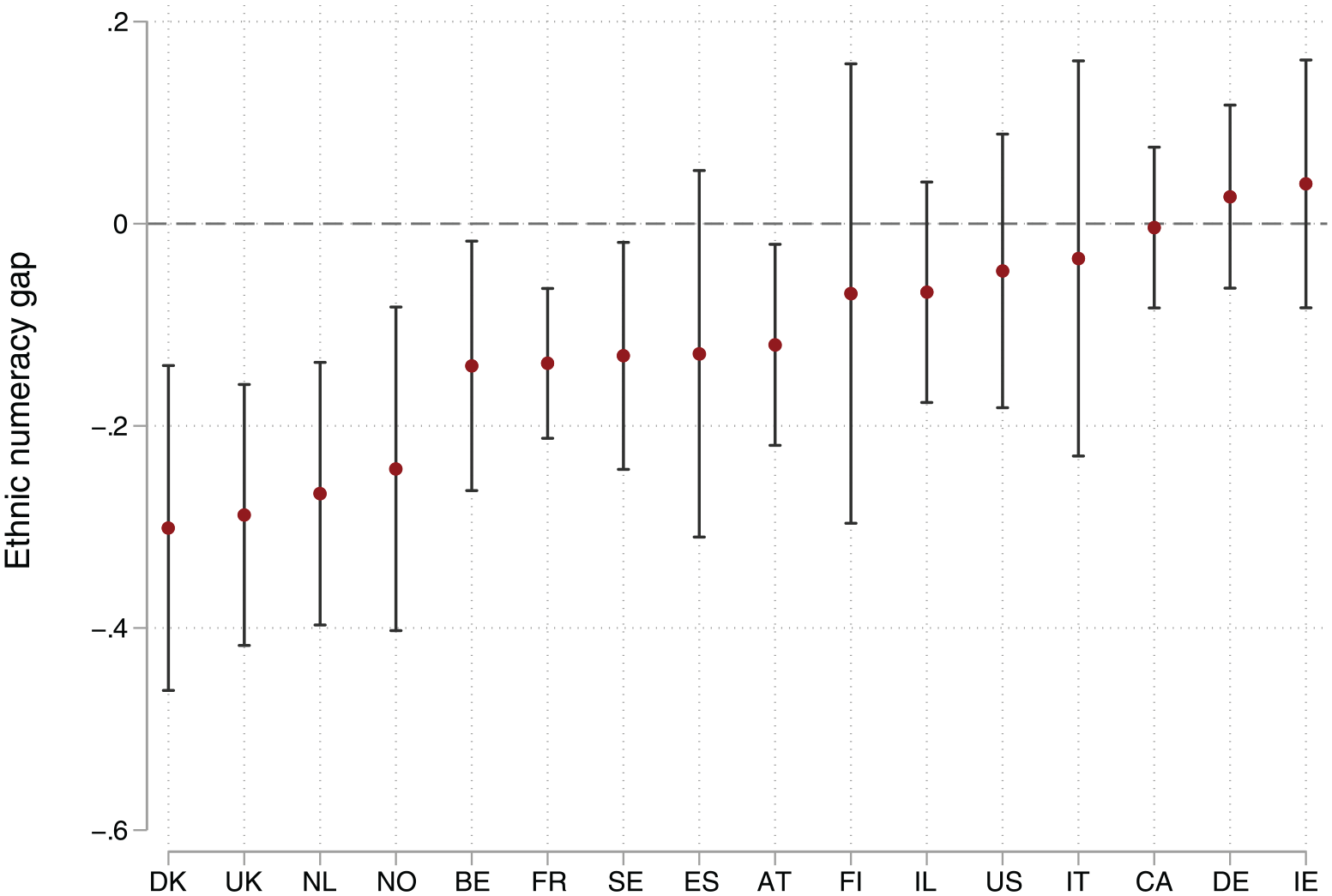
The formal education–adjusted ethnic numeracy gap across 16 immigration countries.
What explains the country differences in the magnitude of the ethnic skills gap? The overall pattern of cross-national variation in Figure 1 seems quite consistent with our two hypotheses. Three of the four countries with the largest gaps (Denmark, the United Kingdom, and Norway) have choice-driven comprehensive education systems, while Germany, one of the two countries where we even find a small positive gap, is known for an education system with early performance-based tracking (but also with a strong emphasis of vocational education, which should be associated with a larger, i.e., “more negative,” ethnic skills gap according to our hypotheses).
To test our expectations more systematically, we turn to the results of the country-level feasible generalized least squares regressions shown in Table 1. The first two columns show results without macro-level controls for the selectivity of the immigrant population. Model 1 shows results for the full sample of the second generation (regardless of parental country of origin). In model 2, the second generation includes only individuals whose parents arrived from non-Western countries (proxied by language spoken at home). We have to drop Canada and the United States from this analysis because information on the languages spoken at home during childhood is not available in the PIAAC public-use files for these countries.
Country-Level Regressions of the Formal Education–Adjusted Ethnic Numeracy Gap on Performance-Based Tracking and Vocational Orientation.

Note: Two-step multilevel model (feasible generalized least squares). Results are controlled for formal education, age, gender, and parental education. Canada and the United States are not included in regressions for children of parents from non-Western countries, because the Programme for International Assessment of Adult Competencies public-use files for these countries do not provide information on the languages spoken at home during childhood. Values in parentheses are standard errors.
p < .10. *p < .05. **p < .01.
Consistent with Figure 1, the estimated constants are negative throughout, indicating that the overall tendency is for the second generation to have lower numeracy skills than children of native-born parents with similar formal qualifications (recall that the predictors are z standardized, so the constant term is the predicted ethnic gap in years of education for a country with average levels of tracking and vocational orientation).
More important and in line with both hypotheses, the conditional ethnic skills gap becomes “more positive” as the index of external differentiation (i.e., our indicator of performance-based tracking) increases and “more negative” as the index of vocational enrollment (i.e., our indicator of vocational orientation) increases. The standardized coefficients for tracking and vocational orientation are of broadly similar (absolute) size. According to model 1, the conditional ethnic numeracy gap shrinks (i.e., becomes more positive) by .0777 standard deviations per standard deviation increase in tracking strength, while growing (i.e., becoming more negative by) .0956 standard deviations per standard deviation increase in vocational enrollment. Substantively, this means that the performance of working-age children of immigrants relative to children of native-born parents with similar formal education (and similar age, gender, and parental education) improves roughly as much with the amount of tracking as it worsens with the extent of vocational orientation in secondary education. 15
One might worry whether persons of immigrant origin living in the United Kingdom or Denmark are comparable with those living in Germany and Canada, given that these countries have quite different historical legacies of immigration. Reassuringly, models 2 to 4 in Table 1 indicate that the coefficients on the education system measures are quite robust to controlling for country differences in the composition of the immigrant population by (1) restricting the group of immigrants to those of non-Western descent (models 2 and 4) and (2) adding country-level controls for the selectivity of immigration (models 3 and 4). Inclusion of the macro-level selectivity controls somewhat reduces the magnitude of the coefficients relative to models 1 and 2, but the change is not dramatic, and the estimates stay (marginally) statistically significant in the case of the full sample at least.
Model 3 is our preferred specification because it is based on the full country sample, including Canada and the United States, and because it includes the macro-level selectivity controls. From now on, we will therefore focus on this setup. To get an impression of the strength of the associations and the overall quality of this model, Figure 2 displays the residualized associations between the adjusted ethnic numeracy gap and the two education system variables. That is, the two panels show the relationship between the skills gap and each education system measure after partialing out the respective other education system variable and the selectivity controls. According to the Frisch-Waugh-Lovell theorem, these residual associations are identical to the coefficients from a multiple regression that includes all of the predictors (i.e., the education system measures and the selectivity controls; Davidson and MacKinnon 2004). In addition to the linear fits, we also include semiparametric locally weighted scatterplot smoothing (lowess) smooths. It is reassuring to see that the lowess lines follow the linear approximation quite closely.

Residualized country-level relationships between the education-adjusted ethnic numeracy gap and two characteristics of the education system.
In addition, Figure 2 does not suggest that the estimated associations are driven by single overly influential country cases, although a few cases do give some reason for concern (e.g., Germany in the case of tracking/external differentiation). To further delve into this, we conducted an outlier analysis and computed delete-one DFBETA and Cook’s D statistics for our preferred model (i.e., model 3 from Table 1). Germany (tracking), Finland (“parental” generation numeracy mean), France (“parental” generation numeracy mean), and Sweden (tracking) exceeded the common threshold values of 2/√16 = 0.5 (DFBETA) or 4/n (Cook’s D). Appendix C in the Online Supplement reports results for the 11-country sample without these 5 cases; effect sizes for the education system variables are actually slightly larger than in the main analysis and remain statistically significant at the 10 percent and 5 percent levels for tracking and vocational orientation, respectively.
On the basis of Figure 1 and Figure 2, one might wonder about the validity of the PIAAC data, as large-scale assessments of students such as the Programme for International Student Assessment (PISA) regularly show ethnic achievement gaps to be quite large in Germany (e.g., OECD 2016), a country that shows only a very small (and positive) conditional ethnic skills gap in our analysis. Appendix I in the Online Supplement therefore compares our PIAAC ethnic skills gap against the PISA 2000 ethnic skills gap. 16 We find a reassuring correlation of ρ = 0.434, but indeed identify Germany, Norway, and Canada as countries in which our PIAAC ethnic skills gap deviates quite considerably from what one would expect on the basis of the PISA data. 17 Appendix I in the Online Supplement reports results for the remaining nine-country sample that does not include the five outliers identified in the previous paragraph or any of the three deviating countries just mentioned. Apart from a loss of precision, the coefficients are even slightly stronger than the ones reported in Table 1.
Further sensitivity analyses show that our results are (by and large) also robust to using a more detailed 15-category measure of education (see Appendix D in the Online Supplement) or to the inclusion of additional controls for current employment status, work experience, and broad occupational categories to test whether the observed skills gaps are partly a result of accumulated work experiences rather than experiences in formal education (see Appendix E in the Online Supplement). We also reran the models with literacy rather than numeracy skills as the dependent variable; both coefficients of interest are attenuated somewhat relative to Table 1 but retain their expected signs (see Appendix F in the Online Supplement). Finally, we assessed the sensitivity of our results to a stricter definition of immigrant origin for which both parents need to be born abroad. Results based on this strict definition are substantially stronger for both performance-based tracking and vocational orientation, but also less certain (see Appendix G in the Online Supplement).
Educational Attainment and Dropout Risks
The preceding analysis indicates that the ethnic skills gap between the children of immigrants and native-born parents is negative in most countries. Moreover, we also found evidence that the skills gap is smaller in countries with strong performance-based tracking and larger in countries with a strong vocational orientation of upper secondary education. We expected these patterns because they are implied in two prominent theories: performance-based tracking limits the ambitious education choices of the second generation (Jackson et al. 2012; van de Werfhorst and Mijs 2010), and vocational orientation “diverts” especially native-born students away from higher education (Shavit and Müller 2000; Tjaden and Hunkler 2017). Here we test two further implications of these two theories.
First, we focus on formal educational attainment, measured as the number of years typically required to attain the respondent’s highest degree. If the tracking theory is correct, we should expect the smaller skills gaps in strongly tracking countries to go hand in hand with larger ethnic gaps in formal educational attainment. Although two recent studies concluded this to be the case (Griga and Hadjar 2013; van de Werfhorst and Heath 2019), our own analysis of the PIAAC data, reported in columns 1 and 2 of Table 2, provides little support for the idea that tracking reinforces ethnic inequalities in educational attainment. 18 The estimated constants indicate that the children of immigrants tend to obtain somewhat lower levels of formal education than their counterparts (i.e., the children of domestically born parents). But the coefficient estimate for the tracking measure is close to zero and far from reaching statistical significance. 19
Country-Level Regressions of the Ethnic Gap in Years of Education and Dropout from Higher Education on Performance-Based Tracking and Vocational Orientation.

Note: Two-step multilevel model (feasible generalized least squares). Results are based on the full sample (i.e., children of immigrants from Western- and non-Western countries) and controlled for formal education, age, gender, and parental education. Information on dropout is also unavailable for the United States, hence the reduced sample size for the dropout regressions for the full sample. Values in parentheses are standard errors.
p < .05.
If a straightforward version of the diversion theory is correct, we should expect the larger skills gaps in vocationally oriented countries to go hand in hand with smaller ethnic gaps in formal educational attainment. But instead, the vocational enrollment coefficient is consistently negative and even attains statistical significance. This does not support a simple “diversion story”—but see the results for dropout from higher education, which we discuss next.
Second, we turn to dropout from higher education: another potential consequence of highly ambitious (or maybe even overambitious) educational choices is an increased risk for dropout and noncompletion (Birkelund 2019; Ciocca Eller and DiPrete 2018; Dollmann and Weißmann 2019). Thus, we might expect the second generation to be at greater risk for dropping out of tertiary education than children of native-born parents. To investigate this possibility, we ran another two-step regression, with the dependent variable being an indicator of having dropped out from tertiary education. 20
We again begin with the estimated intercepts in column 2 of Table 2, which indicates that, in the average country, members of the second generation are more likely to have dropped out of a tertiary-level programs than children of domestically born parents by approximately 3 percentage points. If this difference is at least partly the result of the second generation’s more ambitious choices, we might expect the gap in dropout risks to be smaller in countries with stronger performance-based tracking (which should hamper the realization of highly ambitious aspirations). The regression does not support this expectation, however. The estimated tracking coefficient is essentially zero.
Turning to vocational orientation, model 2 suggests that ethnic inequality in higher education dropout rates are larger in countries with a stronger vocational orientation: the coefficient estimate is positive, sizable, and statistically significant. This result, together with the one for years of education in model 1, is consistent with a variant of the “diversion” theory in which students of native-born parents with limited chances of succeeding in higher education are more likely to choose vocational programs than similar second-generation students. Many of the latter might then eventually drop out of higher education without subsequently obtaining a vocational degree, which would leave them with relatively low levels of educational attainment.
In summary, tracking does not go hand in hand with larger ethnic skills gaps in formal educational attainment and increased dropout rates from higher education in our sample. Thus, although we found evidence in favor of hypothesis 1 (i.e., smaller ethnic skills gaps in performance-tracked education systems), we find no evidence of the mechanism we argued was driving it. We do, however, find evidence in favor of a variant of the “diversion” theory, which thus could indeed be the mechanism driving our findings in support of hypothesis 2 (i.e., larger ethnic skills gaps in vocationally oriented education systems).
Labor Market Attainment
In the final step of our analysis, we now explore some implications of our main findings for ethnic penalties on the labor market. We acknowledge that our analysis is based on a small and cross-sectional country sample and that it is very much open to debate whether the observed relationships between the education system characteristics and the size of the ethnic numeracy gap are causal. That being said, we regard it as a given that a negative (conditional) ethnic skills gap exists in many advanced economies and that its size covaries with characteristics of their national education systems.
These results suggest some potentially important implications for research on the labor market attainment of the second generation. Adjusting “ethnic gaps” in labor market outcomes for formal qualifications will induce (or reinforce) a negative correlation between immigrant background and skills. Because the latter are unobserved in most data sets, this will lead to an “overestimation” of ethnic penalties (provided that labor market returns to skills are positive). Moreover, the extent of this overestimation should vary systematically across countries, making it particularly consequential in comparative studies.
Table 3 provides some empirical evidence on these issues. The dependent variables in this set of country-level regressions are the ethnic gaps in two measures of labor market attainment, the log hourly wage, and the International Socio-Economic Index of Occupational Status (ISEI; Ganzeboom, De Graaf, and Treiman 1992). 21 The first two columns mimic the situation typically faced by applied researchers: the country-specific first-stage regressions adjust the ethnic gap in labor market attainment for parental education, age, sex, and respondent’s own educational attainment, but not for actual skills, which are unobserved in most surveys. Models 3 and 4 are based on first-stage regressions that include the PIAAC skill measures (i.e., literacy and numeracy) in addition to the aforementioned variables.
Country-Level Regressions of the Education-Adjusted Ethnic Wage and ISEI Gaps on Performance-Based Tracking and Vocational Orientation.
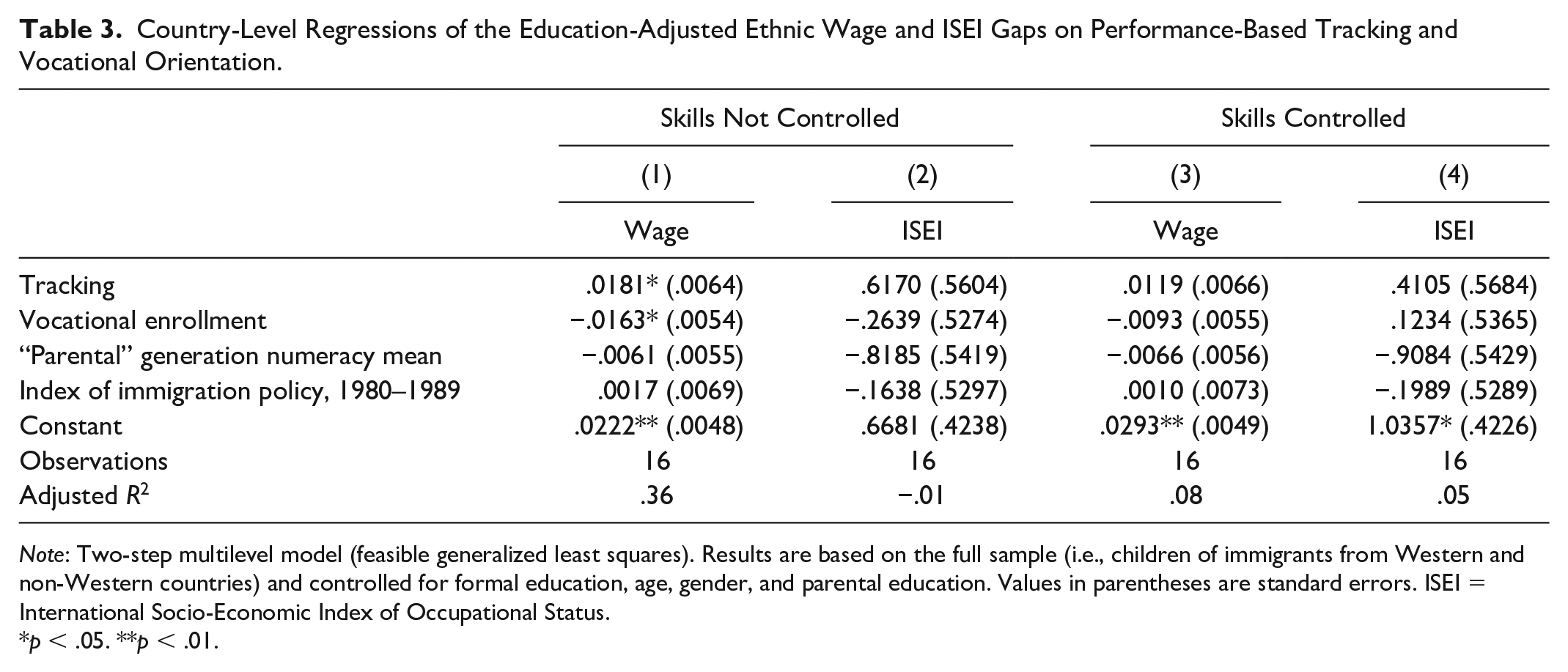
Note: Two-step multilevel model (feasible generalized least squares). Results are based on the full sample (i.e., children of immigrants from Western and non-Western countries) and controlled for formal education, age, gender, and parental education. Values in parentheses are standard errors. ISEI = International Socio-Economic Index of Occupational Status.
p < .05. **p < .01.
The first model in Table 3 shows that the second generation enjoys a slight wage advantage of 2.22 log points in the average country. Although this may seem surprising, it should be noted that this is after conditioning on formal qualifications and consistent with the findings of Schaeffer, Höhne, and Teney (2016). More important and in line with our reasoning, the wage advantage tends to be larger in countries with stronger performance-based tracking (by 1.81 log points per standard deviation increase in tracking strength) and smaller in countries with a stronger vocational orientation (by 1.63 log points per standard deviation increase in the vocational enrollment measure). The coefficients on both education system measures are statistically significant at the 5 percent level.
Model 3 in Table 3 shows how adding the skill measures to the first-stage regressions affects these results. The predicted wage advantage at average levels of tracking and vocational orientation grows even larger, consistent with the above result that the ethnic skills gap tends to be negative (see Figure 1). More strikingly, the coefficients on both education system variables become statistically insignificant, and effect sizes are attenuated by more than 30 percent relative to model 1. The pattern is consistent with the earlier results on cross-national variation in the ethnic skills gap (see Table 1). The positive coefficient on the tracking measure in model 1 is attributable partly to the fact that the skills gap between the second generation and children of domestically born parents with similar formal qualifications is smaller/“more positive” in countries with stronger tracking. Similarly, the coefficient on the vocational enrollment measure is partly attributable that the gap becomes larger/“more negative” as vocational orientation increases. 22
Models 2 and 4 repeat the same sequence of specifications for the ethnic gap in occupational status. We find that the second generation enjoys a slight occupational status advantage in the average country and that the advantage tends to increase with the extent of tracking and to decline with the vocational orientation of secondary education. We also find that the relationships between the education system measures and the ISEI gap are attenuated or even change sign when literacy and numeracy skills are added top the first-stage regressions in model 4. These results resemble those for the wage gap, but overall they appear less clear and the coefficients of the education system measures are rather small and far from reaching statistical significance even before adjusting for literacy and numeracy skills (model 2).
Conclusions
Previous research suggests that children of immigrants have unusually high educational aspirations and that choice-driven educational systems, which allow them to attain higher formal levels of education, facilitate the structural integration of immigrant minorities. This article opened by suggesting that these well-established positions imply a pattern of “lower skill selectivity” according to which the children of immigrant origin strive for higher levels of formal education even at levels of academic performance at which many children of native-born parents would not attempt to do so.
Our main goal was to spell out some underappreciated implications of this argument and to subject them to a first empirical assessment. Established research argues that performance-based tracking limits secondary (choice) effects and thus hampers the second generation in striving for the aspired high levels of formal education. Conversely, “choice-driven” comprehensive systems should facilitate the educational attainment of the second generation. We pointed out a potential flip side of this argument: that comprehensive systems should also reinforce the pattern of lower skill selectivity and lead to the emergence of an “ethnic skills gap” conditional on formal qualifications. We further suggested that the vocational orientation of an education system might matter. Other things being equal, children of domestically born parents might have a stronger inclination to pursue vocational tracks, perhaps because they are better aware of the labor market value of these qualifications (Abrassart et al. 2018; Tjaden and Hunkler 2017). Any “diversion effects” (Shavit and Müller 2000) that lead relatively high-performing children to attend vocational rather than higher academic tracks and tertiary education should then be more pronounced for the children of native-born parents than for the second generation. This might make the ambitious educational choices of the second generation even more ambitious relative to those of children of domestically born parents and thereby further reinforce ethnic skills gaps conditional on formal qualifications.
Consistent with the pattern of lower skill selectivity, our analysis of PIAAC data on working-age adults provides evidence of statistically significant education-adjusted ethnic skills gaps for 8 of 16 Western immigration countries: the adult children of immigrants have significantly lower numeracy skills than the children of native-born parents with similar formal qualifications in these countries. The extent of these ethnic skills gaps is systematically larger in vocationally oriented and in comprehensive education systems. Several robustness tests support this conclusion. To the degree that these skills gaps are observable to employers, they could result in labor market penalties for persons of immigrant origin. Our analysis also provides some tentative evidence for this implication, particularly for wage differences (and less so for differences in occupational status). Although we generally find wage advantages for persons of immigrant origin (Schaeffer et al. 2016), these advantages are less pronounced in vocationally oriented and choice-driven education systems. Importantly, country differences in the ethnic skills gap explain a good portion of this pattern.
Taken together, these findings have two important implications. First, our cross-national findings indicate that labor market penalties of persons of immigrant origin are likely overestimated, particularly in vocationally oriented and choice-driven education systems. That is, by controlling for educational attainment, researchers induce omitted variable (i.e., specifically an omitted skills variable) bias along with potentially spurious country-level correlations. We do not think that anyone is currently aware of this issue. Second, established research suggests that choice-driven education systems facilitate the structural integration of immigrant minorities because they allow them to attain higher levels of education. Somewhat ironically, a causal interpretation of the results presented here suggests that exactly these education systems also lay the ground for statistical discrimination against the second generation (because they lead to a stronger negative correlation between immigrant origins and skills conditional on formal qualifications).
That said, not all of our results are fully consistent with the established wisdom that underpins our argument. Counter to claims by Jackson et al. (2012) and others (e.g., Griga and Hadjar 2013), we find no clear evidence that choice-driven education systems lead to higher relative educational attainment among the children of immigrants because they allow the unfettered realization of their high educational aspirations. These results must be viewed with caution because of small country- and individual-level sample sizes. Future research should both revisit the relationship between tracking and immigrant educational attainment and explore alternative explanations for country differences in the ethnic skill gaps.
Our analysis faces several serious limitations and can therefore be regarded only as first evidence that calls for further research into the topic. Most important, Although the cross-national skill assessment among the working-age population is a unique quality of PIAAC, the data were not collected for country-comparative migration research. Unfortunately, comparable surveys of persons of immigrant origin, such as TIES or EURISLAM, contain no skills assessments. In consequence, our analyses brush over the huge heterogeneity of the different groups of immigrant origin and their distinct experiences in the 16 different countries. The second limitation is the small country-level and moderate individual-level samples, which severely limit the statistical power of our analysis. Moreover, the absence of final grades in PIAAC prevents us from investigating whether the identified ethnic skills gaps are reflected in lower average grades. Finally, our education system measures are far from perfect for our purposes. Specifically, the external differentiation index focuses on the extent and timing of tracking rather than the degree to which it is performance based. These factors may help explain why our results are not fully conclusive.
Despite these limitations, we are confident that our article contributes to a richer understanding of the implications of immigrant optimism and its interaction with national education systems. Our modest goals were to highlight some underappreciated consequences of immigrant optimism and to stimulate further research into these and related issues.
Supplemental Material
ManuscriptSupplement – Supplemental material for The Educational System and the Ethnic Skills Gap among the Working-Age Population: An Analysis of 16 Western Immigration Countries
Supplemental material, ManuscriptSupplement for The Educational System and the Ethnic Skills Gap among the Working-Age Population: An Analysis of 16 Western Immigration Countries by Jan Paul Heisig and Merlin Schaeffer in Socius
Footnotes
Acknowledgements
Parts of this article were presented at the DGS-Kongress 2016, the International Conference on PIAAC, the ECSR 2016 Conference, and in seminars at Aarhus University, the University of Amsterdam, the University of Oxford (Nuffield College), Humboldt-Universität zu Berlin, the University of Konstanz, the University of Bremen, WZB Berlin Social Science Center, the University of Cologne, the University of Copenhagen, and VIVE – The Danish Center for Social Science Research. We thank participants for their helpful feedback. We are particularly indebted to Sarah Carol, Jesper Fels Birkelund, and Stine Møllegaard. Both authors have contributed equally.
Funding
The author(s) disclosed receipt of the following financial support for the research, authorship, and/or publication of this article: Open-access publication of this article was funded by the Open Access Fund of the Leibniz Association and WZB Berlin Social Science Center.

Supplemental Material
Supplemental material for this article is available online.
Notes
Author Biographies
References
Supplementary Material
Please find the following supplemental material available below.
For Open Access articles published under a Creative Commons License, all supplemental material carries the same license as the article it is associated with.
For non-Open Access articles published, all supplemental material carries a non-exclusive license, and permission requests for re-use of supplemental material or any part of supplemental material shall be sent directly to the copyright owner as specified in the copyright notice associated with the article.
