




Abstract
This article offers a qualitative empirical examination of the ways in which Israeli family members of elderly persons evaluate live-in elder care and translate their evaluations into monetary value. The author explores the relationship between family members’ views of appropriate wages for live-in elder care providers and their perceptions of their own power relations with their parents’ caregivers. The findings demonstrate that family members who perceive such power to be held one-sidedly, either by themselves or by their caregivers, also argue that the state’s minimum wage is appropriate for the work of caregiving. The findings also establish that family members who recognize codependence in their relationships with caregivers believe that live-in caregivers should receive a wage much higher than the minimum. Exposing the convoluted relationship between perceptions of power and perceptions of value in live-in care shifts our understanding of the possible mechanisms that shape the low monetary value assigned to care work.
The aim of this study is to understand how Israeli family members of elderly care recipients evaluate live-in care and how their evaluations translate into monetary value. These families obtained around-the-clock, live-in care for their elderly kin after experiencing difficult situations, such as finding a father on the floor of his home, sitting in his urine, unable to get up; searching the streets for a mother and realizing that advancing Alzheimer’s disease has taken her ability to walk home from the local grocery; and discovering a mother bedridden and neglecting hygiene because of depression. In such cases, families likely perceive live-in care workers as lifelines who “save” the elderly persons and their families from the consequences of a harsh reality. Despite this, half of the interviewees for this study argued that these care workers deserve low pay, even in a hypothetical scenario in which the Israeli state fully finances wages.
In this study, I draw on 52 interviews conducted with Israeli family members of elderly people who required around-the-clock, paid care to determine their perceptions of such work and the appropriate monetary compensation for it. I show that half of these interviewees regard the current minimum wage as appropriate, while the other half argue that live-in caregivers should be paid much more. The appropriate wage family members assign to live-in care is associated with their perceptions of the power relations that exist between themselves and caregivers. Family members tell three types of stories regarding power and dependency. One story claims that power resides solely with elderly persons and their family members: a narrative that emphasizes caregivers’ considerable dependency on their work. A second story sees power resting in the hands of caregivers, stressing the dependence of elderly persons and their family members on the caregivers. Interviewees who tell these two stories tend to believe that caregivers should be minimally compensated. A third story perceives mutual power relations, in which elderly persons and their family members participate in a macro-system of social domination on one hand while caregivers wield control over the micro-system of domestic work and the relations it involves. Interviewees who hold this interdependent view of the care relationship tend to advocate higher compensation.
Over the past few decades, developed countries have increasingly relied on paid care, as family members provide ever less long-term elder care (Lowenstein and Katz 2010; Stuifbergen and van Delden 2011). Care that family members traditionally provided without monetary compensation has gradually shifted to the market, which assigns a monetary value to caregivers’ labor. This transformation highlights the importance of investigating how people evaluate care work and translate this appraisal into monetary value. This study contributes to such investigation by providing rich empirical evidence of the interconnections between perceptions of power, dependency, and monetary value of live-in care work in Israel.
Literature
Live-in, paid care is a major component of elder care in Israel (Ayalon et al. 2013; Brodsky et al. 2017; Natan 2011; Population and Immigration Authority 2019). Live-in care is provided by migrant caregivers, mostly from the Philippines, India, Nepal, Sri Lanka, and to a lesser extent Eastern Europe and South America. The employment of migrant caregivers is tightly regulated by the Israeli state. Migrant caregivers can be employed only if they possess a state permit. Such a permit is provided only after a representative of the Israeli National Insurance Institute conducts a home visit and assesses that the older person’s level of dependency requires assistance or supervision most hours of the day. 1 Moreover, migrant caregivers’ employment is regulated via multiple terms determining the expiration and renewal of their visas. For example, migrant caregivers are allowed to work only as live-in caregivers; they cannot move from caregiving to other jobs, and they cannot live outside of their charges’ homes. In addition, migrant caregivers can switch employers only a limited number of times and with some geographical limitations. Furthermore, generally their visas can be renewed for up to a maximum of five years and three months, unless they continue to care for the same older persons or if they receive “special visas” given only in special circumstances requiring special care. Thus, de facto after the first few years of work, caregivers are legally bound to specific employers, and their continued stay in Israel depends on their employers’ satisfaction with their work.
Evidence shows that the mean monthly wage for care work in Israel is particularly low—indeed, lower than in other occupations usually performed by women (Mundlak 2012). In 2017, the mean monthly wage for care workers in Israel’s welfare sector was $990, lower than the country’s monthly minimum wage of about $1,335 (Central Bureau of Statistics 2017). In addition, in March 2013, the High Court of Justice ruled that live-in care workers are not covered by the Hours of Work and Rest Law (1951) and therefore are not entitled to overtime pay for working more than eight hours per day (Yolanda Gluten v. National Labor Court 2013). This effectively reduces their hourly wages to substantially below Israel’s official minimum.
Low wages for care work are also common in the United States. Empirical evidence demonstrates that, all other things equal, care workers earn less than those holding equivalent jobs in the United States. England, Budig, and Folbre (2002) showed that the same person (with the same human capital and bargaining inclination) earns 5 percent to 6 percent less when performing care work than when pursuing other occupations (Budig, Hodges, and England 2019; England 1992; England et al. 1994; Kilbourne et al. 1994; Steinberg 1990).
The literature regarding paid care work suggests that three main mechanisms shape the low monetary value people assign to it: devaluation, resistance to commodification, and the agency problem. According to devaluation theory, the association of care with women and mothering best explains the wage penalty for care work. Skills associated with mothering, perceived as natural rather than acquired, go unnoticed or are dismissed as undeserving of compensation (Aronson and Neysmith 1996). Similarly, people may devalue paid, live-in elderly care simply because migrant workers perform it, drawing upon the social construction of care workers as “other” (Ayalon 2014; Duffy 2005; Ehrenreich and Hochschild 2003; Raijman, Semyonov, and Schmidt 2003; Romero 1996). As for resistance to commodification, the second mechanism, people may resist perceiving care as a commodity (Ariely 2006:71–86), fearing it may corrupt the nature of the caregiving relationship (Anderson 1995; Sandel 2000). Care, they may say, should be provided by people who “do not do it for the money,” because of the fear that “monetization of care will lead to care becoming an impersonal commodity, produced at least cost and sold to the highest bidder” (Dodson and Zincavage 2007; England et al. 2002; Folbre and Nelson 2000:130; Nelson 1999; Zelizer 2005). The theory behind the “agency problem,” the third mechanism, relates the low monetary value of care work to the interests of the person or institution paying for it, which differ from the interests of the care recipient (England and Folbre 1999). One might attribute low monetary value to the fact that those paying for the care are not the ones directly benefiting from it. 2
However, these three mechanisms inadequately explain the ways interviewees perceive appropriate wages for live-in care. In general, interviewees did not refer to gendered characteristics in their narratives regarding the value of care work. Many interviewees doubted the fact that women still generally perform care work or averred that the numbers were skewed by the fact that elderly women outnumber elderly men and that older patients preferred caregivers of their own gender. Additionally, although interviewees often noted the low status of migrant caregivers in Israel’s elder care market, such references did not differentiate between interviewees assigning low monetary value and those assigning high value. Interviewee narratives do not strongly reflect a fear that commodification may corrupt the nature of care, because the vast majority of interviewees accept market services as a necessary condition of current times. Finally, I queried interviewees about the hypothetical case of full state support for caregiver wages; thus interviewees’ responses all address the same circumstances by which they assign monetary value to the care their parents receive while the state assumes the costs. In other words, the agency problem theory cannot explain the difference between the interviewees assigning high appropriate wages and those assigning low appropriate wages.
I argue that an additional mechanism shaping perceptions of appropriate wage has been largely ignored: the impact of perceived power relations. This observation is informed by developments in sociological studies that have used social identity theory (Hogg and Abrams 1990; Tajfel and Turner 1986) and, in particular, the notion of identity threat (Branscombe et al. 1999; Ellemers, Spears, and Doosje 2002) to explain the sometimes contradictory role of power in various human exchanges. For example, in the case of sexual harassment in the workplace, research has demonstrated that power plays out in two seemingly opposing ways. First, it has been shown that women situated in powerless and vulnerable positions in the workplace hierarchy are most likely to experience harassing behaviors (Uggen and Blackstone 2004). Second, it has been shown that, counterintuitively, women in authority positions are also likely to face sexual harassment (Chamberlain et al. 2008; McLaughlin, Uggen, and Blackstone 2012). Explaining these findings, researchers suggested that sexual harassment has been used as an equalizer to challenge traditional gender roles (McLaughlin et al. 2012). It appears that sexual harassment has also worked as a countermeasure to denigrated women when they seem to threaten the gender hierarchy. To show this, Maass et al. (2003) demonstrated in a computerized experiment that threat to male identity increased the likelihood of participants’ engagement in sexual harassment. Similarly, the risk for spousal violence demonstrably increases whenever a woman “brings home the bacon” while her husband is unemployed (Macmillan and Gartner 1999; McCloskey 1996). Likewise, the share of housework performed by a wife and husband can also manifest this “compensatory gender display mechanism” (Willer et al. 2013) whenever the wife’s income exceeds her husband’s, contrary to expectations, woman actually performs more housework, not less (Bittman et al. 2003; Brines 1994; Risman 2009; Tichenor 2005a, 2005b). In all these examples, an increase in the power of one party in an exchange relationship, which stands in contrast to the perceived “normative” social order and party identities, leads the powerless party to discount and diminish the value of the party holding the formal power to maintain and protect his or her perception of what he or she believes to be the “normal” state of power relations.
Applying the power paradigm to this research, one can expect that assigning an appropriate wage may constitute an additional mechanism parties can use to either endorse or resist perceived power relations between parties. One can anticipate that interviewees who perceive employers as the power holders may assign a low wage to the work to ratify and justify their perception. Applying identity threat theory, one can also expect that interviewees who resent their deep dependence on migrant caregivers may assign low monetary value to the latter’s work to balance their sense of vulnerability against those whom they perceive ought to be powerless. However, neither of these explanations illuminates the high monetary value assigned to live-in care by half of the interviewees, who view themselves as the powerful party.
Elucidating this finding, I expand the existing theory by demonstrating that the vast majority of interviewees who assigned high monetary value to live-in care hold a complex perception of the relations of power between themselves and their caregivers. Although they realize their privilege and dominance at the macro-level of the global care market, they also apprehend and actively strengthen caregivers’ power and control at the micro-level of the relationship.
Methodology
The findings and analysis presented in this paper are based on a qualitative study incorporating 52 in-depth individual interviews conducted between January 2016 and August 2018. My research was designed as a multiple-case study, with each individual interviewee representing a single case (Small 2009; Yin 2003). Initially, I engaged in “theoretical sampling” (Glaser and Strauss 2007; Trost 1986). My basic criteria for selecting a case required that the subject be a Jewish 3 Israeli and the relative of an elderly person who, at the time of the interview or during the preceding year, received assistance from a paid live-in caregiver. Furthermore, I required that the family member be deeply involved in and familiar with all aspects of employment. Thus, although in most cases the older person is the formal legal employer of the caregiver, the family members I interviewed either functioned as the de facto employers of their older kin’s caregivers or completely identified with their older kin’s interests as employers. Therefore, for the purpose of this study I refer to older persons and their family members as employers. Because my initial theoretical assumption included the possibility that perceptions of care work differed according to gender, I included both men (33 percent) and women (67 percent) among my interviewees and also among the caregivers profiled (84 percent of women and 16 percent of men). Furthermore, because I assumed that perceptions of the family’s role in caregiving might form a central part of the interviewees’ views of paid, live-in care, and that differential perceptions might derive from more basic perceptual differences between secular and religious families, I selected interviewees from both groups (60 percent and 32 percent, respectively; 8 percent did not clearly identify as either religious or secular). I also made sure that my sample included interviewees from both higher and middle socioeconomic classes (33 percent and 67 percent, respectively), on the basis of their entitlement to receive state care benefits.
Participant recruitment was based on the personal connections my research assistants and I had with potential interviewees and the snowball method (Lofland et al. 2006; Weiss 1994). Recognizing the limitations of these methods, however, I reached out to various research assistants, originally from different parts of the country, to gain access to unrelated interviewees.
In conducting the interviews, I referred to a list of questions I had prepared for the interviewees that related to the following: the circumstances that led to their initiation of paid, live-in care; their experiences with finding paid, live-in caregivers; their views of the caregivers’ work, schedule, and influence on their parents and family; the actual wages and benefits they paid to live-in caregivers; their perceptions of the appropriate wages for this work in the context of a hypothetical scenario in which the Israeli state fully finances such wages; and their views of the possible differences in the appropriate wages paid to Israeli and migrant caregivers. At the very end of the interview, I also inquired about the interviewee’s political and economic orientation. 4 The interviews were formatted as open-ended, casual conversations, which allowed the participants to relate personal narratives; this also gave both the interviewees and myself leeway to take discussions down unexpected paths (Patton 2002). I continued to develop my interview guide over the course of the study as I refined my understanding of the ways in which family members evaluate live-in care and translate it into monetary value (Small 2009).
After conducting each batch of interviews, I analyzed the data to find recurring themes, which I then organized categorically. Next, I indexed each interview according to the appropriate categories as index keys, creating a database table that enabled me to cross-compare interviews and identify logical relationships among categories.
Findings
Assigning Monetary Value to Live-In Elder Care
The average basic wage paid to live-in caregivers during the period of this research totaled about $1,200 per month. In the vast majority of cases, the actual wage is calculated from the monthly minimum wage dictated by Israeli law, after a deduction of about $200 for assumed living expenses paid by the employer. 5 On top of this basic wage, the employer provides a weekly allowance of about $30 a week and pays about $100 per weekend that a caregiver remains in the home and forsakes his or her weekly vacation. In addition, caregivers are entitled to yearly benefits of about $1,500 and pension and compensation funds that they cash out at the end of their employment.
The actual wages interviewees paid to their caregivers varied little: no more than about $285 per month. This fact held even when significant differences appeared in interviewees’ perceptions of caregivers’ quality of work and in their socioeconomic status and resources. Differences in the actual wages paid by the interviewees were most often attributed to variations in employer deductions for expenses. Most of the interviewees withheld about $200, as most placement agencies recommend; relatively few chose not to deduct food and living expenses at all or to deduct the full amount allowed by the law. Moreover, interviewees differed in terms of the amounts they paid caregivers to compensate for staying over the weekend and whether they calculated the weekly allowance as part of the minimum wage they are required to pay or as an additional payment they made on top of the minimum wage. In rare cases, interviewees paid a basic wage that exceeded the state’s minimum wage.
During the period of time when I conducted the interviews for this study, Israel’s state benefit 6 covered up to one third of the cost of employing a live-in, migrant caregiver. Holocaust survivors are entitled to an additional benefit that can cover approximately another third of the cost. In addition, whenever both spouses in a marriage were entitled to the care benefit, they could sometimes hire a single caregiver and use the double benefit to cover most of their caregiver costs. In most cases, however, employing a live-in caregiver required an elderly person to supplement the state care benefit with his or her own private funds. The vast majority of interviewees reported that in order to afford live-in caregivers, they used the personal funds of the elderly receiving care to complement the state care benefit (suggesting that most of my interviewees belong to the middle or higher socioeconomic class).
The actual wages paid to live-in caregivers do not necessarily reflect interviewees’ evaluations of live-in care. Instead, they reveal a mix of factors, including sentiments such as employers’ appreciation of the caregivers and their work and practical considerations such as limited resources and market price, driven by the number of migrant workers permitted to enter Israel to work as caregivers. It is beyond the scope of this research to fully explain the relatively small differences in actual wages interviewees paid to their caregivers. Nonetheless, anecdotal evidence suggests that interviewees refrain from increasing wages, even when they have the means to do so, because of four major factors. First, many believed that the minimum wage is appropriate for the work. Among the 18 interviewees who belong to Israel’s higher socioeconomic class, 10 made such statements. Second, there exists a high level of uncertainty about the future care needs. Therefore, interviewees abstain from a commitment to a higher wage whenever they are unsure about how long they will require such care and whether they might be required to pay for additional care in the future. Third, many interviewees chose to treat the wage information provided by placement agencies, which informs employers about the minimum wage they are required to pay, as if it were a stipulation of a mandated set wage. Fourth, a few interviewees reported that when they suggested a significant increase to the caregiver wage, their placement agencies pressured them to keep them relatively uniform. In those cases, placement agencies argued that the interviewees’ increases in wage would negatively affect the live-in care market by driving wages upward, leaving elderly people who did not have the means to meet this increase without proper care.
To understand how interviewees evaluated live-in care and translated their assessment into monetary value, I aimed to neutralize the influence of an interviewee’s economic resources, as well as the impact of uncertainty about future elder care needs. To this end, I presented interviewees with a hypothetical scenario in which a bill proposing the expansion of the state care benefit to fully cover live-in caregivers wages passes into law; then I asked them, under such circumstances, what the wages of caregivers should be.
In response, 26 of 52 interviewees stated that the appropriate wage should be significantly higher than the minimum wage as dictated by Israeli law. For example, Rami, whose mother was diagnosed with Alzheimer’s disease, stated, “If I had the financial ability, I would have helped Fannie [the caregiver] to build a house. Yes, I think that she does deserve more than $1000.”
In contrast, 26 interviewees, the other half, answered that the minimum wage is appropriate for live-in care. As justification, Roni compared her caregiver’s net income to her own to argue that her caregiver’s wage appropriately reflects both her level of education and the type of job she performs. Her caregiver, she said, “has at least 4,500 shekels in her pocket, if not 5,500.” In contrast, Roni observed, “I have two degrees . . . am a government employee . . . [am] not at the bottom of the wage scale, [and] I don’t have 5,500 to put aside.”
What might explain this stark difference of opinion between these two groups of interviewees regarding the appropriate wage for live-in care? As noted in the introduction, I could not detect an association between the appropriate wages assigned by interviewees and their conceptions of gender, migrant workers, or commodification of care. Furthermore, I did not detect in my sample an association between perceptions of appropriate wages for live-in care and the interviewees’ socioeconomic class. Among the 18 interviewees who belong to the high economic class, only 8 (44 percent) thought that live-in caregivers should receive high wages. In contrast, among the 34 interviewees who belong to the middle and lower classes, 18 (53 percent) thought that live-in caregivers should receive high wages. I also explored the possibility that interviewees’ concepts of caregivers’ appropriate wage are related to their satisfaction with and quality of connection to the caregivers they employed. To this end, I applied Anderson’s (1995) theory of value to systematically examine interviewees’ perceptions of their relationships to their caregivers. Accordingly, I examined whether interviewees who regarded minimum wage as appropriate perceived this relationship in terms of market norms—characterized by impersonality, egoism, and exclusivity, driven by desire rather than need, and emphasizing the caregiver’s choice to exit and leave the job—and therefore assigned a wage on the basis of their assessment of the work’s “use value.” Also, I tried to detect whether interviewees who believed that caregivers deserved higher compensation understood the employer-employee relationship in terms of personal norms—which would emphasize intimacy and commitment, intrinsic motivation, and reciprocity between equals—and from that assumption calculated a monetary value of live-in care that reflected in some way not only the “use value” but also notions of “shared understandings, affections, and commitments” (Anderson 1995:151). Nonetheless, I did not find a strong association between interviewees’ perceptions of appropriate wage and level of satisfaction or between the quality and degree of closeness in the relationship with the caregiver. As I demonstrate below, interviewees tended to perceive the appropriate monetary value of live-in care in relation to their perceptions of power and dependency’s function in their relationship with their caregivers.
Stories about Power and Dependency
Interviewees’ perceptions of their power relationships with caregivers reflect feelings of vulnerability, dependency, and control over employment. The vulnerable and dependent party has less control over employment initiation or termination; less control over employment conditions such as space, time, and job requirements; and less room to convey his identity through work.
Interviewees told three different stories about power and dependency that highlight varied elements of dependency and control within the employer-employee relationship. First, among the 26 interviewees who assigned low monetary values to live-in care, 14 (54 percent) emphasized the employer’s upper hand in the relationship and the caregiver’s deep dependence on the employer. Second, 10 of the 26 interviewees who assigned low value to care pay (38 percent) highlighted only those story elements that indicated heavy dependence by elderly care recipients on caregivers that tilted the balance of power to the latter. Among those who assigned low monetary value, only 2 interviewees (8 percent) portrayed the elderly-caregiver relationship as interdependent. In a third contrasting account, 24 of the 26 interviewees who assign high monetary value to live-in care (92 percent) conceived of employer-employee relations as mutually dependent. These interviewees recognize that family members hold more power at the macro-level while affirming and encouraging caregiver control over domestic work at the micro-level and the relations it involves (Figure 1). In the following sections, I will show the ways in which interviewees constructed elements that reflect these stories.
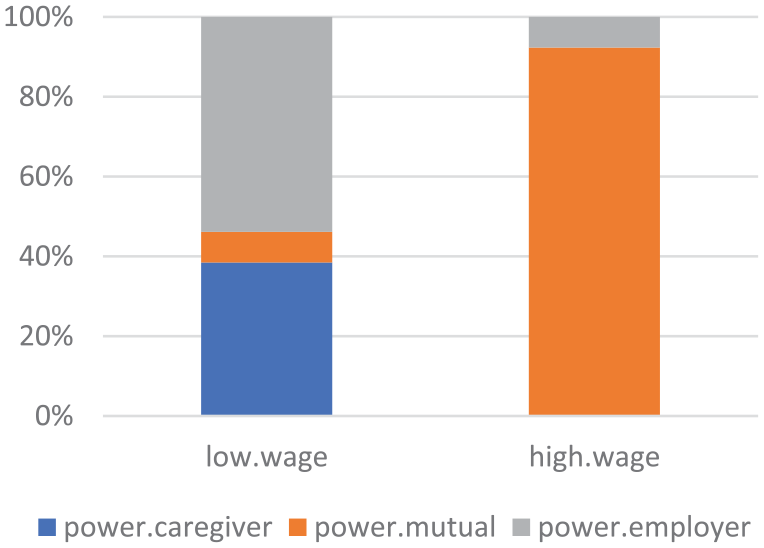
Perceived power versus appropriate wage.
The Powerful Employer
Caregiver dependency
All the interviewees who used this narrative emphasized the deep economic need that motivates migrant caregivers. For instance, Maxine stated that migrant caregivers “need the money so badly that they will do whatever they need to do for it.” Haim, another interviewee, acknowledged the desperation caregivers feel about repaying the commissions they paid to enter Israel so that families back home would not suffer consequences. Similarly, Avichai portrayed a caregiver’s need to satisfy an employer’s demands as a matter of life or death because, in his view, only hunger awaited the caregiver in the home country: “If you know that your survival and . . . hunger depends upon whether you work, and that people are satisfied with you and won’t fire you, then you are capable of doing a lot.” This narrative emphasizes not only caregivers’ dependency on employment but also employers’ control over the employment relationship in a few diverse ways (detailed below).
Employer control over employment
Depicting employers as the people holding all the power stresses the control they exercise at both the beginning and the end of the employment relationship. It also highlights their control over space, time, job requirements, and even caregivers’ identities. Dani, highlighting his total control over the power to terminate the employment contract, disregarded the intimate nature of the caregiving relationship or the possible hardships in finding a new and suitable caregiver; if “the quality of work will be to our satisfaction,” he declared, then “we’ll let her stay, and if not—not.” Likewise, Avichai stresses the fact that caregivers can be easily replaced, because they lack any unique capabilities: “It’s not as if she were Leonardo da Vinci and you say, ‘Wow, I’ve lost out here.’”
The power relations between employer and caregiver are also expressed in the answer to the question, Who controls the home? The peculiar circumstance in which employees cohabit with employers and assume responsibility for everyday domestic chores augments the issue of spatial control. Lan (2003) demonstrated how employers and domestic workers negotiate class and ethnic distinctions through the “domestic politics of food and space.” Similarly, interviewees apparently perceive control over buying and preparing food as a key indicator of who actually controls the home. Thus, interviewees who assert that primacy of power should reside with employers emphasize this aspect of home life that they try to control. For example, Rachel directly connected her mother’s sense of control over the home and her power to decide what the caregiver should cook: “But I am the boss in this house,” she recalled her mother saying. “I am the one who decides what to cook and what to do.”
Avichai described conflicts between his father, who is observant and keeps kosher food, and his caregiver over who should buy the caregiver’s personal food. From the son’s description, it seems that his father insists on buying the caregiver’s food, and though he makes an effort to buy food that she loves, the caregiver keeps sneaking her own food purchases into the house, infuriating him. Likewise, Maxine described how her mother sought to dominate her caregiver by dictating exactly what every meal has to include. “Every morning she would need six tomatoes, cottage cheese, a yoghurt, and something else.”
Employers can also communicate control over space by asserting that the domicile in which both the elderly person and the caregiver live is fundamentally the home of the elder and the family. Constituting the caregiver’s status as a guest in the older person’s home implies that the caregiver needs the employer’s permission to do certain things that would otherwise not require approval, such as inviting friends to visit, moving furniture, or choosing decorations. Reflecting this notion, Rachel recalled a conversation she had with her father’s caregiver in which she stressed her right to enter her father’s apartment unannounced whenever she wished: “This is my house,” she told her. “I don’t need to ring the doorbell or knock.” In another telling account, Ziva related that despite having a spacious living room, her mother refused to build a partition that would allow the caregiver a private space: My mother . . . refused . . . [because] she didn’t want to ruin her living room. . . . The first [caregiver] asked that we build [it]. We were so afraid, thinking we had to do it. But in the end . . . the second [caregiver] . . . was grateful to have a bed and stay in such a nice house.
Interviewees also conveyed control over caregivers’ use of time. This is evident both in the exercise of control over daily routines as well as rest and vacation times. Thus, interviewees who think that employers should dominate the employer-employee relationship expect and justify caregivers’ availability to provide care on demand regardless of any personal needs. For instance, Yotam stressed that the caregiver’s job includes obedience to all of his mother’s capricious demands, irrespective of the immense and unnecessary burden this creates for her, sending her “to buy eggs”; then, “when she comes back [from the store], she [my mother] will send her once again to buy some more eggs.” Similarly, Ziva stressed her control over whether the caregiver and her mother will take walks on rainy days: “The caregiver and my mother have to get out of the house. When it rains . . . the caregiver calls me, and I either give in, or I convince her how important it is that they go out.”
Finally, narratives in which the narrator views the employer as dominant also perceive and to some extent justify an employer’s control over a caregiver’s identity. Thus, according to the logic of this narrative, caregivers concede their personal desires, needs, opinions, and feelings—indeed, any sense of individuality—as part of their job. Eyal referred to this idea as “becoming invisible”—his words—which allegedly is a part of what migrant caregivers are taught to do when preparing for this job. Discussing the caregiver, Eyal describes her as a kind of a slave: she’s submissive; she does what she’s told. She eradicates her personality. . . . I think that . . . the caregivers coming from abroad learn to be invisible. . . . The Indian [caregiver] cannot even define what she wants.
A few interviewees even mentioned using means to ensure the social isolation of caregivers in order to maximize employer control. For example, Meir explained his reluctance to hire a caregiver from the Philippines, because Filipinos could link to a community of their own in Israel, and this could turn their full attention away from their charges: Next to my parents’ house there is a really beautiful garden. . . . And in the afternoon all the Filipino caregivers go there. They sit in a group, play cards and put aside all the elderly. . . . So I did not want it.
Likewise, Talya, who had two caregivers caring for her parents, insisted that they come from different countries in order to ensure that their cultural identities would not take over the home and thus leave her out. “I do not need the two of them speaking [with each other] in a language that I do not understand.”
To summarize, the first narrative portrays caregivers as deeply dependent on their jobs because of dire economic need. Moreover, this narrative pictures employers as the sole power in the employer-employee relationship by emphasizing their control over job initiation and termination as well as asserting and justifying control over space, time, and even caregiver’s identities.
The Powerful Caregiver
The second narrative also asserts that the employer should hold all the power in an employer-caregiver relationship but communicates this belief by emphasizing antithetical elements: (1) an elder’s dependency on a caregiver and (2) the ways that a caregiver controls employment by circumscribing space, time, and job duties.
Dependency of the elderly
According to this narrative, interviewees underscored their inability to uphold both their lives and also the lives of their parents without the caregivers’ assistance. To emphasize this dependency, Mina and Tamar repeated stories they had heard about friends who supposedly pay much higher wages, even though they do not have the means, just to ensure that the caregivers will not leave their parents completely stranded. Similarly, Roni recollected the stress she suffered during a period of time when she could not find a caregiver for her mother: “How can I manage living my life and being with her [all the time]?”
Moreover, Roni stressed that adult dependency on a caregiver can grow stronger than it does among children because elderly dependents usually lack relatives who can return home daily to better supervise care. This dependency is evident in interviewees’ expressions of fear of the caregivers’ ability to exploit their vulnerable parent. Yotam, for instance, talked about his fear of economic and physical exploitation: First of all, there is a fear of abuse, because you give the caregiver a lot of power. She holds [the parent’s] credit card. She does not know the secret code, and I insist on keeping it this way. She needs to keep invoices so we can keep track. And even in the daily routine she has a lot of power.
A few of the interviewees supported this notion, saying that the role of the law in regulating the employer-caregiver relationship exists primarily to protect the elderly. In other words, they identified the elderly as vulnerable dependents requiring protection of the law. Similarly, this narrative argues that caregivers need no further safeguards because they are already amply protected and know their rights: “They know the rules much better than I do,” Shalom remarked. “And you know what? Even much better than you. They know the rules very well.”
Similarly, Roni is appalled by the fact that a local nongovernmental organization (NGO) works to guarantee caregivers’ rights without any regard for the implications for elderly dependents: And then you hear that Kav LaOved [an NGO advocating for migrant workers’ rights] are so concerned about the caregiver, and advise her not to notify her employer that she is [pregnant], although it means the [old] woman will be stuck [without care]. Is this reasonable?
Moreover, as I demonstrate below, this “powerful caregiver narrative” is complemented by another form of narrative highlighting caregiver control of employment.
Caregiver Control of Employment
In stark contrast to the powerful employer narrative analyzed above, the second narrative portrays the caregiver as the person holding the power to initiate and terminate employment. Many interviewees mentioned that caregivers were difficult to find and that during the employee search they felt compelled to persuade caregivers to come to work for them. This surprised Eyal, who found it utterly absurd that caregivers were interviewing him for the job rather than the other way around: They asked me if he got up at night. . . . It was just ridiculous. . . . They are looking for someone . . . with muscular dystrophy or something like that . . . so they’ll have employment security for many years and he [the elderly] won’t bother them.
In a similar vein, other interviewees described cases in which caregivers unilaterally decided to quit, leaving the family in deep distress. Itamar explained how he and his family were left stranded when their caregiver returned to Israel from a visit home and, to their surprise, announced that she would not be coming back to work for them. Itamar underscored his sense of powerlessness when he explained the shifting role the law plays with respect to each of the parties involved. On one hand, he stressed that in order to obey the law, he had to incur the costs and difficulties imposed by hiring an Israeli caregiver while the migrant caregiver returned home for her vacation. On the other hand, he added that the caregiver did not return to work because she had married and borne a child, although he did not think it is legal for her to give birth and stay in Israel.
Moreover, such a narrative maintains that employers lacked control over space. First, it assumes that elderly persons’ diminishing capacities most often undermined their ability to make everyday decisions in the home. Therefore, control of space in practice relies on the ability of family members to assert it from afar. However, family members face inevitable limits when trying to control space from afar. To solve this predicament, a few interviewees stated that it was ideal for a family member to live with the elderly relative and caregiver. Other interviewees admitted to the use of cameras as a way to partially overcome their lack of control over the home. In accordance, eight interviewees asserted that it was important to install cameras, either hidden or overt, in the elderly persons’ homes. Rachel described how camera installation restored her control: We realized that her boyfriend was coming over, and she cooked for him . . . without telling us. . . . She [also] goes out without telling us. . . . So when we brought the camera, everything came up because they were afraid we would discover what is going on in the house.
Yotam also explained that he had decided to install cameras in order to restore his lack of control over space, which was amplified by his parents’ diminishing ability to use technologies that would help him to keep informed.
Furthermore, this narrative of the powerful caregiver stresses that the caregiver controls the schedule. Control over time is pertinent to the everyday schedule: when to wake up, when to go for a walk, when to go to their rooms to rest or talk to their family, as well as when to take vacation days. Interviewees who used this narrative expressed dismay at their lack of control over the daily schedule, complaining that the caregivers can disappear into their room at certain times, regardless of their parents’ needs, talk on the phone all the time, and so forth. For example, Roni argues that it is completely unreasonable to require employers to provide caregivers with a two-hour break each day: “I do understand that a person needs air. . . . But, [to] go out in the middle of the day, leaving the [elderly] person alone for two hours? Does this make sense to you?”
The issue of control over rest and vacation days also found expression in the question of whether caregivers could enjoy regular, secure rest time and vacation days or had to submit a request. Requiring caregivers to request rest and vacation time inevitably means that the caregivers lose control over time, having no reliable schedule to organize around. Moreover, this system is based on the idea that caregivers’ requests for rest and vacation time may be denied if they are inconvenient and do not fit the older persons’ needs. Shalom, for example, resents how the family’s caregiver insisted on regular vacation days and holidays regardless of their needs and requests: “and if there was a situation in which he had a holiday and we asked [him] to change . . . [then] he wasn’t willing to switch. [He is] Christian, and he is super close with his Jesus.”
Shalom’s remarks also reflect the notion among interviewees that caregivers should repress identity, needs, and desires in order to best care for their elder parents. Mina likewise disparaged her caregiver’s religious rules, which prohibit her from touching meat. In a similar vein, Roni believes that her caregiver should have inhibited her desire to become a mother while working as a caregiver to her mother: And it was good luck—if you can say such a thing—that a month after she came back, my mother died . . . because she came back pregnant. . . . Despite my repeated warnings before she left, she returned pregnant. And I don’t know what I would have done.
This powerful caregiver narrative also emphasizes that in the end, caregivers could devise ways to avoid work they did not wish to perform. For example, Yotam illustrates how their caregiver avoided certain tasks by pretending to be sick: “Every time the family came to eat at my parents’ [house], we got a message 24 hours in advance that she doesn’t feel well. Because she didn’t want to clean up after us.” Likewise, Sima describes how her lack of control over the caregiver’s work led to the extreme neglect of her mother: “on her phone all day,” the caregiver “had forgotten all about my mother.” She neglected to “to take her out every day” as promised, so Sima’s mother “just degenerated sitting on the sofa.”
In summary, the second form of narrative, similar to the first, is based on the idea that within the relationship between a caregiver and her charge, power should rest with the employer. Nonetheless, this account highlights the deep dependency and vulnerability of the elderly and inherent limits to the supervision of caregivers, thus situating the latter as the party in de facto control of their employment. Hence, they portray caregivers as inappropriately powerful over elders, in a way that justifies employers’ actions to increase their power.
A Story of Interdependence
Unlike the first two forms of narrative, which one-sidedly portray power as resting in the hands of one party, either employer or caregiver, the third narrative depicts both parties as deeply interdependent. It acknowledges that although caregivers hold power over the relationship at the micro-level, controlling space, time, and tasks, employers wields preponderant power at the macro-level because of their general privilege as citizens of the developed world benefiting from a globalized care market that provides them with relatively cheap labor. Interviewees who used this narrative simultaneously used elements from the previous two accounts: one that presents elders’ deep dependency on caregivers and another that stresses employers’ power over caregivers. For instance, Rami expressed his profound sense of dependence on his caregiver by articulating a persistent anxiety about the day he expects that his mother’s caregiver will resign: “Maybe that’s why I say that I’m trying to make her happy as much as I can.”
However, in contrast to his lack of power at the micro-level, Rami also confessed his belief that he participates in a system of domination: OK, it’s a trap—every month they have to set aside [money] to pay back the agency that brought them [to Israel]. . . . She might be in debt for $10,000. So, she cannot say “I’m leaving.” It is modern slavery.
This great sense of dependence on caregivers that family members feel at the micro-level is vividly articulated in Dimitri’s recollection of the manner in which he went to Jerusalem to meet his parents’ caregiver to convince her to stay after she gave notice to leave her job: “I told her: ‘I ask you for the last time . . . I’m begging . . . I’m begging . . . keep working [with my parents]. Stay with them.”
At the same time, interviewees also referred to structural conditions at the macro-level—migration laws and high commissions caregivers must pay in order to work in Israel—as a further hindrance to limiting caregivers’ mobility and thus deepening their dependency on their employers. For example, Aviva recognized that the country’s migration laws offer her added power over her caregiver because the latter required a special visa to authorize her continued stay in Israel beyond the time mandated by law. Because of Israel’s migration laws, in these circumstances the caregiver’s continued stay in Israel was completely dependent on Aviva’s satisfaction with her work. “If we fired . . . replaced her, she would return to Russia. So she . . . tried to be awfully good to stay here.” Shira added that her mother “wasn’t blind to the fact that someone lives with them and works at the worst job ever while abandoning her own family” and often felt conflicted because of her position as both the privileged employer and the dependent patient in need.
Indeed, interviewees articulating this third narrative seem to have felt uncomfortable with the structurally weak position caregivers are put in. Twenty-three of the 26 interviewees deploying this narrative addressed the migrant live-in employment system using harsh terms such as slavery, slaves, modern slavery, and exploitation. Nurit confessed, “I feel like a white lady in colonial Africa.”
It seems that to decrease their unease, these interviewees deployed various mechanisms to empower their caregivers by further increasing the caregivers’ control at the micro-level. In contrast to the first two narratives, which aim to increase employers’ control over the home, the third narrative stresses the adoption of measures to make caregivers feel at home in every sense. A compelling example of this idea appears in Shira’s description of the gathering her parent’s caregiver hosted for her friends on the weekends: When they [the caregivers] had free time, they would sit in the garden at my parents’ house . . . I knew all of her [the caregiver’s] friends, and they knew us. . . . When her friend would have her day off she would come to stay with us for the weekend.
In addition, within this narrative, interviewees stressed the importance of giving maximum freedom to the caregivers to control schedule and work. As a result, interviewees stressed their intentional avoidance of any interference in the caregivers’ daily schedules and their reliance on the caregivers’ discretion. An extreme example of this idea can be found in the case of Nitzan. When her father died, Nitzan reached a special arrangement with the caregiver, in which the caregiver would continue to live and care for her mother, who at the time did not require 24/7 care, while also working during the day in a nearby nursing home. The caregiver received a full salary from the nursing home and a significant additional payment from Nitzan. This arrangement was highly beneficial economically and convenient for the caregiver. As time passed, Nitzan’s mother became entitled to receive the state care benefit, but this depended on the caregiver’s departure from the nursing home to work full-time with Nitzan’s mother. However, Nitzan decided to let the caregiver decide what she preferred, even at the risk of losing the benefit.
In another case, Yonatan aspired to increase the caregiver’s power by directly asserting his power to terminate the employment relationship whenever he chose. He did not resent the possibility that the caregiver would quit. More than that, he expressed the belief that he had a responsibility to continuously remind the caregiver of this option.
In summary, interviewees relating the third form of narrative viewed the relationship as codependent. They recognized the power they held over their caregivers as citizens of the wealthy and powerful global North. At the same time, they acknowledged that the caregivers held the power over the employment at the micro-level and even used different mechanisms to increase their control at this level.
Discussion and Conclusions
This study explores the relationship between family members’ views of the appropriate wage for live-in elder care and their perceptions of their power relations with their older kin’s caregivers. I conclude that family members who perceive such power to be held one-sidedly, either by themselves or by the caregivers, also argue that the state’s minimum wage is appropriate for the work of caregiving. In contrast, family members who recognize codependence in their relationships with caregivers believe that live-in care should receive a wage much higher than the minimum.
Moreover, I reveal the elements constituting three different narratives of power and dependence that family members tell. The first two stories seem to share the normative assumption that the employer should hold the power in this type of a relationship. The “powerful employer story” fits well with this assumption. Accordingly, family members describe the deep dependence of caregivers on keeping their positions and emphasize employers’ complete control over employment parameters such as space, time, expected tasks, and even caregivers’ identities. The “powerful caregiver story” challenges the family members’ normative assumption about who should hold all the power in the employer-caregiver relationship. To increase their leverage, family members highlight the vulnerability of elderly people and portray their inability to supervise caregiver work as a hindrance to obtaining desired care. Quite unlike the first two narratives, the third narrative seems to be based on a normative aspiration to realize a more egalitarian employment relationship. Thus, although family members relating this narrative recognize the macro-level mechanisms that provide them with power over the caregivers, they take measures at the micro-level to increase the caregivers’ power in the arenas of space, time, and job tasks.
Revealing the multifaceted relationship between perceptions of power and perceptions of value has several implications for understanding the value of live-in elder care and perhaps the value of care work more generally. First, it challenges existing theories that attempt to explain the low wages of care work in terms of gender, commodification, or the agency problem. It also challenges general theory of value, which focus on the separation between “use value” and personalized “high value,” which fail to explain the findings of this research. Instead, it suggests redirecting attention to perceptions of power as a new paradigm for investigating the low monetary value people assign to care work. Exposing the convoluted relationship between perceptions of power and perceptions of value in live-in care shifts our understanding of the possible mechanisms that shape the low monetary value of care work. It proposes, similar to what has been suggested in the sociological literature explaining the sometimes paradoxical role of power in different exchanges involving gendered behaviors, that perceptions of value might by related to a person’s assumptions regarding the “normative” social order. Thus, assigning monetary value might be a means to either ratify what is viewed as normative power relations or balance a social order that seems tilted in the “wrong direction.” Following from this, it appears that family members who assume that they should hold the power but in reality feel vulnerable and dependent on their caregivers may seem to compensate for what they view as unjustified vulnerability by assigning low monetary value to the work. Similarly, family members who assume that the employment relationship should be somewhat equal but realize they nonetheless hold a lot of power over the caregivers may attempt to empower the caregivers at the micro-level in order to rebalance the power relationship and better fit their notion of the way things ought to be.
Nonetheless, this study leaves several unanswered questions that call for further inquiry. Foremost, as this study design cannot establish causal relationship, it is necessary to clarify whether family members first assign what they view as the proper wage for this work and then justify it through a story about power and dependence or whether, as suggested above, different perceptions of power and dependence result in different perceptions of the appropriate wage. Second, it would be valuable to support the qualitative findings of this research with quantitative research that can more effectively verify that the relationship between perceptions of power and the value of live-in care is not driven by a third variable that qualitative research could not detect. Third, it is unclear from this research what drives the different perceptions interviewees hold regarding the “normative” social order. Thus, why do half of the interviewees seem to believe that employers should hold the power, while the other half seem to hold more egalitarian values? Surprisingly, I did not find any relationship between these perceptions and the interviewees’ political and economic orientation. Hence, I did not detect an association between the interviewees’ perceptions of the welfare state and their views regarding who should hold the power in their relationships with their caregivers. Using the social identity threat theory suggests that live-in care work taps into and sometimes threatens a major social identity interviewees hold such as class, gender, and national identities. However, it is necessary to further investigate the possible relationships between these various identities and interviewees’ perceptions of the appropriate wage for live-in care. Fourth, there is need to explore whether the relationship between perceptions of power and that of proper wage also applies to other types of care work or only pertains to the specific setting of live-in elder care, which involves specific forms of understanding vulnerability, dependence, and power. Also, it is necessary to investigate whether this paradigm also relates to the ways people assign monetary value to other types of work or whether it applies only to care work.
Finally, there is a need to investigate whether the findings of this research are also applicable to other countries. This question is becoming increasingly important with the growing trend of live-in care work in the globalized care market. It is nearly impossible to disentangle the context-related findings from the more generalized findings, solely on the basis of the empirical work I conducted. Yet building on the literature leads me to suspect that the association between perceptions of power within relations and the value assigned to care work might appear in other countries.
Nonetheless, it is reasonable to assume that the ways people perceive the power relations between themselves and their caregivers vary by country and culture. Perceptions of power relations may be influenced by various factors, some associated with the ways countries practice and regulate live-in care and others related to differences in the social and economic contexts. For instance, whereas in Israel live-in care is especially prevalent as a form of care for the elderly, in many developed countries, including the United States, this form of care is mostly used with respect to child care. Countries also differ in the ways they regulate the employment of migrant caregivers, specifically the extent to which they allow migrant care workers to legally enter the country for such purposes. Also, countries further vary by social structure and the ideology that legitimizes it. Whereas some countries are organized in a more hierarchical structure, others are organized in a more egalitarian structure. Finally, countries differ by whether they allow, financially incentivize, and normatively support live-in care. These differences affect the availability, social acceptability, and legitimacy of such form of care and as a result influence the perceptions of power between caregivers and employers.
Footnotes
Acknowledgements
I thank Paula England, Tamar Kricheli-Katz, and Irit Porat for their useful comments, and I am also grateful to the interviewees who were willing to share their views.
Funding
The author(s) disclosed receipt of the following financial support for the research, authorship, and/or publication of this article: This research was supported by the Israeli Science Foundation (grant 1504/15).

1
The activities of daily living dependency test examines an older person’s functioning according to five daily activities: mobility, dressing, bathing, eating, and personal care. Adjustments for patients with Alzheimer’s disease and dementia have been made to the dependency test.
2
Of course, these explanations address preferences, not actual wages, which are affected by additional factors such as labor supply, wages workers will accept, and disposable resources affecting willingness to pay. In other words, preferences do not fully determine wages; however, they clearly affect them.
3
I excluded Israeli Arabs from my sample because I assumed a difference between Israeli Arab and Jewish conceptions of the family’s role in elder care significant enough to create a difference in perceptions of paid live-in elder care too great for my limited sample to address.
4
In Israel, political orientation to either right-wing or left-wing is attributed to attitudes relating to the Israeli-Palestine conflict and does not reflect the standard economic divide between left and right. Therefore, I did not ask questions regarding the interviewees’ political affiliations but rather questions aiming to detect their economic orientation.
5
The minimum wage gradually increased during the interview period, from $1,300 in January 2016 to $1,470 in August 2018.
6
Since 1988, Israel’s welfare state has provided in-kind, long-term care service (called Gimlat Siud) to those who meet certain age, income, and dependency requirements.