




Abstract
Employing a cultural sociological approach, this article asks how individuals from two postsocialist societies articulate principles of justice by providing narrative accounts of other peoples’ perceived choices and social mobility trajectories after 1989. Using data from an interview study of 67 respondents from former East Germany and the Czech Republic, I present two interrelated findings: First, as respondents negotiate the tension between the principles of merit and need, they show widespread support for the idea that individuals are personally responsible for their fate despite the legacy of egalitarianism commonly associated with postsocialist societies. Second, individuals can effectively challenge the principle of merit by using a certain type of eventful knowledge about economic change after 1989 that is articulated morally but points to the limits of choice. The article distinguishes different notions of deservingness and contributes to the current debate on the links between culture and economics.
Introduction
“Inequalities are more likely to be turned into questions of character if people start out equally,” observed Richard Sennett and Jonathan Cobb (1972:256) almost half a century ago. Today, a mounting sociological literature is concerned not only with analyzing structures of inequality but also with the way it is culturally apprehended (Block and Somers 2014; Lamont, Beljean, and Clair 2014; Lareau 2015; Sherman 2017). People inhabit moral worlds, drawing on images of the good and the just to evaluate economic processes, with ready explanations for why some are coming out on top, manage to overcome economic hardship, or remain at the bottom. In this way, they understand their own place in society in a decidedly nontechnical way. Moral apprehensions and evaluations of inequality matter because they either naturalize or problematize unequal distribution of resources and access, thereby shaping larger economic outcomes as well as horizons of political action.
Of particular relevance in this respect is the widespread support for the principle of merit, or “market justice” (Lane 1986). In Western societies, those who hold individualized explanations of economic outcomes tend to regard social inequalities as just (Castillo 2011; Kluegel and Smith 1986; Svallfors 1997), and those with a higher social status position are more likely to justify inequalities by advocating the principle of merit (Robinson and Bell, 1978; Verwiebe and Wegener 2000). What we know about the significance of inherited wealth as a central mechanism of inequality reproduction (Beckert 2008; Piketty 2014) seems to reverberate little beyond an academic audience. Thus, sociologists are back to researching the ways in which merit is morally conjured, seeking to explore the worlds of meaning that sustain social legitimacy for this idea. There is renewed interest in ideas of entitlement (Sherman 2017), character (Alexander 2011; Wuthnow 1989), dignity, and respect (Lamont 2000, 2018), each as a tension between individual autonomy and group membership. All of these approaches reference a central theme: that there is some connection between who one is or what one does and what one can legitimately expect in return. In other words, there is a moral tension of equity, generating deserved or undeserved economic outcomes.
Social justice research is bedeviled by the puzzling relation between merit and a second key principle of distributive justice, the principle of need. In theory, the two principles are mutually exclusive: While merit deems unequal outcomes to be legitimate as long as they are based on individual performance or effort, need stresses that because they operate with different capabilities and conditions, individuals deserve support. In practice, however, they can be held by the same person (Kluegel and Smith 1986; Schneider and Castillo 2015; Törnblom 1992). Recently, it has been suggested that culture might provide a key to understanding this apparent contradiction better. Leslie McCall (2013) has demonstrated that across the second half of the twentieth century, Americans disapproved of social inequality whenever it was effectively perceived, communicated, and problematized as growing out of unequal opportunities in the past. The notion of legitimate inequality in the present, it seems, rests on a particular image of the past.
In this article, I explore this possibility further by examining the role of culture in mediating the relation between merit and need. Drawing on the classic finding that justice beliefs are generated by means of social comparison (Adams 1965; Homans 1974; Major 1994), I study how individuals attribute responsibility for deserved and undeserved social mobility outcomes of others in their environment by providing a narrative, relational account of their agency. I suggest that this moral delineation of agency is key to understanding deservingness beliefs as the relationship between merit and need is expressively negotiated in these accounts.
I find that deservingness is embedded in historical consciousness. In the material, merit is articulated as a moral structure upholding distance to both the perceived failure and excessive wealth of others. It is effectively abandoned only by introducing narrative, or eventful knowledge about constraints to individual agency, and thus by contextualizing a person’s capability for making choices and taking advantage of opportunities at the time.
There are two reasons why postsocialist societies (Bandelj 2016; Hann 2002; Rona-Tas and Guseva 2014; Verdery 1996), namely, societies that have experienced the transformation from state-socialism to capitalism quite recently, are a particularly rewarding context to examine this question. The transformation after 1989—a time of fundamental economic change—was a collective experience for an entire generation. The shared experience of rapidly rising inequality, growing out of a state of coerced equality, provides a heuristic framework for thinking about an issue that is notoriously elusive in justice research, namely, “what constitutes equality among potential recipients?” (Hegtvedt and Isom 2014:71). It is not required that individuals normatively judge there was equality pre-1989; rather, what matters is that the event of 1989 is perceived as the “beginning” of a process of rising inequality. Second, the puzzling relationship between merit and need is particularly pronounced in postsocialist societies. While some have argued that the principle of need is expressed in the dominant legacy of egalitarianism across the region (Kunovich and Slomczynski 2007; Pop-Eleches and Tucker 2017), others assert that individuals in postsocialist societies tend to hold others individually responsible for their misfortune as the strongest inclination to blame poverty on the poor themselves among all European societies can be found here (Kallio and Niemelä 2014).
The article draws on a qualitative, narrative-centered interview approach with 67 respondents from a generation with first-hand experience of 1989. Respondents come from two societies, East Germany and the Czech Republic (Diewald, Goedicke, and Mayer 2006; Večerník 1996, 2009). These two societies displayed the highest degree of state-socialist coerced equality before 1989 (Hegewisch, Brewster, and Koubek 1996; Offe 1996), but after the transition, their respective model of economic and political change was very different, allowing us to examine how different political-economic frameworks of the transformation are negotiated on the ground. Despite this variation, references to the aftermath of 1989 form a basis for deservingness beliefs among respondents in both cases.
Beyond this context, this discussion underscores the role of historical consciousness for perceptions and evaluations of economic change, an issue that is pertinent to current debates on the role of identity and economics in the rise of populism across the globe (Inglehart and Norris 2016; Morgan and Lee 2018; Mutz; 2018; Williams 2017). Taking up insights from E.P. Thompson’s writings on the “moral economy,” which he theorized as a close interconnection between events and justice sentiments (Arnold 2001; Thompson 1963), the article moves beyond the binary opposition between culture and economics. The present framework lends itself for exploring these links because in most postsocialist societies today, the far right dominates public debates about justice (Krastev 2017). In the part of Germany that was formerly East Germany, the anti-immigrant and nativist party Alternative for Germany today enjoys widespread support, massively outsizing its electoral results in the formerly Western part of this country. The traction of economic narratives about the meaning of 1989 and the aftermath of this event are an important dimension of its success.
The article proceeds as follows. First, I explore the concept of deservingness through the respective contributions of the literatures in social justice, poverty and welfare, and social boundary and cultural grammars of worth. I then provide an overview of justice beliefs in East Germany and the Czech Republic post-1989. Next, I discuss the methods of this study. In the empirical part, I distinguish between respondents’ accounts of deserved success, undeserved success, deserved failure, and undeserved failure. Finally, I show how interpretations of the time after 1989 shape deservingness beliefs. I close by discussing implications for culture and inequality scholarship.
Approaches to Deservingness
One of the classic findings in empirical justice research emerging in the 1960s is that justice beliefs are generated through social comparison (Adams 1965; Homans 1974; Major 1994). Such beliefs are always formed socially and articulated relative to others. Because there is often considerable uncertainty about which standards apply, individuals look to others to generate or affirm a sense of what constitutes legitimate outcomes. Motives to compare also vary: Individuals draw comparisons to generate information, but they can also do so for purely affective reasons such as “feeling better about oneself” (Buunk and Gibbons 2007:7–8).
Sociologists have long argued that justice reasonings based on social comparisons are not limited to local contexts: Instead, they reference principles of social legitimacy (Hegtvedt 2005). This is because whenever a person advances a claim to the injustice of a particular outcome, he or she necessarily invokes a principle of legitimacy. In other words, claims of fairness about a distribution are always tied to views about what constitutes a legitimate order. 1 Merit, need, and equality are three fundamental principles of justice that each express a normative vision in this way (Deutsch 1975; Hegtvedt and Isom 2014; Liebig and Sauer 2016; Miller 1999). The principle of merit deems as legitimate the combination of individual effort and equality of opportunities, the principle of need proclaims that basic conditions (physical and psychological, social, cultural, or economic resources) have to be guaranteed so that an individual gains the capability to participate in the competition over resources, and the principle of equality holds that a just market order must work toward equality of outcomes for all.
Building on classic equity theory (Adams 1965; Homans 1974), a large branch of the literature has explored what individuals regard as a just financial outcome, based on an equitable relation between investment and returns (Clark and D’Ambrosia 2015; McCall 2013; Osberg and Smeeding 2006). This research frequently applies mathematical modeling to evaluations of wage differences (Jasso 1980), finding for instance that certain occupations are regarded in the public as deserving of higher pay than others primarily because of the value of their skills (Osberg and Smeeding 2006). There is a strong tendency for individuals to compare themselves to those who are similar in attitudes, values, or personality traits (Clark and Senik 2010; Major 1994). Individuals look to those whose experiences they can relate to, who are proximate, and who they tend to interact with frequently rather than to distant groups. Local comparisons to colleagues or former high school friends as well as temporal comparisons to one’s personal situation in the past are known to be particularly powerful (Clark and Senik 2010). Because these approaches focus on measuring financial outcomes, they fall short of reconstructing the level of moral justifications behind deservingness beliefs.
Scholars writing on poverty attributions (Alesina and Glaeser 2004; Block and Somers 2014; da Costa and Dias 2015; Kallio and Niemelä 2014; Schneider and Castillo 2015; Watkins-Hayes and Kovalsky 2016) and the associated fields of welfare eligibility (van Oorschot 2000, 2006) and race and welfare (DeSante 2013) offer a qualitatively richer account. This literature demonstrates that individuals explain, instead of merely describe, social inequality and that there is a rich moral imagination around agency construed as responsibility for economic outcomes. One finding is that perceived agency is a critical factor for moral evaluations. For instance, in public perception across Europe, the elderly and the sick and disabled are generally perceived as the most deserving of public assistance (and thus the principle of need) because their vulnerabilities are strongly understood to be beyond their own control, whereas immigrants are perceived as least deserving (Reeskens and van Oorschot 2013; van Oorschot 2000, 2006). Research on poverty beliefs has similarly shown that attributing responsibility is the single most important factor for how poverty is evaluated (Watkins-Hayes and Kovalsky 2016). These approaches provide a rich perspective on the tension between merit and need. However, they are limited to negative outcomes such as poverty and social dependency.
Because deservingness also concerns positively perceived outcomes such as dignity, pride, and moral worth, the contribution of scholarship on social boundaries and evaluation must also be considered. Writings on moral worth explore in substantive terms perceptions of deserved outcomes that are not necessarily financial in nature (Alexander 2007, 2011; Kefalas 2003; Lamont 2000, Lamont et al. 2014; Newman 1988; Sachweh, 2011; Sennett and Cobb 1972; Sherman 2017). In this perspective, equity is the desire to achieve and narrate a relation of symmetry: “External” goods like money or fame are commonly pursued as a means to ensure the “internal” goods of developing character, qualities, and certain social relations (Sayer 2005:114). The relationship between these goods is always in tension as individuals wish to demonstrate that external goods and rewards are deserved by virtue of some internal characteristics (Alexander 2011; Sherman 2017). As individuals pursue these moral ends, which are often interlinked with financial goals but not reducible to them, they draw symbolic boundaries to set their ingroup apart from a variously conceived outgroup.
I synthesize these perspectives in a concept of deservingness that considers how both positively and negatively defined outcomes are derived from a particular image of agency in the past among those who a respondent has (had) some sort of relation to and whose experiences he or she can relate to. Because individuals make inferences about the inputs that are required to achieve something on the basis of outcomes (Feather 2015; Lerner 1975), the focus is on the narrated relationship between agency and perceived results. I suggest to determine the cultural dimension in the way this temporal relation is construed (Albert 1977). As David Miller (1999:50) remarked, deservingness “looks backwards to what people have already done,” thereby creating a meaningful, symmetrical relation between agency in the past and outcomes in the present or future. In studying how responsibility for economic outcomes is attributed to individual agency, we can trace the dynamic relationship between justice principles.
Deservingness Beliefs in Postsocialist Societies
Postsocialist societies (Bandelj 2016; Hann 2002) provide a good framework for examining the temporal dimension of deservingness because after the rupturing events of 1989, individuals living in these societies have experienced the sudden and rapid advent of capitalist markets and Western-style political institutions (Berend 2009; Bohle and Greskovits 2012; Vanhuysse 2006) and the simultaneity of political, economic, and social change (Offe 1996). The scope of rising social inequality differed across the region, but it was everywhere experienced as a fast and very tangible process (Ther 2016). In other words, consciousness of material change was (and still is) high. The majority of citizens living in these societies today have information about what it was like to master this transition economically. Today, 30 years after 1989, the grounds of legitimacy for individual economic trajectories are a politically and morally pressing subject.
Scholarship on justice beliefs in postsocialist societies has produced puzzling results: Compared to the West, here, the “distinction between dominant and challenging [justice] beliefs is less clear” (Schneider and Castillo 2015:268). On the one hand, the legacy of state-socialist egalitarianism still seems to be remarkably strong. Compared to West Europeans or North Americans, citizens in Central Eastern Europe and post-Soviet societies decidedly favor state intervention and welfare provisions and are generally much more critical of inequality, particularly high wages (Kunovich and Slomczynski 2007; Pop-Eleches and Tucker 2017; Saxonberg 2012). In terms of order-related justice beliefs, some claim that those who grew up in state-socialist societies tend to favor the principles of need and equality over merit: The more time an individual has spent living in a Communist Party–ruled society, the more likely this person will today be inclined to favor extensive welfare provisions and government intervention over market justice (Pop-Eleches and Tucker 2017).
On the other hand, support for market justice was high in the immediate aftermath of 1989. Based on data of the International Social Justice Project, for the year 1991, Kluegel, Mason, and Wegener (1999:261) detected a “revolutionary zeal” when the “average endorsement of the capitalist principles” in both East Germany and the Czech Republic was “higher than that found in Britain, West Germany, and the USA for the same year.” Other studies document similar feelings of excitement. Bierhoff (1999) offers an overview over a number of smaller studies measuring the satisfaction of East Germans, documenting how in the very first years after 1989, many expressed very little concern with unfairness in society and reported confidence in the principle of merit that exceeded the levels reported by West Germans. This was, of course, also a time in which high hopes were communicated enthusiastically in the media. This enthusiasm and principled belief in market justice was challenged and in part even reversed by the mid-1990s, with popular support for the principle of need returning (Gerlitz et al. 2012; Smith 2010; Smith and Matějů 2012). A feeling of disappointment and cynicism took hold across transforming societies as citizens increasingly perceived changes as marked by unfairness and systemic corruption (Kluegel and Mason 2004). In particular, there was marked disappointment with the idea that wealth could be achieved through hard work. Soon, many were convinced that it could only be attained through dishonest means (see Kluegel et al. 1999). Those who have experienced unemployment post-1989 for longer periods of time are known to be particularly critical of the principle of merit (Gerlitz et al. 2012).
Still, there are problems with the assumption that market-critical sentiments today are nourished by an ideal of egalitarianism. For once, we know that today, postsocialist citizens are much more likely than West or South Europeans to blame poverty on the poor (Kallio and Niemelä 2014). This potentially points to the significance of labor market experiences made after 1989 for beliefs about justice (Gerlitz et al. 2012). It also complicates the commonplace binary opposition between an “individualistic” North America versus a “collectivist” Europe because in this regard, Central Eastern Europeans are much closer to North Americans than to Western Europeans. Second, it must be remembered that the specific ethos of work at the heart of the state-socialist social contract, particularly in the late-socialist period after 1968, was based on negative boundaries toward individuals who were deemed, both socially and legally, as “work-shy,” “parasitic,” or otherwise “unwilling to work” (Lampland 1995; Lindenberger 2005; Pullman 2011; Wierling 1996). This moral disciplinary mechanism proved to be a critical source of legitimacy for the otherwise widely distrusted Communist-ruled state. Political opponents and dissidents were persecuted on these grounds. A decidedly anti-universalist and accordingly, anti-egalitarian legacy of the notion of “productive work” thus persists in these societies today.
To what extent can deservingness beliefs be explained by individual status attainment after 1989? On an aggregate level, there is evidence that social mobility after 1989 shaped justice beliefs: Those who fared better in terms of status today are more likely to support the merit principle; those who fared less well are more likely to reject it (Gerlitz et al. 2012; Smith and Matějů 2012). However, once we look a little closer, we find interesting cultural factors at play. For instance, an “extraordinary mentality” has been detected among high-status East Germans who discursively reject certain manifestations of market society, likely as a sign of disapproval of the West German order (cf. Liebig and Verwiebe 2000; Schneider and Castillo 2015). One study found that in the mid-1990s, evaluations of the collective economic plight of East Germans were more important for justice beliefs than was individual status (Montada and Dieter 1999). Martin Kreidl (2000) similarly found that the rise of meritocratic sentiments among Czechs was driven by the perception of economic opportunities more than by their objective distribution. 2
Data and Method
Research Data and Framework
Data for this research come from an interview and survey study with 67 respondents from two postsocialist societies, former East Germany and the Czech Republic. The political-economic framework of these two societies was similar pre-1989 but different post-1989, so the analysis can foreground the transformation time in a systematic manner as it is less likely that differences between the two cases are due to varying conditions before the system transition.
Pre-1989, the German Democratic Republic (GDR) and Czechoslovakia (CSSR) have been described as the most similar regimes in the Communist-ruled world (Hegewisch, Brewster, and Koubek 1996). They represented the economically most advanced, most industrialized, modern types of state-socialism (Offe 1996). Drawing on the strong industrial traditions with roots in the nineteenth century and a highly educated, skilled workforce, the Communist Parties in both of these regimes were able to develop a centralized, technocratically ruled state apparatus that coordinated economic planning and was resistant to reform from below. Both regimes achieved almost full employment, and an exceptionally high share of the adult population (both male and female) was active in the workforce. Unlike in Poland or Hungary, private economic activity was not permitted; instead, the model of “welfare dictatorship” (Jarausch 1999) was based on social integration through work primarily in large, state-owned plants. Leveling wages and status differences, the two regimes attained the highest degree of coerced equality in the communist-ruled world. Thus, emerging inequalities after 1989, even if never as stark as in post-Soviet cases (Berend 2009; King and Szelényi 2005), directly contradict this institutionalized form of equality.
Post-1989, through liberalization, deregulation, and privatization, these societies have seen a declining value of labor in general (labor became cheaper and flexible or superfluous) and a dramatic revaluation of skills (widening the gap between valuable and less valuable skills). 3 East Germans and Czechs have experienced very different transformation trajectories. Politically, East Germany was incorporated into the Federal German Republic in 1990, and all socialist institutions, along with large parts of the socialist industry, were dissolved; the Czech Republic in contrast became its own nation-state after the separation from Slovakia in 1993. The starkest difference concerns labor market transition after 1989: East Germans experienced dramatically high rates of unemployment after 1989. The dismantling of the socialist industry and agriculture sector and the privatization of the “people’s property” left around a million people unemployed in just a little more than a year after the fall of the Berlin wall (Lutz and Grünert 1996). Counting in those who were working in government-subsidized welfare jobs, around 4 million workplaces were lost in the first years after 1989 (Lutz and Grünert 1996). The unemployment rate in East Germany hovered at around 20 percent in the mid-1990s; in the longer run, around a third of the population became “extremely vulnerable to unemployment” (Diewald, Solga, and Goedicke 2006; Mayer 2001). Mainly to avoid unemployment, more than 1.5 million people left in the course of the 1990s (Diewald, Goedicke, et al. 2006) In contrast, the unemployment rate in the Czech Republic amounted to a mere 3 percent to 4 percent during the 1990s (which was low even compared to Western societies at the time), and it remained relatively low in the 2000s (Večerník 2009). Czechs did not experience much outmigration.
East Germans also experienced an “elite takeover” by West Germans: About 35,000 civil servants, judges, and political experts populated East German administration offices between 1990 and 1994, a process that decreased East German social mobility chances in the long run as leading positions generally remained occupied by West Germans (Goedicke 2006).
I selected respondents between 45 and 74 years of age at the time of the research in 2016 and 2017 (58 years on average, with 82 percent of respondents between 50 and 69 years of age) to ensure that they have had some work experience or finished their education during state-socialism and the system change is directly reflected in their work biography. Table 1 provides an overview over the sample. I conducted semi-structured interviews, lasting between 45 minutes and 2.5 hours.
Overview of Sample, N = 67.
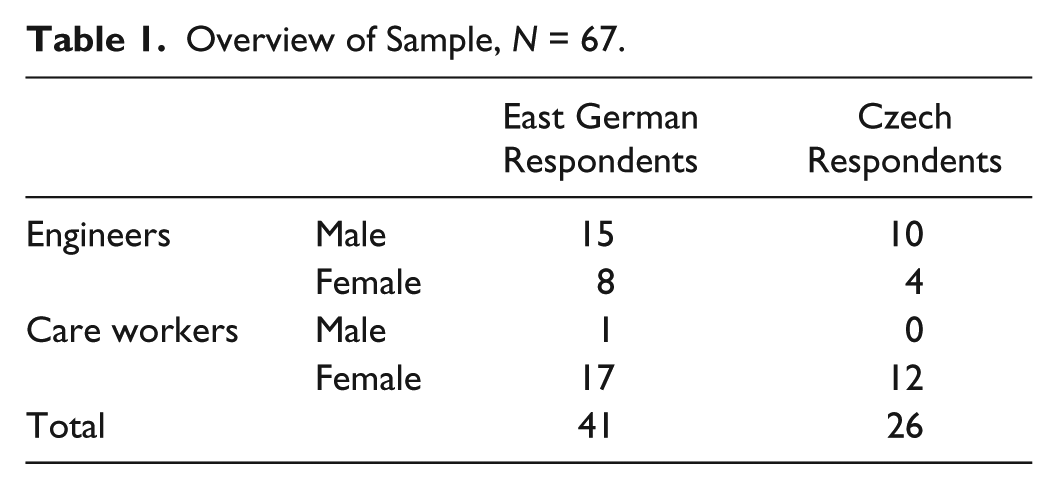
To capture variation in economic trajectories after 1989, I contacted individuals from two groups that have seen their skills differently valued in the emerging labor markets: engineers and care workers. 4 Seen from the perspective of the valuation of skills and gender, engineers are a (predominantly male) group with a high likelihood of being among the relative “winners” of the transformation, whereas (predominantly female) care workers (nurses and elderly care) constitute a group with a likelihood of being among the relative “strugglers” or “stagnators” (cf. Diewald, Goedicke, et al. 2006; Večerník 1996, 2009). Connected in particular to the gender aspect is a relative tension between these two professions that is also of interest: Engineers’ professional ethics are centered around individual autonomy and technical competence (Gambetta and Hertog 2016; Zussman 1985)—thus, approximating the principle of merit—whereas that of care workers revolves around the values of positive dependency and social support for the needy (England 2005)—thus, it is linked to the principle of need. In East Germany, although the massive restructuring of industries also left engineers with a high danger of becoming unemployed, in the long run, they had very good chances on the integrated German labor market since their skills were highly valued (Martens 2008). Care workers, in turn, were relatively less likely to be affected by unemployment. Yet in the long run, stagnating wage developments, a perceived lack of control over the developments in the sector, and some pockets of specialization versus a large segment of low-skilled work brought a systematic undervaluation of this type of feminized labor (True 2003). Care workers’ wages remained low for decades in the Czech Republic (Read 2007; Večerník 2009). A downside of this sampling strategy is that gender and profession cannot be disentangled in the analysis. The difference in rates of unemployment between the two cases is reflected in the empirical sample: Whereas around 36 percent of the East German respondents have experienced unemployment at least once, only 4 percent of the Czech respondents did. 5
Method
In the process by which the self is narratively construed (Abrams 2016; Bamberg 2009), autobiographical elements are intermingled with broader social, economic, and political concerns. The interview situation is one way to access such narratives (Elliott 2005; Lamont and Swidler 2014). In the following, I draw on a cultural sociological and social boundary approach (Alexander 2007; Lamont 2000; Presser 2004) to capture the moral self-positioning of individuals.
I relied on a combination of unstructured, biographical interviewing and semi-structured, focused interviewing (Abrams 2016; Rubin and Rubin 2012). This article is primarily concerned with the latter. Attention was given to how individuals communicate moral beliefs by referencing other people in their environment. There are two ways in which this can happen. First, respondents sometimes bring up such stories as part of their biographical narrative. Second, in the focused part of the interview, respondents were asked if they were able to provide examples for deserved or undeserved outcomes from someone they know. 6 This way of asking targeted relational references (Desmond 2014; Gartrell 2002), namely, people who a respondent has come to know and/or is still in touch with. Table 2 provides an overview over the types of social ties referenced. Through these stories, individuals locate themselves in a social space, narrating the moral self as either proximate or distant from others (Lampropoulu and Myers 2013; Presser 2004). If there were no example based on such a personal tie, a respondent could still evaluate the agency of more distant actors and groups.
Type of Social Relation Referenced When Articulating Deservingness Beliefs.

Respondents were invited to participate in the project to talk about personal experiences of the aftermath of 1989 in terms of work and social relationships, and since this prompt is event-centered, it also constituted a principal thread for the conversations. However, the meaning of the event was not imposed. The first part of the questionnaire, biographical and open-ended in nature, focused on respondents’ experiences of changes at work. Here, the interview guide did not prescribe any particular meaning to 1989, leaving it to respondents to introduce critical “small” events from their biography and ensuring that respondents’ accounts were not required to follow a predetermined temporal order. The second part documented perceived change or continuity in social relations after 1989. Here, respondents were actively encouraged to evaluate whether 1989 functioned like a turning point in their view. The third part covered focused questions on deservingness beliefs. Respondents were asked to take a stance and encouraged to tell stories (Lampropoulu and Myers 2013) by referencing concrete examples from other people on what constitutes deserved or undeserved economic outcomes after 1989. It was left to respondent to accept or reject the assumption that the system transition had any particular effect.
Interviews were coded inductively in a first step (in a number of cases, deservingness beliefs were already articulated in the first or second part of the interview); the strategy was to work out a definition for a code after a couple of interviews, then consistently apply it (Boyatzis 1998). In case a new subdimension emerged, adjustments were made (Rubin and Rubin 2012), and new codes were introduced as they emerged from new patterns identified in the analysis of the material. The codes on which the subsequent analysis is based were systematically generated and compared on the basis of the range of stories introduced by respondents that contained evaluations of others (their character traits as well as their actions) and elements of explanations of outcomes as either deserved or undeserved.
Individuals make inferences about the inputs that are necessary to achieve something by first considering outcomes (Lerner 1975). The analysis thus begins by schematically distinguishing between “positive” and “negative” outcomes as narrated by respondents. Stories with a positive result are usually concerned with how someone managed to cope with economic hardship and difficulties, such as unemployment. Here, hardship is located in the middle part of the story. Most stories with a negative result are concerned with how someone is stuck in a negative economic plight (not managing to cope) or has amassed wealth (including welfare benefits) by illegitimate means.
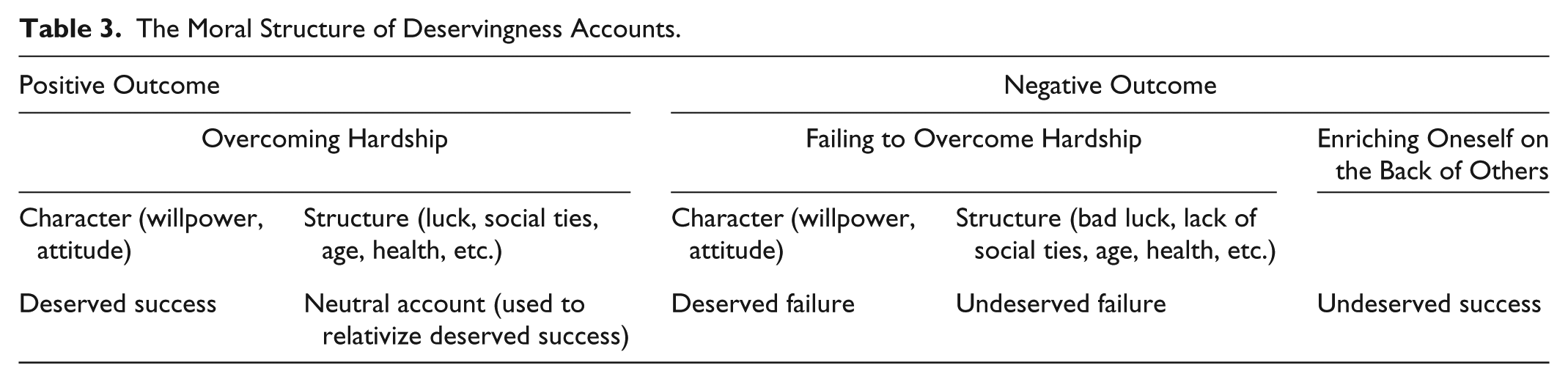
Table 3 provides a systematization of deservingness accounts found in the material. The primary challenge for the analysis is to distinguish causality as attributed by respondents. The difference between internal and external attributions, as elaborated in social psychological locus of control and social justice theories (Kluegel and Smith 1986; Lefcourt 1976; Miller 1976, 1999; Schneider and Castillo 2015), is gauged here. Notions of an internal force (character) can be distinguished from notions of an external force (structure). The latter references conditions that constrain, such as age or health, or enable moral agency externally, such as learning, support networks, or social capital, locating the force primarily outside the individual (Miller 1976). 7 Respondents meaningfully link outcomes back to agency, thereby assigning (or deflecting) individual responsibility and creating moral tension in a narrative arch. Accounts of character are associated with the principle of merit; accounts of structure are associated with the principles of need (if targeting individual capabilities) or equality (if arguing for an outcome independent of individual capabilities). Because the prompt invites respondents to evaluate unequal outcomes and asks for personalized stories, the primary focus is on the tension between merit and need. Prior empirical studies have identified this tension as key to the problem of responsibility attributions (cf. Schneider and Castillo 2015).
The Moral Structure of Deservingness Accounts.
Scholars writing on poverty attributions have noted that more than one justice principle can be held by the same person and one can be introduced to relativize the other (Kluegel and Smith 1986; Törnblom 1992; van Oorschot 2006). The strength of narrative accounts is that here, individuals communicate with rich detail what they believe are critical parameters of a principle of justice in a concrete example given. This allows respondents to communicate a principle along with specific conditions under which they believe it does not apply. Acknowledging disadvantaging effects of age and sickness, for instance, makes economic failure likely to be understood as partly beyond control and therefore less likely to be regarded as deserved (van Oorschot 2006). It is normal to relativize a principle when generating a story or an account, something that survey questionnaires usually miss when forcing an either/or decision. One important strength of the narrative analysis is that it can distinguish between relativizing a principle to some degree and abandoning it altogether.
Findings
Respondents regard 1989 as a turning point particularly with respect to labor market agency. Most express the belief that the system transition forced individuals to finally “take care of things” themselves. Respondents from both societies studied use a terminology that captures a processual temporality resulting from 1989, referring to it as Nachwendezeit in German and porevoluční dobá in Czech. Both are literal concepts of an “after-event-time” that are semantically linked to economic change and the challenges associated with it. Beliefs about deservingness are anchored in this period.
Based on the coding of the interview material, four accounts of deservingness can be distinguished (see Table 3): accounts of deserved success, stories of undeserved success, stories of deserved failure, and stories of undeserved failure.
Accounts of Deserved Success
Accounts of deserved economic success after 1989 are commonly accounts of another person overcoming various kinds of hardships typical for the transformation time, like phases of unemployment, job insecurities, or involuntary retraining. 8 Stories of deserved success foreground the level of individual responsibility for economic outcomes. It is held that hard work and a certain level of individual sacrifice is required to achieve success and that success is legitimate to the extent that it is based on a moral conviction. Character attributes and individual dispositions are foregrounded when identifying agency in attributes such as a “forward-looking” or “hard-working” attitude and “savviness.” The lessons derived from these accounts include adages such as “you can do it if you really want to”; “whoever wants to work, will find work”; “every man is the architect of his own fortune”; “without work, there’s no treat”; 9 and “you can’t wait for someone to take care of you.”
For instance, a German engineer in his early 60s, himself an entrepreneur who founded his own company in the early 1990s, refers to as a time after 1989 as one of “great opportunities.” He tells the story of a relative who was “muddling through” for years, not doing anything “proper,” but at some point, finally understood that “you have to take matters into your own hand”: There were these closed-minded people who, out of principle used to say, “you took all this from me, now please take care of me.” . . . I have a brother-in-law, he was around 30 at the time of the Wende [transition of 1989], and he tried to always muddle himself through, you know, capitalism grants you to do that for some time. Now this guy got—I have to say, for some time I employed him—he got cancer, had to undergo surgery, couldn’t work. Now he works at a security firm, so he can sit there and finally do something. And now, he told his buddy who still idles time away doing nothing: “get lost, you keep on complaining!” Never would I have thought he’d dare tell him his opinion!
This change of mind of his relative, which the respondent welcomes as type of purging of an immoral past, today creates a balance because it makes the other person think more like the respondent. It is deserved to the extent that character and economic outcomes align in this story.
Respondents assign individual responsibility in this type, but they often also relativize it in parts by introducing structural, circumstantial elements that point to exceptions.
Accounts of Deserved Failure
Respondents report numerous stories that advance individualized explanations for economic failure after 1989, as in poverty evaluations (Kallio and Niemelä 2014; Schneider and Castillo 2015; Watkins-Hayes and Kovalsky 2016). Those referenced are regarded as “stuck” in their plight. Their agency is narrated as lacking in willpower or principled convictions. Frequently, immoral motives such as envy, closed-mindedness, or a vainglorious pursuit of money are associated with this. The gist of such accounts is often summarized in proverbs such as “it all comes back to you,” “you can’t save everyone,” or some variation of the notion of a “survival of the fittest.”
An East German professional working in elderly care recounts a story of her former friend from high school who was struggling financially after 1989 as both her parents were unemployed at home. The respondent recalls the change in her character to have been caused by material change: This friendship was broken by envy. . . . We went through thick and thin together, then came the Wende, and then it started, she went “you got new sneakers again!” But it was hard work and not just like that. . . . I couldn’t bear her always complaining anymore at some point. In the beginning I said, “well then take my sneakers,” I gave her my old sneakers so we could keep it up for another two years or so, but then I said, at some point, I don’t have to do this to myself, she finally has to go and do some hard work herself, and so I quit. I never saw her again, never.
In these stories, a person’s willpower is implicated in their economic success. Lack of ambition is identified as the main cause of failure, making their trajectory a logical and necessary consequence of a set of decisions at a certain point in time in the past. These accounts are consistently reported together with an image of the post-1989 labor market and economic environment as principally favorable to those who are willing to work and are ambitious.
At times, political issues are also negotiated through this logic. Some respondents report to have known someone who worked for the Secret Police before 1989 and then failed economically in the new system after 1989, which generated a sense of justice and personal satisfaction. Here, market justice is upright, it serves to “purge” the political past.
Another version of this account defines the “materialist attitude” of those who became wealthy as an outcome of failure because it “corrupted” their character. In many cases, these stories are also associated with accounts of severely strained or broken friendships.
Accounts of Undeserved Failure
In accounts of undeserved failure, respondents criticize the merit principle and advocate a position that points to the limits of character-based explanations. They use these stories to make a case for the importance of the principle of need. These convictions are expressed in sayings such as “you can’t blame it on the person” or that there is a need to “help people to help themselves.”
One respondent, himself having experienced unemployment multiple times after 1989, tells the story of a brother-in-law who founded a business but made bad choices because of limited knowledge: Around the time of the Wende, you had lots of people who started their own business who were naïve and got hornswoggled by some random strangers who told them “well, you need this and that now” and so they indebted themselves, went bankrupt. . . . These people were lacking information. You can’t just do these things with your own hands. I have someone like that in my own family. A brother-in-law set up his own construction firm after 1989, well, the end of the story was now 10 years ago, he went insolvent. They’ve been living at the poverty margin ever since.
This account highlights how East Germans were expected to play by the rules of the free market economy when they lacked the chance to learn them. Many respondents who tell such stories, Czechs and Germans alike, also bring up the issue of age, with a large group of people regarded as having been “too old” to be able to learn the tools of the trade. Others point to more existential problems. One respondent tells the story of her former friend who, moving to the West as a care worker in the early 1990s, found herself with psychological problems and an addiction to alcoholism because she developed a “materialist attitude,” thereby “removing herself from her true self.” Ultimately, this happened because she was “torn out of her social context.”
Stories of undeserved failure are not principally detached from individual attributions of responsibility either. Instead, they introduce another level that serves to explain the kinds of character traits that allow individuals to achieve or fail: Equality of opportunity is questioned by pointing to skewed structural conditions, such as availability of jobs, age, the valuation of new skills, or lack of context of social support. Most respondents advancing notions like this have a profound sense of individual agency in economic matters, but they differentiate by introducing the principle of need when it comes to the question of what it takes to get there. This is a model of explanation that regards individual autonomy as borne out of some sort of dependency (Sayer 2005).
Care workers in both national samples more frequently recount stories of undeserved failure, introducing the principle of need more often than engineers. They do so by pointing to a greater number of dimensions, such as age, mental or physical impairments, or the need for a stable social environment and support from others.
Accounts of Undeserved Success
Unlike the others, this type does not entail an evaluation of an experience of economic hardship. There is thus a different logic of evaluating someone’s agency attached to it, expressed in lessons such as “people get by cheating.” These are accounts of people taking advantage of others by engaging in nontransparent or otherwise morally questionable financial activities that contradict the merit principle in the eyes of the respondent but also stories of luck (referencing a system that allows for such “luck” and “connections” to prevail over market justice) as well as stories of individuals who take advantage of “undeserved” welfare money, as in moral discourses on welfare eligibility (van Oorschot 2000, 2006).
These accounts often involve former Communist Party members or secret police informers whose economic success post-1989 serves as an illustration that something is wrong with the market order. The Czech material reveals a strong concern about illegitimate means of attaining wealth post-1989 (see also Smith 2010; Tucker 2015). Corruption and illegitimate privatization practices come up as an important theme in many conversations. Some tell stories about “turncoats,” former “reds” (Communist Party functionaries) who quickly became “capitalists.” One Czech engineer was employed at a cooperative specializing in socialist housing construction for more than 20 years before the revolution. In 1989, when the former boss was dismissed for political reasons, he became the director of the firm. He reports the story of one of his former coworkers as an example of someone who was failing in his profession but successful because he knew how to take advantage of the new rules of the game: This person has been working with us in the cooperative. . . . Today he’s the major’s representative. We had laid him off back then because he was incompetent. It’s hard when you know his profile. Everyone knew about each other, we knew about his working morals, about his personal qualities. . . . So the people we kicked out for total incompetence back then today are the ones who make politics.
Another Czech engineer similarly creates a dichotomy between decent, economically productive people and those who “eat off politics” after 1989, suggesting there exists an entire class of people whose political connections are the reason for their economic advantage. Through these stories, respondents cast doubt on the notion that 1989 brought equality of opportunities. But importantly, this is most often articulated as a political instead of an economic problem. These accounts normatively advocate market justice, but they point to adverse political conditions that enabled some to game the system. Some Czech respondents draw boundaries to the Roma minority in racialized references to alleged “welfare cheats” (DeSante 2013).
East Germans draw strong boundaries to West Germans, who are remembered as new owners, investors, and bosses post-1989, adding insult to the injury of leveled East German economic structures by devaluing their work ethic. Some respondents draw a parallel between former “reds” and West Germans as both are examples of undeserved success. But it can also be observed that their agency is differently evaluated because individuals from West Germany are not perceived on a level playing field with East Germans in 1989. They are understood to have arrived “from the outside,” thus not to share the immanent experience of the 1989 transition.
Generally, it is notable that stories of undeserved success and excessive wealth accumulation tend to focus on rather distant individuals and groups and are thus more abstract and less rooted in proximate ties than other accounts.
Using Eventful Knowledge to Construe a Space of Economic Agency Post-1989
Most accounts express a principle of individual responsibility for one’s economic outcomes after 1989. In other words, the majority is guided by a version of merit, namely, that there is, in principle, a “healthy” symmetry between what someone voluntarily did and what the person gets in return. This idea functions like a working hypothesis with reference to 1989; it is generally regarded as valid until contradicted.
However, a difference can be found between the East German and the Czech material: East Germans are more inclined to relativize the idea of merit by citing unemployment as well as West German dominance post-1989. This is in line with earlier studies that have found East Germans to be less supportive of the principle of individual responsibility for economic outcomes than Czechs and tied it to the East German transformation with its skyrocketing levels of unemployment (e.g., Gerlitz et al. 2012; Schneider and Castillo 2015).
Experiences of the time post-1989 can thus be shown to shape justice beliefs. But how do respondents use knowledge about the time to relativize merit?
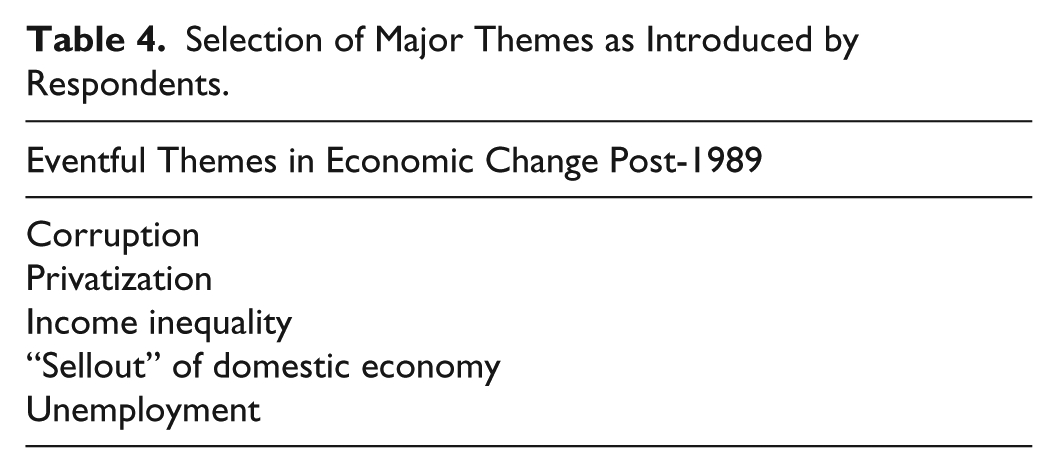
This is a pressing question because in general, negative evaluations of economic developments post-1989 are widespread, and we might expect individuals to favor structural explanations on these grounds. In particular, as confirmed by earlier studies (Kluegel and Mason 2004), excessive income inequality and wealth accumulation after the revolutions is viewed very critically and thus can be expected to challenge beliefs in equality of opportunity. Table 4 presents the main themes that surface in the material that constitute a type of eventful knowledge: These themes relate to processual developments post-1989 that most respondents understand to have originated in 1989 (Wagner-Pacifici 2017). 10
Selection of Major Themes as Introduced by Respondents.
From the material, it becomes evident that the criticism of undeserved wealth or social inequality post-1989 does not necessarily contradict beliefs in merit. A Czech construction engineer for instance paints a bleak picture of economic developments after the revolution, linking the success of “turncoats,” who could draw on their pre-1989 networks, to widespread corruption during privatization. He nevertheless proposes the ability to “take advantage of opportunities” as the main criteria for economic success after 1989, arguing that “those who lament the new material differences do not deal with the fact that it is their own fault.” Similarly, an East German engineer and entrepreneur refers to the federal German privatization agency as one of the “biggest criminal organizations in history” because it had “squashed” the East German economy. Yet he also insists the time after 1989 was one of “great opportunities,” blaming those who did not take advantage of them individually. While he accepts that unemployment was a collective problem initially, he holds that after this phase, “you cannot blame it on the system.” A Czech care worker detects a dramatic injustice in wage developments in the time after the revolution but at the same time vividly draws a boundary toward the unemployed, who she regards as “unwilling” to work and thus undeserving of social benefits. Her conviction that anyone “who wants to work, will find work” offers a common view on the theme of opportunity.
The principle of merit is effectively abandoned only in accounts that connect eventful knowledge about the period post-1989 with stories of how individual agency was constrained at the time. One 66-year-old East German engineer, who is retired today and looks back to a successful career, characterizes the labor market post-1989 as marked by bitter competition: “It was easy to depress wages when so many people were unemployed, and at that time, each and every one would take any job!” He regards these initial developments as the root cause of unequal life chances today. In contrast to the examples cited previously, the negative assessment of the period after 1989 directly enters his relational account of agency. In his view, these social forces were far beyond a single person’s control, speaking on behalf of his friends from before 1989 who he still regularly meets up with. Among them are people who experienced hardships such as repeated unemployment, debt, and in some cases alcoholism after 1989. The respondent regards them as deserving, though not of their economic outcomes but of assistance they receive. He also regards them as deserving of his time: He seeks to bring everyone together because as he sees it, there is a danger of blaming economic outcomes on each other, when these are until this day “systemic effects” of the time after 1989. His is thus a structural account but still hinges on a moral and relational story of economic change.
Discussion
Social justice research has demonstrated that moral judgments are shaped by whether someone’s circumstances are understood as within or outside of a person’s control (van Oorschot 2006). Yet oftentimes, a benchmark against which individuals meaningfully compare economic outcomes is lacking. The present article has considered the event of 1989, a historical rupture that engendered the shift from state-socialism to free market democracy in this way. From the standpoint of a particular generation old enough to experience this rupture in their work environment, references to 1989 constitute a shared temporal horizon for evaluating moral agency in market society ever since. Taking up this perspective, the goal of this article was to deepen our understanding of the role of culture in the puzzling tension between the principles of merit and need, both of which can be held by the same person (Kluegel and Smith 1986; Törnblom 1992).
The narrative-centered perspective elaborated in this article underscored how a critical moment of contingency rests with the ways an image of moral agency and responsibility in the past is construed. This work demonstrated this in four different accounts of deservingness. As they are generated from relational, interpersonal experiences, they provide rich insights into the ways in which inequality is culturally apprehended. From this, two major findings were gleaned.
First, the notion that “one gets what one deserves” is widespread, in contrast to claims found in the literature about the egalitarian heritage of state-socialism in justice beliefs (Kunovich and Slomczynski 2007; Pop-Eleches and Tucker 2017). When it comes to narrating legitimate reasons for economic outcomes, respondents often focus on the problem of individual responsibility and blame. Outcomes are also regularly understood in terms of “character” (Alexander 2011; Sayer 2005). In this respect, it is notable that accounts of others struggling to overcome economic hardship tend to be concrete and rooted in one’s circle of friends, family, or acquaintances, while those concerned with others generating undeserved wealth remain rather distant and sometimes abstract.
This concern with negative trajectories, with maintaining a boundary toward those considered “undeserving” in examples that are rather small in scope and scale, is likely rooted in the wish not to be associated with economic failure, understood as moral failure (Lamont 2000, 2018). Individuals can signal distance by drawing on cultural repertoires stemming from late-socialist times, when a person deemed as “work-shy” was publicly stigmatized and persecuted by the Communist Party (Lindenberger 2005; Pullmann 2011; Wierling 1996).
One interesting question arising from this is whether individuals’ perception that everyone enjoyed similar “starting conditions” in 1989 might encourage market justice explanations of inequality post-1989. To ponder this question, future research employing a systematic, narrative-based comparison to a nonpostsocialist framework is needed.
Second, whether someone’s circumstances are regarded as within this person’s control is a matter of meaning-making. Such an interpretation does not happen outside of historical time. Among the two groups compared, care workers were found to relativize the principle of merit more strongly than engineers. Keeping in mind the caveat that gender and profession is collapsed in this sample, this arguably reflects the aggregate-level finding that social mobility experiences post-1989 shape beliefs about justice (Gerlitz et al. 2012; Smith and Matějů 2012). But once we turn attention to the qualitative depth of this problem, we can see how historical, eventful knowledge of the time comes to bear in deservingness accounts. It is quite puzzling that many respondents hold on to individual attributions of responsibility given that widespread negative assessments of corruption, excessive wealth accumulation, rising social inequality, unemployment post-1989, or foreign (i.e., West German) dominance all point to structural, external mechanisms (Diewald, Goedicke, and Mayer 2006; Kluegel and Mason 2004). Because these forces constrained equality of opportunity post-1989, they should effectively challenge merit ideas (Kreidl 2000, McCall 2013). However, I found that they do so only when eventful knowledge of the period post-1989 was used to construe a space of moral agency in which a person’s capability for making choices and taking advantage of opportunities at the time was narrated as constrained. The burden of proof is with the principle of need because a robust historical imagination that is concerned with moral agency of another person is needed to regard him or her as deserving. Otherwise, upholding the moral boundary towards those “below” the self can in fact function as a “lesson” drawn from the time.
As Michèle Lamont and colleagues (Lamont, Park, and Ayala-Hurtado 2017) have, for instance, shown, it is possible to conjure collective economic narratives that seemingly restore moral worth by externalizing blame and promote the principle of merit at the same time. A core strategy in Donald Trump’s presidential campaign in 2016 was to remove individual blame for economic failure from white working-class individuals by providing a compelling narrative of global trade.
The political-economic framework of the East German transformation provides an interesting case in point. It is well documented that mass unemployment in the 1990s has affected justice beliefs there (Diewald 2006; Gerlitz et al. 2012; Schneider and Castillo 2015). But for deservingness beliefs, it matters how such negative experiences are narrated, interpreted, and translated into a matter of moral agency today. Because individuals draw on collective frames of reference to make sense of experience (Alexander 2012; Halbwachs 1992), further research must consider the power of relational environments and explore social network effects within them for examining how experiences of the time are translated into inequality beliefs.
Conclusion
Individuals draw on narrative in their pursuit of moral worth and justice, and narratives about the economy are nurtured by historical and relational imagination.
Yet in analyses of the global upsurge of right-wing populism and reactionary conservatism (Inglehart and Norris 2016; Morgan and Lee 2018; Mutz; 2018; Williams 2017), oftentimes, still, “economy” and “culture” are posed as two competing explanatory variables. It must either be the force of an objective economic process that harbors moral-economic sentiments, or else they are generated out of concerns for identity. But this opposition overlooks the mediating power of moral worth. Research on culture and inequality research must look beyond individual accounts of economic experiences and explore how socially shared references to the past fuel moral evaluations of social inequality as there is great political power in definitions over whose livelihoods and histories count as deserved or undeserved.
Footnotes
Acknowledgements
I would like to thank Jeffrey C. Alexander, Julia P. Adams, Emily Erikson, Marci Shore, and the anonymous reviewers of this article. A first version of this article was presented at the Junior Theorist Symposium 2017 as part of the ASA Meeting in Montreal.
Funding
The author(s) disclosed receipt of the following financial support for the research, authorship, and/or publication of this article: This research was kindly supported by a Yale MacMillan International Dissertation Research Fellowship and a German Academic Exchange Service (DAAD) Grant.
1
In theories of social justice (cf. Liebig and Sauer 2016;  ), these order-related principles are usually analytically separated from outcome justice as well as from the third domain of procedural justice.
2
I thank an anonymous reviewer for pointing out this reference.
3
Unlike in many post-Soviet cases, informal networks (“connections”) and thus, political capital (King and Szelényi 2005) do not constitute a decisive resource for social upward mobility post-1989 (see Diewald, Solga, and Goedicke 2006:84 for East Germany; for the Czech Republic, see Verčernik 2009:85–88). Instead, formal qualifications and skills matter most for labor market chances.
4
Respondents were recruited by corresponding (sending out emails, then calling) with engineering offices and care facilities/hospitals in middle-sized (East) German and Czech cities. Some respondents were also recruited through snowball sampling.
5
In this study, more East German respondents also report being in touch (until today) with someone who has experienced unemployment than do Czech respondents.
6
The wording of the two particularly relevant questions asked was as follows: “Some people think that those who did not manage to ‘get back on their feet’ after 1989 economically were responsible for themselves. Do you agree?” And “In turn, some people think that some had generated ‘undeserved wealth’ after 1989. Do you agree?” Usually, respondents generate stories about others who they have come to know to illustrate their point, creating a narrative arch about someone else’s experience. If they do not introduce stories about someone they have come to know themselves, the interviewer asked them: “Do you have an example from someone you know, in your circle of friends, relatives, acquaintances, of coworkers?” Some accounts were also generated in a focused part on perceptions of changing social ties after 1989, in particular, friendship ties. Because of this focus, the fact that “friends (including former)” are cited more often than other types of social relations cannot be treated as evidence in itself. merely provides a sense of the range of social ties that appear here.
7
The analysis cannot rely on respondents’ use of the word character for this distinction as it does not always signify internal attributions. Sometimes, character refers to an internal transformation caused by external forces, for instance, in the idea that someone was able to become autonomous thanks to support by someone else.
8
Respondents don’t share a single definition of economic success. Given the economic challenges of the post-1989 years in East Germany and the Czech Republic, economic success does not signify becoming wealthy; rather, it means getting through the time with a sense of autonomy, achievement, the notion of a “decent” outcome in terms of a middle-class ideal of having a steady job and being able to provide for one’s family, travel, and “stay true to oneself.” Respondents were not asked to define economic success but instead encouraged to recount their experience of the transition, thereby articulating their expectations in this process.
9
Czech proverb: Bez práce nejsou koláče.
10
These themes tend to be associated with “politics” post-1989 more than with the “market” (see also ). Equality of opportunity has both an economic and a political dimension to it as it is understood primarily as an economic promise promoted by those who were in charge of the political transition of 1989. Respondents who express feelings of disappointment with this promise connect broader political understandings of the meaning of 1989 with stories of deservingness. Particularly in accounts of underserved failure, a type of “economic betrayal” (as one German care worker puts it) either by political elites (predominant in the Czech material) or businessmen (West Germans as “taking over” predominating in the East German material) is formulated.