




Abstract
One function of undergraduate education is supporting successful citizenship later in life. Educational achievement is positively, if variably, related to political engagement. However, questions remain about the role of selection into college education as well as the specific college experiences that facilitate postcollege good citizenship. The aim of this study is to test the independent effect of higher education completion on three forms of postgraduation political engagement, using national longitudinal data and controlling for selection into college completion using control-function models. The authors also test the effects of several specific experiences encountered during college—course topic areas and high-impact educational experiences—on these outcomes. College completion has an independent effect (beyond selection) on citizenship behaviors. Social sciences and humanities coursework and two high-impact experiences (being mentored and engaging in a community-based project) were associated with political engagement. Higher education is a training ground for citizenship; particular course and extracurricular experiences help fulfill that mission.
One important reason advocates give for supporting broad undergraduate education is the possibility that such education underwrites successful citizenship later in life (Astin 1997:210–11), and many American colleges and universities claim preparation for effective democratic citizenship as part of their educational missions. Educational achievement has indeed been shown to be positively, if variably, related to political engagement in a variety of ways (Nie, Junn, and Stehlik-Berry 1996). More generally, political habits formed in youth have lasting effects (Fowler 2006; Gerber, Green, and Shachar 2003; Plutzer 2002). Young people develop habits of political participation and civic engagement that likely persist throughout the life course, a process in which higher education may well play a role. But the reasons for that relationship remain unclear. Why and how is higher education associated with good citizenship?
Higher education—particularly the achievement of a four-year college degree—has consistently been found to be a key correlate of political engagement (Burns, Schlozman, and Verba 2001; Hillygus 2005). However, it is unclear whether these findings are because higher education itself is responsible for this increased political engagement or because the types of people who would be more politically engaged are also the types of people who go to college. In other words, does college increase civic engagement, or are the effects we see due to selection into college? The social capital available to children early in life has a strong effect on the likelihood of their eventually graduating college (Mayger, Hochbein, and Dever 2017), and Zheng (2017) found that selection effects account for a significant proportion of the effect of college education on health outcomes, but college education remains an independent predictor of those outcomes even after accounting for selection. Much of the research on returns to higher education is about the economic returns to education, focusing on it as a private good (for reviews, see Barrow and Malamud 2015; Hout 2012) and on relative effects of educational achievement (Horowitz 2018) and overmatch (Vaisey 2006). However, if college does increase civic engagement, and this effect is not due to selection, then scholars should also be focused on the public good that higher education can provide in the form of civic returns to education (AAAS, Commission on the Humanities and Social Sciences 2013; Allen 2016; Colby et al. 2007).
In addition, it is unclear what aspects of college education (e.g., coursework, extracurricular activities, volunteering) are responsible for any education effect on citizenship. In other words, how does college help make citizens? The college experience varies significantly among institutions and is both internally complex and multivalent (Pascarella 2006; Stevens, Armstrong, and Arum 2008). How do college experiences and pathways through college influence the gains to civic participation? Two mechanisms proposed have been academic curriculum (Hillygus 2005) and high-impact experiences (Flanagan and Levine 2010).
In this study we test for selection effects and examine pathways by which higher education is associated with a range of citizenship behaviors after graduation. Using longitudinal data from students in high school and following them through their mid-20s, including detailed higher education transcripts, we find that college completion is associated with increased civic engagement even after accounting for selection into college. Both academic curriculum and high-impact experiences are associated with increased civic engagement after college. Specifically, students with more social science and humanities or arts courses show higher levels of civic engagement, suggesting that these fields are strong contributors to higher education’s civic mission. Likewise, volunteering, community-based projects, and being mentored were all associated with greater civic gains.
Higher Education and Selection in Civic Engagement
Higher education attainment is strongly associated with political participation across a range of measures (Burns et al. 2001). A significant proportion of this attainment effect is likely due to selection effects (Berinsky and Lenz 2011; Kam and Palmer 2008): the young people most likely to attend college—those from wealthier, whiter, and higher socioeconomic status backgrounds—are also those likely to participate in political life (Lewis-Beck et al. 2008), so college education may serve mostly as a “proxy” for individual and family characteristics of young people prior to college entrance (Kam and Palmer 2008).
However, education may have an effect on political participation beyond selection, just as it does with economic and social returns to education (Hout 2012). Some independent effects of college education on civic engagement have been demonstrated (Dee 2004; Milligan, Moretti, and Oreopoulos 2004), particularly for students with relatively low prior propensity to attend college (Brand 2010). And these effects appear to be, at least in part, the result of intellectual engagement, as college graduates also show gains in prosocial attitudes (Kingston et al. 2003). In an important review, Hout (2012) summarized: “The correlations between education and desired outcomes reflect, in surprisingly large part, the causal impact of education on those outcomes” (p. 380).
Prior studies finding that higher education did not have an independent effect have generally accounted only for higher education attendance (Berinsky and Lenz 2011; Kam and Palmer 2008), but as we note below, the mechanisms for higher education increasing participation may depend on engagement with certain particular curricular or high-impact experiences encountered during college. In addition, Kam and Palmer (2008) rely on data from students who were high school seniors in 1965 and in 1980. Berinsky and Lenz rely on a natural experiment—the increase in higher education brought on by the Vietnam War draft—which means that they were roughly the same age as the older group studied by Kam and Palmer, and they similarly had no information about the experiences the students had while in college. Substantial changes in educational and political patterns since those times may well have changed the relationship between education and civic engagement. We leverage data on a nationally representative cohort of high school sophomores in 2002: a generation more recent than prior studies.
College Curriculum and Experiences
Evidence suggests that the content of educational experiences, particularly verbal skills learned in school, underwrites civic engagement (AAAS, Commission on the Humanities and Social Sciences 2013; Condon 2015). The U.S. higher education sector is widely varied, and the specific curricular experiences students encounter during college may provide different types and degrees of skills for successful civic engagement. Prior research has shown differences between student educational pathways in terms of postcollege political participation (Hillygus 2005; Lott et al. 2013; Nie and Hillygus 2001).
Specifically, education in the humanities may provide students with skills that are valuable in some tasks of public-sphere engagement, including perspective taking, civil discussion, and frank disagreement (Moy and Gastil 2006; Zakaria 2015). Social sciences provide understanding of probabilistic thinking and analysis of complex causal pathways (Arum, Roksa, and Cook 2016) and often directly discuss political and social issues (Clydesdale 2007; Galston 2001). Helen Small (2013) noted (with skepticism) that the humanities are often credited with supporting democratic citizenship, and Geoffrey Harpham (2017) argued that the interpretive skills of humanities scholarship are at the heart of democratic citizenship.
Meanwhile, education in natural science, technology, engineering, and mathematics fields may provide a different, complementary set of participatory skills such as critical evaluation of evidence and alternative hypotheses. However, Hillygus (2005) showed that social science exposure is associated with higher voter turnout among college graduates, and Nie and Hillygus (2001) and Hillygus (2005) both showed reduced voter turnout among graduates who encountered more math and science credits. Hillygus (2005) argued that science courses are unlikely to provide students with the “verbal acuity” or “political attentiveness” necessary for civic engagement: “It is a civic or social science curriculum that imparts the skills and resources necessary to be active in the political realm” (p. 28).
High-Impact Experiences
Kuh (2008) identified a set of high-impact experiences in college that are associated with positive educational outcomes. Some of these high-impact experiences in college have been linked to civic engagement after college, including both behavioral outcomes such as volunteering and attitudinal outcomes such as valuing helping others in the community (Astin and Sax 1998; Astin, Sax, and Avalos 1999; Flanagan and Levine 2010). Flanagan and Levine (2010) argued that young people are most likely to continue to be civically engaged in young adulthood if they have become knowledgeable about issues and learned how to take action on them, which they argue occurs best in institutional settings such as schools and community organizations. High-impact experiences outside the classroom, such as internships, study abroad, and volunteering, create opportunities to develop such knowledge and experience and should therefore increase civic engagement afterward (Flanagan and Levine 2010). Einfeld and Collins (2008) found that a critical key to successfully inspiring long-term changes in civic engagement is active mentoring in understanding and applying knowledge about political and social issues. This finding suggests that mentoring by faculty and/or staff members in different institutional settings may increase civic engagement after college.
Specifically, Astin and Sax (1998) found that volunteering during college was associated with attitudinal changes after college, including being committed to helping others and serving the community, as well as behavioral aspirations regarding future volunteering, influencing politics, and other forms of civic engagement. Astin et al. (1999) found that college students who engage in at least six hours of volunteering per week are almost twice as likely to volunteer after college and hold attitudes of being committed to helping others, even nine years after they entered college. Kim and Morgül (2017) showed that voluntary service work by youth increases long-term volunteering, although not voting, among those who choose to do such work themselves (as opposed to having it required of them).
Service learning experiences are also associated with intentions to continue to be civically engaged (Einfeld and Collins 2008), as well as having a greater commitment to helping the community (Monard-Weissman 2003). In fact, Colby et al. (2007) found that participating in service learning courses decreases the participation gap by social class after college. However, all of these studies are limited in being able to account for selection into college and precollege experiences: although some studies are able to control for precollege civic engagement factors, none can robustly account for selection into college as an institution to provide these opportunities for engagement. Thus, we test the pathway of high-impact educational experiences on the same three measures of postcollege civic engagement: voting in national elections, voting in local or off-year elections, and volunteering frequently.
Preprofessional and vocational courses are often focused on developing specific skill sets that will prepare students for future careers; such courses generally teach students to use these skills within a narrow private domain rather than toward the public good (Checkoway 2001).
Hypotheses
To examine the independent effect of higher education over and above selection effects, we test the relationship between earning a bachelor’s degree and three measures of postcollege civic engagement: voting in national elections, voting in local or off-year elections, and volunteering frequently. We test this relationship first on its own, then after accounting for selection into college completion. We test the following hypotheses with regard to college achievement:
Hypothesis 1: Students who attain a bachelor’s degree will be more likely to participate in civic and political life than those who do not;
Hypothesis 1a: This relationship will be robust to selection effects.
Assuming that civic participation gains are robust to the selection effects for which we are able to account, the next step is to understand how college experiences foster civic engagement. The academic content of college studies may help students gain important skills for civic behavior and/or may influence graduates’ outlooks on civic life. In addition, nonclassroom activities in college, including volunteering (Astin and Sax 1998; Astin et al. 1999; Flanagan and Levine 2010) as well as “high-impact educational experiences” (Kuh 2008) may provide experiential or network bases for future civic engagement.
Academic Curriculum
We hypothesize as follows:
Hypothesis 2a: Students who take more social sciences and humanities courses during college will be more likely to participate in political life than those who take fewer of these courses, all else being equal.
Hypothesis 2b: Students who take more natural science and similar courses, as well as preprofessional courses during college will be less likely to participate in political life than those who take fewer of these, all else being equal.
We also expect that students’ cocurricular experiences during higher education will affect their likelihood of postcollege participation:
Hypothesis 2c: Students who participate in service learning and who are mentored (two high-impact college activities) will be more likely to participate in postcollege civic life than those who do not.
Data
To estimate these effects, we turn to the Educational Longitudinal Study of 2002. These data, gathered and published by the U.S. Department of Education, consist of four waves of surveys with a nationally representative sample of students who were high school sophomores in 2002 (n = 15,362 at the base year). The additional waves took place in 2004, when most of the students were high school seniors; in 2006, when most had recently finished high school and were either in college or in the workforce; and in 2012, when most of those who went quickly to college had completed their first college degrees. In addition to the student surveys, the data include information about the high schools the students attended (from parents, teachers, principals, and library heads) as well as test scores, occupational aspirations, and a few citizenship measures. We restrict analysis to those students who responded to all four waves, and we use the recommended weights and survey settings to account for design effects.
In addition, we obtained a license from the Department of Education to use the restricted-use data from the Postsecondary Education Transcript Study. These data include full postsecondary transcript information on all Educational Longitudinal Study of 2002 respondents who attended at least one postsecondary institution. For each course taken by a respondent, they include the academic field of the course, the institution at which the course was taken, the grade received in the course, and other information. We use the College Course Map classification system to classify courses taken into seven content categories: natural science (including mathematics and engineering), social science, arts and humanities, preprofessional, vocational, remedial, and other.
Dependent Variables
We use three indicators of citizenship and civic engagement measured at wave 4, when the respondents were about 25 or 26 years old:
Voting in the 2008 presidential election: a high-profile, national election, featuring very high turnout nationwide (64 percent of voting-age citizens, but just 48.5 percent of 18- to 24-year-olds and 57 percent of 25- to 34-year-olds [File and Crissley 2012], voted, while 78 percent of adults reported voting in that election in the well-respected American National Election Studies).
Voting in any local, state, or national election during 2009, 2010, or 2011, an indicator of greater civic attention because turnout is typically far lower for such elections than for presidential elections (Perrin 2014:52).
Performing unpaid volunteer or community service work at least once a month during the prior two years, which we call frequent volunteering.
These measures, along with all key independent and control variables, are summarized in Table 1 with descriptive statistics. 1
Variables Used (Frequencies and Descriptives).
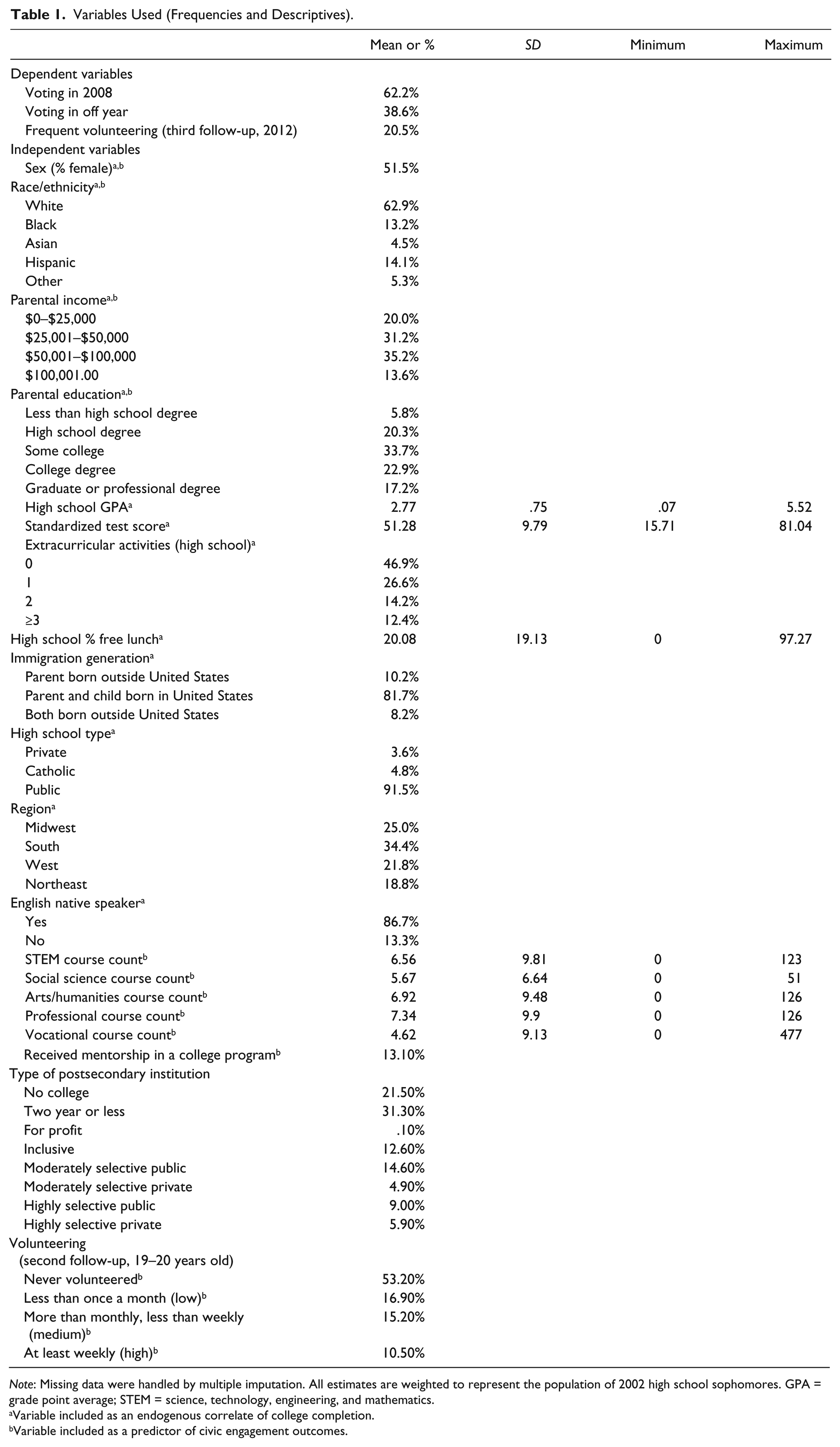
Note: Missing data were handled by multiple imputation. All estimates are weighted to represent the population of 2002 high school sophomores. GPA = grade point average; STEM = science, technology, engineering, and mathematics.
Variable included as an endogenous correlate of college completion.
Variable included as a predictor of civic engagement outcomes.
Independent and Control Variables
To measure each respondent’s degree of exposure to coursework in different academic areas, we used the transcript data for all students who had attended any postsecondary education. Each course was labeled in the Postsecondary Education Transcript Study data set with a College Course Map category for the kind of course, providing a detailed typology of courses. We combined these categories into seven types of courses: natural science (including mathematics and engineering), social science, arts and humanities, professional, vocational, remedial, and other. Because remedial and other had such low sample sizes and were not related to our hypotheses, we did not include these two categories in our analysis. We summed the total number of courses a student had taken in each of our seven categories to derive a course count variable for each area. As seen in Table 2, the average student who earned a bachelor’s degree took about 11 natural science courses, 10 social science courses, 11 humanities and fine arts courses, 12 preprofessional courses, and 5 vocational courses. Median values for each of these are lower, suggesting that a few students take a large number of specific types of courses, likely because of their majors.
Course and High-Impact Experience Frequencies by Bachelor’s Degree Completion Status.
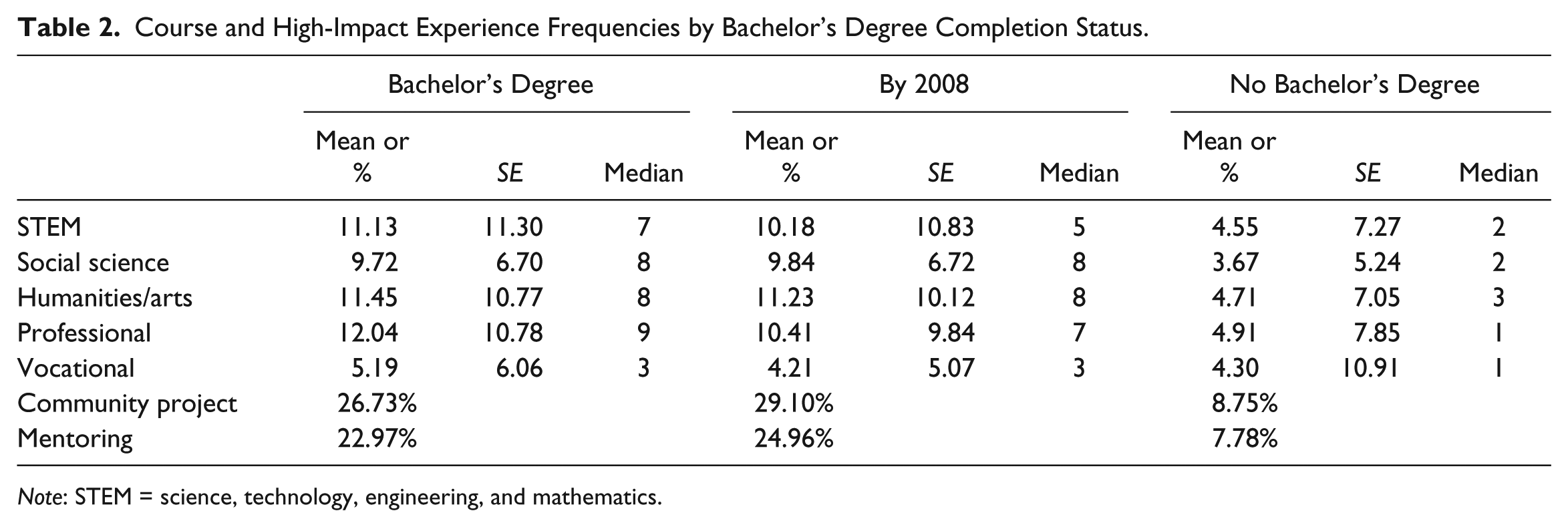
Note: STEM = science, technology, engineering, and mathematics.
To measure the frequency of volunteering during college ages (used as an independent variable), we use the frequency of volunteering at follow-up wave 2, when the respondents were 19 or 20 years old (about 2 years out of high school; this question was asked regardless of postsecondary attendance). Nearly half (48 percent) of 19- to 20-year-olds volunteered at least once during the previous two years.
We include two “high-impact educational experiences” in college for respondents who had attended any postsecondary education: participating in a community-based project (e.g., service learning) as part of a course and being part of a program in which the respondent was mentored. Participation these high-impact experiences was rare, with only about 27 percent of BA recipients having participated in community projects and about 23 percent having been mentored.
We use the respondent’s cumulative high-school grade point average (GPA) at wave 2, standardized test scores in math and English from wave 1 (restandardized to the national mean of 50 and standard deviation of 10), and number of extracurricular activities from wave 1 as indicators of high school academic success. To account for characteristics of the respondent’s high school, we use the percentage of students at the respondent’s high school who received free lunch as well as the type of high school (public, private, or Catholic). To account for possible regional effects, we include the region of the country in which the student attended high school. Finally, we include the respondent’s immigration generation (first generation, second generation, or nonimmigrant family) as well as whether the respondent is a native English speaker.
Methods
We begin by estimating probit models for each of our dependent variables of interest as well as for achieving a bachelor’s degree (college completion). We estimate a separate model for completing a bachelor’s degree before the 2008 election, because college completion cannot logically lead to voting in that election for those who had not yet completed college before then. These models do not account for selection into college; we estimate them to establish a baseline association between college completion and citizenship outcomes.
We conceptualize college completion as essentially a “treatment,” a condition we theorize to cause the outcome of greater civic engagement. We seek to estimate the effect of that treatment, net of selection effects that might explain the difference. Because those selection effects may be related to the same characteristics of the respondents as those estimated in the main models, we consider them endogenous, meaning the likelihood of receiving the treatment (college completion) is potentially related to the likelihood of the outcome (civic engagement). We treat college completion by the 2008 election (for voting in 2008) and college completion overall (for the other outcome variables) as an endogenous treatment (Deb, Norton, and Manning 2017:209–20). To do that, we incorporate a probit model predicting that treatment into the model predicting the civic engagement outcome of interest.
We use a control-function model (Vella and Verbeek 1999) to estimate endogenous treatment effects. Essentially, this approach involves estimating variation in the theorized endogenous causal variables, then adding control functions to the next stage on the basis of these estimations. These control functions allow consistent estimation as if the endogenous variables were exogenous, conditional on those control functions (Wooldridge 2015). In other words, the procedure lets us estimate the effect of college completion on citizenship behaviors as if college completion were unrelated to the characteristics and experiences that lead to those citizenship behaviors.
We implement the control-function approach using Stata 15’s extended regression models (ERMs; StataCorp 2017a). In a series of ERMs, we include college completion alone, course mix, high-impact experiences, and a combined model including both course mix and high-impact experiences, each of these for each of the five outcome measures. For the frequent volunteering outcome, we estimate additional models that include college-age high-impact experiences other than volunteering in order to distinguish between the role of learning habits of volunteering and other citizenship learning.
We report probit coefficients and significance levels, as well as average treatment effects (ATEs) for the treatment variable (college completion) and average marginal effects (dy/dx) for other independent variables. Coefficients and treatment effects are adjusted for selection effects using the ERM and for survey design effects using the recommended weights. Stata is unable to calculate ATEs under multiple imputation, so the ATEs reported are based on the same model run under single imputation. A few of the marginal effect estimations were also unable to be estimated under multiple imputation, so the ones that could not were also estimated until single imputation. The results were very similar in both cases.
We handled missing data using multiple imputation. Data were weighted to represent the national population of students enrolled in 10th grade in spring 2002 and adjusted for design effects using Stata’s svy: command suite. All models were estimated in Stata/SE 15.0 (StataCorp 2017b).
Results
Association between College and Engagement
We begin by testing the association between college completion and civic engagement measures, temporarily leaving aside the questions of selection into college completion, curriculum, and college experiences. Table 3 shows the results of probit models predicting each of our dependent variables on the basis of college completion (by 2008 for the 2008 voting model), with appropriate controls included.
Education and Demographic Associations with Civic Outcomes, Not Adjusting for Selection into Bachelor’s Degree Completion.

Note: Probit coefficients, ATEs (for bachelor’s degree), and AMEs (dy/dx, for covariates) for civic outcomes are presented. AME = average marginal effect; ATE = average treatment effect.
p < .05. **p < .01. ***p < .001.
As predicted, the results of these models confirm that college completion is associated with all three measures of civic engagement, though the effect sizes vary. It is more strongly associated with voting in 2008 than with off-year voting and frequent volunteering.
Parental income and education are significant predictors of voting in 2008, in the expected direction: lower income and education are associated with less likelihood of voting. For off-year voting, parental income remains a significant predictor, but parental education is less of a factor. That pattern is reversed for frequent volunteering; parental education is associated with that measure, but parental income is not. For all outcomes, African Americans and women are significantly more likely to participate, net of other predictors.
Selection into College Completion and Testing Selection Effects
Next, we turn to testing whether the relationships found between college completion and political participation are robust to the selection effects for which we are able to account. In order to do so, we first model the likelihood of college completion, both by follow-up wave 3 (in 2012) and by the date of the 2008 election. These are weighted probit models (Table 4) and are what we refer to as the selection models into bachelors degree completion.
Predicting Bachelor’s Degree Completion by 2008 and Overall.

Note: Adjusted probit coefficients and AMEs (dy/dx) for completion of bachelor’s degree overall and by 2008 are presented. AME = average marginal effect; GPA = grade point average.
p < .05. **p < .01. ***p < .001.
Most predictors are similar for both models (bachelor’s completion by 2012 and by 2008). High school GPA, standardized test scores, extracurricular activities, parental income, region, school type, and proportion of students in the high school receiving free lunch are all associated with both outcome measures in the expected directions, as prior literature indicates we should expect (Buchmann and DiPrete 2006; Ishitani 2006). Parental education is more powerfully associated with bachelor’s completion overall than it is with completion by 2008, but the trends are similar. Net of other predictors, African American students are more likely to complete bachelor’s degrees than are white students. 2
Now that we have modeled the selection process into college as well as the data allow, we combine this selection model (from Table 4) with the college and civic engagement models (from Table 3). We account for selection into college completion using probit models adjusting for college completion as an endogenous treatment effect. We include endogenous covariates predicting college conclusion on the basis of the selection model (Table 4): high school GPA, standardized test score, extracurricular activities, race, gender, parents’ education, parents’ income, native English speaker status, immigration generation, high school type, high school region, and high school proportion receiving free lunch.
We find that the relationships between college completion and the outcomes (voting and volunteering) are similar after accounting for selection, shown in the first column for each dependent variable in Tables 5, 6, and 7. 3 For voting in off years, the effect sizes of a few demographic variables decreased compared with the preselection model. Parental income and education predictors are smaller than both for voting in 2008 and for off-year voting uncontrolled for selection, and parental education is no longer a significant predictor. Interestingly, the gender effect, which was strong in the unadjusted model and is strong for voting in 2008, is not significant in the selection-adjusted models for off-year and local voting, suggesting that the effect of gender on that outcome is mostly about the effect of gender on college completion.
Voting in the 2008 Presidential Election.

Note: Adjusted probit coefficients, ATEs (for BA completion effect), and AMEs (dy/dx, for covariates) are presented, adjusted for endogenous selection into BA completion. AME = average marginal effect; ATE = average treatment effect; GPA = grade point average; STEM = science, technology, engineering, and mathematics.
p < .05. **p < .01. ***p < .001.
Voting in a Nonpresidential Election.

Note: Adjusted probit coefficients, ATEs (for BA completion effect), and AMEs (dy/dx, for covariates) are presented, adjusted for endogenous selection into BA completion. AME = average marginal effect; ATE = average treatment effect; GPA = grade point average; STEM = science, technology, engineering, and mathematics.
p < .05. **p < .01. ***p < .001.
Frequent Volunteering.
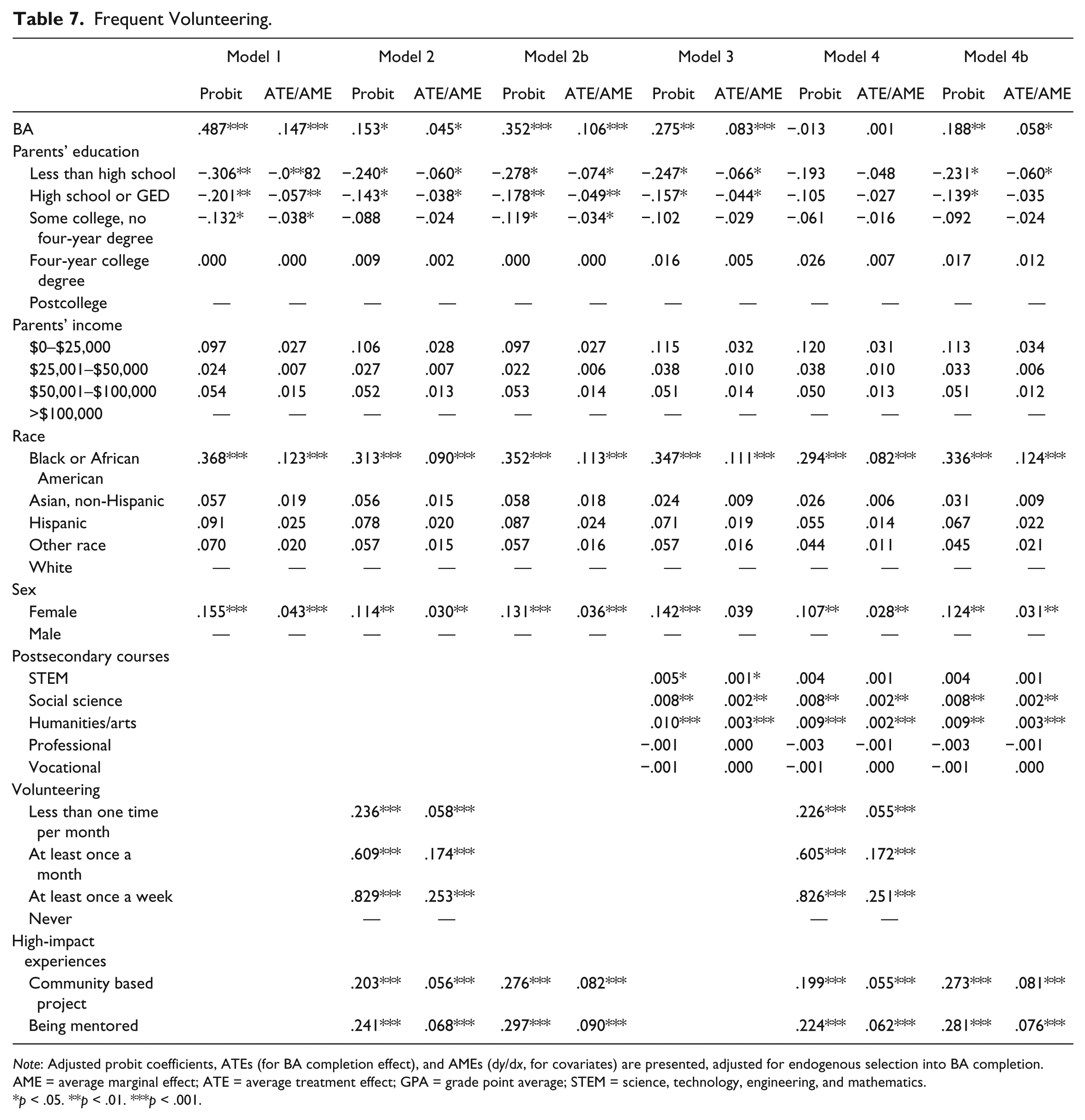
Note: Adjusted probit coefficients, ATEs (for BA completion effect), and AMEs (dy/dx, for covariates) are presented, adjusted for endogenous selection into BA completion. AME = average marginal effect; ATE = average treatment effect; GPA = grade point average; STEM = science, technology, engineering, and mathematics.
p < .05. **p < .01. ***p < .001.
There are fewer differences for the demographic variables in the other outcomes, though there are modest reductions in the independent effect of parental education for voting in 2008 and for frequent volunteering. Overall, the models are mostly similar to the findings before accounting for selection, though with some differences. Therefore, our first hypotheses are supported: the relationship between college degree completion and civic engagement after college remains significant after accounting for selection into college completion.
Testing Dimensions of the College Experience
Having established that college does generally increase civic engagement even after accounting for selection effects, we now turn to testing the elements of college experiences that might explain part of this relationship. For these models we include the number of courses taken in each area as well as high-impact educational experiences and volunteering frequently during the college-age years (in separate models 2 and 3 and then a combined model 4). Results are in the second through fourth columns for each dependent variable in Tables 5, 6, and 7. For ease of interpretation, we discuss results for each dependent variable separately.
Voting in 2008
The addition of high-impact experiences to the model reduces the marginal effect of bachelor’s completion, suggesting that these experiences explain part of the effect of college on voting. Volunteering in the years shortly after high school, typically in college for students who proceed directly from high school to college, is a significant positive predictor of voting. Including course mix reduces the effect size of bachelor’s degree completion similarly; additional coursework in most areas (the only exception being vocational education) is associated with significant increases in the likelihood of voting in 2008. 4 Coursework in the social sciences shows a much stronger effect than coursework in the other areas.
Finally, including both high-impact experiences and course mix, the effect of bachelor’s completion remains significant and positive, and the demographic predictors remain significant in the same directions. The effect of late-teen volunteering remains significant and positive, as does social science and humanities and arts coursework. Social science coursework remains a much stronger predictor than humanities and arts coursework. However, natural science and professional coursework are no longer significant independent predictors.
Voting in Off-Year Elections
The story for off-year and local elections is similar. When high-impact experiences are added, the effect size for college degree decreases. Any amount of volunteering in the late teens is significant, as is participating in a community based project. When courses are added to the model, social science and (to a lesser extent) humanities and arts are significant predictors. When high-impact experiences and courses are added together in the full model, all of those predictors remain significant, though the independent effect of college degree is no longer significant. This suggests that the specific experiences of college (courses and high-impact experiences) together explain the mechanism for college completion increasing the likelihood of voting in off years in young adulthood.
Frequent Volunteering
Frequent volunteering in young adulthood is explained through different mechanisms from those explaining voting. When we include high-impact college experiences, particularly volunteering during the college years, this eliminates the independent effect of bachelor’s completion as well as the effects of parental education and income. We theorize that this may be because students who become habituated to volunteering either before or during college may continue that volunteer work after graduation. Therefore, we estimate two additional models (2b and 4b) that test the effects of high-impact experiences without including college-years volunteering. However, these models do not change the significance of other high-impact experiences or of parental income or education. Even in the full model, in which courses and high-impact experiences are both included, gender and African American race remain strong positive predictors. In addition to the strong effects of prior volunteering, community-based projects and a mentored experience remain significant predictors, as does social science and humanities and arts coursework.
Discussion
Our analysis confirms that college completion is positively associated with each of three important citizenship behavioral outcomes (confirming hypothesis 1) and that this effect is robust to the selection effects for which we were able to control (confirming hypothesis 1a). Important demographic inequalities persist within these models. For voting in particular, though not for volunteering, parental income is a significant, substantial predictor even after controlling for parental income’s effect on bachelor’s completion and for the completion itself. This persistent effect suggests a kind of “class ceiling” (Friedman, Laurison, and Miles 2015), in which class origins show continuing, iterative effects. After controlling for these class and parental education effects, African Americans show a significantly increased likelihood of all the civic outcomes; African Americans appear to outperform other racial groups in civic engagement. Women outperform men with most forms of civic engagement including voting in 2008 and frequent volunteering.
College completion, though, is not the whole answer. What happens in college—including classroom experiences, high-impact experiences, and volunteering—affects civic returns as well. Hypothesis 2a is confirmed, as humanities and arts coursework and social science coursework are associated with all the outcomes of interest (though there are much stronger effects for social science coursework). However, hypothesis 2b is not confirmed; natural science coursework is not associated with less civic participation in any of the models. Finally, hypothesis 2c is largely confirmed: being involved in a community-based project in a college course is related to all three outcomes, and being mentored is associated with future volunteering. Volunteer work performed during the late teens—for “typical” students, during the college years—is strongly and positively associated with all the outcomes of interest.
Limitations
Our study breaks new ground, using nationally representative longitudinal data to assess civic returns to higher education. There are, however, some limitations. Most important, although we seek to control for omitted variable bias by using the control-function method to model selection as endogenous, we cannot fully account for unobserved characteristics of young people that may predict both selection into college and civic engagement in young adulthood. And although we control for selection into college completion, we are unable to control for selection into within-college differences such as academic major or high-impact experiences. As assignment to these groups is not random (Davis 1965; Johnson et al. 1998), and selection is related to individuals’ values (Rosenberg 1957), these selection effects may explain some of the variation we identify.
We also combine courses into a relatively coarse typology in order to be able to identify broad patterns, but we do not examine specific characteristics of particular courses or disciplines beyond their general topic area. For instance, economics might have a different effect from sociology or political science in driving the strong social science finding, relationships that should be investigated further by future studies. Also, the Educational Longitudinal Study data do not indicate citizenship status, so we are not able to determine whether some immigrant students might be ineligible to vote because they are not U.S. citizens.
Finally, because of our modeling strategy, we are unable to consider the substantial variation among four-year colleges, such as college selectivity, diversity, academic quality, and similar aspects. We know that these measures are not only related to likelihood of degree completion (Bowen, Chingos, and McPherson 2009) and course mixture (Brint et al. 2005), but they also largely determine the high-impact experience opportunities that are even available for students. For instance, more selective and academically elite colleges are much more likely to provide opportunities for community-based projects (Kuh 2008). We did estimate similar models distinguishing among levels of college selectivity and found no major differences from the results reported here. We do recommend that future studies more fully investigate how college characteristics might matter in explaining the relationship between degree completion, high-impact experiences, and civic engagement in young adulthood.
Conclusion
Our findings lend additional evidence to the claim that college, both overall and among different types of academic and extracurricular pathways, is associated with civic engagement in young adulthood, even after accounting for selection into college. That is, there are indeed civic returns to college completion that are not due simply to the fact that some young people are more likely to achieve this milestone than others. Furthermore, students learn civic participation behaviors in college: college has a lasting effect on continuing to volunteer and to vote, even in off-year elections. There is, therefore, a public interest in fostering college education for reasons that go beyond employment prospects.
To the extent that this study confirms that higher education contributes to the public good, rather than simply to private individual fortune, it particularly supports the humanities and arts and especially social science classes as being an essential part of this mission. Although these fields on average have smaller economic gains for students after graduation (Thomas and Zhang 2005), the evidence is that they bring civic gains. Universities are right to claim that they are, on average, fostering civic engagement in their students and must rigorously defend the arts, humanities, and especially social sciences if they wish to continue to do so. Unfortunately, over the past few decades less selective colleges have increasingly focused on occupational-professional degrees that are applied fields of study to directly prepare students for particular jobs—such as business, education, or nursing (Brint et al. 2005)—which may reduce the potential for those students to learn the skills that increase political participation.
Likewise, colleges’ investments in high-impact experiences produce civic returns as well. Although internships largely dominate the story of how high-impact experiences produce economic gains for students (Nunley et al. 2016), different high-impact experiences are responsible for the civic returns to education. Particularly volunteering, participating in a community-based project, and being mentored all demonstrate positive relationships with civic engagement in young adulthood. To the extent that large inequalities exist in access to these types of experiences in college, there may continue to be social class differences in civic engagement, even among college graduates.
Footnotes
Acknowledgements
We thank Anna Rybinska, Chris Wiesen, Cathy Zimmer, the Cultural & Political Sociology Workshop at the University of North Carolina at Chapel Hill, and the Carolina Seminar on Education and Inequality for valuable comments and assistance.
1
The larger percentage of respondents reporting voting than the actual turnout for their age group likely reflects the widespread practice of overreporting voting (Perrin 2014:3;  ).
).
2
This finding, although not core to our analysis here, suggests that African American disadvantage in college completion may be explained by other structural disadvantages to which African American students are subject, such as poverty and neighborhood disadvantage. See :68–70) for a similar finding with respect to high school completion.
3
Coefficients and marginal effects for college completion increased for the three behavioral outcomes after robustly accounting for selection. However, standard errors also increased, more than doubling in many cases, suggesting that correcting for selection also increased variability. We therefore do not interpret these changes in coefficients and marginal effects beyond the finding that selection, course mix, and high-impact experiences do not in most cases explain the independent effects of college completion.
4
Although these coefficients appear small, they are significant because they represent the effect of a single course in postsecondary education. For context, the average respondent took just over 34 courses in these fields; the average bachelor’s degree recipient took nearly 50.