




Abstract
Research on workplace discrimination has tended to focus on a singular axis of inequality or a discrete type of closure, with much less attention to how positional and relational power within the employment context can bolster or mitigate vulnerability. In this article, the author draws on nearly 6,000 full-time workers from five waves of the General Social Survey (2002–2018) to analyze discrimination, sexual harassment, and the extent to which occupational status and vertical and horizontal workplace relations matter. Results demonstrate important and persistent race, gender, and age vulnerabilities, with positive vertical (i.e., supervisory) and horizontal (i.e., coworker) relations generally reducing the likelihood of discriminatory and sexually harassing encounters. Interaction modeling further reveals a heightened likelihood of both gender and age discrimination for those in higher status occupational positions but uniform vulnerabilities across the occupational hierarchy when it comes to women’s experiences of sexual harassment and minority encounters with racial discrimination.
Research on workplace inequality, discrimination, and harassment, although certainly insightful, has developed in a largely fragmented fashion by focusing on a singular axis of inequality and/or a specific type of injustice, and with much less attention to potential variations by class positioning and proximate workplace relations. Audit and experimental analyses, for instance, have generated compelling and worthwhile insights on biases in the hiring process specifically, usually in relation to race or gender (e.g., Correll, Benard, and Paik 2007; Gaddis 2015; Pager 2003, 2007; Pedulla 2018; Yavorsky 2019). Discrimination, however, takes several other important forms (e.g., unfair promotion and demotion practices, firing, harassment)—forms that predominate official discrimination claims and that happen, for the most part, after hiring occurs (EEOC 2019). Analyses drawing from alternative data sources, such as official compositional and/or discrimination case materials, partially fill existing gaps by elaborating on multiple discriminatory types (Light, Roscigno, and Kalev 2011; Roscigno 2007), highlighting changes in segregation (Stainback and Tomaskovic-Devey 2012), drawing attention to bias in the legal-judicial claims-making process (Green 2016; Krieger, Best, and Edelman 2015), and identifying interventions and their degree of impact (Dobbin, Schrage, and Kalev 2015; Kalev 2014; Kalev, Dobbin, and Kelly 2006). Vulnerabilities nevertheless remain underrepresented in the literature because victims, particularly those of lower occupational status, seldom make formal complaints, let alone have the knowledge or resources to challenge the indignities they experience (Berrey, Nelson, and Nielsen 2017).
Survey data that capture firsthand experiences of unjust treatment offer an important and potentially complementary alternative. Although not adjudicated relative to legal vetting, firsthand accounts are fundamental to the “naming and blaming” process (Felstiner, Abel, and Sarat 1981; Nielsen and Nelson 2005), are critical to the experience of inequality (Hirsh and Kornrich 2008; Hirsh and Lyons 2010; Nielson and Nelson 2005), and are consistently good predictors of health, satisfaction, and overall well-being (e.g., Pavalko, Mossakowski, and Hamilton 2003; Thoits 2010; Williams and Sternthal 2010; Williams et al. 1997). Moreover, and especially pertinent for my purposes, survey-based accounts will tend to be more representative across the occupational hierarchy (because they are not constrained by legal and bureaucratic screening), are more encompassing when it comes to discriminatory experiences, and can offer insight into the character and implications of relational and positional power within the workplace context. I build on these points in this article, bridge multiple literatures, and draw on approximately 6,000 full-time workers from the 2002 through 2018 waves of the General Social Survey (GSS). My analyses interrogate the patterning of workplace discrimination and sexual harassment and the extent to which occupational positioning and proximate workplace relational interactions alleviate or bolster vulnerability.
I begin with attention to general frameworks on the salience of status for inequality (e.g., Berger et al. 1977; Ridgeway 1991, 2014; Ridgeway and Correll 2006; Webster and Foschi 1988) as well as more specific streams of research on race (e.g., Wilson and McBrier 2005; Pager, Western, and Bonikowski 2009; Wingfield and Alston 2014), gender (e.g., Correll et al. 2007; Padavic 1992; Quadlin 2018), and age (e.g., Calasanti 2016; Moen, Kojola, and Schaefers 2017; Roscigno et al. 2007), each of which offers important launch points for understanding workplace discrimination and harassment. Intersectional perspectives (e.g., Browne and Misra 2003; Collins 2000; Harnois 2015) and labor process literatures (e.g., Hodson 2001; Roscigno, Sauer, and Valet 2018; Rubin and Brody 2011) direct further attention to aspects of positional and relational power that may intensify or mitigate injustice experiences. In analyzing these possibilities, my analyses contribute to the study of inequality, organizations and work by (1) bridging otherwise discrete research literatures on workplace inequality, (2) examining the contemporary patterning of discrimination and sexual harassment specifically, and (3) considering the degree to which occupational positioning and relational power matter. I conclude by elaborating on these points and suggesting directions that future research might effectively take.
Status Vulnerability, Discrimination and Sexual Harassment, and Workplace Injustice
That there are race, gender, and age vulnerabilities within the domain of employment should hardly come as a surprise to sociologists. Classic work in the field (e.g., Dubois, Addams, Weber, etc.), of course, stressed the hierarchical, status bases of social exclusion, and more recent and general streams of empirical work have clearly pointed to the consequences of status generalization for inequality (e.g., Berger et al. 1998; Correll 2004; Lovaglia et al. 1998; Melamed and Savage 2016; Webster and Driskell 1978). Further elaboration, particularly within status characteristics theory (Berger et al. 1977), has and continues to underscore the ways in which status categories become salient in the course of appraisal and treatment of others (Doering and Thébaud 2017; Fisek, Berger, and Norman 1991; Foschi, Lai, and Sigerson 1994; Smith-Lovin, Skvoretz, and Hudson 1986). Indeed, social psychological processes, biases, and categorical distinctions are central to inequality production (see also Bourdieu 1984; Lamont et al. 2016) especially when reflecting what proponents of status characteristics theory refer to as “diffuse” characteristics with “general expectation states,” that is, competency expectations that are culturally constructed, differentially assessed and acted upon (by coworkers or gatekeeping actors, for instance) in a manner that generates advantage and disadvantage. Experimental work surrounding group-oriented tasks certainly finds this to be the case (e.g., Lovaglia et al. 1998; Kelley, Soboroff, and Lovaglia 2017; Wagner, Ford, and Ford 1986), although as noted by Ridgeway (2014) in her American Sociological Association presidential address and summary of the field, status is not seen as an independent mechanism by which inequality between individuals and groups is made. This, I argue, is a major misjudgment that greatly limits our ability to understand how stratification actually works . . . treating status as a side topic limits our ability to understand how status-based social differences, such as gender and race, are woven into organizations of resources and power. (p. 2)
Status processes for Ridgeway as well as others (e.g., Berger et al. 1977; Correll and Ridgeway 2003; Fiske 2011; Webster and Foschi 1988) are or should be central to the analyses of inequality. Moreover, beliefs regarding worthiness or competence that underlie status vulnerabilities should be conceived of as relational in impact and resilient (Ridgeway 2011) because of their culturally embedded, self-perpetuating character (Ridgeway and Correll 2006; Ridgeway and Nakagawa 2017). Relative to the workplace, race, gender and age should stand out as particularly poignant in these regards given that all three tend to be seen as essentialized and stable, rooted in the body (Morning 2011; Prentice and Miller 2006).
Workplace inequality scholars—scholars who have undertaken important work on particular patterns of exclusion and disadvantage—would likely disagree with Ridgeway’s argument regarding the neglect of status. Her broader case regarding status centrality, multidimensionality and its relational foundations, however, is well taken when one considers how the study of workplace inequality has practically developed into distinct subfields (pertaining to race or gender or age) rather than offering more synthetic treatments. 1 There are, of course, exceptions that take on more universal questions regarding equal opportunity and change (Dobbin 2009; Stainback and Tomaskovic-Devey 2012), discrimination processes and consequences (e.g., Berrey et al. 2017; Roscigno 2007), and how policy shapes inequality across multiple statuses (Kalev 2014). The general point, however, is that the literature has proceeded in largely specialized fashion, focusing on a singular dimension of status or a distinct form of social closure without returning to more general questions of vulnerability and interactional power.
As an example of useful but specific work, I point again to exemplary audit and experimental streams of research that have emerged over the past two decades—research that has centered mostly on the distinct topic of hiring by race or gender (e.g., Betrand and Mullainathan 2004; Correll et al. 2007; Gaddis 2014; Pager 2003; Quadlin 2018). Such work points to the ways in which status-related beliefs and expectations are used by gatekeepers in a manner that disadvantages minorities or females in assessments of value and worth. The categorical distinctions and associated assumptions (e.g., criminality or trustworthiness relative to race, dependability and suitability regarding gender) are unique, to be sure, but the impact is more or less similar (i.e., inequality maintenance through discriminatory exclusion). A similar point can be made with regard to age and ageism. Although largely relegated to life-course scholarship and gerontological studies, there is now good evidence from both surveys of employers and case materials that age as a status and the essentialized beliefs undergirding it (i.e., aging bodies, brains, and capabilities) are often invoked in ways that generate hiring exclusion (Roscigno et al. 2007; Rosen and Jerdee 1976; Shah and Kleiner 2005; Swift 2006).
Various lines of research on the production of inequality once employed (e.g., in demotions, promotions, hostile environments, pay, firing) can similarly be tied together in ways consistent with Ridgeway’s general points. A well-known and gender-specific argument is found, to be sure, in the now classic work of Acker (1990; also see Martin 2004), who argued that both normative and structural dimensions of employment amplify gender’s salience as a status and insure the maintenance of patriarchy. Such patriarchy is evidenced within contemporary analyses of women’s devaluation and pay disparities (e.g., Budig and England 2001; Mandel and Semyonov 2014), gender segregation (e.g., England et al. 1988; Wharton and Baron 1987), tensions in family-work balance (Bielby and Bielby 1989; Glass and Camarigg 1992; Kelly et al. 2014), and pregnancy discrimination (Byron and Roscigno 2014; Kelly and Dobbin 1999).
Others have argued, in a largely analogous vein, that organizations are racialized (Byron and Roscigno 2019; Ray 2019; Wingfield and Alston 2014; Wooten and Couloute 2017) and that, correspondingly, a “minority vulnerability thesis” is warranted (Wilson and McBrier 2005). Empirical work in this regard points to structural aspects of employment, evaluation, and bias that expose racial/ethnic minorities to discretionary and unequal treatment on the job—unequal treatment reflected in persistent differentials in job positioning and mobility (e.g., McBrier and Wilson 2004; Wilson 1997), pay and rewards (e.g., Cancio, Evans, and Maume 1996; Grodsky and Pager 2001), networks (e.g., Fernandez and Fernandez-Mateo 2006; McDonald, Lin, and Ao 2009), and firing (Byron 2010; Zwerling and Silver 1992). Scholars of aging could certainly make a similar case given what we now know about the disadvantages aging workers face in promotions, job assignments and discriminatory layoffs (Berger 2009; Henry and Jennings 2004; Kelley et al. 2017; Lassus, Lopez, and Roscigno 2015; Rothenberg and Gardner 2011).
Tying together such strands of work relative to Ridgeway’s most general argument regarding multidimensionality and the activation of status hierarchies leads to the clear prediction that race, gender, and age within the employment context will be consequential by amplifying vulnerability to discrimination on the job:
Hypothesis 1: Women, racial/ethnic minorities, and aging workers will be more likely to experience discrimination than men, whites, and younger and middle-age workers.
Although status vulnerability and discrimination type will likely be closely aligned (i.e., female and gender discrimination, older worker and age discrimination, and minority and racial discrimination), the labor process literature points to other manifestations of injustice that are similarly about hierarchy maintenance and boundary making (Einarsen et al. 2003; McCarthy and Mayhew 2004). Sexual harassment is an especially poignant case in this regard, not to mention a specific and illegal form of bullying, with research typically assuming and finding that younger women are disproportionately the targets (DeCoster, Estes and Mueller 1999; MacKinnon 1979; Padavic and Orcutt 1997).
Hypothesis 2: Women, particularly those who are younger, will be more likely to experience sexual harassment on the job.
Some work along the lines above suggests that women of higher position and power will be more likely targeted (e.g., see McLaughlin, Uggen, and Blackstone 2012). It is nonetheless difficult to draw this conclusion definitively because sexual harassment is seldom reported, victims experience serious backlash and retaliation, and significant biases, noted earlier, occur in the legal-judicial vetting process (McCann, Tomaskovic-Devey, and Badgett 2018)—biases in knowledge, resources, and leverage that ensure that women in lower occupational positions and with less power will be less likely to report. 2 The GSS survey data from which my analyses draw are rich and representative across the occupational hierarchy and thus partially overcome this by allowing analyses of conditional associations by high and low occupational rank (discussed in more detail momentarily).
Occupational Position and Workplace Relational Power: Safeguards or Liabilities?
Inequality creation, of course, is not merely just about status vulnerabilities. Rather, it is also fundamentally about power and social relations (Ridgeway 2014; Roscigno 2011; Tomaskovic-Devey and Avent-Holt 2018; Tilly 1999; Uggen and Blackstone 2004). The workplace context, in fact, is an arena suffused by power relations, and just how these power relations play out has important consequences for not only material livelihoods but also justice and personal dignity (Hodson 2001). In this regard, labor process research (e.g., McCarthy and Mayhew 2004; Mehra, Kilduff, and Brass 2001) and literatures surrounding justice specifically (Liebig and Sauer 2016; Roscigno et al. 2018) point to the protective cover as well as susceptibility that workplace power in the form of occupational positioning and proximate horizontal and vertical relations might afford.
Low occupational positioning arguably makes individuals more vulnerable to injustice, including discriminatory and harassing encounters, given limited power in a given bureaucratic context. Indeed, those of lower occupational rank are more likely to experience various forms of control and constraint—a point well established in the literature (e.g., Crowley 2012)—and thus will arguably be more vulnerable to unfair treatment. Consistent with this possibility, literature surrounding dual or internal labor markets suggests that those of lower occupational rank not only reap lower rewards and worse conditions but, unlike their higher position peers, tend not to have at their disposal formalized grievance procedures and due process rights (e.g., Doeringer and Piore 1971; Kalleberg and Sørensen 1979; Pfeffer and Cohen 1984). Consideration of occupational position in this way leads to an expectation about protection for those of higher occupational rank who otherwise might be status vulnerable:
Hypothesis 3: Higher occupational position in the workplace hierarchy will offer protection against unjust treatment and thus reduce the likelihood of discrimination and sexual harassment.
An alternative possibility exists, of course, especially if one considers that contests for occupational mobility and rewards as well as possible tendencies toward discriminatory social closure may be more intense at higher occupational levels. 3 Such a possibility, originally suggested by Weber (1968) (see also Tomaskovic-Devey 1993; Weeden 2002), has received some support in research on sexual harassment (McLaughlin et al. 2012) along with bodies of work highlighting significant inequalities, glass ceilings, and related barriers experienced among higher occupational status women, minorities, and aging workers (e.g., Kalev 2014; Wilson and Roscigno 2018; Wingfield 2017; Roscigno et al. 2007; Yavorsky et al. 2019). Rather than higher occupational status serving as a safeguard (as suggested by hypothesis 3, above), there is an alternative possibility:
Hypothesis 4: Vulnerabilities to and the likelihood of discrimination and sexual harassment will be amplified for those in higher occupational positions given that mobility contests and pressures toward social closure will arguably be more intense.
Finally, it is essential to consider proximate workplace relations given their implications for interactional power and the fundamentally relational character of status, noted earlier. Like occupational position, relations with coworkers and immediate supervisors have the capacity to ameliorate or exacerbate both unjust treatment and perceptions of fairness (Maume, Rubin, and Brody 2013; Roscigno et al. 2018). The vertical character of relations, research has suggested, may be especially consequential, foster a generalized sense of injustice for those toward the bottom (Liebig and Sauer 2016), and be driven by workers’ expectations that managers exhibit a basic respect for the dignity of organization members (Hodson 2001). A violation of such normative principles can undercut a sense of justice and fair play, especially when certain individuals or groups are targeted (Rubin and Brody 2011). Moreover, and along with shaping one’s more general sense of fairness, it is also often the case that it is immediate supervisors who are directly implicated in discriminatory and sexually harassing behaviors (Roscigno 2007). Thus, although the impact of supervisory relations may be indirect through justice perceptions, the impact can be and often is direct through concrete supervisory actions.
Hypothesis 5: Poor vertical relations (with one’s supervisor) will increase the likelihood of discriminatory treatment and sexual harassment on the job.
Horizontal relations with one’s coworkers may likewise matter, and for good reason. We know from recent analyses, for instance, that effective coworker cohesion and integration reduces artificial group divisions, biases, and ascriptive forms of inequality by providing workers opportunities to prove themselves to both coworkers and superordinates (e.g., see Ely 2004; Kalev 2009; Payne, McDonald, and Hamm 2013). Furthermore, good integration among coworkers boosts one’s sense of security, pride, and commitment to the organization (Roscigno et al. 2018). By offering opportunities, undoing biases toward others, and encouraging a sense of common fate, good coworker relations can provide protective cover for those who might otherwise be status vulnerable. The expectation, building off these points, is as follows:
Hypotheses 6: Good horizontal relations (i.e., with coworkers) will tend to mitigate the likelihood of discriminatory treatment and sexual harassment by offering a safeguard, to some extent, for otherwise status-vulnerable groups and individuals.
Prior research on employment has been especially informative when it comes to specific axes of inequality and/or particular forms of discriminatory closure. A more comprehensive approach to discriminatory and harassing encounters—one that recognizes multiple status vulnerabilities and the extent to which relational power dynamics and occupational positioning matter—is nevertheless warranted. The data from which I draw, discussed next, allow such analyses while also helping partly rectify prior limitations surrounding representativeness and possible variations across the occupational hierarchy.
Data
My analyses draw from the 2002 through 2018 waves of the GSS to examine the impact of race, gender, and age on four especially important dimensions of workplace injustice: race, gender, and age discrimination and sexual harassment. The GSS is a full probability sample of English-speaking adults living in households in the United States (for a full description of the GSS, see Davis, Smith, and Marsden 2007). I limit my analyses to full-time workers for whom there is no missing data on these four distinct workplace injustice outcomes. These selection criteria result in samples of 5,817 (racial discrimination), 5,820 (gender discrimination), 5,816 (sexual harassment), and 5,822 (age discrimination) across five distinct GSS waves (2002, 2006, 2010, 2014, and 2018).
With regard to missing values on key explanatory indicators and control variables, 4 I use multiple imputation, which accounts for statistical uncertainty in single imputations and, instead, replaces missing values across sample waves with predictions based on associations observed in the sample when generating imputed data sets. Results across the imputed data samples are pooled across waves. This helps account for variation within and between imputed data sets to arrive at unbiased standard errors of the coefficient estimates (Rubin 1987). Supplementary analyses, using a more standard listwise deletion procedure, generate results that are consistent with those reported below.
Although such data are admittedly limited in their cross-sectional character, the measures afforded, described below, are representative and rich on multiple outcomes pertaining to discriminatory experiences, key status indicators, occupational positioning and workplace relational measures, and controls. Reasonable inferences regarding causality, especially with regard to the impact of status on experiences of discrimination and sexual harassment, can be made given what specific streams of workplace inequality research have already demonstrated. Relative to the impacts of occupational positioning and particularly workplace relations, some confidence in causality is further afforded from what we know about organizational inertia (e.g. Hannan and Freeman 1977; Stevenson 1986) and the stability of workplace norms, interaction, and culture (Ely and Thomas 2001; Kerr and Slocum 1987; Vallas 2006). 5 I nevertheless draw causal interpretations with care and discuss future research strategies in my concluding discussion.
Workplace Discrimination and Sexual Harassment
One clear benefit of the GSS data lies in its rich indicators of workplace injustice. Experiences of workplace discrimination, measured directly across five waves beginning in 2002 and every four years through 2018, are especially central to my analyses and are captured by three discrete indicators: the extent to which the respondent reports experiencing workplace racial/ethnic, gender, and/or age discrimination. 6 Specifically, respondents were asked, “Do you feel in any way discriminated against on your job because of your race or ethnic origin/gender/age?” More than 5 percent respond in the affirmative when it comes to racial discrimination, more than 6 percent relative to gender discrimination, and more than 8 percent relative to age discrimination.
My additional measure of workplace injustice, sexual harassment, has a more restrictive temporal component and is captured by the following question: “In the last 12 months, were you sexually harassed by anyone while you were on the job?” It is notable that even with the temporal restriction to the past 12 months, more than 3 percent of respondents from the combined samples report experiencing sexual harassment. Although overlap between the four outcomes I consider might be problematic for interpretation, such connections are relatively minimal in these data with correlations between the three measures of discrimination and sexual harassment only ranging between 0.06 and 0.28. 7
Status Vulnerabilities: Race/Ethnicity, Gender, and Age
My analyses focus on three primary status vulnerabilities highlighted in prior work: race/ethnicity, gender, and age. With regard to race/ethnicity, the GSS creates categorical distinctions (i.e., white, black, and other) on the basis of respondents’ verbatim responses. Although the general clustering of “other” is unfortunate, it nevertheless allows a sizable enough sample to include within the analyses. Across the waves considered, and as reported in Table 1, 13.3 percent and 12.1 percent of respondents, respectively, are black and other, while the remainder identify as white. Gender is captured dichotomously, with 46 percent of the sample female and the remainder male. Age (mean = 41.9 years) is measured continuously in years, although my analyses of age discrimination specifically consider and include squared and cubed terms to capture age-specific vulnerabilities across the work career and life course, suggested by prior work (e.g., Lassus et al. 2015). I graphically display this relation and highlight specifically the 40-year-old and older threshold and protections codified in civil rights law and the Age Discrimination in Employment Act of 1967. 8
Means and Descriptions for Dependent Variables, Status, Workplace Relational Measures, and Controls.

Note: GSS = General Social Survey; R = respondent.
Occupational Status and Workplace Relations
Higher occupational positioning may offer a protective resource against status threats. Conversely, if closure pressures and mobility contests rise with occupation rank, then we might expect increased discrimination reports at higher levels. High occupational position is derived from the GSS measure SEI10 (range = 10.6–92.8). SEI10 is a socioeconomic index based on the 2010 census occupational classification, estimated across 539 occupational categories. It is calculated from both earnings (SEI10INC) and the percentage of those who had a college education or higher (SEI10EDUC) within occupational groups (Hout, Smith, and Marsden 2016) and provides a good overall summary indicator of occupational standing and class position (Morgan 2016). For reasons of interpretability relative to earlier predictions, I dichotomize this indicator within my analyses into high versus low occupational rank.
Workplace relations, which similarly might amplify or mitigate the likelihood of injustice and/or specific status vulnerabilities, are measured with two scales, one capturing horizonal (coworker integration and cohesion) and the other reflecting vertical (supervisory) relational dimensions of power and the employment experience. Good coworker relations, a scale indicator (α = 0.6), ranges from 0 to 6. It is derived from two questions regarding whether “Coworkers can be relied upon when respondent needs help” (0–3, 3 = “very true”) and “The people with whom respondent works take a personal interest in respondent” (0–3, 3 = “very true”). Taken together, these questions effectively capture intergroup reliance and interpersonal integration, both of which are arguably central to the work experience (Roscigno et al. 2018).
The indicator of poor relations with one’s supervisor is similarly a two-component scale (α = 0.7) ranging from 0 to 6. It is derived from the following items, reverse coded: “My supervisor is concerned with the welfare of those under him or her” (0–3, 3 = “not at all true”) and “My supervisor is helpful to me in getting the job done” (0–3, 3 = “not at all true”). The character of such vertical relations and the implied social distance and power differential, prior work has demonstrated, are important to levels of inequality, experiences of injustice, and worker dignity (e.g., Hodson 2001; Maume et al. 2013; Rubin and Brody 2011).
Controls: Job Tenure, Organizational Attributes, Sector, Geographic Location, and GSS Wave
The modeling to follow also accounts for job tenure, organizational size, economic sector, urbanicity or rurality, region, and GSS wave. Time at current job (i.e., job tenure) is measured straightforwardly as the amount of time in years that the respondent has been working at the current place of employment. Specifically, individuals were asked, “How long have you worked in your present job for your current employer?” The mean for this indicator is 7.89 years, with a standard deviation of 8.75 years. Organizational size in the literature is sometimes equated with levels of bureaucracy (e.g., Astley 1985; Havemann 1993) and may also capture demographic implications for workplace experiences and social relations. Organizational size is derived from a question specifically asking, “About how many people work at the location where you work?” Responses were coded in the GSS across seven size categories and then recoded to midpoints (mean = 74.44) with the natural log version used within the following analyses.
The sectoral distinctions I consider (i.e., core, high-wage service, low-wage service, and public sector) are consistent with conventional breakdowns within the labor markets literature and help account for potential effects associated with type of work. It is also the case that there continues to be significant differences by race and gender when it comes to labor market segregation (e.g., Browne and Misra 2003; Stainback and Tomaskovic-Devey 2012) and that protections against and experiences of injustice on the job may differ significantly across public and private sector work (Byron 2010; Wilson, Roscigno, and Huffman 2013). Public sector is measured dichotomously with private sector as the referent and was derived directly from the GSS measure WRKGOVT, which differentiates those who work for federal, state, or local government from those who are employed in the private sector. Other specific sectors (i.e., core, high-wage service, and low-wage service) are captured with the GSS measure INDUS10, which includes relatively detailed three- and four-digit aggregate sector codes. 9
I also control for urbanicity or rurality and region to account for potential spatial effects that may be due to (1) variations in the local cultural milieu that might intensify or diminish the salience of status-based divisions and inequalities and/or (2) political differences that might heighten the relevance and likelihood of status-based grievances. In these regards, some literature has pointed to rural/urban and regional differences in the extent of race and gender inequality (e.g., McCall 2001; Tickamyer 2000; Tomaskovic-Devey 1993) and spatial variation in status salience and claims-making attributable to local politics and, specifically, legal-judicial processes, media attention, and even proximity to EEOC or Civil Rights Commission offices (e.g., Hirsh 2009; Skaggs 2009). Rural and urban residence are each coded dichotomously, with suburban as the referent. Regions include the Northeast, South, and West, with the Midwest serving as the referent.
Because of potential biases and variations in reliability, all models also control for the GSS wave being used. Recent analyses by Hout and Hastings (2016) of core GSS items between 2006 and 2014 demonstrated significant reliability (i.e., >0.85) overall, especially on demographics indicators, but somewhat less reliability when it comes to both the 2007–2009 recession period and indicators that have more subjective dimensions, such as race and gender interpretations of inequality. 10 I control for each GSS wave in the models that follow in an effort to account for such variability across years as well as the possibility that particular dimensions of status become more or less salient owing to prominent national events or media attention.
Analytic Strategy and Results
My analyses proceed in two steps. First, I use logistic regression to assess the degree to which status distinctions by race, gender and age affect vulnerabilities to workplace discrimination and sexual harassment. The first model for each includes baseline effects of status (i.e., race/ethnicity, gender, and age) along with controls for job tenure, organizational size, region, urban or rural status, and GSS wave. For reasons noted earlier, I include a test of nonlinearity (i.e., squared and cubed terms) in my analyses of age discrimination specifically and report these when significant. The second equation for each outcome introduces occupational position and vertical and horizontal workplace relations. I supplement my main analyses with a simple summary decomposition of effects that relates the contribution of clusters of predictors to the overall explanatory power of the models.
I also conducted parallel analyses of the 2016 GSS, wherein discrimination questions are more temporally specific (i.e., discrimination over the past five years) but where indicators of workplace relations are not available. Findings from these analyses, presented in abbreviated form in the Appendix, parallel the core findings of my main analyses. Moreover, and following recent suggestions in the literature that point to potential drawbacks to using nonlinear probability models such as logistic or probit for multistep modeling or group comparison (see especially Breen, Karlson, and Holm 2018), I reestimate my core models using generalized linear models with robust standard errors and similarly offer these reanalyses in the Appendix. Effects of race, gender, and age as well the those pertaining to occupational position and workplace social relations are notably consistent regardless of the modeling strategy used.
The second part of my analyses, following prior discussion and expectations, systematically considers the possibility that observed patterns of group vulnerability might be dissipated or exacerbated depending on occupational status and coworker and supervisory relations. This required a series of interaction tests between status attributes and occupational status and workplace relations, the final results of which are reported in trimmed form. 11 Especially notable in these regards is that (1) greater vulnerability to discrimination is observed for women and aging workers who occupy higher occupational positions, suggestive of greater closure pressures higher in the occupational distribution; (2) effects of occupation position are not observed for minority encounters with racial discrimination or for women relative to sexual harassment; results that imply largely uniform vulnerability across the occupational hierarchy; and last, (3) the likelihood of discrimination varies conditionally in several important ways depending on proximate vertical and horizonal relations in the workplace; specifically, there is some protective cover afforded by good coworker relations (when it comes to women and gender discrimination and older workers and age discrimination) and additional exposure to injustice when supervisory relations are poor (when it comes to other nonwhite minorities and racial discrimination).
Impacts on Discrimination and Sexual Harassment
Model 1 in Table 2 reports the baseline impact of race, gender, and age on the likelihood of experiencing specific forms of workplace discrimination and sexual harassment. Notable are status-specific effects across discrimination type. That is, consistent with hypothesis 1, status vulnerabilities by race, gender, and age are pronounced overall, nearly perfectly corresponding when it comes to discrimination type and without especially clear or evident spillover across other statuses. The two small divergences from these more or less straightforward connections suggest that other (nonwhite) racial/ethnic individuals are somewhat less likely to report experiencing gender discrimination and that, along with women generally, younger workers are more likely to experience sexual harassment (consistent with hypothesis 2).
Log Odds Estimates (Standard Errors) of Likelihood of Workplace Discrimination and Sexual Harassment among Full-Time Workers by Key Status Attributes, Occupational Position and Workplace Relations, and Controls.

Source: General Social Survey, 2002 to 2018.
p < .05, **p < .01, and ***p < .001 (two-tailed tests of significance).
The main vulnerabilities observed, although significant and specific, are also substantively noteworthy as revealed by the conversion of log odds to odds ratios. Drawing on model 1 coefficients, for instance, African Americans and other nonwhite respondents are, respectively, about 6 and 4 times more likely than their white counterparts to experience workplace racial discrimination. Women are generally about 4 times more likely than men to encounter gender discrimination on the job, and more than 2.5 times more likely to report being sexually harassed over the past 12 months.
Age is directly meaningful for the experience of age discrimination, and this nonlinear relation is plotted and reported in Figure 1. This conditional plot, which focuses exclusively on those 40 and older who are covered by civil rights protections and the Age Discrimination in Employment Act, reveals a quite mild increase in the likelihood of age discrimination between 40 and 50 years old but with a significant increase and upward slope for those between the ages of 50 and 70. 12 This pattern is consistent with prior qualitative work that points to pronounced vulnerabilities between the ages of 50 and 65, often driven by employer efforts to reduce costs by downsizing more highly compensated (i.e., older) employees and minimizing health insurance, pension, and benefits afforded to their workforces (in these regards, see Roscigno et al. 2007).
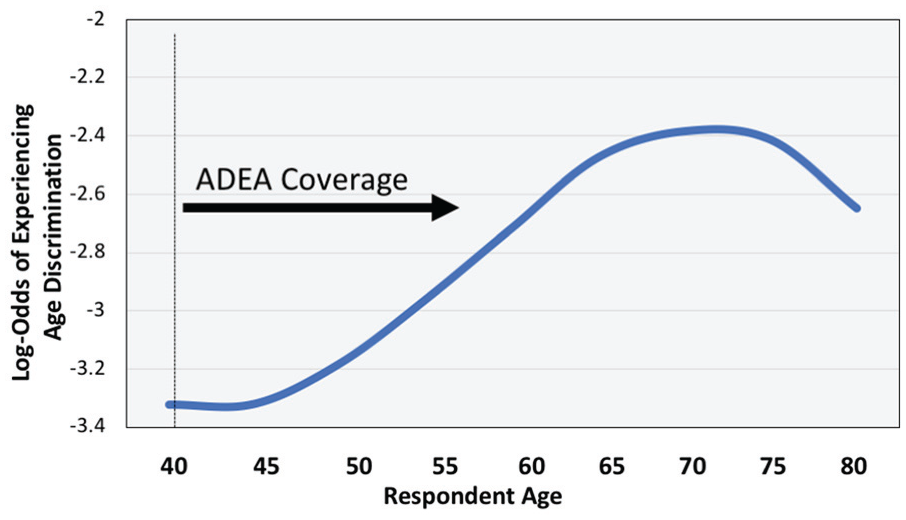
Likelihood of experiencing age discrimination by respondent age for those 40 and older (covered by the Age Discrimination in Employment Act [ADEA]).
Nonsignificant findings from model 1 are likewise informative and suggest that racial discrimination, generally, affects women and men of various ages more or less uniformly, gender discrimination cuts across black and white individuals and age groups similarly, and age discrimination cuts generally across gender and racial lines. Supplementary analyses reported in Table A1 in the Appendix, drawing on the 2016 GSS’s more temporally specific measurement of discrimination (i.e., over the past five years), show largely parallel patterns. 13 Among controls in Table 2, reports of race and gender discrimination in employment appear to be more pronounced in larger organizations, while those working or residing in rural areas and/or who are part of the 2010 and 2014 GSS waves are less likely to report such experiences. These patterns by rurality and time period are especially applicable when it comes to gender discrimination, sexual harassment and age discrimination.
Model 2 in Table 2 introduces occupational position and horizontal and vertical relations. These do little to explain away the unique and more general status effects, yet their significance across outcomes and contributions to the overall explanatory power the models clearly indicate relevance. Earlier it was suggested (via countervailing hypotheses) that occupational positioning and workplace relations might either provide cover or bolster the likelihood of discriminatory or harassing treatment. Both possibilities are observed. High occupational status increases the overall likelihood of gender and age discrimination, suggesting heightened status competition in the upper occupational ranks and an intensification of social closure pressures. Notably, there are no clear or statistically significant effects of occupational position on either racial discrimination or sexual harassment, suggesting that these two forms of workplace injustice operate uniformly across the occupational hierarchy.
Horizontal and vertical relations on the job exhibit clear and mostly uniform effects in the expected directions. Specifically, coworker cohesion reduces the likelihood of all four outcomes and reaches statistical significance for three of the four. This is, by and large, consistent with prior literature and findings on work group integration, cohesion, and the ameliorative protections it might offer (e.g., Ely 2004; Kalev 2009; Payne et al. 2013). Poor supervisory relations, in comparison, intensify vulnerability across each of the four outcomes modeled. The extent to which these observed effects are conditional by race/ethnicity, gender, and age is examined momentarily.
The fact that neither occupational status nor coworker relations have a discernable impact on the likelihood of sexual harassment, whereas poor supervisory relations do, suggests that power relations and particularly the vertical character of workplace relations are consequential. Such importance lies not so much in protections but rather as a proximate interaction that, when negative, intensifies vulnerability directly or indirectly for those underneath the supervisor. Along these lines, and as noted earlier, negative supervisory relations can be influential through the shaping of justice perceptions, oversight or lack thereof, or more directly through the sexually harassing behaviors of supervisors themselves (Roscigno 2007). The fact that occupational status itself does not reduce or intensify the experience of sexual harassment implies general effects across the occupational hierarchy. This runs counter, to some extent, to the argument that women in more powerful positions are either protected or are more vulnerable. Instead, such vulnerability seems to cut across high and low occupational ranks at nearly equal levels and is more often shaped by the character and quality of immediate supervision.
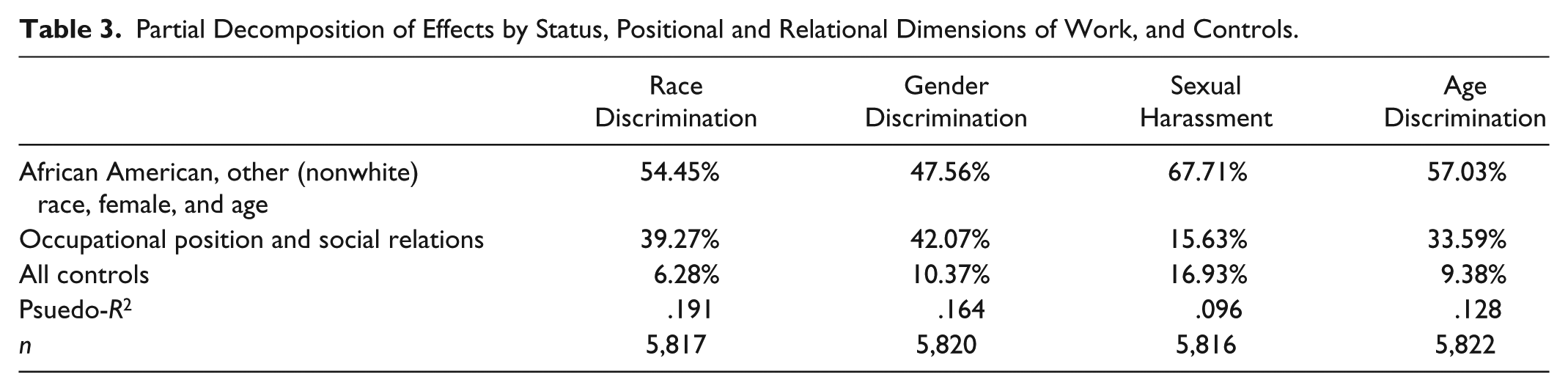
A simple summary decomposition of the findings reported thus far, derived from separate modeling of controls, status attributes, and occupational position and workplace relational effects, is offered in Table 3. 14 Such summary statistics reveal the clear predominance and explanatory power of race, gender, and age but also occupational position and workplace relations compared with the controls. Race/ethnicity, gender, and age explain a notable 54 percent to 68 percent of the overall variation captured in the prior modeling of discrimination and sexual harassment, followed by occupational status and workplace relational effects (16 percent to 42 percent). Controls surrounding time on the job, organizational size, sector, region, urbanicity or rurality, and GSS wave, in contrast, account for only 6 percent to 17 percent of the overall variation explained.
Partial Decomposition of Effects by Status, Positional and Relational Dimensions of Work, and Controls.
Supplementary and parallel analyses using linear modeling with robust standard errors, reported in Table A2 in the Appendix, reveal a high degree of directional consistency and statistical significance with the patterns thus far reported. This includes observed patterns of discrimination and sexual harassment by race, gender and age, but also (1) heightened vulnerability to gender and age discrimination among those in higher occupational positions; (2) stable, mitigating effects of good coworker relations on the likelihood of unjust workplace encounters; and (3) amplified liabilities surrounding poor supervisory relations. Further consideration of interactions, reported next, helps clarify these patterns even further.
Conditional Effects of Occupational Position and Workplace Relational Power by Race, Gender, and Age
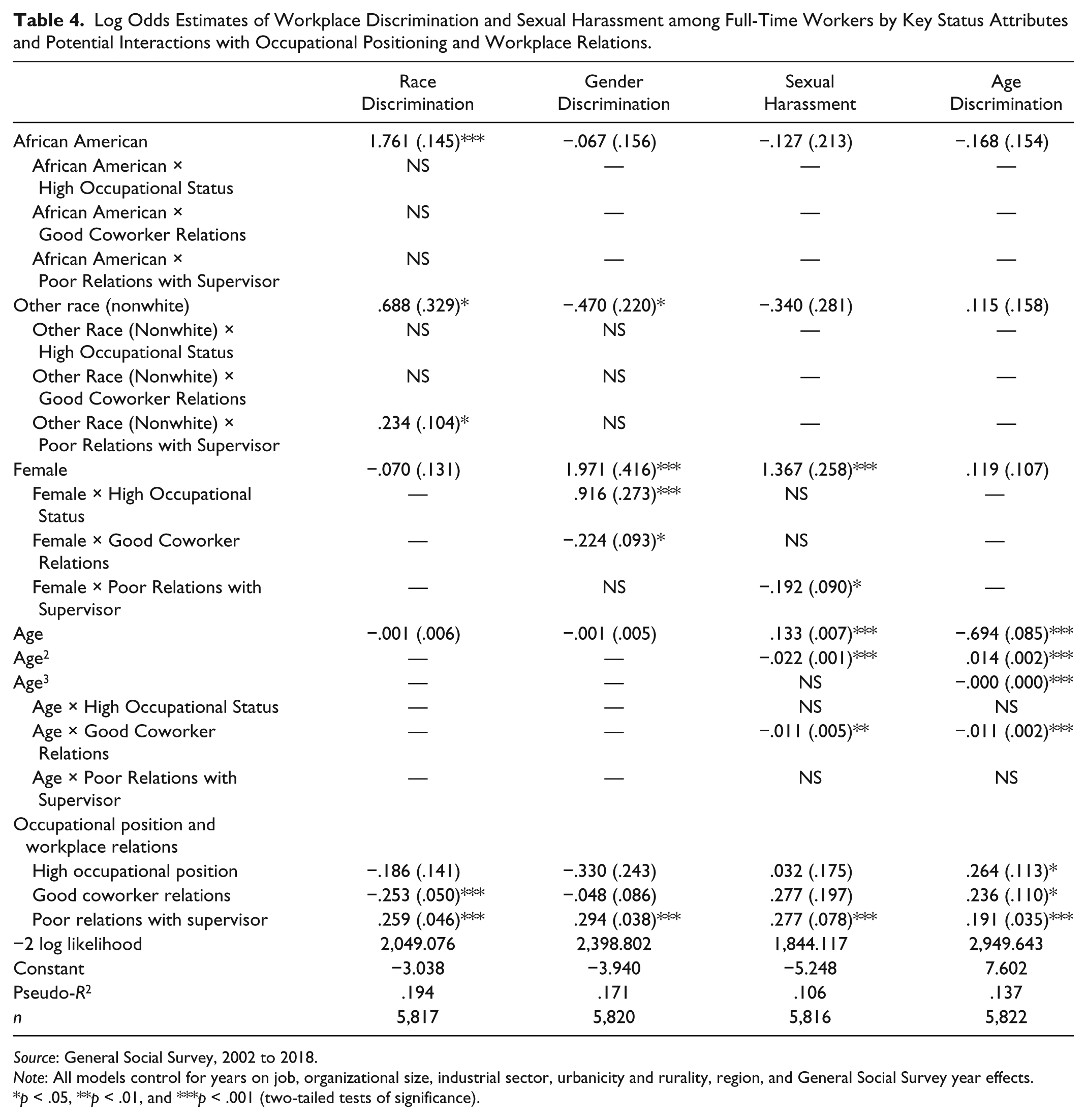
Table 4 reports trimmed interactional models that relate how, if at all, observed vulnerabilities by race, gender and age vary across the occupational hierarchy and/or depending on the character of coworker and supervisory relations. Tests for interactions were limited to and determined by the prevalent and statistically significant effects observed and reported earlier in Table 2.
Log Odds Estimates of Workplace Discrimination and Sexual Harassment among Full-Time Workers by Key Status Attributes and Potential Interactions with Occupational Positioning and Workplace Relations.
Source: General Social Survey, 2002 to 2018.
Note: All models control for years on job, organizational size, industrial sector, urbanicity and rurality, region, and General Social Survey year effects.
p < .05, **p < .01, and ***p < .001 (two-tailed tests of significance).
Several important conditional associations are evident. Earlier it was observed that those in higher occupational positions are more vulnerable when it comes to gender discrimination and age discrimination. The conditional modeling shows this to be the case, most notably for women and gender discrimination. In fact, the baseline coefficients and significant interaction, when taken together, suggest that the vulnerability in higher ranked occupations is precisely absorbed by women. Although all women are vulnerable to gender discrimination in the workplace, those of high occupational rank are observed to be about 2.5 times even more likely to encounter it. Conditional effects surrounding age and occupational positioning do not reach statistical significance when it comes to age discrimination, although the overall vulnerability to age discrimination within high occupational positions, captured by the baseline coefficient, remains significant.
Horizontal and vertical relations similarly have interesting and observable conditional effects, as noted in Table 4. Baseline effects of poor supervisory relations persist across the board but are elevated even further for those of other nonwhite racial groups experiencing racial discrimination and mitigated somewhat, although not entirely, for women experiencing sexual harassment. This conditional impact for women is somewhat puzzling, although it may be related to either women’s self-selection out of hostile environments in which sexual harassment occurs or amplified sensitivity to abusive or problematic supervisors among the small population of men experiencing sexual harassment according to self-reports in these data. 15 The first possibility is difficult to assess without longitudinal data, while the second is supported to some extent by recent work highlighting gender variations in the effects of vertical versus horizontal features of workplace environments and, specifically, the particularly pronounced and negative reactions men have to what they perceive as unjust supervision (see, e.g., Roscigno et al. 2018).
Like supervisory relations, good coworker relations clearly matter in important ways. They matter both directly (for reducing the incidence of reported race and age discrimination) and conditionally for women and gender discrimination, age and sexual harassment, and for aging worker’s experiences of age discrimination. Importantly, and in each of these regards, good coworker relations provide a protective buffer. For instance, the benefits of coworker cohesion accrue to women specifically and reduce the likelihood of gender discrimination according to the modeling and the conditional effects reported. Likewise, good coworker relations in conjunction with age reduce the likelihood of sexually harassing encounters as well as the reported incidence of age discrimination among older workers.
Conclusions
The sociological literature has been clear for quite some time that discrimination in employment and the inequality it generates are fundamental to stratification, justice, and life chances. Specific streams of contemporary research, in focusing on either a particular axis (i.e., gender, race, and age) or a discrete form of social closure (i.e., hiring, sexual harassment, etc.), have followed through and provided tremendously valuable insights on key dimensions and select processes through which such disadvantage is generated. Relative to general conceptions and according to scholars such as Ridgeway (2014), however, the literature has tended to lose sight of status vulnerability’s multipronged character as well as the ways in which it is fundamentally relational and power laden in activation and use. In an effort to address this, I have bridged in this article otherwise discrete literatures and drawn on rich, multiwave data from the GSS to consider race, gender, and age and the degree to which occupational positioning and coworker and supervisor relations bolster or mitigate vulnerabilities to workplace discrimination and sexual harassment.
My analyses suggest, and quite clearly, multiple, pronounced, and contemporary status vulnerabilities in the sphere of employment. Most notably, racial/ethnic minorities across the occupational hierarchy experience race-specific discrimination at a rate 4 to 6 times higher than their white counterparts; women are 3 to 4 times more likely, respectively, than their male peers to experience gender discrimination and sexual harassment; and workers in their 50s and 60s are significantly more likely to experience age discrimination. Such status vulnerabilities occur simultaneously in the realm of employment and reflect a three-fold hierarchical status system. 16
I temper such conclusions, of course, with recognition that my analyses focus on the likelihood of discrimination and sexual harassment rather than detailed experiences associated with unjust treatment, the processes leading up to discrimination or sexual harassment, and/or the justifications underlying unfair actions aimed at minority, female, or aging employees. In all three regards, one can easily imagine scenarios within which biases and status-based assumptions were tied not only to a singular status but possibly multiple statuses, in which case intersectional processes become relevant. Some work has begun to capture intersectional processes preceding what seem to be, at face value, otherwise similar objective workplace outcomes (Chavez and Wingfield 2018; Harnois 2015; Ortiz and Roscigno 2009) and/or unique assumptions and rationales underlying unequal actions by gatekeepers (Berrey et al. 2017; Light et al. 2011). Deeper immersion in the future, through qualitative and case-specific analyses, would be helpful and likely uncover clearer patterns of intersectional spillover.
Status vulnerabilities by race/ethnicity, gender, and age, in and of themselves, account for a sizable share of the variation explained in the four workplace injustice outcomes analyzed (between 47 percent and 67 percent), followed by occupational position and workplace relations (between 15 percent and 42 percent of the variation explained) and controls (between 6 percent and 17 percent of the variation explained). This bolsters confidence in the assertion that status, and the vulnerabilities it creates, are tremendously influential to inequality production and should be treated as such, both theoretically and analytically. Indeed, conceptualization should make clear that status is fundamentally a social, cultural, and relational construct, imbued with power and valuation, and activated in meaningful ways that simultaneously confers advantage and vulnerability.
Workplace power and the relational (and potentially conditional) nature of vulnerability, one of the primary foci and contributions in this article, was likewise considered with the inclusion of occupational positioning and workplace relations, each of which were important directly or conditionally. Prior work has implied that occupational positioning and relations with coworkers and supervisors are, at their core, about workplace power and thus might offer protective cover to those who are status vulnerable or, conversely, can amplify susceptibilities to unjust treatment. Part of the problem in assessing these possibilities lies in a general lack of data on both workplace injustice and occupational status and relations but also reporting biases surrounding discriminatory and harassing experiences—biases due to bureaucratic and legal vetting that consequently reduce the representation of those in weaker positions. Survey data partially overcome these problems while also offering significant heterogeneity across the occupational hierarchy.
Notable throughout my analyses and across outcomes is that good relations with coworkers nearly uniformly reduce while poor supervisory relations consistently bolster the likelihood of discriminatory and harassing encounters on the job. Although these do little in the way of mediating observed status vulnerabilities, the consistent effects of vertical and horizontal relations are nevertheless noteworthy and thus should be taken seriously future work. Prior research surrounding intragroup appraisal, networks, and interaction (Melamed and Simpson 2016; Webster and Sobieszek 1974; Webster, Whitmeyer, and Rashotte 2004), work team integration and the potential reduction in biases and group divisions it may afford (e.g., Ely 2004; Kalev 2009; Payne et al. 2013), and normative standards, procedural expectations, and behavioral actions of immediate supervisors (e.g., Hodson 2001; Maume et al. 2013) would be especially useful starting points, especially if integrated with research on concrete aspects of workplace policy and inequality.
Occupational positioning, also considered explicitly within my analyses, is likewise meaningful for experiences of workplace discrimination and sexual harassment. Its impact, however, is quite variable. Some of the observed effects of high occupational position are relatively direct and negative. For gender and age discrimination, for instance, findings suggested that individuals of higher occupational rank are more vulnerable. Interaction modeling helped clarify these patterns to some extent, revealing that all women are vulnerable to gender discrimination, yet the effect is magnified for those of higher occupational rank (a pattern suggesting heightened [and gendered] social closure pressures in more advantaged positions); racial discrimination in employment is not directly or conditionally affected by occupational status, suggesting minority vulnerability across the occupational hierarchy; and those occupying higher status occupational positions are more likely to encounter age discrimination. The fact that no conditional effects surrounding occupational positioning were observed for sexual harassment suggests a general vulnerability for women across the occupational hierarchy. 17 Further work in this last regard is surely needed. Particularly useful would be efforts to systematically disentangle possible effects of occupational positioning and authority from those associated with working in numerically male-dominated establishments and/or traditionally male occupational domains (wherein gendered displays and expressions of power are and will be more intense).
The representative data and analyses in this article, with pertinent outcomes surrounding discrimination and sexual harassment and rich indicators of status, occupational positioning and workplace relations, contribute to broader, synthetic efforts within the stratification literature to recognize the ongoing and contemporary relevance of status, interactional processes, and proximate power within everyday encounters. Further attention moving forward to how and why status vulnerabilities persist and how they might be ameliorated by more effective integration and/or policies that undercut vertical tensions would be useful in helping fill some of the important theoretical “black boxes” that remain in literatures on inequality, exclusion, and organizational life. Future data collection efforts and analytic designs, for instance, could be more sensitive to issues of temporal sequence and causality, one of the limitations of my analyses. Ideally, the same workers could be followed over time, pinpointing especially the timing of discriminatory or harassing encounters relative to change at policy, relational, and/or structural levels (see, e.g., Kalev 2014; Kelly et al. 2014).
Attention to status vulnerability but also positionality, power, and the relations that undergird them within the workplace should, of course, in no way be taken as a critique of research focusing on a singular axis of disadvantage or a unique point or mechanism of social closure. The field has developed in a manner encouraging both specialized expertise and the adoption of new and novel methods that may be well-suited to interrogating a particular cause or even axis of inequality. We can and have learned a lot, to be sure, about race and gender job exclusion from audit and experimental studies, and we continue to be afforded significant insights on gender, race, and age inequality from both qualitative and case-analytic approaches to, for example, sexual harassment and job termination. It is nevertheless essential, in my view, that sociological scholarship not lose sight of the centrality and multipronged character of status vulnerability, positionality, and relational power within institutional and organizational environments—vulnerability, positionality, and power that, when considered broadly and systematically relative to the analyses used, will provide a much more comprehensive sociological understanding of inequality production and social justice.
Footnotes
Appendix
Generalized Linear Model Estimates (Robust Standard Errors) of Discrimination and Sexual Harassment among Full-Time Workers by Key Status Attributes, Occupational Position and Workplace Relations, and Controls, 2002 to 2018.

| Racial Discrimination | Gender Discrimination | Sexual Harassment | Age Discrimination | |||||
|---|---|---|---|---|---|---|---|---|
| Model (1) | Model (2) | Model (1) | Model (2) | Model (1) | Model (2) | Model (1) | Model (2) | |
| African American | .125 (.014)*** | .117 (.013)*** | −.000 (.011) | −.003 (.010) | .001 (.008) | −.001 (.008) | −.010 (.011) | −.013 (.019) |
| Other (nonwhite) race | .070 (.013)*** | .060 (.013)*** | −.016 (.010) | −.023 (.010)* | −.008 (.007) | −.010 (.007) | .012 (.013) | .005 (.013) |
| Female | −.001 (.006) | .000 (.006) | .079 (.007)*** | .079 (.007)*** | .028 (.005)*** | .028 (.005)*** | .008 (.008) | .009 (.008) |
| Age | .000 (.000) | .000 (.000) | .000 (.000) | .000 (.000) | −.001 (.000)*** | −.001 (.000)*** | −.073 (.008)*** | −.075 (.008)*** |
| Age2 | .001 (.000)*** | .001 (.000)*** | ||||||
| Age3 | .000 (.000)*** | −.000 (.000)*** | ||||||
| Occupational position and workplace relations | ||||||||
| High occupational position | −.009 (.006) | .020 (.007)** | .001 (.005) | .017 (.008)* | ||||
| Good coworker relations | −.015 (.003)*** | −.015 (.004)*** | −.003 (.002) | −.018 (.004)*** | ||||
| Poor relations with supervisor | .019 (.003)*** | .020 (.003)*** | .006 (.002)** | .016 (.003)*** | ||||
| Time on the job | .000 (.000) | .000 (.008) | .000 (.000) | .000 (.000) | .000 (.000)* | .000 (.000)* | −.001 (.000)** | −.001 (.000)** |
| (Ln) organizational size | .004 (.002)** | .004 (.002)* | .004 (.002)** | .002 (.002) | .000 (.001) | −.001 (.001) | .003 (.002) | .001 (.002) |
| Sector (reference: extractive and other) | ||||||||
| Core | .013 (.015) | .004 (.015) | .008 (.013) | .003 (.013) | −.012 (.010) | −.014 (.010) | .000 (.012) | −.006 (.018) |
| High-wage service | .020 (.015) | .022 (.015) | .020 (.013) | .016 (.013) | −.012 (.009) | −.012 (.009) | −.019 (.017) | −.022 (.017) |
| Low-wage service | .013 (.015) | .007 (.015) | .011 (.013) | .009 (.013) | −.003 (.010) | −.005 (.010) | −.003 (.018) | −.005 (.017) |
| Public sector (reference: private) | .013 (.010) | .012 (.009) | .018 (.010) | .015 (.010) | −.003 (.006) | −.003 (.006) | .024 (.011)* | .021 (.011)* |
| Residence (reference: suburban) | ||||||||
| Urban | −.006 (.007) | −.007 (.007) | −.002 (.007) | .000 (.017) | −.004 (.005) | −.003 (.005) | −.006 (.008) | −.005 (.008) |
| Rural | −.018 (.009)* | −.017 (.009) | −.027 (.010)** | −.022 (.010)* | −.010 (.008) | −.009 (.008) | −.045 (.011)*** | −.040 (.011)*** |
| Region (reference: Midwest) | ||||||||
| Northeast | .002 (.009) | −.003 (.009) | −.007 (.010) | −.013 (.010) | −.008 (.007) | −.010 (.007) | .000 (.012) | −.005 (.012) |
| South | .005 (.008) | .005 (.008) | −.002 (.009) | −.003 (.009) | .010 (.007) | .010 (.007) | −.002 (.010) | −.002 (.010) |
| West | .003 (.008) | .007 (.008) | −.013 (.009) | −.010 (.009) | −.003 (.006) | −.002 (.006) | −.004 (.010) | .000 (.010) |
| GSS year (reference: 2002) | ||||||||
| 2006 | −.012 (.008) | −.013 (.008) | −.010 (.009) | −.012 (.009) | −.018 (.007) | −.019 (.007)** | .000 (.010) | −.001 (.010) |
| 2010 | −.009 (.009) | −.011 (.009) | −.027 (.010)** | −.030 (.010)** | −.026 (.007)*** | −.026 (.007)*** | −.013 (.011) | −.015 (.011) |
| 2014 | −.019 (.009)* | −.019 (.009)* | −.022 (.010)* | −.022 (.010)* | −.019 (.007)** | −.019 (.007)** | −.030 (.011)** | −.030 (.010)** |
| 2018 | −.005 (.009) | −.002 (.009) | −.011 (.010) | −.009 (.010) | −.015 (.008)* | −.014 (.007) | −.016 (.011) | .014 (.011) |
| Constant | .011 | .053 | .027 | .061 | .098 | .104 | 1.238 | .212 |
Source: General Social Survey, 2002 to 2018.
p < .05, **p < .01, and ***p < .001 (two-tailed tests of significance).
Acknowledgements
I wish to thank Donald Tomaskovic-Devey, Alexandra Kalev, David Melamed, Toni Calasanti, Carsten Sauer, and the editors and anonymous reviewers of Socius for their helpful comments on an earlier draft.
1
The push for more synthetic or generalizable approaches is not to suggest that specific status vulnerabilities (regarding, for instance, race, gender, or age) are not grounded in unique cultural or ideological beliefs. They surely are. The general point, however, is that they also have important parallels when it comes to their use in everyday interaction and/or inequality creation.
2
Another important addendum, and one not thoroughly explored in this article, derives from perspectives that draw attention to intersectional vulnerabilities (e.g., Allison and Banerjee 2014; Choo and Marx Ferree 2010; Collins 2010). Such scholarship suggests that status vulnerabilities, rather than necessarily mattering in unique, singular ways, might generate compounding disadvantages (e.g., Browne and Misra 2003; Harnois 2015; McCall 2005). My analyses are somewhat limited in the ability to tackle such possibilities, although they are somewhat helpful in reporting variations in discrimination and harassment across race, gender and age groups simultaneously. I caveat any interpretations in these regards, however, with explicit recognition that the outcomes analyzed center on the likelihood of experiencing unjust treatment rather than on how precisely that injustice was experienced or the underlying rationales perpetrators use to justify discriminatory and harassing conduct, important points that I revisit in my conclusions. For a more detailed treatment of intersectional patterns using GSS data, see  .
.
3
It is important to distinguish my argument regarding status-based social closure via discrimination and sexual harassment, including potential variations in occurrence by high and low occupational positioning, from the more general sociological usage of occupational closure, that is, social and legal barriers around occupations, such licensing, educational credentialing, voluntary certification, association representation and unionization, that restrict the labor supply, enhance demand, boost prestige, and so on (in this regard, see especially ). The analyses that follow, to be clear, are not occupationally specific, nor do they highlight systemic, general, or bureaucratic barriers to particular occupations. Rather, I analyze the patterning of employment-based discrimination and harassment by race/ethnicity, gender, and age (or what I comfortably interpret and refer to as status-based social closure) and how it is more or less likely within high- and low-ranked occupational positions. Future theoretical and empirical work that explicitly grapples with overlap between status-based and occupational closure, especially in relation to female and minority movements into previously segregated occupational domains, would undoubtedly be worthwhile and most likely reveal how mechanisms of closure shift between more bureaucratic and status-based forms as well as how, in fact, they may not be so mutually exclusive.
4
There is little in the way of missing data overall, with no indicator missing more than 10 percent of responses.
5
In considering causal interpretation, it is also difficult to conceive of a process wherein those of a particular status or those with an inclination to recognize unjust treatment would somehow self-select into workplace environments on the basis of whether good or poor horizontal or vertical relations exist.
6
A more temporally specific version of workplace discrimination questions was asked of respondents in the 2016 GSS: “Over the past five years, have you been discriminated against with regard to work, for instance when applying for a job, or when being considered for a pay increase or promotion?” This question, when combined with another, “In your opinion, what was the main reason for the discrimination?” allows the creation of somewhat parallel indicators of racial/ethnic, gender, and age discrimination. Because of both the temporal character of the 2016 question and the noninclusion of workplace relational indicators in 2016, however, I draw on the 2002, 2006, 2010, 2014, and 2018 waves. Supplementary analyses of the 2016 data, offered in the and discussed in my analytic strategy section, reveal largely parallel results regarding status vulnerabilities.
7
Initially, I was concerned that gender discrimination and sexual harassment may significantly overlap. Supplementary analyses and correlations, however, suggest that such overlap is minimal and that these indicators are capturing unique phenomena. Sexual harassment and gender discrimination are related at only 0.21.
8
Younger workers often report being discriminated against because of their age, but only those older than 40 are legally protected from age discrimination. This suggests a probable curvilinear relationship in self-reports of age discrimination, which is indeed shown in my analyses and examined with squared and cubed terms. The most important part of the curvilinear relationship, legally speaking, is that for workers 40 years and older, something earmarked in the present.
9
Core sector employment includes industries such as construction, manufacturing, materials and food processing, communications, and transportation. High-wage service sector employment entails industries such finance and banking, administration, wholesale sales, justice and law, management and scientific consulting, and so on. Low-wage service sector employment includes retail sales, administrative and educational support services, health and related support services, childcare, food services, and other personal services. The referent excluded from the modeling includes extractive industries and others that do not fit into the designations above.
10
In this regard, Hout and Hastings were referring to the GSS questions regarding attributions respondents make surrounding race or gender inequality generally, not reports of whether they have personally experienced status-based discrimination: the core of my focus. Nevertheless, the caution they offer regarding variability across waves in the reliability of particular indicators is well heeded and reflected in my inclusion of these controls.
11
Although my analyses cannot directly interrogate detailed occupational closure, significant interactions between occupational positioning and status attributes when it comes to the likelihood of experiencing workplace discrimination and sexual harassment can nevertheless be interpreted as patterned gender-, race-, and age-based social closure at high or low occupational ranks.
12
Younger workers often and report age discrimination in firsthand and survey accounts, and this is no less true with the GSS data. Unlike coverage regarding race and gender discrimination, which has universal applicability to all employed individuals, age discrimination coverage is more specific and applies only to those 40 and older. It is for this reason that I restrict the graphical representation in to those 40 and older, covered the Age Discrimination in Employment Act.
13
There are two differences worth noting in these supplementary analyses. First, women are somewhat as less likely to report experiencing racial discrimination, and younger workers are more likely to have experienced gender discrimination in 2016. These differences may be due to the temporal character of the 2016 questions, although in the latter case (i.e., age and gender discrimination), the pattern observed closely resembles my current findings regarding sexual harassment. Thus, it could be that the significance of age on gender discrimination in the 2016 data may be because respondents are including sexual harassment in their conception of gender discrimination. The 2002 through 2018 GSS waves, upon which my primary analyses focus, tease these apart, while the 2016 data do not include an indicator of sexual harassment.
14
These summary estimates are derived from staged modeling wherein the three respective clusters are introduced independently.
15
Within the GSS data and my analyses, 57 men (or approximately 1.8 of the overall male subsample) reported experiencing sexual harassment at their current jobs, compared with 131 women (or approximately 5 percent of the female subsample).
16
A few intersectional patterns are certainly observed, but these are much weaker compared with the general vulnerabilities captured by the main and independent effects of race/ethnicity, gender, and age. Most prominent in my analyses were those surrounding racially/ethnically “other” women and somewhat lower levels of reported gender discrimination and younger workers and greater vulnerability to sexual harassment.
17
This is in contrast to some recent work suggesting that higher status women, particularly those in supervisory positions, will somehow be more vulnerable to sexual harassment (McLaughlin et al. 2012). I do not close off the possibility that holding a supervisory position may generate greater vulnerability. It remains unclear, however, as to whether it is women’s positionality as supervisors or their more general location in numerically male-dominated establishments and/or in normatively male occupational fields (e.g., police officer, construction worker) that drive such patterns (see ). It is also the case that higher status women have the resources, knowledge, and efficacy to report at higher rates than lower status women and/or that the experience of sexual harassment may be a more salient dimension of injustice for higher status, educated women who are climbing mobility ladders. The use of nationally representative survey data on full-time workers across the entire age distribution arguably overcomes some of the reporting bias in these regards.