




Abstract
The 2021 Census of England and Wales was one of the first in the world to ascertain the gender identity of an entire population. This article argues that its results are implausible with regard to geography, language, education, ethnicity, and religion. The results contradict data on referrals to gender clinics and signatures on a pro-transgender petition. The results are also internally inconsistent when the various categories of gender identity are correlated across localities, and when compared with sexual orientation. The spurious results were produced by a flawed question, which originated with a transgender campaigning organization. The question evidently confused a substantial number of respondents who erroneously declared their gender identity to differ from their natal sex. Confusion is manifested in the overrepresentation of people lacking English proficiency in the most suspect gender categories. These findings demonstrate how a faulty question can distort our apprehension of the social world.
As the number of people identifying as transgender increases, it becomes more important for them to be counted in social statistics. The earliest representative sample surveys to elicit this information were conducted in the United States in 2007 and New Zealand in 2012 (Clark et al., 2014; Conron et al., 2012). These directly asked the respondent whether they were transgender. An alternative was to infer transgender status indirectly from successive questions on the respondent’s sex and their gender identity. This two-step method was deployed in representative sample surveys in the United States from 2016 onwards (e.g. Wilkinson et al., 2021) and in the 2021 Census of Canada. When the Office for National Statistics (ONS) counted transgender adults in the 2021 Census of England and Wales, it eschewed both of these accepted methods. Instead, it asked ‘Is the gender you identify with the same as your sex registered at birth?’ Of residents aged 16 years and over, 0.54% answered in the negative. ONS presented these results as ‘the first official data on the size of the transgender population’ (Office for National Statistics, 2023c).
These official data are scrutinized in this article. This assessment contributes to growing methodological interest in the measurement of gender identity (Currah and Stryker, 2015; Fraser et al., 2020; Lindqvist et al., 2021; Snyder et al., 2022). The relative priority of gender versus sex has been especially contentious. Some social scientists insist on collecting data on sex, defined as a binary biological distinction between male and female (Sullivan, 2020; Sullivan et al., 2023). Others prefer to collect information on gender as subjectively understood by the respondent, encompassing multifarious identities that transcend the binary of sex (Collier and Cowan, 2022; Fugard, 2020; Guyan, 2022; Hines, 2020). Evaluating the validity of data on gender identity in England and Wales is essential because the statistical portrait of society provided by the decennial census is taken as authoritative. Beyond the 2021 Census, the same question on gender identity is being standardized for surveys in England and Wales, and so will be generating data on the trans population for the foreseeable future (GSS Harmonisation Team, 2022).
The article proceeds as follows. The first section investigates the genealogy of the question on gender identity, tracing its origins to a transgender campaigning organization. The question had been found very confusing for non-transgender respondents, but ONS ignored this finding, because it was concerned only with the question’s acceptability to trans people. The second section scrutinizes the various transgender categories produced by ONS. Some categories reflected what the respondent wrote in the optional free-text field for gender identity, like ‘nonbinary’, and so are valid. Other valid categories can be constructed by cross-referencing the answer to the separate sex question. Unfortunately, most respondents classified as transgender by ONS are in three categories of dubious validity. The third section of the article investigates the geographical distribution of gender categories across the 331 local authorities in England and Wales. The proportion of residents with low English proficiency is strongly correlated with the proportion of residents in the dubious gender categories. The fourth section examines individual characteristics, including English proficiency, educational qualifications, ethnicity and religion. Bivariate comparisons underline the implausibility of the dubious gender categories, reinforced by comparison with data on referrals to gender clinics. The fifth section estimates the numerical impact of these errors and compares the results for sexual orientation.
In geographical scope, this article is confined to England and Wales. The Scottish Census diverged significantly (Guyan, 2022; Murray and Hunter Blackburn, 2019). National Records Scotland chose a different question: ‘Do you consider yourself to be trans, or have a trans history?’ Enumeration there was postponed for a year and suffered an unprecedently low rate of completion (Smith, 2022); the results have not been released yet. No question on gender was asked in Northern Ireland. With regard to terminology, this article will use ‘trans’ and ‘transgender’ interchangeably to denote someone who if asked ‘are you transgender?’ would respond in the affirmative.
Origins of the Census Question
In the first decade of the 21st century, the Labour government augmented Britain’s equality legislation and its associated bureaucratic apparatus, creating the Equality and Human Rights Commission and passing the Equality Act. As new categories of person emerged as claimants for state intervention, so statistical agencies sought to count them (Aspinall and Mitton, 2008). The influential Equalities Review highlighted the ‘lack of robust data on inequality within certain groups, most notably sexual orientation and transgender’ (Equalities Review Panel, 2007: 95). Collecting ‘trans data’ from households was initially considered infeasible, due to privacy concerns and to small numbers (Office for National Statistics, 2009). Within a few years, however, there was sufficient demand to prepare a new question on gender identity for the 2021 Census, along with one on sexual orientation (Office for National Statistics, 2016).
Unlike sexual orientation, gender identity has no basis in the Equality Act 2010. The legally protected category is ‘gender reassignment’, defined as someone who ‘is proposing to undergo, is undergoing or has undergone a process (or part of a process) for the purpose of reassigning the person’s sex by changing physiological or other attributes of sex’ (section 7.1). This cumbersome definition, using phrasing from a regulation promulgated in 1999, was already outdated by the time the law was passed. Therefore, ONS formulated its own definition. Borrowing terminology from the Women and Equalities Committee of the House of Commons (2016), it defined trans people ‘as those whose gender identities do not match the sex assigned at birth’; gender identities included female, male, nonbinary and non-gendered (Office for National Statistics, 2016: 4).
Given this definition, the question ultimately selected for the Census – ‘Is the gender you identify with the same as your sex registered at birth?’ – might seem to follow naturally. In fact, however, its selection was a lengthy and contingent process. The genealogy is traced in Table 1. The question was originally proposed in 2007 by Press for Change, the first transgender campaigning organization to achieve political influence. For monitoring the number of trans people in an organization, it recommended asking ‘Is your gender identity the same as the gender you were assigned at birth?’ Asking whether the respondent was transgender was inappropriate, according to Press for Change, because ‘Different trans people describe themselves with different labels and what one person adopts happily [sic] offends another’ (Press for Change, 2007).
Genealogy of the question on gender identity in the 2021 Census of England and Wales.
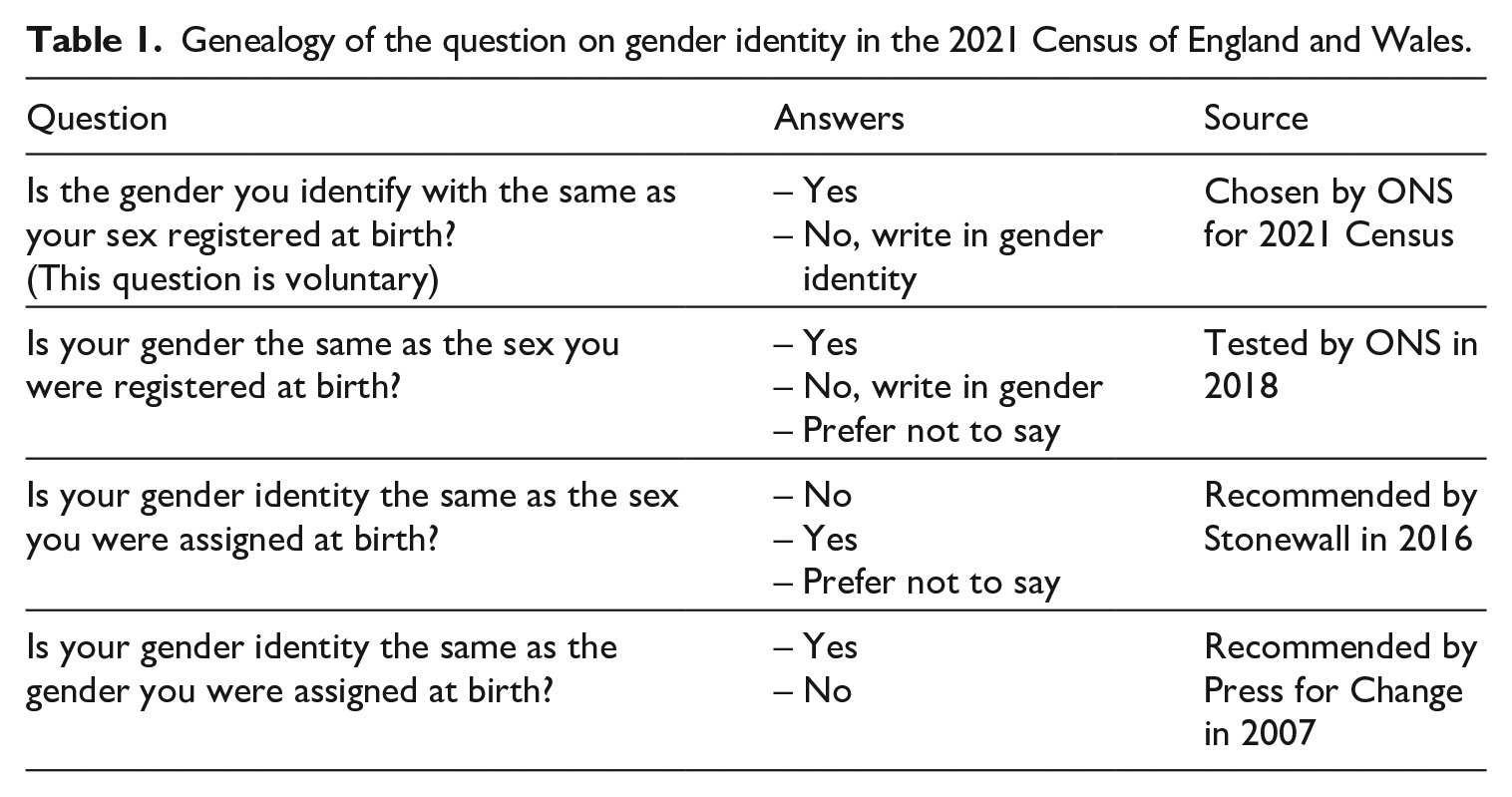
This question was among those tested by NatCen (a not-for-profit research organization) on behalf of the Equality and Human Rights Commission (Balarajan et al., 2011). A non-transgender focus group (numbering 35) found the question ‘very confusing’. The verdict from a transgender group (numbering 30) was mixed, but they ‘accepted that non-trans people would not understand the question, especially if first language [sic] was not English’ (Balarajan et al., 2011: 60–61). NatCen therefore rejected this question and recommended a different approach: a question on sex followed by a question on ‘how you think of yourself’ with the answer chosen from male, female or ‘another way’. This approach anticipated the two-step method that soon became widely adopted in social and medical research in North America (GenIUSS Group, 2014; Reisner et al., 2014; Tate et al., 2013). This method comprises two questions: one on sex, phrased in the past tense as ‘assigned at birth’; and one on current gender identity, with options including male, female, and a free-text field.
This two-step method was considered by ONS when testing potential questions in 2017. It was rejected, however, following ‘18 cognitive interviews with transgender participants’ (Office for National Statistics, 2020). One problem was that ONS intended to repeat the sex question from the 2011 Census – ‘what is your sex?’ – rather than using the euphemism of ‘assigned’. Therefore ‘trans participants reported their gender identity in both the sex and the gender questions’. The participants also rejected this two-step method as ‘underhand’ because it did not explicitly ask about the respondent’s transgender status. Such suspicion is curious given that the two-step method was eventually recommended by the National Academies of Science, Engineering and Medicine and by transgender advocates in the United States (Bates et al., 2022; Kronk et al., 2022), and it was adopted for the 2021 Census of Canada.
Having rejected the two-step method, ONS tested two alternatives. The first was a variant of Press for Change’s question, as transmitted by Stonewall. Originally an organization campaigning for gays and lesbians, Stonewall embraced the transgender cause after same-sex marriage was legalized. In advising employers, it recommended the question from Press for Change, albeit with ‘sex’ substituted for the second occurrence of the word ‘gender’ (Stonewall, 2016: 22). ONS in turn substituted ‘registered’ for ‘assigned’. The second question tested by ONS was ‘do you consider yourself trans or have a trans history?’ The clumsy formulation was evidently intended to address Stonewall’s concern that simply asking respondents whether they are transgender would not capture those ‘who have transitioned but do not consider trans to be a part of their identity’ (Stonewall, 2016: 21). ONS evaluated these two questions ‘via community testing at LGBT History Month events’ in 2018 (Office for National Statistics, 2020). The second question was rejected for various reasons. Some interpreted ‘trans history’ to imply that people could detransition, which is anathema in transgender communities. Some objected to the word ‘consider’. And some nonbinaries felt excluded from the ‘trans’ category. Curiously, the very same question when tested in Scotland was determined to ‘produce good quality data’ (Guyan, 2022: 80).
Throughout the years of question development by ONS, the only documented concern was how the question could be interpreted by trans people. That is why the question needed to capture even ‘people who have fully transitioned to a binary gender and might not still identify as trans’ (Office for National Statistics, 2020). 1 Absent from the record, however, was any concern for how the question would be interpreted by non-transgender people beyond the professional-managerial class, especially those with limited English proficiency. 2 This lack of concern was remarkable given that focus groups in 2011 had judged the formulation eventually adopted by ONS as incomprehensible. Indeed, one transgender informant had derided the ‘ridiculous trans lingo’ associated with ‘queer academia’ (Balarajan et al., 2011: 61). The professional-managerial class has become familiar with this discourse, thanks in part to Stonewall’s training and audit schemes rolled out across the public sector and private corporations. ONS, for example, paid Stonewall to teach its staff to become ‘LGBT Workplace Role Models’ and ‘Trans Allies’ (Office for National Statistics, 2022); it was appraised by Stonewall (2017: 1) as one of the ‘most inclusive employers in Britain’. Members of the professional-managerial class who adopted this discourse would assume that every individual has a gender identity that is distinct from sex, and that sex exists only inasmuch as it is ‘registered at birth’. The first assumption is questionable. Many languages make no distinction between gender and sex, as ONS discovered when it attempted to translate the gender question (Bureau of the Conference of European Statisticians, 2019). The second assumption is false. A substantial number of Britons have immigrated from countries, such as Pakistan and India, where most births have not been registered (United Nations Children’s Fund, 2019). 3
Because the transgender population is so small, the primary consideration in creating a question should be its intelligibility to non-transgender people; false positives pose a greater threat than false negatives. This false-positive paradox might seem counterintuitive, and so a numerical illustration will help. Assume that 0.5% of the population are transgender. If we formulate a question that one in 10 trans people were to answer incorrectly due to confusion or offence, then we would estimate the proportion as 0.45% – an underestimate, but not a large one. By contrast, if our question were answered incorrectly by only one in 200 non-transgender people, then we would estimate the transgender proportion as almost 1% (to be strictly accurate, 0.9975%) – a serious overestimate, double the true proportion.
Besides the question on gender, the 2021 Census included a question on sex. It was located earlier in the questionnaire (with a note flagging the later question on gender). The Census asked ‘What is your sex?’, with the answer constrained to either female or male. The guidance was to ‘use the sex recorded on your birth certificate or gender recognition certificate’ – the latter certificate enables people to change their legal sex, according to the Gender Recognition Act 2004. The cumulative number of certificates issued down to the end of March 2021 numbered 6010 for the entire United Kingdom (Her Majesty’s Courts and Tribunals Service, 2021). Almost all transgender people, therefore, should have recorded their natal sex on the Census questionnaire. Although it is a legal obligation to provide accurate information to the Census, in practice there is no mechanism of enforcement. Moreover, the sex question had attracted political controversy before the Census date. Following the lead of transgender campaigners, ONS had initially issued guidance that sex could be taken from any identity document, explicitly including a passport (the sex on which can be changed with a doctor’s letter) and implicitly including documents such as a driver’s licence (the sex on which can be changed at will). A dissident feminist organization won a judicial review to amend the guidance just two weeks before the Census date (Fair Play for Women v UK Statistics Authority and Minister for the Cabinet Office, 2021). Established LGBT organizations could not overtly advise their constituents to flout the new guidance. Gendered Intelligence (2021), however, came close: ‘respond with whichever one feels closest to your understanding of your sex’.
Whatever the controversy over sex, the new Census questions on gender identity and sexual orientation were promoted by LGBT organizations and activists, using the Twitter slogan #ProudToBeCounted. They advised how an individual could privately submit their own questionnaire without disclosing this to the head of their household; they emphasized the fact that answers would be sealed for 100 years. Such reassurance surely maximized the number of trans people willing to declare their identity on the Census, even if it was not sufficient for everyone (Rininsland, 2023).
Results from the Census
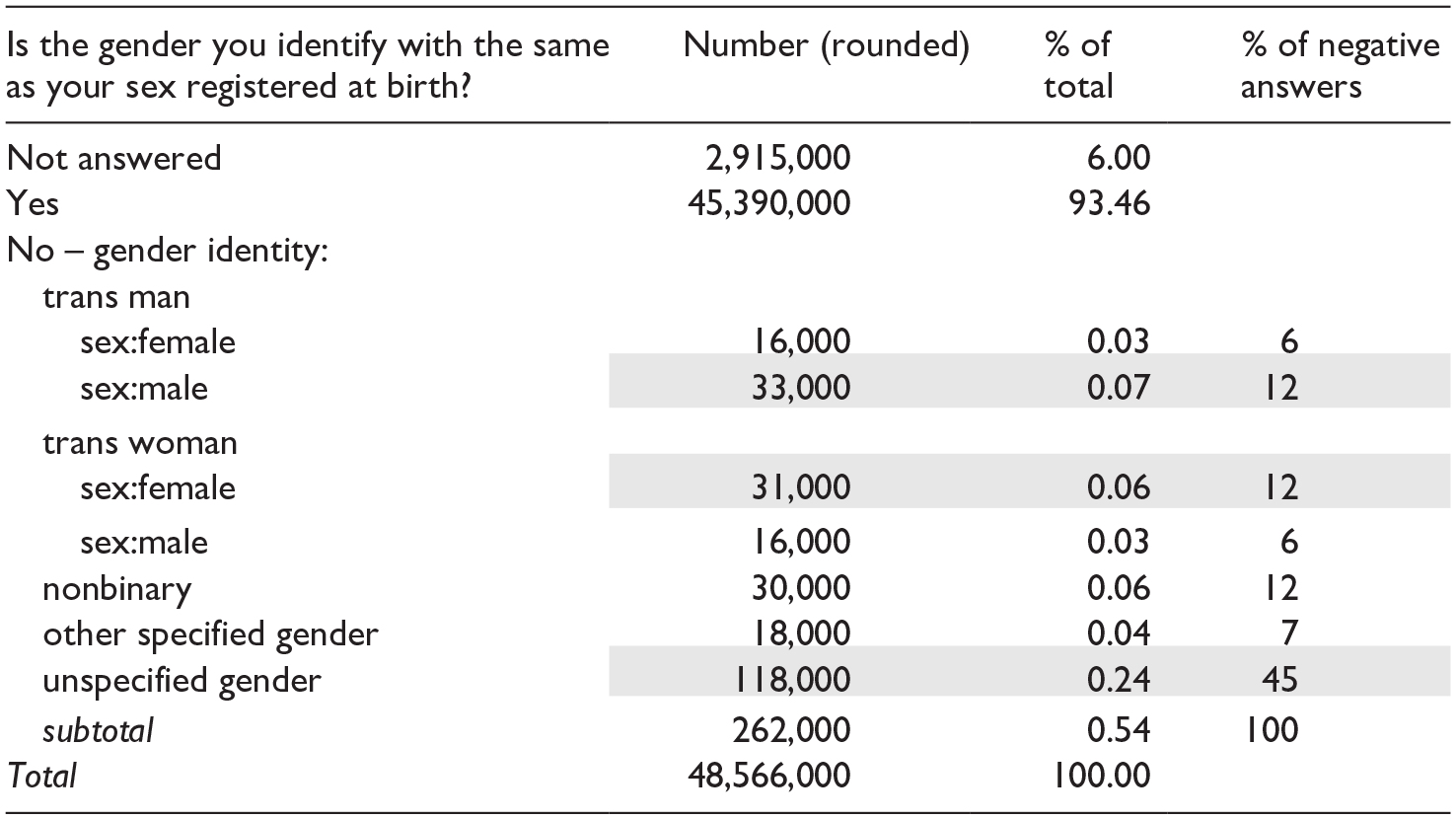
The Census of England and Wales achieved a response rate of 97% from usual residents. Table 2 shows the results for gender (Office for National Statistics, 2023c). The question was given to respondents aged 16 years and over. The question was voluntary, but only 6% skipped it. A total of 262,000 people answered that their gender identity was not the same as their natal sex. The number represents 0.54% of the total adult population. (Adult will be used to denote those aged 16 or over.) ONS disaggregated the trans population into six categories. How they were constructed was opaque in the original report, but ONS clarified this by email and by a subsequent investigation (Office for National Statistics, 2023a, 2023d) prompted by an early version of this article (Biggs, 2023a, 2023b).
Gender identity of population aged 16+, England and Wales, 2021.
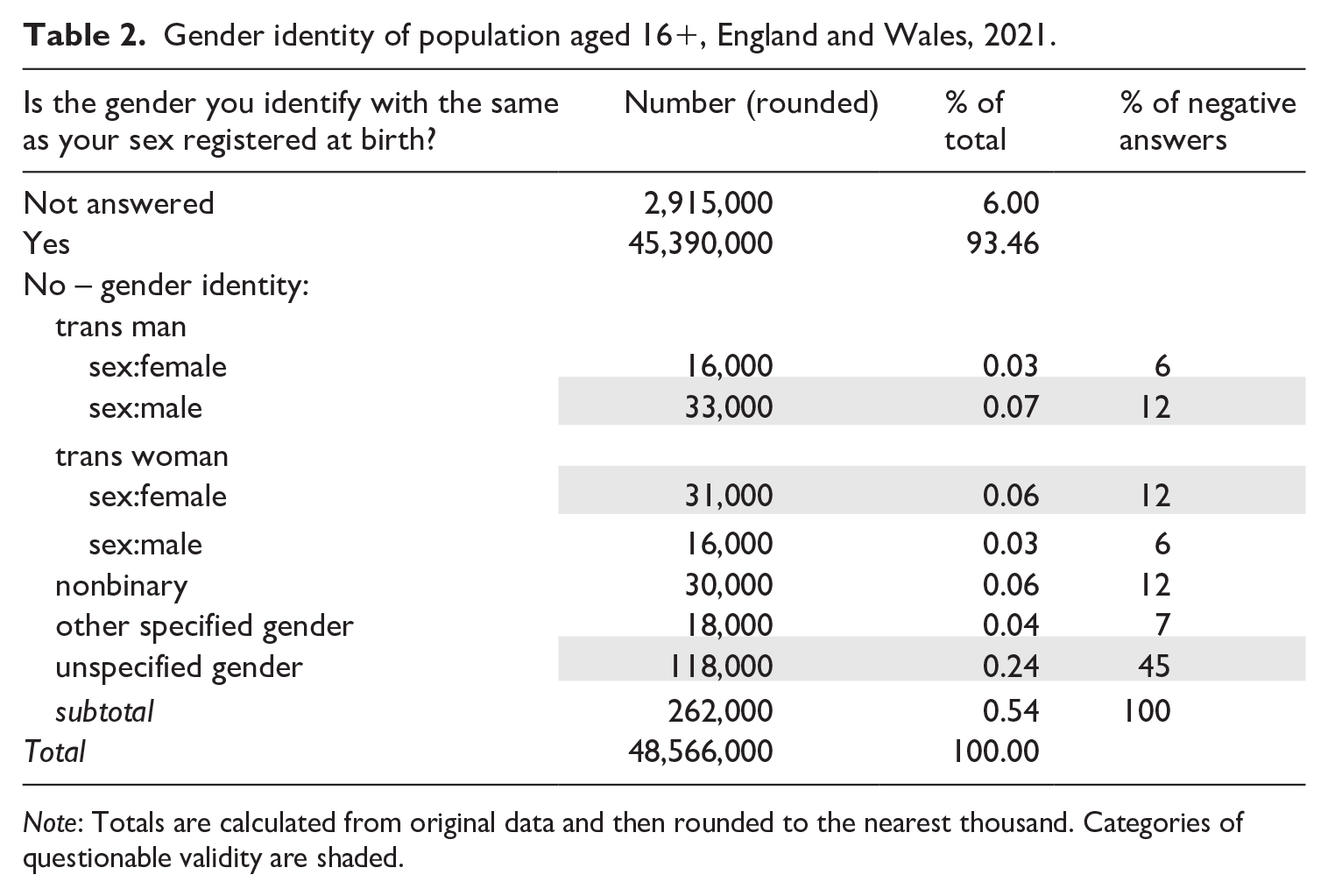
Note: Totals are calculated from original data and then rounded to the nearest thousand. Categories of questionable validity are shaded.
The trans man category was created from those who wrote in their identity as ‘male’ or ‘transgender male’ or synonymous terms. Conversely, the trans woman category was created from responses such as ‘female’ or ‘trans woman’. Disaggregation by sex reveals the first anomaly (Office for National Statistics, 2023b). Of the more than 48,000 classified as trans men, only 32% stated that their sex was female. Of the almost 48,000 trans women, only 34% stated that their sex was male. I create subcategories for male trans women and female trans men, because these combinations almost certainly indicate someone who identifies as transgender. The other subcategories, by contrast, are questionable: female trans women and male trans men. These would be correct responses only from individuals who had obtained certificates to switch their legal sex. In the entire United Kingdom from 2004 to 2021, some 4200 males changed their legal sex to female, and 1800 females changed their legal sex to male (Her Majesty’s Courts and Tribunals Service, 2021). Some of them will have died by the date of enumeration while others reside in Scotland or Northern Ireland, and so this group would account for fewer than 6000 responses. What accounts for the remainder – at least 58,000 people – who declared that their gender identity differed from their sex but then wrote in the same identity as their sex? The numbers will include some transgender people who contravened the guidance and answered the sex question with the sex with which they identified (Morgan, 2021). In addition, however, these numbers could include people who misunderstood the gender question, answered in the negative, and then wrote in either ‘male’ or ‘female’ in accordance with their sex.
The nonbinary category was restricted to those who wrote in ‘nonbinary’ or synonyms like ‘nb’. This category is unquestionably valid. The other specified gender category included identities such as ‘gender fluid’ or ‘agender’. ONS attempted to omit ‘write-in responses that did not relate to the question’, coding them instead as no answer. Nevertheless, responses such as ‘none’ or ‘gender free’ – conveying disbelief in the concept of gender identity – were included in the other specified category. This ambiguity will not make a significant numerical difference, however, and so this category can be treated as valid. The residual category none specified comprised those who did not write in any identity. This was the largest category, making up nearly half the total number of people whose gender identity differed from their natal sex. Why so many trans people would fail to write in their identity was not explained by ONS, but conceivably they felt they had used the sex question to indicate their identity as male or female and saw no need to repeat it. In addition, however, this category could erroneously include many non-transgender respondents who were confused by the question.
Overall, then, out of 262,000 adults classified as trans by ONS, 80,000 responses were in categories that should be accepted as valid: females who identify as men, males who identify as women, those who identify as nonbinary and those who identify as another gender. But that leaves 182,000 respondents in categories of questionable validity (shaded in grey in Table 2).
Geographical Characteristics
When ONS released ‘the first official data on the size of the transgender population’, it disaggregated them by the 331 local authorities in England and Wales. ‘Of the 10 local authorities with the highest proportion of the population aged 16 years and over whose gender identity was different from their sex at birth, 8 were in London, with Newham (1.51%) and Brent (1.31%) topping the list’ (Office for National Statistics, 2023c). The 25 local authorities with the highest proportion are displayed in Figure 1. (The denominator for all proportions presented here is the total adult population, including those who skipped the question.) The prominence of Newham should raise suspicion, because the borough is known for its large concentration of Muslims (the third highest in Britain). Conversely, it is peculiar that Brighton and Hove – known as ‘the LGBTQI+ capital of the UK’ (Sankey, 2023) – ranks only 20th. This city is the home of the longest-running trans pride march in Europe (McConnell, 2014). It is the home of the Trans* Inclusion Schools Toolkit, subsequently adopted as a model throughout England and Wales (Brighton and Hove City Council and Allsorts Youth Project, 2013). It is the home of two universities, including the University of Sussex where transgender activists and their allies campaigned to oust a philosopher for writing about sex (Stock, 2021; Woolcock, 2021). Is it plausible that people who grew up in Newham would be more likely to come out as trans than people who grew up in Brighton, or that trans people choosing a new place to live would prefer Newham over Brighton?
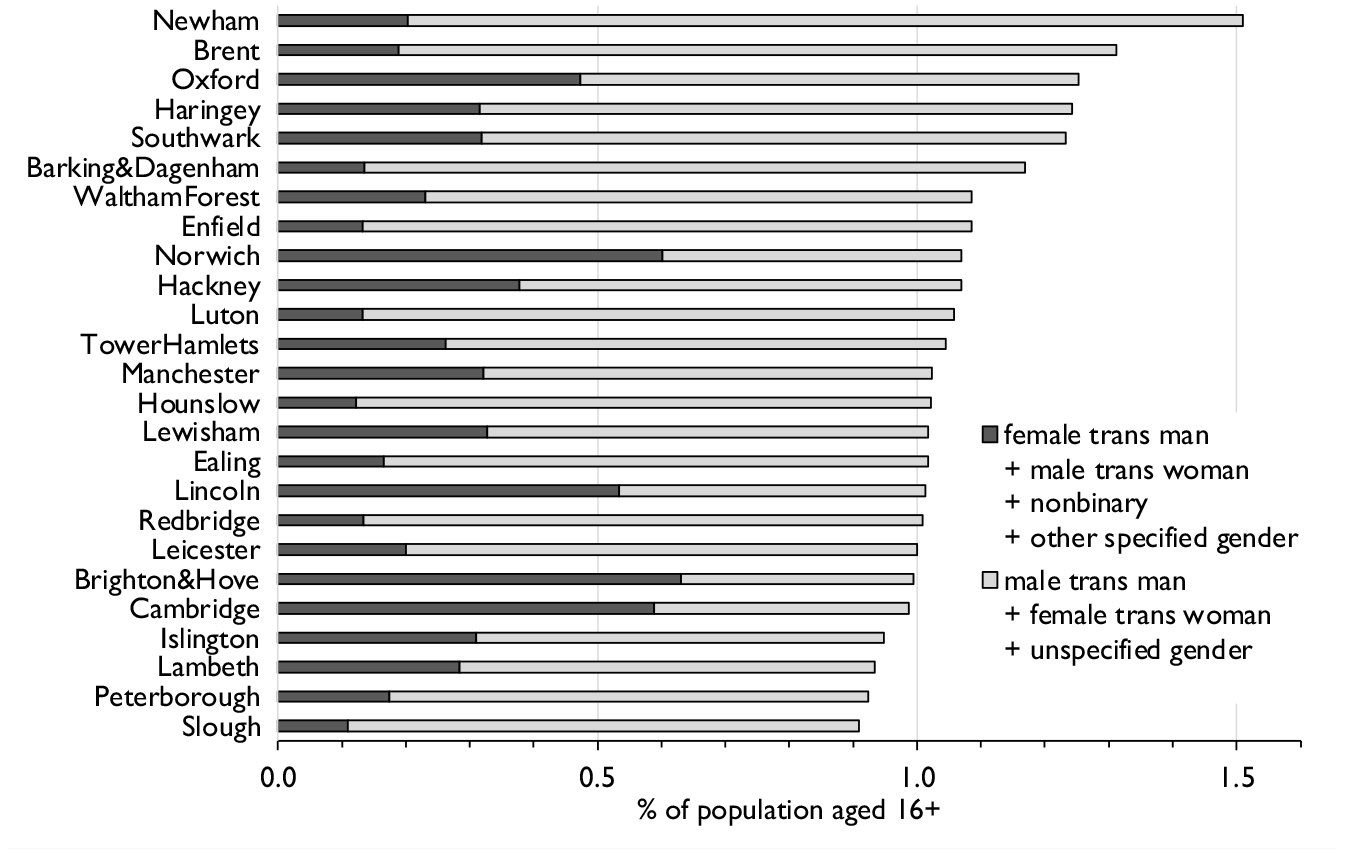
Gender identity in 25 local authorities, England and Wales, 2021.
Impressions can be substantiated with two sources of data. (The Online Appendix provides full details of the analysis.) One is referrals to the Gender Identity Development Service (GIDS) at the Tavistock and Portman NHS Foundation Trust, which served all those under 18 in England and Wales. Referrals disaggregated by clinical commissioning group in 2018–2019 indicate where children and adolescents were most likely to seek medical treatment for gender dysphoria. Divided by the population aged under 18 years, the rate of referral from Brighton and Hove, 82 per 100,000, is almost six times the rate from Newham, 14 per 100,000 (p < 0.001, two sample test of proportions). The other source of data is a petition ‘to allow transgender people to self-identify without the need for a medical diagnosis, to streamline the administrative process, and to allow nonbinary identities to be legally recognised’ (Reform the Gender Recognition Act, 2021). It was signed by 118,000 people in England and Wales. They entered their name and postcode on the government website, though this information was not displayed publicly. Areas with more signatures should have a climate of opinion more conducive to declaring a transgender identity and more attractive to trans people choosing somewhere to live. I redistribute the number of signatures in each Westminster constituency among local authority districts according to the population of their constituent output areas. As a percentage of the population aged 16 and over, the proportion signing from Brighton and Hove, 0.74%, is more than quadruple the proportion signing from Newham, 0.16% (p < 0.001, two sample test of proportions). 4 Why, then, did the Census find a higher proportion of trans people in Newham than in Brighton?
To resolve the puzzle, the transgender population should be disaggregated by gender identity. Figure 1 divides the categories into two groups. One combines the presumptively valid categories of female trans men, male trans women, nonbinaries, and other specified gender. Focusing just on these categories, the geographical pattern makes perfect sense: Brighton and Hove has the most, followed by Norwich and Cambridge. Norwich is home to the University of East Anglia. It also has a significant transgender history: a social worker in Norwich founded a counselling service for trans people in the 1970s; she subsequently started a self-help group, Oasis, which still exists today (Johns, 2011). Cambridge has two universities and was the first city in Europe to have a transgender mayor (Bannerman, 2007). The other grouping comprises the questionable categories of male trans men, female trans women, and unspecified gender. In these categories, Newham has the most, followed by the London boroughs of Brent and of Barking and Dagenham. The latter two boroughs resemble Newham in having some of the lowest rates of referrals to GIDS in England and the lowest proportions of signatories to the petition to reform the Gender Recognition Act. 5
For a finer analysis of the various categories, Table 3 provides the correlation matrix across all 331 local authorities. The proportion of adults who are nonbinary is highly correlated with the proportion of other specified gender (r = .79). The proportion of male trans women is highly correlated with the proportion of female trans men (r = .78). Correlations are much lower between the proportions of male trans women and female trans women (r = .32) and between the proportions of female trans men and male trans men (r = .38), revealing the heterogeneity within these gender categories. The proportions of male trans men, female trans women, and unspecified gender are very highly correlated (r = .86–91). These are of course the three categories most likely to include non-transgender people who misunderstood the question. The proportions in these three categories are also highly correlated with the proportion of respondents who skipped the question (r = .72–.79).
Correlation among categories of gender identity across local authorities, England and Wales, 2021.
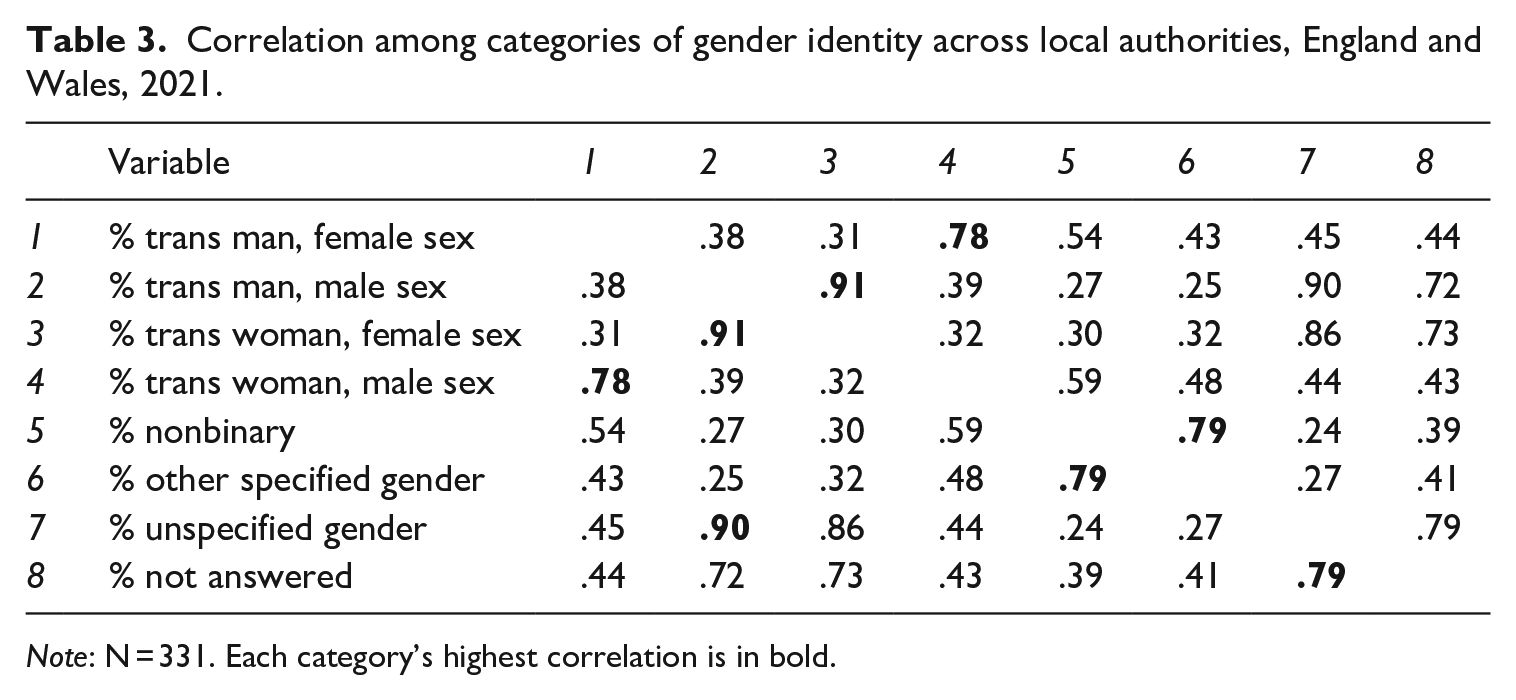
Note: N = 331. Each category’s highest correlation is in bold.
The question would have been least comprehensible for those who are not native speakers of English. The Census asked whether the respondent’s main language was English (in Wales, English or Welsh). Unsurprisingly, there was a strong correlation between the proportion of those whose main language was not English (or Welsh) and the proportion who skipped the gender question (r = .83). More remarkably, there was an even stronger association with the proportion in the three suspect categories – male trans men, female trans women, plus unspecified gender (r = .91). This association is depicted in the top graph of Figure 2. (Dashed lines indicate the overall proportions in England and Wales.) Newham and Brent have the highest proportion in these categories and the highest proportion of people who do not speak English as their main language. These are ecological correlations, of course, which cannot prove that these were the same individuals. One could hypothesize that trans people, tending to be younger and poorer, simply inhabit the same places as immigrants, namely urban areas with cheap housing. This hypothesis should apply equally to the other transgender categories. The bottom graph shows a low correlation with the proportion who are nonbinary (r = .27). There is likewise little association (not shown) with the proportion of other specified gender (r = .30) and the proportion of female trans men plus male trans women (r = .35). This hypothesis is therefore not supported. To completely refute it, though, we need to shift from geographical distribution to individual characteristics.
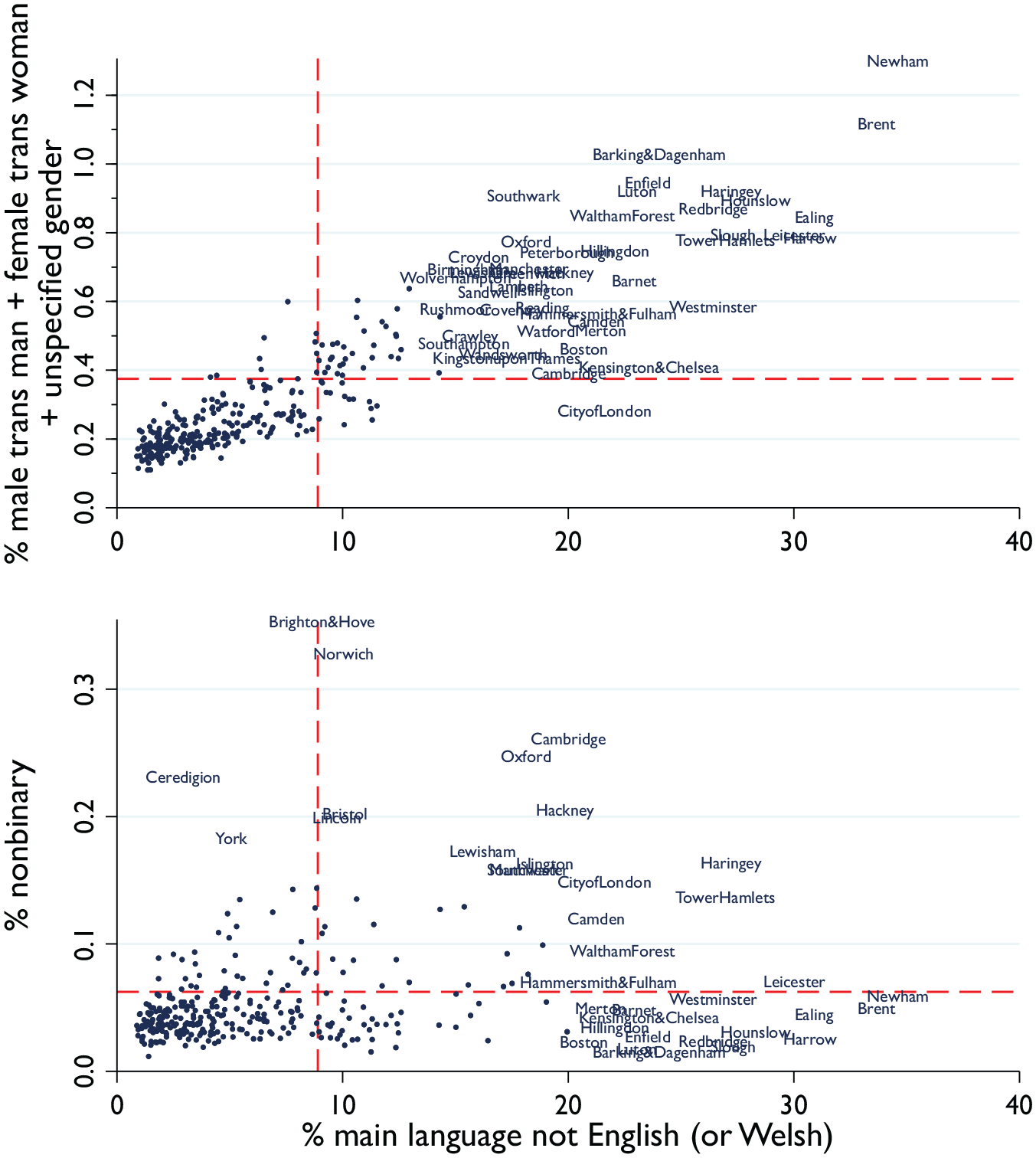
Gender identity and English proficiency by local authority, England and Wales, 2021.
Individual Characteristics
After discovering the strong ecological association between the suspect gender categories and English proficiency, I asked ONS to provide a custom table of these two variables at the individual level, along with sex (Census tables CT21_0008; CT21_0186). The cross-tabulation is graphed in Figure 3. 6 It divides English proficiency into three levels: those who spoke English (English or Welsh in Wales) as their main language; those whose main language was not English but who spoke it ‘well’ or ‘very well’; and those who spoke it ‘not well’ or ‘not at all’. If the Census is believed, then 0.4% of those who spoke English as their main language were transgender, compared with 2.2% of those did not speak English well. The figures for male trans men and female trans women show a significant disparity. Surprisingly, there is a similar disparity for female trans men and male trans women, though it is less pronounced. What is most striking is the massive disparity in unspecified gender. Those who did not speak English well were 10 times more likely to fall in this category than were those who spoke English as their main language. By contrast, those who did not speak English well were far less likely to identify as nonbinary or other specified gender than those who spoke English as their main language. (All these differences are statistically significant, p < 0.001, two sample test of proportions.) The only plausible explanation is that many immigrants with lower English proficiency were understandably confused by the gender question and mistakenly answered in the negative. Most of them did not write in any identity, and so were categorized as unspecified gender; some of them wrote in their sex and were categorized as trans men or trans women. These mistakes would have made a substantial difference to the numbers. Only 10% of all adults did not speak English as their main language, but according to the Census they contributed 29% of the total number of transgender adults.
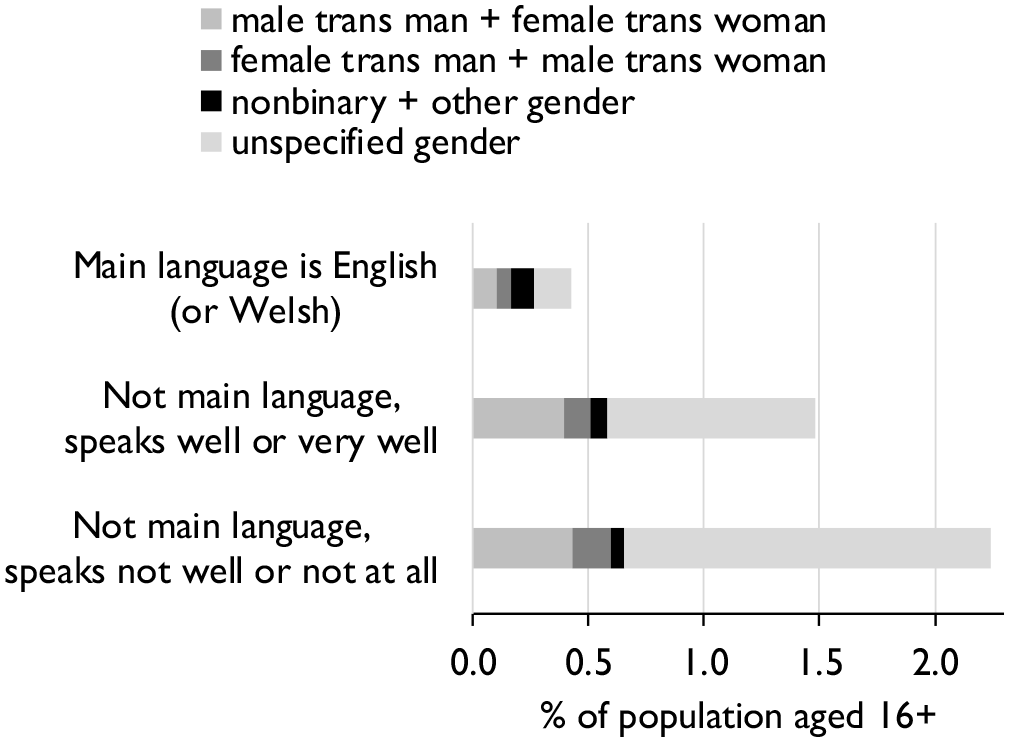
Gender identity by English proficiency, England and Wales, 2021.
While the gender question was particularly confusing for anyone without fluent English, it surely also confused some native speakers who lacked familiarity with the concept of gender identity. Evidence for such confusion comes from the cross-tabulation with educational qualifications (Census table RM167). About one in five adults had no qualifications. They were more than three times as likely to be categorized as unspecified gender than were university graduates, 0.54% compared with 0.15%. Conversely, they were far less likely to identify as nonbinary or other specified gender than were university graduates, 0.03% compared with 0.12%.
Religion and ethnicity are also worth scrutinizing (Census tables RM173 and RM038). ONS does not disaggregate these by separate gender categories. According to the Census, 61% of trans people were religious. Muslims were almost three times more likely to be transgender than people adhering to no religion. The notion that 1.5% of Muslims are transgender – one in every 67 – is scarcely credible. According to the Census, 1.6% of black adults were transgender, and 1.0% of Asian adults – but only 0.4% of white adults. These ethnic and religious disparities are the reverse of those found in referrals to gender clinics. In referrals to GIDS in three years from 2016 to 2021, white children and adolescents were overrepresented compared with the population of the same age (Manjra et al., 2022). Data on adult gender services in England in 2016 also showed a lower proportion of black and minority ethnic patients than in the population (NHS England, 2017). For adults and children alike, the large majority of those attending gender clinics had no religion. Not all people who are transgender seek medical intervention on the NHS, of course. But it is hardly plausible that such large numbers of black, Asian and Muslim adults would identify as transgender while eschewing clinical intervention.
Discussion
This article has presented compelling evidence that the gender question was misinterpreted by a substantial number of respondents. Just under a third of adults classified by ONS as transgender were in the four valid categories: female trans man, male trans woman, nonbinary, and other specified gender. Together these comprised 0.17% of residents aged 16 and over. The remaining categories inadvertently combined people who do actually identify as transgender and people who were confused by the question. With access to the original Census schedules, more responses could be validated. Some respondents explicitly declared a transgender identity – writing ‘trans woman’ rather than ‘woman’, for instance (Rininsland, 2023) – and so ONS could produce a separate category for them. These were a small minority, however, comprising only 8% of trans men and 9% of trans women (Office for National Statistics, 2023d: table GI04).
Any attempt to recalculate the transgender population is inevitably speculative. An estimate could start with the four valid categories and add the two problematic categories of male trans men and female trans women but omit unspecified, in the hope that the included false positives will offset the omitted true positives. This would yield a transgender population of 144,000 or 0.30%. A useful check is provided by the 2021 Census of Canada, which used the two-step method. ‘What was this person’s sex at birth?’ (‘assigned at birth’) required a binary answer, male or female. ‘What is this person’s gender?’ (‘current gender’) allowed the answer to be male, female, or something else specified in a free-text field. Of the population aged 15 and over, 0.33% were classified as transgender, including nonbinary (Statistics Canada, 2022). Another check will be provided in due course by the Scottish Census, though that is marred by substantial nonresponse. Such figures necessarily exclude anyone who was unwilling to disclose their transgender identity (Carl, 2023).
The results on sexual orientation deserve mention, though lack of space precludes detailed examination. This question was simple: ‘Which of the following best describes your sexual orientation?’ The answer was either ‘straight/heterosexual’, ‘gay or lesbian’, ‘bisexual’, or ‘other’ with a free-text field. The results are entirely plausible, thus demonstrating how reliable data on intimate personal characteristics can be obtained by asking a clear question. The local authority with the highest proportion of non-heterosexuals, for example, was Brighton and Hove; Newham ranked 43rd and Brent 71st. On all the individual characteristics considered here, the non-heterosexual population had the opposite profile from the population classified by the Census as transgender. Adults whose main language was English were more likely to be non-heterosexual than were adults who did not speak English well (Census table CT21_0128). University graduates were far more likely to be non-heterosexual than were adults with no educational qualifications (Census table RM182). Adults with no religion were far more likely to be non-heterosexual than were Muslims (Census table RM188). White adults were more likely to be non-heterosexual than were black or Asian adults (Census table RM125). These consistent disparities between LGB and T, according to the Census, are surely artefacts induced by the faulty question on gender.
Conclusion
In conclusion, then, ‘the first official data on the size of the transgender population’ in England and Wales are seriously flawed. This was a lost opportunity. In planning the 2021 Census, ONS had access to superior questions validated in other countries (Bureau of the Conference of European Statisticians, 2019). The two-step method, as used in the Canadian Census, was arguably infeasible given that ONS intended to replicate the sex question from the 2011 Census – asking ‘what is your sex?’ rather than a euphemism such as ‘what was your sex at birth?’ Nevertheless, there was the option of asking simply whether the respondent identified as transgender. As an example, from 2014 onwards the Behavioral Risk Factor Surveillance System in the United States posed the question, ‘Do you consider yourself to be transgender?’ There were three possible affirmative responses: ‘female to male’, ‘male to female’, and ‘gender nonconforming’ (Baker, 2019). National Records Scotland chose a similar question for its 2022 Census, albeit with more clumsy wording. ONS, by contrast, selected a question that had been invented by activists in Press for Change in 2007 and then adopted by Stonewall – despite this question having been tested and found too confusing for non-transgender people. Not coincidentally, perhaps, ONS was simultaneously paying Stonewall to train its staff and to audit its policies. There was no intent, of course, to formulate a question that would overestimate the trans population. Problems arose from an assumption that everyone in England and Wales comprehended a discourse on gender that had recently circulated among the professional-managerial class. Evidently absent was ‘queer data competence’: ‘a willingness to assume a contrarian role in data discussions: present provocations, challenge categories and recognize different ways of knowing’ (Guyan, 2022: 156). 7
This episode provides a salutary example of how the phrasing of a survey question can distort our understanding of the social world. A similar instance is a spurious trend of increasing protest that was created by survey questions invented by a doctoral student in the 1970s and then canonized by the World Values Survey (Biggs, 2015). In that case, however, the questions were appropriate for their original purpose, and the consequences of their subsequent misinterpretation were confined to a specialized academic literature. The flawed question on gender in the 2021 Census of England and Wales has far wider implications. Numbers at the local level will be crucial for the allocation of resources. Councils like Newham and Brent will come under pressure to recruit their workforce from and distribute funding to the large numbers of trans people supposedly discovered by the Census. Because the decennial census is the gold standard for official statistics, the same flawed question has been embraced by the Government Statistical Service (GSS Harmonisation Team, 2022). It has been used by the Crime Survey for England and Wales, the Civil Service People Survey and the GP Patient survey conducted by NHS England (Saunders et al., 2023; Watkinson et al., 2024). These errors will therefore ramify for years to come.
Supplemental Material
sj-docx-1-soc-10.1177_00380385241240441 – Supplemental material for Gender Identity in the 2021 Census of England and Wales: How a Flawed Question Created Spurious Data
Supplemental material, sj-docx-1-soc-10.1177_00380385241240441 for Gender Identity in the 2021 Census of England and Wales: How a Flawed Question Created Spurious Data by Michael Biggs in Sociology
Footnotes
Acknowledgements
My thanks are due to Chetan Bhatt, Noah Carl, Eric Kaufmann, Maya Forstater, Juta Kawalerowicz, Sherena Kranat, Susan Matthews, Bernard Silverman, Alice Sullivan, Nicola Williams and to the journal’s reviewers over three rounds of revision.
Declaration of conflicting interests
The author(s) declared the following potential conflicts of interest with respect to the research, authorship, and/or publication of this article: The author is a board member of Sex Matters, and advised Fair Play for Women for their judicial review of the sex question in the 2021 Census.
Funding
The author received no financial support for the research, authorship and/or publication of this article.

Supplemental material
Supplemental material for this article is available online.
Notes
References
Supplementary Material
Please find the following supplemental material available below.
For Open Access articles published under a Creative Commons License, all supplemental material carries the same license as the article it is associated with.
For non-Open Access articles published, all supplemental material carries a non-exclusive license, and permission requests for re-use of supplemental material or any part of supplemental material shall be sent directly to the copyright owner as specified in the copyright notice associated with the article.
