




Abstract
The author draws on the oral histories of 44 LGBTQ Princeton alumni who graduated from 1960 to 2011 to examine student strategies for negotiating marginal identities when integrating into an elite university. Even with greater LGBTQ visibility and resources at the institutional level, LGBTQ students’ experiences and strategies suggest that we question the larger social narrative of linear progress. Across time, students navigate space by highlighting difference to belong as queer students in explicitly LGBTQ circles or muting difference to belong as token queer students in heteronormative circles. Integration of an LGBTQ person does not necessarily mean incorporation of an LGBTQ identity and vice versa. These strategies are largely contingent upon students’ social positions: intersectional identities, structural location, and available models. Student strategies are structurally tempered by queer integrative marginalization: the process of select predominantly elite LGBTQ people’s achieving special status among the heteronormative mainstream.
The 2018 governorship race in Colorado went to Jared Polis, a gay and Jewish Princeton graduate of the class of 1996. Although many are taking his election as a marker of LGBTQ (lesbian, gay, bisexual, transgender, queer) progress, his victory should be understood in the context of growing up wealthy and pursuing political and entrepreneurial ambitions from a young age. At 23, he sold his first company, AIS, for $23 million. Although proud of being the first gay governor, he admits to not “wear[ing] any of those things [sexuality and religion] on [his] sleeve” (Burness 2018). While addressing LGBTQ Princeton alumni on campus at the 2013 Every Voice Conference, Polis triumphantly reflected that gay and lesbian Princetonians now and into the future are very much incorporated into a wide array of activities in ways that many of us weren’t and . . . [that] our full identities are now being fully embraced as part of our Princeton experience. (Alumni Education 2013)
Mainstream media, scholars, and activists often propagate an LGBTQ “it gets better” narrative much like Polis framed LBGTQ experience at Princeton. Further examination of LGBTQ Princeton alumni experiences suggests that we interrogate this narrative of linear progress at Princeton and beyond.
Universities that historically excluded students on the basis of characteristics such as gender, race, ethnicity, and religion now promote “diversity” to recruit students (Jubas and White 2017; Karabel 2005; Urciuoli 2003). At Princeton University, demographic shifts began in earnest during the late 1960s and the creation of resources to handle those shifts in the 1970s. These include the residential college system, the Third World Center (now Carl Fields Center), the Women’s Center, and alternative dining options to the exclusive eating club system. The LGBT Center did not open its doors until 2005. This late institutional response to the presence of LGBTQ students reflects a combination of negative societal attitudes toward nonheteronormative gender and sexual expression, a historically conservative campus climate, and many LGBTQ students’ flexibility to disclose their difference, rendering them invisible. Whether visible or not, individually or collectively, LGBTQ students strategically navigated Princeton before and after the creation of the LGBT Center.
We might assume that the growth of LGBTQ organizations on campus would improve LGBTQ student experience. Although spaces such as the LGBT Center do help students who come looking for resources and to connect with one another, it is not clear that this growth has changed an overall bifurcation of student experience predicated on solidifying distinctions among students. The LGBT Center has altered the configuration but not the organizing heteronormative and elite logic of campus. In this article, LGBTQ-specific resources are considered solely within the context of who decides to use them and why. It is at the intersection of LGBTQ student experience, institutional change, and navigation of elite space with marginalized identities that I focus my inquiry. How did LGBTQ students navigate this elite institutional space and logic over time? How did LGBTQ-specific resources affect LGBTQ student integration?
I draw on oral histories I conducted with Princeton alumni who graduated from 1960 to 2011 and build on previous scholarship to provide insight into the historical process of LGBTQ student integration at Princeton University. In addition to describing participant strategies for navigating Princeton, I use my findings to propose a concept that illuminates the relationship between integration and marginalization for LGBTQ elites. I bridge scholarship in the sociology of education, sexualities, LGBTQ studies, and elites to examine LGBTQ student integration at an elite institution over time. Using a framework that builds on the language of assimilation and diversity used to discuss LGBTQ integration in a postgay period (normalization and acceptance of gays) (Ghaziani 2011) and insight about the marginalization of African Americans expressed by integrative marginalization (selective integration of Black elites) (Cohen 1999), I propose queer integrative marginalization: the process of select predominantly elite LGBTQ people’s achieving special status among the heteronormative mainstream.
Institutional Influence on Student Identities and Campus Integration
College students negotiate identities and belonging while navigating relationships and campus norms, resources, and associations. The work on educational context argues that students hold similar preferences across elite universities (Bourdieu and Clough 1996) because they attract similar students and possess similar organizational practices that reproduce elites (Karabel 2005). These organizational practices influence students’ status construction, individual identities, and aspirations (Arum and Roksa 2011; Meyer and Rowan 1977). In short, college can change students’ sense of self (Kaufman and Feldman 2004) and strategies for navigating the world (Binder and Wood 2013; Grigsby 2009; Khan 2011; Willie-LeBreton 2003).
We know that low-income, first-generation, and/or ethnic and racial minority students face challenges in spaces of higher education even as more of them attend college (Aries 2008; Aries and Seider 2005; Goodwin 2002; Ostrove and Long 2007; Torres 2009). This work speaks to how students adapt to different norms or acquire different social capital to best navigate opportunities that traditionally privileged students take for granted (Jack 2016; Lehmann 2014; Stuber 2011). Although developing a “cleft habitus” can help low-income students navigate elite schools and nonelite home contexts, it can also lead to rifts in students’ senses of self (Lee and Kramer 2013). I notice similar dynamics in negotiating LGBTQ identity.
Scholarship on sexual and gender minorities in education pertains to how heteronormativity is reproduced in the classroom (Gansen 2017; Ripley et al. 2012), LGBT activist action and collective identity formation in student groups (Ghaziani 2011; Swank and Fahs 2012), and the effects of LGBT student group involvement on mental health (Kulick et al. 2017), but not on how campus atmosphere and institutional resources affect student experience and integration strategies more broadly. Furthermore, although we tend to generalize elite educational institutions, specific campuses and their organizing logics uniquely affect students. Individual schools affect a range of outcomes, from students’ career pathways after college (Arum and Roksa 2011) to their political dispositions and styles of campus activism (Reyes 2015). Specific university environments and myths (campus logics) uniquely organize the ways students interpret campus life and, therefore, navigate and integrate into campus (Reyes 2015). I fill the gap in the existing literature on university student identities, navigation strategies, and campus influence on historically marginalized people by focusing on LGBTQ students’ campus integration.
LGBTQ: From Perverse Proclivity to Collective Identity to Postgay
Princeton University students attended college at different historical moments over which nonheteronormative sexuality and gender developed into group identification and belonging with increasing visibility (Armstrong 2002; Bronski 2011; D’Emilio 2002; Weeks 2017). Queer people had to contend with sexual stigma (Plummer 1975) before embracing sexual diversity (Seidman 2002). LGBTQ identity and belonging around nonheteronormative sexuality and gender developed through personal connections and forming community around non-heterosexuality (Plummer 1995, 2015; Weeks 2017). Identity labels for nonheteronormative sexuality and gender changed as people fought against discrimination and for full political incorporation (Warner 1993). Many turned from the medically imposed homosexual and transsexual labels to affirming labels such as gay, lesbian, bisexual, and transgender. In the late 1980s, activists reclaimed queer to politically push against heteronormative encroachment on homosexuality, while academics contemplated the theoretical potential of queer to construct queer theory (Rand 2014). The acronym “LGBTQ” continues to morph to recognize the diversity of gender and sexual minorities.
These historically specific patterns of nonheteronormative sexuality and gender (Armstrong 2002; Chauncey 1994; D’Emilio 1983; Seidman 2002; Valocchi 1999) have been conceptually organized into eras that progress from the closet (pre–World War II) to coming out (World War II to 1997) to postgay (1998 to the present) (Ghaziani 2011). The assumption is that this historical progression matches an experiential progression characterized by concealment of nonheteronormative sexuality and gender, isolation, shame, and construction of almost exclusively gay networks to now a postgay moment when nonheteronormative sexuality and gender is normalized and disentangled from political struggle.
Postgay is the tension between the assimilation of gay people into the mainstream and antiassimilation focus on the diversity of identity and experience encompassed in LGBT, which has led activists in the twenty-first century to change the way they relate to the straight majority (Ghaziani 2011). Scholarship has focused on efforts to form collective identities that oscillate between highlighting sameness to or differences from a heteronormative mainstream (Bernstein 1997; Gamson 1995; Ghaziani, Taylor, and Stone 2016). The sameness strategy stresses that sexual and gender minorities are just like everyone else, and the difference strategy stresses that sexual and gender minorities are not fundamentally like everyone else. Some scholarship uses postgay to distinguish a current moment that privileges sameness from a former moment that privileged difference (Ghaziani 2011).
Other scholars are skeptical that we have arrived at queer acceptance (Ng 2013) or that queer people desire highlighting sameness (Pfeffer 2014). Today, LGB students must work harder to maintain equality in friendships with straight peers (Ueno and Gentile 2015), and LGBTQ student group involvement is challenging for students of color, who can develop mental health issues (Kulick et al. 2017). Furthermore, queer people continue to face violence (Meyer 2015), and gay Black men, for example, continue to use different strategies to navigate multiple stigmatized identities in the process of their identity formation (Hunter 2010). Although LGBTQ activist efforts historically revolved around alternative sexual and political rights like sexual liberation, much of what was successful, like same-sex marriage, reflects social conformism to heteronormative values or “homonormativity” (Duggan 2002).
Nevertheless, this tension between assimilation and diversity that scholars use to conceptualize activist efforts to develop collective identity is useful beyond the collective identity formation of activists. For example, in examining gay and queer men’s identity and habitus formation in gentrifying gayborhoods (Ghaziani 2014; Orne 2017). I extend it to examine how LGBTQ people manage stigma and reconcile nonheteronormative sexuality and gender with their senses of self while navigating space and finding belonging.
Conceptual Framework: Queer Integrative Marginalization
Queer integrative marginalization brings together insight from Amin Ghaziani’s (2011) use of postgay to discuss the interplay of assimilation and diversity in LGBTQ collective identity formation and Cathy Cohen’s (1999) term integrative marginalization, which she used to discuss how dominant groups maintain power over marginalized groups, more specifically Black Americans. I queer this term to bring Cohen’s insight into intragroup difference among LGBTQ people across race and ethnicity.
Integrative marginalization describes the process of dominant groups’ maintaining power over marginal communities “by unequivocally regulating the majority of marginal community members while allowing a chosen few to have limited access to dominant institutions and resources” (Cohen 1999:58). This special status is awarded to the Black elite: professionals and leaders mostly, but not exclusively, located in White institutional positions of power.
Ghaziani (2011) briefly invoked Cohen’s (1999) concept to recognize the internal hierarchical divisions that can occur within a group already facing marginalization. Collective identity construction in a postgay era results not from an “us versus them” but increasingly from an “us versus them-inside” mentality (Ghaziani 2011). Mignon Moore (2011) used integrative marginalization more fully to discuss how middle-class Black lesbians used credentials and economic achievement to compensate for their lesbian identity in their Black communities. The strategies Moore’s middle-class lesbian participants used to achieve respectable lesbian identities involved assimilationist or homonormative dynamics in Black communities as well as White spaces. Their strategies reflect the complicated position of marginalized elites. Perhaps elites from marginalized groups are more susceptible to assimilationist respectability because of their greater proximity to White-heterosexual institutional power.
Although Ghaziani (2011) accounted for the narrowness of assimilation by acknowledging that gender non-normative or sexually non-normative people cannot conform, he did not disrupt the assumption of temporal linearity for LGBTQ experience associated with the historical eras described above. We might assume, then, that my participants’ narratives would reflect this linearity. I argue, however, that the development of a “them-inside” collective identity might be a question not of time but rather of agency and of the process of dominant groups and spaces integrating a select few from marginalized groups, as in the case of the Black elite. Indeed, as I demonstrate, variation in LGBTQ people’s experiences disrupts historical linearity.
Methods
I conducted 44 oral histories that ranged from 1.5 to 3 hours in length; I conducted most of the interviews in participants’ homes. Every participant signed a release form that included the option to restrict information or to remain anonymous. Almost all participants elected to use their real names and share their full stories. I conducted the first round of interviews from June to September 2017 and the second round from June to August 2018. My participants were concentrated mostly in the greater metropolitan areas of Los Angeles, San Francisco, and Seattle.
I secured access to my participants via institutional efforts to record and archive LGBTQ alumni experiences at Princeton’s Seeley Mudd Manuscript Library via the Princeton LGBTQIA Oral History Project for educational, scholarly, and personal use. I was invited to participate in the project’s advisory committee, a body made up of alumni, LGBT Center staff members, and faculty members. We placed an open call for participation on alumni Web sites and mailing lists and reached out to personal networks to solicit participation. Interested alumni signed up with LGBT Center staff members. We prioritized interviews with elders, alumni of color, and trans (transgender, nonbinary, genderqueer, etc.) participants. I volunteered to conduct West Coast interviews.
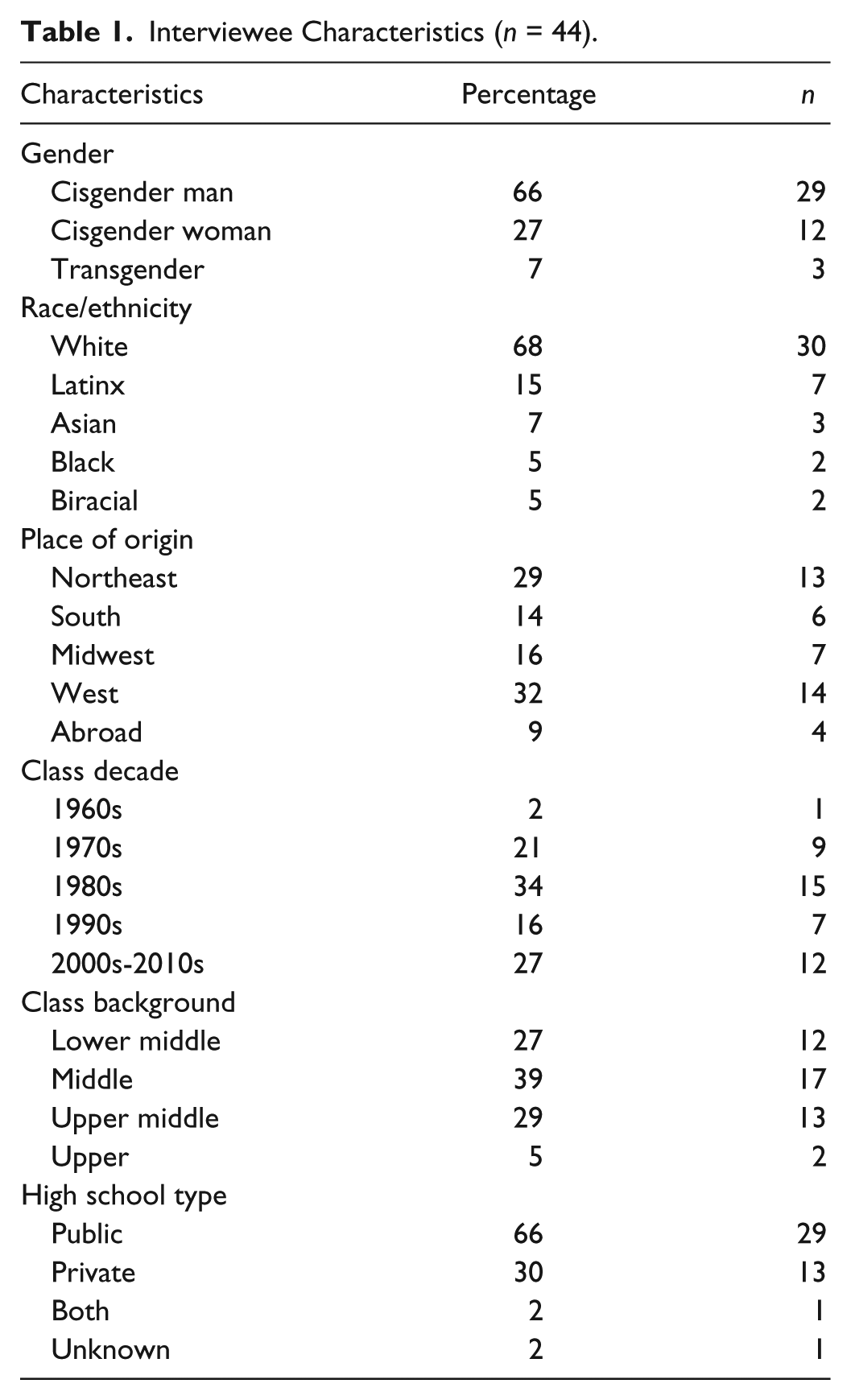
As Table 1 demonstrates, most participants identify as men, which reflects the campus makeup of earlier class years as well as a strong gay alumni presence among men from the 1980s. Women are represented in every class decade except for the 1960s, and the three trans participants were at Princeton during the 1990s and 2000s. Despite efforts to recruit a diverse sample of participants, most are White. Although many participants were born and raised in different places, only one participant grew up through adolescence abroad. Sixty-six percent of participants attended public school. Almost all private schools participants attended were college preparatory. Participants did not discuss their parents’ incomes; therefore, I surmised the above class categories on the basis of participants’ childhood lifestyles, schooling, parents’ profession, and self-categorization. The lower middle category includes participants whose parents held working-class or low-income jobs with varying degrees of income stability. Class did not neatly correspond to high school type. Some lower income participants obtained scholarships to private schools; some upper income participants went to public schools. Parents’ professions, incomes, and educational attainment changed over time while many participants grew up.
Interviewee Characteristics (n = 44).
The ability of storytelling to communicate multiple meanings and to generate additional stories renders narrative a powerful resource (Polletta et al. 2011; Portelli 2009). We tell stories to craft identity, to persuade, and to hold disjointed parts together. They encourage us to ask clarifying questions and explore unknown details. Oral history is, as Karida Brown (2018) argued, quoting Cobb and Hoang, “protagonist-driven research.” As Brown pointed out, memory is messy; messiness is a limitation. However, apart from memory’s power to illuminate meaning, collecting the memories of people who significantly range in age can help us tease out some of the mess and discover if certain experiences, and the way people make sense of those experiences, are consistent over time. Oral histories serve as both sources of evidence and interpretation (Murphy, Pierce, and Ruiz 2016; Portelli 2009). Placed together, these contextualized stories paint a fuller picture of the past and illuminate contradictions.
Although these oral histories range from childhood experiences and relationships to career trajectories and recent life, in this article I focus mostly on experiences and relationships at Princeton. I lightly directed interviews and asked open-ended questions to encourage elaboration and detailed stories, such as, “What was it like to be gay/LGBTQ at Princeton?” and “What were some transformative moments—whether good or bad—that you had at Princeton?” Although some of my questions were consistent across interviews, most were contingent upon participants’ ability to tell chronological narratives about their lives with Princeton prominently featured.
I transcribed the interviews manually in individual Word documents. I combed through each document using a system of open coding for emergent themes and patterns across interviews; I used a system of focused coding for experiences and reflections that illuminated participants’ identity and community formation, gender and sexuality, influences, and participant networks before, during, and after Princeton. I also took note of important demographic characteristics and participant affiliations. My approach can be considered abductive, both bringing existing theoretical understanding to the data and allowing the data to shape my understanding (Tavory and Timmermans 2014). I analyzed data and consulted the literature during both collection periods and throughout the writing process. Therefore, my coding, coding refinement, and analysis involved an iterative process.
Context: A Case Study of LGBTQ Alumni at Princeton
Princeton University is a useful “critical case” of LGBTQ experience (Ghaziani 2011). It is a historically elite space with strong social norms that experienced relatively rapid demographic change with the financial resources to invest in nontraditional students. Princeton traditionally favored Protestant White men from a handful of boarding schools along the East Coast, a tradition that dominated admissions, and therefore the campus makeup, into the late 1960s (Karabel 2005). With Princeton dragging its feet to fully include women and African Americans, some of my participants come from a time when almost everyone on campus was a man, and just about everyone was White. A continual loss of traditionally desirable candidates to competing schools such as Harvard and Yale drove efforts to cultivate a diverse student body and raise academic standards (Karabel 2005). Given this demographic change, looking at integration at Princeton, an elite institution responsible for reproducing and creating elites, is insightful for understanding queer elites.
As Khan (2011) argued, examining the shifting character of elites helps us understand the shifting character of inequality and power. In many ways, exclusion has been replaced by inclusion so that elites increasingly frame themselves as being part of a more democratic, meritorious world (Cousin, Khan, and Mears 2018). Inclusion at the level of admission, however, is not necessarily integration into mainstream spaces once on campus, especially for low-income and ethnic/racial minorities (Jack 2016; Lee and Kramer 2013; Torres 2009).
Princeton is characterized by tradition. Some spaces on campus, such as the resource centers, are inclusive and relatively new, especially the LGBT Center, whereas others, such as the eating clubs, are exclusive and old. Most upperclassmen eat meals and party at these clubs, which continue to dominate social life. Although many are no longer formally selective, each has a different personality that continues to attract certain archetypes of students. Informally, these spaces are segregated by race, habitus, and scholarly and extracurricular interests. Intraelite distinction complicates privilege and marginality within these categories and spaces. Does being gay or LGBTQ matter in integration into elite space? If so, how, why, and for whom?
Disrupting the Linear Progress Assumption of the “Postgay” Narrative
Megan (class of 2011) is a queer White woman who grew up around animals in a rural town; both her parents are veterinarians. She studied engineering and was involved in an outdoor orientation program for freshmen and a campus dance company. She was briefly involved in an eating club before joining a food cooperative. Although fully part of campus, Megan was not out, nor did she have queer friends. Although she is a recent graduate, she did not feel comfortable coming out or romantically connecting with others: I remember having a debate with my roommate about the ethics of being gay and raising a child. . . . [She thought] that a child should have a male and a female influence in their life and it’s unfair to a child for a gay couple to raise them, and I was just like—noted. This was one of my best friends, who I came out to accidentally. She didn’t talk to me for two weeks, and that was her way of dealing with it.
Megan was discouraged by her friend’s negative feedback about nonheterosexuality and by others’ assuming her heterosexuality. A dearth of personal connections with LGBTQ students seems to have stifled her from taking full advantage of the LBGT Center. She recalls sitting to study around the center without entering it. Megan did not feel like campus was conducive to being queer, even with the presence of the LGBT Center; it would take leaving campus to explore that side of her. She could not incorporate her queer identity but was easily able to integrate into mainstream campus spaces and organizations even though she opted out of the eating clubs.
Jane (class of 1977), a White lesbian with scientist parents, attended one of Princeton’s first classes to include women. She was involved in martial arts and active in the Women’s Center and the Gay Alliance of Princeton student group. She presented as more masculine and recalled a level of openness and visibility that helped her connect with a group of gay and lesbian students who threw dances on the top floor of a school building that still stands today. She even visibly presented her gay identity to her hallway mates by posting a “suggestive” poster in her dorm hallway: Yeah, generally my friends were supportive. There was a little kickback from some of the people in my dormitory when I started posting posters in the hallway, especially the kiss me I’m gay, the Snoopy sign, some people didn’t appreciate that.
The “kickback” she describes was mostly in the form of other students’ anonymously writing comments or questions on her Snoopy poster, which she frames as generating an important discussion. Overall, her experience was positive, and she had different outlets to connect with not just budding lesbian-feminists but also gay men in discussion groups and at parties.
Joe (class of 1987), a White gay man from a rural middle-class home, was an out athlete during a time many people would not think it possible. He was connected to a sports team and spent a lot of time with members of respected theater and acapella groups. He did not participate in these artistic groups but realized that many of those friends were out. He strategically used his relationships with these performers to actively seek out the gay student group. The logic was that these students, rather than the athletes or members of other groups he was a part of, would be connected to a gay student group: So right away as a freshman I knew people and interfaced with people who were out. That was the theater crowd. That was the art crowd. . . . They’re the ones that I went to when I said I think I need to go to a Gay Alliance of Princeton meeting. . . . And then they also took me to a dance a month later and that’s when it was just sort of like, OK, cat’s out of the bag now. I need to start demonstrating this all the time now.
Here, he reflects on his opportunity to connect with other gays immediately upon arriving on campus but navigating elite spaces strategically until he decided to highlight his difference. Joe believed that once he chose to be in gay- and lesbian-specific spaces, he would be labeled gay and must “demonstrate it all the time.” This logic can explain why some participants knew about these spaces but chose not to attend these meetings or dances, even though some participants attended events without being out. Joe’s experience on campus was quite positive.
We can contrast Joe’s experience with that of Curtis, who, like Joe, is a gay White man with a Professor father who graduated with the class of 1987. In the following passage, Curtis reflects on how coming of age in the 1980s negatively influenced his understanding of being gay and how that affected how he navigated campus. Even though he had come out prior to coming to campus, building community with others was difficult: I told my brother the end of that summer when I was seventeen . . . senior year of high school in ’83 [was] when AIDS sort of hit the media and that’s so linked with my experience at Princeton and also coming out.
Curtis then talked about how being plagued with a sense of inevitable death caused him to feel isolated, discouraged his involvement in student activities, affected his studies, and limited his sexual behavior: You know I was in college and thought, and I looked at my brother who was having just a regular college experience, the biggest concern that students had you know was the next party, or getting a good grade, or what to do after graduation, my thought was am I going to die in three years.
Indeed, there is evidence to support Curtis’s hunch that when one came of age in relation to the AIDS crisis greatly affected how one navigated sexuality and sense of self (Tester 2018). Yet although Curtis experienced a lot of stress related to his gay identity, and was not as integrated into campus life, he did have positive relationships and experiences with gay friends and hallmates, and he remained close to an openly bisexual woman at school. Curtis’s experience is capacious enough to hold qualities associated with the closet, coming out, and postgay eras.
A few participants mentioned the 1970s fondly. Some participants remember announcements and activities in the 1980s, whereas others experienced a ubiquitous sea of sexual and gender normativity. Some remember key queer faculty members, whereas others felt that there were no role models. There were eating clubs known for gay gatherings or specific bathrooms in Firestone Library where men could cruise, whereas others felt sexually stifled. Most remember neither a hostile nor a welcoming environment to explore or express being queer. Students’ connections to campus activities, feedback from friends and peers, or chance encounters like being propositioned for sex or witnessing homophobia influenced their knowledge of how to approach different campus settings and explore identity.
Social Integration of LGBTQ Students versus Student Incorporation of LGBTQ Identity
Tim (class of 2003), a White gay man affiliated with both visual arts and sports, said that he felt a stifling environment at Princeton. Coming of age in a “postgay” period and being a relatively upper middle class legacy student would suggest a more comfortable and smooth experience. However, Tim suffered through a lot of internal turmoil and felt suffocated at Princeton. He expressed feeling that he could not be out in this environment, that he was inauthentic with peers, and that he could not have sexual relationships on campus: I mean, I still never had a relationship with anyone, no sexual experiences, was just not kind of willing to go there. So, yeah, senior year just started to open the door a little bit and then after graduation, [I] just like fled the country. You know lived in Asia for a while—was like I need to get the fuck away from Princeton and my family—need to get away from all these expectations that I had felt about who I need to be, what I need to do.
Tim was fully integrated into campus, participating in multiple activities that included cycling, writing for the student newspaper, and spending a good amount of time in the studio creating art. For Tim, being able to integrate into campus and being intimately familiar with Princeton did not ease concerns about sexuality. Despite attending college during a more visible LGBTQ moment with an official LGBT Student Services Office, it took him a long time to meet another gay person on campus. It took not only leaving campus but also leaving the country to cultivate sexual and romantic relationships.
The expectations Tim refers to partly reflect familial expectations and partly reflect his sense about campus as a sexually stifling place. Tim would go on to discuss the pressure he felt not to waste his opportunities at Princeton and to take advantage of a liberal arts education that facilitated rigorous training in both engineering and art and design. He and many other participants expressed this logic that students should be taking full advantage of opportunities on campus and therefore involved in multiple time-consuming activities.
David (class of 1996) is a gay Latino man who comes from a working-class immigrant family that settled in New Jersey. Here, David describes one organizing logic at Princeton—students should and are expected to stay on campus—to show how his experience was different. Even with a strong campus cultural pressure to socialize on campus, David spent a lot of time away to express his gay identity by developing a relationship with another student off campus: It was nice to have an experience away because I feel like there weren’t many, while there were gay-friendly spaces on campus, I didn’t feel like I had a community there necessarily, so it was nice to have that experience away.
His experience demonstrates that although there were more spaces in the 1990s that were understood as gay friendly on campus or spaces that incorporated gay identity, they were not enough for him to feel integrated into campus life, even though he had a strong sense of himself as a gay man. Before long, however, we broke up the first semester of my senior year mostly because this is my last year at Princeton, I want to spend more time on campus with my friends. So, we broke up and then after that I didn’t really date anybody in my last year, sadly.
David was out, but his integration into campus life often involved muting his sexuality. When he was open, his connection to others did not manifest in incorporation of his gay identity through community. He did not develop a core group of queer friends.
Maru (class of 1987), a Puerto Rican woman, remembers having plenty of gay and lesbian friends while in college and being plugged into different communities. In Puerto Rico, her family was fairly middle class, but at Princeton, she was not connected to the elite eating clubs or traditional extracurricular activities. In fact, she was very involved in campus life, but via the Third World Center and a radical theater troupe she helped found that performed in Spanish. She knew about her attraction to women and spoke about feeling out of sync with the gender expectations placed on her from a young age: My close group of friends . . . included several lesbians and a couple of gay guys. They, when I would communicate my questions, my questioning my own sexuality and like feeling things for women but not being sure what I was, they would insist that I was too feminine to be a lesbian. Too feminine to be gay.
The logic of “too feminine to be a lesbian” discouraged a deeper exploration of her identity and limited her romantic and sexual opportunities. Not only was she not affirmed in her sense of self, but the way she integrated into campus space and relationships discouraged an incorporation of LGBTQ identity as well as non-normative sexual and gender expression. This remained the case even though she was around other mostly gay and lesbian students. It was the conflicting messages that she received growing up paired with the feedback she received from friends that muted a queer identity even as she navigated outside of privileged spaces at Princeton.
Finding Community as Queer in and out of Queer Space
My participants who attended Princeton in the twenty-first century could take the presence of LGBTQ-specific student groups, resources, programming, and, starting in 2005, the LGBT Center, for granted. For those with access to more traditional or privileged spheres, navigating as LGBTQ meant deciding whether to carve out space as a token queer or finding community and belonging within queer organizations.
Amy (class of 2005), who identifies as nonbinary under the larger umbrella of trans, is White and has romantic and sexual relationships with women. Their story provides an example of using a strategy of diversity or highlighting difference to find community not just with other LGBTQ people but in a community that is explicitly organized around being LGBTQ: I told them I was lesbian and my parents said, you know, we love you. This is no problem for us. But don’t tell anybody because you know, you won’t be able to get a job and you’ll lose all your friends and you know, it’s not safe.
Amy reflects on coming out to their parents, a law professor and high school teacher, and rejecting their advice to mute Amy’s difference. At the time, Amy identified as a lesbian, rather than with their current nonbinary gender identification. Amy’s parents were worried about safety, but Amy did not experience threats to their safety while at Princeton. Amy was out from the start of college and mostly received “really positive responses at Princeton.”
Amy attended Princeton at the same time as Tim and had external pressure to conform or assimilate but decided to highlight their nonheteronormative sexuality and gender presentation and actively took advantage of LGBTQ student groups and LGBT Center programming: I kept going to events at the LGBT Center and feeling more sense of community. Um, and then I joined another group, um, that was really the group that formed my support structures as an LGBT person [was the] “Fire Hazards” acapella group. . . . I think they were started before I got to Princeton by a couple of gay male students . . . they got their name because one of them said you’re so flaming, you’re a fire hazard.
Amy could have chosen to pursue their love of music with another group organized by just interest but, instead, merged interest with identity in a LGBTQ-specific acapella group. Rather than hidden from view, this group, the Fire Hazards, was visible enough to show Amy a path they could take in navigating Princeton and finding belonging.
Proximity to White heterosexual conformity structures not only students’ strategies but perhaps their desires as well. Carter (class of 2007), a gay White man from a middle-class home in California, had an experience that exemplifies finding community as an out gay student but connecting with very few gay students in those spaces. In fact, the spaces in which he sought belonging are not only understood as traditionally elite or privileged spaces but are also stereotyped as homophobic. Carter was involved in athletics and a fraternity and joined one of the oldest eating clubs known for catering to athletes, especially American football players: And even after I came out of the closet it wasn’t like I like ran to the LGBT Center and I was like, well, I’m going to hang out here from now on, this is where I live. Like, sorry guys. I was in a fraternity. . . . I was in T.I. [an eating club] and it isn’t a very gay [place], you know. . . . I guess ever since I was there, there were always a few people who identified on the spectrum. And I’m like, I never really made a crew of gay friends. I just had my own friends, the friends that like I liked, you know what I mean?
Carter reflects on finding a sense of belonging with mostly straight friends and in straight spaces. He associates being out with an explicitly queer space, the LGBT Center, but was not interested in developing community as a gay man with either a group of queer friends or in an explicitly queer space. A “crew of gay friends” does not hold the same utility for Carter, because of the community he can easily find in more normative male spaces at Princeton. He is part of the select few chosen via queer integrative marginalization. Yet although he successfully navigated Princeton and remembers his time fondly, upon later reflection, he regretted that he did not attempt to connect more to the LGBT Center. The “few people who identified on the spectrum” referred to at least one gay man he befriended in his fraternity and perhaps other queer people who may or may not have been out but were visible to Carter.
Those participants, like Elizabeth (class of 2011) below, who pursue a middle path act as a counterexample that reinforces a general trend of bifurcation. She “actually felt like there was a lot of power in being able to move between different spheres” but noticed a tension through her work with the LGBT Center and conversations with mostly gay White wealthier men that many did not feel the way she did: It was really interesting because I talked to a lot of gay people who wanted gay community and gay friends but did not want to go to the LGBT Center because in their mind, even though they didn’t exactly say this, knew it was not a privileged space and a lot of the people who I talked to were White gays. They were upper-class. I’m not sure, but they kind of were able to exist within the more traditional Princeton social culture or environment. And there was this, I think, fear that if they went to something that was outside of that, that they would somehow lose status or power—social power.
Elizabeth is detecting queer integrative marginalization, but from the perspective of someone who distinguishes herself from traditionally privileged White gay students who exist in traditionally elite spaces even as she, a gender-conforming White woman from an upper middle class home, can be a part of those same spaces. Elizabeth points to this organizing logic that tangibly influenced students emotionally and physically, keeping them away from the LGBT Center and related activities. She specifically expresses a hunch that highlights the relationship that ties together concepts such as power, integration, and marginalization.
Roger (class of 2008), a genderqueer pansexual-identifying participant, could not seamlessly navigate a middle passage like Elizabeth or proactively choose one strategy and reject the other like most participants whose experiences largely fit into this bifurcation. Roger attended a small prep school and comes from educated Black professionals on one side of their family but found Princeton a particularly challenging place to be: Because I had always lived in some liminal space between male and female, between Black, Irish, and Asian. . . . They became my magic and my charm. And then I went to [Princeton] and I had to choose. Well, I wouldn’t. So, I was very unpopular within certain communities because I wouldn’t settle down in one or the other.
Roger articulates their position at the center of multiple overlapping circles of identity as a sort of liminality that renders them unintelligible. This difference had been a source of positive experience until they arrived at Princeton, where they found it difficult to navigate the campus the way they had previously navigated their life. This constraining campus structure distinguishes the most marginal of LGBTQ students even when their strategy is to move in mainstream spaces.
When reflecting on their relationship to other LGBTQ students, Roger discusses the difficulty of their hypervisibility, which constrained connecting with others and finding belonging: Well, I was ostracized there too, because you see the persona got the best of me, cause you know I was Miss Thang, so I was very out and very loud and very feminine at the time and very vocal and very visible. So, you had a lot of people that were trying to find their identities and they were still in the closet. So, the queers didn’t take too kindly to me either because I was too damn loud and by being associated with me, they would be outed and we couldn’t have that.
Roger’s reflection that they were too visible or too open for other LGBTQ peers who were struggling with their own identities or wanting to navigate campus in a less visible way is about gender and race as much as it is about sexuality. Roger was both visible as a multiracial Black student and as a person with a more feminine gender expression that was “too damn loud.” It is difficult to be both “Miss Thang” and to fulfill a campus logic of conformity.
Illuminating Queer Integrative Marginalization
Gabriel (class of 2010) is a gay Latino man born in Mexico and raised in Los Angeles; his father was a truck driver and his mother stayed at home. He was involved in LGBT Center activities and student groups that were affiliated with the center. He also developed a close group of multiethnic/racial gay friends that he hung out with on campus. By all accounts, he was visibly out as a member of the LGBTQ community. He reflects on his personal experience and identifies social dynamics of navigating Princeton as queer: I never felt unsafe at Princeton or felt like I couldn’t be myself. I think the only spaces where I truly felt that were the eating club spaces. . . . There was a large closeted population . . . there was this weird idea of . . . being out on campus, but not letting it “define everything about you.” And I think that was the stigma that was placed against people like myself who were part of the pride alliance, worked with the LGBT center who like lived and breathed [it]. . . . I did that for myself and I did that for my community . . . but others didn’t feel that responsibility . . . there was this guy from T.I. who was out and his friends knew and everything, but he still talked about how hard it was . . . there were microaggressions [at T.I], lots of like slight homophobic comments or not feeling like you could hold someone’s hand or not feeling like you could dance with someone . . . that’s why my friends and I took a kind of a group mentality and we would go to these spaces and purposely dance with each other because there was like a power in visibility and we felt safe with each other.
Gabriel is describing his experience in relation to different institutions at Princeton: an exclusive eating club (T.I.) and the inclusive LGBT Center. He reflects on boundaries along multiple axes that organize students into those who are out as opposed to those who are closeted and those who affiliate with the LGBT Center and related activities as opposed to those who choose to maintain their social ties in more traditional spaces. Gabriel juxtaposes his experience with a friend of his who, although out to his friends, finds it very difficult to exist in, even as he is a part of, an eating club known for catering to athletes and marginalizing nonheterosexuality. Gabriel points to his friend’s experience of microaggressions in the same club that Carter successfully navigated and built community with just a few years earlier.
Gabriel stands in contrast to many of my White male participants across class years who navigated traditionally privileged spaces. For Gabriel, Princeton itself was not a totalizing experience, but rather specific spaces were associated with marginalization and others with community. However, he also perceived that his spaces of community were stigmatized in their overt association with LGBTQ identity. He describes how his sense of identity is linked to a sense of responsibility to the LGBTQ community on campus through involvement with the LGBT Center and associated student groups.
Gabriel found belonging as queer in explicitly queer spaces with other queer people. He was able to incorporate his queer identity while integrating into alternative campus spaces and activities. His experience was generally positive, but his reflections on his own experience and that of others again reveals facets of gay experience that do not fit neatly within a linear progress narrative. His reflections make explicit how the process of queer integrative marginalization affected his experience by limiting his ability to comfortably move through mainstream spaces in contrast with some of my other participants. He explicitly points to a collective strategy of visibility by taking up space in unfriendly locations not alone, but with supportive friends.
Taking up elite White heteronormative space is important not only to subverting the norms of unofficial institutions like the eating clubs but also of official institutions with clear gatekeepers. I return to Roger’s experience as an example. Roger received pushback when insisting to put on a performance by a newer and alternative performance company, The Black Arts Company, in an older and traditionally elite venue on campus: Our claim to fame was a production of Fences that we did the year August Wilson passed. It is still to this day, at least as far as I know, one of the highest grossing shows at Theater Intime and . . . almost didn’t happen because Intime was extremely skeptical about the talent pool and the audience for this play. . . . So, I brought none other than Liliana Blain Cruz, and Brandon Jacob Jenkins with me to vouch for my legitimacy. . . . And they grilled us all up and down—including one girl who asked who’s August Wilson and why should we produce this play? And at that point, I realized, you all—this place—need this play more than we do.
Here, Roger describes insular theater spaces and the students who act as gatekeepers for the kinds of productions these spaces support. Roger was tasked with convincing these gatekeepers who had not heard of August Wilson that Fences was worth producing and successfully did so only through relationships with other students who “vouched for [their] legitimacy.” These insular and elite spaces were not easy to navigate and met Roger with skepticism. Stating that Theater Intime “need[s] this play more than we do” alludes to these gatekeepers’ Whiteness.
Although Whiteness matters for achieving proximity to eliteness, it is not the only factor. Princeton as a physical space holds parallel circles of dominance or privilege where people are distinguished by race, social class, legacy status, intellectual prowess, ability in musical theater—in other words, different organizing logics of dominance or privilege. Some White students might be or feel barred from traditional space, while someone like Angel (class of 1984), a lighter skinned Cuban American raised in New Orleans without financial means but with a classically elite artistic and academic repertoire, could comfortably navigate Princeton’s environment. Some of my participants could count on ethnic and class ambiguity as well as normative gender expression to facilitate their integration. Queering integrative marginalization to think about the intragroup differences within LGBTQ helps us better understand participants’ strategies of navigation in a prevailing hetero, gender normative, and conforming space when the intersection of their identities has competing elite and marginal statuses.
Discussion and Conclusions
This study presents three key findings. First, the integration of LGBTQ people at Princeton does not follow a linear progress narrative. Student experience at this elite university over five decades suggests that student cohort does not sufficiently predict navigation strategies or having a positive or negative experience as LGBTQ on campus. Second, integration of LGBTQ people into traditional campus life does not necessarily mean incorporation of queer identities and vice versa. The integration strategies that LGBTQ students used involved muting their queer identity to assimilate to mainstream campus culture and student groups or highlighting their queer identity to actively connect with others through that difference in alternative spaces. Third, LGBTQ students navigate college by finding community through connections with groups specifically organized around LGBTQ identity or as queer people connecting around other meaningful identities and interests not explicitly framed as LGBTQ. These themes are co-constitutive realities that reflect both the process of queer integrative marginalization and the strategies my participants used to navigate this structure.
Scholarship demonstrates continuing challenges for LGBTQ people but does not fundamentally disrupt queer group experience as linearly progressing; it just pushes postgay into the future (Kulick et al. 2017; Meyer 2015; Ng 2013; Pfeffer 2014; Ueno and Gentile 2015). My findings lead me to reject postgay because my participants not only faced challenges in the past but also shared experiences that include joy, openness, sexual fulfillment, and gender transgression before the late 1990s. The kind of groups and social relationships students gravitated toward on campus depended largely on the identities and interests that students entered with and the feedback they received about changes in self-understanding that affected their sense of belonging. This dilemma of whether it is better to fit in or to stand out has been examined sociologically for a long time (Goffman 1986; Simmel 1950).
Opting out or toeing the line between finding community in traditional heteronormative spaces and nontraditional spaces is not universally accessible. Those with choice have already been distinguished through the process of queer integrative marginalization from their peers. Although for many people, LGBTQ identity is an unmarked category that one reveals by “coming out,” for others, it is as legible as race and gender. Participants who maneuver in and out of contexts develop a “cleft habitus” (Lee and Kramer 2013) that facilitates code switching or moving in and out of different forms of verbal and physical expression on the basis of context.
My work demonstrates how gender and sexual minority status interacts with other identity categories to build upon work that shows how low-income, first-generation, and/or ethnic and racial minority students adapt to different norms and acquire social capital to navigate privileged university spaces (Aries 2008; Aries and Seider 2005; Goodwin 2002; Ostrove and Long 2007; Torres 2009). Heteronormativity limits expression and feelings of belonging. Some contexts constrain expression and others, such as the LGBT Center or alternative student groups, facilitate bonding through stigmatized parts of students’ identities. Other factors play into individuals’ deemphasizing their queer identity to maintain positions of privilege or highlighting their queer identity, but in relation to other identities such as being Black or Jewish or interests such as athletics or artistic performance.
Class matters for navigating an elite space, yet it was not as salient for my participants when discussing LGBTQ identity formation and connection beyond participant observations about higher class male students’ avoiding the LGBT Center. Even participation in an expensive institution such as the eating clubs is not completely contingent on financial means. Not everyone who opted out of being in an eating club did so because they could not afford it. Campus jobs and financial aid facilitate participation, and students who are not members can still party at the clubs. Still, even in a space (Princeton) that is categorically elite, there is a preoccupation with stigma (Goffman 1986) and distinction (Bourdieu and Clough 1996). Who is selected for mainstream inclusion through a process of queer integrative marginalization is not easily explained by just race or gender or class alone but rather by the interaction of multiple identities and a logic of value in these elite spaces additionally generated through athletic ability, performance talent, taste, mobility, or networks, among other factors.
Although important for the students who choose to use these resources, more institutional support for and visibility of LGBTQ resources such as the LGBT Center has not led to an encompassing welcoming feeling or normalization of sexual difference associated with postgay. Ghaziani’s (2011) previous work at Princeton describes how the gay student group name change to a palatable and encompassing “Pride” from “Gay” reflects changing collective identity boundaries to include everyone. It is telling that a decade after Ghaziani’s research was conducted, there are now more than 20 LGBTQ student organizations and support groups at Princeton. The desire to highlight and connect over difference is not going away.
Queer integrative marginalization is an intersectional way to explore how logics of power and privilege affect initiation into elite spaces. As a sanitized gay identity and rights discourse continues to promote homonormativity broadly, we can extend queer integrative marginalization beyond Princeton and other universities to examine a larger social bifurcation of LGBTQ people and politics as well as hybrid or “borderland” (Anzaldúa 2012) queer experiences. Highlighting sameness may help homonormative integration, but insisting on difference is necessary for those who cannot assimilate and those who choose not to; after all, integrative marginalization is still a type of marginalization, just one that facilitates greater relative proximity to power.
One limitation of oral history relative to other interview techniques is that I could not ask participants a standard list of questions, so I do not have 44 answers per question that I can compare consistently. I also could not interject too often for my curiosity or clarification, because oral history is not a conversation but rather an opportunity to spotlight a person’s narrative. This work would benefit from more participants of color, especially Asian and Black participants as well as participants outside of the advisory committee’s recruitment reach.
The current political moment casts serious doubt on our living in a poststratifying social category era of any kind. Although I reject postgay as a historical period, the term could be useful to consider in future work not in organizing queer people’s experiences but as a conceptual shorthand for a kind of rhetoric and set of assumptions that could potentially introduce new, and obscure old, institutional challenges for LGBTQ populations, as the term postracial has for racial minorities. Future work should also examine queer visibility and opportunities for mobility within elite LGBTQ identity and in relational processes of community formation.
Research should further tease out the role of additional identities in the process of queer integrative marginalization and more explicitly examine power. These examinations of power must include both individual strategies and structural ways of understanding the integration and marginalization of LGBTQ people, forms of expression, and so on. Research can also explore how integration strategies persist or change over the life course. What paths did participants take after college, and what can this reveal about the process of queer integrative marginalization and the strategies elite credentialed LGBTQ people use to navigate other spaces?
Footnotes
Acknowledgements
I would like to acknowledge support from the Princeton University LGBT Center. Iterations of this article greatly benefited from the feedback and labor of multiple friends and colleagues. I list them here in alphabetical order of first name: Abigail Saguy, Amelia Hill, Amy Zhou, Andrew Chalfoun, Anthony Williams, Ariceli Alfaro, Becca DiBennardo, Cory Mengual, Deisy Del Real, Diya Bose, Estela Diaz, Harleen Kaur, Karida Brown, Luis Chica, Mallory Rees, Marcus Anthony Hunter, Marlin Yoselin Gramajo, Nadia Andrade, Nick Lavrov, Nicole Iturriaga, Peter Nguyen, and Yessica Martinez. All conclusions and mistakes are my own.