




Abstract
Public charge, a term used by immigration officials for over 100 years, refers to a person who relies on public assistance at the government’s expense. Immigrants who are deemed at high risk of becoming a public charge can be denied green cards; those outside of the United States can be denied entry. Current public charge policy largely applies to cash benefits. The Department of Homeland Security has proposed a regulation that will allow officials to consider the take-up of both cash and non-cash benefits when making public charge determinations. Nearly 90 percent of children with immigrant parents are U.S.-born and therefore eligible for public benefits. Most of these children live in mixed-status households. We examine the potential child poverty impact of the proposed regulation. Our results show that depending on the chilling effect, more than 2 million citizen children could lose access to the Supplemental Nutrition Assistance Program as a result of the proposed regulation.
Keywords
Introduction
In recent years, child poverty in the United States has been on the decline. The percentage of children living in poverty (according to the Supplemental Poverty Measure) reached a record low of 15.2 percent in 2016. Since the late 1960s, the child poverty rate has been reduced by nearly half. A large share of this progress can be attributed to the creation and expansion of the federal food assistance program (now the Supplemental Nutrition Assistance Program [SNAP], previously known as the Food Stamp Program). As a result of the nationwide implementation of the Food Stamp Program in the early 1970s and its increased effectiveness over time in reaching more of the eligible population, millions of children have been lifted out of poverty (Shapiro and Trisi 2017; Tiehen, Jolliffe, and Gundersen 2012).
A proposed regulation from the Department of Homeland Security (DHS), if implemented, could potentially reverse the downward trend in child poverty. The proposal (available at https://www.regulations.gov/document?D=DHS_FRDOC_0001-1706) addresses what DHS refers to as a public charge, a term used by U.S. immigration officials for more than 100 years. Under current law, a public charge is a person who relies on or is likely to rely on public cash assistance or government support, including programs such as Supplemental Security Income (SSI) and Temporary Assistance for Needy Families (TANF). Foreign-born individuals who are deemed by immigration officials to have a high likelihood of becoming a public charge can be denied entry into the United States. Noncitizens within the United States who are considered to be a public charge can be denied lawful permanent residence (i.e., green cards).
The proposed regulation from the DHS will allow immigration officials to consider the take-up risk of cash and non-cash public benefits when making public charge determinations. Non-cash benefits in the DHS proposal include SNAP, nonemergency Medicaid, premium and cost sharing subsidies for Medicare Part D, as well as subsidized public housing programs.
In this analysis, we simulate potential attrition from the SNAP program under the assumption that the DHS public charge proposal becomes a DHS regulation. After simulating attrition from SNAP, we calculate the change in the child poverty rate. Prior research from the U.S. Department of Agriculture (USDA) suggests that a large number of children will be affected. Of the nearly 20 million children receiving SNAP, one in five are citizen children living with a noncitizen adult (Lauffer 2017). Drawing from prior research about the disenrollment of immigrant families from SNAP following changes in eligibility and immigration enforcement, we present results across a range of plausible chilling effects.
The objective of this study is to identify the child poverty outcomes that could arise if DHS expands the public charge regulation to include SNAP. In addition to being timely and relevant, there are two ways in which this study improves on methods typically used by policy and sociology researchers. First, unlike most studies of immigrant participation in food assistance programs, we take into account SNAP underreporting. Most studies of SNAP participation use either the Current Population Survey (CPS) or the American Community Survey (ACS). 1 Studies comparing SNAP reporting in the CPS to SNAP administrative records have found that 40 percent to 50 percent of SNAP recipients in the CPS do not report SNAP (Fox et al. 2017; Meyer and Mittag 2015). Fox et al. (2017) find that in the CPS, 40 percent of native-born recipients and 51 percent of foreign-born recipients do not report receiving SNAP.
Second, unlike most sociological studies of poverty in the sociology literature, we use the Supplemental Poverty Measure (SPM) rather than the Official Poverty Measure (OPM). The SPM is superior to the OPM in that the SPM is adjusted for cost of living differences between metro areas, and the SPM includes government transfers and taxes in the calculation of household resources.
Background
Immigrant Eligibility and Participation in the SNAP Program
The Supplemental Nutrition Assistance Program is one of the largest federal safety net programs in the country. SNAP provides nutrition assistance to participants, most of whom are children, the elderly, or people with disabilities. In fiscal year 2017, SNAP households received an average of $254 a month; SNAP recipients received an average of $126 a month—about $1.40 per meal (Center on Budget and Policy Priorities 2018). To qualify for SNAP, households generally have to have an annual income below 130 percent of the Federal Poverty Line (FPL). 2 For low-income households, access to SNAP can lead to long-term improvements in health and economic outcomes, especially for those who receive SNAP as children (Hoynes, Schanzenbach, and Almond 2016).
Unauthorized immigrants are ineligible for most public benefits, including SNAP. Legal immigrants are eligible for SNAP if they have lived in the United States for five years, receive disability-related assistance, or are children under 18. SNAP applications routinely ask for names and Social Security numbers of all persons in the household applying for benefits; some states also ask for date of entry, country of origin, alien registration number, and citizenship status of each person in the household (Alsan and Yang 2018). Using this information, states verify the immigration status of each household member. According to 2016 USDA data, approximately 9 percent of SNAP recipients are foreign-born (Lauffer 2017). Of that group, nearly half are naturalized citizens. Three percent of SNAP recipients are other noncitizens (lawful permanent residents or other eligible noncitizens). Nearly 1 in 10 SNAP recipients are citizen children living with noncitizen adults, about 4 million children in total. Among SNAP-eligible households, participation rates are slightly lower for those households with noncitizens compared to those with only citizens (Koball et al. 2013).
Prior Research on the Chilling Effects of Anti-immigrant Policies on Food Stamp Take-up
Under current public charge regulations and enforcement practices, immigrants can be denied permanent residence or entry to the country based on their likelihood of receiving cash assistance or long-term care at the government’s expense. Recent surveys show that a large share of immigrants believe that receiving any kind of public benefit could affect their immigration status. According to the 2017 UCLA Luskin Quality of Life Index Survey, more than a third of residents in Los Angeles County report being concerned that they, a friend, or family member could be deported (Alsan and Yang 2018). Of those with such a concern, 80 percent report that they, a friend, or family member would be at greater risk of being deported by enrolling in a government health, education, or housing program.
This fear is not new, but there is evidence to suggest that it has become especially salient since the election of Donald Trump—a candidate and a president known for his anti-immigrant agenda—and the subsequent increase in immigrant arrest rates. 3 In the months following the 2016 election, SNAP agencies in regions with high immigrant populations reported a spike in canceled appointments and urgent requests for disenrollment (Baumgaertner 2018). According to anecdotal reports following the leak of the public charge executive order to the Washington Post in the spring of 2018, a number of immigration attorneys have started to advise their clients to give up their SNAP benefit regardless of the client’s plans to seek change of status (Vimo 2018).
The proposed public charge regulation explicitly targets noncitizens seeking a change of status and those applying for admission to the United States. The effects of the proposal, however, can operate through anyone with a noncitizen in their household or family. There are at least two reasons SNAP recipients not directly targeted by the proposal might have an incentive to cancel their benefit. First, SNAP recipients who plan to seek a change of status at some point in the future will need to cancel their benefit to demonstrate what the DHS refers to as “self-sufficiency.” According to the proposed regulation, immigration officials making public charge determinations will negatively weight the receipt of SNAP benefits at any point during the 36 months prior to the date of application. Second, if the public charge proposal generates chilling or spillover effects, recipients will cancel their benefit if they come to believe that receiving SNAP will threaten citizenship eligibility or increase the risk of deportation—either for themselves or someone in their household. Noncitizen parents afraid of scrutiny from immigration authorities could cancel benefits for their citizen children. A less likely but still plausible chilling effect is that naturalized citizens could fear denaturalization—either for themselves or others in their network. 4 In their study of immigrant responses to the roll-out of Secure Communities—a federal program that allowed the U.S. Immigration and Customs Enforcement Agency (ICE) to check the immigration status of anyone arrested by local law enforcement—Alsan and Yang (2018) find that SNAP enrollment in households headed by Hispanic citizens declined by more than 10 percent after the activation of Secure Communities. Declines were even larger among mixed-citizenship households and in areas where deportation fear is high. Alsan and Yang’s effects are consistent with findings from public health studies about the decline of Medicaid participation when local police coordinate enforcement operations with federal immigration authorities. 5
Evidence of the chilling effects of anti-immigrant policies on SNAP take-up can also be found in research related to the 1996 Personal Responsibility and Work Opportunity Reconciliation Act (PRWORA). PRWORA denied federal welfare benefits to most legal immigrants who entered the United States after August of 1996 for five years after immigration. While the legislation was intended to bar only new immigrants (post-1996 immigrants) from receiving benefits, PRWORA also reduced the enrollment of eligible legal immigrants who immigrated before 1996. Haider et al. (2004) report that after taking economic conditions and immigrants’ heightened sensitivity to economic fluctuations into account, foreign-born participation in food stamps declined 14 percent after PRWORA. After controlling for state differences in eligibility, East (forthcoming) reports an 8 percentage point decline (roughly a 50 percent decrease) in SNAP participation rates among citizen children with noncitizen parents who became ineligible after PRWORA. Others have found similar post-PRWORA declines in Medicaid and TANF participation among eligible immigrant households (Fix and Passel 1999; Kandula et al. 2004; Watson 2014).
Data and Methods
To simulate the poverty impact of the DHS public charge proposal on the SNAP population, we use the Annual Social and Economic Supplement (ASEC) of the Current Population Survey for 2017 (2016 calendar year). The CPS is sponsored jointly by the U.S. Census Bureau and the U.S. Bureau of Labor Statistics. The CPS ASEC is the source for U.S. government poverty statistics.
In the following, we describe how we define the lower and upper bounds of the SNAP population that would be affected by the public charge proposal. Adjustment of status is the final stage of the lawful permanent residence (green card) application. In the proposed public charge regulation, DHS estimates the population affected based on the number of individuals submitting the I-485 Application to Register Permanent Residence or Adjust Status. According to the U.S. Citizenship and Immigration Services (USCIS) data in the public charge proposal, 565,427 foreign-born individuals applied for adjustment of status in the United States in 2016. This 565,427 figure is equivalent to approximately 2 percent of the total noncitizen population in the CPS. Thus, we use 2 percent of the noncitizen population as a lower bound of the population affected by the proposal. The true lower bound is higher than 2 percent because the USCIS data do not include those outside of the United States who are seeking entry. This lower bound scenario assumes that among the 2 percent of the noncitizen population who are seeking change of status, those living in SNAP households will cancel the SNAP benefit for their entire household.
There are two factors that may cause our lower bound estimate to be an overestimate of the actual scenario in which there is no chilling effect. First, the DHS proposal states that public charge determinations will not be affected by receipt of benefits by children in the household. Because we assume that the population affected will cancel their benefit for the entire household, our lower bound estimate includes a small chilling effect. The public-use CPS data indicate the number of people in the household covered by the SNAP benefit, but there is no indication of which people are covered. Second, according to the DHS proposal, immigrant households will only be subject to a public charge determination based on benefit receipt if (1) the cumulative value of one or more such benefits that can be monetized (i.e., where DHS can determine the cash value of such benefit) exceeds 15 percent of the Federal Poverty Guidelines (FPG) within a period of 12 consecutive months based on the per-month FPG for the months during which the benefits are received or (2) for benefits that cannot be monetized, the benefits are received for more than 12 months in the aggregate within a 36-month period. SNAP falls under the monetized category, but whether SNAP receipt is grounds for a public charge determination depends on the cumulative value of the monetary benefits received by the household and the duration of nonmonetized benefit receipt. Unfortunately, we cannot be certain whether these two conditions are met using CPS data. We believe, however, that it is unlikely that everyone in SNAP households will be well versed in all of the technical provisions of the DHS regulation. For many households, canceling SNAP may be a more efficient option than verifying whether their household meets all of the public charge determination criteria.
Our upper bound scenario assumes that 35 percent of the noncitizen population will avoid taking up SNAP as a result of the proposed regulation, an estimate that is consistent with upper bound chilling estimates recently used by Artiga et al. (2018) in their analysis of the public charge proposal and post-PRWORA chilling effects. In both the lower and upper bound scenarios, eligible citizens could lose SNAP benefits if they live with a noncitizen who is assumed to be affected by the public charge policy.
We simulate poverty outcomes for our lower bound scenario, our upper bound scenario, and the entire range in between (2 percent to 35 percent of noncitizens affected). For each percentage share of the noncitizen population assumed to be affected by the public charge proposal (up to 100 percent), we draw 1,000 samples. For example, in the scenario that assumes 10 percent of the noncitizen population will be affected, we draw 1,000 10 percent samples of the noncitizen population. This sampling approach allows us to take into account uncertainty about the composition of the population that will give up benefits. After drawing a sample, we identify noncitizens in SNAP households. For each noncitizen in a SNAP household in a given sample, we subtract the household’s SNAP benefit from the calculation of household resources. Our outcomes of interest include the change in the child poverty rate and the number of children losing SNAP.
Our measure of poverty is based on the Supplemental Poverty Measure. In addition to SNAP, SPM resources also include the Earned Income Tax Credit (EITC); the National School Lunch Program; the Women, Infants, and Children Program (WIC); housing assistance; and the Low Income Home Energy Assistance Program (LIHEAP). Medical out-of-pocket expenses, work-related expenses, and child care expenses are all subtracted from SPM resources. SPM thresholds reflect contemporary purchasing patterns adjusted for the relative living expenses of metro and nonmetro areas within states. 6 The SPM household includes foster children and cohabiters and their children (all SPM household members have the same resources). More details on the computation of the SPM can be found in annual Census Bureau SPM reports (e.g., Fox 2017).
We present results that are conditional on the size of the chilling effect. We acknowledge that the true chilling effect is unknown and that subpopulations and policy specifics differ across prior chilling effect studies. As DHS officials note in the proposed regulation (page 362), “PRWORA was directly changing eligibility requirements, whereas this proposed rule, if finalized, would change enrollment incentives.” However, given anecdotal reports about SNAP disenrollment already underway based on leaked versions of the DHS proposal and the sensitivity of immigrant families to small changes in SNAP eligibility rules after PRWORA (Haider et al. 2004), we believe that prior studies can provide an indication of what to expect should the DHS proposal become a DHS regulation.
Although the CPS is the data source used to calculate the official U.S. SPM poverty rate, recent analyses by Census Bureau researchers linking CPS with administrative data find that 46 percent of SNAP recipients (according to administrative records) do not report receipt in the CPS; only 54 percent of SNAP recipients in administrative records also report receipt in the CPS (Stevens, Fox, and Heggeness 2018). 7 Our results show the SNAP population before and after taking underreporting into account.
Findings
Figures 1 and 2 show our estimates of the potential impact of the public charge proposal on the child poverty rate and the number of people potentially impacted. In both figures, the solid line represents the median (50th percentile) estimate of the 1,000 samples that were drawn for each percentage share of the noncitizen population assumed to be affected. The shaded area around the solid line shows the range of estimates from the 5th percentile to the 95th percentile.

Percentage increase in Supplemental Poverty Measure child poverty rate conditional on the chilling effect of the proposed public charge rule on noncitizen Supplemental Nutrition Assistance Program (SNAP) participation.
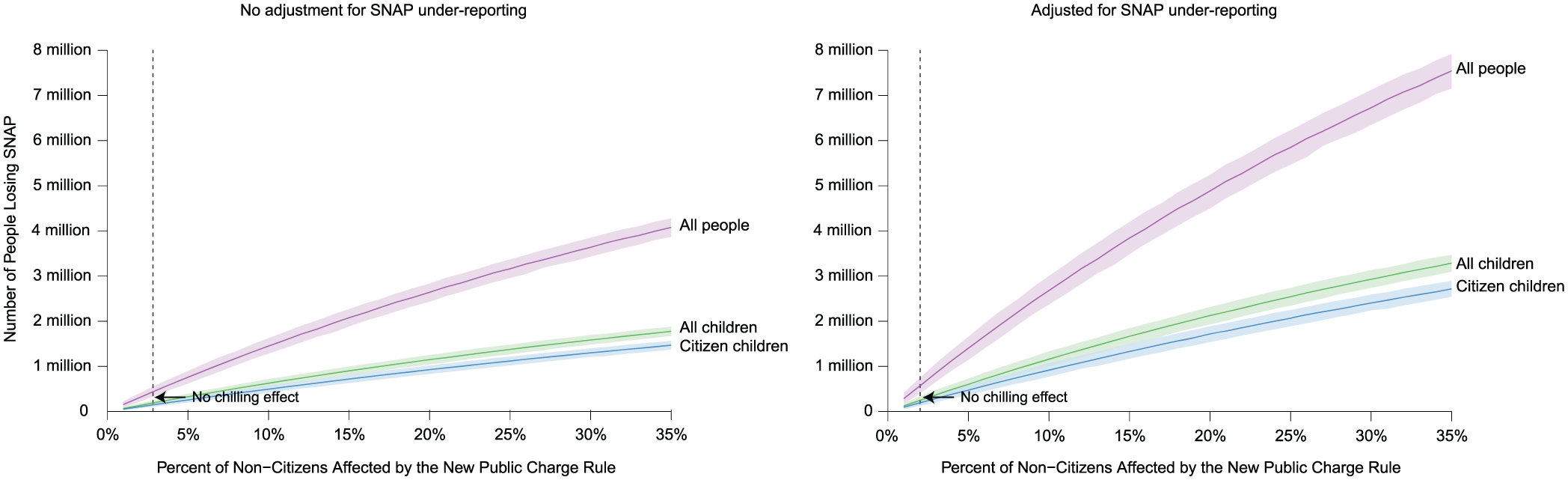
Total number of people losing Supplemental Nutrition Assistance Program (SNAP) conditional on the chilling effect of the public charge proposal.
We first show how the SPM child poverty rate increases depending on the percentage of noncitizens who are affected by the public charge proposal (Figure 1).
Figure 1 shows a wide range of estimates. If we assume that the only people giving up their household SNAP benefit are those planning to apply for green cards in the next 12 months (no chilling effect), the increase in the child poverty rate is approximately .001 percent. Under this scenario, slightly more than 10,000 children fall into poverty. If we assume that 35 percent of noncitizens will refuse SNAP for their household (our upper bound scenario), the child poverty rate increases by 1.7 percent. While a 1.7 percent increase might not seem large—the child poverty rate would increase from 15.6 percent to 15.9 percent—an increase of this size would push nearly 200,000 children into poverty.
We next examine the size of the SNAP population affected by the public charge proposal before and after adjusting for underreporting. The left plot in Figure 2 shows the number of people losing SNAP conditional on the chilling effect without adjusting for underreporting. Consistent with Stevens et al.’s (2018) finding that the actual SNAP population is 85 percent (46/54 = .85) larger than the SNAP population in the CPS, the right plot in Figure 2 increases the population affected by 85 percent.
We first discuss the results without taking SNAP underreporting into account (the left plot of Figure 2). If we assume no chilling effect, our simulation indicates that approximately 300,000 people will lose access to SNAP, more than a third of whom are U.S. citizen children. According to the upper bound chilling effect, nearly 2 million children (most of whom are U.S. citizens) will no longer have access to SNAP. It is important to note that the economic impact will be substantial—even without a chilling effect and without taking underreporting into account. If only 2 percent of the noncitizen population chooses not to take up SNAP, more than $100 million in SNAP benefits will be left on the table.
After adjusting the number affected based on Stevens et al.’s (2018) estimate of SNAP underreporting in the CPS (the right plot in Figure 2), our simulation suggests that depending on the chilling effect, up to 2.7 million U.S. citizen children could lose access to SNAP.
Labor Supply Response
To make up for the lost assistance, some of the adults in the households giving up their SNAP benefit may work more after canceling their benefit. If this is the case, then the increase in poverty will not be as large as what we report in Figure 1. While the true labor supply effect is unknown—especially for undocumented adults who are not legally eligible for work—we can estimate the total increase in income that noncitizen households would have to generate to make up for the lost SNAP benefit. 8 In the 2017 CPS, the average SNAP benefit for SPM households with noncitizens is $3,000 per year. Median annual cash income for these households is roughly $27,000. The typical SNAP household with noncitizens would have to increase their income by more than 10 percent to make up for their lost SNAP benefit.
Conclusion
This study examines the potential poverty impact of the SNAP provision in the proposed DHS public charge regulation. Of the SNAP participants potentially affected by the proposal, approximately a third are U.S. citizen children. Depending on how noncitizens respond to the proposal and whether the proposal becomes policy, up to 7.9 million people (2.9 million of whom would be U.S. citizen children) could lose access to food assistance. In the absence of a large labor supply response, a mass exodus of mixed-status households from the SNAP program will lead to a substantial increase in the child poverty rate (Figure 1).
Our simulation only focuses on the SNAP population. The DHS proposal also targets recipients of Medicaid and public housing assistance. Moreover, if the proposed regulation reduces enrollment in programs not included in the new definition of public charge—school meal programs, for example—or reduces the enrollment of eligible citizen families in cash assistance programs (already included in the definition of public charge), the child poverty effects will be substantially larger than what we report in this analysis.
Footnotes
Acknowledgements
We are grateful to David Brady for insights on a prior version of this article.
Authors’ Note
A draft of this paper was presented at the 2018 meeting of the American Sociological Association.
1
For example, see Bitler and Hoynes (2013); Kaushal, Waldfogel, and Wight (2014); and  .
.
2
For most households, Supplemental Nutrition Assistance Program (SNAP) eligibility is determined by three tests: a gross income test (must be less than 130 percent of the federal poverty line), a net income test (income minus deductions must be less than 100 percent of the poverty line), and an asset test (assets must be less than $2,250, excluding home and retirement accounts). For some households, broad-based categorical eligibility has effectively raised the gross income limit above 130 percent of the FPL.
3
According to U.S. Immigration and Customs Enforcement (ICE) data, there was a 38 percent increase in the number of immigrants arrested between 2016 and 2017.
4
While there is no historical precedent for denaturalizing citizens based on public benefit participation, in June of 2018, the U.S. Citizenship and Immigration Services created a task force of lawyers that will review cases of naturalized citizens who are suspected of applying for citizenship under false pretenses. Press accounts about the task force’s activities could theoretically create a chilling effect for naturalized citizens.
6
7
The Urban Institute’s Transfer Income Model (TRIM) is a microsimulation model that has been used by researchers as an alternative to the regular Current Population Survey (CPS). TRIM imputes SNAP receipt by identifying eligible units and then selecting additional participants until the imputed CPS data match administrative targets for number of recipients, available demographic characteristics, and total benefit amount. In their study linking CPS, TRIM, and administrative data, Stevens, Fox, and Heggeness (2018) find that while TRIM reduces the underreporting rate to 36 percent (vs. 46 percent in the regular CPS), TRIM produces false positives, namely, individuals receiving SNAP in the TRIM CPS data but not in administrative data. These false positives are clustered around the bottom of the income distribution. Compared with Supplemental Poverty Measure (SPM) rates estimated using administrative records, the CPS Annual Social and Economic Supplement (ASEC) overestimates the overall SPM rate by .4 percentage points, whereas using TRIM3 SNAP data underestimates the SPM rate by .5 percentage points. For this reason, we do not use the TRIM imputations.
8
To date, the most rigorous study of a labor supply response to federal food assistance is Hoynes and Schanzenbach’s (2012) study of the county level rollout of the food stamp program in the 1960s and 1970s. Hoynes and Schanzenbach report that heads of household who took up food stamps in the 1960s and 1970s reduced their employment rate by 24 to 27 percentage points (a treatment-on-the-treated reduction of 505 annual hours)—a large effect, although it was statistically indistinguishable from zero in their data. Hoynes and Schanzenbach’s findings predate an expansion of the Earned Income Tax Credit (EITC), large increases in female labor force participation, a large decline in female wage elasticities during the 1980s, and the introduction of SNAP and Temporary Assistance for Needy Families (TANF) work requirements after 1996 welfare reform. These changes affect both program participation and work incentives. More recent research by using CPS data to understand immigrant labor supply after welfare reform finds employment effects that are similar in magnitude to Hoynes and Schanzenbah’s effect.