




Abstract
Men in the United States have higher rates of life-threatening diseases than do women, in part due to behavioral differences in health practices. We argue that men’s enactment of masculinity in their daily lives contributes to health behavior differences. We focus on meat consumption, a masculine-stereotyped dietary practice that epidemiological studies have linked to negative health outcomes. In study 1, nationally representative survey data indicate men report less healthy lifestyle preferences than do women, including less willingness to reduce meat consumption. In study 2, an internet-based experiment shows that experiencing a masculinity threat leads men to express more attachment to meat consumption. In study 3, lab experiment data with a different experimental manipulation and study population again indicate that threats to masculinity influence men’s meat preferences. These results support the claim that men’s masculinity maintenance may be one factor contributing to gender differences in meat consumption and health disparities related to overconsumption of meat.
Introduction
Across a number of lifestyle practices that affect health and longevity, men in the contemporary United States engage in more harmful and fewer health-promoting behaviors than do women. One particularly pronounced disparity is seen in men’s and women’s dietary choices. Among other dietary differences, men eat far more meat, particularly red and processed meat, than is nutritionally advised. Research has also linked greater meat consumption to illnesses such as heart disease and cancer (Daniel et al. 2011; Fraser 2009; Huang et al. 2012; U.S. Department of Health and Human Services and U.S. Department of Agriculture [USDHHS and USDA] 2015).
One potential explanation for this gender difference in health-related behaviors can be found in research on how men enact masculinity in their daily lives. Since masculinity is a highly valued identity that must be constantly proven, men are continually working to demonstrate their masculinity in everyday life (Carrigan, Connell, and Lee 1985). However, many masculine-stereotyped behaviors that men engage in are detrimental to health and longevity (Courtenay 2000).
Yet while existing research has documented practices of masculinity maintenance and of detrimental dietary preferences among men, little work has drawn a causal link between the two. In this article, we draw on observational data to show that men prefer meat more than do women and then provide causal evidence linking men’s masculinity maintenance to their greater preference for meat-based diets. In a nationally representative survey (study 1), we show that men express a greater attachment than do women to unhealthy dietary and exercise choices, including meat consumption. In an online experiment (study 2) and a laboratory experiment (study 3), we find that men’s attachment to eating meat is heightened after experiencing a threat to their masculinity. In causally linking men’s health behavior preferences with the maintenance of their masculinity, we illustrate how the micro-level process of enacting masculine gender expectations shapes macro-level gender health patterns.
Background
Maintaining Masculinity in Everyday Life
Within a given culture, men are judged against a dominant form of masculinity, which acts as a standard by which all other masculinities and femininities are evaluated (Connell 1995). As with virtually all social categories, dominant masculinity is not static or fixed. However, there is considerable consistency in the qualities that make up dominant masculinity across contexts, including traits such as courage, aggression, risk taking, and rejection of the feminine (Schrock and Schwalbe 2009). Dominant masculinity often legitimates unequal gender relations by positioning “superior” masculine qualities against “inferior” feminine qualities and is referred to as hegemonic masculinity when it does so (Beasley 2008; Messerschmidt 2010). However, dominant masculinity also encompasses masculine behaviors that do not necessarily elevate men’s status vis-à-vis women, such as following particular hygiene norms (Messerschmidt 2018).
Dominant masculinity acts as the standard for all men, such that even if a man personally rejects this standard or endorses a different form of masculinity, he is still evaluated by others relative to the prevailing ideal (Carrigan et al. 1985). Thus, though men are not monolithic in the types of masculine ideals they value and the extent to which they adhere to these ideals, they share the experience of being measured by others relative to norms of culturally defined dominant masculinity. Moreover, because masculinity is highly valued and respected relative to femininity (Ridgeway 2011), and because failing to live up to masculinity standards can result in shaming and ostracism (Phoenix, Frosh, and Pattman 2003), men are incentivized to conform to the ideal.
However, achieving dominant masculinity tends to be a difficult (if not impossible) task, which requires proving one’s self to others on a regular basis (Connell 1995). Asserting one’s masculinity takes place on an everyday basis through behaviors such as consumer decisions or expressing political views (Willer et al. 2013; Zhu et al. 2015). In addition, people tend to view manhood as something that must be proven through masculine acts rather than assumed (Vandello et al. 2008). While femininity is likewise enacted through everyday actions, in many domains the behaviors that are deemed acceptable for women are defined more broadly than those deemed acceptable for men (Adams and Bettis 2003; McGuffey and Rich 1999). This is not to say that women experience less pressure to meet societal gender expectations relative to men. Rather, since masculine traits are generally seen as more valued and higher status, women and girls often face pressure to achieve in both traditionally masculine and feminine domains (Hinshaw and Kranz 2009). Men, on the other hand, are often held to a single standard of masculinity, which they strive to achieve through seeking out masculine-typed traits and behaviors and avoiding feminine ones (Pascoe 2005).
Evidence that men care about masculinity and work to maintain it can be seen in past research on how individuals respond to threats to their gender identity (i.e., one’s sense of masculinity or femininity). Using experimental methods, social psychologists have looked at masculinity maintenance through studies that randomly assign men to experience a threat to their gender identity, for example, by being told that their score on a gender test aligns with the average woman’s score (Willer et al. 2013).
Willer and colleagues (2013) have called this phenomenon “masculine overcompensation” and argue that the high-status, precarious nature of masculinity leads men to enact extreme displays of masculine behavior to restore their masculinity when it is threatened. When men in such studies experience a threat to their gender identity, they adopt more prototypically masculine attitudes and behaviors such as risk taking, physical aggression, and homophobia (Bosson et al. 2009; Weaver, Vandello, and Bosson 2013; Willer et al. 2013). This is in line with identity control theory, which proposes that individuals who receive information that challenges a salient identity will enact exaggerated behaviors associated with that identity to close the discrepancy between the outwardly perceived and inwardly felt identity (Burke and Stets 2009).
In sum, masculinity takes on many forms, but men are generally evaluated according to a standard of dominant masculinity. Moreover, masculinity is valued by men and must be constantly proven in everyday life with displays of prototypically masculine characteristics such as risk taking and rejecting all things feminine. For the sake of brevity, we use “masculinity” to refer to the dominant masculinity ideal as we turn to work that connects it to the creation of gender disparities in health and longevity.
Linking Masculinity and Men’s Health
There are a number of stark gender differences in the health of men and women in the United States today. While women are more likely to suffer from nonfatal, chronic conditions, men more often suffer from diseases related to premature death, such as heart disease (National Center for Health Statistics 2017). Men’s life expectancy is also five years shorter than that of women (Read and Gorman 2010). While numerous processes shape gender disparities in health outcomes, behavioral differences are a contributing factor. In particular, men’s lifestyle choices generally include higher rates of risky behaviors that are harmful to health and longevity (e.g., substance abuse, delaying medical care) and lower rates of behaviors that promote good health (Courtenay 2000; Williams 2003).
Meat consumption is one domain in which men engage in significantly higher rates of unhealthy behavior. On average, American men, but not women, eat far more meat, poultry, and eggs than nutritional experts advise (USDHHS and USDA 2015). Moreover, red and processed meats make up more than half of men’s meat intake, and greater consumption of these foods has been linked to heightened risk for heart disease, cancer, and death (Daniel et al. 2011; Wang et al. 2015). In other words, not only do men eat more total meat than is recommended for a healthy diet; they also are consuming the least healthy types—red and processed meats—as the majority of their meat intake.
In addition to the tendency for men to eat more meat than recommended, men are less likely to follow a vegetarian diet. While overconsumption of meat (especially red and processed meat) is related to negative health outcomes, recent studies show that maintaining a vegetarian diet is related to positive health outcomes, including a longer lifespan and lower risk of heart disease and cancer (Fraser 2009; Huang et al. 2012; National Center for Health Statistics 2017). Taken together, men’s overconsumption of meat and their lower rates of vegetarianism put them at greater risk for lifestyle-related diseases and premature death.
Social science research suggests that men’s greater likelihood of overconsuming meat and eschewing vegetarianism is shaped and reinforced by cultural associations between meat and masculinity. Historically, meat consumption was seen as a way to revitalize masculinity at the turn of the twentieth century (Kimmel 1996), and meat, particularly red meat, still acts as a means to bolster dominant forms of masculinity (Buerkle 2009). Indeed, both men and women associate meat with masculinity, and men face pressure to eat meat by gendered media representations (Nath 2011; Rogers 2008; Rothgerber 2012; Rozin et al. 2012). And as might be expected, men who opt not to eat meat or who forgo animal products entirely are seen as less masculine than other men (Ruby and Heine 2011; Thomas 2016).
Differences in men’s and women’s meat consumption also can be traced to a broader trend in dietary behaviors whereby food decisions are influenced by gendered norms and expectations surrounding diet. Research suggests that eating unhealthily is stereotyped as masculine behavior (Zhu et al. 2015), and indeed, a study looking at how families provide food for their children found that fathers were perceived as less concerned about dietary health and tended to provide unhealthier food to children relative to mothers (Fielding-Singh 2017). This sets a precedent early in life that the work of planning and provisioning a healthy diet is women’s work. In addition to provisioning healthy food, women face other dietary pressures, including the dual threat of appearing either too restrictive or too slovenly in their dietary choices (Cairns and Johnston 2015).
In sum, research has documented gender differences in health practices, particularly those surrounding diet and meat consumption (Courtenay 2000). Men tend to eat more meat than is recommended, and more than half of the meat they consume is red meat or processed meat products. Moreover, consuming meat and unhealthy eating practices more broadly are stereotyped as masculine behaviors (Rozin et al. 2012; USDHHS and USDA 2015). In this article, we test whether a causal link exists between the two. More specifically, we test whether men’s unhealthy practices, such as overconsuming meat, can be explained by their desire to demonstrate masculinity through dietary preferences that are stereotyped as masculine but that may have negative implications for health.
Present Research
To determine whether the maintenance of masculinity has deleterious effects on men’s health-related outcomes, we test our hypotheses with data from three sources: a nationally representative survey of U.S. adults (study 1), an internet-based survey experiment (study 2), and a laboratory experiment (study 3). In study 1 we analyze survey data on health-related attitudes to test our first hypothesis:
Hypothesis 1. Men will show a stronger preference for unhealthy meat, diet, and exercise practices than will women.
Study 1 allows us to establish whether there are gender differences in endorsement of health-related dietary and exercise practices while using a representative sample of U.S. adults. After looking for evidence of men’s higher support of unhealthy lifestyle practices in the general population, we attempt to establish the causal role of masculinity maintenance in shaping men’s health attitudes.
We posit that men’s efforts to maintain their masculinity will lead to increases in unhealthy diet and exercise practices that then negatively affect health outcomes. In studies 2 and 3 we use experiments that randomly assign men and women to have their masculinity and femininity threatened to test our second hypothesis:
Hypothesis 2. Experiencing a threat to masculinity will cause men to increase their preference for unhealthy meat, diet, and exercise practices.
As most other scholars have not found significant effects for femininity threat among women, we predict that threatening women’s femininity in these studies will have no effects on their expressed preference for unhealthy meat, diet, and exercise practices. Given that women are increasingly expected to embody both masculine and feminine ideals (Adams and Bettis 2003; Hinshaw and Kranz 2009), women who receive feedback that they lack femininity (or that they are masculine) may not feel threatened in the same way as do men who receive feedback that they lack masculinity (or that they are feminine), because for women such feedback may be interpreted as successfully achieving socially valued masculine ideals such as strength and independence.
Study 1: Nationally Representative Survey
To determine whether men’s lifestyle preferences tend to reflect less healthy choices than do women’s, we use survey data to assess willingness to adopt health-related diet and exercise behaviors. Data from study 1 were collected using a nationally representative online survey of U.S. adults. We pooled resources with several researchers studying social and political preferences to conduct this survey as part of a larger 20-minute omnibus survey that included several modules. The survey was administered by the polling company YouGov from June 24 to July 5, 2013, and was part of a larger 20-minute omnibus survey that included several modules. YouGov samples by recruiting a subset of respondents from its more than 1.2 million U.S. members and creates a representative sample by matching respondent characteristics to those in the 2007 American Communities Survey. The panel was selected from an initial group of 1,165 respondents, who were matched down to a sample of 1,000 based on demographic characteristics. The matched sample was then weighted to known characteristics of the general population of the United States, based on the 2007 American Community Survey. 1 The data are available upon request.
Measures
Four items measuring health-related behaviors were included on the survey, and respondents reported their answers on seven-point Likert-type scales (see Table 1). These questions asked respondents about their attitudes toward meat consumption, dieting, and exercise. We ask primarily about future, rather than current, behavior, for two reasons. First, past research has already documented gender differences in health-related behaviors, such as the lower rates of vegetarianism and higher consumption of red and processed meat among men (Daniel et al. 2011; Kim et al. 2017). Attitudinal measures about future behavior allow us to examine gender differences in the strength of health-related meat, diet, and exercise preferences. For instance, if men’s concerns about masculinity cause them to be more resistant than women to changing existing behaviors to ones that foster health and longevity, this has important implications for policy makers. Second, using attitudinal measures about meat, diet, and exercise allows us to see how threats to masculinity and femininity shape these preferences when we turn to experimental methods in studies 2 and 3.
Health Attitude Item Wording.

Note: Items 1 through 3 were answered on Likert-type scales ranging from 1 (no, not at all) to 7 (yes, definitely) while items 4 was answered on a scale from 1 (strongly disagree) to 7 (strongly agree).
The main independent variable of interest is gender, which is represented in analyses with an indicator variable for male. 2 We control for family income, age, race/ethnicity (white, black, Latina/o, other), education (four-year college degree or not), marital status, parental status, and employment (those who work full-/part-time vs. others). Respondents who did not provide income data were dropped, which left us with a final sample size of 847, but results are substantively similar when we include these respondents and do not control for income. Table 2 provides descriptive statistics of the overall sample and broken down by respondent gender for all the variables used in analyses. The far-right column in Table 2 provides the t statistics from independent samples t tests comparing the mean values of each measure by respondent gender.
Descriptives for All Variables Used in Analyses by Respondent Gender.

One man did not answer the vegetarianism and red meat questions; for these the overall n = 846 and men’s n = 399.
t statistics and significance levels are from independent samples t tests based on respondent gender.
p < .01. ***p < .001, two-tailed tests.
Results
We ran a series of multivariate ordinary least squares regressions using gender to predict levels of support for each of the health attitude items. Alternative analyses using ordered logit models yielded comparable results; these models are available upon request. We include demographic controls in the models, which allows us to estimate gender differences in health attitudes while holding constant potentially confounding factors. All models were conducted using population weights and robust standard error estimates, though results remain substantively similar without these specifications. Table 3 displays the results from these analyses with a separate regression model estimated for each of the health attitude measures.
Unstandardized Coefficients from Ordinary Least Squares Regressions Predicting Agreement with Health Attitudes.

Note: Robust standard errors are in parentheses; analyses were done with population weights.
p < .10. *p < .05. ***p < .001.
Consistent with prior work demonstrating that men eat more meat than do women (Kimmel 1996; Rothgerber 2012), we find that men are significantly more resistant to the idea of reducing red meat consumption (p < .001) and are significantly less willing than women to consider becoming vegetarian in the future (p < .001). Men also are less likely to report openness to going on a diet at some point in their life (p < .001) and are significantly less likely than women to think they should be exercising more than they currently do (p < .05). Although a few of the control variables significantly predict health attitudes, none have as consistent an effect on meat-based diet and exercise preferences as gender.
Discussion
Data from study 1 support our first hypothesis that men are more likely than women to endorse greater meat consumption and are less willing to exercise and diet more. Compared to women, men demonstrated greater opposition to reducing red meat consumption, adopting a vegetarian diet, dieting, and exercising.
By using a nationally representative survey in study 1, we can be confident that these findings are generalizable across a diverse sample of U.S. adults spanning many ages, racial/ethnic groups, and socioeconomic categories. However, while data from this survey allow us to document gender differences in endorsement of health-related behaviors related to meat and exercise, they do not address how concerns about masculinity may lead to these differences. To test our hypothesis that masculinity maintenance leads to detrimental health behaviors in a more tightly controlled setting, we turn to experimental methods.
Experiments offer the distinct advantage of allowing us to disentangle potentially confounded factors that could explain the gender disparity in health behaviors. When looking at the question of masculinity maintenance and health, correlational data do not adequately allow us to rule out the possibility that the gender differences we observed are due to factors other than men’s concerns about proving their masculinity. For example, from the results of study 1, it would be equally reasonable to frame the gender gap in health attitudes as a product of women’s femininity concerns, which could conceivably lead them to endorse healthy choices at higher rates. To address this, we use experiments that directly manipulate men’s sense of masculinity and women’s sense of femininity.
Study 2: Internet-based Experiment
To determine whether the gender differences in health attitudes we observed in study 1 can be explained by men’s attempts to maintain their masculinity, we designed a 2 × 2 online experiment with factors for respondent gender (male/female) and threat to gender identity (threat/no threat). By randomly assigning men and women to either have their gender identity threatened or not, we can test for a causal relationship between responses to masculinity or femininity threats and attitudes toward health-related practices.
Participants from the online crowd-sourcing website Amazon Mechanical Turk (AMT) were recruited to complete a study that was ostensibly about “attitudes and opinions.” AMT is an online platform on which workers are paid to complete tasks, including research studies. AMT sampling is not nationally representative, but respondent characteristics tend to be similar to those of the general U.S. population, though AMT workers are more likely to be younger, be female, and hold a college degree (Paolacci, Chandler, and Ipeirotis 2010).
A total of 95 participants from AMT (53 men, 42 women) participated in the study. 3 Participants ranged in age from 18 to 63, with a mean age of 31; 77 percent were white. Further information about respondent characteristics is available by request. After reading a brief description of the study, respondents were shown the following prompt displayed above an essay text box in an online survey: “Please think about [2/8] times in the past when you felt very [masculine/feminine]. List them below.” Men were asked to write about times they felt masculine, and women were asked to write about times they felt feminine.
The logic of the manipulation works as follows: Recalling two times that you felt very masculine (or feminine) is typically an easy task, but listing eight times tends to be much harder. When faced with the difficulty of listing eight examples of feeling very masculine, respondents will make inferences about their own masculinity, which produces a feeling of threat (i.e., “If it’s hard to think of eight examples, I must not be very masculine.”). Several experiments have successfully used this ease of recall paradigm to manipulate inferences about various facets of the self (e.g., Schwarz et al. 1991). One recent study on how threats to masculinity affect men’s financial decisions found that the ease of recall manipulation yielded similar results to commonly used masculinity threat manipulations (Weaver et al. 2013). Furthermore, since participants respond to the prompt by writing about their own conceptions of masculinity or femininity, it allows for respondents to define these ideas for themselves rather than having an external definition imposed upon them.
At face value, women and men in the study were exposed to parallel manipulations. However, given the higher status afforded to masculinity (Ridgeway 2011) and the societal expectation that men achieve only masculine ideals but that women achieve both feminine and masculine ideals (Adams and Bettis 2003; Pascoe 2005), it is possible that the women and men in our study experienced and processed the manipulation differently. That is, men may have found the feedback that they were not masculine more distressing than women who received feedback that they were not feminine.
Measures
After completing the manipulation, respondents were asked to indicate their agreement with health-related attitude items about meat, diet, and exercise (see Table 4).
Health Attitude Item Wording.
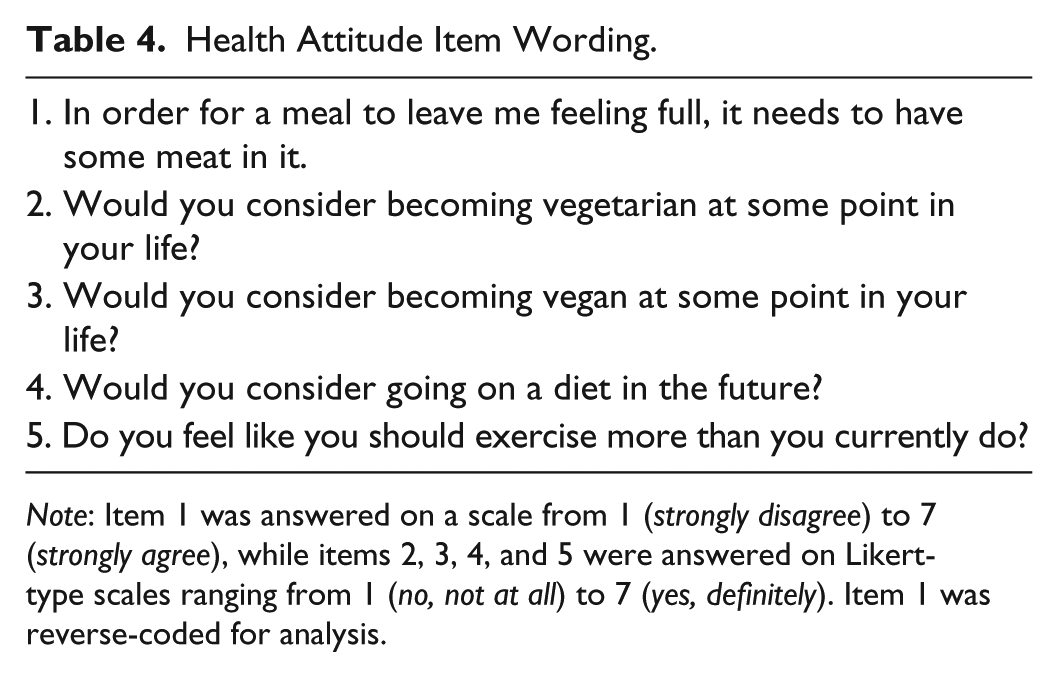
Note: Item 1 was answered on a scale from 1 (strongly disagree) to 7 (strongly agree), while items 2, 3, 4, and 5 were answered on Likert-type scales ranging from 1 (no, not at all) to 7 (yes, definitely). Item 1 was reverse-coded for analysis.
Results
Our results indicate that when men’s masculinity is threatened, men show a greater attachment to meat (see Table 5). Using independent samples t tests, we find that men whose masculinity is challenged are significantly more likely to agree that they need meat to feel full (p < .05). Men whose masculinity is threatened are also significantly less willing to consider adopting a vegetarian diet (p < .01) and are marginally less likely to consider adopting a vegan diet (p < .10).
The Effect of Gender Identity Threat on Health Attitudes in an Online Survey.

Note: Standard deviations are in parentheses.
p < .10. *p < .05. **p < .01, two-tailed tests.
Given that these three items all relate to an individual’s attachment to meat, we created a composite measure that takes an average of the three meat-related items (Cronbach’s alpha = .82). 4 Using this composite, we find that men who have their masculinity threatened are significantly more likely to show attachment to having meat in their diet relative to those in the control condition, means = 5.65 vs. 4.43, t(51) = 2.93, p < .01. In other words, across a composite of the three meat-related items, men who have their masculinity threatened are much more likely to express that eating meat is important to them.
While the averages for the items about future exercise and dieting from study 1 are in the predicted direction for men, these differences are not statistically significant at conventional levels. In addition, no differences in any of the individual health-related attitude items or in the composite measure for attitudes about meat (means = 4.13 vs. 4.73, t(40) = −1.15, p = n.s.) were found between women in the femininity threat condition and women in the control condition.
Discussion
Data from study 2 provide support for a causal relationship between men’s concerns about maintaining their masculinity and their endorsement of unhealthy lifestyle choices (hypothesis 2). When men in the study experienced a threat to their masculinity, they reported significantly more attachment to meat and meat-based diets. While study 1 used a nationally representative survey to show that men were less willing to consider adopting healthy behaviors than were women, study 2 allows us to demonstrate causation in a controlled setting. In doing so, we find that men’s concerns about masculinity lead to an increased preference for unhealthy lifestyle choices.
By contrast, we find that women in the femininity-threat condition did not respond differently from women in the control condition. This might suggest that having their gender identity threatened simply does not prompt women to alter their dietary and health preferences. However, as discussed above, it also is possible that women simply did not find the endeavor of trying to list eight times they felt feminine to be as threatening to their gender identity as men might find the exercise of trying to list eight times they felt masculine.
Although the ease of recall task used to threaten gender identity in study 2 has been used previously, one can imagine alternative explanations for these results. For example, perhaps the differences we observe in attitudes toward meat are not caused by men’s masculinity concerns but are instead due to the way men react to difficult tasks in general. It could be that after completing a hard task (i.e., remembering eight examples of a time they felt masculine), men may be less interested in other challenging activities such as altering components of their diet. To address these concerns, study 3 uses a different manipulation to threaten gender identity.
Study 3: Laboratory Experiment
In study 3 we use a 2 × 2 laboratory experiment with respondent gender (female/male) and threats to gender identity (threat/no threat) as the two experimental factors. To create the threat, we asked participants to take a gender identity test and then randomly assigned them to receive feedback that their score on the test fell into the average range for either men or women. A total of 135 undergraduate participants (60 women, 75 men) from a Northern California community college took part in the study in exchange for course credit. Upon arriving at the lab, they were led to believe that they would be taking part in two separate studies: the first on gender attitudes and the second on general health attitudes. This was done to minimize suspicion about the true purpose of the study.
After signing a consent form, each participant filled out a pen-and-paper gender identity test that was described as having been “used for decades as a method for classifying individuals with respect to their gender attitudes.” The gender identity test was the Bem Sex Role Inventory (Bem 1974), a measurement tool that lists a series of adjectives (e.g., friendly, aggressive) and asks respondents to indicate how much each term describes them. A few minutes after collecting the test, the researcher returned with a half sheet of paper with a randomly assigned gender identity score which displayed the respondent’s score as being either in the “average male” or “average female” range for people in the Bay Area. Men in the threat condition received feedback that they scored in the “average female” range, while men in the control condition were told they scored in the “average male” range (and vice versa for women).
The gender identity threat administered to women and men was comparable in the sense that both were given feedback that they were gender nonconforming. However, as discussed in study 2, women may not find the information that they lack femininity to be as threatening compared to men who are told that they lack masculinity. Indeed, research linking gender nonconformity and health suggests that standards of what constitutes gender nonconformity may differ for women and men (Hart et al., 2019).
After receiving their purported gender identity score, each participant was then moved from the desk to a computer station where he or she was given a new consent form for the ostensibly unrelated second study on general health attitudes. During this portion of the study, respondents worked on a computer and answered survey questions about their attitudes toward various health-related behaviors. After finishing the survey, participants were debriefed and were informed about the true purpose of the study. 5
Measures
Attitudes toward health-related practices were assessed with the computer-administered survey and covered meat preferences and willingness to engage in future diet and exercise. The wording of the items used in this study matched that of items used in study 2.
Results
As in study 2, we find that men with threatened masculinity expressed a greater attachment to having meat in their diets (see Table 6). Using independent samples t tests, we find that men with threatened gender identity are significantly more likely to report that they “need meat in order to feel full after a meal” (p < .05). In addition, they show less willingness to consider becoming vegetarian or vegan in the future relative to men in the control condition (p < .05 and p < .10, respectively).
The Effect of Gender Identity Threat on Health Attitudes in a Laboratory Setting.

Note: Standard deviations are in parentheses.
Two men did not answer the vegetarianism item; for this variable n = 68.
One woman did not answer the veganism item; for this variable n = 49.
p < .10. *p < .05, two-tailed tests.
Again, we created a composite measure averaging the three meat-related attitudes (Cronbach’s alpha = .63). Men with threatened masculinity have significantly lower scores on this composite relative to men in the control condition, means = 5.74 vs. 4.89, t(66) = 2.66, p < .01. Thus, as in study 2, receiving a threat to masculinity caused men to demonstrate a significantly higher attachment to eating meat. Men who received threatening feedback on the gender identity test also are less likely to agree that they should be dieting or exercising more, but these differences are not statistically significant.
In study 3, we find evidence that women who are told that they are more masculine than feminine also express an increased attachment to meat on two of the three measures. Women given the masculine score on the gender identity test are significantly more likely to say they need meat to feel full (p < .05), and marginally significantly less likely consider vegetarianism (p < .10). They also are less likely to consider veganism, although this difference is not statistically significant. We created a composite score of these three measures for women (Cronbach’s alpha = .65) and find that women assigned the masculine score have significantly lower scores on this composite measure compared to women in the control condition, means = 5.56 vs. 4.68, t(47) = 2.24, p < .05. Women whose femininity was threatened do not express significantly different views on dieting or exercising relative to nonthreatened women.
Discussion
Results from study 3 provide further evidence that concerns about maintaining masculinity lead men to increase their attachment to meat-based diets. Specifically, threatened men show greater resistance to cutting meat from their diets and are more likely to say they need meat to feel full after a meal, while nonthreatened men demonstrate less attachment to meat in their diets. This suggests that threatened men may attempt to restore their masculinity by playing up the importance of a stereotypically masculine behavior, eating meat. Men who experienced a threat to their masculinity in study 3 also are less likely to think they ought to exercise more or diet, but these differences were not statistically significant.
Though we predicted that threatening femininity would have no effect on women’s health-related attitudes, we find evidence to the contrary. Women whose femininity was threatened were significantly more likely to report needing meat to feel full after a meal and were marginally less likely to consider adopting a vegetarian diet than were women whose femininity was not threatened. This is in contradiction to the results of study 2, in which threatened women did not exhibit stronger attachment to meat on any of the three items relative to nonthreatened women.
We urge caution in interpreting the findings for women, given the inconsistent results between studies 2 and 3. Nonetheless, we find it interesting that women whose gender identity was threatened in study 3 appear to act the opposite of threatened men, relative to their respective gender stereotypes: While men under gender threat increase their gender normative behavior, women under gender threat adopted masculine-typed, promeat preferences. We speculate that because women are encouraged to embody both feminine and masculine ideals, and because masculinity is afforded higher status than femininity (Adams and Bettis 2003; Ridgeway 2011), women who are given feedback that they are masculine may be more likely to accept the identity and enact behaviors that align with it.
Overall, results from study 3 provide evidence that masculinity maintenance has a causal and detrimental effect on men’s health preferences. When men experienced a threat to their masculinity they exhibited a preference for dietary practices favoring meat. Though study 2 and study 3 each reflect a different variation on how men relate to masculinity (i.e., through their own definition in study 2 and to a supposed quantitative standard in study 3), both studies demonstrate that masculinity maintenance involves a preference for greater meat consumption and less willingness to adopt vegetarian or vegan diets.
General Discussion
Our findings show that men express greater preference for meat and less willingness to diet or exercise than do women (study 1) and that men’s concerns about maintaining masculinity play a causal role in creating these differences in meat-based diet preferences (studies 2 and 3). Across these studies, men showed a preference for having meat in their diets relative to women and responded to masculinity challenges by adopting even stronger promeat views. This is important because overconsumption of meat, particularly red and processed meat, is associated with increasing likelihood of developing heart disease and cancer and with overall mortality (Fraser 2009; Huang et al. 2012; Wang et al. 2015).
Therefore, if men overemphasize the importance of meat in response to masculinity threats, this could further strengthen and reinforce the association between masculinity and meat. Moreover, proving one’s masculinity through meat-based diets may exacerbate men’s greater vulnerability to negative health outcomes related to excess meat consumption. As masculinity is precarious and constantly subjected to threat, these threats can accumulate over the life course and contribute to larger health disparities between men and women (Vandello et al. 2008).
We also find that men whose masculinity is threatened express less interest in diet or exercise in studies 2 and 3, but these results are not statistically significant. We think the relative weakness of these results may be explained by the less salient gender stereotypes associated with these activities. The gendered associations with exercising and dieting, compared to eating meat, are more ambiguous. Exercise may be viewed as feminine when it involves cardiovascular activity but masculine when it involves strength training; likewise, protein-heavy diets may be seen as more masculine, while diets cutting carbohydrates or fat may be seen as more feminine. We suspect that this ambiguity may have led to weaker results on these items relative to our consistent finding that masculinity threat is associated with increased attachment to meat.
In their everyday lives, men face great pressures to act in ways that exemplify our culture’s masculinity standards. Because masculinity is such a precarious identity that it must be constantly proven, responding to gender identity threats is routine for many men; likewise, the behaviors we examine across these three studies map onto frequent, everyday choices about diet. Given this, one can see easily how men’s health outcomes may be adversely affected by the cumulative lifetime impact of masculinity maintenance processes that lead men to prefer unhealthy lifestyle practices beyond just those we examine in these studies. However, while we provide evidence for the role of masculinity maintenance in shaping men’s health, this process is only one part in the much larger puzzle of explaining health outcomes via the interplay of numerous social and biological factors. Future work should explore how much of the gender gap in longevity or preventable disease rates can be attributed to men’s efforts to maintain their masculinity.
While we generally find support for our hypotheses across the three studies, we do not explore how masculinity maintenance varies across individuals from different positions in the social structure. Since we know that men’s health and longevity outcomes vary by both race and class (Williams 2003), it is important that researchers look at how the process of masculinity maintenance may manifest differently for men based on the intersection of these factors. And though we sought to avoid imposing a single definition of masculinity on the respondents in study 2 by asking them to provide examples from their own lives when they felt masculine (or feminine) in the experimental manipulation, the relatively small sample size prevents us from being able to perform further analyses on these responses by subgroups.
Since we focus on dietary attitudes and masculinity, we are less likely to detect how women’s maintenance of femininity shapes their health-related practices. Our finding in study 3—that women who are told that they are masculine may then enact masculine-stereotyped dietary preferences—suggests that women may indeed be sensitive to masculine ideals when prompted. Future research should explore this question, especially in light of work showing that girls and young women face increasing pressures to achieve both masculine and feminine ideals of success, which contributes to their higher rates of self-mutilation, eating disorders, and depression (Hinshaw and Kranz 2009).
Overall, this article seeks to further our understanding of how the micro-level process men enact in maintaining their masculinity can help explain the macro-level tendency for men to die earlier than women from preventable causes related to diet. Our aim is to provide empirical evidence demonstrating a causal relationship between men’s concerns about masculinity and the undermining of their health through meat-based dietary preferences. By showing that efforts to maintain masculinity cause a preference for meat-intensive dietary behaviors, we build on previous efforts linking the construction of masculinity to the experience of adverse health outcomes (see Courtenay 2000).
Along with suggesting one explanation for why men’s longevity lags behind women’s, these results have implications for policy makers. For example, certain medical recommendations (e.g., cutting out red meat) may be seen as threatening to a man’s masculinity. In these cases, medical professionals can be coached on how best to handle dietary recommendations that may conflict with an aspect of the patient’s identity. This approach might be informed by existing research that examines how vegetarian and vegan men maintain their sense of masculinity despite their feminine-stereotyped diets (Mycek 2018). Resources like the Thug Kitchen cookbooks that posture a plant-based diet as aggressive and brazen also may be useful. Alternately, one can imagine designing an intervention study that bolsters men’s masculinity to give them license to eat more plant-based foods.
To explain macro-level phenomena, we need to continue to broaden our understanding of the diverse social forces that shape individual behavior. When it comes to the problem of men’s relative deficit in health and longevity, we see that as men work to maintain their sense of masculinity, they also adopt dietary preferences that could undermine the chances that they will lead a long, healthy life. Understanding this process promises to further knowledge about the social determinants of health while simultaneously informing policy makers about how they can encourage both men’s and women’s health and well-being.
Footnotes
Acknowledgements
We are grateful to Shelley Correll, Cecilia Ridgeway, Mark Granovetter, Aliya Saperstein, Robb Willer, Christin Munsch, Priya Fielding-Sing, Alison Wynn, Christianne Corbett, and Christopher Frank for their feedback and support. We also would like to acknowledge the Stanford Social Psychology Workshop, the Laboratory for Social Research at UC Berkeley, and the ASA Group Processes Mini-conference for allowing us to present this research and the Laboratory for the Study of American Values at Stanford University for the opportunity to field study 1. And thank you to our very capable undergraduate research assistants: Amy Ackerman, Febry Marshall, and Carlos Roman.
Authors Note
Both authors contributed equally.
1
Panel members complete surveys in exchange for points that are redeemable for gift cards and other rewards. Of the respondents in the sample, 152 did not provide their family income, and 1 respondent did not answer any of the dependent variable items; these respondents were dropped from analyses. Respondents who identified their race as Asian, Native American, mixed, or Middle Eastern were grouped with those who identified as “other” because there were very few (<15) participants in each of these categories.
2

3
A total of 99 participants took the study, but 2 men and 2 women in the threat condition were dropped from analyses for failing to list eight times in which they felt masculine or feminine, respectively. When these respondents are included in the model, results for the meat-related items for men become slightly smaller in magnitude and statistical significance (for needing meat to feel full, means = 4.65 vs. 3.67, t(53) = 2.00, p < .10; for willingness to become vegetarian, means = 2.52 vs. 3.71, t(53) = 2.14, p < .05; for willingness to become vegan, means = 2.13 vs. 2.67, t(53) = 1.01, p = n.s.). Results for women remain nonsignificant. Given that the threat is administered only when one attempts to complete the task, the attenuation of effects when these participants are included is unsurprising.
5
We exclude five participants who were unable to correctly recall their assigned gender identity scores, as this indicated that participants had not successfully received the gender identity threat manipulation. When these participants are included in the model, however, results are substantively similar and significance levels do not change. The results are as follows when the three men who could not recall their gender identity score were included: for needing meat to feel full, means = 4.97 vs. 4.03, t(70) = 2.23, p < .05; for willingness to become vegetarian, means = 2.00 vs. 3.03, t(68) = 2.17, p < .05; for willingness to become vegan, means = 1.86 vs. 2.54, t(70) = 1.71, p < .10. Two women also failed to correctly recall their assigned gender identity scores. Their results for willingness to eat less meat are means = 4.85 vs. 3.78, t(51) = 2.12, p < .05; for willingness to become vegetarian, means = 2.42 vs. 3.33, t(51) = 1.68, p < .10; for willingness to become vegan, means = 1.96 vs. 2.12, t(50) = 0.36, p = n.s.