




Abstract
Scholar Ricardo G. Costa Filho explores Brazilian meat brand Friboi’s recent advertising campaign, and finds an intricate connection between hygiene, masculinity, and animal protein consumption.
In the 2013 Brazilian advertisement, Açougue (“Butcher Shop”) a lady who appears to be in her 60s is at the counter of a butcher shop. She asks Tomás, the attendant, for a “fresh rump steak.” Actor Tony Ramos glides abruptly into the scene to exclaim, “Ms. Sueli, won’t you ask if the meat is Friboi?” According to this iconic Brazilian actor, asking for fresh meat is not enough. He urges the consumer to request the brand explicitly, reminding her of Friboi’s “origin guarantee” and “rigorous quality control.” In the background, images of a sanitized meat processing center, where workers wear pristine white coats, are displayed. Ms. Sueli reformulates her order, finger-wagging, to ask, “Tomás, is the meat Friboi?” “That’s it!,” Ramos praises her as the attendant brings to the counter a box featuring the Friboi logo. Lesson learned.
This butcher shop scene is one of several scenarios depicted in a Brazilian advertising campaign called Peça Friboi (“Ask for Friboi”) and sponsored by the JBS group, one of the world’s largest multinational food processing companies. All of the ads portray veteran actor Tony Ramos intervening suddenly in each different character spot to give advice for buying the most “reliable” meat on the market.
Although supposedly unintentional, the Friboi videos had a comic effect that went viral among Brazilian Internet users. Images of The Walking Dead’s zombies eating human flesh were featured in one fan version of the ad; many others used puns for parts of the female anatomy. The catchphrase for each spot, “É Friboi?” (“Is it Friboi?”), has turned into a meme. In an interview, Márcio Oliveira, president of Lew’Lara\TBWA, the agency that produced Friboi’s campaign, celebrates the popularized use of his client’s brand: “When they make a joke like: ‘Oh, this woman is such a filezão [“large filet,” a Brazilian slang for an attractive woman]! Ask her if she is Friboi,’ even when it is a joke like that, they are talking about her [fine] qualities.” (This interview can be found online at http://youtu.be/C_IA0jZtfF0.)
The Friboi campaign quickly gained popularity on the Internet.
Source Unknown

Women Learning from Men
In a 2003 article titled “Televised Consumption: Women, Advertisers and the Early Daytime Television Industry,” scholar Inger Stole writes about the common use of “male show-business personalities” to educate women about the superiority of the sponsors’ products. The Friboi ads stand out not only as sharp examples of this type of gender interaction in advertising, but for the particular masculinity attributed to meat consumption.
According to Carol J. Adams in The Sexual Politics of Meat, meat-eating is connected to power. There are, she says, dietary hierarchies in societies that differentiate not only in terms of class, but also gender. As a “symbol of male dominance,” meat consumption can be an essential act of defining masculinity and the place of women in patriarchal cultures. While in Peça Friboi, both men and women are depicted as consumers of meat, the ads make clear that men are in charge of deciding what meat to eat.
Tony Ramos, featured as the campaign’s pitchman, is widely known among Brazilian audiences for his masculine roles in films and telenovelas. His acting roles include a man convicted of murdering his unfaithful wife (Torre de Babel, 1998), a patriarchal land owner (Cabocla, 2004), a powerful businessman (Paraíso Tropical, 2007), and an aristocrat involved in a dispute with his female cousin (Guerra dos Sexos, 2012—literally “War of the Sexes”).
A Friboi/The Walking Dead mash-up plays on the popularity of both pop culture references.
Source Unknown

Açougue’s schema is repeated in two other videos from the campaign Peça Friboi: Restaurante (“Restaurant”) and Mãe e Filha (“Mother and Daughter”). These ads limit active roles for males to the employees that answer the “Is it Friboi?” question and Tony Ramos himself. But what happens when men are part of the meat-purchasing act? The teaching tone is preserved—but, rather than gently educating woman as housekeepers, mothers or consumers, Ramos gives his fellow men lessons on how “real men” choose their meat properly.
In Casal (“Couple”), a couple shops in a supermarket. The woman asks her male partner, “Bê, (a nickname for Bernardo) can you get the meat?” He responds by quickly grabbing a package from the meat case and placing it in the shopping cart. Ramos appears and asks, “Wait, are you not going to check if it is Friboi?” Importantly, Ramos always advises women to ask a male employee whether the meat is Friboi, but a male consumer deserves a different approach: he should be able to check for the brand name himself. This happens even if the venue where the situation takes place, i.e., the supermarket, is the same.
Bernardo’s companion grabs the non-Friboi meat from his hands, puts it back in the fridge, and hands him the Friboi package offered by Ramos. “Haven’t you learned, Bernardo Jardim Nogueira?,” she rebukes. A similar approach is used in Amigos (“Friends”), in which a young male is called “lame” (vacilão) by one of his friends for not choosing Friboi’s meat.
An ad featuring Tony Ramos, which reads: “Ask for Friboi. Reliable meat has a name.”
© Friboi|JBS Foods
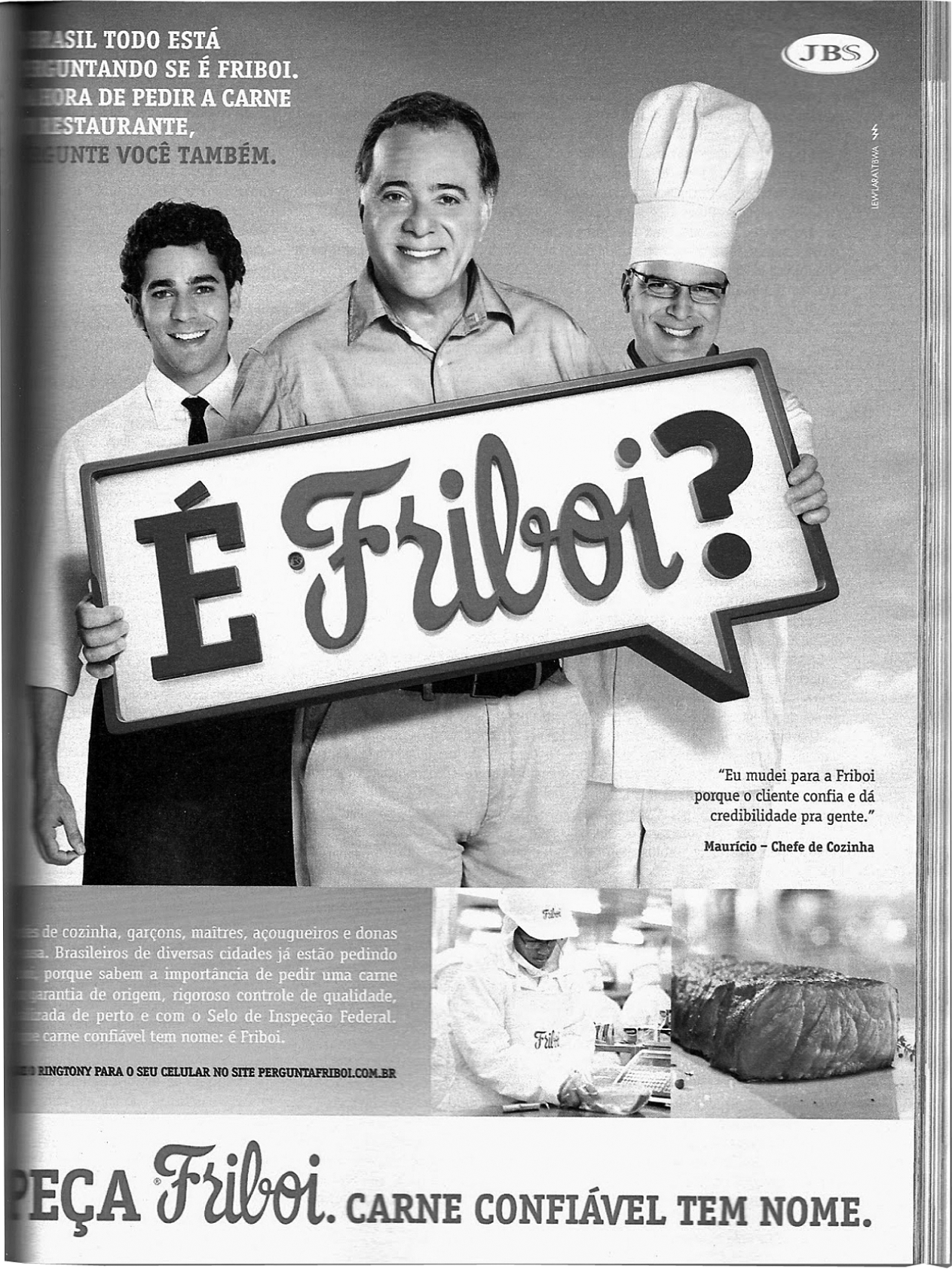
Reliable Meat Advances Profit and Patriarchy
Concerns about food safety that emerge in the Peça Friboi campaign are underscored in each ad at the final display of Friboi’s brand and slogan, which is read aloud by Ramos: “Peça Friboi—carne confiável tem nome” (“Ask for Friboi—reliable meat has a name”). Friboi’s marketing manager, Maria Eugenia Rocha, explained why the firm chose a brand-enhancement strategy based in sanitation standards in an interview: “Some [media] vehicles exposed what was the unregulated meat in Brazil…JBS, as the larger meat industry in Brazil, wanted to place itself in a different way.” A very similar statement was given in the same interview by Manir Fadel, Lew’Lara\TBWA’s chief commercial officer: “What we are doing in this Friboi movement…is putting a name onto meat. Why? Because you need to know where it comes from.”
Although this apprehension is not new, early 2013 was filled with news stories picturing gruesome images of the nation’s slaughterhouses. For instance, poor processing conditions were featured in Fantástico, a widely watched weekly newscast, and in two of the most circulated Brazilian weekly magazines, Veja and Istoé. These sources informed their viewers and readers that as much as 30 percent of the meat consumed in Brazil is produced under unsanitary conditions. Peça Friboi’s profusion of images of hospital-like facilities in which meat is prepared for sale serves as a response to some concerns about hygiene in a “modernizing” nation.
According to this ad, male chefs know to ask: “Is it Friboi?”
© Friboi|JBS Foods
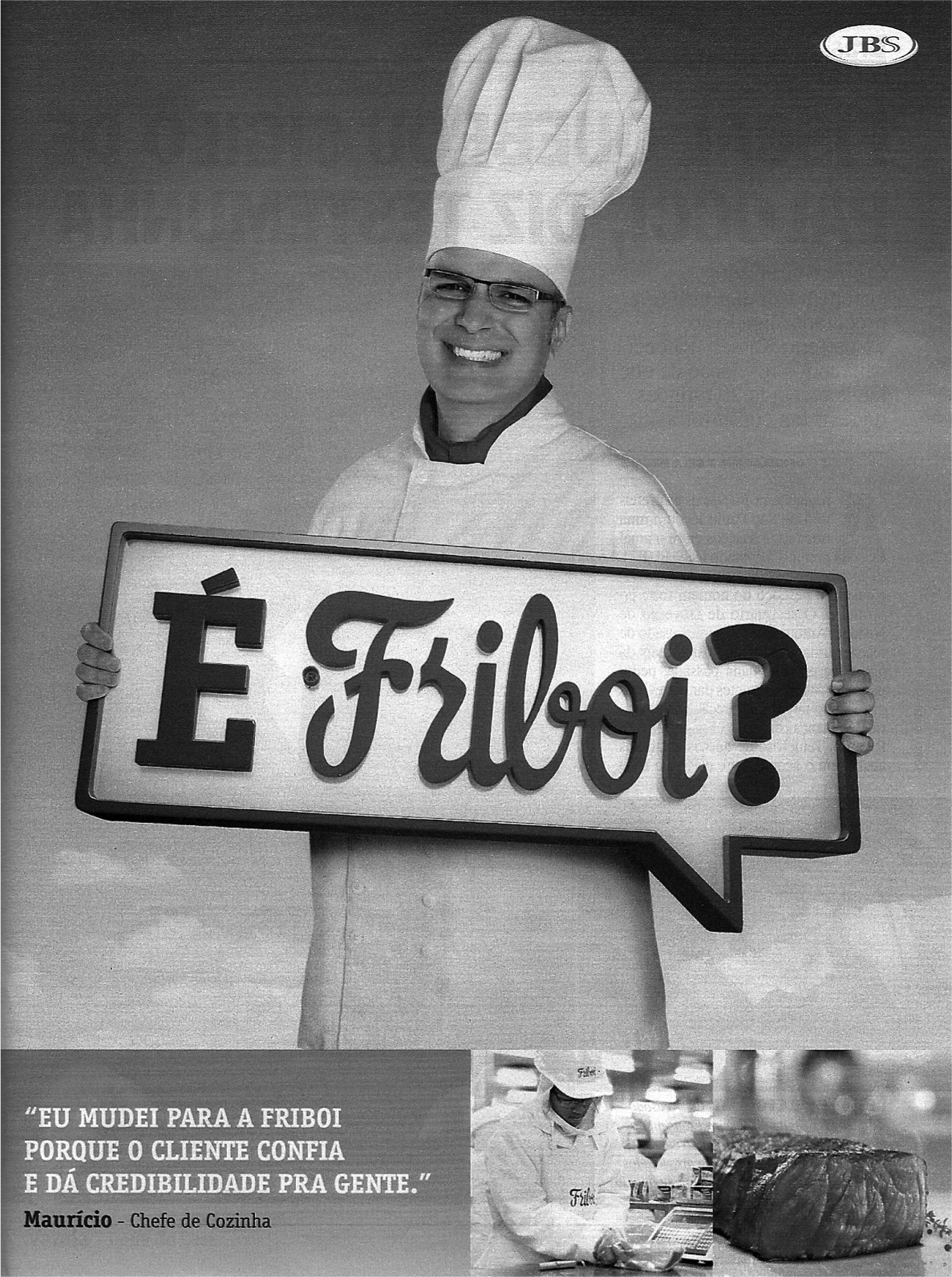
Meat consumption defines masculinity and the place of women in patriarchal cultures.
At another moment in her interview, Rocha emphasizes that branded meat is advanced meat. Unbranded meat presents industry with an “opportunity,” she claims. “Melon is branded; water is branded. These are products with supposedly the same intrinsic characteristics. So why meat shouldn’t be branded?” (This interview is available online: http://bit.ly/15KWzOp.)
Meat is not the only product to reveal a connection between consumption and constructions of gender in Brazil. As Sandra Rúbia Silva and Felipe Trotta have shown in the journal Comunicação, Mídia e Consumo, the importance of “male performance” in Brazilian culture is related to a variety of consumer products, from mobile phones to regional music. Nevertheless, meat-eating occupies a highlighted spot in the country. According to its Ministry of Agriculture, Brazil has dominated the international beef market since 2008. Much of the meat is exported (JBS is a major player in exporting Brazilian meat to the United States). Still, the domestic market consumes 50 percent of all its livestock production with an annual per capita consumption of 82.4 pounds of beef. This market is symbolized in the ubiquitous images of steakhouses and barbecue parties and the message is clear. In patriarchal cultures meat matters, especially to male consumption behavior.
It’s no wonder that a relationship between meat and masculinity appears as one of the sustaining points of Friboi’s 2013 advertising campaign in its effort to be associated with trustworthiness. When women are customers, they are encouraged by a male authority to verify that they are getting the best brand; according to Peça Friboi, when it comes to meat, women need help and they must not feel ashamed to ask for it. For men, on the contrary, having trouble choosing the right meat is embarrassing. If “meat eating measures individual and societal virility,” as Adams suggests, then men should be able to demonstrate their expertise by showing an immediate preference for Friboi. If not, their very manhood is at stake.