




Abstract
The issue of bribery raises questions about the implications of institutional development and trust in the raw material industry. This paper uses theories of institutionalism and trust to explore path dependence arguments seeking to explain the resource curse puzzle. Institutional development and trust are examined as potential mediators linking mineral extraction/processing to bribery in sub-Saharan African countries. The model suggests potential factors linking raw material industries to institutional development and institutional development to the degradation of interpersonal and generalized trust. The proposed model is tested with data on a sample of sub-Saharan African countries using multilevel logistic regression with promising results.
Introduction
In several African countries, increased dissatisfaction with corruption has led citizens to select anti-corruption candidates in elections (Banoba 2017). Bribery has been a source of economic inefficiency in many parts of sub-Saharan Africa (Kelsall 2013). Between 1999 and 2015, bribery sanctions have been brought against a total of 397 individuals and 133 entities under the OECD Anti-Bribery Convention (OECD 2016). There are national and international efforts to reduce bribery and corruption through legal and nongovernmental channels—efforts that are complicated by differences in cultural practices, such as gift giving (Cleveland et al. 2009). This study gives attention to the issue of trust and bribery in the cultural and historical context unique to sub-Saharan Africa.
The purpose of the study is to advance a general statistical model that may be used to explore more detailed associations and processes at a country or local level in sub-Saharan Africa, so data are taken from the 2006 US Geological Survey and the 2008 Afrobarometer Survey as a baseline for comparisons with other time periods, past or present. This study considers the following questions: Do mineral extraction and processing facilities increase the likelihood of bribery? And if so, what role do institutional development and trust play, if any? The author proposes a double mediation model in which mineral extraction and processing is theorized to affect institutional development, which in turn affects generalized and interpersonal trust, which then affects the likelihood of paying a bribe. The model is tested using multilevel logistic regression.
There is strong evidence to suggest that direct effects exist between mineral extraction/processing and institutional development, between institutional development and trust, and between trust and bribery. There is some support for a relationship between mineral extraction or processing and bribery, and this significance disappears in the full mediation model. The results emphasize the need for further research into the processes of institutional development and its relation to raw material industries.
Background
Bribery has been widely studied, but there is still more that must be understood about the social mechanisms surrounding trust and the effects associated with institutional development in raw material industries.
The world systems argument suggests that the current structural inequalities are rooted in colonial activity of the past (Chase-Dunn 1982; Wallerstein 2004). With a few exceptions, colonizers established extractive institutions in various parts of Africa. These institutions facilitated the transfer of natural resources to the colonizing state but provided little protection against abuses of power internally (Acemoglu, Johnson, and Robinson 2000; Mizuno and Okazawa 2009), leaving underdeveloped institutions. The pattern of institutional underdevelopment has persisted over time and fostered a lack of trust, as described previously.
World systems theory follows Pierson’s (2000) “increasing returns” brand of path dependence: Wealthy countries reinvested their wealth to maintain an edge over global competition such that global inequalities have sustained long after the official end of colonization. It suggests that corruption in sub-Saharan African countries finds its roots in colonization, and it remains institutionally linked to natural resource industries (Acemoglu et al. 2000; North 1990). Studies with this theoretical orientation have found that resource-rich countries experience stunted institutional development, a phenomenon known as the resource curse (Hilson and Laing 2017; Sachs and Warner 1997, 2001). In other words, institutional development is occurring, but the institutions suffer from dysfunctions, like bribery.
This approach has attracted criticism. Sanderson (2005) argues that world systems theory ignores endogenous factors contributing to poor development. Alternative theories have attempted to account for agency in the development process and have accused some path-dependent interpretations of morality biases (Gilberthorpe and Rajak 2017). To be sure, there are exceptional cases (e.g., Botswana) in which effective political coalition building strengthened institutions and contributed to economic stability even though historical conditions might have predicted otherwise (Poteete 2009). The neoclassical economic approach is criticized for being atomistic in its focus on agency motivated by self-interest and models of equilibria such that it is necessary and appropriate to push beyond this old paradigm (Schrank 2015). Endogeneity is an important aspect of development. In this paper, trust is treated as a partially endogenous factor that is both intrinsic to national social structures and culture as well as influenced by historical events.
Theory and Hypotheses
While this paper takes a world systems approach more broadly, it incorporates perspectives on institutions and trust from the structuralist/institutionalist traditions into a study of the effect of the raw material industry on bribery.
It has been widely argued that political corruption was not a problem in sub-Saharan Africa until Western institutions were introduced for the purpose of trade of raw materials and other products (see Acemoglu et al. 2000; Mizuno and Okazawa 2009; Nunn 2007). If a relationship between mineral extraction/processing and bribery exists, it begs an investigation into the specific mediating factors that may sustain such a pattern. I contend that institutional development and trust are key mediating factors, for reasons I will elaborate on in due course. The concepts of institutions and trust referred to here are grounded in institutionalist literature and studies of social capital.
This study conceptualizes institutional development as the acquisition of formal institutions that reflect pervasive developments and reflect a Western-style culture (Meyer and Rowan 1977). This concept is measured using data on household access to utilities and services. The model proposed in this paper has three parts. It is a double mediation model in which mineral extraction and processing affects institutional development, which in turn affects levels of interpersonal and generalized trust, which then affects bribery. The first proposed mediating variable is institutional development.
The first hypothesis predicts that mineral extraction and processing is associated with higher levels of institutional development. Sub-Saharan African countries are rich in natural resources, and raw material extraction is responsible for much of the economic growth in many regions. Western institutions have diffused into these countries for some time now (Acemoglu et al. 2000; North 1990). The historical role of raw material industries in bringing new institutions to colonized countries is reflected in the modern age in a new way as companies encourage institutional development through acts of corporate social responsibility for the purpose of expanding the consumer base and improving business operations (Betancourt 2016). The facilities may also experience pressures within the industry to conform to institutional standards of the global market (Husted and Allen 2006), which is dominated in large part by the West. Drawing on world systems theory, I propose that this political and economic incentive should result in clear prioritization of extraction industries for institutional development. Thus, utilities and services should be located near the extraction facilities. Thus, the first hypothesis is formally stated as:
Hypothesis 1: Respondents who live in regions where mineral extraction/processing facilities recently existed will have greater odds of having access to utilities and social services.
The concept of trust has been defined in many ways in social capital literature. For some scholars, trust is part of social interaction and occurs through reciprocity (Coleman 1988), shared identity, or social status (Portes 1998). Shapiro (1987) contends that trust can be placed in norms, rules, and practices that constitute institutions without social interaction at all. Formal institutions are legitimated in part by the trust people place in them (Meyer and Rowan 1977). Hence, when one speaks of institutions as legitimate systems of behavior reproduced over time (Zucker 1977), one necessarily speaks of the trustworthiness of those institutions. Institutions that fail to function as intended—whether it is due to inadequate enforcement, poor accountability, or some other deficient mechanism—are at risk of becoming mistrusted and delegitimized. Although institutional trust is not the focus of this study, it is appropriate to recognize that attitudes of generalized trust often correspond with institutional trust, a trend that remains to be fully explained (Rothstein and Stolle 2008).
This paper defines trust as faith or confidence. This confidence can be placed in virtually anyone or anything and for many reasons, but the main object of interest here is trust in other people. Trust will be operationalized as an attitude toward other individuals in the analysis. Interpersonal trust is confidence placed in people with whom one shares close ties, such as family members, whereas generalized trust is confidence placed in generalized others, such as fellow citizens, with whom one may share some common identity but not necessarily know on a personal level. Importantly, both types of trust may have institutional underpinnings, and these institutions are taken into account based on the context of the research study. Namely, interpersonal trust may be related to norms of reciprocity, while generalized trust may be affected by internal conflict and foreign interference.
The second hypothesis argues that institutional development can affect interpersonal and generalized trust through societal changes that accompany development. First, this paper contends that ethnic conflict and divisiveness lingering from colonization is likely to damper generalized trust in many regions (Mizuno and Okazawa 2009). The development of formal institutions was an inseparable part of the power abuses that occurred during colonization. Rothstein and Stolle (2008) argue that individuals may experience a decline in generalized trust in their fellow citizens as a result of observing others interacting with procedurally unfair institutions such that one may feel like others are receiving a relative advantage. Thus, higher institutional development should be related to lower levels of generalized trust.
Second, relationships based on interpersonal trust may become less valuable in impersonal, formal institutional environments. For the Igbo in Nigeria, Meagher (2006) observed that business relationships in the informal garment industry weakened as liberalization in the context of weak state support and poor economic conditions caused trust to degrade as opportunism spread and interpersonal ties became detrimental to competitive business practices. This suggests that higher institutional development should be associated with lower levels of interpersonal trust.
This is part of the cultural incompatibility argument, which suggests that incompatible norms or values have damaged the cultural basis for trust without adequate replacement. Institutional monocropping, or imposing Western institutions onto non-Western countries with the expectation of universal results, can have deleterious consequences (Evans 2004). It is Gichure’s (2006) contention that the combination of consumerist values associated with the new political and economic systems imposed by colonial rulers and the traditional African values of honor and wealth accumulation held by warriors in battle has helped foster corruption and greed in many parts of Africa. Reciprocal exchange remains dominant in some traditional societies, but formal institutions with norms of rationality and efficiency have tended to replace reciprocal exchange in modern societies (Meyer and Rowan 1977).
A third argument is based on Putnam’s (1993) theory of community ties and implies that social fragmentation is a universal quality of Western institutions. In a similar vein, Wuthnow (1998) argues that the degradation of trust and loosening of community ties is an issue in the United States with multifarious roots. He argues that greater commute times or traveling outside of one’s community to go to work is one reason that communities may become fragmented. A similar phenomenon has been witnessed in parts of sub-Saharan Africa. For instance, many decades ago, the Tswana in Botswana noted that a growing number of young men were leaving the villages for longer periods of time to work for the colonial settlers in exchange for a paid wage and Western laws and customs were being integrated into their existing institutions (Schapera 1955). Thus, traditional social structures, such as reverence to one’s elders, were beginning to erode as institutions evolved and community ties weakened.
The second proposed mediating effect is that institutional development, in the form of accessible, formally organized utility and social services, is associated with a loss of interpersonal and generalized trust in African countries. The hypothesis is stated as follows:
Hypothesis 2: Respondents with access to utilities and social services will have lower odds of trusting their family members or trusting their fellow citizens.
The final mediating effect proposed in this paper is that a lack of trust increases the odds of bribery occurring. Although bribery can be defined in different ways, this paper focuses on respondents’ reports of having paid a bribe to three types of ground-level public service workers (police officers, water utility workers, and bureaucrats who provide documents). Other kinds of informal exchanges, such as political campaign contributions (Samuels 2006), have been studied widely in development literature but are not the focus of this study. The question in the Afrobarometer survey does not specify the size of the bribe, whether the bribe was given willingly, whether the action was consistent with the legal definition of a bribe, whether payments of this type are common, or whether the bribe was considered morally justifiable. These precise details cannot be ascertained. For this paper, bribery is conceptualized as the respondent’s perception of having personally paid extra for a service.
The perception of paying a bribe is an important factor. Bribery may be understood to be a deviant act from the perception of the respondent. Therefore, it is conceivable that an individual who perceives reciprocal gift giving as right and proper might be hesitant to call it an act of bribery as the latter implies deviance. This is important to keep in mind as a possibility. However, the extent to which the bribes are demanded versus willingly or reciprocally given is impossible to determine based on the data. Respondents were asked about whether they paid bribes, not gifts.
This proposition focuses on interpersonal and generalized trust from the perspective of the respondent. However, the perception of paying a bribe is closely related to institutional trust. Goldsmith (2005) identifies various reasons for public distrust in policing institutions, including bribery, incompetence, inconsistency, brutality, and other malfunctions. A lack of institutional trust does not necessarily imply the occurrence of bribery, but the occurrence of bribery may imply a lack of institutional trust. A similar association is expected of interpersonal and generalized trust.
Empirical evidence suggests that a link between generalized trust and bribery may exist. A relationship between a loss of trust and bribery may occur out of practical compulsion as part of a competitive process. Resource-rich countries are vulnerable to opportunistic acts of greed (Hilson and Maconachie 2009), which has been partly attributed to ethnic conflicts previously enflamed by colonizers through acts of favoritism (Mizuno and Okazawa 2009). Consistent with game theory (Olson 1965), the incentive to follow the rules is diminished if others cannot also be trusted to follow the rules even though it may be in everyone’s best interest to do so. There is some evidence to show that generalized reciprocity may be associated with improved government performance (Knack 2002; Putnam 1993). Conversely, a lack of generalized reciprocity may be associated with an elevated chance of bribery.
Bribery need not be considered a harmful act. Giving gifts to public servants on the basis of reciprocity is different than public servants demanding bribes from clients. The former is based on trust and obligation, however misplaced it may be in the formal institutional context, while the latter is based on an abuse of formal authority. Where interpersonal reciprocal exchanges are highly salient, these norms of reciprocity may be applied to institutional contexts (Bian 1997). Reciprocal gift giving can sometimes constitute bribery in the context of a formal public service agency, which is a challenge in some sub-Saharan African countries (Bello 2014).
Drawing further on Coleman (1988), it can be argued that generalized trust begins with individual experiences. Norms of reciprocity in economic exchange are achieved through trust (Coleman 1988)—the lender must have confidence that the recipient will reciprocate the gift or favor at some future time, while the recipient must trust the lender to be fair and reasonable (e.g., not to unexpectedly increase the interest rate to some exorbitant amount). A person who fails to experience interpersonal trust may be unable to generalize that trust to others. While it is possible that individuals may, at a given moment, feel greater generalized trust than interpersonal trust due to complex personal circumstances (e.g., the death of trustworthy loved ones), this situation is arguably the exception rather than the rule. Interpersonal trust and institutional trust have been shown to be mutually reinforcing (Brehm and Rahn 1997), lending some empirical credit to the broader significance of interpersonal trust. Based on the arguments presented, the third hypothesis is:
Hypothesis 3: The odds of paying a bribe are increased among participants who report lower levels of interpersonal or generalized trust.
For the final hypothesis, the full model depicts the expected mediating effects of all variables together. It posits that a relationship between the presence of mineral extraction/processing facilities and the occurrence of bribery is mediated by institutional development and trust. Empirical evidence has shown that extractive industries can attract corrupt behavior (Vicente 2010). World systems theory provides an explanatory link for the long run connection between raw material industries and institutional development problems. Insufficient institutional development has reduced trust in those institutions—an issue that has persisted to the present day. Moreover, these foreign institutions were imposed on an existing culture (Evans 2004), raising possible concerns with community fragmentation or changing economic norms (Meagher 2006; Osili and Paulson 2008). The final hypothesis proposed is:
Hypothesis 4: Institutional development and the strength of interpersonal and generalized trust mediate the effect of the presence of mineral extraction/processing facilities on the odds of paying a bribe.
Data
Dependent Variable
Data on bribery were taken from the Afrobarometer surveys conducted between 2008 and 2009 (Afrobarometer Data 2008). This is the first round of Afrobarometer surveys that contains a large number of country-level cluster samples, so it was selected over earlier rounds. This study aims to test the double-mediation model during a relatively older year such that it can be compared to more recent surveys as the data are released. This is useful for understanding the effects of policies and broader shifts in global cultural climates. Bribery is a dichotomous variable in which respondents who never paid any type of bribe for any services were coded 0. Those who paid at least one bribe to (1) obtain documentation or permits, (2) receive water or sanitation services, or (3) avoid difficulties with police officers over the past year were coded 1.
Respondents were asked how frequently, over the previous year, they paid bribes to (1) obtain documentation or permits, (2) receive water or sanitation services, or (3) avoid difficulties with police officers. The variables were originally measured using an ordinal 0 to 3 scale, ranging from never to often. The Kruskal-Wallis test yielded a p value of zero, which indicated that these variables differ significantly from one another. Since this study seeks to examine the occurrence of bribery rather than its regularity, the scaled variables were combined and condensed into a dichotomous variable, which is used as the dependent variable in this study. Bribery is the dependent variable for the mediating models, not the direct effects models.
The combination and dichotomization of these bribery variables was necessary and appropriate for the hypotheses that were posed previously. However, the use of a dichotomous variable is as much a practical choice as a theoretical choice. The number of bribes paid depends on the nature of the bribe. For example, it cannot be verified whether a bribe paid for water was a large, one-time payment or multiple, smaller payments. Without additional information about the amount of the bribe payment and the circumstances surrounding it, it is difficult to make a theoretical claim regarding the frequency of bribe payments. In other words, disparities in frequency could reflect ground-level interactions or practicalities more so than the severity of bribery.
The Afrobarometer surveys have been cited in numerous publications concerned with developmental patterns in Africa (Bratton 2004; Mattes and Mozaffar 2016; Robinson 2014; Sacks and Levi 2010). This round of Afrobarometer surveys cluster samples countries in the sub-Saharan region only. Many sub-Saharan African countries were excluded from this round of Afrobarometer surveys, including several countries that are notorious for corruption, such as the Democratic Republic of Congo and Gabon. This may limit the generalizability of the results.
Independent Variable
Sachs and Warner (1997, 2001) use natural resource exports to approximate the geographic availability of natural resources in African countries. For an approximation of raw material facility locations, this study uses a dichotomous variable indicating the presence (coded 1) or absence (coded 0) of raw material facilities in a given region. The variable was created using data on the location of mineral extraction and processing facilities from a data set compiled from various sources by the staff of the 2006 US Geological Survey (Eros and Candelario-Quintana 2006). I used the latitudinal and longitudinal coordinates and the location names of the facilities to determine the approximate region or province of the facilities. Since precise political boundaries may be disputed, I used the regions and provinces listed in the 2008 Afrobarometer survey as my categorization scheme. The facilities include open and closed facilities at a single time point. There is a time disparity between the 2008 Afrobarometer and 2006 US Geological Survey. The 2006 survey is the closest match to the 2008 year of the Afrobarometer.
A dichotomized variable for raw material facility location is the most accurate form for the purposes of this paper. This type of variable is used to make the most conservative estimate possible by choosing accuracy over precision. First, the US Geological Survey data provide precise latitudes and longitudes of facility sites as well as the names of the locations. Unfortunately, the names of the locations do not always match the precise latitudes and longitudes, and the latitudes and longitudes are not given for all of the named locations. Second, there are many factors that can affect the economic importance of any given facility, such as the number of individuals employed at a site and whether those employees commute across provincial borders. Such information is not readily available for analysis.
The data set includes mines, refineries, mills, and other facilities in the raw material industry. Certain facilities, including multiple gold mines, had missing location data. Locations are approximate and sometimes straddle the lines of two or three regions. The facilities focused on the extraction or preparation of natural resources or amalgamations of resources, including but not limited to elements (e.g., copper), soils (e.g., clay), precious stones and compounds (e.g., diamond or graphite), industrial materials (e.g., steel or cement), and other extractive resources (e.g., fertilizer or petroleum). Both open and closed facilities were coded as present to account for any lingering effects of mineral extraction or processing in the past.
The countries included in the sample are Benin, Botswana, Burkina Faso, Cape Verde, Ghana, Kenya, Lesotho, Liberia, Madagascar, Malawi, Mali, Mozambique, Namibia, Nigeria, Senegal, Tanzania, and Zambia. Although the list included all African and Middle Eastern countries, only those countries for which there were data available in the Afrobarometer survey were selected, with the exception of South Africa. South Africa was excluded because many countries in southern Africa are dependent on South Africa for trade or utility services. Moreover, it is an exceptional case on many Afrobarometer measures. Its relatively high levels of institutional development differentiate it from other sub-Saharan African countries (Arora and Vamvakidis 2010; McDonald 2009) such that it may considered semi-peripheral rather than peripheral.
Thus, excluding South Africa creates a more conservative model. I reran the analysis with South Africa included and found little difference in the results—a mild improvement in a couple of indicators. There was an increase in the significance of the direct effect of mineral extraction facility presence on police stations (.05 to .01 significance) and post offices (nonsignificant to .09 significance). There was also a general increase in the odds ratios (but not the significance) of other institutional variables in the mineral extraction → institutional development relationship.
It should be noted that Uganda and Zimbabwe had mineral extraction/processing facilities present in every region. Excluding these countries from the analysis did not change the significance of the models during the initial test runs, so they were left in. Country-level variables are not included in the models of this study due to technical limitations in running the model, but it is critical to keep in mind that each country studied has a very unique history, geography, ethnic composition, and set of circumstances affecting it.
Figure 1 reveals some interesting geographical features. Smaller countries, like Cape Verde and Lesotho, have few facilities as well as lower rates of bribery. Facilities often appear to be concentrated along national borders, yet bribery rates differ between bordering countries.
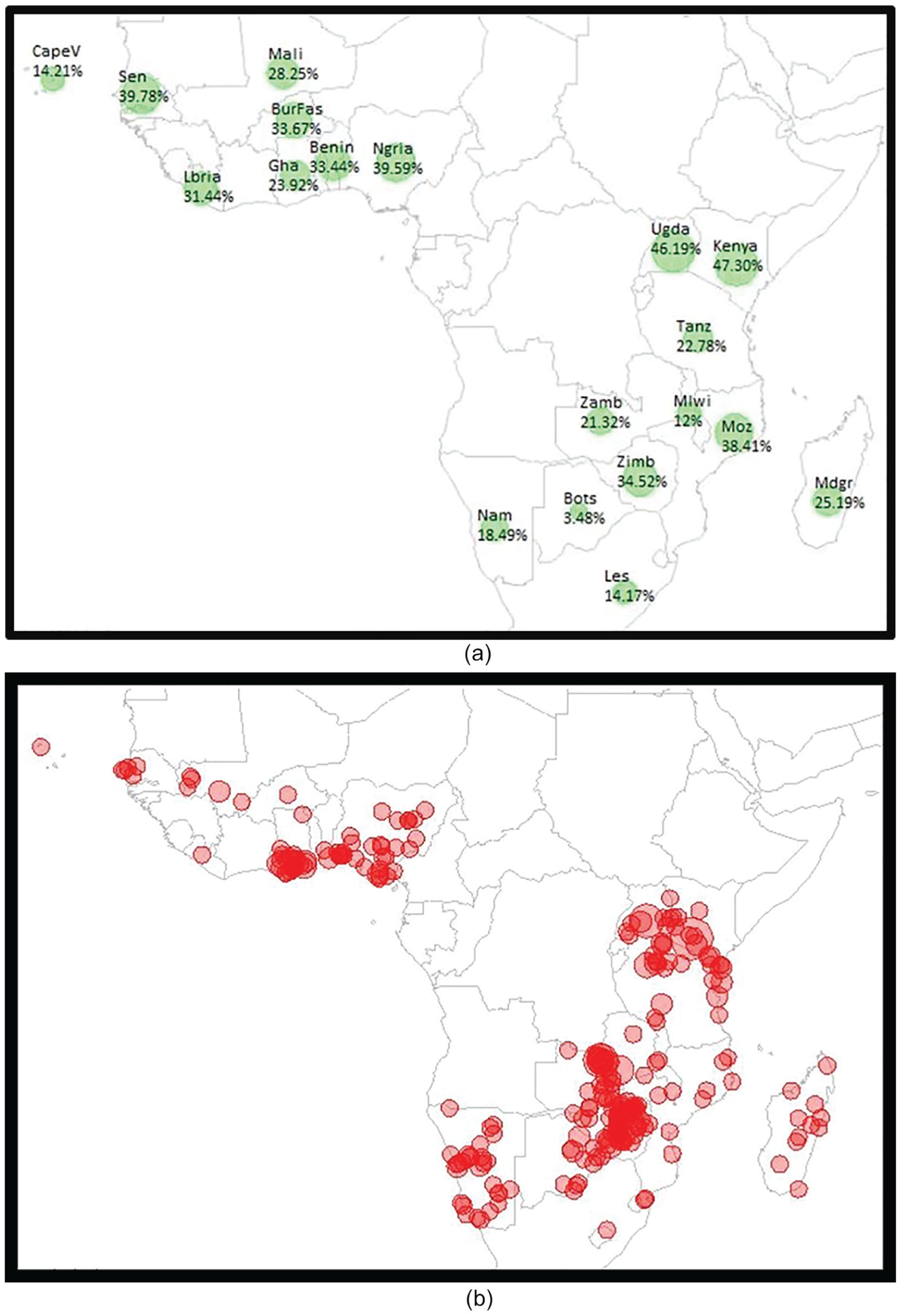
(a) The percentage of respondents who paid at least one bribe last year by country. (b) The concentration of mineral extraction facilities by region within countries.
The first mediator is institutional development. This variable is conceptualized as the adoption of Western practices and organizational forms, which is measured using data on household access to utilities and services from the Afrobarometer survey. Access to utilities and services is a reflection of technological development patterns as well as the institutional developments associated with them, such as the creation of bureaucracies (private or public) and regulations. Respondents from the survey are indicated dichotomously (coded 1 for services present and 0 for services not present) as living near an accessible (1) electric grid, (2) piped water system, (3) sewage system, (4) cell phone service, (5) post office, (6) school, (7) police station, or (8) health clinic.
The institutional indicators consist of utilities and services, which indicate formalization of practices. Many sub-Saharan African countries have worked toward privatizing their water and electric supplies with mixed effects on improving efficiency and accessibility (Bayliss 2014). The World Bank (2009) states that the sewage services involve a longer chain of public and private actors, unlike water services, which contribute to the underdevelopment of the sanitation sector in African countries. They report that sewage remains inaccessible to larger, poorer populations. By contrast, the privatization of information and communication technology companies has shown clear success as cell phones have become widely available and coverage has expanded exponentially (Williams, Mayer, and Minges 2011). Analyzing several years of Afrobarometer surveys, Wambua (2015) identifies police as among the most corrupt and least trusted public institutions in Africa, especially in eastern and western Africa, but it is an institution that most people still perceive as legitimate.
Trust is the second proposed mediator. Two subjective measures of trust from the Afrobarometer survey were added to the model. In separate questions, respondents were asked to rate on a 0 to 3 scale the extent to which they trusted (1) their relatives and (2) their fellow citizens. The variables are used to measure interpersonal ties and generalized trust, respectively.
For generalized and interpersonal trust, the original coding was retained, and the variables were treated as ordinal dependent variables or categorical independent variables, depending on the model. It should be noted that institutional development and trust are independent variables for the mediating model, but they also function as dependent variables in direct effects models.
Control Variables
Several control variables are added to the model to account for other factors affecting trust. In support of my mechanistic argument, I include a variable for how often the respondent commutes at least 10 km to work. Commute time is measured as a categorical variable for how often the respondent commutes at least 10 km to work: never (0), less than once a month (1), a few times a month (2), a few times a week (3), or every day (4).
As an indirect measure of community dissolution, I also add a scaled variable for how often the respondent or anyone in the respondent’s family has gone without a cash income. The cash income variable ranges on a scale from never (0) to always (4). Individuals who do not earn cash income are likely subsistence farmers, who would be more likely to reside in traditional tight-knit communities. Cash income has also been used in other studies because bribery payments may be more easily demanded from those who have cash (Rose and Peiffer 2016).
The culture of civic society can also affect trust. There is a nominal variable for the extent to which respondents feel (1) the government should be able to ban any organization or (2) citizens should be able to join any organization. The variable provides the options: strongly agree with, agree with, and agree with neither for statement (1) and agree with or strongly agree with for statement (2). Respondents who live in societies with stronger civic societies may be more open to allowing organizations to form freely, while those in violent or less trusting environments in general may desire stricter regulations on the formation of organizations.
Religious groups have been prominent in institutional development initiatives in sub-Saharan Africa. A categorical variable is included that asks respondents if they are members of a religious group (not a member, inactive member, active member, or official leader). Religious communities can be centers of social interaction, which may inspire more trust. At the same time, trust tends to be higher in countries where organizations share members than where organizations are relatively isolated and religious organizations tend to be relatively isolated (Paxton 2007). Thus, members of religious organizations could also have less trust in some contexts. The effect on bribery could be positive or negative, but one way or the other, religious membership could be impactful. Hence, a control for religious affiliation was included.
In a similar variable, respondents are asked if they are members of a voluntary association or community group (same categories). Greater community involvement may be associated with more trust, as Putnam (1993) argues. In this particular context, members of community groups may be at greater risk for paying bribes, particularly those in charge, because of demands for formal documentation or the need to equip the physical establishment with running water. Finally, given Africa’s history of colonial rule and the establishment of corrupt political institutions, it is important to control for political factors affecting trust. First, a scaled variable was included that indicated the extent to which the respondent was satisfied with democracy. Responses ranged from not at all satisfied to very satisfied on a 4-point scale or a fifth option that their country is not a democracy. Second, there is a variable asking respondents how often officials go unpunished. Responses ranged from never to always on a 4-point scale. A functional democracy should correspond with higher levels of trust and thus lower chances of bribery. Democratic political systems provide economic protections against corruption and encourage the effective harnessing of local human capital to create economic stability (Rodrik 2000). Recent Afrobarometer research suggests that democracies with high infrastructural development correspond with improved health service utilization (Quamruzzaman 2017).
Statistical Model
Multiple imputation was applied to deal with missing cases. Twenty imputations were added to each variable, including the control variables. Bribery was also imputed because for the purposes of this analysis, it was necessary to run analyses between each variable in mediation model. Since the trust and institutional development variables were treated as dependent variables in some of models, it was more efficient to multiply impute all variables. Missing data patterns were analyzed beforehand in Stata. About 71 percent of the data across all variables are not missing. The patterns of missing data appear to be mostly random. Of those respondents with missing data, 6 percent are only missing post office information, 5 percent are only missing data on how often they have gone without a cash income, and 3 percent are only missing data on the availability of cell phone data. The remaining variable patterns are missing among 1 percent or fewer of the respondents.
I analyze the data using multilevel logistic regression. There is no evidence of multicollinearity among the variables (all VIF scores are < 2). To date, goodness-of-fit tests do not exist for this type of regression. This is a random coefficient model where the intercept (β0j) is allowed to vary across regions on Level 2.
Everything was conducted in Stata using the mi estimate command. The melogit command was used for all dichotomous dependent variables, and the meologit command was used for the ordinal trust dependent variables. Multilevel modeling allows for error estimations at both the individual and group levels. This model has been checked to ensure that it meets appropriate specifications (Austin and Merlo 2017). Consistent with the design of multilevel models (Krull and MacKinnon 2001), the dependent variable is never at a lower level than the independent variables in the analysis for either the direct effects or mediating models.
The analysis considers both direct effects and mediating effects. The dependent variable is bribery in the mediating models. The equations for the full model are as follows:
Level 1:
Level 2:
A given variable corresponds with a particular individual i and/or region j. The dependent variable is measured as the log odds of bribery (
Results
Direct Effects
The odds ratios reported here (see Figure 2) indicate the odds that a person paid a bribe rather than not with respect to an independent variable. The results will be given for all independent variables, but it should be noted that these results are not comparable between independent variables. Without mediators, the odds of a respondent having paid a bribe in the previous year in a region where a mineral extraction or processing facility is present are about 1.348 to 1. This relationship achieves a modest .05 level of significance. The mediation model shows promise with most variables achieving high significance. The odds of having access to sewage (9.431 to 1), an electric grid (3.875 to 1), cell phone service (2.89 to 1), or a police station (1.869 to 1) are very high among those living in regions where mineral extraction or processing facilities are present. Water pipes, post offices, and social service indicators did not achieve significance. The results provide sufficient support for Hypothesis 1.

Model of concepts and variables with multilevel regression odds ratio estimates.
Interpersonal and generalized trust show different patterns. The odds of feeling more trusting toward one’s own relatives are lower where any of the services are accessible, and these odds ratios are significantly different than 1 to 1 for all institutional development variables.
The odds of strongly trusting one’s fellow citizens are lower where electric grids, water pipes, sewage, and schools are accessible, all of which have odds ratios between .83 and .87. The odds of a respondent reporting high generalized trust are still very significant, though relatively less drastic, where police stations (.924 to 1) and health clinics (.904 to 1) are accessible. The strength of generalized trust is not significantly related to the accessibility of post offices and cell phone services, both of which are intended for long-distance communication. This suggests that long-distance communication services neither help nor hinder how trusting respondents felt toward their fellow citizens but did reduce feelings of interpersonal trust. This provides partial support for Wuthnow’s (1998) argument that long-distance relationships reduce trust. Hypothesis 2 is supported.
The odds of paying a bribe are lower for those with the strongest trust in their fellow citizens. Comparing those with just a little trust to those with a lot of trust, the odds ratio is 1.444, while those who trust their fellow citizens somewhat or not at all have odds ratios of 1.374 and 1.383, respectively, with respect to the reference category
For interpersonal trust, the results for those who trust their relatives somewhat and just a little are similar to the results for generalized trust. These variables have odds ratios of 1.347 and 1.469, respectively. Both are significantly different than a 1 to 1 ratio. Interestingly, individuals who do not trust their relatives at all achieve a lower level of significance, and the coefficient is smaller. Compared to those who trust their families a lot, those who do not trust their relatives at all have only a 1.2 odds ratio of having paid a bribe during the last year. There is support for Hypothesis 3, though respondents who do not trust their families at all are a unique phenomenon.
Mediation Effects
Summary statistics for the data are listed in Table 1, and data on the mediation effects are shown in Table 2. In Table 2, the log ratios are provided, and the standard deviations are in parentheses. The first column in Table 2 contains data for Model 1, which shows the effect of the presence or absence of a mineral extraction or processing facility (X) on whether bribery occurred (Y), with institutional development (A) as the mediating effect. The second column shows data for Model 2. This is the double mediation effect of the presence of a mineral extraction or processing (X) facility on institutional development (A), the effect of institutional development on generalized (B) and interpersonal (C) trust, and effects of trust on bribery (Y). The final column shows data on Model 3, which is the same as Model 2 with control variables (N) included as additional mediating effects.
Summary Statistics of Variables.

Multilevel Logistic Regression Estimates, Direct Effects and Multilevel Logistic Regression Estimates of the Odds of Paying Bribes for Public Services Last Year, Full Model, 2008–2009.
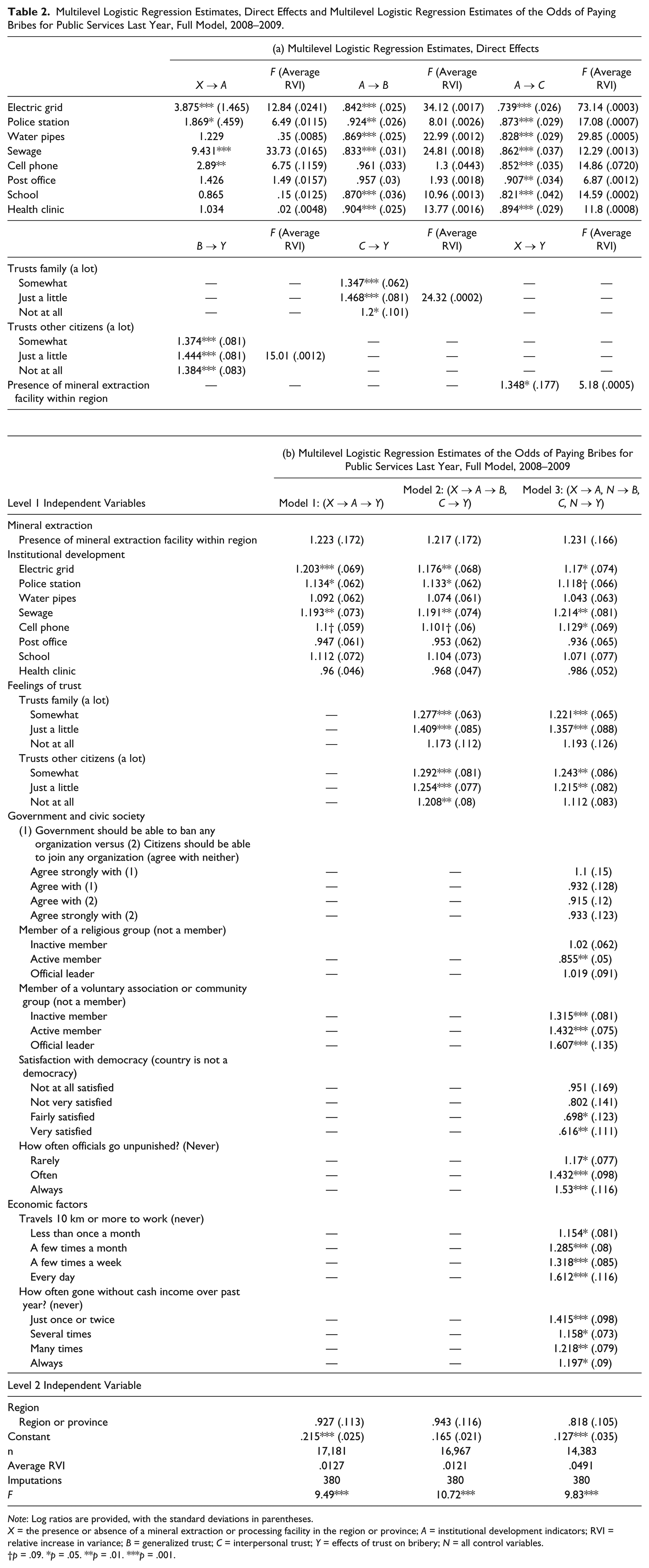
Note: Log ratios are provided, with the standard deviations in parentheses.
X = the presence or absence of a mineral extraction or processing facility in the region or province; A = institutional development indicators; RVI = relative increase in variance; B = generalized trust; C = interpersonal trust; Y = effects of trust on bribery; N = all control variables.
p = .09. *p = .05. **p = .01. ***p = .001.
All three models in Table 2 have highly significant F values. Goodness-of-fit tests cannot be calculated for this type of analysis, as mentioned previously. Model 1 includes mineral extraction or processing facility (X) and the first set of mediation variables for institutional development (A) as independent variables predicting the occurrence of bribery (
The mineral extraction or processing facility variable loses its significance with the introduction of the mediating variables. The institutional development variables that were nonsignificant in at least one conjunction of the direct effects model also showed no significance in the mediation model. The accessibility of electric grids, police stations, and sewage are the strongest indicators of bribery in the model, though sewage experienced a slight drop in significance, and cell phone service only achieved mild significance. The significance of some institutional development variables and the loss of significance of mineral extraction or processing facilities suggest a moderate mediation effect.
There is moderate support for Hypothesis 4. In Model 2, there is a loss of significance and drop in the odds ratio for the electric grid variable. The police station, sewage, and cell phone variables barely change with the introduction of the trust variables. Trust is highly significant, with the exception of respondents who do not trust their relatives at all. Interestingly, individuals who do not trust their families or fellow citizens at all show a decline in significance. It is possible that mineral extraction/processing or institutional development is a mediator for this particular subgroup. The accessibility of electric grids is the only institutional development variable with a mediation effect in this model.
In Model 3, there is a decline in significance and the odds ratios of electric grid and police station accessibility. Generalized and interpersonal trust may be partially mediated by some of the control variables as they show a decline in odds ratios. The exception, again, is individuals who do not trust their relatives at all. All generalized trust categories decline in significance. Indicators of the strength of civic society showed mixed results. Individual opinions on government regulations of organization formation were nonsignificant. Only active members of religious organizations had significantly lower odds of paying a bribe compared to nonmembers. Inactive members, active members, and leaders of community groups all had significantly greater odds of paying bribes in relation to nonmembers.
The strength of the political system had a clear effect. The odds of paying a bribe was significantly lower for respondents who were satisfied with democracy compared to those who claimed their country was not a democracy. Compared with those who state that officials never go unpunished, all others have significantly greater odds of paying a bribe. Both economic indicators had significant relationships with bribery. As the frequency of travel (10 km or more) increases, the odds of paying a bribe compared to those who never travel increases. This is a strong pattern. The variable for cash income shows surprising results. Individuals who have ever gone without cash income have greater odds of paying a bribe compared to those who have never gone without cash income. The presence of other variables in the model might be affecting odds ratios for cash income. Alternatively, other explanatory variables might be unaccounted for.
Future Research
This study utilizes relatively dated data sets from 2006 and 2008, but more recent data are available for analysis. The goal of this paper is to set an early baseline for the double-mediation model so that policy-related changes can be examined over time or between countries. As globalization brings growing investment and economic growth (Jugurnath, Chuckun, and Fauzel 2016), socially responsible activity, and environmental consciousness, there is no theoretical reason to discount the possibility for institutional problems to be proactively corrected by citizens, multinational corporations (MNCs), or other actors, especially with the contemporary emphasis on cultural sensitivity. World systems theory assumes an institutional continuity dictated by power arrangements, but this ignores the numerous ways that institutions can and do change, as argued by institutional theory.
Beyond the standard questions of economic and political policy decisions, there is a spatial and cultural component to bribery that deserves further exploration. A study of macro-level effects risks overgeneralization. The aggregated effects depicted in the double-mediation model do not necessarily represent the state-level effects of every country in the sample or every country on the African continent. The adequacy of the model must be explored in greater detail on state and local levels and across time. This study leaves many substantive questions to be answered in future research. How can the rate of economic growth and differences in reliance on natural resources affect changes in the double-mediation model, if at all? In which parts of each country is there a growing, nonsubsistence middle class? Are these individuals migrating, or are they geographically concentrated?
Discussion
It can be concluded from the results that a relationship between the presence of mineral extraction/processing facilities and the occurrence of bribery is significant and worth exploring in future research. The connection of institutional development and trust to raw material industries and bribery is supported. The mediating relationship between institutional development and trust was weak, but it became stronger with the introduction of control variables. This particular mediating effect must be subject to more rigorous testing, preferably at the micro level. There was a significant increase in the likelihood of a respondent paying a bribe if they reside in a region or province where an extraction facility was located. This effect disappeared when institutional development, trust, and several control variables were added to the model. These findings contribute to our understanding of the resource curse problem more broadly.
The findings lend support for the idea that trust degradation may be related to institutional development. This raises important questions about whether Western institutions provide an appropriate model for sub-Saharan African institutions and how any type of formalization should take place. Institutional development has a strong, direct, negative relationship with trust such that the presence of any public service or utility corresponds with a decreased likelihood of feeling more trusting toward one’s family. The same is true for generalized trust except when post offices and cell phone services were present. This is interesting and appropriate given that post offices and cell phone services are mainly useful for direct communication, which would be more relevant to interpersonal trust than generalized trust. Finally, trust had a strong, direct, negative relationship with bribery such that respondents who were relatively less trusting toward their family or fellow citizens were more likely to pay a bribe. The control variables provide some insight into why this might be the case.
The control variables for civic society showed mixed effects. Membership in community groups appeared to have a very strong relationship to bribery, but the effect is the opposite of what Putnam (1993) would suppose. Stronger community ties should create more effective civic societies, presumably with less bribery. One possible explanation is that norms of reciprocity are more salient among members of community organizations and bribery occurs without malicious intent. It is also possible that community group members are more likely to encounter bureaucrats as they attempt to purchase property, assemble, and so on. To be sure, the circumstances in sub-Saharan African countries are different than those in the United States, and care must be taken not to overextend Putnam’s theory.
Although the reasons for the community organization membership cannot be known for sure, it is appropriate to reiterate that actions perceived as bribery or corruption from a Western perspective may not necessarily be taken as such in non-Western states. Whether bribery, gift giving, or any other informal action is problematic is a concern that this study cannot speak to. Globalization has in some cases created opportunities for governments to channel funds into social services through international ties with other public and private actors (Tsai 2007). There have been efforts within some African states to replace corruption-prone centralized administrative structures with decentralized or privatized administrations to reduce corruption (Kiser and Sacks 2011). However, practices viewed as corrupt do not necessarily signal institutional breakdown; in some cases, these informal practices and norms supplement the formal institutions to create a unique but functional system (Darden 2008; Erdmann and Engel 2007; Helmke and Levitsky 2004; Kelsall 2011, 2013). There are a number of factors that contribute to the development of strong, effective institutions (Van Cott 2005).
The situation of morality is difficult to parse out from the results. Although active members of religious groups had lower odds of paying bribes, religious leaders did not have lower odds. This may be explained by Hunt and Laszlo’s (2012) finding that some individuals who pay bribes are sympathetic with the plights of civil servants. Thus, there is a moral contradiction here. Bribery itself may be construed as immoral, but the act might be considered understandable if it is committed out of necessity.
The frequency with which respondents travel 10 km or more to work was a highly significant predictor in the full model. This supports Wuthnow’s (1998) argument that increased commuting weakens community ties. More frequent travel implies less time spent in one’s community, but it may also mean a greater likelihood of encountering police or for travel across borders, border security officers. Control variables for the quality of political institutions are highly significant, consistent with the argument that bribery is related to poor perceptions of democracy and low accountability stemming from a history of colonial rule.
The path dependence approach from development sociology breaks down into specific arguments, many of which can be clarified using institutionalist arguments. The particular mechanisms cannot be ascertained without additional ethnographic research, nor would one expect this model to be applicable to all countries in sub-Saharan Africa. However, following Evans’s (2004) argument, the general trends and theoretical arguments from this study indicate that we must exercise healthy skepticism regarding the mimesis of Western institutions in non-Western countries that have different cultures and histories than our own.
There are several other limitations to this study. Goodness-of-fit tests are currently unavailable for multilevel logistic regression. A statistical test for endogeneity is also currently unavailable for this model. The interdependence of variables may be explored further using longitudinal data (Petersen 2001). While multilevel logistic regression is an effective tool for analyzing cluster samples, there may be promising work to be done with the use of structural equation modeling (SEM). SEM allows for the testing of complex operationalizations and associations. Whereas multilevel models make assumptions of reliability and normalcy, SEM does not (Hox 2013).
Technological and statistical barriers limit the number of variables that can be included in the model. That is to say, the addition of more control variables does not necessarily improve the model, but rather, it can overcomplicate the model and compromise the results. Future papers should endeavor to incorporate alternative combinations of variables and employ alternative statistical techniques that can contribute to a more comprehensive understanding of these interrelated factors. Although adding too many additional variables to the model increases the possibility of convergence problems due to high variation, it is appropriate to acknowledge that development in Africa has been affected by numerous factors, such as human trafficking, missionary work, and nonprofit organizations, data for which were not available in the Afrobarometer data set.
Conclusion
A number of perspectives have emerged on the issue of bribery in sub-Saharan Africa. This paper attempts to incorporate world systems theory from development sociology with structuralist/institutionalist perspectives. As countries in sub-Saharan Africa continue to rely on raw material industries, research must be conducted to determine the broader implications of these industries for political and economic development. This paper used multilevel logistic regression analysis to test a double mediation model that identifies possible mechanisms that may link mineral extraction and processing to bribery. The mediators of institutional development and trust are promising in this model. The full double mediation model reveals some significant effects. There are significant direct effects between the presence of a mineral extraction/processing facility and institutional development, between institutional development and trust, and between trust and bribery. Institutional development and trust are potential social processes that warrant further attention in international development literature.
Footnotes
Appendix
The type and quantity of facilities located in each state are displayed in Table A1. There is no clear relationship between bribery and the value of raw materials produced. Botswana has the lowest rate of bribery, yet diamonds are one of its principal exports. Burkina Faso and Liberia have fairly high rates of bribery and few mineral extraction or processing facilities. Both countries produce cement only. In Burkina Faso’s Dori region, the commonplace practice of paying high bribes to legal brokers to beat competitors in land purchases, according to Lund (1999), is perpetuated by a strong traditional culture of preserving one’s honor. Bribery appears to have a strong cultural basis, which is the focus of this study.
Acknowledgements
I would like to express my deepest gratitude to Albert Bergesen for his assistance in getting this project off the ground and to Jeremy Fiel, Erin Leahey, Kathleen Schwartzman, and Joseph Galaskiewicz for their comments and guidance. I would also like to acknowledge Miguel Dorta and Philip Ender for their kind advisement on technical software matters.
