




Abstract
The purpose of this study is to address whether labor union members’ organizational commitment and job satisfaction are more influenced by labor union utility than those of nonunion employees. This study uses data from the Korean Labor and Income Panel Study published by the Korea Labor Institute. The study’s methodology employs panel data regression analysis. The findings are that labor union utility increases workers’ organizational commitment and job satisfaction and that these effects are positively greater for labor union members than nonunion employees.
Can labor unions be beneficial for both labor union members and nonunion employees? In South Korea, labor unions are powerful stakeholders in the labor market because of their sound and robust channels for expressing workers’ complaints in order to increase workers’ organizational commitment and job satisfaction. Labor unions’ collective actions, such as strikes, help union members hold leading positions as labor market insiders. However, a number of workers with nonpermanent contracts in South Korea are restricted from becoming labor union members, which threatens their employment stability and makes them labor market outsiders (Jung 2013). In this respect, employees without their own labor unions seem not to benefit from labor unions’ activities such as improving wages and securing employment stability (Park and Lee 2015).
In this study I examine whether nonunion employees can receive, as free riders, the workplace benefits associated with organizational commitment and job satisfaction from labor unions’ activities. Although nonunion employees are not engaged in the labor movement, they may expect to benefit from labor unions’ positive efforts to improve workers’ organizational commitment and job satisfaction.
Theoretical Framework
Labor unions’ effect on workers’ organizational commitment and job satisfaction can be understood through Farrell’s (1983) exit, voice, loyalty, neglect (EVLN) theory. Figure 1 illustrates the EVLN model.
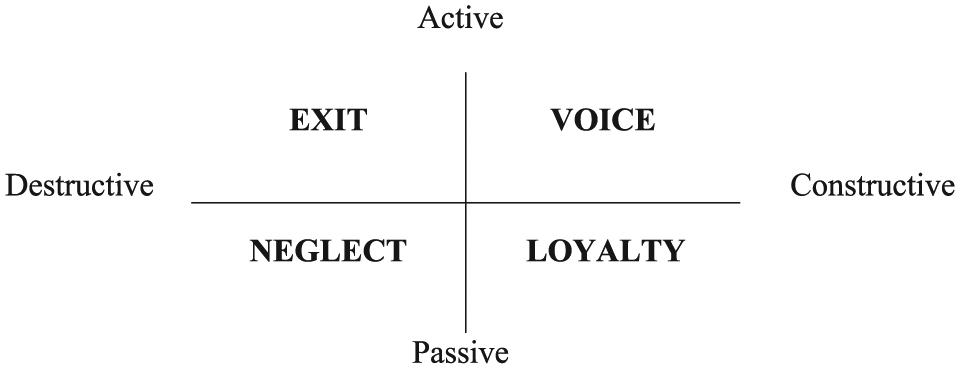
Exit, voice, loyalty, neglect theory.
According to Figure 1, four types of behaviors can be categorized in relation to workers’ attitudes.
First, the exit behavior pattern occurs when a worker is active within an organization but also destructive. This behavior pattern is seen in workers who are determined to leave the organizations where they are employed. Specific behaviors include leaving the organization, changing jobs, searching for other employment, and considering leaving the organization (Si and Li 2012).
Second, the voice behavior pattern occurs when a worker is both active and constructive. This pattern’s specific behaviors include demanding improved working conditions from management, expressing dissatisfaction with the organization, suggesting ways to relieve dissatisfaction factors to an employer, and whistle blowing (Si and Li 2012). These behaviors usually occur through a labor union (Deery et al. 2014).
Third, the loyalty behavior pattern occurs when a worker is passive yet constructive. Specific behaviors include staying at an organization and waiting for work conditions to improve (Farrell 1983). Although a worker may be passive, he or she is also optimistic, which leads to positive organizational citizenship behavior (Deery et al. 2014).
Last, the neglect behavior pattern occurs when a worker is passive and also destructive. Specific behaviors include being unable to remain engaged in one’s job, being consistently absent from or late for work, and behaving in uncooperative ways (Lavelle et al. 2018; Rusbult et al. 1988).
Literature Review and Research Hypotheses
Labor Union Utility and Workers’ Organizational Commitment
In this study, a concept of labor union utility is defined somewhat differently than in previous studies. I regard labor union utility as a function of protection, security, and wage. Prioritizing these three factors is difficult because satisfaction preferences vary among workers. However, when each factor increases, the workers’ perception of union utility will increase in accordance with the utility function graph. In other words, workers’ satisfaction with their unions increases.
Union utility implies that a union has properly reflected workers’ demands through the voice behaviors regarding working conditions and has obtained whatever workers want from employers. Essentially, high union utility can instill recognition in workers that they are entitled to sufficient wages and favorable working conditions; thus it can encourage employers to retain contracted talented workers and decrease staff turnover rates by fostering workers’ organizational commitment (Jeong, Son, and Choi 2003). Labor unions also implement official procedures and systems to solve workers’ complaints efficiently (Waddington 2006). Thus, if union utility is high, workers’ organizational commitment will tend to increase (Cardador et al. 2017).
Labor Union Membership and Workers’ Organizational Commitment
According to Farrell’s (1983) EVLN theory, workers with union membership can belong to the voice behavioral category (Hammer and Avgar 2005). Regarding organizational commitment, workers with union membership may initially belong to the loyalty category. However, when they make demands of their employers, workers shift to the voice category (Gahan 2012). Workers exhibiting the loyalty and voice behavioral types do not leave their organizations; instead, they remain committed to them through their attachment. Therefore, workers with union membership tend to have higher organizational commitment than workers without this membership (Hammer and Avgar 2005).
Moreover, though nonunionized workers can only behave by staying at their corporations with an organizational commitment attitude, union members can go further and express their own voices through their unions’ collective bargaining. Thus, union members experience higher organizational commitment levels and lower turnover rates than nonunion employees (Laroche and Salesina 2017). Additionally, union members have more opportunities to resort to union grievance resolution procedures than nonunion employees. Ultimately, the positive effect of union utility on organizational commitment may be greater for union members rather than nonunion workers (Charlwood and Pollert 2014).
Labor Union Utility and Workers’ Job Satisfaction
According to Farrell’s EVLN theory, union members tend to actively express their discontent, demonstrating behavioral patterns aligned with the voice category (Gahan 2012). In other words, a union can argue for higher pay, better working conditions, and benefits for its members to reduce workers’ workplace grievances. Thus, union members’ job satisfaction may be higher than that of nonmembers (Bryson and White 2016).
Job satisfaction can be subdivided into two dimensions: intrinsic and extrinsic job satisfaction (Lee, Back, and Chan 2015). Intrinsic job satisfaction is related to workers’ motivation for their jobs (Sardžoska and Tang 2015). On the other hand, extrinsic job satisfaction is related to factors such as pay, security, and work conditions (Hipp and Givan 2015).
A high degree of labor union utility implies that a union has successfully performed its role to improve wages, shorten working hours, improve employment stability, and introduce advanced benefits packages. Therefore, conditions such as wage satisfaction, employment security, and labor welfare satisfaction resulting from union activities can also be associated with high extrinsic satisfaction levels (Bryson and White 2016). In addition, extrinsic job satisfaction and intrinsic job satisfaction are positively related, meaning that workers are more motivated to perform their tasks when they witness the behaviors of their labor unions. In turn, this might lead to higher intrinsic job satisfaction (Huang and Van de Vliert 2003).
Labor Union Membership and Workers’ Job Satisfaction
Workers’ union membership and job satisfaction are significantly correlated with each other (Bryson, Cappellari, and Lucifora 2010). According to EVLN and exit, voice, loyalty theory, a union functions to encourage workers’ “voice” behaviors (Brewster, Wood, and Goergen 2015). Workers with union memberships express their discontent through their unions in order to improve the unions’ bargaining power with employers (Bryson and White 2016). Therefore, even though workers with union membership may feel dissatisfied with their employers, they tend to stay at their organizations and continue to fight for better working conditions (Green and Heywood 2015).
It is difficult to determine whether workers’ contradictory behaviors of remaining at an organization despite voicing feelings of grievance are due to actual job satisfaction levels or to the practice of resistance (Heywood, Siebert, and Wei 2002). In terms of the effect of union membership on workers’ job satisfaction, job satisfaction can be low even when the wage factor is ruled out (Borjas 1979). However, considering that unions possess a collective bargaining channel, there is a possibility that grievances expressed by a union-signed worker may in fact be false and that union members’ true intrinsic job satisfaction may be higher than that of nonunion employees (Borjas 1979). Moreover, union-signed workers tend to have high intrinsic job satisfaction, which is related to union activities that directly affect extrinsic job satisfaction as well, such as wage satisfaction, employment security satisfaction, benefits package satisfaction, and so forth. These employees’ extrinsic job satisfaction levels therefore tend to also be high (Hammer and Avgar 2005).
Unions implement employees’ fair and systematic mechanisms to handle workers’ grievances (Pekdemir, Glasbergen, and Cörvers 2015). Individual employees also expect their unions to resolve their complaints through dispute settlement procedures (Currie et al. 2017). Thus, high union utility may increase workers’ job satisfaction. A union may positively affect certain facets of union-signed workers’ job satisfaction including wage premiums (Breda 2015), and union members have more opportunities than nonunion employees to participate in management and express their voices to their employers (Bryson et al. 2013).
Given the above discussion, the study’s research hypotheses are outlined as follows:
Hypothesis 1a: Labor union utility will increase workers’ organizational commitment.
Hypothesis 1b: Labor union membership will increase workers’ organizational commitment.
Hypothesis 1c: The effect of labor union utility on workers’ organizational commitment is greater for union members than for nonunion employees.
Hypothesis 2a: Labor union utility will increase workers’ intrinsic job satisfaction.
Hypothesis 2b: Labor union membership will increase workers’ intrinsic job satisfaction.
Hypothesis 2c: The effect of labor union utility on workers’ intrinsic job satisfaction is greater for union members than for nonunion employees.
Hypothesis 3a: Labor union utility will increase workers’ extrinsic job satisfaction.
Hypothesis 3b: Labor union membership will increase workers’ extrinsic job satisfaction.
Hypothesis 3c: The effect of labor union utility on workers’ intrinsic job satisfaction is greater for union members than for nonunion employees.
Data and Methodology
I use data from individual questionnaires administered in 2006–2014 by the Korean Labor Income Panel Study published by the Korea Labor Institute. The study’s basic method of analysis is random-effect model panel regression using panel data. 1 Four panel regression analyses are conducted based on the study’s three dependent variables. In model 1, control variables’ effects on dependent variables are examined; then, in model 2, the effects of control variables and union utility on dependent variables are examined. In model 3, union membership’s effect on dependent variables is evaluated, and in model 4, union membership’s moderating effect is investigated by standardizing the union utility variable, multiplying it by the union membership variable, and creating an interaction term. The reason for multiplying a standardized union utility variable is to prevent collinearity due to an existing union utility variable.
Dependent Variables
This study focuses on three dependent variables. The first is organizational commitment. The Korean Labor and Income Panel Study used questions presented in Porter et al.’s (1974) Organizational Commitment Questionnaires to measure workers’ organizational commitment (Kim and Lah 2015). Second, I consider workers’ intrinsic job satisfaction. In the Korean Labor and Income Panel Study, Brayfield and Roche’s (1951) questionnaire items were condensed into three items to measure job satisfaction (Kim and Lah 2015). Third, extrinsic job satisfaction is also examined to produce a more refined analysis of a labor union’s effect on workers’ job satisfaction. A five-point Likert-type scale is used for measurement. Cronbach’s α is used to measure the reliability of the questionnaire items used to measure organizational commitment. Table 1 shows the result.
Dependent Variables: Questionnaire Items and Reliability Measurement.

As presented in Table 1, regarding organizational commitment, the reliability outcome of the three questionnaire items that constitute organizational commitment was α = .8921, indicating a high reliability level for this measurement. Regarding intrinsic job satisfaction, the reliability outcome of the three questionnaire items that constitute intrinsic job satisfaction was α = .9018, indicating a high reliability level for this measurement. Finally, regarding extrinsic job satisfaction, the reliability outcome of the four questionnaire items that constitute extrinsic job satisfaction related to a labor union was α = .7563, indicating an adequate reliability level for this measurement.
Independent Variable
Three questionnaire items are used to measure labor union utility, which is the main independent variable of this study (Table 2).
Union Utility: Questionnaire Items and Reliability Measurement.

The reliability outcome of the three questionnaire items that constitute the independent variable, union utility, was α = .9049, which is a high reliability level to measure union utility.
Control Variables
Many variables affect organizational commitment and job satisfaction. Of these, social demographic variables include gender, age, educational level, race, and personality factors (Fu and Deshpande 2014). Individual characteristics that affect organizational commitment and job satisfaction vary by region and time period. Job-related variables that affect organizational commitment include job level, work ethics, job overload, and skill variety (Petrou et al. 2012). From an organizational dimension, corporate characteristics and work environment are also variables that can affect organizational commitment (Gutierrez, Candela, and Carver 2012). More recently, pursuing job-life balance has become an important personnel practice. Therefore, life satisfaction level is also relative to organizational commitment (Naderi Anari 2012). Table 3 illustrates control variables used in this study.
Measurement and Method of Coding for Control Variables.

Results
Descriptive Statistics
Table 4 reports the basic characteristics of research subjects.
Characteristics of Research Subjects.

There are more female than male research subjects. The average age is 43.86 years. Subjects’ educational level ranges from no education to the doctoral level education, and the average educational level is three years of high school. In terms of workers’ status, there are more permanent than temporary workers in the research sample, and there are more workers who do not receive merit-based pay than those who do. In terms of job fit, the average values of educational level fit and skill level fit are 2.84 and 2.85, respectively. Workers’ life satisfaction is also measured as the degree of workers’ satisfaction with their overall lives through a 5-point Likert-type scale. Given the average value of 3.35, subjects appear to have fairly high life satisfaction levels.
Table5 reports the basic descriptive statistics of key variables.
Basic Statistics for Each Key Variable.

Table 5 shows that the average values of workers’ organizational commitment, intrinsic job satisfaction, and extrinsic job satisfaction are 3.23, 3.40, and 3.04 respectively. The average value of union utility is 3.41, indicating that tested workers have an above-normal level of awareness of union utility. The average value of union membership is 0.10, indicating that the majority of tested workers are not members of a labor union.
Regression Analyses of Labor Unions and Workers’ Organizational Commitment
Table 6 illustrates the results of a panel regression analysis of workers’ organizational commitment, which is the study’s first dependent variable.
Panel Regression Analysis of Labor Unions and Workers’ Organizational Commitment.

p < .001.
Model 1 is a panel regression analysis focused on the control variables. In model 2, the effect of union utility on workers’ organizational commitment is examined by controlling other variables. In model 3, union membership and union utility are added as variables in order to examine union membership’s effect on organizational commitment. In model 4, a panel regression analysis is performed with all variables, including the interaction term that multiplies the standardized union utility variable by the union membership variable.
The panel regression analysis confirms that union utility significantly increases workers’ organizational commitment. This finding is in agreement with hypothesis 1a. It can also be confirmed that union membership significantly increases workers’ organizational commitment, which is in agreement with hypothesis 1b. Moreover, the interactive term was confirmed to significantly increase workers’ organizational commitment, which also confirmed the moderating effect of labor union membership. This result is in agreement with hypothesis 1c. Figure 2 illustrates the moderating effect of labor union membership on workers’ organizational commitment.

The moderating effect of labor union membership on workers’ organizational commitment.
Regression Analyses of Labor Union and Worker’s Intrinsic Job Satisfaction
Table 7 illustrates the results of a panel regression analysis of workers’ intrinsic job satisfaction, which is the study’s second dependent variable.
Panel Regression Analysis of Labor Union and Workers’ Intrinsic Job Satisfaction.
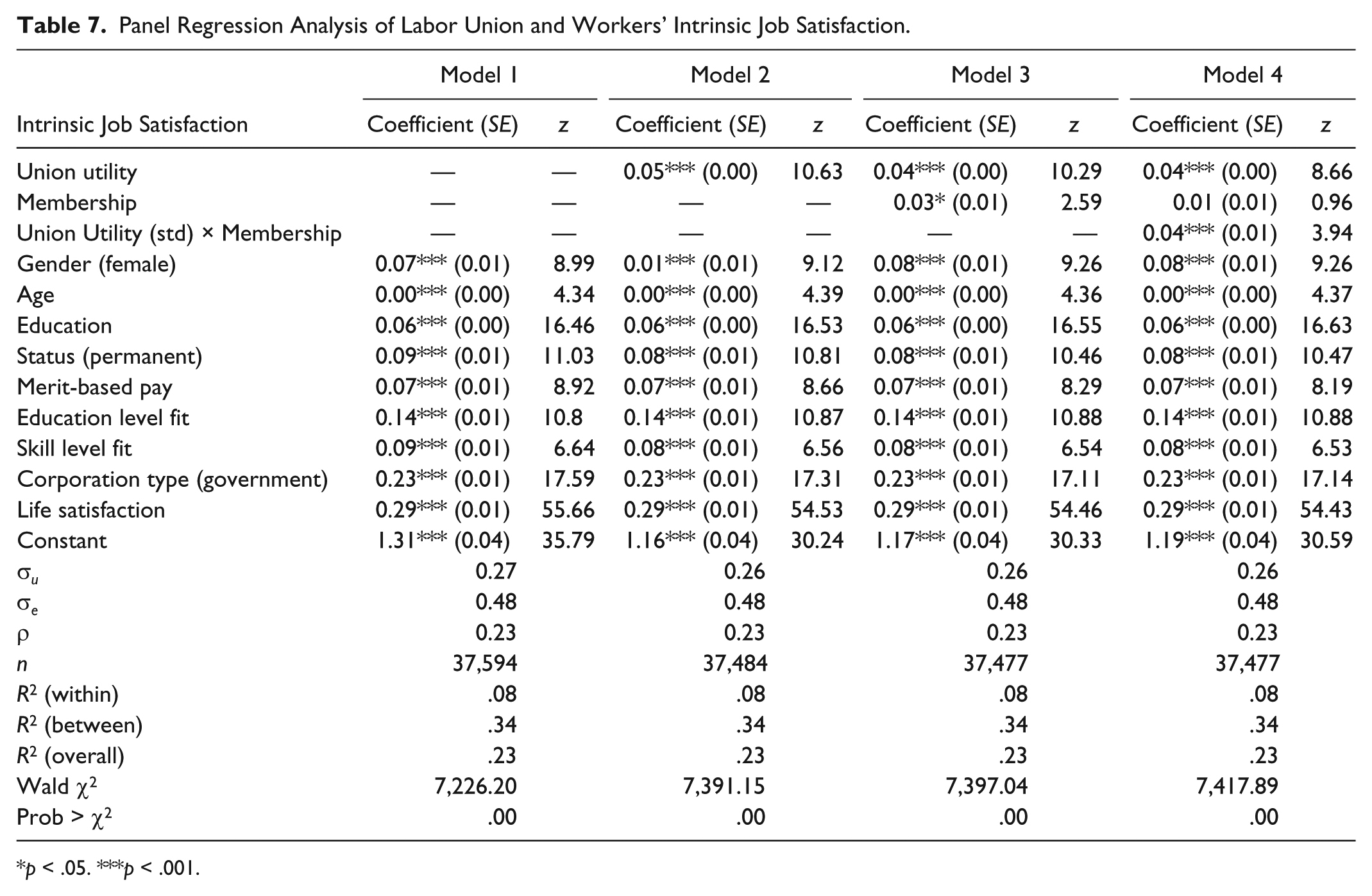
p < .05. ***p < .001.
Union utility significantly increases workers’ intrinsic job satisfaction. This result is in agreement with hypothesis 2a. However, union membership did not have any statistical significance in relation to workers’ intrinsic job satisfaction in model 4. Thus, this result did not confirm hypothesis 2b. However in model 3, union membership was shown to significantly increase intrinsic job satisfaction. The interaction terms have positive statistical significance in relation to workers’ intrinsic job satisfaction. Therefore, the moderating effect of union membership was confirmed, and this result corresponded with hypothesis 2c. Figure 3 illustrates the moderating effect of labor union membership on workers’ intrinsic job satisfaction.

The moderating effect of labor union membership on worker’s intrinsic job satisfaction.
Regression Analyses of Labor Union and Workers’ Extrinsic Job Satisfaction
Table 8 illustrates the result of a panel regression analysis of workers’ extrinsic job satisfaction, which is the study’s third dependent variable.
Panel Regression Analysis of Labor Union and Workers’ Extrinsic Job Satisfaction.

p < .01. ***p < .001.
The panel regression analysis confirms that union utility significantly increases workers’ extrinsic job satisfaction. This result is in agreement with hypothesis 3a. Additionally, regarding the union membership variable, workers with union membership have higher extrinsic job satisfaction than workers without such membership. These results support hypothesis 3b. Moreover, the interaction term was confirmed to significantly increase workers’ extrinsic job satisfaction, which in turn confirmed the moderating effect of union membership. This result supports hypothesis 3c. Figure 4 illustrates the moderating effect of labor union membership on workers’ extrinsic job satisfaction.

The moderating effect of union membership on workers’ extrinsic job satisfaction.
Discussion and Conclusion
Summary of Research
According to this study’s panel regression analysis, the higher the union utility, the higher workers’ organizational commitment, intrinsic job satisfaction, and extrinsic job satisfaction. These results support hypotheses 1a (model 4: β = .02, z = 4.36,p < .001), 2a (model 4: β = .04, z = 8.66, p < .001), and 3a (model 4: β = .03, z = 8.11, p < .001). Although the union membership variable was found to increase workers’ organizational commitment and extrinsic job satisfaction, it did not significantly increase workers’ intrinsic job satisfaction. In other words, although this result supports hypotheses 1b (model 4: β = .10, z = 7.63, p < .001), 3b (model 4: β = .10, z = 9.07, p < .001), it does not support hypothesis 2b (model 4: β = .01, z = 0.96, p > .05) of this study. Regarding the moderating effect of union membership, the effect of union utility on organizational commitment, intrinsic job satisfaction, and extrinsic job satisfaction was confirmed. Therefore, these results supports hypotheses 1c (model 4: β = .06, z = 6.72, p < .001), 2c (model 4: β = .04, z = 3.94, p < .001), and 3c (model 4: β = 0.02, z = 2.97, p < .001) of this study.
Policy Implications
This study has determined that labor unions can positively benefit both labor union members and nonunion employees. Although the moderating role of labor union membership is greater for union members than nonunion employees, workers who do not belong to labor unions can benefit from unions’ activities in the labor market. The findings of this study have the following policy implications for various stakeholders in the labor market.
First, the government, a moderator between corporations and labor unions, should redesign the direction of labor policy. In South Korea, most of the government’s labor policies are aligned with the neoliberal perspective, which aims to expand the labor market’s flexibility so as to alleviate high unemployment rates. To be more specific, government policies regarding the labor market are focused on creating new jobs and recruitment rather than protecting workers already in the labor market. This situation has resulted in a small degree of labor union density in South Korea. On the basis of the present results, if this trend of low labor union density continues, many employees would face difficulties expressing their opinions and rights to their management teams. This, in turn, would degenerate labor productivity including workers’ organizational commitment and job satisfaction. Therefore, the government should consider a labor policy that would secure a certain level of labor union density to ensure adequate labor performances.
Second, corporations, who act as major counterparts to labor unions, should consider corporate policies that aim to produce win-win labor management relations. To be more specific, corporate decision makers should expand communication channels that can ensure workers’ active participation and cooperation. Management needs to keep in mind that high levels of workers’ organizational commitment and job satisfaction are indicators of efficient job performance (Yousef 2017). Therefore, corporations should actively cooperate with labor unions to create mutual benefits, as they share a common goal of improving workers’ organizational commitment and job satisfaction (Cardador et al. 2017).
Finally, labor unions should avoid solely pursuing benefits for their own members. It might be necessary for unions to seek strategies that will increase membership and maintain high levels of workers’ organizational commitment and job satisfaction. Moreover, it is important for unions to keep an open mind, allowing temporary workers to join without much difficulty. In addition, labor unions should make efforts to fulfill their original goal and function of increasing their own utility. When it comes to labor management relations, individual workers are often in a position of inequality with their employers. Labor unions exist to help workers stand on equal ground with an employer in these instances. Labor unions must be aware that if they neglect to fulfill their roles, workers would likely experience employment insecurity, unfair wages, and low commitment to their organizations.
Footnotes
Appendix
Explanatory Factor Analysis of Independent and Dependent Variables.
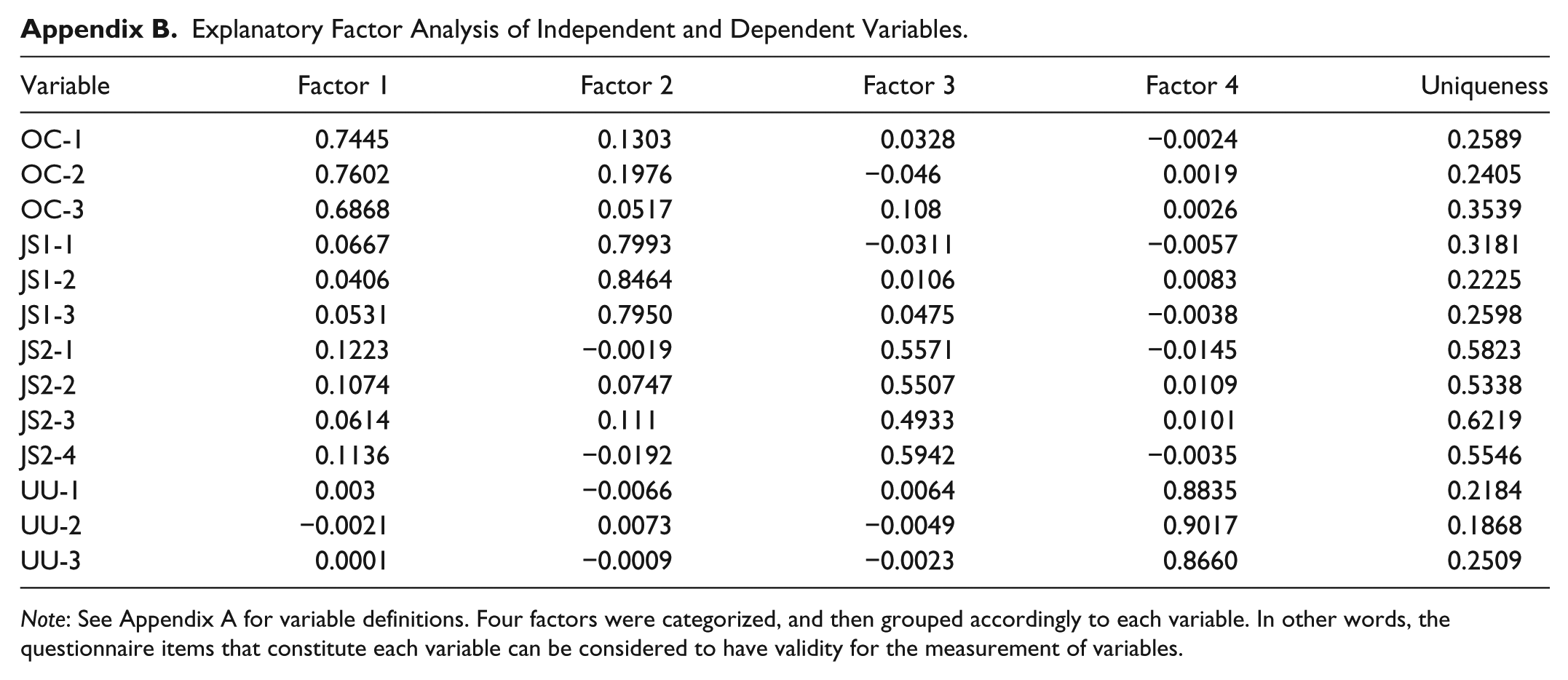
| Variable | Factor 1 | Factor 2 | Factor 3 | Factor 4 | Uniqueness |
|---|---|---|---|---|---|
| OC-1 | 0.7445 | 0.1303 | 0.0328 | −0.0024 | 0.2589 |
| OC-2 | 0.7602 | 0.1976 | −0.046 | 0.0019 | 0.2405 |
| OC-3 | 0.6868 | 0.0517 | 0.108 | 0.0026 | 0.3539 |
| JS1-1 | 0.0667 | 0.7993 | −0.0311 | −0.0057 | 0.3181 |
| JS1-2 | 0.0406 | 0.8464 | 0.0106 | 0.0083 | 0.2225 |
| JS1-3 | 0.0531 | 0.7950 | 0.0475 | −0.0038 | 0.2598 |
| JS2-1 | 0.1223 | −0.0019 | 0.5571 | −0.0145 | 0.5823 |
| JS2-2 | 0.1074 | 0.0747 | 0.5507 | 0.0109 | 0.5338 |
| JS2-3 | 0.0614 | 0.111 | 0.4933 | 0.0101 | 0.6219 |
| JS2-4 | 0.1136 | −0.0192 | 0.5942 | −0.0035 | 0.5546 |
| UU-1 | 0.003 | −0.0066 | 0.0064 | 0.8835 | 0.2184 |
| UU-2 | −0.0021 | 0.0073 | −0.0049 | 0.9017 | 0.1868 |
| UU-3 | 0.0001 | −0.0009 | −0.0023 | 0.8660 | 0.2509 |
Note: See Appendix A for variable definitions. Four factors were categorized, and then grouped accordingly to each variable. In other words, the questionnaire items that constitute each variable can be considered to have validity for the measurement of variables.
Acknowledgements
I would like to thank Professors Jong Soo Lee, Yoon Jik Cho, and Young Jun Choi for their constructive comments, as well as the editors of Socius and reviewers.
Author’s Note
This article is an abridged version of the author’s master’s thesis, “The Effect of Labor Union Utility on Workers’ Organizational Commitment and Job Satisfaction: Moderating Effects of Labor Union Membership” (Yonsei University, 2017).