




Abstract
Does acquaintanceship with gays and lesbians produce more accepting attitudes toward homosexuality and gay rights? Although most scholars and laypeople would likely answer in the affirmative, previous work has struggled to answer this question because of the difficulty in disentangling social influence from social selection. Using panel data from the 2006 to 2010 editions of the General Social Survey, this study provides a conservative test of the contact hypothesis for gay acceptance. People who had at least one gay or lesbian acquaintance at baseline exhibited larger attitude changes at two- and four-year follow-ups with regard to support for same-sex marriage and moral acceptance of homosexuality. Furthermore, this contact effect extended even, and perhaps especially, to people who otherwise displayed more negative prior attitudes and lower propensities for gay and lesbian acquaintanceship.
Increasing acceptance of gays and lesbians is one of the defining social changes of the past several decades. In the 1973 General Social Survey (GSS), just 11 percent of respondents agreed with the statement that homosexuality is “not wrong at all.” By 2016, this number had increased to more than 52 percent. When the GSS first elicited opinions on the topic of same-sex marriage in 1988, a paltry 12 percent of respondents expressed support, compared with 59 percent in 2016. The sweep of these shifts, as well as their broad social and political consequences, has sparked a great deal of interest across the social sciences. Most previous work has analyzed population-level change by comparing successive cross-sections of the GSS and other nationally representative surveys (Altemeyer 2002; Andersen and Fetner 2008; Avery et al. 2007; Baunach 2012; Fischer and Hout 2006; Inglehart and Baker 2000; Kozloski 2010; Loftus 2001; Powell et al. 2010; Yang 1997). Yet the most consistent finding in such work is that demographic turnover explains less than we might expect. In contrast to the age stability observed for many other attitudes (Alwin and Krosnick 1991), whereby opinions formed in young adulthood generally change little with age, societal acceptance of homosexuality largely reflects change within birth cohorts (Andersen and Fetner 2008; Baunach 2012; Loftus 2001).
Much of this within-cohort attitude change is thought to stem from the prejudice-reducing effects of intergroup contact at the micro level. To this end, previous work has demonstrated a robust correlation between social contact with gay people and more accepting attitudes toward homosexuality (Altemeyer 2002; Anderssen 2002; Bassett et al. 2005; Garner 2013; Herek and Capitanio 1996; Herek and Glunt 1993; Lewis 2011; Pagtolun-An and Clair 1986). The extent of social contact with gays and lesbians is suggested by the 2006 GSS, in which 54 percent of respondents reported at least one gay acquaintance, including 47 percent with a gay coworker and 31 percent with a gay family member. Furthermore, the increasing proportion in recent decades of U.S. adults who reported knowing a gay or lesbian person correlates strongly with simultaneous shifts in approval of same-sex marriage (Rosenfeld 2017). Yet work documenting correlations between acquaintanceship and attitudes cannot tell us whether being acquainted with gays and lesbians actually produces changes in attitudes. It could as easily be the case that people who are already more accepting are simply more open to interacting with gays and lesbians or are likelier to receive disclosures of homosexuality from acquaintances who may be more reticent around alters known to be less tolerant.
In this study I use longitudinal data from the 2006 to 2010 panel of the GSS to provide a more robust answer to the question of whether acquaintanceship with gays and lesbians produces more accepting attitudes toward homosexuality and gay rights. The 2006 edition of the GSS included an extensive one-time module on respondents’ networks of acquaintances (see DiPrete et al. 2011), including ties to people the respondents knew to be gay or lesbian. Taking this as a baseline for panel analysis, I show that respondents who were acquainted with at least one gay or lesbian person in 2006 exhibited greater shifts toward increased acceptance of homosexuality and gay marriage in 2008 and 2010. By controlling for attitudes at the 2006 baseline, which could easily have already been influenced by prior contact with gay and lesbian acquaintances, this analysis provides an especially, perhaps overly, conservative test of the contact hypothesis.
After shoring up this baseline account of contact and attitude change, I then ask what mechanisms might account for the attitude-shifting effects of gay acquaintanceship. After all, if waves of gays and lesbians “coming out” of the proverbial closet have increased social acceptance, this has also arguably intensified expressions of disapproval. For example, ballot initiatives banning same-sex marriage diffused widely in the early 2000s based in part on their ability to increase turnout among socially conservative voters (Campbell and Monson 2008). One possible explanation is that contact itself is doubly selective: individuals who express accepting attitudes may be both more likely to elicit disclosures of homosexuality and to respond positively to those admissions. “Coming out” may produce greater acceptance at the population level by increasing the depth of acceptance within already tolerant individuals rather than by increasing the breadth of acceptance across the population. Contact with gays and lesbians may accelerate attitude change for those with high propensities for such contact while having little or no effect on those who may lack exposure to gay and lesbian people or avoid such contact out of a more deeply anchored distaste for homosexuality.
Conversely, attitude change from contact may extend further to those people who improbably find themselves tied to gay or lesbian alters, for example, a conservative parent whose child unexpectedly “comes out.” This theory is perhaps most eloquently expressed in Harvey Milk’s famous exhortation for gays and lesbians in all walks of life to “come out” to their friends, relatives, and coworkers in order to “end prejudice overnight” (Shilts 1982:277). The implicit assumption in this narrative is that most people will attach greater weight to their social ties (including those with people who turn out to be gay) than toward their attitudes and beliefs toward homosexuality more abstractly. Thus, the cognitive dissonance that results from receiving knowledge of an alter’s homosexuality tends to be resolved by shifting one’s attitudes rather than by rejecting the alter or dissolving the social tie. Consequently, those who begin with more negative attitudes toward homosexuality should also experience the largest attitude change in the course of resolving this dissonance.
These alternative accounts pose the question: Can contact change attitudes even among those who may be less likely to experience such contact? Or does the contact effect simply reflect a “preaching to the choir” dynamic in which already tolerant people become even more accepting? To assess these questions, I estimate propensity scores that capture the likelihood of any given respondent’s reporting a gay acquaintance on the basis of his or her baseline attitudes and sociodemographic background. Working within a potential-outcomes framework for causal inference (Morgan and Winship 2007), I then compare how the average estimated effect of gay acquaintanceship differs with the propensity to report a gay acquaintance. By way of preview, this analysis of causal heterogeneity supports the second account presented above: the average person without any gay acquaintances would actually be expected to experience an even larger shift in attitudes if he or she were to have a gay acquaintance, compared with the actual attitude shifts experienced by people who do report gay acquaintances.
The rest of the article proceeds as follows. In the next section, I review the previous theoretical and empirical literature on contact and attitude change, paying particular attention to work that addresses this relationship in the context of gay and lesbian populations. Then I elaborate a theoretical framework that draws on classic theories in social psychology to explain how and for whom contact with gay and lesbian acquaintances might produce greater or lesser attitude changes. After introducing the GSS panel data set, I then present two sets of analyses. The first set of analyses seeks to establish the main effect of gay and lesbian acquaintanceship on attitude change at two- and four-year follow-ups while controlling for baseline attitudes. Having established this main effect, the second set of analyses explores causal heterogeneity by prior attitudes and sociodemographic background. I conclude by discussing some limitations of the necessarily provisional findings reported here and speculating on further theoretical and empirical implications.
Selective Contact? Existing Theory and Evidence
In his classic 1954 work The Nature of Prejudice, Gordon Allport presented a simple claim: that interactions across social boundaries could foster a reduction in prejudice toward an outgroup. In particular, Allport suggested that prejudice-reducing contact could most easily occur in situations in which outgroup members are personally acquainted with ingroup members, equal or higher in status, and in which ingroup and outgroup members are engaged in the pursuit of common objectives. Through these and other mediating conditions, contact is thought to have greater or lesser effects on the ingroup’s ability to see through stereotypes of outgroup members (Allport 1954), reduce feelings of anxiety in outgroup encounters (Stephan and Stephan 1985), and feel empathy toward outgroup members (Batson, Early, and Salvarani 1997). The “contact hypothesis” has subsequently found wide support, even in contexts in which some of Allport’s original conditions are lacking, particularly (thought not exclusively) in studies of prejudice toward racial and ethnic outgroups and immigrants (DellaPosta 2013a; Ellison and Powers 1994; Ellison, Shin, and Leal 2011; McLaren 2003; Pettigrew 1997, 1998; Pettigrew and Tropp 2006; Powers and Ellison 1995; Sigelman and Welch 1993).
Despite the wide range of studies supporting the contact hypothesis, similar contact experiences can nontheless be associated with very different outcomes for different individuals (Festinger and Kelley 1951). Such heterogeneity is likewise suggested by studies applying the contact hypothesis to attitudes toward gays and lesbians; although a growing literature shows that knowing gays and lesbians personally is associated with more tolerant attitudes (e.g., Anderssen 2002; Garner 2013; Herek and Capitanio 1996; Herek and Glunt 1993; Lewis 2011), this association is also thought to vary for people of different political, religious, and cultural predispositions (Skipworth, Garner, and Dettrey 2010). For example, Barth and Overby (2008) reported that contact with gays and lesbians is only associated with more positive attitudes in nonsouthern states (though see Baunach, Burgess, and Muse 2010). Meanwhile, Garner (2013) showed that contact is associated with consistently more positive attitudes toward gay rights among liberal-leaning respondents while being associated with less predictable and more variant attitudes among conservative-leaning respondents.
Cross-sectional studies of contact and attitudes, however, share a common limitation: how can we distinguish the effects of contact from selection due to confounding attributes that make individuals more or less likely to experience contact in the first place (Powers and Ellison 1995)? If more prejudiced people simply avoid contact with outgroups, in other words, we would observe a cross-sectional correlation between contact and prejudice even in the absence of any causal effect of contact (Pettigrew 1998). This problem becomes even more vexing when studying attitudes toward gays and lesbians, because the selectiveness of contact then takes on an additional layer: sexual identity is a “concealable stigma” requiring the gay or lesbian person to “come out” to his or her alters (Herek and Capitanio 1996). For the gay or lesbian person, fear of prejudice and rejection can be a powerful motivator to keep one’s identity concealed or to “come out” selectively to peers whom one thinks will react more positively (Wells and Kline 1987).
This “double selection” raises a question: does contact produce attitude change, or do more accepting attitudes simply elicit contact? 1 Most studies of contact with gays and lesbians ignore this question, instead interpreting cross-sectional correlations between contact and attitudes as unproblematically suggesting a causal effect of contact. There are, however, some exceptions worth noting. For example, Herek and Capitanio’s (1996) 1990–1991 telephone survey of U.S. adults and Anderssen’s (2002) survey of Norwegian college students both suggest a reciprocal relationship between contact and attitudes using two-wave formats. Against this backdrop, it seemed that LaCour and Green (2014) had achieved a breakthrough in showing through a field experiment that a brief conversation with a gay canvasser was enough to substantially shift attitudes toward same-sex marriage; however, that study was subsequently retracted when researchers discovered statistical irregularities suggesting falsification of data.
The present study contributes to the foundation established by previous work in three ways. First, I use nationally representative data (the GSS) collected relatively recently (2006–2010) and during a period in which attitudes toward gay rights underwent dramatic change. Second, and more important, I use the panel structure of the data to construct an especially conservative test of the contact effect in which both attitudes and contact are measured at baseline and used to predict subsequent attitudes for the same respondents. Third, and finally, I use propensity-score techniques to investigate how the effect of contact varies with the propensity to experience contact. This allows greater understanding of the mechanisms through which contact leads to attitude change, an issue to which I turn next.
Theoretical Model: Attitude Change as Dissonance Reduction
Individuals are simultaneously invested in their attitudes, beliefs, or convictions and in their social ties with network alters. Furthermore, individuals tend to balance these investments such that they do not conflict with one another, implying that two friends will tend to hold similar views toward impersonal “objects” (e.g., homosexuality, abortion, or any other issue; Heider 1946) and toward other network alters (Cartwright and Harary 1956). By implication, individuals with gay people in their networks should tend to have more accepting attitudes toward homosexuality, and individuals who are rigidly intolerant of homosexuality should tend to have few gay friends or acquaintances. Learning that a network alter is gay would create cognitive dissonance when the ego’s positive personal assessments of the gay alter conflict with negative assessments of homosexuality, gay rights, or gay people in general.
Figure 1 graphically depicts this dissonant arrangement from the ego’s perspective and demonstrates three potential dissonance reduction pathways. In addition to the positive or negative valence assigned to each edge (or line) in the graph, I also include weights (e.g., wij for the weight between ego i and alter j) to indicate that the strength of one’s commitments to beliefs and social ties can vary. The weight attached to attitudes and beliefs could be rooted in internalized moral values or political convictions, for example. The weight attached to social ties may reflect expected social benefits from the continuation of the relationship and the social or emotional costs of severing the relationship. To illustrate, severing ties with family members or close friends can be especially costly both because of affective bonds and because triadic closure—the tendency for close ties to be embedded in dense networks of other mutual ties (Coleman 1988)—implies that third parties will become ensnared in the conflict and forced to choose sides. In contrast, severing ties with a neighbor or casual acquaintance may be less costly.
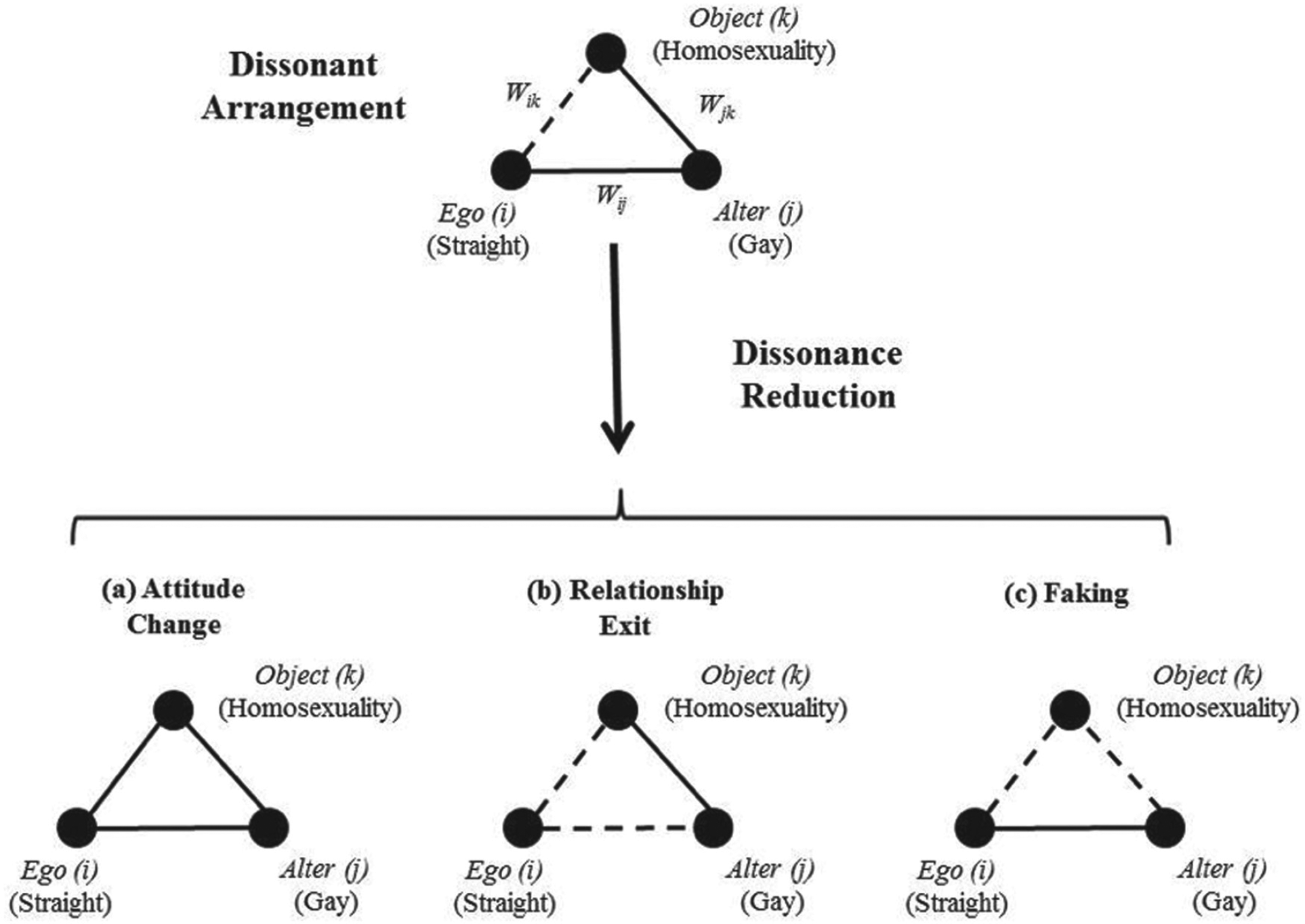
Resolving dissonance between attitudes and social ties.
Learning that an alter is gay is most likely to produce attitude change when the tie with the gay alter outweighs one’s negative attitudes toward homosexuality or gay people in general (wij > wik). In this situation, the ego reduces dissonance by using the positively viewed gay alter as evidence that homosexuality or gay people “aren’t really so bad.” In the reverse case, the same dissonant arrangement can produce relationship exit—ceasing or reducing interactions with the gay alter—if those negative attitudes outweigh the social tie (wik > wij). A third possibility is that the ego maintains her current attitudes and social ties but pressures the gay alter to change. This reduces her own dissonance by increasing that of the alter, who is forced to choose between “faking” heterosexuality and maintaining the social tie or breaking the tie and dealing with the social costs. In an even stronger version of “faking,” closeted gay people might actively enforce norms against homosexuality specifically to avoid uncomfortable accusations (Centola, Willer, and Macy 2005). Historical evidence suggests that such behavior was commonplace, for example, among closeted government officials during the McCarthy-era “lavender scare” (D’Emilio 1983). 2
Clearly, this stylized theoretical model does not aim to capture every element that could influence attitude change in specific situations. Rather, the goal is to specify just the core implications of viewing attitude change as dissonance reduction in order to generate empirical predictions. At baseline, we should expect that more tolerant individuals will be more likely to report gay peers in their acquaintanceship networks. This is because gays and lesbians are more likely to disclose their orientation to those who already appear tolerant (Wells and Kline 1987) and because contact with alters one knows to be gay may already have influenced one’s attitudes prior to baseline.
The next logical question is whether the effects of contact also depend on the factors influencing one’s propensity to experience contact: are tolerant heterosexuals more likely to be acquainted with known gay alters and to further change their attitudes as a result of those acquaintances? If intolerant views are generally strong enough to outweigh the social tie with the gay or lesbian alter, then contact will have a lesser effect among those holding such views. Large initial prejudices, in other words, may create incentives to find ways to avoid attitude change, particularly if those prejudices are strongly connected to other beliefs, cognitive schemas, or religious and moral convictions. Changing one’s attitudes toward homosexuality would then induce further dissonance by rupturing the consistency between beliefs. Classic studies of “anchoring” in psychology note that beliefs connected to other beliefs are more resistant to persuasion (Nelson 1968). Indirectly illustrating this point, Sherkat, de Vries, and Creek (2010) find that education and political affiliation have a weaker effect on support for same-sex marriage for African Americans than for whites and that this gap is a function of religiosity. When negative attitudes toward homosexuality are rooted in religious convictions, in other words, they can become immunized against secular influences that normally produce attitude change. Other studies suggest that the “biased assimilation” of new information through the prism of one’s current beliefs produces similar dynamics (Boysen and Vogel 2007). 3
From a different perspective, intergroup contact theory suggests that contact with members of an outgroup reduces prejudice through a corresponding reduction in social distance (e.g., Allport 1954). The distance-reducing mechanisms proposed by this approach, such as learning about the outgroup and reappraising previous beliefs (Pettigrew 1998), share the logical implication that contact should have the strongest prejudice-reducing effects in cases in which initial prejudices and social distances are largest. In this case, individuals who begin from a baseline of less tolerant views will experience the largest shifts in attitudes because of contact. This expectation, however, implicitly assumes that attitude change is the dominant way in which less tolerant people who encounter a gay or lesbian alter will resolve the resulting dissonance they experience. If the weight of their previously held attitudes are great enough, these individuals may instead cling to their beliefs even at the expense of damaging the social tie.
In sum, I pose two empirical questions to be addressed in the remainder of the article. First, when we construct a conservative test, will we observe an overall tendency for acquaintanceship with gay and lesbian alters to produce more positive attitudes toward homosexuality and gay rights? And second, if we do observe such an overall tendency, will it manifest only among those individuals most disposed to hold more positive attitudes and experience contact, implying that contact operates largely by “preaching to the choir,” or will it extend further to those who are otherwise less disposed to hold such views and to experience contact?
Data and Methods
To construct a conservative test of contact effects on attitudes toward homosexuality and gay rights, I use data from the 2006 to 2010 panel of the GSS. The selection of this particular time frame for analysis was driven by the coincidence of the 2006 GSS’s inclusion of an extensive module on acquaintanceship and trust in respondents’ personal networks (see DiPrete et al. 2011 for an extensive presentation of these data). The module begins with the following prompt:
I’m going to ask you some questions about all the people that you are acquainted with, meaning that you know their name and would stop and talk at least for a moment if you ran into the person on the street or in a shopping mall. Some of these questions may seem unusual but they are an important way to help us understand more about social networks in America. Please answer the questions as best you can.
One such question asks the respondent how many of these acquaintances the respondent is “pretty certain are gay men or women.” The valid responses are partitioned into five groups: 0, 1, 2 to 5, 6 to 10, or more than 10 gay acquaintances. Because exploratory analyses suggested that knowing more than 1 gay person had effects similar to those of knowing 1 gay person, I use a simple dichotomous treatment variable taking a value of 1 if the respondent knows 1 or more gay people and 0 if the respondent does not know any gay people. I also test a second treatment on the basis of a similar set of questions about social ties whom the respondent would consider to be closer than a mere acquaintance. The respondents were prompted, “Now I’m going to ask you some questions about people that you trust, for example good friends, people you discuss important matters with, or trust for advice, or trust with money.” Again, respondents were asked how many people in the category of those they would trust are gay men or women. As with the acquaintanceship measure, I dichotomized this contact treatment.
For both treatment variables, respondents who reported a gay alter (whether a mere acquaintance or someone who the respondent trusts) are compared with respondents who neither knew nor trusted any gay people. Thus, although respondents can belong simultaneously to both groups of treated cases (i.e., a respondent can both know and trust at least one gay person), the set of control cases (i.e., respondents who did not report knowing or trusting any gay person) is defined the same throughout.
To measure respondents’ attitudes toward homosexuality and gay rights, I use two outcome measures. The first question (labeled “homosex” in the GSS), which was originally presented in the 1973 GSS and has appeared in most subsequent surveys, asks respondents whether they view “sexual relations between two adults of the same sex” as “always wrong, almost always wrong, wrong only sometimes, or not wrong at all.” The second question (“marhomo”), first offered in 1988 and then reincluded in 2004 and subsequent GSS editions, elicits respondents’ assessments (from “strongly agree” to “strongly disagree”) of the statement that “Homosexual couples should have the right to marry one another.” For ease of interpretation, I reverse-coded this measure such that higher values indicate support for same-sex marriage.
In total, I test eight treatment effects in a 2 × 2 × 2 design: (1) the effects of contact with gays and lesbians in relationships of either acquaintanceship or trust on (2) attitudes toward homosexuality in general and same-sex marriage in particular for (3) two- and four-year follow-ups after the 2006 baseline measurement. In each case, I take a difference-in-differences approach that tracks attitude changes from baseline to follow-up for the same individuals and compares the difference in those changes between those with at least one gay contact (treatment group) and those with no reported contact with gay people (control group). By comparing successive observations for the same respondent, this approach adjusts for any time-constant factors that might otherwise confound the relationship between treatment and outcome.
As discussed previously, this is intentionally an overly conservative test of the contact effect, because we do not actually know how long a respondent has already known his or her gay contacts at the time of the 2006 baseline. Thus, the effects of contact may already be reflected in the respondent’s baseline attitudes toward homosexuality and gay marriage, which are nonetheless controlled in order to focus only on further attitude changes after the 2006 baseline. Because both attitudinal outcomes are measured as ordinal scales, I use ordered logit regression to predict each person’s response at 2008 and 2010 follow-ups as a function of contact with gay alters while controlling for baseline attitudes. For further robustness, I control for these baseline attitudes through categorical fixed effects such that each respondent is strictly compared with others with the same baseline response, rather than simply treating the baseline response as a continuous predictor. In the tabular results below, I also include results from linear ordinary least squares specifications of the same model, which produce substantively similar patterns to those found using the ordered logit models.
Of 2,000 eligible 2006 GSS respondents, a total of 1,536 were reinterviewed in 2008, and 1,276 were again reinterviewed in 2010. However, the effective sample size for analysis is much smaller because the network module was only assigned to a representative subset of 689 respondents because of its length, and only a subset of these respondents would have also been selected for subsequent reinterview in the panel format. For each treatment condition, I include only respondents who (1) were reinterviewed at the relevant follow-up (either 2008 or 2010, depending on the condition), (2) responded to the relevant attitudinal outcome (either attitude toward homosexuality in general or toward same-sex marriage) at both baseline and follow-up, and (3) responded to both personal networks questions about relationships with gay alters. I also exclude respondents who reported sexual contact with members of the same sex in the year prior to the 2006 baseline; although this is a rough heuristic to apply, it provides an approximate means of focusing on the attitudes of heterosexual respondents. The resulting n in the treatment models after these restrictions varies from a low of 139 to a high of 216. Of the respondents who appear in at least one of the treatment models for gay acquaintanceship, 114 (53 percent) report at least one gay acquaintance, while 102 report none. Of the 182 respondents who appear in at least one of the models for ties of trust, 80 (44 percent) report at least one trusted gay alter; the control group remains the same as for the models of acquaintanceship.
Results
To illustrate some general patterns, Table 1 displays cross-tabular results for respondents’ support or opposition to same-sex marriage at each panel wave separately by gay acquaintanceship in 2006. Notably, the sample is close to evenly split between those who reported a gay or lesbian acquaintance (about 53 percent) and those who did not. On the basis of the cross-tabular results, furthermore, we can see that respondents who were acquainted with a gay or lesbian person were indeed likelier to change their attitude in the direction of greater support for same-sex marriage. Although those with no gay acquaintances generally retained similar attitudes over time, or even became slightly less supportive of same-sex marriage, the percentage of people with gay acquaintances who also supported same-sex marriage increased from 45 percent in 2006 to 60 percent in 2010. Note that these tabular results collapse responses into the three categories of support, opposition, and neither. The regression analyses to which I now turn will retain the original five-category ordinal response ranging from strong disagreement to strong agreement.
Gay Acquaintanceship and Change in Support for Same-sex Marriage.

Note: Percentages are rounded to the nearest whole number. Support is indicated by either agreement or strong agreement with same-sex marriage; opposition is indicated by disagreement or strong disagreement. The sample size differs across waves because of attrition; percentages only reflect those for whom responses are available.
Table 2 reports estimates of the treatment effect of contact with gays and lesbians across all eight conditions using both ordered logit and ordinary least squares regression specifications. Although the estimated treatment effect is positive in all cases, this effect is only statistically significant at conventional levels in some of the conditions. Given the relatively small number of cases combined with the conservative structure of the tests, this is not surprising. The strongest treatment effects are observed at the 2010 follow-up. The fact that these effects are larger than those observed for the initial 2008 follow-up suggests that the attitude-shifting effects of contact unfold gradually over time. 4 A second notable observation from these models is that having closer bonds of trust with a gay alter does not predict a larger shift in attitudes than merely having a gay acquaintance in one’s network. Clearly, even acquaintanceship is a higher threshold of contact than merely seeing outgroup members on the street or in the grocery store without having any personal interactions with them (Allport 1954). Still, it is striking that the relatively weak bond of acquaintanceship produces at least as large of an effect as the closer tie of trust. Of course, one reasonable interpretation is that closer ties are likelier to have been in place longer prior to the baseline than ties of mere acquaintanceship. Consequently, these closer ties may have already affected the respondent’s attitudes, leaving less room for further change between the baseline and subsequent follow-ups. Because the network questions are measured only at baseline (the module was not featured in subsequent GSS editions), these issues cannot be rigorously disentangled here.
Ordered Logit and OLS Models of Attitude Changes.

Note: Logit and ordinary least squares (OLS) coefficients are shown, with bootstrapped standard errors (1,000 replications) shown in parentheses. All models include categorical fixed effects for 2006 attitudes.
p < .05, **p < .01, and ***p < .001 (two-tailed tests).
The remaining analyses focus on heterogeneity in the contact effect by the propensity to interact with gay and lesbian alters. Table 3 presents logit models predicting respondents’ likelihood of having at least one gay or lesbian acquaintance or trusted contact at the 2006 baseline as a function of potentially relevant sociodemographic background variables along with baseline attitudes toward homosexuality and gay marriage in the 2006 survey. 5 The dominant predictor of one’s likelihood of reporting a gay or lesbian alter is one’s baseline attitude toward homosexuality. In fact, this single covariate virtually subsumes all of the others in the model, despite the fact that several of these other factors (particularly age and political conservatism) were found to be significant predictors in alternative specifications that did not adjust for respondents’ attitudes toward homosexuality.
Logit Model of Propensity for Gay Contact.

Note: Logit coefficients are shown, with bootstrapped standard errors (1,000 replications) shown in parentheses.
p < .05, **p < .01, and ***p < .001 (two-tailed tests).
I use the models in Table 3 to compute propensity scores quantifying the model-based probability that a given respondent would report a gay alter given her or his baseline attitudes and sociodemographic background (Rosenbaum and Rubin 1983). These scores give a sense of the “typicality” of each respondent’s treatment status. In other words, a respondent who is acquainted with at least one gay person and has a high propensity score is typical of the kinds of respondents who typically reported having gay and lesbian acquaintances. In contrast, a respondent acquainted with a gay person but with a low propensity score—or, to give another example, a respondent who is not acquainted with a gay person but has a high propensity—is less typical of his or her treatment group. We can see from the models predicting treatment status that respondents with more positive baseline attitudes toward homosexuality are much more likely to report at least one gay or lesbian acquaintance. If contact effects reflect positive selection in which the people most likely to change their attitudes because of contact are also the ones likeliest to experience such contact, then the largest contact effects should be concentrated among those with higher propensities to report a gay alter.
To assess the relationship between selection into contact and the effects of contact itself, respondents in the treatment (contact) group are matched with respondents in the control (no contact) group who otherwise resemble them with regard to baseline attitudes and sociodemographic background. If the effects of contact on attitude change are concentrated among those who are most disposed to experience contact in the first place, then we would observe the largest effects of contact when comparing treated and control cases with high propensities for contact. If, instead, the effects of contact are largest among respondents for whom contact with gays and lesbians would otherwise seem atypical, then the largest effects of contact would appear when comparing treated and control cases with low propensities for contact. For such an analysis to be meaningful, the propensity scores must create substantial balance such that respondents with similar propensity scores closely resemble each other with regard to baseline attitudes and sociodemographics. In additional analyses not shown here, I found that the propensity scores estimated through the logit model indeed generated adequate balance across the treatment groups. In the analyses below, I further adjust for any residual differences between treated and control cases with similar propensities by including all pretreatment covariates as control variables, including again the inclusion of categorical fixed effects for baseline attitudes.
To capture how contact effects vary with the propensity to experience contact, I estimate a series of models comparing the average treatment effect for the treated (ATT) with the average treatment effect for the controls (ATC) across the same eight treatment conditions previously investigated in Table 2. ATT models are based on matching each treated case with comparable (similar-propensity) control cases and observing the differences attributable to the treatment itself. Because treated cases on average feature higher propensities than control cases, this estimate is weighted toward respondents with higher propensities. In contrast, the ATC estimates are weighted in the opposite direction, based on estimating the average treatment effect that a control case would have experienced by matching him or her with comparable (generally lower propensity) treated cases. If the estimated average treatment effect would be larger for those who did not actually receive the treatment, this is indicative of negative selection into the treatment: the respondents who experience the treatment receive a smaller effect from said treatment compared with a hypothetical control case if he or she were to instead receive the treatment. By comparing the ATT and ATC for a given treatment, we can gain leverage on the way in which the effect of a particular treatment depends on the surrounding factors that influence one’s likelihood of experiencing the treatment in the first place (e.g., DellaPosta 2013b; Morgan and Winship 2007).
To capture these differences, I adopt an approach introduced by Morgan and Todd (2008) that allows estimation of regression models with propensity-score weights. These allow estimation of conditional average treatment effects within a regression framework and without having to compare across numerous propensity score matching algorithms. 6 Table 4 shows that, in the select treatment conditions in which we observe a significant contact effect, these effects are generally larger when weighted toward the controls rather than the cases that actually received the treatment. This striking pattern speaks against the narrative of positive selection. When contact affected changes in attitudes, these changes were greatest for respondents who would otherwise seem unlikely to report a gay or lesbian alter in the first place. Notably, this pattern is also not explained by a “ceiling effect” in which high-propensity respondents simply cannot move as much as low-propensity respondents because of the former’s already reporting much more positive attitudes toward homosexuality at baseline. Because the models include categorical fixed effects for baseline attitudes, respondents are compared with those who reported the same ordinal-scaled attitude toward homosexuality or gay marriage at baseline and thus have the same range of potential movement available to them at the follow-ups.
Ordered Logit and OLS Models of Attitude Changes with Propensity-score Weighting.

Note: Logit and ordinary least squares (OLS) coefficients are shown, with heteroskedastic-consistent standard errors in parentheses. All models include adjustments for all covariates in Table 3 and categorical fixed effects for 2006 attitudes. ATC = average treatment effect for the controls; ATT = average treatment effect for the treated.
p < .01 (two-tailed tests).
Discussion
This study pursued two empirical objectives. The first was to provide a conservative test of the hypothesis that gay acquaintanceship produces attitude shifts toward increased acceptance of homosexuality and gay rights. The results show that under some but not all treatment specifications of the contact effect, people who reported a gay acquaintance in their network exhibited larger subsequent attitude shifts compared with those who did not. These attitude shifts were most clearly apparent four years after the baseline measurement. The second goal was to investigate whether and how these contact effects related to the factors that influence selection into gay acquaintanceship in the first place. Does contact only affect attitude change for those with a strong propensity for contact, or can contact have broader effects beyond “preaching to the choir?” The results from an analysis aided by propensity-score weighting suggest that the effects of contact perhaps apply most strongly to those who otherwise seem to have lower propensities for gay acquaintanceship.
Although contact itself is selective and depends strongly on prior attitudes, the analysis presented here then suggests that the effects of contact would be observed even, or especially, among those who are relatively unlikely to experience it. Because many studies of contact effects are cross-sectional, critics reasonably suspect the workings of reverse causation: does contact change attitudes or do attitudes create a propensity for contact? However, in addition to documenting a conservative estimate of the overall contact effect that adjusts for prior attitudes, the present study suggests that the average person without any gay acquaintances would likely experience a larger attitude shift from contact compared with the average person who actually did have a gay acquaintance.
There are clear limitations to the analysis undertaken here that should make these findings necessarily provisional. Most critically, we might wonder whether there is some underlying and unobserved selection in the type of person who reports relatively negative views toward homosexuality at baseline but nevertheless reports a gay acquaintance. We might imagine, for example, that for the social tie with a gay alter to have already survived the respondent’s negative attitudes toward homosexuality, the tie must be an abnormally strong one or might reflect a relationship that is difficult to exit (i.e., immediate family). Or perhaps these low-propensity respondents have weaker or less long-standing ties with their gay acquaintances, and thus these social ties have not already influenced their attitudes, leaving more room for further movement. Without the aid of a more directly experimental or quasi-experimental intervention, we cannot ensure a true “apples-to-apples” comparison even with the aid of propensity scores to match respondents on the basis of baseline attitudes and sociodemographic factors. Furthermore, the relatively small number of GSS respondents who both were given the acquaintanceship module and were part of the longitudinal panel limits the statistical power of the results. When I further investigated differences across different types of relationships coded in the GSS networks module (e.g., familial, coworker, neighbor), this problem of statistical power was even further compounded such that no differences could be reliably discerned.
We should perhaps be especially cautious in drawing strong conclusions from the propensity score–aided analysis of effect heterogeneity. The availability of comparable apples-to-apples matches between treated and control cases is limited by both the relative sparsity of the data (because of small sample sizes) and the reliance on a particular propensity score estimation model that remains open to further refinement. Although I have tried to include the key predictors of contact, as suggested by previous studies, there are any number of additional variables that could also have been included, such as party identification (perhaps in place of political ideology), marital status, or parenthood. With a different set of covariates, we may observe a different pattern of heterogeneity in the effect of contact. Building further on the model presented here with more data would thus be a useful task for future work.
Future work could also usefully focus on linking the micro-dynamics of contact and attitude change with concurrent population-level shifts in attitudes toward homosexuality and gay rights, returning to the puzzle laid out at the beginning of the article. The simultaneity of population-level shifts in social exposure to gays and lesbians with similar shifts toward acceptance of homosexuality and gay rights (Rosenfeld 2017) suggests contact as a driving force of these attitude changes, and the evidence presented here further supports this argument by demonstrating a clearer causal effect of contact.
Yet the analyses undertaken here also suggest that the relationship between micro and macro is not entirely straightforward. On one hand, contact is selective, and the people likeliest to report having a gay acquaintance also tend to be those who already display more positive attitudes toward homosexuality and gay rights. In this sense, the selectiveness of contact may promote stasis rather than change at the population level. However, running contrary to such an interpretation, the results here also suggest that the people less likely to report a gay acquaintance nevertheless experience larger attitude shifts when such contact does occur. This latter tendency would seem to imply attitude shifts capable of producing convergence toward a more accepting consensus, even if contact itself remains selective in who it reaches. Agent-based modeling and computer simulation may prove one fruitful path for disentangling the macro-level consequences of the micro-level patterns reported here.
Footnotes
Acknowledgements
Michael Macy provided valuable feedback on an earlier iteration of this project. I also gratefully acknowledge research assistance from Kelli Knipe and support from the Department of Sociology and Criminology at the Pennsylvania State University during the writing of this article.
1
This question can be seen as one instantiation of a broader problem that has long vexed scholars interested in network effects on behavior: how do we distinguish the processes through which we select our networks from those by which our networks influence us (see, e.g., Aral, Muchnik, and Sundararajan 2009; Christakis and Fowler 2007;  )? The difficulty lies in the fact that both processes, selection and influence, produce the same empirical signature, namely, the clustering of attitudes and other traits in network space.
2
Of course, network pressures beyond the two directly implicated parties can create a “noisy transfer” from private commitments to public expressions. The social costs of accepting an openly gay alter can be prohibitively high, for example, in a family or workplace where everyone else is firmly entrenched in their rejection of homosexuality. At the opposite end of the spectrum, even someone with rigidly intolerant attitudes toward homosexuality might be forced into a tolerant stance if negative expressions toward the gay alter would bring about social banishment. In real-world cases, the recipient of a disclosure of homosexuality may well consider social consequences beyond the dyadic relationship with the gay alter when responding to the admission.
3
Third-party network effects may further reinforce this pattern. Sociologists observe a near-universal tendency for individuals to form egocentric networks that are homophilous with regard to opinions, statuses, and a host of sociodemographic dimensions (McPherson, Smith-Lovin, and Cook 2001). Homophilous interaction reinforces similarity of beliefs, while those similar beliefs in turn reinforce the social propinquity that encourages further interaction (DellaPosta, Shi, and Macy 2015; ). These dynamics imply that individuals’ prior attitudes toward homosexuality will tend to be similar to those of their network neighbors. By extension, homophilous network pressures might make individuals with negative prior attitudes less likely to change those attitudes upon learning of a gay acquaintance, because doing so would presumably create uncomfortable disagreement with third-party peers.
4
The n of the treatment models differs partly because of attrition between the 2008 and 2010 follow-ups. Thus, we might be concerned about selectiveness in the types of respondents who stayed in the panel across all three waves. People who dropped out between the 2008 and 2010 follow-ups held nearly identical views to others on same-sex marriage at the 2006 baseline and were slightly more positive toward same-sex marriage in 2008 (by about one tenth of a standard deviation); however, they were slightly more negative toward homosexuality in general at the 2006 baseline and 2008 follow-up. The fact that the treatment effects on 2010 attitudes are larger than for 2008 attitudes for both opinion items while the attrition pattern differs suggests the absence of a systematic bias driving the effects.
5
White non-Hispanic, female, and southern (which includes the GSS’s regional labels of “South Atlantic,” “East South Central,” and “West South Central”) are binary indicators. Size of place is the population of the respondent’s place of living measured in the thousands. Conservative ideology and religious activity are ordinal measures, respectively, of the respondent’s self-reported political ideology (from extremely liberal to extremely conservative) and the frequency with which the respondent takes part in religious activities (from never to once a day). Age is measured in years, and education is measured as the highest year of school completed. To avoid listwise deletion of cases with missing values on these covariates, I conducted model-based imputation of eight missing values for political ideology and one missing value for age.
6
Formally, the weight used to estimate the ATT takes a value of 1 for treated cases and a value of pi/(1 – pi) for control cases, where pi is the propensity score for respondent i (). The weight used to estimate the ATC takes a value of 1 for control cases and a value of (1 – pi)/pi for treated cases.