




Abstract
The author argues that the increase in support for same-sex marriage in the United States must be interpreted in light of the changing social imagination of homosexuality. The author measures the social imagination at the micro level by comparing the frequencies and semantic contexts in which two cohorts use metaphors and analogies to talk about same-sex marriage. Younger informants articulate them in ways that characterize homosexuality as identity, whereas older informants characterize homosexuality as behavior. Because the former image replaced the latter as hegemonic, cohorts coming of age after 1990 tend to support same-sex marriage, and older cohorts are changing their attitudes.
The Evolution of Public Opinion about Same-sex Marriage
Prior to the June 26, 2015, U.S. Supreme Court decision that legalized same-sex marriage throughout the United States (Obergefell v. Hodges 2015), support for same-sex marriage had risen by more than 30 percentage points in 19 years (McCarthy 2015; Pew Research Center 2015). This shift in public opinion has prompted much scholarly research and popular speculation about the cause. Longitudinal analyses suggest that a combination of cohort replacement and period effects, especially attitude change among older liberals, accounts for much of the trend (Baunach 2012; Dimock, Doherty, and Kiley 2013; Hull 2014; Lewis and Gossett 2008; Sherkat et al. 2011). 1 Among analysts, there is an emerging consensus, that, as Baunach (2012) put it, “changing attitudes toward same-sex marriage reflect a cultural shift” (p. 376) in American society, but there is no consensus on the nature of the shift.
Sociologists have highlighted several factors that might help explain the change in public opinion. Increases in educational attainment and personal contact with lesbians and gays are part of the explanation, because both education (Ohlander, Batalova, and Treas 2005; Schwadel and Garneau 2014) and personal contact (Brewer 2008; Herek and Glunt 1993; Lemm 2006) are positively associated with tolerance for homosexuality. Additionally, Powell et al. (2010) argued that support for same-sex marriage is related to more inclusive definitions of family, while Rosenfeld (2007) argued that it is related to the emergence of the “independent life stage” in American society.
Following the symbolic interactionist, interpretive, and phenomenological traditions (Blumer 1969; Martin 2011; Reed 2008, 2010), in this article I proceed from the axiom that the rise of same-sex marriage must be interpreted in light of the meanings that homosexuality and marriage have for ordinary Americans. Empirically, people’s attitudes toward lesbians and gays and their moral evaluations of homosexuality are two of the strongest predictors of attitudes about same-sex marriage (Brewer 2008; Gaines and Garand 2010; Wilcox and Wolpert 2000), so a thorough explanation of changing attitudes about same-sex marriage should take into account when and how people’s views about homosexuality have changed.
Longitudinal analyses of attitudes about homosexuality show that a combination of cohort and period effects explains the increasing tolerance; importantly, this trend began around 1988 or 1990 (Andersen and Fetner 2008; Loftus 2001; Treas 2002). Thus, it is likely that the United States entered a new historical period in its construction and representation of homosexuality at this time, which caused intracohort attitude change among older adults and the development of more tolerant attitudes among young cohorts and which provides the context for interpreting the rapid increases in support among all cohorts for same-sex marriage. 2 What cultural change defines this historical period?
Although it is beyond the scope of this article to fully explain the rise of same-sex marriage in the United States, I argue that it must be interpreted in light of the changing social imagination of homosexuality. The social imagination is a collective process of cultural meaning-making, whose product (the social imaginary) provides the cultural basis for implicit schemas, categories, and prototypes, which individuals use in future cognition and action. The social imagination of homosexuality shapes key aspects of individuals’ worldviews regarding homosexuality, including their beliefs, attitudes, moral judgments, and policy preferences. It defines part of young cohorts’ formative encounters with social structures, and changes in the social imagination can mark a new historical period, inducing older cohorts to alter their worldviews. The rapid increase in support for same-sex marriage in the United States today must be interpreted in light of changes in the deep structures of American culture, which cause Americans to imagine homosexuality differently than they did three decades ago.
It should be noted at the outset that this theoretical argument emerged inductively from the empirical analysis presented below. My initial research questions sought to uncover the cultural foundations of Americans’ attitudes about same-sex marriage, focusing on the similarities and differences between cohorts. Earlier (Hart-Brinson 2014), I showed that informants’ discourses about same-sex marriage emerged because of how cohort interacted with political and religious ideologies in their cultural repertoires, but the reason for the independent influence of cohort was unclear. After noticing apparent differences in the analogies informants used to explain their views, I began to study different approaches to metaphor analysis (Berggren 1962; Lakoff and Johnson 1980; Ricoeur 1977), and I noticed that previous research on the imagination (Appadurai 1996; Orgad 2012) provided a useful conceptual framework for interpreting the sociological significance of metaphor.
The argument advanced here is illustrated in Figure 1. Different cohorts imagine homosexuality differently, depending on the social imagination of homosexuality that was dominant during the historical period in which they came of age. People articulate the social imagination of homosexuality in discourse through metaphors, analogies, and other figurative tropes. Ultimately, discourses about same-sex marriage are the products of the interaction between people’s social imagination of homosexuality and their religious and political ideologies.
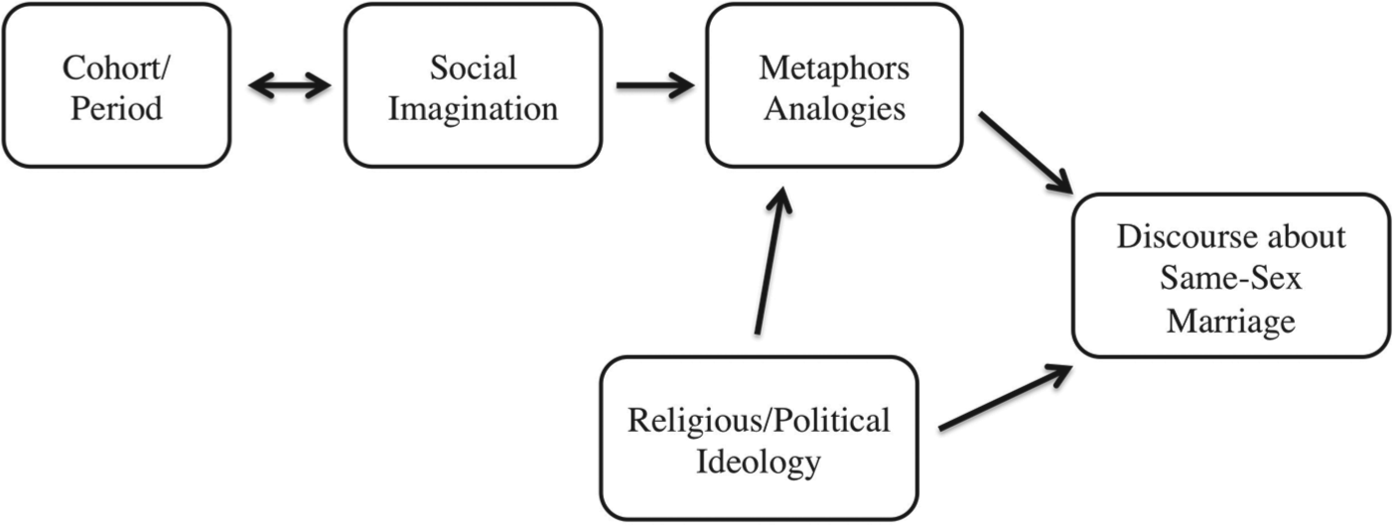
Simplified model of the production of discourses about same-sex marriage.
Social Imagination
The concept of social imagination is philosophically grounded in Kant’s ([1781] 1996) Critique of Pure Reason, in which he posits the “transcendental power of imagination” as the essential, synthetic capacity that combines intuition and understanding, thus rendering human knowledge and experience possible (see also Heidegger [1929] 1962). 3 Although Kant and Heidegger theorized the imagination at the individual level, sociologists following Durkheim ([1912] 1995) posit that the categories and processes of cognition are social (DiMaggio 1997; Zerubavel 1997). Castoriadis (1987) was the first to argue that the social imaginary is the essential ontological root of all sociohistorical phenomena, but the theory of social imagination advanced here builds primarily on Appadurai’s (1996) conception of the imagination (see also Orgad 2012), combined with research on social cognition (e.g., Slusher and Anderson 1987; St. Evans 2008).
Like collective memory (Olick 1999), the social imagination must be theorized as both an individual, cognitive phenomenon at the micro level and a collective, cultural phenomenon at the macro level. At the macro level, the social imagination is the ongoing process of symbolic contestation through which collectives jointly produce a set of ideal categories, concepts, and prototypes (the social imaginary), which provides the cultural basis for the implicit cognitive schemas that individuals use in subsequent cognition and action. At the micro level, individuals draw on those implicit schemas in interactive contexts and articulate the social imagination through metaphors and other figurative tropes (Gibbs 1994; Lakoff and Johnson 1980).
In psychology, imagination refers to an individual’s capacity to produce mental images of nonpresent phenomena. When activating one’s imagination, one uses existing mental structures—schemas, prototypes, and so on—to create a new, imagined entity that exists inside the mind. The resulting mental image can have measurable effects on attitudes, regardless of its veracity. For example, when people are asked to imagine different kinds of people, attitudes are either attenuated or reinforced, depending on the consistency of the mental image with existing stereotypes (Blair, Ma, and Lenton 2001; Slusher and Anderson 1987). Although we frequently conceptualize imagining as a deliberate and/or future-oriented cognitive act, dual-process theories of cognition (Haidt 2012; St. Evans 2008; Vaisey 2009) suggest that imagining is also essential to automatic and present-oriented cognition, because individuals process incoming information in light of existing schemas.
At the collective, cultural level, the social imagination is an ongoing, contested process of meaning-making in which social actors create, use, modify, and challenge the content and meanings of collective representations. The process of social imagination takes place in the public sphere and through social interactions, in which individuals, organizations, movements, and so on, compete for symbolic legitimacy and hegemony. Just as the individual imagination produces a mental image, the process of social imagination produces the social imaginary: the set of ideal categories, concepts, and prototypes that define the hegemonic cultural understandings (Glaeser 2011) of a society. In other words, cultural schemas (Sewell 1992) are produced and modified through the process of social imagination.
The relations between levels of analysis of the social imagination may be further described as follows: because individuals encounter the social imaginary as a cultural structure with which they must engage, and because people must orient themselves to mutual understanding in communicative action (Habermas [1981] 1984), individuals both internalize the dominant social imaginary cognitively and communicate in ways that are resonant with it. This does not mean that utterances inevitably reinforce the hegemonic social imaginary, but even subaltern and countercultural discourse dialogically addresses the hegemonic in terms set out by it (Bakhtin 1981). The communicative interactions of people at the micro level (especially those that occur in the institutionalized public sphere) then modify, reinforce, or undermine the preexisting social imaginary. The process of social imagination, then, is this continual, collective, and contested process by which agents both internalize prototypical understandings and (re)invent them through communicative action.
This theory of social imagination adds to Glaeser’s (2011) “sociology of understanding” in that the social imagination is the essential social-cognitive process that generates, validates, or challenges understandings. 4 It also should be distinguished from related concepts such as collective representation, social construction, and framing. Social imagination is more specific than the general concepts of collective representation and social construction because it works specifically through the cognitive process of imagination and the implicit schemas and mental images presupposed by it. Framing is a similarly expansive concept, but it has come to be used in ways that imply a strategic communication process to achieve interpretive influence over an audience (Benford and Snow 2000; Entman 1993), rather than communication oriented to mutual understanding.
Existing research on the social imagination demonstrates its analytic value. For example, Orgad (2012) showed that media representations increasingly provide the raw materials of the imagination as globalization advances. Other studies have shown that the imagination provides an essential cultural foundation for nationalism (Anderson 1991), empathy with suffering others (Boltanski 1999), and political participation (Baiocchi et al. 2014; Perrin 2006). In general, theorists argue that the imagination constitutes an essential link between structure and agency and between factual and normative and that it functions as a cultural repertoire from which agents draw in practice (Appadurai 1996; Taylor 2002).
The Macro-level Social Imagination of Homosexuality
Applied to the case of same-sex marriage, the social imagination of homosexuality at the macro level is the collective process of creating prototypical understandings of same-sex sexuality in a society. Cohorts coming of age in different historical periods defined by a given social imaginary came to understand homosexuality in fundamentally different terms.
In the lifetimes of contemporary Americans, the dominant social imaginary changed twice: from mental illness to deviant behavior between 1969 and 1974 and from deviant behavior to collective identity between 1987 and 1992. The two moments of change should be understood as turning points, not disjunctures, because of how macro-level change in the social imagination occurs through innumerable contests over meaning, with change in public opinion occurring cumulatively. Each turning point was caused by tactical changes in the LGBTQ movement, which pressured epistemic communities (Haas 1992) (mental health professionals in the first episode, journalists in the second) to alter their discourses and practices. Because of their institutionalized claims to expertise and scope of influence, changes in how homosexuality was constructed and represented by these epistemic communities caused the broader public’s imagination to shift afterward.
Americans coming of age prior to the first turning point, 1969 to 1974, grew up in a society in which homosexuality was defined as mental illness because of its institutionalization in the World Health Organization’s International Classification of Diseases and the American Psychiatric Association’s (APA) Diagnostic and Statistical Manual of Mental Disorders (DSM) and the practices of institutionalizing and treating lesbians and gays as mentally ill (Conrad and Schneider 1992). Prior to the mid-1960s, this social imaginary remained hegemonic because homophile movement organizations remained largely covert, and activists rarely challenged their collective representation in public (Bernstein 2002; D’Emilio 1983). As late as 1970, about 62 percent of Americans said that, for most lesbians and gays, homosexuality was a “sickness that can be cured” (Leavitt and Klassen 1974).
Nineteen sixty-nine marked the beginning of the first turning point because of both the Stonewall uprising and the release of the final report from the National Institute of Mental Health Task Force on Homosexuality, the recommendations of which emphasize changing society’s attitudes and policies about homosexuality rather than changing lesbians and gays themselves (Livingood 1972). Although lesbian and gay activists became more militant throughout the 1960s, Stonewall marked the emergence of a new phase of contention: it was commemorated by annual pride marches beginning the following year, and it led to the founding of organizations like the Gay Liberation Front and Gay Activists Alliance, which openly challenged medical and legal authorities (Armstrong and Crage 2006). In 1970, activists began disrupting meetings of the APA, and in 1973, they concluded a successful campaign to eliminate homosexuality from the DSM. The demedicalization of homosexuality was ultimately approved by a highly publicized referendum of the entire APA membership in 1974 (Bayer 1981; Conrad and Schneider 1992).
Despite homosexuality’s demedicalization, Americans continued to imagine homosexuality as deviant behavior through the late 1980s. Americans’ intolerance of homosexuality remained steady (or even increased) between 1974 and 1988 (Loftus 2001; Treas 2002). Despite the “identity deployment” (Bernstein 1997) of movement activists in the 1970s and 1980s, lesbians and gays remained a relatively powerless minority in politics, were further stigmatized by HIV/AIDS, and were continually “symbolically annihilated” (Tuchman 1978) in mass media (Gross 2001). The conservative and religious counter-mobilization neutralized many successes of the lesbian and gay movement and was largely successful in framing homosexuality as a deviant lifestyle (Fejes 2008; Fetner 2008; Stein 2012). In 1986, the Supreme Court reaffirmed the institutional status of homosexuality as a deviant behavior for which individuals could be punished (Bowers v. Hardwick 1986).
During the late 1980s and early 1990s, the social imagination of homosexuality began to shift from deviant behavior to collective identity. The start of the second turning point can be meaningfully marked by the 1987 National March on Washington for Lesbian and Gay Rights (Ghaziani 2008) and the emergence of ACT UP (Gould 2009). Simultaneously, the LGBTQ movement began to strengthen its rights-oriented strategy of attaining legal equality while deploying confrontational and dramatic tactics to draw attention to the AIDS epidemic and the prejudice that exacerbated it. Fejes and Petrich (1993) argued that the AIDS crisis and ACT UP “force[d] the media to regard the gay and lesbian community more seriously” (p. 404), ultimately causing a shift in the language and practices of journalists covering the gay community. In 1990 and 1991, both the organizational culture and news portrayals of lesbians and gays in the New York Times improved dramatically (Signorile 1992), and the American Society of Newspaper Editors issued a report urging newspapers to alter both the language used to cover lesbian and gay issues and the organizational policies that discriminated against lesbian and gay journalists (Ghiglione et al. 1990). The 1992 election of Bill Clinton gave lesbians and gays mainstream political standing, while representations in prime-time television and Hollywood films improved in the early 1990s, thanks to pressure from organizations such as the Gay and Lesbian Alliance against Defamation and changing dynamics of competition in mass media markets (Becker 2006; Gallagher and Bull 2001; Gross 2001; Seidman 2004; Walters 2001).
In short, Americans coming of age between 1974 and 1990 encountered a social imagination of homosexuality as deviant behavior, while Americans coming of age after 1990 increasingly imagined homosexuality as a collective identity. Once constructed, the dominant social imaginary shapes the cognitive schemas of individuals coming of age during that period. It was only when homosexuality was socially imagined as a collective identity that tolerance for homosexuality increased in public opinion and institutional supports for gay rights began to spread.
Metaphors and the Micro-level Social Imagination
At the micro level, an individual’s imagination of homosexuality is their implicit understanding of same-sex sexuality that they use to construct explicit discourse and make sense of the world. The social imagination can be measured in interactional contexts through metaphor analysis, by interpreting metaphors, analogies, and other figurative tropes sociologically and comparing the frequency and semantic contexts of their use across groups. The sociological analysis of metaphors in this article combines conceptual metaphor theory (Gibbs 1994; Lakoff and Johnson 1980) with the tension theory of metaphor (Berggren 1962, 1963; Ricoeur 1977).
Like the social imagination, metaphors operate at the intersection of culture and cognition. According to Lakoff and Johnson (1980), “The essence of metaphor is understanding and experiencing one kind of thing in terms of another” (p. 5). When people use metaphors in language, they express their thoughts about one subject using words of another. Metaphors are not merely tropes of poetic description; they are essential components of language and culture that structure our perception of the world (Gibbs 1994). Metaphors are the preeminent example of how one’s experience of reality is meaningfully encoded in language and institutionalized in the social imaginary, thereby structuring future communicative and meaning-making activities.
In contrast to older conceptions of metaphors as composed dichotomously of tenor and vehicle (Richards 1936) or focus and frame (Black 1962), Ricoeur (1977) argued that metaphor analysis involves the semiotic, semantic, and hermeneutic levels of analysis and requires a focus on the novel meanings generated metaphorically. According to the tension theory of metaphor, “the legitimate and vital use of metaphor” (Berggren 1962:247) creates a tension between two subject domains (manifested variously at different levels of analysis), which produces a new mental image (its “iconic moment”; Ricoeur 1977:208) with new meanings even as it preserves the two previously separate ones. The meaning created by metaphor then becomes linked to the shared cultural context of the communicators and gives rise to webs of discursive entailments (Berggren 1962, 1963; Ricoeur 1977).
The tension theory of metaphor requires that we reject both strict literal and figurative readings, along with the assumption that there is some natural homology between the two subject domains, and instead emphasizes the generative capacity of metaphors. For example, what makes the metaphor of the closet and its associated discourse of coming out culturally resonant and sociologically significant are the new truth claims it generates. Literally, the metaphor is non-sense, and it is much more than a figure of speech based on some preexisting resemblance between the two subject domains; interpreted sociologically, the closet metaphor creates a politics of visibility, a phenomenology of stigma, and a theory of how stigmas shape social relations (Seidman, Meeks, and Traschen 1999).
Unlike this “vital” use of metaphor, most conceptual metaphors analyzed by social and cognitive scientists are “dead metaphors”: figurative expressions whose metaphorical tension has been resolved and its novel meaning absorbed into the cultural commonsense of a group. Sexual orientation and sexual attraction are two dead conceptual metaphors that are ubiquitous in Americans’ discourse about sexuality; they express sexuality in spatial and directional terms and in terms of physics, respectively. When people use directional or spatial language (e.g., some people lean that way) or talk about feeling attracted to someone, they are using their embodied experiences in the world to communicate about the more abstract concept of sexuality. From an aesthetic point of view, dead metaphors warn of the potential “abuse” of metaphor (Berggren 1962:245–46), but from a social scientific point of view, dead metaphors provide fundamental insights into processes of cognition and meaning-making.
In psychology, analysis of conceptual metaphors builds on embodied (grounded) theories and dual-process theories of cognition (Landau, Meier, and Keefer 2010). Many metaphors express abstract concepts in terms of bodily encounters with concrete things:
Because so many of the concepts that are important to us are either abstract or not clearly delineated in our experience (the emotions, ideas, time, etc.), we need to get a grasp on them by means of other concepts that we understand in clearer terms (spatial orientations, objects, etc.). (Lakoff and Johnson 1980:115)
Put in terms of dual-process theory, many of the schemas that facilitate automatic processing are based on conceptual metaphors (Gibbs 1994; Landau et al. 2010).
Together, the tension theory of metaphor from the humanities and conceptual metaphor theory from cognitive science provides a framework for the sociological analysis of metaphors. To interpret metaphors sociologically, one must interpret them as expressions of the social imagination, both the public, shared culture of a group and the internal, cognitive structures of the mind. Some metaphors are articulated after deliberate cognitive processing for the purpose of generating new insights, while other metaphors are articulated after automatic processing because they express the tacit understandings of the world that a group takes for granted. By comparing the frequencies and contexts in which different groups articulate various metaphors, an analyst can document differences in both their expressed attitudes and taken-for-granted understandings.
For example, Schatzberg (2001) demonstrated that metaphors of fatherhood, family, and food consumption provide a “moral matrix of legitimate governance” in central Africa and argued that metaphors constitute a “realm of subjacent politics” (p. 31) that provides an implicit foundation for explicit political action. Similarly, Lakoff (2002) argued that political ideologies in the United States are metaphorically grounded in two different prototypical models of the family. Lastly, Ignatow (2009) argued that the analysis of metaphors, combined with theories of embodied cognition, provide insight into the construction of the habitus.
In the analysis that follows, I present the frequencies and semantic contexts in which cohorts use major metaphors and analogies for homosexuality to talk about same-sex marriage. First, I analyze the metaphors and analogies that characterize homosexuality as identity, which are articulated more frequently by members of the younger cohort and are used in contexts that essentialize homosexuality and minimize its significance. Second, I analyze metaphors of lifestyle, nature, and invisibility, which are used more frequently by the older cohort and in ways that characterize homosexuality as behavior. Variations in the frequency and context of their use show that cohorts’ discourse about homosexuality and same-sex marriage are consistent with the social imaginations of homosexuality that were dominant during the periods in which they came of age. Throughout the analysis, I describe how these metaphors and analogies interacted with political and religious ideologies to produce different discourses about same-sex marriage, and I argue that cohort and period effects in attitudes about same-sex marriage should be interpreted in light of the changing social imagination of homosexuality.
Methods
I conducted 97 individual interviews with college students (n = 65) and their parents (n = 32) in northern Illinois between September 2008 and April 2009. During the time of interviews, same-sex marriage was legal only in Massachusetts; it was the subject of political controversy in California, where voters overturned the right to same-sex marriage in the 2008 election, and in Connecticut, where it was legalized in October 2008. Lax and Phillips (2009) estimated that support for same-sex marriage in Illinois at this time was at 42 percent, lower than in 17 other states and tied with Wisconsin, Minnesota, and Alaska.
I recruited students at a regional public university and a two-year community college by posting advertisements offering $30 in exchange for an interview “about current social and political issues.” The two colleges were selected as recruitment sites because they draw students primarily from the northern Illinois region; thus, students and parents come from a cross-section of rural to urban environments within a shared regional cultural context. I used a theoretical sampling method (Glaser and Strauss 1967) to facilitate comparisons between and within cohorts, seeking variation in socioeconomic background, ideology, ethnicity, and city size. I made a special effort to recruit religious conservatives in 2009 after relatively few informants from the fall semester identified as such. After completing an interview with a student, I asked for permission to contact a parent for an interview.
All informants were screened for cohort membership, childhood residence (United States), and current residence (northern Illinois and the surrounding region). The study required that college students have been born in the United States between 1978 and 1990 and that at least one parent have been born in the United States between 1945 and 1963. All students therefore reached adulthood after 1996, when tolerance for homosexuality was steadily increasing, while parents reached adulthood in the 1960s and 1970s, when public disapproval of homosexuality was widespread. Demographics of informants are listed in Table 1. Because this is a nonprobability sample that is statistically unrepresentative of any larger population, no reliable statistical inferences can be made from significance tests (Agresti and Finlay 1997); all quantitative comparisons that follow are descriptive only.
Demographic Characteristics of Informants.

Note. Not all percentages sum to 100 percent, because of rounding. Although I purposely refrained from asking about sexual preferences or behaviors, one student voluntarily identified as gay, and three students voluntarily identified as bisexual. Two heterosexual-identified parents admitted having homosexual feelings and/or experiences in the past.
One parent had two students in the study, one at Northern Illinois University and one at Rock Valley College; the latter student contacted me for an interview first.
Ideology was determined in the coding process by combining self-identification, expressed political and religious views, and life history information.
Interviews lasted between 70 minutes and three hours. They were intended to elicit the cultural foundations of the informants’ attitudes about same-sex marriage by posing questions that would require them to draw from elements in their cultural repertoires to formulate responses. My interview techniques combined the “responsive interviewing” approach (Rubin and Rubin 2005) with Swidler’s (2001) techniques of using interviews to find out how people “use” culture. In addition to asking questions about a person’s experiences and opinions, I included hypothetical scenarios, intentionally vague questions, and questions that required respondents to take the role of the other. Such questions were designed to reveal “the schematic” and “the visceral” aspects of the informant’s worldview (Pugh 2012). A full list of questions on same-sex marriage and homosexuality can be found in Appendix A.
All interviews were fully transcribed and analyzed using NVivo. In the open coding period, I coded both inductively (e.g., keyword codes) and deductively (e.g., statements expressing an attitude about particular topics); further axial coding was inductive (e.g., what exactly was their expressed attitude). After identifying the discourse about same-sex marriage that each informant articulated, I coded the sections of the interview transcript that pertain to homosexuality and same-sex marriage for the varieties of conversational resources informants used to construct answers to my questions. I focused on the metaphors and analogies informants used to talk about these topics, but I also coded for anecdotes, rhetorical questions, factual claims, and other tropes. After coding, I used text search queries to identify instances of prominent metaphors and analogies that had been missed in the previous analyses of the transcripts, and I tabulated whether each individual used each metaphor and analogy at any point during the discussion of homosexuality and same-sex marriage.
Results
Table 2 displays most of the major metaphors and analogies informants in each cohort used to talk about homosexuality and same-sex marriage, categorized by their semantic or discursive function. The relative frequencies with which cohorts articulate metaphors are suggestive of cohort differences in the imagination of homosexuality, but because any metaphor can be used in a variety of semantic contexts to communicate different messages, the semantic context of their use is more important than their frequency. Students used analogies to race and heterosexuality more frequently than parents, and they often used essentialist language to describe homosexuality as identity—who you are. They also used a variety of analogies in their discourse that minimized the significance of homosexuality as no big deal. By contrast, parents used metaphors of lifestyle, invisibility, and nature more frequently than students, and they used a discourse of life choices to define homosexuality as behavior—what you do. They also more frequently compared homosexuality with major acts of deviance, such as stealing and alcoholism. To be clear, the use of these metaphors alone does not predict a person’s support or opposition to same-sex marriage; rather, the cohort-related imagination of homosexuality, which is measured in the use of metaphors and analogies, interacts with the informant’s political and religious ideologies to produce discourses about same-sex marriage (Hart-Brinson 2014).
Percentage of Informants Using Selected Metaphors for Homosexuality and Same-sex Marriage, by Cohort.

Unlike the other metaphors in this table, rhetorical metaphors are collections of analogies that were used for purposes of rhetorical emphasis or de-emphasis. The trivializing and amplifying analogies refer to two disparate sets of analogies that informants made to various other subjects for the purposes of either minimizing or emphasizing the importance of homosexuality.
Homosexuality as Identity
Students used metaphors and analogies that characterize homosexuality as identity more frequently than their parents, and they did so in contexts that both essentialize homosexuality and minimize its significance. Informants frequently compared homosexuality with other identity categories—race and heterosexuality—and they used essentialist language to define homosexuality simply as part of “who you are.” Following this logic, they do not deny that there are differences between gay and straight sexualities; rather, they trivialize the differences using analogies to various insignificant differences among people.
Almost three quarters (74 percent) of students compared homosexuality with either heterosexuality or race at some point during the interview, while 59 percent of parents made one or more of those analogies. Rarely is the use of these analogies associated with opposition to same-sex marriage: only one student and three parents who used either analogy opposed same-sex marriage. Perhaps more important, though, the articulation of these analogies is not an indicator of liberal political ideology 5 : 10 of the 25 informants who self-identified as conservative or Republican used the race analogy, for example.
Although both race and heterosexuality are identity categories, their use in discourse differs somewhat. They are similar in that many informants make the analogies to explain homosexual feelings of attraction:
Where do you think it comes from? Like why do you think some people are homosexual?
I don’t really know. I guess wherever our feelings come from. The same place that my feelings about my boyfriend come from. Some people, you know, there’s white people who like black people or Mexicans who like white people, or you know, people who like people with blonde hair or people who like people with dark hair. . . . It’s what we see that attracts us, I guess. (Claudia, 22)
Informants also use both analogies when explaining their feelings about same-sex marriage. If homosexuality is like race, then the debate over same-sex marriage is analogous to the past debate over interracial marriage:
I think over time it’s gonna be seen as the miscegenation laws of, I think eventually it’s gonna be seen in that kind of ridiculous light. There’s gonna be some people, like, “that law was great,” but they’ll be marginalized. (Alan, 22)
Similarly, when informants compare homosexuality with heterosexuality, they imagine the controversy over same-sex marriage in terms of their own heterosexual relationships:
I really think that if two people are happy, then far be it from me or the government to tell them that their love is wrong. Like, how would anyone else feel if, “No, you can’t be married because when you get married, that’s a sin. Your love is wrong”? That would be a horrible feeling to me. If I brought home my boyfriend and my mom said, “No, your love is wrong,” I think, I don’t think that’s fair to judge. (Jane, 19)
Put simply, race and heterosexuality are two culturally accessible models that people can use analogically to explain their views on homosexuality and same-sex marriage.
Aside from these similarities, however, there are important differences. The analogy to heterosexuality is unique because it is the binary opposite of homosexuality; so it should be no surprise that anyone would compare homosexuality with heterosexuality. What is noteworthy is that students uses the analogy primarily to describe homosexuality as ontologically and morally equivalent. For example, some informants invoked the heterosexual analogy along with a species metaphor to argue for equality: “Gay people, it’s not like they’re a different species. They have the same feelings that straight people have towards each other. So, it’s still the same feelings they have that would be going through” (Alan, 22). The comparison of homosexuality with heterosexuality is sociologically significant in that informants used it to deny the legitimacy of discrimination against lesbians and gays.
The race analogy is unique in a different way: because of the salience of race in American society, the same-sex marriage debate is refracted through the prism of race. Informants compared the prohibition of same-sex marriage with various moments in the history of racial discrimination, and they positioned same-sex marriage within the narrative of racial progress. For example, some informants compared prohibitions of same-sex marriage with slavery and segregation:
This country is such a frickin’ paradox. You know, like slavery, we were one of the last countries in the world to be legalizing [sic] slavery. And now here comes same-sex marriage on a different front, but it’s like we’re going to be one of the last countries, probably, to legalize gay marriage. So I see it coming, slowly but surely. Just like slavery, we just couldn’t let go of it. (Gabe, 24)
The analogy of “separate but equal” was invoked frequently when asked about the hypothetical scenario of creating separate civil unions for same-sex couples:
I would be opposed to it. . . . They tried that before, that with the African Americans and the white people and saying that they’re separate but equal, you know. And obviously that didn’t work out, you know, that was a big disaster. (Kevin, 20)
Informants also described the civil rights movement of the 1960s as providing a moral lesson applicable to same-sex marriage:
If they’re gay and they’re in love, let them get married. That, I don’t see, it’s just, it’s discrimination and we should have, I thought we did away with it all in the ’60s with the civil rights movement, and we, we didn’t have to go through any of that shit again. (Terrence, 19)
Last, because I conducted my interviews around the time of the 2008 election of Barack Obama, the idea of a black president served as an analogy for the possibility that same-sex marriage would be legalized one day:
If you think into the future, like I don’t know, 20, 30, 40, however many years, do you think same-sex marriage is ever going to be legal in the U.S.?
Yeah, I think so. We elected a black man. I’m serious, nothing surprises me more. I mean, I already told you, I voted for him, but I’m still amazed he made it. (Lindsay, 45)
Because of the American cultural consensus that racism and discrimination are wrong, this analogy provides strong rhetorical support for same-sex marriage: logically, if homosexuality is like race, then discrimination against lesbians and gays is wrong because racial discrimination is wrong.
Americans imagine race and heterosexuality to be unchangeable aspects of self-identity, so the use of essentialist language to describe homosexuality follows logically. About one third (34 percent) of older informants used some form of essentialist language to talk about lesbians and gays, while 47 percent of younger informants did so. The discursive construction of homosexuality as identity was thus bolstered by the use of the verb “to be” to define homosexuality as a part of who you are: “It’s not really a choice, I don’t think. It’s more of how that person is, what stimulates their brain to want that. It’s not a decision; it’s not a choice; it’s just how they are” (Dylan, 23). Not only do informants who use this essentialist language conclude that you cannot change who you are, but this view logically implies a division between those who are true to oneself—who are authentically gay—and those who are lying to oneself:
I don’t think that you can change completely. You can tell people that you’re not gay, or you can suppress emotional tendencies, or you can lie to yourself and other people. But I don’t think that you can biologically change the way you feel. . . . You could try as hard as you can, but you can’t really change who you are. (Jane, 19)
In this view, stigmas and religious prohibitions against homosexuality prevent people from acting authentically in the world. Most students interpreted my question about whether legalizing same-sex marriage would encourage people to be gay as ridiculous, except in that it would help make it easier for those who are “truly” gay to be open about who they are, or to come out of the closet:
Do you think that, like, legalizing same-sex marriage would encourage more people to be gay?
To be more open about it maybe. Um. [Pause] Not necessarily like to encourage them, like for wrong reasons, but like to, maybe like open their eyes and like see who they really are. Like some people may be more open about their relationships if there was same-sex marriages. (Jeremiah, 19)
For these informants, legalizing same-sex marriage would be a recognition and validation, not of behavior, but of identity.
Finally, informants who imagined homosexuality as identity tried to delegitimate the stigma of homosexuality by trivializing the difference between gay and straight sexualities. Young informants in particular compared the difference between heterosexuality and homosexuality with the most insignificant differences among people that they could think of:
It’s not my personal, you know, my personal opinion that we should tell people, “Well no, I don’t agree with it, you shouldn’t get married because I don’t feel the same way that you do.” I mean that would be like saying, “I like Play-Doh and you like Legos. I’m sorry we can’t play together because you like something else.” (Chris, 22)
Twenty-five percent of students made such a statement, and 8 percent of parents did so. In no case did the informant who made such a comparison oppose same-sex marriage. Informants articulate these analogies for rhetorical reasons, because they perceived that same-sex marriage opponents get bent out of shape about homosexuality. To them, homosexuality is truly no big deal.
I don’t really see why this has to be a big deal with everybody, you know. It’s like two people love each other, they want each other, you know, to be secure for the rest of their lives. . . . It’s not like we’re saying everyone should get married, or people should marry animals and all this weird stuff. It’s just so, uh, like a guy and a guy want to get married, that shouldn’t be a big deal if that’s how they are. (Terrence, 19)
Interpreted sociologically, these metaphors and analogies articulate the social imagination of homosexuality as identity that has been increasingly dominant in American society since the early 1990s, during the period in which the young cohort came of age. This imagination of homosexuality interacts (via metaphor) with the informant’s political and religious ideology in discourse about same-sex marriage. Politically liberal informants who imagine homosexuality as identity produce a discourse of unambiguous support: almost 80 percent of the 47 informants who articulated this discourse used either the race or heterosexual analogy during the interview, and 66 percent who articulated this discourse identified politically as Democratic, liberal/left, or libertarian. By contrast, religious conservative informants who imagine homosexuality as identity produce the discourse of immoral inclusivity.
6
All seven informants who articulated this discourse are young conservative Christians; six of the seven articulated at least one analogy to race or heterosexuality, and five of the seven articulated at least one trivializing analogy. These informants agreed that homosexuality is a sin, but they trivialized the sin, arguing that their sins were no worse than anyone else’s:
One thing that I don’t like is that, to me, Christians are picking this out as, you know, a worse sin than others or like as unacceptable. They’re just bashing the issue, but it’s really not anything worse than telling a lie. (Elizabeth, 19)
Young religious conservatives articulate the discourse of immoral inclusivity to reconcile their imagination of homosexuality as identity with their religious belief that homosexuality is a sin. It is because they imagine homosexuality as identity that they do not articulate an oppositional discourse, like older conservatives.
Homosexuality as Behavior
Compared with the younger cohort, older informants more frequently used metaphors that describe homosexuality in behavioral terms. Parents frequently referred to homosexuality as a lifestyle, a metaphor that characterizes homosexuality as a set of behavioral choices that people make. They also more frequently used adjectival metaphors of invisibility and nature to insist that homosexual behavior is unnatural and that they did not want to see it. Last, parents frequently compared homosexuality with major acts of deviance to emphasize its importance.
First, older informants more frequently used the lifestyle metaphor and analogies to life choices to explain their views about homosexuality and same-sex marriage. The lifestyle metaphor characterizes homosexuality as an array of practices and behaviors, perceived as a whole, that distinguishes a way of life. Only 14 percent of students referred to homosexuality as a lifestyle, while 47 percent of parents did so. The word defines homosexuality in terms of actions, not feelings:
If that’s their lifestyle, and they want to find the ideal partner for them, and to be equal, really, I think that’s what it is. I think they want to be acknowledged for who they are and for us to be happy for them that they found their mate. . . . I can’t say I condone it, but like I said, I was raised that that’s just not the right way to be. Girls are supposed to be with guys, guys are supposed to be with girls. (Debra, 57)
This quotation is illuminating because the informant uses essentialist language (“to be”) in a way that refers to behavior, not identity. The lifestyle metaphor translates lesbian and gay feelings and identities into behavioral terms. This discourse is thus closely related to the attribution of homosexuality as a choice, and it prompts informants to make analogies to other life choices:
There may be certain people out there that lean that way, okay. But life is about choices. I mean, it’s like alcohol. When I was younger, like I said, I drank, but when I got married, moved up here, realized drinking wasn’t the smartest thing to do. It was going to create problems. . . . Sometimes those choices at the start are very tough, very hard to carry through on those choices. But it’s choices. (Vincent, 48)
Conservative Christians were especially likely to speak of homosexuality as behavior, because religious prohibitions against homosexuality are prohibitions against sinful behavior, not feelings or identity. In orthodox religious discourse, homosexual acts are sins, and people choose whether to commit them or to struggle to resist them. The analogies used by older conservatives to explain their views on homosexuality—gluttony, smoking, alcoholism, drug use, stealing, and criminal sexual behavior—indicated the severity of their disapproval:
There’s a delusional thinking that they were born that way, that they were born gay. . . . That’s like saying I was born a crack addict or I was born a drunk. Maybe predisposed to an environment that allows you to have an addiction; and that addiction could come in the form of alcohol, drugs, or sexuality. So it’s a choice that you choose: you can choose to be homosexual, you can choose to be lesbian. (George, 50)
Conservative Christian discourse against homosexuality and same-sex marriage emphasizes the behavior-identity dichotomy. To “hate the sin and love the sinner” is to show love and compassion to the person by preventing them from engaging in immoral behavior:
I do believe God is all-loving, infinite love. Where we may condemn a sin or a way of living, I believe God has more love than we can ever understand, and He will still love them no matter what. Our job as Christians is to try to show as much of that infinite love as we can to others, no matter who they are, no matter what their lifestyle is, no matter that they are still sinning or still living a lifestyle that is not acceptable to us. (Pablo, 51)
This view is reinforced by a theological belief that people are created in God’s image, and that God does not intend for people to be lesbian or gay. Informants used metaphors of wiring, planning, and design to convey the idea that human beings are created by another agent who intends for them to function in a particular way.
Although the conservative religious discourse is the most obvious manifestation of this behavioral imagination, there is a secular liberal variant. In secular discourse, nature replaces God; homosexuality is compared with a mistake, handicap, or disability instead of a sin; and a rhetoric of invisibility replaces a rhetoric of struggle and resistance.
The nature metaphor is complex because it lends itself to both imaginations of homosexuality, but older informants used the metaphor more frequently as an adjective to describe behavior. Many informants denied that homosexuality is a sin but instead described it as unnatural. They focused on the fact that homosexual behavior could not lead to reproduction: “It’s an abnormalacy [sic], really, when you look at nature. . . . You look at the human body, and it really isn’t the natural way to go, period. Physically” (Natalie, 60). The natural-unnatural dichotomy is part of a larger functionalist logic that is reinforced by other binary metaphors—healthy/unhealthy and functional/dysfunctional—that informants used to refer to larger contexts of that person’s life, family, or society as a whole:
I’m not trying to point the finger and tell them they’re terrible people; I’m trying to tell them what is best for your life because of what research has shown it does to a family, a couple, children. It’s not healthy. (Dana, 48)
Even though many informants described homosexual behavior as unnatural and unhealthy, some also acknowledged that homosexual behavior is found in nature and that there may, in fact, be a genetic attribution to homosexuality. To understand this paradox, informants described homosexuality as a mistake of nature: “I personally think that it’s, if you can be born with a defect—missing fingers, missing toes—why can’t you have something go haywire with the chemicals that make you who you are?” (Stephanie, 50). It should be emphasized that the mistake of nature metaphor, even though it seems consistent with identity, is fundamentally behavioral because of the functional necessity of the sexual reproduction of a species.
Although this metaphor implies that homosexuality is abnormal and could foster implicit negative attitudes about it, some informants made analogies to handicaps and disabilities to argue for acceptance of lesbians and gays. This particular use of the nature metaphor is consistent with both the imagination of homosexuality as identity, and as attributable to factors beyond an individual’s control:
[Lesbians and gays] are not just designed to piss you off or to get your church upset or anything like that. It’s not that. It’s not like saying, “Okay, I’m going to have a Down’s syndrome child.” They have an extra chromosome, that’s why that child is Down’s syndrome. There’s reasons for things. (Ariel, 47)
In some ways, then, the nature metaphor lends itself to support for same-sex marriage. However, most informants who described homosexuality as unnatural, or a mistake of nature, did not support same-sex marriage. Only 6 of the 20 informants who articulated this metaphor expressed support for same-sex marriage.
Last, 50 percent of parents used metaphors of invisibility to express their feeling that one should not have to see or confront homosexuality in any way, whereas only 14 percent of students did so. No student who used this metaphor supported same-sex marriage, though several parents did. These informants argued that lesbians and gays should have equal rights because their sexuality does not make them less human; but they said they did not want to see it and they did not want it in their face: “I just don’t want to see it. I don’t want to see you kissing anybody. I just don’t like to see that kind of stuff. I just don’t feel comfortable with that” (Debra, 57). Some informants expressed this feeling by talking about how lesbians and gays rub, cram, or throw their sexuality in people’s faces:
I don’t like it being thrown in my face all the time, ’cause just like, even though I, you know, am a heterosexual, I don’t feel like it’s necessary that I throw that in your face all the time, too. So that’s how I feel about that whole thing. . . . I feel like any sexual situation is just, or any relationship needs to be private; it shouldn’t be thrown in people’s face like it is. (Elaina, 22)
Like the nature metaphor, the invisibility metaphor can modify both identity and behavior. Whereas the closet is an invisibility metaphor that refers to identity, these informants are imagining homosexuality in behavioral terms; the nonreligious informants express disapproval for lesbians and gays only when they cannot be mistaken for straight. These two manifestations of the same metaphor thus carry opposite political implications.
The insistence that sexuality remains invisible is also related to a business metaphor that deems one’s sexuality private, not public. In modern Western ideology, business is a private domain to be protected from unnecessary interference by the state or outside parties. Supporters of same-sex marriage used the business metaphor to express the right to privacy and to explain why they thought it was wrong to prevent lesbians and gays from having the same rights as heterosexuals. However, informants also used the business metaphor to claim that it is improper for lesbians and gays to speak or act openly about their sexuality:
I don’t have any problem with, you know, I figure people’s sexuality is their business. I don’t want to, you know, I don’t want to know about their sex life. I really don’t care. . . . A lot of them are kind of radical and they’re in your face about it. It’s like, I don’t care, I just, I just don’t care. That’s just, if you want to have sex with a particular person, as long as it doesn’t involve animals or kids, hey, you do whatever, whatever makes you happy. Behind closed doors, you know. (John, 47)
This demand that sexuality be rendered invisible creates a double-bind for lesbian and gay activists. These informants are, by and large, supportive of gay rights in principle, but they view open expressions of sexuality and political mobilization negatively.
Interpreted sociologically, the metaphors of lifestyle, nature, and invisibility indicate and articulate a social imagination of homosexuality as behavior. This imagination of homosexuality was dominant in American society during the period in which parents came of age, and the imagination of homosexual behavior remains the primary source of stigma and homophobia directed toward lesbians and gays. Like the imagination of homosexuality as identity, this imagination interacts with informants’ political and religious ideologies to shape their discourse about same-sex marriage. Imagining homosexuality as behavior is consistent with conservative religious ideologies that classify homosexuality as a sin, and they shape a discourse of unambiguous opposition to same-sex marriage: of the 17 informants who articulated such a discourse, all identified as Catholic or Christian, and 16 articulated one of the major metaphors or analogies above. By contrast, many political liberals who imagine homosexuality as behavior articulate a discourse of libertarian pragmatism.
7
Seven of the 8 informants who articulated this discourse described homosexuality as unnatural, a lifestyle, or something that should be invisible. Faced with a contradiction between their imagination of homosexuality and the liberal political belief that one should extend equal rights to minorities, they try to avoid stating an opinion by denying that it is any of their business:
The whole gay thing and stuff, I really don’t understand it, but at the same time, I think that, I guess I can understand why people want to be, they want to have the recognition. I don’t think that it bothers me that much. I mean, it’s the other people’s business, it’s not mine. It doesn’t affect me, you know. (Maria, 45)
For liberals who imagine homosexuality as behavior, the business metaphor allows them to deny that their opinion about same-sex marriage matters and thus avoid expressing negative attitudes about lesbians and gays.
Discussion
In sum, analysis of the frequencies and semantic contexts in which informants articulate metaphors and analogies for homosexuality and same-sex marriage suggests that there appear to be cohort differences in the social imagination of homosexuality. Students used analogies to race and heterosexuality and trivializing analogies more frequently than parents, and they articulated the analogies in ways that characterize homosexuality as identity—who you are. By contrast, parents used metaphors of lifestyle, nature, and invisibility, and analogies to major acts of deviance, more frequently and in semantic contexts that characterize homosexuality as behavior—what you do. These metaphors both indicate and express the social imagination of homosexuality that was dominant when each cohort came of age: young cohorts reaching adulthood after 1990 came of age in a society in which homosexuality was increasingly imagined as identity, whereas older cohorts came of age in a society in which homosexuality was imagined as deviant behavior or mental illness.
As articulated in discourse, these two contrasting images of homosexuality are not incompatible; some sense of identity and behavior are essential for any social ontology of sexualities. However, to the extent that either image is dominant in the social imagination, support for same-sex marriage follows more or less logically. If one imagines homosexuality as an identity, like race, then extending equal rights to same-sex couples is logical, moral, and just. By contrast, if one imagines homosexuality as a behavior, then it does not logically follow that the institution of marriage should be expanded to accommodate same-sex couples.
In the end, discourses about same-sex marriage are shaped by the combination of the informant’s social imagination of homosexuality with their religious and political ideologies. Young political liberals who imagine homosexuality as identity articulate a discourse of unambiguous support, and older religious conservatives who imagine homosexuality as behavior articulate a discourse of unambiguous opposition. Young religious conservatives who articulate a discourse of immoral inclusivity do so when they try to reconcile their religious ideology with their imagination of homosexuality as identity, and older liberals who articulate a discourse of libertarian pragmatism do so when they try to avoid the conflict between their political beliefs and their imagination of homosexuality as behavior.
I argue that cohort and period effects in public opinion about same-sex marriage must be interpreted in light of the changing social imagination of homosexuality. Young cohorts are more likely to support same-sex marriage in part because they came of age during a period in which the social imagination of homosexuality as identity was hegemonic, and the question of same-sex marriage was a question of marriage between any two people, regardless of gender. By contrast, older cohorts are less likely to support same-sex marriage in part because they came of age during a period in which the social imagination of homosexuality as behavior was hegemonic; however, they have begun to change their attitudes about same-sex marriage because the new hegemonic imaginary is causing them to think differently about homosexuality.
This analysis has several implications for research on same-sex marriage. First, it suggests that the debate about same-sex marriage is shaped by a fundamental misunderstanding, not a simple disagreement, between young and old. People who imagine homosexuality as identity would likely fail to understand the arguments made by those who imagine homosexuality as behavior—and vice versa—because each side is effectively talking about different things. If the debate merely revolved around homosexuality’s attribution, the simple disagreement could be solved through scientific research; but this analysis suggests that people who imagine homosexuality differently are not even “on the same page.”
Second, this analysis complicates public opinion research on the attribution of homosexuality by describing a deeper, implicit set of cultural schemas and prototypes on which attribution statements are based. When survey researchers ask about homosexuality’s attribution, respondents’ answers are likely to be based on a variable mix of implicit schemas, explicit beliefs, and ideological rhetoric. Quantitative survey researchers, who may not have the ability to analyze metaphors in discourse, should consider using vignettes and hypothetical scenarios (Doan, Loehr, and Miller 2014) to measure a respondent’s implicit schemas and thus differentiate them from their explicit beliefs.
Third, if this analysis is correct that the imagination of homosexuality as identity has become increasingly dominant after 1990, then two trends are likely to extend into the future. First, the hetero-homo binary will be reinforced because of the essentializing of heterosexuality and homosexuality as inherent, stable identities; bisexual, trans, queer, and other nonbinary sexualities are likely to remain deviant. Second, support for same-sex marriage will continue to increase through cohort replacement because young cohorts that grow up imagining homosexuality as identity will continue to replace older cohorts that imagine homosexuality as behavior in the population. It is possible that the Supreme Court’s legalization of same-sex marriage will cause a backlash, but opposition will become increasingly confined to religious orthodox communities as older opponents die off.
Beyond the case of same-sex marriage, I argue that the concept of social imagination can advance sociological theory and analysis of the relationships among culture, cognition, politics, and history. The social imagination is both a powerful cultural process that shapes the foundation of individuals’ worldviews and a cognitive tool that agents deploy in symbolic interaction. The social imagination responds to changes in social structures and historical circumstances, and it acts as a cultural force whereby the outcomes of symbolic contests in the public sphere shape the stereotypes, worldviews, and actions of future cohorts. It is one of the social generational processes that shows how young cohorts develop distinctive worldviews, because of their biographical encounter with history while coming of age, and how societies gradually change over time through cohort replacement.
The concept of social imagination also enriches theory and research about the changing cultural dynamics of race, gender, and other core concerns of the discipline. For example, applying the social imagination to contemporary racism shifts the analytic focus to the problems of implicit racism, stereotyping, and how contests over the collective representations of race reinforce or undermine institutional racism. The concept requires us to consider how dynamics of inequality and discrimination are linked to people’s tacit understandings of the world, and it asks us to consider how groups imagine the contemporary realities of race and racism differently. People’s attitudes and actions regarding race must be interpreted in the context of their own lifeworld—both as it actually is and as they imagine it.
Last, this article invites sociologists to further develop metaphor analysis as a method of social research. Specifically, metaphor analysis should prove useful as a method for analyzing how social actors encode cultural meanings in texts and for analyzing how texts and discourse shape the interpretations and actions of readers. Currently, frames, codes (Alexander and Smith 1993), and narratives (Polletta and Lee 2006) are dominant features in the sociological analysis of texts, and framing in particular is in danger of becoming (if it has not done so already) so expansive that it is used to explain the persuasive effect of any linguistic unit larger than a subject clause but smaller than a story. By contrast, rhetoricians and linguists have a far more nuanced and variegated set of conceptual tools for analyzing the power of texts. Metaphor analysis can provide a distinctive contribution to sociological research if we devote more careful attention to the variety of ways that language encodes and constructs social meaning.
There are, however, three significant limitations to this study. First, this analysis should be considered somewhat exploratory, because the study was undertaken as a direct test of neither metaphor analysis nor social imagination theory. This study was originally an investigation of the cultural foundations of discourse about same-sex marriage, and I arrived at this theoretical and analytical framework in the inductive manner of grounded theory (Glaser and Strauss 1967). Thus, future research should test this theory of social imagination directly.
Second, the theoretical and empirical claims in this article are limited because of my interpretive approach, combining a theoretical sampling strategy with qualitative interview methods. Because of the resulting nonprobability sample, no statistical inferences should be made from this study. Moreover, this study was not designed to test and establish causal relationships between variables in public opinion. The interpretive analysis of discourse is substantially different from the type of study necessary to test the proposed relationships between cohort, imagination, and attitudes. Future research should adopt such an approach using public opinion data and should take into account covariates like education and personal contact.
Third, this study is limited insofar as it uses only a single cross-sectional method of data collection and analysis, whereas the concept of social imagination suggests the need for longitudinal and multimethod studies. At the individual level, experimental methods in psychology (e.g., implicit association tests) are superior to discourse analysis for measuring imagination and different types of cognitive processing. At the collective level, longitudinal and comparative-historical studies should be used to measure the process of social imagination because, as a multifaceted contest over cultural meanings that takes place through media, social interaction, and other institutional venues, it unfolds slowly and unevenly over time. If the social imagination is one ongoing process by which we continually remake the social world as meaningful, then its sociological significance should be open to investigation in many different areas of research and by many different methods.
Footnotes
Appendix A
The following are all main questions and follow-up questions from the two sections of the interview guide that pertain to same-sex marriage and homosexuality. Questions asked of fewer than eight respondents are excluded. For most questions, the actual language used in interviews differed from what is printed in the interview guide.
Acknowledgements
For their support and critical feedback on this work, I would like to thank the editors and anonymous reviewers, the National Science Foundation, Brian Powell, Pamela Oliver, Lew Friedland, Myra Marx Ferree, Mustafa Emirbayer, Katherine Cramer Walsh, Matthew Desmond, the University of Wisconsin–Eau Claire Sociology Department and Honors Program, the New College of Florida Sociology Department, and the Politics, Culture, and Society brownbag at the University of Wisconsin–Madison.
Funding
The author disclosed receipt of the following financial support for the research, authorship, and/or publication of this article: This research was funded by a Doctoral Dissertation Improvement Grant from the National Science Foundation (Award MSN116987).