




Abstract
Income or health returns linked to obtaining a college degree often are greatest for individuals who come from socioeconomically disadvantaged families. Although this importantly suggests that college lessens many forms of inequality linked to parental socioeconomic status, empirical knowledge about adult network inequality remains limited. Drawing on the 1972–2014 General Social Survey, the author finds that higher education associates on average with a greater number of nonkin and community ties. However, college gains in nonkin networks and capital exist mostly among those coming from disadvantaged families, suggesting that college may substitute or compensate for otherwise limited networks. In contrast, differences in frequency of socializing by higher education are not conditioned by parental background. As a whole, the present findings suggest that college attendance may lessen life-course network inequality within the general population.
On average, obtaining a four-year college degree is associated with a plethora of improvements in adult outcomes, including higher levels of happiness, self-rated health, and sense of control; sorting into safer and more autonomous occupations; and greater likelihood of job stability, high income, and substantial wealth accumulation across the remaining life course (Hout 2012; Lawrence 2017; Mirowsky and Ross 2003). However, recent studies have exposed a previously overlooked pattern behind these average college gains, by finding that associations between college and improved life chances are larger for those who were least likely to attend and graduate college on the basis of their childhood socioeconomic background (e.g., Andersson 2016; Bauldry 2014, 2015; Brand and Xie 2010; Ross and Mirowsky 2011; Schaan 2014; Schafer, Wilkinson, and Ferraro 2013). Often understood as resource compensation or substitution, this recent set of findings falls in line with the idea that college education is an “equalizer” that may lessen many forms of childhood inequality that otherwise might persist. From the standpoint of what college is thought to provide, such as enrichment of an individual’s cognitive and social skills and adult job prospects and opportunities (Lawrence 2017; Mirowsky and Ross 2003), this heterogeneity makes a good deal of sense. Individuals coming from disadvantaged families would potentially stand to gain the most from what college has to offer, whereas students from more privileged families may already enjoy many of these resources anyway because of their personal, parental, or community capital in place prior to college.
Yet at the same time, it is well known that college abundantly rewards the kinds of skills, habits, and behaviors that are far more common among students from advantaged backgrounds (Hamilton, Roksa, and Nielsen 2018; Lareau and Weininger 2009). Often called resource multiplication or cumulative (dis)advantage, this contrasting perspective on college and inequality instead illuminates how college serves to reinforce or widen differences by childhood social class, thus perpetuating rather than leveling childhood inequality. For instance, advantaged students may receive more guidance, mentorship, or resources while attending college or may enjoy greater postcollege prospects because of familial resources or greater successes in college. Although most empirical studies of unequal returns to college conducted so far have not found aggregate outcome patterns that are consistent with cumulative (dis)advantage (but see Andersson 2016; Bauldry 2014), resource compensation and resource multiplication are not mutually exclusive, as college may lessen inequalities in some specific life domains during or after college while reinforcing certain types of inequality in other domains (Lucas 2001; Phelan, Link, and Tehranifar 2010).
Although adult health and attainment have been studied extensively, adult social integration remains curiously absent from our understanding of unequal returns to college by family background. In this vein, personal networks represent a basic and important part of social integration: they include close or significant others as well as local organizations that embed an individual within a meaningful community during adulthood. Aside from being linked to mortality and numerous facets of adult physical and mental health (Berkman et al. 2000; Thoits 2011), social integration is social capital that drives relationally embedded stratification processes, such as locating or securing new employment or a different neighborhood in which to live, or obtaining reliable childcare, transportation, legal or medical advice, or referrals to local organizations (Cornwell, Poppe, and Bea 2017; Granovetter 1995; Perry and Pescosolido 2012; Small 2009). Nonkin ties, or ties beyond spouses, children, and other relatives, are more useful than kin for obtaining job, neighborhood, or community resources, by serving as “weak ties” that dramatically widen the repertoire of information and resources at one’s disposal. Kin ties offer valuable emotional and instrumental support and confer many benefits of social integration, but their reach into communities or for labor markets or organizational referrals tends to be more limited than that of nonkin networks.
Educational attainment is one of the strongest and most robust predictors of the number and diversity of social ties during adulthood. Individuals who obtain higher levels of schooling enjoy larger and more heterogeneous personal networks during adulthood, encompassing a greater quantity and variety of nonkin ties and community organizations, compared with those with lower levels of attainment (Fischer 1982, 2011; McPherson, Smith-Lovin, and Brashears 2006). Yet studies of adult networks continue to overlook parental education and originating social class for the most part, thereby limiting our understanding of the life-course origins of adult network inequality.
To more fully integrate life-course socioeconomic status into the study of adult network inequality (Marsden 2018), related avenues are ripe for empirical inquiry. First, the relative importance of parental and personal educations for understanding variation in adult network size, composition, and closeness remains to be established. That is, how do childhood or parental background and higher education matter in a relative sense to predicting various aspects of adult social integration? Second and related, does childhood background shape the magnitude of network inequality linked to higher education, similar in nature to the unequal returns to college already documented for adult earnings and health? Finally, do these patterns vary meaningfully across measures of network size, contact frequency, and composition?
Background
Although robust associations are suggestive of college’s wide-ranging benefits for adult health and economic well-being, many researchers have been at work trying to rigorously evaluate for whom and under what conditions these associations may indicate plausible effects of schooling as opposed to selection or precollege differences (e.g., Montez and Friedman 2015). Generally, recent studies find that higher education is most beneficial for those who are least likely to attend college, where probability of attendance is a selection or propensity score generated across a rich vector of demographic, economic, family, community, and student achievement variables measured before college entry (Brand and Xie 2010; Schafer et al. 2013). However, evidence to date on heterogeneous returns to college has been focused on adult earnings and health outcomes such as mortality, disease, and depression. Two notable exceptions, both with relevance to adult social integration, focus on volunteering (Brand 2010) and fertility (Brand and Davis 2011). These studies find, in line with work on earnings and health, that college’s associations with increased volunteering and lower and delayed fertility are strongest among low-propensity individuals who were least likely to attend or graduate.
Although volunteering and family formation certainly yield some insights into adult social integration, they hardly offer a full portrait, in terms of the number, type, and closeness of personal, informal, and community ties. Volunteering is unpaid work that is freely chosen, and it may or may not be induced by social networks (Musick and Wilson 2008; Paik and Navarre-Jackson 2011). Although raising a child is linked to significant differences in informal socializing and formal social ties (Fischer 2011), these differences are shaped in complex ways by other determinants of adult social integration, such as work, marriage, and gender roles (Nomaguchi, Milkie, and Bianchi 2005), all of which in turn are shaped profoundly by higher education (Mirowsky and Ross 2003; Schieman, Milkie, and Glavin 2009). Another limitation of existing work regarding how parental and personal education may influence adult social integration ironically follows from its strength. Although propensity-based methods carry the key strength of rigorously adjusting for a rich set of precollege differences, they leave unclear exactly which precollege factors are most important for understanding differences in college’s potential benefits and they also may be sensitive to treatment specification under some circumstances (Brand and Xie 2010:292; Breen, Holm, and Choi 2015).
What are the relative associations of personal education and parental education with adult network inequality? Parental education and capitals certainly have well-established implications for children’s emergent social skills and human capital and for the development of quality friendships growing up (Case and Paxson 2010; Farkas 2003; Flynn et al. 2018; McLeod and Fettes 2007), but distal ramifications for adult network inequality are less clear. Parental origins not only dramatically shape odds of obtaining any higher education (Hout 2012; Sewell, Haller, and Portes 1969), but they also lay foundations for adult social capital, through sorting individuals differentially into specific types of neighborhoods, communities, and schools (Brazil and Clark 2017; Lareau and Weininger 2009; Swartz 2009), which in turn effectively create network path dependencies for unfolding transitions across adolescence and young adulthood (Neves et al. forthcoming; Rözer and Brashears 2018; Verhaeghe, Li, and Van de Putte 2013). Meanwhile, parental social class establishes developmental, social, and emotional foundations for the acquisition of human and cultural capitals that later become pivotal to forming social ties with other adults (Conti and Heckman 2010; Farkas 2003; Lareau and Weininger 2009).
After schooling is complete, parental resources may be marshaled during adulthood. Direct assistance such as intergenerational advice giving, financial transfers, or network brokerage are possible (Neves et al. forthcoming; Swartz et al. 2011; Verhaeghe et al. 2013), the latter referring to cases in which parents place their children into contact with familial, work, or community resources. Indirect parental resource activation could involve patterning of adult residence or interaction, given how adult children often live near their parents or at least contact or visit with them frequently (Fischer 2011). Living near parents could promote family solidarity, by adult children supporting their parents emotionally or instrumentally, or by adult children allowing their parents the opportunity to care for or interact with their grandchildren, for example (Fingerman et al. 2009). The kin composition of personal networks seems to carry indirect ramifications for nonkin ties, through constraining or shaping social niches such as neighborhoods and personal schedules or obligations (Fischer 2011; McPherson et al. 2006; Wellman et al. 1997). In sum, higher parental social class is associated with children’s enhanced social capital and social support from adolescence through the transition to adulthood (e.g., Conger and Donnellan 2007; Flynn et al. 2018; Verhaeghe et al. 2013), and also carries implications for geographic proximity, family solidarity, and parent-child relationships as children age into adults, with higher class family backgrounds generally being consistent with geographic mobility and sparser and broader networks (Conger and Donnellan 2007; Neves et al. forthcoming; Rözer and Brashears 2018; Swartz et al. 2011; Turley, Desmond, and Bruch 2010).
A second research question about network inequality and socioeconomic status relates to unequal network returns to college by family background. Namely, does family socioeconomic status shape various adult network inequalities linked to higher education? Recent studies have examined heterogeneous effects of college degrees on adult outcomes such as earnings, fertility, and health. This work generally finds unequal benefits linked to college, such that college carries the strongest beneficial associations with adult outcomes for those from socioeconomically disadvantaged childhood backgrounds (Bauldry 2015; Brand 2010; Brand and Xie 2010; Ross and Mirowsky 2011; Schafer et al. 2013). Put another way, college is an equalizer or leveler of sorts, in that it lessens the observed association between parental social origins and adult outcomes. This mechanism has been termed resource substitution by some scholars (e.g., Andersson 2016; Ross and Mirowsky 2011; Schafer et al. 2013), as it is suggestive of the possibility that parental and personal educations may contribute to a common pool of embodied, social, cognitive, and financial resources that are useful for adult success, and, to the extent one type of education is present, the other becomes less decisive or important for adult life chances.
However, some work finds support for an opposing interaction dynamic, in which personal college attainment reinforces or strengthens inequalities by childhood socioeconomic origins, a type of resource multiplication or cumulative (dis)advantage (Andersson 2016; Bauldry 2014). In such an observed dynamic, returns to higher education are highest among those most likely to attend, and disadvantaged individuals are least likely to attend school and show the lowest returns to schooling. Scholars have suggested that resource multiplication may operate through a critical period model, in which childhood is more important than later life stages in dictating life chances or outcomes, or through the pervasive middle-class bias of higher education, which is structured around the preferences, habits, and capabilities of socioeconomically advantaged young adults (Schafer et al. 2013).
Applying these countervailing perspectives to the study of adult social integration would provide a fresh set of results to illuminate unequal returns to higher education. Resource substitution could be expected to prevail if parental mechanisms mainly serve to configure odds of higher education, and if higher education itself carries a more pervasive and uniform influence on adult networks. On the other hand, cumulative (dis)advantage could be observed if parental education configures adult networks in substantial ways outside of higher educational experiences and if parental education also shapes the size and composition of networks obtained during college and during postcollege transitions.
Networks are by no means a homogenous phenomenon, as any given individual belongs to multiple role-related social groups and is nested within personal and communal webs of social associations (Fischer 2011; Thoits 2011). Therefore, results may depend on the type of network measured or elicited for empirical analysis. For instance, personal networks of close ties, friends, or confidants may be relatively responsive to personal experiences whereas broader networks implicating neighborhoods or community organizations may be more structurally determined by socioeconomic statuses and by neighborhood attainment and segregation.
Overview of the Present Study
In this study, I draw on recent decades of data from the General Social Survey (GSS), which offer multiple measures of personal networks, informal socializing, and community ties. I examine associations between higher education and parental background and these diverse, network-based measures of adult social integration. I then test for unequal network differences linked to a college degree, to adjudicate between the resource substitution and cumulative (dis)advantage perspectives on childhood background and obtaining higher education.
Data and Methods
The GSS is a nationally representative sample of the noninstitutionalized, English-speaking U.S. population aged 18 years and older. Begun in the 1970s, the GSS has been administered at least every other calendar year, with response rates of 70 percent to 82 percent. Here I use the cumulative data file, which spans 1972 to 2014 (available at http://www.norc.org). Of the 59,599 respondents in this data file, 34,752 received questions about informal close or community socializing, and for 20,853 a count of number of voluntary associations is supplied. Meanwhile, across the special survey years 1985, 1987, 2004, and 2010, 6,101 respondents received a core discussion networks module asking about their personal networks. From 1972 to 2014, 3.1 percent of respondents (n = 1,841) were in school at the time of the survey, and 2.0 percent had indeterminate school or labor force status (n = 1,208). These respondents are excluded here, to focus the analysis on persons for whom educational careers may be complete.
Across all variables examined in this study, voluntary nonresponse is very low, at or near 1 percent. A sole exception to this nonresponse pattern is parental education, for which about 7 percent of respondents did not supply either mother’s or father’s highest year of schooling. Listwise estimation is used in the present analyses because it is not appropriate to impute parental education from personal education given the theoretical focus of the paper on distinct associations of parental and personal educations with network outcomes.
Personal Networks: Kin and Nonkin Core Discussion Ties
To generate their personal social networks, respondents were asked the following: “From time to time, most people discuss important matters with other people. Looking back over the last six months—who are the people with whom you discussed matters important to you? Just tell me their first names or initials” (McPherson et al. 2006:355). 1 Respondents could name up to six discussion ties. For the first five names mentioned, respondents were asked to provide additional information. They designated whether each person named was kin or nonkin by choosing from a variety of kin-based (parent, spouse, child, sibling, other kin) and nonkin-based (coworker, fellow group member, neighbor, friend, adviser, other nonkin) roles. 2 In addition to considering overall counts of nonkin and kin ties, I examine overall network composition (proportion nonkin) among those reporting at least one tie or discussion partner (e.g., McPherson et al. 2006).
Informal Socializing and Community Ties
Respondents were asked how often they engage in various forms of socializing, including spending the evening with friends, relatives, or neighbors (1 = almost daily, 2 = several times a week, 3 = several times a month, 4 = once a month, 5 = several times a year, 6 = once a year, and 7 = never). The seven-category response format was transformed to a continuous measure of days per year, ranging from 0 to 300 times/year. I consider absolute frequencies of socializing as well as proportion spent socializing with close ties outside the family (friends) relative to within (relatives).
The GSS also supplies a count of the overall number of voluntary associations reported by the respondent, on the basis of the question “Here is a list of various kinds of organizations. Could you tell me whether or not you are a member of each type?” The list includes fraternal groups, service clubs, veterans’ groups, political clubs, labor unions, sports groups, youth groups, school service groups, hobby or garden clubs, school fraternities or sororities, nationality groups, farm organizations, literary, art, discussion or study groups, professional or academic societies, church-affiliated groups, and any other groups.
Educational Attainment: College (Bachelor’s) Degree
The GSS queries education in terms of the respondent’s highest completed degree (1 = less than high school, 2 = high school graduate, 3 = some college or junior college, 4 = bachelor’s degree, 5 = graduate education). Following other research in this area (Brand 2010; Lawrence 2017; Schafer et al. 2013), I designated the upper two categories as having received a four-year or bachelor’s degree (1 = college or higher, 0 = less than four-year college).
Parental Education
To assess parental education, I made use of mother’s and father’s highest educational attainment (measured as 0–20 years). Because incremental year differences in education are likely less indicative of parental social class than are ordered categorical differences in basic level of education (e.g., Lareau and Weininger 2009), I recode the raw year count to eight categories: less than eighth grade, eighth grade, some high school, high school graduate, some college, four-year college graduate, master’s degree, and doctorate. This use of multiple, ordered categories is in keeping with prior research treating parental socioeconomic background as a graded, continuous score, where higher levels indicate greater relative advantage prior to college entry (Brand and Xie 2010; Bauldry 2014, 2015; Schafer et al. 2013). Results using alternative parental education classification schemes did not produce significantly differing findings.
Demographic Covariates
All models of network outcomes adjust for sex, race, age, labor force status, marital status, and number of children as queried in the GSS (e.g., Lee and Bearman 2016; McPherson et al. 2006). Per GSS data, sex is a binary indicator (male or female), race is two binary indicators for black or African American and other nonwhite race, 3 and age is measured in years and allowed to take curvilinear form where appropriate. Labor force status is specified as working or looking for work, retired, or keeping house (Lee and Bearman 2016). Meanwhile, marital status compares married with nonmarried individuals, and number of children (up to eight) is included in all estimations.
Analytic Strategy
I begin descriptively, by examining raw differences in social network outcomes by whether respondents hold a four-year college degree (e.g., Brand and Xie 2010; Schafer et al. 2013). These raw differences helpfully show the average unadjusted gains linked to college across all network outcomes, and they also provide preliminary insights into whether or what extent gains are present consistently for all network outcomes or only for certain aspects of adult network inequality.
Having described unadjusted mean differences in network outcomes by college, I then estimate multivariate regression models of network outcomes adjusting for parental education as well as demographic covariates. 4 These regression models address the three motivating research questions concerning (1) the relative importance of personal higher education and parental background or education to various forms of adult network inequality, (2) unequal associations between higher education and network outcomes by parental background, and (3) variations in relative and unequal associations across network outcomes.
In a first regression model, the network outcome is regressed on personal education (college degree) and level of parental education. This first model reveals the relative adjusted associations between network outcomes and personal and parental educations. In a second regression model, I then specify a two-way statistical interaction between higher education and parental educational background. The interaction term tests for unequal returns to college that are consistent with either resource substitution or cumulative (dis)advantage. All regression models include fixed effects for GSS year.
To visually document unequal differences in networks linked to higher education, I focus the exposition of regression results on differences in networks by college and to what extent these vary across parental education. To help place these educational network trends into context, I selectively review other demographic differences in network size, composition, or socializing frequency. In auxiliary results, I take a closer look at network composition in terms of average education of discussion partners, to provide some novel insight into debates about network stratification among college graduates.
Results
Respondents from diverse demographic and educational backgrounds are present in the GSS cumulative sample (1972–2014). Across these years, 21.7 percent of respondents hold at least a four-year college degree, while average parental education is slightly less than high school graduate (M = 2.83, SD = 1.76, ranging from 0 = less than eighth grade to 3 = high school graduate to 5 = four-year college graduate to 7 = doctoral). The average respondent is 46.3 years old (SD = 17.4 years) at the time of the survey, 43.7 percent of respondents are male, and 68.7 percent are working or looking for work (17.0 percent keeping house, 14.3 percent retired). Respondents classified by GSS interviewers as white constitute 81.8 percent, black 13.5 percent, and other races or ethnicities 4.8 percent. Meanwhile, 54.5 percent are married, and respondents report about two children on average (M = 1.98, SD = 1.78).
Table 1 shows means of network outcomes by whether the respondent has obtained a four-year college degree, accompanied by 95 percent confidence intervals (which are nonoverlapping by college unless otherwise noted). In terms of personal networks, college graduates report greater numbers of kin (1.45 vs. 1.28) as well as nonkin (1.47 vs 1.03) discussion partners. At the same time, the core discussion networks of college graduates carry a larger share of nonkin (.47 for graduates vs. .41 for nongraduates). In terms of informal socializing, a reverse trend obtains, whereby nongraduates report socializing more times per year with relatives than college graduates (100 vs. 74 times/year). However, college status does not predict differences in frequency of socializing with friends (averaging about 61 times/year for both degree categories). Proportionally, however, those who hold college degrees allocate more time to friends than relatives (.49 vs. .39). Finally, in terms of community ties, while nongraduates socialize more often with neighbors or community members than college degree holders (65 vs. 50 times/year), graduates report more voluntary association memberships (2.98 vs. 1.49). In sum, for all outcomes dealing with counts of ties (kin and nonkin ties, and voluntary associations) and share nonkin (personal network and informal socializing), college graduates exceed nongraduates. Oppositely, for outcomes focused on frequency of informal socializing (relatives or neighbors), nongraduates exceed those who hold college degrees, except for socializing with friends specifically, for which there is no raw or unadjusted college gap.
Adult Social Integration by College Degree Status, 1972–2014 General Social Survey.

Note: Number of observations, means, and 95% confidence intervals (CIs) are shown, organized by whether the respondent has obtained at least a four-year college degree. Kin and nonkin network sizes range from 0 to 5, socializing ranges from approximately 0 to 300 times per year, and number of voluntary associations as compiled by the General Social Survey ranges from 0 to 16.
Multivariate Regressions
Personal Networks
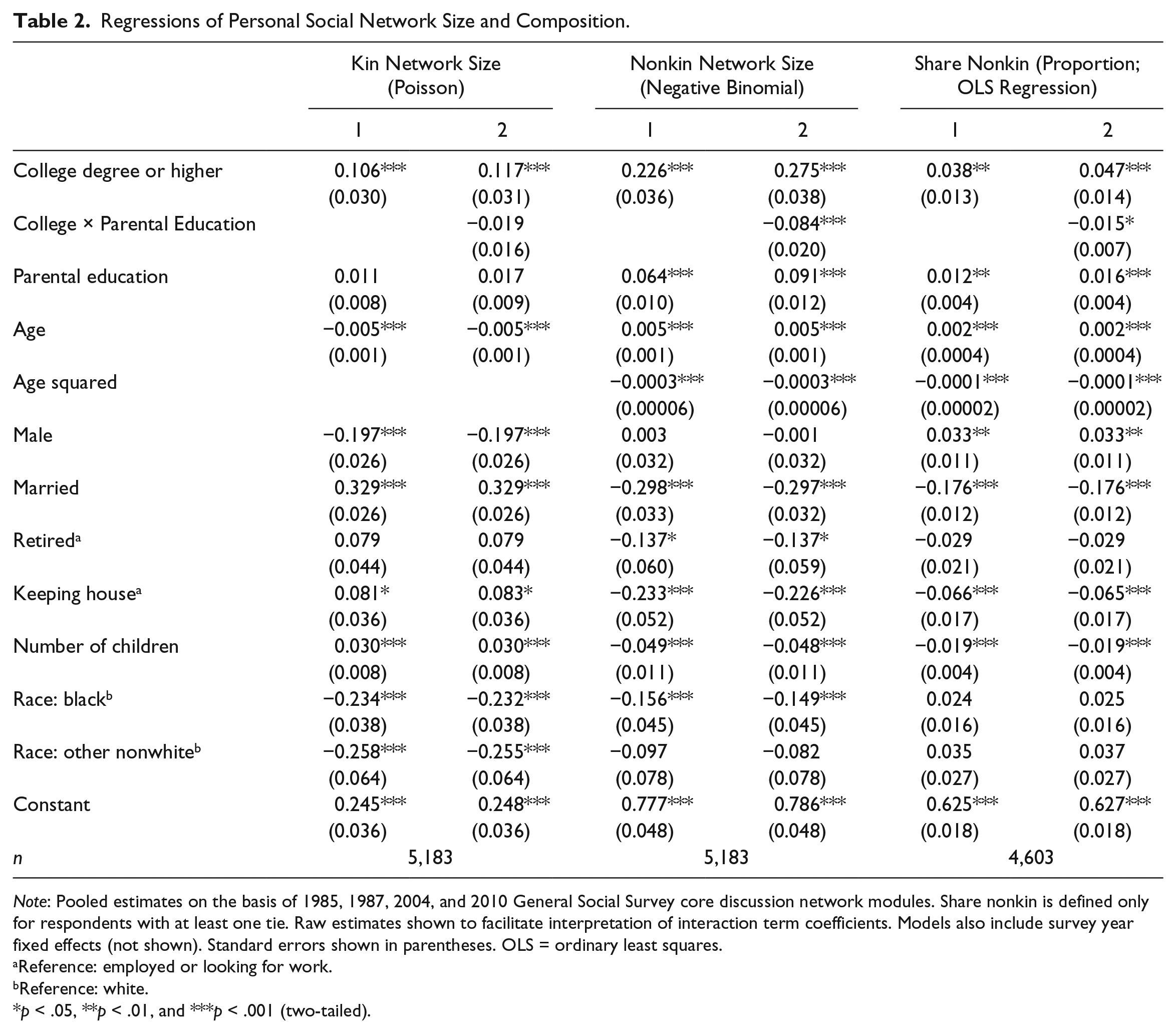
Table 2 shows results from regressions of personal network size and composition controlling for sociodemographic factors. On the left, two sets of Poisson estimates for kin network size are reported. In the first model, a significant association between having a college degree and larger counts of kin (b = .106, p < .001) translates to a predicted 11.2 percent increase in kin network size all else constant (e.106 = 1.112); meanwhile, parental education does not associate significantly with an increased number of kin discussion partners (b = .011, ns). In a second model, which adds a statistical interaction term between college degree and parental education, no modification of the college degree status across parental background is evident (College × Parental Education: b = −0.019, p > .20). Across both regressions, age, sex, marital status, number of children, race, and whether the respondent is keeping house all show significant associations with kin network size, at magnitudes rivaling or often exceeding the college gap. For instance, married respondents report 39.0 percent larger kin networks than those who are not currently married (b = .329, p < .001), while black respondents report networks that are 20.9 percent smaller (e−.234 = .791) when all other variables are held constant.
Regressions of Personal Social Network Size and Composition.
Note: Pooled estimates on the basis of 1985, 1987, 2004, and 2010 General Social Survey core discussion network modules. Share nonkin is defined only for respondents with at least one tie. Raw estimates shown to facilitate interpretation of interaction term coefficients. Models also include survey year fixed effects (not shown). Standard errors shown in parentheses. OLS = ordinary least squares.
Reference: employed or looking for work.
Reference: white.
p < .05, **p < .01, and ***p < .001 (two-tailed).
The next models (shown in the middle of Table 2) are negative binomial regressions of nonkin network size. Here again, a significant association with college is evident (b = .226, p < .001), translating to a more substantial predicted increase of 25.4 percent in nonkin network size, all else equal. Moreover, parental education bears a significant association with number of nonkin discussion partners (b = .064, p < .001), equating to a predicted 6.6 percent increase per unit of parental education, which is measured on an eight-point scale ranging from less than eighth grade to doctoral. In the accompanying interaction model, substantial modification of the college pattern by parental background is revealed (College × Parental Education: b = –.084, p < .001). Figure 1 explicates this pattern, by graphing predicted college gaps in nonkin network size against parental education using average marginal effects. College gaps narrow with increasing parental education, closing to nonsignificance once parental education meets or exceeds a four-year college degree. The narrowing gap in nonkin tie count by respondent degree status is driven by a strong observed parental influence among nongraduates, coupled with a very weak association with parental background among those who obtain college. Across both models, age, marital status, labor force status, number of children, and race show significant links to nonkin network size. In contrast to patterns observed for kin network size, married respondents and those with children have smaller nonkin networks.

College gaps in size of nonkin personal network, by parental education.
The rightmost models shown in Table 2 report ordinary least squares estimates of adjusted associations between proportion nonkin in the personal network and college education. With demographic factors controlled, college graduates have proportions about .038 higher than nongraduates (b = .038, p < .001). With each additional unit of parental education, nonkin composition also increases (b = .012, p < .001). A significant interaction term between personal and parental education (College × Parental Education: b = –.015, p < .05) is consistent with a narrowing college gap in personal network composition, which is shown in the left panel of Figure 2. The composition gap by college converges at parental education of some college or higher. Like gap dynamics observed for nonkin tie count, the compositional disparity is dictated by a stronger association between parental background and network outcomes among non–college graduates relative to graduates, who again show a very weak trend across parental education.

College gaps in share of nonkin social ties, by parental education.
Informal Socializing
Table 3 reports estimates from regression models of socializing among relatives or friends. Consistent with descriptive findings, college graduates socialize with relatives on fewer occasions (b = –.210, p < .001; 19 percent lower) than do nongraduates, holding demographic variables constant. A significant negative relationship with frequency of socializing with friends obtains as well, once adjusting for demographic background (b = –.065, p < .001). Neither inverse college gap is modified by parental education (College × Parental Education: b values ⩽ .015, ns), though parental education is linked to lower rates of socializing with relatives (b = –.044, p < .001) and greater rates of socializing with friends (b = .026, p < .001) in its own right. Meanwhile, respondents who are older or who are married report less frequent socializing, while men socialize less often with relatives and more often with friends than do women. Number of children is linked to more socializing with relatives and less socializing with friends (b = .031 for relatives, b = –.041 for friends, p values < .001).
Regressions of Informal Socializing (Relatives and Friends).

Note: Pooled estimates on the basis of 1972–2014 General Social Surveys. Share nonkin socializing is defined only for respondents with at least some socializing. Raw estimates shown to facilitate interpretation of interaction term coefficients. Models also include survey year fixed effects (not shown). Standard errors shown in parentheses. OLS = ordinary least squares.
p < .05, **p < .01, and ***p < .001 (two-tailed).
Reference: employed or looking for work.
Reference: white.
The final model in Table 3, predicting share or proportion of nonkin socializing, reveals positive associations of personal or college education (b = .060) and parental education (b = .018). Moreover, the college gap in composition of informal socializing is heterogeneous by parental background (College × Parental Education: b = –.010, p < .001), as depicted in the right panel of Figure 2. As for the other heterogeneous college gaps discussed so far, this pattern starts wide at the lowest levels of parental education and then converges at higher parental education. However, this compositional pattern for informal socializing is different in two respects: first, convergence appears only at the highest levels of parental education (around doctoral), and second, the gap is far slower to converge, because composition among college graduates shows a discernibly positive rather than very weak association with parental background.
Community Ties
Table 4 presents a final set of negative binomial regression estimates, focused on frequency and number of community associations. As for relatives and friends, college graduates show lower adjusted frequencies of socializing with neighbors or others in the community relative to those without four-year college degrees (b = –.143, p < .001; 13.3 percent lower, all else equal), as do married relative to nonmarried individuals (b = –.474, p < .001; 37.7 percent lower). In contrast, those who are retired (b = .342, p < .001) or keeping house (b = .341, p < .001) socialize more often. No main association with parental education is evident (b = –.007, ns), and inverse college gaps in neighbor socializing do not differ systematically across parental background (College × Parental Education: b = .030, ns).
Negative Binomial Regressions of Community Ties.

Note: Pooled estimates on the basis of 1972–2014 General Social Surveys (voluntary associations last reported in 2004). Raw estimates shown to facilitate interpretation of interaction term coefficients. Models also include survey year fixed effects (not shown). Standard errors shown in parentheses.
p < .05, **p < .01, and ***p < .001 (two-tailed).
Reference: employed or looking for work.
Reference: white.
In contrast, regressions for number of voluntary associations show substantial, positive associations with college degree status (b = .522, p < .001; college graduates have 68.5 percent higher counts of associations than nongraduates, all else equal) and parental education (b = .082, p < .001). A second model reveals substantial differences in this college gap by parental education (College × Parental Education: b = –.093, p < .001), depicted in Figure 3. Unlike other heterogeneous gaps depicted, this gap does not converge even at the highest levels of parental education. Although it narrows substantially as parental education increases, predicted differences in number of voluntary associations linked to college even at master’s- or doctorate-level parental education still are approximately 0.5, far less than the difference of about 1.5 associations by college predicted among those whose parents have less than a high school education.

College gaps in number of voluntary associations, by parental education.
Auxiliary Results
In the present findings, nonkin tie count and proportion of socializing follow a pattern whereby those least likely to attend college gain the most from college across different measures of adult social integration. However, this does not rule out the possibility that specific tie content, such as networking with elite individuals or organizations across the postcollege transition, serves to reinforce network inequalities by family background even as broad contours in networks are leveled across family background by college (e.g., Hamilton et al. 2018; Lareau and Weininger 2009). As is well known to theorists of educational and socioeconomic inequalities, education is both a multilayered process and a complex credential, and thus different facets of education may be mobilized in ways that reinforce or perpetuate certain inequalities even as some more visible forms of inequality are leveled or equalized (Lucas 2001; Phelan et al. 2010).
To help gain some additional traction on facets of adult networks, I make use of personal network composition data available in the 1985 and 2004 GSS. In pooled regressions adjusting for survey year, 5 I estimated associations between average education among nonkin discussion network ties and personal and parental education, controlling for demographic variables. Under the argument that average nonkin education is a rough proxy for network social and cultural capital relevant to occupational success, 6 one might expect to find that the college gap in nonkin network educational resources does not converge across family background, perhaps because of robust parental effects that serve to perpetuate network inequality even among college graduates.
Patterns in the GSS data demonstrate a significant interaction between personal and parental education, consistent with unequal network returns to obtaining higher education. Figure 4 shows predicted college gaps on the basis of regression estimates. Among college graduates, average education among network ties or contacts stays consistently within the range of college graduate across all levels of parental education, though a slight positive slope is evident, which is consistent only with a weak background effect. Among nongraduates, the association between parental education and average network education is stronger, as average education held by respondent discussion partners is predicted to increase from around “high school” to around “some college” across the range of parental education.

College gaps in average education level of nonkin personal network, by parental education.
Overall, the college gap in network educational attainment narrows as parental education increases but does not converge. A lack of convergence speaks to the fact that parental background does not entirely compensate for the network compositional gains linked to obtaining a college degree. Moreover, the pattern of results depicted in Figure 4 is consistent with a weakened, rather than strengthened, background effect among college graduates. Thus, findings for educational network composition fall in line with a resource substitution perspective on college rather than a cumulative (dis)advantage pattern.
Discussion
For decades, educational attainment has received attention from network researchers as one of the strongest and most consistent correlates of personal network size and diversity, with gains linked to college being especially strong in many cases (Fischer 1982; McPherson et al. 2006). Meanwhile, in recent work focused on unequal returns to college, researchers of income and health inequality have shown heterogeneous associations between college and improved life chances by parental background, raising the question of whether personal networks might show a similar pattern. Although perhaps not as closely linked to life chances as income or health, personal networks are social capital, providing access to emotional support and instrumental resources and advice across a variety of routine and stressful life situations. Differences in personal networks carry wide-ranging implications for social stratification and inequality, influencing outcomes of key adult life-course stages such as labor market entry, community integration, and family formation.
Bringing in theoretical perspectives from prior research into unequal returns to college, I focused on whether associations between college and networks vary by parental education, and on overall patterns of divergence and convergence across parental or family background. Most research to date on unequal returns, focused on income and health, has shown evidence for resource substitution across life-course socioeconomic statuses. Namely, gains in income or health associated with college degree receipt are strongest among those least likely to attend and graduate from college in the first place on the basis of their disadvantaged childhood or adolescent socioeconomic background. Other work focused on volunteering or fertility has documented similar outcome patterns that also are broadly consistent with resource substitution (Brand 2010; Brand and Davis 2010). However, a full portrait of adult social integration remains lacking, representing a notable oversight given the well-known fact that college has distinct links to different aspects or measures of social integration. Therefore, in this study, I drew on the GSS to discern college gaps in personal network size and composition, informal socializing with close and community ties, and number of voluntary associations, moving toward a more comprehensive understanding of unequal associations between college and adult social integration by family background.
The present findings suggest that college helps level or equalize many forms of network inequality linked to childhood background, an important and novel result. In line with this idea, correlations between parental background and adult network outcomes were far weaker among college graduates than nongraduates, and, correspondingly, college gains in networks were highest among those from socioeconomically disadvantaged family backgrounds. Findings here generally resonate with the resource substitution perspective on family background and obtaining higher education. Namely, counts of ties outside the family, whether measured as counts of nonkin personal network ties or voluntary associations, show unequal associations with college by family background, with these nonkin gaps narrowing at higher levels of parental education. Moreover, compositional differences in networks, whether personal network composition or composition of time spent socializing informally among close ties, favor nonkin among college graduates relative to nongraduates, but this composition gap also narrows with higher parental education. Put another way, tie count and compositional differences in adult social integration are biased toward nonkin among college graduates on average, but this especially true among those from disadvantaged parental backgrounds. Among those who come from more advantaged households, tie and composition gaps across college are noticeably more modest and even are nonsignificant in some cases, falling in line with prior findings on health, income, and civic participation (Andersson and Vaughan 2017; Bauldry 2014; Brand 2010; Ross and Mirowsky 2011; Schafer et al. 2013). In contrast, frequency of socializing with close or community ties, although certainly lower among college graduates overall, shows relatively homogeneous patterns by parental background according to estimates here.
Auxiliary findings on educational capital within personal networks also supported a resource substitution perspective. Although average educational capital among discussion partners only is a weak proxy for the specific work, community, or social opportunities provided by close contacts, this preliminary analysis still supports the idea that college provides the greatest network capital gains among those least likely to attend, rather than reinforcing the network advantages of those most likely to attend in the first place. Future work using multiple name generators to elicit weak ties more robustly would be useful. Likewise, network data with detailed information on alter resources, affiliations, or assets would provide a more direct window into potential economic, cultural, or social capital furnished by ties and could potentially support a cumulative advantage rather than substitution perspective in some respects.
The important, consistent finding from this study that higher education greatly diminishes links between parental background and adult network size and composition suggests that network inequality within the general population might be diminished if more individuals attended college. College expansion often carries the unanticipated consequence of lowering certain returns to degrees such as occupational placement (Horowitz 2018), suggesting that the credential loses its value in some ways as it becomes more common. Dissipation of network inequalities seen with college may be partly immune to college expansion effects, given that connectedness is not a limited social good in that same way as job opportunities. This said, the utility of robust networks for socially scarce outcomes such as finding a job that is autonomous, well-paying, and not precarious (Kalleberg 2009) may depend more on college expansion than for other network-linked outcomes that are not inherently scarce, such as health or community integration.
Directions for Future Research
Social integration is a multifaceted concept with no shortage of fitting measures (e.g., Berkman et al. 2000; Thoits 2011). The measures in this study fit within the rubric of personal networks and informal social ties (Fischer 2011) but leave unclear how specific forms of emotional and instrumental support might vary by personal education, parental education, or both. Some recent work on this topic finds higher levels of perceived support during adulthood among those with higher levels of childhood socioeconomic status or status attainment (Umberson et al. 2014). Network turnover and specific tie stability also differ by demographic and socioeconomic statuses (e.g., Cornwell and Laumann 2015; Small, Pamphile, and McMahan 2015; Wellman et al. 1997), representing another area worthy of empirical research. Future work should establish whether these and other facets of adult social integration show unequal returns to educational attainment by family origins.
Research into heterogeneous or unequal returns to college is in the early stages of merging insights about family background with sophisticated age, cohort, and subgroup analyses. Although some initial efforts on this front have documented (non)differing patterns of family, education, and health by gender, cohort, or age (Andersson 2016; Brand and Xie 2010; Conti and Heckman 2010), these categories have yet to combined with race and ethnicity to form intersectional approaches that have gained traction in other areas of health disparities research (e.g., Brown et al. 2016). The present study averaged across numerous survey years to gain accurate insights about prevailing overall trends in how college gaps in adult social integration vary across parental education. However, future work could move forward knowledge on unequal returns to college considerably by combining intersectional approaches with the analysis of resource substitution or cumulative (dis)advantage across life-course socioeconomic statuses. Existing work already finds that health or well-being returns to education in its own right vary by gender or race (Ross and Mirowsky 2006; Turner, Brown, and Hale 2017; Williams 1999), but merging these insights with heterogeneous contributions of family of origin to reveal precise contours of inequality across the life course likely will require large-scale data and careful and adequately powered subgroup analyses that span multiple social and socioeconomic hierarchies at once.
In addition to overlooking nuanced subgroup variation, research on unequal educational returns also is in the early stages of postulating and testing mechanisms for understanding these variable associations. Plausible pathways include college selectivity or institution type or unequal paths through college by family socioeconomic status (Ross and Mirowsky 2001), college selectivity and degree completion (Heil, Reisel, and Attewell 2014), and postcollege correlations between parental background and first employment even among those who hold a university degree (Torche 2011). Although the present results take marital status into account, partner selection and homophily contribute to the intergenerational transmission of status and social capital (Rözer and Brashears 2018) and thus may potentially be relevant to understanding heterogeneous returns to college by family of origin as well.
Eventually, it would be useful to place together various findings on unequal social, health, and income returns to higher education, to begin constructing a metatheory of how unequal returns to college fit together conceptually or reinforce each other. For instance, unequal returns to college in social integration or posteducation income by family background may set into motion unequal returns to college in midlife or later life health, through pathways linking social integration and capital and adult permanent income or wealth to later patterns of health and disease across the life course (Berkman et al. 2000; Cornwell and Laumann 2015; Ferraro, Schafer, and Wilkinson 2016; Hout 2012; Thoits 2011). Or early health returns to education may influence network structures which in turn shape health (Cornwell 2009). Although formal insights remain to be discovered, the quintessential fact that family origins correlate with life chances before, during, and after completing formal education should continue to energize this promising approach to understanding educational inequalities.
Footnotes
Acknowledgements
Thanks to Shawn Bauldry and Patricia Thomas for their insights.
1
The rise in network isolation observed in the 2004 GSS data has been analyzed in great detail (e.g., Lee and Bearman 2016; Paik and Sanchagrin 2013). The present findings concerning personal networks are substantively unchanged if the 2004 data are omitted from multiyear regressions presented here. Survey-year fixed effects are used.  made a compelling argument using multiple data sets that independent voters may be especially prone to reporting social isolation for “important matters” on the basis of how the question is interpreted in political context, yielding an especially strong isolation pattern by partisan status (nonpartisan or independent vs. partisan or nonindependent) around the 2004 presidential election and a milder, though not absent, isolation pattern in other GSS years. Robustness analyses controlling for partisanship produced a substantively identical pattern of results in terms of magnitude and significance of education coefficients (available on request).
2
Also, respondents provided demographic information about nominated ties, such as their age, sex, education, race, and religious denomination. I address educational composition in auxiliary analyses.
3
In survey years from 2000 onward, the GSS consistently implements more precise measurement of race and ethnicity. Additional analyses using only these recent years and an extended set of controls for race and ethnicity (non-Hispanic white, black, Hispanic, and other race/ethnicity) produced the same overall findings for college gaps in adult social integration.
4
Kin network size is determined appreciably by marital status or number of children, often because spouses or adult children are named as discussion partners. In additional analyses, I predicted kin network size using a narrower set of demographic covariates. Overall patterns regarding any unequal returns to college (resource substitution or cumulative (dis)advantage) did not change.
5
Running this analysis separately by survey year shows similar, nondiffering estimates for personal and parental education and for their statistical interaction.
6
Total educational credentials in the network conflates network size and content, though substantive results are the same when total education across all network members is considered instead. Average education across the entire network rather than nonkin specifically yields the same pattern of results, though results including kin ties are probably less relevant to a weak-ties perspective on labor markets and status attainment (Granovetter 1995). Although the “important matters” instrument is not designed to tap weak ties specifically, it elicits an ample number of nonkin associates ().