



Abstract
Scholars Sean Kelly and Laura Northrop discuss recent changes in perceptions of school quality. They find that Americans are not positive about the overall quality of elementary and secondary schools in the United States, while beliefs about school-to-school differences in quality are often exaggerated.
In early June 2006, parents of students attending Liberty Elementary in Mishawaka Indiana received a letter notifying them that the school’s standardized test scores were the lowest in the district. They were now eligible to transfer their children to another school, under a provision of the No Child Left Behind (NCLB) act of 2001. However, it turns out options were limited; a shocking 64 percent of all schools in the South Bend, Indiana metropolitan area were labeled “failures” under NCLB. In two districts, every single school was failing.
Strict accountability standards are intended to motivate school improvement efforts. However, they may have unintended consequences. Parents searching for the best education for their children are left to ponder what “failing” really means and scrambling for options when there aren’t any other options. What if there are no “passing” schools in which to enroll their children? Moreover, when high proportions of schools throughout the nation are identified as failing, much-needed public support for education may falter, and the schools penalized for failure are unlikely to improve.
The United States has a decentralized education system in which the responsibility to fund schools and make decisions concerning improvement and reform efforts falls to local school boards and districts. Under such a system, attitudes toward schools are an important determinant of educational investment, financial and otherwise. Generally there has been widespread support for a robust system of public education in the United States, but new policy developments in testing and accountability have given the public reason to question such support. Following NCLB, states developed systems of testing and accountability with the goal of reaching 100 percent proficiency by 2013. Although setting the lofty goal was meant to address educational inequality, it also meant that a great many public schools would be labeled as failures each year. Schools that failed to meet adequate yearly progress in multiple years would risk being closed down. At the same time, the growth of charter schools and voucher programs has given many parents an alternative to traditional public schools.
Disparities in achievement across schools are due to differences in students’ academic readiness and the influence of families and neighborhoods.
Have Americans lost their faith in public education? Perhaps even more important, have perceptions of school-to-school differences in the quality of instruction and learning changed in recent years? Sociological research has shown that school-to-school differences in learning environments are, in reality, relatively modest—“bad schools” are not simply bad, and “good schools” are not simply good. Disparities in achievement across schools are due, in large part, to differences in students’ academic readiness and the influence of families and neighborhoods, rather than classroom instruction. Yet, parents have always been concerned with seeking out the best educational environment for their children. Have accountability labels and choice options given parents an even greater incentive to do so?
Overall Opinion of Public School Quality
Source: GSS and PDK/Gallop
Note: GSS data only collected in the years marked with a square.
Variable Perceptions in School Quality
Source: PDK/Gallop
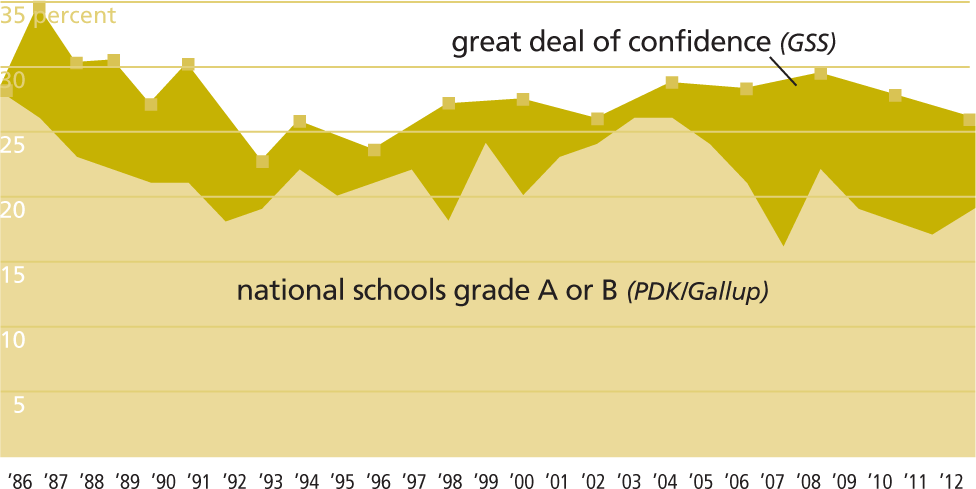
Since the mid-1980s, representative samples of Americans have been questioned in countless polls and surveys about their attitudes toward public schooling. The chart on the left on the previous page reports findings from the PDK/Gallup Poll (PDK) and the General Social Survey (GSS) on the percentage of respondents giving the nation’s public schools an “A” or “B” rating and reporting “a great deal of confidence” in education. While the PDK/Gallup poll focuses exclusively on attitudes toward education, the GSS questions respondents about schools as part of a wide array of social institutions (religion, medicine, the press, etc.). Note also that the GSS does not ask specifically about public schools, but private schooling accounts for only a small fraction of total school enrollments (about 10 percent of elementary and secondary students in the 2009-10 school year). This means the numbers effectively report attitudes about public education.
Two findings jump out from these data. First, Americans are not positive about the overall quality of elementary and secondary schools in the United States. While it is impossible to attribute such a widely held, over-arching sentiment to any one source, negative overall ratings may reflect lofty ideals and hopes for schooling. We expect a lot from schools—including students’ social, civic, and cultural development—so it’s not surprising that people are often disappointed. More troubling, attitudes toward public schooling have become even more negative over time. Indeed, the PDK and GSS data, depending on the specific response category, suggest a 20 to 40 percent decline in positive ratings in the past 25 years. Importantly, this decline cannot necessarily be attributed to the specific policy changes accompanying NCLB, as, in many cases, the downward trend appears to have begun much earlier.
Attitudes toward public schooling have become even more negative over time.
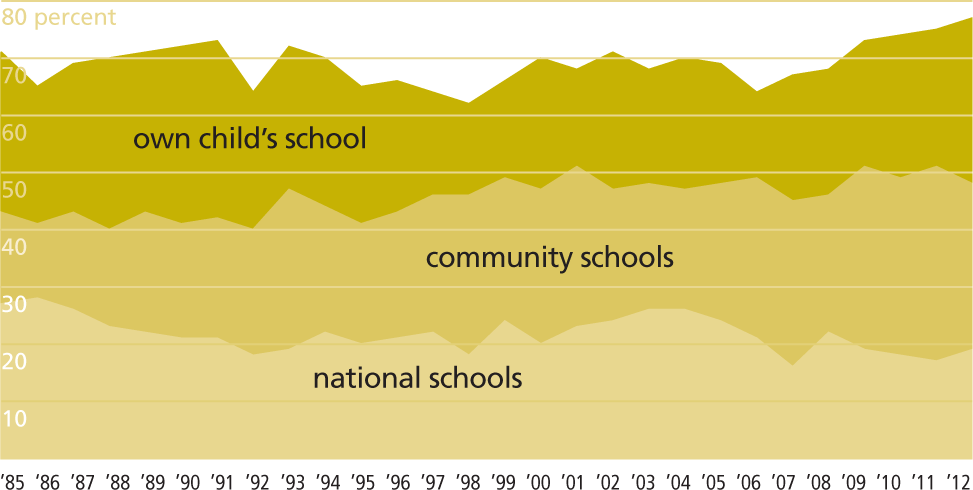
If attitudes toward schools have dropped, how have perceptions of the variability in school quality changed in recent years? The other chart (see chart on the right) shows that parents rate the quality of schools in their own community (especially the schools their own children attend) much more positively than all respondents (both parents and non-parents) rate the nation’s schools as a whole. Indeed, they are more than three times as likely to give an A or B to their own child’s school as to schools in general.
In addition to the inclination to feel positively about situations that pertain to your own well-being (a “cognitive-dissonance” mechanism), it seems likely that the differential ratings are related to the quality and specificity of information parents have about different sets of schools. Schools usually make a concerted effort to reach out to parents and involve them in their children’s schooling, and many parents have social networks comprised of the parents of their students’ peers. Thus, in addition to the ubiquitous dinner-time question, “How was school today?” parents get a great deal of information about the school their child attends, both directly and indirectly.
In contrast, information about community schools and schools in other parts of the country tends to come from media coverage, often of test scores, cheating scandals, and drop-out rates, which when taken at face value and without an appreciation of context, is often alarming. And in Hollywood, there are few films about happy teachers and students going about their days and making good grades. Instead, movies like Freedom Writers, Dangerous Minds, and Stand and Deliver typically show the protagonist as a lone hero working amidst a cast of incompetent teachers and administrators. Viewers are sure to think this is what “other cities’ schools” look like.
The findings in the chart on the right add an important caveat to the overall picture in the chart on the left: parents are much more positive about the schools with which they interact closely. Unfortunately, the chart on the right also suggests that parents view schools as being of widely varying quality. Consequently, it is their job to select the best possible schools for their own children, a job most parents feel they have done well (at least relative to the available options elsewhere in the community and nation). Moreover, the gap between localized attitudes toward their own child’s school and schools in general has widened from 44 percentage points in 1985 to 58 in 2012, with much of that widening occurring in the last 10 years. In other words, in parents’ minds, the stakes attached to selecting a high quality school have increased.
Negative attitudes toward public schooling and the strong belief in school differences lead parents to feel they should flee “bad” schools for “good” schools.
Fortunately, it doesn’t look like the pervasive “rhetoric of failure” associated with NCLB and the school accountability movement has dramatically changed overall attitudes. However, the mean ratings were quite low to begin with (they were already beginning to decline in the late 1980s), so any further decline would have been remarkable. Yet, we should be concerned about the possibility of increasing perceptions of variability in school quality. An overall negative attitude toward education, coupled with a strong belief in differences in quality between schools, indicates a situation in which parents feel the need to flee “bad” schools for “good” schools. Research shows that such perspectives are based on overly negative beliefs about school performance, but the attitudinal trends also suggest that, in the coming years, the public will readily embrace even more policies that allow for greater variety and choice in the educational marketplace. Charter school enrollment continues to grow at a steady pace; in the 2011-2012 school year, there were more than 5,500 charter schools enrolling more than 2 million students in the United States. An additional 600,000 students were on waiting lists in hopes of switching to a charter school. In a world where a great many schools are perceived to be failing beyond repair, but good education is considered paramount for a successful life, it is not surprising that parents go to extreme lengths (and suffer huge anxiety) to find the “best” schools.