




Abstract
Hispanic Serving Institutions (HSIs) are colleges with 25 percent or higher Latinx student bodies. Categorization as HSI permits institutions to apply for restricted competitive federal grants that are meant to help alleviate Latinx educational inequalities. However, HSI designations have increased fivefold over recent decades, leading to greater competition between them for these racially designated resources. This is the first known study to investigate patterns of racialized resource allocation to this subset of colleges. Multivariate results indicate that HSIs with larger white and smaller black student bodies are more likely to receive competitive funds, whereas the proportion of Latinx and Asian students is unassociated with funding receipt. These findings point to important distinctions among racialized organizations. Despite their overarching categorical racial designations (e.g., Hispanic Serving Institutions), racialized organizations’ institutional proximities to whiteness and distance from blackness may still shape the distribution of opportunities and resources.
In 2016, 37 Historically White Colleges or Universities (HWCUs) were newly designated as Hispanic Serving Institutions (HSIs)—and thus eligible to apply for multi–million dollar minority serving institution (MSI) grants from the Department of Education. Any not-for-profit college or university that passes a 25 percent Latinx student body threshold wherein half are low income can be designated as an HSI (U.S. Department of Education 2017). Over the past 25 years, the share of colleges and universities meeting those criteria has increased dramatically, growing from 105 HSIs in 1992 to 492 today (Excelencia in Education 2017). The rapid growth of HSIs has been a byproduct of immigration, substantial gains in Latinx college enrollments (Krogstad 2016), and Latinx migration from traditional gateway cities to new destinations (Lichter 2012; Marrow 2011; Williams et al. 2009). Increases in federal HSI funding, however, have not kept pace with the expansion, leading to increased competition between HSIs for federal resources.
Notably, HSIs can vary considerably from one college to the next, especially in terms of student racial demographics. For example, South Texas College is a four-year public institution with a 3 percent non-Hispanic white student population and a 94 percent Latinx student body. Columbia Gorge Community College, on the other hand, is a two-year public college in Oregon with a student body that is predominantly white (65 percent) and 28 percent Latinx. These institutions are categorically designated under the same ethnoracial label, Hispanic, and are therefore equally eligible to apply for Title V Developing HSI grants of approximately two million dollars over a five-year period. Despite the categorical similarities, alternative dimensions of race within the institutions are relevant for understanding patterns of resource allocation. Yet, no known study has systematically examined how institutional variation among this subset of similarly racialized colleges and universities might be associated with the receipt of said funding. Given increased competition between HSIs for a limited set of resources, it is worthwhile to consider if HSI funds are serving colleges with larger or smaller shares of Latinx students.
How federal HSI funds are distributed is of significance to scholars of race, education, and inequality as the divvying of resources along racial lines is a prime example of a racial project (Omi and Winant 1986). Racial projects, according to Omi and Winant (1986), are “effort(s) to reorganize and redistribute resources along particular racial lines.” In the same vein, the creation of the HSI designation was also a racial project, the product of decades-long advocacy by Latinx higher education leaders to secure federal resources to address growing Latinx educational disparities (Valdez 2015). Yet, research has not considered the degree to which these racial projects align. Are the anti-racist intentions of Latinx higher education leaders of the 1970s and 1980s playing out in the manner they had intended—to effectively undermine Latinx educational disparities? The answer to this question has broad societal implications. HSIs currently make up nearly 15 percent of all U.S. colleges and universities, enroll over 60 percent of all Latinx college-goers, and are poised for additional growth (Calderón Galdeano and Santiago 2014). How funding is distributed within HSIs shapes opportunities for millions of underrepresented students. Despite advances in sociological and higher education scholarship on HWCUs and MSIs (Allen et al. 2007; Allen and Jewell 2002; Ayala and Contreras 2018; Brunsma, Brown, and Placier 2012; Contreras, Malcolm, and Bensimon 2008; Cuellar 2014; Garcia 2016, 2017; Garcia et al. 2016; Gasman, Baez, and Viernes 2008; Maestas, Vaquera, and Zehr 2007; Núñez, Hurtado, and Galdeano 2015; Torres and Zerquera 2012), systematic analyses of racialized higher education funding and the types of colleges it is allocated to has gone underexamined (but see Ortega et al. 2015; Vargas and Villa-Palomina 2018).
In this article, I examine how institutional characteristics, especially the student racial demographics of HSIs, are associated with the likelihood of being awarded Title V Developing Hispanic Serving Institution grants. In doing so, I draw from the U.S. Department of Education’s list of all Title V grant awardees over the period of 2011 to 2015 and employ HSI institutional data from the National Center for Education Statistics’s (NCES) Integrated Post-Secondary Educational Data System (IPEDS). IPEDS collects annual institution-level data—including student racial demographic information—from over 7,500 U.S. colleges that participate in federal student aid programs. In the following sections, I briefly describe educational inequalities impacting Latinxs; outline the purpose, utility, and definitional criteria of HSI status as a potential means to ameliorate these disparities; and argue that both categorical and proximal dimensions of race are worthy of investigation when analyzing if and how racialized organizations ameliorate or exacerbate racial inequalities.
Literature Review
The Emergence of HSIs and Racialized Funding
Despite the growth of HSIs, the vast majority of colleges and universities in the United States today remain historically and predominantly white (Allen, Epps, and Haniff 1991; Brunsma et al. 2012). For centuries, many U.S. higher education institutions were limited exclusively to English-speaking white men. The nineteenth century bore the first designated black colleges and universities (now labeled Historically Black Colleges and Universities [HBCUs]), and the late twentieth century to the present day spawned recategorization of many preexisting historically white colleges as MSIs. In addition to HBCUs, MSIs are composed of HSIs, Tribal Colleges and Universities (TCUs), and those that serve disproportionate shares of Asian American, Native American, and Pacific Islander Students (AANIPISIs). HBCUs were born and constructed out of periods of legal racial exclusion, whereas the latter subsets of institutions were first conceptualized after the Civil Rights Movement. HSIs were conceptualized in the late 1970s by Latinx educational advocates and finally institutionalized in 1992. In the 1992 amendment to the Higher Education Act, HSIs were officially defined as not-for-profit colleges and universities with a full-time enrollment of at least 25 percent Latinx students wherein 75 percent were first-generation college students and Pell grant eligible due to their lower household incomes. Today, the student threshold remains the same, though the first generation requirement no longer exists and the Pell grant eligibility restriction has been reduced to 50 percent. These eligibility criteria have resulted in the reclassification of many HWCUs, especially those located in common migrant destinations, as HSIs.
Notably, the HSI designation was created after decades of advocacy by Puerto Rican, Mexican American, and other Latinx leaders in the 1970s and 1980s who recognized the vast educational inequalities between Latinxs and other racialized groups (Valdez 2015). Many of these inequities persist. Despite high levels of educational aspirations and expectations (Bohon, Johnson, and Gorman 2006; Langenkamp 2017; Sanchez et al. 2016), Latinxs continue to have the highest rates of high school noncompletion (Krogstad 2016). Despite increasing rates of college enrollment, they also maintain the lowest rate four-year college degree attainment of any major ethnoracial group in the country (Gramlich 2017; Krogstad 2016). Much of this educational inequality corresponds with racialized inequalities across other societal institutions. Racial segregation in schools, residential segregation, disproportionate punishment, bullying, discrimination, and other structural components of k–12 education, for example, shape higher education inequalities (Goldsmith 2009; Irizarry 2015; Lewis and Diamond 2015; Ochoa 2014; Peguero 2011). Moreover, inequities in educational access and outcomes is not primarily a problem associated with immigration as the third generation frequently experiences similar and at times amplified disparities in comparison with their earlier generation counterparts (Ortiz and Telles 2017; Telles and Ortiz 2008).
After decades of advocacy from Latinx groups, the U.S. Department of Education now allocates competitive grant funding to colleges and universities that disproportionately serve Latinx students in a manner intended to address such disparities. According to the U.S. Department of Education (2017), Title V Developing Hispanic Serving Institution grants, the most readily disseminated HSI grant, exist to
expand educational opportunities for, and improve the academic attainment of, Hispanic students, and to expand and enhance the academic course offerings, program quality, and institutional stability of the colleges and universities that educate the majority of Hispanic students and help large numbers of Hispanic and other low-income students complete postsecondary degrees.
Insofar as Latinx students are affected by interlocked webs of racialized inequality and have some of the lowest rates of college completion, we might expect that HSI funding would be disproportionately allocated to HSIs with larger Latinx student bodies to directly address such disparities. This would result in a more efficient alleviation of ethnoracial disparities. However, there are theoretically guided expectations related to the proximity to whiteness and institutional distancing from blackness that suggest alternative patterns of resource allocation.
Theoretical Framework: Racialized Categories and Racialized Proximities
In a racialized social system wherein whiteness dominates, those categorized as white are afforded privileges in accord with their white racial status (Bonilla-Silva 1997). As illustrated in a large and growing set of social scientific scholarship, there is a persistent and systematic racialized advantage to whiteness (and disadvantage to the designation of racial “otherness”) across most influential institutions in U.S. society. This includes housing (Desmond 2016; Flippen 2004; Massey and Denton 1993; Rugh 2015), the labor force (Pager 2003, 2007; Pager, Western, and Bonikowski 2009; Stainback and Tomaskovic-Devy 2012; Turner, Fix, and Struyk 1991), the criminal justice system (Gonzalez Van Cleve 2016; Pettit and Western 2004; Russell-Brown 2008), credit markets (Oliver and Shapiro 2006; Ross and Yinger 2002; Rugh and Massey 2010), consumer markets (Ayres and Siegelman 1995; Feagin and Sikes 1995; Graddy 1997), and schools, among others (Lewis and Diamond 2015; Moore 2008; Ochoa 2014; Orfield and Frankenberg 2014; Shedd 2015).
Yet, the organization of race in U.S. society is complex, and some privileges associated with whiteness are not solely limited to those who fit neatly within its categorical bounds. Because the U.S. racialized social system has built up and supported white dominance, nonwhites in greater proximity to whiteness may receive some social and economic advantages. For example, people of color who are phenotypically closer to widely accepted physical traits of whiteness (light skin color, light hair, light eyes, etc.) reap advantages (Herring, Keith, and Horton 2004; Hunter 2007; Vargas 2015). On average, self-identified Latinxs and blacks who are lighter in skin color have higher levels of educational attainment and higher levels of income than their darker counterparts (Hunter 2007; Monk 2014; Murguia and Saenz 2002). In this context, phenotypical proximity to whiteness is granted greater status, value, and opportunities in a U.S. society stratified by race, even among individuals who are categorically designated as nonwhite. Notably, proximity to whiteness is not always without costs; people of color in predominantly white contexts can experience tokenization, feelings of social isolation, and discrimination (Evans and Moore 2015; Kanter 1977; Moore 2008; Stainback and Irvin 2011). Moreover, people of color who are more phenotypically similar to whites may experience claims of ethnic or racial inauthenticity by other members of their self-identified racial group (Hunter 2007). Nonetheless, most research illustrates that mere proximity to whiteness is associated with material advantages.
Building from the proximity to whiteness argument embedded in studies of skin color stratification, I shift the unit of analysis to the institutional level to examine the contours of racialized inequality across racialized higher education institutions. Though a growing set of scholarship has explicated the significance of considering the multidimensionality of race and racial measurement at the level of individuals (Gomez and Lopez 2013; López et al. 2018; Morning 2018; Roth 2016; Vargas 2014; Vargas and Stainback 2016), fewer studies have examined how organizations and educational institutions specifically are similarly shaped by multiple dimensions of race.
Like individuals, higher education institutions are categorically differentiated from one another by race. Colleges and universities are designated as MSIs when they serve a disproportionate share of nonwhite students or if they were established historically as racially distinct colleges and universities throughout periods of de jure segregation. All other colleges and universities not explicitly labeled as MSIs have been usefully designated as historically or predominantly white institutions (HWCUs or PWIs) (Allen et al. 1991; Brunsma et al. 2012). These are categorical distinctions, associated with racially disparate allocations of funds and resources. For example, PWIs receive a substantially larger share of state resources than HSIs (Ortega et al. 2015). Moreover, education and related expenditures are significantly lower at HSIs than at comparable non-HSIs (Ortega et al. 2015). Funding streams are categorically unequal such that PWIs have greater access to financial resources that are not explicitly labeled or recognized as racialized.
We know far less, however, about explicitly racialized funding allocation to institutions defined categorically as MSIs. It is plausible that even among institutions categorically designated as MSIs, alternative dimensions of race, namely institutional proximity to whiteness and distance from racial otherness, shape resource allocation, just as it does at the individual level. According to Sidanius and Pratto (2001), institutional distancing occurs when resources and positive social value are allocated to the dominant group and a lack of value, or negative value, is ascribed to subordinate groups. In this context, institutional proximity to whiteness and distancing from blackness and Latinxness could shape resource allocation such that HSIs with larger shares of white students (the dominant group) and smaller shares of Latinx and black students (subordinate groups) would have greater odds of receiving resources. Of course, it is also plausible that the funds are allocated in the anti-racist manner by which they were originally advocated—to focus primarily on redressing Latinx educational inequalities (Valdez 2015). If true, we would expect that HSIs with larger Latinx student populations would be more likely to receive HSI resources and the share of other racialized student groups (whites, blacks, and Asians) should be unassociated with receiving these competitive funds. This is the first known study to explore systematic variation in how this racialized stream of funding is allocated and adjudicate between these competing expectations. In summary, the primary aim of this study is straightforward but also novel and important—to identify whether and how the racial demography of HSIs is associated with the likelihood of receiving multi–million dollar HSI grants from the U.S. Department of Education. Such analyses contribute to scholarship on the multiple dimensions of racialized organizations and may uncover hidden mechanisms by which racial inequality manifests, even in programs with anti-racist foundations.
Data and Methods
Data used for these analyses stem from the Integrated Post-Secondary Education Data System. IPEDS is the primary and most comprehensive data collection program in the U.S. Department of Education’s National Center for Education Statistics. It includes institutional-level data of over 7,500 postsecondary accredited and nonaccredited institutions. From these data, I extracted the subset of higher education institutions designated as HSIs as detailed by Excelencia in Education (2017), the Hispanic Serving Institutions Center for Policy and Practice (2014–2015), and included 11 additional institutions that were designated as eligible for HSI funding from the U.S. Department of Education. Institution-level data for this research stem primarily from the 2015 wave of IPEDS but also include data on the racial demography of colleges and universities stemming from each IPEDS wave between 1982 and 2015.
Dependent Variable
The dependent variable for this analysis is derived from data on federal grant allocations that are publicly available from the U.S. Department of Education. The measure, coded as a dichotomous variable, differentiates designated HSIs that received a Title V Developing Hispanic Serving Institution grant over the course of 2011 to 2015 from those that did not. Title V grants serve as the principal federal funding source allocated specifically to HSIs. After having been declared HSI eligible by the U.S. Department of Education, colleges and universities may apply for grants from the U.S. Department of Education’s Title V, Developing Hispanic Serving Institutions Program. According to the Department of Education (2017), one of the primary purposes of the program is to expand educational opportunities for Latinx students.
For comparison sake, I excluded a small subset of Title V Cooperative Development Grant recipients because at least half of all awardees are not designated as HSIs. Cooperative Development Grants permit one eligible HSI to seek federal funding in cooperation with one or more non-HSIs to accomplish mutually beneficial goals. Moreover, because the racial demography and racial schema of Puerto Rico differ in important ways from that of the U.S. mainland (Roth 2012), I exclude HSIs located on the island from all forthcoming analyses. Last, I limited the parameters of this measure by time (2011–2015). Because Title V awards typically last a total of five years, aggregating to a five-year period ensures that all HSIs in the analysis had at least a one-year window from which they could apply for and receive funding. Thus, the dependent variable in this analysis is operationalized as a dichotomous measure wherein 1 represents all U.S. colleges or universities that held an individual Title V Developing HSI grant between the years of 2011 and 2015 (n = 106; 28 percent), and 0 represents all other designated HSIs on the U.S. mainland that did not receive the grant over the same time period (n = 274; 72 percent), for a sample of 380 HSIs.
Independent Variables
Key independent variables of interest include the student population shares of Latinx, white, black, and Asian students at each HSI. These data are reported directly to IPEDS from each U.S. college participating in federal financial student aid programs, including all designated HSIs.
Notably, I also consider the number of years that a college or university has had a 25 percent Latinx student enrollment. This was calculated by examining multiple waves of IPEDS data from 1982 to 2015 to examine the year that each current HSI first reported a 25 percent Latinx student body. This year was then subtracted from 2015—the final year of data analyzed. Colleges and universities that have disproportionately enrolled a large share of Latinx students over a greater period of time may have a legacy of recognition as HSIs, which could shape Title V expenditures. Thus, if student racial demographics are associated with Title V grant receipt independent the number of years institutions have met the HSI population threshold, we can be more confident that it is student racial demographics and not the known (or unknown) legacy of an HSI that is associated with resource distribution.
To isolate the relationship between student racial demographics and Title V grant receipt, I also control for a host of additional variables. Specifically, I control for institution size and its squared term. The former is a count of the number of full-time enrolled students at a college or university. Controls for institution type (1 = four-year college, 0 = two-year college) and private or public status (1 = private, 0 = public) are also included in the regression models. Notably, three institutions had missing data in IPEDS for one or more independent variables and were dropped from the analysis, resulting in a final sample of 377 HSIs.
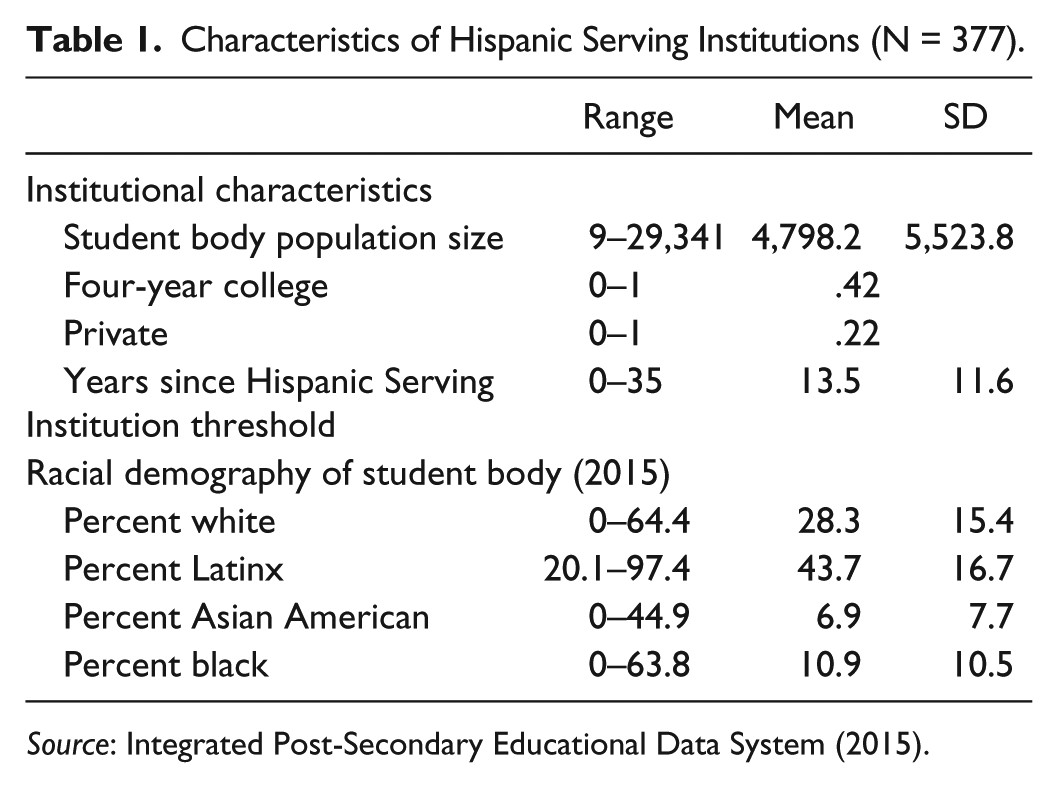
As seen in Table 1, the mean total enrollment at HSIs is approximately 4,800, and the average time that an HSI has had a 25 percent Latinx student body is just over 13 years. In terms of student racial demographics, the average Latinx student population share at HSIs is 43.7 percent, while the mean white, black, and Asian American population shares are 28.3 percent, 10.9 percent, and 6.9 percent, respectively. These students account for 90 percent of all students enrolled at HSIs. The remaining 10 percent fail to report their race or ethnicity or identify with multiple (non-Latinx) racial groups.
Characteristics of Hispanic Serving Institutions (N = 377).
Source: Integrated Post-Secondary Educational Data System (2015).
Results
Figure 1 illustrates the rate of HSI growth between 1992 and 2015, along with the amount of Title V HSI funds distributed over the same time period. The number of HSIs is illustrated in bar chart form (left) and the amount of corresponding HSI funding, in millions of dollars, in line graph form (right). Here, we see that 105 colleges and universities were first officially designated as HSIs in 1992, but there was not yet a subset of federal MSI funding allocated to HSIs at the time. By 2000, the number of HSIs grew to approximately 230, and the federal government allocated $45 million in competitive grant funding to HSIs. Notably, this figure includes totals for Cooperative Development Grants and Puerto Rican institutions. In 2010, a total of 311 colleges and universities across the country were designated as HSIs, and the state allotted nearly $120 million in grant funding to eligible colleges and universities. Despite the continued growth of HSIs in 2010 (472), funding dropped by nearly 17 percent to approximately $100 million. This resulted in less funding for an even larger subset of institutions and necessitated increased competition for resources meant to help alleviate Latinx educational inequalities. Moreover, it is noteworthy that nearly all Title V Developing HSI grant recipients are allocated approximately $500,000 to $650,000 annually over a 5-year period, for a total of nearly $2.5 million per grant awarded. There is very little variation in the amount of money received across Title V awardees in any given year. Therefore, to fund each designated HSI in 2015 for a new five-year grant, the state would need to allocate approximately $236 million annually for five consecutive years. This level of funding would not account for any growth in HSIs that would occur throughout the period. We can see in Figure 1 that the actual amount allocated falls short of a “full funding” scenario.

Hispanic Serving Institution growth and Title V funding (1992–2015).
Given increased competition for a decreasing set of funds, it is worthwhile to examine if and how particular institutional characteristics are associated with grant receipt. The primary aim of this study is to examine if student racial demographics shape Title V HSI funding. Therefore, Table 2 details the results of a multivariate binary logistic regression analysis wherein the dependent variable is a dichotomous measure of whether or not an HSI was awarded Title V funding over the period of 2011 to 2015. Models are estimated separately across measures of student racial demographics. Results are presented as odds ratios, with standard errors in parentheses.
Odds Ratios of Title V Developing Hispanic Serving Institution Grant Receipt, 2011 to 2015 (N = 377).

Note: Standard errors in parentheses.
Source: Integrated Post-Secondary Educational Data System (2015).
p < .10. *p < .05. **p < .01. ***p < .001.
In Model 1, we see that only two variables are significantly associated with Title V Grant receipt: the number of years that an HSI has met the threshold criteria of having a 25 percent Latinx student body and the proportion of the student body that is non-Hispanic white. In the case of the former, this corresponds roughly to the amount of time that an HSI has been known to serve a disproportionate share of Latinx students. For each additional year, there is a corresponding 5 percent increase in the odds of Title V funding receipt. Thus, holding all other factors constant, an institution that met the threshold criteria in 1992 when the HSI designation was first created has 115 percent higher odds (2015 − 1992 = 23 years; 23 × 5 = 115) of Title V grant receipt than an institution first designated as HSI in 2015.
However, the most central variable of interest in this model concerns student racial demographics. Here, we see that controlling for other institutional characteristics, each additional percent non-Hispanic white corresponds with a 2 percent increase in the odds of receiving Title V HSI funding. These findings illustrate that racialized resource allocations to HSIs are shaped by institutional proximity to whiteness such that “whiter” HSIs are more likely to receive MSI funds. For example, all else equal, an HSI with a 60 percent non-Hispanic white student body has 100 percent higher odds of Title V grant receipt than a HSI that has a 10 percent white student population.
Model 2 includes the same covariates but replaces the white student body share with the Latinx student body share. We again see no association between total enrollments and Title V grant receipt. We also see no significant differences between four-year colleges and universities and their two-year counterparts. However, there is a marginal association between the public or private status of a college and their likelihood of receiving Title V funds. Net all other measures in the model, private institutions are less likely to receive Title V resources than public colleges (odds ratio [OR] = 0.45; p < .09).
We continue to see in Model 2 that the number of years an HSI has met the 25 percent Latinx student body threshold is significantly associated with the outcome. However, most central to the research question at hand, the actual Latinx student body share is not associated with Title V grant receipt. In supplementary analyses, out of concern for potential multicollinearity between measures, I regressed the dependent variable on the Latinx student body share measure while excluding the number of years as an HSI as a key control. Once again, there was no discernable association between percent Latinx and Title V grant receipt. 1 Independent the model specification and in stark contrast to the significance of the white student body share, there is no discernable correlation between an HSI’s share of Latinx students and its odds of receiving Title V funds. HSIs that enroll larger shares of Latinx students are no more likely to secure MSI resources meant to address educational inequalities than their lower Latinx student enrolling counterparts.
Model 3 includes the same covariates but replaces the Latinx student body share with the Asian American student body share. Again, we see a marginal association between public and private colleges and Title V grant receipt such that private colleges are less likely to receive funding. Years meeting the HSI student threshold remains an important predictor. And most notably, we see no association between the share of Asian American students at an HSI and the institution’s odds of receiving Title V funds.
Results of Model 4 almost mirror those of Model 1. Across both models, years meeting the HSI threshold and student racial demographics are associated with Title V grant receipt. Yet in terms of student racial demographics, the results are in the opposite direction. There is a marginal negative association between percent black and Title V grant receipt (OR = 0.97; p < .06) such that each additional 1 percent increase in the share of non-Hispanic black students is associated with a 3 percent decrease in the odds of receiving Title V funds. This indicates that all else equal, an HSI with a 45 percent non-Hispanic black student population would have 105 percent lower odds of receiving Title V funds than a corresponding HSI with a 10 percent black student body.
Across all four models, the primary institutional characteristics associated with Title V grant receipt are the number of years a college has met the HSI criteria and the racial demographics of the student body. Though the relationships appear robust, I sought to examine each more closely. It is plausible, for example, that student racial demographics shape the probabilities of grant receipt differently for institutions with longer or shorter legacies of serving Latinx students. Thus, holding all other covariates at their means, Figures 2 through 5 illustrate the predicted probabilities of Title V grant receipt across the range of student body demographics for a prototypical “young” HSI—one that has met the threshold criteria for only 5 years—and a prototypical “older” HSI—a college that has met the threshold for 20 years.
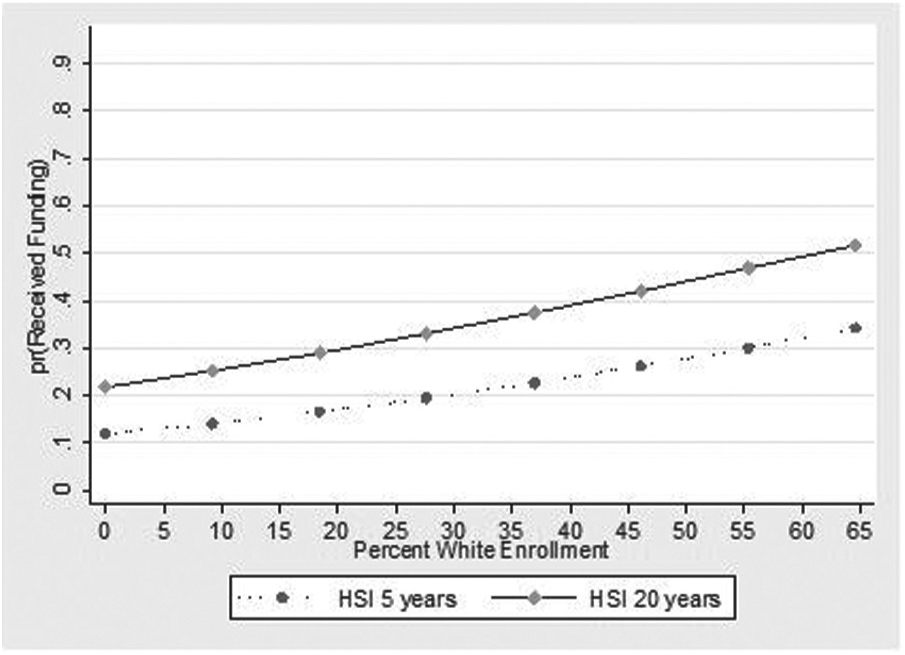
Probability of Title V Hispanic Serving Institution (HSI) grant receipt across white student enrollment and length of HSI designation.
In Figure 2, we see that there are higher probabilities of receiving Title V funding for older HSIs than younger HSIs across proportion white. This illustrates that colleges and universities with a legacy of serving Latinx students are more likely to receive Title V funds. We also see in Figure 2 that even among older HSIs, those with larger shares of white students have considerably higher probabilities of receiving Title V funds than those with smaller shares. For example, an older HSI with a 5 percent non-Hispanic white student population has a predicted probability of .25, whereas an otherwise equivalent HSI with a 50 percent white student body has a predicted probability approaching .5. Though the slope is not quite as steep, the pattern remains the same among the prototypical younger HSIs: Larger white student bodies correspond to higher predicted probabilities of HSI grant receipt. Moreover, Figure 2 permits comparisons of grant receipt between newly designated HSIs and older HSIs. For example, we can see in Figure 2 that a newly designated HSI with a 55 percent white student population has an equivalent probability of Title V grant receipt as an HSI with a longer Latinx serving legacy with only a 20 percent white student body. Both have predicted probabilities of approximately .3. These results are consistent with the institutional proximity to whiteness argument that whiter HSIs are provided social and material value in ways that others are not. Additionally, younger HSIs, which are typically whiter, at times have equivalent or higher odds of Title V grant receipt than their older less white HSI counterparts.
Figure 3 plots the same probabilities across the population share of Latinx students. Here, we see a slight negative slope such that HSIs with larger shares of Latinx students have lower predicted probabilities of receiving HSI funds. Notably, the negative slope appears nearly parallel across the older and younger HSI types, with younger HSIs trailing their older counterparts by approximately .1. Figure 4 illustrates these relationships across the student population share of non-Hispanic black students. Here we see a substantially steeper negative slope such that both old and young HSIs with no black students have predicted probabilities of Title V grant receipt of nearly .4 and .3, respectively. However, at the high end of black enrollment (65 percent), the predicted probabilities for both HSI types decline to nearly .1. This illustrates that the blacker an HSI, the lower likelihood of receiving HSI funds, and this relationship persists across both younger and older HSIs. Figure 5, which details the same relationships across Asian American enrollment, illustrates similar findings. As Asian American student population share increases, there appears a corresponding decreased probability of receiving Title V funding across both old and young HSIs, with younger institutions trailing by approximately .05.

Probability of Title V Hispanic Serving Institution (HSI) grant receipt across Latinx student enrollment and length of HSI designation.
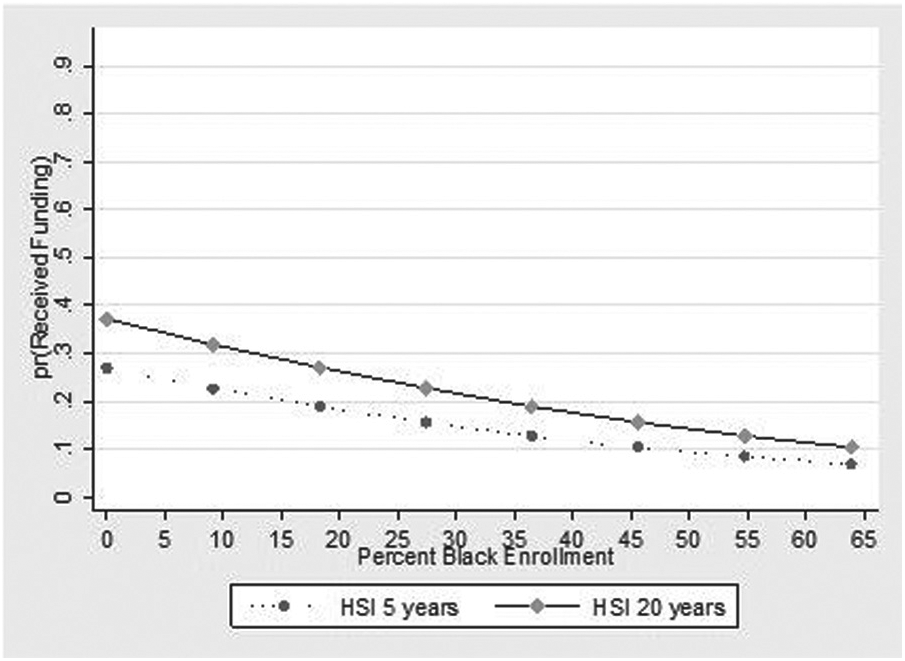
Probability of Title V Hispanic Serving Institution (HSI) grant receipt across black student enrollment and length of HSI designation.

Probability of Title V Hispanic Serving Institution (HSI) grant receipt across Asian student enrollment and length of HSI designation.
In summary, across estimations, it is only white student population share that is positively associated with HSI funding. For each of the three groups of color (Latinxs, blacks, and Asian Americans), there was either a moderately negative or steep negative association between student population share and the probability of Title V receipt. These findings are in concert with institutional proximity to whiteness and institutional distancing from blackness arguments. All else equal, there is no evidence that HSI resources are allocated in a manner that prioritizes the alleviation of Latinx educational inequalities by disproportionately serving institutions with larger Latinx shares.
Discussion
Recognizing vast educational disparities between Latinxs and other racialized groups, early Latinx education leaders advocated for the federal classification of Hispanic Serving Institutions. Their intention was to financially support the particular subset of higher education institutions serving large shares of Latinx students such that inequalities could be ameliorated over time (Valdez 2015). The HSI designation was officially recognized and allocated a separate funding stream by the federal government in 1992. At the time, 105 institutions were categorized as HSIs. Since then, many more institutions previously described as HWCUs or PWIs have enrolled larger shares of Latinx students and are becoming recategorized as HSIs eligible for said funding. In addition to the 492 current HSIs, 323 colleges and universities have been described as emerging Hispanic Serving Institutions (EHSIs) as they have between 15 percent and 24 percent Latinx student bodies and may cross the 25 percent threshold in the coming years (Excelencia in Education 2017). Recent demographic changes and the financial incentive of Title V grant eligibility have led some PWIs near the 25 percent threshold to actively pursue HSI status more rapidly by systematically recruiting Latinx students because it is organizationally useful (Nellis 2015). As illustrated in Figure 1, the growth in HSI funding eligibility necessitates greater competition for an even more limited set of federal resources.
How such racialized streams of funding are allocated is of interest to scholars of race, inequality, and education because these resources have the potential to partially ameliorate or even exacerbate preexisting patterns of racial inequality. For example, it is plausible that MSI funds for HSIs are allocated such that HSIs enrolling disproportionately larger shares of underrepresented groups are more likely to receive said resources. If true, larger shares of underrepresented students would have the potential to benefit from those funds in ways that diminish aggregate-level inequities between educationally advantaged and disadvantaged ethnoracial groups. This outcome would align with the goals of early Latinx higher education advocates. On the other hand, it is also plausible that among those categorized as HSIs, the share of underrepresented students matters little for resource allocation. After categorization as an HSI, alternative dimensions of race, namely, institutional proximity to whiteness and distance from blackness, may shape resource distribution (Sidanius and Pratto 2001). Insofar as whiteness confers status and value in a white-dominated society and blackness is devalued and denigrated, HSIs in closer proximity to whiteness and greater distance from blackness may be more likely to receive resources independent their share of Latinx students. Regrettably, this study—the first known systematic analysis of HSI funding as a racial project—illustrates that the latter is a more accurate characterization of how Title V Developing Hispanic Serving Institution resources are allocated and finds no evidence for the former. This represents an otherwise veiled contribution to racial inequality wherein a federal program created to alleviate ethnoracial inequities mirrors racially unequal patterns of resource distribution. This is not to say that some Latinx students and other students of color do not benefit from these resources. However, the funding is allocated in an aggregate manner such that smaller shares of Latinxs and other students of color, and larger shares of white students, are benefitting from MSI funds.
In addition to highlighting how racial inequality manifests for HSI funding, this study highlights the significance of considering the multidimensionality of race, often examined at the individual level (Campbell and Troyer 2007; Feliciano 2016; Morning 2018; Roth 2016; Vargas and Kingsbury 2016), at the meso level of racialized institutions (Ray 2017). Sociological scholarship has recently highlighted how the racial classification of individuals is multidimensional and how the power of race to stratify is influenced not only by how individuals self-classify but also by factors like skin color and how they are perceived racially by others (Monk 2015; Vargas et al. 2016). Likewise, scholarship has detailed insidious mechanisms by which institutions racially stratify as racialized organizations (Moore 2008; Ray 2017). Future work merging the insights of these literatures will permit a multidimensional framework for conceptualizing racialized institutions. In the case of HSIs, we see that racialized institutions can be clearly designated or identified as “minority serving” and yet other racialized dimensions of the organization may shape or elicit alternative racial understandings and stratifications. In this particular case, student demographics situate HSIs as proximal or distant to whiteness and blackness and pattern resource allocation in a manner that does not appear to alleviate aggregate-level ethnoracial educational inequalities. In accord with Ray (2017), it may serve scholarship on the racialization of institutions well to continue considering the multidimensional ways that race can stratify within and between organizations.
One related limitation of this study is that proximity to whiteness and distance from blackenss are multidimensional concepts that can be measured in a myriad of ways, and perhaps not all indicators of proximity are associated with how racialized resources are allocated. One might consider, for example, the skin color or national origin of those enrolled in categorically nonwhite institutions as indicators. Others might consider the racial demography of power-brokers within institutions marked as nonwhite. Each is worthy of consideration but unfortunately goes beyond the capabilities of the data used in this study. IPEDS does not collect data on students’ phenotypical characteristics or national origin, and data on the racial demography of college and university administrators suffer from high levels of missingness. Nonetheless, I find that one important dimension of proximity to whiteness and distance from blackness shapes the likelihood of receiving resources restricted to institutions categorically demarcated as nonwhite.
An additional limitation is that this study does well to differentiate between HSIs that did and did not receive Title V funding between 2011 and 2015 but cannot discern the Title V application process. Data on unsuccessful grant applications would permit a closer analysis of the mechanisms by which racialized federal funds are inequitably distributed by student racial demographics. Unfortunately, records of unsuccessful Title V grant applications are not publicly available. Therefore, this analysis is well suited to detail what the systematic patterns of racialized funding allocation look like but is not capable of differentiating the various mechanisms that may produce or maintain them. For example, it is plausible that for an unknown reason, eligible HSIs with larger white student bodies and smaller black student bodies are simply more likely to apply for HSI resources and aggregate differences in application rates account for the differences in resource distributions. Since the U.S. Department of Education does not make publicly available the failed applications, this explanation cannot be ruled out with the available data. Related, another limitation concerns issues of endogeneity. It is plausible that there are unmeasured factors that account for both the student racial composition of an institution and the likelihood of receiving Title V HSI resources. One such hypothesis is that larger shares of white students attend prestigious colleges and universities than their black student counterparts, and thus, it may not be the racial demography of an institution but its prestige or status that shapes HSI funding allocation. This hypothesis, of course, neglects to consider that institutional prestige and status are, in part, a product of racial composition. HBCUs, for example, were established as inequitably resourced institutions with lower status precisely because they enrolled black students. Likewise, HWCUs were afforded greater resources and prestige precisely because they enrolled white students. Therefore, it remains challenging to disentangle these relationships. Moreover, HSIs are composed of both two-year and four-year colleges, and there is no known ranking system that includes both types of institutions to produce a prestige or status score in order to examine systematic variation. However, insofar as four-year universities are generally perceived to have greater status than two-year colleges and private colleges are sometimes perceived as more prestigious than public universities, these remain important, though crude, control variables to consider. Notably, both measures were included in all multivariate models. Across each, there was no evidence that four-year institutions were more likely to receive HSI funding than two-year colleges, and private institutions were moderately less likely to receive Title V resources in two of the four models. Moreover, IPEDS includes an additional measure that hints at institutional prestige or status in the amount of institutions’ endowments. Unfortunately, this measure has very high levels of missingness, but in supplementary models with a much smaller sample (N = 240), I included this measure into the full statistical models detailed in Table 2 and found no significant association between institutional endowment and the likelihood of receiving Title V funding. Thus, while the prestige hypothesis may be worthy of additional investigation, results with the available data indicate that the status of an institution is not a core predictor of Title V grant allocations and that proximity to whiteness and distance from blackness shape resource allocation even while controlling for related indicators.
Conclusion
In this article, I found that institutional proximity to whiteness and distance from blackness are associated with how racialized higher education funding is distributed to institutions categorically designated as Hispanic Serving Institutions. This represents an important but otherwise hidden dimension by which racial inequality manifests within educational institutions (Garces and Gordon da Cruz 2017; Ray 2017). It is even more noteworthy that such patterns persist in an institutional context that was originally conceptualized to be anti-racist in practice. Though subsets of Latinx students undoubtedly benefit from HSI funding, it is clear that these resources can be allocated in the future to better serve a larger share of underrepresented students and thus truly serve anti-racist goals. The intention here is not to impugn HSIs or question the utility of valuable HSI funds but rather, to call attention to the racially unequal patterns of funding allocation from the state and urge a corrective.