




Abstract
Using the marital events data from the American Community Survey for the first time, we examine the association between the quantity and characteristics of unmarried men and first marriage for Black and White women ages 20 to 45. We incorporate both unmarried sex ratios and the economic status of unmarried men within each racial group using multilevel logistic models. We find higher marriage odds in markets with more (same-race) unmarried men, holding constant women’s own characteristics. In addition, local men’s education and employment rates also predict higher odds of White women’s first marriage. The findings imply that if White and Black women experienced similar unmarried sex ratios in their local markets, the gap in first marriage rates would be much smaller. We conclude that marriage promotion policies may be ineffective in part because they are targeting women who face structural barriers to marriage in their local marriage markets.
Debates over the decline of marriage revolve around the poles of structure and culture. The structure side sees marriage decline as a function of a combination of increased opportunity for some women (making marriage less necessary) and a lack of “marriageable” men for others (making marriage less available). The culture side focuses on some combination of individualism, feminism, and welfare dependency, any of which may be seen as weakening the will to marry. As the decline in marriage has been much steeper for less advantaged women (Lundberg, Pollak, and Stearns 2016), the emphasis has turned to these women rather than those for whom marriage is less imperative. The related policy debate has revolved around poverty and welfare programs, and the marriage gap between Blacks and Whites—especially parents—has been especially salient, with conservative culture warriors advocating for marriage promotion programs and structure proponents targeting mass incarceration, job opportunities, racial segregation, and discrimination.
In this paper, we assess the local marriage market characteristics that Black and White women encounter, specifically, the quantity and (economic) quality of potential male marriage partners, along with women’s individual characteristics, and the extent to which these variables predict marriage. To do this, we offer a new analysis of data from the American Community Survey (ACS), which has several unique properties that contribute new information to this set of questions. We examine the local availability of single men and the characteristics of those men as potential determinants of marriage for Black and White women using marital events data from the ACS. We have two goals that are essentially descriptive. First, we develop a multilevel model of marriage market conditions and women’s individual characteristics to help explain women’s odds of marrying. This is relevant because to the extent that marriage market factors influence the odds of marriage so that there is a relative shortage of men—or men with greater resources—then welfare state policies intended to increase marriage among poor women will be swimming against the tide. The continued political salience of marriage—and its decline, especially among African Americans and people with low incomes—underscores the need for ongoing analysis of this question. Second, we assess the extent to which Black-White differences in marriage market conditions affect race difference in marriage rates. Although this is a well-worn question from decades past (e.g., South [1996, which used data from the 1980s; Guzzo 2006, which used data from the 1990s), the problems it represents persist, making it worth revisiting under current conditions and with updated, nationally representative data.
Retreat from Marriage
William Julius Wilson’s “male marriageable pool index” (Wilson 1987; Wilson et al. 1985) established the importance of the local availability of men for women to marry—men who are not deceased, unemployed, incarcerated, or already married—for race differences in marriage rates. More recent research shows that low incomes and economic instability are major barriers to marriage even when existing couples, with children, have hopes of marrying (Gibson-Davis, Edin, and McLanahan 2005); this implies that both structural conditions and attitudes toward marriage are in play. Nevertheless, under the banner of a rejuvenated “culture of marriage” (Marquardt et al. 2012), marriage promotion—premised on behavioral change rather than structural change—remains a key component of U.S. welfare programs (Heath 2012; Randles 2016), with the expressed goal of reducing poverty by increasing marriage. Further, the Department of Health and Human Services currently includes “success sequencing for poverty prevention” among the goals of the Sexual Risk Avoidance Education Program, which refers to promoting marriage before childbearing (U.S. Department of Health and Human Services 2017). These efforts persist despite their demonstrated record of failure in both increasing marriage and reducing poverty (Cohen 2018).
The decline in the proportion of people who are married continues to generate scholarly attention. The increase in cohabitation, the baby boomers aging out of the typical age range of first marriages, a delay in timing of first marriages, and the increasing proportion of people who will never marry all are linked to the declining rates of marriage (Amato 2004; Brotherson and Duncan 2004; Lee and Payne 2010; McLanahan and Jacobsen 2015; Sassler and Miller 2017; Schoen and Cheng 2006). Although some scholars attributed marital decline to a rise in women’s education and employment opportunities, since Oppenheimer (1997), this theory has receded. Both men and women with more education and economic resources are now more likely to marry, and increasingly so (Gibson-Davis and Rackin 2014; Kuo and Raley 2016; Musick, Brand, and Davis 2012; Schoen and Cheng 2006; Sweeney 2002; White and Rogers 2000)—a pattern we confirm in the following. In particular, economic and social instability among men is one factor driving low marriage rates among women with low incomes and levels of education (Edin and Nelson 2013; Tach and Edin 2011).
While the proportion of all women who are married has declined since 1960, the proportion of married Blacks has decreased much more dramatically than for Whites. To establish this contemporary context, we present Figure 1 (Bennett, Bloom, and Craig 1989; Schoen and Cheng 2006). The causes of these differences remain unresolved (Lee and Payne 2010), but the lower educational attainment of Black men—perhaps relative to Black women’s—certainly accounts for some of their decline in marriage rates (Autor and Wasserman 2013).

Percent ever-married: non-Hispanic women ages 18 to 59, 1960–2016.
Marriage Markets
Prior research has analyzed the effects of marriage markets on odds of marriage using sex ratios (Guzzo 2006), a structuralist perspective that attends to effects of sorting, and marital search theory, which proposes that individuals with more desirable characteristics will be most likely to marry within a given marriage market (Graefe and Lichter 2007; Lewis and Oppenheimer 2000). This tradition of research focuses on local variation in accounting for the potential pool of mates available (Crowder and Tolnay 2000; Lichter, LeClere, and McLaughlin 1991), in some cases down to the neighborhood level (South and Crowder 1999).
A surplus of available men increases the probability of women’s entry into marriage (South 1996), and men are less likely to marry in markets with higher employment rates for women (Lloyd and South 1996). Choosing to marry is also positively related to the availability of potential mates for unmarried parents in particular (Harknett and McLanahan 2004). In addition, weak marriage markets, defined by a shortage of employed men, increase the likelihood that women who do marry will partner with economically unappealing men (Harknett 2008). Early research showed that marriage markets favorable to women increase the odds that women marry up in terms of education and occupation (Lewis and Oppenheimer 2000; Lichter, Anderson, and Hayward 1995). In the past several decades, as women’s educational attainment has risen relative to men’s, women’s tendency to marry men with lower levels of education has increased (Qian 2017).
The pool of available partners affects a range of relationship behaviors and disparities (Warner et al. 2011). Shortages of available men are associated with more negative attitudes about marriage, lower quality relationships, and poor fathering (Harknett and McLanahan 2004). Women who delay marriage to pursue educational and economic opportunities may face bleaker marriage markets as their odds of marriage diminish as they age (England and McClintock 2009; Manning et al. 2010). One explanation for the reduction in older women’s odds of marriage is men’s tendency to marry younger women and women opting to remain unmarried instead of marrying down (England and McClintock 2009).
With regard to race differences, Black women face weaker marriage markets, which negatively influences the probability of cohabitation or entry into marriage (Bennett et al. 1989; Raley 1996; South 1996). However, how much of the disparity is attributable to marriage market characteristics is unresolved—and may be changing. Marriage market disparities do not explain most of the Black-White marriage gap (Guzzo 2006), although for single parents, the greater relative number of employed White men compared to employed Black men explains a significant amount of the race differences in odds of marriage (Harknett and McLanahan 2004). Higher rates of incarceration of Black men negatively influence the odds of marriage for incarcerated men and increase the risk of divorce, while limited research indicates the effect on the marriage market for Black women is small (Harknett 2008; Lopoo and Western 2005).
Family scholars have also studied the multiple other market variables such as state child support enforcement (Huang 2002), welfare benefits (McLanahan and Casper 1995), average male wages (Blau, Kahn, and Waldfogel 2000), and access to assisted reproductive technology (Abramowitz 2014). High divorce rates in a population decrease the probability of entry into marriage, at least for single parents (Waller and Peters 2008). Whereas most research on marriage markets focuses on men’s characteristics, a few studies have looked at women’s attributes (Manning et al. 2010). For instance, mothers are less likely than women without children to marry men with similar resources and less likely to marry men with higher education or status (Qian, Lichter, and Mellott 2005). Despite all of the marriage market factors that influence odds of marriage, however, advocates for marriage promotion consistently have neglected the connection between marriage rates and the quantity and quality of available partners.
Marriage Promotion
The retreat from marriage triggered research and social policy initiatives (Amato 2004; Fincham and Beach 2010), mostly focusing on discouraging premarital births and reducing poverty (Amato and Maynard 2007; McLanahan 2009). The marriage movement became a part of the national agenda with its incorporation into the welfare system after 1996 (Heath 2012; Randles 2016). The 1996 welfare reform led to the Healthy Marriage Initiative, which budgeted $150 million annually to promote fatherhood and marriage (Cohen 2018; Fincham and Beach 2010). Despite these national initiatives, marriage rates continue to decline, especially for those most directly targeted: women with low education (Cohen 2015). Rigorous studies of marriage promotion programs showed the interventions yielded no effect on marriage rates (Lundquist et al. 2014; Wood et al. 2010). Given that marriage aspirations have remained high (Lichter, Batson, and Brown 2004), it is important to note that these programs have also attempted to teach relationship skills and values, not just increase the desire to marry. Without improving economic stability and resource availability, such efforts are unlikely to succeed (Lichter et al. 2004; Qian et al. 2005; Smock, Manning, and Porter 2005).
We test whether structural factors are associated with marriage probabilities for women, within-race for Black and White women, beginning with unmarried sex ratios. Then we consider whether that association is mediated by the economic characteristics of the available men in terms of income, education, and employment. This follows prior research on marriage market effects that has considered related variables with older data (Lichter et al. 1995; Lloyd and South 1996). The advances reflected in our data and methods are described in the following. Our expectation is that sex ratios skewed toward men will be positively related to the odds of marriage because of the greater number of potential partners for women to find and because the odds will be greater that a particular woman will be seen as a desirable marriage partner by the men she encounters. However, for relatively poor women, the logic of “I can do bad by myself” (Edin and Kefalas 2005:81) may discourage women from wanting to marry men who don’t have adequate economic resources or earning potential. The descriptive nature of this analysis precludes differentiating between “independence” effects for women and the cultural attitudes that lead men not to want a wife who earns or will earn more than they will (Harknett and Kuperberg 2011).
Data and Methods
We used the 2009–2011 American Community Survey public use data files made available by IPUMS (Ruggles et al. 2010). The ACS is a nationwide, annual survey conducted by the U.S. Census Bureau. Our analyses used the 2011 ACS three-year file because the variables for migration between metropolitan areas (MAs) used in our models were not available starting after 2011. 1 The total unweighted sample consisted of 300,090 non-Hispanic White and Black women between the ages of 20 and 45 who were either never married or married for the first time in the previous year. We limited the sample to ages 20 through 45 because this age range represented 95 percent of people who married for the first time the prior year. We focused on first marriages because they are the target of marriage promotion efforts, and research shows marriage markets are qualitatively different for previously married individuals than never-married persons (Qian and Lichter 2018). To ensure an adequate sample size in each MA, we used 172 MAs with at least 50 unmarried Black women in the sample; we excluded women who lived in MAs that were not identifiable or outside of any MA and those who were incarcerated.
To better capture conditions affecting marriage decisions in the previous year, for the MA-level variables, we used the current metropolitan variable for all respondents who did not move the previous year and the metropolitan area of residence one year previous for respondents who migrated within the year. Due to changing delineations of boundaries of the public use microdata areas, we did not know migration destinations for people from six metropolitan areas in our sample. 2 Thus, we were unable to identify whether 10,041 respondents (3 percent of the analytic sample) moved from another location within the same MA or from a different MA than they currently reside. Therefore, we used their current area of residence in the analyses. We excluded people who did not live in a metropolitan area in the previous year.
To our knowledge, this is the first analysis to use these recent ACS data for analysis of marriage market composition and marriage incidence (rather than prevalence). The dependent variable was dichotomous, with 0 indicating never-married women and 1 designating the respondent married for the first time in the previous 12 months. Essentially, we were modeling the odds of first marriage occurring in a single year using a cross-sectional data set. The key predictor variable was a sex ratio, the number of unmarried men per unmarried woman aged 20 to 45, calculated separately for Black and non-Hispanic White women in each metropolitan area (e.g., unmarried White men per unmarried White woman). To ease interpretation in the models, we subtracted 1 from this variable so that zero equaled sex balance, positive numbers indicated more men than women, and negative numbers indicated the reverse. For men’s marriage-relevant economic resources, we used the local mean of dichotomous indicators for completion of high school, a bachelor’s or higher degree, and being employed, all for unmarried men ages 20 to 45. We also included a continuous indicator of the natural log of annual earnings for men with income greater than zero. We constructed the marriage market variables on a within-race basis and estimate separate models by race. We included several MA-level control variables to capture other characteristics of the local area that might influence the odds of marriage decisions. For family context, we included the divorce prevalence (the percentage of people ages 20–64 with marital status of divorced). For housing market conditions, we included the percentage of homes that were owned by their residents. Finally, although we modeled marriage markets as monoracial, our marriage outcome was not restricted to those who married within their racial group. To help account for the local propensity to intermarry (Crowder and Tolnay 2000), we also controlled for the local interracial marriage rate (the percentage of married Blacks who are married to Whites), and the census region.
Models were adjusted for individual characteristics identified from previous research or suspected to influence women’s odds of marrying. We used a series of six dichotomous variables for women’s educational attainment, from completed less than high school to completion of a MA or professional degree. We accounted for disability status influences with a dichotomous variable (1 = yes, 0 = otherwise). We also controlled for earnings (the natural log of annual hourly wage), which was relatively normally distributed for those with earnings, as well as a dichotomous variable for those with no earnings in the previous year (those at the far left of the income distribution), and age in years.
We first present descriptive statistics for the dependent and independent variables for White and Black women in our analytic sample. Next, we employed a multilevel modeling approach because observations within MAs are not independent. Unobserved characteristics that vary by metropolitan area were thus accounted for by adjusting the standard errors of the regression coefficients, providing a more conservative estimation of the MA effects. We show hierarchical logistic regression analyses to examine the odds of marrying for the first time separately for White and Black women, adjusting for women’s individual characteristics. We then regressed marriage on the sex ratios and then on the male characteristic variables separately for Black and White women. In our final analyses, we added the remaining MA-level predictors. All predictor variables in the regressions were centered at their grand means (mean = 0), except the metro area sex ratio, which is 0 when the unmarried sex ratio is 1 (see previous). In all analyses, we used census-provided person weights. The models were estimated with the software package HLM 7.
Results
Descriptive statistics for variables used in the analysis are shown in Table 1. The summary statistics show that 5.5 percent of the women in our analytic sample married for the first time the previous year. First marriage was more than twice as likely for White women (6.7 percent) compared with Black women (3 percent). These White women on average lived in MAs with 1.176 unmarried White men for every unmarried White woman (.176 in the table). That was about 50 percent higher than the ratio for Black women, which averaged .784 unmarried Black men for every unmarried Black woman (−.216 in the table). Among unmarried men ages 20 to 45, the White men in these markets were systematically better off than the unmarried Black men. Means across MAs show White men have higher earnings (logged 9.937 vs. 9.602, or $20,683 vs. $14,788), employment rates (74 percent vs. 58 percent), high school completion (95 percent vs. 84 percent) and college completion (31 percent vs. 13 percent).
Summary Statistics for Analytic Sample.

Note: Weighted with person weights.
Among individuals in the analytic sample, White women were also heavily advantaged, with college graduation prevalence more than twice as high as Black women’s as well as higher wages and lower levels of non-employment or disability. White women in the sample were also about two years younger on average, reflecting their higher rates of early marriage. The descriptive statistics also show the importance of our decision to code women according to where they lived in the previous year if they have moved as their mobility rates were high: 32 percent of White women and 26 percent of Black women in the sample lived in a different MA the previous year. Because this variable was also positively associated with the odds of having married (see the following), we know that migrating is more likely around the time of marriage, and therefore it is important to use characteristics of the previous MA for analyzing the determinants of marrying.
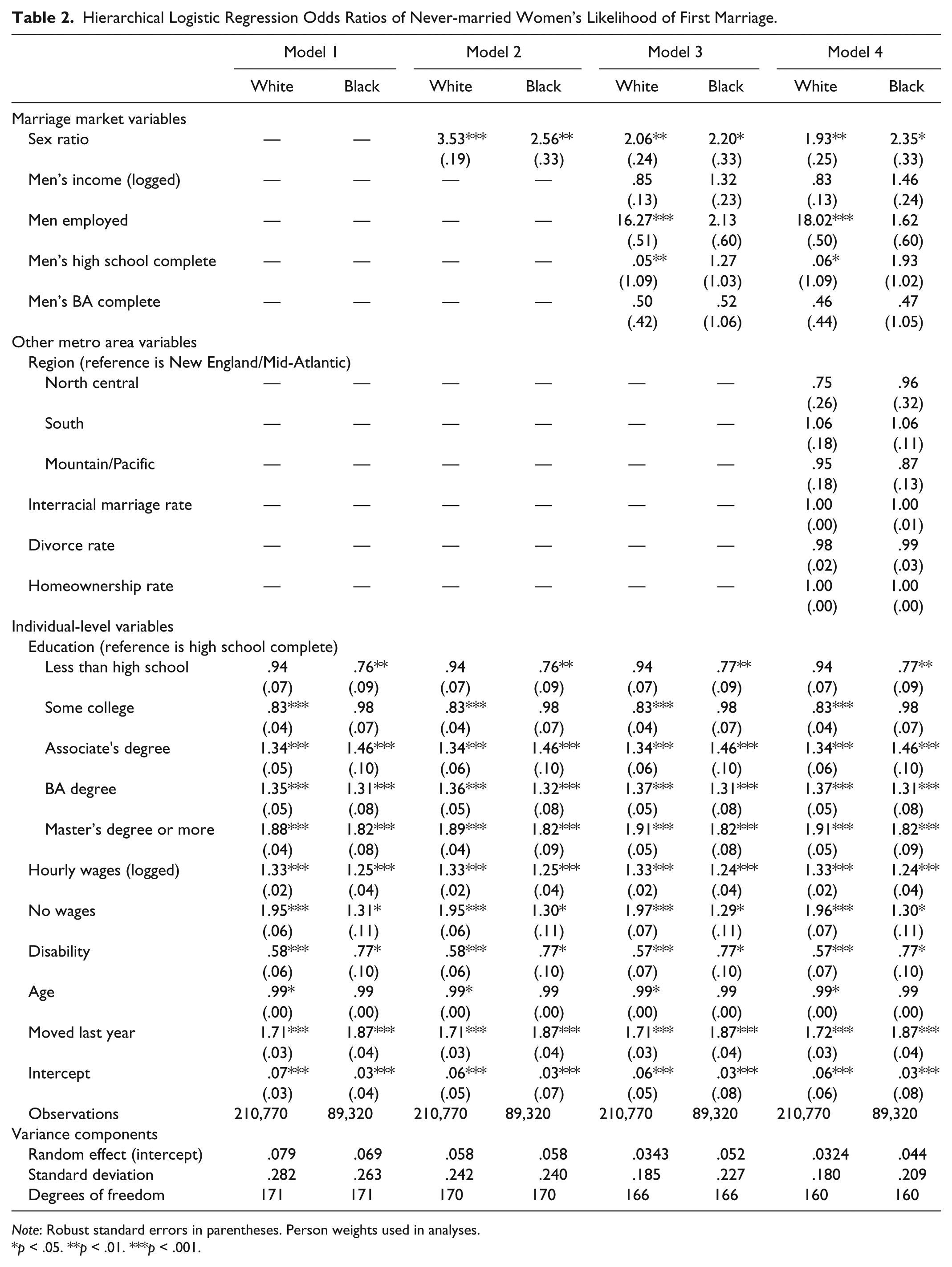
Results from our hierarchical logistic regression models are shown in Table 2, with odds ratios and robust standard errors in parentheses. Model 1 includes only the individual variables, showing that the models were quite similar for Whites and Blacks: First marriage was more likely among those with higher levels of education; those with master’s degrees or higher were most likely to marry. Women with higher wages were more likely to marry, unless they had no wages at all, in which case they were more likely to marry as well. Those who moved in the last year were also more likely to have married. Note that because wages were calculated from previous year earnings and the exact date of marriage and migration are not reported, we don’t know the sequence of marital, labor market, and migration events; our goal here was to control for any factors that might be driving the marriage market effects we assess in the subsequent models.
Hierarchical Logistic Regression Odds Ratios of Never-married Women’s Likelihood of First Marriage.
Note: Robust standard errors in parentheses. Person weights used in analyses.
p < .05. **p < .01. ***p < .001.
Model 2 shows a strong and significant effect of unmarried sex ratios for both White and Black women, who were more likely to marry for the first time when there were more unmarried men per unmarried woman in their respective marriage markets, as anticipated. Model 3 adds the indicators of unmarried men’s economic status in their marriage markets. Only men’s employment and high school completion rates were significantly associated with the odds of first marriage and only for White women. For White women also, adding these variables substantially attenuated the effect of sex ratios on first marriage rates (the odds ratio falls from 3.53 to 2.06), but for Black women the attenuation was much more modest. (Concerned about possible collinearity, in additional models, not shown, we combined the male economic variables into an index variable, but it also had no significant effects on Black women’s first marriage odds.) Finally, Model 4 adds the metro area controls for region, interracial marriage, divorce rate, and homeownership rate. None of these had significant effects in the models, and the sex ratio effects remain relatively stable.
Figure 2 shows the results from Model 4, with White and Black women plotted together (although estimated separately), with each metro area represented by a marker scaled to its relative sample size. The predicted first marriage probabilities were calculated at the mean of all variables except sex ratios, which were set to equal zero at sex balance. The figure shows the almost completely distinct marriage market conditions for White and Black women. Vertically, the markers for White women were clustered around their average first marriage rate (6.7 percent), while those for Black women were clustered at less than half that rate (3.0 percent). The horizontal spread illustrates the separation in sex ratios between the two groups of women, with virtually all White women living in metro areas where unmarried same-race men outnumbered them and the opposite holding true for Black women. For both groups, there was a clear positive relationship between sex ratio and marriage odds, holding constant the other individual and metro area variables. These results imply that if both groups experienced similar sex ratios, at or close to equality, the gap in first marriage rates would be much smaller (we have refrained from the exercise of calculating this hypothetical convergence more precisely than what the figure shows).

Unmarried sex ratios and predicted first marriage rates, by race, U.S. metro areas, 2009–2011 (ages 20245).
Discussion
We presented evidence that the structure of marriage markets, especially the unmarried sex ratio, was strongly associated with the odds of first marriage for Black and White women. This empirical analysis provided updated, nationally representative data and multilevel models with both individual and marriage market variables to the existing literature on this subject (e.g., Graefe and Lichter 2007; Harknett and McLanahan 2004; Lewis and Oppenheimer 2000; Lichter et al. 1991; South 2006; South and Crowder 1999; Wilson 1987). To our knowledge, this is the first use of the American Community Survey marital events data to study racial differences in transitions to marriage across marriage markets.
This analysis is limited in several important ways. First, in addition to only including non-Hispanic Black and White women, we impose monoracial compositions on Black and White women’s marriage markets. Intermarriage rates are low, so this is not an unreasonable compromise to make for the sake of analytical parsimony, but more thorough attention to intermarriage between different groups would add greater understanding to these questions (Crowder and Tolnay 2000). Second, because the data are cross-sectional, we were limited in our ability to analyze the sequence of events related to marriage, migration, and labor market status. The ability to place women in the marriage markets where they lived one year previously is an important innovation, but we cannot be completely sure of the context in which marriage decisions were being made. Note also that because the ACS has no information about prior household composition, we cannot analyze the effect of previous living arrangements, including the presence of children, on marriage. This is a key reason we focused on first marriages, to reduce such life course complexities. Finally, the cross-sectional nature of the data and construction of the marital events variables here also prevented us from studying the role of nonmarital cohabitation either as a precursor to marriage or an outcome of local contextual factors. Although it is possible to identify cohabitors in the ACS data, it is not possible to identify people entering (or leaving) cohabiting relationships. Finally, left out of this analysis is the crucial, preceding question of what creates disparities in the relative number of unmarried men, which presumably reflects a combination of disparities in mortality, incarceration, outmarriage, and geographic mobility; these questions are left for another day.
We were motivated to pursue this analysis by the continued attention in policy circles to the idea of promoting marriage, especially among poor parents, with the expressed goal of reducing poverty (Cohen 2018). As noted, research on the programs that have emerged from this agenda shows their unequivocal failure to increase marriage rates. However, the idea continues to garner supporters, based on the assumption that poor people, especially poor Black people, have insufficient motivation or perhaps lack the necessary relationship skills to marry. For example, a “consensus plan” to reduce poverty from the American Enterprise Institute and the Brookings Institution recommends a national program to “promote a new cultural norm surrounding parenthood and marriage” (AEI/Brookings 2015). Our analysis showed that such programs are swimming against the tide. Not only do women with low education levels have lower odds of first marriage, but in the case of Black women, their odds of marriage were further hampered by a shortage of unmarried men in their marriage markets. This result held when we controlled for both individual and other marriage market characteristics. Although the results we presented were consistent with those found in previous research, offering updated data and new methods of analysis (data and code freely available) may be useful to other researchers in this area.
