




Abstract
The papers in this special issue use newly available panel data and data from the Program for International Student Assessment (PISA) to examine linkages between parental resources and children’s outcomes in China, Japan, and Korea. Specific foci of the papers include regional differences, non-monetary resources, shadow education, gender differences, and the proximity of grandparents. Results demonstrate that, as in western societies, parental education and income are positively associated with child well-being and development in East Asia, but distinctive contextual features contribute to variation in these relationships. It is also clear from the findings that relationships between parental resources and child outcomes are more complicated than suggested by simple emphases on economic inequality and the relative success of children from rich and poor families. Together, these papers contribute a much needed geographic extension to the large cross-national literature on parental resources and children’s well-being. The findings provide a valuable empirical basis for assessing the role of context and understanding similarities and differences within East Asia and between the East and West.
Introduction
The role of parental resources in shaping children’s well-being and life chances is a question of long-standing interest to social scientists. Numerous studies in economics, education, human development, sociology, and psychology demonstrate that parents’ financial resources, human capital, and social capital are positively associated with many aspects of children’s development. This research has focused primarily on the disadvantages faced by children living in poverty, but also considers the ways in which middle- and upper-middle-class parents invest in their children’s success (e.g. Duncan and Brooks-Gunn, 1997; Ermisch et al., 2012; Mayer, 1997; Reeves, 2018). Importantly, socioeconomic differences in children’s outcomes are visible from early childhood and appear to grow as children enter adolescence and young adulthood. Relationships between early-life well-being and subsequent educational success, occupational outcomes, and other dimensions of well-being across the life course (e.g. Knudsen et al., 2006) mean that socioeconomic differences in childhood well-being play an integral role in the intergenerational transmission of inequality.
Analyses of linkages between parental resources and children’s outcomes in a number of countries, and in cross-national comparative perspective, have made foundational contributions to our understanding of these relationships. Cross-national research has typically utilized large, multi-country studies like the Program for International Student Assessment (PISA) or harmonized panel studies in select countries such as the Early Childhood Longitudinal Study in the USA and the Millenium Cohort Study in the UK (e.g. Chmielewski and Reardon, 2016; Waldfogel and Washbrook, 2011). While this work provides valuable evidence regarding similarities and differences across societies, it contains little information about countries in East Asia. Data sources that do include East Asian countries (e.g. PISA) typically do not include measures of parents’ income or of children’s non-academic outcomes (e.g. physical and emotional well-being) and are typically limited to a single year in children’s lives. The absence of longitudinal surveys of children in East Asia has precluded the inclusion of these countries in cross-national research based on harmonized panel survey data. As a result, our understanding of the ways in which parental resources are associated with children’s outcomes is largely devoid of insights from a large region of the world characterized by highly competitive educational systems, strong links between education and labor market outcomes, high levels of family investment in children’s education, and growing social and economic inequality.
The goal of the five papers in this special issue is to address this key limitation in the cross-national literature on child well-being by drawing upon newly available panel data on children’s outcomes in China and Japan, and data from PISA in Korea. The papers also include analyses of comparable data from the USA to provide a well-studied point of comparative reference. This overarching goal encompasses two more specific objectives. The first is to provide an initial descriptive overview of children’s cognitive and non-cognitive outcomes and how they vary by household income in East Asia. The focus on income, rather than parental education or other well-established socioeconomic correlates of children’s educational success, is motivated primarily by large differences in the distribution of parental educational attainment (especially in China) and the consistency with which parental income is measured across the surveys. 1 A second specific aim is to capitalize on contextual differences to better understand how social, cultural, economic, and policy context may shape relationships between parental resources and child well-being. Results of the five papers provide an empirical basis for assessing the role of context and understanding similarities and differences in these relationships within East Asia and between the three East Asian countries and the USA. These insights are facilitated by the incorporation of cross-national comparative analyses and the authors’ efforts to evaluate the consistency of results across the three countries (and the USA). Do we observe consistent patterns across the East Asian countries that differ from the findings of research on the USA and other western countries? To what extent might such results reflect distinctive features of the East Asian context, including highly competitive educational systems, high economic returns to education, heavy family (especially maternal) investment in children’s education and development, uniform school curricula, increasing social and economic inequality, and histories of gender disparities in educational aspirations and attainment?
Socioeconomic gradients in children’s well-being in the West
It is clear that children in families of higher socioeconomic status (SES) fare better on a wide range of cognitive/academic and non-cognitive outcomes relative to their less advantaged counterparts. Cognitive outcomes include school readiness (e.g. word recognition), test scores, grades, completed education, and general intelligence, and non-cognitive measures include emotional and behavioral outcomes, self-esteem, friendships, psychological health, and physical health (Duncan and Brooks-Gunn, 1997; Duncan et al., 2014; Hjalmarsson and Mood, 2015). While positive socioeconomic gradients have been documented for all of these outcomes, they appear to be stronger for the cognitive measures (Ermisch et al., 2012; Khanam and Nghiem, 2016; Washbrook et al., 2014).
Previous research clearly shows that socioeconomic gradients in children’s outcomes are visible from infancy and continue through adolescence. Analyses of differences (by parental income or education) in school readiness have repeatedly shown that students from lower-SES families start school well behind their middle-class counterparts (Carneiro and Heckman, 2003; Duncan and Magnuson, 2011; Duncan et al., 2012; Lee and Burkam, 2002; Waldfogel and Washbrook, 2011) and do not catch up. The persistence and recent widening (Bailey and Dynarski, 2011; Reardon, 2011) of differentials apparent in early life is critical for understanding processes of cumulative dis/advantage through which early childhood disparities serve to either advantage or disadvantage children at subsequent stages of their development processes and schooling trajectories (Cunha and Heckman, 2007; Lee and Jackson, 2017). These processes of cumulative dis/advantage link early childhood differences in well-being to disparities in adult educational and economic outcomes (e.g. Duncan and Magnuson, 2011; Duncan et al., 2010; Farkas, 2011; Jackson, 2010; Mood et al., 2012; Sobolewski and Amato, 2005).
The link between parental income (or socioeconomic resources more generally) and children’s success is thus critical for our understanding of patterns of intergenerational mobility and of policies designed to ‘level the playing field’ (Ermisch et al., 2012; Goldin and Katz, 2008). Powerful evidence of the effectiveness of such policies is provided by earlier experimental studies (e.g. the Perry Preschool and Abecedarian studies and the Infant Health and Development Program) that serve as an important empirical basis for recent efforts to promote broad access to early childhood education programs as an effective tool for reducing income gradients in children’s well-being (Duncan and Sojourner, 2013; Gormley et al., 2008) and for more comprehensive efforts in the UK and USA to substantially reduce levels of child poverty (National Academies of Sciences, Engineering, and Medicine, 2019; Waldfogel, 2013). 2 Of particular importance is recent evidence that the cognitive and non-cognitive benefits of early-childhood educational interventions appear to be strongest for the most disadvantaged children (Xie et al., 2020).
Efforts to understand relationships between parental economic resources and children’s well-being have considered a range of potential explanations. These include correlation of family income with parents’ own education and social capital, residential segregation and the quality of local public schools, and direct expenditures on children, including investment in quality day-care/preschool and enriching activities (Becker, 1991; Duncan and Murnane, 2011; Ermisch et al., 2012; Kornrich and Furstenberg, 2013; Shonkoff and Phillips, 2000). The relationships between parental income and children’s outcomes may also result from differential fertility and socioeconomic differences in family formation and dissolution (Becker and Lewis, 1973). To the extent that higher-earning men and women have fewer children on average, are less likely to form single-parent families (through non-marital childbearing or divorce), and become parents at older ages, their children may have access to higher-quality parenting and greater social capital, and face less competition from other siblings for parental time and resources (Duncan, Kalil and Ziol-Guest, 2017; Ram and Hou, 2003). Other research has emphasized relationships between economic deprivation, home environment, stress, and the quality of parenting and parents’ interactions with children to explain income gradients in children’s outcomes (Chase-Lansdale and Pittman, 2002; McLoyd, 1990; Smith et al., 1997; Waldfogel and Washbrook, 2011; Yeung et al., 2002). While identification of causal relationships has typically not been an explicit goal of this research, some efforts to account for the potential endogeneity between parental income and children’s outcomes find a relatively small (but not zero) causal effect of income (e.g. Blau, 1999; Dahl and Lochner, 2012; Mayer, 1997). Research using experimental data has also documented positive causal effects of parental income on children’s outcomes (Duncan et al., 2011; Morris et al., 2001).
Earlier research typically focused on academic outcomes (e.g. test scores, school completion), but scholars increasingly emphasize the role of early-life socioeconomic differentials in shaping children’s non-cognitive skills as well. The term ‘non-cognitive skills’ encompasses a broad range of characteristics, including self-control, patience, attention, persistence, self-esteem, ambition, and goal orientation (Duncan and Magnuson, 2011; Farkas, 2003; Heckman and Kautz, 2012). This research shows that children of lower-earning (and less-educated) parents tend to fare less well on these outcomes. For example, Duncan and Magnuson (2011) showed that low parental income is strongly correlated with lower attention skills and more behavioral problems for children. The importance of these relationships lies in the fact that non-cognitive skills, broadly defined, have been linked to success in school and beyond and thus play a central role in the processes of intergenerational transmission of dis/advantage described above.
The mechanisms linking parental resources, children’s non-cognitive skills, and subsequent outcomes are varied and reinforcing. For example, parental income is positively associated with favorable attitudes toward school and children’s own expectations/aspirations for their education (Farkas, 2011), and the social skills and attention skills of children from higher-SES families facilitate their success in school (Cunha and Heckman, 2007, 2008). In addition to the aforementioned evidence of a weaker association between parental income and children’s non-cognitive outcomes (relative to cognitive outcomes), some evidence suggests that the relationships we do observe may be due primarily to the deleterious effects of parental stress, lower parenting quality, and more chaotic home environments in low-income families (Khanam and Nghiem, 2016).
Research on poverty and child development often considers differences by children’s age and sex. From this work, it appears that exposure to poverty in early childhood, and longer duration of exposure to economic disadvantage, is particularly detrimental for subsequent outcomes (Duncan and Brooks-Gunn, 1997; Duncan et al., 1994, 2010; Smith et al., 1997). This appears to reflect a range of factors, including residential segregation and lower school quality, higher levels of family stress, more exposure to toxins, less access to intellectually stimulating activities and resources, and the physiological effects of poverty on brain development (e.g. Duncan, Magnuson and Votruba-Drzal, 2017; Hair et al., 2015). There is some evidence that the association between resources and outcomes is stronger for boys than for girls, especially the linkages between economic resources, behavior problems, and educational success (Duncan and Magnuson, 2011). Recent research on parental spending on children also shows that the pattern of lower spending on girls visible in the 1970s has disappeared and perhaps reversed (Kornrich and Furstenberg, 2013).
Much of the research on family resources and child well-being has focused on the United States – either in single country studies or as part of cross-national comparative analyses. From this work, it is clear that the USA is an outlier with respect to the strength of the association between parental socioeconomic resources and children’s well-being (Ermisch et al., 2012; Smeeding et al., 2011). It is also clear that the magnitude of childhood differentials varies markedly across countries, with implications for cross-national differences in intergenerational mobility. In general, this research suggests that the strength of the income gradient in children’s well-being and the degree to which dis/advantage is transmitted across generations are more pronounced in societies characterized by relatively higher levels of social and economic inequality (Corak, 2013; Smeeding et al., 2011). This is not surprising considering that differentials in children’s success may be both a consequence and a cause of economic inequality (e.g. Becker and Tomes, 1979). Other research points to the role of policy environment (e.g. welfare policies, family support policies, early childhood education policies) in shaping the socioeconomic gradient in children’s outcomes (DiPrete and Eirich, 2006; Ermisch et al., 2012; Solon, 2004).
Increasing economic inequality has also been linked to growing socioeconomic gaps in children’s achievement in the USA (Reardon, 2011). Related research describes a growing sense among parents that substantial investments in children are necessary to facilitate their success (Doepke and Zilibotti, 2017; Kornrich and Furstenberg, 2013), and it appears that those with more income are acting on this view of childrearing in ways that exacerbate socioeconomic differences in investments in children (Kalil et al., 2016; Lundberg and Pollak, 2015; Reeves, 2018).
The East Asian context
In contrast to the large body of literature on socioeconomic inequalities in children’s well-being in the USA and other western countries, research on East Asia is scant. To a large degree, this reflects data limitations. Because large-scale, nationally representative panel studies of children have not been available, researchers have been forced to rely on cross-national comparative studies that include surveys of countries in the region. Surveys such as PISA and Trends in International Mathematics and Science Study (TIMSS) are excellent sources of comparative information on children’s academic performance but, as noted above, are limited in other ways relative to panel surveys containing detailed information on parents’ economic resources and children’s cognitive and non-cognitive outcomes throughout childhood and adolescence.
The paucity of research on East Asia is unfortunate in light of many distinctive features of both families and educational systems in the region. As mentioned above and discussed in greater detail below and in the papers contained in this volume, these features include strong family ties (such as the involvement of grandparents in childrearing and children’s education), strong norms of intensive maternal investment in children’s education and development (particularly during preschool ages), son preference, highly standardized public education systems, and heavy family investment in private education (i.e. cram schools). All of these features are potential sources of important insights regarding contextual modification and extension of existing theory and empirical evidence.
Social, economic, and demographic indicators in China, Japan, Korea, and the USA.
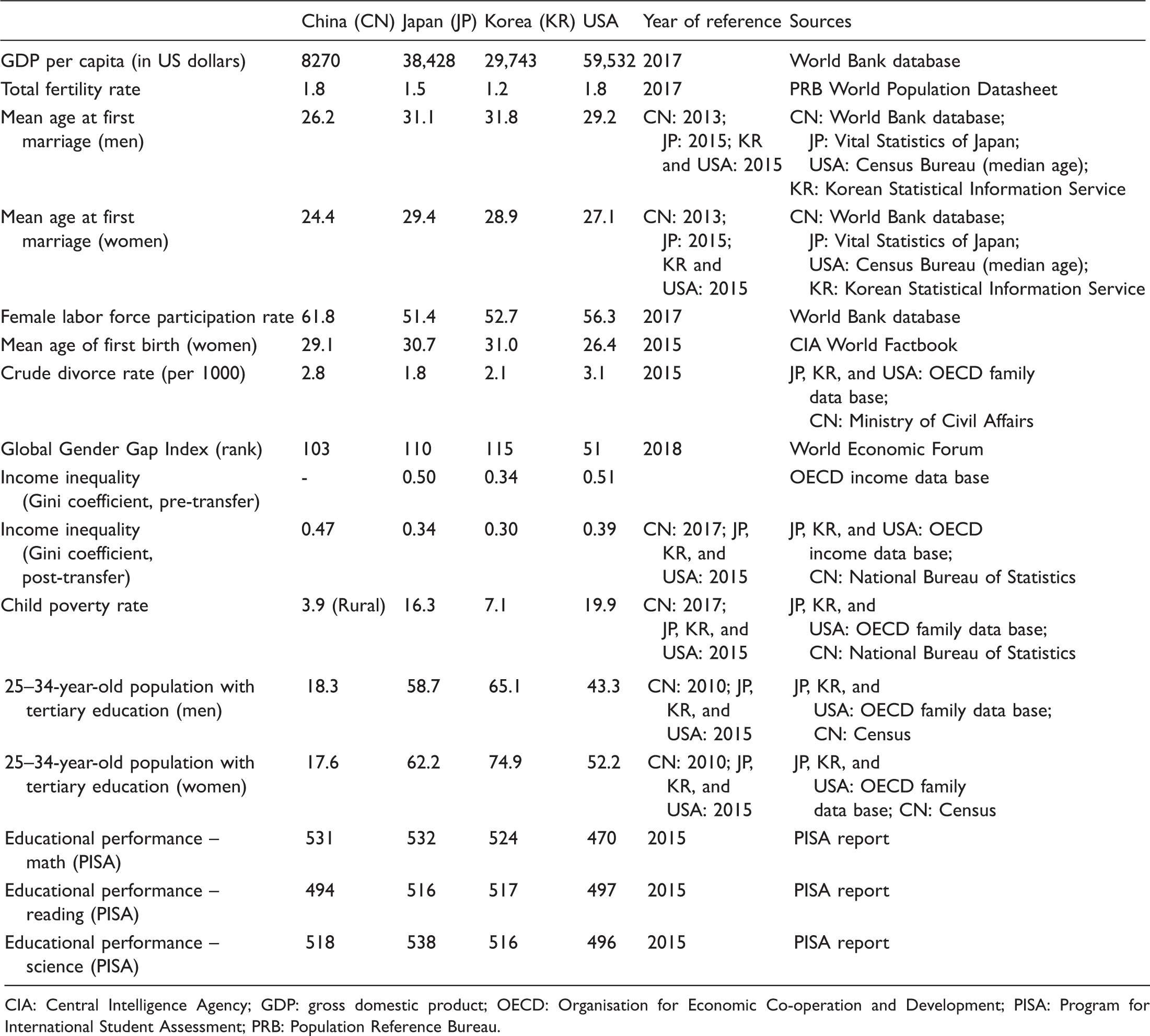
CIA: Central Intelligence Agency; GDP: gross domestic product; OECD: Organisation for Economic Co-operation and Development; PISA: Program for International Student Assessment; PRB: Population Reference Bureau.
The relatively high levels of income inequality in China, Japan, and Korea are particularly interesting in light of the aforementioned evidence from cross-national research indicating that aggregate inequality plays a role in shaping linkages between parental resources and children’s outcomes. In the not-so-distant past, Japan and Korea were characterized by average levels of income inequality (e.g. Bauer and Mason, 1992; Ku et al., 2018), and China had a state-run economy, but income inequality has increased in all three countries, most dramatically in China (Feng, 2011; Xie and Zhou, 2014). To the extent that aggregate levels of income inequality reflect social and economic forces (and patterns of behavior) that result in relatively strong linkages between parents’ economic resources and children’s well-being, we might expect the income gradient to be pronounced in analyses of recent data from these three countries.
Aggregate income inequality is associated with other key contextual characteristics in Table 1, including family stability. Income inequality tends to be relatively high in countries (like the USA) where rates of family dissolution and the prevalence of single-parent families are also high. It is also clear from a large number of studies that children tend to fare better in two-parent families than in single-parent families and that this relationship reflects the fact that single-parent families have, on average, fewer economic resources, less time, and more limited capacity to provide effective parenting (e.g. Brown, 2010; McLanahan et al., 2013). Family stability has long been the norm in East Asian countries, but this is changing rapidly. Until recently, China, Japan, and Korea were all characterized by relatively low rates of divorce (and they continue to be characterized by negligibly low levels of non-marital childbearing), but divorce rates have risen steadily over time (rapidly in China). As in the USA, there is a clear negative income gradient in divorce in Japan (Raymo et al., 2013), Korea (Park and Raymo, 2013), and China (Ma et al., 2018). These findings suggest that differences in family stability may contribute to the income gradient in children’s outcomes in ways consistent with ideas about ‘diverging destinies’ of children from different socioeconomic backgrounds (McLanahan, 2004; Raymo and Iwasawa, 2016).
Increasing levels of income inequality in East Asia also reflect changes in labor market conditions, especially the rapid rise of non-standard employment and ‘bad jobs’. This is particularly true in Japan and Korea, where the spread of contingent employment has been pronounced (e.g. Osawa et al., 2013). It is clear that men and women with lower levels of education (including degrees from less-prestigious universities) have a higher likelihood of ending up in these kinds of jobs and that early-career exposure to non-standard work has profound implications for subsequent earnings and occupational attainment (Yu, 2012). In this context, it is possible that the strong expectations of intensive parental investment in children’s success that have long characterized East Asia (Li and Xie, 2019; Liu and Xie, 2015) have intensified in recent years. Recent research on the USA (Kornrich and Furstenberg, 2013; Lundberg and Pollak, 2015) suggests that such trends may result in particularly strong parental income gradients in children’s outcomes, reflecting intensified efforts among middle- and upper-middle-class parents to mobilize resources in ways that facilitate their children’s early educational success.
Parental resources and child well-being in East Asia
How are these (and other) cross-national similarities and differences in the East Asian region reflected in relationships between parental resources and child well-being? The collection of papers in this special issue represents a collaborative effort to address this question and to begin integrating research on East Asia into the broader cross-national, comparative understanding of inequalities in child well-being. In this section, we briefly synthesize the five papers’ analyses of relationships between family SES and child outcomes in the context of specific macro-, meso-, and micro-level features of the East Asian social, economic, and regional landscape.
Sub-national regional differences in the relationship between parental resources and child well-being have not been a major focus in the existing cross-national research on the USA and Europe. They may also be of little relevance in the relatively small and regionally homogenous countries like Japan and Korea, although the concentration of population in large cities may be of interest (over one-third of Japan’s population lives in the Tokyo metropolitan area and nearly half of Korea’s population resides in the Seoul metropolitan area). China, however, is different, with substantial differences in economic development between rural and urban areas and between coastal provinces and inner provinces (e.g. Wu, 2019). Regional disparities are reflected not only in the quality of local public-schools, but also in parents’ resources and opportunities for investing in children’s education (Liu and Xie, 2015; Lyu et al., 2019). We may thus expect a meaningful role for structural forces like the rural–urban divide, and regional differences more generally, in shaping variation in child development outcomes in China.
Strong support for this supposition is provided by Liu et al.’s (2020) examination of how macro-level social structure and institutions condition the influence of family income inequality on variation in child well-being. In particular, they show that regional disparities in economic development and institutional barriers are so influential in the Chinese context that they can modify or even trump family influences on children’s educational outcomes. The authors did not include explicit comparisons with Japan, Korea, and the USA in this paper, but a related cross-national comparative study demonstrated that children’s outcomes are less closely related to parental income and more strongly related to institutional factors in China than in the USA and Germany (Lyu et al., 2019). A key message from both the paper in this special issue and the earlier paper by Lyu et al. (2019) is the importance of investigating regional variation and institutional differences for understanding socioeconomic differences in child well-being within East Asia and between East Asia and other parts of the world.
At the meso level, family organization and patterns of interaction also matter. One distinctive feature of East Asian families is the relatively high prevalence of intergenerational coresidence and grandparental involvement in childrearing. The role of grandparental support in facilitating children’s school readiness and academic success has been widely studied (Chen et al., 2000; Chiang and Park, 2015; Park, 2007; Zeng and Xie, 2014). Some of this work has focused on how grandparental proximity and provision of support may mitigate some of the disadvantages faced by children in vulnerable family circumstances. For example, Park (2007) and Raymo (2016) examined how the children of single mothers fare depending on whether or not they coreside with grandparents. In general, these studies have shown that grandparents play an important role in supporting the development and educational success of their grandchildren, a pattern that appears to be particularly salient in China, where grandparental involvement is more widespread, and where high levels of parental absence (due primarily to internal migration) leave children in need of care from family members other than parents.
The implications of grandparental investment in children’s success for socioeconomic gradients in child well-being are unclear. One recent study found that the beneficial effect of grandparental education on children’s education was stronger for children with more highly educated parents, thus suggesting a role for grandparents in heightening the intergenerational transmission of dis/advantage (Chiang and Park, 2015). Similarly, Zeng and Xie (2014) found a strong positive association between the educational attainment of coresidential grandparents and the educational outcomes of their grandchildren. Research on these relationships is scarce, however, and we know even less about how grandparental involvement in childrearing may be associated with non-academic outcomes.
In an effort to address our limited understanding of whether and how the contributions of grandparents may shape relationships between family socioeconomic status and child outcomes, Wang and Raymo (2020) evaluated the role of grandparental proximity (including multi-generational coresidence). Their findings based on Japanese data describe a complex pattern of interactions between family income, household structure, and children’s cognitive and non-cognitive well-being. While they do find that the income gradient in children’s cognitive outcomes is smaller among those coresiding with grandparents, this does not reflect the posited benefits of intergenerational coresidence for children in low-income families. Rather, it is the combined result of a negative relationship between coresidence and children’s test scores at both ends of the income distribution. Similar patterns in China and the USA point to the potential importance of negative selection into intergenerational coresidence and the implications of associated family stress and conflict. Given the history of extended family organization in East Asian societies (Dong, 2016), more attention to the prevalence and the nature of intrafamilial interactions across different types of living arrangements is an important direction for research on processes of social stratification and the intergenerational transmission of dis/advantage.
At the micro level, well-documented patterns of high parental expectations and investments in children’s educational success are a critical piece of any effort to understand relationships between parental resources and children’s well-being in East Asia. Educational success is highly valued within the extremely competitive education systems of China, Japan, and Korea. All three countries are characterized by a system of progressively competitive educational transitions in which early academic success is strongly linked with subsequent educational success and ultimately with success in the labor market (Hannum et al., 2019). Emphasis on educational performance has a long history in the region that some scholars link to Confucian principles – a cultural heritage that characterizes each of these societies to varying degrees (China and Korea much more than Japan). The fact that part of this cultural emphasis is a strong belief in meritocracy – that those who work hard can achieve success regardless of background (e.g. Ho, 1962) – suggests that widespread investment in children’s success may limit the strong socioeconomic gradient in children’s outcomes that we see in the USA and many other western societies characterized by similarly high levels of inequality.
Liu et al. (2020) provide a particularly clear portrayal of this feature of the East Asian cultural context and its role in generating high parental expectations for children’s educational success and in motivating substantial investments to realize those expectations. Compared to the USA and other western countries, where inequality in family income explains much of the variation in child development (Bradley and Corwyn, 2002), they show that it is the non-monetary resources of Chinese families, such as home environment, parental involvement, and educational expectations, that are more important in explaining variation in children’s educational achievement. Another result of the long-standing and widespread cultural emphasis on educational success is that differentials (with respect to parental income) in children’s non-cognitive outcomes may be less pronounced than in the USA and other western countries where emphasis on these characteristics (relative to cognitive and educational outcomes) may be stronger.
Other reasons to expect relatively limited socioeconomic gradients in the well-being of children in East Asia include relatively low geographic and socioeconomic variation in the quality of public educational resources and curricular content (e.g. Liu and Xie, 2015). In all three countries, public education is characterized by highly uniform curricula established by ministries of education. School quality does vary markedly and rankings of school quality are regularly published and widely recognized, but these rankings do not map onto neighborhood socioeconomic characteristics in the way that they do in the USA. This reflects the facts that school funding is not linked to local taxes, that students are not constrained to attend secondary schools in their neighborhoods in Japan and have been assigned randomly to within-district schools in Korea, and that residential segregation is not as pronounced as in the USA (Park, 2013). All of this suggests that public educational systems in these countries may act as a ‘leveler’ of socioeconomic differences in children’s academic outcomes.
At the same time, however, it is important to emphasize that a narrow focus on relatively homogeneous school systems and uniform school curricula obscures a potentially powerful source of socioeconomic differentials in children’s academic success in East Asia. Shadow education is far more prevalent and important in these countries than in the USA and other western countries, reflecting the perceived need for substantial investment in preparation for the high-stakes tests that determine entry into the next level of education. Privately funded attendance at fudaoban/juku/hagwon (cram schools) is particularly important for high school entrance exams and college entrance exams, but regular attendance often starts at even younger ages, as elementary school students prepare for junior high school entrance exams.
The importance of attending fudaoban/juku/hagwon throughout childhood reflects both the importance of early educational success for later success and the fierce competition to enter highly ranked schools whose ranking reflects success in placing students in top schools at the next level. In Japan, early childhood preparation for high-stakes tests is increasingly important for entry into ‘elevator schools’ – private schools attached to prestigious high schools and, in some cases, colleges – that provide students with a pathway to educational success that does not require them to face the stress of even higher-stakes tests at older ages. The system is similar in China, where entry into ‘key point’ high schools is based on test scores, but is also increasingly associated with family socioeconomic resources used to purchase homes in the most desirable school districts and to pay for extra-curricular test prep classes. 5
In this special issue, Park and Lim (2020) provide one of the first systematic comparisons of private supplementary class attendance in China (Shanghai), Japan, Korea, and the USA. They find, on the one hand, that family SES is positively associated with cram school attendance, suggesting that differential parental investment in test preparation may contribute to differences in opportunities for, and success in, higher education. On the other hand, their findings also reinforce previous research showing that the proportions of East Asian children attending private supplementary classes at age 15, especially in Korea and China (Shanghai), are larger than for American children. More importantly, they show that, in contrast to the USA, where the students who attend private supplementary classes tend to be those doing poorly in school, it is the better-performing children in East Asian societies who are more likely to take part in private education, presumably amplifying their advantages.
In a closely related study, Nakamura et al. (2020) use nationally representative longitudinal data to systematically examine relationships between parental resources, the amount of time that children spend on educational activities, and educational/cognitive outcomes. They find that, although children whose parents have higher income or higher education levels tend to spend more time studying, the magnitude of this difference is rather small. They also find that differences in children’s time use are most pronounced during middle school, highlighting the importance of children’s (and parents’) investment in preparation for high school entrance exams. Importantly, Nakamura and colleagues find that additional time spent studying is associated with better math and language test scores. Despite the differences in data and differences in the mechanism of interest, both Park and Lim (2020) and Nakamura et al. (2020) thus conclude that family socioeconomic resources support engagement in learning activities outside school that are associated with better cognitive outcomes, thus contributing to a positive socioeconomic gradient in child well-being.
Gender inequality is another important feature of the East Asian context that is of potential relevance for understanding variation in relationships between family resources and children’s well-being. China, Japan, and Korea all rank quite low on the global gender gap index (103rd, 110th, and 115th, respectively, out of 149 countries in 2018 – see Table 1). This index measures gender gaps in a range of broad social indicators like education, health, and political representation, but these measures are also correlated with gender gaps at the individual and family levels, especially with respect to maternal and paternal investment in children’s education and development. All three of these countries are characterized by strong valuation of the maternal role and entrenched norms and expectations of intensive mothering. Indeed, it is these countries that have given us terms like ‘tiger mother’, ‘education mother’, and ‘goose families’ (or education migrants). To the extent that intensive maternal investment is associated with better cognitive and non-cognitive outcomes for children, and if the level, or the effectiveness, of that investment is systematically associated with parental economic resources, this distinctive contextual feature could either exacerbate or mitigate the association between parental resources and children’s success in East Asia.
A related contextual feature of potential relevance is relatively high levels of gender inequality in the labor market. This has long been true in Japan and Korea and is increasingly true in China (Brinton, 1993, 2001; Liu et al., 2016). In light of earlier research suggesting that parents may invest less in their daughters in contexts where women’s employment opportunities are constrained (Brinton, 1993), we might expect the parental income gradient in children’s outcomes to be less pronounced for girls (relative to boys) in East Asia. It is possible that, in addition to more limited labor market opportunities, inherent preferences for investing in sons may also make the gradient stronger for boys. This is more likely to be true in China and Korea, where evidence of son preference is clear (Das Gupta et al., 2003), than in Japan where there is no evidence of son preference. We might also expect such gender differences to be more pronounced for academic outcomes than for non-cognitive skills, which are presumably of more equal relevance for girls and boys. However, it is important to temper this speculation about gender differences by recognizing that all three countries are characterized by very low levels of fertility and high levels of investment in all children. Similarly, high valuation of educational attainment in both the labor market and the marriage market points to incentives for similar parental investment in the academic success of boys and girls. Finally, we also need to keep in mind that girls perform better, on average, than boys in school in most countries and there is no reason to believe that this is not true in East Asia as well.
The study by Akabayashi et al. (2020) provides new insights into these alternative expectations regarding gender differences in East Asia. In contrast to both conventional views about the strength of son preference in East Asia (especially in China) and results from previous research on the USA, their study finds no evidence that girls score lower on math tests in China or Japan. Moreover, in both China and Japan, girls score higher than boys on verbal tests. Most importantly, Akabayashi et al. (2020) find very little evidence to suggest that the socioeconomic gradient in children’s academic performance differs by child’s sex. Gender inequality at the societal level thus appears less consequential for gender differences in child well-being than for differences in labor market outcomes and the division of labor within families. These findings suggest that patterns of family change in these countries reflect complex interrelationships among low fertility, high valuation of education, and entrenched gender norms and point to the importance of continued attention to these relationships for understanding future trends in gender inequality across the life course.
Summary
What do we learn from this collection of papers on parental resources and child well-being in East Asia? One key insight is that, as in western societies, parental education and income are positively associated with child well-being and development in China, Japan, and Korea. Another important insight is that some distinctive features of the East Asian social and family context, like developmental disparities between regions and multi-generational living arrangements of families, contribute to variation in the well-established association between parental resources and child well-being. A third insight is that, when we focus on non-cognitive development, time use, and private supplementary education, relationships between parental resources and child outcomes are more complicated than suggested by simple emphases on economic inequality and the relative successes of children from rich and poor families.
What remains unclear after reading this collection of papers? We suggest four key directions for future research based on the findings (and limitations) of these five papers. First, more direct evidence is needed to link observed patterns of children’s time spent on learning activities and private class attendance to cultural valuation of education and high labor market (and marriage market) returns to education in East Asia. This would provide further insight into the relationships documented by Liu et al. (2020) and by Nakamura et al. (2020). One promising step in this direction is comparison of socioeconomic gradients in parental expectations for children’s education in East Asia and other societies (see Li and Xie (forthcoming) for one such study). Second, to better understand the roles of multi-generational family organization and interaction in supporting child development, we need not only to focus on the geographic proximity of different generations, but also to incorporate explicit measurements of the investments that grandparents (and other kin) make in children. For example, analyses of the daily activities, time allocation, and intergenerational interactions of parents, grandparents, and children would shed light on the mechanisms underlying the findings presented in the paper by Wang and Raymo (2020). Third, while regional disparities in economic development in Japan and Korea are surely not as pronounced as in China, it is important to consider other institutional features that may contribute to variation in child development and well-being. For example, the implications of systematic selection into different schools in contexts of pronounced stratification in school quality and ranking (despite uniform curricula) remain under-studied in comparative research. Fourth, to further understand the observed gender differences in test scores (or lack thereof) documented by Akabayashi et al. (2020), it will be helpful to focus not only on parental resources, but also on the roles played by teachers, school peers, and the media.
While it is tempting to contemplate a distinctive ‘East Asian Model’ of parental resources and child development (and its implications for processes of social and economic stratification), we believe that the papers in this special issue do not provide a sufficient empirical or theoretical basis for such a model. Rather, we see these papers as an initial step in what we hope will be a continued and systematic effort to better understand relationships between parental resources and child well-being in East Asia and how those relationships may, or may not, be distinct from those observed in western societies. The value of the papers in this special issue lies in their theoretical and empirical elucidation of relevant contextual features that may contribute to differences within the three East Asian countries and between East Asia and other parts of the world. Continued attention to the ways in which social, economic, and political context modifies relationships between parental resources and child well-being is essential for our understanding of variation in well-being in childhood (and across the life course) and in identifying potential points of intervention to support the development of economically disadvantaged children.
Footnotes
Declaration of conflicting interests
The author(s) declared no potential conflicts of interest with respect to the research, authorship, and/or publication of this article.
Funding
The author(s) disclosed receipt of the following financial support for the research, authorship, and/or publication of this article: James Raymo acknowledges support provided by a center grant from the Eunice Kennedy Shriver National Institute of Child Health & Human Development (P2C HD047873).
