




Abstract
The vast amount of reviews available online presents a paradox: Why do reviewers spend hours writing them? Here we demonstrate in three studies that one reason people write online reviews is to bolster their public identity by conspicuously affiliating with high-status products or organizations. First, we conducted a set of surveys and found that participants are more likely to post online reviews of restaurants that are higher status, controlling for their familiarity and liking of the restaurant. Second, we found that individual differences in status consumption motivation predicted increased desire to post reviews. Third, we conducted an experiment and found that participants were more likely to review the higher versus lower status restaurant.
Introduction
Online review websites allow people to share opinions about organizations such as restaurants, hotels, concert venues, or daycares, and online reviews can play a large role in how these organizations fare (e.g., Chevalier and Mayzlin 2006; Kovács, Carroll, and Lehman 2014; Luca 2011). To get their content, these review websites rely on laypeople voluntarily contributing their opinions; the whole industry is fueled by people’s willingness to write reviews that will be publicly available. A recent Pew Research survey report on how Americans interact with these online review platforms finds that many people read online reviews prior to making a purchasing decision when buying something for the first time (82 percent), and most say it is important to do so (74 % Pew Research Center 2016). In contrast, a somewhat smaller—but still significant—portion of the population says that they regularly provide online ratings or reviews of products (61 percent), restaurants (51 percent), and services (60 % Pew Research Center 2016). Given the critical role of online review websites in shaping how people navigate the marketplace, it is important to understand how and why people generate the reviews that drive this whole industry.
Writing reviews, which can often be lengthy and detailed, is a time-consuming activity with little to no direct compensation; why do so many people do it? And since it would be nearly impossible for most people to review every purchase they make, how do people select which of their purchases to review? Previous research has proposed that situational factors influence whether people write reviews; these factors include attributes of the product experience that spur people to write reviews (e.g., experiencing something that is extremely good or bad) and attributes of the online review platform environment that encourage people to contribute (e.g., having strong ties to the recipients of the review; see review by King, Racherla, and Bush 2014).
Other researchers have examined attributes of the consumer that predict who will engage in review writing behavior. Individual personality differences can influence whether people generally write reviews, with people who are high in conscientiousness and low in neuroticism being more likely to write reviews (Picazo-Vela et al. 2010). In studying why people write reviews, some research has asked people to self-report their motivations. People often report that they are motivated by altruism, a desire to help good organizations and other consumers (Hennig-Thurau et al. 2004; Yoo and Gretzel 2008). Additionally, people report that they write reviews because they enjoy sharing their experiences with others and connecting to like-minded people (Hennig-Thurau et al. 2004; Yoo and Gretzel 2008). These studies identify several different self-reported motivations, but they are limited in that people may not always have conscious access to their motivations (i.e., people are not aware of why act in a certain way) and the questionnaires do not present an exhaustive list of possible motivations.
In the current work, we suggest that people seek to enhance their own status via conspicuous affiliation with high-status organizations on online review platforms. In other words, we argue that review writing is modern-day enhancement of traditional conspicuous consumption of status-signaling goods (Berger 2014; Cialdini et al. 1976; Eastman, Goldsmith, and Flynn 1999; Lampel and Bhalla 2007; Rucker and Galinsky 2008; Veblen 1899). Just as a person might park his or her fancy car in the driveway instead of in the garage, we expect that people will want to make their purchases visible by writing reviews for an online audience so that others can observe their status. We test this hypothesis in the domain of restaurant reviews because many types of people make restaurant purchases and people easily associate restaurants with different levels of social status (Johnston and Baumann 2007).
Theory and Literature
Social status hierarchies are a feature of many societies, and perhaps since Veblen (1899) first described the phenomenon of “conspicuous consumption,” social scientists have documented the ways in which people use their purchasing power to display, establish, or augment their social status (Chaudhuri, Mazumdar, and Ghoshal 2011; Fiske 1992). While status can be defined in many slightly different ways, all definitions share the approach that status is a rank in a group or a society that is awarded to the individual by others (e.g., Dawson and Cavell 1986). Notably, one’s status comes from other’s beliefs that the focal individual has status. Because status is a social attribute, people often, consciously or not, engage in status displays where they signal their status to others so that others may see these displays and attribute status to the displayer. People can accurately signal their status or selectively and strategically display inflated status cues as an attempt to gain status in the eyes of others.
People’s purchases can serve as a status signal, particularly when one’s peers are made aware of his or her purchases. When people specifically “seek to purchase or to consume goods services for the status they confer,” this is called conspicuous consumption (Eastman et al. 1999; Saad and Vongas 2009; Veblen 1899). In other words, the utility of purchases often lies not in their actual qualities but in the way that the purchase conveys status-relevant and status-enhancing information about the purchaser. Choosing high-status options can also shield people from potential blame by others, such as in the saying, “Nobody ever got fired for choosing IBM” (Sharkey and Kovács forthcoming).
More recently, researchers have coined the term status consumption and defined it as the “motivational process by which individuals strive to improve their social standing through conspicuous consumption of consumer products that confer and symbolize status both for the individual and surrounding significant others” (Eastman et al. 1999:42). Thus, status consumption refers to the ways in which the status-seeking drive is enacted through purchasing behavior. Inherent in this process is the idea that others observe the purchase or are made aware of it somehow; in other words, the conspicuous part of conspicuous consumption process. This part of the process could be enhanced by display behaviors that make one’s purchase visible to a wider audience; we hypothesize that review writing behaviors are one such type of behavior.
Not only do people purchase products, but often consumers purchase experiences, such as a meal at a restaurant. Restaurant purchases may also be good candidates for status consumption products because one’s “taste” in cuisine is often seen as an indicator of social status background (Bourdieu 1984; Goldberg, Hannan, and Kovács 2016). Yet given the brevity of a restaurant meal, the audience for the consumption of a meal may be limited to those who are present in the dining room or extended to include those with whom one discusses their meal either before the experience or afterward, a common way in which people get more utility from their experience purchases (Kumar and Gilovich 2015). Writing about a restaurant on an online review platform or a social media site allows the consumer to greatly expand the network of people who will be aware of their consumption experience and thus extends the network of people who could perceive the purchaser’s apparent status. 1
We hypothesize that people who are driven by status-seeking motives write online reviews as a way to make their consumption behavior even more conspicuous. Depending on whether people choose to write a review on a social networking site (e.g., Facebook now includes an organization review interface) or a dedicated review platform (although review websites such as Yelp now include a social component that encourages users to form friend networks), people can share their opinions with either those in their social network who would not otherwise be aware of the purchase or strangers who have no other connection to the reviewer. Even if review writers are unaware of the specific individuals who view their written reviews, the very act of writing a review is a form of public display. Although writing an online review is a way to extend the reach of who is aware of any purchase, this motivation may be particularly apparent for experiential purchases, like restaurant meals, rather than hard goods, like a car, that would last much longer and naturally be visible to large audience.
Of course, not all consumer products are equally likely to enhance one’s status. We predict that people will be more motivated to write reviews about higher status purchases that have the higher potential to increase the reviewer’s apparent status over relatively lower status purchases. Although any restaurant purchase may signal that one has disposable income for dining out, people may be particularly motivated to publicize that they are eating out at restaurants associated with higher status.
Notably, we predict that the desire to write a review for a high-status purchase is distinct from an overall preference for high-status products as we theorize that the motivation for review writing behavior partly stems from a desire to signal status. While people are also likely to be motivated to write reviews of purchases that they liked because saying positive things about another person’s business is intrinsically rewarding or socially rewarding (Henning-Thurau et al. 2004; Yoo and Gretzel 2008), we make a conceptual distinction between these two processes (reviewing high-status products vs. reviewing liked products). Across our studies, we specifically test this conceptual distinction by including liking of a product experience as a predictor of review writing behavior and examining whether measures of the product’s status offer additional explanatory insights into review writing behavior beyond mere liking of the product.
In this paper, we test the prediction that status consumption is one motivating factor for online reviewing behaviors. Previous researchers have identified several other factors that predict review writing behavior. As mentioned previously, some researchers have examined situational factors that predict whether people will contribute reviews. For example, when there are already existing ratings of a product and they are positive, people are more likely to want to add their own opinion than when the preexisting ratings are negative (Moe and Schweidel 2012). Beyond the absolute value of the existing ratings, a disconnect between a person’s expectations of a product and their own experience of the product can prompt them to post a review (Ho, Wu, and Tan 2017). Environmental factors such as how many friends one has on an online review platform and the existence of monetary rewards for writing a review can also increase review writing behavior, although they interact in complex ways (Sun, Dong, and McIyntre 2017).
Besides the literature on conspicuous consumption, our main assertion builds on prior literature in social psychology and marketing. In a classic study, Cialdini and colleagues (1976) have demonstrated that people like “basking in the reflected glory of others.” Basking in the reflected glory (BIRG) is, as they define it, “the tendency for people to publicize a connection with another person who has been successful” (p. 366). In a series of studies, Cialdini and colleagues demonstrate that university students show a greater tendency to wear school-identifying apparel when their university’s football team had won and that students use the we pronoun more often when describing a victory than when describing a loss. Closely related to our main argument, Cialdini and colleagues argue that the BIRG phenomenon is due to peoples’ attempt to enhance their public image.
More recently, in the domain of word of mouth, Berger (2014) reasons that consumers may write reviews to influence what others think of them. He argues that whether people share their ideas and thoughts with others is influenced by a mixture of impression management, emotion regulation, information acquisition, social bonding, and persuasion. More specifically, and closest to our argument, some researchers suggest that status seeking can be an important driver of why people post online reviews (Lampel and Bhalla 2007). Relatedly, in offline conversations, consumers more often discuss products that communicate that the speaker is familiar with high-status products (Chung and Darke 2006; Ritson and Elliott 1999). As Berger (2014:591) notes, “Talking about owning a Rolex should make people seem wealthy and high status.” As a consequence, luxury brands generate more discussion (Lovett, Peres, and Shachar 2013).
In three studies, we examine the relationship between people’s perceptions of restaurants’ social status and their desire to write a review for those restaurants. In contrast to some previous work on review writing motivations, we do not ask people to directly self-report their motivations for writing reviews and instead use a less obtrusive method where participants make hypothetical decisions about a range of restaurants, and we then examine patterns in their responses. Because people may not be aware of their motivations or want to admit that they are motivated to enhance their status via conspicuous consumption, this method allows us to assess participants’ motivations without the need for self-report.
In Study 1, we offer a proof-of-concept demonstration that people are more motivated to review restaurants serving cuisines with relatively higher status than cuisines with relatively lower status and that motivation to review a restaurant is conceptually distinct from other types of restaurant evaluations (i.e., familiarity, liking). In Study 2, we conduct a rigorous survey of participants’ desire to review higher and lower status restaurants, again using cuisine as a cue to status. In addition to a general tendency to review higher status restaurants, we find that individual differences in status consumption motivation predict greater desire to review restaurants, offering converging support for our theory about review writing behaviors. In Study 3, we provide experimental evidence of the causal relationship between restaurant status within the same type of cuisine and participants’ subsequent motivation to review that restaurant.
Study 1
We studied how the perceived status of various restaurant cuisines influenced whether people would like to write a review about them. 2 For example, controlling for participants’ liking of and familiarity with the French (a higher status) and hot dog (a lower status) cuisines, are people more likely to review a French restaurant than a hot dog restaurant? To answer this question, we had online participants rank 93 different cuisines along the dimensions of perceived status, desire to review a restaurant from that cuisine, liking, and familiarity. We had separate samples of participants rate the cuisines along each dimension to avoid any crossover effects, and we created a score for each cuisine reflecting a composite of the participants’ responses. We then analyzed the relationships between each variable to understand what motivates a desire to write a restaurant review.
Because we are not aware of a preexisting scale that measures the status 3 of various cuisines, we first conducted a survey using the All Our Ideas framework (AOI). Specifically, we asked participants to go through a series of pairwise comparisons of cuisines (e.g., sushi vs. Mexican) and answer the following question for each pair: “Out of these two restaurant types, which one is typically higher class?” See Figure 1 for an illustration. The pairs of cuisines were randomized such that both the cuisine shown on the left and the right were randomly chosen from a predetermined list of 93 cuisines and restaurant types (see Table 1 for the list of cuisines or restaurant types included; we used the cuisine list of Yelp.com), with the condition that the two cuisines shown are different. The participants could choose one of the two cuisines or indicate that the two options are “about the same.” We recruited 50 participants through Amazon Mechanical Turk and asked each participant to answer at least 30 pairwise comparisons. All our participants were US-based, and they received a small remuneration ($0.70) for completing the survey. In total, we received 4,253 pairwise comparisons (“votes”), that is, on average, each cuisine was compared to 47 other cuisines. From these pairwise comparisons, the algorithm of AOI calculates a rank ordering of the options such that each option receives a score between 0 and 100, roughly referring to the overall probability that the option will win a pairwise comparison. For example, the value of 81 for French in Table 1 indicates that when the option French is shown in a pairwise comparison with a randomly selected other cuisine, it will be chosen as higher status in roughly 81 percent of the cases (for details on the All Our Ideas framework, see Salganik and Levy 2012). The second column of Table 1 shows the status values for all restaurant cuisines.

Study 1: Screenshot from the All Our Ideas survey for cuisine status.
Study 1: Cuisine Scores from the Survey Conducted on All Our Ideas.
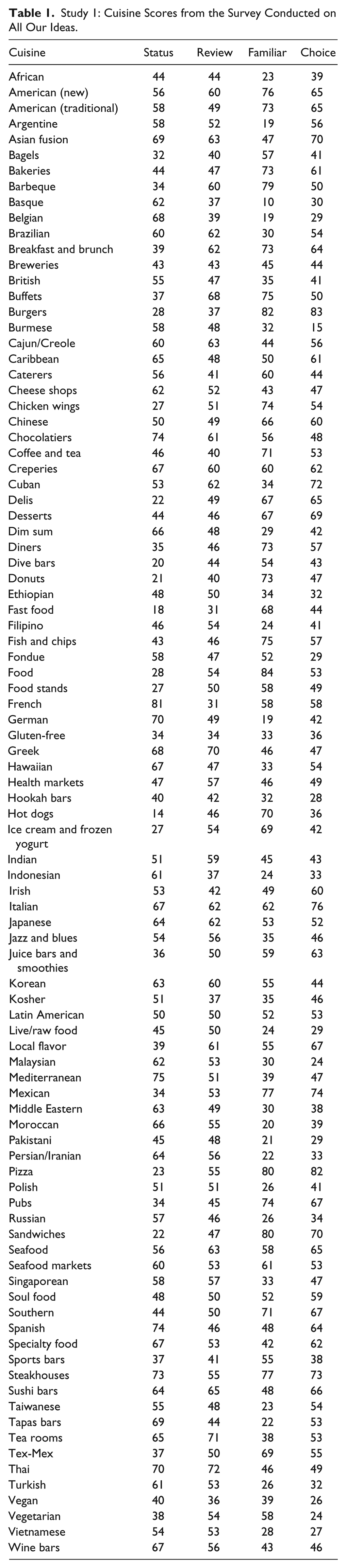
Next, we conducted another AOI survey, asking participants to “Imagine that last week you ate these two types of restaurants. Which would you write about on your SOCIAL MEDIA profile?” 4 Forty participants, who were different from those who completed the first set of comparisons, compared the same set of 93 restaurant types as before. The third column of Table 1 shows the resulting ratings for this question.
Finally, to assess overall liking and familiarity of the restaurant types, we conducted two additional AOI surveys with 40 participants each, asking in one survey, “Out of these two restaurant types, which one is more familiar to you?” and in the other survey, “Out of these two restaurant types, which one would you like to go to?” The fourth and fifth columns of Table 1 show the resulting ratings for these questions.
Results and Discussion
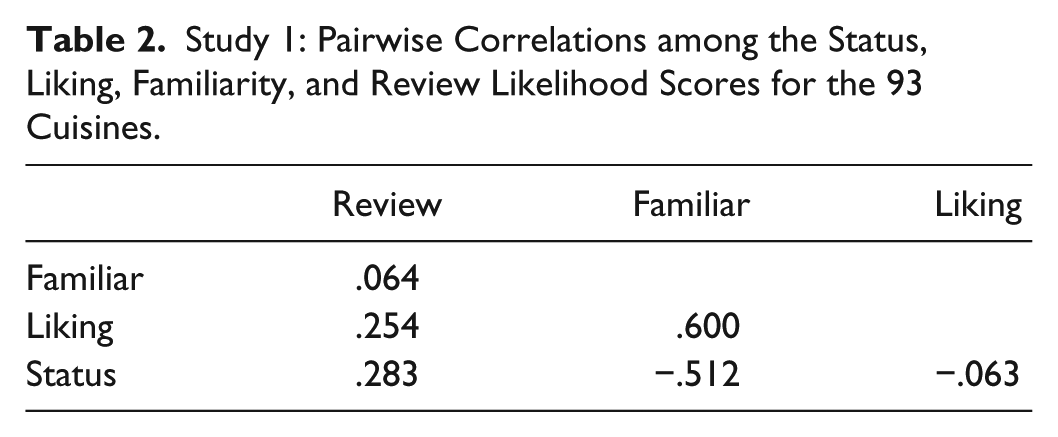
Table 2 shows the pairwise correlations among the status, liking, familiarity, and review likelihood scores for the 93 cuisines. Three patterns are worth noting. First, consistent with our theoretical proposition, higher cuisine status correlates positively (.283, p < .05) with the likelihood of posting a review. Second, participants are less familiar with higher status cuisines than lower status cuisines (–.512, p <.05). Third, familiarity and liking go together (.600, p < .05).
Study 1: Pairwise Correlations among the Status, Liking, Familiarity, and Review Likelihood Scores for the 93 Cuisines.
Next, we test in a regression framework the relationship between restaurant status, liking, familiarity, and review likelihood scores. Table 3 shows the results. Model 1 shows that the higher the status of the cuisine, the more likely the reviewer will post a review. Model 2 demonstrates that reviewers are also more likely to post reviews about restaurant cuisines that they like (this finding is consistent with the pattern on most review websites that the average of the ratings is high and its distribution is skewed to the right). Model 3 shows that, somewhat ironically, expertise or familiarity with a cuisine does not influence whether the participant would review that cuisine or not. Finally, Model 4 shows the results for the full specification. While liking continues to have positive effects on the likelihood of reviewing, the coefficient estimates become marginally significant. The main factor that influences whether participants would post a review on social media is the status of the cuisine. This pattern provides a strong corroboration of our hypothesis, showing that across 93 restaurant cuisines, one important factor influencing the likelihood of posting a review is the social status of the restaurant’s cuisine.
Study 1: Regression Models on the Likelihood Score That the Participants Will Write a Review for Restaurants in That Cuisine.

Note. Bootstrapped standard errors in parentheses.
p < .10. **p < .05. ***p < .01.
Study 2
In Study 2, we replicate and extend the findings from Study 1 using a complementary survey methodology. In this survey, each participant provides direct ratings of a smaller set of eight cuisines along the dimensions of desire to review, perceived status, and liking. In addition to examining an overall population-level motivation to review higher status cuisines, we also examine whether individuals who are generally motivated to use purchases to enhance their status are also particularly motivated to write reviews.
Eastman and colleagues (1999) have shown that individuals differ in their motivation to improve their social standing by engaging in conspicuous consumption. If writing reviews is one way to increase one’s status in the eyes of others by making purchases known, people who are high in status consumption motivation should be more likely to write reviews, both in their daily lives and our survey paradigm. While there may be additional reasons why people are motivated to review higher status restaurants (e.g., more money at risk, wider diversity of experiences between restaurants), a relationship between established measures of status consumption and review writing behaviors as measured in our survey is clear support for our hypothesis.
In a new sample of online participants, we examine the relationships between perceptions of a cuisine’s status, a desire to review restaurants from that cuisine, and general liking of that cuisine while also measuring individual differences in status seeking.
Method
Participants
We recruited 250 online participants. Participants (53 percent male, 47 percent female, 1 participant did not report their gender and was excluded from analyses using this variable) were predominantly white (76 percent), African American (8 percent), Asian American (6 percent), and in middle adulthood (M = 35.60 years, SD = 11.19 years, range, 19–76). Participants self-reported their household income bracket: less than $5,000 (4 percent), $5,000 to $15,999 (8 percent), $16,000 to $34,999 (22 percent), $35,000 to $74,999 (41 percent), $75,000 to $199,999 (24 percent), over $200,000 (2 percent).
Procedure
Participants were recruited from Amazon’s Mechanical Turk interface for a study where they would “Read and respond to questions about restaurants,” thus we did not specifically recruit participants based on their online review behaviors.
At the start of the study, participants were asked about their online review behaviors using two questions taken from the Pew Research Center’s (2016) American Trends Panel, “When visiting restaurants, how often do you provide your own online ratings or reviews of restaurants you have visited? [always or almost always/sometimes/never]” and “Have you ever shared your experiences with, or feelings about, a company or product on a social media site like Facebook or Twitter? [yes/no].”
For our main variable of interest, participants were presented with a list of eight cuisines and asked to indicate how likely they were to publicly review each type of cuisine. Based on responses from Study 1, we selected eight familiar cuisines that varied along status and likability: Two products were generally seen as high in status and were very well liked (Italian, steakhouse), two products were high in status but liked less (Thai, Mediterranean), two products were low in status and very well liked (pizza, burgers), and two products were low in status but liked less (hot dogs, barbecue). Participants received the following instructions: “Imagine that you recently ate at the following types of restaurants. How likely is it that you would SHARE your experience at the restaurant on your social media profile (Twitter, Facebook, Instagram, etc.) or on an online review platform (Yelp, TripAdvisor, etc.)?” and then, in a random order, indicated their likelihood of reviewing each cuisine using a scale from 0 (not likely) to 100 (very likely).
Next, participants indicated how much they liked each cuisine (“Imagine that you recently ate at the following types of restaurants. How much do you think you would have ENJOYED your experience at the restaurant?”), in a new random order, on a scale from 0 (not at all) to 100 (very much). Following the liking ratings, participants indicated their perception of each cuisine’s social status (“For the following types of restaurants, how would you rank each one in terms of social class?”), in a new random order on a scale from 0 (lower status) to 100 (upper status).
After evaluating the cuisines, participants completed the five-product Status Consumption Scale (Eastman et al. 1999) designed to assess how much individuals care about status consumption (e.g., “A product is more valuable to me if it has some snob appeal”). Responses to each statement were closely related (alpha = .92) and thus were averaged to create a status consumption score.
Participants next answered a question about their online review reading behavior taken from the Pew Research Center’s (2016) American Trends Panel. Last, participants answered demographics questions.
Results and Discussion
Preliminary Sample Analyses
We first examine participants’ past experiences with online review platforms. When asked about writing online restaurant reviews, our participants reported doing so with some frequency; 6 percent doing so always, 64 percent sometimes, and 30 percent never. Our sample seems to have had more reviewing experience compared to a representative sample of Americans (frequency of writing: 8 percent always, 43 percent sometimes, 48 percent never; Pew Research Center 2016), perhaps because our participants were recruited from an online platform. Similarly, 76 percent reported previously sharing a review on social media (in contrast to only 39 percent of Americans; Pew Research Center 2016). All but one of our participants reported reading online reviews; 54 percent doing so always, 46 percent sometimes, and .40 percent never, suggesting that even participants who did not report writing reviews were highly familiar with these types of online review platforms.
We next examined the results of our status consumption scale to better understand how this variable manifest in our population. Status consumption scores were unrelated to participants’ age, income, or gender, all p values >.20. However, scores were related to reports of online review usage. Review writing experience was related to increased status consumption motivation, F(2, 247) = 5.34, p = .005, such that those who always or sometimes wrote reviews were higher in status consumption than those who never did, t(89) = 2.78, p = .007 and t(232) = 2.56, p = .011, respectively.
Main Analyses
We examined the factors that predicted participants’ likelihood of writing reviews and found similar patterns across the eight different cuisines. Thus, for ease of analysis, we created a data set that included each participant’s ratings of each cuisine, and we conducted several regression models on participants’ likelihood scores for each cuisine. To correct for the fact that each participant’s ratings of each cuisine are not independent from each other, in all of our regression analyses, we use bootstrapped standard errors (Cameron, Gelbach, and Miller 2008). In all of our models, we control for participant sex (including only those who report being male or female), age, and household income level.
In Model 1, we tested whether likelihood of reviewing was predicted by the cuisine’s perceived status and participants’ liking of that cuisine, the two factors that seemed to be influential in Study 1. We found that both factors were significant predictors such that people were more likely to review cuisines that they liked and cuisines that they saw as higher in status. Table 4 shows the results of this and the following regression models.
Study 2: Regression Models on the Likelihood of Reviewing as a Function of the Cuisine Liking, Cuisine Status, Participant’s History of Writing Reviews, and Participant’s Status Consumption Score.

Note. Bootstrapped standard errors in parentheses. Models include controls for participant sex, age, and household income.
p < .05. ***p < .01.
In Model 2, we controlled for participants’ overall tendency to write reviews, as measured by the questions asking about frequency of writing reviews and whether participants had shared a review on social media (coded 0 = no, 1 = yes). While both measures of previous behavior predicted an increased likelihood of reviewing, our variables of interest remained significant.
In Model 3, we examine the role of individual differences in status consumption behaviors and include status consumption scores. We hypothesized that participants who are high in status consumption motivation would be more likely to review restaurants than participants who rate low in status consumption motivation because review writing is a way to advertise one’s purchases. We find a main effect where people high in status consumption are more likely to write reviews.
In Model 4, we include an interaction variable between the respondent’s status consumption orientation and cuisine status. In line with our theory, we find a significant positive interaction. That is, the more a reviewer cares about status, the more a restaurant’s status will increase the likelihood that the reviewer would post a review about the restaurant.
Study 3
In Study 3, we use an experiment to establish a causal relationship between restaurant status and participants’ desire to review that restaurant. Rather than use restaurant cuisine as a proxy for conveying status, in this experiment, we directly manipulate a restaurant’s status within the same type of cuisine. Such a manipulation eschews the possibility that we manipulate something other than status (Kovács and Sharkey 2014). We presented participants with a vignette of an American restaurant. We choose the American cuisine because this cuisine was perceived to be in the middle of the social status spectrum in Study 1 (American [new] rated 56, American [traditional] rated 58) and because it is likely familiar to all our American participants.
Participants viewed a fictional restaurant portrayed as higher in social status or lower in social status and then reported their opinions about the restaurant. We predicted that people would want to review the higher status restaurant more than the lower status restaurant, controlling for general liking of the restaurant. We also expected that participants who were higher in status consumption motivation would be more likely to write a review, while participants with higher incomes would be less likely to write a review.
Method
Participants
We recruited 249 online participants (one additional recruit did not complete the survey for unknown reasons). Participants (46 percent male, 53 percent female, 1 participant reported gender as “other” and was excluded from analyses using this variable) were predominantly white (79 percent), African American (6 percent), Asian American (7 percent), and in middle adulthood (M = 36.50 years, SD = 11.71 years, range, 19–74). Participants self-reported their household income bracket: less than $5,000 (1 percent), $5,000 to $15,999 (8 percent), $16,000 to $34,999 (25 percent), $35,000 to $74,999 (39 percent), $75,000 to $199,999 (25 percent), over $200,000 (2 percent).
Procedure
Participants were again recruited from Amazon’s Mechanical Turk interface for a study where they would “Read and respond to questions about restaurants” so that we did not specifically recruit participants based on their online review behaviors. Participants were randomly assigned to either the higher status restaurant condition or the lower status restaurant condition in a between-subjects design.
Participants read a fictional review webpage for one restaurant and were instructed, “Please IMAGINE what it would be like to go to the restaurant,” in order to increase participants’ engagement with the study materials. The page gave some basic information about the American cuisine restaurant that was the same across conditions (i.e., name, four-star rating, hours, location) and contained information designed to convey the restaurants’ high or low status. The restaurant’s status was conveyed through the price rating ($$$ vs. $), photographs of the restaurant and its food, and the adjective used in the description (“Fine dining” vs. “Affordable dining”). See Figure 2 for examples.

Study 3: Experimental stimuli. (a) The high-status condition. (b) The low-status condition.
After viewing the review page for at least 15 seconds, participants responded to questions about the restaurant. In a random order, participants responded to questions, using similar wording as in Study 2, about whether they would review the restaurant and whether they would enjoy the restaurant. Next, participants rated the restaurant on social status from 0 to 100 and estimated the cost of a meal at the restaurant (which served as checks of our status manipulation).
Next, participants answered the Status Consumption Scale (Eastman et al. 1999). Responses to the scale were closely related (alpha = .92) and averaged to create a status-seeking score. Last, participants answered questions about their review writing behaviors (adapted from Pew Research Center 2016; e.g., to have a 6-point response scale instead of 3 response options) and demographics questions.
Results and Discussion
Preliminary Sample Analyses
As before, we examine participants’ past experiences with online review platforms with more fine-grained response options in this study. When asked about writing online restaurant reviews, our participants reported doing so with some frequency: 2 percent always, 6 percent most of the time, 9 percent about half the time, 28 percent sometimes, 40 percent rarely, and 15 percent never. Similarly, 69 percent reported previously sharing a review on social media. All but two of our participants reported reading online reviews: 23 percent always, 38 percent most of the time, 17 percent about half the time, 17 percent sometimes, 4 percent rarely, and less than 1 percent never, suggesting that even participants who did not report writing reviews were highly familiar with these types of online review platforms.
We also examined the results of the status consumption scale in this new sample. In this sample, status consumption scores were higher in men than women, t(246) = 2.108, p = .036, and were negatively correlated with participants’ age r(246) = –.152, p = .017, but were unrelated to income level, p = .133. Consistent with the findings in Study 2, scores were related to reports of online review writing frequency, r(247) = .161, p = .011.
Manipulation Check
To ensure that participants reacted to our manipulation of the restaurant’s status and interpreted these cues in line with our intentions, we examined responses on the scale measure of restaurant status and the open-ended measure of meal cost. Indeed, participants in higher status condition rated the restaurant as higher in social status, t(246) = 5.273, p < .001, and as having more expensive meals, t(246) = 9.871, p < .001, than those in the lower status condition.
Main Analyses
We examined the factors that predicted participants’ likelihood of writing reviews using a series of regression analyses. In all of our models, we control for participant sex (including only those who report being male or female), age, and household income level.
In Model 1, we tested whether likelihood of reviewing was predicted by the restaurant’s manipulated status (dummy coded as 0 = low status condition, 1 = high status condition) and participants’ liking of that cuisine. As in previous studies, we found that both factors were significant predictors such that people were more likely to review the higher status restaurant and restaurants that they liked. Table 5 shows the results of this and the following regression models.
Study 3: Regression on Likelihood of Reviewing as a Function of Manipulated Restaurant Status, Liking, Participant History of Writing Reviews, and Participant Status Consumption Score.

Note. Bootstrapped standard errors in parentheses. Models include controls for participant sex, age, and household income.
p < .01.
In Model 2, we included variables representing participants’ frequency of writing reviews, this time measured on a 6-point scale, and whether participants had shared a review on social media (coded 0 = no, 1 = yes). As in Study 2, both measures of previous behavior predicted an increased likelihood of reviewing, and our variables of interest remained significant.
In Model 3, we included individual differences in status consumption behaviors as measured by status consumption scores. As in Study 2, we again find a main effect where people high in status consumption are more likely to write reviews. 5 We note, however, that an estimated interaction effect between status consumption and restaurant status (not shown here), while provided a positive coefficient estimate, was not statistically significant (p = .40). This nonfinding may be due to the fact that there is not enough variation on the perceived status scale: While the perceived status of the restaurants in the two conditions differ from each other significantly, both conditions are still in the middle status range. Future research should further probe into this issue by incorporating status manipulations that provide more variance in the perceived status of the restaurant cuisines.
Additional Analyses
Inconspicuous Consumption
The inconspicuous consumption literature argues that conspicuous consumption is more important for low-status groups than high-status groups (Charles, Hurst, and Roussanov 2009; Cialdini et al. 1976). Moreover, some researchers have argued that for high-status groups, conspicuous consumption can turn into inconspicuous consumption as high-status groups tend to disassociate themselves from products that are viewed as high status by the general audience and start signaling their status by affiliating with products that are only known to those with the “right” cultural capital (Berger and Ward 2010; Eckhardt, Belk, and Wilson 2015; Goldberg, Hannan, and Kovács 2016). 6 Given that we have (self-reported) data on the family income of the participants in Studies 2 and 3, we could test this prediction with our existing data. Specifically, in additional analyses, we tested whether the interaction effect between participant’s income and restaurant cuisine status is negatively affecting the likelihood that the participant would review the restaurant. We found support for this assertion in Study 2. Specifically, we found that perceived restaurant status has 2.5 times as large positive effect on the likelihood of reviewing for low-income participants than higher income participants (p < .05). Figure 3 plots the marginal effects.

Study 2: Marginal effect of cuisine status on the likelihood of reviewing, as function of participants’ yearly household income. The shaded area depicts 95 percent confidence intervals.
We ran the same test using data in Study 3, and while the interaction effect with income was also negative, it did not reach significance (p = .46). Besides the limitation that our sample size may be viewed as limited (n = 250), another explanation for the nonsignificant result could be that the MTurk participant pool is heavily skewed toward lower income people: Only 27 percent of the participants reported family income more than $75,000 per year. High-income participants (above $200,000 per year), for whom we would expect the inconspicuous consumption argument to really apply, are virtually nonexistent in the sample (2 percent).
We note, however, that in both Studies 2 and 3, restaurant status has a positive effect on the likelihood of reviewing even for higher income participants. That is, while status matters more for low-income participants, the effect of status is always positive, and conspicuous reviewing does not turn into inconspicuous reviewing for high-income participants.
Signaling Status by Giving Bad Reviews to Low-status Restaurants
In theory, one could also bolster one’s identity by reviewing a low-status organization and giving it a bad review. 7 If this mechanism were to be present, we would expect a nonlinear, U-shaped relationship between restaurant status and participants’ propensity to review the restaurant: high likelihood of reviewing for high-status restaurants because of the conspicuous reviewing explanation we provided, high likelihood of reviewing for low-status restaurants because of the possibility of giving a bad review, and low likelihood of reviewing for middle-status restaurants because these restaurants do not lend themselves for either mechanisms. We tested this possibility using data from Study 2. 8 Specifically, we estimated the marginal effect of the individual status consumption variable on the likelihood of reviewing as a function of the quintile of the cuisine status. That is, instead of a linear cuisine status variable, we estimate the effect for the lowest quintile, second lowest quintile, and so on. Figure 4 shows the estimated effect, indicating that the higher the cuisine class, the more likely it is that participants would review it. This pattern is consistent with our conspicuous reviewing explanation but not consistent with the explanation that reviewers would signal their identity by negatively reviewing low-status restaurants.

Marginal effect of the reviewer’s status consumption on the likelihood of reviewing as function of the status of the restaurant’s cuisine (based on Model 3 of Table 4, with individual dummy effects for each of quintile of restaurant class). The shaded area depicts 95 percent confidence intervals.
General Discussion
In this paper, we argued that a main reason why people may write online reviews is to bolster their public image by affiliating with high-status products or organizations. In a set of three studies, we demonstrated that people are more likely to write a review of a restaurant if the restaurant is high status versus when it is low status and when individuals are generally higher in status consumption. Importantly, these relationships hold even after controlling for other factors, such as the popularity of the restaurant and the extent to which the participant likes or knows the cuisine of the restaurant. Supporting our theory that review writing behavior is motivated by status concerns, we find that status consumption, as measured by a previously developed scale, predicts higher levels of review writing in our experimental paradigms and self-reports of online reviewing in the field.
These findings have important implications for the domain of online reviews. First, because higher status places receive more reviews (assuming that the reviews themselves are unbiased), the average rating is closer to the real quality for high-status organizations than low-status organizations (Le Mens et al. forthcoming). In other words, the wisdom-of-crowd argument works better for high-status products and organizations. This mechanism can create a rich-get-richer effect for high-status products and organizations (Podolny 1993). Also, as most online recommender systems weigh in the number of reviews into their recommendation, they can lead to a lower than optimal diversity in online recommendation systems (Fleder and Hosanagar 2009).
Second, our finding that people with high-status consumption motivations are more likely to write online reviews means that not only is the difference between high- and low-status organizations and products magnified in online rating environments but also that online reviews will be more representative of the tastes and opinions of these specific reviewers. Put differently, from the point of view of users of online reviews, online reviews provide a good matching platform especially for high status–seeking consumers.
This research also suggests new ways to think about the benefits of online behaviors. Writing reviews, and thus creating an association between oneself and a product or an organization, may actually change the way that others see the reviewer. Often, the qualities associated with one entity (in this case, the thing being reviewed) can then spread to another entity (in this case, the reviewer; Gawronski and Bodenhausen 2006; Walther 2002). This sort of spreading association can occur is many different contexts; in the online review context specifically, researchers have theorized that the positivity associated with upper status can spread from a high-status reviewer to the organization being reviewed, enhancing evaluations of the organization (Horwitz and Kovács 2017). Yet it may also be that the status-based qualities associated with an organization can spread to the reviewer, enhancing evaluations of the reviewer. Given the benefits bestowed on people with higher social status (Freeman 2006; Goodman and Gareis 1993; Osborne and Rappaport 1985), future research could examine whether reviewing higher status purchases in a public forum is an effective way to enhance one’s status in the eyes of others.
Future research could also examine whether different types of review websites affect review writing behavior and whether the effects observed in these studies vary across different platforms. In the current research, we probed participants’ broad motivation to write a review by asking about their motivations to share their opinions on both social media websites or content-specific review websites in the same question. Although these two types of forums share many features, they may differ in ways that moderate the influence of status consumption motivations. For example, people may know more of their potential audience members on social networking sites than review-focused sites or may spend more time on their own “homepage,” which makes their social identity very salient. To the extent that people write reviews to gain status in the eyes of their “real life” peers or bolster their social identity, a social media website may amplify these effects relative to a limited-scope website. On the other hand, review websites that focus solely on consumer experiences could activate status consumption motivations, thus increasing review writing behavior. By comparing various outlets for online reviews or experimentally manipulating what information the audience is thought to have about the reviewer’s identity, future research can investigate other factors shaping status-seeking review writing behavior such as strength of the tie with the audience or the salience of social identity. 9 One could, for example, design an experiment in which it is manipulated whether the respondent is writing the review for a friend or the general audience and whether the respondent’s identity will be made public or not.
Our research, naturally, is not without limitations. First, we focused on the domain of restaurant reviews and we used a U.S. sample—whether our findings generalize to other domains and cultures remains a question for future research. We have no reason, however, to doubt that these findings would generalize given that status hierarchies are defining characteristics of most cultures and domains of life (Fiske 1992). Second, our studies were hypothetical vignette studies, asking participants whether they would write a review. That is, we did not observe participants in their naturally occurring environments to see whether and when they write reviews. Such a task would be an onerous exercise as it would require knowing the full risk set of products and organizations they interacted with and could possibly review, and out of this full risk set, one would need to test whether the higher status products are more likely to be reviewed. As such data are currently not available to us, we leave such tests for future research. Third, we also did not explore whether the status of the options influence what people write: Besides the positive effect of status of the product or organization on the likelihood that it will be reviewed, it is not clear how status would influence the content of the review. It may be the case that reviewers are more lenient toward high-status organizations, or they may be stricter (Anderson 1973).
Moreover, our studies have not taken into account the fact that conspicuous consumption is influenced by accessibility to various options. Rather, our experimental paradigm has implicitly assumed that participants have access to all the options. In real life, access to high-status option is often limited by financial and other means: Not everyone has the same access to, for example, Michelin star restaurants, partly because of how much they cost and partly because they may not even exist in their part of the world. Relatedly, we did not account for the fact that reviewers may differ in how they interpret the different options. For example, it may be the case that options that are held to be high status by some are viewed as middle status by others (Kovács and Liu 2016). Future research should further investigate how such issues influence conspicuous reviewing.
These limitations notwithstanding, we believe that we have demonstrated a powerful factor behind the motivation of writing online reviews: status. Status-based motivations, our results show, are at least as important in predicting whether a person will review a product or an organization as other factors previously demonstrated in the literature, such as familiarity with or liking of the product or organization to be reviewed. This process introduces a selective sampling into online reviewing, which will need to be taken into account by future users and researchers of online reviewing behavior.
Footnotes
Acknowledgements
We appreciate comments on this manuscript from lab members at Yale University.
Funding
The author(s) disclosed receipt of the following financial support for the research, authorship, and/or publication of this article: We appreciate the financial support from Grant No. 100018_159511from the Swiss National Science Foundation.
1
A scope condition of our theorizing is that the identity of a reviewer is visible to other users of online reviews. That is, reviewers who create anonymous profiles or profiles with fake names and/or nondescriptive profile pictures such as a picture of a cat, would benefit less from conspicuous reviewing. At the time of writing of this article in 2018, we think that this scope condition holds in the majority of reviews: Casually perusing platforms that provide reviews, such as Yelp, Tripadvisor, Google, or Facebook, we see that the majority of the users have recognizable user names with real profile pictures. Current trends also point to the direction of tighter coupling of reviews to real identities of the users, mostly to reduce the prevalence of fake reviews. Moreover, as review websites and online social networks merge (such as in the case of Facebook and Yelp), a review posted by a focal reviewer is featured in his or her own social network, in which case the identity component of our argument becomes even more central.
2
In Studies 1 and 2, we focus on the restaurant’s cuisine as a relevant dimension of restaurant status. This approach builds on  assertion that the status of an entity depends on the status of the category it belongs to. Other dimensions can also influence perceptions of a restaurant status, such as its price range or location. In Study 3, we study the effect of price on status consumption and conspicuous reviewing.
3
In this paper, we use the words status, class, and prestige as synonyms. In the surveys, we used the word class (as in high class) because we believe that class is the most commonly used in everyday language. In the manuscript, we typically refer to the concept of status because that is the theoretical tradition we build on.
4
Participants did have the option to say that they would not want to review any of the two cuisines. In the All Our Ideas framework, when the two options are displayed, participants are also shown an “I don’t know/Other” option. After clicking on this option, a window popped up, and participants could choose among the following options: “I would review both of them equally/I would not review any of them/I don’t know the option on the left/I don’t know the option on the right/I don’t know any of the options.” Only a small fraction of the answers used this “other” option though (about 5 percent of all answers), and even fewer, less than 1 percent of the responses, indicated that they would not review any of these cuisines.
5
An anonymous reviewer raised a possible alternative explanation to our findings: People may perceive that others (i.e., consumers of reviews) are less likely to have experience with high-status restaurants, and thus a review of such a restaurant would be perceived as more useful. We do not believe that the explanation would be the major driver of online review dynamics because expensive and/or high-class restaurants tend to get more reviews than cheap restaurants (see e.g., Kovács, Carroll, and Lehman 2014). Yet, to rule out this possible alternative explanation, one could rerun the experiment in Study 3 but make explicit in the manipulation the number of reviews a restaurant has received. We leave this for future research.
6
We thank an anonymous reviewer for calling our attention to this argument.
7
We thank an anonymous reviewer for calling our attention to this possibility.
8
Study 3 does not lend itself to studying a nonlinear effect because there is not enough variation on the perceived status scale: While the perceived status of the restaurants in the two conditions differ from each other significantly, both conditions are still in the middle-status range.