




Abstract
Health gains linked to a college degree appear to be contingent on childhood socioeconomic background, with disadvantaged individuals typically showing the greatest gains in physical health. However, contingent gains in subjective well-being remain unexplored. This study examines happiness and life satisfaction gains linked to college degree attainment, using representative U.S. data spanning recent decades (from the General Social Survey 1972–2014). For women, happiness and life satisfaction gains linked to college are highest for those who were least likely to attend and graduate based on their family economic circumstances. In contrast, men show the highest life satisfaction gains from college when coming from privileged family backgrounds. These findings fall in line with gender and institutional perspectives on education and life chances. For both sexes, college disparities in life satisfaction show substantial variation across cohorts and the life course.
Individuals with college degrees are physically healthier as adults than those without, showing better self-rated health and lower rates of disease, inflammation, and early death (Cutler and Lleras-Muney 2010; Lawrence 2017; Mirowsky and Ross 2003). However, whether one expects to attend college or university, whether one does, and the social and economic returns linked to obtaining a degree also trace profoundly—and perhaps just as much—to one’s family socioeconomic origins (Conti and Heckman 2010; Sewell, Haller, and Portes 1969). In this vein, recent studies reveal differing associations of college with adult health by family socioeconomic background. Some studies find evidence that those from socioeconomically disadvantaged backgrounds exhibit the most substantial health gains from college or greater levels of education, viewed as a form “resource substitution” across socioeconomic statuses (SESs; Bauldry 2015; Ross and Mirowsky 2011; Schaan 2014; Schafer, Wilkinson, and Ferraro 2013). Other studies find that initially advantaged or privileged individuals show the greatest health gains from college or higher levels of education, which instead is a form of cumulative (dis)advantage across life-course SESs (Bauldry 2014; Conti and Heckman 2010; Schaan 2014). Further studies find differing patterns of either resource substitution or cumulative (dis)advantage across health outcomes examined (Andersson 2016; Conti and Heckman 2010).
Assessing divergence in educational health gains across levels of family SES is a potentially important approach to gaining a better understanding of how educational attainment may cause better health in the first place (Montez and Friedman 2015). However, this recently taken approach remains conceptually narrow in terms of domains of health or well-being examined and in terms of potentially masked life-course or cohort variation. In terms of outcomes analyzed, studies of heterogeneous returns have focused squarely on physical health or symptoms, diagnosed illness, or timing of death. While two recent studies examine mental well-being, they do so in terms of depressive symptoms (Bauldry 2015; Schaan 2014), which correlate strongly with mental morbidities or comorbidities such as depression, anxiety, or substance abuse (Kessler et al. 2002) and with physical health problems (Yang 2006). Existing approaches overlook broader aspects of personal well-being in terms of personal meaning or satisfaction—or even personal thriving. As is well known, the absence of distress, malaise, or infirmity by no means equates with the presence of thriving in terms of vitality, meaning, happiness, or life satisfaction (Diener and Chan 2011; Gable and Haidt 2005; Keyes 2007). Existing findings cannot be assumed to extend similarly to these positive well-being indicators because they capture distinct domains of personal functioning.
Happiness and life satisfaction are tethered to subjective interpretations and normative expectations surrounding life achievements and transitions (Diener and Chan 2011; Elder 1998; Reynolds and Baird 2010; Schnittker and McLeod 2005; Yang 2008), making them a curious oversight in our empirical understanding of returns to a college degree. Across the twentieth century, social expectations, consequences, and meanings for and of college shifted greatly (DiPrete and Buchmann 2006; Hout 2012). Beyond having an education itself, individuals achieve happiness or life satisfaction on the grounds of their socioeconomic attainments enabled by higher educational credentials, such as occupational, income, neighborhood, community, and marital attainments and prospects after graduation (Mirowsky and Ross 2003; Schwartz and Mare 2005), and individuals hold and face subjective interpretations and normative expectations for these subsequent life-course transitions as well (Bardo 2017; Elder 1994; Settersten 2003).
While positive well-being indicators remain a notable oversight in the empirical study of heterogeneous returns to a college degree, basic knowledge of associations between education and happiness or life satisfaction already exists. Generally, associations between education and positive well-being have a step-like quality in that degrees or certifications seem to matter more than years for predicting happiness linked to education (Hout 2012; Yang 2008). However, in line with previous research on heterogeneous health gains to education, education’s association with positive aspects of well-being should further depend not only on family or parental background but also on broader structural categories or forces such as gender, the life course, and cohorts or generational successions.
Childhood Socioeconomic Background and Health Returns to Higher Education
Family socioeconomic background shapes many parameters relevant to primary, secondary, and postsecondary educational careers and experiences and thus likely shapes well-being returns to higher education as well. Educational factors influenced by family social class include school resources and teacher quality; student engagement and attendance; peer or friend networks; student and peer achievement and aspirations for higher education; choice, selectivity, and resources of colleges or universities attended; tertiary course of study (and persistence within course); and sorting into the labor market or advanced degree programs after four-year college graduation (e.g., Calarco 2014; Goldrick-Rab 2006; Hamilton, Roksa, and Nielsen 2018; Lareau and Weininger 2009). Meanwhile, childhood SES is a fundamental lifestyle niche for health, shaping material conditions and safety, food availability and quality, social and cognitive skill acquisition during critical developmental periods, and neighborhood and community exposures (Johnson and Schoeni 2011; Montez and Hayward 2011). However, at the same time, the importance of early-life conditions for adult health may depend on intervening socioeconomic attainments such as a college education (Montez and Hayward 2011; Schafer et al. 2013).
College attendance often shows the strongest linked health gains for those who grew up socioeconomically disadvantaged, as these individuals may have the most to gain from college degrees in terms of social, cognitive, and material resources that college attendance or a college degree offers (Andersson 2016; Bauldry 2015; Ross and Mirowsky 2011; Schaan 2014; Schafer et al. 2013)—a type of resource substitution mechanism (Ross and Mirowsky 2011). However, some work has found net support for an opposing argument that college simply advances the well-being of those most likely to attend in the first place, consistent instead with resource multiplication or cumulative (dis)advantage (Andersson 2016; Bauldry 2014; Conti and Heckman 2010; Schaan 2014). For instance, given the middle-class nature of universities as social institutions, individuals growing up privileged may be more likely to derive benefits, profits, or capital from higher educational experiences (Bauldry 2014; Lareau and Weininger 2009; Schafer et al. 2013). These mechanisms are not mutually exclusive, and in fact heterogeneity in educational returns may reflect a variety of countervailing mechanisms or processes (Brand and Xie 2010).
Sex and Gender
Beyond well-established biological differences by sex and differences in health behaviors and health trajectories by sex (e.g., Denney et al. 2010; Liu and Hummer 2008; Pudrovska and Aniskin 2013), Ross and Mirowsky (2006) showed educational attainment carries differing associations with adult health depending on sex, with women showing stronger associations between higher education and lower depressive symptoms than men in their longitudinal analysis of U.S. data spanning 1995, 1998, and 2001. They reasoned that women stood to gain more from educational attainments and experiences due to pervasive gender discrimination and the more limited social and economic opportunities of women relative to men even in modern American society. Beginning in the early 1980s, women surpassed men in attaining college degrees (DiPrete and Buchmann 2006). However, earlier yet in the twentieth century, going to college was not normatively expected of women to the same extent as men, and there is compelling evidence that family socioeconomic resources may have figured more prominently in women’s college attendance than men’s (Goldin, Katz, and Kuziemko 2006).
Ross and Mirowsky’s (2006) perspective on gender, education, and adult health remains unapplied to our understanding of how family origins matter to educational health gradients. While they propose that women may benefit more, they do not examine the differential importance of family background as they do in their later work (Ross and Mirowsky 2011). Men and women differ in terms of how family background or resources translate to educational experiences and attainments, with men’s educational careers potentially being more vulnerable to family resource shortcomings, at least in recent decades (Buchmann and DiPrete 2006; Shanahan et al. 2008). Men and women also differ in terms of occupational, income, and marital returns to college degrees (DiPrete and Buchmann 2013; Quadlin 2018; Schwartz and Mare 2005) and in terms of physical health differences linked to educational attainment or professional environments accessed through education (Andersson 2016; Montez et al. 2009; Pudrovska 2013; Ross, Masters, and Hummer 2012), all of which also are known to be contingent on or at least correlated with parental or childhood SES as well (Brand and Xie 2010; Schwartz and Mare 2005; Sewell et al. 1969). Thus, positive well-being returns to education across levels of family or parental status may be fundamentally contingent on gender as well.
Recent work on physical health finds that resource substitution or cumulative (dis)advantage patterns across educational attainment and family socioeconomic background are gender contingent (Andersson 2016), with men showing cumulative (dis)advantage in self-rated health and women showing resource substitution for mortality. While these recent findings comport with the ideas that men extract more social and economic resources from higher education, perhaps due to persistent sexism in university settings and in more lucrative areas of study and work, while women stand to gain more from college degrees especially when coming from disadvantaged families, a broader analysis of well-being remains to be undertaken.
Positive well-being indicators such as happiness and life satisfaction should reflect not only adversities or challenges in life but also meanings and expectations surrounding college and life after college by gender. While higher education has become more important to earned wages and marriage probability during recent decades, women persistently show higher odds of marrying than men, and among college graduates, women are less likely to work full-time, are paid less for their work, and are more likely to quit work when residing in dual-earner households (Cha 2010; Cherlin 2010; England, Allison, and Wu 2007; Reskin 1993). In short, women may continue to have a more difficult time than men achieving the posteducational life courses they had envisioned for themselves, due to “separate spheres” (Cha 2010) and other persistent forms of gender inequality that affect even highly educated couples.
Cohort and Age
At the same time, expectations for marital and occupational roles as well as gender parity at work and in the home differ considerably across birth cohorts, with earlier cohorts being more accepting of gender traditionalism. Across genders, cohort signifies educational expansion and greater expectations for higher education. Net of cohort, individual life courses or aging patterns involving family and work are gendered, with time off from careers, marriages, and retirements showing quite different timings across the life course by gender (Elder, Johnson, and Crosnoe 2003). Across genders, educational health disparities disproportionately reflect school, family, and peer selection at younger ages (e.g., Maralani 2014; von Hippel and Lynch 2014), processes quite indicative of family socioeconomic background; at middle ages, they more directly reflect personal occupational, marital, and neighborhood attainments; and at older ages they may predominantly reflect exiting or remaining out of the labor force and remaining free from or managing incident disease or disability. A variety of existing work on physical health returns has shown the importance of distinguishing age and cohort in estimating these educational health returns (e.g., Goesling 2007; Lynch 2003; Masters, Hummer, and Powers 2012; Ross et al. 2012). However, the distinct roles of age and cohort to positive well-being returns have yet to be documented.
Overview of the Present Study
In this study, I draw on more than forty years of representative U.S. repeated cross-sectional data to examine subjective well-being gains linked to college. By analyzing whether happiness and life satisfaction gains linked to college attainment differ by childhood background, and across the key demographic considerations of gender, cohort, and age, I help move toward a closer understanding of how much and for whom a college education may yield gains in well-being (Montez and Friedman 2015).
Method
The General Social Survey (GSS) is a nationally representative sample of the noninstitutionalized, English-speaking U.S. population aged 18 and older. Begun in the 1970s, GSS has been administered at least every other calendar year with response rates of 70 to 82 percent. Here I use the cumulative data file, which spans from 1972 to 2014 (available at www.norc.org). Of the N = 59,599 respondents in this data file, n = 53,489 were aged at least 25 at the time of the survey, giving adequate time in the life course to complete a college degree. n = 49,481 of these respondents received the happiness and life satisfaction questions when taking GSS.
Subjective Well-being
Across its repeated administrations, GSS offers two key measures of subjective well-being. First, the survey includes a question about overall happiness: “Taken all together, how would you say things are these days—would you say that you are very happy, pretty happy, or not too happy?” Second, it offers a series of domain-specific satisfaction items, asking the respondent how satisfied he or she is with finances, work, nonwork activities, neighborhood or community, and personal ties involving family and friends. A learned effectiveness perspective on education posits that obtaining higher education broadly improves personal networks and resources (Mirowsky and Ross 2003), and population research supports the contention that educational attainment triggers broad and favorable changes across related adult life domains (Cutler and Lleras-Muney 2010; Lawrence 2017), making it appropriate to consider these items jointly as an index averaging across available items, rescaled across items to a uniform scoring system of 0 (least satisfied) to 10 (most satisfied). 1
Educational Attainment: College (Bachelor’s) Degree
GSS queries education in terms of the respondent’s highest completed degree (1 = less than high school, 2 = high school graduate, 3 = some college or junior college, 4 = bachelor’s degree, 5 = some graduate education). Following other research in this area (Bauldry 2014, 2015; Conti and Heckman 2010; Lawrence 2017; Schafer et al. 2013), I designated the upper two categories as having received a four-year or bachelor’s degree (1 = college or higher, 0 = less than four-year college). 2
Childhood SES Score
Prior work on heterogeneous returns to college favors taking into account diverse and multiple social and economic conditions, with (mis)alignment across education, income, and occupation influencing both estimated probabilities of college and estimated returns to college (Bauldry 2014, 2015; Brand and Xie 2010; Schafer et al. 2013). Therefore, to assess childhood SES, I made use of mother’s and father’s highest educational attainment (measured as 0–20 years; maximum value between both parents) and occupational status (socioeconomic index) as well as estimated relative household income growing up “compared with American families in general then (at the time)” (rated subjectively as 1 or 2 = [far] below average, 3 = average, 4 or 5 = [far] above average). Each of these SES facets was standardized and converted to a cumulative normal probability (range = 0 to 1, noninclusive; correlations between these measures = .34 to .58), and facets were then averaged across all available and valid responses. 3 Additional analyses using parental education only did not yield differing substantive findings (available on request).
Demographic Covariates
All models of subjective well-being adjust for sex, race, age, and cohort. Per GSS data, sex is a binary indicator (male or female), race is two binary indicators for black or African American and other nonwhite race, age is measured in years, 4 and cohort or birth year is calculated as GSS survey year minus respondent age.
Analytic Strategy
The analyses here involve a series of regressions predicting subjective well-being, controlling for all demographic covariates. Following preliminary analyses demonstrating significant gender interaction terms, all regressions are run separately by sex. 5 These regressions establish estimated average associations or main effects of college attainment and childhood SES (models 1–2), and then they examine heterogeneous returns to college across childhood SES (model 3) and whether these heterogeneous returns are age dependent (model 4) or cohort dependent (model 5). Raw or unstandardized estimates are reported to facilitate the interpretation of statistical interaction terms. Standard errors are robust. List-wise estimation is used given the limited number of variables and relatively low rates of voluntary nonresponse.
An initial model (model 1) estimates the association between college degree attainment and subjective well-being, holding all demographic factors constant. In model 2, the childhood SES score is added to the specification, revealing an adjusted association between degree attainment and subjective well-being after accounting for childhood socioeconomic resources that make higher education dramatically more likely (Hout 2012). Model 3 adjudicates between the resource substitution and cumulative (dis)advantage perspectives on heterogeneous returns to college by specifying a two-way statistical interaction between degree attainment and the childhood SES score. Finally, the next two models allow these heterogeneous returns to vary across the life course and across generations of students by specifying two- and three-way interactions of key predictors with respondent age (model 4) and then two- and three-way interactions involving respondent cohort or birth year (model 5). 6
Results
Table 1 overviews the 1972–2014 GSS sample. Respondents averaged moderate levels of happiness (around “pretty happy”) and life satisfaction (about 6.6–6.7 on a scale from 0 to 10). About one quarter of men (26 percent) and one fifth of women (20 percent) had attained a college degree. Parental education averaged just below the level of high school graduate (M = about 11 years), and about 17 to 20 percent of respondents identified as nonwhite. Meanwhile, respondents were typically in their late 40s (M = 48–49 years old) at the time of the survey (SD = 16 to 17 years), with average birth years around 1944 to 1945 (SD = 20 years). 7 The appendix table shows age and cohort distributions by gender. Generally, younger individuals or respondents from more recent cohorts are more frequent in the GSS data than are older individuals or respondents from earlier cohorts.
Descriptive Statistics, 1972–2014 General Social Survey.
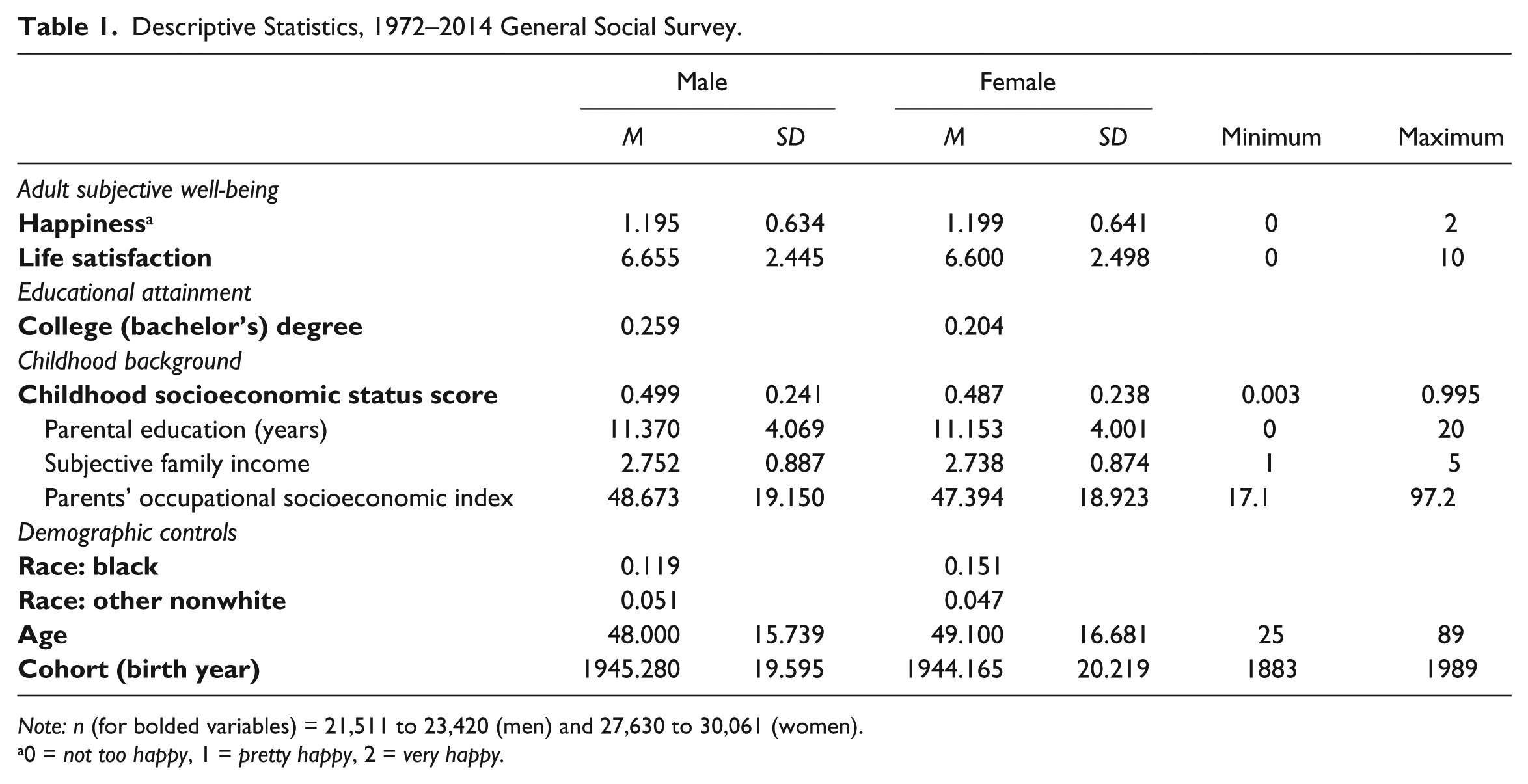
Note: n (for bolded variables) = 21,511 to 23,420 (men) and 27,630 to 30,061 (women).
0 = not too happy, 1 = pretty happy, 2 = very happy.
Table 2 reports estimates from ordinal logistic regressions of happiness, with the left pane showing estimates for male respondents and the right pane giving estimates for female respondents. In models 1 and 2, college attainment associates positively with happiness (p < .001), as does childhood SES (p < .001). However, in model 3, which specifies a two-way interaction between college and childhood SES, men and women show differing patterns of results. For men, no interaction obtains (College × Childhood SES: b = −.024, p > .8), whereas for women, a significant negative interaction is observed (b = −.328, p < .01), consistent with resource substitution. Models 4 and 5 do not reveal any significant three-way interactions with either age or cohort, suggesting that these demographic variables do not further modify the resource substitution pattern. Figure 1 depicts resource substitution for women only, based on model 3. Here, predicted probabilities for being “very happy” are shown, by level of childhood SES score (low = 25th percentile, moderate = 50th percentile, or high = 75th percentile) and by college degree status within level. Meanwhile, the happiness gap by college graduation narrows by 24.6 percent as childhood SES increases from low to moderate to high, consistent with the interpretation that college attainment provides more of a gain in personal happiness given disadvantaged familial origins and relatively less of a gain given familial socioeconomic privilege. All college gaps (differences in predicted probabilities between No College and College) are statistically significant based on two-tailed tests.
Ordinal Logistic Regression Models of Happiness, by Gender, 1972–2014 General Social Survey.

Note: Logistic coefficients are shown. Robust standard errors are in parentheses. SES = socioeconomic status.
p ≤ .05. **p < .01. ***p < .001 (two-tailed tests).

College gaps in probability of being very happy by childhood SES score (females only; General Social Survey 1972–2014).
Table 3 repeats the same sequence of models, this time for life satisfaction. Ordinary least squares estimates reveal substantial gains in satisfaction linked to college degree receipt (ps < .001; model 1) and childhood socioeconomic advantage (p < .001; model 2). Again, however, the sexes diverge in model 3, where no significant statistical interaction is observed for male respondents (College × Childhood SES: b = .142, p > .35) while a significant interaction emerges for female respondents (b = −.463, p < .01). As for happiness, this significant interaction is consistent with resource substitution. However, in contrast to the happiness results, models 4 and 5 reveal further contingencies in heterogeneous returns to college. For men, age interacts with college degree receipt specifically (model 4; Age × College: b = .015, p < .001), enough to reveal a significant cumulative (dis)advantage pattern masked previously (College × Childhood SES: b = .372, p < .05), and cohort strengthens the cumulative (dis)advantage pattern directly (model 5; Cohort × College × Childhood SES: b = .021, p < .01). For women, age strengthens the resource substitution pattern (model 4; Age × College × Childhood SES: b = −.025, p < .05) whereas cohort tends to attenuate the pattern at a magnitude somewhat less than age (model 5; Cohort × College × Childhood SES: b = .017, p = .05). 8
Ordinary Least Squares Regression Models of Life Satisfaction, by Gender, 1972–2014 General Social Survey.

Note: Coefficients are unstandardized. Robust standard errors are in parentheses. SES = socioeconomic status.
p ≤ .05. **p < .01. ***p < .001 (two-tailed tests).
To make general sense of these patterns, Figure 2 depicts life satisfaction predictions for men and Figure 3 displays predictions for women. Within each figure, age-based predictions are shown in the top pane (based on model 4; age thirty-five is approximately 25th percentile, and age sixty is 75th) and cohort-based predictions in the bottom pane (based on model 5; born 1930 is approximately 25th percentile, and born 1960 is 75th), thus defining four cells. Each cell takes the same format as shown previously in Figure 1, where well-being predictions are arrayed by college degree receipt within level of childhood SES. In Figure 2 (male), cumulative (dis)advantage is quite robust among young men, with a college well-being gap widening by 37 percent across levels of childhood SES. However, for older men, this diminishes to 11 percent. Meanwhile, in the bottom pane of this same figure, the widening pattern exists for only more recent cohorts, whereas among earlier cohorts this reverses to a weak narrowing or resource substitution pattern. In contrast, Figure 3 (female) reveals consistent resource substitution, although among younger women the pattern is barely present and the pattern also is diminished, though not as much, among recent cohorts. Overall, for men, cumulative (dis)advantage is robustly present only for younger ages and recent cohorts, whereas for women resource substitution is present most strongly for older ages and earlier cohorts. All college gaps depicted in these figures are statistically significant.
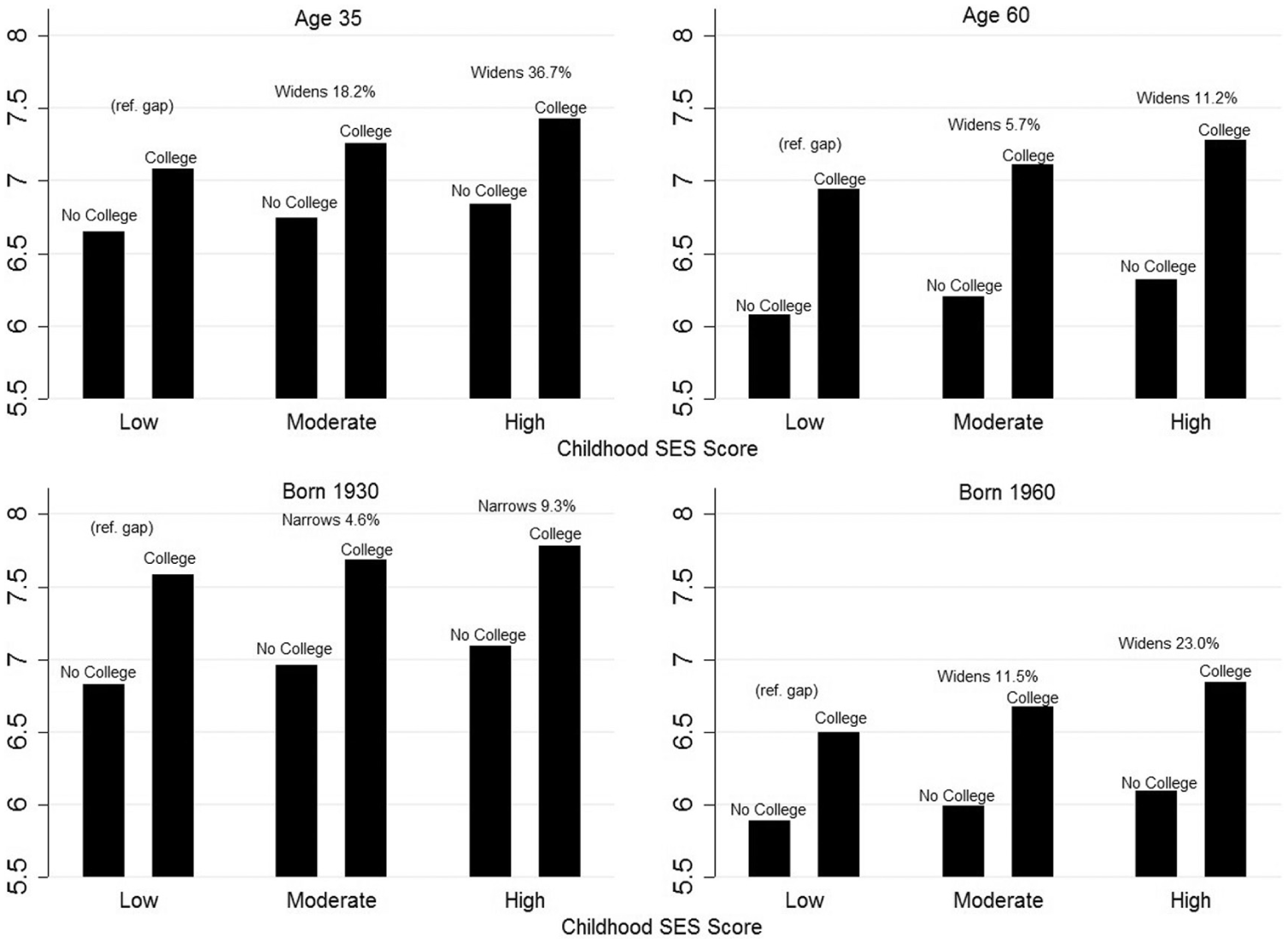
College gaps in life satisfaction by childhood SES score (males only; General Social Survey 1972–2014).

College gaps in life satisfaction by childhood SES score (females only; General Social Survey 1972–2014).
Discussion
Adult well-being certainly involves possible health challenges; however, more broadly, it involves personal and cultural expectations and meanings attached to life-course transitions. Obtaining a college education is a watershed in many life courses, with lasting and numerous consequences, as it shapes subsequent occupational, income, and wealth trajectories, as well as possibilities and probabilities of union formation, neighborhood and community attainment and relocation, and the size and diversity of personal social networks. At the same time, meanings of college attainment also radiate from earlier in the life course, as familial socioeconomic background vitally shapes both objective odds and subjective expectations of attainment. In short, college attainment is laden with personal meanings—and thus emotional and cognitive consequences—due to processes occurring before and after college is complete.
According to findings here, heterogeneity in happiness and life satisfaction gains linked to college across childhood socioeconomic backgrounds was considerably smaller than average gains linked to a college degree in general. This general pattern aligns with perennial claims that college attainment is generally beneficial for life-course social, emotional, financial, and physical well-being across personal and demographic backgrounds and across adult situations or contexts (Lawrence 2017; Mirowsky and Ross 2003). Robust associations of education with health and well-being across samples, outcomes, time, and space strongly suggest that heterogeneity in educational returns is less important than any universal benefits potentially conferred by higher education (Link and Phelan 1995; Masters et al. 2012). In the GSS data, college gaps in happiness or life satisfaction either widened or narrowed by about one tenth to one third relative to the gap present for individuals coming from disadvantaged childhood backgrounds, meaning that college showed links to higher well-being regardless of childhood socioeconomic background. Other important work draws the universality of education’s health benefits into question by demonstrating its lesser associations with improved life chances for racial or ethnic minority groups facing structural and systemic oppression (e.g., Liu and Hummer 2008; Masters, Link, and Phelan 2015; Williams 1999) or by showing weak or absent educational gradients for health problems that are difficult or impossible to control using clinical technologies (Masters et al. 2015; Phelan et al. 2004). These further contingencies provide a useful window into understanding the multifaceted and interwoven mechanisms by which education may—or may not—improve health or life chances (Montez and Friedman 2015).
For both happiness and life satisfaction during adulthood, women showed the strongest associations between college attainment and adult subjective well-being when coming from relatively disadvantaged families, consistent with resource substitution across life-course SESs. Meanwhile, men showed heightened well-being gains, in terms of life satisfaction, when coming from privileged socioeconomic backgrounds, which instead is consistent with cumulative (dis)advantage across childhood and adult socioeconomic attainments. In another recent analysis of sex-specific heterogeneous educational returns, Andersson (2016) similarly finds resource substitution for women’s mortality while finding cumulative (dis)advantage for men’s self-rated health. Auxiliary pooled models using sex interaction terms confirmed that this pattern of heterogeneous educational health benefits significantly differs across sexes at or below conventional two-tailed significance thresholds and below one-tailed thresholds recommended by prior theory and work documenting gender dependence in conditional or unconditional educational health gradients (Andersson 2016; Montez et al. 2011; Ross and Mirowsky 2006, 2011; Ross et al. 2012).
This pattern of results for women is consistent with resource substitution, or the guiding theory that college degrees may hold the greatest gains for those least likely to obtain them, given how college may compensate or substitute for earlier deficits created by socioeconomic disadvantage during childhood. The robustness of resource substitution across subjective well-being measures for women falls in line with Ross and Mirowsky’s (2006) gendered perspective on health returns to education. According to their argument, women face more limited social and economic opportunities than do men, making college more pivotal for women’s economic and overall well-being than for men’s. A key implication of their original argument—demonstrated for the first time in this study—is that gender differences in educational returns should be especially strong among students from economically disadvantaged families precisely because family disadvantage amplifies what women would have to gain by attending college. Thus, the present study’s findings both resonate with and extend Ross and Mirowsky’s original theoretical perspective by showing that resource substitution across higher education and family socioeconomic origins is far more robust for women than for men. Even more, the results show that resource substitution for women is strongest for earlier cohorts, which is consistent with the notion that college helped women overcome familial economic disadvantage especially in the earlier decades of the twentieth century, when college attendance in general was less common, as was female labor force participation. In earlier college-going cohorts, individuals used college as a means of gaining skills and qualifications and expanding their social networks, often courting marriage partners (DiPrete and Buchmann 2006; Goldin et al. 2006; Hout 2012).
In contrast, men showed equivalent well-being returns to college across familial origins for happiness, but in the case of life satisfaction, patterns of cumulative (dis)advantage emerged. While happiness as measured in GSS captures as an overall basic assessment of how happy one has been feeling lately, the life satisfaction items captured in GSS cut across social, work, financial, and community domains of adult functioning, tapping a more comprehensive portrait of adult thriving or success. Life satisfaction gaps among male college graduates relative to nongraduates became wider, not narrower, with higher levels of family socioeconomic standing, attesting to the perspective that college attainment may amplify or extend the social advantages of those men likely to attend college or university in the first place. While improving significantly in recent decades, higher education historically has been a male-dominated institution in terms of a preponderance of men occupying professorships or mentoring roles, especially in well-remunerated areas of study such as medicine, science, law, and business and in terms of positions of student influence or oversight in the university more generally. This perpetuates status dynamics at the university in terms of biased allocation of time, resources, guidance, and mentorship to men over women (Ridgeway 2014), perhaps allowing men to more easily leverage their class-based cultural capital in universities to enhance their human or social capital acquisition during the college years, for example, thus enhancing their postgraduation prospects in terms of advanced degrees or labor market entry after college relative to women.
While outright gender discrimination by universities has declined, income and wealth inequality have risen (Piketty and Saez 2003), benefiting men more than women due to men’s disproportionate placement into high-paying occupations and jobs, providing one feasible explanation for why the cumulative (dis)advantage pattern is strongest for younger men and men in more recent cohorts. Moreover, at the same time, subjective evaluations trace separately to objective resources and evaluations of those same resources (Bardo 2017); it remains unclear from these findings to what extent gender differences in life satisfaction returns to college trace to differing subjective evaluation processes between men and women as opposed to objective resource differences involving occupational or social attainments after college between men and women.
Beyond these cohort-related findings, the age-related patterns in resource substitution and cumulative (dis)advantage suggest that subjective well-being effects materialize for men and women at different life-course stages. These gendered life-course differences may trace to differences across the life course between men and women in rhythms of labor force participation and earnings, family formation, marital transitions, and community involvement and social network change, all of which relate to higher education (Cherlin 2010; Hout 2012).
While the patterns uncovered here using multiple decades of representative data certainly begin to answer the valuable question of which population groups have shown the highest well-being returns to a college degree in America across the twentieth century and into the twenty-first, specific mechanisms underlying these gendered educational returns across age and cohort should be tested explicitly. 9 Net college returns for health or well-being, within or across age or cohort, reflect diverse countervailing social mechanisms or processes, making simple explanations of them likely incomplete (see Bauldry 2014, 2015; Conti and Heckman 2010; Schafer et al. 2013). These social forces include, but are not limited to, shifts in the gendering of educational expectations and attainments; educational content, quality, or expansion across cohorts; economic conditions influencing labor market entry, placement, and persistence; rates of marriage and changing patterns in educational homogamy; domestic division of labor and separate spheres; and shifting social mobility and intergenerational correlations in educational attainment (Cutler and Lleras-Muney 2010; DiPrete and Buchmann 2006; Lawrence 2017; Mirowsky and Ross 2003; Ross and Mirowsky 2006). Once the demographic nuances of overall patterns in educational returns have been established, which is no small empirical task (see Montez and Friedman 2015), a necessary direction for causal research will be to disaggregate these patterns into their social determinants, or factors present and effective before, during, or after educational attainment, allowing these mechanisms to be specific to demographic groups when possible.
Footnotes
Appendix
Distributions of 1972–2014 General Social Survey Respondents, by Gender and Age or Cohort.

| Male (n = 22,442) |
Female (n = 28,762) |
|||
|---|---|---|---|---|
| Age | n | % | n | % |
| 25–34 | 5,521 | 24.60 | 7,029 | 24.46 |
| 35–44 | 5,162 | 23.00 | 6,299 | 21.89 |
| 45–54 | 4,305 | 19.18 | 5,136 | 17.86 |
| 55–64 | 3,472 | 15.47 | 4,238 | 14.74 |
| 65–74 | 2,547 | 11.34 | 3,453 | 12.02 |
| 75–89+ | 1,435 | 6.40 | 2,607 | 9.06 |
| Cohort | n | % | n | % |
| 1883–1900 | 315 | 1.40 | 456 | 1.59 |
| 1901–1915 | 1,588 | 7.08 | 2,430 | 8.45 |
| 1916–1930 | 3,499 | 15.58 | 4,878 | 16.96 |
| 1931–1945 | 4,949 | 22.06 | 6,149 | 21.38 |
| 1946–1960 | 7,113 | 31.69 | 8,638 | 30.04 |
| 1961–1975 | 3,921 | 17.48 | 4,859 | 16.89 |
| 1976–1989 | 1,057 | 4.70 | 1,352 | 4.70 |
Note: n = 51,204 individuals aged 25 or older at the time of survey had valid information about college degree status, childhood socioeconomic status, sex, and race.
Acknowledgements
A summer sabbatical research award at Baylor University (AY 2016-2017) facilitated the preparation of this article. Thanks to reviewers and to participants at the 2017 Population Association of America annual meeting in Chicago, Illinois, for their valuable feedback.