




Abstract
All work is social, yet little is known about social skill dimensions or how social skill experiences accumulate across careers. Using occupational data (O*NET) on social tasks, the authors identify social skills’ latent dimensions. They find four main types: emotion, communication, coordination, and sales. O*NET provides skill importance scores for each occupation, which the authors link to individual careers (Panel Study of Income Dynamics). The authors then analyze cumulative skill exposure among three cohorts of workers using multitrajectory modeling. They find substantial variability in social skill experience across early-, middle-, and late-career workers. White, female, and highly educated workers are the most likely to accumulate social skill experience, net of total years of experience. Group differences in cumulative exposure to social skill are rooted in early-career experiences. This study enhances the understanding of social skill exposure across careers and has important implications for future research on social stratification and economic inequality.
Skills are central for understanding economic inequality. Skill accumulation represents the key mechanism that undergirds human capital theory, which views investments in productivity enhancing skills as the primary determinant of wages (Becker 1993). Social skills play an especially prominent role in sociological theory. According to Fligstein’s (2001) field theory, social skill operates as the key mechanism by which individuals secure access to resources by persuading others to cooperate via collective action. Organizational theory suggests that social skill is required for “relational work” used to generate affective connections (empathy, trust, respect, and belonging) and establish cooperative relationships (Bandelj 2012; Zelizer 2005). Social skill is therefore crucial to organizational claims-making and resource access (Tilly 1999; Tomaskovic-Devey 2014).
Given the importance of social skill, it is surprising how little attention has been paid to the measurement of distinct social skill dimensions, the mapping of social skill exposure to employment contexts, and the analysis of social skills across workers’ careers. Nearly all jobs contain social task components, from low-pay service work (Hochschild 2003; Moss and Tilly 1996) to professional, technical, and managerial employment (Deming 2015; Erickson 2001; Joseph et al. 2010; Snell, Snell-Siddle, and Whitehouse 2002; Sukhoo et al. 2005). The social task content is likely to be unique across these very different occupational contexts. Understanding the extent to which different groups of workers are exposed to different forms of social skill experiences across their careers is critical for elucidating social stratification processes.
The aim of our study is to answer three questions. First, what are the distinct dimensions of “social” work tasks? We conduct an exploratory analysis of social skills from the O*NET survey, which provides information on the detailed job tasks linked to each occupation, reported by the incumbents of those occupations and analysts (https://www.onetonline.org). We use exploratory factor analysis to identify the dimensions associated with a wide range of social tasks. Second, we consider how workers are exposed to different forms of social skills throughout their careers. To address this question, we apply the social skill estimates for each occupation (obtained from the factor analysis) to the work histories of individual respondents in the Panel Study of Income Dynamics (PSID). We then use multitrajectory models to identify unique patterns of social skill experience over the careers of younger, midcareer, and older workers. Third, we ask how cumulative social skill experience varies across segments of the workforce. For this, we conduct multiple regression analysis of the social skill trajectories on gender, race, and education, which helps reveal how social skill experiences contribute to trenchant patterns of social stratification.
Skill Measurement and Dimensionality
Despite the prominent role skill plays in human capital theory (Becker 1993), precise measurement of skill effects often plays a secondary role to the goal of merely “accounting” for skill variability. Skill is frequently treated more as statistical annoyance than point of emphasis. For example, wage attainment models routinely rely on education levels and work experience measures as course indicators of skills (Autor and Dorn 2013; Autor, Katz, and Kearney 2006, 2008; Card and DiNardo 2002). Alternatively, fixed-effects modeling of panel data is used to control for unobserved (and time-invariant) individual skills (e.g., Juhn, Murphy, and Pierce 1993; Kambourov and Manovskii 2009; Lemieux 2006).
More sophisticated measurement of skill variability can be found in studies that rely on standardized tests to capture different skills, such as verbal and math skills (Baird 2012). Even more informative are detailed surveys of occupational tasks—such as those collected through the O*NET surveys and its forerunner, the Dictionary of Occupational Titles—which provide a high-quality source of information about the skills of workers in a given field. Unfortunately, these data have mostly been used to develop unidimensional measures of job skills (Autor and Dorn 2013; Autor, Levy, and Murnane 2003). Attempts to develop multidimensional skill indicators have relied on factor analysis of Dictionary of Occupational Titles or O*NET task data tend to differentiate between cognitive and physical skills without reference to social skills (Autor et al. 2003; Borghans, Weel, and Weinberg 2014; Kilbourne et al. 1994). Some studies account for interpersonal skills (Carbonaro 2005; Grodsky and Pager 2001), focusing on adaptability to dealing with people, demand for talking or hearing, verbal skills, and complexity in dealing with people.
Although social skills are conspicuously absent from most of the empirical research on skills, a few studies have attempted to differentiate between work that is more or less social in character. For example, dichotomous indicators have been developed to identify detailed occupations that either do or do not involve care work (England, Budig, and Folbre 2002). A similar approach has also been extended to the study of specific types of care work, such as nurturant or reproductive care work (Dwyer 2013). Continuous measurement of specific social skill dimensions has begun to develop only recently (Deming 2015; Green 2012; Hirsch and Manzella 2015; Liu and Grusky 2013). Although these latest approaches acknowledge and explore the complexities of social skills, they are still limited in that they focus on a small and predetermined set of social skill categories. The most common social skill distinction is between managerial skills (common in jobs that involve supervision, motivation, and regulation) and emotion skills (common in jobs that involve expressive and interpersonal connections as well as nurturing skills and care work) (Liu and Grusky 2013). Other social skills may also be important for participation in social tasks.
The existing research literature also remains silent regarding (1) how workers develop social skills over time and (2) how career trajectories of social skills vary across different segments of the workforce. To the first point, little is known about the extent to which different forms of social skills tend to develop in tandem with one another or whether specific social skills experiences accumulate independently (e.g., some workers may be exposed to emotion social skill experiences whereas others may be exposed to managerial social skill experiences.) To the second point, different segments of the workforce (e.g., women vs. men, whites vs. nonwhites, less vs. more educated) may display unique patterns of social skill exposure. For example, care work is highly gendered, which might lead one to suspect that the social skill exposure profiles of women are characterized by rapid accumulation of care work experience.
Data
To gather information on job specific skills, we use O*NET data (release 18.1). O*NET is a survey of analysts and job incumbents, asking them to report on the extent to which different types of knowledge, tasks, work styles, work activities, and abilities are important for each occupation (using the Bureau of Labor Statistics [BLS] Standard Occupational Classification codes; https://www.bls.gov/soc/home.htm). O*NET variables range from 1 to 5, with higher values indicating greater importance. We select all of the O*NET skill indicators that reference social or interactional activities and use factor analysis to identify these latent dimensions of social skills associated with the range of occupations. 1
Next, we use the PSID to acquire individual-level longitudinal information on occupations, wages, job tenure, and demographics. Specifically, we use family-level PSID data on the heads of households and their spouses from 2003 to 2011. From two-person households, we randomly select either the spouse or the head to be part of our sample. Additionally, we restrict our sample to persons between the ages of 18 and 65 years and those who were present for at least two waves of data collection. This results in a total sample size of 7,982 people. These data are matched with the social skill estimates obtained from O*NET to examine trajectories of social skill experience across work careers.
Findings
Identifying Social Skill Dimensions
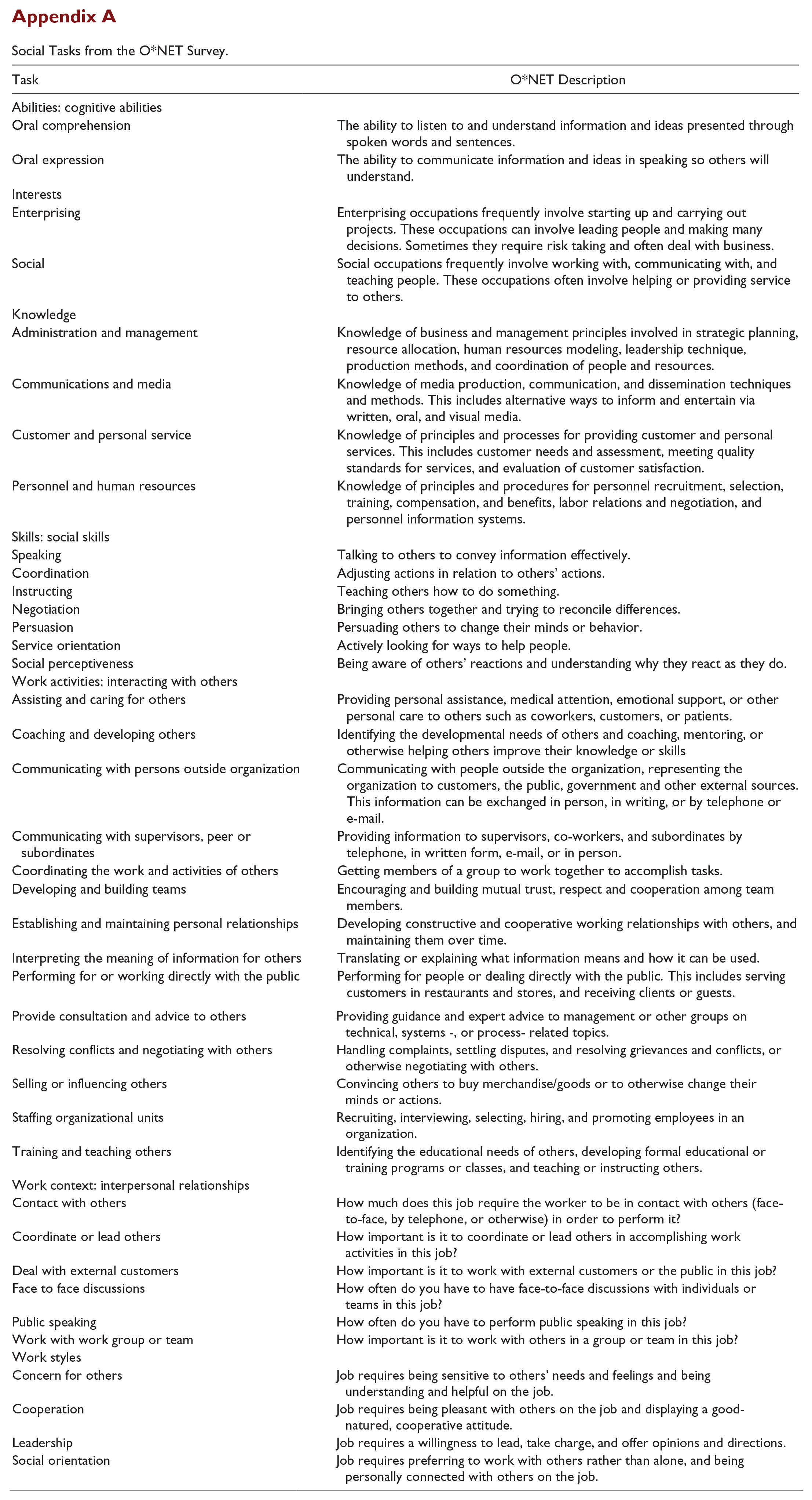
First, we examine the O*NET survey to identify all the job tasks requiring any form of social activity or interaction. The Appendix provides the list of all 39 task indicators used in the analysis, which include a wide range of work activities.
Using principal-components factor analysis with varimax rotation, we estimate the latent skill dimensions of these job tasks. The factor analysis produced six different factors, which we label as emotion, communication, coordination, sales, team, and administration skills. Table 1 summarizes the results from this analysis. For each of the six factors, we present the eigenvalue and variance explained. The results show that none of the factors is truly dominant. The coordination factor explains the most variance (16.7 percent) across the social task indicators, but three of the other factors (emotion, communication, and sales) each exhibit similar explanatory power (14 percent to 16 percent each). Team and administration skills seem to be less salient dimensions as they explain only 6 percent to 8 percent of the overall variability. Under each of the six factors, we present the job tasks that display the highest factor loadings and therefore align more closely with each social skill dimension. To the right of the tasks, we include a list of representative occupations that tend to characterize these social skill dimensions, as evidenced by their relatively high factor scores.
Factor Analysis on Social Skill Dimensions.
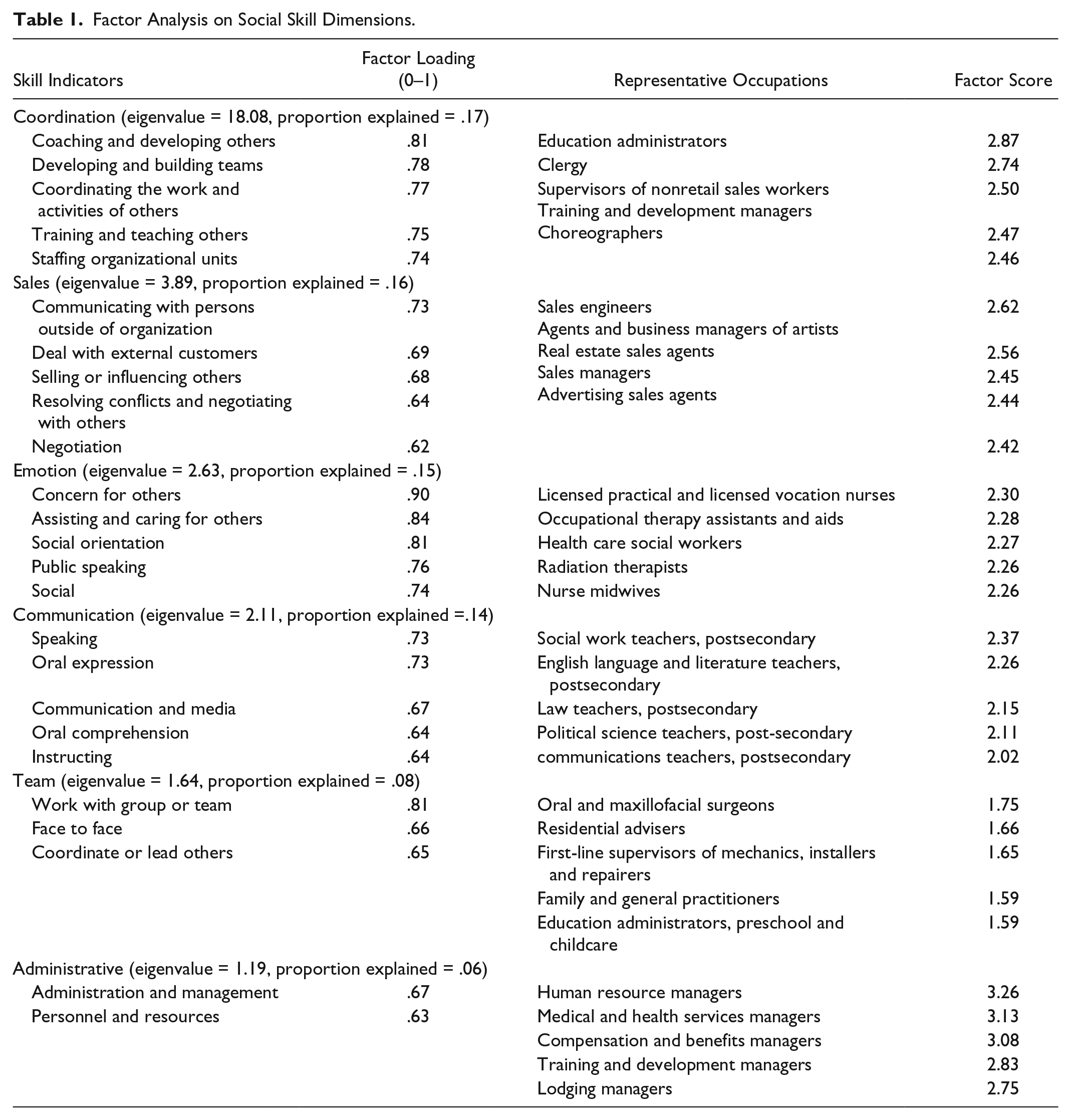
The first factor includes tasks such as coaching and developing others, developing and building teams, and coordinating the work and activities of others. We label this factor “coordination skills” because they require an individual to bring people together and facilitate activities among them. Jobs that align with this factor include education administrators, clergy, and training and development managers. The BLS describes development managers as workers who coordinate the development and training activities for staff members.
The second factor involves communicating with people outside of the organization, dealing with external customers, and selling or influencing others. Because selling usually requires people to communicate with outside organizations or external customers, in addition to selling to others, we label this factor “sales skills.” Jobs that represent this factor include sales engineers, agents and business managers of artists, real estate agents, and sales agents. Sales engineers primarily use in-depth product knowledge in order to sell products.
The third factor is associated with job tasks such as concern for others, assisting and caring for others, and public speaking, which led us to label this factor “emotion skills.” Several of these tasks require caring for others and the use of emotions when dealing with patients or customers. Jobs that fit into this occupation include licensed practical and licensed vocational nurses, occupational therapy assistants and health care social workers. For example, licensed practical and vocational nurses’ jobs care for those who are ill or injured, which fits well with the job tasks associated with emotion skills.
We label the fourth factor “communication skills” because it is linked to speaking, oral expression, and oral comprehension. Jobs that represent this factor include many postsecondary educators, including social work teachers, English language and literature teachers, and law teachers. Because the BLS defines postsecondary teachers’ jobs as including instructing students, conducting research and publishing scholarly papers and books, it is not surprising that they use communication skills in their daily activities.
The fifth factor, labeled “team skills,” includes tasks from O*NET such as coordinating or leading others, face-to-face work, and working with a group or team. Many of these tasks are associated with jobs that involve working in groups or teams. Jobs that are associated with this factor include oral and maxillofacial surgeons, residential advisers, and first-line supervisors of mechanics, installers, and repairers. The daily activities of residential advisers include coordinating activities and assisting residents with problem solving.
The sixth factor is most closely associated with tasks such as personnel and resources, as well as administration and management. We refer to this factor as “administration skills” because these tasks involve managing workforce records and relationships. These types of tasks are especially important for managers in the fields of human resources, medical and health services, and compensation and benefits. Human resource managers spend time recruiting, interviewing and hiring new staff.
Overall, these results show that social skills are truly multidimensional. The factor analysis solution is consistent with commonly referenced divisions between emotion labor and coordination activity. Furthermore, social tasks are differentiated by the extent to which they involve communicating with others and salesmanship. Skills related to working in teams and in an administrative capacity represent significant, though somewhat less salient aspects of social skills.
Trajectories of Social Skill Exposure
Our next goal is to match the social skill scores for each occupation with individuals’ career survey data to examine variation in the cumulative exposure to these different social skill dimensions. For the remainder of the analyses, we focus on only four of the social skills we identified: coordination, sales, emotion, and communication skills. This decision was guided by three reasons: (1) these four factors explain the most variability in social skills, (2) team skills and administration skills are somewhat redundant in that they are highly correlated with the remaining skills (especially coordination skills), and (3) focusing on a smaller set of skill dimensions aids convergence of the multitrajectory models.
First, we standardize the factor scores for each occupation prior to applying them to individuals’ careers. Our goal is to generate a metric for each job that represents the extent to which the job duties in a given occupation are devoted to a specific social skill dimension. We therefore transform the factor scores into proportions by (1) subtracting the minimum factor score value for each social skill dimension from the overall distribution of scores (effectively setting all minimums to zero) and (2) dividing each distribution by the maximum value. This generates distributions that range from 0 to 1, with 0 being assigned to occupations in which the social skill dimension matters the least and 1 being assigned to occupations in which the social skill dimension matters the most.
Second, we match the skill proportion measures for each occupation with survey data from the PSID. Specifically, we multiply the skill proportions by the number of years of experience each survey respondent had within each occupation. For example, a job as a cashier has an emotion skill score of .66. Therefore, a worker who had spent 3.5 years working as a cashier would have accumulated roughly 2.31 years of emotion skill experience (.66 × 3.5 = 2.31). 2 We then add up the experience that each individual gained for each social skill dimension across all years reported from 2003 to 2011. The yearly estimates provide the basis for the trajectories of experience for each social skill dimension.
Third, we estimate trajectory models to define skill exposure groupings (Jones and Nagin 2012). Trajectory models measure population differences in outcomes using discrete mixture models and create groups based on similar trajectories over time. We apply the censured normal model, which is the most appropriate for our case as the skill exposure variables are continuous in nature (Jones and Nagin 2012). We include only individuals who fit standard working age and stratify our sample into three age categories: 18 to 34, 35 to 50, and 51 to 65 years. We stratify our analysis because age is a major determinant of skill exposure and thus skill accumulation processes differ by age.
We first apply single-trajectory models to describe how each of the four social skill experiences—emotion, communication, sales, and coordination—accumulates over time within each of the three age categories. Trajectory modeling fits the longitudinal outcome and age using a polynomial function (cubic, quadratic, linear, or intercept) (Jones and Nagin 2012). To determine the best fit of the data, we estimate skill exposure groups with several combinations including one group, two group, and three groups to evaluate fit on the basis of statistically significant p values (Jones and Nagin 2012). 3 Next, to further understand how these social skills fit together, we fit multitrajectory models incorporating all four skill exposure variables for each age category. The average social skill trajectories can then be plotted and compared across the different groups.
The results of the multitrajectory analysis are presented in Figures 1 to 3. Groups are presented vertically and show the average social skill trajectory for each dimension. Figure 1 displays the trajectory groups for the youngest age category (18–34 years). The best fitting multitrajectory model includes three skill groups. Most of the respondents in this age range fit into group 1, which we label low social skill exposure (48.3 percent). This group is characterized by a slight increase over age in all social skills. Group 2, which we label moderate social skill exposure (37.1 percent) has a steeper accumulation trajectory. Group 3 (14.7 percent) has the highest amount of exposure, although appears somewhat similar to group 2 but with a steeper slope. Note that within each group, the trajectories are relatively consistent across all dimensions. Surprisingly, we do not find evidence of divergent exposure across different types of social skills (e.g., increase in emotion but not in coordination skills). This pattern is consistent for the other age categories as well.

Multitrajectory analysis results for ages 18 to 34 years.

Multitrajectory analysis results for ages 35 to 50 years.
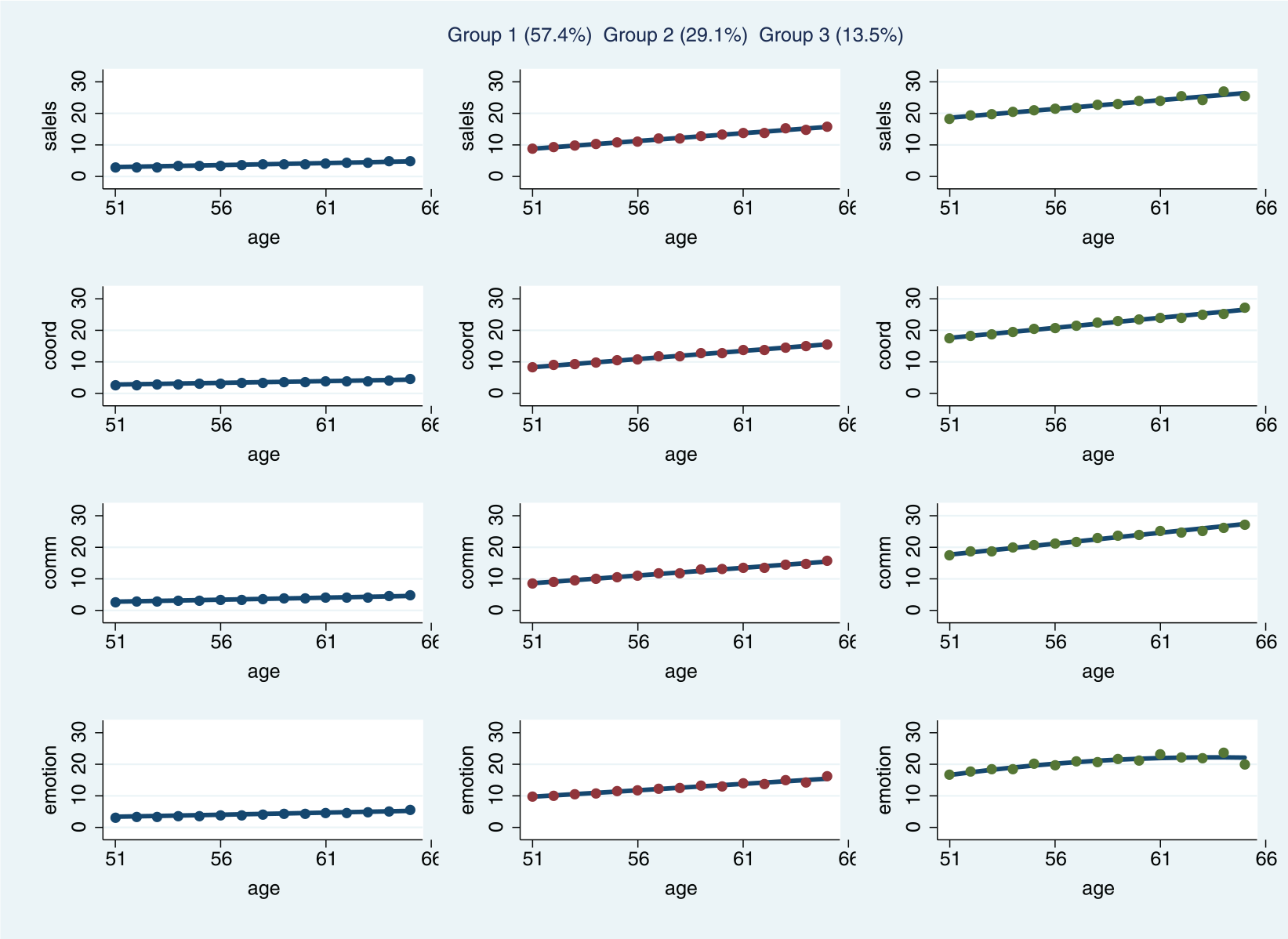
Multitrajectory analysis results for ages 51 to 65 years.
For the middle age category (35–50 years), the best fitting multitrajectory model also includes three skill groups. In Figure 2, the first group is the largest group and has minimum differences in skill exposure over age (55.0 percent). We label this group low social skill exposure because of the flat skill trajectories. The group in the middle is labeled moderate social skill exposure (31.1 percent), as it captures a modest increase in social skills. The group on the right represents high social skill exposure (13.8 percent) because of the steep increase in skills. Much of the variation in social skill experience takes place during this career stage. Note that each set of skill trajectories originates near zero at age 35, except for the last group, which has a larger intercept than the other two groups.
Figure 3 presents the results for the oldest category (51–65 years). The best fitting multitrajectory model separates respondents into three groups. As with the other two age categories, the trajectory groups split into low (57.4 percent), moderate (29.1 percent), and high social skill exposure (13.4 percent). The high-skill group is characterized not only by a steep increase in the accumulation of social skill experiences but also by a relatively high initial value of social skills. This offers evidence of cumulative social skill advantage, suggesting that most of these individuals might have belonged to moderate- or high-trajectory groups during the middle-career stage. Supplemental analysis supports this interpretation. Removing from our exposure measures all social skill scores accrued prior to age 50 reduces the number of observed multitrajectory groups for older workers from three to two. This confirms that much of the variability in social skill trajectories among older workers can be attributed to differences in their intercepts rather than their slopes. Finally, the trajectories among the older age category are mostly consistent across social skill dimensions. However, we see some divergence in the skill dimensions. Especially among the high skill exposure group, the emotion skill trajectories appear to level off as workers near retirement, whereas skill exposure remains mostly linear for sales, coordination, and communication.
Workforce Variation in Social Skill Accumulation
Finally, we examine the likelihood of belonging to each type of social skill exposure group on the basis of gender, race, and education, while controlling for total work experience. We run these analyses separately by age category. 4 The outcome variables measure membership in the social skill groups from the multitrajectory models. Because the multitrajectory analysis generated three groups, we use multinomial logistic regression to compare the odds of being a member of the high-skill and moderate-skill trajectory group versus being a member of the low-skill group. Gender is measured by a dichotomous variable (female = 1, male = 0). Race is measured by a pair of dummy variables for black and other race, with white as the reference category. Education is measured as the highest degree completed. The education variables include dummy indicators for individuals who received a high school, bachelor’s, or graduate/professional degree, with less than high school degree as the reference category.
Results, shown in Table 2, reveal few significant race differences in the odds of membership in the moderate skill trajectory group versus the low skill trajectory group. However, black and other race respondents are significantly less likely to be members of the high-skill group than the low-skill group. We observe some variability in the significance of these coefficients across the age ranges, but overall the models tend to show a pattern of social skill advantage accruing to white workers more so than minority workers.
Unstandardized Coefficients for Multinomial Logistic Regression Analysis.

p < .05. **p < .01. ***p < .001.
Women are significantly more likely than men to be in both the high and the moderate skill trajectory groups rather than the low skill trajectory group. This finding is consistent with the expectation that women tend to fulfill job duties associated with care work and emotion labor (Hochschild 2003). The significant female advantages over men in social skill exposure appear to be confined to the early and later portions of careers. Interestingly, supplemental analyses show that the gender effects are reversed when total work experience is not included as a control variable in the model. Not surprisingly, total years of work experience is strongly associated with the accumulation of social skill experiences. Women only accrue more social skill experiences than men net of total experience. In other words, men actually tend to accrue more social skill experience than women overall, but this is due entirely to their increased labor force attachment relative to women.
Increased education is positively and significantly associated with greater social skill exposure. For example, the odds of a midcareer worker being in the high social skill trajectory group versus the low social skill trajectory group are more than 7 times greater for workers who obtained graduate or professional degrees than for those who did not complete high school (odds = exp[2.041] = 7.698). Furthermore, the association between social skill exposure and educational attainment tends to increase in successive career stages. That is, education appears to be a stronger predictor of social skill exposure later in the career than earlier in the career. The explanatory power of the models are also substantially improved in the late career stage relative to the early career stage (see the pseudo-R2 values).
We conducted one final set of supplemental analyses to examine the source of the workforce differences in social skill exposure. The observed advantages in social skill exposure could be due to divergent slopes during early stages of careers that carry forward to (i.e., fully explain) social skill differences later in careers. Alternatively, slope differentials in social skill trajectories could be apparent at each stage independent of earlier experience. We tested these ideas by removing from each observation all social skill exposures accumulated prior to the career stage in question. Social skill estimates for midcareer workers were therefore not allowed to reflect any work experience prior to age 34, just as social skill estimates for older workers could not reflect work experience prior to age 50. This change effectively minimizes many of the significant differences shown in Table 2. 5 All of this suggests that the initial divergence in social skill exposure during early portions of careers is largely responsible for subsequent variability.
Discussion and Conclusion
This study makes several important contributions. First, our detailed analysis of the multidimensional aspects of social skills improves on the previous measurement of social skills by revealing the complexity of social interaction at work. In some ways, this complexity is consistent with the popular distinction between care work and managerial social skills. However, we show that other skills, such as communication and sales, are distinct dimensions of social activity at work.
Second, we use an innovative statistical technique, multitrajectory analysis, to identify multiple latent trajectories of social skill. Rather than treating social skill exposure as independent across multiple dimensions, we examine social skill exposure holistically by defining groups on the basis of similarity in skill trajectories across multiple dimensions. We observe substantial variability in the extent to which workers are exposed to social skills across employment careers. The results suggest that social skill experiences tend to accumulate in tandem with other social skill dimensions, rather than accumulating in one form at the expense of another. This finding suggests that researchers should not view detailed occupations as mutually exclusive domains for social skill exposure (e.g., see Dwyer 2013). Care work jobs may involve much coordination just as supervisory jobs may involve much emotion labor. Future research should attempt to explore in greater detail the areas of overlap in different forms of social tasks and work.
Third, we offer an initial assessment of who accumulates social skill experience and at what career stages. Whereas care work and soft skills are often described in reference to the working-class and disadvantaged segments of the workforce, our analyses suggest that a broader set of social skill experiences tend to accumulate to more advantaged workers (whites and highly educated). Gender is an exception to this rule, as women tend to accrue social skill experience more rapidly than men do. However, our supplemental analyses showed that the female advantage in social skill experience is only apparent net of total work experience. Overall, men tend to accrue more social skill experience than women because of their accumulation of more total years of work experience. Furthermore, our supplemental analyses led us to conclude that much of the divergence in social skill accumulation profiles can be tracked to early career dynamics. Future research should examine this possibility in greater detail.
The results imply that variation in the accumulation of social skill experience could help explain social stratification. Employers consider social skills to be highly valuable (Erickson 2001; Moss and Tilly 1996) and increasingly so because of recent transformations in the organization of work (Deming 2015; Rainie and Wellman 2012; Van Dijk 2012). The extent to which some groups accrue these types of skill experiences should be consequential for understanding group differences in career outcomes. Our study stops short of analyzing (1) the economic value (i.e., wages and salary) associated with the exposure to different social skill dimensions and (2) how that value might accrue differently across social groups. These seem to be important issues for future research to consider. The results from the separate age-based analyses also raise questions about the extent to which the economic value associated with social skills might vary across the career. Although this study is not able to answer these questions, we hope that it effectively conveys the tremendous promise of research on the social aspects of work for advancing an understanding of career dynamics and economic outcomes.
Footnotes
Appendix
Social Tasks from the O*NET Survey.
| Task | O*NET Description |
|---|---|
| Abilities: cognitive abilities | |
| Oral comprehension | The ability to listen to and understand information and ideas presented through spoken words and sentences. |
| Oral expression | The ability to communicate information and ideas in speaking so others will understand. |
| Interests | |
| Enterprising | Enterprising occupations frequently involve starting up and carrying out projects. These occupations can involve leading people and making many decisions. Sometimes they require risk taking and often deal with business. |
| Social | Social occupations frequently involve working with, communicating with, and teaching people. These occupations often involve helping or providing service to others. |
| Knowledge | |
| Administration and management | Knowledge of business and management principles involved in strategic planning, resource allocation, human resources modeling, leadership technique, production methods, and coordination of people and resources. |
| Communications and media | Knowledge of media production, communication, and dissemination techniques and methods. This includes alternative ways to inform and entertain via written, oral, and visual media. |
| Customer and personal service | Knowledge of principles and processes for providing customer and personal services. This includes customer needs and assessment, meeting quality standards for services, and evaluation of customer satisfaction. |
| Personnel and human resources | Knowledge of principles and procedures for personnel recruitment, selection, training, compensation, and benefits, labor relations and negotiation, and personnel information systems. |
| Skills: social skills | |
| Speaking | Talking to others to convey information effectively. |
| Coordination | Adjusting actions in relation to others’ actions. |
| Instructing | Teaching others how to do something. |
| Negotiation | Bringing others together and trying to reconcile differences. |
| Persuasion | Persuading others to change their minds or behavior. |
| Service orientation | Actively looking for ways to help people. |
| Social perceptiveness | Being aware of others’ reactions and understanding why they react as they do. |
| Work activities: interacting with others | |
| Assisting and caring for others | Providing personal assistance, medical attention, emotional support, or other personal care to others such as coworkers, customers, or patients. |
| Coaching and developing others | Identifying the developmental needs of others and coaching, mentoring, or otherwise helping others improve their knowledge or skills |
| Communicating with persons outside organization | Communicating with people outside the organization, representing the organization to customers, the public, government and other external sources. This information can be exchanged in person, in writing, or by telephone or e-mail. |
| Communicating with supervisors, peer or subordinates | Providing information to supervisors, co-workers, and subordinates by telephone, in written form, e-mail, or in person. |
| Coordinating the work and activities of others | Getting members of a group to work together to accomplish tasks. |
| Developing and building teams | Encouraging and building mutual trust, respect and cooperation among team members. |
| Establishing and maintaining personal relationships | Developing constructive and cooperative working relationships with others, and maintaining them over time. |
| Interpreting the meaning of information for others | Translating or explaining what information means and how it can be used. |
| Performing for or working directly with the public | Performing for people or dealing directly with the public. This includes serving customers in restaurants and stores, and receiving clients or guests. |
| Provide consultation and advice to others | Providing guidance and expert advice to management or other groups on technical, systems -, or process- related topics. |
| Resolving conflicts and negotiating with others | Handling complaints, settling disputes, and resolving grievances and conflicts, or otherwise negotiating with others. |
| Selling or influencing others | Convincing others to buy merchandise/goods or to otherwise change their minds or actions. |
| Staffing organizational units | Recruiting, interviewing, selecting, hiring, and promoting employees in an organization. |
| Training and teaching others | Identifying the educational needs of others, developing formal educational or training programs or classes, and teaching or instructing others. |
| Work context: interpersonal relationships | |
| Contact with others | How much does this job require the worker to be in contact with others (face-to-face, by telephone, or otherwise) in order to perform it? |
| Coordinate or lead others | How important is it to coordinate or lead others in accomplishing work activities in this job? |
| Deal with external customers | How important is it to work with external customers or the public in this job? |
| Face to face discussions | How often do you have to have face-to-face discussions with individuals or teams in this job? |
| Public speaking | How often do you have to perform public speaking in this job? |
| Work with work group or team | How important is it to work with others in a group or team in this job? |
| Work styles | |
| Concern for others | Job requires being sensitive to others’ needs and feelings and being understanding and helpful on the job. |
| Cooperation | Job requires being pleasant with others on the job and displaying a good-natured, cooperative attitude. |
| Leadership | Job requires a willingness to lead, take charge, and offer opinions and directions. |
| Social orientation | Job requires preferring to work with others rather than alone, and being personally connected with others on the job. |
Acknowledgements
We would like to thank Bobby Jones for providing guidance regarding using trajectory models and multitrajectory models. We also thank Michelle Lore, who provided valuable assistance to data management and analysis. Data for this project came from the PSID, which is partly supported by the National Institutes of Health under grant R01 HD69609 and the National Science Foundation under award 1157698. We want to thank the anonymous reviewers who provided valuable feedback.
Authors’ Note
Earlier versions of this paper were presented at the Southern Sociological Society’s 2015 meeting and at the American Sociological Association’s 2016 meeting. The article benefited from helpful suggestions provided by participants at those presentations.
1
One concern is that the skill content of occupations may change over time. We tested this concern by comparing O*NET social skill scores from six different data releases spanning the eight years covered by the PSID analysis. The year-to-year correlations are quite strong, typically exceeding r = .9 from one year to the next and in the .5 to .6 range across the eight-year period. Our analyses of panel data also mitigates concerns about cross-year variation in skill content due to changing workforce composition (see  ).
).
2
Our reference to these estimates as “years of skill experience” is merely a heuristic device. Our calculation is an imperfect approximation of years of social skill experience because it is based on a relative comparison of factor score values rather than a comparison of social versus all other skills. Furthermore, summing social skills across multiple skill dimensions could result in values that exceed the total number of years of work experience.
3
In order to determine best fit for trajectory models, we started with the highest polynomial function and one group. If the model was not statistically significant, we fitted another trajectory with the next lowest polynomial function, and so on. Once we found a statistically significant function, we added another group in the same manner until the groups became too small, or less than 5 percent of the sample.
4
Gender, education, and age are important to account for in our models because they are the main predictors of task variability within occupations (see Autor and Handel 2013; Bidwell 2016; ). We also attempted to account for this form of task variability through supplemental analysis that effectively weighted the summary occupational skill scores on the basis of the inverse of the standard deviation of their individual survey scores. The results (available on request) were nearly identical to the nonweighted results reported here.
5
The race and gender differences in social skill exposure were no longer significant after the early-career stage. High levels of education remained beneficial for social skill exposure after the early career stage, but only when contrasting high versus low social skill groups.