




Abstract
Advancement in medical science and technology enhanced the human capacity to intervene in the process of dying, forcing professionals and the public to face ethical dilemmas and question the boundary between life and death. The contentious discourse on this boundary is particularly salient given the unprecedented levels of population aging all over the world. This paper analyzes the discursive field surrounding a notable Italian end-of-life controversy. Combining field and narrative theories, the present study spans structural aspects and rhetorical mechanisms. Results show that not only are antithetical interpretations of the event tied to media’s ideological leanings, but the latter are also systematically associated with different sequential structures of headlines and story leads. Competing actors produce alternative frameworks by identifying different sets of perpetrators.
Introduction
In January 1992, a 21-year-old Italian woman, Eluana Englaro, was involved in a car accident that caused her to fall into a state of unconsciousness. One year later, she was diagnosed as exhibiting a permanent vegetative state. In 1999, her father, Beppino Englaro, initiated a lengthy court proceeding with the aim of suspending feeding and hydration, claiming to follow Eluana’s will, which she allegedly expressed after the death of a friend. Beppino’s request was denied twice. In 2007, however, the Italian Court of Cassation accepted an appeal for a new trial, given two circumstances: the irreversible vegetative state of the patient and verification that the patient, if conscious, would have denied authorization to continue treatment. On July 9, 2008, the Milan Court of Appeal approved Beppino’s request to suspend feeding and hydration.
On that day, the story of Eluana became the center of an intense debate on patients in a vegetative state, the boundary between the private sphere and government intervention, and ultimately the meaning of life and death. The Italian government, led by conservative Silvio Berlusconi, and the Catholic Church exercised their influence to stop the withdrawal of life support (WLS). The progressive opposition supported the decision of the judges and the will of Eluana’s family. The president of the republic, Giorgio Napolitano, initially took a position of neutrality, until Prime Minister Berlusconi tried to adopt emergency measures to keep Eluana alive, which Napolitano opposed. Jurists, physicians, and ordinary citizens voiced their conflicting opinions. Amid this fierce ideological battle and at the apex of an institutional crisis, on February 9, 2009, only four days after feeding and hydration were stopped, Eluana died (Latronico et al. 2011; Luchetti 2010; Rubulotta et al. 2010).
Making Sense of End of Life
How does society make sense of cases like the one just described? As such events unfold, their meaning is proposed, contested, negotiated, and shaped by ubiquitous social forces. Following the “cultural turn” that has characterized American sociology in the past few decades (Friedland and Mohr 2004), social researchers have dedicated a growing amount of attention to the question of meaning-making and have analyzed symbols, texts, and an extensive variety of cultural objects, from household possessions (Csikszentmihalyi and Halton 1981) to national anthems (Cerulo 1995). Two (largely intersecting) strands of research proved particularly influential. One, rooted in field theory, seeks to explain individual or collective behavior between competing actors as they take position vis-à-vis one another (Martin 2003). The other uses formal methods to uncover the structure of phenomena (Breiger 2000; Mohr 1998). Within the latter, Cerulo’s (1998) work on narrative theory is particularly relevant to this study because it permits identification of patterns in how an event is narrated from the perspective of different protagonists and of the relations of these patterns to different interpretations of the event itself. Cerulo analyzes fictional and nonfictional accounts of violence, and she observes an association between sequencing (i.e., the order according to which events are described) and meaning (i.e., whether the events are justifiable or unacceptable).
Her work and subsequent relevant contributions (Cerulo 2000; Muschert 2007; Muschert and Carr 2006) examined a variety of topics, including public apologies (Cerulo and Ruane 2014), awakening narratives (DeGloma 2010), and use of fear (Altheide 2002). These studies, however, have not considered how actors with different positions in a field might compete to affirm their particular perspective. The present study fills this gap by analyzing how newspapers with different political leanings reported the story of Eluana Englaro. This also represents a novel contribution to the literature on media coverage of vegetative states. In fact, this line of research, which can be found in multiple disciplines, has primarily focused on two questions: whether coverage is realistic and whether it is laden with graphic descriptions.
Scholars have uncovered the recurrent misrepresentation of vegetative state in several well-known cases, such as Karen Ann Quinlan (Healey 1976), Terri Schiavo (Racine et al. 2008), and Eluana Englaro (Latronico et al. 2011). Fanciful and excessively optimistic depictions appear also in movies (Wijdicks and Wijdicks 2006) and soap operas (Casarett et al. 2005). Another common observation is the use of charged language not only to negatively characterize WLS (Racine et al. 2008, 2010) but also to describe the unconsciousness of patients (Waldman 2006). However, there is no systematic analysis of antithetical frames across the political spectrum, and the question of how meaning is produced is still largely unanswered.
I contend that end-of-life crises can be variously interpreted on a continuum between an act of mercy and an act of killing. While it might be intuitive (albeit it is untested) that such interpretations are ideologically patterned, we ignore whether the same holds true for the narrative styles employed by the media. Thus, I propose the following research questions:
Research Question 1: Does media ideological self-identification predict their position on end-of-life crises?
Research Question 2: Is sequential structure independent of media leanings? Or do sequencing patterns reflect newspapers’ positions on the political spectrum?
Combining Field and Narrative Theories to Formalize Meaning
At the intersection of field theory and structural analysis, a rich research tradition has developed to examine meaning as the product of contention between competing institutions. A comprehensive review of this field is beyond the scope of this study, but I will review a few pertinent contributions here. In his influential work, Bourdieu (1984) mapped the distribution of cultural tastes and practices across varying levels of education and social origin. Wagner-Pacifici’s work shed light on the effect of meaning on political violence. For instance, she analyzed the kidnapping of Italian politician Aldo Moro by the terrorist group Red Brigades and showed how the government’s refusal to negotiate with the terrorists, which culminated in Moro’s assassination, was instrumental to maintaining Italian political stability (Wagner-Pacifici 1986). She also demonstrated how shifting definitions of the radical group MOVE led the city of Philadelphia to a dramatic conflict resolution strategy (Wagner-Pacifici 1994). Within this research tradition, formal approaches have been used to analyze alternative meanings of love across different social contexts (Yeung 2005), patronage in Renaissance Florence (McLean 2007), and workfare (Krinsky 2008). Particularly relevant to this work, Snow, Vliegenthart, and Corrigall-Brown (2007) examined the 2005 French riots and observed variation in salience and frames across progressive and conservative newspapers in six countries.
Only a subset of this vast literature is broadly concerned with sequences. In his attempt to transcend “general linear reality,” Abbott (1995, 2001) succeeded in placing sequence analysis and related methods, such as optimal matching, within the boundaries of mainstream sociology, with special attention to the study of life courses, family histories, and career paths (Cornwell 2015). Event structure analysis (Griffin 1993; Heise 1989) formalizes historical events as a series of actions that parallel a series of counterfactual questions: Would the subsequent action occur in the absence of the previous one? Mische (2008) synthetized these approaches by formalizing a field in which a sequence of events leads to an outcome, namely, presidential impeachment. Cerulo’s work is unique, however, for her attention to sequences in text.
In an attempt to analyze meaning by looking at the syntactical structure of content, Cerulo (1998) provided a pioneering framework that sociologists of culture could use to model events. Her focus was on fictional and nonfictional accounts of violence that might be interpreted as deviant, ambiguous, or normal. Cerulo suggested that order matters: Meanings are “linked to the ‘timing’ by which information reaches us” (Cerulo 1998:5). Using cross-tabular analysis, she found a significant association between the moral acceptability of the events and different types of sequences: (1) Victim sequences introduce the event through the eyes of those subjected to the incident and are associated with deviant violence (e.g., homicide); (2) performer sequences describe the event from the point of view of the perpetrator and typically introduce normal acts of violence (e.g., self-defense); (3) contextual sequences prioritize data on the setting and circumstances of the event and that are associated with ambiguous violence, that is, violence that “contains both deplorable and moralistic elements; such acts may be distasteful and unpleasant, but nevertheless defined as justifiable” (Cerulo 1998:47) (e.g., suicide and euthanasia); and (4) doublecasting sequences simultaneously frame the main actor of the event as both victim and perpetrator and are also connected to ambiguous violence.
This approach inspired a number of analyses of deviant and criminal cases (Adorjan 2010; Altheide 2002; DeGloma 2009; Muschert 2007; Muschert and Carr 2006; Muschert and Janssen 2012; Wallace 2008), but it is not solely confined to instances of violence. For instance, Cerulo and Ruane (2014) analyze the association between the syntax of public apologies and public forgiveness, identifying a new instance of sequence that signals action-ownership, and DeGloma (2010) utilizes this framework to analyze “awakening narratives.” As mentioned in the introduction, a limitation of this work, which I address in this study, is its separation from field theory. This matters because, for example, Cerulo does not sort newspapers into different ideological positions. If we think about euthanasia, progressive and conservative media will likely interpret the same story in dramatically different ways. Will their sequence structure vary as well?
Some authors that built on Cerulo did consider media variation in political leanings (Altheide 2002), format, and distribution (Adorjan 2010; Wallace 2008). However, this was primarily a strategy to increase diversity in the sample, and none of these works had the objective of mapping a formal field of competing institutional meanings. This is, instead, the goal of the present study, which to my knowledge is the first attempt to combine narrative theory, sequencing in particular, and field theory. Central to both perspectives is the knowledge of the actors that constitute the field and the definition of their role, which I provide in the following section.
The Field: Victim, Performers, and the Media
Eluana Englaro is the silent protagonist of this story. A variety of individuals and institutions acted around her. These can be broadly grouped as follows: Eluana’s family (mainly represented by her father, Beppino), the church (members of the ecclesiastical hierarchy), the government (Silvio Berlusconi, his ministers, and members of his coalition), the progressive opposition (leaders of parties gainsaying the government), super partes institutional figures 1 (the president of the Republic, Giorgio Napolitano, and the president of the Chamber of Deputies, Gianfranco Fini 2 ), and medicine and law experts.
To outline the victim and perpetrators, it is crucial to provide an unambiguous definition of the event. Because its interpretations are an object of contention, I propose to define it starting from the judicial truth established in court, that is, if conscious, Eluana would refuse treatment. The event is the reaction to this pronouncement. Once Eluana’s will is determined, it follows that she is the victim of those who oppose it: primarily, government and church. However, an alternative framing is possible. In fact, an anti-withdrawal narrative would characterize the case as akin to homicide and portray Eluana as a victim of those who support and attempt to enable the judicial truth: judges, progressive opposition, and potentially even her family. These considerations also guided the coding scheme for sequencing. I combined the deductive reasoning just described with an inductive and iterative open coding of headlines and story leads. The result, shown in Figure 1, is five sequences: victim (Eluana and her family), performers (government and church), alternative performers (judges and progressive opposition), double-casting (Eluana as victim and her family as performer), and contextual.
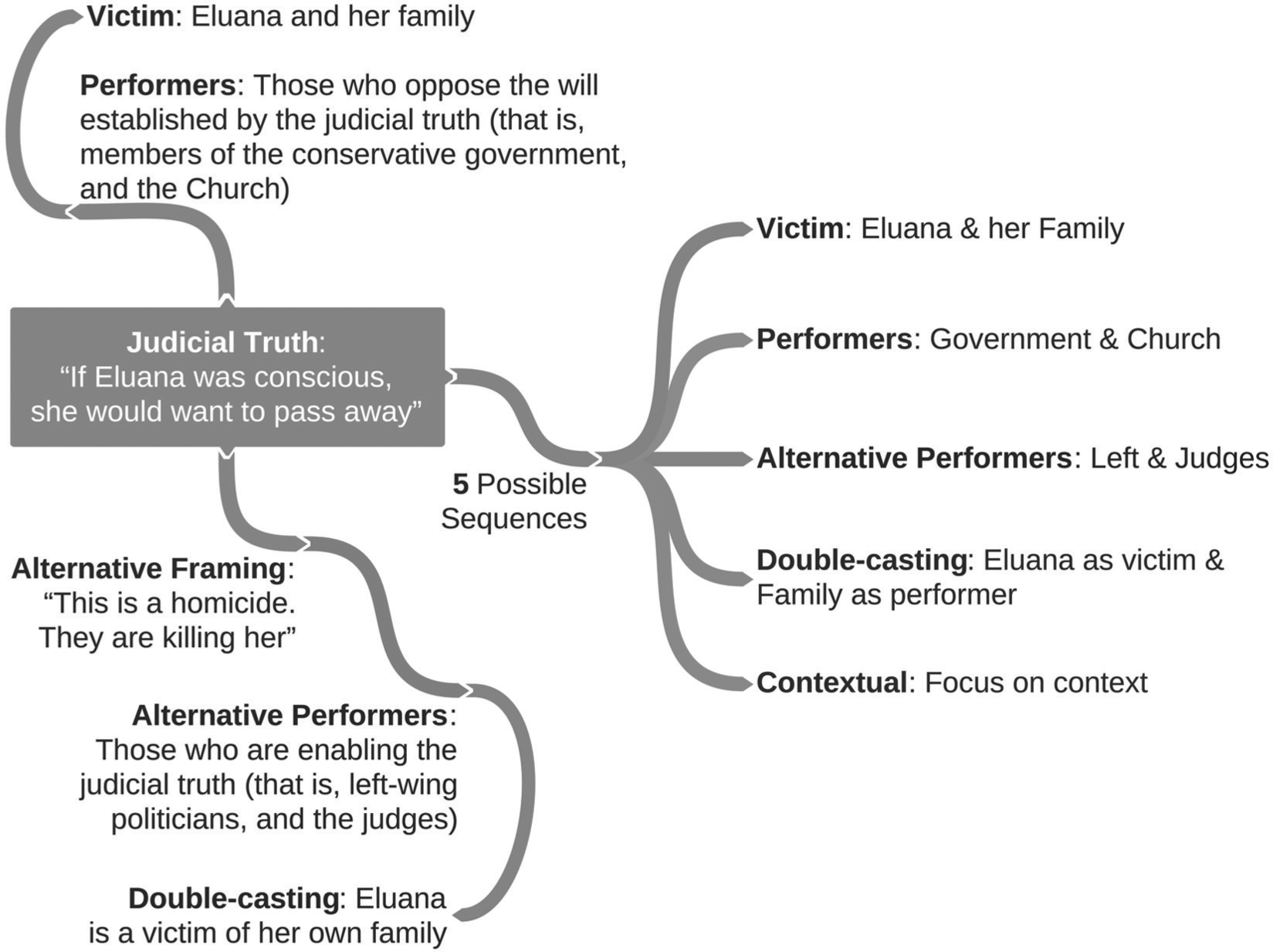
Coding scheme for sequencing.
Seven Italian broadsheet daily newspapers comprise the media field: Manifesto, l’Unità, la Repubblica, Corriere della Sera, Avvenire, il Giornale, and Secolo d’Italia. They represent different positions on the ideological spectrum. Referring primarily to each newspaper’s self-identification, I coded them as either progressive (Manifesto, l’Unità, la Repubblica, and Corriere della Sera) or conservative (Avvenire, il Giornale, and Secolo d’Italia 3 ).
Data and Methods
Data
For this analysis, I collected 260 news articles reporting on the story of Eluana since the moment it became more publicly debated (July 2008, when Beppino Englaro’s request was accepted) to the aftermath of her death (February 2009). I decided to use this broader temporal interval resting on the assumption that meanings are negotiated and the collective negotiation occurs over time, as the process unfolds.
First, as mentioned, I identified seven newspapers that vary on the ideological spectrum. Only five Italian newspapers (including Corriere della Sera) were accessible through the popular database LexisNexis, but they presented no relevant variation on the dimensions considered. Furthermore, three of them (Il Resto del Carlino, La Nazione, and Il Giorno) belonged to the same network and published identical articles. Additionally, not all newspapers had an online archive of their articles or an online version when the case occurred. Thus, I determined that LexisNexis was not a viable option for collecting data varying on the dimensions of interest, and I identified seven newspapers that were digitally available elsewhere and presented ideological variation.
After choosing the newspapers, I searched articles about Eluana’s case within each newspaper. I applied two strategies to collect data: (1) I used Google search to collect cases from Corriere della Sera, la Repubblica, and il Giornale, setting the website domain, the appropriate interval of dates, and using as the keyword the first name of the woman, Eluana (it is a very uncommon name, which media and public used to refer to the story); and (2) I locally accessed the Senate Library in Rome, which started a project of digitalization of newspapers, to gather reports from Avvenire, Il Manifesto, Secolo d’Italia, and l’Unità, setting the same temporal range and using the same search keyword. I only selected articles that were pertinent to the story of Eluana, discarding those that cited her incidentally in an account dedicated to a different event. The result, as said previously, is a nonprobability sample of 260 newspaper reports.
Variables
The first variable is the newspapers’ ideological position. As explained in the previous section, I operationalized this position as either progressive (Manifesto, l’Unità, la Repubblica, and Corriere della Sera) or conservative (Avvenire, il Giornale, and Secolo d’Italia). This is a newspaper-level variable and does not vary across articles within the same newspaper.
The second variable, also introduced in the previous section, is sequencing. Figure 1 shows the coding scheme, which I applied when analyzing the headlines and story leads. Sequencing varies at article level. Table 1 shows one example per sequence.
Sequencing Examples.

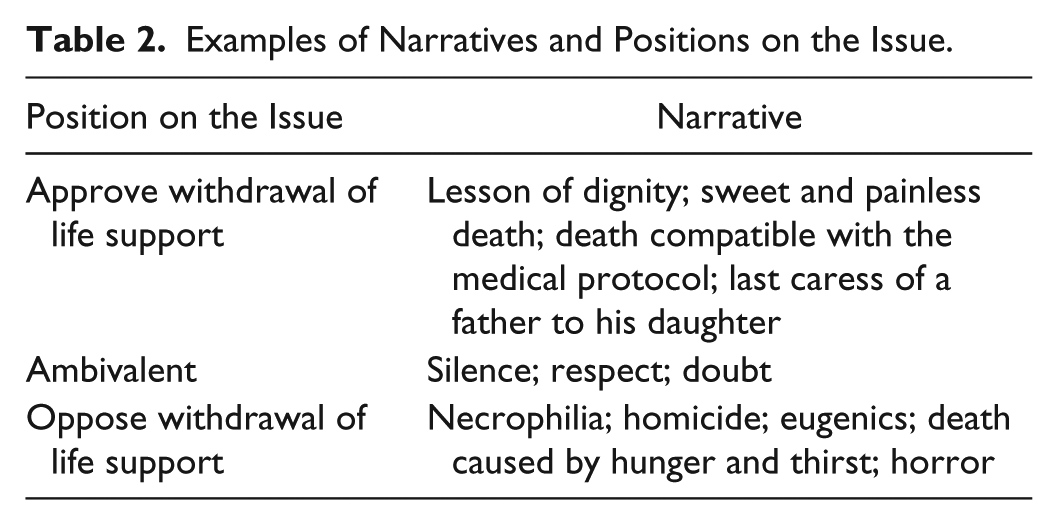
Field theorists and relational sociologists (Bourdieu and Wacquant 1992; Emirbayer and Johnson 2008) propose a distinction between having a position, for example, from left to right on the political spectrum, and taking a position on particular issues, for example, approving or opposing WLS. The position one has is related with the position one takes: They are mutually constitutive and can provide the observer with information about each other. However, they are not necessarily overlapping. For instance, given particular circumstances, a conservative can approve of WLS, whereas any actor in the field might just be uncertain. Resting on this distinction, I coded the articles’ position on the issue (third variable) in three categories: in favor of WLS, ambivalent, and opposed. 4 I analyzed the metaphors conveyed in each article (Lakoff and Johnson 1980; Santa Ana 2002) by looking at keywords or concepts that emerged in both the headlines and the body of the news reports. The narratives (see Table 2 for examples) were often quite graphic, making the interpretation straightforward. I also considered reported speech, drawing on the idea that “attributing statements to third parties” (Clayman 1988:482) is a way of making a statement while apparently maintaining neutrality. Furthermore, news reports can (more or less) subtly legitimize or delegitimize their sources. For instance, progressive newspapers cite Beppino Englaro and define him as “lucid and composed” (Manifesto, November 14, 2008), “stoic” (Manifesto, November 12, 2008), and “a civil rights hero of our times” (l’Unità, February 10, 2009). On the other hand, conservative media describe Beppino’s call for silence as an attempt to “cover his shame” (il Giornale, February 10, 2009), and they describe his claim that he is following Eluana’s will as one that is “continuously repeated despite lacking any logic or validity” (Avvenire, July 16, 2008). I used such instances of reported statements as supporting evidence to identify the article’s position on the issue.
Examples of Narratives and Positions on the Issue.
Finally, the fourth variable is time. Cerulo’s (1998, 2000) work focuses on initial reporting, while other contributions that have applied her framework also analyzed subsequent stories (Muschert 2009; Muschert and Carr 2006) and observed an increase in attention to contextual elements. For this reason, rather than considering time as a linear variable, it is more appropriate to distinguish first versus subsequent reporting.
The theoretical considerations advanced thus far inform my hypotheses. Beliefs on abortion and euthanasia move along political and religious lines (Ekland-Olson 2011; Moulton, Hill, and Burdette 2006). Hence, I formalize my first hypothesis:
Hypothesis 1: Progressive newspapers will approve WLS; conservative newspapers will oppose it.
This study proposes to combine insights from field (Martin 2003) and narrative theories (Cerulo 1998) by simultaneously examining ideological and syntactical structure of media reporting. Thus, my second hypothesis:
Hypothesis 2: Sequences will pattern on the newspapers’ ideological spectrum.
Resting on evidence on prolonged media coverage (Muschert 2009; Muschert and Carr 2006), I advance my last hypothesis:
Hypothesis 3: Subsequent reporting will focus on diverse elements of the story, using more contextual sequences and a broader set of sequences overall.
Analytic strategy
This work is essentially a case study, and statistical inference is not a primary goal. Consistent with much literature that formally analyzes meaning, I used mainly descriptive methods with the intent to identify the meaning structure of the event (Mohr 1998). To do so, I used histograms and social network analysis (SNA). SNA is capable of mapping the association between a set of cases and their attributes, but it also represents a valuable tool to assess whether this association changes over time. More specifically, I used quadratic assignment procedure (QAP) to estimate “the extent to which the network structure at one time . . . can predict future events in later periods” (Ghaziani and Baldassarri 2011:187). QAP is a method used to correlate two or more square matrices (Krackhardt 1987, 1988). It provides Pearson correlation coefficients (range, –1 to +1) and p values that can be interpreted conventionally.
Findings
Figures 2 and 3 show how articles’ attributes vary on newspapers’ political spectrum during first exposure and subsequent stories. For each figure, I computed a chi-square test to assess whether the association is significant. I considered 23 articles as first exposure: They were published in the first two days that followed Milan Court of Appeal’s authorization to withdraw Eluana’s life support. No article in my sample was published in the following three days. There is therefore a small break between first exposure and the remaining 237 stories.

Approve/oppose withdrawal of life support (WLS) by newspaper field position. (a) Approve/Oppose WLS by Newspaper Field Position – First Exposure Pearson chi-square = 23.00; p = .000; N = 23. (b) Approve/Oppose WLS by Newspaper Field Position – Subsequent Stories Pearson chi-square = 206.93; p = .000; N = 237.

Sequence by newspaper field position. (a) Sequence by Newspaper Field Position – First Exposure Pearson chi-square = 8.82; p = .032; N = 23. (b) Sequence by Newspaper Field Position – Subsequent Stories Pearson chi-square = 19.02; p = .001; N = 237.
Figure 2 exhibits a strong association between the newspapers’ positions on the issue and their position on the field (p = .000). Progressive newspapers approve of WLS; most conservative articles oppose it, although some are ambivalent. There is a modest difference between first exposure and subsequent stories: Ambivalence slightly grows across the field, but the whole picture is unaffected.
In Figure 3, it is possible to observe the association between sequences and newspaper’s ideological positions. The first thing to note is that sequencing does vary across the political field. In fact, there is a significant association both within the initial stories (Figure 3a: p = .032) and the following accounts (Figure 3b: p = .001).
Progressive and conservative reporting differ in two ways. First, progressive newspapers rely heavily on the victim perspective in their initial stories, while conservative media evenly focus on the victim, context of the event, and alternative performers, particularly the judges. Cerulo (1998) shows that victim priming is associated with unacceptable cases of violence. Progressive newspapers should welcome the sentence of the Court, so how can we explain their focus on the victim? The answer is in the body of the articles. In fact, after focusing on Eluana and her family in headlines and story leads, reports move on to highlight the lengthy and strenuous battle pursued by Beppino Englaro to affirm his daughter’s will. Tolerating the interference of the church and government throughout years of draining legal disputes—the progressive media suggest—is the real unacceptable side of this story, in which Eluana is a finally liberated victim: “After more than 16 years it is finally time for the long-awaited verdict, which does justice to Eluana’s will and to her parents’ exhausting battle” (l’Unità, July 10, 2008).
The second main difference between progressive and conservative newspapers emerges over time. In fact, in subsequent stories, the attention on the context increases as predicted (Muschert 2009; Muschert and Carr 2006), and so does the conservative focus on the victim. The rightist alternative framing, according to which Eluana is a victim of judges, leftist politicians, and even her own family, is responsible for the latter. As a result, in the long term, progressive and conservative newspapers tend to become similar in their focus on victim and context, exhibiting a remarkable degree of isomorphism (DiMaggio and Powell 1983). 5 In fact, looking at Figure 3b, there is isomorphism in the middle whereas the two ends of the distribution differ: Performer (government and church) sequences are predominantly used by progressive media; alternative performer (left and judges) and double-casting sequences are almost exclusively used by conservative papers. Not only does this generate a significant difference in sequencing, but it also indicates that the contention over alternative framings has changed the purpose of (alternative) performer sequences: In fact, they are no longer used to normalize perpetrators as in Cerulo (1998) but to accuse them.
To map the field of contention, I created a two-mode network that shows connections between newspapers and their attributes. In Figure 4, newspapers appear in different colors (progressive media are blue; conservative are red), and attributes are in gray. To increase clarity, I have reduced data to binary ties: Connections exist if the number of observed ties is larger than random ties (Mohr and Duquenne 1997). 6

Newspaper by attribute graph.
It is possible to identify two clusters, in the left and right regions of the network, respectively. The cluster on the left is very coherent: Its members are progressive newspapers that approve of WLS and predominantly use performer sequences. According to these media producers, Eluana is being liberated, and the decision of the judges to stop life support is an act of mercy that allows the woman to die with dignity. “It is against nature to keep her alive,” says Corriere della Sera (February 7, 2009). For la Repubblica, “it is not euthanasia. It is the interruption of an unwanted treatment—with a 17-year delay” (February 4, 2009). There is no cruelty in this vision: “Her death will be graceful, dehydration is painless” (la Repubblica, February 4, 2009).
On the right side of the network, instead, there are the conservative newspapers that do not condone WLS. They use alternative performer and double-casting sequences. For these papers, Eluana must be saved from leftist politicians and judges who do not respect the sanctity of life. For Avvenire, “removing hydration and nutrition opens the way to exterminating the weakest and the severely disabled subjects” (July 24, 2008). Eluana’s fate is grim: “She is destined to die amidst the most atrocious pain. You would not let a dog suffer this much” (il Giornale, February 4, 2009).
Secolo d’Italia represents an interesting exception. The right-wing newspaper adopts a narrative that demands respect for the sorrow of the family and the decision of the judges. Figure 2 showed a notable portion of conservative articles that were ambivalent toward WLS: Secolo d’Italia published nearly all of them. It might be baffling to understand why Secolo took this position on the issue (or rather, decided not to take a position), but some details on the political background can help.
I introduced Gianfranco Fini, president of the Chamber of Deputies, earlier. It must be noted that Fini led Alleanza Nazionale (National Alliance), a right-wing party that controlled Secolo d’Italia, and that he was a crucial member of Berlusconi’s coalition since 1994, when together they won the general election. Legitimized by Berlusconi, Fini’s post-fascist movement joins the Italian government for the first time after WWII. Fini shows unwavering loyalty. In fact, previous research on the political discourse during the 2006 Italian general election (Decataldo, Rambotti, and Tulelli 2006) found Fini adopting a post-democratic narrative (Crouch 2004) very similar to that of Berlusconi. Fini, at the time, was Berlusconi’s strongest ally: Their discourse was almost identical. In April 2008 (three months before the case of Eluana becomes prominent), Fini is elected president of the Chamber of Deputies. From this moment, he unconditionally embraces the respect of political institutions as a nonnegotiable point. His narrative style starts to drastically diverge from that of his ally Silvio Berlusconi, and their relationship starts to deteriorate. In February 2009, Berlusconi tries to adopt emergency measures to prevent removing life support from Eluana, creating a critical institutional crisis. Fini sides against his ally Berlusconi, whose attempt is “blocked by Fini and Napolitano.” 7 The distance between Fini and Berlusconi increases. In fact, in July 2009, a few months after Eluana’s death, the alliance collapses: Fini founds a new movement (Futuro e Libertà, Future and Freedom) that opposes Berlusconi’s coalition. Not only does this explain Secolo’s position on the issue, but it also demonstrates the real consequences of meaning and discourse for political dynamics: A similar narrative was an indicator of a strong alliance; a divergent narrative preceded the break of the coalition.
Figure 4 clearly visualizes how sequences are distributed across the field. In fact, I already observed how performer sequence is on the left while alternative performer and double-casting sequences are on the right of the graph. It is also possible to note the central positions of victim and contextual sequences. The former is connected to one progressive newspaper (la Repubblica) and two conservative newspapers (il Giornale and Secolo d’Italia); the latter is connected to one progressive (Corriere della Sera) and one conservative (Avvenire) newspaper. It must be noted that these newspapers use identical sequences to convey antithetical messages. This highlights how it is possible to use the same strategy, such as victim priming, to signal the occurrence of an unacceptable event while still disagreeing on what element of the case actually is reprehensible (Trying to remove life support or trying to prevent it?), on which the perpetrators are (Ill-advised judges? A government that has no respect for a family’s will and for a tribunal’s decision? Progressive politicians who show no consideration for human life? Ecclesiastics who challenge the separation of church and state?), and on the desired outcome (Letting Eluana pass away or keeping her alive?). The key here is to identify the perpetrator. The real value of integrating field and narrative theories, beyond showing how sequences systematically vary on the political spectrum, is exactly this: In a contentious case, given that the victim is constant, one must look at the perpetrator unambiguously reveal the underlying logic of a narrative.
One last consideration pertains to the stability of the whole event structure between first exposure and subsequent stories. We can assess this through QAP, which estimates the correlation between two square matrices: The result is .80 (p = .000). 8 The distinctions set forth previously remain valid (e.g., the rise of contextual sequences and the increasingly similar use of contextual and victim sequences across progressive and conservative media); nonetheless, one can conclude that the discourse on Eluana’s story was remarkably stable over time.
In conclusion, I will now relate the findings to the hypotheses stated previously. Hypothesis 1 predicted that progressive media would approve of WLS while conservative would oppose it. It is largely confirmed, with the exception of one conservative paper, Secolo d’Italia, which is essentially ambivalent. As per Hypothesis 2, I expected sequencing to pattern on newspapers’ ideological leanings. This is confirmed. As shown in Figures 3 and 4, headlines and story leads that focused on the perpetrators (government and church) appeared prevalently in progressive newspapers, while alternative performers (judges and political left) and double-casting sequences were almost exclusively present in conservative media. The remaining sequences were almost evenly distributed across the political spectrum, suggesting that media adopt similar rhetorical techniques despite trying to convey opposite meanings. Finally, data support Hypothesis 3: In fact, subsequent stories increasingly focus on the contextual elements of the story and use a variety of sequences overall (e.g., during first exposure, conservative media only use three sequences, while in subsequent stories, they use all of them). That being said, I also observed that the early structure of the event is a strong predictor of its later developments.
Discussion
In this paper, I examined a story where private drama, public debate, political dynamics, ideological battle, juridical reason, medical knowledge, and the very concepts of life and death played a role in the fate of a woman who spent almost half of her life in a vegetative state. I attempted to capture the discursive field around a subject whose meaning attracted a great deal of contestation and whose characteristics evoked those at the center of other sequence analyses (Adorjan 2010; Altheide 2002; Cerulo 1998, 2000; Cerulo and Ruane 2014; DeGloma 2009, 2010; Muschert 2009; Muschert and Carr 2006; Muschert and Janssen 2012; Wallace 2008). This allowed engaging with cultural theory while trying to find a compromise in the ceaseless tension between context and structure. Lying at the intersection of narrative analysis and field theory (Martin 2003), this paper represents to my knowledge the first empirical endeavor to formalize the meaning structure of an event (Breiger 2000; Mohr 1998) by examining the conjoint role of syntactical and ideological structures.
This is also the first analysis of end-of-life discourse as a field. The literature on coverage of permanent vegetative state should move forward by placing media reporting in the context of broader social forces and interrogate the societal effect of such narratives. This piece represents a step in this direction as it attempts to “explore the structure of public discourse in public clinical ethics controversies to increase our understanding of the media’s content in these cases” (Racine et al. 2010:573). Public discourse on vegetative states and end of life cannot fully be understood unless it is unequivocally presented as a form of contested morality within fields where competing institution act vis-à-vis one another.
This paper opened questioning how societies make sense of controversial end-of-life crises and how the production of meaning occurs. My work shows that antagonistic actors propose antithetical interpretations of the same event, particularly by identifying different sets of perpetrators. Both sides of the ideological field recognized Eluana Englaro as a victim, but they disagreed on whom to hold responsible for her situation: Their choice revealed their ideology.
Future research can improve the current study in several ways. First, it is possible to compare two or more cases, possibly across different cultural contexts. The case of Terri Schiavo (Annas 2005) would be an excellent comparison in light of two factors: (1) Schiavo’s family was divided, as her husband supported withdrawal, while her parents opposed it; (2) American newspapers historically adhere to stricter norms of objectivity (Schudson 2001). Second, we could learn more about the combination of field and narrative theories by comparing an ambiguous case, such as permanent vegetative state, to an unambiguous one, such as a mass shooting. These attempts might adopt an approach that utilizes text data mining, whose automated reading can in turn be informed by a more direct analysis of how meanings hinge on narratives and sources such as the one at the the center of the present study (Mohr, Wagner-Pacifici, and Breiger 2015). Third, with a more traditional approach, one relying on direct reading of the texts rather than trying to impose any formalization (Biernacki 2014), it might be possible to delve into the reasons why we accept or reject WLS, some of which might be unexpected. For example, practices in these newspaper stories pertaining to the gender of the patient might be explored. Several reports mentioned feminine characteristics of Eluana with regard to her need for protection or, on the contrary, to assert that she was alive although vegetative. The most infamous example is a statement from then Prime Minister Silvio Berlusconi, who said Eluana looked fine and healthy and “could even bear a child” (Turone 2009). Finally, research in an experimental environment could test whether using competing framings about end of life influences people’s attitude and policy preferences.
Undoubtedly, the end-of-life question is a pressing one. Advancement in medical technology determines a twofold scenario: On one hand, “in many cases, the very moment of death rests on a medical decision,” and on the other hand, “doctors are increasingly faced with ethical issues” (Luchetti 2010:335). Such issues resound in the whole society and pose challenging questions to magistrates, policymakers, media, and public opinion. With the world population aging to an unparalleled degree in the history of humanity, particularly in the more developed regions of the planet (World Health Organization 2011), answering these questions becomes greatly urgent as many approach late and end of life.
These topics, whose moral ambiguity is intrinsic, resonate with the definition of takeoff issues (Baldassarri and Bearman 2007): They are able to attract intense attention of the media and radically polarize the public. Thus, the analysis of these cases offers an invaluable opportunity to reveal the deep values of the social actors involved in the definition of such divisive topics. Some scholars (Lakoff 2002) point out that it is exactly these values rather than rational logic that inform citizens’ evaluation of policy options.
In their discussion of takeoff issues, Baldassarri and Bearman (2007) provide reassuring arguments against the fear of societal disruption or “culture wars” as these issues are rare, and even when ideological polarization occurs, it only regards a single issue at a time. However, from a policy perspective, the polarization observed on a single issue is still worrisome. In fact, when the case of Eluana Englaro exploded, she was only one of approximately 2,000 to 2,500 Italian citizens living in a permanent vegetative state (Gigli et al. 2009). This condition was not regulated by any policy on right to die or living wills (Biondi 2009). Months of harsh debate, analyzed here, did not help, nor did the following years: No policy was produced, and at the moment of writing, the fate of people like Eluana Englaro is still uncertain.
Footnotes
Acknowledgements
I would like to thank Ron Breiger, Morgan Johnstonbaugh, Chiara Coluccia, Terrence Hill, Charles Ragin, Jane Zavisca, Corey Abramson, Misty Ring, Eric Schoon, Kyle Puetz, Jessie Finch, Krista Frederico, Jess Pfaffendorf, Mike Gibson, Andrew Paul Davis, Eliza Benites-Gambirazio, David McBee, Eric Bjorklund, Julia Smith, Kathryn Freeman Anderson, Amanda Schutz, Heidi Reynolds-Stenson, and all the participants to the Arizona Culture Workshop for reading drafts, providing formal and informal feedback, and patiently joining me in endless conversations. I would also like to thank the editors and anonymous reviewers at Socius.
1
It is important to note that Italy is a parliamentary republic. The Parliament consists of two houses (Senate and Chamber of Deputies) that have equal powers. The Parliament elects the president of the Republic. The president of the Republic appoints the prime minister, whose cabinet must be confirmed by the Parliament.
2
The president of the Senate, Renato Schifani, was a member of Berlusconi’s party and shared his position on the issue.
3
In addition to self-identification, a second coder recoded the ideological positions of the newspapers: Agreement was 100 percent.
4
A second coder, blind to my hypotheses, recoded 10 percent of the newspapers reports and classified sequencing (kappa = .808) and position on the issue (kappa = .879): Agreement was at least 88 percent (p < .001).
5
It is possible to argue, as did a reviewer, that the isomorphism I identify is in reality the product of a specific coding strategy, that is, the decision to code narratives at a relatively high degree of abstraction. A more detailed coding, such as that resulting from automated text-analysis procedures, might have directly identified two different forms of victimhood, one from the left side and one from the right side. Nevertheless, the coding strategy that I used successfully identifies divergent narratives. More generally on differences between content analysis and automated text analyses, see Mohr, Wagner-Pacifici, and Breiger (2015).
6
The whole network (divided in first exposure vs. subsequent stories) is available as supplemental material (Figure S1.) The interpretation is essentially identical.
7
Headline from Secolo d’Italia, February 6, 2009. Let us remind that Napolitano is president of Italy.
8
More information about the quadratic assignment procedure (QAP) method is available as supplemental material.
Author Biography
References
Supplementary Material
Please find the following supplemental material available below.
For Open Access articles published under a Creative Commons License, all supplemental material carries the same license as the article it is associated with.
For non-Open Access articles published, all supplemental material carries a non-exclusive license, and permission requests for re-use of supplemental material or any part of supplemental material shall be sent directly to the copyright owner as specified in the copyright notice associated with the article.
