




Abstract
Being nonwhite, Asian Americans are an important case in understanding racial/ethnic inequality. Prior research has focused on native-born workers to reduce unobserved heterogeneity associated with immigrants. Native-born Asian American adults are concentrated, however, in areas with a high cost of living where wages tend to be higher. Regional location is thus said to inflate the wages of Asians. Given that many labor markets are national in scope with regional migration being common, current place of residence is unlikely to be a fully exogenous independent variable. We use two-stage least squares to estimate wage regression models in which the cost of living is endogenous because people with higher wages can afford to live in more expensive areas. The results fail to reject the hypothesis of no racial discrimination. Native-born Asian Americans seem to have overcome the disadvantage of being nonwhite in the labor market at least in regard to wages.
Introduction
Asian Americans are the fastest growing minority group, and their population size now exceeds 20 million (Pew Research Center 2013). They are an interesting case in the study of racial/ethnic inequality because they are the only major racial/ethnic group for whom educational attainment exceeds whites on average (Sakamoto, Goyette, and Kim 2009). Given the increasing social significance of education as well as its rising economic returns (Fryer 2011; Hout 2012), the comparison of Asian Americans versus whites is informative in suggesting whether class advantage can sometimes ameliorate labor market discrimination and the disadvantage of racial/ethnic minority status (Maia, Sakamoto, and Wang 2015). In the following, we focus on whether the wages of native-born Asian Americans have reached parity relative to non-Hispanic whites.
Prior studies have often focused on native-born workers to reduce unobserved population heterogeneity, which can be an important issue when assessing discrimination in labor market outcomes (Ko and Clogg 1989; Xie and Goyette 2004; Zeng and Xie 2004). An example of the significance of population heterogeneity is evident in the analysis of the effects of education in the older literature. Hirschman and Wong (1984) argued that education served as a sort of suppressor effect on the bivariate association between minority status and wages for Asian American men. Hirschman and Wong (1984) claimed that the average earnings of Asian Americans did not differ very much from those of whites due to Asian American “educational overachievement.” The labor market could then be construed to be discriminating against Asian Americans in that they must make a higher investment in human capital to obtain the same earnings as whites. As stated by Hirschman and Wong (1984:602), “The apparent equality between Asians and whites is largely a function of educational overachievement by Asians. If Asians experienced the same process of stratification as whites, their educational credentials would shift their [Asians’] occupational and earnings levels substantially above those of the majority population.”
Later research, however, has rescinded the conclusion of Hirschman and Wong (1984) after more carefully distinguishing between the education of native-born men versus the educational attainment of foreign-born men (Sakamoto et al. 2009). While the vast majority of whites are native born and schooled in the United States (Farley 1996), most adult Asian Americans are foreign born (Xie and Goyette 2004), especially at the time of Hirschman and Wong (1984). Other research finds that educational degrees obtained from other foreign countries are heavily devalued in the American labor market (Bratsberg and Ragan 2002; Kim and Sakamoto 2010; Zeng and Xie 2004). Hirschman and Wong (1984) failed to control for what Zeng and Xie (2004:1075) refer to as “place of education.” What Hirschman and Wong (1984) interpreted as racial discrimination due to lowered returns to education was essentially omitted variable bias associated with having a foreign educational background. Later research confirms that more appropriate regression specifications that control for place of education find that the estimated racial disadvantage derives primarily from the higher proportion of Asian Americans who have a college degree from overseas rather than a U.S. institution (Zeng and Xie 2004). Restricting the analysis to the native born thus reduces the heterogeneity associated with common measures of educational attainment used in the first generation of research from the 1970s and 1980s on Asian American socioeconomic outcomes (Lee and Kye 2016; Sakamoto et al. 2009).
In addition to place of education, Asian immigrants may be disadvantaged in other ways. Immigrants face reduced labor market opportunities when they lack fluent English-language skills (Kim and Sakamoto 2010). Immigrants are usually less familiar with American labor market practices and institutions, which may be further obfuscated by cultural differences and limited social networks (Sakamoto et al. 2009). Acculturation may sometimes be more arduous for Asian immigrants (e.g., compared to whites from Canada or the UK) given the different collectivist cultural values that are common in many Asian societies but are at odds with the heightened individualism of the United States (Sakamoto, Kim, and Takei 2012).
Another aspect of unobserved heterogeneity (or omitted variable bias) in the measurement of educational attainment is field of study in college. As more workers have obtained a college degree in recent decades, horizontal aspects of educational attainment may be becoming more significant (Kim and Sakamoto 2010; Kim, Tamborini, and Sakamoto 2015). For example, degrees in science, technology, engineering, and math (i.e., STEM) have substantially higher economic returns on average than education degrees or liberals arts majors such as history or English (Kim et al. 2015). Asian Americans are heavily overrepresented in STEM fields of study in comparison to whites (Kim and Sakamoto 2010). Field of study is therefore a source of omitted variable bias in the estimation of a racial effect for Asian Americans to the extent that field of study directly affects wages and varies by race but is not controlled for in the regression model (Kim and Sakamoto 2010).
However, this omitted variable bias in the measurement of educational attainment cannot be accounted for by simply limiting the analysis to the native born. Native-born Asian Americans are still overrepresented in STEM areas compared to whites (Kim and Sakamoto 2010). Earlier studies that controlled for place of education (Zeng and Xie 2004) by deleting the foreign born concluded that (native-born) Asian American men had reached wage parity with whites. After controlling for field of study among the native born (when the data actually include information on college major), a negative net racial effect for college-educated Asian American men reemerges (Kim and Sakamoto 2010).
The Regional Distribution of Asian Americans and the Cost of Living
Limiting the analysis to native-born Asian Americans may be theoretically appealing, but in practice, an empirical complication arises because native-born Asian American adults disproportionately reside in areas characterized by a high cost of living. These areas include California, Hawaii, and New York, where housing costs especially are typically higher than the national average (Hurh and Kim 1989; Sakamoto et al. 2009; Takei, Sakamoto, and Powers 2012). Many researchers have argued that native-born Asian Americans have high wages in large part because they are more likely to reside in areas with a high cost of living. The contention is that Asian Americans have not really achieved earnings parity with whites because the higher cost of living is said to fundamentally exaggerate their reported income statistics (e.g., Hurh and Kim 1989; Kim and Mar 2007; National Public Radio 2013; Ramakrishnan and Ahmad 2014; Stewart and Dixon 2010).
As further discussed by Kim and Sakamoto (2010) and Sakamoto et al. (2009), contemporary American society is characterized by a high degree of geographic mobility, particularly among the college educated (Farley 1996), who are disproportionately Asian American. Higher skilled labor markets are usually more national in scope, and Asian Americans are well known to have a higher rate of college attainment than whites (Sakamoto et al. 2009). Workers locate to places where the combination of job opportunities, regional characteristics, and cost of living most suit their preferences and labor market situations (Black, Kolesnikova, and Taylor 2009). Current place of residence in the contemporary labor market is no longer a strictly pre–labor market factor. Treating current place of residence as an exogenous covariate (like age or education) in wage regression models is problematic in an era when anyone with access to the Internet can readily ascertain local housing prices and other amenities for any place in the country. 1
In addition, native-born Asian Americans may have slightly different preferences from whites in regard to region of residence. 2 Due to historic social and ancestral ties, Asian Americans may be more likely to have greater preferences for living in California and Hawaii or New York because their family relations are more likely to have previously lived in those areas. In keeping with traditional Asian cultural norms, Asian Americans may be more concerned than whites with residing near or with aging parents (Kamo 2000; Sakamoto et al. 2012; Xie and Goyette 2004). Because of this preference, Asian Americans may not be maximizing their cost-adjusted earnings to the same extent as whites (among whom three-generational households are less common than among Asian Americans; Sakamoto et al. 2012; Xie and Goyette 2004). The Asian American regional distribution might not derive from a lack of labor market opportunities nationally (i.e., widespread labor market discrimination) but may reflect the greater preference of Asian Americans to live in places such as California despite their higher costs (Takei et al. 2012).
The causal argument implied by the conventional wisdom—that Asian Americans have higher wages because they are more likely to live in high cost of living areas—ignores the possibility that Asian Americans are more likely to live in high cost of living areas in part because Asian Americans have higher wages; in other words, the causality may be reversed. Asian Americans may be more likely to live in high cost of living areas because they want to and they can afford to. Takei et al. (2012) find that native-born Asian Americans are more likely to reside in the Pacific region even after controlling for age and region of birth. 3
Investigating native-born college-educated men, the results of Kim and Sakamoto (2010) confirm the significance of controlling for region when assessing the Asian American wage differential. When estimating the ordinary least squares (OLS) regression models without region, there is no statistically discernable difference between the wages of Asian American and white men. However, after controlling for the nine standard U.S. census regions, then a statistically significant disadvantage of 8 percent is evident for Asian Americans. Controlling for region in the regression changes the conclusion as to whether native-born Asian American men have reached full parity with white men in the contemporary labor market. To the extent that region of residence should be considered a necessary control variable, then college-educated native-born Asian American men have yet to reach full wage parity with whites (Kim and Sakamoto 2010).
Research Methods
Data, Measures, and Target Population
We investigate data from the 1 percent file of the 2013 American Community Survey (ACS). The ACS is nationally representative of the non-institutionalized population in the United States. The 2013 ACS survey has a 93.3 percent coverage rate of the total population and an 89.9 percent response rate. It is currently the largest available survey that includes information on race/ethnicity and socioeconomic characteristics.
As is customary in labor force studies, we limit our sample to individuals who were born in the United States and were aged 25 to 64 at the time of the survey. As is also common in this literature, we deleted from our target population persons who were not in the labor force, were entirely unemployed, or did not have any positive earnings during the previous year. We include only “single-race” non-Hispanic whites (hereafter “whites”) and “single-race” Asian Americans in our analysis to focus on the contrast between these two groups. Although our sample of Asian Americans includes Hispanic Asians, their proportion is small (422 cases, or about 3.5 percent of Asian Americans), and their inclusion does not appreciably affect any of our major conclusions.
For our target population, we use the ACS data on annual earnings during the previous year, the hours usually worked per week during the previous year, and the total weeks worked during the previous year. We estimate the total hours worked by the respondent in 2012 by multiplying usual hours worked per week by the total weeks worked. We then obtain the hourly wage by dividing total annual earnings in 2012 by the total hours worked.
The dependent variable used in our regression models is the natural logarithm of the hourly wage (log-wage). Because the hourly wage has a high positive skew, the log transformation is applied to obtain a more normally distributed dependent variable. The estimated coefficients (when they are not very large in absolute value) are approximately equal to percentage effects. On the grounds of probable measurement error and to ensure more robust estimates by ameliorating the consequences of having extreme outliers, we recoded to $1.00 any calculated values on the hourly wage that were originally less than $1.00.
The independent variable of key theoretical interest is the dichotomous variable for Asian American racial identity, with whites as the reference group. Gender is a dichotomous variable that is used in the regression models for the combined sample. Other independent variables include age, a quadratic for age, and educational attainment in terms of highest level completed (i.e., less than high school, high school, associate degree, bachelor’s degree, master’s degree, professional degree, and doctorate degree) as well as dichotomous variables to indicate field of study in college (for those who obtained at least a bachelor’s degree). Note that the ACS provides information only on the field of study for the bachelor’s degree (not for the highest degree obtained).
The regression models also include an endogenous covariate, which is the U.S. Metropolitan Area Cost of Living Index (COLI) for the respondent’s current place of residence. This contextual variable is obtained from a report by Moody’s Analytics, which is a financial consulting firm (Lafakis and Cochrane 2010). Across the metropolitan areas, COLI has a mean of 100 with a high value of 149.6 (for San Jose, California) and a low value of 79.4 (for Muncie, Indiana). Two hundred and sixty metropolitan areas are identified in our data set, and a COLI value is available for each of them. For respondents residing in unidentified metropolitan areas or nonmetropolitan areas, we assigned a COLI value of 79.0. The actual independent variable used in our regressions of log-wage is the natural logarithm of COLI (log-COLI) so that its coefficient refers to an elasticity. Our approach to indicating differentials in the cost of living is much more systematic and precise than most prior research, which simply includes dichotomous variables to indicate U.S. census regions or whether one resides in a metropolitan area (e.g., Hirschman and Wong 1984; Kim and Sakamoto 2010; Snipp and Cheung 2016).
Regression Models and Estimation
Our primary models of interest are estimated using two-stage least squares (2SLS). In the first stage, the dependent variable is log-COLI for the respondent’s current place of residence. This is a continuous variable ranging from 4.37 (i.e., the log of 79.0) to 5.01 (i.e., the log of 149.6). The instrumental variables used in the first stage include: state of birth (i.e., 10 dichotomous variables indicating the states with the largest Asian populations, which are California, Florida, Hawaii, Illinois, New Jersey, New York, Pennsylvania, Texas, Virginia, and Washington vs. all other states), a dichotomous variable indicating the presence of children aged 6 to 17 in the household (yes is coded 1, no is coded 0), total other family income, and total other personal income (where the latter two income variables are continuous). These instrumental variables are available in the ACS.
We assume that these instrumental variables have no (or at least minimal) direct causal effects on log-wage net of age and educational attainment. However, these instrumental variables should affect the respondent’s preference or probability of residing in an area with a higher cost of living. Since many persons generally tend to be habituated to the weather, amenities, and other characteristics of the areas in which they were raised, the dichotomous variables for state of birth are proxy indicators of preferences for region of residence (Takei et al. 2012). The presence of children aged 6 to 17 is assumed to indicate the respondent’s preference for a lower cost of housing. This variable is assumed to be mostly exogenous since the decision to have a child 6 to 17 years ago is prior to one’s current hourly wage. Other personal income and other family income are assumed not to directly affect one’s current hourly wage (net of education and demographic characteristics), although they likely indicate one’s ability to pay for a higher cost of living.
In the second stage of the 2SLS estimation, the dependent variable is the log-wage. The predicted value of log-COLI (i.e., the instrumented value of log-COLI from the first stage) is used as a covariate in the second stage. The exogenous independent variables in our baseline model include Asian, age, age-squared, educational level, and field of study as described previously. Gender is used as an additional exogenous independent variable in those models that use the combined sample (i.e., both men and women). 4
OLS estimates of this baseline model are shown for reference alongside the 2SLS estimates. Also for comparative purposes, a simplified model is estimated that includes all of the independent variables in the baseline model except log-COLI. The simplified model is only estimated using OLS since it does not include log-COLI as an endogenous covariate. In all of our estimation results, the data are weighted by the person weights provided by the ACS to enhance the national representativeness of the sample.
Finally, we use 2SLS for the baseline model estimated separately for each of the four demographic groups (deleting gender and Asian as independent variables), including: Asian men, white men, Asian women, and white women. The purpose of this part of the analysis is to investigate whether the degree of the endogeneity of log-COLI may vary by group. For example, the net effect of log-COLI on log-wage may be lower for Asian men than white men if Asian men have a stronger preference for residing in high COLI areas regardless of their wage opportunities in such places. For white men, the net effect of log-COLI on their log-wage may be greater because otherwise they would be unwilling to reside in high COLI areas (compared to Asian men). By contrast, Asian men may be observed to reside in higher COLI areas even when doing so does not significantly increase their wage because Asian men have a stronger preference for living in such places (i.e., Asian men may be more likely than white men to pass up higher wage opportunities in lower COLI places).
Estimating the baseline model separately for each group allows for a full interactions model in that the estimated coefficient for each independent variable is free to vary across the four demographic groups. To use the results to estimate the net effect of being Asian among men, the regression for Asian men is evaluated at a given set of values on the independent variables (i.e.,
Given those values on the independent variables, a standard error for
Empirical Results
Table 1 shows descriptive statistics. The results indicate that Asian Americans have a higher hourly wage than whites on average. Asian men have an average hourly wage of $33.52 compared to $31.66 for white men. Asian women have an average hourly wage of $29.51 compared to $23.54 for white women.
Descriptive Statistics by Demographic Group in the 2013 American Community Survey.
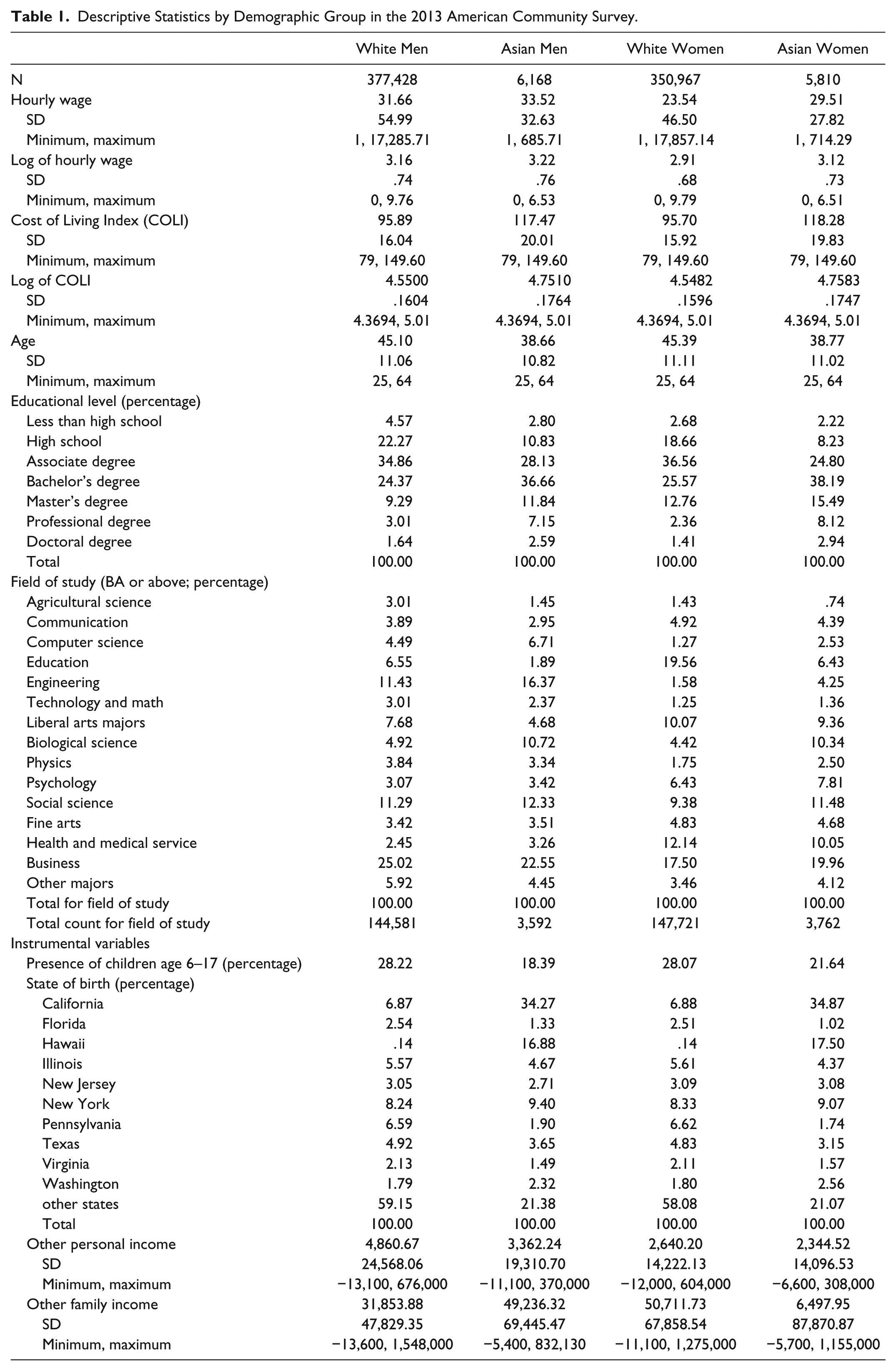
Being predominantly the descendants of post-1965 immigrants (Xie and Goyette 2004), native-born Asian Americans are younger on average than whites (i.e., about 39 years of age for Asians compared to about 45 years of age for whites for both genders). Other results in Table 1 show that a majority of Asian men have a bachelor’s (or higher) degree, whereas a majority of white men do not have a bachelor’s degree. Asian women have higher levels of educational attainment than white women: About one out of four Asian women have a graduate or professional degree compared to about one out of six for white women. In terms of field of study in college among men, Asians are more likely to major in STEM while whites are more likely to major in education and liberal arts. Among women, whites are much more likely to major in education while Asians more likely to major in biological science.
Table 1 shows that COLI is higher for Asians. For Asian men, the mean COLI is 117 compared to 96 for white men (i.e., about 21 percentage points higher). For Asian women, the mean COLI is 118 compared to 96 for white women (i.e., about 22 percentage points higher). Consistent with prior discussions on this topic as mentioned earlier, our results corroborate that native-born Asian Americans have a higher average COLI than whites.
Likely related to this COLI differential are the major racial differences in state of birth. Table 1 indicates that slightly over half of Asian men and women were born in California or Hawaii in comparison to only about 7 percent of white men and women. California and Hawaii are states with a high cost of living. Asians are also slightly more likely than whites to have been born in New York, which is another state with a high cost of living. Although state of birth often differs from current state of residence, they do correlate due to the formation of regional preferences and family ties. The fact that Asians are so much more likely to have been born in California, Hawaii, or New York than whites is consistent with the higher COLI associated with Asians’ current state of residence.
In regard to sources of income other than one’s own earnings, Asians have a lower average than whites on other personal income (e.g., dividends, rents, transfer incomes). However, Table 1 also shows that Asians have a substantially higher average than whites on other family income. Asians can more readily afford a higher COLI than whites because Asians have higher family incomes.
Table 2 shows the regression results for the combined sample including both men and women. The OLS estimate for the baseline model indicates that Asians have about a 6 percent lower wage than whites (on average) net of the control variables including gender, age, educational attainment, and log-COLI. However, the OLS estimate for the simplified model indicates that Asians have about a 6 percent higher wage than whites (on average) net of the control variables including gender, age, and educational attainment but excluding log-COLI. These results are consistent with Kim and Sakamoto (2010), which finds that controlling for regional differences in the cost of living directly alters the conclusion of whether wages among Asians have reached full parity with whites.
Regression Results for Baseline Model and Simplified Model.

p ≤ .05. **p ≤ .01. ***p ≤ .001.
The 2SLS estimates for the baseline model are also shown in Table 2. First of all, the Hausman test of endogeneity yields a chi-square test statistic of 8.00 with 1 degree of freedom. The p value for the null hypothesis that log-COLI is exogenous is .0047, which is obviously significant at the .05 level. In short, the Hausman test indicates that log-COLI is endogenous.
Table 2 shows that the 2SLS estimate for the baseline model indicates that Asians have about a 7 percent lower wage than whites (on average) net of the control variables including gender, age, educational attainment, and (instrumented) log-COLI. This negative effect of 7 percent is just slightly more negative than the negative effect of 6 percent for the baseline model estimated by OLS. Although the results for the 2SLS estimation of the baseline model indicate that the endogeneity of log-COLI is statistically significant, substantively, the 2SLS estimate is not much different from the OLS estimate (i.e., negative 7 percent vs. negative 6 percent, respectively).
Since prior research on Asian Americans and other minorities has found notable gender differentials in the net effect of race (e.g., Greenman and Xie 2008; Xie and Goyette 2004), the results for the baseline model estimated separately by gender are shown in Table 3. The OLS estimates in Table 3 are indeed consistent with prior research suggesting that a negative effect of being Asian is less evident among women (Greenman 2011; Kim and Zhao 2014; Xie and Goyette 2004). The OLS estimates for the baseline model indicate that Asian men have an 11 percent lower wage than white men while the difference between Asian women and white women is not statistically significant. Consistent with prior research as well as the results in Table 2, however, the estimates are different when COLI is not controlled for in the simplified model, in which case the difference between Asian men and white men is not statistically significant while Asian women have wages that are about 12 percent higher than white women. These findings show that the net effect of being Asian varies by gender (i.e., less disadvantageous for women) and that the net effect of being Asian becomes more disadvantageous after controlling for COLI.
Regression Results for Baseline Model and Simplified Model by Gender.

p ≤ .05. **p ≤ .01. ***p ≤ .001.
Table 3 also shows the 2SLS estimates for the baseline model. The Hausman tests are statistically significant for both men and women, indicating that log-COLI is likely endogenous for both genders. Among men, the 2SLS estimate for Asian is a negative effect of about 11 percent, while among women, the 2SLS estimate for Asian is a statistically significant negative effect of about 3 percent. The 2SLS estimates for the baseline model in Table 3 are generally close to the OLS estimates in Table 3 (as is similarly the case for the baseline model in Table 2). Although the results for the 2SLS estimation of the baseline model indicate that the endogeneity of log-COLI is statistically significant by gender in Table 3, substantively, the 2SLS estimates are not so different from the OLS estimate (i.e., a negative 11 percent for both estimates among men while among women the estimate switches from being statistically insignificant with OLS to becoming statistically significant but slightly negative with 2SLS).
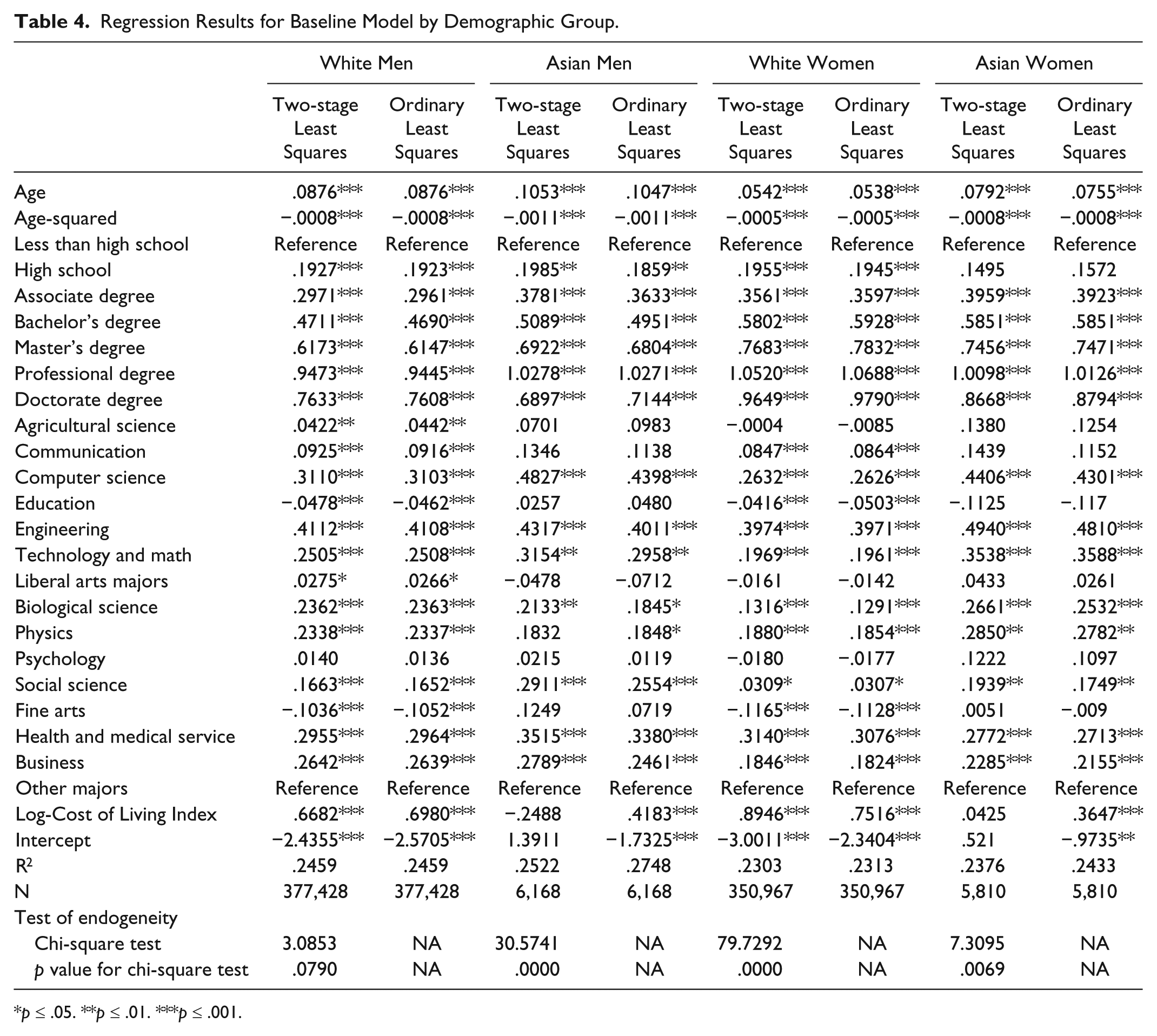
Table 4 shows the OLS and 2SLS estimates for the baseline model broken down for each of the four demographic groups. Within each demographic group, most of the coefficients seem to be fairly similar whether estimated by OLS or 2SLS. The main exception to this similarity is the coefficient for log-COLI. For whites, the coefficient for log-COLI does not differ so much by estimation method, but for Asians, the change is quite notable. For Asian men, the OLS estimate of log-COLI is .42, which is highly significant, but the 2SLS estimate is –.25 and is not significant at the .05 level. For Asian women, the OLS estimate of log-COLI is .36, which is highly significant, but the 2SLS estimate is .04 and is not significant at the .05 level.
Regression Results for Baseline Model by Demographic Group.
p ≤ .05. **p ≤ .01. ***p ≤ .001.
For Asian men and Asian women, Table 4 furthermore shows that the Hausman tests are statistically significant, indicating that log-COLI is likely endogenous for both genders. While the OLS estimates for Asians indicate an elasticity of around .4 for log-COLI, the 2SLS estimates are likely more accurate in indicating that this elasticity is actually closer to zero. In keeping with our theoretical expectations and methodological approach, these findings reveal that accounting for the endogeneity of log-COLI dramatically changes its estimated effect on log-wage for Asians.
The other parameter estimate that changes notably for Asians is the intercept. For Asian men, the OLS estimate of the intercept is −1.73, which is highly significant, but the 2SLS estimate is 1.39 and is not significant at the .05 level. For Asian women, the OLS estimate of log-COLI is –.97, which is highly significant, but the 2SLS estimate is .52 and is not significant at the .05 level. Usually the estimates for intercepts do not involve much substantive significance in regression analyses, but in this case, our models are separated by demographic group so that the intercepts are quite relevant when calculating predicted values for each group to assess net racial effects.
Table 4 shows that in the case of white men, the Hausman test is not statistically significant at the .05 level. This finding indicates that the OLS estimate for log-COLI (i.e., .70) is not statistically different from its 2SLS estimate (i.e., .67) despite a very large sample size of 377,428 for white men. The coefficient for the intercept is also similar across the two estimation methods for white men. These results underscore the importance of estimating the baseline model separately by demographic group because the coefficients for Asian men are more critically affected by 2SLS estimation than white men.
In the case of white women, Table 4 indicates that the Hausman test is significant. In this regard, white women are similar to Asian men and Asian women but contrast with white men. For white women, the 2SLS estimate of log-COLI is .89, which is the least inelastic among the four demographic groups. The 2SLS estimate of the intercept for white women is more negative than its OLS estimate.
These results in Table 4 reveal that the wages of whites are significantly increased when residing in areas with a higher COLI (most so in the case of white women), albeit an inelastic effect. In the case of Asians, however, wages do not seem to necessarily increase at all when residing in an area with a higher COLI. We interpret these findings as indicating that Asians are less adverse to residing in a high COLI place. Compared to whites, Asians are either less likely to move away from a high COLI place to a low COLI place, or they are more willing to move to a high COLI place despite not incurring a compensatory wage increase.
To estimate the net effect of being Asian, we used the estimates in Table 4 to calculate the predicted values for each demographic group based on various selected values on the independent variables. As discussed earlier, the estimate of the net racial effect of being Asian is equal to (
The results of these calculations are shown in Table 5. Different predicted values are computed by varying the educational level. For the educational levels at the bachelor’s degree and higher, predicted values are further differentiated for engineering majors and liberal arts majors. All of the calculations assume an age of 45 and a log-COLI of 4.6.
Predicted Log-wage for Demographic Groups by Educational Level and Field of Study Using Two-stage Least Squares Estimates.

Note. The predicted values are based on age = 45 and log-Cost of Living Index = 4.6.
p ≤ .05. **p ≤ .01. ***p ≤ .001.
For example, among men with only a high school degree, the predicted log-wage for Asians is 3.03 while for whites it is 3.05, as shown in Table 5. The difference is –.02, which refers to the net effect of being Asian for men aged 45 with only a high school degree and a log-COLI of 4.6. The t test statistic for this net effect is –.56, which is not significant at the .05 level. For men with a bachelor’s degree in liberal arts, Table 5 shows that the predicted log-wage for Asians is 3.29 while for whites it is 3.36. The difference is –.07, which refers to the net effect of being Asian for men aged 45 with a bachelor’s degree in liberal arts and a log-COLI of 4.6. The t test statistic for this net effect is –.64, which is not significant at the .05 level. In fact, Table 5 shows that none of the net racial differentials are statistically significant for men at the .05 level, suggesting that there is no wage differential between Asian men and white men.
Table 5 also shows the predicted log-wages for Asian women and white women, but in this case, the net racial differentials are all uniformly positive. For women with an associate degree, the predicted log-wage for Asians is 3.01 while for whites it is 2.88. The difference is .13, which refers to the net effect of being Asian for women aged 45 with an associate’s degree and a log-COLI of 4.6 (i.e., an approximately 13 percent higher wage). The t test statistic for this net effect is 3.48, which is significant at the .05 level.
For women with a bachelor’s degree in engineering, the predicted log-wage for Asians is 3.69 while for whites it is 3.50. The difference is .19, which refers to the net effect of being Asian for women aged 45 with a bachelor’s degree in engineering and a log-COLI of 4.6 (i.e., an approximately 19 percent higher wage). The t test statistic for this net effect is 3.18, which is significant at the .05 level. Table 5 shows that Asian women also have positive net racial effects that are statistically significant for a master’s degree in engineering (i.e., a 16 percent higher wage), a professional degree in engineering (i.e., a 14 percent higher wage), a bachelor’s degree in liberal arts (i.e., a 15 percent higher wage), and a master’s degree in liberal arts (i.e., a 15 percent higher wage). 5
Although not shown, we computed the net racial effects as calculated in Table 5 but using OLS estimates for the baseline model as given in Table 4. Then the calculated net racial effects were more similar to the estimates provided in Table 3 based on OLS for the baseline model. For men, the net racial effects were often negative and statistically significant, while for women they were usually not statistically significant. These auxiliary calculations confirm that after breaking down by demographic group, the 2SLS estimates (and the associated issue of the endogeneity of log-COLI) are the main source of the finding that there is no wage differential between Asian men and white men and that it is sometimes positive for Asian women compared to white women.
Discussion and Conclusions
No sociologists argue that the income differential between whites and Native Americans is overstated due to the fact that the latter group, being more rural, has a much lower cost of living. No sociological studies conclude that the income differential between whites and African Americans is overstated because African Americans are more likely to live in rural areas of the southeastern United States (e.g., Mississippi, Alabama) where the cost of living is low. Hispanics disproportionately reside in the states and areas bordering Mexico where the cost of living tends to be lower, but no one argues that the Hispanic income disadvantage is thereby exaggerated. To the contrary, an entire literature contends that in urban areas, African Americans are causally disadvantaged (relative to whites) by residing in neighborhoods where the costs of housing are substantially lower (Desmond and Emirbayer 2016). The conventional wisdom that Asians are disadvantaged (relative to whites) by residing in neighborhoods where the costs of housing are substantially higher is logically inconsistent with how other minority groups are analyzed in the contemporary literature on racial/ethnic relations.
A more extreme rationale for disregarding the incomes of Asian Americans is to deny that they are even a legitimate group of inquiry in the first place purportedly because a few demographically tiny ethnic groups (i.e., Cambodians, Hmong, and Laotians) tend to have below average socioeconomic attainments (Sakamoto et al. 2009). This curious view contrasts with the lack of any reluctance among sociologists to study the average incomes of whites, Hispanics, African Americans, and Native Americans—while ignoring Asians (Desmond and Emirbayer 2016)—despite the fact that whites, Hispanics, African Americans, and Native Americans are far from ethnically homogeneous (Sakamoto et al. 2009). 6 We do not dismiss ethnic variation within the Asian category (i.e., we have published extensively on that topic), but we nonetheless contend that all racial groups are broad, socially constructed (rather than “real”) categories that are characterized by a great deal of internal variability of various sorts (Sakamoto et al. 2009). The investigation of Asian American income is no less legitimate than the study of the incomes of any other racial/ethnic category such as whites or Hispanics.
We have sought to shed light of the issue of the cost of living among Asian Americans rather than obliquely avoiding serious scrutiny of it by continuing to reiterate the conventional talking points on this matter (Kim and Mar 2007; National Public Radio 2013; Ramakrishnan and Ahmad 2014). We have used recent data from the ACS to assess whether native-born Asian Americans have achieved labor market parity relative to whites in terms of the hourly wage after accounting for the cost of living. In keeping with prior research, we focused on the expanding population of native-born Asian Americans to minimize unobserved heterogeneity when assessing labor market processes. A notable advantage of our analysis over other studies (e.g., Zeng and Xie 2004) is that we control for field of study (i.e., for those with a college degree) because even native-born Asian Americans are overrepresented in STEM areas, which tend to pay higher wages.
Our results corroborate that the average COLI is higher for Asian Americans. This finding is perhaps not surprising given our other findings indicating that Asian Americans are far more likely than whites to have been born in California, Hawaii, or New York, where COLI is higher. Other descriptive statistics reveal that Asians have substantially higher total family incomes so that they are presumably more capable of affording a higher COLI.
Much prior research has treated region of residence as an exogenous independent variable akin to age or education as being primarily a predetermined (i.e., pre–labor market) characteristic (e.g., Hirschman and Wong 1984; Snipp and Cheung 2016). Our analysis goes beyond this simplistic assumption to estimate models in which COLI is an endogenous variable with respect to log-wage. The results indicate that COLI is exogenous only for white males. In the case of Asians using these data and models, COLI is endogenous, and 2SLS estimates yield substantively different conclusions from OLS.
The 2SLS estimates indicate that the wage differential between Asian men and white men is not statistically significant. For women, the wage differential is either not significant or significant with a positive net effect in favor of Asians. The 2SLS estimates thus lead to the conclusion of failing to reject the hypothesis of no discrimination against native-born Asian American men and women. After adequately accounting for the cost of living, Asian Americans seem to have overcome the disadvantage of nonwhite minority status in the contemporary labor market.
One could question the adequacy of the instrumental variables that are used in the 2SLS estimation. This is a reasonable concern that is common in studies using 2SLS. However, our results indicate that 2SLS yields estimates that are very different from the OLS estimates for Asians but less so for whites (especially in the case of white men, for whom COLI can be treated as exogenous for these data). The very fact that the results reveal such a major racial difference using the same instrumental variables suggests that they are useful to consider and that they are uncovering an important racial aspect of the relationship between wages and area of residence. The estimated racial differential in the endogeneity is theoretically explicable in terms of the probable regional preferences of native-born Asian Americans, their higher household incomes, and their greater observed propensity to reside in high COLI places such as California and Hawaii. We furthermore argue that dismissing the adequacy of the exclusion restriction for our instrumental variables (e.g., state of birth) represents a much higher standard of methodological certainty than the common practice in the literature of assuming that current region is exogenous with respect to earnings (Kim and Sakamoto 2010).
One could alternatively suggest that native-born Asian Americans prefer California, Hawaii, and New York because they face greater labor market discrimination in other parts of nation such as the South. However, the growth rate of the Asian population (including the foreign born) is higher in the South and Midwest than the West (Sakamoto et al. 2013). Furthermore, the household incomes and wages of Asians in the South versus whites in the South actually exceed those racial differentials in the West because whites in the South tend to be less educated and less regionally mobile than whites in the West (Sakamoto et al. 2013). The lack of employment opportunities for higher paying jobs probably characterizes California and Hawaii more than the South, which has had dramatic economic and population growth in recent decades, including among Asian Americans (Sakamoto et al. 2013). In other OLS results for our data (available on request), we find that the net Asian-white wage differential for men was most negative in the Pacific but not statistically significant in the South.
In conclusion, the reluctance of many sociologists to seriously investigate and theorize the significance of Asian American socioeconomic circumstances is not simply an accidental oversight (Sakamoto et al. 2009). Our analysis of wages suggests, however, that native-born Asian Americans do not appear to fit the conventional paradigm according to which whites are always privileged over nonwhite minorities in the contemporary labor market (Desmond and Emirbayer 2016). Denying the existence of Asians as a “real” category or emphasizing their higher COLI are not convincing rationales for maintaining that the white-privilege model necessarily explains all racial/ethnic relations. In the case of Asian Americans, their higher levels of a scarce class resource—namely, education—may be their key characteristic that has allowed them to reach wage parity with whites in the labor market of the twenty-first century (Maia et al. 2015; Sakamoto and Furuichi 1997; Sakamoto and Kim 2003).
Footnotes
1
Even among low-skilled workers whose supply has increased in recent decades due to immigration from Latin America, Borjas, Freeman, and Katz (1996) and  argue that native-born workers and immigrant workers relocate fairly quickly to places where their labor market returns are greater.
2
3
4
5
The field of study for graduate degrees (master’s, professional, and doctoral) is not known in the American Community Survey (ACS) so that our indicators of field of study only refer to the bachelor’s degree. This omission is somewhat less critical for graduate degrees, however, since the lifetime earnings for a graduate degree in science, technology, engineering, or math (STEM) or liberal arts are not that much different than for an undergraduate degree in STEM or liberal arts (Kim, Tamborini, and Sakamoto 2015).